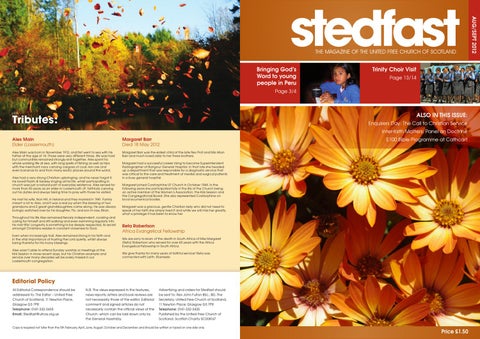
Bringing God’s Word to young people in Peru
AUG/SEPT 2012
THE MAGAZINE OF THE UNITED FREE CHURCH OF SCOTLAND
Trinity Choir Visit Page 13/14
Page 3/4
ALSO IN THIS ISSUE:
Tributes:
Enquirers Day: The Call to Christian Service Inter-faith Matters: Panel on Doctrine
Alex Main Elder (Lossiemouth)
Margaret Barr Died 18 May 2012
Alex Main was born in November 1912, and first went to sea with his father at the age of 14. Those were very different times, life was hard but communities remained strongly-knit together. Alex spent his whole working life at sea, with long spells of fishing as well as trips with the merchant navy carrying cargoes of coal, iron ore and even bananas to and from many exotic places around the world.
Margaret Barr was the eldest child of the late Rev Prof and Mrs Allan Barr and much loved sister to her three brothers.
Alex had a very strong Christian upbringing, and he never forgot it. He loved Psalm & Sankey singing all his life, whilst participating in church was just a natural part of everyday existence. Alex served for more than 50 years as an elder in Lossiemouth UF, faithfully carrying out his duties and always taking time to pray with those he visited. He met his wife, Nan Hill, in Ireland and they married in 1941. Family meant a lot to Alex, and it was a real joy when the blessing of two grandsons and 2 great-granddaughters came along. He was always lovingly watched over by his daughter, Flo, and son-in-law, Brian. Throughout his life Alex remained fiercely independent, cooking and caring for himself and still walking and even swimming regularly into his mid-90s! Longevity is something to be deeply respected, its secret amongst Christians resides in constant closeness to God. Even when increasingly frail, Alex remained strong in his faith and in the vital importance of trusting the Lord quietly, whilst always being thankful for His many blessings. Alex wasn’t able to attend Sunday worship or meetings of the Kirk Session in more recent days, but his Christian example and service over many decades will be sorely missed in our Lossiemouth congregation.
E100 Bible Programme at Cathcart
Margaret had a successful career rising to become Superintendent Radiographer at Bangour General Hospital. In that role she headed up a department that was responsible for a diagnostic service that was critical to the care and treatment of medial and surgical patients in a busy general hospital. Margaret joined Corstorphine UF Church in October 1944. In the following years she participated fully in the life of the Church being an active member of the Women’s Association, the Kirk Session and the Congregational Board. She also represented Corstorphine on local ecumenical bodies. Margaret was a gracious, gentle Christian lady who did not need to speak of her faith she simply lived it and while we will miss her greatly, what a privilege it has been to know her.
Reta Robertson Africa Evangelical Fellowship We are sorry to learn of the death in South Africa of Miss Margaret (Reta) Robertson who served for over 60 years with the Africa Evangelical Fellowship in South Africa. We give thanks for many years of faithful service! Reta was connected with Leith: Ebenezer.
Editorial Policy All Editorial Correspondence should be addressed to: The Editor – United Free Church of Scotland, 11 Newton Place, Glasgow G3 7PR Telephone: 0141-332-3435 Email: Stedfast@ufcos.org.uk
1
N.B. The views expressed in the features, news reports, letters and book reviews are not necessarily those of the editor. Editorial comment and signed articles do not necessarily contain the official views of the Church, which can be laid down only by the General Assembly.
Advertising and orders for Stedfast should be sent to: Rev John Fulton BSc., BD, The Secretary, United Free Church of Scotland, 11 Newton Place, Glasgow G3 7PR Telephone: 0141-332-3435 Published by the United Free Church of Scotland. Scottish Charity SC008167
Copy is required not later than the 5th February, April, June, August, October and December, and should be written or typed on one side only.
2
Price £1.50
Contents 2–3
Spotlight on Northfield UF Church Aberdeen
3/4
Bringing God’s Word to young people in Scotland and in Peru
5/6
Assembly Reflections
6
Licensing of Nathan Owens
6
Enquirers Day: The Call to Christian Service
7–8
Ladies Day at Assembly
9/10
Inter-faith Matters: Panel on Doctrine
Spotlight on Northfield UF Church Aberdeen
Northfield Choir’s Spring Concert By Grace McCartney 12
11/12 E100 Bible Programme at Cathcart 12
What’s ‘The POINT’?
13/14 Trinity Choir Visit 15/16 Interview with the Moderator 17
Book Review: Old Testament Ethics
17
Favourite Hymn
18
Tribute: Alex Main
18
Tribute: Margaret Barr
18
Tribute: Reta Robertson
5/6
16
6
17
Editorial Its interesting that each of us brings our own perspective when reflecting on events. The Rev Dr Douglas Galbraith offers such a reflection in his article on this year’s assembly in his capacity as Convener of Action of Churches Together in Scotland (ACTS) and also as Precentor of the Church of Scotland’s Assembly. It’s sometimes helpful to have our own views and practices constructively challenged by others as this can help us refocus and move forward. The woman of the United Free Church are looking to move forward in new directions and Janette Neil, President of the Women’s Home and Overseas Committee, in answering questions put to her by Rev Archie Ford outlines her desire in the coming year to explore with local groups the way ahead picking up on any new initiatives that are out there. She looks forward to listening to your ideas. “The Christian faith has always existed in societies shaped by different views of the world” and looking at our faith from the perspectives of other faiths and how we interact with them in our multi-faith society is something that challenges us all. The article on the report to the General Assembly of 2012 was provides some helpful guidelines in meeting these situations. In his interview for Stedfast the Moderator, the Rev Ian Lloyd, looks at the coming “storms” facing the Church in Scotland, not just from other faiths but from the increasing secularization of society. In calling for us to refocus on the deep truths of our faith, he considers this not to be a retreat in the face of these forces, but rather as the way forward in standing stronger in the faith and paving the way for future revival. Finally, in this regard, for those seeking to move forward in “Running the Race” don’t miss the opportunity to take part in this year’s exciting event at Dunblane High School on Saturday 25th August.
1
Alastair Wright Stedfast Secretary
This year’s Spring Concert took place on Tuesday, 15 May on the theme ‘You Have Called Us’, a title from the opening item. Our objective was to worship the Living God to the best of our abilities and, once again, the hall was filled to capacity, with over 60 attendees, including a lot of ‘new’ faces alongside the ‘well kent’ ones. The 38 choir members wore their ‘uniform’: white top and turquoise skirts for the 17 ladies; white shirts, turquoise ties and dark trousers for the 7 men; white tops and white skirts or white dresses for the girls; white tops and dark trousers for the boys. Accompaniment was by our 3 musicians – Nida Buchan, Choir Mistress, on the keyboard; Ian Duguid on the piano; and Ross Hammond on the clarinet and guitar. From the evening opening with the communal singing of ‘What a wonderful change in my life has been wrought’ to the triumphal climax of the choir singing a beautiful and unusually harmonised version of ‘Sing Hosanna’; joy resonated and echoed throughout. While everyone greatly appreciated the warm rich voices and resonant harmonies of the nine items sung by the whole choir, the children singing of ‘Did you ever talk to God?’, ‘He is the Way’ and ‘When you’re feeling good’; was so movingly beautiful that it stole the show. An offering was uplifted, which will be disbursed to various good causes. The celebration concluded with the communal singing of ‘Jesus is the name we honour’ followed by a lavish spread of home baking, tea and coffee. The choir also added ‘Food for thought’ at the foot of their printed programme:
“A small church with a big vision has greater impact than a big church with a small vision”.
Women’s Association “Variety Evening” Having been ‘born and bred’ in the UF Church, I was accustomed to supporting and attending Spring Teas. However, Aberdeen: Northfield’s WA ‘takes the biscuit’! Tears and laughter filled the air in Northfield’s Church Hall on Monday, 5 March 2012, when over 60 ‘witnesses’ observed the WA members perform their annual ‘Variety Evening’ with gusto. They were dressed in colourful dirndl skirts and tops, bobby socks (ie ankle socks) and flat shoes. Among the hilarious acts were: • the treasurer, George Bruce, giving ‘Advice from a Retired Husband’ about dealing with his ‘sensitive’ wife, only to be chased off stage by his, saucepan wielding, real wife Evie; • a ‘Mr & Mrs’ Competition causing a few consciencestricken blushes from the menfolk; • a dramatic ‘Medley of Music’ from Diane Ledingham and Ian Duguid; • and community singing of some old favourites led by the comically dressed ladies of the WA. • The event raised £193.90 for charitable causes, a record amount; so a big thanks to all who took part.
2
Bringing
Spotlight on Northfield UF Aberdeen (Cont.)
God’s Word
to
young people in Scotland and in
Northfield ‘baby’ plays his way to 2012 Ogston Prize Finals The Ogston Prize for Music is a prestigious annual competition at Aberdeen University. Ross Hammond, aged 21, a third year music student, played his clarinet all the way to the 2012 Finals in Cowdray Hall, Aberdeen, on Friday, 27 April. Ross is a ‘Northfield Baby’ who ‘plays’ regularly during Sunday Worship and musical events. Not only were his family (all Northfield members) represented at the Final but also six members of his Northfield UF family, amongst whom were his former Sunday School Teachers and the Church Organist. Prof Paul Mealor (of Royal Wedding: Ubi caritas and Military Wives: Wherever You Are fame), Lecturer in Composition, was the host for the event. In his opening remarks he made it clear that the six finalists had experienced stiff competition from numerous high calibre musicians before reaching the Final.
3
A comical note that Ross brought to the event was his playing of a piece called Immer Kleiner in which he ‘appeared’ to have technical problems with his clarinet that he had to overcome while continuing to play. Nobody, not even the Judges, had anticipated that the clarinet would literally become Immer Kleiner ‘smaller and smaller’ as the piece was played. No other competitor had the same effect upon the audience that Ross had. However, it wasn’t the audience’s decision and, frankly, the Northfield contingent were very biased and glad that they weren’t the judges. As they left Cowdray Hall, their faces shone and glowed with justifiable pride in the achievements and playing of their ‘Northfield Baby’.
Lawrence Sum of the Scottish Bible Society writes about an exciting project in Peru modelled on an existing project in Scotland Kylie hasn’t heard of a book called ‘the Bible’. She lives in a home where ‘Jesus’ is a swear word. Her parents have never been to church and although her Gran used to go to Sunday School, she now only visits church for funerals.
PERU
Sadly Kylie’s situation is more common today than we might think. Many children in Scotland know very little about the Bible and even fewer are attending Sunday Schools than before. If we are serious about wanting our young people to find out about this life-changing book, we have to do this where the opportunity is greatest – and this is at school. Since the beginning of 2010, over sixteen thousand children have been introduced to the Bible through Bibleworld Mobile – a 45 ft fold-out trailer which travels throughout Scotland visiting schools, communities and churches. The trailer’s expanding classroom is divided into six activity zones which offer P5 to S1 pupils a lively and stimulating introduction to the Bible and Christianity. The content is based on the Curriculum for Excellence for Religious and Moral Education giving teachers a fun and interactive way of introducing their pupils to the Bible. Through this project and because of your prayers and financial support, the Scottish Bible Society is actively helping children like Kylie to find out more about the Bible.
Heard at the General Assembly: “One of the tragedies of church history is the way our celebration of the Lord’s Supper has divided us.” (Rev Canon Dr Charlotte Methuen, Scottish Episcopal delegate)
Peru...
The challenge of reaching young people with God’s Word is not ours alone. In Peru, children are also immersed in an increasingly secular society with little interest in spiritual issues. This is why the Peruvian Bible Society has ambitious plans to develop their own version of Bibleworld. As in Scotland, this will be a multimedia experience for the children which will not only teach the history of the Bible but its relevance for the young people today. The facility will contain modules featuring the origin, formation, stories and spread of the Bible as well as its message for today. Sharing knowledge, experience and skills with the Peruvians has been successful and fruitful for many collaborations between our two countries and we pray that this will be the case in 2012 as the Peruvian Bible Society embark on this exciting project.
She says, “We now go every day and I’ve been having meals there – milk, bread, butter and jam. I’ve grown and put on weight, I’ve met other children and I’ve learned how to pray. I didn’t know the Bible. Now I’m in the Bible classes. I colour, fill in crosswords, make jigsaws and sing songs. I’d like to play the piano at church. I won’t forget all this.” Julio is eleven and tells us his experience with the project: “I’ve learned to tell right from wrong. I’m doing what God teaches: ‘Honour your father and mother’ and ‘Love your neighbour as yourself.’ My behaviour is changing for the better.” And his final comments suggest a surprising maturity for a boy of eleven: “I thank God for the books – I’m learning a lot from them. I’m also learning to share what I learn and to give my opinion of what we’re taught. I also know that we are all intelligent because God has made us that way.”
SCOTLAND
It’s easy to see how Marisol and Julio would benefit from and enjoy an experience like Bibleworld and how their siblings, friends and many more children could be reached with God’s Word. This is exactly the hope of Pablo Gurierrez, Programme Director of the Peruvian Bible Society who says, “Our prayer is to reach 50,000 young people over five years and engage them with the Bible through the creation of Bibleworld.” Join us in praying for Pablo and the Peruvian Bible Society, that their new Bibleworld will be as successful as Bibleworld Scotland in engaging young people with the Bible.
If you would like to pray or to financially support this project in Peru or Bibleworld in Scotland, please contact the Scottish Bible Society on 0131 337 9701 or info@scottishbiblesociety.org
The Peruvian Bible Society is already making an impact among young people with the ‘Bread of Life’ project – a holistic care programme that provides food for the hungry bodies as well as food for the soul. Marisol is twelve and her family only have electricity in their home thanks to an extension cable from a neighbour’s house. She says that until she started attending the ‘Bread of Life’ project she never had milk to drink and didn’t know the Bible. 4
Rev Ian Lloyd with Mr George McRobb.
Assembly Reflections By Rev Dr Douglas Galbraith Convener, Action of Churches Together in Scotland (ACTS) Nathan Owens who was presented with his Certificate of Theological Studies and was introduced by Rev Douglas Scrimgeour, Adviser of Studies.
Licensing of
Nathan Owens Lieut Colonel Alan Burns, Scotland Secretary of the Salvation Army, who spoke on Thursday evening on ‘Motivating Membership’.
Discussion groups on Thursday evening.
As a visitor to the Assembly from another Presbyterian background, I expected to find some similarities and some differences. I’ll tell you one difference! The United Frees are Presbyterians at a Higher Pitch! Even as Precentor of the Church of Scotland’s Assembly, I had to strain to get to the top notes. (Good singing, though.) There were differences, yes, but just as interesting were the similarities. You also keep the procession of the whole Assembly at the end – in your case, to farewell the Moderator as he begins his year of journeying. Our conduct of business is similar, yours a bit more informal – but then you don’t have a Lord High Commissioner glowering over the balcony.
Heard at the General Assembly: “We don’t have parties, we have socials” (Lt Col Alan Burns)
5
But I came as Convener of the body where the churches meet, Action of Churches Together in Scotland. This is a sort of market place for the churches together, all with an equal voice and vote. After recent reconstitution, ACTS is no longer a council separate from the Churches, but the place where we hear from each other – and challenge each other. I was glad to be able to say publicly how much the commitment and the quality of the UF’s input was valued by the other Churches. This is an important time for ACTS, when we are trying to progress from being just good friends to trusting each other as we grasp nettles – both the things that keep us apart and the issues facing church and society.
Pete Chrinside of Scottish Bible Society who spoke about the work on the Friday morning and presented the Moderator with a copy of the NIV.
There was much of interest in your reports – and here my choice is bound to be personal and selective. We all need to hear of the commitment you have, and seek to nurture, to the preaching of the Word of God. I was interested in the suggestion that congregations look to the three-year lectionary, which several denominations now have in common. Some might fear being ‘tied’, but it is quite astonishing how relevant each Sunday’s passages turn out to be to a congregation which is truly engaging with today’s society. No part of the Word of God is irrelevant, and being encouraged to visit passages you would not choose to preach on, far from limiting one’s message, brightens it and gives it new depth.
Carol Raeburn of the RNLI, with Robert Owens, Convener of the Youth Committee, after receiving a cheque for £8000 for Easter Scheme.
On Tuesday 19th June the Drumchapel UF church was well filled for the licensing of Nathan Owens. Rev Dr John Evans, moderator of Presbytery, led the worship and put the relevant questions to Mr Owens. Charges were given by Rev Jim Neil. Nathan has completed his studies at Highland Theological College and has decided to embark on a year’s further study in the field of preaching.
passion, resurrection, ascension and coming again of Christ. Our shared treasury of hymnody, Scottish and English, scours Scripture for event and narrative as well as makes inspired use of its wonderful language and imagery, and offers to enrich the texture of our faith and prayer. Of course these things were not absent, and I dare say if I had kept all the sheets and studied them again I would be reminded of that. It’s just an impression. But my overwhelming impression and was of the warm and wholehearted welcome to those of us who came representing other traditions. Robert and Jane Owens together with Nathan and fiancée.
The Church and Society report was proof of the Church’s continuing engagement with the issues of the day, and the thoughtful appendices made for interesting reading. On all reports, I appreciated the measured and friendly tone of the debates. The impression was of a Church confident in itself, willing to co-operate with others at home and abroad, and flexible in its approach to patterns of church and ministry caused by changes in society. The Assembly was flanked by two addresses, by the outgoing and incoming Moderators, both worth in themselves making the journey for. Worship and song was all-pervasive. The depth of spirituality was evident through the hall and the prayers struck rock. What I missed was a greater variety of metaphor and biblical reference in the hymns and songs. What they did do was draw deep on the theology of the atonement, unimpeachably so. Yet, in the story of Jesus’ life, the truths of the cross were exemplified and proved in his way with people and with his Father, while in Old Testament prophecy and in the history of the chosen people of God, truths are evident which enhance and serve to draw attention to the
Enquirers Day:
The Call to Christian Service Heard at the General Assembly: “You’re probably only welcoming part of him” (Rev Ian Boa to Moderator introducing the Canonbie United minister, Rev Steve Fulcher)
There are many ways in which people become aware of God calling them to serve him within the Church and in other forms of service at home and abroad. Could God be calling you to serve him in some way? The Ministry Committee is making plans for an Enquirers’ Day which will take place at Auchterarder Church Centre on Saturday 10th November starting at 10.30 am. There will also be involvement from the Overseas Committee. This will be an opportunity to reflect on God’s Call even if your thoughts are at a very tentative stage. It will also offer suggestions as to how to take things forward and give information on who you might contact to consider matters further. Further information will be sent out nearer the time – but meanwhile, please note the date! If you would like an information leaflet sent to you when they are ready, please contact Church Office.
6
Looking to the Future
Ladies Day at Assembly
Joyful Day as Ladies Delight in The Lord Once again the Salutation Hotel in Perth reverberated with the sound of music on Ladies Day at the General Assembly. Added to the songs of worship and choruses Northfield Ladies Choir raised the roof and Mrs Isobel Martin sang two beautiful solos.
Janette Neil, President of the Women’s Home and Overseas Committee, answering questions put to her by Archie Ford
What are the good things that are happening in women’s work today? By Nancy Cowan Image: The Joy of The Lord is Our Delight © INSPIKS Inspirational Pictures
Having just attended Ladies Day of our General Assembly, once again I was warmed by the sense of fellowship and support that was evident in the gathered throng. The singing was uplifting and it was obvious that our God and Saviour were being faithfully worshipped. As in past years the gift offerings were generously supported and I know that throughout our churches our ladies are always quick to respond to the needs of others at local, national or world levels, both financially and even more by prayer support. On behalf of the Committee I say thank you for all your efforts.
What are the challenges that are facing women’s groups and the work of your Committee? I have to admit that I did feel saddened as I looked out at the ladies gathered, to realise that I was one of the younger ones present (even though now ‘in retirement’!) I respect the fact that there are those still in employment who could not take time off to come to Perth, but more worrying is the fact that our group meetings seem also to be more senior in age and as we lose some we do not appear to be attracting younger members in. I have heard the response “It’s not for me!”... “Then what is for you? Meetings are what you (we) make them. Fresh vision and zeal are what makes groups evolve and prosper. What would you like to see taking place? You (we) must take the initiative... then be willing to stand up and explore new ideas.
Salutation Hotel, venue for the Assembly.
Of course it wasn’t all singing. Having represented the UF church at her funeral in Botswana, Mr George McRobb paid a moving tribute to Mrs Mary Merriweather. He reminded us of the amazing missionary work Mary had accomplished including supporting her late husband Dr Merriweather and opening a Christian school, starting with five pupils and which is still going strong with over 500 on the roll. Later Mr McRobb spoke of the privileged time he had enjoyed travelling round our churches and elsewhere as Moderator. Naturally he finished his talk with his memorable words “Pray with me, please.”
7
Miss Ellen Findlay of the International Nepal Fellowship spoke of her work as a nurse in Nepal over many years. Conditions in the rural areas are still very primitive with few roads and people with few material possessions, never mind money. As part of a Medical Team, Ellen would visit these remote communities on a rotational basis (every four months or so) bringing much needed expertise and medical aid. Emphasis was placed on how good and faithful God is and
Some of the stewards – Alison Strawbridge, Jennifer Paterson and Cat McKenzie.
that prayer is one of the best assets we have. Unusually, 50% of Nepalese children have hearing problems but it is a joy to diagnose the trouble one day and fit a Hearing Aid the next (how long did you wait for a Hearing Aid or even for an appointment?). Rosie, a Speech Therapist, told Ellen of a young girl needing a cochlea implant but the cost was an insurmountable £4000. “We need to pray about this,” said Ellen as a matter of course and then gave Rosie £1000 of her own money which had been ear-marked for a future project. When news got around two gifts of £500 were given to Rosie and Ellen received a further £1000 by Email. “Get on your computer” Ellen told Rosie and there was another £1000! Prayer and Technology! And a successful operation. What stories she told. The other main speakers were Major Iain MacDonald and Mr David Murray from SASRA (Soldiers and Airmen Scripture Readers Association) both of them spoke movingly of their work with soldiers in various Scottish Barracks. The organisation was started
in the 19th century to help soldiers to read (especially the Bible) and to write letters home. Nowadays the vast majority of soldiers know nothing of Jesus. Much of their time is spent building up a relationship with individual soldiers, helping in any way apposite, and when appropriate, talking of their own faith. The whole day was very ably led by Mrs Moira Patterson who reminded everyone of the recent Jubilee Celebrations and rejoiced in how the Queen took her faith and her vows to the nation very seriously but as Christian women there is One to follow who is higher than any monarch. A warm welcome was given to 8 representatives from other churches in Scotland. A word about money. Good news and thanks all round! The Special Gift Offering from all the Women’s Associations for the Rev Dr Alfred Merriweather Memorial Scholarship raised £4500 while the Winter Offering for SASRA came to £2000. Offerings on the day, morning and afternoon, came to over £900. All quite
At the Praise Service.
magnificent; well done!! The Women’s Home and Overseas Report and Accounts, presented by Mrs Jean Baguley, were approved, and these included various grants to Missionaries and Students of our Church. Mrs Patterson’s term of office having come to an end, her Convener’s badge was passed on to Mrs Janette Neil who will preside for the next two years with Miss Jackie Ramsay as Vice (ie Vice-convener). Let’s end with another happy note. During the meeting a former Convener Mrs Wemyss Billows, who had been seriously ill during the past year, had ‘a little word’ (almost impossible) for the gathering. She thanked everyone for their prayers and how wonderful to be part of the family of God. She finished with “Thank you for all your cuddles, women and men” The Theme for 2012/13 (with Study Notes by Mrs Mgt Robertson) is:
DELIGHT YOURSELVES IN THE LORD AND HE WILL GIVE YOU THE DESIRES OF YOUR HEART!
What ideas and visions do you have? Work parties formerly were an important part of our ladies’ time together –could this be a way once again of enabling folks to use their talents for a needy cause. There are many to choose from both locally and further afield through organisations like Blythswood Trust. We can no longer just expect people to ‘drop in’; we have to reach out to our community. I know in some areas there are monthly Supper Clubs where friends and neighbours are invited along for friendly informal chat over food followed by perhaps a demonstration and short epilogue. Erskine Church, Burntisland, now has a ‘Lite-Bite’ where parents pop in around 9am, having dropped their children off at school or nursery, for tea, toast and time to chat and relax whilst some of the church grannies play with the tiny tots who are there .... the idea being to reach out to some of the new or lonely mums in the area (some dads have joined in too!). Response was slow to start (stepping into church buildings can be a big thing for some!), but now a regular full house meets each Wednesday in term time. Perhaps you prefer an informal setting like a house group, discussion or study group, sharing fellowship and building confidence and trust in one another. If you have groups of ladies meeting in any capacity other than Women’s Associations then please tell us what is happening and how you are encouraging others as women ‘associated to’ the United Free Church. Each one of us has a part to play in reaching out with God’s love and message of salvation for our communities today. Dare I suggest (no, even state!), that if we fail to look to the future of our women’s work we will be dishonouring God in our service to Him.
In the coming year I would like to meet up with many of you to explore the way ahead. Leadership has to be shown at a local level within each congregation. Your committee is here to help you achieve your ends and to work as work as one for God’s glory – are YOU willing to come?
8
Inter-faith Matters: Panel on Doctrine By Andrew Scott
Let your speech be always with Grace, seasoned with SALT that you may know how to answer any man
Last year the General Assembly asked the Panel on Doctrine “to consider from a Biblical and doctrinal viewpoint the position of the United Free Church on inter faith matters” Introduction Because we live in a multi-faith society there are matters of life and faith, of teaching and practice, that crop up in day to day situations. The General Assembly of 2012 was looking for guidelines in meeting these situations. The Christian faith has always existed in societies shaped by different views of the world. As our Scottish society has changed over the years we are faced with questions and issues that for our forefathers were largely academic. The Panel, as ever, was not in the business of reinventing the wheel. It was able to draw on material produced by a wide range of denominations. It was also able to look back to the General Assembly report of the Overseas and Inter-church Committee of 1994 which had approved guidelines for dealing with requests to participate in multifaith worship. The Panel’s report looked at the Biblical background and noted that Israel throughout most of the Old Testament found itself surrounded by pagan nations whom they were not to be like. The New Testament is equally clear on the exclusive claims upon God’s people, but here it is expanded and sharpened to be the worship now of God revealed as the Father of our Lord Jesus Christ. What the New Testament begins to lay out for us is that all the Bible claims for God in the Old Testament, are true for Jesus in the New – not as another form of God but as Son; and as the Nicene Creed will put it, God of God, light of light, true God of true God. Against this Biblical background, the Panel concentrated on three main areas of inter-faith relations.
Heard at the General Assembly:
1
Freedom of Religion
As a church committed to the principles of religious tolerance and the separation of church and state, the Panel reaffirmed the church’s conviction that “the Lord Jesus Christ is the only king and head of the church, and that civil rulers possess no jurisdiction in her spiritual affairs”. These words of course are acknowledged at every ordination service whether for a minister or for an elder. The Panel wanted to emphasise that these principles need to be safeguarded in a world where our Christian brothers and sisters in other lands face pressure and persecution. Restrictions are placed on their freedom to engage in evangelism. Although the Universal Declaration of Human Rights gives everyone freedom of expression and freedom of thought, conscience, and religion, there are some countries such as Pakistan, Iran, and Saudi Arabia who have sought to redefine the Universal Declaration of Human Rights to be described in terms of “a dignified life in accordance with the Islamic Shariah”.
2
Dialoguing and Working with those of other faiths within the community
Dialogue, said the Panel, is always to be encouraged. Tolerance is not to be defined as meaning that we must agree with everyone, but rather the ability to discuss and disagree. Working together with those of other faiths raises its own unique problems. The Panel concluded that working together should always be attempted, as it was for example in the Jubilee 2000 Campaign to cancel debt. The campaign was a good example where working together could cross all kinds of borders. The one proviso, said the Panel, was that the clarity and distinctiveness of the Christian Gospel should not be compromised.
3
Christians and multi-faith worship
The Panel reaffirmed the General Assembly principle of 1994 that “for Christians to be involved in multi-faith worship is not only to compromise but also to deny that Jesus Christ is the one mediator between God and men.” However it also recognised the need to distinguish between the actions of an individual from that of one representing the wider church. For example, what should the individual do if invited to a wedding celebrated in accordance with the rites of another faith? Or what should the individual do regarding attendance at a funeral service for the death of a friend who adhered to another faith? The Panel’s advice is to follow the guidelines laid down in 1 Corinthians chapter 8 about food sacrificed to idols, where the individual conscience becomes a touchstone. If the Christian is secure in his own faith, and desires to attend out of respect and goodwill, then there would be no problem. If however, attendance might cause the individual to stumble in his or her faith, or have a negative impact on others, attendance would be unwise.
The Panel concluded that attendance does not imply, nor should it involve, engaging in worship. If an individual is representing the Church in an official capacity the situation is more problematic. For example the Moderator might be asked to represent the church at a service to mark some national event or occasion where representatives of other faiths are present. The Panel felt that the central issue is whether the service or worship compromises the Gospel. It also made the point that in the case of a service marking some national or personal tragedy the Christian Gospel itself has a distinctive response which can only be understood in the light of the death and resurrection of Jesus Christ. The whole area of different faiths rubbing against each other is a complex one. The Panel concluded with words from Colossians chapter 4 that “our conversation should be full of grace seasoned with salt, so that we may know how to answer everyone.” If you wish to read the full report you can either obtain a copy from the General Secretary or you can download the Panel’s report from the UF Church website.
“You only get away with saying ‘I’m a newcomer’ for so long.” (Moderator to Rev Bruce McDowall)
9
10
What’s ‘The POINT’?
E100 Bible Programme at Cathcart By Angus Morrison
In the spring of 2011, E100 was brought to our attention as a means of celebrating the four hundredth anniversary of the King James Version of the Bible. E100 (the ‘essential’ one hundred readings from the Bible) was devised by Whitney Kuniholm to enable his own children to see the ‘Big Picture’ of God’s relationship with his people, revealed in the Bible. Whitney Kuniholm is President of Scripture Union in the USA, and in 2003, it was Scripture Union who published his supporting notes under the title ‘Essential 100 – Your journey through the Bible in 100 readings’. Since then a group study guide has been published and a web site devised, giving access to various support materials and suggestions on how to use E100 in church.
The Essential 100 presents the readings as a ‘challenge’, so in response to the enthusiastic interest from the congregations, various ‘challenges’ were set. • The E100 Reading Challenge: Complete the prescribed E100 readings. • The E100 Sunday Preaching Challenge: Hear the related E100 sermons. Some were recorded for those unable to attend services. • The E100 Sofa Challenge: To participate in discussing the readings either in the organised groups or informally with family and friends.
In Cathcart, we had been looking to develop personal Bible Reading and group Bible Study. E100 had just the Bible focus we sought. Over the summer as planning progressed we discovered that very many people were interested in participating in E100. Over two hundred Essential 100 Guides were sold; the children and the young people were enthusiastic to follow their own related programme and there was a demand to establish E100 Sundays when the preaching at all our services would focus specifically on the relevant readings. Since embarking on the course, more and more people have caught the vision and joined in. Between the two partner churches, Cathcart United Free and Cathcart Trinity, there are four services on a Sunday. It was agreed that all these services should focus on the E100 readings. E100 identifies twenty blocks of five readings – each block has a specific theme – and ideally the five readings should be completed by individual participants prior to the E100 Sunday. In that way, the preaching could consolidate what had been learned, answer questions or deal with difficult issues posed by the readings. Some churches complete the series in twenty consecutive weeks; we decided to take two years. The first fifty readings focussed on the Old Testament – ten blocks of five readings each block taking three weeks.
• The E100 Big Bible Challenge: The children’s E100 programme of teaching, discussion and practical activities. • The E100 Saturday Challenge: A one-day conference looking at the whole of the Old Testament. As the E100 programme progressed we encountered minor frustrations relating to our planned structure; it was not possible to hear all the various E100 sermons on any given E100 Sunday and in the three weeks allocated, there was not time for the Sofa Challenge Groups to talk through and unravel all the passages. For the children, every Sunday was an E100 Sunday, but this meant covering five readings in three weeks. This was a challenge in itself. In September we embark on the fifty readings from the New Testament. This time our plan is to take four weeks for each block of readings and within the four-week block there will be two Sundays set aside for E100. The feedback at the end of the first year has been very positive. Many have commented that previously their knowledge of the Old Testament had been limited to the familiar stories learned in Sunday School, but without an understanding of how they all fitted together. Through the E100 programme these stories have been brought together cohesively to form the ‘Big Picture’.
Heard at the General Assembly: “Cherish these moments when you are still referred to as a Youth Group” (Moderator to Nathan Owens and friends)
11
A new drop in service, known as ‘The Point’, for secondary school pupils was launched recently in Cathcart. An old scout hall has been renovated and equipped with internet access and the latest computer games, a tuck shop and a chill-out room. The scheme is run by the Cathcart Youth Ministry Project (CYMP), formed by three of the area’s churches — Cathcart Trinity Church of Scotland, the Baptist Church and the United Free Church — in 2007.
E100 has also been adapted and used with children, teenagers and older young people. Ruth Fulton comments:
Through Sunday Club, primary age children have been following the E100 passages by taking part in the Big Bible Challenge – covering five passages over a three week period, in line with what the younger teenagers are doing through Pathfinders (Bible Class) and what the adults are following. Having all ages being involved in E100, at a level that is appropriate to them, helps give a sense of unity and it has been both interesting and challenging to think about many well known Bible stories from the children’s perspective, approaching them from different angles and learning from the children. At The Couch (youth group for 18–25 year olds), we have been following a similar programme as the adult groups, with an E100 night every three weeks. While reading the passages individually is good, it is really helpful to be able to get a chance to talk with others about what we have taken from the passages, and to be able to reflect on the readings from different perspectives. E100 is giving me a better overall picture of the Bible as well as providing me with a fresh look at many familiar passages.’
The work is led by senior development worker Cara Wightman, alongside part-time youth worker Craig Morris. Cara commented: “The idea of The Point is to create a safe environment for young people to hang out after school. There’s nothing in the community for young people, but this is creating a space that’s especially for them. It’s a place for homework, playing games or doing whatever, and we hope that more young people will come along after Saturday”. It is hoped this will be a way of developing links with more young people in the community and that through these links there will be opportunities to share with them about Jesus.
12
Trinity Choir Visit Trinity Choir at Cathcart By Archie ford
The visit to Blantyre.
Singing outside St Georges Tron, Glasgow.
Performing in concert at St Giles.
After more than a year of planning, preparation and fund raising, the choir from Trinity Congregational Church, Gaborone arrived at Glasgow Airport on Wednesday 13th June – after a journey of almost 30 hours. Out of a choir of 65, 36 were able to come to Scotland. They were taken by coach to the Bible Centre at Inchinnan which was to be their accommodation for the 10 days of their visit. As soon as they got off the coach, their conductor led them in a ‘prayer’ – which was, of course, a hymn and it was a magnificent sound!
On the Thursday they had their first outing to Largs – and their first opportunity to visit some Scottish shops! Retail therapy was high on their agenda in each place they visited! That evening the singer Alastair Macdonald came along to introduce them to some Scottish music and enjoy time with them. On the Friday evening they had their first concert at Craigmailen Church in Bo’ness and you will see a separate report on that from Patricia Johnston. Saturday saw them visiting the David Livingstone Centre at Blantyre. After an excellent concert in the Africa Pavilion, which was packed out, they had a tour of Livingstone’s birthplace and found it very moving to see pictures of their ancestors being released from slavery. A key purpose of their visit was to see ‘where some of their missionaries came from’.
The two men at the bar remarked ‘I wish they had sung more!’
On Sunday, they went out in small groups and visited 13 churches where they spoke, sang and encouraged people. They appreciated the opportunity to meet with people in local churches and to find out more about the Church in Scotland and how it differs from the Church in Africa.
At the airport the General Secretary was asked by the check-in supervisor if he would take responsibility for paying for any excess baggage – and it looked as if there might be a lot! But at the end of the process, the supervisor informed him ‘There’s nothing to pay!’. Praise the Lord!
This was the start of 10 days of wonderful singing, drama, meeting folk, sight-seeing and spending time on retreat. For some it was their first trip out of Africa which inevitably caused them some anxieties but at the end of it they said ‘All of us were more than happy for everything that happened during our stay in Scotland. We enjoyed every moment and many thanks for that. Please also pass our sincere thanks to everybody who made our stay in Scotland enjoyable. By God’s grace, we will meet again!’ Chance meeting at St Giles: Marion Peter from Dundee, who was Sister Tutor at the Scottish Livingstone Hospital, Molepolole from 1953–1975 discovered one of the choir members is a nurse whom she had trained.
13
Tuesday saw them at St Giles Cathedral where they were impressed by the grandeur and the history. A large crowd came to listen and others paused on their walk round the cathedral as the Africa harmonies rang out. On the way home they stopped at a Crown Carvery for a meal and the waitress was very interested and sorry she had not heard them singing. So with the manager’s permission that was put right and the whole restaurant stopped as people came to listen and record it on mobile phones.
The elders sat around the chief as he decided the most appropriate day to call in the harvest. That agreed, he instructed that his words ring out in every district of his village. On the appointed day his people should come bearing their contributions, as God had blessed them. The day arrived and as the people of the village approached singing and dancing, an infectious rhythm and loud cries of joy rang out across the Church. It was like being in Botswana at harvest-time as the Gaborone Trinity Choir enacted this centre-piece of Setswana culture.
Then on Wednesday it was Glasgow and singing in Buchanan Street prior to a lunch time service at St George’s Tron. Again a large crowd gathered and people even dropped £70 onto the Botswana flag they had on the pavement. After the service they sang several songs in the church. The final concert was on Friday evening in Cathcart Trinity Church in Glasgow. Again there is a separate report about this from Archie Ford. It was another excellent evening and a great finale to a very worthwhile visit. After the concert they headed back to the Bible Centre and spent 90 minutes in worship and prayer before heading for bed and an early start next morning.
So they headed home to Botswana – another 30 hour journey since they got a coach from Johannesburg to Gaborone. I am sure they were tired but they were obviously greatly encouraged by their time here. And they encouraged everyone who met them!
By the way it is worth saying that they full funded this visit, not only their airfares but all the costs associated with their time in Scotland. That says something about how much they wanted to come here – and we are very glad they came!
Trinity Choir at Bo’ness Craigmailen By Patricia Johnston Despite the dreadful weather a large audience arrived at Craigmailen United Free Church, Bo’ness on 15th June, to hear the Trinity Church Choir from Botswana. Having heard the Choir sing in their home Church in Gaberone I knew the concert would be something special, and I wasn’t disappointed. The Choir began by saying a bit about the Choir uniforms that evening (they had a different one for each concert) – the pale blue representing water, even more vital than usual in such a dry climate. They went on to comment on how much they were enjoying the rain and the beautiful green countryside. Given that there was rain on most days of their visit the novelty of the rain probably wore off fairly quickly! Anyway, back to the concert it was a wonderful programme of both Western and African music each piece performed with a clarity of tone and diction that would leave many choirmasters green with envy.
The choristers put on a stunning show at Cathcart.
Appropriately, in Cathcart Trinity, a well-filled Church enjoyed and was blessed by a wonderful group of choristers. Would Ira Sankey ever have thought that a Scotsman called Robert Moffat would take his hymns to Southern Africa and translate them into Setswana? Would he ever have contemplated that the tunes would gain rhythm and dance? And what would he have said when over 100 years later, upward of thirty Batswana travelled thousands of miles at their own expense, to sing those hymns in Scotland and share their message of Jesus? We enjoyed a mix of hymns and vibrant choruses filled with life, vigour and smiling energy. The harmonies were wonderful and the choreographed movement was natural and lovely. At the end of a programme that enthralled for over two hours, the choir even took on the challenge of singing the Hallelujah Chorus to rapturous applause. This was an evening of joy and beauty to lift the heart. I am sure most of us were inspired by the power of music and the Word and perhaps challenged to do something ourselves in the days ahead.
There was also a very interesting cultural drama based in the kgotla, the area in each village where the chief meets with elders and villagers to discuss current issues. The drama was around how the news of the harvest was brought to the kgotla and the discussions, which led to a consensus decision on how it should be fairly distributed. To achieve their high standards the Choir rehearses twice a week, on a Wednesday and a Friday from 5.30–7.00pm with an additional practice after Sunday worship as a concert.
Thank you, Trinity Church Choir for sharing with us your wonderful God-given gifts all offered to His praise and glory! The choir In full voice in the restaurant at the Crown Carvery, St Giles.
Heard at the General Assembly: “The local church is the hope of the world” (Lt Col Alan Burns from the Salvation Army)
14
Interview with:
Moderator of the United Free Church of Scotland
Interviewer: Alastair Wright
Can you begin by telling us a little about your personal background?
I applied for ministry with the Church of Scotland; was accepted; and never thought much about leaving behind the NHS career. At the end of my training, I felt again quite clearly, God saying to me that I’d have to wait – and He also provided a job back in NHS Personnel for a year. During that time I did pulpit supply for Torry UF – they ‘foolishly’ asked if I would consider coming as their minister and the rest is history.
Originally from Holyhead in Wales, we moved via England to Fraserburgh with my father’s work; all of which left me feeling a bit rootless and nomadic. However I took comfort in my love of books, so getting sent to bed was never a punishment for me as I could always sneak a book in under the covers.
What would you say have been some of the milestones in your time at Torry UF and the challenges you are facing?
From Fraserburgh Academy I went on to Aberdeen University where I accidentally ended up with two degrees: one in Economics which taught me economists are mostly guessing; and one in Sciences – primarily Maths and Biology, which now helps me in grasping creation issues. From there I went on to be a Personnel manager with the NHS. However after 6 years I felt the very strong call of God to the ministry. It was during my studying for the ministry that I married Jane, who has been my right arm.
What your first recollections of being in church and your earliest thoughts about God?
make a big difference to where I went with that. I wanted to do what was right, and to help change things for the better.
Church recollections are mixed. I went to Sunday School and church with my parents. I do remember the minister in black robes and a shock of black hair leaning over the pulpit as he preached. I was always confused by the Old Testament reading; then the New; then the minister would announce ‘My text for today is ..’ and it was from neither reading – just didn’t make sense! On the other hand I occasionally used to head off to bed and sing my way through the church hymn book! I was never sure what my parents – or brother thought of that.
I suppose my sitting under the ministry at Gilcomston trained my thinking as I became more involved in politics, and paradoxically, less involved as I began to see the very clear evidences of the fallen-ness of man in some of the petty power struggles; wanting to be open and honest didn’t lend itself to the kinds of deals on which politics thrives. I also began to understand that political engagement could not work the really necessary fundamental shift that was needed – hearts needed transformed. Sin was not simply a theological term but was so clearly being worked out in these transactions. So by the time I was selected to stand for Parliament, I was acutely aware that this was the one thing I did not want. Fortunately I lost my deposit!
My best friend was killed in a road accident which made me, at the age 13, a confirmed atheist. Thankfully God had other ideas and brought me Christian friends at University who put up with me; led me to Gilcomston South where the minister read a passage and preached from it – and I found suddenly it all made sense! I have also been very involved in politics from early on. But growth in Christian understanding made me see that the deeper problems were about our fallen human nature; so the answers were much deeper and more radical.
Was your interest in politics and science part of a deeper quest for answers and how did your Christian walk develop after Gilcomston South?
15
My political interests came very much from my mother, who from an early age would discuss the football on the back page of the paper, but only after I had sat and read the front page. It felt very natural to be involved by the time I got to University – in one sense my conversion didn’t
Rev Ian F. R. Lloyd
It was during one of those struggles that I cried to God to help me pray – and he did – and then as clearly as if a letter had dropped through the door, I knew my call to the ministry.
How did the transition happen from Personnel Manager to ministry? At the same time I was in Personnel management in the NHS, enjoying it tremendously, I suppose underneath a dissatisfaction grew that looking back I would describe as Ecclesiastes – this wasn’t it. I would have to say it was a God-given dissatisfaction because – maybe having starved myself as a teenager – I also felt the satisfaction; the meaning; the fulfilment in sitting under God’s word preached, and then feeling this was something you wanted to share too.
I’m not sure I would talk in terms of milestones – like much of providence, its only looking back that you see the miles have passed, and that God has been there. For us at the moment it seems that God has laid a particular burden for a part of Torry (Tullos) where there is no church, and the needs are great in the community. We have in mind to ultimately plant a church; but we recognise that we are in pioneer missionary territory. We are praying for the right pioneer and in the meantime we are finding good opportunities and openings, such as our BB works in the area where relations are being built. But as everywhere else, it’s the step from relationship with us, to relationship with Christ that remains the challenge. The deepest milestones are always individual – when someone sees Jesus Christ truly for the first time.
In your moderatorial address you spoke of the importance of ‘deep rooting’ and the need to ‘nurture new found Christians’; in looking at the landscape of our denomination and the absence of the child from many congregations, how do you think we as a church should respond? What I was trying to say was that in storms – which it would be hard not describe our present situation as church in Scotland – we need not just to have a memory verse here and there, but be rooted deep in the things of God; the doctrines of God because when the really hard times come – and we haven’t really tasted persecution yet, we need fixed on Christ. What enabled the martyrs to go to lions or stakes? They saw clearly the surpassing greatness of Christ. Jesus meant all to them, so that they were unconcerned about losing the world. My, almost subsidiary point was, we sometimes speak of praying for revival as if it were the solution on its own – but we need to be revived too. How can we pray for revival to sweep through unbelievers, when the result would be hungry new-born Christians, whom we would be unable to nurture – worse, we would have less interest in the things of God than these whom God has touched.
In that sense whilst the rooting prepares explicitly for the one thing – trouble – it actually unconsciously also prepares us for the other – renewal; and the desire for that rooting is a cause of renewal in ourselves. And if we are renewed; revived – which is after all life back in then much else of mission naturally flows out.
Again in the context of your moderatorial address, what do you think church leaders can do to encourage the re-invigoration of our eldership and once again ‘set their hearts ablaze’ for the wonders of His grace? I believe it depends on a recovery of the truth. It’s why I took the theme of history in my address – the Reformation for example seems to me to be not a new discovery, but recovering the truth of justification by faith. But more than that, it led to the rediscovery of the surpassing glory of Jesus Christ as the single governing factor of theology and living. The truth, after all, is what sets us free. One other thing from the address was that our culture’s thinking seeps into us in unconscious ways – and one of those ways is the downplaying or side-lining of the reality and seriousness of sin. We love little because we believe ourselves forgiven little. We are also a culture that uses ‘awesome’ to describe trivia, and have lost the awe of the infinite and glorious God. In a sense we have lost sight of God. So we come back to the recovery of the truth. The truth about ourselves: as deservedly and eternally hellbound; the truth about the awesome majesty of a holy God; and the truth that nevertheless this same God bore this hateful sin in Himself. Grasp that and our hearts must be set ablaze. But, yes we are close to dead; grown cold. So church leaders – we must plead for these things to be made alive again in our thinking; that God would fill our sight-lines. I’ve always been struck by M’Cheyne’s comment – ‘what my people need most is my personal holiness’. May this speak to my heart and to us all in the days ahead.
Heard at the General Assembly: “We’re not very good at listening. That’s why God gave us two ears and one mouth” (Rev Gordon Currie)
16
Book Review Living as the People of God: (The relevance of Old Testament Ethics) Christopher J.H. Wright IVP £9.99 Many Christian just shake their heads when the subject of the Old Testament comes up. Many may dismiss it as for a previous time, except perhaps for the Psalms and some selected verses it really is not relevant. Adding to that is the recent criticisms of, particularly, the New Atheists who delight in picking out odd verses completely out of context to prove what a capricious oppressive God we claim to have. If your opinion falls somewhere in the previous paragraph or you want to find answers to the criticisms then you need to read this book! You will come away with a new respect for the Old Testament and see how the God of the Old Testament is the same as the God of the Gospel. The book is divided into two sections, the first looks at what he calls the ethical triangle, of three angles; the theological; a God centred state: the social; Israel and God’s redemption of a chosen people and the economic; the part the land played in their history. This part sets the scene. Israel was a chosen people redeemed from slavery through grace and the love of God. They were gifted the land os Canaan and their worship was in gratitude for what God had done for them. This is compsre to the redemption won by Jesus Christ through God’s grace and love. Our lives are to be lived in gratitude for this great gift. Part two looks at themes in Old Testament times. Themes include the position od Israel in the world of nations, righteousness and justice, the law and the legal system, Society and culture and last but not least the way of the individual. The last two chapters address many of the hot potatoes of today, slavery, divorce, polygamy and the general moral climate of Israel at that time. Wright points out the most radical law to do with slavery was that a runaway slave is to be given sanctuary, a place to live, not returned to his owner and not oppressed! You wouldn’t keep many slaves in such a society – unless they were quite happy! The way Israelite society was organised gave every person equal rights under law and emphasized justice and compassionate treatment of the poor. The seven year Sabbath and the year of Jubilee made sure that debts did not build up and if land was los due to debt or misfortune then eventually it was restored to the original family. I was a far more egalitarian society than Britain was until a few generations ago, perhaps eve to this day!
17
It is the way he draws together the redemption of Israel and the redemption of Jesus as similar acts for similar purposes coming out of grace and the unmerited love of God which gives the Old Testament a relevance for today and show how one follows on from the other.
Favourite Hymn By Grace McCartney – Northfield UF Church
It was May 1997. I was a second year undergraduate at Glasgow Bible College. Suddenly I was a widow with three young children. It was the end of the month, and income had dropped from £1,000 per month to zero. Lord, the Bank Manager said I wasn’t to worry about the bills. He would still pay them until Alex’s estate was settled. What estate? I laughed bitterly. What am I to do? How will we cope? My precious child, I know what I’m doing. Tread one step at a time. Why don’t you accept the College Choir’s invitation to their meal and rehearsal tomorrow? Okay, I’ll go, but I’m feeling so miserable I don’t think I’ll be able to sing. I was aware of Him smiling gently at me. We were welcomed with open arms. The children made a beeline for the food, as if hypnotised at the spread. We only had to be invited once to help ourselves! There was a lot of laughter and friendly banter, which I sorely needed. I hadn’t looked at the music since Alex’s admittance to hospital the week before he died. Listen to what you’re singing! It tells you what to do and how you’ll cope! It was a version of Psalm 23, ‘The Lord’s my Shepherd’ by Stuart Townend. It had a chorus. Tears flowed down my cheeks as I sang the descant with all my heart and soul: ‘I will trust, I will trust in You. I will trust, I will trust in You. Endless mercy follows me, goodness will lead me home.’ The Good Shepherd kept His word. In the days and months ahead, the money came in unsought; the bills were met; the children were clothed; and we had plenty to eat. We did not want – and He has continued to look after us during the last 15 years. ‘The LORD is my Shepherd.’
In a summer filled with sporting activities, this year’s denominational event picks up the theme of ‘Running the Race’! Leaflets have been distributed to all congregations and copies have been sent to those who attended last year’s event. The event will take place at Dunblane High School on Saturday 25th August from 10am–4.15pm. These events have proved to be encouraging opportunities to meet, worship and learn together. In the morning the opening session for adults and teenagers will be led by Rev Willie Black, who was minister of the High Church in Stornoway and he will open up the theme in his own inimitable and very helpful style. Praise and Worship will be led by Nathan Owens and a group of musicians.
each lasting for an There will be two series of workshops –
hour – on a wide range of topics:
Hot Potatoes:
God’s elect – exiles?:
Meditative prayer and Bible Reading:
Led by Ann Allen of the Church of Scotland and Ian Lloyd, UF Moderator.
Led by Richard Tiplady, Principal of International Christian College, Glasgow.
Led by Jeanette Miller of Uddingston Park UF Church.
This seminar provides an opportunity to ask the difficult questions and explore how we apply God’s word to everyday life, in the small issues as well as in the huge complexities we wrestle with.
Christians in Scotland are used to hearing stories of the loss of Christian influence. What does it mean for Christians to be “elect, exiles” (1 Peter 1:1). What are the implications for us today?
This is about learning to be quiet in God’s company and learning to listen to what He has to say to us through His word. Many of us find that doing things for God and talking to Him are much easier than just being with Him and listening.
Alive & Active:
Encountering Non-Christian Spiritualities
Led by Fiona McDonald, Director of National Ministries with the Scottish Bible Society.
This seminar will demonstrate that even in a culture where the Bible is so often undermined, God’s Word is still ‘alive and active’ in the lives of those who study it. Some Ideas for Engaging with the Community: Led by Ralph Dunn and Bruce McDowall
Including Messy Church and The “Basics Bank Concept – A model of Holistic Evangelism. It provides a friendly, nonthreatening atmosphere where people can be given a “Helping Hand”. Be part of the solution and have a major impact on people’s lives. Making Disciples Globally and Locally: Led by Denns & Elizabeth Shutte, Wycliffe Bible Translators’ representatives to Scottish churches.
Your local United Free Church should passionately believe that that in His commandment, (Matt 28:18-20), Jesus Christ was commanding us to be both local and global in Mission outreach. Dennis & Elizabeth are an exciting, challenging couple – they have an illuminating story to tell of how God works in, and through, his local church to build His kingdom throughout the world.
Led by Rory MacKenzie, Lecturer in at International Christian College.
Encouragement: Led by Rev Archie Ford of Calder Church, Lochwinnoch.
This talk looks at some of the distinctive ideas of Non Christian Spiritualities and makes suggestions as how to build friendships with people from these communities.
We will take some time to explore how encouragement can build people, congregations and the work and witness of the Church. The workshop will include study, reflection and practical possibilities.
Mental health problems and the Church:
Fuller information is given in the leaflet. Why not invite others to come with you – including your neighbours in churches of other denominations who might find the day of interest. As previously, there will be a crèche, children’s programme and teenage programme. Please pray for the event and for those involved in planning it!
Led by Marion Carson who worked for many years as a Psychiatric Nurse and is also a lecturer in pastoral care.
Mental health problems are very common but often people do not know how best to help. This workshop will consider the most common kinds of mental illness and how the church community can care for those affected and their families. Developing Praise & Worship: Led by Jaan Martindale who is responsible for music at Cathcart Trinity Church of Scotland, Glasgow.
This workshop is designed for musicians who are involved in church music and who would like to improve their praise leading. Instrumentalists and singers are invited to develop existing skills and to learn new ones so that they can enhance worship.
The programme for the day is a little different this year and timings will be approximately:
From 9.30am 10.00–11.20 11.30–12.30 12.30–1.45 1.45–2.45 2.45–3.15 3.15–4.15
Arrival & Registration (tea & coffee available) Opening session Workshops 1 Lunch Workshops 2 Tea Break Closing Celebration
18