August/September 2010
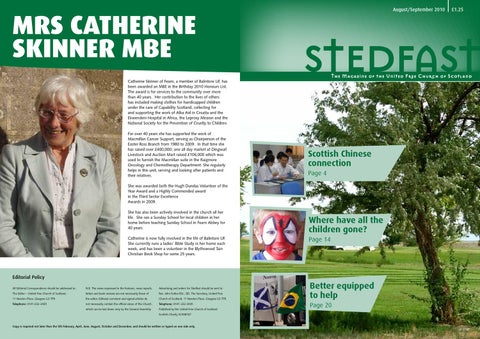
Mrs Catherine Skinner MBE Catherine Skinner of Fearn, a member of Balintore UF, has been awarded an MBE in the Birthday 2010 Honours List. The award is for services to the community over more than 40 years. Her contribution to the lives of others has included making clothes for handicapped children under the care of Capability Scotland, collecting for and supporting the work of Alba Aid in Croatia and the Ekwendeni Hospital in Africa, the Leprosy Mission and the National Society for the Prevention of Cruelty to Children. For over 40 years she has supported the work of Macmillan Cancer Support, serving as Chairperson of the Easter Ross Branch from 1980 to 2009. In that time she has raised over £400,000; one all day market at Dingwall Livestock and Auction Mart raised £106,000 which was used to furnish the Macmillan suite in the Raigmore Oncology and Chemotherapy Department. She regularly helps in this unit, serving and looking after patients and their relatives.
Scottish Chinese connection Page 4
She was awarded both the Hugh Dundas Volunteer of the Year Award and a Highly Commended award in the Third Sector Excellence Awards in 2009. She has also been actively involved in the church all her life. She ran a Sunday School for local children in her home before teaching Sunday School in Fearn Abbey for 40 years. Catherine is now fully involved in the life of Balintore UF. She currently runs a ladies’ Bible Study in her home each week, and has been a volunteer in the Blythswood Tain Christian Book Shop for some 25 years.
Where have all the children gone? Page 14
Editorial Policy All Editorial Correspondence should be addressed to:
N.B. The views expressed in the features, news reports,
Advertising and orders for Stedfast should be sent to:
The Editor – United Free Church of Scotland,
letters and book reviews are not necessarily those of
Rev. John Fulton BSc., BD, The Secretary, United Free
11 Newton Place, Glasgow G3 7PR
the editor. Editorial comment and signed articles do
Church of Scotland, 11 Newton Place, Glasgow G3 7PR
Telephone: 0141-332-3435
not necessarily contain the official views of the Church,
Telephone: 0141-332-3435
which can be laid down only by the General Assembly.
Published by the United Free Church of Scotland. Scottish Charity SC008167
Copy is required not later than the 5th February, April, June, August, October and December, and should be written or typed on one side only.
Better equipped to help Page 20
£1.25
BOOKS TO BUILD FAITH AND CONFIDENCE
In this Issue...
Another book in response to Richard Dawkins?!!!
2
12
7 1
Books to build faith and confidence
8
Rev Robert Owens Moderator of the General
17
A letter to the Editor
2
New ways forward at Portobello
10
Bringing Kingdom Values to Modern Society
17
Racial justice in Scotland
4
Scottish Chinese connection
12
Pathways to Ministry
18
Witnessing to Christ
6
Montrose churches together
14
Where have all the children gone?
20
Better equipped to help
Editorial What is it that motivates us within the Church? Why do we do the things we do? Recently I attended the Ordination of Rev Ann Deacons and every time I attend such a service, I am challenged by one of the questions asked of ministers and elders at ordination ‘Are not zeal for the glory of God, love for the Lord Jesus Christ and a desire for the salvation of men, so far as you know your own heart, your chief motives for entering into the office of the Holy Ministry/ Eldership?’ It is challenging to measure all that we do within the Church against that question and ask if that is our chief motivation! This Stedfast reflects on a number of matters that we focused on at General Assembly when we sought to grapple with some of the issues which challenge us in the Church today. They are not easy to deal with and sometimes the temptation is to ignore them. Yet if we love Jesus, have a desire for God’s glory and long to see those around us come to know His salvation then we must grapple with the issues and look to the Lord of the Church to lead us forward as we step out in faith to Him. Who knows where He will lead us in the coming years! John Fulton
I cannot help but feel that the debate initiated by Richard Dawkins re the existence of God is doing the cause of God and the Gospel a great deal of good. Even the opposition and anger of men works ultimately for the glory of God (c.f. Ps 76.10; AV, RSV, ESV). Our omnipotent Lord is well able to use the efforts of his enemies for his own good purposes. One of the consequences of the debate is that the spotlight has been on God. Further, it has caused not a few people to think through the whole idea of God, if only as a hypothesis. As CS Lewis pointed out, it is always a dangerous thing for the enemy to focus on God! A consequence of Dawkins’ books has been the spawning of responses, including some by scientists who are also Christians. When some months ago I saw a book with the title “Who made God?” I dismissed it as just another contribution to the debate. More recently when staying overnight with friends in Glasgow this very book had been strategically placed, so I was told later, to see if it caught my interest. It did! The first thing I spotted on the cover was a commendation from the writer and broadcaster, Fay Weldon, as follows: “Thoughtful, readable, witty, wise. I discovered things I didn’t know.” Sub-title of the book is “Searching for a Theory of Everything”.
Rev David Cartledge reviews: Edgar Andrews, Who Made God, Evangelical Press, £9.99.
The next thing to catch my attention were the intriguing chapter headings, for example: Sooty and the Universe; Yoghurt, cereal and toast; Pouring concrete; Ferrets and fallacies: Peeling onions; Cosmic chess; Over the moon; Information, stupid!; Life in a cake-mixer – all, fortunately, with explanatory sub-headings. Moreover, the headings are relevant to the material that follows. Of course, catchy titles may simply be a cover-up for a second-rate, superficial book. Then I noted that the author, Professor Edgar Andrews, had a strong scientific background as Emeritus Professor of Materials at London University and publisher of well over 100 scientific papers and books and various works on science and religion. When I began to dip into the book I found it more readable than many of the more technical books stimulated by the Dawkins debate – and readable without being superficial. Prof Andrews is responding to the favourite question of sceptics: “If God made everything, who made God?” As he comments: “They wield it like a sword – drawn from the twin scabbards of science and philosophy and calculated to decapitate any theists
foolish enough to stick their heads above the parapet. In reality, however, the sword is all haft and no blade…” Each chapter begins with (a) an exceedingly useful outline of the purpose of the chapter and, where relevant, definitions of words used, and (b) some fascinating quotations, serious and humorous, from a wide range of sources both for and against his own position. While tackling the big issues Andrews goes to a great deal of trouble to take his readers with him as he discusses the issues. Yet another response to Dawkins? Yes, and I am delighted that I was finally persuaded to buy the book. One Reviewer wrote: “Edgar Andrews possesses this ability, bringing together scientific and theological expertise to present a work that is both engaging and palatable. It is this synthesis that makes this book a very important and unique contribution to the larger arena of faith and science.”
1
NEW WAYS FORWARD AT PORTOBELLO
The Souper Soup Day event team
By Rev Ralph Dunn
Some of the former Methodist congregation with Ralph Dunn
Wilson Memorial Congregation celebrated their 75th Anniversary in September 2009. A weekend of special services and concerts gave a further boost to feelings of encouragement and signs of growth in the past two or three years. Membership has increased year on year since 2008, including several adherents. Much of the increase came about from the closing down of the local Methodist Church. The crucial factor in this was the realization that the ‘culture of decline’ can be reversed.
2
The key ingredient for growth is something we have always known: ‘People INVITING People’. We are excited about being church here; we talk the church up and seek to raise our profile in everything we do. Our watchword is ‘INTENTIONALITY’. This means that the things we do are
clearly designed to befriend people and introduce them to Sunday Church our Home Group or other activities. Our deepest conviction is Mission. That is our main intention and we try not to be swayed from that central commitment. This means, ‘Keep the main thing, the main thing’. Or to put it another way ‘We keep the purpose of the fellowship clearly in mind and try not to get diverted from it’. In 2006 the Kirk Session discussed future strategy for growth, looking at short-term and long-term goals, strengths, weaknesses and so on. From this we started: 1. Men’s Breakfast Held in Morrison’s Café last Sunday of every month. 2. House Group A group of about 12 people have been meeting for almost 3 years in the
Manse – using Navigators 2.7 (study in Colossians), course. Year 2: - Christianity Explored. In 2010 we’ve used Lee Strobel’s ‘The Case for Christ’. It’s been wonderful to see clear Spiritual Growth developing in this group. 3. Midweek Open Hour The Church is open for quiet reflection every Wednesday between 11am-12 Noon. This opportunity has been much appreciated 4. Film Club Friday evenings monthly – intentionality being to have a variety of meetings to which friends, family, neighbours could be invited. 5. Food‘n Fellowship Nite An Annual Church Meal ( April or May) held between 5pm-6pm on a Sunday evening followed by a Songs of Praise
service. Between 40 and 50 people attend, which is designated a ‘bring- a -friend’ event.
discussion concerning the way forward for the church. This ‘Vision Team’ will liaise very closely with the Kirk Session.
6. Electronic Games Evenings Using the latest technology, this is a popular event for our young people and their friends.
• Leaflets (Door - to – door) These will focus on the Wednesday Open Hour and Sunday School, Youth Activities.
7. Religion and Science DVD Course In January 2010 we launched something new, an Adult Education Course produced by Wesley Theological Seminary in Washingtonsubtitled: ‘Is it possible to be a Christian and Take Science Seriously?’ We are only the second church in Scotland to run this Course! We have now loaned the Course to a Church in North Berwick, so now that is three.
• Search for the Searchers Endeavour to approach at least one person, (weekly/monthly?) who may be looking for answers to spiritual questions.
After a special Kirk Session meeting on Church Growth held on 12th October, 2009, we produced a ‘Where did we end up?’ paper, covering the following issues: • Establish a small leadership team This was implemented on 4th May 2010 and consists of 3 members (2 being elders) and the Minister. We intend to meet fortnightly, on a midweek morning, for prayer and
• Prayer We need to ‘intentionally’ pray for growth. Our belief is that small churches can grow. Churches of
between 30 and 80 members can expect to see sustainable growth. Many churches are locked into a long - term slide into decline, with no VISION, GOAL or PLAN for growth. This leads to lack of confidence and a remnant or survivalist mentality sets in. All living things grow so why not our Churches? We can reasonably look for gradual growth each year. We just need to develop a ‘culture of invitation’ - which means cultivating warm personal contacts and relationships. To lift our spirits, we must strike out and go forward. This demands energy, faith and some risk-taking, but this is the way of the mission-shaped church.
Some of the children at Portobello enjoying the celebrations
3
Scottish Chinese Connection
Sally Boa recently visited China to introduce people to the ‘Talking Mats’ programme. When I was a Speech and Language Therapy student, I was taught an old Chinese proverb: ‘Tell me – I forget; Show me – I remember; Involve me – I understand.’ Throughout my working life, I have used this as basis to help me work with my patients.
4
In April 2010 I was fortunate enough to be able to spend two weeks working with a colleague in China. The invitation came via the Scottish Churches China Group (SCCG) which has had a strong link with the medical system in Shenyang, a city in North East China, for some years. My colleague, Joan Murphy and I are Speech and Language Therapists with a background in community rehabilitation and research. We were invited to the Hua Xiang Branch Hospital Rehabilitation Unit of Shengjing Hospital. It was built 4 years ago and is a modern purposebuilt facility for 200 in-patients with stroke and traumatic brain injuries. It
is led by Professor Zhang and a staff of doctors, nurses and ‘therapists’. Patients’ treatment is funded through their own health insurance or by their families. The therapists come to the hospital with a general technical training. They then decide if they want to follow a physio, occupational or speech therapy route and learn ‘on the job’. In comparison, UK training involves a four year degree course. Rehabilitation in Shenyang is mainly based on a medical model with a focus on trying to get patients ‘back to normal’. Patients are passive recipients of treatment. This differs from the UK approach where we focus on helping patients adapt and live with long term disability following stroke or brain injury. Patients here are expected to take an active part in their therapy.
Shifting thinking The purpose of our visit was to run workshops on communication in general and ‘Talking Mats’ in particular as a method to help patients express their views. During our first week, we ran a series of workshops. We realised that the staff did not understand communication in its widest sense. They were hoping that we would give them speech techniques and exercises to cure people. Instead we tried to shift their thinking so that they would start to introduce patients to the idea of using a variety of methods to convey their message (e.g. drawing, gesture and symbols), as for many patients, speech may no longer be a reliable method of communication. During the second week we worked with patients and focused on using Talking Mats to set broad goals. In doing this we were able to show how
Sally discussing matters with staff and patients
the framework could be used to help involve patients as active participants in their rehabilitation. It also helped staff to see the types of practical and realistic goals which could be set with a range of patients. We ended our second week by running a group session with patients and staff. This turned out to be a great success with lots of laughter and both verbal and non verbal communication between everyone, irrespective of our ability or language. Outcomes: We certainly did not alter the working practice or views of all the staff but we did initiate a shift in the thinking of a group of staff. By the end of the 2 weeks, they were talking about working together with a small group
of patients to try to work in a more patient–centred and functional way. The main outcomes were: • Some staff understood the importance of considering how patients participate in and communicate about daily activities; • We felt we had sown the seed of an understanding of ‘total communication’ • There was an awareness of the need to change the therapy environment and we left staff with a list of resources and materials to help them create more communicative surroundings ; • Staff were keen to start group work which would include the use of different methods of communication and involve families.
Reflections and next steps: Living and working in a country where we were unable to speak the language or understand the written word gave us a small but significant insight into some of the challenges that our patients are faced with. Overall, the visit was stimulating and provided us with time and space to think about how we work. We found that the most rewarding part of the two weeks was working with the patients, who face exactly the same challenges as the people we work with in Scotland. We hope that this trip is just the beginning of collaborations between ourselves and Shenyang. There are plans for the SCCG to bring a member of staff over to Scotland to carry out some observational visits. This will be an important step in helping staff in Shenyang to further develop their rehabilitation services. Please pray for this important work which was instigated by Patricia Johnston on behalf of the SCCG. Thanks to the Overseas Committee of the United Free Church of Scotland for their contribution towards some of the costs of the trip.
The patient seems to be enjoying the process
Back to the Chinese proverb: The people we met told us about many of their proverbs, but they hadn’t heard of mine. They had to agree that it is a good basis for rehabilitation – even if it’s not Chinese!
5
Montrose Churches Together Celebrating the Mission of the Church
Sunday School Trip at Craigmailen By Frank Hartley Church, Bo’ness Bo’ness Good News Crew
Rev Graeme Bruce reports on a service in Montrose to mark the centenary of the Edinburgh 1910 World Mission Conference “As we gather for the centenary of the World Missionary Conference of Edinburgh 1910, we believe the church, as a sign and symbol of the reign of God, is called to witness to Christ today by sharing in God’s mission of love through the transforming power of the Holy Spirit” So reads the opening paragraph of the Common Call issued on Sunday 6th June from those who gathered at the Edinburgh Conference 2010. On that same day, every congregation that makes up Montrose Churches Together gathered in the Old and St Andrew’s Parish Kirk to celebrate its mission to the local area. At 11 am musicians from various congregations led the congregation in joyful praise as preparation for the worship to come. At 11.30 am in traditional fashion the Word of God was brought into the Church and the congregation rose to sing the 100th Psalm. The service theme was “Celebrating the Mission of the Church “.
6
A visual presentation showed how the congregations have worked together in mission since 1990 -
another memorable anniversary providing services in nursing homes and sheltered housing; setting up and running the Seafarer’s Centre where, since June 2008 over two thousand seamen from all over the world have visited and found a ready welcome from the volunteers with nearly five hundred positive enquiries made about the Christian faith; supporting social services for the homeless and those in emergency accommodation, organising the collections for Christian Aid; supporting one another in various congregational missions for denominational work at home and overseas; chaplaincy work to schools and uniformed organisations along with arranging special united services at Christmas, Week of Prayer for Christian Unity, World Day of Prayer, Easter and Pentecost. We were sharply reminded through the reading from the Gospel of Mark 6.113 and through the preaching of God’s Word that the mission of the Church involved a daily encounter with Christ and being strengthened through the Holy Spirit to make God’s love known to the whole of our community. In a thought for the young – ‘What can we do?’, the large number of children
Bo’ness Lauren, Kelly, Jane
gathered heard the story of the Good Samaritan told by the Church’s Youth Worker from Jamie Stuart’s Glasgow Gospel. The practical message that followed the story touched young and old. The Preacher was the Very Rev Stephen Collis newly inducted minister at Montrose Scottish Episcopal Church. In a short visual presentation, all of the member church buildings were shown and he asked if it was within those buildings where we gather week by week that mission was done. The final picture the one included with this article, was of Montrose High Street and he challenged all present with the words of Christ as he sent out the twelve (Mk6) reminding us of the task of reaching the many people who walk up and down our High Street who use and run our shops and offices and know nothing of the saving love of God in Christ. It was also a joy and a blessing to welcome members of our newest congregation, The Redeemed Christian Church of God, with their families bringing colour and fresh life to our gathering.
Saturday 5th June was a brilliantly sunny day when over fifty of us set off to Almond Valley Farm Centre near Livingston. We fed the lambs, calves and birds. We petted animals of every type. We rode on trains, go-carts and tractors. We played on trampolines and adventure playgrounds. The children were also allowed to do these things! Craigmailen Church is blessed indeed to have such a wonderful group of young people.
“I ran a motor car through all my student days” (Rev Jim Neil) “Could you sponsor a student “I realise that if I keep jumping up to speak I’ll through their training?” have to change my name to Smith” (Mrs Cathie McKenzie) “Paying for a part-time ministry (George Bruce) but expecting a full-time “I would ask you not to snore, ministry” “There is a lot of life in the UF you might wake up your (Rev Andrew McMillan) Church yet.” neighbour.” (Rev Joe Creelman) (Rev Desmond van der Water) “The rules of the road are intuitive in Vietnam. “We do not worship the Book, we “The time is coming when we must (Elaine Duncan) worship the God of the Book” stand our ground.” 7 (Elaine Duncan) (Rev David Cartledge)
Heard at the General Assembly
Rev Robert Owens Moderator of the General Assembly 2010
Rev Peter de Villiers recently spoke to Rev Robert Owens and asked how he came to minister the Word of God in Drumchapel. In this article Robert outlines some important events that affected his life.
8
In 1904 a revival affected large areas of Wales. This move of God changed many lives and churches. It was said that the presence of the Holy Spirit could be felt in such a real way that even the unbelievers were afraid to sin! A number of ministers who were converted during the tail-end of that revival were close friends of my family. These men used to visit our home and preach in the Church.
reverential fear of God. The reason for this reverential fear of God was they had seen something of His glory. They lived and spoke as if God was right there with them. The passion they had for God was amazing and evangelism was, to them, as natural as breathing. One thing was clear about these men and it was the fact that they were sold-out on God. The life and message they proclaimed was a challenge to the message of the world.
One thing that marked these men out was that since they had met with God in such a mighty and powerful way that they had lost the fear of man. They feared God, they loved Him and knew of His amazing love for them but at the same time they had a holy and
In many ways this was the atmosphere that my parents lived and breathed and the one in which I was brought up. This was quite an experience for a young man in the ‘1960s’, with a rebellious heart - even if he could not be rebellious outwardly because he was ‘the minister’s’ son!! The temptations
none who understands; There is none who seeks after God. They have all turned aside; They have together become unprofitable; There is none who does good, no, not one.......23 for all have sinned and fall short of the glory of God,” these words became so real to me and the verses so clearly described my inward heart (even if family restraints meant that I was not been able to outwardly live that way). Brought up in a godly atmosphere but my heart was far from being godly. At 15 I left school and went to work at the Jaguar car factory, this being the boom years for the motor industry in Coventry and the wages were good. During these years I was quite content to have a ‘secular’ occupation but also to also help within the various organisations of the congregation. During these ‘contented’ years I became aware that God was calling me into something different – what a blessing for me that I had no qualifications!! Trainee Ministers and Missionaries were required to have this, that, or the other qualifications ... so I was off the hook!
Rev Robert Owens with his wife Jane.
of the world were pulling one way but I had the Gospel of Christ being faithfully preached and I constantly heard the call to follow Christ Jesus. Becoming a believer I am not sure when I became a ‘true’ believer because the things of God were always so real and normal to us as a family - the Lord was just part of everyday life and that was life to us! I would find myself defending the truth because that was what my dad preached! But there came a time when I understood these truths for myself and they became real to me. I remember vividly when God made me aware of my sinfulness and as I read in Romans 3:10f “There is none righteous, no, not one; 11 There is
Full-time Service Around this time I attended a youth meeting at which a Glaswegian, by the name of Bill Gillvear, spoke about his journey to the missionary field [his life-story is written in the book Rough Diamond]. He told us that God had taken him, a nobody with nothing, and by His grace had fitted him for missionary service overseas. He challenged the young people by adding ‘what is stopping you from going into full-time Christian service?’ - Look what God has done for me”. Not long after this a family friend, Rev Brash Bonsill, ended a meeting that I was attending by saying, “If you have nothing to give to God, come with nothing and say ‘I have nothing; if You can do something with nothing, here I am’”. Not long after that incident Dr Martyn Lloyd Jones came to speak at the Church. I had to drive him back to the station. During the journey I told him that I felt that God was calling me into the ministry. His advice was straight to the point - “Don’t, unless you have to, make sure you have a call”. As I
sought to ascertain whether or not I had a definite call, the Lord impressed on my mind various verses, two of which are – Luke 7.22: Jesus answered and said to them, “Go and tell John the things you have seen and heard: that..... the poor have the gospel preached to them. 2 Corinthians 5.17 - 19: Therefore, if anyone is in Christ, he is a new creation; old things have passed away; behold, all things have become new.18 Now all things are of God, who has reconciled us to Himself through Jesus Christ, and has given us the ministry of reconciliation, 19 that is, that God was in Christ reconciling the world to Himself, not imputing their trespasses to them, and has committed to us the word of reconciliation. To Glasgow The Lord made it clear to me that to be poor means more than just finance, there are a lot of rich people who are poor! The other burning word was reconciliation, He has given to us the ministry of reconciliation. God shook me out of my contentment and so it was that at the age of 29 I entered the Bible Training Institute at Glasgow to learn more about the ministry of
Rev Robert Owens with his son, Nathan.
reconciliation. Every student had to engage in two outreach activities and I found myself as a B.B officer in Garngad and also taking a Sunday School in Drumchapel Children’s Hospital! I remember attending Drumchapel U.F as a student! Three years later I was working in the Church and 30 years later still there! It has been a privilege for Jane and myself to be part of this congregation. One of the men mentioned above is well into his nineties, I remember as a young man his zeal and passion for the Lord - it was as if the fire of God was burning in his heart. This man is still praying with passion for the lost and still preaches in the open air! I know that we cannot live in the past but what a need there is in our day to see and hear something of the reviving power of God in our land again. What a joy it would be to see men and women coming to know Christ and having a passion to live for HIM. We hope to hear more from Robert in the next issue about some of his experiences in Drumchapel.
9
Bringing Kingdom Values to Modern Society
First we must remind people that this world, this earth, is God’s creation and does contain sufficient resources to provide all with a satisfactory life, provided that these resources are used wisely. Mankind has been given a sacred duty of stewardship of the world and we have to get this idea across to our leaders. Second we have to convince all the people that God is a God of love and therefore it is incumbent on us to show that love in our stewardship. 3. Are there Biblical themes that could help us in the debate? Two Biblical themes suggest themselves. One is the call to God’s children to be Stewards of His Creation as laid out in Genesis and later books of the OT. The second theme is the love of God for His children and I simply refer to the text quoted in the report, ie Matthew 7 v12. 4. Could you outline some of the big questions that we need to tackle as the Church?
1. What do you see as some of the major problem areas facing our society today? Society is undoubtedly facing a variety of serious problems some of which are new to this generation. Leaders and Politicians are aware of them but appear to be either unaware of suitable solutions or afraid to carry them out.
10
The underlying cause of our present difficult situation is the rapidly increasing human population in a finite world. In the West previous generations have acted as if the earth’s resources are infinite and have used them profligately to build up the affluent life-style enjoyed by so many. Now those populations that have continued to live in poverty aspire to enjoy the same high life standard as in the West. Unfortunately this comes at a time when the Earth’s resources are
Archie Ford spoke to Fergus Henderson, a member of the Church & Society Committee, who prepared a paper with this title which the committee brought to the Assembly.
becoming increasingly stretched and degraded. The result of this begins to be evident in ‘Climate Change’, in degradation of the environment, in the increasing frequency of natural disasters such as flooding or drought, and perhaps has even contributed the our current financial problems. If nothing is done it is likely that this century will experience an increasing incidence of violence and wars over disputes about scarce resources. So it seems that the solution to the problems facing us must firstly try to limit the increase in world population and secondly learn how to make better
and eventually sustainable use of the world’s resources in a way that is fair and just to all. Thirdly we must learn how to defuse disputes when they arise in a peaceful and just manner. If we cannot do this then future generations may look back and condemn us. 2. How can the Church approach these issues? The Christian Church has always had and continues to have the duty to bring Christ’s message to the world. The way in which this is done has varied down through the centuries according to the state of society at various times. In our present situation there are two things that need our firm attention.
The Church & Society Committee has already tackled a number of issues and
issued reports. However we have to recognise that we are a small group with limited expertise and so we try to cooperate with others as appropriate. Areas where we have commented or where we might have done so include:• • • • • • • •
responsibility for the way in which the world is governed.
So as individual Christians we must do what we can to ensure that God’s message of love gets out to those who have the power to bring about change. Energy Use. This of course will not be easy and Conservation and recycling of scarce opportunities for effective action may resources. be presented only to a few, but when Safe disposal of toxic substances. such opportunities arise we should be Fair distribution of food and water. prepared to accept them. It could be Development of structures to avoid by a meeting with a politician, perhaps use of war to settle disputes. before an election, or maybe there is a Reconciliation between battling chance to help with a charity seeking to peoples. help others. Elimination of poverty. Etc. etc.. For a local congregation the first
5.How can ordinary Christians and congregations get involved? We are told that we are a ‘Peculiar People’, ‘The People of God’, (1st Peter). We are different from others but we must never allow ourselves to think that we are somehow separate from them. As God’s people we are called upon to glorify God and bring His praises before the nations. As citizens we have a share, along with all our brothers and sisters, in
priority must be to ensure its practices and customs are without blemish. Is the welcome given to strangers open and generous and free from prejudicial qualification? Is it willing to cooperate with other local Christian congregations and groups to advance knowledge of the Gospels? Does it seek to work with other community groups to help the less fortunate? Once it is convinced that its own heart is right then it is ready to reach out and strive to make the world a better place.
STOP PRESS
Email received 2nd July 2010: The partnership with the Scottish Bible Society has been very providential. The North-East of Brazil right now is going through an unusual rainy season, which is causing great suffering to the people. Up to now 57 people have died as a consequence of the flooding (these last two weeks), 26,618 have lost their homes, and 47,897 had to leave their homes until the waters get lower. Now, the “Light in the Northeast” program (using the truck) is actively present, bringing a Word of hope to these people. And this is made possible through the help of the Scottish Bible Society. So, Halleluiah, thank you. Rudi Zimmer (Rev. Dr.) Executive Director Bible Society of Brazil
11
PATHWAYS TO Interview with Rev MINISTRY Alexander Ritchie
The Ministry Committee brought a significant report to the Assembly on ‘Pathways to Ministry’. Andrew Scott asked Alexander Ritchie about the report and how it might affect the way we do things. Alexander you are the UF Ministry Development Worker. Tell Stedfast readers why the post was set up, and what you have been doing?
12
I’ve been acting officially as Ministry Development Worker since September 2009. It was agreed, in consultation with Lossiemouth Kirk Session, that I would devote 1-day per week to this new and challenging role. One of the Ministry Committee’s main reasons for setting up the post was to facilitate the Pathways to Ministry process, which is intended to develop means of delivering ministry to congregations in these changing times for the Church. I work closely with other members of the Pathways group, and we are tasked with unpacking the fine details which must accompany the big picture of ideas which the document contains. It has been a key feature of my work in this 1st year to identify suitable training courses for Ministry Assistants. This has involved online searching and communication with a wide range of institutions offering theological
courses of study. The Pathways group looked at 14 options, from which we have identified 4 training providers although our list still remains open! It was quite exciting to see the Pathways document mature and come together for this year’s General Assembly. I feel the groundwork for a new approach, bearing in mind that congregations have consistently said that they want a trained ministry, has been effectively put in place for the future. You have been working on Pathways to Ministry. What are these pathways, and why is the Church choosing this model of training? That’s a good question! Most denominations in Scotland are trying to grapple with the same basic problem of how to put together a coherent strategy for ministry which meets the needs both of congregations and those likely to be applying for
a ministry role. We now have 3 paths under the system approved by General Assembly 2010. These lead to 3 possible outcomes-either being a Reader, Ministry Assistant or Minister of Word & Sacrament. Why have we gone for this model? Well we no longer function as a denomination in the perfect world of one fulltime Minister to one congregation. More and more the same is found across the whole spectrum of church denominations. There are also issues about finance, seeking to balance what congregations can manageably afford with reasonable expectations of what it is fair to pay someone in recognition of their time, experience, level of training and (not least) the current cost of living. I think the Pathways structure is very helpful because ways of training and preparation have been brought together. It’s now possible to move between the different paths in a consistent way, providing of course that the necessary training and other criteria are being met. So, for example, it will be perfectly possible for a Reader
to move on to the Ministry Assistant path, and also to the Ministry of Word & Sacrament path. Equally the option is there for a Ministry Assistant to consider the path to full-time ordained ministry, if and when he or she feels called to do that. This makes a lot of sense and opens the way to some exciting possibilities. Obviously anyone thinking about either coming into the Pathways model or moving freely within it, must sense God’s call. We hope the structure will allow that to be a central part of the whole process, and our plan is to try and help people fulfil the potential and use the gifts which God has given them. The General Assembly approved the Pathways paper, but some Commissioners were not sure about the term proposed for those who until now have been known as ‘parttime pastors’, i.e. Ministry Assistants. What is the thinking behind this term? To be honest we were aware that some didn’t and don’t like the term Ministry Assistant, although I cannot really understand why that is. I can assure everyone that there is no hidden agenda in the use of this term, and the thinking was and is simply to identify a way of describing the nature of the role. That is to assist in the provision of ministry to a congregation, normally on a part-time basis. We must remember that churches served either by a Pastor at present, or a Ministry Assistant in future, are also assisted in ministry by an Interim-Moderator provided by Presbytery. Of course we recognise that congregations get very attached to the person who is fulfilling the role in their church’s life, many of whom take on duties and responsibilities in addition to the basic task of regularly leading Sunday worship and giving pastoral care. The Ministry Committee’s Convener did say at General Assembly that we are open to considering alternative suggestions for the terminology we might consider using in future. In a sense developing the role is as, if not more, important from the Committee’s point of view than the label which is attached to describe it.
A number of folk who took the first Readers course in the 1980s and the second Readers course in the 1990s continue to act as local preachers. Will there be a third Readers course and what form do you think it will take? We know that our Readers do a lot of good work preaching faithfully, and that vital role should continue. However it is also a strongly viable idea that Readers could fit into team ministries, working in cluster groups of congregations alongside both Ministers and Ministry Assistants. I have been looking at the Church of Scotland’s training programme for Readers, which has been helpful and provided a lot of potential strategies to assist us in our ministry planning for the future. This is something for the Pathways group and Ministry Committee to look at more closely. My first impression is that a training framework will be put in place for those coming forward to serve as Readers, using a similar model to that already prepared for Ministry Assistants. I would imagine that will normally include some commitment to theological study, although the experience and circumstances of each candidate will have to be looked on a case-by-case basis. It would probably be valuable for Readers to undertake some other more practical training initiatives, such as a short placement with a congregation. I am sure potential new Readers would also enjoy the delights of sitting an English Bible exam! Of course one of the benefits in Pathways to Ministry is that the first part of our selection process for all types of ministry is the same, and so that standardisation of things will apply equally and fairly to new Readers as well. The General Assembly expressed some concern about the continuing reduction in the number of full-time Ministers of Word & Sacrament. How do you see “ministry” developing in future years? I’m excited and concerned about the future at the same time, if that makes sense! The more the Pathways process develops, the more obvious it becomes
that the way of delivering ministries to our congregations will have to change radically if we are going to survive. Young and gifted Christians are needed to answer God’s call, and it is a great blessing when even a precious few are doing that. But the kind of ministry roles they will fulfil over time won’t be the same as those which the traditional system has supported in past generations. In the United Free Church we simply cannot sustain delivery of Word & Sacrament ministry to, in round figures, 65 churches with 25 Ministers! Our Pastors have done, and are doing, a great sustaining job in many congregations. I know that God’s work can never become a numbers game, but along with other denominations we have to face the facts. It has been good for us, though, to reflect on our theology of ministry, and for that I think the whole Church owes a debt of gratitude to the Panel on Doctrine. At the same time it is exciting to see just how much is out there in terms of opportunity for people to train for ministries nowadays! Every week, though, the Ministry Committee has to deal with the on-the-ground reality of what is happening, and we know that some of our congregations are struggling. I think we will have to use our human resources more creatively and selflessly in future. Team ministry is an obvious possibility, but it will ask questions of those churches that already have a full-time Minister, and those folks may be asked to share their Minister with others in the context of a team. We do also need to look seriously at the way we fund ministry, because we ask a lot of those who answer God’s call. Although it is always God’s work, we cannot reasonably expect to be drawing applicants with family and other responsibilities into ministry, if what they are given in return is not commensurate with their level of training and degree of commitment to the task. Thank you, Andrew, for these questions. I have enjoyed trying to answer them! And thanks to Alexander for his responses! What do you think? If you have any comments, please let us know!
13
WHERE HAVE ALL THE CHILDREN GONE?
Laura Mackenzie, UF Youth Worker, reflects on the challenge of declining numbers in groups for children and young people and considers what we can do about this. “The students in your youth ministry don’t need your great programming skills. They need a living model – a man or woman of God who is passionate about his or her faith. Your passion will be contagious. Students will want what you have. Your faith will help you develop a strong foundation for a healthy youth ministry.” Doug Fields, Purpose Driven Youth Ministry
14
Looking at Sunday school and youth work today, we cannot help but think back to the days of larger numbers. This decline is found in church attendance as a whole and it is having an adverse effect on the numbers of young people coming to church and church based groups. We are now in a situation where many children and young people in our communities have never attended Sunday school or any church organisation. Deuteronomy
6 tells us to ‘teach our children and our children’s children’. We live in a society where we have at least one generation, if not more, with no basic knowledge of God or church and parents who cannot pass on the things of God to their children because they do not know them. In the book ‘Christian Youth Work’, Danny Brierley comments: “In the last decade this problem has intensified. Despite a population increase the attendance of young people at UK churches has continued to drop. Projected figures for the coming years predict this trend will continue.” It is not always the case that children and young people never attend church. Some come for a time and then drift away. In ‘Already Gone: Why your kids will quit church’, Ken Ham refers to research carried out into those in their early twenties leaving the church.
The research states:
What can we do? What can be done about this problem? How can the church begin to stem the tide of declining numbers of young people? This is a frequently asked question and one that is not easy to answer as we work in different areas and cultural settings. There are however, fundamental issues that can be addressed including the way we reach out to young people and the way we teach the Christian faith to them. Society quickly realised the benefits of the disposable income many young people have and linked into that with advertising campaigns and magazines aimed specifically at the teenage or younger market. This group is regarded as a valuable resource and if you can reach that age group with your product, you have cracked it! Games consoles, phones, fashion, music and even foods are aimed at certain ages. The world knows how to reach this age, and in some cases it seems that the church is trying to buy into this type of outreach too. We organise programmes and events to reach the youth. Some are very successful, crowds of youth attend and yet there is still a problem when they get to fourteen. We may be able to attract them, but what happens about
the future? If the emphasis on fun and excitement first offered begins to fade, is there enough solid food to nurture them? If we only ever offer separate ‘youth events’ and programmes we are moving into dangerous ground. The Church needs to be seen as the ‘family’ of God. Yes young people need time together but there needs to be a sense of the bigger picture and being part of the family of God. Young people can cope well with church, but not so easily if they have never really been part of it before that age. Why do they leave at fourteen or younger? In some cases perhaps the programmes have run out and sitting in church is not so attractive as Sunday school or the youth group? Or the many things of the world that call to them take priority in their struggle to see who they really are? Part of the Church Young people need to be part of the church from when they first enter, be that in childhood or later. The opening quote of this article comments on young people needing true living examples of what it means to be a Christian and that passion should be contagious. No programme or event can measure up to a man or woman of God sharing their faith with the young
and getting alongside them, taking an interest in them. Young people live in such a different society now and they are looking for truth, for people who will live out their faith and who will help them to do the same. Ivy Beckwith in ‘Postmodern Children’s Ministry’ comments: “Something is broken when we trivialise God to our children. It is broken when we depend on our programmes and our curriculum to introduce our children to God – not our families and communities. It’s broken when we’ve come to believe that church has to be something other than church to be attractive to children.” The bible clearly shows the heart of God towards children and young people. We are called to reach out to them, to teach and instruct them. Psalm 119:9 says that a young man can keep his way pure by living according to God’s word. Jesus rebuked the disciples when they tried to stop the children from being presented before Him. Titus 2 gives the example of the younger men and women being taught
“A majority of twenty something’s – 61% of today’s young adults, had been churched at one point during their teen years but are now spiritually disengaged.” When questioned on why they no longer attend, reasons including boring services, legalism, hypocrisy, distance from home, lack of relevance to personal growth and finding the bible not practical. Why are fewer young people coming to church? There are many reasons including a plethora of other options for Sunday mornings such as football, other sports, shopping trips, family visits and no one at home attending church to take them. Changes in society have also played a significant role and Church attendance is no longer seen as important. The breakdown in family life often means children and young people spend weekends visiting parents.
15
by the older men and women. God is a God of all ages. Young people can and should be encouraged to deepen their relationship with God through active participation in church. Family services, times of collective worship and bible teaching that does not compromise truth help young people to play their part in the congregation, to be part of the family of God. We must encourage families to take seriously their role in the Christian education of their children and grandchildren. If we do not tell them, the world will, but what will it teach them? Christian families are so important. Not all children and young people come from Christian homes so the church has a serious job to do. Evangelism and discipleship must work together. We can reach out and get them in perhaps, but what do we offer once they are there? Are we ready for groups of young people in our congregations who may need to belong way before they behave? The teaching our young people receive must equip them to stand firm in society knowing what they believe and why. It must
give them the answers to the world’s questions. Non-compromising solid teaching will help and support them. Getting alongside them will help, making connection with their families through home visits and letters, invitations to services and involvement in the local schools can help. Stop apologising! The church must stop apologising for what it has to offer and begin to actively take back its role in society. Does your congregation have involvement in your local school, can you help in some way? Are there young people hanging around in your area with nothing to do? Could you open your church hall and chat to them? Can you pray? Then pray for the young people in your area. The numbers are in decline, yet there is hope! Organisations such as Scripture Union see young people in their clubs in schools every week, people are praying for their local schools and colleges. There are congregations with young people, we have committed teenagers and young people within our denomination. Let us not get
despondent! Let us hold fast to the Great Commission, not just to ‘go’, but to ‘make’ disciples through solid teaching, family involvement and support. Some have left, have we gone after them? The farmer left 99 sheep and went after the one who had strayed, have we made contact with those we are missing, do they know they are missed? How many young people were baptised in our churches and now there is no connection with them? Can we make contact again? Youth ministry is a challenge and a blessing, and I believe something we are commanded to do by God in whatever role that may be from family instruction and worship to Sunday school and youth groups of varying forms. It’s time to stand up for what we believe and un-apologetically proclaim the authority of God. Prayer is the key. Our passion for God will make an impact on those around us, we are called to this work in faith and obedience, God will do the rest.
A LETTER TO THE EDITOR... Dear Sir
16
I attended Assembly for the first time this year on Thursday 10 June 2010. I expected to find the proceedings slightly boring, but found myself most interested in the reports and discussions, especially the Report by the Panel on Doctrine.
stranger came (not really a stranger but one of our former students who had now been ordained). When my first child was born, once again my own Pastor had to step aside and a stranger came; this happened again with my second child.
I have to say that during the discussions on this Report I went through various emotions ranging from anger, frustration and sadness. Who could not be moved by the appeal from Pastor George Banks regarding who should or should not administer the sacraments of Baptism and Communion. I was reminded of my years as a member of Gorebridge UF Church from the age of 12 until I married in 1964. The church at Gorebridge was served by students. Nothing wrong with this but come Communion a stranger arrived to give Communion. We eventually had a pastor appointed, Johnny Hamilton who came from the Fishermen’s Mission. At last we had someone of our own who could go out and about and get to know the people of Gorebridge.
I cannot understand why a person who has given their life over to the Lord and wants to serve His people is any less fit than someone who has gone to College or University. I know the bible can be quoted showing that training was given and expected by those who followed the Lord but where was the first “university/college”. I have heard many an ordained minister preach who would send the angels to sleep and heard wonderful exciting uplifting preaching from Pastors, lay preachers etc.
However, when I was arranging my marriage in 1964 I found that Pastor Hamilton could not conduct the service, so a
Letters to the editor are always welcome and please include your name and address (not for publication.)
Yours faithfully Joan Anderson Edinburgh
RACIAL JUSTICE IN SCOTLAND Peter de Villiers spoke to Rev Francis Alao who has been appointed as Scottish Churches Racial Justice Officer. To begin with, tell us something about your background and immediate family. I was born in Nigeria and lived there for most of my life until I came to the United Kingdom. Following some years of working as a clerk and later as a manager of a local building merchant, I enrolled at University of Ibadan, Nigeria (the first and only British founded University in Nigeria) where I took a BA in Religious Studies (1999). Following my move to Scotland, I gained a postgraduate diploma in Social Ethics (2002) and an MSc in Marketing (2007) from Glasgow Caledonian University. However, prior to this, I was ordained in the God’s Foundation Church Nigeria in 1996. I also taught between 2000 and 2004 in a Methodist Grammar School (Religious Studies), a federal Polytechnic (OT/NT) and The Redeemed Bible College in Lagos (Ethics/Contemporary issues). Following my move to Scotland, I have been the Senior Minister of Glasgow International Christian Church – a local Church arm of “Heart For The City” and administrator in the “Heart For The City” in Maryhill, Glasgow. I married Becky in 2002 and we have two girls and one boy. My wife is a graduate in Animal Science and later trained in financial and office administration. She is also a gospel singer with her debut album recorded in 2009. When did you come to Scotland, and why? I came to Scotland in January 2005 with the aim of studying and to also explore ministry opportunities.
What did your work for “Heart For The City” involve? I started with “Heart For The City” in 2005 as a volunteer minister. I was in charge of discipleship and training and also played an active role in community outreach work until I became the head of administration. Having been a pastor since 1996, I was made the senior pastor of the church arm of “Heart For The City” in September 2007 to oversee the local church situated in Glasgow Caledonian University. This position I held until my recent appointment as the Scottish Churches Racial Justice Officer. What, do you think, are the most crucial racial justice issues in Scotland? Being new in office I must admit that I am not yet in full grasp of the up-to-date trend of race related issues in Scotland. However, in the wider Scottish society, racial justice issues, especially the correlation between race hate and the crime wave has increased in the last three years by 40%, according to expert reports. This could be attributed to the recent influx of immigrants and asylum seekers into Scotland in an unprecedented manner. In the Scottish church community one of the racial justice issues I have identified is lack of mutual understanding between the Traditional Churches and the Emerging Churches especially Black Minority Ethnic Churches in Scotland. This misconception, to some extent, has birthed negative assumptions and suspicion between the two ecclesiastical groups
How do you intend to deal with these issues? Well, as my primary remit focuses on Scottish Churches before extending to the wider community, we have embarked on a mission of building relationships and partnerships between the ‘Traditional’ and ‘Emerging’ Churches in Scotland. It is hoped that this will enhance an opportunity to focus more on common ground rather than dividing factors between the two groups. Why is it important for the Church of Christ to be concerned about racial justice? Suffice it to say that racial injustices, covert or overt, have not been unknown, even within the Church. As long as the Church of Christ believes that God made man and woman in his own image and after his own likeness, any form of racial injustice is a direct affront against God. Jesus Christ summarised all the laws and commandments he said the most important thing is ‘loving God with our ‘all’ and to love our neighbours as ourselves’. How can local congregations become involved in the struggle for racial justice where they are? Charity begins at home. A healthy Scottish church community will, to an appreciable extent, guarantee a healthy Scottish community: a. By becoming an advocate for racial justice in the church and the community; b. Supporting and speaking for and with those that suffer discrimination and abuse; c. Praying for victims of racism, for refugees and for those seeking asylum.
7 17
WITNESSING TO CHRIST
Cardinal O’Brien (right) with Rev Andrew McMillan at the service at Dunblane Cathedral in 2006 marking the Covenant between United Free Church and the Church of Scotland
be to strive for that unity for which Christ prayed. When speaking to myself and my brother Scottish Bishops in Rome on 5th February 2010 he stated: “The Church in your country, like many in Northern Europe, has suffered the tragedy of division… I give thanks to God for the progress that has been made in healing the wounds that were the legacy of that period.” And he said to us as Bishops: “See that the work of rebuilding unity among the followers of Christ is carried forward with constancy and commitment. While resisting any pressure to dilute the Christian message, set your sights on the goal of full, visible unity, for nothing less can respond to the will of Christ.” And this brings me to my second point – as the visit of Pope John Paul II in 1982 set us further along the path toward Christian unity I believe that the forthcoming visit will repeat that message in ever stronger tones. It is evermore necessary for us all to live that Christian message and bear witness to it.
I pen these words for “Stedfast” being on something of a “high” spiritually following on two events. The first event in which I was privileged to take part was being part of a pilgrimage group attending the world famous Passion Play in Oberammergau, Germany.
18
This play took us back to the roots of our Christianity performed by the local people of this particular village in Germany every ten years as a result of their predecessors in the village having been saved from death by the great plague then engulfing Europe. I was then brought back to those same roots of our faith when asked to preach in Luss Parish Church of Scotland as they were commemorating the 1,500th anniversary of the arrival of Christianity in that area through the apostolate of St Kessog. My thoughts in both places went back to that Christian baptism which we all share and the union which all Christians once possessed with Jesus Christ and one another.
We invited Cardinal Keith Patrick O’Brien, Archbishop of St Andrews and Edinburgh for his reflections as preparations are made for the visit of the Pope to Scotland in September. My awareness of that unity was further enhanced through my being invited to speak as a guest at the recent Edinburgh 2010 Conference hosted by the University of Edinburgh and commemorating the first Edinburgh Missionary Conference of 1910. At that time there were no Roman Catholics at all present at the Conference; and the thought of a Roman Catholic Cardinal being invited to speak at the opening service would have been unthinkable. I was not of course there as the only Roman Catholic – but had the privilege of welcoming the Roman Catholic delegation in my own home in Edinburgh the day before the Conference began with that delegation led by our Archbishop of Glasgow the President of the Commission for Doctrine and Christian Unity of the
Bishops Conference of Scotland, and Bishop Brian Farrell the Secretary of the Congregation for Christian Unity in Rome. One might say that we have journeyed far since the time of the Protestant Reformation 450 years ago – and indeed now recognise one another as pilgrims together and friends journeying along in our common Christianity as Pope John Paul II said in his visit to Scotland in 1982. We now look forward to a visit from another Pope and I share with you something of my hopes. First of all it must be recognised that Pope Benedict XV1 has indicated that one of his goals in his papacy would
I myself when speaking one Easter to my own people indicated that it was something of their responsibility to be “PC”! I indicated that I was not using those initials in the common meaning “politically correct”! Rather I indicated that for each and every baptised Christian it was their responsibility to be indeed “P.C.” – these initials standing for the words “proclaim Christianity”! I would indeed hope that this forthcoming Papal visit will indeed strengthen us all in our common Christian witness and help us all to be more aware of the call which we have. That call is not only to live that Christian message which has inspired us all in our lives but to strengthen us to hand on that message with all its force at this present time to a world which must live by those Christian standards with ever greater vigour.
CAN WE BELEIVE IN GENESIS TODAY?
The Bible and the questions of science
by Ernest Lucas Intervarsity Press The author is a tutor at Bristol Baptist College and Bristol University who started his career as a research biochemist at Oxford University before going into theology.
Reviewed by Ian Shering The first few chapters of Genesis have been under attack lately. This book begins to address and defend this from a Christian perspective. It is a short book which investigates some issues but does not go into great depth. However, at the end of each chapter an excellent list of books for further reading is given for further investigation. The book starts with a chapter on “What is Truth”. Science is in fact a child of Christianity in that faith in a personal, rational creator and a rational creation created a climate in which science could develop. When Christianity is attacked in the name of science, it is usually being attacked on grounds which are not purely scientific. Generally an antiChristian philosophy lies behind the jargon, with scientific facts being brought in to make it sound
scientific. Christians have nothing to fear from facing up to established findings of science because they are facts about God’s creation. As such they will eventually fit into the overall picture of His truth. There are chapters on understanding the Bible, a discussion of creation, chaos and design. The problems of interpretation in the first chapters of Genesis are dealt with. A short digression into, “When Christians disagree.” Rather important in this day and age! Possible puzzles contained in Genesis are honestly considered and possible solutions aired. All truth is God’s truth and we should never be afraid of the genuine truth. This book is well worth being read. It will stimulate a lot of thought and perhaps heart searching. Prepare to be challenged!
7 19
BETTER EQUIPPED TO HELP
The truck has already visited many locations in co-operation with local partners, offering basic dental and medical attention. Staff and volunteers also dispense civic advice and assist folk with official forms.
In late June part of Brazil’s impoverished north-east was hit by devastating floods that killed more than 50 people. The water gouged streets, upturned massive vehicles, swept away homes leaving a wasteland of mud and debris. The president flew in, promising emergency aid and rebuilding. Victims who had lost everything salvaged what little they could and struggled to find food and clothing. But how can we help, so far away?
At the heart of the project is God’s Word and a desire to act out his love. “I have gone a long time without caring for myself,” confessed Josefa (63). “The doctor showed me I had a problem; many women need to attend prevention workshops. I also like it that I received a Bible. For me, it brings life, strength, help and salvation.” The truck’s fold-out pod contains a Scripture display, and each visitor receives a gospel or children’s package. You already have! The Scottish Bible Society’s bicentenary project exceeded its £200,000 target to provide a multi-purpose truck that was delivered to Recife last autumn. Major support from the UF Church’s young people and many other donors not only funded this impressive vehicle but also its running costs during the first year.
On June 24 Márcia, a Bible Society worker, struggled into flood-ravaged Palmares. “It’s a desperate calamity for the population,” she reported. She immediately arranged an emergency visit by the truck for July 3rd (subject to access routes being open by then). Her boss, who took part last December in SBS’s bicentenary thanksgiving at St Giles’ in Edinburgh, shared this thought with Elaine Duncan – who had spoken about the truck’s ministry at the General Assembly:
“I thank God that through your partnership we are better equipped to help these people in extreme need.”
Heard at the General Assembly When you are at the clerks’ desk they call you names like “Ant and Dec”, or “Bill and Ben”, but never “Dave and Nick”. (Rev Colin Brown) “There is a unique combination of gravity and fun.” (David Cowling)
20
“I have to smuggle a CD past my wife after every visit to Glasgow.” (Rev Ian Lloyd)
“Mr Ford is like a terrier, he never gives up.” (Dr Donald McDonald)
There is a cluster of ministers around Balintore. It’s something to do with Chernobyl” (George Bruce) “You meet in a good hotel, not an uninviting church.” (Methodist delegate, David Cowling)
“Rossetter, Presbytery of the North, supposed to be retired.” (Rev Bruce Rossetter)
“Pulpit supply, what a terrible title.” (Rev John Fulton)
7 21