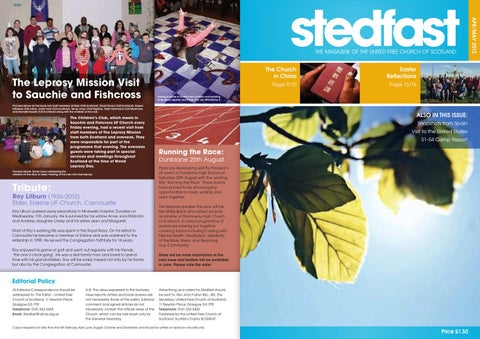
The Leprosy Mission Visit to Sauchie and Fishcross
Pictured above: Terver Anyor addressing the children on the story of Jesus’ healing of the man who had leprosy.
Tribute:
Roy Lilburn (1936-2012) Elder, Erskine UF Church, Carnoustie Roy Lilburn passed away peacefully in Ninewells Hospital, Dundee on Wednesday 11th January. He is survived by his widow Anne, sons Malcolm and Andrew, daughter Linsey and his sisters Jean and Margaret. Most of Roy’s working life was spent in the Royal Navy. On his retiral to Carnoustie he became a member of Erskine and was ordained to the eldership in 1998. He served the Congregation faithfully for 14 years. Roy enjoyed his game of golf and went out regularly with his friends, ‘the one o’clock gang’. He was a real family man and loved to spend time with his grandchildren. Roy will be sorely missed not only by his family but also by the Congregation at Carnoustie.
Easter Reflections
Page 9/10
Page 15/16
Playing a game of Snakes and Ladders and learning more about leprosy and those who are afflicted by it.
Pictured above (in the back row) staff members Jill Bain (TLM Scotland), Stuart McAra (TLM Scotland), Rajeev Pallakke (TLM India), Linda Todd (TLM Scotland), Terver Anyor (TLM Nigeria), Talen Nawnkhar (TLM Myanmar) and Michelle Russell (TLM Scotland) along with the children of the club.
The Children’s Club, which meets in Sauchie and Fishcross UF Church every Friday evening, had a recent visit from staff members of The Leprosy Mission from both Scotland and overseas. They were responsible for part of the programme that evening. The overseas guests were taking part in special services and meetings throughout Scotland at the time of World Leprosy Day.
The Church in China
APR/MAY 2012
THE MAGAZINE OF THE UNITED FREE CHURCH OF SCOTLAND
ALSO IN THIS ISSUE: Snapshots from Spain Visit to the United States S1–S4 Camp Report
Running the Race:
Dunblane 25th August Plans are developing well for this year’s UF event at Dunblane High School on Saturday 25th August with the working title ‘Running the Race’. These events have proved to be encouraging opportunities to meet, worship and learn together. The keynote speaker this year will be Rev Willie Black who retired recently as minister of Stornoway High Church of Scotland. A varied programme of workshops is being put together covering topics including Coping with Mental Health, Meditation, Reliability of the Bible, Music and Reaching Your Community. There will be more information in the next issue and leaflets will be available in June. Please note the date!
Editorial Policy All Editorial Correspondence should be addressed to: The Editor – United Free Church of Scotland, 11 Newton Place, Glasgow G3 7PR Telephone: 0141-332-3435 Email: Stedfast@ufcos.org.uk
1
N.B. The views expressed in the features, news reports, letters and book reviews are not necessarily those of the editor. Editorial comment and signed articles do not necessarily contain the official views of the Church, which can be laid down only by the General Assembly.
Advertising and orders for Stedfast should be sent to: Rev John Fulton BSc., BD, The Secretary, United Free Church of Scotland, 11 Newton Place, Glasgow G3 7PR Telephone: 0141-332-3435 Published by the United Free Church of Scotland. Scottish Charity SC008167
Copy is required not later than the 5th February, April, June, August, October and December, and should be written or typed on one side only.
2
Price £1.50
Contents 2/3
Sabbath Day
4
Rev Lilly Twist
5/6
Snapshots from Spain
7/8
Church History
9/10
The Church in China
11 Anti-Sectarianism Legislation 12
Friends of the Students
12
75 years Celebrations at Wifflet
5/6
13/14 Visit to the United States
By Andrew Scott / Vice-Convener: Church and Society Committee
15/16 Easter Reflections 17
Assembly Article
18
S1–S4 Camp Report
19
Sauchie and Fishcross
19
Tribute
19
Dunblane Event
Sabbath Day
7/8
11
THE TEN COMMANDMENTS AS THEY ARE RECORDED IN EXODUS CHAPTER 20 CONSIST OF FOUR WHICH ARE DEVOTED TO OUR RELATIONSHIP TO GOD AND SIX WHICH ARE DEVOTED TO OUR RELATIONSHIP TO OUR NEIGHBOUR. WE GIVE GOD FIRST PLACE (THE FIRST COMMANDMENT); WE DO NOT WORSHIP OTHER GODS (THE 2ND COMMANDMENT); WE DO NOT MISUSE THE LORD’S NAME (THE 3RD COMMANDMENT); AND WE GIVE GOD OUR TIME (THE 4TH COMMANDMENT). IT IS THIS 4TH COMMANDMENT ABOUT THE SABBATH THAT OFTEN PROVES THE MOST VEXING FOR US TODAY. What can we say about the Sabbath that can be helpful for our understanding of its purpose?
13/14
18
Editorial How are we to keep the Sabbath in today’s society? While there have always been provisions for essential commerce on a Sunday such as hospital work, pharmacies, and such, there has in the past 50 years been a dramatic increase in the nonessential commercialisation of the Lord’s Day. While it would be honest to reflect that there has probably been a lot of individual drift in our responses to these changes, what should our unified response be as a Church that recognises the growing pressures being placed on us as individuals and our personal witness within the wider community. By way of a starter for reflection and discussion the article opposite outlines our Church’s current position on Sabbath day observance. What do we stand for and believe as a denomination that makes us different from the many other churches in Scotland. This is a question we are often asked and which many of us find difficult to answer. In this edition we launch a series of articles that explore the history of the United Free Church with a view to help us better understand and own our heritage as a blessing both for ourselves and the wider Church in Scotland and beyond. The Easter Reflection article from the Rev Jim Neil invites us to pause and ask ourselves some searching questions: A Tragedy or a Triumph? A Transition or a Transaction? The article concludes that Easter, being fundamental to our Faith, is like a well: “The more we draw from its timeless message the more we are sustained the deeper our draw, the fresher our supply.” I trust this Easter we will all take the opportunity to look once again at the Cross and draw in deeply.
1
Alastair Wright Stedfast Secretary
In the FIRST place we know that God blessed the Sabbath day and made it holy. (Genesis 2:3). So this commandment has its roots in the very foundation of the world. It is built into the creation story. It is a creation ordinance. And God blessed it. It is to be a blessing not just to the people of God but to the whole created order. On the seventh day God ceased from his creating. Some used to argue that He departed the scene and left the creation to get on with it. But God does not rest. His eye is always “on the sparrow”.
19
GOD:
In the SECOND place the Sabbath is not to be a burden but a delight. Isaiah 58:13 – “If you call the Sabbath a delight you will find your joy in the Lord and I will cause you to ride on the heights of the land.”
1 DO NOT WORSHIP ANY OTHER GODS
In the THIRD place the Sabbath is to be a day of joy and praise. Psalm 92 is headed “A psalm for the Sabbath day” and opens with the words – “It is good to praise the Lord and make music to your name.”
2 DO NOT MAKE ANY IDOLS 3 DO NOT MISUSE THE NAME OF GOD 4 KEEP THE SABBATH HOLY
As Presbyterians we believe that the Sabbath has been changed from the last day of the week to the first day. Thus the Westminster Confession of Faith says: “From the beginning of the world up to the resurrection of Christ this Sabbath was the last day of the week. Since the resurrection of Christ it has been changed to the first day of the week, called the Lord’s Day in Scripture, and it is to be continued to the end of the world as the Christian Sabbath.” (chapter 21 section 7 modern version)
2
Responding to the Challenge
Sabbath Day (cont.)
By Rev Lily Twist / Chair of the Methodist Synod in Scotland
The Westminster Assembly followed Calvin in their deliberations. For Calvin says: “The ancients did not substitute the Lord’s Day for the Sabbath without careful consideration. The purpose and fulfilment of that true rest, represented by the ancient Sabbath, lies in the Lord’s resurrection. By the very day that brought the shadows to an end Christians are warned not to cling to the shadow rite.” (Institutes of the Christian Religion Book 2 chapter 8) When we look at the FOURTH commandment which is the longest of the ten we find four principles enunciated. Firstly we are to remember the Sabbath Day. We are to give time to God. Someone has called the Sabbath a “memorial to the resurrection” in the same way as the Lord’s Supper is a memorial of the Lord’s death. Secondly we are to keep it holy. In other words it is to be different from the other days. It belongs to God. Thirdly we are to do no work. We have to decide for ourselves what is meant by work. It may mean doing different things from what we do on the other days. Fourthly we should not employ others to work for us. The Sabbath is for the whole of God’s creation. In today’s world of course we cannot all have the same day of rest because society needs workers on every day, but the principle of a day free from work for all is important.
MAN: 5 Honour your father and mother 6 Do not murder 7 Do not commit adultery 8 Do not steal 9 Do not lie 10 Do not covet 3
However the Sabbath is not a day of inactivity although paradoxically it is a day of rest. In his sermons on Genesis and here on chapter 2 verse 3 the late James Montgomery Boice (formerly minister of 10th Presbyterian Church, Philadelphia) points out that “the first Lord’s Day was a day of activity: the women on the way to the tomb, the appearances of Jesus, the return to Jerusalem of the Emmaus disciples, the sharing of experiences, communion, the Lord’s commission.” So the Christian Sabbath is the Lord’s Day or Sunday and it is both a day of rest and a day of activity, a different day, a day of remembrance, a day of joy in the resurrection, and a day of praise. In reflecting on what the writer of the Book of Genesis meant when he said “God rested on the seventh day” James Montgomery Boice suggests – “what is involved here is what Augustine had in mind when he contrasted the rest of God with our restlessness. He said: ‘thou hast made us for thyself and our hearts are restless until they find their rest in thee.”
Jesus put it memorably when he said:
The Sabbath is made for man, and not man for the Sabbath. So the Son of Man is Lord even of the Sabbath.” (Mark 2:27-28)
It seems that the current challenges facing the Methodist Church are common to most Christian denominations. Two most obvious examples are of the ministry to young people and the need to make all of our buildings fit for purpose. There are some encouraging instances of these being addressed. For example growing youth work at the Venture FX work in Inverness, after school clubs in Peterhead and Kidz Club in East Kilbride. Many of our churches have been refurbishing their premises with the largest scheme being at the City of Edinburgh City Centre Church, Nicolson Square which is currently undergoing major refurbishment. and we desire to “continue with one accord in prayer and supplication” “until the Spirit be poured upon us from on high and the wilderness becomes a fruitful field”. (Isaiah 32v15).
The British Methodist Connexion of which we are a part is also proposing radical transformation with a view to relinquishing its colleges and courses to develop instead a central hub which might be a place or a network or both. It is seeking through the Fruitful Field Project to discern what training and learning structures will enable all, lay or ordained, to grow as Christ’s disciples. The title derives from the following extract from the Minutes of the Methodist Conference in Liverpool in 1820: “For ‘the revival and extension of the work of God, the greet thing to be desired is an abundant effusion of the Holy Spirit on ourselves, and our families, our societies and our congregations; we solemnly agree to seek that blessing by humble and earnest prayer in our private in our family devotions and in the pulpit;
Almost two hundred years ago there was clearly a real passion to draw others into God’s kingdom and a conviction that was absolutely dependent on the work of the Holy Spirit. It is a necessary reminder today not to depend on human effort and good ideas but on the Holy Spirit and God’s leading. (However that is not to imply that God-given integrity should be unused!) In our Conference in Southport last year we made a commitment to becoming a “discipleship movement shaped for mission”. In so doing we remembered how John Wesley was called to spread scriptural holiness throughout the land and not to form a new church so early Methodists met in classes or bands midweek but attended the church on Sunday’s. Here in Scotland the Methodists and Methodist church buildings are dispersed. There are some attending other denominations who would like to connect with their roots and perhaps others who might value an opportunity to engage. Hence our
commitment to forming more small groups both within and away from our churches through which personal discipleship can develop. The passage from Isaiah continues to speak of the effect of an outpouring of the Holy Spirit: “Then justice will dwell in the wilderness and righteousness abide in the fruitful field. The effect of righteousness will be peace and the result of righteousness quietness and trust for ever”. (Isaiah 32 v 16, 17). There has always been a strong emphasis in Methodism on personal holiness leading to social action and there are many signs of that through our members here. We are not one of the larger denominations in Scotland but we often seem to be able to stretch beyond our perceived capacity. In the coming months we shall continue to wrestle with how to be more of a discipleship movement with ways of working and resources which shape it for mission. In so doing we seek to work and pray with those of other denominations in our common desire that Scotland will indeed be a fruitful field where God’s love is more fully known. I wish you every blessing as you do likewise.
4
adopted the Westminster Confession they rewrote this particular chapter!
By Rev Martin Keane
At every ordination and induction service we hear the phrase ‘our historic testimony’ that as a church we believe that the Church should be free from interference by the state in our ‘spiritual affairs.’ That phrase recognises that biblically we have to submit to the state as over us as citizens of an earthly kingdom but not as citizens of a heavenly kingdom.
Our Heritage
Those who moved away from this idea of establishment became known as the ‘New Lights’ and those who held to the idea of establishment and the ‘Solemn League and Covenant’ Old Lights.’
United Free Church History
The Burgess oath was eventually abolished and both ‘New Light’ groups in 1820 united. Eventually most of the ‘Old Light’ groups were to join the Free Church of Scotland.
Patronage: Who chooses the minister? In 1712 Parliament interfered in the Church by passing an act giving the right of ‘patronage,’ the ability to choose ministers, to the land owners or ‘heritors’ rather than as previously with the ‘heads of families.’ In most places there was a spirit of cooperation and very few issues arose. However the General Assembly in 1732 illegally passed an act without the consent of the majority of Presbyteries that if after six months of vacancy the Heritors and Elders could choose a minister.
The Beginning: The Reformation It was the desire following the reformation in Scotland that there should be one Church and that Church would be supported by the state. Those who owned the land were required to pay a ‘tiend’ to cover the minister’s stipend and were also required to maintain the Church and Manse in the parish they owned land. The Covenanters went further desiring a not only a covenanted Church but also state.
7
When the Union of Parliaments in 1707 was agreed there were three areas of Scots life that were specifically safeguarded, Scots Law, Scots Church and Scots Education. The framers of the union however left unforeseen loopholes. In the area of Law they forgot to exclude the House of Lords and so it became the final Court of Appeal in matters of civil law.
Erskine and his three friends met at Gairney Bridge near Kinross and established the Secession Presbytery. The Assembly realised it had gone too far and repealed the Act and tried to make peace with Erskine but having been treated so he refused.
Disagreement: The Secession Church It The Secession Church grew drawing on the support of many ‘praying societies’ as they were called around the country. House groups and prayer triplets etc., are no new idea! The progress of the Secession Church was hampered by division. In the some towns to hold civic office and to join trade guilds an oath was required, the burgess oath. In taking the oath the promise was given assenting to “the true religion presently professed within this realm, and authorised by the laws thereof.” For some this meant the reformed faith but others felt it meant the Church of Scotland which they had left. The result of the controversy was ‘the Breach.” The synod split in 1747 into two churches ‘Burgher’ and ‘Anti Burgher.’
Church and State: Another split! Statue of the 18th century churchman Ebenezer Erskine in Stirling Valley Kirkyard, Erskine.
Ebenezer Erskine the minister of Stirling attacked this in a sermon preached as Moderator of the Synod of Stirling and Perth. He and his supporters were brought before the Assembly and despite their legitimate protests he was deposed. Erskine was a son of the Manse who like his contemporary John Wesley was converted after being a minister for some time.
Both branches were to split again over the question of the Church and state. The world was changing and the views of the covenanters and of the 17th century were seen as belonging to a very different age. The Westminster Confession took the view that the State had the duty to not only support the Church but to direct the Church in the right ways. This became known as the ‘Establishment Principle’ When the Presbyterian Church in America
The Relief Church: For the relief of oppressed Christians While the Secedes were engaged in their controversies the problems of patronage did not go away. ‘Riding Committees’ of Presbyteries were established to carry out unpopular inductions. This of course caused great embarrassment so an example was made of a minister who would not take part in such a forced induction. The minister deposed in 1761 was Thomas Gillespie from Carnock near Dunfermline. Gillespie quietly left and continued to minister to his people. He was soon joined by Thomas Boston and Thomas Collier and together they formed a Presbytery “For the relief of Christians oppressed in their Christian principles.” This Presbytery became known as “The Relief Presbytery.” This was a quite a remarkable group. In an age of strict fencing of communion tables they opened their table to ‘all that visibly hold the Head, and with such only.” They were the first to take up the anti-slavery cause, support foreign mission and introduce hymns!
social upheaval. The old parish system was finding it increasingly impossible to cope with the growth of towns and cities. In the Church of Scotland the response was led by Thomas Chalmers who embarked on a programme of Church Extension. He sought the support of the wealthy to build Churches and gives funds to endow them. At the same time he looked to the Government to finance even more churches as the inadequacy of the situation became clear.
Trouble with the Law: the Church of Scotland Chalmers was the leader of the evangelicals party in the Church though like Erskine a hundred years before had begun his ministry with a very different outlook. These new Churches were not Parish Churches (Quoad Civilia as they were known) but were regarded as Chapels (Quoad Sacra). As such they had no right to be represented in the General Assembly. In 1834 The General Assembly passed two important acts. The Chapel Act giving ministers in Quoad Sacra Churches the right to be appointed to the General Assembly and the Veto Act giving ‘Heads of Families’ (not as this stage every member) the right to vote to veto the appointment of the patrons choice as minister. Over the next ten years the result was a number of court cases in the civil courts as ministers ‘vetoed’ looked the courts to uphold their right to the charges. The conclusion was not only the courts interfering in the spiritual affairs of the Church but the Veto and Chapel Act being declared unlawful.
Agreement again! The United Presbyterian Church The United Secession Church and the Relief Church campaigned together for the end of the state establishment of the Church so it was no surprise that in 1847 they united to form the United Presbyterian Church (UP). While the Secession and Relief grew slowly the story of the Free Church was the opposite it was not one or two but over 400 ministers who left the Established Church to found it. Scotland as it entered the nineteenth century was in the midst of enormous
While Chalmers view was not held by all the early Free Church leaders he said he left believing in the Establishment Principle and longed to return to a pure establishment. The great need in Scotland for more churches was met (in some cases though too many) as the now three large Presbyterian Churches sought to reach the people of Scotland. The next 60 years were years of union as gradually almost all the smaller Presbyterian Churches joined the Free Church.
The Last General Assembly of United Free Church, 1929.
Church and State: Another split! Patronage was finally abolished in 1874 but the whole question of the role of state in the affairs of the Church meant for many that was only one example of the problems that arise with the state establishment of the Church not the only one. The Free Church and United Presbyterian Church began talks for union. There were however those in the Free Church who held the view that while outside the state established Church they believed the Church should be established and as such they could not join with the ‘Voluntary’ United Presbyterians.
More Unity as the United Free Church! The First General Assembly of The Free Church of Scotland, Signing the Act of Separation and Deed of Demission at Tanfield, Edinburgh 23 May, 1843
Frustration and a walk-out: The Disruption As a result the disruption took place in 1843 when Chalmers frustrated by the interference led many in the Evangelical Party out of the Established Church to form the “Church of Scotland Free” or Free Church as it became.
Eventually however the majority of the Free Church and the United Presbyterians united in 1900 to form the United Free Church of Scotland. The minority (and hence the nickname Wee Free) continued as the Free Church of Scotland. In turn union would take place between the Church of Scotland and the majority of the United Free Church. Those who held to ‘voluntaryism’ continued as the United Free Church.
8
The Church in China By Rev Patricia A Johnston / Advisor: Scottish Churches’ China Group (SCCG)
Starting with its origins during the Roman Empire, Christianity has always had a complex relationship with state authorities around the world, and this is no less true in China today. However, there are many positive sides to this relationship in China which can both encourage and challenge us here in Scotland. To those outside China, the picture seems pretty straightforward. On the one hand, there are registered churches, sometimes referred to as “official” or “state-controlled” churches. Then there are the “unregistered” churches, sometimes referred to as the “true” or “persecuted” or “underground” churches. However, using these terms does a disservice to Chinese Christians, as they neither give a full picture of Chinese Christianity nor |fully explain the very complex, intermingled relationships between the different Christian groups in China. Let us look, first of all, at the “registered” churches. To register a church in China, a number of criteria have to be met, such as: having a fixed location where believers regularly meet for worship, having theologically-trained leaders and a legal source of income, having a clear management structure. It is worth noting here that, even in Scotland, churches must comply with various government regulations, such as submitting financial reports in a prescribed manner or performing the
necessary background checks on those working with children and young people, to say nothing of Health and Safety regulations. Ministers and church workers in registered churches are trained at Bible schools and seminaries which offer the same courses and content you would find almost anywhere although not, admittedly, to the same standard as in a Faculty of Divinity in the west, primarily due to a lack of suitably-trained lecturers and adequate resources or facilities. However, as more and more staff go overseas to obtain Masters and Doctoral degrees, these standards are being raised. Once qualified, a seminarian will usually work in a church for some considerable time before going on to be ordained. It should also be noted that some seminarians may end up serving unregistered congregations after graduation. There are numerous rumours and myths about what exactly goes on within a registered church in China and whether or not they can truly be called “Christian”.
If you go to any registered church, the simple fact is, you will find Chinese Christians regularly engaging in the following activities: • Reading the entire Bible, usually one printed, in China, by The Amity Printing Company and approved by the United Bible Societies. • Praying, including the Lord’s Prayer and prayers for healing. • Singing hymns, many of which we also sing in Scotland. • Giving and listening to Bible-based sermons, with many ministers using the Lectionary. • Sharing Holy Communion. • Baptising – both children and adults. • Running Sunday Schools and youth group meetings. • Sharing pre and post-worship fellowship, very often in the form of spontaneous prayer groups. • Running year-long Communicants classes. • Organising mid-week prayer meetings and Bible study groups. • Marking all the major Christian seasons and festivals: Advent, Christmas, Lent, and Easter. • Offering Christian literature, posters and calendars to believers. • Running and managing the church, its buildings and personnel.
9
With unregistered churches, the situation is less clear-cut. Particularly in rural areas, such churches are often
made up of largely illiterate members, dependent on church leaders for access to the Christian message and Scripture. Church leaders may themselves have limited education, little or no reliable theological training, and so may offer teaching which ranges from the orthodox to the heretical. Training opportunities and facilities are limited, as are mechanisms which might identify and correct theological errors. While registered churches require leaders to have a certain level of theological training, and those leaders then oversee lay leaders who run smaller, more rural church congregations who cannot sustain their own full-time clergy (a system we would also recognise in Scotland), no such requirements exist within unregistered congregations. Given such difficulties, why do some churches in China choose to remain unregistered? There are a number of reasons. In some cases, they are not yet able to meet all the criteria. For others, it is because they prefer to retain their denominational identity and / or links with overseas mission agencies that gave birth to them and still offer some financial assistance. Still others believe strongly in the separation of church and state and so wish to distance themselves from the State Administration for Religious Affairs. Now to the thorny subject of persecution. Without wishing to trivialise a very serious issue, the bottom line is: if you break the law, you may be prosecuted under a legal system which is very different from our own. Chinese authorities have worked for decades to minimise what they see as negative foreign influence in
many spheres of Chinese life, all the while maintaining that positive foreign accompaniment and assistance are very welcome and acceptable. Any foreign influence which seeks to undermine the government is, quite simply, not welcome, as it isn’t here! When foreign Christians choose to become involved with the unregistered (and under Chinese law, illegal) Chinese churches, they are simply confirming the concerns of the Chinese authorities concerning negative foreign influence. Having said this, the situation is constantly changing and also varies greatly from region to region. Today, even when unregistered Chinese Christians gather illegally, they are more and more likely to be left in peace and have a blind eye turned towards them as long as they don’t disrupt the peace or try to impose their views or actions on others around them who don’t wish to join them. That the situation for Christians in China is changing and improving is largely thanks to the work of registered church leaders who, over the decades since 1980, have worked at building up relationships of trust and respect within Chinese society. In 2010, at the 25th anniversary of The Amity Foundation (a Christianinitiated social service NGO) and the Service of Thanksgiving to mark the printing of the 80 millionth Bible at The Amity Printing Company, a number of local and national government figures spoke openly, in front of Chinese and foreign guests, about the benefits of Christianity to Chinese society, a stance which now represents official Chinese government policy. Meanwhile, during the 2011 Christmas Eve Service in a Protestant church in Inner
Mongolia the preacher mentioned several past and present Chinese Communist Party leaders who had once denounced Christianity but who had then later come to recognise its value. Such progress cannot be denied, should be celebrated, and can be built upon whenever we assist churches in China in their efforts to improve their seminaries, Bible schools and theological training.
I mentioned at the beginning of this article that the situation in China should both encourage and challenge us. Above is the encouragement, now for the challenge. You will not be persecuted or threatened with legal action in China for: wearing a cross around your neck at work, putting up a sign saying “Happy Christmas” instead of “Happy Holidays”, or reserving places in Christian-run residential care homes exclusively for Christian residents. In our own politically-correct culture, it could be argued that, in certain areas, UK Christians have less freedom than Chinese Christians. Is this not something we perhaps need to give some thought to?
10
Freedom to Speak? Anti-Sectarianism Legislation By Rev John Fulton
By Rev Andrew McMillan
We live in a society which often talks about ‘freedom’ and yet where increasingly legislation seems to put more and more restrictions on what Christians can do and say. Some sections of the Press often report on Christians being asked to tone down their religious habits – whether it is wearing a cross at work, medics praying with a patient or the council in Devon which was told it could no longer begin meetings with a prayer.
The Times, The Telegraph and Daily Mail reported earlier this year on an inquiry by Christians in Parliament on discrimination against Christianity as reflected in the undue amount of discrimination against Christians in our UK society.
11
Politicians often seem to disregard the position of many Christians who want to follow the teaching they find in the Bible and apply it in their working lives, in their local communities etc. As a result Christians, who believe human life is given by God, have spoken out against proposals for an ‘End of Life’ Bill which would make it possible for people in Scotland to end their lives in certain circumstances. Recently Christians have spoken out against proposals in a consultation that Same-sex Marriage should be introduced in Scotland and that it should be possible for these ceremonies to take place in
Friends of the Students
churches. Many Christians feel this is against the clear teaching of the Bible. However an ongoing concern is that the Governments (at Westminster or Holyrood) will impose restrictions on Christian preachers and others being able to expound the clear teaching of the Bible. There was concern towards the end of 2011 when the Offensive Behaviour at Football and Threatening Communication
(Scotland) Bill was being debated at Holyrood. It was felt that the wording used in the bill could have unintended consequences for those who claimed that Jesus is the ‘only way’ to God or who claimed that the positions taken by other faiths were wrong. It could have made it an offence to try to convert those of another faith. Those who raised these concerns recognized this was not the intention of the Bill which covers sectarian and other offensive chanting and threatening behaviour related to football which is likely to cause public disorder. Fortunately on this occasion the Government listened to the concerns. They moved to appease deep concerns expressed by many – including Christian denominations and organisations – that the Bill could impinge upon free speech. The government introduced a free speech clause which not only protects the “right to discuss and criticise religion” but also “an individual’s right to try to convert people to their religion or religious beliefs”. This means that the offence detailed in the legislation will not stop peaceful preaching or proselytising, or restrict freedom of speech including the right to criticise or comment on religion or non-religious beliefs, even in “harsh terms” (Scottish Government). We are grateful that on this occasion the outcome was satisfactory but it reminds us of the need to be vigilant on such matters and ready both to pray about them and make representations to those who represent us at Holyrood and Westminster.
Embarking on the path to ministry within in the United Free Church demands a tremendous personal sacrifice and commitment. At present we have four students on the “Pathway” to ministry, an unprecedented number in recent years. They are Nathan Owens (Drumchapel), Duncan Whitty (Leith: Ebenezer), Martin Paterson (Uddingston: Park) and Gordon Mackenzie (Lochwinnoch: Calder). As they progress within the United Free Church this is a tremendous amount of encouragement for our congregations and presbyteries. Our denomination has always shown their interest in our students in a very practical way with prayer, pastoral and financial support. The Ministry Committee and Presbyteries have a duty of care, and students and probationers committees of presbytery are conscientious in their responsibility. The wider membership has also been able to do offer support through “the Friends of the Students“. Through its fundraising it has, in the past, been able to give generous financial gifts for the purchase of books (very expensive items for students) at least twice a year. During the General Assembly they have held a special meeting to meet the students and hear reports of their progress. Over recent years there have been few students, which was a cause for concern and had led to much prayer. The fund-raising of the “Friends of the Students” has been by means of a yearly subscription from members of the denomination, mainly from those attending the General Assembly. To date that was of a sufficient level to maintain a reasonable amount of money to maintain the support of our students. With the answer to prayer and now such an encouraging number in preparation for the ministry of the United Free Church, there is a need to increase contributions towards this important ministry for our students and appeal to the wider constituency of the whole denomination. Please support the work of the “Friends of the Students” by donating generously to their funds.
75 years
75
Celebrations
at Wifflet By Mrs Isabel Martin
On Saturday 11th February members of the congregation at Wifflet gathered to celebrate their 75th anniversary as a Church. We were please to be able to share our celebration with the Rev & Mrs John Evans; Rev & Mrs Douglas Scrimgeour; and the Rev & Mrs Bruce McDowell (Interim Moderator). The event was also attended by friends and good wishes from other churches in the community. The programme for the afternoon was enhanced by ministry in word and song conducted by Walter and Ishbel Stevenson. A memorable day was had by all as we gave praise and thanks to our wonderful Lord for his guidance over these 75 years.
Further information is available from:
The Secretary/Treasurer of the Friends of the Students Association, Mrs Heather Lindsay, 24 Dougalston Crescent, Milngavie, Glasgow G62 6HP.
Email: heather.y.lindsay@btopenworld.com Cheques should be made payable to ‘UF Church of Scotland Friends of the Students Association’ and sent to the above address. To witness this new generation of Christian leaders preparing to take their place in our denomination, and their response to the ‘Call of God’ to the work of Christ and the Kingdom of God is so heartening.
Paige, Cora, Pamela and Rebecca look on as Mrs Martin (Session Clerk) and Mr Davis (oldest member and senior elder) cut the anniversary cake.
12
By Rev Deirdre Lyon
Visit to the United States
Revitalised and Renewed: Sharing the Vision
By Rev Deirdre Lyon
Rev Deirdre Lyon with Senior Pastor Rev Adam Hamilton.
Despite facing a lengthy journey which included three flights, it was with great excitement and anticipation that I headed off to the United States for a two month Sabbatical at the end of September 2011. Many people were curious why I decided to spend my time with The United Methodist Church of the Resurrection in Leawood, Kansas. It was for no other reason other than that I keep in contact with a member of Church of Resurrection (COR), whose early years were spent at St Andrew’s United Free Church, Cumnock. During her regular visits back to family, we have spent a great deal of time discussing the mission work of COR, the vast variety of ministries it is involved with, and the visionary ideas it endorses. It therefore made sense to build upon this connection, and after making enquiries with the Pastors and staff of COR, a schedule was drawn up for me to shadow and work alongside the various ministries. My aim was to get a first hand glimpse of the models of ministry that COR adopts, and to glean best practices, ideas and resources.
13
COR began in 1990 with four people and a dream. Their vision and dream was to launch a fellowship that would reach thinking people who were not
already actively involved in a church. The aim was to help them see how the Bible and the Christian faith could change their lives, and in turn they could change the lives of others. They began by worshipping in the chapel of a funeral home, believing that if this new congregation was developed with excellence, authenticity, and relevance people would be drawn to it. Today, COR has become one of the largest churches in the United Methodist denomination, with more than 8000 people worshipping weekly at one of the church’s four locations in the greater Kansas City area, it also has more than another 1000 people worshipping on-line each week. In addition to this they are also exploring a partner church pilot programme in which they will be sharing sermon and worship resources with three other congregations located across the country. The thread that connects and runs throughout COR is their Purpose, Vision and Journey.
Purpose:
To build a Christian community where non-religious and nominally religious people are becoming deeply committed Christians.
Vision:
Changing lives, transforming communities and renewing the church.
Journey:
To know God with our heads, love God with our hearts and serve God with our hands.
The timing of my Sabbatical was fortunate in that it coincided with COR’s annual three day Leadership Institute. Having registered for that, I then planned to move through the different areas of ministry assigned to me. The Leadership Institute was led by Senior Pastor Rev Adam Hamilton with guest speaker Rev Bill Hybels of Willow Creek. The words… Renewing, Energizing and Empowering were heard frequently during the three days at the conference and to say that it was all of these would be “an understatement.” It truly was an amazing gathering which embodied all these... but much much more than that. Through the seminars, workshops and worship the presence of the Holy Spirit overflowed as Christians from all over the US and
from different parts of the world convened, praising and lifting the Saviour’s name on high. The Education Division was next up on my schedule and I set out to investigate the work that was carried out involving young people and youths. Apart from facilities that we can only dream of having here in Scotland, there was a real drive and emphasis to educate and encourage young people in the Christian faith. Along with Sunday School classes, a wide range of activities were offered every weekday evening providing fun and nurturing. On some of these evenings, I was amazed to find up to two hundred young people in attendance. For me, Matthew’s Ministry was the highlight in this department. To see young people with a range of learning difficulties being included in the church family and also running a small bakery providing goods to sell in the café area of the church was a very humbling experience. My next port of call was Congregational Care where I looked forward to being involved in all aspects of pastoral work. I certainly was not disappointed, in that I participated in: funeral arrangements and worship services; healing services for those recovering from cancer; wedding service; support group ministries for wide ranging pastoral issues and concerns.
With pastoral care taking up a large chunk of my time, I was interested to see how it would be undertaken with such a vast membership. What was demonstrated to me was pastoral care modelled on the ministry of Jesus Christ, who offered compassion, understanding, healing and wholeness as a way of extending God’s redemptive gift of grace. It confirmed that no matter who or where you are in the world there is always a need for the love of God to be shared. My last and final area of ministry to shadow was with the Adult Discipleship Team. Reading the vast remit of their work, I was somewhat overwhelmed by the breadth of it. Ranging from beginners Bible Classes, to Women’s Fellowship groups, Connections Ministry, to Small Groups to Faithworks it seemed as if it would be impossible to get round all of them. I don’t have the space here to do justice to the individual ministries, some of which even have branches within, so let me share with you one section of the outreach that Faithworks seeks to accomplish. Every week COR distributes 1600 backpacks filled with an assortment of food to six schools within the downtown Kansas City area. Due to high levels of poverty and the immigrant population many of the inner city schools pupils receive free meals, but at the weekend there is
very little if any provision made for them at home. Working in partnership with these schools, COR provides backpacks filled with nourishing food in order that these children don’t go hungry. The organising of this, which takes place within the basement of the church, is like a military operation. Church members, young and old alike, volunteer their time and money to provide this phenomenal number of backpacks. I was delighted to be able to be part of this, from the very outset of cleaning the backpacks, to filling them, to packing them into the large containers and then distributing them to the pupils at school.
What a wonderful experience to see the joy on the faces of these pupils and to know their appreciation as they received their backpacks just before home-time on a Friday afternoon. This truly was evidence of the “Social Gospel” in action. My Sabbatical trip surpassed all my expectations. I have returned home, revitalised and with a renewed sense of joy in my calling to serve, knowing that God has richly and deeply blessed my time with all those whom I came into contact with at COR. My aim now is to make use of all the resources and learning from this “Awesome” experience in my own congregation, and much further afield.
14
Easter reflections By Rev Jim Neil
‘Its tragedy summons all sufferers. Its absurdity attracts all cynics. Its hope lures all searchers.’ ‘God on the Cross. Humanity at its worst. Divinity at its best… God with tears, a Creator with a heart. Blood-stained royalty.’ …Thus with pithy drama Max Lucado opens his small publication THE CROSS. No brief article can plumb the depths of all that transpired in the closing days and hours of Jesus’ life, nor in his post-resurrection appearances. Not even a lengthy treatise on these events could unveil the enormity of the significance of the cross and the resurrection. The centrality of Easter in its proclamation and celebration is, and remains, the one ‘constant’ in the Church’s witness down through the centuries.
A Tragedy or a Triumph?
15
Our souls cry out for natural justice but there was none meted out to Jesus as he faced his accusers …. none by the Jewish authorities of his day and none by the Romans. His clandestine trial was a betrayal and a travesty of power. Yet these powers alone cannot account for the death of Jesus when seen against the prophesies in Scripture, most notably in Psalm 22 and Isaiah 53. These things had to be ‘for there was no other good enough to pay the price of sin’! The justice that was accomplished was God’s brand of justice involving a scapegoat (Jesus) and a transfer of guilt allowing the guilty to go free whilst the guiltless pays the price. This act of atonement was one that Jesus well understood. All his actions in those final days of his life obtained a
substantial victory for each one of us, for God was in Christ reconciling the world to Himself. The cost was immense. The price was the life of His Son, His one and only Son. The victory was absolute and complete – God’s wrath against sin was appeased, His righteous anger placated and all humanity, as the apple of God’s eye, redeemed.
A Transition or a Transaction? In reading the Easter account we are held captive by Jesus passion as He is raised from death to life, then to follow the drama that befell His followers as they too underwent a different kind of rebirth in the wake of their Saviour’s self-offering. The raising of Christ from the dead, seen by many as the ultimate miracle, could be viewed as a transition wherein He is freed from the ties that bound Him to this earth and so return to the fullness of the kingdom of Heaven from which He had earlier been summoned. However there was more than a transition going on, more than a door opening: an amazing transaction took place at Calvary. A ransom price was paid in the form of Jesus’ life allowing all who trust Christ for their salvation to be released from sin’s bondage. The resurrection of Jesus Christ was as clear a statement of
Jesus’ innocence as God could give and that indeed this was His beloved Son in whom He was well pleased.
The Hill and the Beach On Calvary Jesus gave testimony to an eternal truth that God is love: This is love: not that we loved God, but that He loved us and sent His Son as an atoning sacrifice for sin. (1 John 4:10 NIV) On this hill a living sacrifice was made beckoning all believers to enter into that same experience of offering themselves as a living sacrifice. (Hebrews 12:1) And on the Beach, by the shores of Galilee (Tiberias), Jesus appeared to seven of his closest friends and followers as they fished, testifying that he was indeed alive (John 20:1-20). Together they ate with Jesus in a breakfast they would never forget. We can only poorly imagine what wonder and bewilderment surged through their hearts, for what they saw and heard that morning dispelled any doubt that Jesus truly was alive. During my ministry at Burntisland I felt constrained to observe a practice duplicated in many communities throughout the world, to await the rising sun on Easter morning from a hill or promontory. Towering over Burntisland the Binn (hill) stands at
631feet of black volcanic rock. Easter was late that year which meant a very early climb to meet the rising sun before engaging in a short act of worship. I was apprehensive, fearing few would rise to the challenge. We had planned to share a breakfast with other believers and suggested to the those catering to consider a dozen for breakfast. Imagine my surprise and delight as over thirty local believers gathered in celebration that Easter morning to shout aloud, “He is Risen, Christ is risen, Jesus is alive!”, and the shock given to the catering team who thought they might have to start gathering up the crumbs to ensure everyone was fed! Each year as the practice developed it became natural to evolve a simultaneous Easter morning celebration on Burntisland’s beach thus allowing the less-able bodied to gather. These services were ecumenically led and brought the whole spectrum of the Christian witness in the town together. I needed to be reminded that Easter has a resonance in the hearts of Christians. Easter has a joy that is unique - it is a joy based on a divine truth that God’s love is bigger than any human sin. It carries a hope that encompasses every human aspiration and a forgiveness that lightens up the darkest room. From The Binn historic memories of that first Easter were re-kindled. As
On this hill a living sacrifice was made beckoning all believers to enter into that same experience of offering themselves as a living sacrifice. (Hebrews 12:1) Jesus looked from the cross towards crowds of on-lookers and kinsfolk, his heart and soul was bleeding, quite apart from his bruised and scarred frame. In that broken state He prayed for them. So on that Easter morning we looked out from a high position towards our town nestled below us remembering its people and industry, those given over to us to love and serve, and to share in their joys and sorrows. Beyond the town seven miles across the expansive Forth estuary, home to sea-faring industries large and small, lay the city of Edinburgh. Again we prayed for those who hold office and determine the affairs of the Scottish people for we sensed clearly that Jesus held those in power accountable, called to fulfil great undertakings entrusted to them. And how Jesus wept as he had looked out over Jerusalem days before his death. From the Beach, with fresh winds driving off the sea, somehow Jesus could so easily have been there calling his followers afresh to cast their nets and fish for souls. How alive were
the ears of those gathered nearly two thousand years later to hear Jesus speak on the beach to Peter (and to them) questioning the depths of his love for His Master and calling him to “Feed my sheep” and “Take care of my sheep,” ! (John 21: 15, 16) Easter is fundamental to our Faith. It is like a well. The more we draw from its timeless message the more we are sustained – the deeper our draw, the fresher our supply. In an age of reasoning, questions about the truth of the Gospel accounts of Jesus resurrection will continue and proofs sought. But the question “Why did Jesus die?” will provide greater insights into the Easter story than “How was Jesus raised?” To bear witness to the quickening of one’s own spirit in coming to terms with the death of Christ is a major step towards full faith in the resurrection, “for once I was blind and now I can see!” 16
General Assembly
2012
The General Assembly is an opportunity for ministers and elders from all our congregations to meet together to review what has been happening over the past year and to consider our future direction as a Church. All sessions of the Assembly are normally open to the public. In 2012 we will again meet in the Salutation Hotel, 34 South Street, Perth from Wednesday 6th – Friday 8th June. Prior to the General Assembly, the Annual Meeting of the Women’s Home and Overseas Committee will be held in the hotel on Wednesday 6th June at 11am and 2.15pm. The General Assembly will open at 7pm when the new Moderator, Rev Ian Lloyd will be appointed followed by a Communion Service when Mr George McRobb, retiring Moderator, will preach. During the closing service on Friday 8th at 7pm, Mr. Lloyd will give his address and we anticipate that Nathan Owens will receive his Certificate of Theological Studies. On Thursday and Friday the various Assembly committees will make presentations and we will welcome visitors from other Churches and from various Christian agencies. On the Thursday evening the Ministry Committee is preparing a programme on ‘Motivating Membership’ which will include information on opportunities available under the Pathways to Ministry scheme. All sessions of the Assembly are normally open to the public.
S1–S4 Camp Report
On Friday the 19th of February twelve young people joined with the teaching team and cooks at the Bible Centre, Inchinnan for the S1–4 Camp. The young people came together from Croftfoot, Lochwinnoch, Darnley and Torry UF Churches for a weekend of bible teaching, friendship and fun. The teaching focused on young people in the bible that God had used in mighty ways and then looked at how God could use us and how we could live as examples to those around us. The team led sessions on Timothy, Esther and Samuel as well as sessions on what we could do for God, what is our purpose and how can we serve God where we are. In groups the young people looked at bible passages, answered questions and even took part in some unusual activities like retrieving Weetabix from a bowl full of beans without using their hands!
Please remember the General Assembly in your prayers.
THURSDAY 7th June: 9.45am • • • • •
Reception of Delegates from other Churches Report by Committee on Women’s Home and Overseas Presentation by Ecumenical Relations Committee Presentation by Christian Education & Evangelism Committee Presentation by Ministry Committee
The Annual Meeting of the Friends of the Students Association will be at 4.30pm
FRIDAY 8th June: 9.45am • • • • •
Representative of Scottish Bible Society Presentation by Church & Society Committee Presentation by Administration & Finance Committee Presentation by Overseas Committee Presentation by Youth Committee
Breaks on both days will be: Lunch 12.30pm – 1.45pm / Tea 4.30pm – 7.00pm 17
They were put into teams for the weekend to earn points for games, washing up, setting tables, winning at crazy golf and for taking part in the events of the Saturday evening. They chose their own team names and all worked well together. The final points were totalled and prizes awarded at our closing session. Much hilarity was involved throughout the weekend as the teams competed to win points with the leader’s team being by far the most competitive! On Saturday afternoon the group went to Paradise
Cove Crazy Golf at Xscape and had a great time. On return to the centre we had a time of crafts (mug decorating) and questions. The young people were given space to write questions and put them into a box which we as a team would then begin to attempt to answer! This is always an interesting time at camp as you never know what you will get and these young people really put us to the test! They are thinking about their faith as we tackled questions relating to all manner of topics including suffering, salvation in Christ, Old Testament people and what happened to them, creation and God’s bigger picture for the world. What questions we were asked, it was a challenge and a thrill to see young people with enthusiasm for the bible and wanting to know more! Saturday evening was, ‘Saturday Night Live’, a series of games and challenges for the young people to take part in. This was excellent and allowed them to really get to know one another well. On Sunday we finished the teaching by looking at what the bible says our purpose is and how we can serve God. The young people prayed for each other and went home with memory verse cards relating to the teaching sessions, their decorated mugs and mirrors and were asking about next year’s camp!
Thank you to Julie Hubbert, Cat McKenzie and Gordon Mackenzie for cooking for us, we all ate very well indeed and thank you also to Morag Steven, Rachel Keane, Jennifer Paterson, Ross McNaughton and Andrew Brown for their excellent teaching throughout the weekend. We have so much to thank God for! What a joy to spend a weekend with these young people teaching them and seeing them grow in their faith.
Thank you to all involved in working with our young people in our congregations, without this vital work we would not be able to run these camps and thank you for your prayer support. We were very aware throughout the weekend of people praying, God is so faithful. We had an excellent weekend and look forward to the next one!
18