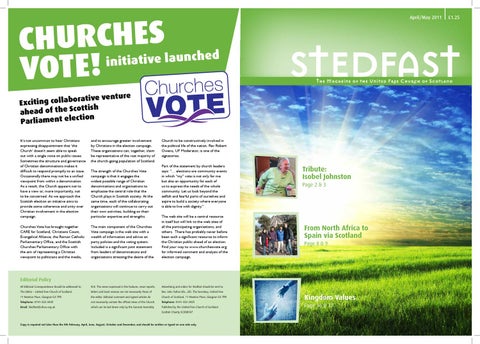
S E H C R U H C VOTE!
April/May 2011
d e h c n u a l e v i t a i t ini
e venture iv t a r o b a ll o c g Excitin ottish ahead of the Sc tion Parliament elec It’s not uncommon to hear Christians expressing disappointment that ‘the Church’ doesn’t seem able to speak out with a single voice on public issues. Sometimes the structure and governance of Christian denominations makes it difficult to respond promptly to an issue. Occasionally there may not be a unified viewpoint from within a denomination. As a result, the Church appears not to have a view or, more importantly, not to be concerned. As we approach the Scottish election an initiative aims to provide some coherence and unity over Christian involvement in the election campaign.
and to encourage greater involvement by Christians in the election campaign. These organisations can, together, claim be representative of the vast majority of the church-going population of Scotland.
Churches Vote has brought together CARE for Scotland, Christians Count, Evangelical Alliance, the Roman Catholic Parliamentary Office, and the Scottish Churches Parliamentary Office with the aim of representing a Christian viewpoint to politicians and the media,
The main component of the Churches Vote campaign is the web site with a wealth of information and advice on party policies and the voting system. Included is a significant joint statement from leaders of denominations and organisations stressing the desire of the
The web site will be a central resource in itself but will link to the web sites of all the participating organisations, and others. There has probably never before been such a significant resource to inform the Christian public ahead of an election. Find your way to www.churchesvote.org for informed comment and analysis of the election campaign.
All Editorial Correspondence should be addressed to:
N.B. The views expressed in the features, news reports,
Advertising and orders for Stedfast should be sent to:
The Editor – United Free Church of Scotland,
letters and book reviews are not necessarily those of
Rev. John Fulton BSc., BD, The Secretary, United Free
11 Newton Place, Glasgow G3 7PR
the editor. Editorial comment and signed articles do
Church of Scotland, 11 Newton Place, Glasgow G3 7PR
Telephone: 0141-332-3435
not necessarily contain the official views of the Church,
Telephone: 0141-332-3435
Email: Stedfast@ufcos.org.uk
which can be laid down only by the General Assembly.
Published by the United Free Church of Scotland.
The strength of the Churches Vote campaign is that it engages the widest possible range of Christian denominations and organisations to emphasise the central role that the Church plays in Scottish society. At the same time, each of the collaborating organisations will continue to carry out their own activities, building on their particular expertise and strengths.
Church to be constructively involved in the political life of the nation. Rev Robert Owens, UF Moderator, is one of the signatories. Part of the statement by church leaders says: “… elections are community events in which “my” vote is not only for me but also an opportunity for each of us to express the needs of the whole community. Let us look beyond the selfish and fearful parts of ourselves and aspire to build a society where everyone is able to live with dignity.”
Tribute: Isobel Johnston Page 2 & 3
From North Africa to Spain via Scotland Page 8 & 9
Editorial Policy
Scottish Charity SC008167
Copy is required not later than the 5th February, April, June, August, October and December, and should be written or typed on one side only.
Kingdom Values Page 16 & 17
£1.25
Christian Unity
In this Issue...
in Cathcart By Ian Duff from Cathcart Trinity
8
14
13 1
Christian Unity in Cathcart
6
Scotland at the Crossroads?
12
Living Links
2
Isobel Johnson Tribute
7
General Assembly
13
Operation World
4
Rabble-Rouser for Peace
8
From North Africa to Spain via Scotland
14
Bible Translation - In the Steps of King James
5
One World, One Vision, One Mission
10
Incarnation, Cross, Ressurection
16
Kingdom Values - Part 1
Editorial
Awaiting Copy
Photograph shows: Rev Iain Morrision (Cathcart Trinity), Maria Campbell (Session Clerk Cathcart Trinity), Rev John Fulton (Cathcart UF), Mr Angus Pender (UF Presbytery), Lesley Mathieson (Session Clerk Cathcart UF), Rev Dr Angus Kerr (Glasgow Presbytery), Rev Wilma Pearson (Cathcart Trinity).
On Sunday evening, 20th February, a service was held in Cathcart Trinity Church of Scotland to celebrate the signing of a Covenant with Cathcart United Free Church. This is the formalisation of a long standing relationship of co-operation between the two congregations which it is hoped will allow the Christian churches in the area to engage more effectively with the wider community in Cathcart. The service was well attended with members of both congregations, friends and visitors from churches across Glasgow. Rev Jim Neil, the former minister of Cathcart United Free Church and his wife Janette were amongst those in attendance. Following a welcome from Rev Iain Morrison of Cathcart Trinity Church a number of members from both congregations spoke of the growth in activity that has resulted from this
arrangement including Bible Study House Groups, monthly prayer breakfasts, the formation of a monthly meeting group for ladies as well as the successes of the Cathcart Youth Ministry Partnership which both congregations support in conjunction with Cathcart Baptist Church. As John Fulton explained this relationship has enabled the churches to be more effective together than they could be working separately - the sum of the whole being greater than that of each of the parts. The Covenant was read out by two of the younger members of each congregation, Ruth Pearson and Ruth Fulton before being signed by Rev Dr. Angus Kerr, Clerk to Glasgow Presbytery and Mr Angus Pender, Moderator of the United Free Presbytery of the West. The covenant was also signed by ministers and Session Clerks of each congregation. The service was marked by uplifting songs of praise celebrating the path that
God has led and the journey of faith that the congregations have embarked upon. The sermon was preached by Rev Bruce McDowall of Uddingston Park United Free Church and focussed on the Church as one body working together to the Glory of God and the enthusiasm that the congregations can have knowing that they are fulfilling the teachings of Christ by working in Partnership to serve the community. The service concluded with the celebration of Communion led by Rev Wilma Pearson following which the congregation moved to the halls for refreshments and the opportunity to meet one another. This was an evening of true celebration and,it is hoped, the start of new growth in the work of the churches in Cathcart.
1
Tribute: Isobel Johnston passed to be with her Lord at the age of 88 after a life of service, including 24 years as Sister and Matron of the Scottish Livingstone Hospital in Molepolole. As soon as she could after leaving school Isobel entered nurse training. Fever nursing in Aberdeen; general nursing at Edinburgh; then Bellshill for maternity; doing all three, because from an early age her sights were set on the mission field, though Isobel would also say that in her time at Edinburgh, the reality of Christ’s saving love came home in a fresh and deep way that set her ready for Christian service. In 1951 she went to Botswana, to the Scottish Livingstone Hospital as Sister, becoming Matron in 1958 at the age of 36, and Botswana remained ingrained
Isobel Johnston Molepolole and Aberdeen: Torry in her heart and prayers to the very end. Her deepest joy when two of the Bushmen became pastors to their own people in the 1990’s. (The article by Malcolm McArthur reflects on her time at Molepolole.) Returning home in 1975 Isobel became the first matron of Croft House Nursing Home infusing it with that same blend of homely and spiritual care. She retired in 1987 and almost immediately began a Lunch Club in Torry UF; an example of her perspective - intensely practical; intensely spiritual, with no divide between the two.
2
An extract from the tribute given by Dr Malcolm McArthur at the funeral service. The experience of Botswana gave her a view of all of life, as utterly God’s – so Lunch Club and Prayer Meeting were adjuncts of each other. She was a profoundly people person and in Torry, where she brought both young and older naturally under her wing. Isobel was always a hard worker; never walked where a trot would do and was a tremendous visitor to folks in the church. She had contentment; living on £25 a month in Botswana and expected to entertain; having little when she came home, but always confident the Lord would provide. One carer who only knew her in these last couple of years, physically weakened, memory failing, nevertheless described her as a real Christian. And she was right! A life for Christ, and love for Christ so completely woven into the fabric of who she was that His attractiveness shone right through. Isobel was awarded the M.B.E. for her services to Botswana. It was, however, another kingdom that was always in her sights. Her citizenship in heaven meant everything; and the reward – well done, good and faithful servant!
There are many, nurses, doctors, patients, children and adults, who remember Isobel with many happy thoughts. She touched many lives and we are all grateful for her touch. When I arrived at Molepolole in 1968, Dr Alfred Merriweather was on sick leave and Dr Emrys Thomas was the doctor in charge. After 2 weeks, Emrys said “Malcolm, it’s many months since we had a holiday and we feel we need to go away for a couple of weeks”. I had just come from the National Health Service and a very controlled environment, to this large hospital in Molepolole, which had one hundred and eighty beds, and here I was supposed to run this place. Anyway he said to me “Don’t worry, Jim Skinner is here, he’s a medical student and he’s been with us for a while”. Then Emrys said, “there’s also Isobel and Marion, they will run the place for you, if you have a problem they’ll sort it out”. And that was exactly what happened. Isobel had her finger on the pulse of that hospital in an incredible way and she knew everything that went on. You would see her walking through the hospital and she did not walk slowly, she walked fast. Everybody knew that Isobel could come around that corner at anytime and know what was going on, and know what she expected, and know what you hadn’t done to come up to scratch. One of my first memories of Isobel was in the Out Patients. I was seeing patients and I had this elderly man come in and all the patients were supposed to pay four shillings. But they all had excuses!
Anyway, this old man sat down with a big grin and said “I don’t have the money”. So I let him off the four shillings and wrote on the card, ‘to pay four shillings’, which is what we used to do. Then Isobel came in and she looked at him and she turned to me and she said “he needs to pay four shillings, this man has got more cattle than anybody else in Molepolole and he’s not poor, make him pay!” That was one of the first memories I have of Isobel, laying down the law in the Out Patients. Isobel did, regrettably, land the name ‘Mmabogale’ which means “the angry lady”. Because, she would go around the hospital and if anything was wrong, it had to be sorted out NOW and in the best possible way. Molepolole, under Isobel, I think gained the reputation of being the best hospital in Botswana. People would travel from the north of Botswana passing other hospitals on the way to get to Molepolole. It was clean, the floors shone, the walls were clean, the beds were properly made. Everybody knew that the treatment there was first class, so they used to come long distances. Gudrun told me a story Isobel used to inspect the nurses homes too. She went there one day and found some of the nurses keeping chickens in the bathroom! The chickens ended up on the table to be eaten the next day. Another problem that Isobel had was that nurses who came for training sometimes fell pregnant. One day I heard her talking to Alfred and she said “you know, I’m really tempted to put the ‘Pill’ into their porridge in the mornings”. Of course she never did that. Molepolole had Out Stations in the surrounding villages and even there Isobel
knew what was going on and, if there was a problem, she would get it sorted out. It was just amazing how she ran the whole of the little health service there. And it wasn’t just the health service she was also involved in, what in this country you call the Brownies, but which in South Africa you can’t call Brownies, they were called the Sunbeams and she had a big ministry with young people in the Sunbeams. We used to meet together every morning for tea or for coffee and it was the custom that the hosting of it went round the different houses. Isobel was often the life and soul of the party. There’s another thing she said which I’ll share with you. I cannot for the life of me remember why, but it was typical Isobel. Alfred was saying to her “you need a man to do that job.” Isobel’s response was “Ach, what’s a man? We don’t need a man, what’s a man?” Isobel had the effect of encouraging people to come and serve with her and the others at Molepolole, the prime focus being to serve the Lord in whatever way possible. As I think about Isobel one word comes to mind and that is the word focused, Isobel’s life was focused and it was focused on her service to the Lord Jesus from beginning to the end and that’s how I would describe her. She wanted all her waking energies to be focused on the service of her Master. Gudrun and I did have the opportunity to pop in and meet her in November. One of the things Isobel said then was “you know, I’m ready to go, I’m looking forward to the day when the Lord takes me because my time is up”. I leave that with you, I’m sure she was ready. So it’s a day of joy, her prayers have been answered. Isobel is with her Lord.
3
Rabble-Rouser For Peace By Rev Peter De Villiers
This is the title of the authorised biography of Archbishop Desmond Tutu by John Allen. It aptly sums up the life and work of this enigmatic son of Africa who announced his retirement from public life late last year. Desmond Mpilo Tutu was born on 7 October 1931 in Klerksdorp, a poor black township near Johannesburg. The home where he was born was like that of millions of other black South Africans - small and crowded with no electricity or sanitation. Their water came from a communal tap in the dry, dusty township street. His father was a respected schoolteacher while his mother worked as a domestic servant to a white family.
4
When he was fourteen Desmond became ill with tuberculosis and was kept in hospital for nearly two years. It was during his stay in hospital that he befriended someone who made a profound impression on the young Desmond and set him on a path that would change the course of his life
dramatically. That person was Father Trevor Huddleston, an English priest, who visited him every week. Trevor Huddleston had worked in Sophiatown, a black community in Johannesburg, for thirteen years. This was the beginning of a life-long friendship. His long stay in hospital gave Desmond lots of time to be still and think. He became more thoughtful and reflective, and developed a strong commitment to Christianity and a spiritual approach to life. In his book, God Has A Dream, Desmond Tutu describes how reflection and meditation is an integral part of his spirituality. He says, “I am deeply thankful for those moments in the early morning when I try to be quiet, to sit in the presence of the gentle and compassionate and unruffled One to try to share in or be given some of that divine serenity… I would be completely rudderless and lost if I did not have these times with God.” (p100) After leaving school Desmond trained as a teacher and went to teach at a high school, with typical passion and enthusiasm. He also became involved, with Trevor Huddleston, in working for the oppressed and suffering, helping when there were problems in the school or villages. This experience rooted his faith in a down-to-earth way so that
his religious beliefs were always closely related to his understanding of people and their lives. It wasn’t long before he decided to leave teaching and trained for the ministry. After ordination as a priest in the Anglican Church, Desmond left South Africa to study at King’s College, London and work as an assistant curate.
Five years later, with three degrees behind his name, Tutu returned to South Africa as a lecturer in Greek and theology at the Federal Theological Seminary at Alice in the Eastern Cape Province. He also worked as the chaplain at Fort Hare University, an institute where a number of African leaders, including Nelson Mandela, had spent their formative years. After three years at Alice he accepted a teaching post at the University of Botswana, Lesotho and Swaziland in Roma, Lesotho. Between 1972 and 1975, Desmond went back to London to work as associate director of the Theological Education Fund. During these years he visited many countries to allocate funds.
In 1975, aged 44, Desmond Tutu was elected Dean of Johannesburg, the first black person appointed to such a senior position in the Anglican Church. Tutu showed his support for ordinary black people by refusing to move into the plush home in a white suburb where previous deans had lived. He preferred to live with his family in Soweto, the sprawling, slumridden black township where most of the Blacks working in Johannesburg lived.
In 1976, after only two years as Dean of Johannesburg, Tutu was appointed Bishop of Lesotho, the small, independent country surrounded by South Africa. In 1978 he was given a very senior, and highly controversial, job which he felt compelled to take. The job was that of general secretary of the South African Council of Churches (SACC). The SACC had declared that apartheid was against the teachings of Jesus so Desmond could speak out against apartheid in the name of Christianity and not as a politician. He wanted the SACC to act as a conscience for South Africans which would show how directly apartheid went against the teachings of Jesus. His speeches became more and more rousing and warned people that they would have to accept a very high price in lives lost to win the struggle, but that nothing could stop them because God was on their side.
Desmond Tutu also passionately believed that apartheid damaged white people as well as black people because it made them lose their humanity. So he asked black people to pray for the white people of South Africa. Even though this view was not popular among Blacks, he wanted them to see that white people were also victims of apartheid. In God Has A Dream he writes: “All South Africans were less whole than we would have been without apartheid. Those whites who were privileged lost out as they became more uncaring, less compassionate, less humane, and therefore less human…”(p51) In 1984, whilst visiting America, Desmond Tutu was awarded the Nobel Peace Prize. As a result the spotlight of the world fell upon him and the struggle of black people against oppression in South Africa. He was now recognised worldwide as a symbol for the fight against apartheid. In 1986 he was promoted to Archbishop of Cape Town - the highest position in South Africa’s Anglican Church. He had taken on the most important job ever held by a black person in South Africa, talking on equal terms with, prime ministers, monarchs and presidents.
president. In order to bring about reconciliation between racial groups deeply divided over many decades, the Truth and Reconciliation Commission (TRC) was set up, chaired by Archbishop Desmond Tutu. This involved a process of sorting through the violent past of the apartheid era in order to find out and document the truth about all the crimes committed by both blacks and whites. In the TRC Tutu advocated “restorative justice” which he described as “the healing of breaches, the redressing of imbalances, the restoration of relationships…(a) kind of justice (that) seeks to rehabilitate both the victim and the perpetrator…” (Rabble-Rouser for Peace, p347)
After the first democratic elections in South Africa in 1994, the first black majority government took power with Nelson Mandela as the first black
One World, One Vision, One Mission! Plans are developing well for this year’s denominational event at Dunblane High School on Saturday 27th August with the working title ‘One world, one vision, one mission’. These events have proved to be encouraging opportunities to meet, worship and learn together. This year the event will come at the end of three weeks of mission by the join team from southern Africa and Scotland and the team will be taking part in the main
sessions and in a couple of workshops. The keynote speaker this year will be John Carrick UK Director of MECO (Middle east Christian Outreach). A varied programme of workshops is being put together covering topics including Healing, God’s plans for the world, Mission Opportunities and Developing Bible Study.
5
SCOTLAND AT THE
CROSS-ROADS? We are delighted to have this challenging article by Rev David C Meredith, Moderator of the General Assembly of the Free Church of Scotland
You will all have heard of triage. It’s the system which prioritizes cases in the emergency unit. If you turn up at the Western on a Friday night with a sore finger, you will be there until the next Wednesday. The situation will be dramatically different if you say the magic words, ‘chest pain’, you will then find yourself surrounded by the good and the great of the NHS within seconds. It’s just the same in our churches, the problem is that too many of us get worked up about the trivial. If the major problem in your congregation is conflict surrounding the flower arranging rota then you have problems. We simply do not have the time to tip toe through the tulips.
become missionaries by telling others about the cross. This truth about the cross is under attack from two different sources. On the one hand we have the vacuous trendiness of the emergent church movement and on the other hand the tired old liberal theology which has emptied churches all over the world, and especially in Scotland. The Scottish church must keep on message.
In a triage assessment of the Scottish scene, what would be our priorities? What are the life threatening issues?
6
I suppose that the first would be to ask if we were really on track with the gospel. In other words we ask ourselves if we are actually passing on ‘the faith once delivered to the saints’. Faithfulness to the truth of the Bible must be our starting point. If the foundation is askew then the whole building will be off-line. It may last for a little or even a long time but when it experiences real pressure, it will fall down. We certainly reject American style fundamentalism which owes more to the Pharisees than to our Lord but we view it as crucial (a great word) to teach the things that Jesus taught. At the heart of the gospel is the cross. It was at the cross that we realise that there was none other good enough to pray the price of sin. At Golgotha Jesus went into the very jaws of hell with all its darkness and curse as our substitute. We become a Christian by trusting that Jesus did indeed die for our sin and we
The message of the Bible is exciting. We follow a master who was supernaturally conceived, crucified and then experienced a bodily resurrection. All this is recorded in an inspired book and the message has changed millions of people throughout the centuries. You really have to try hard to make this boring. I think the second issue would be that of faithfulness welded to a contemporary mindset. As people come in contact with us as individuals and enter our churches they must know that we do live in 2011, and not in 1975. In the Bible the men of Issacher were commended because ‘they understood the times’. Jesus spoke the language of the people and dealt with the
issues of his day. It was said of him that the common people heard him gladly and that he spoke with authority and not like the other religious leaders. Our preachers must learn to build bridges between the timeless inspired Bible and the world of iPads and Starbucks. The truths of the past were not meant to be encased in a museum but are to be released in the homes and offices of our generation. The desire to connect does not come without a cost. We all find change difficult to deal with; we love our old pews, songs and Bible versions. It is a significant challenge to us all to know that our own personal preferences must die for the sake of the gospel. The only barrier in our churches ought to be the offense of the cross itself. Maybe even in some situations the building has to go. The old faithful damp shell must go to let new life burst through. The third issue would be that of denominational unity. Let me list the Scottish Presbyterian churches: Church of Scotland, Free Church of Scotland, United Free Church of Scotland, Free Presbyterian Church of Scotland, Free Church of Scotland (Continuing), Reformed Presbyterian Church of Scotland and the Associated Presbyterian Churches. I have not included the Free Presbyterian Church of Ulster in Scotland! The key is that the longer the name, the smaller the church. I think that we could at least reduce the list to three. We would have the liberal Presbyterian wing, the broad evangelical wing and the strictly confessional wing. I don’t think that denominations are all that bad an idea. We are all different and some like their religion dreicher than others. What is essential is that gospel people work together. In practical terms this means that we pray for each other, share ideas, and come to agreements to
plant churches in different strategic areas of the nation. We often forget that unity is not a luxury, it is a command. The effect that disunity has on our witness should not be under-estimated. At a recent wedding I was asked ‘Which lot are you and how are you different?’ I formed the impression that they were not too interested in a discussion on patronage, the voluntary principle and Erastianism. There is a sense that we live in the worst of times. Recent court decisions regarding guest houses and fostering have displayed a remarkable lack of tolerance to a Christian perspective. Christian morals are now an impediment in a fostering situation. In the world of ideas Professor Dawkins and the new atheists are best-sellers as they preach a message of militant and intolerant atheism. In Scotland church attendance is at a very low ebb and fewer people are choosing the church to help them through rites of passage such as baptisms and weddings. I wonder however if these are not also the best of times. One of the features of post-modernity is the willingness to talk about the ‘spiritual’. People now realise that we are not machines with skins, we have a soul and there is life after death. If people have rejected the church they have also rejected the folk religion which has plagued Scottish church life for generations. It is now thankfully rare for a minister to get a request to ‘do the wean’ from some parent who has no clue about saving faith or even love for Christ but simply wants to put some poor baby through a meaningless ritual. In 2011 we can confidently declare that Jesus did not come to start a new religion but he came to do away with religion.
As churches we may be slimmer than we were but we could also be fitter! The message of the gospel is exactly what the new Scotland needs. The United Free Church joins many of us at the cross-roads. What will our future hold for us? We must now ask the hard questions e.g. could we do more? Are we relevant? What are our denominational idols? Are we prepared to reform and change? If we are ready to follow the radical message of Jesus of Nazareth then Scotland will be turned upside down.
GENERAL ASSEMBLY
2011
The General Assembly is an opportunity for ministers and elders from all our congregations to meet together to review what has been happening over the past year and to consider our future direction as a Church. All sessions of the Assembly are normally open to the public.
In 2011 we will again meet in the Salutation Hotel, 34 South Street, Perth from Wednesday 1st – Friday 3rdJune. Prior to the General Assembly, the Annual Meeting of the Women’s Home and Overseas Committee will be held in the hotel on Wednesday 1st June at 11 a.m. and 2.15 p.m. On Wednesday 1st June at 11 a.m. there will also be the Leaders’ Forum meeting in Perth UF Church when the guest speaker will be Rev David Thompson, Mission Development Officer with the Presbyterian Church in Ireland who will be speaking about approaches to congregational mission. The General Assembly will open at 7 p.m. when the new Moderator, Mr George McRobb will be appointed followed by a Communion Service when Rev Robert Owens, retiring Moderator, will preach. During the closing service on Friday 3rdat 7 p.m., Mr. McRobb will give his address. We will have with us some of the Scottish young people who will be joining with the young people from UCCSA when they visit Scotland in August. On Thursday and Friday the various Assembly committees will make presentations and we will welcome visitors from other Churches and from various Christian agencies. On the Thursday evening we hope to have with us Rev David Thompson from Ireland and Mike Webb, Director of Flying Mission in Botswana. All sessions of the Assembly are normally open to the public.
Please remember the General Assembly in your prayers.
THURSDAY 2nd 09.45 • Reception of Delegates from other Churches • Report by Committee on Women’s Home and Overseas • Presentation by Ecumenical Relations Committee • Presentation by Christian Education & Evangelism Committee • Presentation by Administration & Finance Committee • The Annual meeting of the Friends of the Students Association will be at 4.30.
FRIDAY 3rd 09.45 • Representative of Scottish Bible Society • Presentation by Ministry Committee • Presentation by Overseas Committee • Presentation by Youth Committee • Presentation by Church & Society Committee
Breaks on both days will be: Lunch 12.30 – 1.45, Tea 4.30 – 7.00
7
From North Africa to Spain, via Scotland Catherine updates us on her time in North Africa and her preparations for moving to Spain. Please note that this article should not be republished in any form without permission.
Since May ’09 I have been living in North Africa in order to study the language and culture here as preparation for working amongst North Africans in Spain. I have moved house nine times, lived with three different local families and various groupings of foreigners. I have met some inspiring people, and said many ‘goodbyes’ as people left the country, not always by choice. I’ve battled with the ever-changing demands of the administration, ridden a camel, attended a funeral and various weddings, been scrubbed at hammams, and watched sheep being slaughtered for religious festivals. I bought my vegetables at the local market, my bread from the baker’s, and got clothes made at a local tailor’s. I grappled with getting my tongue around new sounds, and tuning my brain into a new language. I studied greeting protocol: groups of women sometimes all greet each other at the same time, asking in different ways how they are, how is their health, how are their families (but don’t ever ask after another woman’s husband!). Always greet people in a group from right to left. Kiss women repeatedly, an older woman on the hand, a child once. Shake a man’s hand, but only if he offers it to you.
8
In order to study the culture, our team had an ongoing list of cultural field notes, listing everything from how to serve tea properly, to beliefs about spirits. The
country still maintains a strong sense of regional identity and culture, with around 5 old languages spoken, plus those left by colonialists. This means that opinions and customs in one region might appear to contradict those of another. Apart from language and culture, I am also continuing to learn and re-learn many personal lessons: where, or rather who is my joy and refuge, when I have no close friends in a new city, or when colleagues are being expelled from the country? How can I talk about grace to others, when I still take pride in my faith, or my gifts, or I forget that all my fellow workers here are still works in progress, with sins, fears and doubts like myself? How can I make the most of my religious freedom in the West? How much compassion do I show to brothers and sisters who are suffering for their faith? How can we more fully express the Biblical concept of community?
Home to Spain In August, after a few months back in Scotland, I’ll finally return “home” to Spain. I say, “home,” because I lived there for thirteen years, until God led me in this new direction. While I’ve been in North Africa, a new team has arrived in my town, and I’ll be working alongside them to reach out to the North Africans there. At the moment, the team represent the countries of Lebanon, the US and Costa Rica, and it is likely that they will soon be joined by a Columbian family that I knew in North Africa, and who had to leave.
God can use all things for His glory. The work there involves four main areas. One obvious way of serving the community is through food distribution. A local church receives food from the Red Cross, and was already distributing to the Latin American immigrants, but had felt very challenged in distributing to the North Africans. The team took over that part of the ministry and are now helping 30 families with food packages.
From food distribution and their interaction with the North Africans, the team learned that most of them do not have a proficient level of Spanish. Over 150 people have enrolled in their language classes throughout the last 12 months, and there is a waiting list. They have now moved into a new centre and
are offering Spanish and English classes there in a two room setting. Project Baraka: Realizing that the food distribution only met the needs of 30 families, they still had more immigrants asking for food. They formed “Proyecto Baraka” which means blessing in Arabic. Basically, if a family comes and requests help in the form of food, medicine, nappies, etc. they set up a time to visit with them in the home. The North Africans open their home, offer tea, and the team brings a modest supply of food, along with the reason that they are helping them. They have a chance to pray
If you would like to receive my regular letters, if you know of any speaking opportunities, or you would like to join myself & other speakers April 15th - 17th at the Scottish conference of UFM Worldwide, please contact Iain Cameron at:
for them and read words from the Bible with them, thus blessing them physically and spiritually. Of course there are other social events that are used as outreach opportunities as well. American, Spanish and Muslim holidays all provide opportunities for visits and day trips to local parks. When they celebrate birthdays or when friends get sick, they also seize opportunities to visit and pray with them.
during my time back in Scotland, I hope to visit as many fellowships as possible to be able to talk about other dimensions of the work, and to thank supporters for the role they have played during these last two years.
I am really looking forward to joining the team and getting stuck in! But first,
UFM Worldwide 11 Newton Place, Glasgow G3 7PR Tel 0141 353 0666. Email: iain@ufm.org.uk
9
Incarnation • Cross • Resurrection “It is not easy to convey a sense of wonder, let alone resurrection wonder, to another. It’s the very nature of wonder to catch us off guard, to circumvent expectations and assumptions. Wonder can’t be packaged, and it can’t be worked up. It requires some sense of being there and some sense of engagement.”
CHRISTMAS
TO EASTER
-Eugene H. Peterson
Christians emphasise Christmas too much! The essence of this is due to the nature of the celebration, apart from being commercialised, Christians tend to exaggerate Christmas to the detriment of Easter. I can sympathize with those who would try to correct the misunderstanding!
‘It’s EASTER that is the centre of our identity as Christians!’ Leading to the reaction that Christians emphasise Easter too much! However, as we get genuinely involved in faith, it becomes clear - that Christmas and Easter can never truly be detached or unconnected from one another. To overemphasise Christmas devalues Easter – is a fundamental mistake. While Easter is the reason we are Christians in the first place, you never get to that point without the birth of the Lord in Bethlehem. Therefore, we must celebrate EASTER and CHRISTMAS in an incredibly deep manner. For the biblical teaching regarding the incarnation of Christ, and the work of the Christ the Mediator in death and resurrection, is awe-inspiring. This amazes us not simply because it is mysterious, but because there is a sense in which the union of the two natures in Christ [God and Man] is the greatest miracle in Scripture. We will examine further the significance of this by discussing the relationship between the Incarnation, the Cross and the Resurrection.
INCARNATION
10
The incarnation simply means God came to be a man. He was fully man while remaining fully God. That way He could identify with our plight in life. He worked with His earthly father. He obeyed His
earthly mother when she asked Him to do various things. He played, He worked, and He lived the life of a man, a human being, with all that we have in our makeup that makes us human. He went to sleep at night, and awoke to a normal life with all of the stresses and opportunities a human could have in the
our redemption. For though Christ, as God, was infinitely sufficient for the work it was needful that he should be also man. If Christ had remained only in the divine nature, he would not have had the capacity to purchase our salvation; not from any imperfection of the divine nature, but by reason of its absolute and infinite perfection: for Christ, merely as God, was not capable either of that obedience or suffering that was needful. The divine nature is not capable of suffering; for it is infinitely above all suffering. Neither is it capable of obedience to that law which was given to man. It is as impossible that one who is only God, should obey the law that was given to man, as it is that he should suffer man’s punishment.
THE CROSS
first century. Therefore, we can never say to Him, You do not understand my situation or me! He does indeed understand. He has indeed been where we are. Christ became incarnate, or, which is the same thing, became man, to put himself in a capacity for working out
The apostle Paul writing to the Philippians says, he took upon him the form of a servant, was made in the likeness of man. Humbled himself unto death, even the death of the cross. (Philippians 2:8) He died. And it’s not enough to say because of his death, it says because of the suffering of death. It was not an easy exit from the land of living for Jesus. It was accompanied with outward torture and inward agony. His death was an excruciating and painful experience for him. So when we think about Jesus as the substitute, we have to remember that he as God above the
angels became for a little while, lower than the angels. Came all the way down to do what no angel has ever done and that is to do what only men do and all men do it - that it to die. That’s the extent of his humiliation.
He took the poison meant for us and drank it all. He bore our sins in his own body on the cross. He was our substitute. God punished him instead of us. He bore the wrath of God. He took the curse in our place. He drank the cup of God’s vengeance. He paid the penalty for our having broken God’s law. He drank the cup of judgment down to the very dregs. Though he was guilty of nothing, he tasted death for everyone who would ever believe in him. There would be no other way to know the grace of God. There would be no other way to know his saving power if Jesus didn’t die. There would be no other way to reclaim lost sinners and bring them to glory. There would be no other way to bring about the new birth, forgiveness, transformation, conversion, new life, except through the death of Jesus Christ so that lowering himself became the means of exalting himself.
He was exalted because he was humbled. He went down in order that he might go up. Far from Christ’s death being something of which he should be ashamed, it is the very reason for which he has been exalted and it is the reason for which he will be praised and is being praised forever and ever and ever by saints and angels. He is our substitute. He came as man, lower than the angels to die in man’s place because of the grace of God and as a result of that he has paid the penalty for our sins and is our saviour, to be crowned with glory and honour forever.
RESURRECTION When Jesus rose, everything changed. What was so different about Jesus’ resurrection? The key lies in who died and rose. In the case of Jesus, someone much more than a man died and rose again. Jesus was a man, but not just a man. He was the God-man — God in the flesh, God incarnate, both God and man in one. The reason his death and resurrection have such power is not because death and resurrection are the greatest miracle. Rather it is because his death and resurrection had been preceded
by the miracle of the incarnation. The incarnation means his resurrection is new. By a miracle that passes human comprehension, the Creator entered his creation, the Eternal entered time, God became human—in order to die and rise again for the salvation of all people. The power of the life, teaching, death and resurrection of Jesus Christ does not lie in the events themselves. The power of the events derives from the person of Jesus himself: who and what he was and is. His words have power and authority because they are the words of God incarnate. His life has power because it is the life of God incarnate. His death and resurrection have power because they are the death and resurrection of God incarnate. The teaching of the New Testament makes it clear that we cannot isolate the resurrection from the whole redeeming purpose of God or from the decisive deed of God in the incarnation of his Son that ran its full course from the birth of Jesus to his crucifixion and triumphant resurrection. It is in the resurrection that we have the unveiling of the mystery of the incarnation: the birth and resurrection of Jesus belong inseparably together and have to be understood in the light of each other.
11
LIVING LINKS FROM CHRYSTON TO KENYA By Rev George Mitchell Rev. George Mitchell reports on a recent visit to Kenya, as part of his ongoing work there, and on his association with the United Free Church.
I was taking an evening service in Cumbernauld, when a group of about eight people from Chryston United Free Church trooped in... Seeing them took me back a few decades! I had preached in the Chryston UF church back in the sixties, when I was a lecturer at the Bible Training Institute in Glasgow. Now the link was re-opened, and I was invited back. The church folk were emerging from a difficult time, and it was a joy to see them stirring with a desire for change. The congregation at Chryston have been among those who have taken an interest, involvement, and have given generous support to the ministry I have been involved in Kenya. I have been a member of a visiting team of lecturers doing a Block Unit for the BA degree students at Scott Christian University, Machakos, Kenya. This year I went back at the invitation of some Africa Inland Church congregations to do preaching workshops, give leadership seminars, and visit orphans at Springs of Hope Child Care in Machakos. I was also able to take help for agricultural and practical projects, like buying ovens. I was there from 3-19 January, working in three centres Nairobi, Nakuru in the Rift Valley, and Machakos. My workshop sessions included pastors, teaching elders and lady
12
workers, and numbered from 35-120. On my first Sunday (9 January) I preached in the AIC Jericho church to about 3300 people in total over two services. My workshop sessions were on ‘Preaching through Galatians’.
It was great to see again how busy God is in Kenya! The kindness of those supporting this ministry has helped me to see the Africans’ tremendous energy, commitment and vision; their work among large numbers of children and young people, and their ambitious building projects. I had taught for years that Christian joy was independent of material circumstances, but I had to go to Kenya to see this teaching embedded in the daily lives of Christian people. Many of the people I met were materially poor, but full of the joy of the Lord. I also realised that there is still a place and a role for foreign help, even on a shortterm basis. Romans 15:1 says: ‘we that are strong ought to bear with the failings of the weak, and not to please ourselves’. This text sets out a Supposition about Strength, and an Obligation about Service, and a Prohibition about Selfishness. I close with two stories arising from my visit. At the end of my workshops
in Nairobi, a beautifully dressed and cultured Kenyan came to thank me for the teaching. I heard Japhet’s life story. He was a barefoot herd-boy, whose education started when he was 14 years old. He paid his friends 20 Kenya shillings (one-sixth of a pound sterling) for each letter of the alphabet they would teach him. He attended church and came to faith in Christ. A Christian man in his congregation funded his schooling, where he did well, and learned to play the guitar. He is now one of Kenya’s foremost Gospel singers, and owns a string of music shops throughout Kenya. He trains the praise bands and the choirs in the Jericho church, Nairobi. Soon after my return on 20 January, the chair-person at a meeting where I was giving a Bible message mentioned my visit to Kenya, and my workshops, seminars and visit to the orphans. A week later, a lady sent me £6000 to help a building project at the Springs of Hope Child Care Orphanage!
I am so grateful to God for the support, kindness and encouragement of those like Chryston UF, among others, and for the strength to serve God overseas.
George Mitchell was born and raised in Glasgow and trained for Christian service at Lambhill Evangelical Church, and London Bible College (now London School of Theology). He has had a varied career spending five years as a metallurgist in the steel industry, seventeen years as a full-time teacher and lecturer, and over twenty years as a Baptist pastor in Scotland. He is currently a guest lecturer at the International Christian College, Glasgow, and Scott Theological College, Machakos, Kenya. George has had five books published perhaps the best known being ‘Comfy Glasgow’.
Operation World By Famie Crawford As can be seen from the cover above, this is the 7th edition of the book. Written this time by Jason Mandryk and his team. Jason is a full-time member of Worldwide Evangelisation for Christ, comes from Canada and works at Bulstrode, the UK Headquarters of the mission. Patrick Johnstone has only retired from the continuing writing of this and future editions but is still active in world mission, lecturing and writing.
If you love geography, you’ll love this book. If you are into statistics, you’ll love this book. But, perhaps most importantly, if you are seriously interested in praying for every people on the earth this is the book for you. It is as it says on the front cover ‘The Definitive Prayer Guide to Every Nation’, a book that is not meant for gathering dust on the shelf but used as a prayer tool for effective prayer for every land and peoples therein.
The book can either be bought on its own or on a CD-ROM, as an e-book in PDF format and also on enhanced DVDROM which provides further information and has photographs and maps that can be used for presentations along with the rights to reproduce its content. It is on sale at Christian bookshops, can be bought directly from OM or WEC (or myself) and can even be found on Amazon.
13
Bible Translation In the Steps of King James
Continuing our series marking the 400th Anniversary of the Authorised version of the Bible, we asked Stephen H Levinsohn to give us an understanding of the role of the translator and what they are seeking to do.
Stephen and Nessie Levinsohn have been members of Wycliffe Bible Translators since 1965. Nessie was converted through the ministry of her Bible class teacher at the Wynd U.F. church in Crown St., Glasgow. The Levinsohns left for Colombia in 1967 to work with the Inga people. The New Testament and parts of the Old Testament in Inga were dedicated in 1997 and recent reports indicate that they continue to be used in local churches. Since 1997, Stephen has been involved in the training of national and expatriate Bible translators, and has also run ‘Discourse for Translation’ workshops around the world for translators working with over 300 language groups. The Levinsohns have a house about five miles from Wycliffe’s UK training centre near High Wycombe, and Nessie helps out at the Wycliffe office. The Authorised Version of the Bible was the culmination of 230 years of efforts to produce a translation into English that any native speaker could understand. John Wycliffe had declared in 1381 that “all Christians ought to know holy writ”. Erasmus had written about 1516, “Christ desires that his mysteries should be spread as widely as possible. I should wish that all good wives read the Gospel and Paul’s Epistles”. And, around 1521, William Tyndale had rebuked a priestly opponent with the words, “If God spare my life, before very long I shall cause a ploughboy to know the Scriptures better than you do”.
14
When King James appointed a committee to produce a new English translation, his main concern was with UNITING
different factions within his kingdom. Translations of the Bible into other languages can still have the same effect. Project co-ordinators seek to ensure that their committee includes representatives from each denomination that works with the language group. At times, this results in Christians working and praying together who have never previously enjoyed fellowship with each other. The members of the committee will also strive to come up with technical terms that are acceptable to all the denominations. It is not unknown for different church groups in an area to have been using distinct words for God, so they have to agree on a single term before the Scriptures can be printed. They will look for an expression for baptism that is acceptable to both Presbyterians and Baptists. ‘This is My Body’ (Matt 26:26) will be rendered in a way that allows for both Protestant and Roman Catholic interpretations. And Pentecostals and non-Pentecostals alike will need to be comfortable with the way references to being baptised with the Holy Spirit and speaking in tongues have been translated.
King James was concerned with ACCURACY. He ordered his committee to produce a text that was faithful to “the original tongues”. Translators today have the same goal, so consultants with knowledge of Hebrew and Greek check the draft translations into target languages to ensure that they communicate what they should.
Each month I receive the draft of a chapter of Exodus in the Balangao language of the Philippines, together with a word-by-word rendering in English of the Balangao text. I compare each verse with the Hebrew, to make sure that it captures the meaning of the original. When I find an error or feel that there might be a clearer way of rendering the verse, I email back with comments, which the native translator considers and then acts upon. For instance, I found that ‘while the owner is not present’ (Exo 22:14) had been rendered, ‘the owner of the animal did not see what happened’. This led me wto write back, ‘I think this misses the point. The Hebrew means that the owner was not present when the animal was wounded or died. If he is present, then the Bible considers that he is responsible for it. So, I suggest you replace ‘the owner of the animal did not see what happened’ with ‘the owner of the animal was not with it’.’ Sadly, not every error is caught by the checker. The earliest edition of the KJV omitted ‘not’ from ‘Thou shalt not commit adultery’! Ruth 2:1 in some Swahili Bibles informs the reader that Naomi ‘was with’ a relative named Boaz (the normal way of translating ‘had’ into the language). Unfortunately, Tanzanian pastors who were translating the book of Ruth into their mother tongues understood this to mean that Naomi was Boaz’s partner! How relieved they were when their drafts were changed to ‘In that town there was a relative...’! Translations can be superficially accurate, yet get the emphasis wrong. This sometimes arises in English when the version has copied the order of the
words in the original. Luke 3:8b provides an example. The KJV reads, ‘for I say unto you, that God is able of these stones to raise up children unto Abraham’. NIV is similar: ‘For I tell you that out of these stones God can raise up children for Abraham’. A casual reading of either sentence will probably put the emphasis on ‘children unto/for Abraham’. In fact, the emphasis should be on ‘out of these stones’, which is best captured in English by putting the expression at the end of the sentence and adding an ‘emphatic’ word such as ‘very’:
‘I tell you that God can make children for Abraham out of these very stones’. King James instructed his team to make the translation CLEAR, and Bible translators today strive to do the same. Modern versions in English avoid words that have gone out of common use such as ‘concupiscence’ (Rom 7:8; NIV has ‘covetous desire’). Rom 3:25 no longer has the term ‘propitiation’ (KJV) or ‘expiation’ (RSV), because neither word features regularly in 21st century English. Instead, the NIV has ‘sacrifice of atonement’, while the GNB rephrases the whole sentence: ‘God offered him, so that by his sacrificial death he should become the means by which people’s sins are forgiven through their faith in him’. In the Inga New Testament, two sentences were needed to capture the same idea: ‘In this, Father God said for Jesus Christ, having become killed, to take
away our sins by means of his blood that was shed. It is by thinking well with him [i.e., believing on him] that we became forgiven.’ Translators also want their work to sound NATURAL. In some languages (e.g., Koiné Greek), it is natural to start every sentence of a story with ‘and’, whereas in other languages (e.g., modern English), it is not. In some languages (e.g., Biblical Hebrew), it is natural to introduce every reported speech with ‘and he said’ (e.g., ‘And Pharaoh said, Who [is] the LORD, that I should obey
his voice to let Israel go?’-Exo 5:2 KJV). In other languages (e.g. modern English), the expression goes later in the sentence (e.g. ‘Who is the LORD,’ said Pharaoh, ‘that I should listen to him and let Israel go?’-REB).
One of the reasons I run ‘Discourse for Translation’ workshops in different parts of the world is to help translators discover the most natural way of putting the different parts of a story together in the target languages.
speakers find the result more pleasing. It isn’t difficult to discover whether stories in the language normally begin with a conjunction like ‘and’ or not, but what a difference such knowledge can make to the naturalness of the translation! Again, it is not difficult to discover whether the language normally puts ‘he said’ before the reported speech, in the middle of the speech, or at the end, but what a difference such knowledge can make to the naturalness of the translation! Etc., etc. Erasmus wished that the Scriptures “were translated into all languages” and his desire is rapidly being fulfilled. In September 2010, a complete Bible was available in 457 languages, 1211 further language groups had at least a New Testament, and an additional 897 groups had one or more books of the Bible.
Around the world, Bible Societies and agencies such as Wycliffe Bible Translators are labouring to ensure that, by the year 2025, workers have started to translate the Scriptures for the estimated 340 million people who cannot yet hear the Gospel in a language that they understand well. Please pray for God to raise up more native and expatriate Christians who, with training, will be able to serve as Bible translators. Pray for more consultants to become available to check the resulting draft translations. In short, pray that the remaining 2000 plus language groups where there is a need for Bible translation to begin will soon have access to Scripture in their heart language that is accurate, clear and natural, ‘so that the body of Christ may be built up until we all reach unity in the faith and in the knowledge of the Son of God and become mature, attaining to the whole measure of the fullness of Christ’ (Eph 4:12-13).
If they then tend to follow the same patterns in their translations, native
15
KINGDOM VALUES
Part 1
The brief paper on this topic among the appendices of the Church and Society Committee’s Report to the Assembly General sought to give a more general biblical and theological rationale to the papers on the specific topics of “green issues”, living and dying well and the end of life assistance bill. Can we try to tease that out some more – not least in the light of all the current debate about “the big society”. In recent years there is a new, timely interest in the concept of the Kingdom of God. The real danger of any quite legitimate burden for the renewing of the Church, is that we can see that as an end in itself; whereas, biblically, the Church is the agent and herald of the Kingdom. Thus whatever else renewal does, it should give a new appreciation and new perspective of the Kingdom. Even the most cursory reading of the first three Gospels reveals the Kingdom of God as the major theme of Jesus’ preaching - “The time is fulfilled, the Kingdom of God has come near; repent and believe in the Good News” [Mark 1:15]. Perhaps more accurately, we are talking about the Kingship or rule/reign of the living God rather than Kingdom - which has connotations of location and place. The Kingdom is present among humankind - “near” or “at hand” - in the ministry of Jesus. It grows through the ministry of the Holy Spirit and the agency of the Church and comes in all its fullness when Christ comes in glory.
God’s Upside Down Kingdom
16
The Sermon on the Mount has been described as “the Manifesto of the Kingdom”. The Beatitudes set out Kingdom values and clearly they are not typically high on the world’s
appreciation list. In fact, they are in sharp contrast - “poor in spirit” with arrogant self-sufficiency; “mourning” or sorrow over sin with indifference to wrongdoing; “meekness” with aggressive self- seeking; “hungering and thirsting for righteousness” with worldly hunger for power; “pure in heart” with worldlywise; “peacemakers” with the stirrers; the “persecuted” and powerless with the funloving or the movers and shakers. Which values do we appreciate as a Church, and which standards do we follow?
Jesus says we are to be in the world as salt and light [Matthew 5:13-16]. We are not intended to be the same as the world but to be agents of Kingdomtransformation within it. As Os Guinness and others have pointed out the world seeks to privatise religion and secularise society. Christian faith is a “private” matter or out of place in the market place. Even more, who among thought we would see the day when the Christian faith and the Church were increasingly marginalized in our country? Yet the Kingdom - like our discipleship and Christ’s Lordship - is clearly a “wholeof-life” concept. Similarly the emphasis of the “antitheses” in Matthew 5:21-48 is on the importance of inner attitude and motivation as much as the outward action.
Neither can we simply make an outward show of our faith - going through the motions - for God is the Father who “sees what is done in secret” [Matthew 6:18] also discerns the thoughts and intentions of the heart. We need to be quite clear about our mindset and what we regard as of infinite value - our “treasure” [6:21]. As well as this, we should not be obsessed with worldly security - getting and having. Rather, we should be continuously and consciously seeking first the Kingdom of God and his righteousness, confident in God’s providential care for his own. We should not be quick to criticise or condemn others, while being easy on ourselves. [7:1-5] Our life of faith should be marked by patient perseverance - keeping on asking, seeking and knocking, for that is the way to receive, to find and to have the door opened to us. The solemn conclusion to the Sermon on the Mount makes plain that mere formal profession is not enough in Kingdom-terms. There is the dire warning conveyed in the picture of the two gates and the two roads, the word about the tree being known by its fruit, as well as the two builders and their two foundations. Spiritual feelings or experiences, pious sentiments and even right doctrinal words or religious activity are not sufficient of themselves. The real test is obedience - a hard thing for our generation to accept - doing “the will of my Father who is in heaven” [Matthew 7:21].
into its mould, but be transformed by the renewing of your mind.” Increasingly we are aware of the world’s attitudes, outlook and standards pressing in upon us. The pernicious siren song of the world is to “Be like us! Don’t be different!” The song of the sirens, however pleasant and hypnotic, drew the sailors to danger, disaster and death. We should heed the warning. The admonition in 1 John is: “Do not set your hearts on the godless world or anything in it. Anyone who loves the world is a stranger to the Father’s love” [2:15NEB].
We are urged to live consistent with our calling in Christ - to live worthy of that calling [4:1]. This in turn requires that we live differently [4:17]. Notice that the gentiles or pagans are described as living “in the futility of their thinking” and as “darkened in their understanding”. This surely equates to an unrenewed mind, evidenced in their “having lost all sensitivity”, giving “themselves over to sensuality” and indulging “in every kind of impurity, with a continual lust for more” [4:19]. Believers are elsewhere warned against the worldly practice of acquisitiveness and greed; “the covetousness which is idolatry” [Colossians 3:5]. Rather, believers are to live in a way which does not grieve the Holy Spirit who dwells within and among them [4:30] While being people of robust faith, capable of standing up to the knocks life brings, we need to be sensitive to the witness and prompting of the Spirit who constantly reminds us of the attitude and standards of Jesus. See how the notion of grieving the Spirit seems related to our having right relationships with one another [4:31-32]. How many lives and
relationships in the church are destroyed by bitterness, rage or by letting our tongues run away with us? The world may harbour grudges or pay off old scores, but the principle of Kingdomrelationships is mutual forgiveness. Similarly we should live disciplined by love [5:2] with Jesus as our model. Notice this is authentic as distinct from superficial, counterfeit love. The love of God for us in Jesus is costly. Its symbol is the cross. Our expression of that love to others must also have something of the cross at its centre. On no account should we be deceived by empty words [5:6], being swayed, influenced or taken in by their glib arguments. In the world’s darkness we are to “live as children of light” [5:8] exercising mature discernment in recognising that “the fruit of light consists in all goodness, righteousness and truth”, while avoiding and showing up for what they are “the fruitless deeds of darkness”. Living the Kingdom-life means concern to “learn what is pleasing to the Lord” [5:10]. We have to be careful and diligent to live in the right way [5:15], living wisely rather than foolishly, according to the light. We should be making the most of every opportunity [5:16] - cf “redeeming the time” [KJV] because we appreciate what is going on between the world and the Kingdom. We need to understand what the will of the Lord is [5:17], - his glorious cosmic purposes, as well as his day-to-day plans for our lives. We need to keep on letting the Holy Spirit fill us [5:18] for we dare not get to the place of “running on empty” so to speak. To change the metaphor a bit, too often congregations and individuals try to exist on the accumulated spiritual capital of the past, and sooner or later it runs out. Thus we require the constant filling up of the Holy Spirit to keep us fresh and vigorous in faith and service. “Always
and for everything giving thanks” [5:20] - what a marvellous characteristic of the Kingdom, in contrast to the all too prevalent attitude of thanklessness and ingratitude. Little wonder John Stott’s subtitle for his commentary on Ephesians, the epistle of the Church, is “God’s New Society”. How does that compare with the politicians call to “the big society”, to help our neighbour, to volunteer to help run all kinds of enterprises from local community halls, post offices and libraries to some public services and charities, for we’re all in this together? Little wonder the Archbishop of York gently chided them some months ago saying many had been doing this for years and it was called “church”. And yet, how often are we as Christians and as “church” failing to live up to our calling to be agents of the Kingdom in the world?
For Personal Reflection or Group Discussion: 1. In what ways could you/your congregation be living as salt and light in your local community? 2. Reflect on what it means to “live as children of light”. Remember Jesus said: “I am the light of the world” [John 8:12] and “You are the light of the world” [Matthew 5:14]. 3. Compare and contrast the notions of “the big society” with the vision of “the Kingdom of God”.
Suggested Further Reading: The Upside Down Kingdom Donald B Kraybill - Marshalls Issues Facing Christians Today John Stott - Marshalls The Gravedigger File Os Guinness - Hodder
A Distinctive Lifestyle The second half of the letter to the Ephesians is about being the people of God in the world. It is a call to a distinctive lifestyle. It might almost be an elaboration of Paul’s phrase in Romans 12:2 “Don’t let the world squeeze you
Postscript In recent issues of Stedfast we have been reflecting on the report from our Church and Society on ‘Kingdom Values’ and the need to bring these values into modern society. One area where this is particularly vital is the media. Norman is someone who is seeking to do precisely that – and doing so with a fair degree of success despite the reluctance at times of the BBC and others to accept his work. Whilst we may bemoan much of what is broadcast, we should remember Christians working in the media and rejoice in the good things that are broadcast. This is a topic we hope to take up in a future issue.
7 17