HAITI UPDATE FROM CHRISTIAN AID (...cont.)
April / May 2010
Easter in China Page 2
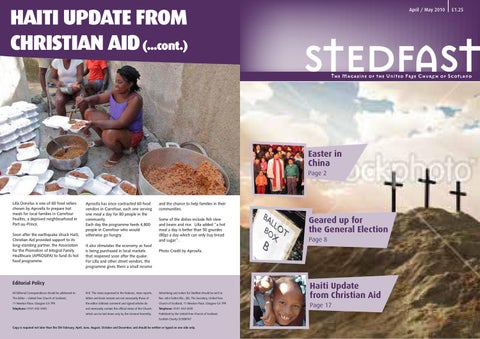
Lilla Dorvilus is one of 60 food sellers chosen by Aprosifa to prepare hot meals for local families in Carrefour Feuilles, a deprived neighbourhood in Port-au-Prince. Soon after the earthquake struck Haiti, Christian Aid provided support to its long-standing partner, the Association for the Promotion of Integral Family Healthcare (APROSIFA) to fund its hot food programme.
Aprosifa has since contracted 60 food vendors in Carrefour, each one serving one meal a day for 80 people in the community. Each day the programme feeds 4,800 people in Carrefour who would otherwise go hungry. It also stimulates the economy as food is being purchased in local markets that reopened soon after the quake. For Lilla and other street vendors, the programme gives them a small income
and the chance to help families in their communities. Some of the dishes include fish stew and beans and rice. Lilla added “a hot meal a day is better than 50 gourdes (80p) a day which can only buy bread and sugar”.
"
Geared up for the General Election Page 8
Photo Credit by Aprosifa
Editorial Policy All Editorial Correspondence should be addressed to:
N.B. The views expressed in the features, news reports,
Advertising and orders for Stedfast should be sent to:
The Editor – United Free Church of Scotland,
letters and book reviews are not necessarily those of
Rev. John Fulton BSc., BD, The Secretary, United Free
11 Newton Place, Glasgow G3 7PR
the editor. Editorial comment and signed articles do
Church of Scotland, 11 Newton Place, Glasgow G3 7PR
Telephone: 0141-332-3435
not necessarily contain the official views of the Church,
Telephone: 0141-332-3435
which can be laid down only by the General Assembly.
Published by the United Free Church of Scotland. Scottish Charity SC008167
Copy is required not later than the 5th February, April, June, August, October and December, and should be written or typed on one side only.
Haiti Update from Christian Aid Page 17
£1.25
In this Issue...
17
We asked Rev Peter de Villiers to find out how the Churches in South Africa are preparing for the World Cup Finals.
4
8 1
Forget South Africa, It’s Scotland 2011
7
Homecoming at Millerston
11
Calvin & The State
2
Reaching Thai people in the UK together
8
Love Life - Live Lent
12
Missionary Prayer Points
5
World Missionary
9
“All you cant leave behind”
14
Easter Scheme 2010: North Korea
6
Training Opportunities
10
News from The Moderator
16
Compassion in China
Editorial So what do you think of politicians? It is very easy to be critical of them over issues such as expenses or because they make decisions which challenge our Christian values. Yet how much time do we spend praying for them? The article on page 3 reminds us of Paul’s instruction to ‘pray for those in authority’ but how often do we do that? Before the next Stedfast appears there will almost certainly be a General Election and there are articles to help us think about some of the issues we should be concerned about so that when we vote in the election we are not simply thinking of what is best for us. The Scottish Parliament also influences much of what we do and the article on the Assisted Suicide Bill suggests we should contact our MSP’s to let them know how we feel about this important and emotive issue. There is also an article which offers the possibility of Christians becoming involved in local government elections in 2012. Pray for politicians, take an interest in the issues, write to those who represent us, become involved ourselves – are these not better options than simply criticising? John Fulton
THE CHURCH AND WORLD CUP 2010
The greatest sporting event in the world, the Football World Cup, will kick off in June, for the first time on African soil. Matches will be played in nine cities across South Africa.
of course, it presents amazing opportunities for people to meet Jesus Christ, in direct and indirect ways, in churches and through witnessing Christians.
Sadly for Scottish football fans, their team failed to qualify for the finals. However, it is hoped that, in a spirit of Christian neighbourliness, many Scots will put their own disappointment behind them and root for the English team.
An interdenominational service is being planned on the opening day, to be broadcast live on TV. There will also be, if possible, multilingual and other liturgical celebrations to show hospitality and share fellowship. Other activities include special services during the World Cup, youth services, and facilities for quiet time.
As in Scotland, football (or soccer) is reported to be the most popular sport in South Africa, more than a sport for some, even a religion or a way of life. There is no doubt that the 2010 Soccer World Cup is going to have a great impact on South African society in a whole range of ways. Construction companies are benefiting, tourism and the entertaining and catering industries are gearing up and will benefit at the time. An obvious benefit will be increased employment in a country where there is mass unemployment. A lot of creative people will use the increased tourism to make and sell more of their goods: jewellery, artwork, and so on. More people will be needed to keep the streets clean and guarding cars is another opportunity for making money. This great world spectacle also presents a host of possibilities for constructive, positive and enjoyable events and activities where the Church too can play its part. Most importantly,
The Anglican Church and other faith groups are teaming up to run “faith clinics” close to stadiums. The clinics will provide a place for prayer, solace and practical support. In particular, the tournament will attract many beggars, asking for food or money or looking for somewhere warm or dry to sleep, such as the new stadiums, if they can get in. The football players will not be forgotten when it comes to pastoral care. A chaplaincy and counselling service for the players and officials will be set up. Local ministers and sportsmen of different faiths will be trained to counsel the world’s soccer players who may have problems. This will necessitate training counsellors and chaplains in the nine different cities where the games are to be played, and notifying all the team managers of these chaplains. For South African church leaders human trafficking is one of the greatest
challenges for local churches. The FIFA 2010 tournament is expected to generate more than 4 billion US dollars, the highest revenue in World Cup history. This raises serious concerns about the possible increase in the abuse, exploitation and trafficking in persons, especially children during the games. More specifically, the concern is based on the argument that a temporary gathering of people in a setting like the World Cup will lead to an increased demand for sexual services and this demand will be filled by trafficking victims. In January 2008 the Counter Trafficking in Persons Desk was set up by the Leadership Conference of Consecrated Religions and the Southern African Catholic Bishops Conference. One of the main tasks of this desk is awareness raising around the whole issue of human trafficking about which a lot of ignorance exists. To this end a number of workshops have been conducted around the country. Resource materials have also been produced. Churches are already preparing themselves to deal with this issue. They are already organising consultations among themselves and with other faith communities to develop a common strategy to tackle the problem. A major focus will be advocacy work with the government. It seems, then, that the churches in South Africa are “on the ball” and excitedly waiting for the kick-off!
1
ELECTION CLIMATE QUESTION
After the perceived failure of Copenhagen it is now time to ‘Ask The Climate Question’ as the country prepares for the General Election. But what does this mean? Rich countries failed to deliver at the 2009 United Nations Climate Change Conference, held in Copenhagen, Demark. “This failure was the inevitable result of rich countries refusing adequately and fairly to shoulder their overwhelming responsibility for global warming” said Nelson Muffah, Christian Aid’s Senior Climate Change Advocacy Officer, who was present throughout. Christian Aid believe the findings of the United Nations Intergovernmental Panel on Climate Change (IPCC) that “warming of the climate system is unequivocal” and “most of the global average warming over the past 50 years is very likely due to…greenhouse gas increases.” Christian Aid thinks that climate change is a development issue because it increases our partners vulnerability to poverty. It is also a justice issue. The people who are suffering the worst effects of climate change have done the least to cause it.
2
Christian Aid sought to get climate justice at Copenhagen. We wanted a legal and binding agreement for all countries; 40% carbon emission cuts in developed nations by 2020; and finance for poor countries to develop clean, efficient energy and to help them as they respond to the effects
of climate change and to ensure they are more resilient to them. There is now an even greater imperative for supporters of Christian Aid and beyond to take more action on this vital issue. In Scotland (and as part of a wider UK initiative) Christian Aid has joined forces with Oxfam, WWF, the RSPB and WDM to bring the issue of climate change firmly onto and higher up the General Election agenda. Climate change needs to be an issue that any new government picks up and leads on, the day after the election. In Scotland we are already ahead of the game. Our Parliament, with your support, voted for a Scottish Climate Act with a 42% emission cuts target, which is the most ambitious in the world. We need your support again, to back our General Election ‘Ask the Climate Question’ Campaign. By making climate change a ‘doorstep issue’ in the run up to the election, the main parties will increase the importance they attach to climate issues. They will be committed to tackling climate change both overseas and here, in the UK, by putting us on a path to a green economy with thousands of new green jobs.
We ask you, your friends and neighbours, church and community groups to do the following: Whenever a pollster, politician or candidate asks what is important to you in this election, please list climate change as one of your top three concerns and ask them a climate question relevant to you. Write or email Christian Aid in Scotland and ask for a poster which you can put in your window so that everyone can see you are ‘asking the climate question’. A fair, ambitious and legally binding agreement may not have materialised in Copenhagen. But it could, at the 2010 United Nations Conference on Climate Change due in Mexico this December. The chances are greatly increased if you join us in establishing a strong foundation for ambitious action on climate change by all parties in the next Parliament. This starts with our new climate change campaign, so join us now! For more information on our General Election ‘Ask the Climate Question’ Campaign contact: Diane Green. dgreen@christian-aid.org; 0141 241 6136 or go to our website www. christian-aid.org.
PRAYING FOR THOSE IN AUTHORITY…
Iain Cameron, Scottish Secretary of UFM Worldwide reports on a recent visit to Catherine (from Cathcart) who is in North Africa. “I urge, then, first of all, that requests, prayers, intercession and thanksgiving be made for everyone – for kings and all those in authority, that we may live peaceful and quiet lives in all godliness and holiness.” 1 Timothy 2:1,2 These verses from Paul’s first letter to Timothy provided the text for the sermon preached at the Sunday morning service that my wife, Fiona, and I attended with Catherine on our recent visit to North Africa. They were apt words within that particular Muslim country. The head of state is highly respected and most influential. His picture adorns not only all the public buildings, but is also proudly displayed in every little shop in town. Imagine, therefore, the impact on the people of that country if their head of state were to become a Christian – hence the continuing relevance of Paul’s urgent instruction to pray for kings and all those in authority. With a burden to share the good news of Jesus Christ among North Africans living in Spain, Catherine has now spent nine months immersing herself in their rich history and culture, as well as learning to communicate in their language. Fiona and I were
greatly impressed by Catherine’s ability to converse confidently with taxi drivers and shopkeepers. Despite the challenges of being a single lady in a Muslim context, Catherine has struck up meaningful friendships with several people. These contacts have given her the opportunity to reach out with the love of Christ in various ways. For example one lady whom Catherine has befriended is lonely yet keen to learn English. She and Catherine meet up regularly on a Saturday afternoon, and together they have had good conversations. Catherine has also had the opportunity of staying in the homes of three local families. This has given her a valuable insight into their way of
life, and helped her understand better their particular worldview. Our visit was short but very enjoyable. Apart from the spectacular scenery of the countryside and the sights, sounds and smells of the bustling markets, it was a special blessing to meet some of Catherine’s fellow ‘workers’ – together they provide a great source of mutual support and encouragement. Please continue to pray: pray for all of them generally in their ‘tentmaking’ ministries; pray for Catherine particularly in her ongoing preparation for future ministry in Spain; and finally to pray for kings and all those in authority.
3
EASTER IN CHINA
Ian Groves, a long term British and Irish Amity Teacher in Nanjing reflects on what it’s like to celebrate Easter (and Christmas) in China Christmas and Easter are the two most important dates in the Christian calendar, reminding us of the birth and death of the Son of God. In the UK, even if you are not a Christian, it’s hard to miss the approach of these two important festivals. Earlier and earlier each year, Christmas decorations and trees, or Easter eggs and bunny toys make an appearance in stores and supermarkets. And churches start displaying signs inviting people to celebrate the birth or resurrection of the Son of God. Whether Christian or not, the whole country stops work and enjoys a holiday at these times of year. In short, even in our increasingly secular society in the UK, these important Christian festivals are remembered, even if you never set foot in a church.
4
Christmas In recent years, you can’t miss Christmas in China either as it has caught on in a big way here. Now during December, stores and supermarkets sell a huge range of Christmas tress, cards and decorations. And many Chinese now give and receive gifts at Christmas time, as well as planning parties and dinners
too. Many Chinese people are also increasingly becoming attracted to the message underlying Christmas celebrations. I was amazed last Christmas when, riding in a taxi with a Chinese friend, we suddenly heard the announcer over the radio talking about Christmas and explaining the Christmas story from the Bible, in highly accurate detail. Neither I nor my friend had ever heard such a thing from a staterun broadcasting arm before in China. And, if you visit any Chinese church on Christmas Eve, they will be packed to overflowing, not just with the faithful but also with multitudes of ordinary Chinese who are simply curious to find out just what “those Christians” get up to at this special time of year. The story of a little baby being born in the poverty of a stable to a simple and humble young couple is one many Chinese can relate to and enjoy. Easter On the other hand, Easter has not caught on in China at all yet, and few Chinese know when it is or what it is. Maybe it’s just too difficult for the average Chinese person not brought up with Easter to know where to start with this festival? For one thing, it is not associated with a fixed date
Newly baptised members, Nanping Church, Fujian Province
each year like Christmas. For another, chocolate does not play a huge role in the Chinese diet or consciousness, so there wouldn’t really be a big market here for expensive chocolate eggs, nor would many Chinese see the point of painting real eggs. And the Easter bunny? Kind of cute, and it’s true that more city dwellers in China are now thinking of keeping rabbits as pets, but for the most part, rabbit means food for Chinese people, not something to cuddle and ooh and ahh over. Easter is not a “cosy” or “fun” festival like Christmas. Although it has a “happy ending”, it tells a story of betrayal, intense suffering and an agonising, death. Life is hard for many Chinese people. They experience such things in their daily life already, so it is a little difficult for many of them to get all enthusiastic about a “festival” which seems to “celebrate” such negative things. As a foreigner in China, I feel that, when I celebrate Christmas here then I am truly celebrating in community and that the “whole world is celebrating along with me”. And, to some extent, this is also true when we celebrate Easter back in the UK, the country
marks this occasion along with us, even if many might say they don’t believe. But in China, at Easter, there is definitely a feeling of celebrating alone. Nothing around me reminds me that Easter is coming. Nobody talks about it or even knows it exists, much less wants to know anything about it. This is confirmed by the memories of a Chinese Christian friend who says, “I grew up with my grandmother who was a Christian. During certain historical periods in China, the church was banned and Christians remained anonymous. So my grandmother did not tell me that much about her own beliefs. I remember on the rare occasions she did share, what she mentioned most was Christmas. Not much of Easter. Therefore, my knowledge of Easter was next to nothing.” All of this can make it a lonely time for believers. In some ways, this situation fits the season. As I read the Easter story this year, I am struck by how it is a gradual descent into loneliness and abandonment for Jesus. After His triumphal entry in to Jerusalem, people very quickly turn away and don’t want to know Him any longer, disappointed He’s not doing and saying what they want to hear. Even the disciples in the Garden of Gethsemane cannot stay awake and support Him. Then, during His arrest, trial and horrific torture and execution, Jesus is not only alone and betrayed by those He loves but feels separated from the sustaining love and comfort of God the Father. Jesus certainly knew loneliness and feelings of abandonment. For this reason, more so than at Christmas, the church in China plays an important role for me during Lent and at Easter. It is a very concrete, tangible reminder of the wider, universal Body of Christ for me. When I go to church at this time, I step for a time out of a place where nobody really cares that much about Christ’s road to Calvary and into a place again where everyone cares about this very much and takes it seriously and talks about it. And this feels so good! It’s like coming home, being with family, being re-assured that these things don’t just matter to me at this time, that many others are also
walking the Lenten and Easter journey, together, with our soon-to-be but notyet risen Lord. It is at Easter more than at any other time that I understand how the Chinese church and my presence there re-affirms the bonds between members of Christ’s body which transcend both time and space. Back home in the UK, coming from an Anglican background, I am used to a lot of liturgy and a lot of visual symbolism during Holy Week itself. On Good Friday, I usually attend a vigil in church for the “Last Hour at the Cross”, where the church has been stripped bare of any and every decoration. In contrast, Easter Sunday is a celebration, with flowers and colour and hymns of joy and jubilation that Christ has conquered death and risen again. The Protestant Church in China is more congregational in its “style” and not given to such “theatrics” or visual stimulation generally, so Easter services are more or less indistinguishable from ordinary services, save in the messages from the pulpit which fit the particular occasion we are remembering. However, there is definitely one aspect of Easter in China which is very different from back home and which never fails to fill with joy: the sight of dozens, in some locations, even hundreds of people who have come to
be baptised. The church in China tends to only baptise people twice a year, at Christmas and Easter, with Easter the preferred date. Candidates for baptism and acceptance in to the church will generally have attended a special “Seekers” preparation class for about a year before their baptism, so they do not make their commitment to God lightly or without much prayer, soulsearching and questioning beforehand. It is thus always humbling and greatly encouraging to see these new members of God’s family proclaiming their “Yes!” to God before me and other Christian believers here in China. And so my thoughts and prayers during Lent this year are running towards when and if China might embrace and celebrate the message and spirit of Easter in the same way as it now embraces the celebration and, to some extent, the spirit of Christmas. I also wonder when and if my own country will ever see large numbers of new believers proclaiming their trust and belief in God at Easter time? And I thank God that, for all its flaws, we have the church, the tangible expression of Christ’s body and God’s family here on earth, to serve as a reminder and a promise that we are not, and will never be, alone. Christians singing hymns at a rural Meeting Point in Sichuan Province.
5
ELECTION 2012 Faith in your Community
One person who has progressed to a high level is Hugh Hunter, leader of the Council at South Ayrshire. He also stresses the involvement with people as being one of the satisfactions of being a Councillor. ‘You need a heart for your community to start with.’ says Hugh. ‘A desire to make a difference and a willingness to deal with the individual issues raise by constituents.’
Bill Baird of CARE suggests one way in which we could serve our communities. No, it’s not a misprint. It does say 2012. ‘2012?’ you may well be asking. ‘We’re in the build-up to this year’s general election and there are Scottish Parliament elections in 2011. Who could possibly be thinking about 2012 already?’ Well, May 2012 is our next opportunity to elect Councillors in Scotland and Election 2012 – Faith in your Community is a forward-looking initiative prompting Christians who may feel called to serve their communities by standing as a council candidate. Local councils provide a range of vital services and the people who determine how these services are delivered – our Councillors – need to be representative of our communities and have the wisdom to be able to set the right priorities.
6
Education, social work, planning, licensing, housing, transport, are among the responsibilities of local
government, all functions which are essential to the smooth running of our modern way of life. Scottish local government spending accounts for a substantial amount of the national budget. Over 230,000 people are employed by councils (excluding fire and police), and even the smaller councils have substantial budgets. Stirling, for example, spends over £212 million annually. How to serve our communities? Christians often see the local church as the vehicle through which to serve their neighbourhood. Many churches do provide practical services like youth clubs, parent and toddler groups and lunch clubs which address real needs, sharing Christian concern in a meaningful way. But there can be no doubt that in most churches there will be people whose gifts, skills and personality are well suited to service in a different sphere. Becoming a local councillor is one opportunity of making a vital contribution in your community, impacting key local decisions with
Conor Snowden serves as a Councillor in Edinburgh. He believes that people with different sets of personal skills are needed to contribute to the political process. ‘Christians, with their faith-inspired desire to care for our world and its most vulnerable citizens, can be effective Councillors even if they have never imagined themselves to be politicians’, says Conor.
Christian values and helping to set the priorities for your local area. It is these people that Election2012 wants to reach. Christians who are councillors Many Christians have sought election as Councillors in Scotland. One who has been elected recently is Caroline Shiers, representing the extensive Blairgowrie & Glens ward in Perth and Kinross. For Caroline, the satisfaction of being a Councillor often comes from the involvement with people and their needs. However she also recognises that being involved in decisions about how the council spends its money is just as important in improving local circumstances. As a mum of two young children Caroline believes that she has a distinctive viewpoint to offer in the council chamber. ‘I often walk round my council ward pushing my son in his buggy’, says Caroline. ’It’s a great way to build up elationships with people and find out about the real issues.’
DARNLEY WELCOMES FOUR NEW MEMBERS
Service rather than politics From the comments of these Councillors there is a real sense that becoming a Councillor is not necessarily about building a political career; rather, it could be for some people an expression of public and community service. The examples in the Bible of Joseph, Daniel and Nehemiah show how circumstances can be changed when people of integrity and spiritual wisdom become involved in public affairs. Do you feel called to live out your faith in public service as a Councillor? Or is there someone you know whom you’ve always thought would make an ideal Councillor? Through Election2012 you’ll get information, support and training in preparation for standing for election. Unless you would plan to stand as an independent candidate, you need to decide which is your preferred political party and join it now. 2012 is not too far away! Election2012 is a joint initiative of CARE for Scotland and Evangelical Alliance Scotland. Go to www. localelection2012.org.uk for full details and to register your interest.
On Sunday 7th March Darnley
baptised in the Church and
Congregation were delighted
Nicola and Paul were both very
to welcome four of our young
young when they came to us.
people into membership
We know that all four are an
by Profession of Faith. The
asset to our congregation and
four, Nicola Young, Andrew
we look forward to watching
Brown, Paul Sutherland and
them continue grow in their
Ross McNaughton have all
faith and knowledge of our
grown up in the Church.
Lord Jesus Christ.
Both Andrew and Ross were
7
GEARED UP FOR THE GENERAL ELECTION?
Trident. There is a possibility for real change in this area as more and more people question both the ethics of replacing weapons of mass destruction at all and the relative value of a nuclear deterrant in a time of economic crisis. The Scottish Government opposes the renewal of Trident and agrees that there is a need to plan the removal of nuclear weapons from Scotland in such a way as to minimise the resultant unemployment. Asylum Seekers In Scotland there is increasing pressure for the Government to end the detention of children at Dungavel. In December 2009 a debate in the Scottish Parliament quoted figures from the UK Border Agency showing that, between October 2008 and September 2009, 103 children were detained at Dungavel in Scotland and set that in the context of 889 children from 488 families throughout the UK being held for over 28 days in the last five years. Ending the practice of detaining
As we approach a General Election, Chloe Clemons, Scottish Churches Parliamentary Officer, considers some of the issues.
Election fever is upon us. Every time I listen to the news or read a paper I am reminded that normal routines of Parliament are about to be suspended and that the political shape of our nation will be significantly changed by the end of the summer. For me, sitting here in the Scottish Churches Parliamentary Office, this means hours of debate about which are the crucial issues of the election and how to provide useful information to our readers. A General Election is the opportunity for each and every one of us to make a decision about what we want from our Government. Plenty of campaign groups are gearing up to get their issue on the agenda by launching postcard and letter writing campaigns or by drawing pledges or manifestos which they will call on prospective parliamentary candidates to sign up to. So what are some of the debates taking place in the run up to the election?
8
The Economy The economy will be one of the most significant issues in the election with high profile discussions taking place around cuts to public spending and
regulation of the banking industry. The present Government have enshrined their commitment to halve the £178b deficit within 4 years; critics say that this would require cuts to essential services of 16-17%. The latest survey of social attitudes across Britain reported in January 2010 that “Support for redistribution from the better off to those who are less well off has dropped markedly. Fewer than two in five (38%) now think the government should redistribute income from the better off to those who are less well off, down from half (51%) in 1994.” It is time for us as a society to reflect on what we think the goals of the economy should be. As voters in a democratic process we can take the initiative and call on those who seek to represent us to prioritise the already marginalised in our society when they make decisions about cuts to public services. International Development Meanwhile in international development the main parties have committed to honouring the UK pledge to provide 0.7% of gross domestic produce (GDP) in international aid by 2013. While this is to be welcomed
it is important that we look beyond the figures and talk about what this money is being spent on. The impact of climate change is already being felt in some developing countries and there are growing calls for developed countries to support them in creating low carbon economies. The impact of the recession on the global economy gives rise to questions about regulation for international trade and tax.
Nuclear Weapons The results of this election are predicted to be close. This means that the views of smaller parties are more important than usual as their support will be of increasing significance for whoever in is power. There is a long history of churches, among others, opposing nuclear weapons. Scottish churches are running a postcard campaign with the slogan “Nuclear weapons kill indiscriminately. We can’t afford them and 70% of Scots don’t want them. Why vote for them?” The campaign asks church members to send a postcard to each of their prospective parliamentary candidates asking whether that candidate would vote for or against the replacement of
children as part of the immigration and asylum system falls within the remit of the UK Government and could be made a key campaigning issue. Questions are also being raised about the number of people who are left destitute because of the asylum process. Thinking about the issues? Over the last year we have seen revelations about MPs expenses culminating in possible prosecutions. As a consequence of these scandals all parties are prepared to consider electoral reforms to make MPs more accountable to us as their constituents. Perhaps the biggest question of this election will be whether we are committed enough to our politicians to take the time to ask thoughtful questions about their policies and to tell them about our priorities. Churches Together in Britain and Ireland has a leaflet “Faith in Politics” which can be downloaded free from www.churcheselection.org – this
leaflet provides more information on these and other issues. Each section is accompanied by some questions that you can reflect on, discuss or ask your candidates. This is designed to be particularly useful if you are able to attend a hustings meeting with your local candidates. Guidance on how to organise a hustings meeting is also available. If you do not have internet access you can obtain a photocopy of the leaflet from the Scottish Churches Parliamentary Office on 0131 558 8137.
Candlish Wynd:
Moira Gray and Mary Atkinson receiving their presentations recently. Moira completed 25 years as our organist and Mary, 30 years as an elder.
9
HEALING ROOMS
Not everyone is healed miraculously or instantly. Some people experience a gradual process of healing as they pray and work through a number of issues. Others are still looking for healing in their lives, but we persevere and are committed to pray for people as long as they choose to come to us. For a number of people finding God’s forgiveness and forgiving those who have wronged them (sometimes long ago) is the key to healing.
We invited Steven & Helen Anderson, National Directors, Healing Rooms Scotland to introduce us to ‘Healing Rooms’ and what goes on there. Mary arrived at one of our Healing Rooms on a dark and damp Thursday evening having been brought along by a friend. She was feeling quite downhearted and her faith in God was at a low ebb. Mary had been suffering painfully from arthritis for over four years, the last two being particularly bad. Her right hand was quite mis-shaped and she had been unable to write by hand for those two years. Mary gave her details to be filled in on a simple form at the reception desk and after a short wait was welcomed into a private room with two Healing Room volunteers. After prayer, where God’s Spirit touched her powerfully, Mary was leaping with joy, had found a fresh faith in Jesus Christ and was pain free! Her right hand had straightened out in just those few minutes and she was able to write out a full page of testimony with her own hand.
10
A Healing Room is simply a place where anyone can come to receive free prayer for healing from a team of trained Christian volunteers. We began Healing Rooms in Scotland in April 2004, opening our first room in a
small shop front on Dumbarton Road in Glasgow. Since then close to 40 such ‘rooms’ have opened offering healing ministry to the people of Scotland from the Shetland and Orkney Isles in the north all the way to Castle Douglas and Selkirk in the south. We have locations in the large cities but also in some of our smaller communities. These ‘rooms’ can be found in church buildings, community centres, shops, and even in a Saturday market. Healing Rooms Scotland, which is a recognised charity, is part of an International Association which began in 1999 and has spread rapidly into almost 50 countries worldwide. Our main aim is to make the healing, liberating and saving power of Jesus Christ available and accessible to the people of our nation. To do this we offer various training courses to equip the Body of Christ for the work of the harvest, and seek to envision God’s people with an expectation of God working in miraculous ways. We strongly emphasise the place of intercessory prayer and run a course on this subject. We believe very much in ‘ordinary believers’ doing ‘extraordinary things’ through the power of the Holy Spirit in Jesus Name.
We desire to see God’s people not only equipped but also activated and released into ministry. We do all this simply because we believe the Bible teaches us to. Jesus went around preaching the kingdom of God and healing the sick everywhere (see Matthew 4:23-25), and He sent His disciples to do the same as we see in chapters 9 and 10 of Luke’s Gospel. We also see the great need of healing in the lives of so many in our land - not only healing of infirm bodies, but all kinds of healing for individuals, families and whole communities. Over the years we have witnessed many people being healed through the power of God from various conditions; physical, mental, emotional and spiritual. In some locations we offer ‘deeper healing’ appointments for those who require prayer ministry to deal with some of the deep roots of infirmity or difficulties in their life. Many people have come for such appointments with the vast majority testifying to a significant change in their life, where they have been freed to live in the greater fulness of the life Jesus promised.
We have around 500 volunteers operating in the ministry around Scotland with more joining up all the time. Our volunteers come from various different local churches and represent a wide spread of denominations. Many of our volunteers have found Healing Rooms to be a wonderful place to learn and express their gifts and faith. One such volunteer is Jimmy in our Glasgow rooms. A few years ago Jimmy was diagnosed with incurable liver disease. He was in a bad way, but came along to the Healing Rooms in faith for a miracle. He got one as the Lord powerfully worked in his life and he subsequently got the all-clear from the hospital. Having freely received Jimmy wanted to give, and so came on one of our training courses and is now a valuable member of our team. Not only do we see people healed, but we have seen many people come to faith in Jesus as He has touched their lives through prayer ministry. Nor do we just wait for people to come to us. We have developed several outreach initiatives including going into New Age fairs where we have led a good number of people to the Lord. We also have a ministry into Kilmarnock Prison and regular outreach among the neediest people on the streets of Glasgow every weekend. Other Healing Rooms around the country have developed their own local initiatives to reach more people with the message and demonstration of the Good News. Our hope and desire is to see more and more Christians in Scotland not only involved in ministries like Healing Rooms, but very naturally and confidently bringing the message of Jesus and His power to heal and
transform lives into their everyday activities whether at work, in the supermarket or wherever. These are days in which it can seem difficult for the church in some ways, but they are also days of great opportunity with an increasing spiritual awareness and openness among many in our nation. We believe that two of the most important sayings of Jesus to us in Scotland at this time are: “Do not be afraid, only believe” (Mark 5:36) and “Everything is possible to him who believes” (Mark 9:23). We must not allow ourselves to be inhibited by fear but instead be inspired by faith, and allow that faith in Jesus Christ to spur us into action, finding that every day can be full of opportunities and possibilities for God to work wonderful things through us His children. This is our prayer: “Now, Lord, look on their threats, and grant to Your servants that with all boldness they may speak Your word, by
stretching out Your hand to heal, and that signs and wonders may be done through the name of Your holy Servant Jesus.” And when they had prayed, the place where they were assembled together was shaken; and they were all filled with the Holy Spirit, and they spoke the word of God with boldness. Acts 4:29-31 You can find out more about Healing Rooms on our website www. healingrooms-scotland.com or by contacting us at admin@healingroomsscotland.com or calling 0141 637 4445. You can also read more on this ministry, the biblical teaching and many more testimonies in Steven’s book ‘Releasing Healing’ which was published in May 2009 (available from our office or via our website). Next issue: Rev Jim Neil reflects on the place of healing in today’s Church.
11
RECOGNISE AND KNOW THE RISEN CHRIST
Rev Sandy Roger, Minister of Middle Church of Scotland, Coatbridge, reflects on the significance of Jesus’ resurrection. Christians make great claims for the resurrection of Christ. It is not too exaggerated to say Christianity stands or falls by this central truth. The New Testament presents it as a historical event (1 Corinthians 15:18), but also as a future expectation (Romans 8:11) for all believers; because He rose our rising is assured too. One other aspect of the resurrection has implications for us in the here and now. Resurrection is meant to be a present experience (Romans 6:4, 5). All those in vital faith-union with Christ can have the confidence that He is with them now. These three aspects are inter-related and inter-dependent. They hang together and cannot be separated without doing damage to one another.
12
But in what sense can 21st century Christians say that we know and experience the risen Christ in our daily lives? We certainly do not know Him in the way the first followers knew Him – in the flesh. Perhaps the story of the two travellers on the Emmaus Road (Luke 24:13-35) will provide us with clues, for when Luke penned the details
of this resurrection appearance he, like us, had no firsthand knowledge of Christ in the flesh – but He knew Him as a reality in His experience. Consider how Luke presents the risen Christ in this passage and allow yourself to be challenged by each aspect he outlines. MYSTERIOUS STRANGER Reading this cleverly constructed resurrection account, the haunting music of Acker Bilk’s clarinet solo “The Stranger on the Shore” is never far from my mind. The impression Luke gives is of just another traveller on the same road; it points to the humanness of Jesus. “Jesus Himself came up…but they were kept from recognising Him” (24:15). A persistent question all through the Gospels has to do with Christ’s identity. “Who is this Man?” is an enquiry made again and again by all sorts of people who encountered Him. It was in the ordinariness of the familiar meal sharing that they recognised who the stranger was. Learn to look for the risen Lord in the ordinary, mundane and all-too-human aspects of day to day living. This is where He wills to be known and can always be found. The danger is that we fail to recognise Him,
as John the Baptist warned (John 1:26), when all the while He stands waiting to be seen and served (Matthew 25:31-46).
we should pray with Annie Steele the hymnwriter, “Teach me to love Thy sacred Word and view my Saviour there”.
PERSISTENT QUESTIONER Notice how quickly Jesus took control of the situation. It is a typically Jewish way of doing things to answer a question with a question. Jesus had done it all through His ministry and on the other side of the resurrection He probes their lives still with His searching enquiry. By adopting this method He gets them to think over recent events, recall details in His teaching they had forgotten and re-assess their situation (24:17, 19, 26).
CONSTANT TRAVELLER It is a well known fact that Luke’s Gospel can be compared to a travelogue. All the way through it Jesus is on the road and on the move. After the resurrection He is still travelling. “Jesus Himself came up and walked along with them” (24:15) and later on “acted as if he were going further” (24:28). All through His three years of ministry Jesus had set the pace. It is not for nothing that His disciples were known as followers. The angel at the empty tomb had given the same message to the women. “He is going ahead of you…there you will see Him” (Mark 16:7).
This is still the method used by the Holy Spirit when the living Jesus is seeking to grab our attention and gain a hearing. Such an approach clarifies the facts and provides explanations. Remember the disciples had just buried Christ and along with Him all their hopes and dreams. But the risen Lord has a way of asking probing questions that allow us to see things from a different perspective. Like a skilled psychologist Jesus will often remind us of forgotten truths that have a way of enlarging our horizons so that we see we are not forsaken or left in the lurch. LUCID INTERPRETER The Scriptures play a central role in the incident (24:27, 32) and in His later appearance (24:24, 25). The key phrase has to do with what was said in the Scriptures “concerning Himself”. Christ in all the Scriptures is the key, and without Him the Bible remains a closed book. Christ had told them this during His ministry. “Diligently study the Scriptures…for these are the Scriptures that testify about Me” (John 5:39, 40). The same Holy Spirit who inspired the Scriptures is present to interpret them and make real the Living Christ of whom they speak. As Spurgeon used to insist, on this occasion “Christ was the text, the sermon and the preacher all rolled into one”. Time and again in the simple reading of the Bible people have encountered the living Lord, and in many instances it was totally unexpected. Perhaps
If we return to our original question, “How do we recognise and know the risen Christ in our day and generation?” then the answer is surely found in looking at these four ways He made Himself known to the Emmaus Road couple. We need to learn to discern His presence in the mysterious strangers we meet on life’s road, particularly if they are in need of our help. We need to open up to the challenging questions He throws at us in life’s varied circumstances, however hard the questions are to face. We must become more avid readers of Holy Scripture and walk with Christ as He strides across its pages to that glorious future up ahead He has promised to all believers. “It is true! The Lord has risen and appeared to Simon” (24:34). And if to him, why not to us? Surely one reason the Gospel accounts record such a variety of resurrection appearances is to emphasise that there is no telling how any of us will meet Him on the road. Luke found the living Christ in the document (24:27, 32), through the atonement (24:28) and at the sacrament (24:31, 35), and that is where we meet Him still. Find a quiet corner over this Holy Week and Easter period to re-read the familiar narrative again and encounter Him on your Emmaus journey.
GENERAL ASSEMBLY 2010 The General Assembly is an opportunity for ministers and elders from all our congregations to meet together to review what has been happening over the past year and to consider our future direction as a Church. In 2010 we will again meet in the Salutation Hotel, 34 South Street, Perth from Wednesday 9th – Friday 11th June. Prior to the General Assembly, the Annual Meeting of the Women’s Home and Overseas Committee will be held in the hotel on Wednesday 9th June at 11 a.m. and 2.15 p.m. The General Assembly will open at 7 p.m. when the new Moderator, Rev Robert Owens will be appointed followed by a Communion Service when Rev Martin Keane, retiring Moderator, will preach. During the closing service on Friday 11th at 7 p.m., Mr. Owens will give his address. On Thursday and Friday the 7 Assembly committees will make presentations and we will welcome visitors from other Churches and from various Christian agencies. On the Thursday evening the guest speaker will be Rev Dr Des van der Water, General Secretary of the Council for World Mission whose address will reflect on the centenary of the 1910 Edinburgh World Mission Conference and lessons from that for mission today. All sessions of the Assembly are normally open to the public. THURSDAY 10th 09.45 Reception of Delegates from other Churches Presentation by Ecumenical Relations Committee Report of Panel on Doctrine Presentation by Ministry Committee Presentation by Overseas Committee The Annual meeting of the Friends of the Students Association will be at 4.30.
FRIDAY 11th 09.45 Representative of Scottish Bible Society Report by Committee on Women’s Home and Overseas Presentation by Church & Society Committee Presentation by Youth Committee Presentation by Christian Education & Evangelism Committee Presentation by Administration & Finance Committee
13
Sc Parliament Image © Scottish Parliamentary Corporate Body
ASSISTED SUICIDE BILL PUBLISHED
By Bill Baird, Manager of CARE (Christian Action Research & Education) Scotland.
involved in ending someone’s life.
Margo MacDonald recently published her End of Life Assistance (Scotland) Bill. The Bill will be discussed by the Scottish Parliament within the next 3 or 4 months. The Bill The proposals in the Bill are unbelievably wide. In addition to allowing people with a recognised terminal illness to seek assisted suicide, the Bill would permit the same facility to people ‘permanently physically incapacitated to such an extent as not to be able to live independently and who find life intolerable.’ It doesn’t take too much thought to realise that this definition could include anyone who has a common disability such as being blind. Worryingly, too, there is no legal definition of what it is to find life ‘intolerable’.
14
The Bill is surprisingly silent on what kind of end of life assistance would be legalised. It is presumed, but not specified, that it would be a cocktail of drugs which the patient would self-administer. But any method would apparently be legitimate. The ambiguity probably results from a mixture of careless drafting and a desire to avoid spelling out what is
The most worrying aspect of the Bill is what is not spelt out. Although purporting to allow assisted suicide (where a patient self-administers lethal drugs supplied by a physician) it would actually also permit euthanasia (where a physician administers death to a patient directly). Not least, this would mean a substantial undermining of the trust implicit in the present doctorpatient relationship The Principle What underlies most attempts to legalise assisted suicide are two notions. The idea of autonomy - it’s my life and I can do what I like with it; and the suggestion that only by deciding the timing of one’s own death can one die with dignity. Both are flawed notions.
Autonomy Autonomy is seen to over-ride any other consideration as if taking one’s own life had no impact on, or involvement with, anyone else. Deciding to take one’s own life has an impact on many people around the patient. Medical staff who supply or administer the cocktail of drugs, and family members who may be against the assisted suicide, are all drawn into the procedure.
statement is one of the main battle grounds between advocates and opponents of assisted suicide. Those opposing assisted suicide argue that human dignity is protected and respected when care, compassion and treatment are offered; in doing so we affirm the inherent human dignity of a person. To offer to terminate someone’s life implies, mistakenly, that they have lost dignity and that their life is no longer worth living.
Dr Stephen Hutchison of the Highland Hospice lays out the dangers clearly: ‘What patients want in response to their distress is loving, compassionate and competent caring — rarely physician-assisted suicide or euthanasia. The huge problem is that if, for this tiny minority who advocate it I was to have the option of providing assisted suicide, my ability to openly acknowledge and address the concerns of the majority would be severely compromised. Patients, already fearful and vulnerable, would simply not be able to talk about their distress without fearing that assisted suicide would be on the agenda. Fears thus suppressed would fester. The needs of the majority would have to give way to the wishes of a minority.’
Are you concerned about this Bill? If so, please consider writing to your MSPs (you have 8) expressing your concern about the Bill.
You can find out who your MSPs are by going to www.scottish.parliament. uk and clicking on ‘MSPs’. You’ll then be asked to enter your post code Or you can write directly to the Scottish Parliament Committee considering the Bill: Email - ELABill.committee@scottish. parliament.uk Postal address - Douglas Thornton, Clerk to the ELA Bill Committee, The Scottish Parliament, Edinburgh EH99 1SP
CARE Not Killing can supply you with a quantity of campaigning postcards which will be sent to your MSP. Phone 0141 332 7212 or e-mail: cfs@care.org.uk If you do not have access to the internet, phone 0141 332 7212 (CARE for Scotland) for information and help. Please pray for MSPs as they consider this crucial legislation; pray especially for Margo MacDonald that she may experience healing and a changed opinion on the issue of assisted dying.
Get guidance on what to write from the Care Not Killing web site (www.carenotkilling.org.uk – and go to ‘Scotland’)
CHRISTIAN AID WEEK 9–15 May 2010
Dignity The word ‘dignity’ has been hijacked by those wanting to legalise assisted suicide. ‘Dignity in Dying’ is the organisation forcing the assisted suicide agenda. The implication is that medical care which does not include assisted suicide in some way lacks dignity. ‘Human Dignity is inviolable. It must be protected and respected,’ says Article 1 of the European Charter of Human Rights. Interpreting this
Christian Aid Week is Britain’s longest-running fundraising week and has been a firm fixture in the calendar of many thousands of people each year since 1957. It is famous for the distinctive envelope that drops through the letterboxes of millions of homes each May – and for the massive impact that the week has made in the fight to end the scandal of poverty around the world.
For example, people such as Catherine Nyaata, in the slums or informal settlements of Nairobi, Kenya have been given a significant boost as they try to work their way out of poverty. Thanks to Christian Aid partner organisation MNU, members of Catherine’s community have been able to install five toilet and shower blocks. ‘They have brought us more dignity. Previously there was none,’ says Catherine.
Christian Aid is an international development agency with a vision – an end to poverty – and it believes that vision can become a reality. It works through partner organisations in around 50 countries for profound change that eradicates the causes of poverty, striving to achieve equality, dignity and freedom for all, regardless of faith or nationality.
15
“£16 could buy the materials needed to build five metres of new drainage in Kenya, to prevent sewage flooding into streets and houses, protecting families from disease.” From Cramond to Kenya – A Personal Story Anthony Vennelle from Cramond, Edinburgh, joined a trip to Kenya last spring to film the DVD for Christian Aid Week 2010. He returned inspired. ‘Four years ago my wife Marjorie arrived home from a parish committee meeting with a big smirk. She’d avoided being the Christian Aid coordinator. We had both collected for Christian Aid for many years. A few days later I was asked to take on the role instead. She missed the chance to do a very satisfying job! I agreed to visit Kenya out of duty. I knew I would be shocked by the conditions and was very unsure of how I would handle it emotionally. I dreaded the trip – could I cope with the appalling
conditions I was going to see? The conditions in Nairobi were terrible. Overcrowded slums of tiny huts made from scrap on either side of open sewers that regularly flooded. But I also saw cheerful, positive, hard-working people somehow wearing freshly laundered clothing. They asked for a little help so that, along with their hard work, they can lift themselves out of awful poverty. I learned of their fight against corruption and effort to ensure every penny is well spent. I encourage collectors and donors alike to strive that bit harder to support millions of people who are desperate to help themselves.’ Ever wondered why your church should take part in Christian Aid Week? Here are seven reasons to start now… 1. You would be joining with more than 20,000 churches in an unparalleled act of Christian witness to your local community– showing them you care about justice and poor people. 2. Christian Aid has a vision – an end to poverty. By being part of this week, you would not only help to fund lifechanging projects, but help to tackle the root causes of poverty – helping to change the world for good. 3. The church has an amazing heritage of working for justice. Christian Aid Week has run every year since
soon after the Second World War – demonstrating the church’s faithfulness to helping the poor. 4. In these difficult financial times, the world’s poorest people need our time, prayers and financial support more than ever. Christian Aid Week helps us give people the opportunity to be generous. 5. Around 300,000 volunteers give their time to deliver envelopes door to door and put on events. You would be part of this movement for change. 6. Christian Aid gets money for nothing! Every taxpayer who signs a Gift Aid declaration on an envelope is giving Christian Aid 28 per cent extra –making even more development work possible in the world’s poorest countries. 7. Christian Aid has successfully campaigned on ‘dropping the debt’, carbon-declaration reform and trade justice. Christian Aid Week helps worldwide structural change to take place. To find out more about how you can get involved, just ask your Christian Aid Week representative. visit www. caweek.org or ring your local Christian Aid Office: Edinburgh 0131 220 1254; Glasgow 0141 221 7475; Perth 01738 643 982
Tribute to Samuel H. Dykes: Shieldhall & Drumoyne Throughout Sam’s life the Church played a very important part. The U.F. ‘inherited’ Sam from the church that became our Govan St.Columba building, where he tended the grounds, and carried out other duties. He became a member of the Congregational Board, and served as Clerk to the Board. He was an Elder for 42 years in Govan St. Columba and latterly in Shieldhall and Drumoyne. Latterly Sam moved into sheltered accommodation 16
HAITI UPDATE FROM CHRISTIAN AID
and appreciated visits and phone calls from friends when he was unable to attend church. Sam served in the Royal Navy during the war and on his return Sam and Helen were married in 1949. Helen died in 1980. They had a son Robert, who with his wife Lila and grandsons’ Robert and Matthew kept watch on Sam. Sam was faithful in his work and service to the Lord and now has his well deserved rest.
Christian Aid has raised over £4.2 million for its Haiti earthquake appeal. Nine local organisations are helping almost 150,000 people in nine communities, distributing food parcels and daily meals, plastic sheeting, hygiene sheets and clothes. Our partners’ expertise and knowledge of the communities where they work has allowed us to organise distributions that target those in most need. As the
weeks pass these local organisations, while still addressing the immediate needs of those affected, are starting to look towards long-term rebuilding and rehabilitation work. We are targeting areas that are getting little help from other agencies and distributions are well underway. Our partners in the Dominican Republic are also involved in the response as members of the Help Haiti coalition.
This is a group of 23 agencies that have come together to channel aid overland to Haiti. A disaster of this scale poses exceptional challenges for aid agencies, and we are drawing on lessons learned from our tsunami response.
cont. on back page...
Tribute to the late Margaret Ferguson: Margaret was born in Northumberland in 1921 and was brought up by her aunt. During the Second World War she joined the A.T.S. and met Bill Ferguson. The couple married in 1943, and moved to Glasgow in 1945, where Bill started a Painter and Decorators business. They moved to Darnley, where she joined the newly formed Church Extension charge of Darnley UF Church. They had two sons, Bill and John, and later five grandchildren and two great-grand children. Margaret was widowed in 1985, and greatly appreciated the support of the Darnley congregation at that time. Her grandchildren grew up in the Sunday school, and she was eventually ordained to the eldership of the church. She was also the Secretary of the Women’s Association
for a long time, and arranged the flowers in the sanctuary. Margaret was a very faithful member and a great asset to the church. Four years after her husband passed away, she moved to Kilmaurs to be near her family and became a member of the Kilmaurs congregation. She was soon admitted to the Kirk Session. When her health deteriorated she kept up her interest and supported the work of the church in a number of ways through prayer and by regular phone calls to others. She received a variety of visitors, and always appreciated their visits, whether on a pastoral level or bringing flowers. God has called her home. She is at peace. Well done, good and faithful servant, enter into your rest!
7 17