LATIN AMER ICAN IST THE
UNIVERSITY of FLORIDA
CENTER for LATIN AMERICAN STUDIES
Annual conference makes connections in Amazonian biocultural conservation Renowned archaeologist
inaugurates new lecture series PAGE 5 PAGE 10
UNIVERSITY of FLORIDA
Annual conference makes connections in Amazonian biocultural conservation Renowned archaeologist
inaugurates new lecture series PAGE 5 PAGE 10
Another academic year comes to a close, bringing with it the sense of pride and celebration for our individual and collective achievements... and sheer awe at how much activity goes on at the Center! Our spring semester was bustling, as we hosted a full schedule of COLOQUIO speakers and distinguished guests, in addition to the usual classes, annual conference, research presentations, and defenses.
My congratulations to the cohorts of Latin American Studies students who graduated this spring! Our MALAS and MDP students continue to advance meaningful interdisciplinary research, and our undergraduate program continues to grow, with 34 students graduating with an LAS certificate or minor in May. We're also proud that two LAS undergraduate students were selected to conduct a research project with the University Scholars Program. (p. 18)
In February, we inaugurated the Distinguished Lecture in Latin American Archaeology, bringing renowned Mexican archaeologist Leonardo López Luján to Gainesville to present his work unearthing the sacred precinct of Tenochtitlan as director of the Templo Mayor Project of the Instituto Nacional de Antropología e Historia (INAH) in Mexico City. (p. 10) We look forward to continuing partnerships with INAH and other institutions of Latin American archaeology as the series goes forward!
of conservation—research, practice, Indigenous communities, NGOs—here in Gainesville working together on innovative conservation strategies. (p. 5)
Our partnership with La Universidad Tecnológica del Chocó (UTCH) continues to develop opportunities for student exchange, thanks to the generosity of LAS alum Craig Breese. In addition to the next set of UTCH Bushnell scholarship students we will welcome in the fall, seven UF students were awarded scholarships to participate in the Chocó Bioregion Summer Program this June, an immersive field experience in an extremely ecologically rich region of Colombia.
It is bittersweet to say goodbye to faculty member Jairo Baquero-Melo but we wish him and his family well as he leaves the Center for other pursuits. A hearty congratulations to Center affiliate faculty Paola Uparela for a remarkable year of professional recognitions (p. 13) and Max Deardorff for his upcoming fellowships from the Gulbenkian Institute for Advanced Study and the American Council of Learned Societies! I continue to be invigorated by the amazing interdisciplinary network of Latin Americanist faculty we have at the University of Florida, and extend a standing invitation to all faculty across campus to get involved with the Center, our programs, and our activities. I especially encourage new faculty and others with Latin American interests who are not yet official affiliates of the Center to consider doing so.
VOLUME 57 NO. 1
SPRING 2026
Center for Latin American Studies
319 Grinter Hall PO Box 115530 Gainesville, FL 32611-5530 (352) 273-4705 latam.ufl.edu
CENTER-BASED FACULTY
Jairo Baquero-Melo (LAS)
Emilio Bruna (LAS/WEC)
Jonathan Dain (LAS/SFFGS)
Carlos de la Torre (LAS)
Glenn Galloway Director, MDP (LAS)
Rebecca Hanson (LAS/Sociology)
Karen Kainer (LAS/SFFGS)
Luis Felipe Lomelí Assoc. Director of Academic Programs (LAS)
Carmen Martínez Novo (LAS)
Susan Paulson (LAS)
Rafael Ramírez Solórzano (LAS)
J. Richard Stepp (LAS/Anthropology)
Carlos Suárez Carrasquillo (LAS/Poli.Sci.)
Ariadna Tenorio (LAS)
Welson Tremura Director, FBLI (LAS/Music)
Catherine Tucker (LAS/Anthropology)
Pilar Useche Interim Director, TCD & LABE (LAS/FRE)
Meg Weeks (LAS)
We also hosted a special edition of our annual spring conference, which served as the crowning event of our year-long “The Power of Connections” Amazonian conservation project funded by the Gordon and Betty Moore Foundation. Over the course of a week, conference activities centered on building and sharing knowledge across networks, featuring a keynote talk by Bacardi scholar and TCD alum Ane Alencar (p. 4). It was wonderfully energizing to see folks from all walks
Finally, I am delighted and honored to share that I will remain as Director of the Center for Latin American Studies for a term of three years beginning in the 2026-27 academic year. I look forward with real pleasure to continue working with the tremendous colleagues, students, and staff here at the Center!
Writer, editor, designer: Christa Markley
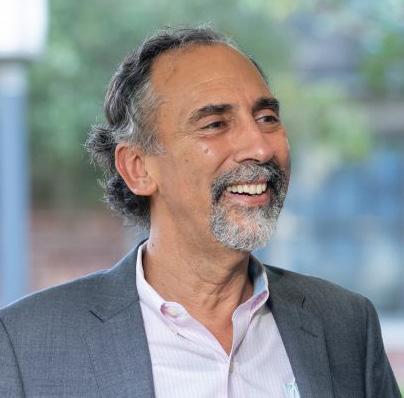
Dr. Leonardo A. Villalón CENTER DIRECTOR
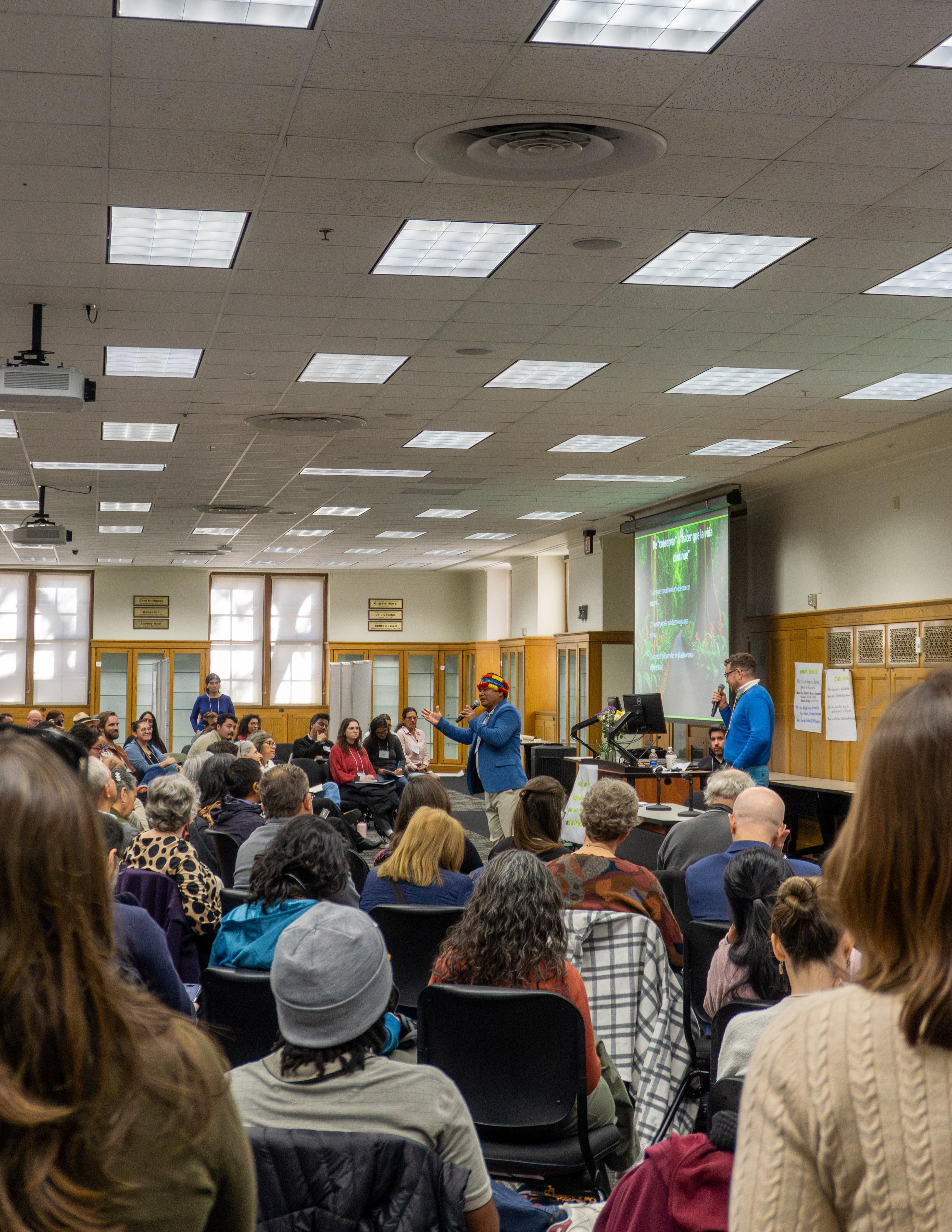
ON THE COVER : Indigenous leader Tuntiak Katan of the Shuar Nation addresses a packed room during the opening session of the annual conference in February. See more on page 5.
Between maps, forests, and people: A conversation with Bacardi scholar Ane Alencar
The power of connections: From dialogue to collective action in Pan-Amazonian conservation
Thesis award winner explores 'Latina labor experience'
Oral histories give Daniela Lizarazo (MALAS 2025) insight into the lives of Latina migrant construction workers
CENTER HIGHLIGHTS
Inaugural archaeology lecture brings director of Tenōchtitlan excavation to UF Report
Encountering Florida's Latinx histories in Ybor City
FACULTY SPOTLIGHTS
Winners of the Fieldwork Festival research presentations
STUDENT SPOTLIGHTS
Undergrad students selected for scholars program research in Latin American Studies
“Opening doors” lead Caroline Centeno to Brazil internship, urban and regional planning
Parting words from SALAS leadership Welcoming new Center director Leonardo Villalón
Paola Uparela brings colonial studies into interdisciplinary conversations
STUDENT RESEARCH HIGHLIGHTS
Stories from student conference presentations
ALUMNI UPDATES & NEWS EVENTS AT A GLANCE
DONORS THANK YOU GRADUATIONS
FACULTY UPDATES & NEWS
BY VITÓRIA LEOPOLDINA GOMES MENDES (MALAS 2027 )
Ane Auxiliadora Alencar is a researcher and professor who teaches not only through her experience and scientific knowledge, but also through her ability to remain a genuine and accessible person, even though she is already considered one of the most respected specialists in her field. A scientist focused on reducing forest degradation in the Amazon, she makes a point of “translating” complex content and making knowledge accessible. At the Instituto de Pesquisa Ambiental da Amazônia (IPAM), where she has worked for more than 30 years, she coordinates initiatives for monitoring carbon and deforestation.
Professor Ane graduated from Universidade Federal do Pará (UFPA), then earned a masters degree from the University of Boston and a PhD from the University of Florida (UF), where she got involved with the Tropical Conservation Development (TCD) Program. Professor Ane says studying at UF was important for her professional trajectory. Her previous training in Brazil had been marked by an eminently technical environment, with dialogue among professionals from her own field. Being part of TCD, on the other hand, meant engaging in dialogue with researchers from different fields, such as anthropology, sociology, and other areas of the social sciences. It was, therefore, much more than looking at a map or learning how to quantify scientific data. It was an experience of expansion: an invitation to see the territory through new lenses, conceptions, and sensitivities.
In spring of 2026, Ane Alencar returned to UF as the Bacardi Family Eminent Scholar. According to her, her enriching experience at UF, combined with the many friends she made along the way, was a fundamental factor in her decision to come back to Gainesville. “That certainly had a role in making me set aside my work a little bit to return to the University of Florida, now no longer as a student, but with the opportunity to share with students,” she said. “And in another role, teaching a class that was a seminar. We exchanged a lot, so that was very pleasurable. The students were very engaged and curious as well.”
We, the students, were delighted by the opportunity to learn from a researcher who carries such knowledge, experience, and commitment to the subject. Professor Ane taught the course “Socio-ecological Tipping Points in Amazonia,” in which I had the great satisfaction of being her student and also her research assistant. She introduced us to complex scientific texts, bringing some of the most advanced debates on the research currently being conducted in the Amazon. But she went further: she used her own network of contacts to bring us closer to the researchers who had written the articles we were studying. Thus, we had mini-lectures with scientists from different parts of the world, all seeking to understand Amazonian dynamics and to offer pathways so that decision-makers can move forward in the protection of this significant natural system, as well as of the communities that coexist with the forest.
Professor Ane emphasized how relevant it was to think through the process: “What I liked most about the process of teaching was thinking about the course. Anticipating what you, the students, might want in this learning process, was what fascinated me the most. When I chose the texts, I always thought: what will each one of you say about this? Sometimes you surprised me; sometimes I knew you were going to say something along those lines. So every class was very enjoyable, so much so that, at least for me, the three hours would pass and we would not even feel it.”
I also asked Professor Ane about her experience at the annual conference. For her, the conferences have always been important spaces for exchange, learning, and sharing. Thus, the 2026 conference was especially intense because it brought together an entire week of activities, meetings, and reunions. “In addition to seeing several friends again, several dear people, I also met people who were not from my time, but whom I admire very much.”
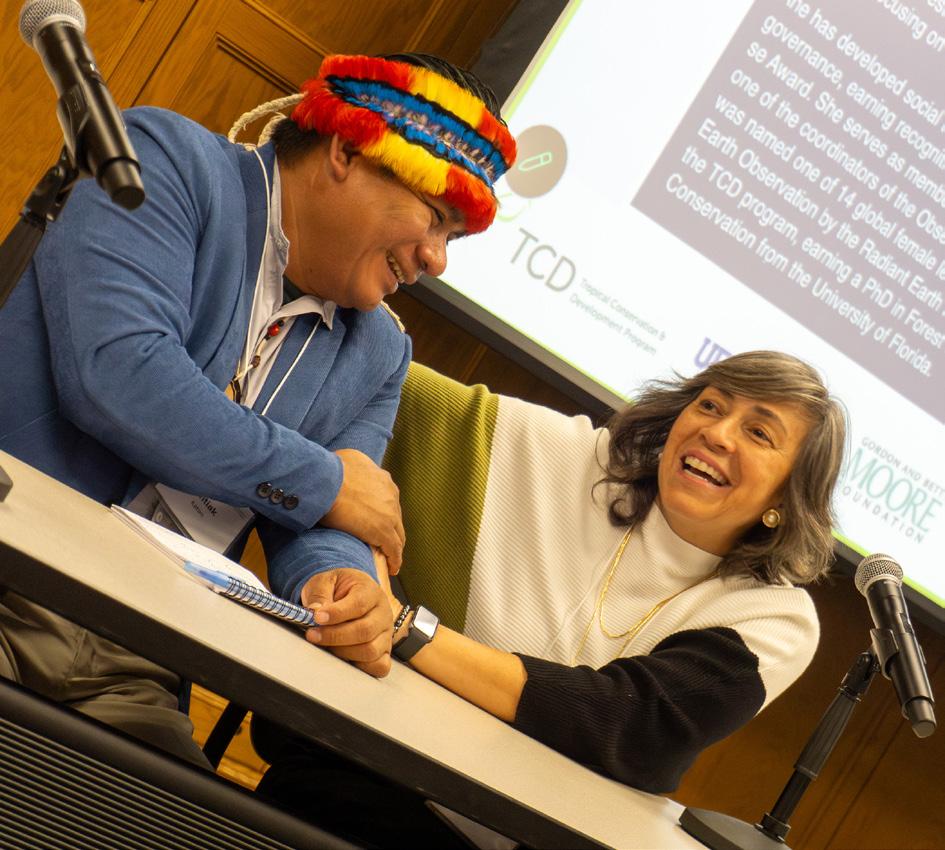
Among the most remarkable moments, Ane highlighted her participation as one of the keynote speakers, especially because she shared the panel with Tuntiak Katan of the Shuar Nation (photo above). For her, this composition brought an important balance between different ways of looking at the territory. “I really enjoyed doing that opening together with an Indigenous representative, because it was a good balance. I spoke from a perspective that was a little more distant from what is happening in the territory, and my remarks could, in a certain way, be revisited from an Indigenous perspective.” From the perspective of a student and spectator, it was clear to see the importance of combining scientific advancement and technical rigor with academic and human humility, by considering traditional cultures, their ways of life and thought, as an essential part of the process of building solutions.
Ane Alencar’s trajectory is marked by a special combination of scientific rigor, interdisciplinary sensitivity, and pedagogical generosity. Her presence at UF as Bacardi Scholar allowed us, as new students, to experience a little of what she herself lived through in her own education with TCD: the possibility of looking at the Amazon not only as a territory of data, maps, and indicators, but as a living, complex space deeply crossed by human, political, ecological, and historical relations. At a time when the Amazon occupies the center of global climate debates, the work of researchers like Ane Alencar reminds us that science must be, at the same time, rigorous and accessible; technical and human; committed to data, but also to the people and territories that these data seek to represent. ◆
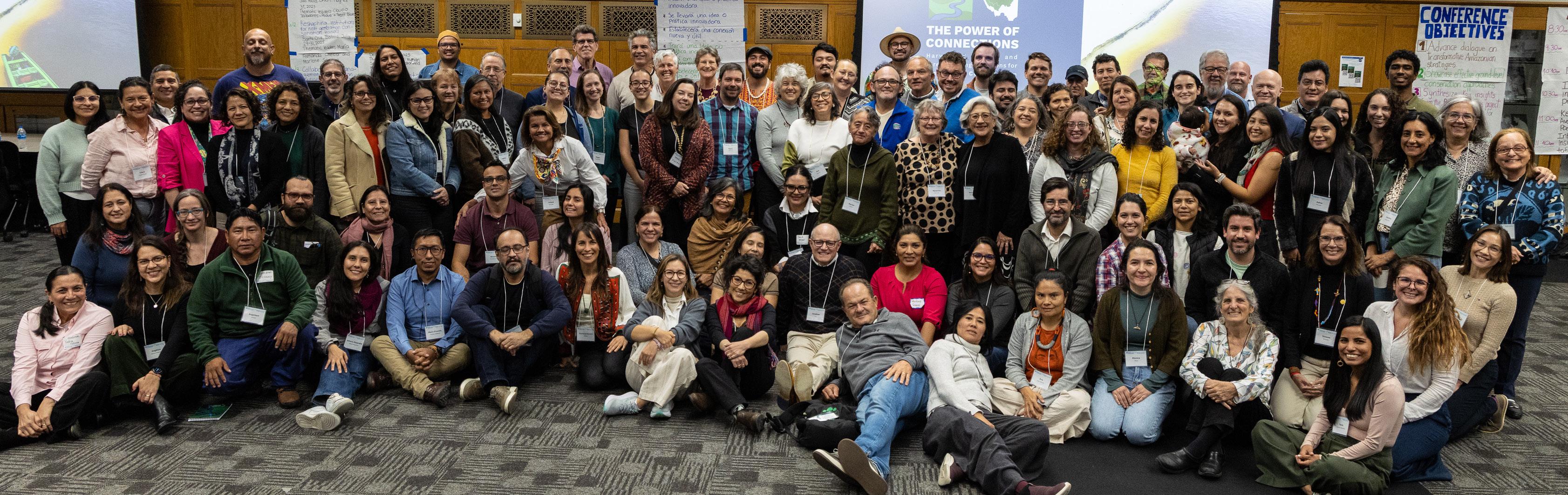
Researchers, practitioners, government, NGO, and private sector representatives, Indigenous elders and youth, funders, and rights specialists gathered from across the Amazon region and beyond at UF from February 22-27, 2026. Their shared purpose: to exchange knowledge, reflect on pressing challenges, and co-create pathways forward for conservation in the region.
Over the course of an intense and inspiring week, four interconnected events unfolded: the 74th Annual Conference of the Center for Latin American Studies (LAS), a focused Amazon Conservation Summit, a series of training clinics, and a Tropical Conservation and Development (TCD) alumni visioning session. Organized in collaboration with the TCD Program, the Center, and the Gordon and Betty Moore Foundation, these gatherings built on five prior workshops held across the Amazon basin as part of the Power of Connections (POC) initiative.
BY THE POWER OF CONNECTIONS TEAM
The week opened with a TCD alumni visioning process that brought together more than 60 graduates spanning four decades. Alumni gathered joyfully, greeted old friends, met new ones, and collectively reflected on TCD’s impact and future. A powerful reaffirmation emerged: beyond an academic program, TCD is a highly active global community of over 700 alumni shaping conservation and development worldwide.
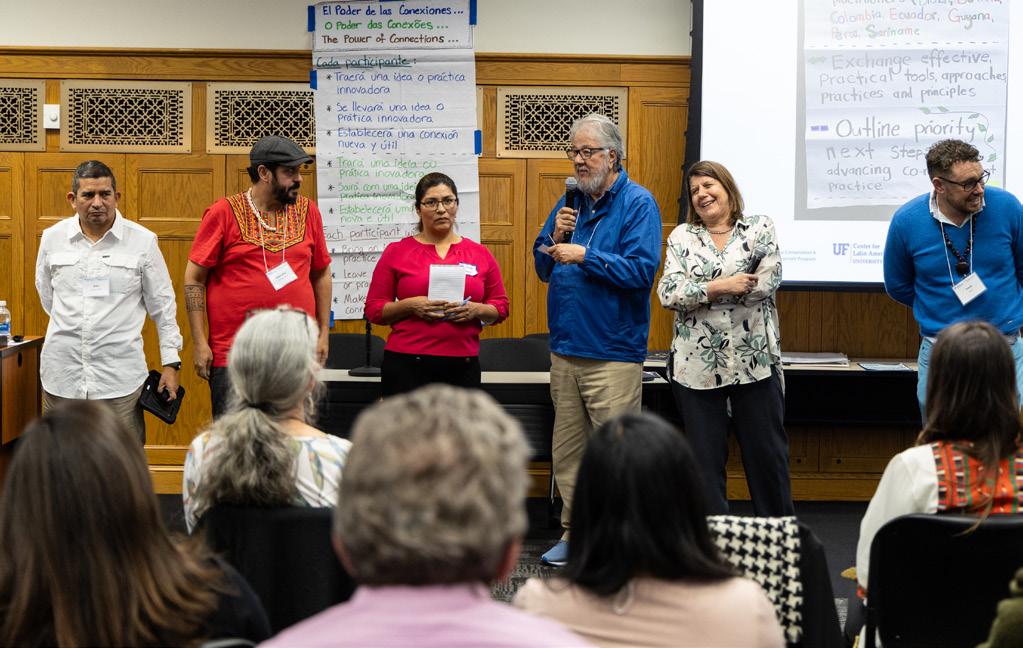
The public Conference opened on Monday with four discussion forums addressing issues ranging from crime and illegal economies in Amazonia to the evolving landscape of conservation funding. The discussions wove together moving personal reflections, such as Suzana and Claudio Padua’s 40
years of conservation science and practice, with evidence-based scientific updates on regional dynamics (by the Science Panel for the Amazon). The second day featured four keynote speakers who underscored a central theme: collaboration is not optional; it is essential. Dr. Avecita Chicchón from the Moore Foundation emphasized that “we cannot save the Amazon alone; we need to build coalitions to achieve our goal,” reinforcing the spirit of the Power of Connections initiative.
Tuntiak Katan, an Indigenous leader from the Shuar Nation of Ecuador, offered a perspective grounded on communities claims for “better money, not more money” to sustain long-term conservation and strengthen governance.
The conference served as a space for reflection on the POC workshops. Representatives from the five thematic areas (finance, leadership, co-management, innovative research, and Indigenous rights) shared lessons from across the basin. Each workshop explored a different piece of a larger puzzle, aiming to build trust, shared understanding, and connections. Participant evaluations highlighted that it was incredibly valuable to connect with people from different Amazonian realities, recognizing how actions in one territory resonate across others. The day closed with a poster session of 29 ground-up initiatives, encompassing conservation societies, environmental education, and bridging of knowledge systems.
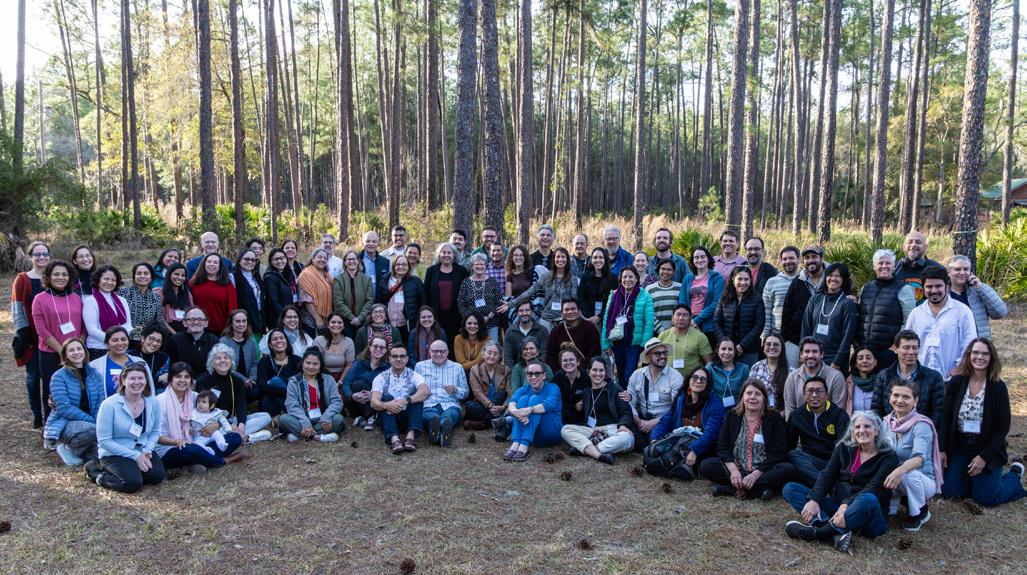
These conversations also set the stage for the POC Summit, a two-day gathering focused on in-depth conversations about Amazon conservation, held at the Austin Cary Forest. ▶
◀ In a figurative and literal circle, more than 80 participants shared their knowledge and collectively analyzed conservation approaches, tools, and strategies that advance protections for Pan-Amazonian lands and people. As facilitator and TCD alum Charo Lanao framed it, the goal was simple: bring what you have and take what you need. Collectively, Summit participants possessed more than 1600 years of experience in the Amazon. Early discussions revealed shared frustration with persistent challenges: illegal economies, weak governance, and escalating climate and biodiversity crises. Yet as conversations deepened, participants shifted to share what is working in the Amazon, including community-led initiatives, collaborative governance, and innovative research. The tone moved from frustration to hope.
This was a key moment.
The facilitator invited participants to step away from the discussions and go outside. Participants were asked to follow one another in motion, forming invisible triangles, where each person was privately connecting with two others in this dynamic system. When one person stopped, the entire system gradually stalled; when movement resumed, the system was reinvigorated. The lesson was immediate: we are all connected and need to embrace the Amazon region as a system, where actions in one place negatively affect or benefit others.
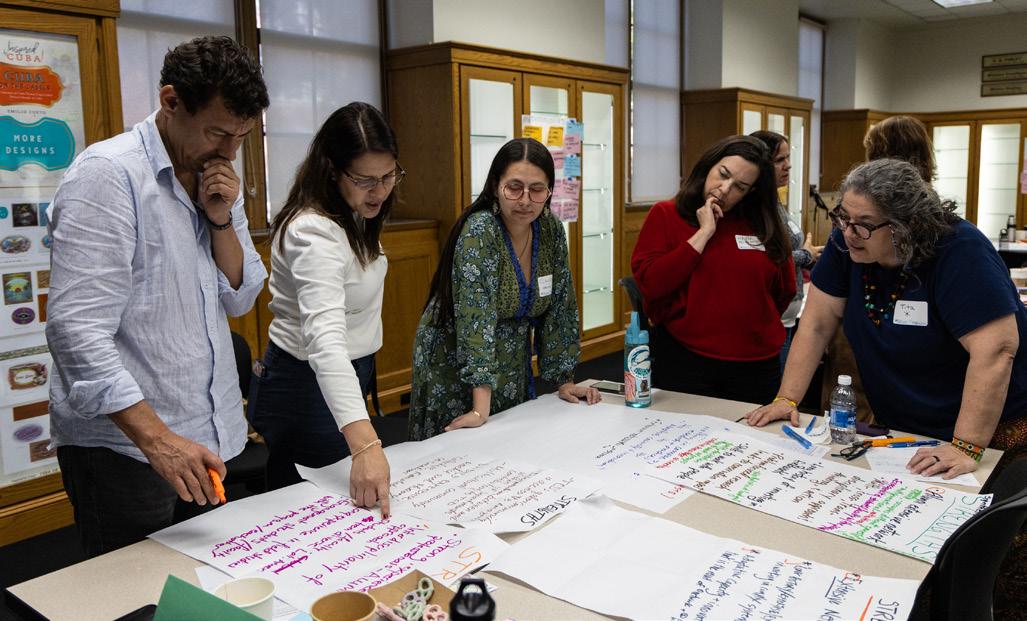
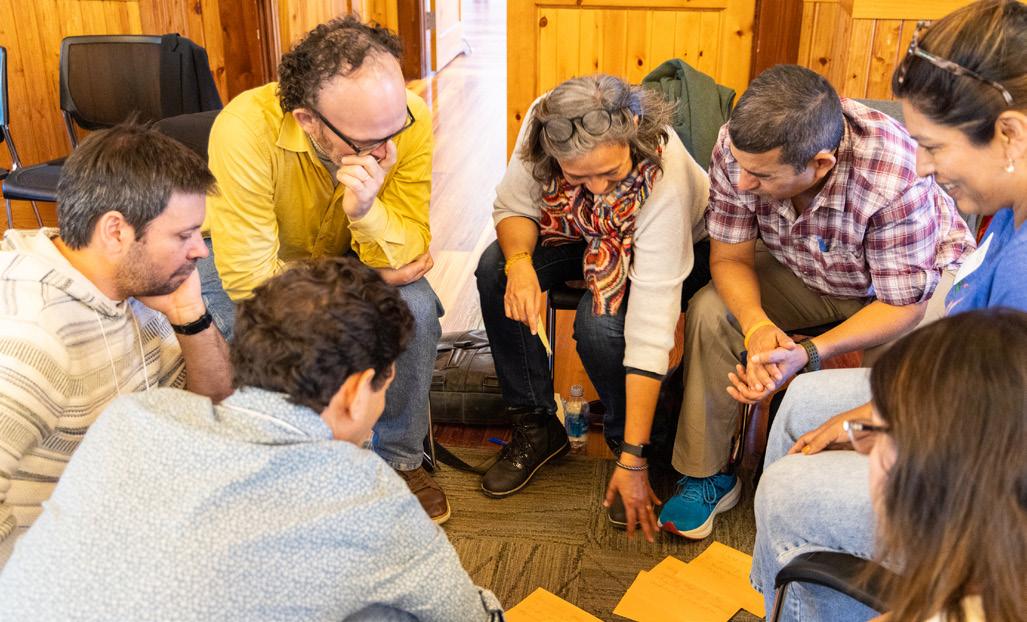
The activity shifted the conversation because it created an understanding that if the challenges are interconnected across the Pan-Amazonian region, then collective action is needed. Multiple topics were identified as areas of action: environmental justice, illegal mining, sociobioeconomies, and social and ecological tipping points.
What emerged from the Summit was not a list of solutions, but a shared direction and renewed commitment to act collectively. One participant reflected that “we need to be working together to address the crisis and build something positive.” Another emphasized that “the power of listening first… will produce sustainable relationships and result in achievable goals.”
The Power of Connections is not only a theme, but a reminder: meaningful change will not come from isolated efforts, but from the collective strength of those willing to listen, collaborate, and move forward together. The remarkable Amazonia-focused week concluded with a series of hands-on training clinics, offering capacity building sessions across seven key conservation topics, ensuring that conversations translated into concrete skills for future action.


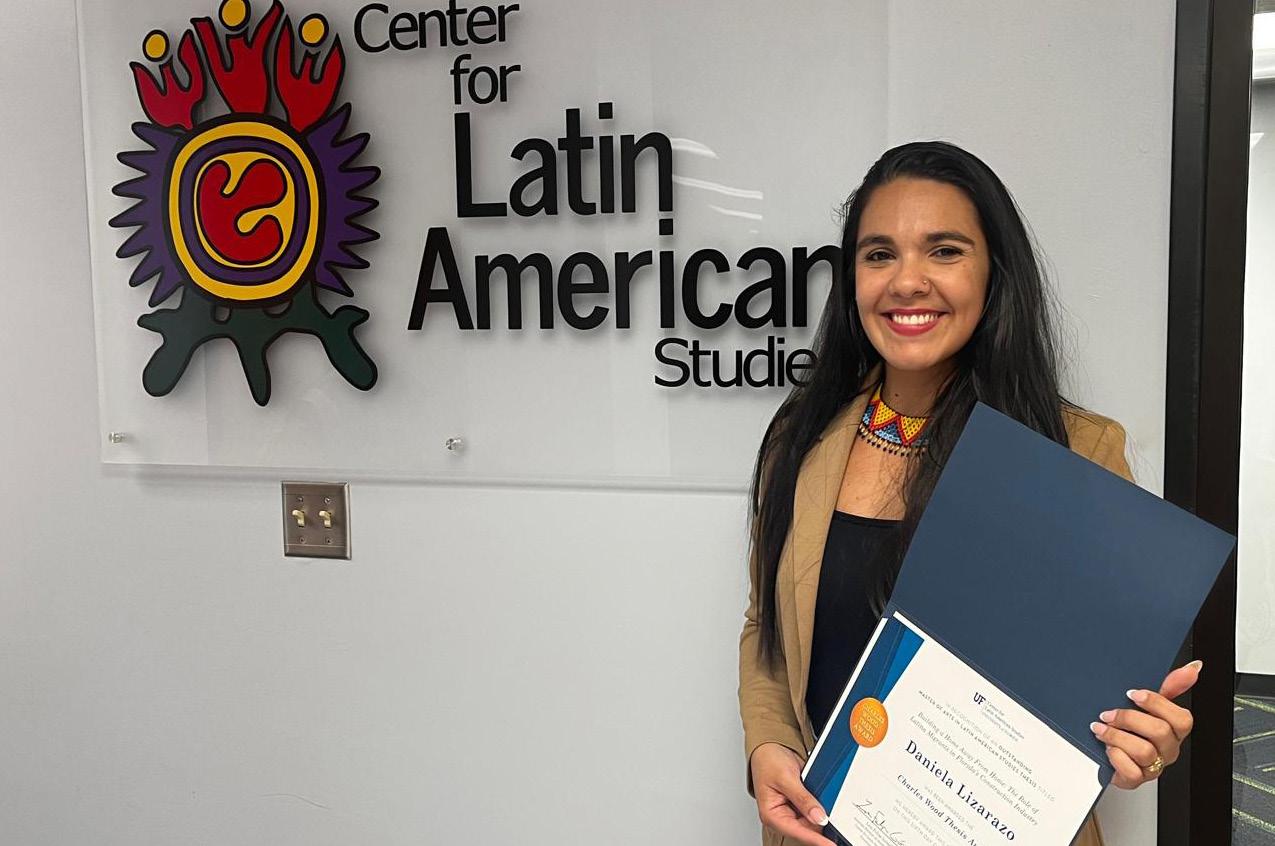
Oral histories give Daniela Lizarazo (MALAS 2025 ) insight into the lives of Latina migrant construction workers
Q: Why were you interested in researching Latina migrant women in the construction field?
DANIELA LIZARAZO: First, I was trying to know and understand the experiences of these women in a masculinized sector. When I migrated to the United States, my mom started working in construction, which was a surprise because in Colombia and in Latin America in general, you don’t really see that. The construction field has been always very man-centric and actually a violent space for women, and sometimes women can have some vulnerability in that field. So I wanted to know what was happening there, and if these women are suffering violence. I wanted to know their stories, their experiences, what they have to say, how being in this masculine sector shapes them. How do their families here in the United States perceive them, and also their families in their home countries? And how do these women think about their own femininity that could shape or reinforce some stereotypes in a masculinized sector?
Q: What takeaways did you find?
DL: The first one was the idea of being a hard worker. For all the women I talked with, their example was from their parents. And they know the meaning of the hard work because most of the parents of these women were laborers in Latin America. The second one is about not seeing themselves as victims. At first, I thought I was going to make the argument that these migrant women are in a liminal space where we’re not wanted but we’re needed, because we’re cheap labor and we're bodies that they can exploit. But then my mentor told me, “Daniela, remember the methodology that you're using. In oral history, you’re just telling the story of those bodies that can tell the story and can appear in history.” And these women didn't see themselves as victims.
So I start creating a draft of a concept called the Latina labor experience. I wanted to reflect how these women take all the disadvantages that they have in the construction field, being a minority in a minority of migrants. They are still experiencing some harassment, but they learned how to respond, to defend themselves. They feel stronger and their femininity is marked by that. Another part of this experience is how women start creating networks of sisterhood in the construction field. None of these women were construction workers before, so they learn. Most of them told me, “The things that I don't know, I know that I can ask my friend and
she's going to teach me or help me.” Not just the work like drywall or finishing, they learn how to negotiate their salaries with the boss, too.
I also talk a little bit about the triple shift that these women have to do, as mothers, daughters, wives. All of them told me that their husbands were very collaborative at home, but they still have more work than men in the home. These women are also in charge of their families in their home countries, because they are the principal economic support for them. They’re paying rent for their parents, maybe groceries every month, brothers’ and sisters’ education. It's a big deal.
Q: Why is researching women and labor important?
DL: I think it’s important to study right now because women are moving in all the areas of labor, but we’re still living in a man’s world. There are still gaps. So to study women and labor is to see how women have advanced in every kind of field, and how we have to still keep looking for a better equality, things like health and safety, salaries, opportunities.
Q: What have you observed about women labor in a masculinized sector vs. a feminized sector?
DL: Something that is very interesting is that most of the women that I interviewed, when they migrated, they start working in feminized sectors: taking care of children, cleaning houses, taking care of elderly people. And all of them decided to move to other jobs because they felt more exploited in those fields. Those fields don’t pay a good salary compared to construction. So we see more women working in the feminized sector, but these women are suffering a little bit more. For example, they told me when you are working in cleaning, you know what time you start, but you don't know at what time you finish. Or if you’re taking care of children or elderly people, you are going to a private space alone and you don't know what can happen to you. As migrants they are in a vulnerable position. That’s the reason these women moved from feminized sectors to the construction field.
Q: Why did you choose oral history as a methodology and what advantages did it give you?
DL: I came from an academic background doing qualitative research that is very rigorous, in almost a scientific method. So when I found oral history, it blew my mind because it puts analysis and theory in comparison with experience. In oral history, the most valuable thing is the story of the person.
What is this person telling you? You have to pay attention to the silences, the facial expressions, everything. And that also serves as a tool that can allow you to be human because you have to have a certain kind of vulnerability when you’re doing research. It’s not just, “Go and ask, and that’s it.” Oral history allows you to be a little bit more open, to go deep in something. You’re going to ask this person all their history from their childhood until their life now. Why do people behave in the way that they behave? Why do people have certain beliefs? What things in their life made them change some of the patterns that their family have?
And then my role as a researcher is to expose to the world their experience in a good manner. So I don’t see the people that I work with like subjects. It’s their experience, their words. I see them as my co-authors. Maybe some researchers say that it’s not ethical to create a bond with them, but for me it’s more ethical to create a bond, a real bond of trust. Because these people are telling you things that maybe they never told anyone else. That makes the space special because they’re opening their hearts. Even though some of the things that they told me were not part of my research, they still told me even though I didn’t ask it.
Q: You presented this research at the Latinx Studies Association Conference this spring. How was the experience?
DL: I was so happy to talk about this work with people out of the South and out of Florida. I was on a panel about migrant
women labor, and it was amazing because it was different topics, but all about how women create ways of resistance and surviving. All of us received good feedback about how we can expand this work. It was my first conference talking about my research and it was a really, really good experience.
Q: I know you’re pursuing your PhD in sociology here at UF. What’s next for this research?
DL: I'm still working with these women, not as a researcher, but because I do a lot of work in different organizations around the city. I do want to continue this research, maybe not for my PhD, but I still have ideas for the future. I want to ask their partners about their perception, and their ideas of parenting together as a construction worker family. I want to continue doing more oral histories and maybe more ethnographic work about going to the field, working some days with them.
Q: Do you have any advice for MALAS students?
DL: Do something that you want to do, because doing thesis research especially social research requires a lot of commitment of you as a person, and it’s going to drain your energy. You are going to need to have passion. And also, do your research with love and a lot of respect for the people that you’re working with. If you’re doing social research and your subject is a human subject and this person is talking about their feelings, their emotions, their experiences? Then be human. Be human. ◆
JANUARY
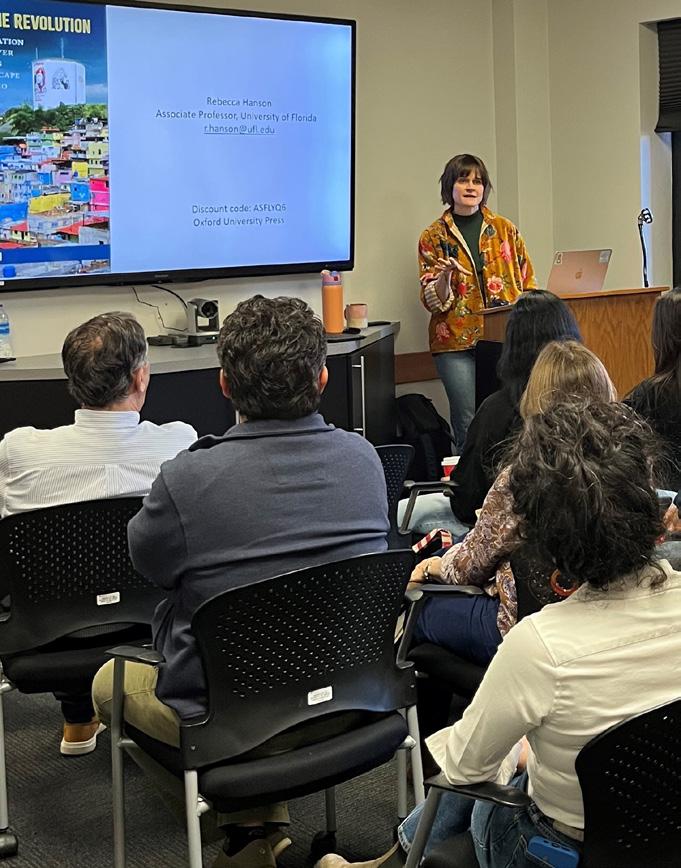
• COLOQUIO | Policing the Revolution: The Transformation of Coercive Power and Venezuela’s Security Landscape During Chavismo Rebecca Hanson* [4]
• Cuba film series | Walking the Cuban Tightrope Margaux Ouimet˚ and Lillian Guerra*
• COLOQUIO | Fantasmagoría Vegetal: Herbarium comalae Luis Felipe Lomelí*, Emilio Bruna*, Antonio Sajid López* [12] FEBUARY
• Latin American Studies Fieldwork Festival
• Justicia penal y homicidios célebres (México, siglo XX) Elisa Speckman˚ [7]
• Archaeology in Downtown Mexico City: Unearthing the Sacred Precinct of Tenochtitlan Distinguished Lecture in Latin American Archaeology, Leonardo López Luján˚ [10]
• COLOQUIO | 2025 Latin American Business Report Pilar Useche*, Brian Gendreau*, Timothy E. McLendon* [2]
• Cuba film series | Corresponding Across The Sugar Curtain: Island-Exile Communications During Cuba’s NotSo-Cold War Michael Bustamante˚ and Lillian Guerra* [5]
• First-Wave Feminism and Women’s Civil and Political Rights in South America Carmen Diana Deere*, Juliana Restrepo Sanín*, Magdalena León˚, Danaya Wright* [11]
• Film screening: Tardes de Soledad with University Film Society
• 74th Annual Conference | The Power of Connections: Harvesting Lessons and Strengthening Coalitions for Amazonian Conservation [3] MARCH
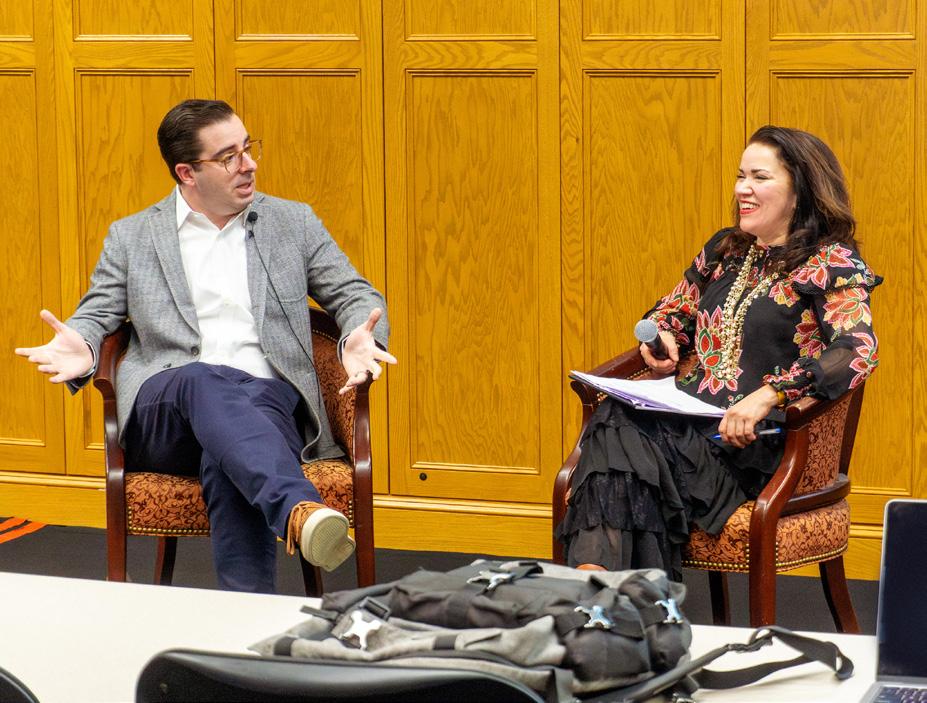
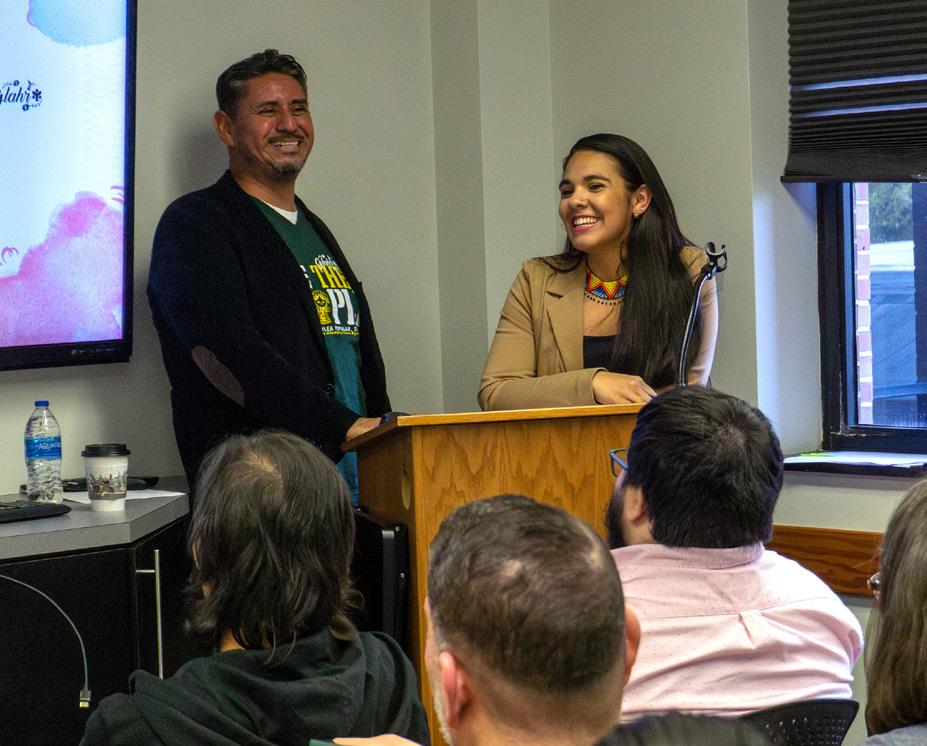
• COLOQUIO | Narrating Struggle, Building Power: Ethnographic Insights from Los Fundadores Oral History Project Rafael Ramírez Solórzano*, Daniela Lizarazo † [8]
• Cuba film series | American Rebels Glenn Gebhard˚, Mario Congreve˚, and Lillian Guerra*
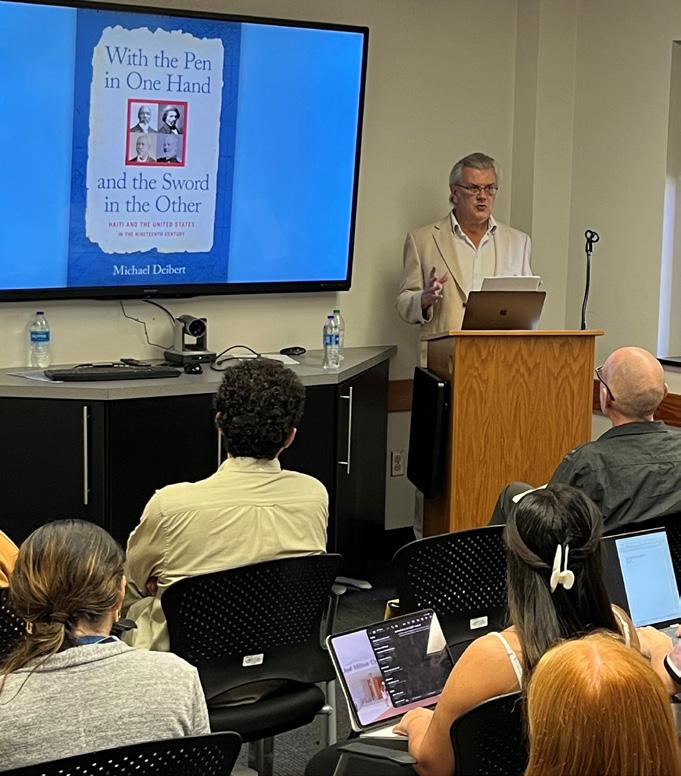
• COLOQUIO | With the Pen In One Hand and the Sword in the Other: Haiti and the United States in the Nineteenth Century Michael Deibert˚ [6]
APRIL
• Jacaré Brazil Spring Concert
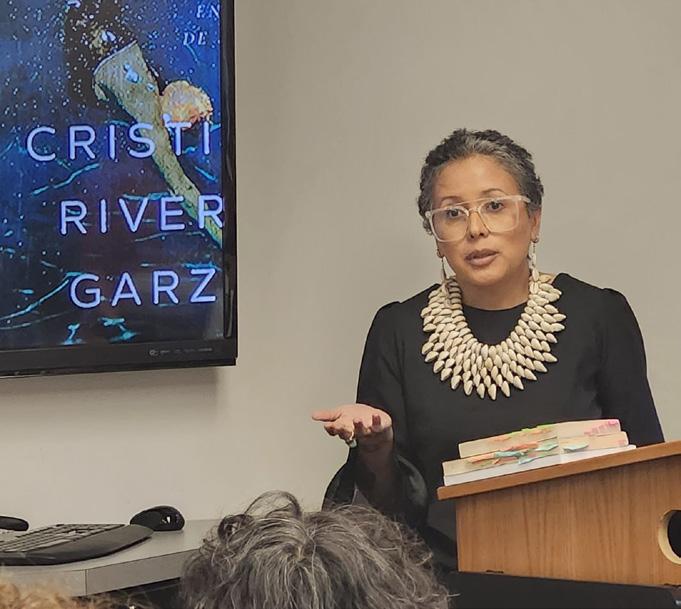
• COLOQUIO | Breathing Life into Archives: How Black Feminist Thought Shaped Cristina Rivera Garza’s Pulitzer Journey Ariadna Tenorio* [1]
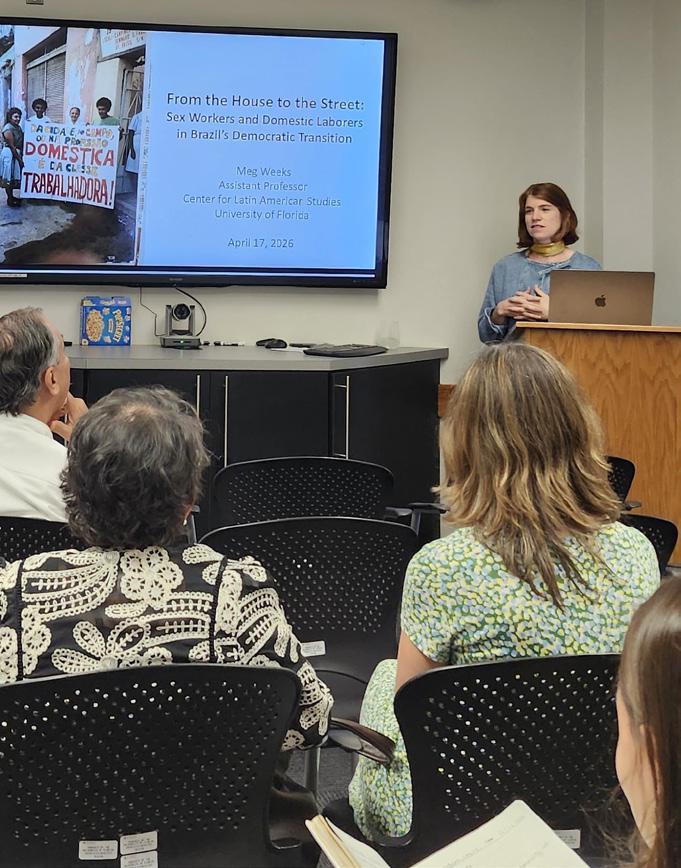
• COLOQUIO | From the House to the Street: Sex Workers and Domestic Laborers in Brazil's Democratic Transition Meg Weeks* [9]
˚Guest speaker from outside institution
† Center student or alum
*Center faculty (Core, affiliate, or visiting scholar)
Renowned archaeologist Leonardo López Luján delivers lecture to packed auditorium
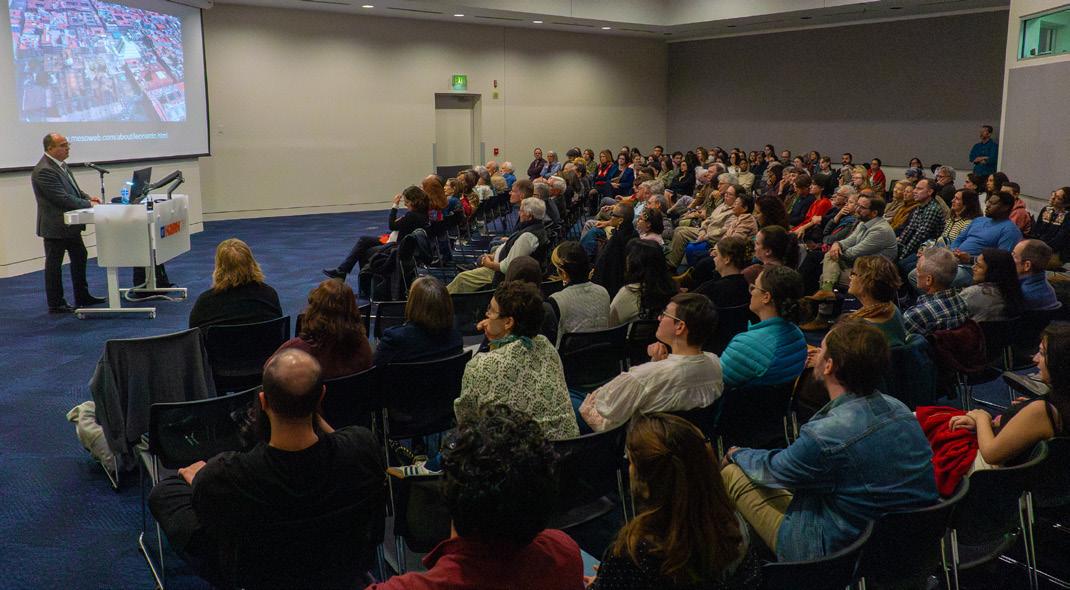
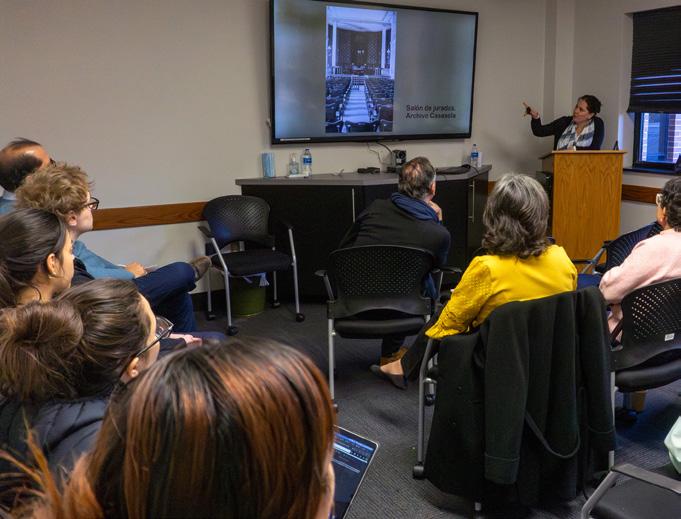
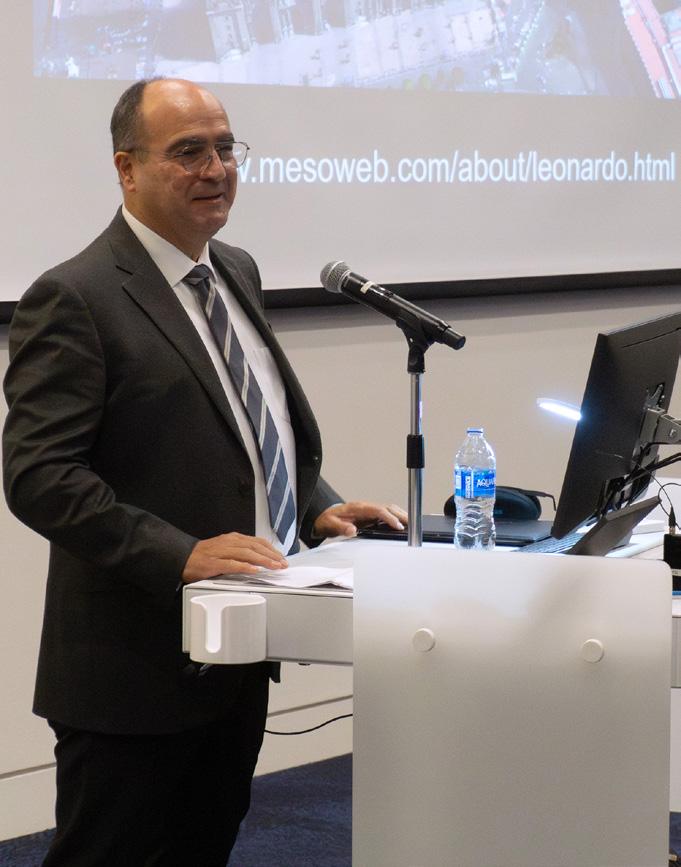
On February 4, as guests filed into the Harn Auditorium approaching 6:00 pm, staff members began bringing out additional seating to meet the demand. The event? The first annual Distinguished Lecture of Latin American Archaeology, delivered by Dr. Leonardo López Luján, director of the Templo Mayor Project, which carries out archaeological investigation of the sacred precinct of Tenōchtitlan beneath downtown Mexico City. Dr. López Luján's visit is the result of a developing partnership with the Instituto Nacional de Antropología e Historia (INAH), spearheaded by Center affiliate faculty Gabriel Prieto (Anthropology). “The most fulfilling aspect was providing our undergraduate and graduate students the
opportunity to meet and converse with a world-leading figure in archaeological research," Dr. Prieto reflects. "Furthermore, it was rewarding to observe the synergy between various UF units as they collaborated to make his visit possible.”
In addition to the lecture, Dr. López Luján also visited several classes, including that of affiliate faculty Derek Burdette (School of Art+Art History) who specializes in colonial art of Mexico. “These visits allow us to showcase the University of Florida's exceptional standing in research and academics to distinguished visiting scholars,” Dr. Prieto states. Not only that, but they open the door to further academic exchange.
Dr. López Luján has graciously offered the opportunity to host graduate students for their thesis research, and other faculty members from UF are in communication with new connections at INAH.
Meanwhile, the Distinguished Lecture in Latin American Archaeology will happen annually, with support from the Department of Anthropology, the Harn Museum, the Center for the Humanities and the Public Sphere, the Harn Eminant Scholar Chair in Art History, and the International Center. Moreover, it will continue to build collaborative opportunities with leading institutions across the region, and, hopefully, draw large crowds from UF and the Gainesville community. ◆
LABER analyzes economic, social, political, policy and legal developments
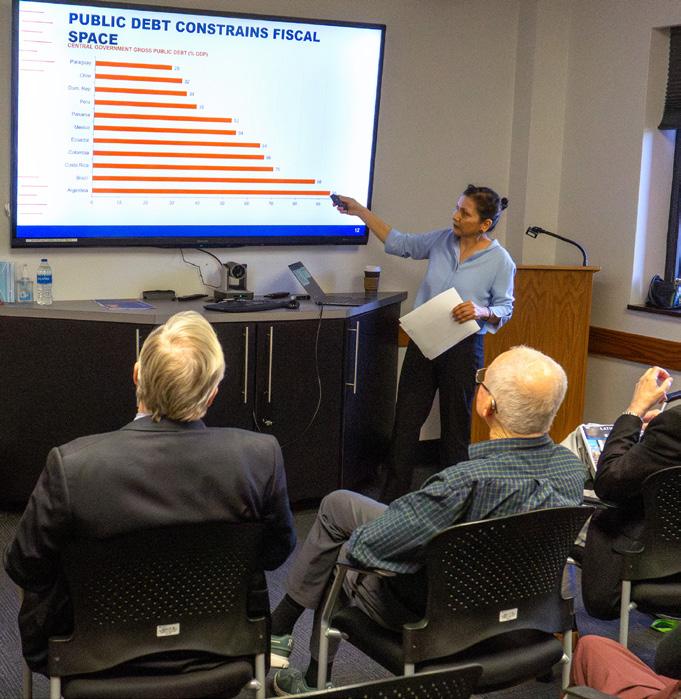
The first Latin American Business Environment Report (LABER) was published by the Center for Latin American Studies in 1999, at the close of a decade where the region's business outlook started strong but ended in a downturn. In an effort to track trends and offer insights from policy, economic, trade, and political analysis, former Center Director Terry L. McCoy compiled a 20-page report. Twenty-seven years later, the LABER continues in the same vision, although on a larger scale; the 2025-2026 edition amounts to 103 pages with a 15-page appendix.
This year's LABER is the collaborative effort of Center faculty and Pilar Useche (Food and Resource Economics), Timothy E. McLendon (Levin College
of Law), Jorge Avila (Economics, Universidad San Francisco de Quito), and Brian Gendreau (Warrington College of Business). Assembling economic data with market analysis and political context, the report synthesizes large swaths of information about 20 countries in Latin America, generates key takeaways, and projects a growth outlook for each country.
Both a reference and a teaching tool, the LABER is a unique, free resource publicly available for students, educators, and business leaders alike. “[The LABER] is pulling together the teaching, the research and the outreach components that are so central to Latin American studies,” Dr. Useche told The Alligator's Ariana Badra in February.
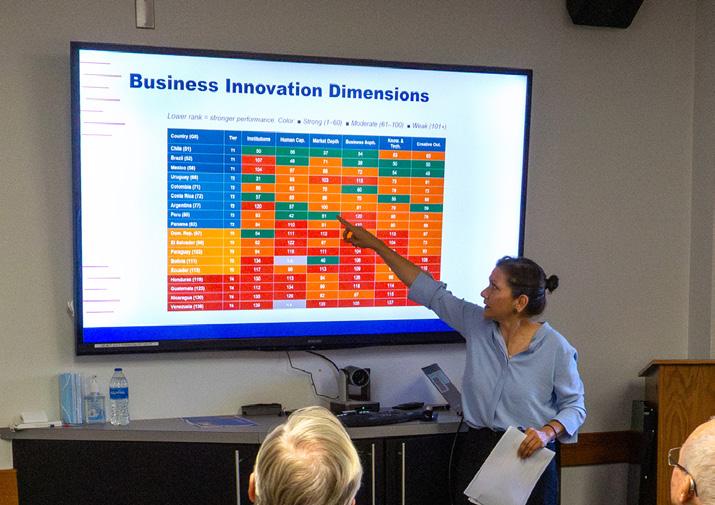
The 2025-26 report shows an overall decline in unemployment and poverty in the region, with increased business innovation and economic competition as a result of increased U.S. tariffs. With greater investment in Latin America opening up, the LABER is a valuable resource to understand the business dynamics, risks, and opportunities. ◆
Class trip with Professor Rafael Ramírez Solórzano illuminates Tampa district's legacy as home of Latin
BY JASMINE E. MARTINEZ (INTERNATIONAL STUDIES)
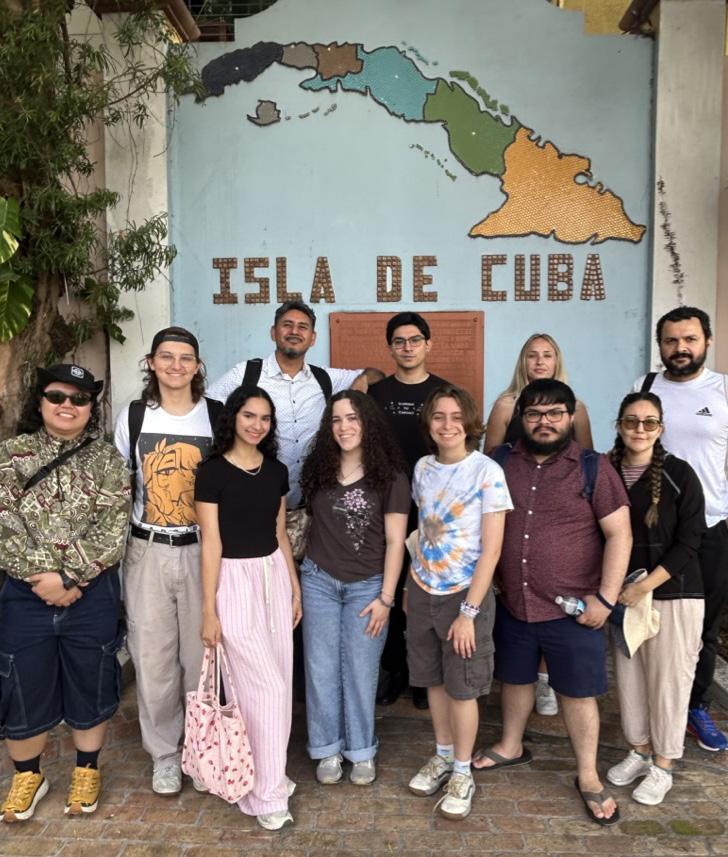
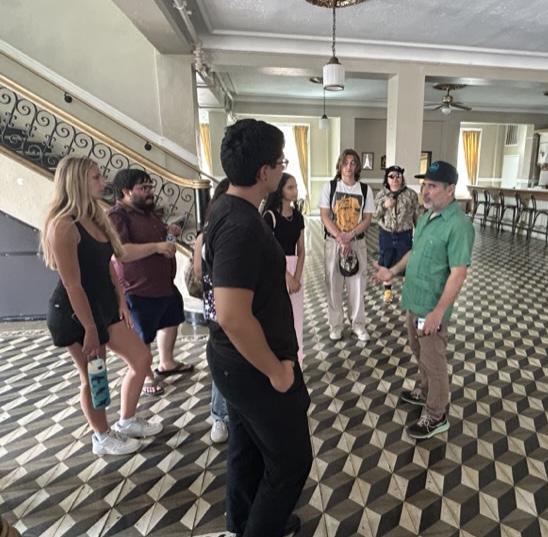
Under the sounds of the traffic and tourists are the historic brick streets and buildings of Ybor City, which once were home to cigar workers, and immigrants from Cuba, Spain, and Italy. This small district within Tampa is one of the most important centers of Latin American and Latinx history in Florida. Through the Gulf Scholars Program and the Center for Latin American Studies course “Latinx Gulf Vibes,” my classmates and I were able to take a walking tour through this crossroads of cultures, political movements, and community formation.
Our tour began at José Martí Park, meeting up with local historian Emanuell Leto, who reminded us that we were standing on Cuban soil within the borders of Ybor City. Learning that the park is officially owned by the Cuban government showed the transnational nature of Ybor City’s history. José Martí, the poet, philosopher and national hero of Cuba, often traveled to Tampa, connecting Florida to the Cuban independence movement during the late 19th century. Before this trip, I mainly associated Miami with the Cuban diaspora, especially as a Miami Cuban myself. However, after this trip, I learned that Ybor City had a significant Cuban population decades before Miami. For this reason, Tampa became an essential center for political activism among Cuban migrants. I deeply enjoyed seeing where Marti organized and spoke.
Continuing through Ybor City, we learned about the social clubs and mutual aid societies that were founded by Cuban, Spanish and Italian migrants. These communities created everyday support systems that were a direct response to the U.S. South’s racial segregation and Jim Crow laws. Seeing these aid societies exemplified the mixture of cultures found within this historic city. El Circulo Cubano, Centro Español, L’Unione Italiana, Centro Asturiano, and La Union Martí-Maceo were institutions built by immigrants to help workers socially, culturally, and materially. In a time when many immigrants faced economic hardship and exclusion, these organizations provided healthcare, education, and entertainment.
The Cuban Club was especially impressive with how expansive it was. It had a gorgeous theater, recreation spaces, and even one of Ybor’s City’s first swimming pools. These clubs served as centers of identity formation and solidarity. They helped immigrants preserve their language and traditions in a city that
was rapidly industrializing. La Union Martí-Maceo was also significant because it helps us understand the experiences of Afro-Cuban workers who often faced exclusion even within immigrant organizations. The name behind this mutual aid society stems from José Martí and the Afro-Cuban General and independence hero Antonio Maceo (El Titán de Bronce). The meetings for this club were originally held in the Pedroso home, which is where Martí used to stay when he would visit Ybor City, and also where we started our tour. Learning about this felt like a full-circle moment.
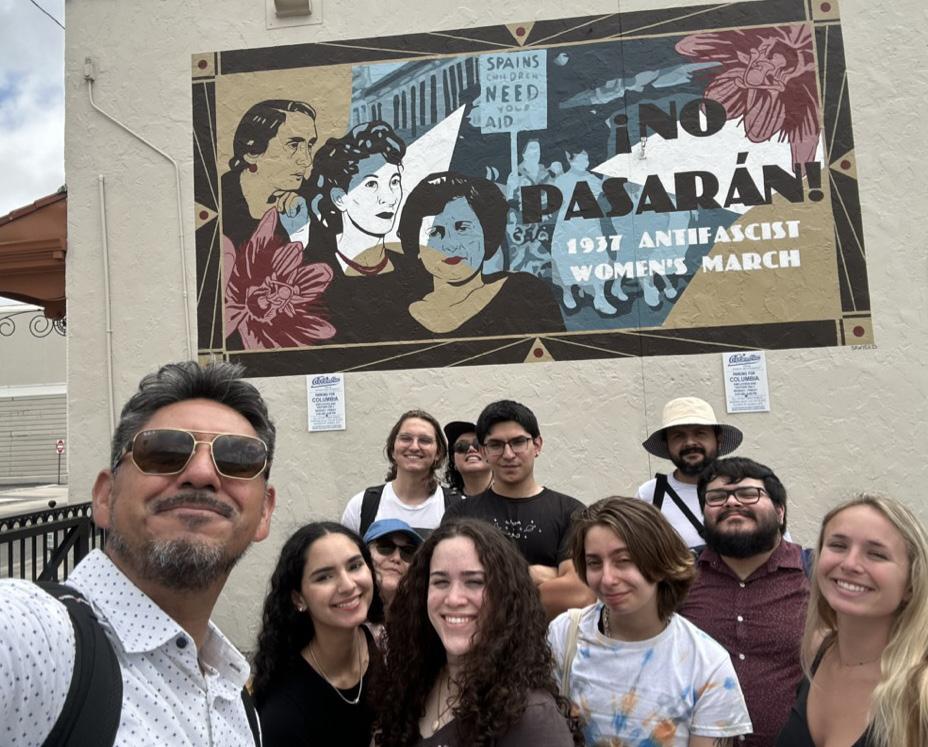
Before going on this tour, my classmates and I read Ybor City: Crucible of the Latina South by Sarah McNamara. It was fascinating to see a mural that McNamara herself worked on. Women were not just simply supporting movements from the background, they rallied together through the duration of the Spanish Civil War (1936-1939). The 1937 antifascist women’s march mural further expanded my understanding of activism in Ybor City. I learned how Latina activists like Dolores Ibarruri, Luisa Moreno, and Margot Falcon Blanco shaped labor and political movements locally and internationally. It’s one thing to learn about this history in class, but it's another to physically walk on the streets that these women once did.
As the walking tour came to an end at Columbia restaurant, I realized that this experience transformed Ybor City from something I had only read about in class into something tangible. Martí’s ideals about liberation and unity influenced the immigrant communities that later built mutual aid institutions. Those same support systems eventually stood in solidarity against labor exploitation, fascism, and inequality. Thanks to the Gulf Scholars Program and the Center for Latin American Studies, my classmates and I were able to better understand the Tampa Bay Gulf communities through their people and cultural legacy. While the streets of Ybor might not be bustling with cigar workers and the smell of fresh tobacco anymore, it has stood the test of time, preserving the history of these communities. ◆
Dr. Villalón ‘enthusiastically
In 2004, Leonardo Villalón, director of UF’s Center for African Studies, was selected to serve on the search committee for a new director of the Center for Latin American Studies—an endeavor which would ultimately result in the hiring of Carmen Diana Deere. Little did Dr. Villalón know that in just over two decades’ time, he would find himself occupying the same role. This turn of events, like many of life’s happy surprises, reflects a philosophy that Dr. Villalón’s leadership brings to the Center: opportunity is to be embraced.
Born in Cuba and having moved to the United States as a child, Dr. Villalón’s worldview has always been international. Immersion experiences in France and Spain following undergraduate study led him to a master’s program at the Johns Hopkins University School of Advanced International Studies, where—by sheer chance—he would discover his interest in African Studies, and follow it to further postgraduate study and a research career in Francophone West Africa. “I’ve always been interested in democracy and religion and politics, especially in the context of democratization,” Dr. Villalón says. “And I’ve also kept a comparative perspective, thinking broadly about the developing world.”
African Studies, like Latin American Studies, falls under the category of “area studies,” an academic field that seeks to understand specific regions of the world through interdisciplinary study of language, culture, politics, and history. Within U.S. higher education, the perceived value of area studies—and hence its funding—has waxed and waned relative to the country’s geopolitical posture. But for Dr. Villalón, a commitment to area studies has defined his career. “The empirically grounded, interdisciplinary approach to complex problems is really important,” he urges. “We need to have political scientists, anthropologists, historians, economists, natural scientists, environmentalists—scholars from all disciplines—talking to each other to understand social and political dynamics in specific places.”
This value led Dr. Villalón to the University of Florida in 2002 to embark on the “dream job” as director of the Center for African Studies, in addition to serving as a professor of political science. After two terms as director and a break for research projects, he was named Dean of the UF International Center, a role he occupied until 2022. “And then I assumed I was finished with administration,” Dr. Villalón laughs. But a temporary agreement to be Interim Director of the Center for Latin American Studies in January 2025 eventually became a request from Provost
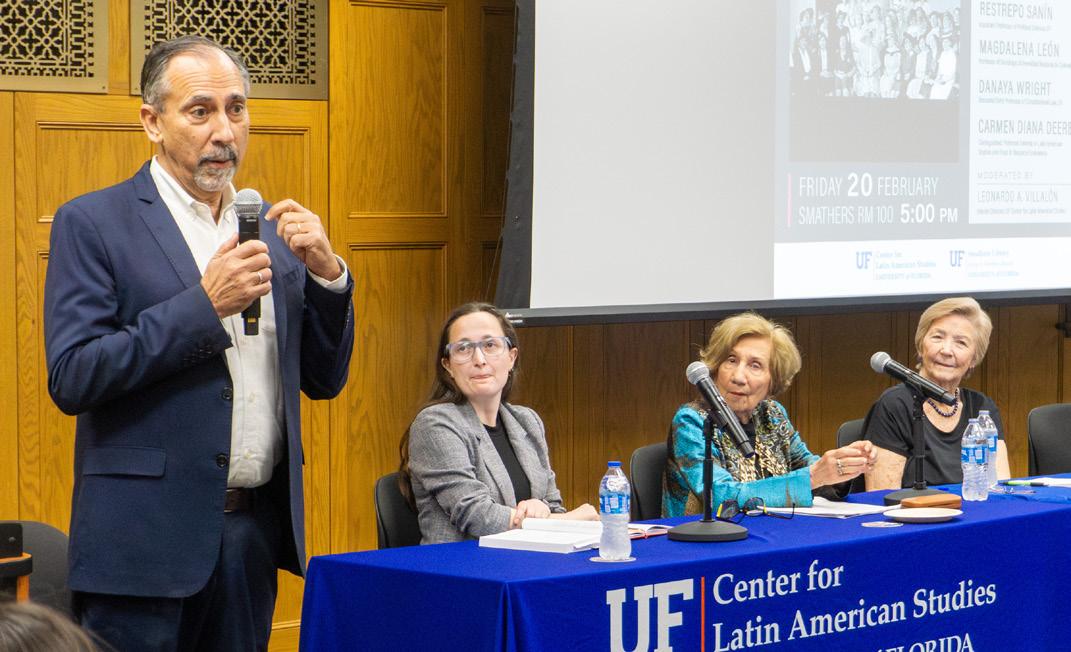
Joseph Glover to serve as permanent director for a three-year term. “It all came as a surprise,” he recounts. “But it’s a surprise opportunity, and I’m enthusiastically embracing it.”
The directorship is another expression of his commitment to area studies, with the chance to engage with Latin America, specifically. “This is the premier area studies center on campus,” Dr. Villalón asserts. “I’m very excited that this role gives me, unexpectedly and late in my career, an opportunity to learn new things, and dive into an area that holds such significance for the university and the state.”
It’s true, too, that the U.S. is currently in a period of diminished support for area studies, with the Department of Education’s termination of Title VI funding for Foreign Language and Area Studies Fellowships (FLAS) and National Resource Centers in 2025. The Center had received Title VI funding continuously since the grant’s inception in the early 1960s. “The current context is challenging,” Dr. Villalón says. “We’re in changing times, and there’s both a need and an opportunity to adapt. But it’s also more important than ever to understand Latin America. The more we know about Latin American realities and dynamics, the better we can engage, and the more we can be creative and positive about things that are mutually beneficial to the United States and to Latin America.”
Now officially director, Dr. Villalón’s vision for embracing opportunity is carried into his leadership. “The Center has such a richness to it, with terrific people doing incredible work,” he says. “I want to maintain the momentum, supporting and enhancing our strengths.” Since his tenure began, he’s carried forward preexisting initiatives, like the partnership with the Universidad Tecnológica del Chocó in Colombia, and developed new ones, like the Distinguished Lecture in Latin American Archaeology.
All told, this new chapter of Dr. Villalón’s career has offered professional and personal satisfaction alike, with the kinds of little surprises that invigorate a daily routine. “I keep telling people, I grew up speaking Spanish, but this is the first time in my life that I spend a significant portion of my day speaking professional Spanish in professional settings,” he grins. “The whole thing has been a gift.” ◆
Year of recognitions 'expanded the horizon' for professor's scholarship in colonial Latin American cultural studies
BY NICOLLE LUZARDO MORÁN (MALAS 2026 )
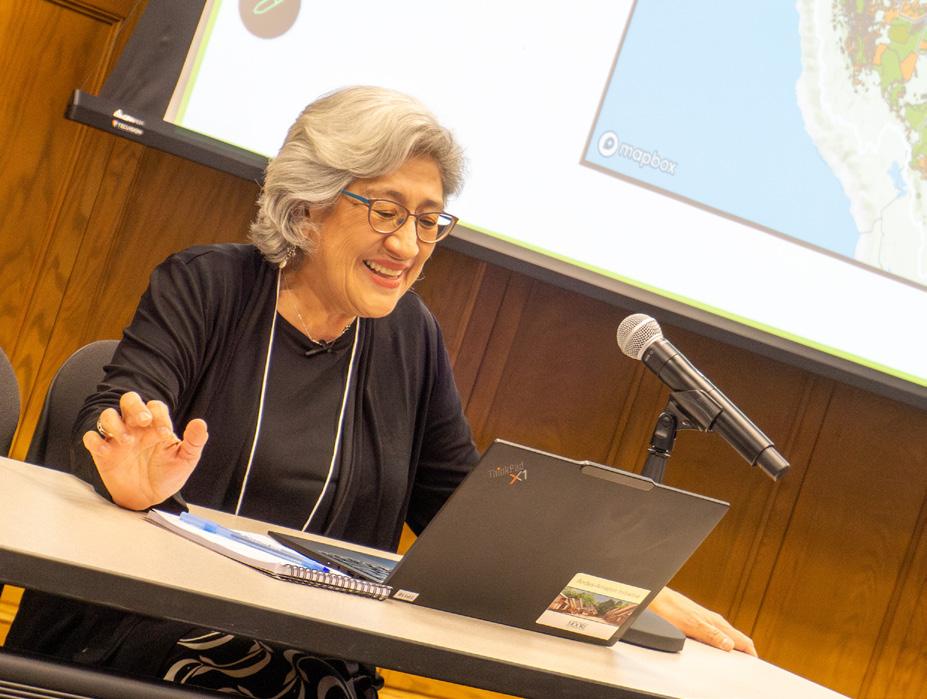
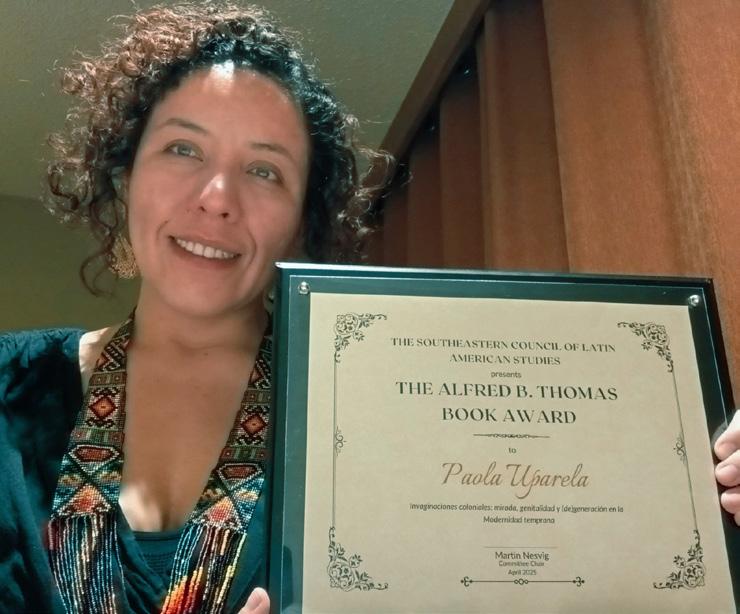
Following an extraordinary year of professional accomplishments, Center affiliate Paola Uparela (Spanish and Portuguese) sat down with graduating MALAS student Nicolle Luzardo Morán to talk about colonial archives, interdisciplinarity, medical humanities, and the future of Latin American Studies.
Dr. Uparela’s work focuses on early modern and colonial cultural studies, Latin American and Spanish literature, the history of medicine and science, visual and material culture, medical humanities, Indigenous studies, and biopolitics. Her book, Invaginaciones coloniales. Mirada, genitalidad y (de) generación en la Modernidad temprana (Madrid/Frankfurt: Iberoamericana Vervuert, 2024), examines the emergence of visual regimes surrounding the female body in medicine, literature, and art between the fifteenth and seventeenth centuries. It has received six major awards, including the Klaus D. Vervuert Hispanic Essay Award and the LASA Visual Culture Book Prize.
Beyond her role at UF, Dr. Uparela is a member of the Executive Committee of the Latin American Studies Association (LASA) Colonial Section, a founding member of the Societas Lascasiana, and Vice President of the Association of Gender and Sexuality Studies (AEGS). This year, she joined the editorial board of LASA’s Latin American Research Review (LARR) and was named a recipient of the Gustavo Gutiérrez Research Award. For the 2026–2027 academic year, she has been invited as Visiting Professor and Research Associate in the Women’s Studies program at the Divinity School at Harvard University.
NICOLLE LUZARDO MORÁN: This has been a remarkable year for you, from awards to institutional appointments to collaborative projects. To what do you attribute these accomplishments?
PAOLA UPARELA: I attribute them to the fact that my work emerges from a sustained commitment to interdisciplinary inquiry and from the conviction that the most compelling historical and cultural questions cannot be addressed from a single disciplinary perspective. My research is driven by the necessity of placing philosophy and theology in dialogue with the history of medicine and art, anthropology and political theory, together with my formation in literature and colonial history. The reception of Invaginaciones Coloniales, along
with these recognitions, has reaffirmed my belief that crossing disciplinary boundaries is not simply productive but necessary for understanding the complexity of colonial archives and their contemporary afterlives.
More importantly, these achievements have expanded the horizon of the conversations in which my work can participate. The Gutiérrez Award and the invitation to Harvard have deepened the philosophical, theoretical, and historical dimensions of my current book project on labor understood simultaneously as work and as delivery [childbirth]. I look forward to continuing my research on visual regimes, embodied histories, and structures of violence within a broader intellectual community and with renewed conviction that the intersection of archives, critical theory, and the humanities remains an extraordinarily fertile—and urgently necessary—space of thought.
NLM: Looking back on the past year, what accomplishment has been the most personally meaningful to you, and why?
PU: Every recognition is meaningful to me because each reflects a distinct intellectual moment and stage in my trajectory. The first award I ever received—for an article on Guaman Poma— was especially decisive because it gave me the confidence and momentum to continue developing my doctoral dissertation at a moment when external validation mattered profoundly. The book awards, however, have represented a different kind of recognition. What I value most is not the prestige attached to them, but the depth of engagement from readers and juries across remarkably diverse fields. My work has resonated with institutions and scholarly associations across Latin America, Europe, and the United States, spanning areas such as visual culture, colonial studies, literature, gender studies, and the history of medicine and art.
Beyond this disciplinary breadth, what matters most to me is the recognition that the humanities remain indispensable for understanding the historical construction of the body, reproduction, science, and knowledge in the early modern world. To have my work recognized by scholars in different fields is not only a personal honor; it also underscores the importance of literary criticism and discourse analysis as essential tools for understanding the colonial histories of the body, medicine, and biopolitics. CONT'D on p. 16 ▶
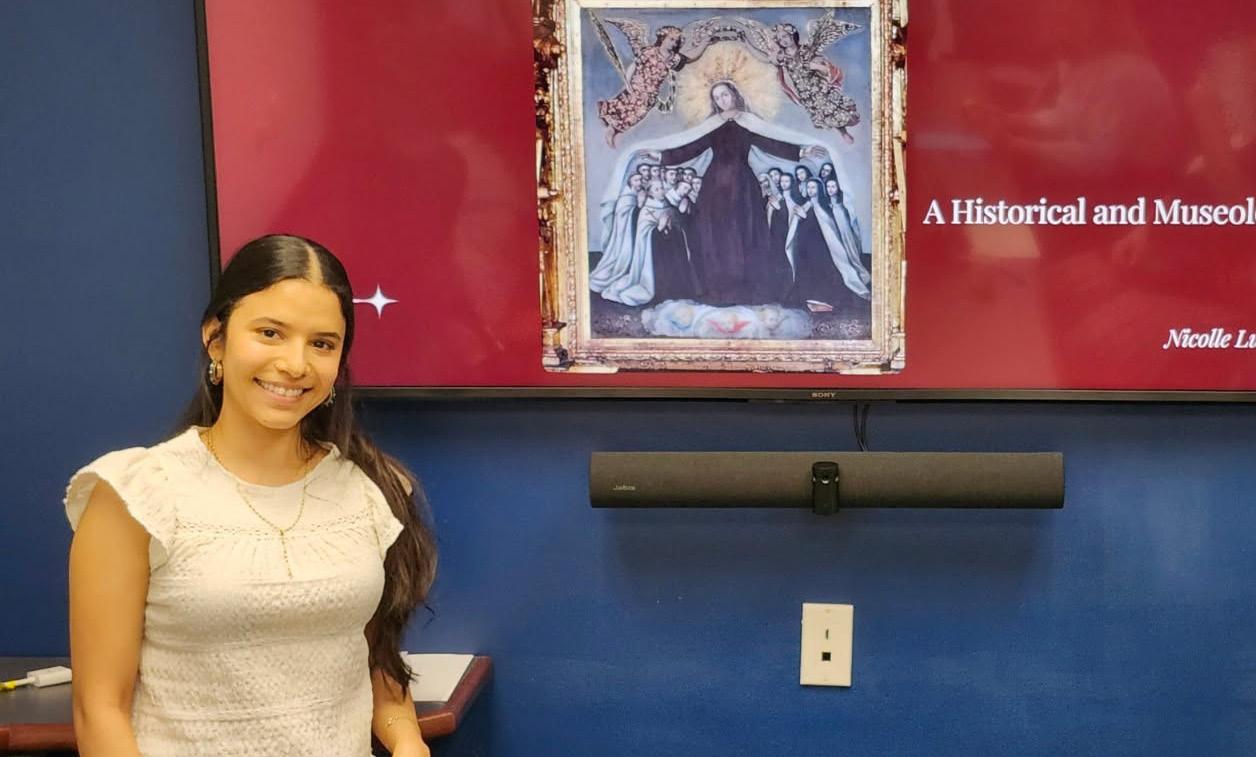
QUINTO SIMPOSIO DE JÓVENES INVESTIGADORES EN HISTORIA DE LA UNIVERSIDAD DE PUERTO RICO.
SAN JUAN, PUERTO RICO
EL MUSEO DEL CARMEN ALTO: LA COEXISTENCIA DE DOS IDENTIDADES EN UN ESPACIO HÍBRIDO
This was my first experience participating as a panelist in a conference. At first, the thought of traveling internationally and presenting my research was extremely intimidating. However, the organizers, professors, students, and panelists at the conference were extremely welcoming and polite. This completely shaped my experience at the conference. I felt like my work was of interest to people, which motivated me to finish my final version of the MALAS paper with strength and confidence.
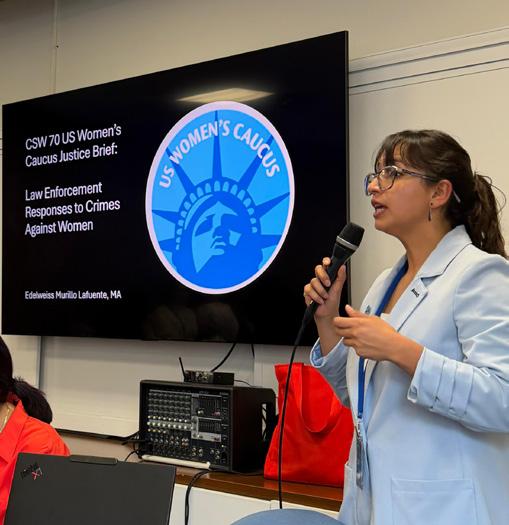
UN WOMEN: THE SEVENTIETH SESSION OF THE COMMISSION ON THE STATUS OF WOMEN NGO CSW70 FORUM
NEW YORK, NEW YORK, USA
LAW ENFORCEMENT RESPONSES TO CRIMES AGAINST WOMEN
The most interesting conversations I had happened at the panel event organized by Sociologists for Women in Society, where I presented my research; Hafza Girdap presented her research on Yazidi women, motherhood in conflict and feminist politics of social identity; Fatema Zohara shared her findings about dating as young Muslims in North America; Özlem Altıok provided an important human rights perspective on the criminalization of abortion in the United States; and Neisha Terry Young presented her work on TikTok advocacy and the oppositional gaze. Such a diverse perspective of scholars made me feel more grounded about my own work, as well as aligned with others in the researcher community. Scholars were interested in my ethnographic methodologies and I was glad to continue the conversations after our panel.
73 RD ANNUAL MEETING OF THE SOUTHEASTERN CONFERENCE ON LATIN AMERICAN STUDIES
LAS VEGAS, NEVADA, USA
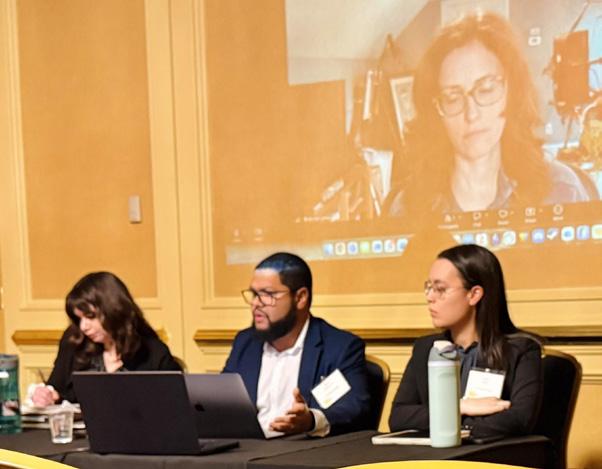
MARKET RULES AND THE LIMITS OF IDEOLOGICAL COHERENCE IN CUBA, 1980–1986
At this year’s meeting, I had the opportunity to engage with and learn from seasoned scholars at a major conference on Latin American Studies. I also chaired the panel “Negotiating Revolution: Economy, Diplomacy, and Cultural Politics in Late Twentieth-Century Cuba,” where I presented a paper titled “Market Rules and the Limits of Ideological Coherence in Cuba, 1980–1986.” Claudia Suárez (UF) and Ryan Metz (The Ohio State University) also presented their excellent work on the panel. The expertise of Dr. Jennifer Lambe (Brown University), who served as the panel discussant, proved essential to the discussion and provided valuable feedback for my work. I now plan to expand and publish this paper while completing my doctoral dissertation.
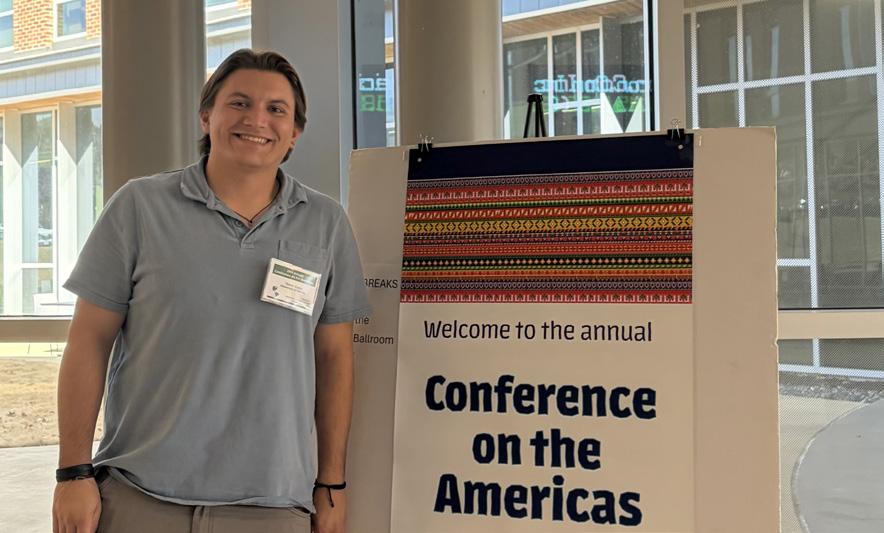
29 TH CONFERENCE OF THE AMERICAS
DAHLONEGA, GEORGIA, USA
ALFREDO DA SILVA AND THE POTOSINO LANDSCAPE IN FLUX
“I thoroughly enjoyed my time at the Conference of the Americas in Dahlonega, Georgia. It was the first time that I had ever presented at a conference, and I appreciate the Center of Latin American Studies' willingness to assist with funding my travel and stay. Given the conference's multidisciplinary approach, I learned from academics outside of my focus of art history, which was really exciting. With live feedback I gained from this conference, I feel more confident in the research I completed and its importance in furthering the study of Andean abstraction. I had wonderful time attending the Conference of the Americas, especially in doing so alongside Jonny López, who accompanied me on the road trip up and down.
LANGUAGE, CULTURE, AND LEARNING STYLES: EXAMINING THE IMPACT OF CHOCOAN CULTURAL IDENTITIES ON ENGLISH LEARNING DYNAMICS
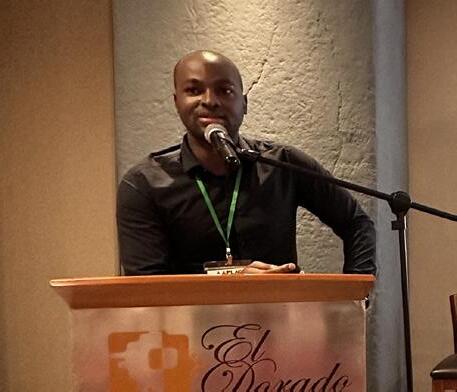
37 A CONFERENCIA ANUAL DE LA ASOCIACIÓN DE PROGRAMAS ACADÉMICOS DE AMÉRICA LATINA Y EL CARIBE (AAPLAC)
CUENCA, ECUADOR
Attending "El intercambio intercultural como motor de comunidades sostenibles y resilientes" this past March in Cuenca, Ecuador, was a remarkable experience. The high level of organization and logistical precision was truly impressive. The event successfully positioned intercultural exchange as a vital catalyst for building sustainable and resilient progress across Latin American communities. I could fully engage with the sophisticated academic discourse and valuable networking opportunities. Cuenca served as a stunning city for such a high-level gathering, making the entire experience flawless and intellectually stimulating.
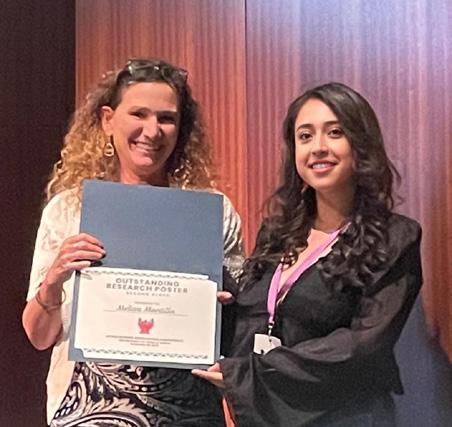
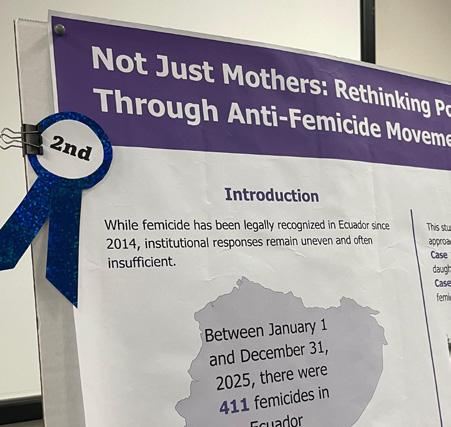
LATINX STUDIES ASSOCIATION CONFERENCE
AUSTIN, TEXAS, USA
NOT JUST MOTHERS: RETHINKING POLITICAL IDENTITY THROUGH ANTIFEMICIDE MOVEMENTS
“2ND PRIZE
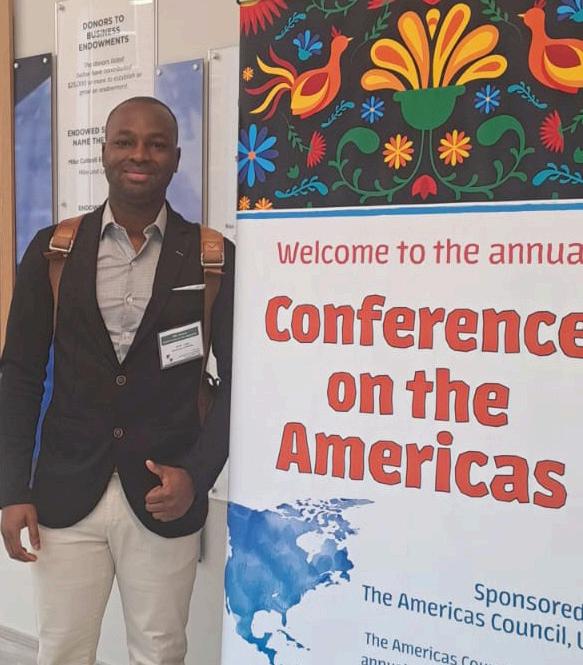
29 TH ANNUAL CONFERENCE ON THE AMERICAS
DAHLONEGA, GEORGIA, USA
The conference was an exceptional experience, as its organization and thematic focus were perfectly aligned with the currently relevant topics across Latin America. The insightful panels meant a unique opportunity to connect with knowledgeable professionals from a wide array of international universities and institutions. I strategically chose this event for its commitment to diversity and interdisciplinarity, which significantly enriched the academic discussion. Beyond networking, it served as a valuable rehearsal for my research defense, which took place just a few weeks later. I highly recommend that Center students apply in the future. It offers a truly stimulating environment to refine presentation skills, exchange innovative ideas, and meaningfully boost one's academic knowledge.
I was amazed that over 500 scholars, students, artists, and organizers came together to share, learn, and broaden Latina/o/x studies at the conference. What stood out most to me was the strong sense of community and the openness to conversations across different disciplines and backgrounds. This year, LSA organized its first poster session, selecting only 15 submissions. I was honored to be chosen to present my research, and was awarded second prize for my poster presentation. The award ceremony took place during the plenary session, which allowed my research to reach a broader audience and opened new conversations with scholars interested in gender violence, activism, and political identity. Because so much scholarship within Latino Studies focuses on diasporic communities in the U.S., bringing conversations and issues emerging from Latin America into the space felt especially important. I also learned so much by attending different panels and sessions throughout the conference. One of my favorites explored Bad Bunny, perreo, and Puerto Rico’s history and culture, highlighting how popular culture can become a site of political and historical analysis.
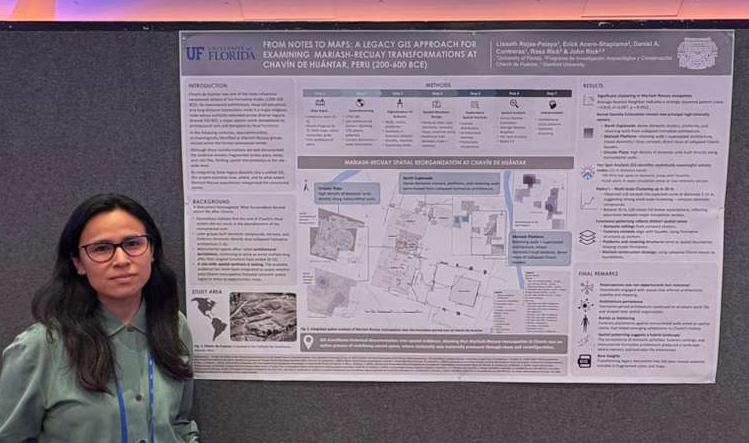
SOCIETY FOR AMERICAN ARCHAEOLOGY - 91 ST ANNUAL MEETING
SAN FRANCISCO, CALIFORNIA, USA
FROM NOTES TO MAPS: A LEGACY GIS APPROACH FOR EXAMINING MARIASH-RECUAY TRANSFORMATIONS AT CHAVÍN DE HUÁNTAR
Presenting at the SAA conference was a really meaningful experience for me, both personally and academically. As a Peruvian archaeologist and PhD student, it was exciting to share my poster and talk with other researchers about the challenges of integrating decades of archaeological records into new spatial analyses through GIS. One of my favorite parts was seeing how interested people were in Chavín and in the idea of bringing together multiple documentation sources into a single spatial database. I had the chance to meet researchers from different universities, exchange ideas, and receive thoughtful feedback that helped me see the project from new perspectives. Beyond my presentation, attending panels from different regions and specialties also pushed me to think outside the box and sparked new ideas and approaches to my own research.
NLM: You organized the inaugural Guaman Poma Colloquium at UF in March, bringing together scholars for two days of conversations around the work and legacy of the Peruvian Indigenous intellectual Felipe Guaman Poma de Ayala. What was the most rewarding aspect of the experience, and how would you like to see the event evolve in the future?
PU: The Guaman Poma Colloquium emerged from a grant awarded by the Center for the Humanities and the Public Sphere (CHPS), but it quickly evolved into a much broader collaborative initiative sponsored by the Department of Art History and HESCAH, the Center for Latin American Studies, and the Departments of Anthropology and Spanish and Portuguese. Planned over more than a year, the colloquium brought together three keynote speakers and more than 20 scholars from Latin America, the United States, and Europe.
From the beginning, the goal was to create a space where scholars from literature, anthropology, art history, theology, history, and Indigenous studies could engage Guaman Poma’s Nueva corónica y buen gobierno from multiple perspectives. In addition to keynote lectures and thematic panels, the colloquium included the Guamanopticon exhibition at the Judaica Suite, which encouraged audiences to rethink Guaman Poma’s visual archive through material, digital, and experimental forms of display.
One of the most rewarding aspects of the colloquium was the close collaboration with undergraduate and graduate students, whose participation was fundamental to the event’s success. Equally meaningful was the opportunity to work with colleagues across multiple departments, whose support transformed the colloquium into a genuinely collective intellectual project. Looking ahead, I hope the colloquium will continue as a recurring space for intellectual exchange and collaboration. We are currently envisioning the Guamanopticon as a larger digital humanities initiative that could travel to other institutions and generate new collaborative research opportunities.
NLM: You were recently appointed to the editorial team of the Latin American Research Review with Cambridge
University Press. What does this opportunity mean to you, and how do you hope to contribute to the journal’s evolving intellectual direction?
PU: Being appointed to the editorial team of the LARR is both an honor and a profound responsibility. Professionally, it represents an opportunity to participate in shaping some of the most important conversations in Latin American Studies at an international level. Because my work moves across literary criticism, visual culture, the history of medicine, Indigenous studies, and biopolitics, I see this role as a natural extension of my scholarly trajectory. I hope to encourage scholarship that challenges inherited disciplinary frameworks and brings different methodologies into conversation,
“
The intersection of archives, critical theory, and the humanities remains an extraordinarily fertile—and urgently necessary—space of thought.
“
particularly work that connects archives, visuality, medical humanities, material culture, and questions of representation.
NLM: From the Guamanopticon project to medical humanities, visual culture, and digital scholarship, your work continually rethinks how knowledge circulates across disciplines, media, and communities. How do you envision dialogue, collaboration, and public engagement shaping the future of Latin American Studies today?
PU: For me, mentorship, collaboration, and public engagement are not secondary to scholarship; they are constitutive of it. I do not see research, teaching, and public humanities as separate activities, but rather as interconnected forms of intellectual practice. The classroom, the archive, the exhibition space, and the digital platform
all belong to the same ecosystem of inquiry. My students constantly push me to formulate better questions, to think across generations and media, and to remember that debates about history, embodiment, representation, and knowledge production are never purely abstract. They shape how people understand archives, bodies, and historical experience in the present. One of the clearest examples of this collaborative model has emerged through the Guaman Poma Study Group and the development of the Guamanopticon project. The exhibition itself brought together medieval, classical, and pre-Hispanic references related to Guaman Poma’s work alongside colonial chronicles, quipus, the yupana, maps, visual recreations, comics, games, and even video games! What fascinated me most was seeing students immediately gravitate toward those interactive forms. That moment revealed something essential: students today often want to engage archives interactively— to reinterpret them, remake them, and translate them into new media and new forms of storytelling.
NLM: For students interested in pursuing research in colonial Latin America and interdisciplinary cultural studies, what advice would you offer about building a meaningful and intellectually rigorous academic path?
PU: Research in colonial Latin America requires an enormous degree of intellectual rigor and patience. It involves archival and paleographic work, navigating nonstandardized forms of Spanish, working with fragmented or lost documents, and understanding systems of authority, knowledge, and cultural negotiation that are often in tension with one another. At the same time, it is an extraordinarily rich field because it reveals complex forms of agency, silenced discourses that can still be partially recovered, and visual and material cultures that do not always correspond transparently to written texts. One of the most important lessons I try to share with students is that the archive is never entirely stable or transparent; it demands careful reading across different forms of evidence and interpretation. Ultimately, I believe that impactful scholarship emerges not only from methodological sophistication but from intellectual curiosity, ethical responsibility, and the willingness to ask difficult questions that connect the past to the world we inhabit today. ◆
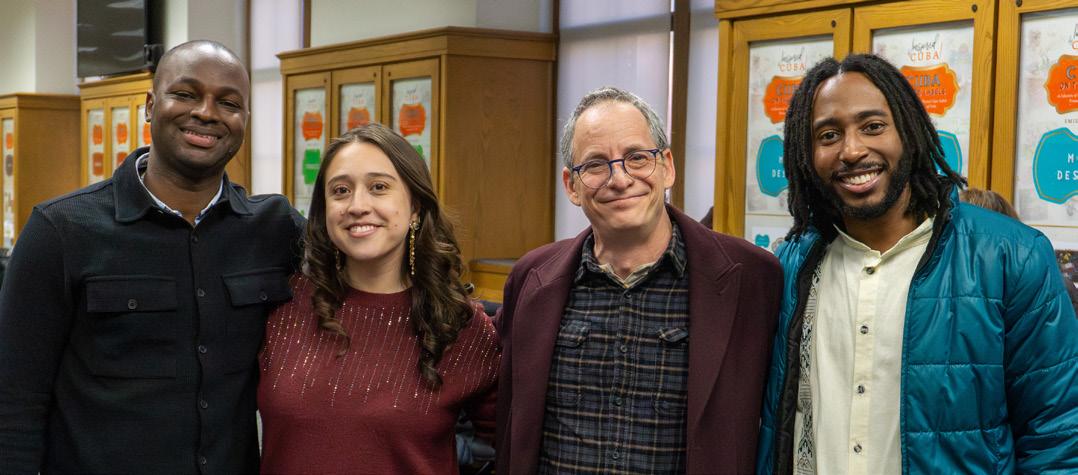
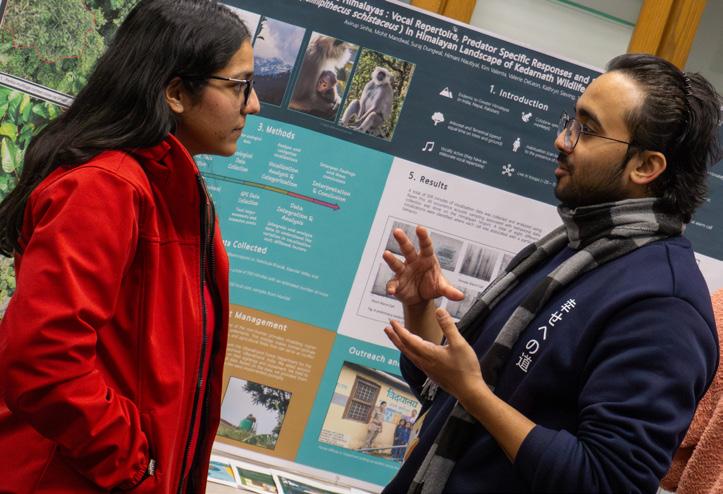
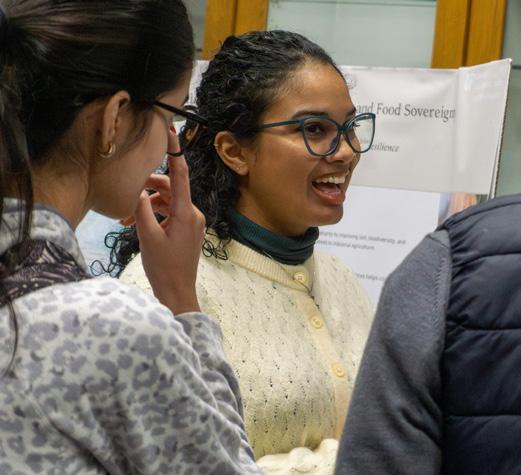
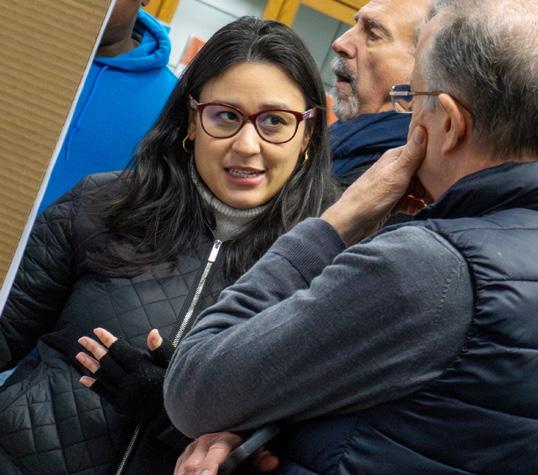
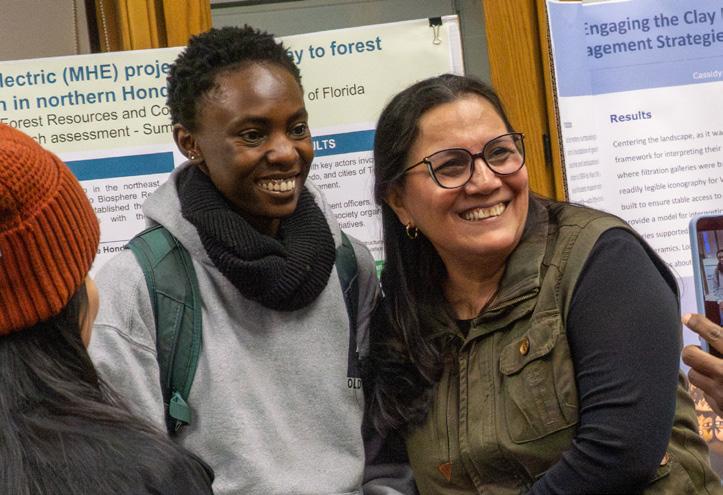
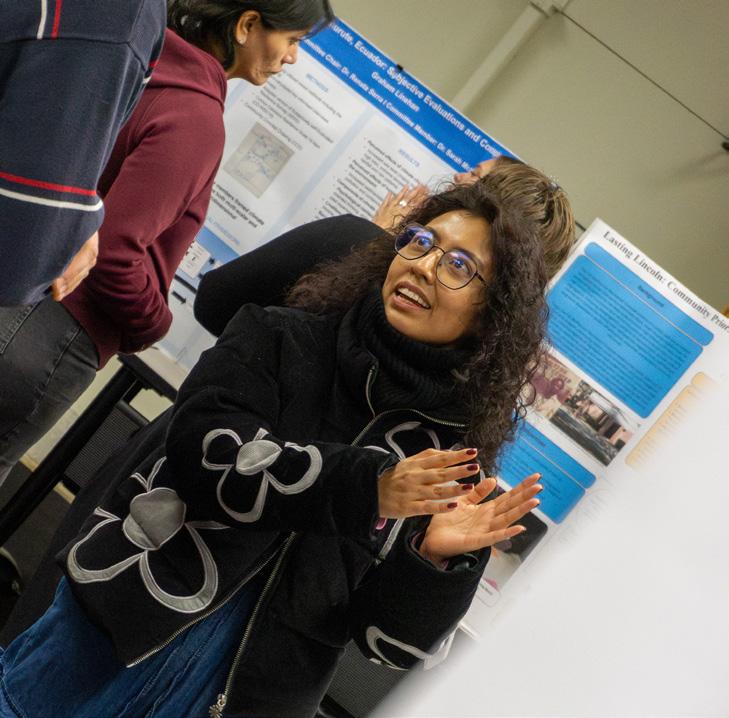
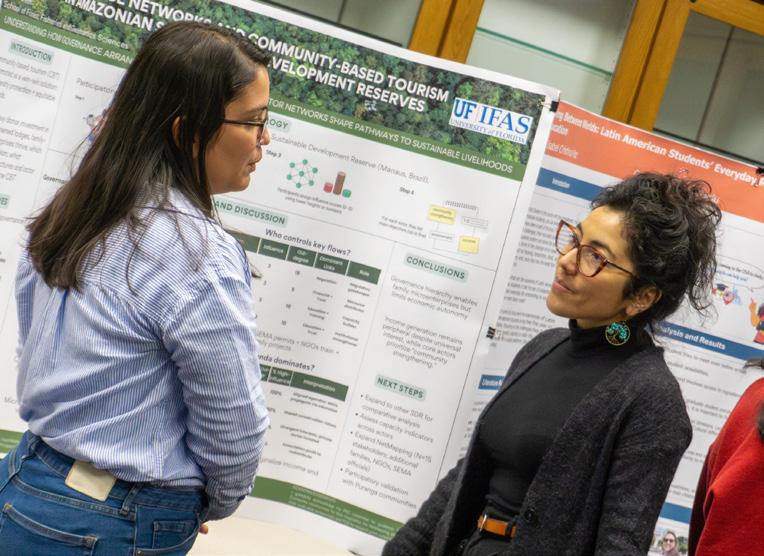
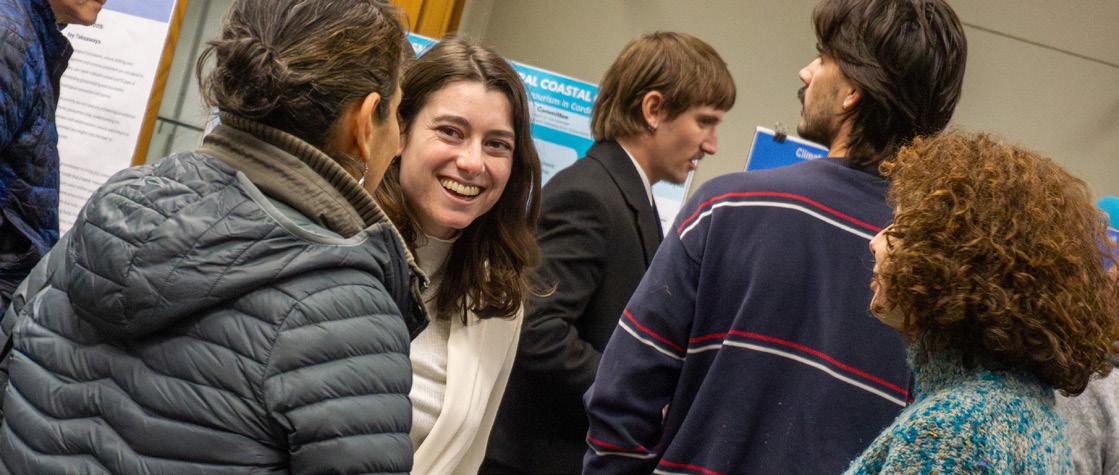
Congratulations to this year’s winners of the Fieldwork Festival!
CONSERVATION, DEVELOPMENT, AND SUSTAINABILITY OTHER FIELDS
MASTER'S LEVEL
ARTIS TRICE
Mapping Jamaican Cultural Food Security in Two Southern Immigrant Enclaves
Honorable mentions:
JONNY ANDRÉS
LÓPEZ LUZANO
Language, Culture, and Learning Approaches: Examining the Impact of Chocoan Cultural Identities on English Learning Dynamics
MELISA MANTILLA
Sustaining Life, Reimagining Justice: Indigenous Women’s Activism and the Politics of Care
PHD LEVEL
WÂNIA GRANGEIRO
CARDOSO
Infrastructure and Indigenous Nations Under Siege: The Case of Ecuador And Brazil
Honorable mentions:
BARBARA HERRERA
“Tómate Miel Con Limón!”: Ethnobotanical Knowledge Among Populations in the Dominican Republic
JULIA PAOLI
Surveillance of Tick-Borne Viruses and Bacteria in Kenya
MASTER'S LEVEL
HANAN LACHMANSINGH
The Socio-Cultural and Economic Dimensions of Shorebird Harvest in Coastal Guyana: A Biocultural and Participatory Approach
Honorable mentions:
GRAHAM LINEHAN
Climate Resistance in Churute, Ecuador: Subjective Evaluations and Conceptualizations
HEATHER BURKYLECHWAR
Regenerative Tourism Potential in Rural Coastal Communities: Community Perception of Regenerative Tourism in Cordova, Alaska
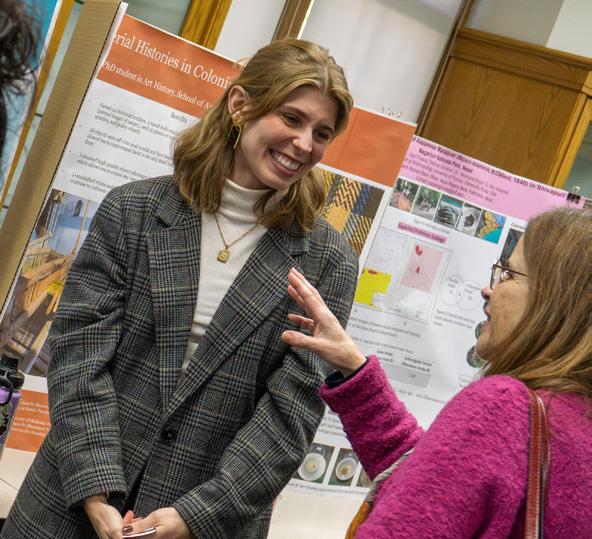
PHD LEVEL
MIRIAN YADIRA MOLINA
Community Governance in Micro-Hydroelectric Systems: Understanding Variations and Perceptions in Honduran Forests Conservation Efforts
Honorable mentions:
ANGÉLICA GOUVEIA NUNES
Governance Networks and Community-Based Tourism in Amazonian Sustainable Development Reserves
VICENTE VASQUEZ
Monitoring Tree Phenology in
Ioel Katz and
Galván take on academic research in University Scholars
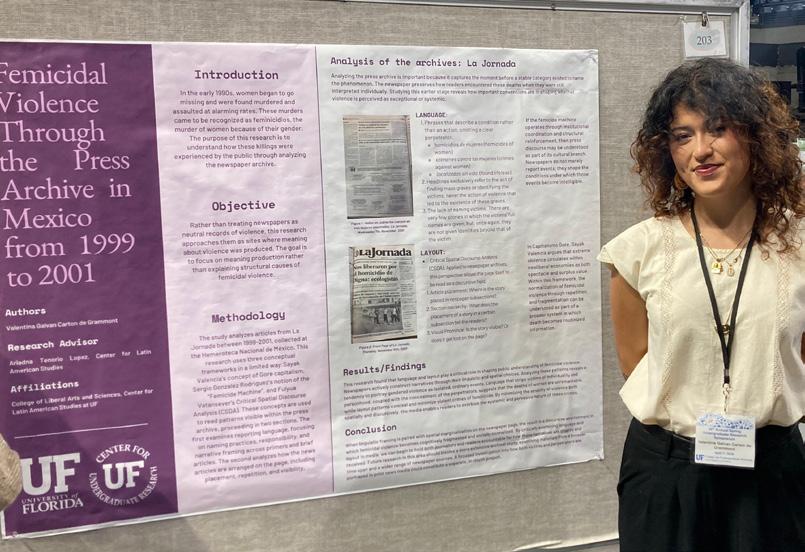
In April, the Center for Undergraduate Research hosted its annual Spring Undergraduate Research Symposium at the O’Connell Center. There, amid a sea of 677 poster presentations from across all disciplines at UF, were two students from Latin American Studies: Valentina Galván (class of 2027) and Ioel Katz (class of 2028). Valentina and Ioel were selected to conduct research as part of the University Scholars Program (USP), which offers undergraduate students the opportunity to gain experience in the academic research process under the guidance of a faculty mentor.
Valentina and Ioel are both completing a minor in Latin American Studies, having taken courses with Center professors Carlos de la Torre, Rafael Ramírez Solórzano, Meg Weeks, Luis Felipe Lomelí (who served as Ioel’s mentor), and Ariadna Tenorio (who served as Valentina’s). Their enthusiasm for the course content and connection with the professors led them to seek opportunities beyond the bounds of coursework. “When I'm writing papers in class about topics that I'm interested in, sometimes I feel like I could take it further,” Ioel says. “Like if I just spent a little bit more time and read a little bit more, I could present an idea and support it.”
how femicide was reported in the newspaper La Jornada from 1999-2001. She found that the language and layout tended to depict gendered violence as isolated incidents and glossed over the identities of the victims. “It was heartbreaking to see how women and girls were just reduced to a body on the newspaper page,” Valentina reflects. “A big challenge for my research was balancing not becoming desensitized to the problem with not inundating myself with feelings of sorrow.”
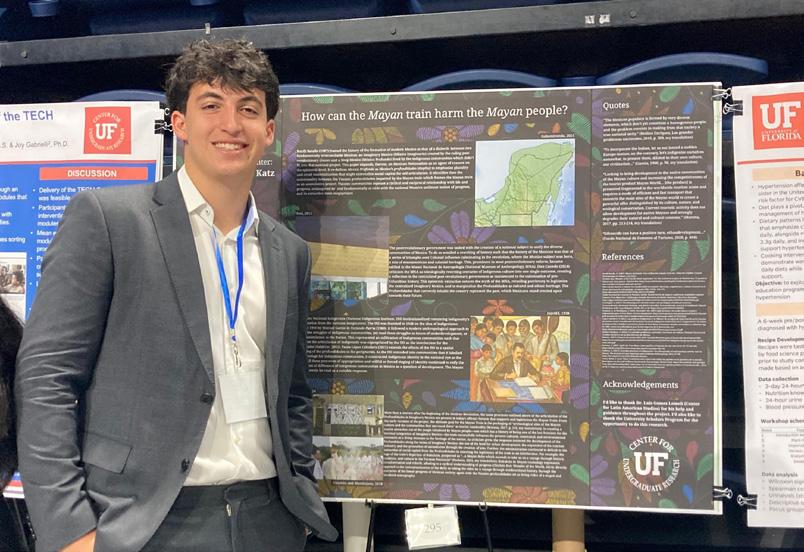
Knowing that this was the type of analysis he wanted to do, Ioel explored possible topics with Profe Lomelí, guided by his interest in nationalist political rhetoric. He decided to research the Tren Maya rail project, which connects tourist destinations in Mexico’s Yucatan Peninsula. His paper, titled “El Tren no es nuestro: The Mayan Train and Mexican Nationalism” uses the framework of México Profundo by Guillermo Bonfil Batalla to argue that the Tren Maya is an expression of an “imaginary” Mexico that appropriates Mayan culture to advance its erasure through industrialization.
Coming from an Argentinian Jewish family, Ioel didn’t anticipate pursuing research in the context of Mexico. But for Valentina, who was born in Mexico and still visits family there, conducting research about Mexico was always “very close to home.” Combing through the newspaper archives at the Universidad Nacional Autónoma de México, Valentina analyzed
Their USP research completed and written articles under review for publication in UF’s Journal of Undergraduate Research (JUR), Ioel and Valentina are already designing their next ambitions. Ioel, who is double majoring in Sociology and Economics, will intern with Center faculty Rebecca Hanson at the International Ethnography Lab in the fall, after completing a summer internship at an immigration law firm in Miami. Valentina, who is an Anthropology major and one year ahead of Ioel, is already developing her senior thesis project, under the guidance of Center affiliate faculty Richard Kernaghan. She’s shifted her focus to studying mothering and grief as political forces in Mexico, researching the madres buscadoras activists who seek justice for their missing children and the forcibly disappeared.
As both Valentina and Ioel are still only undergraduate students, firm plans for paths forward are still taking shape. But, with their aspirations for advanced scholarship, they’re each planning for future study – perhaps a MALAS degree, even, to take advantage of the interdisciplinary, in-depth curriculum in Latin American Studies. “All the LAS classes I’ve taken are amazing,” Ioel says. “I’ve already fulfilled the requirements for my minor but I wish I could take more.”
“I really love what the Center offers,” Valentina echoes. “It’s given me such a good interdisciplinary foundation.” With opportunities like the University Scholars Program, undergraduate students like Valentina and Ioel will continue to develop a strong foundation for future success at the graduate level and beyond. ◆
MALAS student pursues work in asset-based and sustainable community development initiatives
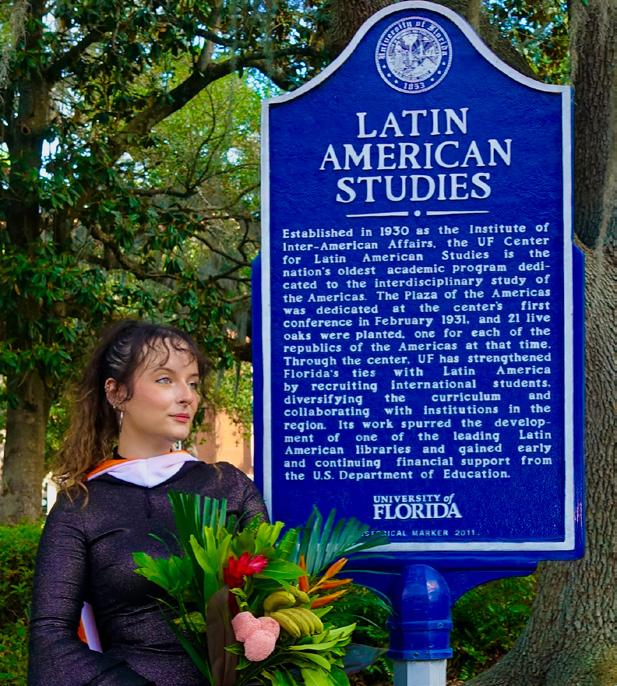
Caroline Centeno (MALAS 2026) would understand any confusion when she tells you that she is starting a PhD in Design, Construction and Planning in the fall. After all, her academic career has thus far encompassed Latin American Studies, Portuguese, political science, and anthropology. “It might seem like a total 180,” she laughs. “Like, where did this come from?” But even though it wasn’t the initial plan, Caroline’s path unfolded organically during her time at UF, as she followed interest and opportunity at each step. “All the doors kept opening and I just kept walking through them,” she grins.
It all began with a language requirement to fulfill her undergraduate international studies degree. Caroline’s choice of Portuguese soon blossomed into a passion for the language, thanks to mentorship from faculty in the Department of Spanish and Portuguese Studies. Then, with financial support from the Foreign Language and Area Studies (FLAS) fellowship, Caroline was able to spend a summer in Brazil on the UF in Rio study abroad program. While in Rio de Janeiro, she discovered the work of Catalytic Communities, a non-profit organization supporting grassroots sustainable development projects across a network of favelas (informal urban settlements) in Brazil. She knew immediately she wanted to get involved.
Another door opened when Caroline applied for the MALAS 4+1 program in her junior year. Not only could she pursue a research project with her burgeoning interest in community development, she could also complete her first year of graduate classes during the final year of undergraduate study. Though it was challenging to see herself at the same level as her peers at first, she soon realized she wasn’t alone in academic self-doubt. “I found out it was a shared sentiment between all of us,” she says. “We have to learn to trust ourselves and what we know about our research.”
Thankfully, trust was a practice Caroline embraced in her choice to pursue an internship option in the MALAS program, saying its flexible framework “gives you the freedom to go wherever you're going and explore what happens.” More than that, an internship with Catalytic Communities meant that she could contribute to the organization’s mission, not simply study it for her own knowledge through research alone. The interdisciplinarity and customizability of the MALAS program allowed her to develop her project according to this vision, and
she ended up with an internship-thesis hybrid: 240 hours of work experience, new networks and future plans, and a 92-page research paper.
The cornerstone of Caroline's project is asset-based community development, an approach to planning that centers solutions around the strengths and capacities of a community, ensuring that its power comes from within, not imposed from outside organizations. Caroline says this aspect is what sets apart Catalytic Communities from many non-profits working in anti-poverty contexts. “It’s made by the community for the community,” she explains. “They don't take the reins when there's an issue; they ask what the community needs and provide assistance to achieve those goals."
In her role as intern, Caroline made site visits to different favelas to engage with the projects that Catalytic Communities was facilitating, including a climate memory exhibit about river pollution, a green roof initiative, planning a communal gathering space, and efforts to increase access to clean water sources. She also contributed to the creation and distribution of an open letter to COP30 (the 2025 United Nations Climate Change Conference), which was meeting in Belém, Brazil later that year. Caroline added her academic skills to the letter by preparing the citations and developed an international contact list for gathering signatures. The letter arrived at COP30 with over 700 individual signatories and 200 institutional signatories urging the inclusion of informal urban settlements in climate discussions on the global stage.
In the fall, Caroline will begin her PhD in urban and regional planning, where she’s excited to gain more technical skills and pursue asset-based community development research in a Puerto Rican context. Ultimately, her background in Latin American Studies, Portuguese, anthropology, and political science makes more sense than meets the eye. “Social science belongs in the sphere of planning,” she emphasizes. “We spend so much time thinking about the division between STEM and ‘everything else.’ But it all works together.”
From this view, it's easy to see Caroline’s own philosophy implicitly guiding her project and the path that revealed itself to her with every opening door: pursuing interest, working from opportunity, and building connections. “The whole experience affirmed that this is what I’m passionate about, and what I want to keep doing in the future,” she reflects. “And it reaffirmed the idea that people need to work together to make change. Any vision we have for the future starts there.” ◆
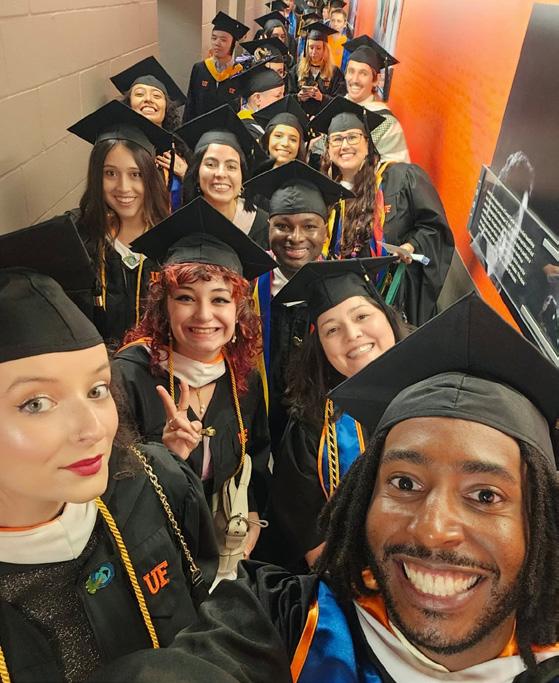
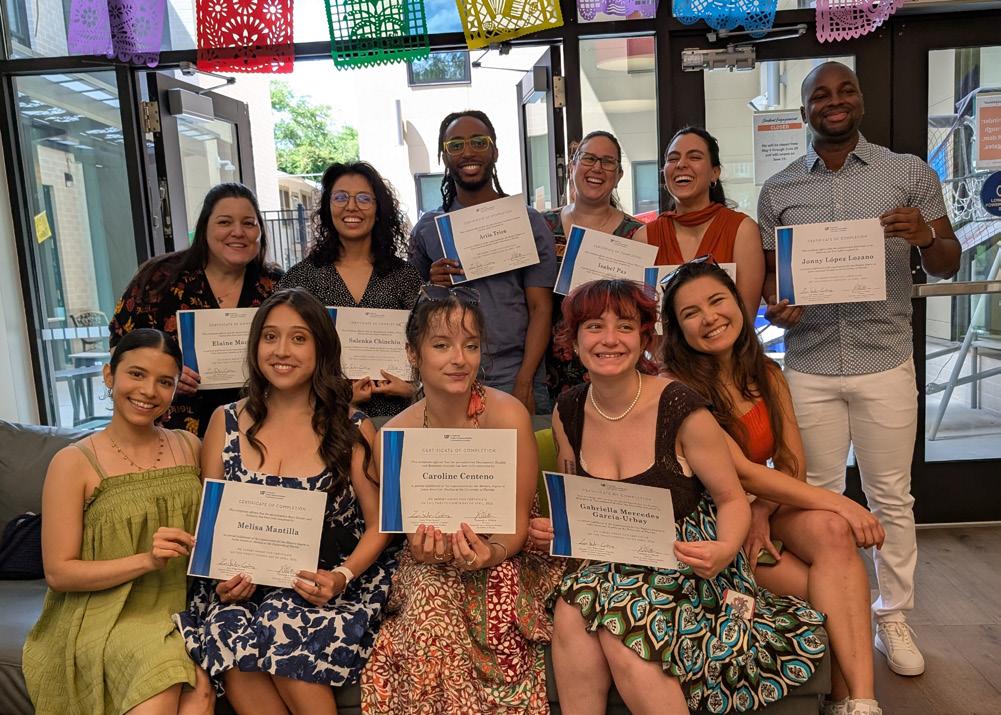
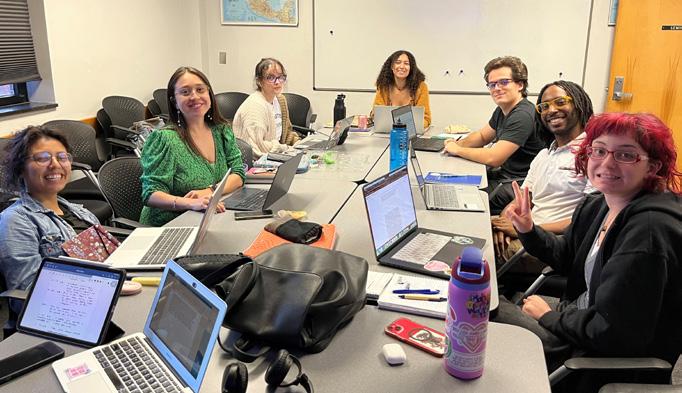
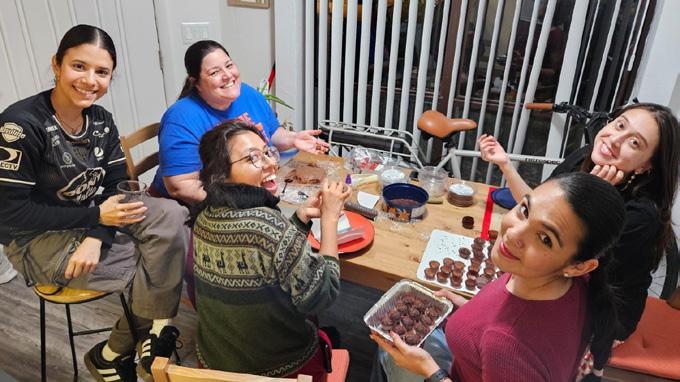
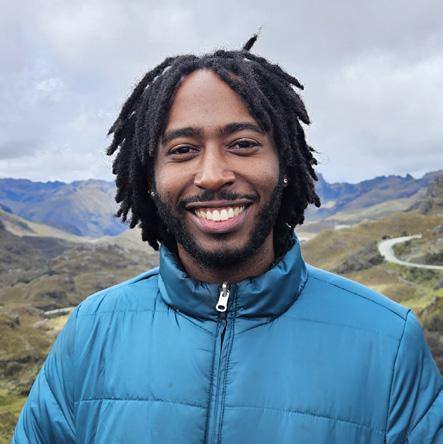
BY SALAS PRESIDENT ARTIS TRICE (MALAS 2026 )
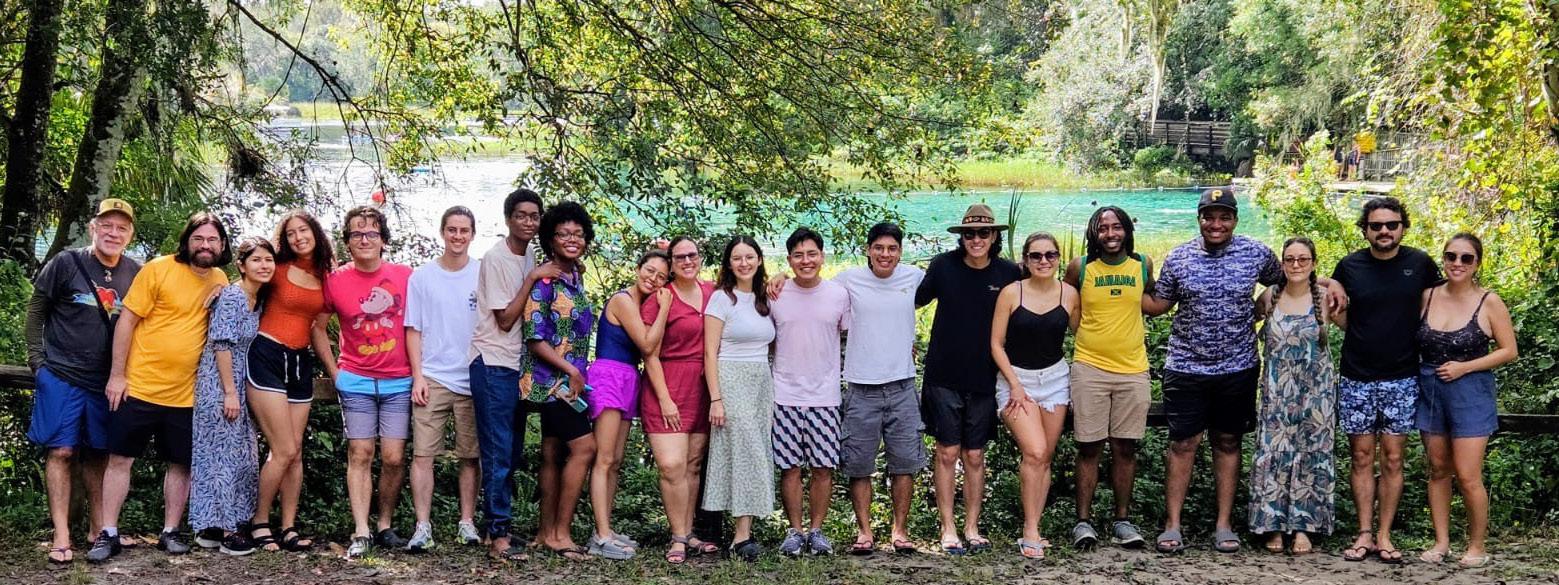
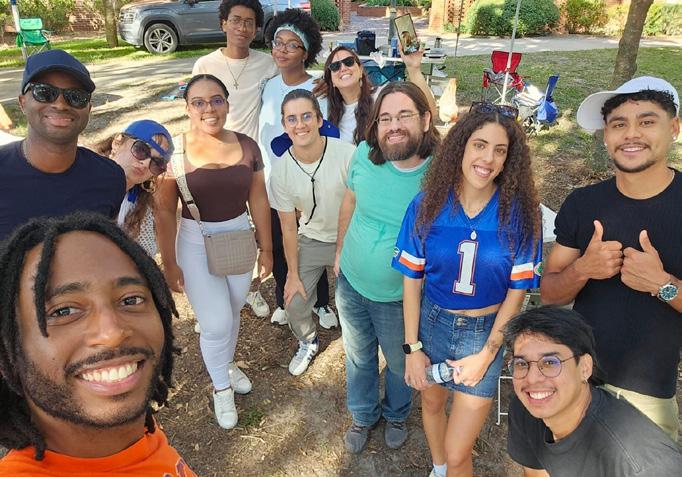
At our first meeting for the Student Association for Latin American Studies in August 2025, we set our intentions for the year fairly early: to learn, to spend time together, and to have fun. We worked hard this year to create a community for students in the Center for Latin American Studies and the University of Florida. Thanks to the dedication of the officer team, our member’s presence, and the support of the faculty and staff in the Center, I’m honored to say that we exceeded our goals for this academic year.
SALAS expanded our professional development activities to include panel discussions with MALAS alumni. We invited alumni pursuing PhDs across the United States in disciplines such as sociology, education, and demography to discuss their application process. We also hosted alumni working in various departments at the University of Florida to a panel on joining the workforce after MALAS, with special attention to applying for positions for international students. On Thursday evenings, we converted Grinter 376 to a study lounge where students could work together on projects, catch up on work, or get ahead on their readings and assignments. In addition to this, we established the Portal Social Science Talks, where MALAS students and other students in the Center for Latin American Studies could present their research, ideas, and methodology to colleagues and friends. With the help of our Center faculty and staff, we established a mini food-pantry for students to access dry staple goods, fresh fruit, and seasonings.
Although we worked hard, we made the time to have fun and enjoy each other’s company. Before the temperature dropped, we took a trip down to Rainbow Springs to enjoy the water and soak up the sun. SALAS also hosted two football tailgates: one in the fall and one in the spring. We spent hours together cheering on the Gators and introducing students to this cultural tradition. Our clothing swap in February provided us with the perfect excuse to update our wardrobes and find something new. We hosted our annual Galentine’s Day party on February 13, where we also distributed the rich, chocolate brigadeiros from our February fundraiser.
Looking back at our accomplishments, I’m so honored to have shared this space with the students in our two cohorts along with our new friends, classmates, and colleagues. To Caro, Elaine, Gigi, Ivonne, and Melisa: I owe a debt of gratitude to each of you. Your brilliance and passion drove us forward as an organization.
Community building is a revolutionary act. In times where it is easy to isolate ourselves or be isolated, I am so proud of our team for creating multiple opportunities to be together intentionally and spontaneously. I will always remember the first jump into the cool, turquoise water on our trip to Rainbow Springs. I’ll remember playing games and dancing at our November tailgate for hours and hours. I’ll remember the conversations we had while rolling the brigadeiro dough in sprinkles in my apartment. However, more importantly, I will cherish the quiet moments working beside one another in the computer lab. I will cherish the moments where we comforted one another on rough days. I’m grateful for the community we built together, and I’m excited to see where things evolve from here. ◆
Undergraduate LAS Certificates & Minors
Joann Almonte (History)
Julia Elizabeth Hayunga (International Studies)
Yasmin Nasr Martins Amar (Art History)
Selora Langston (Political Science, African American Studies)
Miguel Andrés González (Zoology)
Stacy Rodríguez (History, Political Science)
Leah Zimmerman (Criminology, Political Science)
Hannah Sophia Leatzow (Political Science)
Jeffrey James Santiago Martin (Public Relations)
Connor Yair Effrain (History)
Isabel Velasco (Psychology)
Thalia de la Caridad Garcia (Health Science)
Dariannis Argüelles (Philosophy)
Hannah Marcinkowski (History)
Kaliope Banaag (Psychology, Women's Studies)
Tomás Mateo Curcio (Journalism)
Caroline Isabelle Velandia (Political Science)
Emilio José Bastardo Torrealba (Political Science)
Isabella Soto (Sport Management)
Daniela María Hoyos (Public Health)
Lucía Elena Urdaneta ( Anthropology, Women's Studies)
Oriana Carolina Torre da Silva (Journalism)
Eluney González (English, History)
Lydia Weigel (Anthropology)
Sheyla Melissa Granado (Political Science)
Alexandra Hernández-Flores (History, Philosophy)
Clarissa Benjamin (Biology)
Danna Leyton (Nursing)
Liana Carolina Sierra (English, Political Science)
Paula Franco (History, Philosophy)
Ashley Martínez-Arroyo (History)
Dannia Isabel Merino Mejía (Political Science)
Alexa Guardo (History)
Xinqi {Emily} Dong (English)
MALAS Degree
Artis Trice
Capstone: Nyam Like Yaad Abroad: Mapping Jamaican Cultural Food Security in Two Southern Immigrant Enclaves
Specialization: Caribbean Studies
Chair: Rick Stepp
Caroline Centeno (4+1)
Internship: Understanding the Role of Participatory Processes in Sustainable and Asset-Based Community Development in the Favelas of Rio de Janeiro
Specialization: Development Studies and Economic Analysis Chair: Catherine Tucker
Elaine Machado
Capstone: From Academia to Elementary School, From Elementary School to Academia— A Children's Book as a Bridge
Specialization: Arts, Literature and Culture
Chair: Meg Weeks
Isabel Paz
Capstone: Living Between Worlds: Latin American Students' Everyday Realities in U.S. Higher Education
Specializations: Culture, Theory, and Society and Arts, Literature and Culture
Chair: Luis Felipe Lomelí
Ivonne Zelaya
Capstone: Participatory Almanac for Conservation and Food Sovereignty in Casitas, Güinope, Honduras
Specialization: Tropical Conservation and Development
Chair: Luis Felipe Lomelí
Jonny Andrés López Lozano
Capstone: Language, Culture, and Learning Approaches: Examining the Impact of Chocoan Cultural Identities on English Learning Dynamics
Specialization: Education in the Americas Chair: Jairo Baquero-Melo
Melisa Mantilla
Thesis: Sustaining Life, Reimagining Justice: Indigenous Women’s Activism and the Politics of Care
Specialization: Race, Gender, and Sexuality
Chair: Meg Weeks
Nicolle Luzardo Morán
Internship: The Museum of the Carmen Alto: The Coexistence of Two Identities in a Hybrid Space
Specialization: Arts, Literature and Culture
Chair: Paola Uparela
Salenka Chinchin
Capstone: I Have Learned to Be Like This: Adolescent Identity Expression as an Analytical Lens of Ecuadorian Education — A Participatory Experience in Quito
Specializations: Culture, Theory, and Society and Education in the Americas
Chair: Luis Felipe Lomelí
Graduate LAS Certificates
Jennifer Izquierdo (History)
Rae Landingin (Women's Studies)
Jens Watts (Music)
Guiecniza Dehesa Blas (MDP)
Graham Linehan (MDP)
MDP Degree
Guiecniza Dehesa Blas
Specializations: LAS, TCD
Chair: July Dayane Nelson (IFAS)
Field Practicum: “Community Energy Solutions: Advancing Environmental and Economic Justice through the Home Energy Tune-up Program.”
Tayler King
Specializations: TCD, Urban Planning
Chair: July Dayane Nelson (IFAS)
Field Practicum: “Lasting Lincoln: Community Priorities, Barriers, and the Future of the T.B. McPherson Recreation Center.”
Graham Linehan
Specializations: LAS, TCD
Chair: Renata Serra (African Studies)
Field Practicum: “Climate resilience in Churute, Ecuador: Multi-scalar and multidimensional.”
Sustainable Development Practice
Certificate
Simon Suuk (PhD Family, Youth and Community Sciences)
Tropical Conservation and Development
Graduate Certificate
Guiecniza Dehesa Blas (MDP)
Tayler King (MDP)
Graham Linehan (MDP)
Audrey Smith (PhD, SNRE)
Artis Trice (MALAS)
Ivonne Zelaya (MALAS)
Alex Hackett (MS, Graphic Design/Design & Visual Communications)
Tropical Conservation and Development
Graduate Concentration
Hanan Lachmansingh (MS, WEC)
Artis Trice (MALAS)
This spring, eight LAS alumni who graduated across five different decades volunteered their time and expertise for the online course Latin American Business Environment, taught by faculty emerita Mary Risner. Gary Schweitzer (MALAS 1974) and Lindsay Arrieta (MALAS 2012) served as interviewees for
student group projects, sharing insights on their careers in accounting and law, respectively. Additionally, six alumni were guest speakers in the course: Verônica Manguinho de Souza (MDP 2025), Gregory Bates (MALAS/JD 2007), René Duvekot (Management and Marketing, 1972), Steven Keats (Business, LAS
Alumni, want to see your update here?

Complete our Alumni Update Form online: bit.ly/3s5H2KA Let us know what’s going on with you! Your update might be included in the next issue of the Latinamericanist (space permitting).
Cara Rockwell (TCD certificate, 2011) is Assistant Professor at FIU's Department of Earth & Environment/Institute of Environment, conducting research on forest ecosystems and management in South Florida/Caribbean.
Ana María Ramírez Gómez (MALAS 2025) “I have been doing my OPT in Distric of Columbia government in Washington DC.”
Anabell Iglesias (LAS graduate certificate 2010) is Director of Global Social Impact and Sustainability Communications at Kimberly-Clark.
Sofi-Nicole Barreiro (MALAS 2023) “Upon graduating with my Masters in Latin American Studies in 2023, I moved back to Miami, where I worked as a Program Coordinator for the University of Miami Libraries' Cuban Heritage Collection. A little over 2 years later, I found myself moving back to the Swamp and starting a new role in the Latin American and Caribbean Collection at the George A. Smathers (University of Florida) Libraries. It feels like a full circle moment being back in a place that I spent so much time at as a student. In this new role, I look forward to serving students, faculty, and visiting researchers, as well as partnering with the Center!”
Ivy Chen (MALAS 2023)
authored the chapter “National Parks and Ambiguous Affect: ‘American Latino Heritage’ and the Castillo de San Marcos in Saint Augustine, Florida” in The Routledge International Handbook of Heritage and Affect, which will be published in August. The chapter is based on her MALAS thesis research that was funded by a LAS Field Research Grant.
certificate 1977), Jay Brickman (Political Science and Economics, LAS certificate 1964), and Frank Santeiro (Agricultural Economics, LAS certificate 1977). Each alum's background and career experience added valuable perspectives to the course. Thank you to the alumni for sharing their time and knowledge so generously! ◆
Yhovana Karen Chura Cussi (MALAS 2022)
“Following my graduation, I returned to Bolivia in August 2022 to continue my work at the Universidad Mayor de San Andrés' Language and Translation Center. Encouraged by my mentor, Prof. Carmen MartinezNovo, I applied to and was accepted into the competitive doctoral program at Washington University in St. Louis, where I am supported by a fellowship and advised by Prof. Bret Gustafson. After achieving candidacy, earning a second Master’s in Anthropology, and completing my requirements, I am now preparing to return to Bolivia for a full year of independent, intensive fieldwork research.”
Josiah Townsend (MALAS 2006) received a 2026-27 Fulbright Scholar award to study amphibian systematics and conservation at the Universidad de Costa Rica. This is his second Fulbright Scholar award (Honduras, 2019-20).
Alumni, join our LinkedIn group to share career updates and opportunities with other Latin American Studies professionals!
linkedin.com/groups/ 3125999 /


Jairo Baquero-Melo (LAS) Baquero-Melo, Jairo; Palacios Robledo, Jeison Eduardo y López Lozano, Jonny Andrés. (2026). Periferias, brutalismo y contrabrutalismo. Regímenes de movilidad, desplazamiento, y confinamiento en Chocó, Colombia. Estudios Políticos (Universidad de Antioquia), 75. https://doi.org/10.17533/udea.espo.n75a04
Joanne Britland (Spanish and Portuguese) In March, 2026, Joanne Britland presented at the 71st Association of Hispanists of Great Britain and Ireland (AHGBI) Conference in Lancaster, England in a panel entitled “Iberian and Latin American Screen Media and Cultures.” She was also invited to lead the “Early Career Academics” workshop at the conference. While in England, she participated in the “Transitions and Beyond: Women’s Work in Spanish and Portuguese Cinema and TV” symposium at Cambridge University. Joanne Britland was awarded the 2026 Rothman Summer Faculty Fellowship which will enable her to travel to Madrid, Spain this summer as Visiting Scholar at the Universidad Carlos III in Madrid.
Robert Buschbacher ( Tropical Conservation and Development) On tap, not on top: An urgent call for academia to support Indigenous science and equitable conservation was published in Earth Stewardship (DOI: 10.1002/eas2.70038). The position statement reflects the vision of an innovative network of 25 academic leaders who work on Biocultural Conservation in the Americas, Africa, Pacific Islands and Asia, and emphasizes concrete actions based on collaboration, transdisciplinary knowledge, and prioritizing positive outcomes for partners.
Daniel Contreras (Anthropology) Two presentations at the Society for American Archaeology meetings just this past week (the second led by my PhD student): (1) Daniel A. Contreras, Benjamin Vining, and Augusto Bazán. What Are Radiocarbon Dates Proxies For? Dates-as-Data and Monumental Construction in the Chicama Valley, Peru. Invited talk in the ‘Maritime Foundations for Andean Civilization at 50: Whither the Tides?’ symposium at the 91st Annual Society for American Archaeology Meetings, San Francisco, CA, May 2026. (2) Rojas-Pelayo, Lisseth, Erick Acero-Shapiama, Daniel Contreras, Rosa Rick, and John Rick. From Notes to Maps: A Legacy GIS Approach for Examining Mariash-Recuay Transformations at Chavín de Huántar. Poster presentation at the 91st Annual Society for American Archaeology Meetings, San Francisco, CA, May 2026
Max Deardorff (History) Book: Max Deardorff, Las dos Granadas. Costumbre
y ciudadanía cristiana en la monarquía Hispánica, 1568-1668 (Editorial Universidad del Rosario, 2026) Fellowships: (1) Fellow, ACLS (acls.org/fellow-grantees/max-deardorff/); (2) Fellow, Gulbenkian Institute (gulbenkian.pt/ gias/news/the-first-cohort/) Presentations: (1) Yale University, New Haven, CT: “Mobility, Migration, and Belonging in the Early Global Iberian Atlantic” – Conference Discussant, April 22-24, 2026. (2) FEEGI conference, “The Convict and Enslaved Oarsmen of the Spanish Philippine Thalassocracy,” New Brunswick (NJ), April 10-11, 2026. (3) CLAH conference, “Indio Ladino Citizen Settlers in the Sixteenthcentury Spanish Township of Villa de Leyva (Colombia),” Chicago (IL), January 10, 2026.
Carmen Diana Deere (LAS/FRE Emerita) Published the book First-Wave Feminism and Women's Civil and Political Rights in South America with Routledge Press.
Carlos de la Torre (LAS) International Conference Participation: “Differentiating Populist, Democratic, and Fascist Constructions and Performances of the People” delivered at the Workshop Symbolizing the People and Popular Sovereignty Hamburg Institute for Social Research and Kiel University, January 29-30, 2026.
Glenn Galloway (MDP) Publication: Katila, P., De Jong, W., Konczal, A., Galloway, G., Pacheco, P., Winkel, G., & Pottinger, A.J. (Eds.). (2025). Special Issue: Socioeconomic, political and cultural aspects of forest restoration. The International Forestry Review Vol 27 (SI). Panel: Webinar, Panel Chair and presenter, Transforming Education for Sustainable Development: Global Perspectives from Classroom to Practice. E3 – Balanced Solutions for a Better World, Trinity College Dublin, April 24. Other panelists: Karen Brown, University of Minnesota; Pádraig Carmody, Trinity College Dublin; Lucia Rodriguez, Sustainable Development Solutions Network; Erica Odera, University of Florida; Larry Swatuk, University of Waterloo.
M. Elizabeth Ginway (Spanish and Portuguese) M. Elizabeth (Libby) Ginway gave a virtual talk “Los vampiros latinoamericanos” at the University of Richmond in early February 2026 and had the Spanish translation of the Introduction to "La voz de la sangre" de Gabriela Rábago Palafox published in Mexico later that month. In March, she presented “DNA and Decolonial Remixings” at the International Conference on the Fantastic in the Arts in Orlando, FL, followed by a book launch for "The Voice of Blood" at The Lynx Bookstore with Enrique Muñoz-Mantas. In early April she gave the talk “Vampires and Modernity in Latin American Speculative Fiction” at the University of North
Dakota, and later in April, she presented the lecture “Water Revenants, Sertãopunk and Afrofuturism in Three Brazilian Graphic Novels” at Cornell University.
Rebecca Hanson (LAS) 2026-2029 University of Florida Research Foundation Professorship Award; Hanson, Rebecca and Dorothy J Kronick. "Official vigilantism." World Development, vol. 198, 2026; Jiménez, Maryhen, Rebecca Hanson, and Verónica Zubillaga. "La democracia no llegará por ‘delivery’: imaginando un futuro distinto para Venezuela." El País, 2026, https://elpais.com/ america/2026-01-14/la-democracia-no-llegarapor-delivery-imaginando-un-futuro-distintopara-venezuela.html; Hanson, Rebecca and Verónica Zubillaga. "Venezuela’s civil-military alliance is being stretched — if it breaks, numerous armed groups may be drawn into messy split." The Conversation, 2026, https:// theconversation.com/venezuelas-civil-militaryalliance-is-being-stretched-if-it-breaksnumerous-armed-groups-may-be-drawn-intomessy-split-272670.
Ben Hebblethwaite (Languages, Literatures, and Cultures) In 2025-2026, Ben Hebblethwaite gave a talk at the Lynx bookstore and to the FL-OER (Open Educational Resources) Stories Webinars series about our recent textbook publication, "Kreyòl pale, a Haitian Creole Textbook" (with David Tézil 2025). I worked as co-editor at "Delos: A Journal of Translation and World Literature." I received an award from the AI2 Center for my new cross-listed course, "L’Histoire du français avec l’intelligence artificielle" (offered Spring 2027). I received a generous UF sabbatical for fall 2026 to work on an edited volume called "Transatlantic Songs and Music." This year I taught the new courses "Historical Linguistics and AI" and "The Story of French and the Internet, AI, and Machine Translation" for the Quest program.
Emily Hind (Spanish and Portuguese) I published the book chapter “Árbol Ramón, the Axolotl/Ajolote, and LEGOs: Mexico City’s El Papalote Children’s Museum” in Imagining a New Natural History: Latin American Cultural Production in the Anthropocene, for the University of Florida Press. My interview with novelist Amaury Colmenares appeared online in the journal A Contracorriente: Una Revista de Estudios Latinoamericanos. At the MLA conference, I gave a talk on novels by Colmenares and Alma Delia Murillo.
Richard Kernaghan (Anthropology)
Publication: Kernaghan, Richard. 2025. “De relato a paisaje: desafíos de escucha en el Alto Huallaga.” In Flujos de Memorias. Los desafíos persistentes al recuerdo de la Violencia en Perú, Chile, Colombia y Argentina, edited by Maria Eugenia Ulfe,
23-55. Lima: Fondo Editorial del Centro de Investigaciones Sociológicas, Económicas, Políticas y Antropológicas (CISEPA). http:// hdl.handle.net/20.500.14657/205314 Award: Fulbright U.S. Scholar Award to Brazil (20262027), Project Title: "Rivers in Nomos: moving terrains of law through the Apaporis-Tabatinga Line” Host Institution: Universidade Federal do Amazonas Benjamin Constant, AM
Luis Felipe Lomelí (LAS) Book new edition: Book new edition: "Todos Santos de California," Universidad Autónoma de Nuevo León (Fine Arts National Literary Prize 2001, Mexico). USP Award with Nicholas Díaz.
Carmen Martínez Novo (LAS) published the article, “Paternalism and Ventriloquism as Colonial Legacies in Mexico and Ecuador.” Journal of Latin American and Caribbean Anthropology 31(1): 1-12. DOI: 10.1111/jlca.70037, March 2026. She gave a keynote speech at the Third Global Symposium, Institute for the Study of Latin American and the Caribbean, University of Southern Florida, March 5, 2026.
Crystal Marull (Spanish & Portuguese) I have been chosen as the recipient of a 2025 Exemplary Online Teaching Award in the category "Global Learning Experiences" for my course SPN2200: Intermediate Spanish I.
Susan Milbrath (FLMNH) (1) Take My Heart, Take My Head: Death among Gods in the Codex Borgia. In Ritual Violence and Related Body Treatments in Ancient Mesoamerica. Beyond the Maya. Vera Tiesler, ed. pp. 359-372. Oxford: BAR International Series S3263, 2026. Doi.org/10.30861/9781407362557. (2) Xultun’s Astronomical Texts: New Interpretations Related to Planetary Motions. Mexicon XLVII (5):106-115, 2025.
Charles A. Perrone (SPS emeritus) (1) "Of Antennae, Anthems, and Anthologies: Brazilian Poetry of the Twenty-First Century." In Routledge Companion to Twenty-First Century Latin American Poetry, Ben Bollig and Jorge Locane, eds. London: Routledge, 2026. (2) Review of Macunaima by Mário de Andrade, translated by Katrina Dodson, in Review: Literature & Arts of the Americas 58.1 (2026).
Susan Paulson (LAS) Publication: Paulson & Alberto Acosta, Buen Vivir/Buenos Conviveres. In Vocabulary for Sustainable Consumption and Lifestyles. Invited Lectures: (1) ¿Qué tienen que ver el género y la familia con el cambio climático? Keynote, Congreso de Antropólogos Iberoamericanos, Santander. (2) Ecologically unequal exchange. EPOGDN, Barcelona. (3) Cross-cultural learning toward ecosocial regeneration. Universitat Autònoma de Barcelona. (4) Sociocultural systems and regeneration of abundant life. Atelier Interdisciplinaire de Recherches sur l'Environnement, Sciences Po, Paris. (5) What in the world do gender and kinship have to do with climate change? Université Paris-Cité. Conference paper: Challenging hegemonies,
forging masculinities for pleasurable degrowth futures. International Society for Ecological Economics, Oslo.
Stephen G. Perz (Sociology and Criminology & Law) Stephen G. Perz, Aurora Gernert, Elsa Mendoza, and Alan dos Santos Pimentel. 2026. “Infrastructure and the Diversification and Dynamics of Crime: The Case of the Interoceanic Highway in the Southwestern Amazon.” GeoJournal 91: article 72. https://doi.org/10.1007/s10708-026-11630-7
Rafael Ramírez Solórzano (LAS) Scholarly Activity: Published “The Long History of Know Your Rights Workshops and Why This Administration Fears a New Migrant Sense of Self” in Latino Studies Journal (May 2026). Presented a work-in-progress, “On the Making of a Trans Queer Latinx National Movement,” at the Association for Jotería Arts, and Scholarship Conference (Salt Lake City, March 2026). Co-organized two panels with Margarita Vargas-Betancourt and Ariadna Tenorio, “To Preserve Is to Resist: Latin American Archival Praxis,” at the Latin American Studies Association Congress (May 2026) and the National Association for Chicana/o Studies Conference (April 2026). Led a student field trip to Ybor City, Tampa Bay, through the inaugural course Latinx Gulf Vibes for Gulf Scholars. Appeared on El Podcast de El Profe Palacios ( Ep. 18, Dec. 2025).
Mary Risner (LAS emerita) Co-Presented "Connecting Classrooms and Careers: Virtual Collaboration that Builds Employability and Student Confidence" with PK Yonge Entrepreneur teacher, Jennifer Bennett, at the annual Florida Career Pathway Networks conference. Presented "Promoting Multilingualism Within and Beyond the World Language Classroom" at the 8th Languages for Specific Purposes/CIBER conference at Wake Forest University.
Colleen Rua (College of the Arts) I have been awarded a grant by the National Endowment for the Arts to host members of the Puerto Rican theatre collective, Y no habia luz, in Gainesville July 15-25. While here, YNHL will host a series of workshops where participants will create script for a new play and props for a performance and comparsa at Depot Park.
Antonio Sajid López Méndez (Spanish & Portuguese) On March 25, Antonio Sajid López participated in "Latin American Stories: Connecting Communities," an interdisciplinary and bilingual event hosted at the University of Florida. The discussion brought together research and storytelling from cultural studies, creative writing, and anthropology. López, along with Constanza López Baquero and Anne E. Pfister (both of the University of North Florida), presented work exploring stories of inequality, structural violence, and resilience from communities in Puerto Rico, Colombia, and Mexico.
Paola Uparela (Spanish and Portuguese) was selected by Harvard University to be appointed as a Research Associate Professor in the Women's Studies in Religion Program at the Divinity School (2026–2027) to develop her second book project, preliminarily entitled "Trabajo sobre trabajo" — Labor While in Labor. She also received the Gustavo Gutiérrez Research Award from the Cushwa Center for the Study of American Catholicism at the University of Notre Dame. Additionally, Professor Uparela received the 2025-2026 Professor of the Year Award from the Department of Spanish and Portuguese Studies at the University of Florida. Finally, her book Invaginaciones Coloniales received its sixth recognition — the 2026 Alfred P. Whitaker Book Prize from the Middle Atlantic Council of Latin American Studies (MACLAS).
Pilar Useche (LAS/TCD/LABE/FRE)
Recently Published: Falling trade barriers and rising crime? “Evidence from Colombia” Edgar Marcillo-Yepez, Pilar Useche, Conner Mullally, Jaclyn Kropp, Maira Reimão, in the American Journal of Agricultural Economics Accepted for publication: (1) “Cash Transfers and Time Use within the Household: an analysis of the effect of Familias en Acción,” authors Marcillo E.; M. Reimao; Mullally, C.; and Pilar Useche. In journal World Development. (2) “Diverging Paths: How Latin America is Reorienting Exports Amid Geopolitical Tensions,” is accepted for publication in Choices Journal, from the American Association of Applied and Agricultural Economics
Heather Vrana (History) Edited volume: Histories of Disability in Latin America, coedited with David Carey Jr. Johns Hopkins University Press. Book chapter: “Disability Masquerade and Wounded Combatants in Civil War El Salvador,” in Heather Vrana and David Carey Jr., eds. Histories of Disability in Latin America. Johns Hopkins University Press.
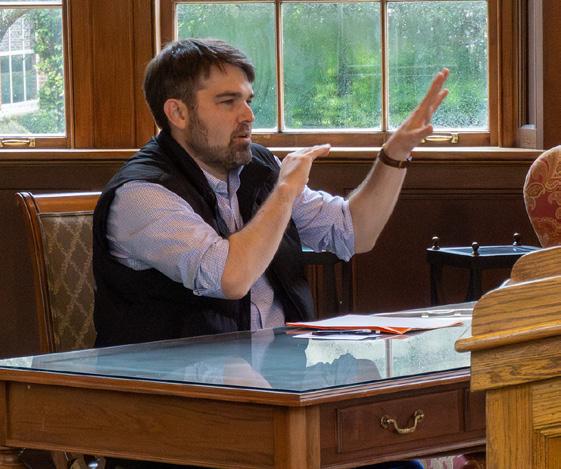
Affiliate faculty Max Deardorff (History) has been awarded two fellowships for 2026-2027!
Dr. Deardorff is part of the inaugural cohort of the Gulbenkian Institute for Advanced Study (GIAS), which will host 15 scholars in residency in Lisbon, Portugal. Additionally, Dr. Deardorff was named a fellow of the American Council of Learned Societies (ACLS) in 2026. Both grants support the
development of Dr. Deardorff's forthcoming book, At Sea and Ashore: Convicts, Slaves, and the Galleys of the Spanish Global Monarchy, a social and cultural history of the galleys, a military penal institution in Spain’s American and Asian colonies. The galleys’ manacled oarsmen contributed to the earliest age of globalization, shaping local port cultures and economies.
Robert Lamb
Nature Coast Biological Station Institute of Food and Agricultural Sciences
The Center for Latin American Studies would like to express gratitude for the generosity of those who have contributed to the Center’s funds and endowments:
Carmen Diana Deere Director’s Fund
Dr. Hannah H. Covert
Carmen Diana Deere
Silvia De Melo Futada
Glenn Galloway
Dr. Bette A. Loiselle and Dr. John G. Blake
Jessica E. Mrozinske and Robert D. Baker III
Cuba Program Fund
Jay S. Brickman
Tonyaa J. Weathersbee and Wallace Z. Weathersbee
David Bushnell Scholarship Fund
Robert C. Breese and Elizabeth F. Breese
Jacqueline Friel & Jonathan Friel
International Travel Fund Anonymous
Latin American Studies Unrestricted Anonymous Anonymous
Jose M. Alvarez
Jessica A. Caicedo and Dr. Hector M.
Caicedo
Caroline E. Centeno
Elaine Centeno
Glenn Galloway
Gabriella M. Garcia-Urbay
Mark P. Kisker and Deborah E. Kisker
Dr. John S. Krigbaum and Denise M. Krigbaum
Elaine Machado
Anna Peterson and Dr. Manuel A. Vasquez
Brent L. Probinsky, PA
Dr. Leonardo A. Villalon and Dr. Fiona
McLaughlin
Ivonne A. Zelaya Bustillo
MDP Program Unrestricted
Glenn Galloway
Dr. Bette A. Loiselle and Dr. John G. Blake
Dr. Leonardo A. Villalon and Dr. Fiona
McLaughlin
Dr. Marta L. Wayne and Dr. Charles F. Baer
The Milenio Américas Society Speakers Fund
Dr. Christopher E. Baker
Richmond F. Brown Graduate Student Travel Fund
Garfinkel Immigration Law Firm
Dr. Hannah H. Covert
William R. Hummel
Tonyaa J. Weathersbee and Wallace Z. Weathersbee
Schmink Fund for Innovation in Tropical Conservation & Development
Glenn Galloway
Dr. Bette A. Loiselle and Dr. John G. Blake
David S. Salisbury
Dr. Richard H. Wallace
Dr. Leonardo A. Villalon and Dr. Fiona McLaughlin
Tropical Conservation & Development Fund
Morgan Stanley GIFT, Inc.
Anonymous
Fidelity Charitable Gift Fund
Sinomar Fonseca
Glenn Galloway
Dr. Bette A. Loiselle and Dr. John G. Blake
Christian Torroella and Maria L. Torroella
Dr. Leonardo A. Villalon and Dr. Fiona
McLaughlin
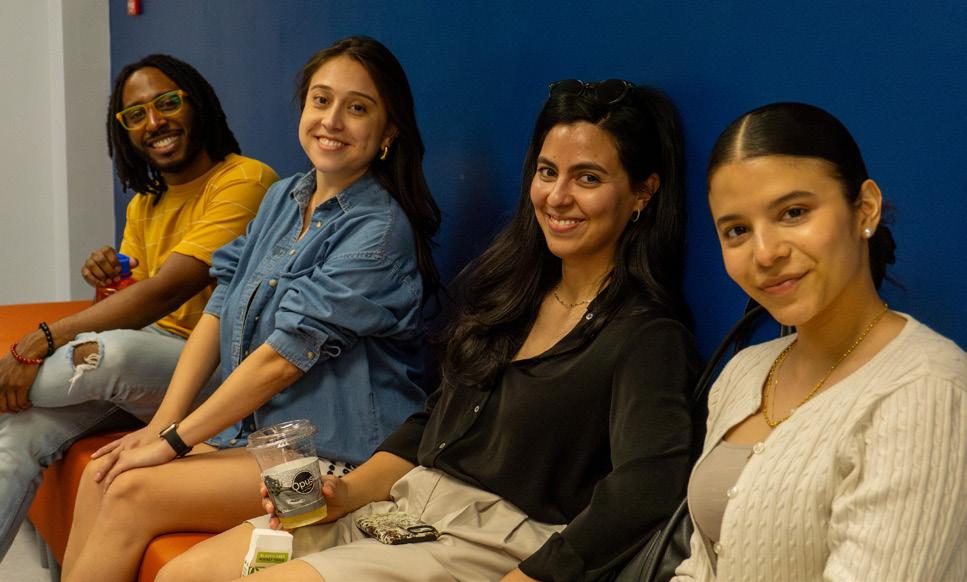
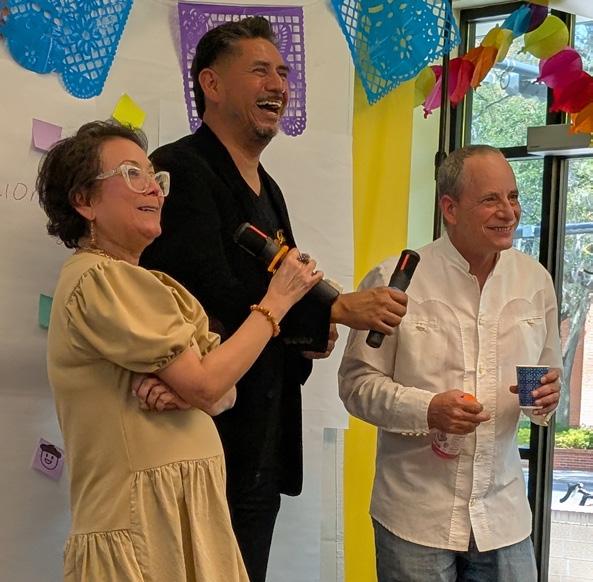
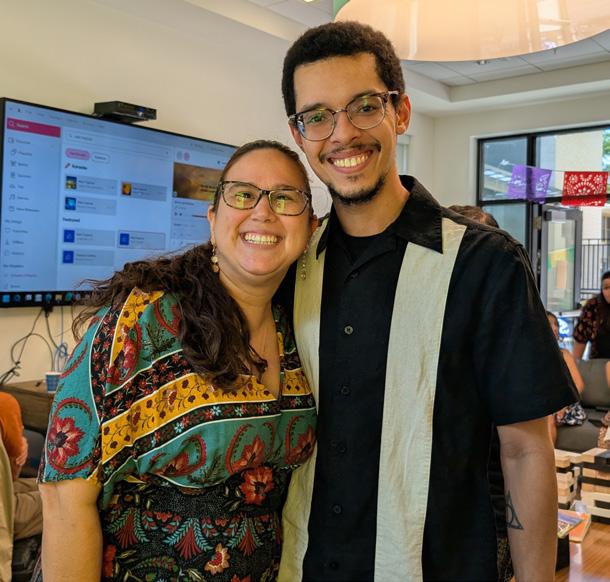
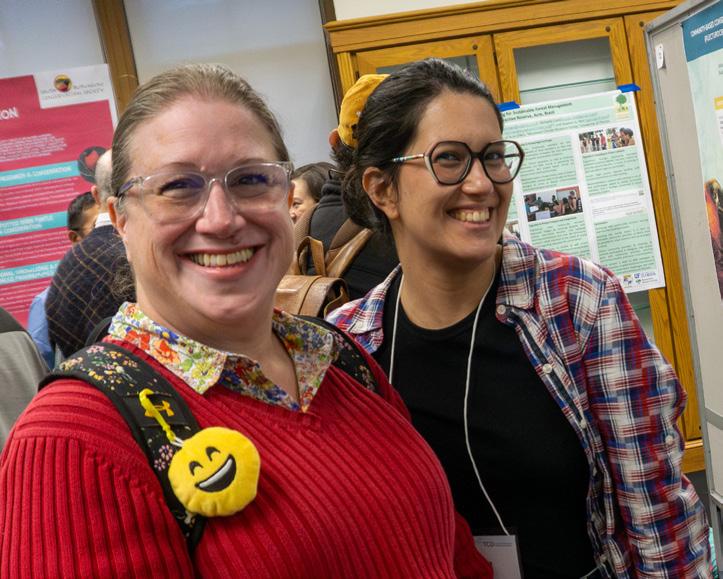
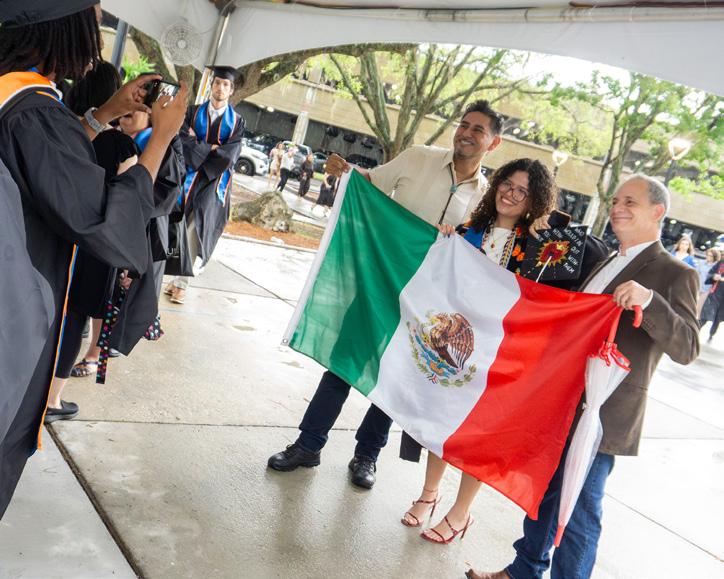
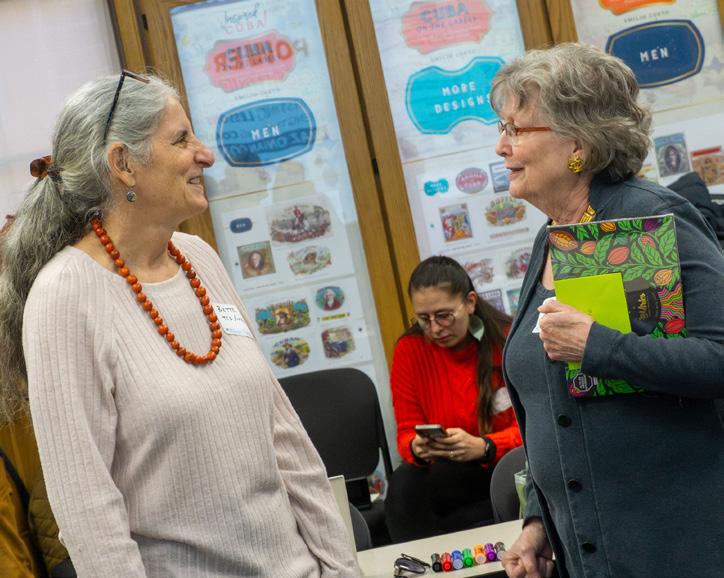
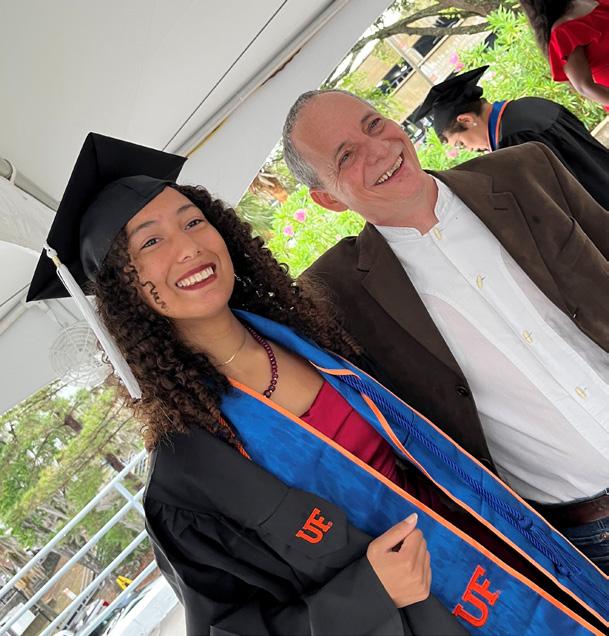
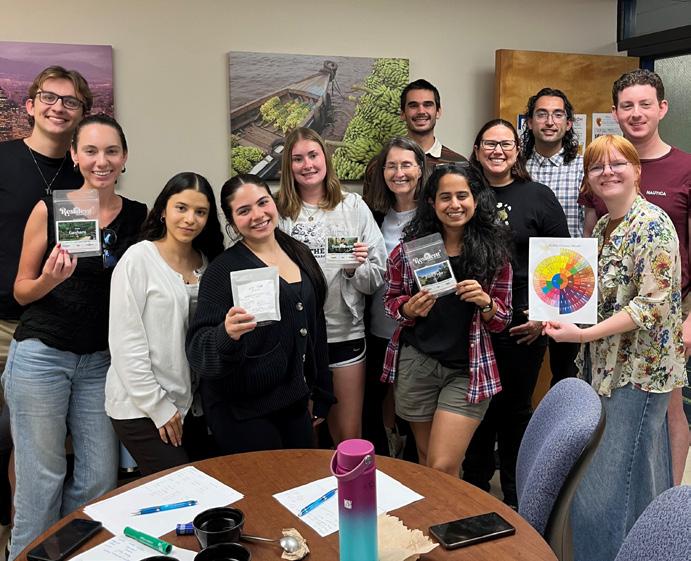
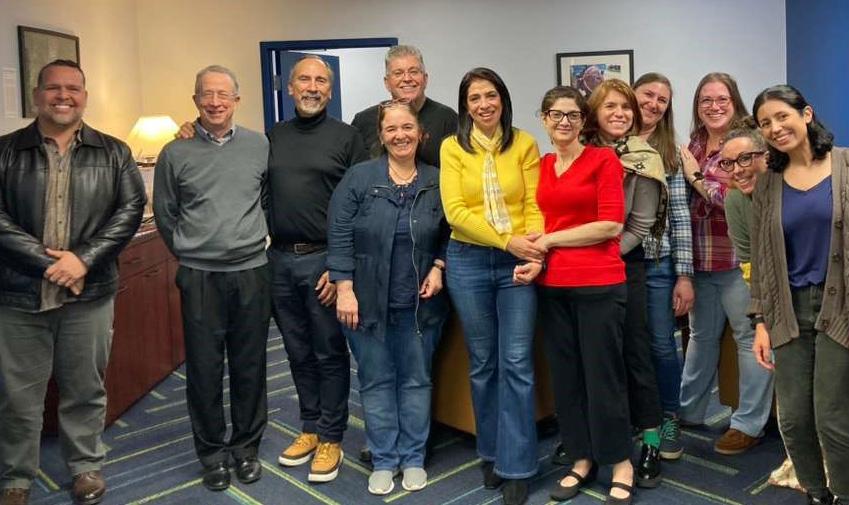
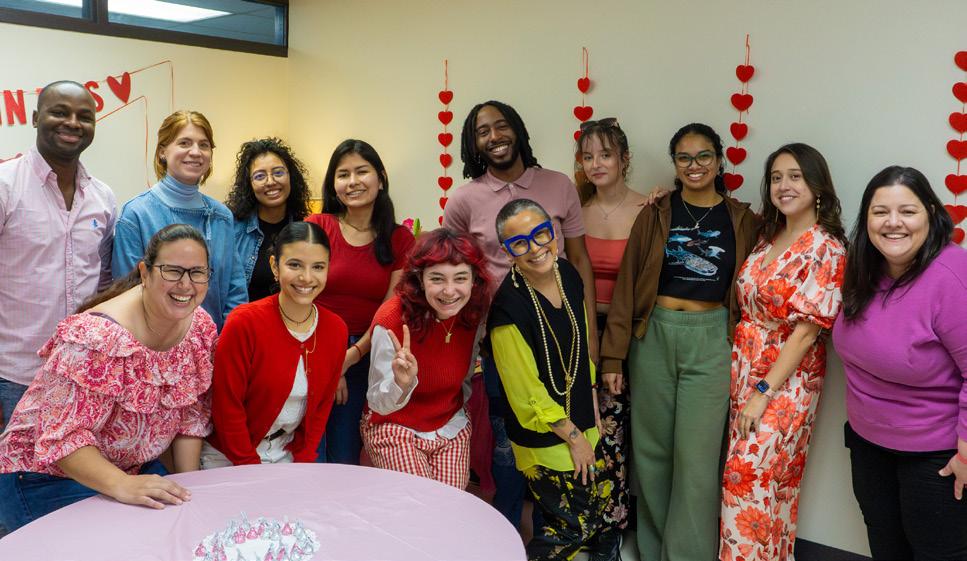
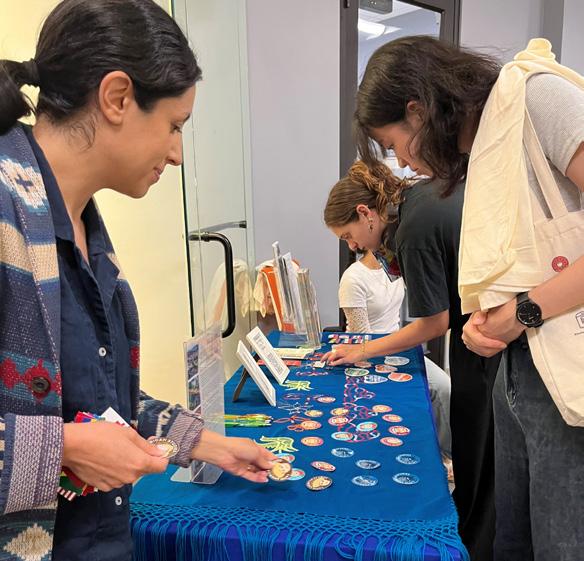
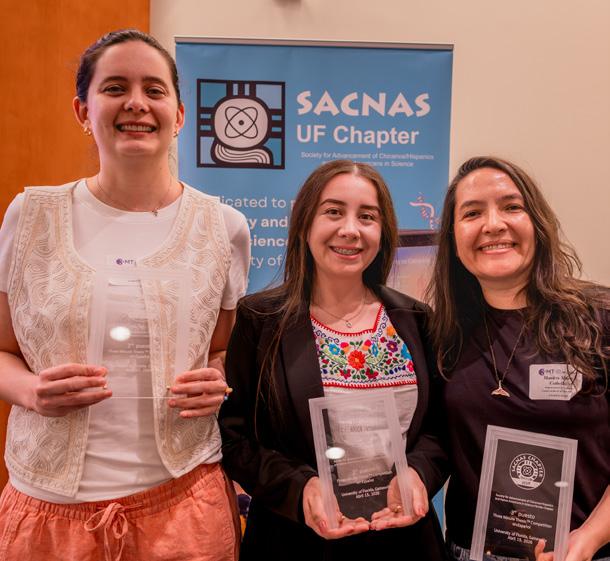
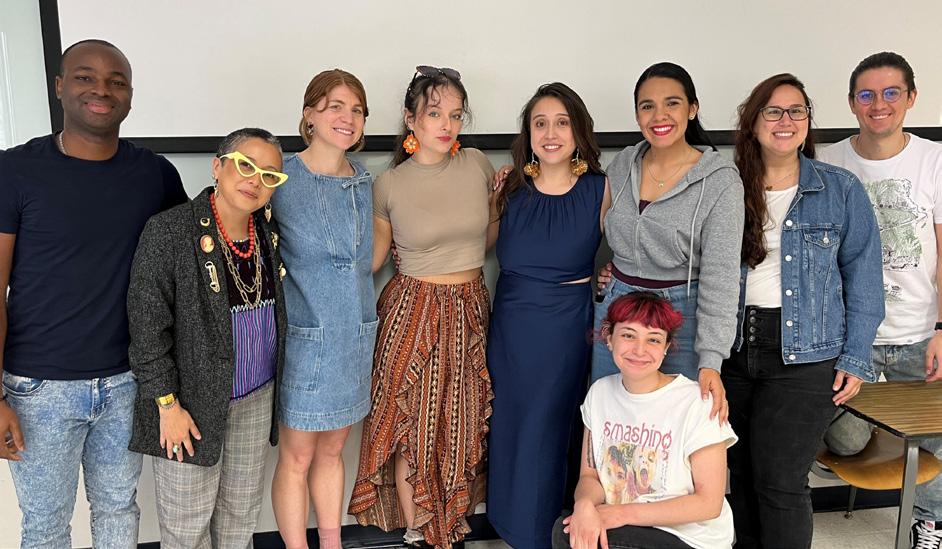
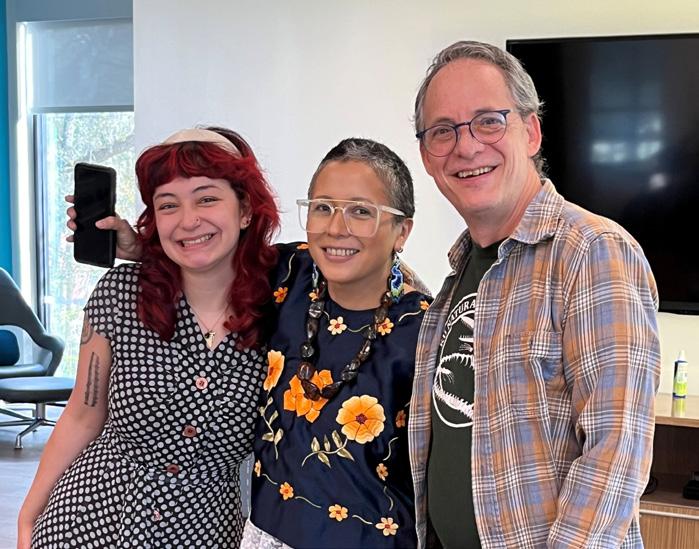
L-R: MALAS first-year Eluney reads while working the conference registration table; students and faculty celebrate Melisa's MALAS thesis defense; MALAS student Gigi celebrates her capstone defense with her committee
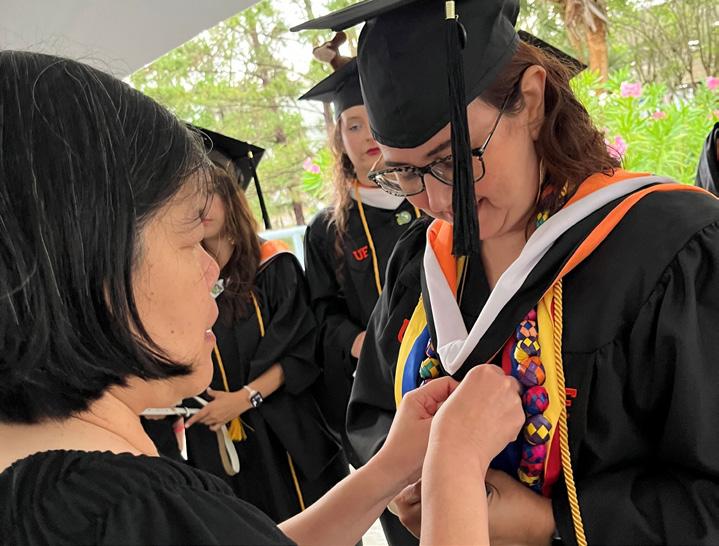
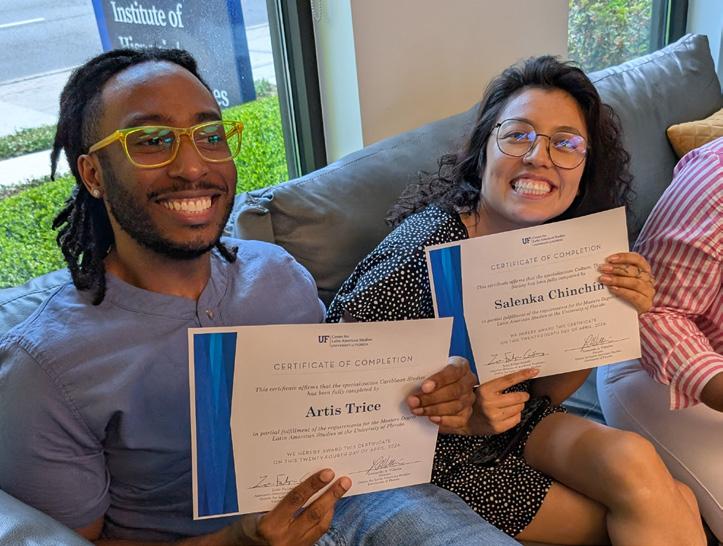
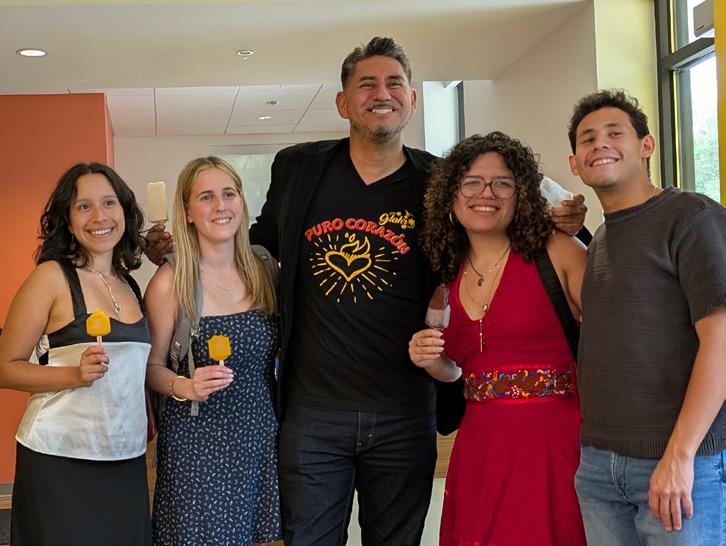
L-R: Alum Ivy Chen (MALAS 2023 ) helps graduating student Isabel Paz with her regalia; MALAS students Artis and Salenka show off their certificates; Profe Rafa Ramírez Solórzano celebrating LAS undergraduates at semester's end
▶ Have a story you’d like to see in The Latinamericanist?
Please email Communications Specialist Christa Markley at communications@latam.ufl.edu .
The Latinamericanist features the impact of the UF Center for Latin American Studies through the experiences and accomplishments of its students, faculty, and alumni. Relevant stories will be considered for publication. The contents of this newsletter were developed under the National Resource Center grant from the U.S. Department of Education. However, those contents do not necessarily represent the policy of the U.S. Department of Education, and you should not assume endorsement by the Federal Government.




University of Florida Latin American Career Network
linkedin.com/groups/ 3125999 / Alumni, join our LinkedIn group to share career updates and opportunities with other Latin American Studies professionals!


Center for Latin American Studies
319 Grinter Hall
P.O. Box 115530
Gainesville, FL 32611-5530
We rely on contributions from our friends and alumni to support certain special activities such as student field research, travel to conferences, and seed support for larger fundraising efforts. If you would like to make a donation to the Center, please visit the Center’s online giving page at go.ufl.edu/las-give or fill out the form below.
MY GIFT IS TO BENEFIT:
• Boonstra Family Research Fellowship (014091)
• Carmen Diana Deere Director’s Fund (019905)
• Carol French Doughty Memorial Fund (016269)
• Colonel Glenn A. Farris Scholarship (005067)
• Cuba Program Fund (017435)
• Florida-Brazil Institute (007277)
• Peter E. and Marie E. Hildebrand Scholarship Fund (022009)
• LAS Alumni Graduate Student Travel Fund (012521)
• Latin American Studies Fund (011147)
• McCoy Travel Scholarship Fund (014527)
• MDP Program Unrestricted (020485)
• Hugh L. Popenoe Mesoamerican Research Endowment (018331)
• Richmond F. Brown Graduate Student Fund (020871)
• Safa Graduate Student Travel Endowment (013515)
• Schmink Fund for Innovation in TCD (018201)
• Tropical Conservation and Development Fund (017809)
• Vivian G. Nolan Graduate Fellowship in LAS (016143)
• Wagley and Carter Fellowships (004763)
GIFT AMOUNT:
$500 $250 $100 $50 $_________
Name:
Address:
City/State/Zip:
Email:
METHOD OF PAYMENT:
• Check (Make check payable to: UF Foundation, Inc.) Please send your check with this form to: University of Florida Foundation Gift Processing Department P.O. Box 14425 Gainesville, FL 32604-2425
• Credit Card Call the UF Foundation’s Gift Processing toll-free number with your credit card information: 1-877-351-2377
This secure line is staffed Monday – Friday from 8:00 am to 4:30 pm
• Online at go.ufl.edu/las-give