VO LU M E 56 | N O. 2
THE
LATIN AMER ICAN IST
DECEMBER 2025 U N I V E R S I T Y of F L O R I D A CENTER for LATIN AMERICAN STUDIES
Artist in residence co-creates collective learning space PAG E 4
Alum scholarship brings students from Colombia to UF PAG E 7
Director’s C O R N E R DR. LEONARDO A. VILLALÓN It’s hard to believe that my second semester as Interim Director of the Center has come to a close! The fall brought both challenges and transitions, but with them also came new opportunities to deepen our work and the collaborations that are so vital to our interdisciplinary community. In August, we welcomed new cohorts of MALAS and MDP students, all eager to embark on their academic journeys at the Center! Meanwhile, the second-year cohorts turned toward their culminating projects, having completed their field research over the summer. In addition to our usual orientation activities, we hosted a Latin American Studies social this fall, bringing together Latin Americanist students, faculty, and alumni from all corners of campus. It was an amazing turnout, and a heartening reminder of what connects us across disciplines. We were delighted to host our fourth Kislak Family Foundation Artist/Writer in Residence in Fall 2025. Colombian artist Nicolás Paris led the course "Art and Pedagogy," and curated a final exhibition entitled "Collecting Pedagogies," in partnership with our friends at the School of Art+Art History and University Galleries (p. 5). We were also thrilled to welcome three Colombian undergraduate students from the Universidad Tecnológica Del Chocó (UTCH)! (p. 7) Thanks to the generous support of Center alumnus Craig Breese (BA LAS 1973), the David Bushnell scholarship—named in honor of Craig’s Latin American history professor— allowed these terrific students to spend a full semester at UF. In September I had the pleasure of traveling to Chocó to discuss ways to continue and expand our fruitful partnership with UTCH (p. 8). And in November Mr. Breese traveled to Gainesville to personally meet the scholarship recipients.
We celebrated another transition this fall as Dr. Bette Loiselle stepped down after 14 years as Director of the Tropical Conservation and Development Program. (p. 12) Hearty congratulations to Bette, an exemplary scientist, leader, and mentor throughout her accomplished career! I extend my gratitude to Dr. Pilar Useche for agreeing to serve as Interim Director of TCD. We bid farewell to Assistant Director of Academic Affairs Clate Korsant, and welcomed Luis Felipe Lomelí to his new and expanded role as Associate Director of Academic Programs. We are grateful to Jazmín Gonzales Tovar for agreeing to assist with MALAS advising, while also contributing her talents as a post-doc lecturer in the MDP Program. Their efforts invigorating and expanding LAS academic programs on campus are already bearing results! Unfortunately, we received notice that the U.S. Department of Education was terminating funding for Title VI programs. The Center was continuously funded by Title VI since the program’s inception in 1962. Although we are disappointed, we look to our long history of Latin American Studies at UF and our present community of dedicated faculty, students, staff, and alumni, and we continue to see an inspiring future of teaching and learning about Latin America. Finally, as a permanent Center Director has not yet been selected, I have agreed to stay on as Interim Director of the Center. I am deeply appreciative of—and energized by—the ongoing support and collaboration with the Center’s community, and look forward to continuing to work with you all.
THE
LATIN AMER ICAN IST
VOLUME 56 NO. 2 FALL 2025
Center for Latin American Studies 319 Grinter Hall PO Box 115530 Gainesville, FL 32611-5530 (352) 273-4705
latam.ufl.edu
CENTER-BASED FACULT Y Jairo Baquero-Melo (LAS) Emilio Bruna (LAS/WEC) Jonathan Dain (LAS/SFFGS) Carlos de la Torre (LAS) Glenn Galloway Director, MDP (LAS) Rebecca Hanson (LAS/Sociology) Karen Kainer (LAS/SFFGS) Clate Korsant Asst. Director of Academic Affairs (LAS) Bette Loiselle Director, TCD (LAS/WEC) Luis Felipe Lomelí Assoc. Director of Academic Programs (LAS)
Carmen Martínez Novo (LAS) Susan Paulson (LAS) Rafael Ramírez Solórzano (LAS) J. Richard Stepp (LAS/Anthropology) Carlos Suárez Carrasquillo (LAS/Poli.Sci.) Ariadna Tenorio (LAS) Welson Tremura Director, FBLI (LAS/Music) Catherine Tucker (LAS/Anthropology) Pilar Useche Interim Director, TCD & LABE (LAS/FRE) Meg Weeks (LAS)
With best wishes for 2026! Writer, editor, designer: Christa Markley
Dr. Leonardo A. Villalón
CENTER INTERIM DIRECTOR
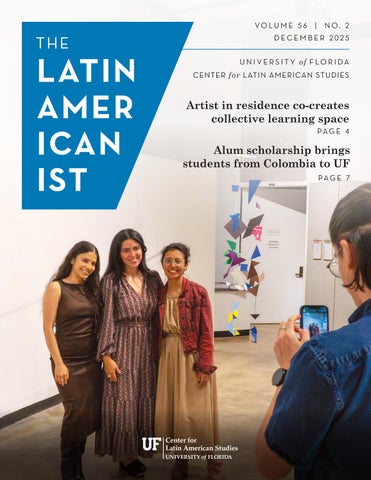
ON THE COVER: Students of the class "Art and Pedagogy" celebrate the opening of their culminating exhibition at University Galleries. See more on pages 4-5.
IN THIS ISSUE and Pedagogy” class co-creates learning space centered 4 “Art on process, reflection, exchange Kislak Family Foundation Artist in Residence Nicolás Paris leads students in cooperative teaching and learning practice
the Printing Press in Spanish America through 6 Exploring Rare Books School
7
Alum scholarship brings students from Colombia to UF Bushnell Scholarship honors former professor, funds Chocó undergrads’ semester at UF OUTREACH ACTIVITIES
exchange training 10 Virtual opens up global classroom
18
opportunities
SALAS hosts alumni for career readiness discussions Founders of P4H Global return to UF to connect with students
funding supports 11 Center Galápagos research
experience for marine science undergraduate
ALUMNI ENGAGED
ALUMNI SPOTLIGHT
19
In conversation with Nicolás Rubio (MALAS 2006)
FACULTY SPOTLIGHTS
Stepp named UF 12 Rick International Educator of the Year
13
Saying farewell to Center faculty and TCD director Bette Loiselle STUDENT SPOTLIGHTS
14 16
STUDENT NEWS
award, 25 Photography online exhibit, research symposium awards
FACULTY NEWS
Galloway co-authors 25 Glenn book on sustainable development education
Student Research Map Undergrad Isabella Castro embraces international studies, leadership, service
Zelaya captures 17 Ivonne portrait of rural Honduras community in transition
8 21
EVENTS AT A GLANCE
21
ALUMNI UPDATES & NEWS
22
FACULTY UPDATES & NEWS
25
DONORS THANK YOU
GRADUATIONS
4
“Art and Pedagogy” class co-creates learning space centered on process, reflection, exchange
FEATURED STORY
Kislak Family Foundation Artist in Residence Nicolás Paris leads students in cooperative teaching and learning practice On November 17, dozens gathered in the Gary R. Libby University Gallery to celebrate the opening of “Institute for Collecting Pedagogies by the Eternal Learners and Ignorant Teachers Cooperative,” the culminating exhibition of the coursework for “Art and Pedagogy,” led by Colombian artist Nicolás Paris, the 2025 Kislak Family Foundation Artist in Residence. But the word “culminating” isn’t quite right, and neither is the word “coursework.” These words suggest results, as though the production of material art was the sole purpose of the class. Paris’s vision was far more intangible, inspired by his interest in experimental pedagogies. “One of the main ideas is to develop a learning process without a goal,” he shares. “My responsibility is to provide a learning environment and learning structure, and then with the students we can develop the content together.” As such, class meetings looked more like workshops, and the teacher-student model reoriented into a collective. Students weren’t acquiring knowledge from an outside source, but rather from within themselves. Learning was more like discovery, as Paris led them through activities designed to provoke curiosity, reflection, and connection. “Every exercise we did was an experience where we could explore, helping us think outside the box to understand things,” says student Isabel Paz. “That was the most valuable part of the class for me.” As the students stepped ’outside the box,’ they began developing their reflections into questions—not in pursuit of answers, but of possibilities. These new ways of thinking shaped the ’device’ from which they constructed their final art pieces. For student Ramiro Figueroa García, experiencing this process unfold was especially gratifying. “The class changed my perspective on how art can become a pedagogical tool, particularly as a way to challenge conventional structures of schooling,” he reflects. “Seeing how [the final projects] emerged reaffirmed my hope that a transformative pedagogy is possible.” Drawing on the principles of the course, each of the students’ projects have an element of transience, experience, or exchange. These characteristics make gallery visitors active participants with the art pieces, co-creating a moment of engagement irreproducible under other circumstances. This philosophy, too, defined the “Art and Pedagogy” class—something especially poignant for a group of students getting the chance to learn
with a visiting scholar for just one semester together. “Our class wasn’t just about developing an art piece,” Paris shares. “Collaborative learning is also about discovering and creating new ways of being together.” For student Artis Trice, that meant finding a support system in the vulnerability of a creative space. With only three months to put together a cohesive project for exhibition, the collective leaned on one another to prepare for the opening. “It’s tough for me to ask for help, especially in a creative space,” Artis reflects. “But Nicolás and the other students in the class are bright, connected, and kind people who are open to collaboration and support. Once I asked for help, everything worked out!” With visitors milling around the gallery space, and big smiles on the student artists’ faces as they shared their work with friends and family, it’s easy to see the positive results of the experience. “One of my greatest takeaways was the opportunity to live the learning process in its transformative dimension,” Ramiro says. “I gained a living framework for how I want my learning processes to be sustained moving forward.” Student Nicolle Moran, who’s interested in a career as a curator, can apply her newfound insights directly to future work in museum and gallery spaces. “The methodology of this course changed everything for me,” she says. “It taught me that art is more than ’creating’ something and is more about experiencing something.” Even more valuable, she shares, was the opportunity to work hand-in-hand with Paris—not only an internationally renowned artist, but one seeking to reimagine art and education. True to philosophy, the ’instructor’ in the collective emerged from the learning experience with just as much reflection as the ’pupils.’ “I really had a good time here with the students, and I’m proud of the environment that we built,” Paris says. “I would love to spread the experience and even transform it into something new. For me, this is not the end point. It’s an open question I will keep working on.” Yes, the sun has set on the semester; Paris is returning to Colombia, and the students of “Art and Pedagogy” are turned loose to their next pursuits. But although the collective has disbanded, the experience they shared remains. They carry their learning forward with them, and the process goes on. ◆
5
Exploring the Printing Press in Spanish America through Rare Books School BY IVY CHEN (MALAS 2023 ), COLLECTION SPECIALIST, LATIN AMERICAN AND CARIBBEAN COLLECTION
With Title VI funding from the Center for Latin American Studies, I attended the Rare Books School online course The Printing Press in Spanish America, 1500–1830 given by Albert Palacios in July 2025. Palacios is the Digital Scholarship Coordinator at LLILAS Benson Latin American Studies and Collections at UT Austin and a co-director of the Primeros Libros de las Américas project, a digital collection of the first books printed in the Americas before 1601.
I was interested in Florencia’s connection to Saint Augustine and his book’s documentation of the history of the Jesuits in Florida. A few exciting things I learned about UF’s copy is that it was once owned by Genaro García (1867-1920), an important Mexican book collector whose collection is held primarily at the Benson, UT Austin. An annotation on the bottom of the title page shows that it was once part of the library at the Colegio de Tepotzotlán. When the Jesuits were expelled from New Spain in in 1767 by King Charles III, their assets were seized and many of their libraries became part of state universities and other religious institutions.
We explored the establishment of print technology throughout the Spanish colonies, focusing on pre-publication licensing, trade practices, circulation of books, the Inquisition’s impact on manuscriptions and printed texts, and the development of libraries. We also looked at the materiality of books, including paper and book binding. There was group analysis of primary sources, secondary source readings, and a final individual project to research and present a case study.
The book was printed in Mexico by Juan José Guillena Carrascoso in 1694 and is dedicated to Francisco de Borja (1510-1572, also known as Saint Francis Borgia), a Spanish nobleman who joined the Jesuits, becoming the third superior general. Borja was canonized in 1670 by Pope Clement X. The title page notes that this book is Tomo Primero, which made me wonder if there are other volumes. Looking in José Toribio Medina’s (1907) La imprenta en México (15391821), Tomo III, I was able to find that there were originally three volumes, but the other two were not published because of the expense.
For my project I chose a book in the PK Yonge Florida History collection at UF Special Collections, Francisco de Florencia’s Historia de la provincia de la Compañia de Jesus. De Nveva-España, printed in Mexico in 1694. Florencia (c.1619-1695) was a historian in the Jesuit order, known for his study of the apparition of the Virgen de Guadalupe. He was born in Saint Augustine, then part of the Spanish colony of La Florida. He was a seminarian at the Colegio de San Ildefonso, Mexico City, where he later taught Philosophy. After holding the position of Attorney General of the Indies in Seville, he returned to Mexico in 1679 where he died in 1695. Historia de la Provincia de la Compañía de Jesús en Nueva España is considered his most important work.
Through this course I gained information to share with students visiting the library with their Spanish colonial history, art history, and museum studies classes. In August I showed the book to first year museum studies graduate students and discussed not just its connection to Florida history, but also the quality of the paper and printing, detailed engravings, and various type fonts and decorative elements. While digital reproductions increase access, physical engagement with special collections materials creates a connection with historical objects. ◆
L I B R A RY T R AV E L G R A N T R E C I P I E N T S The following ten scholars were awarded Library Travel Grants, funded by Title VI, to travel to Gainesville during the summer and conduct archival research at UF’s renowned Latin American and Caribbean Collection: • Javier Álvarez-Jaimes
• Celucien Joseph
• Giovanna Montenegro
• Lisandro Pérez
• Renata Romain
• Corbin Covington
• Chris Lesser
• José Juan Pérez Meléndez
• Daniel Ramos Matos
• Sasha Wells
With topics ranging from religions in the Caribbean to ecological science in rural Brazil to the political significance of corn in Mesoamerica and the Andes, the scholars delved into upwards of 40 collections at the LACC, searching through scores of newspapers, government records, letters, photos, books, recordings, and other documents. Not only does LACC house exceptional archives, it also provides excellent infrastructure and staff support. The staff in particular offer invaluable assistance, helping visitors locate materials, navigate the catalog system, and scan documents. 6
FEATURED STORY
Alum scholarship brings students from Colombia to study at UF Bushnell Scholarship honors former professor, funds Chocó undergrads’ semester of study BY ELAINE MACHADO (MALAS 2026 ) Ferney, Yury, and Joshua with Craig Breese
In recent years, experiences have become as meaningful as material gifts. Instead of objects, people increasingly value opportunities that create lasting memories and personal growth. In academic settings, few experiences are as transformative as studying abroad. Maybe studying abroad is the ultimate experience a student can have?
region while developing critical perspectives that they had not previously explored. For Yury and Ferney, Introduction to Latin American Studies with Professor Luis Felipe Lomelí helped connect academic content to their own lived experiences. Joshua found that political science courses, like International Politics At the football game with Center of Latin America with staff member Danny Oquendo, who Professor Andrew Janusz, handled logistics for their stay encouraged him to engage in discussions about regional history and international relations with his family back home.
That was the case for Yury Casas, Ferney Mena, and Joshua Murillo, three undergraduate students from Quibdó, Chocó, Colombia, who spent the fall semester at UF through the David Bushnell Scholarship. Yury, Ferney, and Joshua are the inaugural recipients of the scholarship, which exists thanks to the generosity of alum Craig Breese (BA LAS 1973), whose career in international business includes nine years as president of Honeywell Latin America. Mr. Breese established the fund in honor of his former professor David Bushnell, renowned historian of Colombia and professor at UF from 1963 until his retirement in 1991. Yury, Ferney, and Joshua, who are currently attending the Universidad Tecnológica del Chocó (UTCH), came to UF not only to study, but to immerse themselves in a different academic, cultural, and social environment. After completing the program, they returned to Colombia to share what they learned with their university and their community.
The students also embraced Gator student life beyond academics. Attending a Gator football game in September gave them the chance to compare American football culture with the culture of Colombian fútbol. Outside the classroom, Gainesville itself played an important role in shaping their experience. Coming from Quibdó, a city surrounded by nature, the students found a sense of familiarity in Gainesville’s green spaces (except for the occasional presence of alligators!).
For the three visiting students, the experience went beyond academics. Living and studying in Gainesville allowed them to reflect on their identities, their region, and their future paths. Yury described the semester as transformative, emphasizing that it helped her better understand herself and her place within a broader social and political context.
As the semester came to an end, all three students reflected on how studying abroad reshaped their goals. Rather than seeing the experience as an endpoint, they understood it as a responsibility. The knowledge, confidence, and perspectives gained in Florida are meant to be shared. As they look beyond their undergraduate degree from UTCH, their plans include pursuing graduate studies, teaching, working in public service, and strengthening educational opportunities in their home region.
One of the most striking differences they encountered was the educational system itself, with UF offering a wide range of academic resources designed to support students beyond the classroom. Joshua was particularly impressed by the availability of writing centers, advising services, and campus facilities that make daily academic life more accessible and efficient. These resources, he noted, create an environment where students are actively supported in their learning process.
Craig Breese and the Bushnell Scholarship made it possible for Yury, Ferney, and Joshua to study abroad, but more importantly, it enabled an exchange of knowledge that continues beyond one semester. Their time at UF has become a bridge between Gainesville and Quibdó, reinforcing the importance of international study, institutional partnerships, and the power of experience for meaningful learning. ◆
Courses focused on Latin America and global politics were especially meaningful for the group. Through interdisciplinary classes that combined history, politics, art, and culture, the students deepened their understanding of the 7
Developing PA R T N E R S H I P S Visits to Mexico, Colombia strengthen linkages In September, Center Interim Director Leonardo Villalón traveled to Colombia and Mexico to meet with representatives from partner institutions to strengthen relationships and develop future opportunities for collaboration and exchange. In Colombia, Dr. Villalón visited the Universidad Tecnológica del Chocó (UTCH) in Quibdó, where the Bushnell Scholarship students are enrolled as undergraduates. In addition to fruitful meetings with administrators, faculty, and students, Dr. Villalón participated in a symposium on biodiversity, and had the chance to enjoy the sights, sounds, and smiles of the Fiestas de San Pancho, an annual celebration of Quibdó heritage. In Mexico, Dr. Villalón, accompanied by Center affiliate faculty Margarita Vargas-Betancourt (LACC) and Gabriel Prieto (Anthropology) met with representatives from Instituto Nacional de Antropología e Historia (INAH). The group toured INAH archives (even glimpsing a 1953 request for a journal exchange from UF Libraries!), the National Museum of Anthropology, and the archaeological site Teotihuacán. These linkages will be invaluable as we expand our UF programs in Latin American archaeology. ◆
LAS events AT A G L A N C E • • • • • • • • • • • • • • • •
FALL 2025
Haitian Creole for Absolute Beginners: A Lesson with Dr. Benjamin Hebblethwaite at The Lynx Benjamin Hebblethwaite* [2] Latin American Studies Fall Social [1,8] 21st Gainesville Latino Film Festival Latina Women’s League˚ [10] Noche de Museo Harn Museum of Art [6,11] Film screening: Ainda Estou Aqui / I’m Still Here University Film Society, Brazilian Student Association Class conversation with filmmaker David David David David˚ and Rafael Ramírez Solórzano [4] Jacaré Brazil Meets the Community Lucha anti-corrupción, persecución legal y género en Guatemala Eva Siomara Sosa Pérez˚ [12] Cuba film series | Letters to Eloísa Adriana Bosch˚ and Lillian Guerra* [5] Huaca de La Luna: Un Caso Desarrollo Sostenible a través de la Arqueología y Conservación Alejandro Yepjen Ramos˚ (with Department of Anthropology) COLOQUIO | The Power of Connections: Harvesting Lessons and Strengthening Coalitions for Amazonian Conservation Karen Kainer*, Vanessa Luna Celino† , Bette Loiselle*, Jon Dain*, Pilar Useche* [9] International Oral History Practicum Land Defense and the Aesthetics of Mourning in Mexico Carolyn Fornoff˚ (with Center for the Humanities and the Public Sphere) Revolutionary Power of Storytelling in Children’s Literature Alumni visit Bertrhude Albert†, Priscilla Zelaya† (p. 18) Opening reception | Institute for Collecting Pedagogies by the Eternal Learners and Ignorant Teachers Cooperative Nicolás Paris* and class (p. 4-5) ˚Guest speaker from outside institution
† Center student or alum 8
*Center faculty (Core, affiliate, or visiting scholar)
EVENTS
1 2
3
5 4
6
7 8
9
10
11 9
12
Outreach A C T I V I T I E S Virtual exchange training opens up global classroom opportunities High school Global Perspectives teacher expands international curriculum, professional development with support from Center initiatives In the summer of 2021, the UF Center for Latin American Studies and the UF International Center Office of Global Learning expanded their offering of a virtual exchange (VE) training for educators to state colleges and K-12 schools across Florida. In development since 2018, the VE initiative was created to help educators at any level design and implement virtual international content and communication activities for their existing courses. In attendance at the training was Danielle Babineau, teacher of U.S. History and Global Perspectives in the Advanced International Certificate of Education (AICE) program at St. Augustine High School. Taking the tools she gained at the training, Ms. Babineau implemented her VE project in the fall of 2021, collaborating with Alba Miriam Olague Rodríguez, the director of the Bicultural Academic Program at PrepaTec Laguna, the secondary school of Tecnológico de Monterrey in Torreón, Mexico. Ms. Babineau has continued VE projects over the subsequent four years, reaching approximately 400 and 350 U.S. and Mexican students respectively. Students from her Global Perspectives classes meet virtually with students from PrepaTec’s Global Studies and English classes, with the goal of developing intercultural competence skills. They work together two days per week for a month, using a mixture of synchronous and asynchronous lessons focused on building relationships and sharing cultural differences. The result? Students go deeper into their understanding of communities different from those in the U.S., learning how to build trust and explore the similarities and differences in their cultures. Going beyond surface-level discussion of behaviors and practices, they use the six dimensions of culture outlined by social psychologist Geert Hofstede to explore complex characteristics related to attitudes, values, perceptions, and beliefs. At project’s end, one of Ms. Babineau’s students reflected: “Going into this process, I was expecting something completely different from the students in Mexico because there is an insane amount of stereotypes and misconceptions depicted in movies, television, media, etc.; it was refreshing to
meet people so similar to us that live differently. Right off the bat, I felt an instant connection to the students in Mexico and found lots in common with them. It was interesting to see what was unique and what was similar between students here in the US as opposed to Mexico.” In the summer of 2022, Ms. Babineau embarked on another professional development opportunity, enriching her virtual connections with Mexico: she participated in the Center-funded Global Teacher Leader Institute (GTLI) in Campeche. The Institute, coordinated by former Associate Director of Outreach Mary Risner in partnership with the Autonomous University of Campeche, brought a group of eight educators to Campeche for visits to local schools, universities, community businesses, and archaeological sites. They met with students of all ages, as well as educators, administrators, and elected officials. They attended lectures on local environmental issues and Mayan history, and worked together to develop curriculum ideas from their trip. For example, after visiting the village of Pomuch and learning about their Day of the Dead traditions at Pomuch Cemetery, Ms. Babineau transformed the experience into a lesson plan for her students back home in St. Augustine. Ms. Babineau continues to share the knowledge that she has gained through these professional development experiences, with students and educators alike. She has gone on to cofacilitate two additional summer VE trainings, imparting her insights with educators just beginning the process. With the initiative and innovation of educators like Ms. Babineau, one summer training in virtual exchange can open up a world of opportunities to connect teachers and learners across borders, enriching their educational experiences with meaningful crosscultural interactions and understandings. ◆ 10
Center funding supports Galápagos research experience for marine science undergraduate Together with the UF International Center, the Center sponsored four research tutorials abroad (RTAs) in Latin America this summer! RTA funding supports an opportunity for a UF faculty member to take two to three undergraduate students to an international field site for hands-on research experience. Featured below is the experience of Melanie Gomez, who accompanied Dr. Robert Lamb (UF/IFAS Nature Coast
Biological Station) to Ecuador for marine science research in the Galápagos. “The RTA program provides a unique platform for UF students to learn field research techniques in a multicultural context,” Dr. Lamb explains. “Melanie gained research expertise both underwater and in the lab. She was the perfect UF ambassador, showcasing Gator excellence in Ecuador and making lasting international connections.”
Just getting to the Galápagos is an adventure! From Florida, it takes about 30 hours of travel with multiple flights, layovers, and a lot of coffee, but the journey is absolutely worth it.
The dives I participated in were the highlight of my trip. Swimming through the Galápagos felt like being inside a massive aquarium filled with life. I saw sea turtles, hammerhead sharks, penguins, octopus, nudibranchs, corals, and anemones. The sheer abundance and diversity was breathtaking!
The trip began with the 7th Annual Research Symposium on San Cristóbal Island, where I presented my thesis poster in Spanish. I speak conversational Spanish, but presenting in scientific Spanish was a whole new challenge. It pushed me to explain complex ideas in a second language and turned into one of the best learning opportunities of the trip. I spoke with scientists studying everything from marine iguana blood transplants to harnessing ocean energy.
After the liveaboard, we began daily boat trips. Capturing Apogon was one of the most challenging and exciting parts of the trip. These fish often hide inside the mouths of moray eels, so catching them meant carefully reaching into small rocky holes, which was both thrilling and nerve-wracking. I also filmed fish foraging behavior, such as when larger fish broke open urchins, creating feeding opportunities for smaller fish like wrasses. These dives were physically demanding and improved my buoyancy and maneuverability skills in strong currents.
After the conference, we traveled to Santa Cruz Island to prepare for a five-day liveaboard science cruise. The Galápagos Islands are far apart, so living on the boat allowed us to do more dives than we ever could by traveling back and forth to shore each day. One of our main research goals was collecting Apogon atradorsatus, a species of cardinalfish, for two primary aims. First, we are comparing population structure, meaning genetic differences between sites, to that of Stegastes beebei. Second, we are comparing growth, size, and general morphology between high and low upwelling sites. On the cruise, I learned to perform CTD casts, plankton tows, fish collection, water filtering for chlorophyll-a, video transects, and eDNA sampling. I also gained experience in the daily operations of working on a research vessel. This involved multiple dive teams deploying out of zodiac tender boats, planning dive profiles to ensure diver safety, and using bathymetry maps and navigational charts to choose dive sites. I was able to see firsthand how much careful preparation goes into planning and executing a successful field research expedition at sea.
Back on land, we worked at the Charles Darwin Research Station. Every Apogon we collected was fully documented. We measured length and weight, photographed the head for biometric analysis, took tail samples for stable isotope and DNA analysis, and removed otoliths to determine age. Dr. Mauricio Landaeta, a Chilean fisheries professor, taught me how to remove Apogon otoliths, and I later taught three other team members the same technique. In just a few weeks, I learned more than I ever could have in a classroom. This experience not only strengthened my goal of pursuing a PhD in marine science, but also gave me valuable field and lab skills, lasting friendships, and meaningful professional connections. I am truly grateful to the sponsors of the Research Training Abroad program for making this opportunity possible. ◆ 11
—MELANIE GOMEZ
Faculty S P O T L I G H T Rick Stepp named UF International Educator of the Year Recognition highlights career of interdisciplinary pantropical conservation research, experiential learning leadership This fall, Center faculty Rick Stepp was selected as the university’s 2025 Senior Faculty International Educator of the Year. The award recognizes faculty members whose work embodies a depth of international engagement and support of international education at UF.
undergraduate education,” Dr. Stepp pauses, then laughs. “I can say that because so much work was done before me. I’m just the steward of it right now.”
Dr. Stepp’s dedication to international studies began with his own journey at the age of 18, when a backpacking trip through Central America transformed his academic future. “I was so entranced by the communities I encountered, but also by the biodiversity,” he shares. These dual fascinations initially led to a dilemma. Should he study anthropology, or ecology?
Dr. Stepp’s involvement with Quest dates to 2019, when he began leading the development of Quest 3, the third-year experiential learning component that builds on the essential questions and real-world issues students explore in Quest 1 and Quest 2. For Quest 3, each student selects an application for those interests, whether research, community service, an internship, study abroad, or a design initiative.
But it turns out, the choice was easy: he could simply pursue them both. With his sights set on ecological anthropology, Dr. Stepp was on the path to his graduate work, and a perfect fit for his eventual role as core faculty of UF’s Tropical Conservation (TCD) Program, renowned for addressing the human dimensions of tropical ecology.
In the fall of 2024, Dr. Stepp was asked to serve as Interim Director of Quest by the Provost’s Office, overseeing the continued implementation of the program across fourteen colleges to reach UF’s near 40,000 undergraduate students. He also continues to lead Quest 3, which debuted in the fall with Warrington College of Business and other select departments across disciplines. The overall initiative will be fully operational in 2027.
Although Dr. Stepp’s primary expertise is in Latin America, the scope of his conservation research extends to the montane tropics of Southeast Asia, too. Presented with the opportunity to work in the Greater Mekong Region, he started noticing parallels – literally. “I was working at about the same latitude and elevation as the communities I work with in Chiapas,” he says. “Even though they’re very different, it was remarkable how the peoples arrived at the same strategies for subsistence. You can really see the effect of the environment on how people figure out the best path forward for their communities.”
Adopting Quest’s bold vision of personalized, meaningful learning on a huge scale amounts to nothing short of a “magic trick,” Dr. Stepp says. Thankfully, Quest is a faculty-led initiative, with strong support in each department, and flexible means for implementation with pre-existing program curricula – many of which already incorporate Quest principles.
Experiences like this only strengthen Dr. Stepp’s emphasis on the value of international learning. “The world is more connected now than it’s ever been,” he says. “There’s so much personal growth and skill building that comes from international studies, regardless of career. It’s crucial to developing many important aspects of being a full, well-rounded human.” This commitment to meaningful development in higher education has also led Dr. Stepp to get involved with UF Quest, a campus-wide initiative to transform the university’s undergraduate education experience. Designed to scaffold across four years, the program emphasizes applied learning, interdisciplinary inquiry, civic responsibility, critical thinking, and real-world engagement. Using the results of the StradaGallup college graduates survey, Quest targets the “Big Six” college experiences that correlate with enhanced lifelong wellbeing and career satisfaction, which include faculty mentorship, experiential education, and extracurricular connection. “It’s an audacious vision, and I think it’s going to put UF on the map for
Nonetheless, the scope of the initiative requires a zoomed-out view of a large university, carried out through many individual meetings to collaborate with stakeholders and ensure a smooth implementation process for administrators, faculty, and students alike. Dr. Stepp, with his connections to LAS, TCD, the Masters of Sustainable Development Program (MDP), and Anthropology, is a perfect example of the benefits of working across networks with a big-picture approach. “I think that’s probably the ecological anthropology training in me,” he smiles.
12
Similarly, if you ask him about being recognized as UF’s International Educator of the Year, his response has the hallmark of an ecological anthropologist. “By definition these awards celebrate the individual… but really, they’re about the ecosystem that nurtures it and creates it.” With his “homes” in LAS and TCD, his conservation research across the tropics, and his leadership roles in the Quest initiative, Dr. Stepp’s vision is clear: the world around you shapes you. Broadening its horizons will transform you. ◆
Saying farewell to Center faculty and TCD director Bette Loiselle Fourteen years at the Center culminates esteemed profile in conservation research, leadership, and mentoring Dr. Bette Loiselle is stepping down from her role as the director of the Tropical Conservation and Development Program in the Center for Latin American Studies. Dr. Loiselle’s fourteen years at the Center cap a 38-year career working across universities, research institutes, and other national and international organizations dedicated to conservation science. While she is leaving TCD and the Center, she will continue in her role in the Department of Wildlife and Ecology Conservation.
Across the course of her career, Dr. Loiselle has garnered research funding totaling almost $6 million and program funding nearing $5 million. Her research has been supported by grants from the National Science Foundation and National Geographic Society; she has also earned program grants from USAID, the Gordon and Betty Moore Foundation, the Maxwell/ Hanrahan Foundation, NSF, and the 100,000 Strong in the Americas Innovation Fund, among others. Together with her TCD colleagues Karen Kainer, Pilar Useche, and Jon Dain, Dr. Loiselle is co-PI of an $890,000 grant to advance Amazonian conservation, “The Power of Connections: Harvesting Lessons and Strengthening Coalitions for Amazonian Conservation.” This project will culminate with the Center’s annual conference of the same name in February 2026.
Dr. Loiselle embarked on her career in conservation after completing a BS and MS in Biology and a PhD in Zoology (major) and Botany (minor). Initially, she worked as a course coordinator for tropical biology field courses for the Organization for Tropical Studies, while also leading natural history tours for an educational travel company specializing in itineraries for scientific organizations. Then, she became an Assistant Professor at the Department of Biology at the University of Missouri-St. Louis. Seven years later, she was the director of the university’s International Center for Tropical Ecology.
Dr. Loiselle’s excellence in both service and science have resulted in numerous honors and accolades, including a Fulbright scholarship (2004), the Margaret Morse Nice Medal (Wilson Ornithological Society, 2020), the William Brewster Memorial Award (American Ornithological Society, 2018), and the Centennial Medal Award (Institute of International Education, 2019). In 2022, she was elected a member of the American Academy of Arts & Science. In 2023, she was named an Honorary Fellow of the Association for Tropical Biology and Conservation.
When Dr. Loiselle came to the University of Florida to lead the TCD program in 2011, she was the director of the Division of Environmental Biology at the National Science Foundation, a role she had fulfilled for 18 months. Calling the TCD director position her “dream job,” Dr. Loiselle’s leadership experience and emphasis on applied and collaborative research made her a perfect fit for the TCD goals and framework.
But, anyone who knows Dr. Loiselle knows that above all, her most cherished role is that of mentor. Throughout her academic career, she has formally advised 44 students, and in any setting, she wholeheartedly shares her time, knowledge, and resources with her students and colleagues. In 2021, she was recognized with the UF Doctoral Dissertation Advising/Mentoring Award.
Dr. Loiselle’s research focuses on understanding the importance of biodiversity in tropical systems, especially the ecological role of animals as seed dispersers, and the ecology and longterm dynamics of bird populations. She is also interested in the application of Geographic Information Systems (GIS) technology to ecology and conservation.
Thank you for your scholarship, leadership, and stewardship, Dr. Loiselle! We have been so lucky that your dream job was here at TCD, where your impact reverberates not only in the values and achievements of the program but also in the lives of the students and colleagues you’ve inspired, guided, and encouraged. ◆
Pilar Useche named TCD Interim Director On August 15, Center faculty Pilar Useche began her new role as Interim Director of the Tropical Conservation and Development Program, after Dr. Bette Loiselle stepped down. Dr. Useche is an applied economist with expertise in international development and sustainable agricultural economics. She has a split appointment between the Center for Latin 13
American Studies and the Department of Food and Resource Economics and is co-PI on TCD’s current project funded by the Gordon and Betty Moore Foundation: “The Power of Connections: Harvesting lessons and strengthening coalitions for Amazonian conservation,” alongside fellow TCD faculty Dr. Karen Kainer and Jon Dain, as well as Dr. Loiselle.
Student R E S E A R C H M A P
ARTIS TRICE CULTURAL FOOD SECURITY AMONG THE JAMAICAN DIASPORA
“
So many people welcomed me into their homes to talk about their experience finding Jamaican food in the U.S. The interviews lasted about an hour, and we discussed memories, perceptions, and affordability of food. After finishing our interviews and talking about Jamaican food for an hour, so many of the interviewees were hungry! Some took me to their favorite Jamaican restaurants, cooked a meal, shared Jamaican snacks, or allowed me to climb into their backyard trees and pick some of their starfruits and mangoes.
JONNY ANDRÉS LÓPEZ LOZANO EXAMINING THE IMPACT OF CHOCOAN CULTURAL IDENTITIES ON ENGLISH LEARNING DYNAMICS
“
Fieldwork was an invaluable experience, as it allowed me to come back home and view language education through a research lens, something I had never done before. Being immersed in the Chocoan community brought back fascinating sociocultural and academic memories. Chocoans are typically outgoing and expressive, which made most conversational interviews last longer, with every comment contributing meaningfully to the study. Additionally, many students did not want to leave the room after focus groups and co-teaching sessions because they wanted to learn more about my experience at UF. This made me genuinely proud because they felt inspired by both my journey and my research idea.
ELAINE MACHADO A CASE STUDY OF A BRAZILIAN TEACHER’S CAREER TRAJECTORY
“
After two intense semesters adapting to my new life in Gainesville and juggling the beginning of my academic journey while working to pay tuition and living expenses, it was time for a break. My research idea was not yet fully formed, and I knew I needed some time to support my creative process. I decided it was time to explore the area where I am living. I visited beautiful Lake Wauburg and the charming town of Micanopy. I caught up on my readings and explored local gems in downtown Gainesville. I spent time making art (trying to!) and cooking for myself. Overall, it was a summer with valuable opportunities to recharge and develop my creative side.
SALENKA CHINCHIN
“
MELISA MANTILLA
“
INDIGENOUS WOMEN’S ACTIVISM I interviewed women who work for a state institution that supports victims of domestic, sexual, and gender-based violence. Their services include legal aid and both individual and group therapy. But one of the options they offer, and the one that stayed with me most, is a form of spiritual healing with ancestral healers. The healer I interviewed told me that when you experience violence, you also need to heal your spirit. For this therapy, participants are asked to bring only a candle and a small gift for the healer, following Indigenous principles of reciprocity. The top photo shows the "ofrendas" (the gifts) the healer had received that week.
A PEDAGOGICAL APPROACH TO ADOLESCENT SELF-REPRESENTATION IN QUITO
Listening to adolescents speak with such transparency about who they are, their ideas, their needs, the struggles they carry and rarely voice, even among themselves, was both moving and unsettling. What struck me was the multiplicity of ways in which they construct and make sense of their own identities within a very specific educational context. 14
It was difficult not to recognize how many transformations education still demands. Yet it was equally refreshing to open spaces where they could speak about themselves and about how they perceive the educational practices they are embedded in, practices that so often speak about them, but rarely with them.
ARTIS TRICE USA: ATLANTA, MIAMI / JAMAICA: KINGSTON
IVONNE ZELAYA HONDURAS: CASITAS
HAOLIANG LIU MEXICO: OAXACA
SASHA SNYDER MEXICO: MEXICO CITY
BARBARA HERRERA DOMINICAN REPUBLIC: SANTO DOMINGO
SERGIO RODO COSTA RICA: PUNTARENAS
JAREN-CLAUDE SERANO BELIZE
HANAN LACHMAN SINGH GUYANA
RYAN COUSINS JAMAICA: KINGSTON
ELION BEATON GUYANA
MIRIAN MOLINA HONDURAS
JONNY LÓPEZ COLOMBIA: CHOCÓ
JULIA PAOLI PANAMA
NICOLLE MORAN ECUADOR: QUITO MELISA MANTILLA ECUADOR: QUITO, IMBABURA, ESMERALDAS GRAHAM LINEHAM ECUADOR: GUAYAQUIL YUKTI TANEJA ECUADOR: GALÁPAGOS VICENTE VASQUEZ ECUADOR SALENKA CHINCHIN ECUADOR: QUITO ANGELICA NUNES BRAZIL: AMAZONIA CASSIDY CANNON PERU: LIMA, ICA, NAZCA CAROLINE CENTENO BRAZIL: RIO DE JANEIRO
NICOLLE LUZARDO MORAN
WANIA CARDOSO BRAZIL
“
COLONIAL ART HISTORY During my amazing time in Quito, I was mesmerized by the beauty of the colonial center set against the spectacular mountains that surround the city. I couldn’t stop staring at the architectural beauty of buildings and churches, and most importantly, the warmth of people left a mark on my heart. I stayed in Quito for four weeks, working for the Museums of Carmen Alto, and I can’t wait to go back and keep falling in love with the rich history of the capital.
DANILLO NISIO BRAZIL: SÃO PAULO, RIO DE JANEIRO, BRASÍLIA ISIDORA LEA-PLAZA CENTRAL CHILE MONICA MORA CHILE: PATAGONIA
15
FUNDING KEY: LAS TCD MDP
STORIES FROM THE CENTER
Student S P O T L I G H T
Undergrad Isabella Castro embraces international studies, leadership, service First-generation student recently awarded the ObamaChesky Voyager Scholarship for Public Service BY VITÓRIA GOMES MENDES (MALAS 2027 )
Some people leave a lasting impression not because of titles or accolades alone, but because of the clarity of their purpose and the generosity with which they share their journey. Isabella Castro is one of those people. At just 21 years old, the University of Florida student is already emerging as a powerful example of what is possible when capability is combined with empathy, perseverance, and a true desire to be of service to the world. Born and raised in West Palm Beach to Colombian immigrant parents, Isabella is the most recent University of Florida student to receive the Voyager Scholarship for Public Service, an award created by Barack and Michelle Obama in partnership with Brian Chesky, co-founder of Airbnb. With only 100 recipients nationwide, it is a highly competitive program that supports students who demonstrate leadership potential and a deep commitment to serving the public good. Which, interviewing Isabella, turns out to be why she was selected.
classes, which included Intro to Latin American Studies with Professor Luis Felipe Lomelí and Latinx Migration, Refugees, & Citizenship in the U.S. with Professor Rafael Ramirez Solórzano. Dr. Lomelí, also serving as Undergraduate Coordinator, made a particular impact on her experience. “I adore him. He’s so kind, and he introduced me to so many interesting subjects,” Isabella shares. “I just really loved his class. I would just like to sit and talk with him about different Latin American subjects.”
In addition to her studies, Isabella serves as a Peer Leader on campus, mentoring first-generation students as they navigate the transition to university life. She also helps them set their sights beyond graduation, assisting with résumé building, LinkedIn development, and interview preparation. More importantly, she works to dismantle the imposter syndrome that often affects students who, like her, are the first in their families to navigate the challenges of how to be successful in college. Isabella emphasizes how common it is for students from Isabella’s accomplishments, however, cannot be understood low-income backgrounds to feel undeserving of prestigious without acknowledging the context from which she was built. opportunities. “Many of my students tell me, ’I could never As the daughter of a domestic worker and a sanitation truck apply for something like that,’” she explains. “And I always driver, she grew up navigating cultural, linguistic, and economic remind them—I am first-generation too. If I can be here, so can barriers from an early age. Acting as a translator for her father they.” in medical and institutional settings, she became intimately From offering practical guidance to providing encouragement familiar with the challenges faced by immigrant families in the and representation, Isabella sees her role as both mentor and United States. proof of possibility. Her recent recognition through the Voyager Rather than discouraging her, these experiences helped shape Scholarship has only strengthened that commitment. Looking a strong sense of empathy and purpose. “Growing up between ahead, Isabella still has some doubts about her career, as is Colombia and the U.S., I never fully felt like I belonged in natural for her youth. Among the possibilities she is considering just one place,” Castro shares. “But that experience made me are careers in public service, including diplomacy as a foreign want to build bridges instead of walls.” That desire to connect service officer focused on migration and refugee policy, as well cultures and people led her to pursue International Studies at as roles designing and implementing education and languagethe University of Florida, selecting a dual-language major in access policy at the state or federal level. French and Russian, and a minor in Latin American Studies. Whatever the path, her Latin American roots and wish to Her academic path reflects not only intellectual curiosity but a contribute are constants in guiding her. At just 21, Isabella is conscious effort to understand global issues through language, part of a new generation of scholars and public servants. Her history, and lived experience. story illustrates the transformative power of education for not Through her minor, Isabella credits Latin American Studies as only academic success but also community, mentorship, and an important part of her academic and personal development. belonging. More than an award recipient, Isabella is a reminder In the Center, she found not only interesting interdisciplinary to students across campus that opportunity is not reserved for courses but also a sense of belonging. “It was nice to be able to the few—and that believing it is possible is often the first step connect with people about Hispanic cultures,” she says of her toward making it real. ◆ 16
STORIES FROM THE CENTER
Student S P O T L I G H T Ivonne Zelaya captures portrait of rural Honduras community in transition Participatory methods and organic approach result in expressions of local agricultural knowledge, community culture Over the course of her academic career, Ivonne Zelaya’s interests in languages, the arts, and sustainability presented her with myriad possible paths – too many, perhaps. How could she choose just one? She pursued French, Italian, communications, teaching, film studies, and even explored avenues in architecture, digital media, literature, and biology. Eventually, a teaching job in Bretagne led to a master’s degree in French and Francophone Studies here at UF. Her thesis, an ecocritical reading of three films by renowned French director Agnès Varda, gave her the chance to creatively synthesize a few of her distinct interests. But one element was missing from her professional pursuits: her home, Honduras. “I always wanted to orient my career to something meaningful for my country,” Ivonne shares. “But I struggled with the best way to do that.” The MALAS program offered her exactly that opportunity. Initially aiming for an internship related to community development, Ivonne pivoted towards the capstone option, thanks to advising from Dr. Clate Korsant. By pursuing a capstone project, Ivonne could gather her seemingly disparate interests and unite them in a larger, cohesive work. The interdisciplinary offerings at the Center encouraged this approach as she developed her capstone. She drew on insights from courses in the Tropical Conservation and Development program, as well as the “Art of Sharing” course led by last year’s Kislak Family Foundation Artist in Residence Eduardo Abaroa. She incorporated knowledge from foundational courses on Latin American issues and qualitative research methods. Her committee chair, Dr. Luis Felipe Lomelí, provided steadfast guidance and feedback throughout the process. Over time, Ivonne’s vision began to take shape. Building from connections in her home country, she would visit the rural community of Casitas, Güinope, and interview its residents about their agroecological practices, food production, and climate adaptation. By doing so, she would preserve this local knowledge through the storytelling of the residents themselves. But Ivonne soon realized that just one research method didn’t fit her project. “I knew that I needed to be flexible, because people let you know things in different ways, not always through dialogue,” she says. “So I started trying every single methodology that I thought might work with them.” While this process might have been daunting for some, Ivonne’s multidisciplinary mindset helped her flourish. “Discovering the best dynamics for the
community was the most exciting part,” she grins. In addition to interviews, Ivonne employed the participatory method of photovoice, wherein participants document their perspectives through photography. Distributing cameras to select Casitas residents, Ivonne tasked them with taking pictures of meaningful subjects related to food. She also hosted a collaborative workshop, another participatory space. This, too, evolved under attention to community needs: an activity to map communal geographies became an activity to create a shared agricultural calendar, opportune due to changing crop timelines in recent years. With the community gathered together and talking, the workshop also uncovered memories. “They started to remember old practices, games they played, food they ate, festivities they celebrated,” Ivonne shares. Witnessing this unfold before her, she realized that part of her project would also become a kind of archive, preserving the community’s past while its present shifts beneath them. Group discussion, too, revealed concerns for the future; community members stayed two extra hours brainstorming solutions to address the challenges they’re facing, like water scarcity, dependence on fertilizers and herbicides to meet market demands, and the increase in young people leaving Casitas while outside entrepreneurs bring in new crops. They shared ideas for innovative business models, collaborations with local universities, and partnerships with nearby communities. “The workshop was the most rewarding part,” Ivonne reflects. “I loved watching them take the space for themselves, proposing ideas and being inspired. It was a special moment.” This experience fueled Ivonne’s own inspiration, as she looks ahead to not only the completion of her master’s degree but also future opportunities to serve the people of Casitas. “I hope to stay in contact with the community, to help them be resilient to all the challenges they’re facing, connecting them with more resources for their project ideas,” she says. In the meantime, she is also assembling the final product of her capstone: an almanac, designed as a kind of portrait of the community, bringing together the multiplicity of expressions she gathered during her fieldwork. In the end, her capstone is not only a reflection of a community, but also Ivonne’s own path to the MALAS program. You don’t have to choose just one method, one path, or one interest. Sometimes, you can collect a multitude 17 and create a harmonious, meaningful whole. ◆
Alumni E N G A G E D SALAS hosts alumni for career readiness discussions Student group facilitates spaces for current students to connect with recent graduates for mentorship, advice The Student Association of Latin American Studies hosted two discussion panels with recent alumni this semester, responding to students’ desire for career readiness after the MALAS program. The first session, designed for students seeking to apply for a PhD, was led by alumni Luísa Bridi Dacroce (MALAS 2023), Daniela Lizarazo (MALAS 2025), Thacher Loutin (MALAS 2023), and Nilton Quirolli Junior (MALAS 2025), all of whom
are currently pursuing their doctoral degrees. The second session was geared toward students seeking jobs outside academia, led by alumni Jorgelina Benitez (MALAS 2025), Duvan Gulfo Perea (MALAS 2024), and Ana María Ramírez Gomez (MALAS 2025). Not only do these sessions offer valuable insight to current students from alumni who recently walked the same path, they also build personal networks between multiple generations of MALAS cohorts, extending beyond the walls of Grinter Hall. Many thanks to the SALAS officers for organizing these events, and to the seven alumni for generously sharing their time and knowledge. We look forward to strengthening these initiatives in the future! ◆
Founders of P4H Global return to UF to connect with LAS students Bertrhude Albert (MALAS 2014 ) and Priscilla Zelaya share experience in Haiti education non-profit In November, the founders of P4H Global, Bertrhude Albert and Priscilla Zelaya, embarked on a multi-city tour of Florida to host screenings of the documentary The Heroes of the Massacre River, which tells the story of the construction of the Wanament Canal in eastern Haiti. One important stop on their tour? The birthplace of P4H Global: Gainesville.
At the Gainesville stop of their tour, Drs. Albert and Zelaya returned to the campus where their journey began. Meeting with students in Grinter Hall, they led a discussion that engaged with the range of interests at the table —Haitian Creole, Caribbean Studies, sustainable development, education, migration and diaspora, and non-profit work.
P4H Global is a non-profit organization that seeks to transform Haiti through educational development and teacher training. What began as an idea between two students at UF is now a successful operation with over 40 staff members, a network of trained educators across Haiti’s 10 departments, and the 2022 recipient of the UNESCO-Hamdan Prize for Excellence in Teacher Development.
In addition to the student session, Center faculty Jon Dain surprised Dr. Albert with a copy of the reflection she wrote at the culmination of his course over a decade ago. In it, she shares how the skills she learned in his class would serve her every day in her mission to transform Haiti’s education system. Ten years later, knowing what she and Dr. Zelaya have accomplished, her words were a powerful “full circle” moment. ◆ 18
Alumni S P O T L I G H T In conversation with Nicolás Rubio (MALAS 2006) Nicolás Rubio graduated from the MALAS program with a specialization in Latin American Business Environment in 2006, after earning a BA in Economics from UF. During his time at the Center, he participated in a full exchange program at Pontifícia Universidade Católica do Rio de Janeiro, where he studied Brazilian history and learned Portuguese.
though the two countries are competitors, we are all trying to find more practical solutions out of the EU that would benefit trade for both countries. Q: How has your MALAS degree helped you in your career? NR: Specifically in Latin America, the coursework helped me understand the dynamics—the business dynamics, the differences between the countries, and the way the way to deal with people in a professional setting. In general, it reinforced my desire to be involved in business, trade, and international work. The exercise of doing a thesis—the process of figuring out a topic, doing the research and the interviews, getting the data, drawing conclusions—also prepared me to do what I do now. Q: What did you enjoy most about the MALAS experience? NR: The flexibility. I like how the program was structured in a way where you had your core classes—in my case, Latin American politics and history—but you also had the chance to expand what you were doing. I took courses in food and resource economics, finance, and business that helped me expand my vision for my career. I also took an art history course with Dr. [Efraín] Barradas—a bit out of my element, not necessarily related to my career goals—but it was one of the best classes, because it challenged me in a different way. Later, when I backpacked in Mexico, I went to as many museums as possible to see some of the artwork we studied.
Q: What is your current position? NICOLÁS RUBIO: I’m in the Foreign Service, part of the diplomatic corps of the U.S. government. My current position is Agricultural Counselor for the U.S. Department of Agriculture (USDA) in Berlin. I’m currently based in Germany, but I also cover five other countries. The main part of my work is to oversee all the USDA programs that promote agricultural exports from the United States. This is my position as of the last two years. Prior to that, I was the Director of the Agricultural Trade Office in São Paulo, and before that, the Agricultural Attaché, also a foreign service role, in Brasilia. So I spent eight years of my career in Brazil, in two different cities, managing all trade issues related to agriculture.
Q: What advice would you give students who are pursuing Latin American Studies? NR: Take advantage of that flexibility that the program offers, the chance to expand your vision. There was always a mix of things happening at the Center. I would go to the third floor [of Grinter Hall] and work in the computer lab. And here I am looking at economic data, and to my right, there was a classmate looking at anthropology writings. It’s such an opportunity to take advantage of that, not to judge or compare yourself, but to take it all in and understand different perspectives. The Center brings together people looking into so many different topics in Latin America, and that richness is an opportunity to listen and to get a better sense of all the things that make this region so interesting, in my opinion. I think that helped me feel comfortable with going abroad, working with people, and connecting with other countries.
Q: How was the transition going from Brazil to Germany? NR: [laughs] Well, it was challenging in the sense that I needed to adjust to the German mindset: the people, the climate, the language. My passion is always Latin America; even before I worked in Brazil, I had done an internship in Argentina, and before I went overseas, my portfolio was focusing on the enforcement of the free trade agreements negotiated with Colombia, Panama, Chile, Central America and the Dominican Republic. But coming to Germany was an opportunity to grow. Being in Berlin especially, you’re at the center of a lot of geopolitical discussions. It was a challenge for me, but I’m very glad I did it. In fact, a lot of the Latin American experience that I brought to Berlin has helped me in some specific issues as well.
Q: What career advice do you have for students/young alumni?
Q: Oh, interesting. In what ways?
NR: For example, Brazil and the U.S. are major agricultural producers, and therefore competitors, right? And in the EU, both countries are like-minded in terms of trade policy challenges. So I work closely with my counterpart from the Brazilian Embassy in Berlin, because a lot of the issues that we discuss with the host governments are the same issues that we care about and we want similar outcomes to facilitate trade. I understand where Brazil is coming from, because I spent so much time there. And even
NR: People connections still matter, even at a time where we can easily be less personal, especially in the professional world. Take the time to find opportunities to connect with someone face-toface, even if it’s a virtual Zoom call or a virtual coffee. Maintain relationships, expand your network, and be more personal when the opportunity arises. Not all of them will land you a job, but you also learn from that experience. It helps you figure out if you have questions about what you want to do. ◆ 19
Student N E W S MALAS student Melisa Mantilla wins second prize for photography Congratulations to Melisa Mantilla (MALAS 2026), who was awarded second place in the International Students, Scholars, and Employees category of the UF International Center’s global culture photography contest! Melisa captured the photo, which she titled “Voices of Resistance,” in Quito, Ecuador, during her fieldwork research on Indigenous women’s activism in July-August 2025 (see page 14). The mobilization Melisa photographed was in protest of the plan to merge the Ministerio de la Mujer (Ministry of Women) with the Ministerio de Gobierno (Ministry of Governance). More than 500 feminist organizations from across Ecuador participated in the protest. The photo will be on display in Grinter Galleries until January 2026. ◆
MALAS student Isabel Paz curates exhibit on Cuban urbanization at LACC Under the guidance of Latin American and Caribbean Collection (LACC) Special Collections Librarian Margarita Vargas-Betancourt, MALAS student Isabel Paz curated the exhibit “On the Road to Urbanism: Cuba 1900-1950,” which is on display on the third floor of Smathers Library. Inspired by archival images from the LACC, Isabel’s exhibit explores how politics and the economy shaped connections between the countryside and cities, driving urban development. The library exhibit focuses on the role of sugarcane and tobacco on Cuba’s economy, but the expanded scope of a digital space allows Isabel to go further in depth in the online exhibit. There, Isabel presents the larger dynamics between the agricultural economy, public works and urban development, and impacts on the population. Scan the QR code above to view Isabel’s exhibit online, in Spanish. ◆
TCD students shine at research symposium Congratulations to the winners of the 2025 School of Natural Resources and Environment (SNRE) Research Symposium! Of the six poster presentations awarded, five were by TCD students. Best Poster Presentation, PhD student: • Hernán Álvarez (Advisor: Dr. Jessica Kahler, Sociology and Criminology & Law) • Carolina Simon Pardo (Advisors: Dr. Yue Li, Forest, Fisheries and Geomatics Sciences and Dr. Julie Brown, Teaching and Learning) • Lydia Soifer (Advisor: Dr. Brett Scheffers, Wildlife Ecology and Conservation) • Ana Yoko Ykeuti Meiga (Advisor: Dr. Denis Valle, Forest, Fisheries and Geomatics Sciences) Honorable Mention Poster Presentation, PhD student: • Yukti Taneja (Advisor: Dr. Luke Flory, Agronomy) 20
Student G R A D U AT I O N S Undergraduate LAS Minors Alexander Javier Cano (Business Administration) Ximena Villegas (Public Relations) Ariana Avilés Rodríguez (History & Political Science) Rachel Nuyten (Linguistics & Spanish) Alejandra Agustin (English & Anthropology) Emily Gabriela Pérez-Segarra (Political Science) Ansley Piazza (Education Sciences) Undergraduate LAS Certificate Lenka Budoff-Corujo (Anthropology) Graduate LAS Certificates Martina Speranza (Sociology) Veronica Manguinho de Sousa (MDP)
SUMMER / FALL 2025
MDP Degrees Hailey Muchnok Specializations: Latin American Studies, Global Health, Entrepreneurship, TCD Chair: Taylor Stein (Forest, Fisheries, & Geomatics Sciences) Field Practicum: “Lingual Horizons: Enhancing Tourism in Rural Costa Rica through Capacity-Building and English Language Acquisition.” Veronica Souza Specializations: Leadership in Sustainability Advisor: Marcia DiStaso (Public Relations) Capstone Field Practicum: “Organizational Culture: The Role of Change Management Processes in Promoting Sustainable Development Practices”
Sustainable Development Practice Certificate Joshua Benjamin, PhD Biology Tropical Conservation and Development Graduate Certificates Joshua Benjamin, PhD Biology Denver Cayetano, PhD Forest, Fisheries, and Geomatic Sciences Veronica Souza, MDP Claudia Garnica Diaz, PhD Biology Priyanka Hari Haran, PhD Natural Resources and Environment Yingchen Xu, PhD Food and Resource Economics
Alumni U P D AT E S Alumni, want to see your update here? Complete our Alumni Update Form online: bit.ly/3s5H2KA Let us know what’s going on with you! Your update might be included in the next issue of the Latinamericanist (space permitting).
Darrell Irwin (LAS undergraduate certificate, 1980) “My current position is Research Professor at the University of Connecticut-gratis appointment. I work remotely on projects in the socio-economic public/private sectors. Prior to UConn, I was a Dean of the School of Social Sciences and Distinguished Professor at Central China Normal University in Wuhan, China, the first American-born social science Dean in China. I was entrusted with the responsibility and resources to internationalize education at Central China Normal University, a leading university in China and gave invited lectures at top Chinese universities. Prior to
my Dean position, I was a Professor at the University of North Carolina Wilmington. I authored a book, Case Studies of the Use of Drug Testing in Corporations: Deviance in Large Organizations and scholarly articles on socio-economic subjects. I am near fluent in Spanish and proficient in Mandarin. I currently sit on the Board of CarolinaBUY, which advocates for collective purchasing and is under the American Educational Purchasing Agencies group. Always interested in participating on discussion, formulating action items, and hearing about issues on international relations. My son and I visited the Center in 2025 and had a wonderful time.”
Thacher Loutin (MALAS 2023) received the Outstanding
Graduate Leadership Award from the UF College of Education and the inaugural Heart and Soul Award for Excellence in Leadership from the Akwaaba Freedom School, where she serves as Site Coordinator. She previously received the Ella Baker Overall Excellence Award. Thacher is currently a doctoral student in Curriculum and Instruction at the UF College of Education. In addition to her leadership roles, she has also 21
co‐authored a peer‐reviewed article, published children’s books, curated an exhibition and presented at national and international conferences. Congratulations, Thacher!
Carlos Paredes (MALAS 2025) served as a Southern
Education Leadership Initiative (SELI) fellow for during the summer after graduation. In this role, he worked with the policy and advocacy organization Every Texan, contributing to education policy research and communication outreach on key legislative issues.
Ana María Ramírez Gómez (MALAS 2025)
“I moved to Washington DC and working in DC Public Schools and implementing my language and teaching experience in the capital. I am so happy to live in my dream city in the States.”
Andréa Cabral Leal Ferreira (MALAS 2009)
is the Senior Academic Developer at the University of New South Wales in Sydney, Australia.
Faculty N E W S & P U B L I C AT I O N S Jairo Baquero-Melo (LAS) Chapter: Baquero-Melo, J. (2025), "Un enfoque territorial para la sociología. Desigualdades históricas y resistencias en América Latina." In: Martinez, L., Favareto, A. & Martinez-Godoy, D. (eds), Sociología del territorio: conceptos, enfoques y perspectvas iberoamericanas – 1a ed. – Buenos Aires: Editorial Teseo., 143-177. Presentation: "Critical Perspectives on Rural Sociology and Planetary Crises" Event: 1.º Seminário Internacional LABGEC: Defying Sociological Boundaries in the Global Climate Crisis (Laboratório de Dimensões Sociais das Mudanças Ambientais Globais no Hemisfério Sul (LABGEC); IFCH/Unicamp). 23-24 Oct 2025. Mark Brenner (Geological Sciences)
Publications: (1) Alruzuq, A., et al. 2026. Morphodynamics and riverbed elevation changes in the Lower Apalachicola River: A study of large lowland river systems. Acta Geophysica 74:11. doi.org/10.1007/s11600-02501744-w. (2) Ghosh, S., et al. 2025. Vulnerability of blue carbon to sea-level rise in coastal freshwater ecosystems. Science of the Total Environment 1002, November 2025, 180637. doi.org/10.1016/j.scitotenv.2025.180637. (3) James, D.H., et al. 2025. Classic Maya response to multiyear seasonal droughts in Northwest Yucatán, Mexico. Science Advances 11, eadw7661. DOI: 10.1126/sciadv.adw7661.
Joanne Britland (Spanish and Portuguese)
delivered keynote lecture at University of South Florida film festival “Música, Sound, Espacios: A Latin American and Spanish Film Series.” Co-edited special issue of Hispania on Iberian comics, published in October 2025. Dr. Britland’s article “’The Infinite Classroom’: Preparing Students for the Real World in Comics Courses” was published in Hispania special issue. Baylor University’s Department of Modern Languages and Cultures invited Dr. Britland to give a guest lecture on contemporary comics studies in November 2025.
Robert Buschbacher (School of Forest, Fisheries, and Geomatics Sciences) As
part of TCD-facilitated int’l working group on Biocultural Conservation: published "On tap, not on top: An urgent call for academia to support Indigenous science and equitable conservation" in Earth Stewardship; and designed the project "Transforming Education and Practice Through a Biocultural Lens: A Case-Study-Based Approach." With Jazmin Gonzales-Tovar, Steve Perz, Percy Peralta and 5 Indigenous co-authors, published "Sustainable Development and Infrastructure: Effective Indigenous Resistance from a Power and Decolonizing Environmental Justice Lens" in Sustainability.
Daniel Contreras (Anthropology) (1) Rick,
John W., Verónica S. Lema, Javier Echeverría, Giuseppe Alva Valverde, Daniel A. Contreras, Oscar Arias Espinoza, Silvana A. Rosenfeld,
Matthew P. Sayre. Prehispanic Ritual Use of Psychoactive Plants at Chavín de Huántar, Peru. Proceedings of the National Academy of Sciences, May 2025. (2) Contreras, Daniel A., Erik J. Marsh, and Kurt Rademaker. Leveraging Radiocarbon in the Central Andes: From Chronologies to Research Agendas. Quaternary International. (3) McCool, Weston C, Kurt M Wilson, Elizabeth N Arkush, Daniel A Contreras, and Brian F Codding. 2025 Climate stability and low population pressure predict peaceful interactions over 10,000 years of Central Andean history. Science Advances 11: eadt9007.
Carmen Diana Deere (LAS/FRE Emerita)
Published “Hacia la autonomía económica de la mujer casada: la ley de 1911 y las reformas de los años treinta en el Ecuador,” in Ana María Goetschel, comp., De la sublevación a la participación: las mujeres en la historia del Ecuador (siglos XVIII-XX) (Quito: Ed. FLACSO, 2025), pp. 131-167. Presented a keynote at the PUCE-Quito annual Economics Conference in November on gender inequality and women’s property rights in Ecuador.
Carlos de la Torre (LAS) Refereed Articles: (1) “Fascism: The Return?” Taiwan Journal of Democracy 21 (1), Jul 2025, pp. 9-30. (2) “A Populist Wave in the Making? The Radical Right’s Attack on ’Gender Ideology’ in Latin America” Georgetown Journal of Int’l Affairs Vol 26 (1), Summer 2025, pp 150-156. Book Chapter: “Fascisms and Populisms: Towards a Conceptual Refinement” in R. Dhondt, M. Jansen and M. Bonaria Urban, “Transatlantic Practices of Fascism(s) and Populism(s) From the Margins,” Routledge, 2025, 35-48. Invited Lectures: (1) “Defining and Explaining Fascism and Populism,” Dept. of Sociology, Univ. of Trento, Nov 26, 2025. (2) “Radical Right Populism, Fascism, or…?” School of Int’l Studies, Univ. of Trento, Nov 18, 2025. (3) “Precarious Times in the Americas: radical right populism, fascism, or…? Keynote, Int’l Forum of Global South Studies, Univ. of Tübingen, Nov 11, 2025. Int’l Conferences: (1) “Populism in Europe Seeing from Outside,” roundtable “Populism in Europe and Beyond,” Jean Monet Euro. Centre of Excellence, Univ. of Trento, Nov 21, 2025. (2) “Reimagining Populism and the People: Lessons from Latin America,” panel “Populism, the People, and Democracy: Insights from Latin America,” Amer. Pol. Sci. Assoc. Annual Mtg, Vancouver, Sep 11, 2025. (3) “¿Transiciones del populismo?” Seminario Int’l 40 Años de Democracia, Transição, Retrocesso de Populismo Univ. Estatual de Ceará, Jul 31, Aug 1, 2025. (4) Presentation, Thai translation of “Global Populisms” at “Populisms in the Global South: Lessons from Latin America, Southeast Asia, and Thailand,” Chulalongkorn Univ., Jul 18, 2025. (4) President’s Plenary, “Populism, Polarization and the Consequences for Democracy” 28th Congress of Int’l Pol.Sci. Assoc., Seoul, Jul 15, 2025. 22
Elizabeth DeVos (Emergency MedicineCOM Jacksonville) with Maureen Suchenski.
A team of six Jacksonville Emergency Medicine faculty members —Dr. McIntosh, Dr. Fraley, Dr. DeVos, Dr. Mendez, Dr. Bryant, and Dr. Suchenski along with former UF employees Dr. Shannon, well UF COM-Jacksonville PEM Fellowship graduates Dr. Ventura Polanco, and Dr. Hanna traveled to Asunción, Paraguay, to collaborate with three local hospitals. The medical team also included Dr. Tortolero, a UF JAX EM resident, Nell Fraley NP and Tawana Brown RN. The team taught essential ultrasound skills at Universidad Centro Medico Bautista, Children of Acosta Nu, and Hospital de clinicasUniversidad Nacional de Asuncion. The team met with local hospital and national Emergency Medicine leaders to build relationships and lay the groundwork for future collaborations for educational exchange, research and systems development.
M. Elizabeth Ginway (Spanish and Portuguese) Libby Ginway published two
chapters, “Violence and the Sacred in Bacurau and Os Sertões” in Unveiling the Sacred in Latin American Literature, edited by Alexander Torres and Pablo A. Baisotti. Routledge, 2025, 54-72 and “Rubem Fonseca” for The Companion to Latin American Crime Fiction, edited by Philip Swanson. Tamesis Books, 2025, 192-204. She and Enrique Muñoz-Mantas published the co-translation and with an introduction of The Voice of Blood (La voz de la sangre, 1990), a short story collection by Mexican author Gabriela Rábago Palafox. University of Tampa Press, Oct. 2025. Recognized as one of NPR’s “Books We Love” 2025. apps.npr.org/bestbooks/#year=2025&book=327
Jazmín Gonzales Tovar (CAS/LAS) A new
manuscript (Sustainable Development and Infrastructure: Effective Indigenous Resistance from a Power and Decolonizing Environmental Justice Lens) was published (mdpi.com/20711050/17/20/9122), co-authored with UF/TCD colleagues and with Indigenous co-researchers. Attended the 2025 IASC conference. Gave a talk/presentation about the struggles of community-forest enterprises to survive in the formal market, from a decolonizing environmental justice lens. Attended the 2025 FLARE conference, as part of the Coordination Committee. Moderated a panel and gave a talk/presentation about community-forest enterprises and food sovereignty in the Peruvian Amazon. Also, the conference featured a paper Dr. Gonzales Tovar published last year (sciencedirect.com/science/article/pii/ S0006320724002271).
Rebecca Hanson (LAS) (1) Rebecca Hanson and Dorothy Kronick. 2026. Official vigilantism. 198. Published online 10/28/24; (2) “Revolutionary Governance and Contestation in Venezuela”. Conference co-organized by Yoletty
Bracho, Rebecca Hanson, David Smilde, and Verónica Zubillaga. Tulane University, October 23-25, 2025; (3) Book discussion: Policing the revolution: The transformation of security and violence in Venezuela during Chavismo. Center for International Studies, Sciences Po, October 3, 2025; (4) Book discussion: Policing the revolution: The transformation of security and violence in Venezuela during Chavismo. Department of Political Science, University of California-Berkeley, September 25, 2025
362–366. The dossier included translation of Ch. 7 of Dr. Kernaghan’s book Crossing the Current (2022) Kernaghan, R., & Guevara Aristizábal, J. F. (Trad.) (2025). Entre crepúsculos. Anthropologica, 43(54), 408–439. (3) On Nov 13, 2025, gave conference paper “Materias de tránsito: los silencios que desafían entre secas del río Amazonas/Solimões” for panel “Telluric Futures and Earthly Struggles in the Americas” at World Anthropological Union Congress in Antigua, Guatemala.
Emily Hind (Spanish and Portuguese) (1)
Luis Felipe Lomelí (LAS) Book: Fantasmagoría vegetal. Herbarium comalae (peer-reviewed non-fiction). Universidad Veracruzana/Instituto de Investigaciones Lingüístico-Literarias, 2025 (2) Interview: Knowledge Lab, “Cognitive Processes and Fiction,” with Dr. Fernanda Pérez Gay (McGill) and Dr. Jesús Ramírez Bermúdez (National Institute of Neurology and NeurosurgeryMexico), June, 25, 2025. University Scholars Program Award, (mentor of Ioel Katz). Talks: (1) “Mira, ahí está un pelícano güero, debe ser octubre,” Congreso de Escritura Creativa, University of Houston, Oct. 25, 2025. “Good and Evil in Nahuatl Cosmologies,” University of Florida, Oct. 22, 2025. (2) “The Jesuits and the extinction of the Guaycuras,” Brown University, Oct. 20, 2025. “Ainda estou aquí,” University of Florida, Cinema Students Association, Sept. 27, 2025.
Macholiteratura, the translation of my book Dude Lit, was published in December with Bonilla Artigas. The paperback of Dude Lit, published with University of Arizona Press, came out in October. (2) "Dude Lit" was issued in paperback with the Univiersity of Arizona Press and in Spanish-language translation with Bonilla Artigas: "Macholiteratura: Hombres mexicanos escribiendo y actuando la competencia, 19552012." Coedited with Jorge Quintana Navarrete a special number of the online journal Balajú on plants in Mexican and Central American literature. That number includes a cowritten introduction and Dr. Hind’s article: “El vegetalfabetismo en ’Supernaturalia’ de Norma Muñoz Ledo, ’Restauración’ de Ave Barrera y ’Desierto sonoro’ de Valeria Luiselli.”
Andrew Janusz (Political Science) Published the article "Who Donates? Gender and Campaign Contributions in Brazil" in Political Research Quarterly. Philip Janzen (History) Book: An Unformed Map: Geographies of Belonging between Africa and the Caribbean, published by Duke University Press in June 2025.
Karen Kainer (School of Forest, Fisheries, and Geomatics Sciences) (1)
Violato Espada, A.L., Kainer et al. 2025. Community-based timber comanagement and the boundaries of people-centered conservation in Brazil. Conserv. Bio. doi.org/10.1111/cobi.70118. (2) Araujo-Santos, I., Kainer et al. 2025. What affects the sustainability of a non-timber forest product value chain? Journal of Ethnobiology and Ethnomedicine. doi.org/10.1186/s13002025-00800-5. (3) Hariharan, S., Karpate, Kainer, Karanth, Vasudev. 2025. Drivers of spatial and temporal patterns of non-timber forest product extraction. Global Ecol. and Conserv. doi. org/10.1016/j.gecco.2025.e03768. (4) Firmino, A.V., Kainer et al. 2025. Amazonian forest conservation through sustainable use: evidence based on Brazil nut life histories linked to human occupation. Environ. Conserv. doi: 10.1017/ S0376892925100143
Richard Kernaghan (Anthropology) (1) In July 2025 issue of Anthropológica, co-edited with Carmen Ilizarbe (PUCP): “Historia, vigencia y materialidad del Estado de Emergencia en el Perú.” (2) Ilizarbe, C., & Kernaghan, R. (2025). PRESENTACIÓN: Aproximaciones a la historia, vigencia y materialidad del estado de emergencia en el Perú. Anthropologica, 43(54),
Lucas Majure (FLMNH) (1) Barrios, D., and
L.C. Majure. 2025. A new species of pinkflowered Leptocereus (Cactaceae) from Cuba. Phytotaxa doi.org/10.11646/phytotaxa.722.3.7. (2) Naranjo, A., et al. 2025. Patterns of endemism and ancestral areas of Hispaniolan Melastomes (Melastomataceae) and the role of Massif de la Hotte in shaping diversity. Botanical Journal of the Linnean Society, doi.org/10.1093/ botlinnean/boaf084. (3) Fawcett, S., et al. 2025. The reference genome of the beavertail cactus, Opuntia basilaris. Journal of Heredity esaf027, doi.org/10.1093/jhered/esaf027. (4) Rothfels, C.J. et al. 2025. The PteridoPortal: a publicly accessible collection of over three million records of extant and extinct pteridophytes. Applications in Plant Sciences. doi.org/10.1002/ aps3.70003
Carmen Martínez Novo (LAS) Article
"Paternalism, maternalism and ventriloquism as colonial legacies in Mexico and Ecuador accepted in the Journal of Latin American And Caribbean Anthropology. Published a brief history of the Journal LARR in “Report from the Editor on the 60th Anniversary of LARR.” Latin American Research Review 60-3, 2025. Presented the paper “The History of the Latin American Research Review: On the Occasion of its 60th Anniversary.” In the session The Past and Future of Latin American Studies Journals. Latin American Studies Association 2025 Meetings, May 23-26, 2025.
William A. Messina Jr. (Food and Resource Economics) presented a paper (in process)
entitled CUBAN AGRICULTURE IN A DEATH 23
SPIRAL -- CAN IT RECOVER? at the Annual Meeting of the Association for the Study of the Cuban Economy (ascecuba.org), October 24 and 25, 2025 in Miami, Florida.
Susan Milbrath (FLMNH) (1) El almanaque de Venus en Yucatán. In Las Tierras de Mayathan: Procesos culturales, interrelaciones e intercambios a lo largo del tiempo. Alfredo Barrera Rubio and Ruth Gubler, eds, pp. 451-462. Oxford: BAR S3237, 2025. (2) Classic Maya response to multiyear seasonal droughts in Northwest Yucatán, Mexico. Science Advances 11, eadw7661, 2025 (Daniel H. James, et al. Milbrath no. 9 of 18 coauthors). DOI: 10.1126/ sciadv.adw7661. (3) Birds and Beasts of Ancient Mesoamerica: Animal Symbolism in the Postclassic Period, Denver: University Press of Colorado, 2023. Paperback edition 2025. Charles A. Perrone (SPS emeritus) Published his translations of four sonnets by Glauco Mattoso in _Review: Literature & Arts of the Americas_ 58.2 (2025).
Anna Peterson (Religion) On Dec. 9, gave a keynote lecture, “La religon, movimientos sociales y la esfera publica" at a conference at the University of Chile. The conference, titled "Dinamicas religiosas y cambio social: Desafios y transformaciones en las sociedad contemporanea," was organized by Nelson Marin Alarcon (PhD 2023). David O. Prevatt (Civil & Coastal Engineering) Published a Preliminary Virtual
Reconnaissance Report (PVRR) documenting the impacts of Hurricane Melissa on Jamaica as part of the NSF-supported NHERI StEER Network. The 70-page report synthesizes field observations, remotely collected data, and historical context to assess housing, infrastructure, and community vulnerabilities, while identifying priority research needs to reduce repeat losses. The work contributes to regional knowledge on hurricane risk in the Caribbean and supports evidence-based strategies for resilient development across Latin America and Small Island Developing States. steer.network/response/melissa
Rafael Ramírez Solórzano (LAS) Awarded
$2,000 UF Gulf Scholar Course Development Enhancement Grant for new course - Latinx Gulf Vibes; Introduced a new oral history project, Los Fundadores, which captures the lived experiences of Atlanta’s Latinx diaspora, developed in partnership with MA alumna Daniela Lizarazo and a community-based organization and funded by UF’s Center for the Humanities and the Public Sphere; Led two public conversations on featured films at the 21st annual Latino Film Festival in Gainesville, a festival dedicated to exploring migration and diversity through music, art, and film.
Mary Risner (LAS) Invited Workshop at Georgia Southern University: "Keeping World Languages Relevant through Innovative Pedagogies and Partnerships". Awards: 1) Received the 2025 "Lifetime Achievement
Award" from the American Organization of Teachers of Portuguese (AOTP). 2) Received the "Irving Wershow Award for Excellence in Leadership for the Profession" from the Florida Foreign Language Association (FFLA). Service: Completed the 3-year term as past-president of the American Association of Teachers of Spanish and Portuguese (AATSP).
Antonio Sajid López Méndez (Spanish & Portuguese) presented his novel La sombra
púrpura del cielo roto (Gnomo) at The Lynx Bookstores in Gainesville, Florida; Casa Norberto in San Juan, Puerto Rico; and the 2025 Miami Book Fair in Miami, Florida. The book received an excellent reception.
Raúl Sánchez (English) presented, with Maria Rogal from the School of Art + Art History, “Horizontalidad as a Cultural Rhetorics Theory and Practice” at the Conference on College Composition and Communication Convention in Baltimore, Maryland (April 2025). Marianne Schmink (LAS/TCD Emerita) (1) Science Panel for the Amazon, 2025. Amazon Assessment Report 2025 - Connectivity of the Amazon for a Living Planet. (eds. Peña-Claros, Schmink, M.C., et al.), Science Panel for the Amazon, Sustainable Development Solutions Network, New York, United States. Available at: sp-amazon.org/publications. (2)Gómez Soto, M., Schmink et al. (2025) Chapter 7: Connecting Healthy Forests and Flowing Rivers with the Collective Well-Being of Amazonian Peoples: The Socio-Bioeconomies We Want. In Amazon Assessment Report 2025, Science Panel for the Amazon. Sustainable Development Solutions Network, New York. (3) Invited speaker, A Scientific Call for COP-30, Brazilian Academy of Sciences and Interamerican Network of
Academies of Sciences, National Institute of Amazonian Research (INPA), Manaus, Brazil, October 20-22 2025.
Kristen Stoner (Music) was a featured Guest Artist at the 40th Festival Internacional de Flautistas in Lima, Peru May 16-19, 2025. During the festival, she performed music from Venezuela, Peru, and Argentina in live concerts and on the national radio. Dr. Stoner performed two duo concertos with orchestra, a duet recital, a flute orchestra performance, adjudicated an international youth flutist competition, and presented a masterclass for student flutists. In August, she performed as a guest principal flute with the visiting flute ensemble Peruflauta at the National Flute Assoc. Convention in Atlanta, GA. Ariadna Tenorio (LAS) published “House of Madness: Neoliberal Control and Feminist Resistance in Aline Pettersson’s Querida Familia” in Ámbitos Feministas; “When Times Flow Together: Anticolonial Temporalities and Geological Intimacies in Matías Rendón’s Pluma de agua y fuego” in Quaderni Culturali IILA; and “Trans-genesis: The Queer Writing of Three Afro-Cuban Post-Zero Generation Authors” in Latin American Literary Review. Co-authored chapter “Against the Harmful Power of Law: Rivera Garza and the Critique of State Pathologization of Women’s Bodies,” with graduate student Paola Hincapié, in Contar con el lenguaje. At 2025 AAA Meeting, presented with Assoc. of Black Anthropologists and Assoc. for Queer Anthropology. Catherine Tucker (LAS) (1) El Papel de
los Bienes Comunes y su Gobernanza en los Sistemas de Patrimonio Agrícola. Invited lecture. Conference on Governance of Dynamic Conservation of Agricultural Heritage
Systems. Valencia, Spain. Oct. 28. (2) Coffee, Sustainability & Climate Change. Invited lecture. Tokyo College, Jul 30. (3) Commons, Culture & Agricultural Heritage Systems. Invited lecture. Tokyo College, Jul 18. (4) Commons, Coffee & Ecosystems Services in Honduras. Presentation. IASC Conference. Amherst, MA, Jun 18. (5) Challenges and Opportunities for Mountain Commons and Communities. Panel Chair. IASC Conference. Amherst, MA, Jun 17.
Arnoldo Valle-Levinson (Civil and Coastal Engineering) (1) Plenary speaker on October
2, 2025, at the "Congreso Nacional de Ciencia y Tecnología de Panamá" in Panama City, Panama, with the talk " ¿Qué tan bien podemos pronosticar la variabilidad interanual del nivel del mar y de los índices climáticos?" (2) Plenary speaker on November 26, 2025, at the Third Congress of the Latin American Physics of Estuaries and Coastal Oceans, in Puerto Varas, Chile, with the presentation "Dynamics in the Chilean Inland Sea: main drivers in the context of worldwide estuaries." At the end of the presentation, Valle-Levinson received a recognition for his thirty years of collaborations on Chilean fjord oceanography.
Margarita Vargas Betancourt (LACC)
Vargas-Betancourt, Margarita. “Mujeres tlatelolcas y tenencia de la tierra , siglos XVI y XVII.” (Tlatelolca Women and Land Tenure, 16th and 17th Centuries). In Trayectorias femeninas. Nueva España, s. XVI-XIX. (Women’s Trajectories in New Spain, 16th to 19th Centuries). Edited by Gisela Von Wobeser Hoepfner, Carolina Aguilar García y Jorge Luis Merlo Solorio. Mexico City: Universidad Nacional Autónoma de México, Instituto de Investigaciones Históricas, 2025. historicas.unam.mx/publicaciones/catalogo/ ficha?id=855
Glenn Galloway co-authors book on sustainable development education Transforming Education for Sustainable Development (Routledge Press) documents and disseminates learning around education for sustainable development (ESD) and associated pedagogical approaches, techniques, and experiences that have been generated across the Master of Development Practice (MDP) Global Association over the past 15 years. It integrates the participation and perspectives of a diverse group of faculty, alumni, students, and partners – including six from the University of Florida. The book applies a critical, analytical lens to discuss experiences across 35 prestigious universities to provide an invaluable synthesis of key findings with a summary of forward-looking implications for global education
for sustainable development. Chapters are developed around key dimensions of the MDP program, exploring how it has evolved since its inception in diverse regional and institutional contexts. With its focus on preparing future development practitioners for important roles in a wide range of organizations involved in different facets of sustainability, the MDP program offers a unique lens through which to better understand effective ESD practices and challenges faced. The book features contributions from across five continents, showcasing a broad range of educational strategies in different professional and cultural contexts. The authors prepared this volume for professionals in higher education for sustainability and sustainable development, as well as researchers, policymakers, and practitioners involved in non-profits, NGOs, and international organizations. ◆
Transforming Education for Sustainable Development is available open access online! 24
Welcome N E W A F F I L I AT E F A C U LT Y Sergio A. Balaguera-Reina Wildlife and Ecology Conservation School of Natural Resources and Environment
Tommy Conners English College of the Liberal Arts and Sciences
Ronald M. Gordon Tropical Research and Extension Center Institute of Food and Agricultural Sciences
Melissa Jerome Latin American & Caribbean Collection George A. Smathers Libraries
Thank you T O O U R D O N O R S The Center for Latin American Studies would like to express gratitude for the generosity of those who have contributed to the Center’s funds and endowments: David Bushnell Scholarship Fund Robert C. Breese and Elizabeth F. Breese
Tropical Conservation and Development Fund Maxwell | Hanrahan Foundation Dr. Bette A. Loiselle and Dr. John G. Blake
Connect W I T H U S ▶ Have a story you’d like to see in The Latinamericanist? Please email Communications Specialist Christa Markley at communications@latam.ufl.edu. The Latinamericanist features the impact of the UF Center for Latin American Studies through the experiences and accomplishments of its students, faculty, and alumni. Relevant stories will be considered for publication.
FIND US ONLINE: University of Florida Latin American Career Network Alumni, join our LinkedIn group to share career updates and opportunities with other Latin American Studies professionals!
latam.ufl.edu
linkedin.com/groups/3125999/
The contents of this newsletter were developed under the National Resource Center grant from the U.S. Department of Education. However, those contents do not necessarily represent the policy of the U.S. Department of Education, and you should not assume endorsement by the Federal Government. 25
Snapshots F R O M T H E S E M E S T E R
L-R: Center staff, faculty, and students celebrate "Spirit Week" in October; Center faculty, staff, and students gather for welcome back luncheon in August
L-R: MALAS second years Isa and Artis unwind with a collective coloring poster; MALAS second year Melisa training MALAS first year Ramiro on traveling suitcase program; Intro to Latin American Studies student dresses up for final project
L-R: TCD alumni meet up during the 2025 United Nations Climate Change Conference in Belém, Brazil; Center students, faculty, and staff in costume to celebrate Halloween 26
Spring C A L E N D A R
SPRING 2026
Mark your calendar for our Spring 2026 events! JA N UA R Y | Policing the Revolution: The Transformation of Coercive Power and Venezuela’s 23 COLOQUIO Security Landscape During Chavismo Book talk with Rebecca Hanson* film series | Envisioning Cuban Freedom: History & its Legacies Walking the Cuban Tightrope with 28 Cuba director Margaux Ouimet˚ via Zoom, Lillian Guerra*
30 COLOQUIO | 2025 Latin American Business Report Pilar Useche* F E B R UA R Y
2 4 13 18
Fieldwork Festival Public poster presentation of MALAS, MDP, and TCD student research Archaeology in Downtown Mexico City: Unearthing the Sacred Precinct of Tenochtitlan Distinguished Latin American Archaeology Lecture with Leonardo López Luján, Instituto Nacional de Antropología e Historia (Mexico)˚ COLOQUIO | Book publication Luis Felipe Lomelí* Cuba film series | Envisioning Cuban Freedom: History & its Legacies Guest lecture by Michael Bustamante (University of Miami)˚, Lillian Guerra*
20
First-Wave Feminism and Women’s Civil and Political Rights in South America Book talk with Professor Emerita Carmen Diana Deere*
22 27
Annual Conference | The Power of Connections: Harvesting Lessons and Strengthening Coalitions for Amazonian Conservation keynote: Ane Alencar, Bacardi Family Eminent Scholar* †
MARCH
6 10
COLOQUIO | Research results in progress Rafael Ramírez Solórzano* Cuba film series | Envisioning Cuban Freedom: History & its Legacies American Rebels with director Glenn Gebhard˚, Lillian Guerra*
APRIL
10 17
COLOQUIO | Research results in progress Meg Weeks* COLOQUIO | Book publication Ariadna Tenorio*
Check our events calendar for more details and updates! latam.ufl.edu/calendar
˚Guest speaker from outside institution † Center student or alum *Center faculty (Core, affiliate, or visiting scholar)
Event schedule may be subject to change
27
Center for Latin American Studies 319 Grinter Hall P.O. Box 115530 Gainesville, FL 32611-5530
GIVING TO THE CENTER FOR LATIN AMERICAN STUDIES We rely on contributions from our friends and alumni to support certain special activities such as student field research, travel to conferences, and seed support for larger fundraising efforts. If you would like to make a donation to the Center, please visit the Center’s online giving page at go.ufl.edu/las-give or fill out the form below.
MY GIFT IS TO BENEFIT: • • • • • • • • • • • • • • • • • •
Boonstra Family Research Fellowship (014091) Carmen Diana Deere Director’s Fund (019905) Carol French Doughty Memorial Fund (016269) Colonel Glenn A. Farris Scholarship (005067) Cuba Program Fund (017435) Florida-Brazil Institute (007277) Peter E. and Marie E. Hildebrand Scholarship Fund (022009) LAS Alumni Graduate Student Travel Fund (012521) Latin American Studies Fund (011147) McCoy Travel Scholarship Fund (014527) MDP Program Unrestricted (020485) Hugh L. Popenoe Mesoamerican Research Endowment (018331) Richmond F. Brown Graduate Student Fund (020871) Safa Graduate Student Travel Endowment (013515) Schmink Fund for Innovation in TCD (018201) Tropical Conservation and Development Fund (017809) Vivian G. Nolan Graduate Fellowship in LAS (016143) Wagley and Carter Fellowships (004763)
GIFT AMOUNT: $500 Name: Address: City/State/Zip: Email:
$250
$100
$50
$_________
METHOD OF PAYMENT: • Check (Make check payable to: UF Foundation, Inc.) Please send your check with this form to: University of Florida Foundation Gift Processing Department P.O. Box 14425 Gainesville, FL 32604-2425 • Credit Card Call the UF Foundation’s Gift Processing toll-free number with your credit card information: 1-877-351-2377 This secure line is staffed Monday – Friday from 8:00 am to 4:30 pm •
Online at go.ufl.edu/las-give