





Center of Latin American Studies
University of Florida
Pilar Useche
Timothy E. McLendon
Jorge Avila
Brian Gendreau
October 2025
The Center for Latin American Studies is uniquely poised to help students achieve their educational and career goals with a Master of Arts in Latin American Studies (MALAS) degree. With over 160 experts on the region, the Center is recognized today as one of the top-ranked centers internationally and has been continuously designated as a National Resource Center by the U.S. Department of Education since 1961.
The Latin American Business Environment (LABE) specialization is for MALAS students with a keen interest in Latin America who seek to acquire the analytical skills for careers in business, non-government organizations, and government. The program also serves the general public and business community through speaking engagements and publications, including the annual Latin American Business Environment report.
The contents of this report were developed under a National Resource Center grant from the U.S. Department of Education. Those contents, however, do not necessarily represent the policy of the U.S. Department of Education, and you should not assume endorsement by the Federal Government.
This is the 24 th edition of the Latin American Business Environment Report (LABER). The Report includes a review of the business, investment and legal environments in all of the Latin American states. As in past years the goal of the Report is to provide an accessible, balanced evaluation of the economic, social, political, policy and legal developments that affect the region’s business and investment climate.
LABER is a publication of the Latin American Business Environment Program (LABEP) in the Center for Latin American Studies in collaboration with the Center for Governmental Responsibility (CGR) in the Levin College of Law at the University of Florida. Through graduate degree concentrations, courses and study abroad opportunities, LABEP (http://www.latam.ufl.edu/research training/latinamerican-business-environment) draws on the diverse expertise and considerable resources of the University to prepare students for careers related to Latin American business. It also organizes conferences, supports the publication of scholarly research and provides professional consulting services.
CGR is a legal and public policy research institute at the Levin College of Law with research programs and grant projects in environmental law, social policy, international trade law, and democracy and governance. CGR provides academic and clinical instruction for law students, and public extension and information services through conferences and publications. CGR (http://www.law.ufl.edu/academics/centers/cgr) has a long history of collaborative work throughout Latin America, in Haiti, Europe and Africa.
Maria Olivia Nelson and Margaret Bekta assisted with background research for the legal environment section. We thank them for their valuable assistance, but we alone are responsible for the content and analysis.
Pilar Useche, Professor, Center for Latin American Studies and Department of Food and Resource Economics, University of Florida useche@ufl.edu
Jorge Avila, Assistant Professor, Economics Colegio de Economía Universidad San Francisco de Quito javilas@usfq.edu.ec
Timothy E. McLendon, Center for Governmental Responsibility
Levin College of Law University of Florida mclendon@law.ufl.edu
Brian Gendreau
Richardson Faculty Fellow Clinical Professor of Finance
Warrington College of Business University of Florida bgendreau@ufl.edu
* Electronic versions of previous reports can be accessed at http://www.latam.ufl.edu/researchtraining/la-business-environment/publications The report may be cited without permission, but users are asked to acknowledge the source.
PREFACE
ABBREVIATIONS
ALBA: Alianza Bolivariana para los Pueblos de Nuestra América (Bolivarian Alliance for the Peoples of our Americas), an organization founded by Cuba and Venezuela in 2004 to foster regional economic, political, and social integration. Its member states, which are socialist or populist in orientation, are Antigua and Barbuda, Bolivia, Cuba, Dominica, Grenada, Nicaragua, Saint Kitts and Nevis, Saint Lucia, Saint Vincent, and Venezuela.
Latin America: The states in the Americas in which romance languages are spoken. This definition includes the Caribbean nations of Cuba, the Dominican Republic, and Haiti.
LA-7: The seven largest countries in Latin America by GDP, in 2019 PPP prices. These are, in order of size, Brazil, Mexico, Argentina, Colombia, Chile, Peru, and Venezuela.
LAC: Latin America and the Caribbean.
Mercosur: (Mercosul in Portuguese) A customs union and trading bloc of countries established in 1991 to promote free trade. Its full members are Argentina, Brazil, Paraguay, and Uruguay. Venezuela’s membership was suspended on December 1, 2016
Pacific Alliance: A trade bloc founded in 2011 with the goal of promoting economic integration and free trade with a “clear orientation toward Asia.” Its members are Chile, Colombia, Mexico, and Peru. Costa Rica, Ecuador, and Panama are in the process of becoming members. Its governments tend to be centrist and market-oriented.
USMCA: A free trade agreement between the United States, Mexico, and Canada which has been passed by legislatures and signed into law in the United States and Mexico and is underconsideration by Canada’s parliament. Also known as NAFTA II, it replaces the North America Free Trade Agreement that came into force in 1994.
Sources for the data, forecasts, and rankings used in this publication are listed in the footnotes to Tables 1 through 13.
Pilar Useche, Timothy E. McLendon, Jorge Avila and Brian Gendreau
Latin America's outlook is shaped by decelerating economic growth and continued external shocks, but also by positive structural trends and new opportunities. Regional GDP is expected to grow around 2.3–2.4%, underpinned by macroeconomic stabilization in countries like Argentina and structural reforms in Brazil, Chile, Uruguay, Paraguay and the Dominican Republic. Robust foreign direct investment, especially in manufacturing and services, and rising intra-regional investment signal confidence in the region’s medium-term prospects. Central America and the Caribbean are poised for above-average growth due to resilient services and tourism sectors, while renewed expansion in agriculture and mining may bolster several South American economies. Despite challenges from elevated US tariffs and weak external demand, aggregate inflation is stabilizing, and business confidence is supported by new infrastructure investments and productive innovation in select markets. Strategic trade diversification, regional integration, and the expanding digital economy all contribute to strengthening long-term resilience and growth potential in the region through 2026.
We classify the region’s economies according to the overall character of their business environments. The table below provides a summary of our findings, structured by country, innovation capacity, growth performance, combined outlook, and qualitative opportunity–risk profiles. Our combined outlook (Column 3) provides a summary of the innovation tier of a country (relatively stable and categorized 1-4, where lower numbers indicate stronger innovation performance) combined with the yearly performance outlook, where black arrow(s) indicate expected improvement (⬆), and red arrow(s) indicate expected deterioration (⬇), no significant change (=) or uncertain (?) performance. In 2026 only a few economies are forecasted to enhance their levels of growth, while the majority will slow down or stay the same. A detailed analysis is presented in the subsequent regional economic outlook.
Manufacturing, Nearshoring, Significant high-tech exports, Large domestic market, Tourism, Agribusiness exports Near-recessionary growth outlook, Policy uncertainty, Underdeveloped knowledge workforce, Stagnant consumer demand
Microfinance sector, High education expenditure, Lithium Triangle potential, Quinoa and agricultural exports
Economic recession, Institutional deterioration, Severely weak innovation linkages, Declining productivity, Closed to private investment in lithium sector
Strong unicorn record, Expanding middle class, Robust university ecosystem, High IP payment activity, Medical and wellness tourism, Expat real estate, Retirement potential, Agriculture opportunities Infrastructure deficiencies, Weak innovation linkages, Political uncertainty
Dollarized, Emerging unicorn activity, Moderate growth, Aquaculture and fishing, Expat real estate, Banana and flower exports, Eco-tourism
Elite tertiary education system, Strong STEM skill pipeline, Microfinance, Trade openness, Copper, Aquaculture and fishing, Premium agriculture opportunities, Growing culinary tourism
Institutional fragility, Weak knowledge creation capacity, Political instability, Resource management challenges
Very weak innovation linkages, Political fragmentation, Infrastructure inadequacies, Declining ore grades, Water constraints, Social conflict in mining regions
Historical education legacy, University infrastructure foundation, Oil reserves, Ag. potential in plains regions
Systemic failure, Poor rule of law, Collapsed credit markets, Infrastructure degradation, Hyperinflationary environment, Resource production severely compromised.
Elite talent pool, Recovery momentum, knowledge absorption through IP payments, Lithium Triangle, shale field development, Premium Ag. and grass-fed beef production, Extensive agribusiness infrastructure
Exceptional market scale, unicorn ecosystem, Significant R&D depth, late-stage venture capital activity, Sustainable forestry and carbon credit projects, Diversified natural resources, Global agribusiness
Superior institutional framework, Regulatory transparency, Robust market capitalization, Advanced ICT infrastructure, Lithium Triangle, Copper, Aquaculture, Wine
Renewable energy, Lowcost electricity, Rapid economic growth, Ag.production, Sustainable forestry/carbon credit, Pulp mill and hydrogen plant investments, Soybeans and beef exports, Agribusiness infrastructure development
Institutional instability, Severely constrained credit market, Currency volatility, Macroeconomic uncertainty
Decelerating growth trajectory, Policy uncertainty, Limited capital formation, Infrastructure deficiencies
Modest growth prospects, Limited domestic market scale, Weak businessuniversity collaboration, Declining copper ore grades, Water constraints in mining, Social conflict risks
Minimal market scale, Underdeveloped innovation ecosystem, Talent constraints, Regional export dependency, Carbon market verification challenges
Premier governance standards, Policy predictability, Quality of life, Renewable energy, Premium agriculture, organic production, Sustainable forestry and carbon projects, Expat real estate, Grass-fed beef & wool
IT services export, Medical device manufacturing, Consistent economic expansion, Medical/wellness tourism, Nearshoring for manufacturing, Expat/retirement real estate, Eco-tourism, Sustainable Ag. & coffee production
Tourism, Robust growth performance, High capital formation, Feature film production, Stable institutions, Nearshoring manufacturing growth, Medical/wellness tourism, Caribbean resorts, Organic cacao, tobacco.
Bitcoin legal tender status, Strong ICT services exports, Trademark activity, Emerging tourism revival, Pacific coast beach destinations
Favorable demographic profile, Significant hightech imports, Coffee, Textile and apparel manufacturing, Emerging nearshoring
Constrained market size, Modest growth trajectory, Limited innovation capacity, Scale constraints
Extremely limited market size, Insufficient R&D investment, Minimal VC activity, Export dependency
Critically weak knowledge creation, Limited R&D infrastructure, Shallow technology sector, Quality control and regulatory oversight concerns in medical tourism
Education system deficiencies, Authoritarian governance risks, Minimal market size, Weak knowledge creation, Limited natural resource base.
Knowledge-worker shortage, Minimal R&D activity & scientific output, Low STEM graduation, Limited value-added natural resource opportunities
Respectable domestic credit access, Young population, Strong productivity growth, Coffee and banana exports, tourism potential, Textile manufacturing nearshoring
Strong microfinance penetration, High FDI inflows, Coffee and agricultural exports, Lowcost tourism potential
Logistics hub, Canal, High capital formation, Energy efficiency, Growth momentum, Medical and wellness tourism growth, Infrastructure PPP, Expat real estate, Regional financial services center, Tourism
Knowledge worker shortage, Broken innovation linkages, Limited differentiated investment opportunities, Political risk
Absent rule of law, Authoritarian regime, Poor intangible asset development, Expropriation risk, Tourism sector damaged
Weak business sophistication, Minimal domestic market, Limited knowledge creation capacity
Notes: Red arrow(s) ⬇ = Expected growth decline; Black arrow(s) ⬆= growth expected to increase.
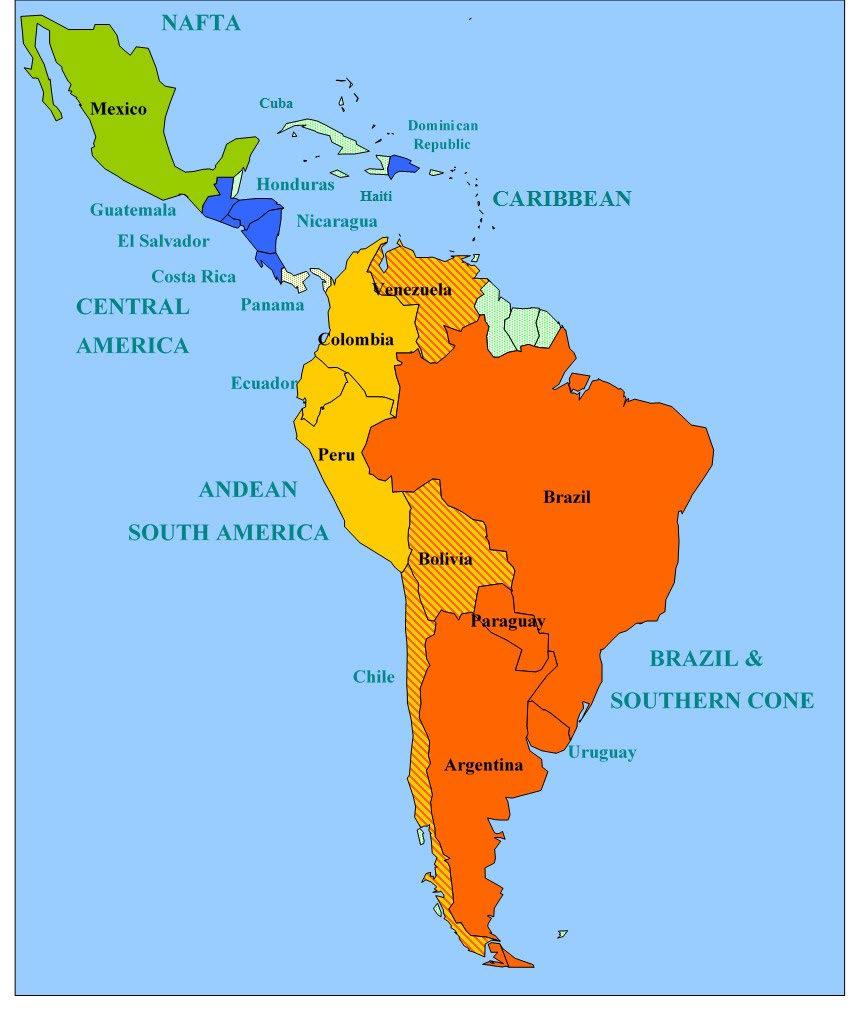
Regional Map
Fueled by pent-up demand, resurgent commodity prices, and strong export growth, Latin America experienced a remarkable rebound after COVID-19 restrictions were eased in 2021. Despite only modest growth in 2023 due to elevated inflation in the wake of unprecedented fiscal and monetary support during the pandemic positive momentum began to build and continued in 2024. Inflation in Latin America began to ease thanks to the decisive and early actions of central banks, which had raised interest rates aggressively. Declining rates in 2024, lowering borrowing costs and supporting spending and investment, combined with more stable currencies and improved external conditions, creating space for domestic demand to rebound and for optimism to build.
However, with the resurgence of global conflicts, underwhelming global growth, and a sharp shift in U.S. trade and foreign policy after President Donald Trump’s return to office in January 2025, conditions quickly deteriorated. As the European Union was burdened by weak productivity, investment, and energy instability due to tensions with Russia, China was contending with a faltering property sector and rising debt burdens. Amidst this economic environment, the new US administration imposed steep trade tariffs, withdrew from or challenged multilateral trade frameworks, and escalated geopolitical friction with several countries. These measures contributed to deepening the global economic slowdown, further dampening external demand and heightening uncertainty in international markets. The ripple effects extended to Latin America.
Beyond the impact on the global sphere, U.S. policy and geopolitical priorities are directly influencing the region’s stance on trade alignment, investment climate, and international relations. Countries in Latin America now face difficult choices: whether to deepen economic cooperation with Washington under Trump’s transactional framework, seek diversification through stronger ties with Europe and Asia, overcome political and economic fractures within Latin America, and/or expand partnerships with China amidst intensifying U.S.–China competition. These uncertainties highlight the risks to business confidence as the investment climate in the region is being reshaped by tariff volatility, tightened scrutiny of supply chains, and shifting expectations about political stability and regulatory landscapes.
These recent developments have constricted global trade and dampened growth prospects for the region in the near term. Most Latin American regional GDP forecasts have been revised downwards (Figure 1), aligning at about 2.2% in 2025 and 2.3% in 2026. 1 Economies
1 The latter estimates, however, include modest recent updates by IMF and ECLAC in July and August, related to lower-than-expected tariff implementation, slight improvement in global financial conditions, and higher-thanexpected first quarter growth in some countries in South America (Argentina, Ecuador, Colombia and Brazil have recently exceeded quarterly expectations).
heavily reliant on the U.S. for exports, remittances, and investment (Mexico and Central America) are forecasted to slow the most. Despite the weakening in external demand from the U.S., pockets of robust growth continue to exist within the services sector and in select countries. Panama, the Dominican Republic and Guyana, for example, have seen positive developments (aided by higher private consumption and remittance performance).
Longer-term, structural indicators such as unemployment and poverty rates continue to show progress (through the first quarter of 2024), though this improvement is forecasted to slow down in 2025-26 (Figure 1). Employment, especially for young individuals, remains robust and post-pandemic gross fixed capital formation (GFCF) has shown significant advances (Table 1) particularly in capital-intensive sectors such as automation, digital technologies, agriculture, and mining which signal rising confidence and an ability to attract capital. Labor productivity gains, however, remain uneven and broad-based job creation remains limited, as indicated by the decline in labor productivity during the 2021-2023 period. The combination of positive GFCP and limited labor productivity reflects a concentration of opportunities in specific, sub-regional or sub-national economic clusters, albeit with continuing high aggregate levels of labor informality, social marginalization and poverty (Figure 1).
Source: GDP: IMF (April 2025), World Bank Data, Youth Unemployment: CEPALSTAT, IMF, and ILOSTAT.
Table 1. Investment and labor productivity are moving in different directions
Source: GFCF: ECLAC; Labor Productivity: OECD Latin American Economic Outlook 2020 (simple average of 17 LAC countries covered by The Conference Board-Total Economy Database, averaged over the time period)
In the global context, Latin America is growing at a slower pace than Emerging Asia or SubSaharan Africa (Table 2.1.). The region’s outlook is expected to improve as policy uncertainty lessens, and new foreign direct investment (FDI) flows strengthen. However, the region’s outlook remains constrained by weak domestic fundamentals and stalled reforms, which limit the region’s ability to respond to large domestic stimuli. Emerging Asia and Sub-Saharan Africa are expected to see stronger momentum or recoveries by 2026 (IMF-WEO, 2025).
Latin America’s aggregate inflation is expected to remain broadly stable at around 3–4% for most countries in 2025–26 (Table 2.2). This is lower than Sub-Saharan Africa or much of Emerging Asia (where inflation pressures often run higher). The median regional forecast, however, masks sharp differences: Venezuela, Haiti, and Argentina continue to see double- or triple-digit inflation (sometimes exceeding 20% or 200%), while Panama, Peru, and Chile have inflation rates under 4% and some, like Panama, near 1%. Central America generally posts lower rates due to dollarization and policy management. These heterogeneous inflation dynamics also explain why a few countries in the region have had to raise interest rates (Brazil, Uruguay), against the trend of declining rates in the region (See section 4 below).
Current account balances in Latin America also display heterogeneous performance. While Brazil, Chile, and Peru are expected to maintain manageable deficits or move toward surpluses thanks to commodity exports, Mexico, Argentina, and most Caribbean countries will grapple with larger deficits. Oil exporters like Guyana, Ecuador, and Colombia may benefit in the short-term from price spikes, adding positive momentum to their external accounts. Overall, while Latin America’s aggregate outlook is stable, high structural diversity across countries means that business risk, the investment climate, and operational strategy will vary by sub-region and sometimes by city or state.
Table 2.1. Growth outlook in Latin America and other emerging market regions (percent)
Source: IMF, World Economic Outlook (April 2025)
Notes: % Change in Real GDP (2019=100) Relative to Previous Year; Baseline Forecasts for 2024 through 2026.
Table 2.2. Economic outlook for the LA-7 economies
Source: IMF, World Economic Outlook (April 2025) (for the seven largest economies in the region: Argentina, Brazil, Chile, Colombia, Costa Rica, Mexico, and Peru).*For comparison.
Despite the challenges it faces, Latin America and the Caribbean have meaningful opportunities in the current environment. The most recent report of the Economic Commission for Latin America (August 2025) identified priority actions that will enhance the returns to investment in the region: mobilizing domestic, external, and private resources to finance development, diversifying trade and investment partnerships, leveraging regional integration to counteract policy uncertainty, pursuing infrastructure modernization, and increasing their participation in sustainable and digital sectors, countries in the region can enhance productivity, build resilience, and protect against external shocks.
Recent external shocks ranging from shifting U.S. policy to increases in global risk and geopolitical disruptions will have deeply uneven effects on Latin American economies. These asymmetries become particularly clear when analyzing U.S. tariffs, each country's trade orientation, export market dependence, and reliance on remittance inflows.
As of August 2025, the Trump administration’s tariff regime for Latin America consists of a baseline 10% tariff on U.S. imports from most countries in the region, such as Argentina, Chile, Colombia, Peru, and key Central American nations (Table 3). However, exceptions to this baseline have imposed higher rates: Brazil (50%), Nicaragua (18%), Guyana (cut from 38% to 15%), Bolivia (15%), Ecuador (15%), Costa Rica (15%), and Venezuela (15%). Mexico, typically subject to 10%, faces 25% tariffs on autos, steel, and aluminum. These exceptions reflect a recalibration after negotiations or were motivated by the administration’s reciprocity formula, with major changes determined in April and revised further in August 2025.
The exceptions to the baseline are officially justified by economic rationales. For Nicaragua, Guyana, and Brazil, higher tariffs were calculated based on trade deficits with them. In Guyana’s case, strategic motives also played a role, responding to both its notably high tariff rates and increasing Chinese economic influence. Political considerations arguably also underpin much of the U.S. stance. Nations seen as uncooperative, with adversarial relations with the United States, have made slow progress on bilateral trade deals (Venezuela, Nicaragua, Bolivia), received stiffer treatment.
Even Costa Rica and Ecuador, with traditionally more cordial relations with the United States, found themselves subject to increased tariffs due to delayed negotiations and “reciprocity” criteria. Thus, the pattern of exceptions reflects both a push for trade reform and targeted pressure on countries whose domestic or foreign policies clash with U.S. priorities.
Table 3. U.S. Tariffs on U.S. Imports from Latin American Countries
Country Tariff (%)
Brazil
Mexico
Oil importing from Venezuela
Chile
Effective Date / Notes
10% → 50% Initially 10% on April 2, 2025; escalated to 50% on July 9, effective August 1 2025
25% (avg. ~10.5%) 25% announced in March 2025 (automobiles, steel, aluminum Feb 1, 2025), but numerous exemptions under USMCA reduced the effective average to around 10.5%.
25% 25% tariff on goods from any country importing Venezuelan oil, effective April 2, 2025.
10% (50% Copper) Faces the baseline 10% tariff; FTA may provide some sectoral exemptions. Recent announcement of new 50% tax on copper products.
Guyana 38%→ 15% Higher-than-baseline reciprocal tariff (initially paused for 90 days, then changed to 15%) .
Nicaragua
Bolivia
Costa Rica
Ecuador
18% Higher-than-baseline reciprocal tariff (paused for 90 days), based on trade deficit.
10% → 15% Effective on August 7, 2025, no trade agreement.
10% → 15% Effective on August 7, 2025, U.S. trade deficit.
10% → 15% Effective on August 7, 2025, no trade agreement.
Venezuela 10% → 15%
Effective on August 7, 2025, no trade agreement.
All Other 10% Baseline 10%, with exemptions due to FTA (e.g. for oil)
Source: Source: White House. Imports data from US Census Bureau (2024). Updated August 06, 2025.
The variation in trade exposure among countries in the region will play an important role in how Latin American economies are affected by, or can respond to, recent policy. Figure 3.1 shows trade as a percentage of GDP in 2023. More open economies in Central America and some South American countries, such as Chile and Panama, exhibit trade shares exceeding 60% of GDP. Large economies like Brazil and Argentina maintain lower trade-to-GDP ratios. Global external shocks (e.g., disruptions in demand from major partners or supply chain uncertainties) more acutely affect smaller, trade-heavy states, causing rapid swings in business climate and investment decisions. In contrast, economies with large domestic markets are somewhat shielded as global inflation and financing costs filter through. 2
Figure 3.1. Heterogeneous trade exposure (as a percent of GDP) (2023)
Source: EIU, UF. Exports and imports as a percent of GDP
Export market concentration also differs dramatically across Latin America (Figure 3.2), with some economies depending heavily on the United States, while others, less dependent, are significantly trading with Asian countries, primarily China. Mexico and many Central American countries were sending more than 70% of their exports to the US in 2025, while Chile, Peru, Brazil, Uruguay and Bolivia have become more exposed to Chinese demand, with shares exceeding 30% for Peru and Chile. Panama is the only country in Central America, that sent a significant share of its exports to Asia as opposed to the U.S. Beyond copper ore, seafood, bananas and palm oil, Panama’s strategic role as the operator of the Panama Canal enhances its export orientation into Asian supply chains.
2 The Southern Cone of Latin America presents a particular panorama because several smaller countries, especially Paraguay, Uruguay, and Bolivia—rely heavily on trade with Brazil. Large economic shocks to Brazil, thus, will affect growth and stability in the subregion.
It is noteworthy that most countries in the region are seeking to diversify their export markets and now trade more than 40% of their exports within Latin America or with countries different than the US and China. Traditionally, the smaller countries in the southern cone of South America sell most of their exports to Brazil (Argentina, Bolivia, Uruguay), Chile, or Argentina (Paraguay), and more recently diversify to other countries in the region and increasingly to Asia (India, Japan, South Korea, Vietnam). Colombia and Ecuador export a large proportion of their goods to Panama, Brazil and other Andean countries.
Figure 3.2. Export market concentration differs dramatically across Latin America.
Exports to the U.S., China and other countries (%, 2024)
Source: IMF, Direction of Trade Statistics. EIU.
Figure 3.3 further underscores these themes by showing both the share of exports going to the United States and the prevalence of free trade agreements (FTAs). Nearly all Central American states and Mexico have signed free trade agreements with the U.S., yet Mexico uniquely displays near-total reliance on the US as an export market. In contrast, South America is more diversified. This is why, when the US imposed new trade barriers in early 2025, Mexico’s manufacturing and automotive sectors saw business uncertainty surge and investment projects stall. Conversely, commodity price swings tied to China's growth fluctuations have significantly affected major South American exporters, affecting business confidence, investment, and fiscal revenues across the southern cone of Latin America, especially Brazil. Politically, these external shocks have often amplified or cushioned existing institutional and governance challenges.
Latin American governments are now aiming for a delicate equilibrium: accommodating shortterm U.S. policy requirements where beneficial, but also reinforcing their export bases,
deepening intra-regional ties, and building resilient economies. For smaller economies or those highly dependent on U.S. markets, tariff pressures are accelerating efforts to negotiate sectoral deals. Countries with larger domestic markets or more diversified external sectors are leveraging their greater resilience, choosing a measured pace for engagement with the United States, and trying to safeguard their sovereignty.
Source: UF with data from IMF, Western Hemisphere Regional Outlook.
With continued uncertainty, high prices of gold and silver have benefited large producers such as Brazil, Bolivia, Mexico, and Peru (Figure 3.4a), but an expected slowdown in infrastructure spending in China and the dismantling of policies favoring electric vehicles in the United States has reduced the prices of industrial metals such as those involved in the production of batteries. Chile, Argentina and Bolivia have seen a sharp decline in their lithium-based revenues. Chile and Peru, to the contrary, have benefited from a continued positive trend in copper prices due to the mix of supply constraints and a robust demand and valuation based on copper’s centrality to the data economy. Crude prices show a declining trend, which have negatively affected Andean nations whose exports are composed by a large share of oil and its derivatives. While oil is not such a large share of Mexico’s exports, softer oil prices may still weigh on its fiscal performance.
Agricultural commodity price trends are mixed (Figure 3.4b). Declining soybean prices significantly affect most countries in the southern cone of South America, while the positive trend on cocoa and coffee benefit Andean and Central American countries the most. As many Latin American countries are importers of energy and food, though, a general declining trend in these commodities is expected to lower inflation. In this sense, Central America and parts of the Caribbean stand to benefit from lower import bills and lower inflationary pressure.
Source: UF calculations with IMF Data
Figure 3.4b) Agricultural Commodity Prices
Source: UF calculations with IMF Data
The Pivotal Role of Remittances
For Central American countries, the Caribbean, and Mexico, remittances from abroad play a pivotal role in cushioning external shocks. The pressure that U.S immigration policy shifts and remittance taxes can exert on these countries is illustrated in Figure 3.5a). It reveals the large magnitude that remittance flows to Mexico and Central America reached in 2024, exceeding $60 billion to Mexico alone. Figure 3.5b) confirms that remittances constitute a very large share of
GDP in Central America and the Caribbean well above 20% for several countries (Nicaragua, Honduras, El Salvador), and between 15 and 20% for others (Guatemala, Haiti, Jamaica). During periods of external demand slowdown and tighter global credit, these inflows have provided vital support for domestic consumption and small businesses, partially offsetting weak export and investment performance. Thus, this reliance introduces a significant vulnerability to any deterioration in US labor market conditions or changes in US migration policy, which could rapidly transmit negative shocks throughout vulnerable segments of the population in these economies.
Figure 3.5.a) Remittance flows to Latin America
($bn.), Panel b) Remittances as a % of GDP
South America
Central America
Caribbean Mexico
Remittances, 2024 Remittances as a share of GDP 2024
Source: UF with data from IDB, Maldonado, R., & Harris, J. (2024). Remittances to Latin America and the Caribbean in 2024: Diminishing Rates of Growth https://doi.org/10.18235/0013258
Public debt and financial investment in Latin America
Latin American governments provided unprecedented fiscal and monetary support to their economies during the pandemic, which helped stabilize consumption and financial markets. However, this stimulus raised debt and debt service to unprecedented levels. Compounded by slower growth and heightened external vulnerabilities, the economic environment features constrained fiscal space and limited policy flexibility in many countries (Figure 4.1). Distinct policy choices and macroeconomic conditions, however, are shaping emerging opportunities in countries embracing new reforms and strengthening fiscal institutions.
Argentina, which has historically struggled with high debt burdens, recently committed to fiscal austerity and liquidity enhancing measures that have elevated its credit rating in 2024 and stabilized the outlook (Figure 4.1 and Table 4.1). Argentina’s credit upgrade from an exceptionally low rating signals increased investor confidence and represents an important opening for future private investment once stability gains traction. Brazil, with one of the region’s largest markets, continues to attract long-term interest. While debt in the country remains high, its robust external position, resilient institutional capacity, and deep capital
markets offer opportunities for investors seeking yield and exposure to a large and diversified economy pursuing structural reforms. Costa Rica and Dominican Republic stand out for reform momentum as well. Costa Rica’s primary surpluses and export dynamism support debt stabilization, while the Dominican Republic upgrade in 2025 reflects a decade of consistent growth and institutional progress.
Other countries in the region have maintained prudent and resilient fiscal policies. Chile remains the region’s fiscal benchmark for fiscal responsibility, with the lowest debt ratio and a solid single A rating. Uruguay, with stable public finances after reforms, enjoys investment-grade status and is seen as a reliable destination for foreign capital in sectors like renewable energy, agribusiness, and services. Peru, despite some political instability, maintains a comparatively moderate debt burden and a strong fiscal reputation. Even countries with low or downgraded aggregate ratings, such as El Salvador, Nicaragua and Colombia, present niche sector opportunities. One example is Colombia, where the valuation of its three unicorn companies 3 represented a joint value of about 2% of the country’s 2024 GDP. The country also enjoys substantial intellectual property and high-tech imports.
Countries with mixed recent economic performances such as Mexico, Guatemala, and Panama, provide both clear advantages and clear risks. Mexico has a large economy which has been stable, has displayed moderate debt levels, and has had consistent access to capital markets. However, fiscal space is narrower that in Chile or Uruguay, and its integration with the U.S. supply chain, while previously seen as an advantage, is now seen as a potential risk. Similarly, its participation in nearshoring trends that represent major growth opportunities –where distant regions relocated parts of their supply chains to Mexico to be closer to U.S. markets are now uncertain and hinge on U.S. external policy. Guatemala has recently seen its outlook upgraded thanks to low debt levels, effectively anchored inflation, and sound economic performance. However, a deterioration in global growth and remittances could negatively impact GDP growth in the medium term. Effective investment in infrastructure and institutional strengthening is also key to consolidating its business potential. Panama, traditionally a strategic global logistics hub with vibrant financial services, had a recent rating downgrade attributed to a combination of factors that generate a risky outlook (the closure of a copper mine that was its biggest source of foreign investment, social unrest, increased drought impacts on the Panama Canal flow, which has also been subject to expropriation threats from the U.S. president).
An ongoing concern for countries with high debt burdens is that their interest payments could crowd out productive investment and critical social spending, which is especially problematic in countries with fiscal rigidity such as Argentina, leaving little room for infrastructure, health or education outlays, and could generate social unrest. Ecuador, El Salvador, and the Dominican Republic (D.R.) also face the risk that fiscal resources may be diverted toward debt servicing, hindering longer-term development prospects. 4 Credit rating agencies have placed Bolivia, Colombia, Ecuador, and Honduras under heightened scrutiny centered on concerns about fiscal consolidation and structural reform.
3 Privately held startups that have reached a valuation of $1 billion or more.
4 While the D.R.’s debt is not in the highest range of the region, its is relatively low as a percent of GDP. Thus, even a “normal” debt-service burden translates into a large share of what the government can spend.
Figure 4.1 Central government gross public debt (% GDP) increased sharply and sovereign ratings declined for highly indebted countries.
AR (CCC)
Bolivia (CCC-; Neg.)
BR (BB)
CHL (A)
COL (BB; Neg.)
CR (BB-, Pos.)
ECU (B-; Neg.)
ELS (B-)
HON (BB-, Neg.)
MX (BBB)
NIC (B*)
PAN (BBB-)
PAR (BB+, Pos)
PER (BBB-)
DR (BB)
Notes: Dotted lines denote countries with a public debt/GDP above 55.5%.
Data for Bolivia was not available 2024, CGGPD was 71.8% in 2023.
Sources: Central Gov. gross public debt, ECLAC; credit ratings: S&P’s Global ratings.
Issuer
Mexico
Ratin
BBB Stable
Bolivia CCC- Negative
Colombia BB Negative
Ecuador B- Negative
Peru
Down from CCC+ (06/25), concerns about ability to meet debt obligations and deteriorating external financial profile.
Down from BB+; weakening fiscal balance, less predictable fiscal policy
BBB- Stable Down from BBB, 04/24, political instability.
Venezuela SD NM
Argentina
Brazil
CCC Stable
BB Stable
Chile A Stable
Paraguay
Uruguay
AMERICA & DR
Costa Rica
Dominican Rep.
BB+ Positive
Upgraded from CCC- (03/24), after local bond swap improving liquidity.
Strong external position, but persistent fiscal deficits.
Commitment to fiscal consolidation& ability to manage debt burden
Upgraded (02/24); improvements in economic and fiscal situation anticipated
BBB+ Stable Fiscal reform stabilized public finances
BB- Positive
BB Stable
El Salvador B- Stable
Guatemala
BB+ Positive
Dynamic export growth & primary fiscal surpluses.
Upgraded from B- (08/25) after a decade of sustained growth and institutional reforms. High debt/GDP ratio remains.
Upgrade (05/25); low debt, stable econ. Performance. Infrastructure and institutional challenges remain.
Honduras BB- Negative Vulnerability to adverse economic conditions.
Nicaragua B+ Stable
Panama
BBB- Stable
Upgraded from B (10/24); commitment to macroeconomic stability, resilient financial sector.
Downgraded from BBB (11/25), increased public debt.
Source: S&P Global Rating, 2025. (https://disclosure.spglobal.com/ratings/en/regulatory/article//view/sourceId/13417847)
SD=selective default; NM=not meaningful.
Latin America is slowly exiting a very tight interest-rate phase. The U.S. Federal Reserve's aggressive rate hikes in 2023 pushed short-term yields above 5%, creating a mildly inverted yield curve initially. Despite rate cuts commencing in late 2024-, medium- and long-term yields rose sharply through 2025 (Figure 4.2.), reflecting the transition from recession concerns and confidence in rapid disinflation to recognition of persistent inflation risk and fiscal worry. This
“higher-for-longer” interest rates environment in the U.S. forced most Latin American countries to keep their own policy rates elevated throughout 2023 and much of 2024, to defend their currencies and deter destabilizing outflows of capital. Elevated rates increased the direct cost of debt for governments and deterred private investment, threatening future economic growth. This has been most acutely felt in high-debt economies (notably Argentina and several Caribbean and Central American economies), where debt sustainability concerns limit access to affordable financing, and a vicious cycle of high rates and subdued investment can emerge. However, as shown in Table 4.2., by late 2025 Mexico, Chile, Colombia, Peru, Costa Rica and Paraguay have been able to lower their rates consistently since last year and the forecast for the region is that rates will gradually decrease. Exceptions are Brazil, Argentina and, to a lesser extent Uruguay, where the process may take longer due to higher inflationary pressures. Consensus from multilateral institutions and major private forecasts is that regional policy rates will decline further in 2026, but the legacy of that period will weigh on growth and public finances through 2026
June 30, 2023
July 1, 2024
May 23, 2025
Source: Federal Reserve. Note: the date on the graph is the date where the yield is calculated and then its maturity projected to different years.
Table 4.2. Heterogeneous pace of cutting interest rates reflects different inflationary pressures.
Source: Central Banks.
Note: aFebruary 24, 2022 and February 24, 2023. aFebruary 27, 2024 and February 27, 2025
After President Trump's new tariff measures and policies that have escalated trade uncertainties in early 2025, a pronounced global “risk-off” sentiment led many investors to temporarily reduce exposure to emerging markets, including Latin America. Most recently however, as investors saw that fundamentals and policy frameworks were holding up despite volatility, Latin American equities and bonds have outperformed major global indices, with the MSCI Latin America Index surpassing the S&P 500, thanks to strong corporate earnings and attractive valuations, mostly in Brazil and to a lesser degree in Mexico (Lefkovitz 2025). Also noted by analysts is a shift among global investors toward greater regional and asset class diversification, balancing between North American, European, and Latin American assets due to continuing U.S.–China tensions and the unpredictable U.S. trade environment (JPMorgan 2025).
Despite heightened volatility and rising political risk, Latin American markets (especially for sovereign bonds) have attracted strong investor interest so far in 2025, leading to record issuance and robust demand even as risk premiums remain elevated and portfolio flows that are sensitive to global policy uncertainty. After initial U.S. trade policy announcements sovereign spreads initially widened modestly but have since narrowed and stabilized (Figure 5.1). As of September 2025, spreads on the bonds of the region’s six largest economies are trading 65 basis points below their 10-year average. Overall, the region compares well with most other emerging markets in risk-reward terms: more attractive coupons than emerging Asia (at the cost of more political and commodity-price risk), but with stronger institutions than many frontier African or low-income issuers. This gives governments a window to term out debt refinancing short-term or expensive floating-rate obligations into longer-maturity bonds, pre-financing future needs, and using the breathing space to strengthen fiscal positions. However, that window could close quickly if global rates jump again or domestic politics deteriorate.
Sovereign Spreads
Basis points
Basis points
Source: Bloomberg & UF estimates. Spread of 10-year yields over U.S. Treasuries
Capital flows into any region are not necessarily the only or even the most important determinant of asset prices – domestic buying and selling is often larger. But capital flows are a good indicator of interest on the part of well-informed investors, which are usually institutions or high net worth individuals. The relationship between capital flows into Latin American and returns on its equity markets is readily visible in Figure 5.2. Capital inflows had diminished to almost nothing in 2020, the worst of the Covid-19 years, only to strengthen markedly in the following years. Capital flows into Latin America are on track, according to the consensus, to reach almost $180 billion in 2025. The inflows have helped support Latin America’s currencies, which have stabilized at competitive levels (Figure 5.3). The region’s competitive currencies should help promote export growth, and therefore overall growth.
Figure 5.2 Capital flows into Latin America have picked up
Source: IMF, Consensus Economics, MSCI
Figure 5.3 Latin America currencies have stabilized
Source: OECD. Monthly averages of daily data
A key factor behind the pickup in capital flows to Latin America is the decline in interest rates in the United States as the Fed initiated its easing round. The lower rates make Latin American assets relatively more attractive. This process is likely to moderate in coming months as U.S. rates fall further, keeping the dollar cheap and making U.S. assets more affordable for Latin American investors. The result may be a recycling out of capital inflows, as domestic investors use in capital inflows to buy foreign assets. Recycling out seems to have occurred elsewhere in the emerging markets in the first half of this year (Marney, August 27, 2025). Expectations that it may occur in Latin America may be behind the consensus forecast of a moderation in net capital flows to the region in 2026 to around $140 billion still large by historical standards but less explosive than 2025.
Latin American stocks have had an extraordinary run in the past two years. With total returns on Latin America’s equities up almost 200 percent in this period, it is reasonable to ask whether this performance can continue. In the emerging markets, returns in future years have been strongly related to levels of initial valuations: high price-to-earnings (PE. ratios), for example, have tended to be followed by low returns in the next year, and vice versa, though there has always been quite a bit of room in that relationship. With the rise in the region’s markets have come higher PE ratios in most countries (Figure 5.4). To be sure, PE ratios and other measures of valuation such as price-to-book ratios are still lower than the average for emerging markets and much lower than in tech-heavy developed markets such as the United States. Still, PE ratios are higher than their 5-year averages in four of the region’s largest markets (Figure 5.4). This does not necessarily mean that those markets are due for a period of underperformance PEs in all six markets are near their average of the past 10 years but it does suggest some vulnerability in the short run. Country selection, for example, favoring markets where valuations are still clearly below history and reforms are advancing, and sector selection (e.g., domestically oriented banks, utilities, or quality exporters versus more speculative names) become more important.
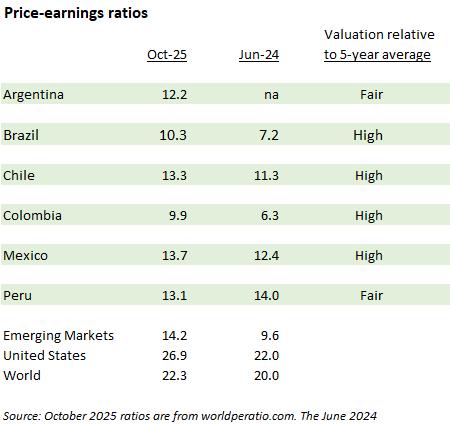
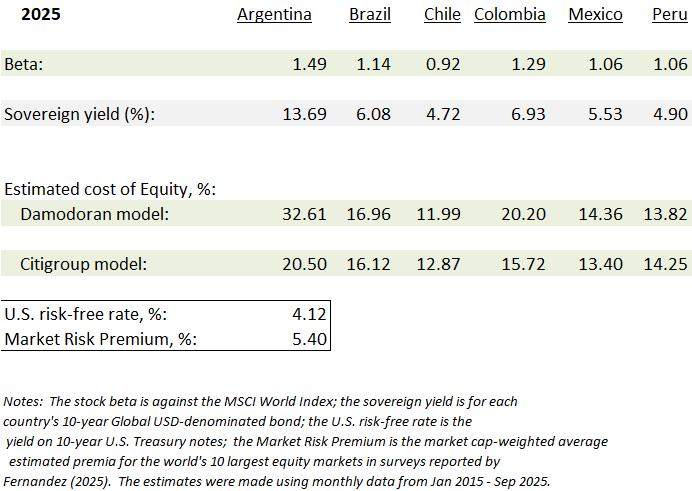
The high valuations in Latin America’s equity markets relative to history mean that the cost of equity in those markets will be higher than in recent years. The cost of equity estimates presented in Figure 5.5.are based on two models, both of which feature information on returns on sovereign bonds to capture the effect of country risk on the cost of equity. The Damodoran
model augments a regression of country returns on global equity returns (a typical single-factor CAPM) with returns on each country’s sovereign bonds multiplied by the ratio of the volatility of local equity returns to the volatility of its sovereign bond returns (Damodoran, 2003). The Citigroup model adds returns on sovereign bonds to a regression of country returns on global equity returns and each country’s sovereign bond returns (Abuaf, 1997). The estimated equity costs are high in both models; in double-digits for all countries. These high numbers, however, reflect in part the volatility in asset returns during the Covid years and should come down in future estimates as those years fall out of the sample. The results from the two models reveal a similar pattern across countries: high costs of capital for Argentina, Brazil, and Colombia and relatively smaller costs for Chile, Mexico, and Peru. Not coincidentally, the cost of equity estimates are lower for the second group, which all have investment-grade credit ratings and therefore lower sovereign yields.
In 2024, FDI flows increased in Brazil, Mexico and Peru, as well as in Central America and the Caribbean. They declined, relative to 2023, in Argentina, Colombia, Ecuador and Chile (Figure 3.4), although Chile’s decline is associated with record FDI inflows in 2023.This trend is
significant given the overall positive regional performance, largely driven by Brazil and Mexico, which together accounted for 62% of the region’s FDI inflows. Early data for 2025 shows that the positive momentum continues for FDI inflows in the region. UNCTAD estimates show that FDI flows to Latin America and the Caribbean rose a further 12% in the first half of 2025, even as global FDI declined, pointing to the region’s relative resilience and ongoing investor interest in selected markets and sectors.
FDI remained concentrated in the manufacturing and services sectors, but this year, the share of manufacturing rose to 43.6%, surpassing services, which accounted for 40.4%. The natural resources sector saw a smaller share of 16%. This shift signals a recovery and rebalancing of Latin America’s role in global manufacturing value chains, possibly linked to nearshoring and friendshoring 5 trends (ECLAC 2025). While natural resources’ share is smaller in aggregate, it represents a significant increase for some countries, such as Argentina, which saw a 44% increase in natural resource investments, and Guyana which experienced a 43% rise in its hydrocarbon sector. Peru and Brazil also saw strong flows into mining and critical minerals linked to the energy transition, while the Dominican Republic and other Caribbean economies attracted more investment in tourism, services and infrastructure.
Notably, too, is the rising share of intra-regional FDI, with cross-country investments within Latin America itself now representing 12% of total inflows the third largest source after the U.S. and EU. Chinese FDI, by contrast, accounted for only about 2%, with much Chinese investment being routed via third countries or non-FDI channels. This 12% share, however, is modest compared with other emerging regions, where intra-regional FDI commonly represents 20–30% or more of total inflows, underscoring how much scope remains to build denser production networks, stronger regional value chains, and deeper cross-border corporate ties. In addition, there has been a significant increase in FDI outflows from the region by Latin American multinational companies (47% increase, totaling a little over $53 billion dollars), with Brazil being the largest investor abroad, and Mexico the fastest growing (ECLAC-FDI, 2025).
At the start of 2024 the United States remained the largest single direct investor in Latin America (with 38% of total FDI in the region), the European Union’s share fell to a low of 15%. However, we expect that US policy dynamics may alter these trends going forward, with Latin American nations proactively diversifying by negotiating trade agreements with the EU and other regions in the world. Brazil and other MERCOSUR countries signed the EU-Mercosur Partnership Agreement in December 2024, one of the largest trade agreements globally, which eliminates tariffs on over 90% of bilateral trade. Other notable regional agreements in 2024-2025 include Mercosur trade deals with Singapore and ongoing negotiations with Canada and South Korea, while Pacific Alliance countries (Chile, Colombia, Mexico, Peru) continue to pursue deeper market integration with Asia and trans-Pacific partners. If these agreements are effectively implemented, EU and Asian investment shares could rise modestly over 2026 and beyond, reducing dependence on U.S. capital while reinforcing manufacturing, services and green-transition projects.
5 Nearshoring relates to companies relocating supply chains operations closer to end markets, friendshoring emphasizes relocation to countries where there is certain political, economic, and ethical alignment.
Figure 6. FDI as a percentage of GDP, 2022-2024
Source: Economic Commission for Latin America and the Caribbean (ECLAC), on the basis of balance of payments information from the region's central banks, according to the guidelines of the IMF's sixth balance of payments manual.
While recent trends in spreads, capital flows and equity markets show how investors are pricing Latin American risk in the short to medium term, they only partially capture the region’s underlying economic strengths. Beneath these market indicators lies a deep base of real assets and natural resources (critical minerals, energy reserves, fertile farmland, forests, and tourism-rich coastlines) that underpin current cash flows and long-term growth potential. Many of the most attractive ones are tied to energy, food security and demographic shifts.
Lithium in Argentina and Chile, large copper deposits in Chile and Peru, and Argentina’s shale field all link directly to the clean‑energy and electrification agenda, where demand for critical minerals and gas is expected to grow faster than supply over the next decade and beyond. At the same time, areas such as premium agriculture, sustainable forestry, aquaculture, medical tourism, expat real estate and core infrastructure can provide steady, often hard‑currency cash flows that are less correlated with global tech cycles, but still benefit from long‑term trends like healthier diets, net‑zero targets, aging populations, and supply‑chain reconfiguration.
In the Lithium Triangle, Argentina and Chile are already important to global battery supply chains, while Bolivia remains largely closed to private investment, so investors can match risk appetite to country conditions: Chile offers more stability and lower upside, Argentina offers more growth but higher macro and political risk. Copper production in Chile and Peru faces challenges from declining ore grades, water constraints and social conflict. However, global grids, EVs and data centers are set to push copper demand higher, which supports long‑term prices and economics of mine expansions, desalination projects and power infrastructure around major mining districts. Argentina’s Vaca Muerta area is now moving into a more mature growth phase, but returns still depend heavily on Argentina’s ability to stabilize inflation, manage its currency and maintain a predictable regulatory regime.
Beyond extractives, real‑asset opportunities can help diversify portfolios. Premium agriculture and branded “natural” production in Uruguay, Argentina and Peru benefit from consumer willingness to pay more for grass‑fed, traceable and organic products, but they also depend on logistics, phytosanitary access to key markets, and consistent quality. Sustainable forestry and carbon projects (in Brazil, Paraguay and Uruguay) may combine timber or pulp revenue with carbon credits, yet these markets still face evolving standards and enforcement gaps, which means project selection and verification quality are critical. Aquaculture and fishing in Chile, Peru and Ecuador tap into rising global demand for seafood and protein, though disease. Environmental rules and resource management have to be taken into account, though, since they can affect margins and operation licenses.
In services, medical and wellness tourism in places like Mexico, Colombia, Costa Rica, Brazil, and the Dominican Republic is growing quickly, are known for excellent value, high-quality cosmetic/dental/orthopedic care, skilled doctors (especially Colombia), and proximity to the U.S. Large cost savings versus the United States and the ease of combining treatment with travel is driving demand for these services. Quality control and regulatory oversight remain central concerns for investors backing clinics or facilitators.
Nearshoring is reinforcing some of these trends. As companies look for “China + 1” diversified production bases Mexico, Costa Rica and the Dominican Republic are attracting more manufacturing (not only in electronics and medical devices but also in autos, appliances and other mid‑tech segments). This supports demand for industrial parks, logistics services, workforce housing and specialized contract manufacturers. Expat and retirement real estate (in Costa Rica, Panama, Uruguay, Ecuador and Colombia) builds on the same drivers: remote work, cost differences with North America and Europe, and lifestyle appeal. This in turn creates niches for professionally managed rental platforms, mixed‑use developments and retirement communities. Region‑wide, a persistent infrastructure gap of roughly US$100–150 billion per year means that roads, ports, energy, water and urban transport will remain priorities for public–private partnerships and dedicated infrastructure funds.
While economists often focus on the ease of doing business as a key component of the efficiency with which labor and capital are combined to produce output, recent economic crises have highlighted that a much broader set of conditions are necessary for well-functioning supply chains, predictable and reliable business deliveries, and sustained and long-term growth. Beyond economic, legal and political considerations examined elsewhere in this report, institutional and technological features of a country such as its intensity of local competition or its investment in human capital and innovation, all contribute to a favorable and dynamic business climate.
The Global Innovation Index (GII), published by INSEAD, Cornell University, and the World Intellectual Property Organization (an agency of the United Nations) tracks over 90 indicators of business and innovation environment, in 139 economies this year Latin America tends to lag
behind other regions according to this index (with 13 out of 17 countries 6 ranked in the bottom half in 2025). However, the GII reveals that the region has an incredibly diverse innovation ecosystem, where the distance between the top and bottom Latin American countries in the ranking is the same as the distance between Switzerland and Egypt, or the United States and Brunei.
Based on the Global Innovation Index (GII) 2025 rankings (Table 6.1), the region's 18 countries analyzed span from position 51 (Chile) to 136 (Venezuela), revealing significant variation in their ability to foster innovation and attract investment. This analysis categorizes these economies into four distinct tiers based on their overall GII rankings, innovation outputs, market sophistication, and institutional strength. Tier 1 countries offer environments comparable to emerging markets globally, with sufficient scale and innovation infrastructure to support venture capital investments. Tier 2 markets provide selective opportunities in specific sectors where institutional risks can be managed. Tier 3 and 4 countries generally require different investment approaches focused on basic infrastructure or natural resources rather than innovation-intensive ventures.
Chile (rank 51), Brazil (rank 52), and Mexico (rank 58) emerge as the region's innovation powerhouses. Chile distinguishes itself with robust institutions (rank 50), strong ICT infrastructure (rank 24), and exceptional market capitalization (rank 17). Brazil leverages its massive domestic market scale (rank 7 globally) and strong knowledge impact (rank 25), particularly in unicorn valuation and high-tech manufacturing. Mexico excels in high-tech exports (rank 13) and production complexity (rank 20), though institutional challenges constrain its potential. In the longer term, Brazil stands out as the country in the region that has made the most consistent progress in its innovation environment (Figure 6). In 2024 it replaced Chile as the top innovative country in the region, however, Chile regained its top position in 2025.
These leaders represent the region's most attractive destinations for innovation-focused investment, with developed infrastructure, substantial markets, and meaningful R&D capacity. Emerging tech hubs in São Paulo, Mexico City, and Santiago, combined with improving digital connectivity, create opportunities for cross-border innovation platforms that can aggregate fragmented markets across the region.
Uruguay (rank 68), Colombia (rank 71), Costa Rica (rank 72), Argentina (rank 77), Peru (rank 80), and Panama (rank 82) constitute the emerging tier. Uruguay stands out with exceptional institutional quality (rank 31), outstanding policy stability (rank 4), and strong ecological sustainability credentials. Colombia demonstrates solid human capital development and notable unicorn activity (rank 24), while Costa Rica excels in labor productivity growth (rank 7) and knowledge impact despite its smaller market size.
6 Excluding three Caribbean countries in the list (Jamaica, Dom. Rep., Trinidad and Tobago; all in the bottom half.
Argentina presents an intriguing profile with strong tertiary education enrollment (rank 4), an emerging tech hub in Buenos Aires, and research capabilities yet suffers from severe institutional weaknesses (rank 120) and business environment challenges that significantly limit its innovation potential. Peru shows strength in tertiary education and market sophistication through microfinance access, while Panama benefits from infrastructure investments despite weakness in business sophistication. This tier offers selective opportunities for investors willing to navigate mixed institutional environments and leverage specific sectoral strengths.
The Dominican Republic (rank 97), El Salvador (rank 98), Paraguay (rank 103), Bolivia (rank 111), and Ecuador (rank 113) occupy the mid-range of regional innovation capacity. These countries face significant challenges in knowledge creation, with most ranking below 100 globally in scientific outputs and patent activity. However, they exhibit some promising attributes: the Dominican Republic shows strong policy stability (rank 23) and capital formation; Bolivia possesses significant market sophistication in the microfinance sector (rank 40); Paraguay demonstrates remarkable ecological sustainability (rank 13) and renewable energy usage; and Ecuador achieved notable unicorn valuation relative to GDP (rank 33). Investment opportunities in this tier are generally limited to sectors with lower innovation intensity or situations where specific competitive advantages can be exploited. These markets require patient capital and higher risk tolerance, with returns more dependent on macroeconomic factors than innovation-driven growth.
Honduras (rank 119), Guatemala (rank 123), Nicaragua (rank 130), and Venezuela (rank 136) represent the region's most challenging innovation environments. These countries suffer from severe institutional deficiencies, with Venezuela ranking last globally on multiple governance indicators. Knowledge creation is minimal, with scientific output and patent activity among the world's lowest. Infrastructure gaps are substantial, particularly in ICT access and usage. Guatemala and Honduras show slightly better prospects, with moderate knowledge absorption capabilities and some knowledge diffusion through ICT exports. Nicaragua demonstrates surprisingly strong FDI inflows (rank 15) despite weak institutions, suggesting natural resource or strategic location advantages. Venezuela's profound institutional collapse (rank 139) and infrastructure deterioration (rank 138) make it effectively non-viable for innovation-oriented investment, despite some historical R&D capacity. This tier is largely unsuitable for innovationfocused investment strategies. Engagement requires high risk mitigation and should focus on commodity- or service-based opportunities rather than knowledge-intensive sectors.
Table 6.1 Latin America’s Innovation Potential (Based on 2025 GII rankings and Heat Map)
Note: Rankings are global positions out of 139 economies. Lower numbers indicate better performance.
Chile
Mexico
Colombia
Uruguay
Costa
Peru
Argentina
Panama
Paraguay
Dominican Rep
El Salvador
Bolivia
Ecuador
Honduras
Guatemala
Nicaragua
Table 6.2. Country specific strengths and weaknesses (global ranking is in parenthesis)
Country Key Strengths
Chile Strong institutions, market cap (17), ICT infrastructure (24)
Key Weaknesses
Limited market scale, weak business-university linkages
Brazil Massive market (7), knowledge impact (25), VC activity (16) Weak institutions, low capital formation
Mexico
Uruguay
High-tech exports (13), production complexity (20), large market (13)
Excellent institutions (31), policy stability (4), infrastructure (46) sustainability
Institutional challenges, rule of law concerns
Small market, limited knowledge creation
7 We analyze longer-term innovation trends through 2024 and separately examine the 2025 rankings for relative positioning among Latin American countries. This bifurcated approach reflects a critical limitation: the 2025 Global Innovation Index introduced sweeping methodological changes revised indicators, new data providers, altered calculation methods, and six additional countries that fundamentally undermine temporal comparability. The fact that all but four countries experienced ranking declines in 2025 may reflect methodological recalibration rather than actual performance deterioration. We therefore restrict longitudinal analysis to 2019-2024, using 2025 data exclusively for within-year regional benchmarking.
Colombia Unicorn activity (24), ecological sustainability (35)
Costa Rica
Argentina
Productivity growth (7), knowledge impact (33), high-tech exports
Tertiary enrollment (4), research capacity (41)
Peru Strong tertiary education (8), credit access, microfinance (5)
Panama Infrastructure (48), capital formation (4), productivity growth
Dominican Republic Policy stability (23), capital formation (20)
El Salvador VC activity (51), moderate credit access
Paraguay
Bolivia
Ecological sustainability (13), renewable energy (2)
Market sophistication (40), microfinance leadership (1)
Ecuador Unicorn valuation (33), government digital services
Honduras
Productivity growth (15), FDI inflows
Guatemala Moderate market sophistication, low tariffs
Nicaragua High FDI inflows (15), microfinance access
Venezuela Historical R&D capacity
Source GII 2025 Report, Subindex Rankings in Parenthesis.
Weak infrastructure (74), limited innovation linkages
Very small market, weak R&D investment
Severe institutional weakness (120), business environment (130)
Weak business sophistication (120), limited knowledge creation
Weak business sophistication (132), limited knowledge outputs
Minimal knowledge creation (137), weak R&D
Poor education (129), weak knowledge creation
Weak innovation linkages (125), small knowledge base
Severe institutional gaps (134), minimal R&D
Institutional challenges, limited innovation capacity
Severe education gaps, weak institutions
Minimal R&D investment (124), weak human capital
Institutional collapse (135), minimal innovation
Complete institutional failure (139), infrastructure collapse (138)
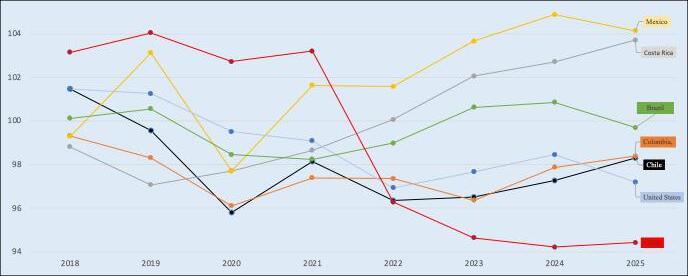
Beyond current business innovation rankings, the Organization for Economic Co-operation and Development (OECD) provides a forward-looking perspective on the business climate through three different indicators. First, the business confidence indicator is used to monitor output growth and to anticipate turning points in economic activity. It provides information on future developments, based upon opinion surveys on developments in production, orders, and stocks of finished goods in the industry sector. It points to a relatively stable optimistic outlook on business in Costa Rica, a moderate and stable outlook in Brazil and Colombia, a lower but rising outlook in Chile, and a more pessimistic and declining outlook in Mexico (Figure 6.1). Estimates for these countries are still above the indicator levels for the U.S. and China.
Second, consumer confidence is measured to provide an indication of future developments of household consumption and savings, based upon stated expected financial situation, and perception of the general economic situation, unemployment, and capability of savings. The indicator is above 100 for Mexico and Costa Rica, yet it mirrors the US declining trend both in Mexico and Brazil, signaling a decline in consumers’ confidence about the future economic
situation in these countries, as a consequence of which they are more prone to save and less inclined to spend money on major purchases in the next 12 months (Figure 6.2).
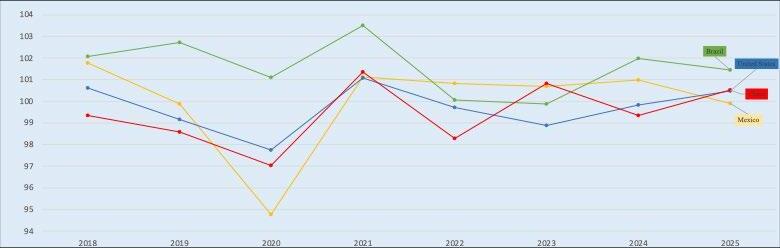
Third, the composite leading indicator measures economic factors that anticipate the ups and downs in the business cycle, such as borders and inventory changes, financial market variables (share prices, business confidence), and trends in key sectors and trading partners for smaller countries. This indicator is designed to provide early signals of turning points in business cycles, showing fluctuation of the economic activity around its long-term potential level, normalized to a value of 100. This index projects declines for Mexico and Brazil (Figure 6.3).
Figure 6.1. Business expectations are high in Costa Rica, and Colombia, Mexico is lagging (OECD Composite Leading Indicator for Chile, Brazil, and Mexico)*
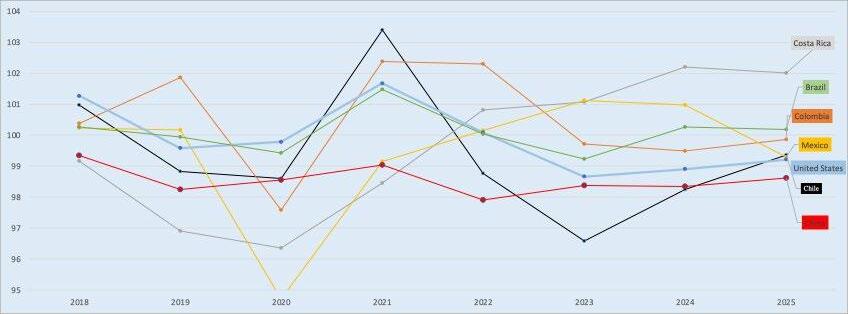
* Numbers above 100 suggest an increased confidence in near future business performance, and numbers below 100 indicate pessimism toward future performance.
Figure 6.2. Consumer confidence is high, especially in Mexico and Costa Rica (OECD Consumer Confidence Index for Chile, Brazil, Colombia, and Mexico)*
* Values below 100 indicate a pessimistic attitude toward future developments in the economy, possibly resulting in a tendency to save more and consume less.
Figure 6.3. Mexico and Brazil are projected to decline (OECD Composite Leading Indicator for Brazil, and Mexico)
Political risk
Political risk in Latin America is shifting unevenly across countries, with debt levels, external financing pressures, and upcoming electoral events shaping the trajectory of risk for each economy. Political risk is often compounded in Latin American countries with both high debt and upcoming elections, since external obligations compete with domestic priorities, feeding social tension and grievances that are then mobilized by political actors. Countries with ongoing or upcoming presidential elections face heightened risk of policy uncertainty –elections can disrupt fiscal planning or prompt capital flight, compounding external shocks and volatility.
Thus, elections in 2025 and beyond represent key flashpoints (Table 5). In Bolivia, the upcoming 2025 general election presents high political risk ongoing MAS party dominance and allegations of electoral and judicial interference directed at this party are said to threaten the transparency and outcome of the process. The country’s weakened gas and lithium sectors, currency overvaluation, and reliance on commodity exports amplify external risks. Guyana’s general and regional elections are in September. While elections may trigger short-lived unrest and add a layer of uncertainty for investors, Guyana’s fiscal position and healthy external accounts currently mitigate the economic risks associated with rising political tensions.
Argentina's midterm legislative elections, slated to occur in October, will serve as a referendum on the government’s economic management amid lower inflation but continued debt stress. The country, however, is expected to continue negotiations with international creditors. Next is Chile’s general election in November, which is not expected to heighten political risk in a disruptive way, given the country’s ample fiscal space and history of credible elections and robust institutions. Honduras, to the contrary, remains vulnerable as fiscal limitations combine with endemic corruption and migratory pressures.
Looking into 2026, the region continues to face an active electoral calendar, starting with Costa Rica’s general elections in February and followed by Peru (April), Panama (May), Colombia (May 31 for the presidential first round, with legislative contests in March), the Dominican Republic (June), Brazil (October), and Nicaragua in November. Of these, Brazil’s and Colombia’s elections are especially significant. Brazil, recovering from recent political volatility and economic turbulence, will test whether a more stable and predictable policy environment can emerge; however, fiscal stress, upcoming pension and tax reforms, and rising U.S. trade pressure, portend a still-elevated risk of policy reversals. Colombia’s elections are set against a backdrop of fragile peace accords and security challenges. In addition, the electoral process will be closely tied to external demands for fiscal and tax reforms amid heightened debt service costs.
Date Country
Electoral Event
8/17/2025 Bolivia General elections
10/19/2025 Bolivia Presidential runoff
9/1/2025 Guyana General and regional
10/26/2025 Argentina Midterm
11/16/2025 Chile General elections
12/14/2025 Chile Presidential runoff
11/30/2025 Honduras General elections
2/1/2026 Costa Rica General elections
4/12/2026 Peru General elections
5/6/2026 Panama General elections
5/31/2026 Colombia Presidential & legislative
6/21/2026 Dom. Rep. General elections
10/4/2026 Brazil General elections
10/25/2026 Brazil Presidential runoff (if needed)
11/8/2026 Nicaragua General elections
Source: Economic Intelligence Unit.
In countries with weaker institutions or more fragile political coalitions, the pressure from current external shocks can lead to abrupt policy shifts, regulatory uncertainty, and social unrest. To the contrary, strong frameworks for macroeconomic management and social protection should act as stabilizers, limiting the adverse spillovers from external turbulence. Metrics for institutional strength calculated for the Global Innovation Index in 2024 (presented in Table 6.2, below) show the resilience of countries like Chile, Uruguay and Costa Rica. To the contrary, Central American countries like Nicaragua, Guatemala and Honduras, as well as Argentina and Bolivia, have the most fragile institutional situation.
During the past four years, the legal environment of the LABER countries has dealt with the relaxation of restrictions introduced during the struggle against the CoVid-19 virus. Although corruption continues to be a major issue in several countries, with former presidents in Panama, Peru and Argentina facing corruption charges, the main Brazilian lava jato, or “car wash” investigations were discredited by the improper collusion and bias of prosecutions and the judiciary. As a result of this, the Brazilian federal supreme court overturned the conviction of former president Luiz Inácio Lula da Silva, allowing him to run for the presidency in 2022. Although his predecessor, Jair Bolsonaro, faces corruption charges relating to fraudulently securing a Covid vaccination certificate, former president Bolsonaro’s main legal danger involves investigations over his knowledge of and possible involvement in the violent resistance to the transfer of power in January 2023.
Immigration remains a big issue for the hemisphere. Some six million Venezuelans have fled that country during its descent into dictatorship and penury. Upwards of 600,000 Haitians have left that country in recent years following the devastating earthquake and the increasingly violent anarchy that has gripped the country joining thousands of others who fled poverty and instability. President Ortega’s increasingly despotic rule has forced several hundred thousand Nicaraguans into exile, with many deprived of their citizenship. Hundreds of thousands of people from Honduras, Guatemala, and El Salvador have left their homes, some seeking a better life, others seeking to escape gang violence.
Figure 7. Migrants & Refugees from Venezuela, Haiti & Nicaragua 2015-2024 and their destinations.
Source: UNHCR, 2025; OECD, 2024; UN World Migration Report, 2024.
The LABER countries have dealt with this influx in different ways as they have been confronted by it. Colombia and Brazil have been very generous to the citizens of neighboring Venezuela. Elsewhere, the pressures of increased numbers produced reactions against immigration. Peru, Ecuador and Chile have imposed visa requirements and tightened rules on entry of Venezuelans and Haitians. The Dominican Republic which hosts half a million Haitians has expanded deportations. Costa Rica has strengthened asylum policies even as it hosts large numbers of Nicaraguans. The governments of the region, together with the United States, promulgated the Los Angeles Declaration in 2022, making commitments to strengthen legal pathways to migration and residency, overhaul asylum policies, and increase co-ordination with other countries in the region.
U.S. veers from hardline to liberal immigration policy – and back to hardline. In the United States, the past few years witnessed a reaction by the Biden administration to the previous administration’s restrictions on immigration. The first Trump administration had been hostile to immigration, a policy signified by the construction of a wall along the border with Mexico. The Trump administration worked with Mexico to make asylum applicants remain in that country while their applications were considered. The CoVid-19 crisis allowed the Trump administration to use public health statutes to place further controls on border entry. Immediately on taking office, the Biden administration suspended construction of the border wall and revoked many enforcement orders. Biden expanded the number of asylum recipients and halted the remain-inMexico policies. The administration initiated special parole programs to deal with Venezuelan, Haitian, Cuban and Nicaraguan immigrants. Biden also continued and expanded temporary protected status for immigrants from troubled countries including Venezuela, Haiti, Nicaragua and other Central American nations, thus allowing them to remain and work in the U.S. American courts rebuffed attempts by states like Texas or Arizona to limit the president’s authority to provide or extend this temporary protected status. These policies attracted immigrants, with the government encountering some 8.7 million migrants on the southwest border between 2022 and 2024. A reaction to these huge numbers, aggravated by some very high-profile criminal incidents involving immigrants, helped swing the pendulum back against unfettered immigration and this in turn helped secure Donald Trump the presidency for the second time.
LABER countries consider a host of constitutional changes. The past few years have brought several important constitutional reforms to a number of countries. One group of countries pushed populist or authoritarian amendment packages. Mexico is considering one of the most ambitious reform packages. The outgoing Lopez Obrador administration proposed 18 constitutional amendments dealing with such issues as: 1) judicial reform; 2) electoral reform; 3) eliminating autonomous agencies; 4) bans on GMOs and fracking; 5) pension reform; 6) minimum wage increases; and 7) national guard reform. As of early 2025, the judicial reform package was approved. Under this amendment, the Mexican judiciary will be replaced by elected judges with shorter term limits. In El Salvador, the government secured passage of an amendment that will allow future constitutional amendments to be passed in a single legislative session. In Nicaragua, a constitutional reform will institute a co-presidency, enshrining the authority of President Daniel Ortega and his wife, current vice president Rosario Murillo, and subjecting all institutions to the control of the executive. The Dominican Republic adopted amendments intended to strengthen institutions, most notably by instituting term limits and preventing future amendments from undermining the country’s democratic and republican
institutions. In Peru, the constitution was amended in 2024 to restore the country’s senate, eliminated by an earlier amendment. The Peru amendment also ends the requirement that the prime minister enjoy the confidence of the lower house of congress. The Peruvian amendments may well strengthen that country’s institutions, but they were rejected by popular referenda in 2018. In Uruguay, amendments to lower the country’s retirement age failed to win sufficient support. Finally, Chileans were offered the choice of a very progressive reform constitution or a moderately conservative new constitution. In two referenda, Chilean voters chose none of the above, and the country will continue under its Pinochet-era constitution.
Reforms strengthen environmental protections and enforcement. Several LABER countries enacted significant environmental legislation in the past few years. The Escazù Agreement has been ratified by 18 countries in Latin America and the Caribbean. First signed in 2018, it took effect in 2021. Colombia is the most recent nation to join, ratifying the agreement in 2024. The Escazù Agreement requires public participation in environmental decisions and access to information about environmental issues and commits states to promote environmental justice and protect environmental defenders. Since the agreement came into force, courts in Panama, Mexico and Argentina have cited it to invalidate or suspend developments or projects which threatened the environment. In Panama, an environmental law modeled on Ecuadorian precedent has given explicit rights to nature to be free of degradation. Panamanian courts enforced this law to close one of Central America’s largest copper mines because of environmental risks. Chile’s government upheld a 2023 court finding that a proposed copper mine in the north of the country posed a threat to biodiversity. In 2023, Colombia passed a law to subject those who harm the environment to liability for the damage they caused. Brazil introduced an ambitious greenhouse gas emissions trading system based on the European model.
Social liberalization continues. In Mexico in 2023 and Colombia in 2022, courts found laws criminalizing abortion to be unconstitutional. Meanwhile, several countries moved to allow same-sex marriage including Mexico, Chile and Cuba in 2022, while Bolivia allowed civil partnerships in 2023. In 2023, a decision by Brazil’s federal supreme court equated homophobia to be equivalent to racial discrimination, thus subjecting it to criminal penalties of up to 5 years in prison. In 2022, Guatemala appeared to buck the trend of social liberalization enacting a law illegalizing abortion and banning same-sex marriage. In the face of national and international opposition, however, the government withdrew the law. Panama’s supreme court in 2023 rejected a call to recognize same-sex marriage.
(previously NAFTA)
Mexico entered 2025 facing significant international challenges after the incoming U.S. administration announced a series of commercial, migration, and economic policies with global repercussions. In this context, Mexico projects a modest real GDP growth of 0.4% for 2025, a whole percent point lower than 2024 and almost 3 percent points elss than in 2023 According to CEPAL and the Economist Intelligence Unit, this slowdown marks a sharp deceleration after the country recovered its pre-pandemic income levels in 2024.
While many nations expanded public debt in recent years to stimulate their economies, President Claudia Sheinbaum Pardo has taken a more cautious stance than her predecessor, declaring that public debt will increase only to “reasonable” levels to finance priority policies and support economic stability.
Mexico has had to rapidly recalibrate its international trade strategy in 2025 as the Trump administration enacted sharp tariff increases on key goods, including steel, aluminum, and autos, raising costs for Mexican exporters. Most steel products now face a 50% tariff, while autos and certain auto parts are subject to a 25% tariff, though exemptions and delays have been negotiated, keeping about 84% of Mexico-U.S. trade largely duty-free under USMCA provisions. Despite these tariffs, Mexican exports to the U.S. rose 6.3% in the first half of 2025 compared to last year, demonstrating resilience in supply chains critical to major U.S. manufacturers even as Mexican steel exports declined sharply by 16.6% due to higher costs and shrinking market share.
Agricultural exports remain strategic for Mexico, but criminal violence particularly in central states and border regions continues to hamper foreign investment, as companies face escalating security expenses to protect assets and safeguard employees. While new U.S. trade measures targeted illicit activities and led to ongoing negotiations, the fundamental uncertainty around future tariff actions has prompted Mexican policymakers and exporters to diversify trade partners, invest in compliance, and advocate for stable cross-border commerce.
Tourism has emerged as an unequivocal bright spot, providing vital momentum for Mexico’s economy in 2024 and accelerating further in 2025. Mexico welcomed a record-breaking 47.4 million international visitors between January and July 2025, marking a 13.8% increase compared to the same period in 2024. INEGI confirmed this surge, while revenue from inbound tourists rose to $21.68 billion over seven months a 6.8% year-on-year increase and 42% above pre-pandemic levels. . Although there is no U.S. restriction to travel to Mexico, U.S. Department
of State has strongly security recommendations once in Mexico. Overall, Mexican authorities expect tourism to grow steadily, especially with the FIFA World Cup taking place there in 2026.
Source: Economic Commission for Latin America and the Caribbean – ECLAC. The Economist Intelligence Unit 2025. International Monetary Fund.1Net lending (+) / net borrowing (-), General government, Percent of GDP. Estimates (red) and Forecast (light blue).
Global Innovation Index
Strengths: Mexico held the world’s largest share of creative goods exports in 2024, the eleventh highest share of high-tech exports and twelfth highest shares of trade, diversification and market scale. In 2025, the country continues to have good assessments in domestic market scale (it ranked 13th), intangible asset intensity (23rd), and global corporate investments (26th). The country also ranks high in unicorn valuation (35th), and global brand value (36th).
Weaknesses: Mexico rates particularly low in policy stability and operational stability for doing business, ranking 106th and 102nd in each area, respectively. While the country has many successful industries, the labor productivity remains challenging, raking 114th.
Constitutional amendment mandating judicial elections. The change to an elected judiciary is one of the few of the group of amendments proposed by the outgoing Lopez Obrador administration to move forward after Morena won a super-majority in Congress. The September 2024 amendment mandates that all judges, from the supreme court down, will be elected by popular vote. Critics fear that the amendment will politicize Mexico’s previously independent judiciary. Under the amendment, all current federal judges will be dismissed and their successors chosen by election in 2025. Other provisions of the amendment reduced terms for supreme court justices and allowed the use of anonymous judges in certain organized crime cases.
New amendment limits challenges to proposed amendments. This amendment, adopted in November 2024, clarifies that once amendments have been approved by a two-thirds majority in Congress and a two-thirds majority of the states, they are not subject to challenge in courts. Previously, Mexican courts had heard challenges that a proposed amendment violated other provisions of the Mexican Constitution or was inconsistent with treaties which Mexico had signed.
President Sheinbaum announces abolition of autonomous regulatory agencies. Among the autonomous entities targeted are the Energy Regulatory Commission, the National Hydrocarbons Commission, the Antitrust Commission, and the Federal Telecommunications Commission. Under the reform, the functions of these agencies will be transferred to government ministries.
2022 amendment transfers national guard to the defense ministry. The national guard had formerly been under control of the civilian Department of Public Safety. President Lopez Obrador championed the move as a response to corruption and inefficiency.
Supreme Court weighs in on detention of migrants. In a December 2024 ruling, the court granted injunctive relief to immigrant assistant organizations. The court will require the Mexican government to create a publicly available registry of migrants in detention providing the names of detainees, as well as when and where they were detained. Legislation will be required to fully implement the court decision.
High profile arrests target the Sinaloa cartel. In 2023, Ovidio Guzmán López, known as “El Ratón”, a key figure in the Sinaloa cartel’s fentanyl operations was arrested. Guzmán is the son of Joaquín “El Chapo” Guzmán. This was followed up in 2024 with the arrest of Ismael Zambada, one of the founders of the Sinaloa Cartel, together with another son of “El Chapo”, Joaquín Guzmán López.
Supreme Court upholds copyright legislation. A 2024 decision upheld changes to Mexico’s copyright laws that make it easier to enforce copyrights. The notice-and-takedown system established under the legislation was a reform introduced in 2020 to comply with the USMCA.
While the legal changes in 2024-2025 (introduction of elected judiciary, tighter controls on judicial review for constitutional amendments, and the elimination of several autonomous regulatory bodies) are intended to enhance government accountability and transparency, they have created some uncertainty among businesses and investors. Concerns about judicial independence, less effective contract enforcement, and politicization of regulatory processes may prompt companies to reassess their risk exposure, rely more heavily on international arbitration, or exercise caution regarding long-term investments. Despite these uncertainties, improvements to intellectual property protections and steps toward greater legal transparency enhance Mexico’s compliance with global standards. These positive developments help temper the perception of an unpredictable legal environment and support a more stable framework for select sectors focused on innovation or transparency initiatives.
Bolivia’s political and economic landscape has shifted dramatically in late 2025 with the election of centrist Rodrigo Paz, ending nearly two decades of leftist MAS rule. Sworn in amid the nation’s most severe economic crisis in 40 years with inflation nearing 24%, rampant fuel shortages, shrinking foreign reserves, and falling natural gas revenues, Paz campaigned on a platform of pragmatic, market-oriented reforms aimed at stabilizing the economy, restoring fuel supplies, and restructuring the state's role. Despite this complex outlook, the country still witnesses positive GDP growth from 2017 to 2024, but at a slow pace.
Paz has pledged to liberalize fuel imports, launch tax and tariff reforms to formalize the economy, and revamp the regulatory framework, signaling opportunities for investment in energy, infrastructure, and Bolivia’s promising lithium sector. At the same time, ongoing shortages and persistently weak export performance—especially in gas, zinc, tin, and soy— underline the gravity of the economic challenge. A soaring public debt, which has reached 95% of GDP, complicates the outlook, as the new administration will be pressured to implement difficult fiscal and structural reforms
In addition to short- and medium-term fiscal and monetary reforms (managed devaluation of currency), analysts point to investments in infrastructure, competitive labor, diversification of the narrow export base away from mineral resources (natural gas alone accounts for about 20% of total tax revenue), justice reform, and better security measures as key factors to improve the business climate.
Source: Economic Commission for Latin America and the Caribbean – ECLAC. The Economist Intelligence Unit 2025. International Monetary Fund.1Net lending (+) / net borrowing (-), General government, Percent of GDP. Estimates (red) and Forecast (light blue).
Strengths: Bolivia also has done particularly well in software spending and global corporate R&D investors, ranking 41st and 44th worldwide. Also, it obtained the 53rd place for unicorn valuation as a percentage of its GDP.
Weaknesses: Bolivia ranks rather low in its political stability at 135th. It also has a particularly poor university–industry R&D collaboration (129th), and weak cluster development (128th) in the world.
Constitutional court rules that presidents may only serve two terms. In 2023, the court upheld a limitation on presidential reelection reversing a 2017 decision. The court held that the provision applies regardless of whether the two terms are consecutive or not. The court reaffirmed its decision in a December 2024 decision, clarifying that the restriction applies to all elected leaders, whether president, vice-president or legislators. The rulings barred former president Evo Morales from running in the 2025 presidential elections.
Constitutional court suspends judicial election requirement and extends its own mandate. A December 2023 ruling extended the terms of elected judges whose 7-year terms expired in January 2024. The court required the institution of a new preselection and election process for judges. In November 2024, the court further suspended preselection processes for judicial candidates for both the constitutional and supreme court in several departments citing procedural irregularities. Elections for judges took place in the remaining departments in December 2024.
New law criminalizes illegal mining. A 2024 law targets illegal mining including trespass into mining zones, unauthorized extraction of mineral resources, and the unlicensed sale of mineral
resources. The law was intended to protect mining sites which for the most part is under the control of the state and local communities.
Billion-dollar agreement with Chinese company to increase lithium production. In November 2024, the state lithium company YTB signed an agreement with Hong Kong-based CBC Investment, Ltd., a subsidiary of CATL, the world’s largest lithium battery producer. The agreement, worth some $1.03 billion, will allow construction of a plant to produce some 10,000 tons of battery-grade lithium carbonate per year.
The enforcement of strict term limits supports democratic renewal and institutional stability, helping reassure investors about rule of law and reducing long-term political risk. Judicial continuity and new laws targeting illegal mining add to this sense of regulatory order, though ongoing concerns about politicization and enforcement persist. Most notably, Bolivia’s openness to significant foreign investment in the lithium sector signals a pragmatic approach to leveraging natural resources for sustainable development. Together, these developments encourage a cautiously optimistic outlook for the business environment: firms will need to monitor political and legal processes closely but may find new areas of opportunity emerging as Bolivia strengthens institutions and deepens its integration with the global economy.
Colombia’s economy has continued a gradual recovery, with GDP growth reaching 1.6% in 2024 about the same as the Latin American regional average (1.9%) and projected to approach but remain below 3% in 2025. Colombia faces moderate to high inflation levels, compared to other nations in the region. However, inflation is expected to ease from 5% in 2024 to an estimated 4% in 2025 Public debt has steadily risen since 2023, hitting 66% of GDP in 2024 and expected to increase to 68% in 2025, driven in large part by expanded fiscal transfers to subsidize energy costs for households and essential diesel for public transportation. The persistent fiscal deficit and increasing public debt (4.3% and 66% of GDP, respectively), have put added pressure on authorities to reassure investors and safeguard Colombia’s investmentgrade status, especially given that a large proportion of public debt is owed to foreigners.
Colombia’s growth forecast for 2026 is propelled mainly by strength in the financial and insurance sector, which is expected to be the top performer, as well as continued robust momentum in entertainment and retail, reflecting strong domestic demand and expanding consumer credit. The agriculture sector also contributes positively, supported by higher exports of coffee and tropical fruits and bolstered by technology and infrastructure improvements. Manufacturing and trade are expected to maintain steady gains, while public administration, information and communication, and real estate add to a more balanced economic expansion. Conversely, mining and hydrocarbon sectors are projected to remain subdued due to regulatory challenges and softer global demand, marking a gradual shift towards greater diversification and value-added industries in Colombia’s growth profile for 2026.
While easing inflation has bolstered Colombia’s domestic demand, growth prospects remain fragile amid shifting U.S. trade policies and continued reliance on commodity exports. The U.S. remains Colombia’s top trading partner. The imposition of a unilateral 10% tariff by the U.S. was weighing heavily on agricultural and textile exports, though the U.S. administration announced the elimination of tariffs to food products in November 2025. With oil, coal, and metals making up over half of exports, Colombia remains especially vulnerable to commodity price swings—oil prices are forecast to remain weak in 2025, deepening the economy’s exposure to external shocks. In 2024, Colombia registered $49 billion in exports, with the U.S. accounting for 27% of the total, reinforcing the need for export diversification and heightened fiscal vigilance in the face of global uncertainties.
Source: Economic Commission for Latin America and the Caribbean – ECLAC. The Economist Intelligence Unit 2025. International Monetary Fund.1Net lending (+) / net borrowing (-), General government, Percent of GDP. Estimates (red) and Forecast (light blue).
Strengths: Colombia receives particularly high marks for generating unicorn companies, where it ranks 24th of this valuation as percentage of GDP worldwide. Also, it shows a strong global corporate investments and domestic demand scale, where it ranks 25th and 31st, respectively.
Weaknesses: The country rates particularly low in the quality of its gross capital formation, ranking 124th. . It also has received low ratings for its political stability, cluster development, and operational stability for doing business.
Decree allows for temporary natural reserves. The decree issued 2024 allows for the protection of ecologically sensitive areas on a temporary basis while application for mining activities are considered. Under the decree, the Ministry of Environment is required to identify areas of high environmental importance. Mining titles and permits in these areas will be restricted until comprehensive environmental impact studies are completed.
New nationality law adopted. The 2023 law governs the acquisition, renunciation and the recovery of Colombian nationality. Under the law, children born in Colombia to foreign parents can acquire Colombian nationality if one parent has valid residence status and intends to remain for 3 years. The new law provides streamlined paths for stateless persons to acquire Colombian nationality after they live in the country for one year.
Petro government intervenes to take over private health insurance. In 2023, after the failure of a bill to replace private health insurance with a government run system, the Health Superintendency issued a decree putting the country’s two largest health insurance providers under government control. The agency cited a failure on the part of the private entities to meet financial reserve requirements. The two private insurers had previously covered half of
Colombia’s population. The government pushed forward with legislation to bring health insurance under government control.
Congress passes environmental liability law. In June 2023, Colombia’s Congress enacted a law to define and document environmental liability. The law requires the creation of a environmental liability registry detailing the location and status of environmental impacts together with responsible parties. The law makes those who create harmful environmental impacts responsible for them and provides for joint liability in cases where multiple parties contribute to environmental harm.
Colombian court grants injunction against Apple in patent dispute. In July 2022, a civil court found that Apple’s 5G-enabled iPhones and iPads infringed against a Colombian patent held by Ericksson. Under the ruling, Apple was banned from importing, selling or advertising 5-G equipped products. Although the Colombian court also enjoined Apple from challenging the injunction in a foreign court, Apple sought relief in a US district court in Texas. The Colombian litigation was part of a broader dispute between the two companies which was settled in December 2022.
Recent legal reforms reflect Colombia’s dual pursuit of environmental protection and enhanced state oversight trends that introduce both opportunities and challenges for business. The temporary reserves decree strengthens environmental governance and risk management standards but increases regulatory complexity for extractive industries. The move toward greater state involvement in health insurance may lower market uncertainty about health costs for businesses long-term, though transitional uncertainty remains high. Clearer environmental liability rules create a more transparent framework for responsible investment. While these measures can boost Colombia’s sustainability credentials and legal certainty, they also require businesses to closely monitor regulatory implementation and adapt to ongoing policy and institutional shifts.
Ecuador entered 2025 amid ongoing political and economic instability following President Daniel Noboa’s ascension after Guillermo Lasso forced early elections, by invoking the crossed death constitutional mechanism in 2023, dissolving the executive and legislative branches in response to “severe political crisis and domestic turmoil”. The economy contracted by 2% in 2024 one of the worst performances in Latin America driven by an energy crisis caused by extreme droughts that crippled hydropower plants and led to daily power outages for nearly three months. Surging homicide rates related to drug trafficking, especially in coastal regions, further undermined stability. In response, the government raised the value-added tax from 12% to 15% to shore up finances and address the complex socioeconomic situation.
President Noboa has issued multiple state-of-emergency decrees and intensified military patrols to confront rising violence. However, the removal of diesel subsidies has sparked ongoing protests in northern cities, disrupting supply chains for basic goods and threatening to spread to the capital if unresolved. While the government has offered compensation to impacted sectors,
persistent social unrest continues to weigh on domestic investment and capital flows, highlighting the urgent need for effective, confidence-building policy measures.
Despite these challenges, external factors offer some hope: a rebound in global oil demand and rising exports of non-traditional products like shrimp, bananas, and canned fish could help Ecuador achieve a positive trade balance by the end of 2025. Additionally, recent debt-for-nature swaps in the Galápagos and Amazon have saved the country around $1.9 billion, easing fiscal pressures and providing a buffer as the government works to stabilize the economy and restore investor confidence. The U.S. remains Ecuador’s largest trading partner, accounting for nearly a quarter of both exports and imports in 2023; a relationship that may strengthen as U.S. tariffs on Mexico open new opportunities for Ecuadorian goods, given Ecuador’s use of the U.S. dollar. China, the second-largest trade partner, is becoming increasingly important with the launch of a Free Trade Agreement in May 2024, particularly as Ecuador imports over 70% of its raw materials, capital goods, and fuels from China.
Source: Economic Commission for Latin America and the Caribbean – ECLAC. The Economist Intelligence Unit 2025. International Monetary Fund.1Net lending (+) / net borrowing (-), General government, Percent of GDP. Estimates (red) and Forecast (light blue).
Strengths: Ecuador receives high marks in government online services and creating unicorn companies, ranking number 25 and 33 worldwide. Also, it has been successful in global corporate expenditure on R&D, which ranks 44th. Additionally, Ecuador presents relatively strong software spending ranking (52nd).
Weaknesses: Ecuador’s big challenge is its political stability (122nd). The country received a particularly low score in the ease of cluster development. It also falls behind in universityindustry research collaboration
Constitutional court limits government response to gang violence. In 2024, the court rejected a declaration by President Noboa declaring a state of “internal armed conflict” to combat widespread gang-related violence in the country. The court found that the legal conditions for this declaration were not met. However, the court did allow more targeted declarations of a state of emergency in certain regions as well as the deployment of the military to help restore order.
Judiciary caught in multiple corruption investigations. Amidst the widespread crime came disturbing evidence of corruption of government officials including judicial personnel. The Metastasis case in 2023 ensnared a former judge of the National Court of Justice as well as the former head of the prison system and other officials. In two separate investigations in 2024, more than 20 judges as well as court staff, lawyers, and security officials were arrested for bribery to alter court outcomes and allowing gang activity in prisons.
Gang leaders convicted for assassination of presidential candidate. In 2024, Ecuador made important progress by convicting gang leaders for the assassination of presidential candidate Fernando Villavicencio, a former journalist and presidential candidate known for opposition to
corruption and cartel activity. Sentences ranged from 12 years for accomplices to 34 years for the mastermind Edwin and Laura Dayanara who had coordinated the logistics of the assassination.
New law provides for co-operation with International Criminal Court. Although Ecuador had ratified the Rome Statute in 2002, the 2024 law provided legal mechanisms to co-operate with the ICC. The law allows Ecuadorian authorities to respond to requests by the ICC to assist in investigations, provisionally detain ICC suspects, and to arrest and extradite persons sought by the ICC.
Voters reject amendment to allow international arbitration in investment cases. In a 2024 referendum, some 65% of voters disapproved of an amendment to the constitution to allow international arbitration. The result leaves intact a 2008 constitutional provision that prohibits the country from entering treaties which cede jurisdiction to international arbitration bodies such as ICSID. Although President Correa had withdrawn from ICSID in 2009, the country had reentered the ICSID Convention in 2021.
Judicial interventions to balance emergency powers reassure on constitutional safeguards but may limit swift policy responses to organized crime, affecting investor perceptions of security risk, especially in critical infrastructure and logistics. Ongoing corruption cases in the judiciary raise concerns about contract enforceability and legal predictability, potentially deterring new investment. While the new ICC law bolsters Ecuador’s global reputation for upholding international rule of law, the constitutional ban on international arbitration preserves a degree of legal uncertainty for foreign investors, who lack recourse to neutral forums in event of state dispute.
Peru rebounded strongly in 2024 after a contraction in 2023, achieving one of the highest GDP growth rates in the Andean region at 3.3%. . The country is expected to grow by 2.9-3.0% in 2025 , despite ongoing global volatility and the approach of national elections in 2026. . Peru distinguished itself by maintaining low inflation (1.9% nationwide in 2024) and showed robust foreign direct investment (2.4% of nominal GDP) inflows, mainly from the U.K.(19%), Spain (18%), Chile (12%) and the US (11%), one of the top performances in Latin America. This marks a significant turnaround from 2023, when the economy contracted due to multiple factors including social unrest and disruptions at major mining operations
Peru's export sector experienced historic growth in 2024, reaching $74.7 billion a 15.6% increase from the previous year. This surge was driven by higher mineral prices (gold, copper, silver, zinc, tin, lead, molybdenum), increased volumes of agricultural products, and expanding market access through 22 free trade agreements covering 87% of total exports. Peru has emerged as a worldwide leader in the export of high value agricultural crops such as blueberries (world leader), avocados (2nd after Mexico), grapes, mangos, cocoa derivatives, asparagus, and artichokes, providing products during the winter months in Northern markets. It is projected to surpass Chile as South America's leading fruit exporter.
Even with all these positive signals, mounting political uncertainty, social conflicts related to mining operations, corruption, and escalating organized crime continue to pose significant risks to foreign direct investment and sustained growth. The medium-term outlook depends heavily on the ability of the next administration to address security concerns, streamline permitting processes, resolve community conflicts around mining projects, and maintain fiscal discipline in a challenging political environment.
Peru: economic indicators
Source: Economic Commission for Latin America and the Caribbean – ECLAC. The Economist Intelligence Unit 2025. International Monetary Fund.1Net lending (+) / net borrowing (-), General government, Percent of GDP. Estimates (red) and Forecast (light blue).
Global Innovation Index
Strengths: Peru received comparatively high rates in several ratings. Overall, Peru was recognized for its advancements in government online services (40th), global corporate
expenditure on R&D (43rd) and domestic scale (46th). Also, it shows a good performance on the entertainment and media market (43rd) and unicorn valuation (53rd).
Weaknesses: Peru lagged its peers in university-industry collaboration (112nd), gross capital formation (111st), political stability (100th), and labor productivity growth (99th).
Congress extends process to formalize small-scale mining. In December 2024, Congress approved a law extending the formalization process for illegal small-scale and artisanal mines through June 2025 with a provision allowing a further 6-month extension by the Ministry of Energy and Mines. Miners receive temporary permits during the period while their mining operations are formalized. The legal extension will also extend the term of the temporary permits. Opponents claim this scheme could expand illegal mining.
Congress passes statute of limitation for crimes against humanity. In August 2024, the Peruvian Congress enacted a statute of limitations for war crimes or crimes against humanity committed prior to July 1, 2002, the date Peru ratified the Rome Statute of the International Criminal Court. The new law would protect crimes committed during Peru’s internal conflict with the Shining Path or during the administration of President Alberto Fujimori from prosecution. Critics argue that the statute of limitations violate international norms and that it contributes to a culture of impunity. The statute would impact some 500 cases of alleged human rights violations by the military and police during the time of internal conflict prior to 2002.
Constitutional reform restores bi-cameral Congress. A reform package approved in March 2024 will restore a 60-member Senate to operate alongside Peru’s 130-member Chamber of Deputies. Members of both chambers will be elected for 5-year terms, the Chamber by proportional representation and the Senate by a mixed representation of nationwide and departmental constituencies. The President will not have the authority to dissolve the Senate which will have the power to confirm high officers and vote on impeachment cases. The Prime Minister will not need to enjoy the confidence of Congress. Under the amendment, members of both houses will be capable of unlimited re-election, and critics note that in a 2018 referendum some 90% of voters rejected a proposed amendment to restore bicameralism and some 85%
rejected a proposal to allow congressmen to seek immediate re-election. The reform takes effect in 2026.
Congress limits jurisdiction of the Inter-American Court of Human Rights. A November 2024 law provides that decisions of the Inter-American Court of Human Rights will be applicable in Peru only in cases where Peru is a party to the case. In other cases, the decision of the Inter-American Court are not to be considered as legal precedent. The law has been criticized by indigenous groups many of whose rights were based on a variety of cases involving indigenous tribes in other countries.
Corruption trial of Keiko Fujimori interrupted. The daughter of former president Alberto Fujimori and 3-time presidential candidate had served 16 months of pre-trial detention after being indicted on multiple charges of corruption and money laundering as part of the investigation of Brazil’s Odebrecht construction company. A court in January 2025 suspended the trial after finding the original indictment defective.
Every living ex-president of Peru in prison or under investigation for corruption. Several ex-presidents were caught up in the wave of Odebrecht-related investigations, including Ollanta Humala (sentenced in 2024 to 15 years), Alejandro Toledo (extradited from the U.S. in 2024 and sentenced to 20 years). In addition, Martin Vizcarra was detained and charged with accepting bribes while he was a regional governor. Pedro Castillo has been in preventive detention since 2022 for a failed coup d’état and corruption. Only Pedro Pablo Kuczynski remains free having been released from house arrest, though an investigation against him continues.
Constitutional court upholds 2017 pardon of former president Alberto Fujimori. The constitutional court rejected petitions by victims and the Inter-American Court of Human Rights to keep Fujimori in prison. Fujimori was released in December 2023 after serving 16 year of a 25-year sentence for multiple human rights violations committed during his presidency. Fujimori died in December 2024.
Legal Environment: Impact on Business and Investment
The extension of mining formalization and bicameral reform may foster a more stable and inclusive regulatory environment, but weak enforcement and legal ambiguities enable informality and governance challenges. Moves to restrict human rights prosecutions and the application of international rulings undermine legal predictability and risk diminishing confidence among rights-conscious investors, especially in sectors subject to global ESG standards. Meanwhile, high-profile corruption cases and political require businesses to remain vigilant as Peru navigates institutional flux ahead of the 2026 elections.
Although the country is now witnessing positive GDP growth, 3.9% in 2024 and an expected rate of 2.5% in 2025, it is inflation levels are still off of the charts with 42.5% price increase in 2024 and forecast of 58.6% in 2025.
The outlook is further complicated by a new U.S. policy, implemented in early 2025, that imposes a 25% tariff on all countries importing Venezuelan oil, sharply reducing export revenue and raising the risk of a slowdown, given that oil accounts for over 90% of Venezuela’s exports and the U.S. is its largest market. The country continues to struggle with an extremely heavy public debt burden, persistent fiscal deficits, and the highest emigration rate in the region, while President Nicolás Maduro, recently sworn in for a third six-year term, faces international strong criticism and U.S. pressure. Ongoing shipping and banking sanctions have significantly reduced Venezuela’s oil export volumes, with oil shipments falling by about 11.5% in the first half of 2025. Escalating U.S. military pressure has intensified geopolitical risk and heightened uncertainty for foreign investors in Venezuela.
Source: Economic Commission for Latin America and the Caribbean – ECLAC. The Economist Intelligence Unit 2025. International Monetary Fund.1Net lending (+) / net borrowing (-), General government, Percent of GDP. Estimates (red) and Forecast (light blue).*Average 2017-2019
Strengths: Venezuela ranked moderately well across some Global Innovation Index indicators, notably in global corporate investments (44th) and unicorn valuation (53rd). Strong results in education metrics, included pupil–teacher ratio (27th), youth demographic dividend (49th), and QS university ranking (65th).
Weaknesses: Although Venezuela was recognized for its achievements in higher education, it lags behind its peers in the overall business environment, ranking 139th in operational stability and 133rd in policy stability. The country also shows weak performance in labor productivity growth (133rd) and cluster development (132nd), underscoring persistent structural and competitiveness challenges.
Battle for Citgo heats up in U.S. courts. Venezuela’s last and most valuable foreign asset, Citgo Petroleum Corporation, is a subsidiary of PDV Holding (PDVH), which is owned by the state oil company PDVSA. It has been subject to complicated rounds of litigation in U.S. courts over bonds issued by PDVSA for which Citgo was pledged as collateral, other sovereign debt, and arbitration awards from investors whose Venezuelan holdings had been expropriated. One issue in these cases was whether PDVSA was an alter ego of the Venezuelan state. Added to the complexity was the recognition by the U.S. of Juan Guaidó as president of Venezuela which gave him some control over the PDVH and resulted in the U.S. Treasury placing temporary protection from seizure of opposition-controlled assets.
Main Citgo litigation proceeds in Delaware federal court. A federal district court in Delaware is supervising the forced auction of PDVH to satisfy claims of expropriated investors including Crystallex and ConocoPhillips as well as debt defaults that go back to the Chávez government. This auction launched in October 2023 with 15 creditor claims of around $21 billion. In 2024, parallel lawsuits were filed in Texas and New York by other investors, including Gramercy and Siemens. When the Delaware judge denied a motion to halt these other suits, it voided the leading bid by Amber Energy which had submitted its bid with the condition that it be protected from other litigation. The auction continued with the requirement that bids
accept litigation risks from other PDVSA bondholders and other claims. The fate of Citgo will be decided in 2025.
But other efforts to seize Venezuelan assets continue. Another major action involves a PDVSA bond issue from 2020. In return for a debt swap of bonds which had matured in 2017, PDVSA offered 50.1% of Citgo Holding, its U.S. refining subsidiary. The 2020 bond totaled $3.4 billion. A key issue involves whether the bonds were valid under Venezuelan law because the pledge of collateral was never approved by the National Assembly. In 2024, a New York court held that Venezuelan law governs the 2020 bonds making it possible that they will be found invalid. Since 2019 the U.S. Treasury Office of Foreign Asset Control (OFAC) has blocked efforts by bondholders to enforce the collateral because of sanctions. Other efforts to enforce arbitration awards have been filed in federal courts in Texas and the District of Columbia. In addition, the U.S. Treasury has allowed creditors to pursue PDVSA assets in other countries.
Biden administration weakens then strengthens U.S. sanctions. In 2022, the Biden administration offered some relief from sanctions when President Maduro resumed negotiations with the opposition over the 2024 elections. Then in October 2023 OFAC granted U.S. companies a 6-month license to work in Venezuela’s oil and gas sector as an encouragement for fair elections. However, after President Maduro barred opposition leaders from running in the 2024 elections, the 6-month license was not renewed. In the aftermath of the 2024 elections, OFAC has sanctioned Venezuelan officials for electoral fraud and the repression afterwards by security forces.
Venezuela escalates dispute over parts of Guyana. Venezuela held a referendum in December 2023 to approve the annexation of the Essequibo region which composes some 2/3 of neighboring Guyana. The region is rich in oil and gold, and there have been further oil discoveries offshore. Some 95% of voters approved the annexation, but turnout was light amounting to only 51%. In the aftermath of the referendum, the International Court of Justice ordered Venezuela not to alter the status quo in the region. Guyana, supported by the U.S., the U.K., Brazil, and the Caricom group of Caribbean nations condemned the referendum. Brazil deployed troops to its border with Venezuela, and the U.S. held joint military exercises with Guyana. A March 2024 law formally created the state of Guayana Esequiba, and the government promised to hold regional elections for the state in 2025.
Anti-corruption campaign leads to downfall of Venezuelan oil minister. A scandal involving sale of oil by PDVSA outside official channels led to the resignation in 2023 of Tarek El Aissami, Venezuela’s oil minister and a key ally of President Maduro. Some $5-10 billion was likely diverted to El Aissami and his cronies in schemes which involved payment through crypto currency. In April 2024, El Aissami was arrested together with several other current and former officials and charged with misappropriation of public funds, money laundering and treason. The U.S. Treasury had formally designated El Aissami a narcotics kingpin in 2017.
The legal and regulatory events heighten uncertainty for investors in Venezuela. The Citgo auction and related court battles emphasize the vulnerability of Venezuelan assets abroad and the
legal entanglements facing creditors. Fluctuating U.S. sanctions and renewed oil sector restrictions undermine operational stability for both domestic and foreign firms, as does rising geopolitical risk stemming from the Essequibo dispute with Guyana. The ongoing exposure of high-level corruption saps confidence, particularly for private sector participation in oil and related industries.
Argentina’s economy has experienced a difficult path toward recovery. During the past two years, GDP growth has remained negative, reflecting persistent economic weakness. High inflation has significantly reduced household purchasing power, leading to a decline in domestic demand and slowing overall economic activity. Some have attributed this downturn to the drastic economic adjustment measures implemented by President Javier Milei, focused on aggressive fiscal consolidation and liberalization and aimed at reducing public expenditures. Despite the short-term contractionary effects, Argentina projects a notable improvement in key macroeconomic indicators for 2025. GDP is projected to rebound strongly, with estimates for 2025 ranging from 4.5% to 5.5% growth, inflation is expected to decline sharply to 23.6 - 30%, marking a return to double-digit levels, and with some forecasts expecting further declines in 2026. Public debt is forecast to decrease substantially from 89.6% of GDP in 2024 to 72.4% in 2025, supported by the first primary fiscal surplus since 2010 and tight spending controls.
Source: Economic Commission for Latin America and the Caribbean – ECLAC. The Economist Intelligence Unit 2025. International Monetary Fund.1Net lending (+) / net borrowing (-), General government, Percent of GDP. 2Export of goods, excluding services for 2025. Estimates (red) and Forecast (light blue).
Global Innovation Index
Strengths: Argentina performs strongly in several structural competitiveness indicators. It ranks 30th in domestic market scale, 35th in the QS University Rankings, and 41st in global corporate R&D investment.
Weaknesses: Argentina ranks particularly low in policy stability and labor productivity growth, placing 132nd and 129th, respectively. Although the country hosts several successful industries, the overall operational environment remains challenging, with Argentina ranking 113th in business stability.
New Bases Law allows Milei government to implement reforms. In June 2024, Congress passed the so-called Bases Law, officially titled the “Law of Bases and Starting Points for the Freedom of Argentines,” declaring a one-year state of emergency and delegating a number of important powers to the executive. Under this law, the president may reorganize or eliminate public agencies, other than a few which are declared off limits. State-owned companies are subject to privatization. The government is given authority to renegotiate or terminate public works contracts and concessions. The law updates labor laws to allow increased flexibility in labor contracts and promote individual contracts over collective bargaining in some cases.
Bases Law includes significant hydrocarbons reform. Among the areas covered by the Bases Law are Argentina’s growing hydrocarbons sector. The law substantially deregulates the hydrocarbons sector, providing for free international trade in hydrocarbons. Producers are freed to export their products. Henceforth, domestic prices should reflect international market conditions.
Argentina incentivizes large investments. Another component of the Bases Law includes provisions to promote large investments, defined as investments of between $400 and $900 million depending on economic sector. Covered sectors include mining, energy, infrastructure, and technology, but provision is also made for forestry and tourism. These major investments are given 30-year guarantees of stability for tax, customs, and currency rules.
President Milei announces plan to simplify tax system. In December 2024, the government released a plan to eliminate 90% of Argentina’s taxes, including the export taxes on the country’s agricultural sector. Henceforth, the state will rely primarily on income taxes and value added taxes. The proposal includes plans to restore tax autonomy to provinces as well to encourage regional competition. The tax plan accompanies the government’s numerous spending cuts and plans to streamline bureaucracy and privatize many state-owned enterprises.
Court suspends issuance of new lithium mining permits pending environmental impact studies. In March 2024, a court in the northwestern province of Catamarca halted issuance of new mining permits until new environmental impact studies on lithium mining are completed. The case was brought by indigenous groups in the area who alleged that the projects which use large amounts of water had caused local rivers to dry up. The court order applies only to new projects in the region with current projects unaffected.
Appeals court upholds corruption conviction of former president Fernández. The investigation of the former president for corruption in public works contracts began in 2016. She was alleged to have steered public works contracts to a close associate for greatly inflated prices. In December 2022, she was found guilty of fraudulent administration and sentenced to 6 years in prison with a lifetime ban from public office. Both Fernández and the prosecution appealed the sentence which was upheld by an appeals court in 2024. The sentence was subsequently appealed to the supreme court. She continues to face charges of money laundering in familyowned hotel and various real estate ventures.
These changing legal frameworks have significantly improved Argentina’s business environment outlook, creating a more open, investor-friendly landscape. Deregulation has been accelerating FDI, especially in energy, mining, and infrastructure sectors. Labor and tax reforms are expected to enhance productivity and global competitiveness, while the privatization and contract overhaul should drive renewed confidence in Argentina’s fiscal sustainability. Even if risks remain elevated, normalization from a low base mechanically yields high positive growth rates as macro conditions begin to improve. Nonetheless, ongoing environmental litigation, as seen with lithium mining permits, and persistent anti-corruption enforcement remind investors of the importance of regulatory compliance and risk management.
Brazil has maintained a solid growth performance compared to its regional peers, with 3.4% GDP growth in 2024 and entering 2025 with official forecasts ranging from 2.1% to 2.5%. The latter is still above the region’s average, despite a visible slowdown due to tighter monetary policy, persistent inflation, and less favorable global conditions. For 2026, consensus projections show further moderation, with GDP expected to grow between 1.5% and 1.8% as high interest rates and fiscal constraints limit expansion. Inflation, among the highest in the region, is projected to decline gradually, from 4.7% at the end of 2025 to near 4.2% in 2026, trending closer to the official target range.
Brazil remains a regional FDI leader, attracting $46.5 billion last year, largely to manufacturing (oil and gas equipment, pulp and paper, food processing, transport machinery, and automotive) and agribusiness. The country continues to benefit from a positive trade balance, large domestic consumption, a resilient labor market, and deep commercial ties with both China and the U.S. despite ongoing penalty tariffs and global trade uncertainty. Public debt, however, rose to 78.1% of GDP in late 2025 and is projected to increase further in 2026, with a deficit expected to hover around 7% of GDP. With the 2026 presidential election looming and President Lula’s future uncertain, business sentiment will depend on policy clarity and continued momentum in renewable energy, mining, agribusiness, digital transformation, and selected segments of advanced manufacturing.
Source: Economic Commission for Latin America and the Caribbean – ECLAC. The Economist Intelligence Unit 2025. International Monetary Fund.1Net lending (+) / net borrowing (-), General government, Percent of GDP. Estimates (red) and Forecast (light blue).
Global Innovation Index
Strengths: Brazil has been successful in scaling its domestic market, ranking 7th in the world. Also, it is a strong marketing innovator ranking 16th in late-stage venture capital deals Brazil received the 21th highest intangible asset intensity and government online services.
Weaknesses: Areas where Brazil needs improvement include the ease of starting a business where it ranks 128th for its policy stability for doing business. As many of its neighbors, Brazil needs improvement in the capital formation, ranking 118th in the world.
Legal Environment
Former president Bolsonaro indicted. In November 2024, authorities indicted the former president along with 36 others accused of attempting a coup d’état and violently overturn the democratic rule of law to keep President Bolsonaro in power after the 2022 elections. The indictments followed 2 years of investigations, including plea bargains from others implicated in the events. The indictment also covers the alleged involvement of President Bolsonaro in the riots of January 8, 2023, which were described as an attempt to overturn the election. Among the others indicted were the former justice, security, and defense ministers. President Bolsonaro had previously been indicted for falsifying a vaccination record by obtaining a false COVID vaccination certificate to allow him to travel to the U.S.
Dispute between Brazil and X becomes personal feud between Brazilian judge and Elon Musk. Under Brazil’s 2014 Internet Bill of Rights, internet platforms may be liable for false or harmful content if they fail to comply with a court order to remove the content. In the aftermath of former president Bolsonaro’s election defeat and the January 8, 2023, violence, the Brazilian Supreme Court, under Justice Alexandre de Moraes, began inquiries into the event. The court requested social media platforms, including Facebook, Instagram and X, to provide IP addresses and suspend accounts linked to illegal activities. When Elon Musk acquired X, he promised to support free speech and reinstate banned accounts. X defied the court’s orders and published them to the public calling them “illegal”. The dispute was personalized by Musk’s attacks against Moraes whom he compared to Voldemort.
Resolution of dispute between Brazil and X. In August 2024, X’s legal representative in Brazil resigned and Musk refused to name a new representative. Moraes interpreted this decision as an attempt to evade the law, and he ordered X banned in Brazil and imposed a heavy fine on the company. Moraes also froze the Brazilian assets of Starlink, a separate company owned by Musk. Brazilians who attempted to circumvent the ban by using virtual private networks to access X were subjected to daily fines approaching $9,000. In September, a panel of the court confirmed Justice Moraes’s actions. In October, the court lifted the ban after X announced that it had suspended the nine accounts, appointed a new legal representative, and paid the $3 million in accumulated fines. The public dispute attracted much public attention in the U.S. where it was characterized as a battle over free speech.
Other social media companies agree to remove disinformation about Brazilian courts. In June 2024, the Federal Supreme Court signed an agreement with representatives of digital media platforms, including YouTube, Google, Meta, TikTok, Microsoft, and Kwai, to adhere to the court’s program to combat misinformation regarding the court, its members and the Brazilian judiciary. The program is the outcome of an inquiry begun in 2019 to investigate fake news and threats against members of the court.
Lava Jato corruption investigations end with a whimper as former (and current) President Lula da Silva’s conviction is overturned. Brazil’s largest anti-corruption investigation was launched in 2014 and uncovered massive bribery schemes involving the state oil company, Petrobras, and the Odebrecht construction firm. The investigation resulted in 280 convictions and some 200 plea deals recovering $800 million. It sparked further investigations throughout Latin America, leading to convictions of former presidents in Peru, Panama and Ecuador as well as many other current and former public officials. In 2017, former president Lula da Silva was convicted of corruption and money laundering and sentenced to 9 years in prison for receiving favors from companies that benefited from government contracts. He began serving in 2018 and was barred from running in the 2018 Brazilian election. Judge Sergio Moro who led the Lava Jato probe later became President Bolsonaro’s justice minister. However, Moro was discredited when his bias and instances of overt collusion with prosecutors were revealed. In 2021, the Lava Jato task force was disbanded. In the aftermath of revelations about Moro, the Federal Supreme Court overturned Lula’s convictions finding that the prosecution lacked jurisdiction and was not impartial. With his conviction overturned, Lula’s political rights were restored which allowed him to run in the 2022 presidential election.
New law seeks to establish greenhouse gas emissions trading system. This 2024 law is modeled after the cap-and-trade system in place in the EU and seeks to create a regulated carbon market in Brazil. The law establishes tradable emission allowances for each ton of CO2, and also provides for verified carbon credits for the reduction of carbon emissions or their removal. Once the system becomes operational, entities generating over 25,000 tons of CO2 per year must comply with the system while those emitting over 10,000 tons will be subject to reporting requirements. The law incorporates credits for projects which reduce deforestation and forest degradation, and these credits can offset emissions. Under the law, indigenous communities will be carbon credit generators. A pilot trading phase will begin in 2027, and the market should be fully operational by 2030.
New president reverses expansion of gun rights by Bolsonaro administration. A presidential decree issued on President Lula da Silva’s first day in office reduces civilian firearm ownership from four to two guns. The decree limited ammunition purchases from 200 rounds to 50 rounds per year. Those seeking authorization to purchase a firearm will be required to demonstrate a special need. The decree prohibited private ownership of 9 mm pistols and higher caliber weapons. Subsequent decrees removed gun control oversight from the military to the federal police and instituted a national database to register all firearms. The president encouraged citizens to surrender banned firearms to avoid confiscation.
Federal Supreme Court finds unconstitutional special conditions of imprisonment for people with higher education. The court found no reasonable justification for a provision in the criminal procedure code which provides special treatment of educated persons prior to their conviction for a crime. The court noted that in other cases, the code justified differential treatment based on the nature of the crime committed, the age or sex of the person charged, and the need to segregate provisional detainees from permanent prisoners depending on the nature of the charge. But to provide special treatment based only on a university degree amounted to discriminatory treatment which increased inequality.
New law enacted to regulate cryptocurrency. A 2022 law defines virtual assets which are digital representations of value that can be traded or transferred electronically and used for payments or investment purposes. These virtual assets could include the national or foreign currencies, but also electronic currencies such as cryptocurrencies. The law provides guidelines for the provision of virtual asset services and their registration by a new regulatory body. Under a June 2023 decree, the Central Bank of Brazil was designated as the competent authority to regulate most virtual asset services and their providers. With the Central Bank as the designated authority, the law provides clarity for the growing digital asset sector and boosts investor confidence in the fintech space.
Legal changes combine to create a business environment in Brazil that is more transparent, better aligned with global standards, and focused on institutional robustness and sustainability. The strengthening of rule of law seen in high-profile judicial actions, comprehensive antidisinformation measures, and new frameworks for carbon and digital assets, makes Brazil both more attractive yet more demanding for investors. It requires heightened compliance, political
awareness, and adaptability to rapidly evolving social and environmental regulations. The outlook for responsible investment and long-term stability remains positive, yet contingent on ongoing judicial independence and continuity in policy.
Chile has maintained a steady economic expansion since 2022, with GDP growth reaching 2.6% in 2024 and forecasted at 2.3% for 2025, buoyed by a strong mining sector, according to Central Bank figures (particularly copper which accounts 52.5% of total exports). Looking ahead to 2026, projections from the OECD and Chile’s Central Bank anticipate continued moderate growth in the 2.1% to 2.5% range, driven by robust external demand, a recovery in domestic consumption, and sustained mining and manufacturing output. Inflation is on a downward trajectory and expected to converge with the central bank’s 3% target by late 2026, maintaining Chile’s position as one of the subregion’s most stable price environments.
Chile’s public debt remains low compared to other countries in the Southern Cone—42.3% of GDP in 2024, edging to 42.5% in 2025—and is consistent with subdued inflation (second lowest in the subregion). Entering an election year that will see a transition from President Gabriel Boric, Chile’s policy agenda will need to address weakening productivity dynamics and a heavy dependence on non-renewable extractive sectors despite the recent cyclical improvement.
Source: Economic Commission for Latin America and the Caribbean – ECLAC. The Economist Intelligence Unit 2025. International Monetary Fund.1Net lending (+) / net borrowing (-), General government, Percent of GDP. Estimates (red) and Forecast (light blue).
Global Innovation Index
Strengths: Chile’s competitiveness is underpinned by robust investment in digital infrastructure and human capital. It ranks 13th in software spending, 25th in the QS University Rankings, and 32nd in entrepreneurship-related policies and culture, reflecting sustained policy efforts to promote innovation
Weaknesses: Despite its strong industrial base, Chile continues to face institutional and structural challenges. It ranks 101st in policy stability for doing business, 100th in the youth demographic dividend, and 76th in the state of cluster development, indicating room for improvement in overall competitiveness.
Legal Environment
Failure of two constitutional reform attempts leaves Chile operating under Pinochet-era constitution. The two proposed constitutions represented something of a lurch from left to right. In September 2022, some 65% of voters rejected a proposed constitution submitted by a constitution convention dominated by progressive groups. The failed 2022 proposal would have made Chile a plurinational state recognizing indigenous nationalities. It would have increased social rights in areas of environmental, housing, healthcare, education and labor protections. It would have mandated gender equality in government institutions, including Congress, and would have replaced Chile’s Senate with a chamber of regions as part of a move to a semi-federal structure. With the failure of the first proposed constitution, the Congress appointed a
commission of experts to draft another proposed constitution. The second proposal was rejected by 56% of voters in December 2023. It would have reaffirmed the single Chilean nationality, provided additional protections for the family and rights of conscience, and provided more limited social protections. The failure of the two proposals means Chile’s 1980 constitution will continue to govern the country.
Economic crimes law strengthens corporate accountability. The 2024 law allows for corporate criminal liability even when the corporation does not derive economic benefits from misdeeds of employees, officers or directors. The law applies in cases of fraud and corruption, environmental offenses, tax fraud, or consumer protection violations. Penalties may include fines, external monitoring, or even loss of legal personality. The law also allows senior corporate leaders to be personally liable if they are implicated in wrongdoing. Corporations can avoid liability under the law only by implementing an effective compliance policy which includes staff training, risk assessments, and monitoring of crime prevention activities.
Government denies mining permits to protect biodiversity. In January 2025, the committee of ministers denied environmental permits for the $2.5 billion Dominga iron and copper mining project on environmental grounds. In 2023, a court invalidated environmental permits for the project. The government cited the risks posed by the two open pit mines to nearby endangered species as well as insufficient plans to mitigate any harmful environmental impacts.
New fintech law takes effect. Congress enacted the law in October 2022 as an attempt to secure open finance, consumer protection and allow for innovation. The law provides that providers must register with the financial market commission before offering crowdfunding platforms, alternative transaction systems, investment and loan advice, and custody of financial instruments. These services must meet capital requirements and comply with governance and risk standards. The law also seeks to implement a secure and interoperable data sharing network for financial institutions with rules for informed customer consent and data protection. The financial market commission promulgated regulations in January 2024 to implement the fintech law.
Immigration laws strengthened. Congress adopted important immigration reforms in 2023 and 2024. The 2023 law provided for alternative notice processes to expedite expulsion of foreigners, including personal notification, certified mail or contact at an e-mail address provided by the foreigner upon entry into the country. In 2024, Congress reformed its law dealing with refugees. The new law tightens criteria for determining refugee status seeking to limit refugee status to those facing imminent threats to life or freedom, and provided both faster screening of refugee applications and immediate return of those failing to meet the criteria. Under the new law, a claimant’s prior stay of over 60 days in another country will prevent the granting of refugee status.
Taken together, Chile’s legal developments deepen its reputation as a rules-based but increasingly demanding jurisdiction for investors. The tougher Economic Crimes Law and fintech framework move Chile closer to OECD best practices on corporate integrity and financial regulation, which can enhance investor confidence and reduce corruption and compliance risk over the medium term. The higher environmental standards, especially in ecologically sensitive
areas, require more rigorous impact assessments and community engagement. Overall, the legal environment favors well-capitalized, compliance-oriented investors, particularly in sectors aligned with sustainability and digital innovation, while raising hurdles for high-impact extractive projects and firms unable or unwilling to meet Chile’s evolving governance and social standards.
Paraguay’s economy has sustained one of the strongest post-pandemic recoveries in South America, with real GDP expanding by 4.7% in 2023 and an estimated 4.2% in 2024, supported by strong domestic demand, fiscal prudence, and increases in fixed investment. Projections for 2025 expect growth in the range of 3.8–4.0%, although some local forecasts see up to 4.4%, driven by services, construction, manufacturing, and livestock (meat) exports. The latter has been supported by increases in meat production, sugar, and textiles. Looking ahead, growth is projected to remain solid, with forecasts of roughly 4% in 2025 and about 4.0–4.2% in 2026, underpinned by large investment projects such as the Paracel pulp mill and fertilizer plants, plus continued strength in services and industry. Meat exports will continue to play a central role, representing about 13% of total exports, with Argentina, Brazil, and Chile as major export destinations, and with growing diversification to other markets.
Inflation, which fell sharply from 8.1% in 2022 to 3.7% in 2023, has edged up but remains near target, averaging around 3.8–4.0% in 2024 and projected to end 2025 at roughly 4.0% before converging toward the central bank’s 3.5% target in 2026. Public debt is still low by regional standards, at roughly 38–39% of GDP in 2024, with most baseline scenarios pointing to a gradual decline toward the mid-30s by 2027 as fiscal consolidation brings the deficit back to the legal ceiling of 1.5% of GDP starting in 2026.
Despite these favorable macroeconomic trends, President Santiago Peña faces enduring structural challenges: rising concerns about public security, gaps in health-care provision, limited export diversification beyond commodities and agro-industry, and high exposure to climate variability, particularly for hydropower-based electricity generation and agriculture. Maintaining strong growth through 2026 and beyond will depend on advancing infrastructure and human-capital investments, deepening value-added agro-industrial and manufacturing capacity, and reinforcing climate resilience in the energy and rural sectors.
Source: Economic Commission for Latin America and the Caribbean – ECLAC. The Economist Intelligence Unit 2025. International Monetary Fund.1Net lending (+) / net borrowing (-), General government, Percent of GDP. 2Export of goods, excluding services for 2025. Estimates (red) and Forecast (light blue).
Strengths: Paraguay shows solid performance in key structural indicators. Strong investment in digital infrastructure and human capital supports its development path, with the country ranking 44th in global corporate R&D investment, 45th in the youth demographic dividend, and 51st in labor productivity growth.
Weaknesses: Paraguay’s industrial base remains resilient, yet the country continues to encounter limitations in innovation and entrepreneurial support. It ranks 130th out of 139 in scientific and technical article output and university–industry R&D collaboration, 123rd in venture capital, and 118th in cluster development.
New law regulates non-governmental organizations. A 2024 law gives the government greater authority over non-governmental organizations. In the name of transparency, the law requires such organizations to register with the Ministry of Finance, to submit biannual reports disclosing private and public funding, and to disclose all partners and donors, whether domestic or foreign. Failure to comply can result in fines, suspension or even the dissolution of the organization. Critics fear the broad language of the law will lead to arbitrary enforcement and targeting of critics of the government.
New laws promote alternative energy production and distribution. A 2023 law regulates production, generation and use of renewable energy such as solar, wind and biomass. Among the provisions of the law are a licensing system depending on the type and amount of energy, and tax incentives. The law governs conditions under which renewable energy may be sold to the national grid. A separate law also enacted in 2023 establishes framework for the production, storage, transport and use of hydrogen. Intended to encourage hydrogen projects, the law provides tax incentives for hydrogen projects, including for the use of hydrogen as a vehicle fuel.
Uruguay’s economy has strengthened notably after the 2023 drought shock, with GDP rebounding by about 3.1% in 2024 and projected to grow between 2.1% and 2.5% in 2025 and around 2.3–2.4% in 2026, supported by better agricultural output and exports, resilient tourism, and solid domestic demand.Exports, especially beef (where China now takes close to 60% of shipments and Brazil and the U.S. remain key markets) continue to underpin the external position.
Uruguay retains one of the highest GDP-per-capita levels and most stable macro frameworks in the region. Inflation has fallen into the target band, hovering near 4–5% in 2024–2025 and
projected to consolidate around the 4.5% central bank target through 2026, allowing for a gradual easing of monetary policy if expectations remain anchored. Public debt, while higher than some neighbors (net debt just under 60% of GDP), is considered manageable because it is spread out over many years (long maturities), has a diversified investor base, and prudent debt management (Uruguay maintains investment-grade ratings with a stable outlook from major agencies). Low corruption (13th least corrupt globally in 2024) and strong democratic institutions continue to support low country risk and favorable financing conditions.
Looking ahead, President Yamandú Orsi’s government needs to balance two goals: improving social programs and keeping public finances healthy. That means making welfare spending more efficient so the state can help those who need it most without letting the budget deficit grow too much. Outside the country, Uruguay has to deal with new U.S. tariffs while protecting its sales to the U.S. (one of its main export markets), and at the same time continue talks with China on a trade deal that could make Uruguayan beef more competitive. Over 2025–2026, key tasks will be to reduce dependence on a few basic exports, grow new “green” and digital industries, and strengthen security and border control as organized crime rises, all while preserving the economic stability and strong institutions that make Uruguay attractive to investors.
Source: Economic Commission for Latin America and the Caribbean – ECLAC. The Economist Intelligence Unit 2025. International Monetary Fund.1Net lending (+) / net borrowing (-), General government, Percent of GDP. Estimates (red) and Forecast (light blue).
Global Innovation Index
Strengths: Uruguay distinguishes itself through its robust political environment, particularly its policy stability for doing business and political and operational stability, ranking 4th and 16th. It also received high scores for government online services (28th) and mobile app creation (34th) within its economy.
Weaknesses: The country received low rankings overall in its investment on physical assets. The country also needs to focus efforts on increasing domestic demand (it ranks 90th in domestic market scale) and strengthening its venture capital system (it ranks 8th in late-stage VC deal count).
Proposed amendment to lower retirement age fails in national referendum. In October 2024, voters rejected a proposed amendment to Uruguay’s constitution which would have lowered the retirement age from 65 to 60 and shifted private pensions to a state-run pension system. The initiative proposal was pushed by labor organizations and opposed by political parties and all main presidential candidates. A majority of voters rejected both the retirement amendment and another proposed amendment which would have allowed nighttime police raids as part of a campaign against illegal drugs.
Law seeks to attract foreign and Uruguayan IT professionals. A 2023 law offered special tax incentives to IT professionals in an effort to expand the country’s information technology sector. Those eligible for the program qualify for a 12% flat tax rate, as opposed to the normal rate of up to 36%. The law also allows these professionals to avoid mandatory contributions to Uruguay’s
social security system. The act applies to foreigners or Uruguayans who had been out of the country for 5 tax years and comes with a requirement to remain in Uruguay for 2/3 of the year. The incentives under the law last up to 5 years
Costa Rica’s economy remains one of the strongest and most stable in Central America, even if growth has slowed somewhat from the immediate post-pandemic rebound. After recording solid GDP growth of about 4.3% in 2024, recent projections put growth in a 3.8–4.2% range for 2025 and around 3.5–3.8% in 2026, still above the regional average and supported by exports, tourism, and strong activity in free-trade zones. Tourism continues to be a key engine: it generated roughly US$3.3 billion in 2024 and is expected to rise by more than 10% in 202. Exports and imports have both trended upward over the past five years, with Costa Rica remaining heavily tied to the U.S. market, while also deepening its role as a hub for high-tech manufacturing (especially medical devices) and value-added services.
On the macro side, low and well-anchored inflation and a gradual decline in public debt—after earlier fiscal reforms—have improved confidence in Costa Rica’s economic management. Debt ratios are projected to continue edging down through 2026 if fiscal discipline holds, even as the country invests in infrastructure, human capital, and climate-resilient projects. That said, both President Rodrigo Chaves and the next administration will face the same core challenge that many Latin American countries do: ensuring long-term fiscal sustainability. This will require keeping deficits under control while maintaining social and infrastructure spending, and managing the impact of changing global trade conditions—such as new U.S. tariff policies—on a small, highly open economy that still depends heavily on the U.S. as its main export destination.
Source: Economic Commission for Latin America and the Caribbean – ECLAC. The Economist Intelligence Unit 2025. International Monetary Fund.1Net lending (+) / net borrowing (-), General government, Percent of GDP. Estimates (red) and Forecast (light blue).
Global Innovation Index
Strengths: Costa Rica ranks highly in labor productivity, being in the top ten worldwide. It also received high score for corporate investments on R&D and political environment to do business. Also, its software spending are key for its firms, ranking 54th in the world.
Weaknesses: Even though Costa Rica scored well in various areas, it needs improvement in, investment in physical assets, domestic market scale and finance for starups.
Constitutional court halts coastal development plan. In February 2024, the constitutional court found that the coastal regulatory plan for the Cahuita district in Talamanca on the Caribbean coast violated laws protecting wetlands and national heritage. The court had previously found that the plan failed to consult adequately with indigenous communities, as required by the law. The plan would have rezoned sensitive coastal areas and mangrove forests to develop hotels, residential areas and parking lots.
Immigration law changes seek to attract investors and retirees and prevent residency abuses. A 2023 immigration law provides temporary residency for investors who invest at least $150,000 in real estate, Costa Rican companies, certain financial instruments, or certified infrastructure projects. The law also provides residency opportunities for retirees with a monthly pension income of $1000 and others who can demonstrate $2,500 in passive income for at least 2 years. The residency comes with a one-time exemption from import duties for household goods and 2 vehicles. It also provides a 20% reduction in real estate transfer taxes and an income tax exemption for foreign income. The 2024 law seeks to prevent abuses of the residency process by making tourist visas valid for 90 days, instead of 180 days. Stricter controls were provided for residency applications, including penalties for non-compliance.
Cuba recorded the third weakest economic performance in the Latin American region, with a GDP contraction of 2.0% in 2024. Over the past three years, the country registered positive growth only in 2022, reflecting persistent structural and external challenges. The energy crisis, which severely constrained industrial productivity, together with the long-standing United States trade embargo, remain key factors behind the country’s weak economic outcomes. Nevertheless, a modest recovery is anticipated for 2025, with GDP projected to expand by 0.9%.
Cuban households continue to experience high inflation, although price pressures have shown signs of easing. The inflation rate declined from 39.1% in 2022 to 24.9% in 2024, following periods of economic strain. The recent surge in inflation is mainly attributed to the elimination of gas subsidies in place for over fifty years and the increase in electricity tariffs for consumers exceeding 500 kWh of monthly usage.
On the external front, nickel remains Cuba’s principal export commodity, accounting for 32.5% of total exports, with Canada and China serving as its main destinations. In contrast, Venezuela and China jointly supply around 30% of total imports, primarily consisting of fuel and food, which together represent 67% of total imports. This composition underscores Cuba’s high exposure to external shocks, particularly due to its dependence on international fuel and food markets.
Source: Economic Commission for Latin America and the Caribbean – ECLAC. The Economist Intelligence Unit 2025. International Monetary Fund.1Net lending (+) / net borrowing (-), General government, Percent of GDP. 2Average for 2020-2021. 3Export of goods, excluding services for 2025. Estimates (red) and Forecast (light blue).
State mandates that major energy consumers invest in renewable energy sources. Dealing with a major energy crisis, a 2024 law requires all major consumers, whether public or private, either install solar panels or enter into special contracts with the state energy company to connect with solar installations. Those who consume either 30,000 kilowatts or 50,000 litres or fuel per month will have 3 years to transition to the requirement that 50% of their daytime use requirement come from solar or other renewable power sources. Under a 2023 law, independent renewable energy producers can sell power to the grid for the equivalent of US$0.05 per kilowatt hour.
New law clarifies that expatriate Cubans can inherit property. A 2024 migration and property reform clarifies that Cubans who live outside the country for more than 24 months do not lose inheritance rights to property. The law requires heirs to register their inheritance promptly as well as to pay inheritance taxes. The heirs are also required to pay any future regulatory or administrative fees.
U.S. appeals court reverses judgment against cruise ships for using expropriated property in Cuba. In October 2024, the Eleventh Circuit Court of Appeals reversed district court judgments of some $100 million under the U.S. Helms-Burton Act against Carnival, Royal Caribbean, Norwegian, and MSC Cruises for docking in Havana. The plaintiff, Havana Docks Corp., had a 99-year lease to operate port facilities in Havana, but this lease expired in 2004. However, the cruise lines used the port facilities only after 2004. The appeals court explained that the Helms-Burton legislation does not extend the duration of property interests. The court also reversed another $440 million judgment against Carnival Cruise Line finding that the company’s use of the Havana port was lawful and incidental to lawful travel to Cuba and emphasizing that the any rights confiscated from the leaseholder had expired prior to the cruise lines use of the facility.
Biden administration eased some Cuban sanctions. The Biden administration reversed the hardline course followed by the first Trump administration. In 2022, the U.S. re-authorized educational visits by U.S. groups to Cuba and eased restrictions on remittances. This was followed in 2024 by moves to allow businesses in Cuba to access banks in the U.S. as a way to promote private sector economic freedom. The U.S. continued numerous sanctions on Cuban personnel, especially those in the military and intelligence services. The U.S. continued Trumpera prohibitions on travel and accommodation, including bans on cruise ship visits and stays at government-owned hotels. In January 2025, after the Biden administration rescinded Cuba’s designation as a state sponsor of terror – a move by the new Trump administration reversed this status and re-tightened some financial constraints.
New penal code expands repression of dissent and foreign-funded activity. Cuba’s new penal code, adopted in December 2022, strengthens prior prohibitions on dissent and protest and foreign-funded civic activity, adding additional penalties. Article 143 criminalizes receiving foreign funding for activities deemed to threaten state security or the constitutional order, with prison terms of 4–10 years, and provisions targeting “disinformation” on social media carry sentences of up to two years. The code also formalizes the state’s ability to imprison individuals for up to two years for vaguely defined offenses such as “disobedience” or “dangerousness,” even without formal criminal charges, reinforcing long-standing practices used against activists, independent journalists, and human-rights defenders.
The Dominican Republic has remained one of Latin America’s fastest-growing economies, with GDP expanding by about 5.0% in 2024 and projected to grow around 3.0% in 2025 and roughly 4.3–4.9% in 2026, still above the regional average. Growth is supported by strong tourism and remittances together generating over US$21 billion in foreign currency in 2024 and by rising exports and free-trade-zone activity, as well as record-high foreign direct investment (FDI) of
about US$4.5 billion in 2024, with authorities expecting close to US$4.8–4.9 billion in 2025. FDI flows and higher-value services exports have reinforced the country’s reputation as a resilient and dynamic Caribbean hub.
At the same time, public debt remains relatively high, at about 58–59% of GDP in 2024, though recent fiscal reforms—including a Fiscal Responsibility Law that caps real spending growth and targets a gradual debt reduction toward 40% of GDP by 2035—aim to strengthen long-term sustainability. The 2025 budget sets a deficit target near 3.1% of GDP, consistent with a slow decline in the debt ratio after 2025. President Luis Abinader’s re-election in 2024 for a second four-year term is widely attributed to this strong economic performance and to perceived progress on fiscal management and investment promotion.
Source: Economic Commission for Latin America and the Caribbean – ECLAC. The Economist Intelligence Unit 2025. International Monetary Fund.1Net lending (+) / net borrowing (-), General government, Percent of GDP. Estimates (red) and Forecast (light blue).
Strengths: The Dominican Republic ranks competitively on several key indicators, including gross capital formation (20th), political stability for doing business (23th), and labor productivity growth (28st).
Weaknesses: Nonetheless, the Dominican Republic shows significant room for improvement in research and innovation, ranking low in the production of scientific and technical articles (138st), software spending (131th), and public research–industry co-publications (128th)
New constitutional amendments seek to strengthen institutions. The 2024 amendments limit the president to two terms and provide that presidential, legislative and municipal elections take place every 4 years in May. Another amendment reduced the chamber of deputies from 190 to 170 members, most of which are elected by territorial constituencies. A further 5 members will be elected nationally, and 7 members will represent Dominicans resident in other countries. Another amendment seeks to prohibit future constitutional reforms that change the country’s civil, republican or democratic form of government, or which change the rules for presidential election.
Reform modernizes tax system. The 2024 tax modernization law introduces new tax brackets culminating at a 27% tax rate. It makes income from digital services or e-commerce taxable, eliminates certain tax deductions, and provides rules for taxation of foreign dividends and interest. The law introduced a unified value added tax of 18% on all taxable goods and services, including digital services. Only essential items like bread, rice, chicken or milk are exempt from VAT. The goal of the reform is to increase tax revenues from 14.5% to 17.5% of GDP and to shift form indirect to more progressive direct taxation.
After a sharp rebound of 11.2% in 2021, El Salvador’s growth has slowed but remained positive, with GDP expanding 3.5% in 2024 and projections clustering around 2.5–2.8% for 2025 and roughly 2.5% for 2026 still close to or slightly above the regional average but below
faster-growing Central American peers. The IMF and World Bank see growth over the next two years driven mainly by private consumption supported by remittances, alongside moderate investment, but note that tighter global financial conditions and the new U.S. trade measures will be headwinds.
El Salvador remains tightly linked to the United States, which is still its main trading partner (36% and 28.7% of 2024’s exports and imports, respectively) and the source of most family remittances. In 2024, remittances from Salvadorans in the U.S. continue to account for nearly a quarter of El Salvador’s GDP, providing a key cushion for household spending and domestic demand. New U.S. reciprocal tariffs of 10% on Salvadoran exports pose a clear risk to the trade relationship (particularly garments and other manufactured goods), and could weigh on export growth and investment.
President Nayib Bukele, re-elected for a second term with overwhelming legislative backing, has pledged to move toward a “zero-deficit” budget from 2025 onward, signaling fiscal austerity to stabilize a high public-debt burden and unlock a potential IMF program. Public debt remains elevated (over 80% of GDP once pension liabilities are included), and rating agencies and multilaterals stress that credible fiscal consolidation is essential to preserve market access and avoid refinancing stress. Going forward into 2025–2026, the administration will need to square ambitious security, anti-corruption, and employment goals with tighter budgets and trade uncertainty. Maintaining gains in public security central to Bukele’s popularity while managing debt and adapting to shifting U.S. trade policy will be critical to sustaining investor confidence and keeping growth from slipping further below the Central American average.
Source: Economic Commission for Latin America and the Caribbean – ECLAC. The Economist Intelligence Unit 2025. International Monetary Fund.1Net lending (+) / net borrowing (-), General government, Percent of GDP. Estimates (red) and Forecast (light blue).
Strengths: El Salvador received high ranks in relation to its peers in several areas, including, venture capital deals (39th), global corporate expending on R&D (44th), and value of unicorn companies (53th).
Weakness: In the higher education system, it has deficiency in research production and university-industry collaboration. The country is particularly weak in the political environment for doing business, ranking 117th. Other concerns are in terms of the few clusters of firms within its territory, weak domestic market, and low investment in physical capital.
New IP law adopted. In 2024, El Salvador enacted a new intellectual property law covering copyrights, trademarks, patents, and industrial designs in a single law. A new Salvadoran Institute of Intellectual Property will manage registrations and mediate disputes in the place of
the former IP registry. The new law introduces protections for digital IP. The law also provides that IP registrations will henceforth be published in special IP Bulletin instead of the Official Gazette. The goal of the new law is to better align the country’s IP protection with international standards.
Constitutional change makes amendment process easier. A 2024 amendment will allow constitutional changes to be approved and ratified within a single legislative period. Previously, constitutional amendments required approval by two successive legislatures to allow public debate and elections as part of the approval process. Because President Bukele’s party enjoys supermajority support in the Legislative Assembly, the amendment strengthens his authority.
President declares state of emergency allowing mass detentions. In March 2022, President Bukele declared a state of emergency to combat insecurity caused by gang violence. The declaration suspended key rights including freedom of assembly and association, privacy, the right to be informed of the reason for arrest, and the right to appear before a judge within 72 hours of arrest. Since the declaration, some 83,000 people have been detained, including some 1,000 children and young people. Arrests have been based on allegations or gang tattoos, without warrants or other evidence. Critics, including the Inter-American Commission on Human Rights, have reported widespread human rights violations, including torture and ill treatment in greatly over-crowded prisons. The state of emergency has been renewed some 30 times since its initial declaration leading to concerns that it will be permanent even though it was never approved by the Legislative Assembly. Notwithstanding these concerns, the detentions have helped turn El Salvador, once the single most violent country in Latin America, into one of the safest countries in the region.
Guatemala grew about 3.7% in 2024 and is projected to grow 3.8% in 2025; making it one of the three fastest-growing economies in Central America and the Caribbean. Its economy benefits from very close ties with the United States, which buys many of Guatemala’s exports and is the main destination for Guatemalan migrants. Money sent home by these migrants is large and steady, close to one-fifth of GDP, helping families spend and keeping the economy more stable when other factors are weak. Foreign investment, especially in manufacturing, agro-industry, logistics, and services, has been rising and also supports growth, although the total amount of FDI is still modest compared with some neighbors. Looking ahead, major institutions expect Guatemala’s above-regional-average performance to continue, as it displays solid macro fundamentals
Since taking office, President Bernardo Arévalo de León has advanced a policy agenda centered on reducing homicides and tackling corruption, which were core campaign commitments. Progress includes efforts to strengthen security operations and expand anti-corruption initiatives, although these reforms face resistance from parts of the judiciary and attorney general’s office, which continue to constrain institutional change. To consolidate these gains, the Guatemalan authorities need to maintain low and stable inflation (currently projected near the middle of the central bank’s target band), while preserving a moderate public-debt ratio and a sustainable fiscal
position. Guatemala’s debt remains among the lowest in Latin America, giving the government some room to increase growth-enhancing public investment without undermining fiscal sustainability, provided revenues are strengthened and spending is well targeted. In addition, and as other neighboring nations, Guatemala is also facing an increase in tariffs to its exports within the U.S. market, which can disrupt its exports if they persist. Its large dependence on remittances may also be an issue. Nonetheless, analysts note that Guatemala’s deep commercial ties with the United States, its participation in CAFTA-DR, and ongoing negotiations to adjust tariff schedules may mitigate some of the impact.
Source: Economic Commission for Latin America and the Caribbean – ECLAC. The Economist Intelligence Unit 2025. International Monetary Fund.1Net lending (+) / net borrowing (-), General government, Percent of GDP. Estimates (red) and Forecast (light blue).
Strengths: Guatemala scores highly in global corporate investment in R&D (44th), creation of unicorn companies (53rd) and increase in domestic demand scale (69th).
Weaknesses: Guatemala rates particularly weak in technological advancement such as investment of software and mobile app development, raking 133rd and 121st, respectively. Also, it receives low scores in capital formation (119th)
Guatemala passes first competition law. In law, enacted in December 2024, establishes a central superintendency of competition with directors appointed by the president, congress and the monetary council. The superintendency will investigate complaints and issue sanctions with appeals possible to the country’s administrative tribunal. The law bans price fixing or other clear infringements on competition and allows the superintendency to investigate claims that dominant players act in ways to restrict market access or act in other ways to eliminate competition.
Controversial life and family protection law suspended. This law, passed in 2022, would have placed restrictions on abortion, including prison sentences for women who have abortion. The law banned same-sex marriage and limited public education about sexual and reproductive health. The law was criticized by national and international human rights organizations. In the face of public pressure, President Giammattei said he would not sign the law.
Haiti is experiencing a fragile situation with extreme violence, health crisis, and political instability. As a result, the Haitian economy continues to face GDP losses, with a persistent contraction from 2022 to 2024. In 2025, GDP is expected to shrink by 2%, a modest
improvement compared to the 4% contraction in 2024. The new transitory President, Laurent Saint-Cyr, has now the social challenge of recovering the peace and improving economic and social outcomes. Haiti has the third highest inflation rate in the region after Venezuela and Argentina, at 25%. Also, foreign direct investment and external debt are the lowest in the region, signaling a lack of resources to confront the current crisis. In addition, the Haitian textile industry is threatened by US tariffs and faces economic challenges, given that a significant share of the country’s formal employment is concentrated in this sector.
Source: Economic Commission for Latin America and the Caribbean – ECLAC. The Economist Intelligence Unit 2025. International Monetary Fund.1Net lending (+) / net borrowing (-), General government, Percent of GDP. Estimates (red) and Forecast (light blue).
UN mission seeks to restore security. In 2024, with gang violence surging and the lack of capacity of Haitian institutions, the UN authorized a Multinational Security Support Mission led by Kenya with funding from the U.S to help restore order. The 1000 Kenyan police officers deployed under the mission will seek to disarm gang members and reintegrate them into society. It will oversee training for prosecutors and judges. The mission is accompanied by a monitoring system to help prevent the abuses by international forces which disgraced earlier UN missions.
Assassination of President Moïse leads to U.S. prosecutions. Several suspects have been extradited to the U.S. to face charges of conspiracy to commit murder or kidnapping. Five suspects have pleaded guilty, and trials for other suspects in U.S. custody are planned for March 2026. In 2024, a Haitian judge indicted president Moïse’s widow, Martine, for complicity and criminal association leading to the murder. The court likewise indicted former prime minister Claude Joseph and former national police chief Leon Charles for murder and conspiracy. Some 50 other suspects, including 17 Colombian former soldiers, remain in detention in Haiti. Joseph Badio, the alleged mastermind of the assassination, remains at large.
Notwithstanding the political and economic uncertainties associated with the upcoming presidential elections, Honduras has exhibited steady GDP growth over the past three years, ranging from 3.6% to 4.1%. For 2025, the economy is projected to expand again by 3.6%, and see a slight decline in 2026 at 3.2%. Growth is driven by strong remittance-financed household consumption, coffee and maquila exports, and social transfers, although weak public and private investment limit faster expansion
Remittances remain a key anchor for domestic demand (around a quarter of GDP), even as inflows are expected to stabilize rather than keep rising as a share of the economy. Inflation has fallen back into the central bank’s 4% ±1 band, averaging about 4.6% in 2024 and projected to stay near 4.5–4.6% in 2025 before easing toward 4% in 2026, supported by tighter monetary policy and lower fuel prices. Net foreign direct investment declined in 2024 amid political uncertainty, security concerns, and weaker global demand, but the IMF and World Bank expect a modest recovery in 2025–2026, helped by Honduras’s role in textiles, light manufacturing, and its free-trade zones (ZOLIs/ZIPs). Even with this improvement, FDI remains below potential given institutional weaknesses and infrastructure gaps. Externally, Honduras is highly exposed to U.S. trade policy, as the U.S. absorbs about 35–40% of its exports, mainly textiles, clothing, and electrical components. New or higher U.S. tariffs on selected manufactured products and potential changes to CAFTA-DR preferences pose a clear risk to maquila exports and investment through 2025–2026, even though some temporary trade diversion could provide short-term gains if competitors face steeper barriers.
President Xiomara Castro governs in a context of high violence, rising emigration, and persistent poverty, and is widely expected to seek re-election, which adds political uncertainty ahead of the
.
next electoral cycle. Structural issues limited job creation, low productivity, and institutional fragility—continue to constrain inclusive growth.
Source: Economic Commission for Latin America and the Caribbean – ECLAC. The Economist Intelligence Unit 2025. International Monetary Fund.1Net lending (+) / net borrowing (-), General government, Percent of GDP. Estimates (red) and Forecast (light blue).
Global Innovation Index
Strengths: Honduras received a high rating in three components, outperforming its peer countries in Central America: labor productivity growth (15th), global corporate R&D investors (32nd), and unicorn valuation (53rd). It also was rated highly for its gross capital formation (53rd) and software spending (68th).
Weaknesses: Honduras received a poor score in its public research-industry collaboration and business environment, ranking 137th and 130th. The country also received a low rating for its venture capital deals and weak link between universities and industries, ranking 119th and 118th.
Supreme Court annuls law creating special economic zones. In a September 2024 ruling, the Honduran Supreme Court found that autonomous special economic zones created under a 2013 law to promote economic development violated the country’s constitution. The court found that these areas which provided autonomy from national laws as well as in their legal, fiscal and administrative structure infringed upon constitutional guarantees of national sovereignty and territorial integrity. The court invalidated the special zone law, and more significantly ruled that the ruling should be applied retroactively from the creation of the zones in 2013. The ruling brings Honduras into conflict with several treaties including the CAFTA-DR Treaty which guarantee special economic zone protection for 50 years.
Honduras withdraws from ICSID. In February 2024, Honduras denounced the ICSID Convention effective in August 2024. The move was part of President Castro’s policy of asserting national sovereignty. Existing cases are not affected by the move. Arbitration provisions in free trade agreements like CAFTA-DR or bilateral investment treaties likewise remain in force. Less clear is the impact of the withdrawal from ICSID on numerous publicprivate contracts in Honduras which include ICSID arbitration provisions.
Nicaragua’s economy has grown steadily and is expected to continue expanding at a moderate pace. Real GDP grew around 3.6% in 2024 and is projected at about 3.1% in 2025 and roughly
3.0–3.4% in 2026, supported by remittances, construction, services, and mining. This keeps Nicaragua slightly above the Latin American average but below the fastest-growing Central American economies. Inflation was among the lowest in the region in 2024 and is now expected to stay contained, with forecasts near 2% in 2025 and around 2.5–2.7% in 2026, helped by cautious monetary policy and some price controls. Remittances—close to 27–29% of GDP— remain a key driver of private consumption and a major source of external financing.
FDI is modest by regional standards but significant for Nicaragua’s size, with inflows around US$1.3 billion in 2024, heavily concentrated in mining and related activities. Mining now accounts for roughly a quarter of export revenues, reflecting high gold prices and new projects exploring ore and rare minerals (mining accounts for about 25% of total exports in 2024). The Border Territory Law seeks to expand mining concessions, but has lead the government to carry out large-scale land confiscations that have sparked conflicts with local communities. On the fiscal side, public debt remains large for a small low-income economy, though it has followed a decreasing trend since 2022 --falling to about 57% of GDP in 2024 and projected to decline toward 53% in 2025 and slightly lower in 2026. However, some analyst point to data transparency concerns.
Externally, Nicaragua faces a more adverse trade relationship with the United States. The current U.S. administration has imposed an 18% tariff on many Nicaraguan exports, which is significantly higher than those applied to other Central American countries. This undermines the preferential access previously enjoyed under CAFTA-DR. Because the U.S. absorbs around 38% of Nicaragua’s exports, mainly in manufacturing (textiles, apparel) and agriculture (coffee, beef, sugar), these higher tariffs pose a direct risk to output, jobs, and FDI in these sectors through 2025–2026. Politically, Nicaragua remains under the control of President Daniel Ortega and the Sandinista government, which has steadily consolidated power through constitutional and legal changes. Presidential elections are next scheduled for 2028 after reforms extended presidential terms to six years, reinforcing concerns about democratic backsliding and institutional checks and balances factors that international agencies and risk assessors see as key constraints on the country’s long-term growth potential despite its recent macroeconomic resilience.
Source: Economic Commission for Latin America and the Caribbean – ECLAC. The Economist Intelligence Unit 2025. International Monetary Fund.1Net lending (+) / net borrowing (-), General government, Percent of GDP. Estimates (red) and Forecast (light blue).
Global Innovation Index
Strengths: Nicaragua has received favorable assessments in differenc economic components, including labor productivity growth (32nd), global corporate R&D investors (44th) and as a host country for unicorn firms (53th).
Weaknesses: Nicaragua is lagging, with low scores in scientific and technical articles (134th), citable documents (122nd), and in scaling its domestic market (112th). In addition, it has a low rating for doing business, ranking 116th in operational stability for enterprises.
Constitutional reform centers power in Ortega family co-presidency. A 2024 constitutional reform greatly expanded the authority of the executive. Under the reform, the presidency will be held jointly by a man and a woman elected for 6-year terms. This reform thus enshrines President Daniel Ortega and his wife, Vice President Rosario Murillo as co-presidents. Henceforth, the presidency will co-ordinate all branches of government. Magistrates of the supreme court will be elected by the national assembly. The presidency also appoints the head of the electoral authority. The presidency will have authority to declare emergencies and suspend constitutional liberties. The state will oversee all media to prevent foreign intervention and disinformation.
Penal code amendments target dissidents. Adopted in September 2024, these changes to Nicaragua’s penal code allow Nicaraguan citizens and organizations charged with crimes against the state to be charged even if located abroad. Penalties include the confiscation of any property located in the country. One provision of the law allows the prosecution as cybercrime of social media posts hostile to the government. In recent years, thousands of nonprofit organizations, including some universities and church groups, have had their legal status revoked, and numerous media outlets have been shut down with journalists emprisoned or exiled.
Panama’s open economy has recorded positive GDP growth over the past three years, expanding by 10% in 2022 and moderating to 2.9% in 2024. This slower expansion of economic activity reflects reduced activity in air transportation services and logistics, the shutdown of a major copper mine, and weaker global trade flows. Even so, forecasts still place Panama among the region’s growth leaders, with GDP projected to grow by about 4.1% in 2025 and around 4-4.3% in 2026, as the above mentioned sectors regain momentum. In addition, Panama has recently registered very low and at times negative inflation, making it an outlier in Latin America. This mild deflation mainly reflects lower prices in communication and health services, clothing and footwear, recreation and culture, and household goods, combined with the economy’s high degree of openness and dollarization, which help anchor price expectations.
On the external side, Panama consistently ranks among the top recipients of net foreign direct investment in the region (US$2.9–3.5 billion in 2024) and strong prospects tied to logistics, financial services, infrastructure, and nearshoring-related investments. In terms of trade, the country is highly outward-oriented, with China being the main destination for goods exports (especially copper and other commodities). The United States is the principal partner when services and re-exports linked to the Canal and the Colón Free Zone are included. Recent and prospective US tariff measures affect some agricultural and manufactured exports and add uncertainty to trade flows, reinforcing the case for diversifying markets and upgrading value-added services around logistics, finance, and tourism to sustain growth through 2026. . In his first year in office, President José Raúl Mulino oversaw an increase in public debt, mainly due to interest payments on past debt acquisitions. Public debt stood at 60% of GDP in 2024 and is projected to reach 61% in 2025. In terms of international trade, Panama’s main
goods export market is China, which accounts for 39% of its total exports. However, the United States is the principal market overall, and US tariffs are also affecting sectors such as agriculture.
Source: Economic Commission for Latin America and the Caribbean – ECLAC. The Economist Intelligence Unit 2025. International Monetary Fund.1Net lending (+) / net borrowing (-), General government, Percent of GDP. Estimates (red) and Forecast (light blue).*Average 2020 and 2021
Global Innovation Index
Strengths: Panama performed high for its gross capital formation as percentage of GDP (4th) and labor productivity (18th). It obtained good scores for global corporate R&B investors (44th) and
mobile app creation (46th). Also, the country also received high marks for its research collaboration between public sector and the industry (49th).
Weaknesses: Panama is challenged in the need to improve its research capabilities, where it ranked 121st in research collaboration between universities and the industry. Panama also shows deficiencies in d in geographically clustering firms to support stronger development (ranked 109th).
Mixed results in corruption cases. In 2024, a court acquitted 28 people of money laundering in a case tied to the Panama Papers and the investigation of Brazil’s Odebrecht construction firm. The court found evidence was insufficient and failed to meet chain-of-custody requirements. A year earlier, in 2023, former president Ricardo Martinelli was convicted of money laundering and sentenced to 10 years in prison. He continues to face charges of receiving bribes from Odebrecht. Former president Juan Carlos Varela also faces Odebrecht-related corruption charges.
Panama enacts new environmental law. The 2022 law recognizes nature as having specific rights to existence, diversity, and freedom from contamination. Based on Ecuador’s constitutional provision, the law requires the government to integrate nature’s rights into all national plans and policies, and to ensure enforcement of these rights. Where doubt exists, the law requires courts or administrative bodies to favor the least harmful alternative. Two cases from 2023 illustrate how the law will be implemented. In the first, the supreme court ordered the closure of one of the largest copper mines in Central America for lack of environmental safeguards and failure to prevent ecological harm. The second case invalidated a law granting a new mining concession holding that it violated constitutional rights to a pollution-free environment. In 2024, the supreme court suspended a projected road project through a nature preserve finding flaws in the government’s environmental impact study.
https://www2.deloitte.com/us/en/insights/economy/americas/mexico-economic-outlook.html
https://www2.deloitte.com/mx/es/pages/dnoticias/articles/nueva-legislacion-en-energia.html
https://www.atlanticcouncil.org/blogs/new-atlanticist/mexicos-new-electricity-law-could-boost-thecountrys-energy-sector/#:~:text=March%2011%2C%202025,Mexico's%20new%20electricity%20law%20could%20boost%20the%20country's%20energy,But%20big %20questions%20remain.&text=Mexican%20President%20Claudia%20Sheinbaum%20has,underinvestm ent%20in%20Mexico's%20power%20sector.
https://www.gob.mx/sectur/articulos/el-turismo-mexicano-rebasa-expectativas-con-el-ingreso-de-mas-de32-mmdd-en-divisas-por-visitantes-internacionales-en-2024-7-4-mas-que2023#:~:text=%2D%20La%20secretaria%20de%20Turismo%20de,y%2034.1%25%20m%C3%A1s%20 que%202019
https://www.bbc.com/news/articles/c62nn665g32o
https://www.americasquarterly.org/article/escape-economic-crisis-bolivia/
https://www.reuters.com/world/americas/everything-is-so-expensive-bolivians-tighten-belts-newinflation-reality-bites-2025-04-07/
https://elpais.com/america/2025-05-11/la-crisis-economica-se-erige-en-el-gran-arbitro-de-las-eleccionesen-bolivia.html
https://yris.yira.org/column/the-impact-of-us-tariffs-and-deportation-on-colombia/
https://www.infobae.com/colombia/2025/03/16/la-deuda-publica-colombiana-supero-a-la-privada-porprimera-vez-y-estas-son-las-consecuencias-para-la-economia/
https://www.elcolombiano.com/negocios/razones-aumento-deuda-colombia-2024-ocdeOP26925946#goog_rewarded
https://www.france24.com/es/am%C3%A9rica-latina/20250206-ecuador-va-a-las-urnas-bajo-la-sombrade-la-crisis-el%C3%A9ctrica
https://www.primicias.ec/economia/crisis-electricidad-cortes-luz-resumen2024-86508/
https://elpais.com/america/2025-04-13/elecciones-en-ecuador-2025-en-vivo.html
https://www.france24.com/es/am%C3%A9rica-latina/20231014-la-crisis-m%C3%BAltiple-quellev%C3%B3-a-ecuador-a-sus-primeras-elecciones-adelantadas-de-la-historia
https://www.ambiente.gob.ec/wp-content/uploads/downloads/2023/06/QA-CANJE-DE-DEUDA-PORNATURALEZA.pdf
https://www.nature.org/es-us/prensa/conversion-deuda-biocorredor-amazonicoecuador/#:~:text=La%20conversi%C3%B3n%20de%20deuda%20refinanci%C3%B3,de%20d%C3%B3la res%20realizados%20para%202030.
https://www.france24.com/es/am%C3%A9rica-latina/20251012-la-crisis-social-en-ecuador-seintensifica-con-nuevas-protestas-contra-el-gobierno-de-noboa
https://www.expreso.ec/actualidad/economia/paro-nacional-cuales-son-las-industrias-mas-afectadas-porlas-protestas-en-ecuador-260086.html
https://www.celag.org/peru-camino-a-las-elecciones-generales-2026/
https://www.dw.com/es/boluarte-convoca-a-elecciones-presidenciales-en-abril-de-2026/a72037562
https://www.infobae.com/peru/2025/03/21/asesinatos-sin-control-este-2025-cada-cuatro-horasse-registra-un-homicidio-en-el-peru-segun-sinadef/
https://edition.cnn.com/2025/03/24/business/trump-venezuela-oil-tariffs/index.html
https://www.bbc.com/mundo/articles/c9837v73jg4o
https://www.emol.com/noticias/Economia/2025/03/19/1160977/pib-argentinacae.html#:~:text=Pese%20a%20un%20crecimiento%20en,de%20un%204%2C8%25.&text=El%20produ cto%20interno%20bruto%20(PIB,al%20%C3%BAltimo%20trimestre%20de%202023.
https://www.swissinfo.ch/spa/el-pib-de-argentina-cay%C3%B3-un-1%2C7-%25-en-2024-perocreci%C3%B3-1%2C4-%25-en-el-cuarto-trimestre/89036340
https://www.telesurtv.net/crisis-economica-en-argentina-se-agudizo-en-2024-registran-caida-de-1-7-delpib/
https://www2.deloitte.com/us/en/insights/economy/americas/brazil-economic-outlook.html
https://www.swissinfo.ch/spa/el-d%C3%A9ficit-fiscal-de-brasil-baja-al-9%2C81-%25-del-pib-en-docemeses-hasta-agosto/87645955
https://www.reuters.com/world/americas/brazil-still-open-tariff-negotiations-ahead-expected-usannouncement-2025-04-01/
https://www.swissinfo.ch/spa/elecciones-en-2026-en-brasil%2C-sin-lula-ni-bolsonaro%3F/88587410
https://america-retail.com/paises/brasil/brasil-en-2025-entre-incertidumbre-economica-y-oportunidadesde-inversion/
https://www.prnewswire.com/news-releases/el-foro-economico-y-comercial-china-brasil-se-reune-en-saopaulo-y-fortalece-los-lazos-bilaterales-302418200.html
https://capitalplay.afpcapital.cl/noticias/elecciones-presidenciales-impacto-economia
https://www.imf.org/es/News/Articles/2025/06/24/cf-chile-can-grow-faster-but-it-wont-be-like-its-the1990s-again
https://elpais.com/chile/2025-08-18/quienes-son-los-ocho-candidatos-para-las-elecciones-presidencialesen-chile-2025.html
https://www.dw.com/es/elecciones-presidenciales-en-chile-entre-el-continuismo-y-el-cambio/a-74138135
https://www.bancomundial.org/es/country/chile/overview
https://ceeep.mil.pe/2024/09/12/los-desafios-de-seguridad-de-paraguay-y-la-respuesta-del-gobierno/ https://www.dw.com/es/decenas-protestan-en-paraguay-contra-la-corrupci%C3%B3n/a-74168441
https://www.swissinfo.ch/spa/econom%C3%ADa-paraguaya-creci%C3%B3-un-5%2C9-%25-en-elprimer-trimestre-de-2025%2C-seg%C3%BAn-el-banco-central/89596410
https://www.wto.org/spanish/news_s/news25_s/pls_31jan25_s.htm
https://www.swissinfo.ch/spa/la-pib-de-paraguay-creci%C3%B3-un-4%2C2-%25-en-2024/89082670
https://enperspectiva.uy/en-perspectiva-programa/analisis-exante/mercado-laboral-pierde-dinamismo-enlos-ultimos-meses-que-se-espera-para-2025-como-incide-en-los-ingresos-de-los-hogares-como-puedeimpactar-en-el-consumo-exante/
https://www.barrons.com/news/spanish/mercado-laboral-de-uruguay-cierra-2024-con-mejora-sobre-2023085fe952
https://enperspectiva.uy/en-perspectiva-programa/analisis-exante/deficit-fiscal-quedo-en-41-del-pib-en2024-como-se-compara-con-anos-anteriores-y-con-las-proyecciones-que-tenia-el-gobierno-exante/
https://www.infobae.com/america/america-latina/2025/03/01/yamandu-orsi-el-delfin-de-jose-mujicaasume-como-presidente-de-uruguay-los-desafios-que-debera-afrontar/
https://apnews.com/article/uruguay-president-inauguration-congress-elections-rightwing-leftista5d37022c0bbb9615c5bc8f18eaecb29
https://www.ambito.com/uruguay/se-prepara-los-aranceles-reciprocos-que-impondra-donald-trumpn6129825
https://observador.cr/costa-rica-recibio-menos-turistas-de-canada-y-europa-en-enero/
https://www.oecd.org/es/publications/2025/03/oecd-economic-surveys-costa-rica-2025_8f08995b.html
https://apnews.com/article/costa-rica-renuncia-ministros-elecciones-20266953808d3b7e70d13c50cd5012d66930
https://ecuador.ladevi.info/actualidad/costa-rica-preve-un-2025-mejor-conectividad-y-seguridad-n78874
https://www.infobae.com/america/america-latina/2024/02/29/crisis-en-cuba-tras-las-demoras-el-regimenconfirmo-que-esta-semana-aumentaran-el-combustible-el-agua-y-la-electricidad/ https://en.unav.edu/web/global-affairs/cuba-en-su-mayor-crisis-desde-1898-una-espiral-sin-salida
https://www.theguardian.com/world/2025/sep/10/cuba-electricity-power-blackout
https://sites.uab.edu/humanrights/2025/10/10/cubas-electricity-crisis-whats-happening-and-what-comesnext/
https://presidencia.gob.do/noticias/presidente-abinader-destaca-rd-esta-entre-paises-con-mayorcrecimiento-economico-mundial
https://www.bbc.com/mundo/articles/cyxxr0vnzwjo
https://revistamercado.do/money-invest/crecimiento-del-5-como-lo-logro-la-economia-dominicana/
https://www.infobae.com/estados-unidos/2025/04/02/pais-por-pais-asi-quedo-el-esquema-arancelario-deestados-unidos-que-anuncio-donald-trump/
https://cnnespanol.cnn.com/2024/02/01/crimen-homicidios-bukele-el-salvador-analisis-orix/
https://www.swissinfo.ch/spa/el-salvador-cerr%C3%B3-el-2024-con-114-homicidios%2C-un-26-%25menos-que-2023%2C-seg%C3%BAn-la-fiscal%C3%ADa/88665171
https://www.wola.org/es/analysis/segundo-mandato-de-bukele-de-guerra-contra-maras-a-guerra-contracorrupcion/
https://cnnespanol.cnn.com/2024/06/01/bukele-segundo-mandato-desafios-orix
https://www.bancomundial.org/es/news/infographic/2024/09/11/futuro-trabajo-el-salvador
https://www.laprensagrafica.com/economia/La-economia-de-El-Salvador-creceria-un-2.7-en-2025proyecta-el-Banco-Mundial-20250117-0092.html
Guatemala
https://www.dw.com/es/un-a%C3%B1o-de-ar%C3%A9valo-en-guatemala-el-peso-de-las-expectativas/a71293934
https://www.interbanco.com.gt/economia-guatemala-2025-proyecciones/
https://republica.com/economia/banco-mundial-destaca-el-crecimiento-economico-de-guatemala202512215540
https://www.france24.com/es/am%C3%A9rica-latina/20240115-bernardo-ar%C3%A9valo-jurafinalmente-como-presidente-de-guatemala
https://cnnespanol.cnn.com/2024/01/15/quien-es-que-propone-bernardo-arevalo-candidato-guatemalaorix
https://www.infobae.com/america/mundo/2025/08/08/un-empresario-asumio-como-nuevo-presidente-delgobierno-de-transicion-en-haiti/
https://www.paho.org/en/haiti-humanitarian-crisis-grade-3
https://www.worldbank.org/en/country/haiti/overview
https://efe.com/en/latest-news/2025-04-04/haiti-economic-hardships-trumps-new-tariffs/
https://www.swissinfo.ch/spa/honduras-sigue-siendo-un-pa%C3%ADs-violento%2C-dice-la-directoradel-observatorio-de-la-violencia/89956397
https://www.swissinfo.ch/spa/gobierno-de-xiomara-castro-enfrenta-duro-golpe-tras-dos-renuncias-poresc%C3%A1ndalo-con-narcos/87474662
https://www.hrw.org/world-report/2025/country-chapters/honduras
https://central-law.com/honduras-proyecta-un-crecimiento-economico-de-entre-35-y-4-en-2025-y-2026/
https://www.swissinfo.ch/spa/honduras%2C-segundo-pa%C3%ADs-m%C3%A1s-violento-delatinoam%C3%A9rica%2C-con-11.294-muertes-entre-2023-y-2024/87526510
https://www.dw.com/es/nicaragua-blinda-fronteras-y-protege-concesiones-mineras-chinas/a-73696692
https://elpais.com/america/2025-01-30/ortega-y-murillo-alargan-un-ano-su-periodo-presidencial-ennicaragua.html
https://www.swissinfo.ch/spa/daniel-ortega-cumple-79-a%c3%b1os%3a-29-en-el-poder%2c-17%22gobernando-desde-abajo%22%2c-y-7-en-prisi%c3%b3n/88097716
https://www.vozdeamerica.com/a/ortega-amplia-poder-nicaragua-tras-aprobacion-finalreformas/7957864.html
https://www.dw.com/es/centroam%C3%A9rica-y-la-ue-hay-que-poner-los-pies-en-la-tierra/a-73097996
https://www.reuters.com/world/americas/panamas-economic-growth-slows-29-2024-after-key-mineclosure-2025-03-19/
https://www.riotimesonline.com/panamas-economy-grows-2-9-in-2024-despite-major-mining-closure/
https://www.bloomberglinea.com/latinoamerica/panama/inflacion-anual-de-panama-en-2024-fue-del-07la-interanual-fuenegativa/#:~:text=%E2%80%9CLa%20baja%20en%20el%20grupo,grandes%20(0%2C6%25)
https://revistasumma.com/relacion-deuda-publica-y-pib-de-panama-muestra-una-tendencia-a-la-bajasegun-el-cnc/
https://ensegundos.com.pa/2025/07/21/deuda-publica-aumento-4485-millones-en-solo-12-meses/
https://www.fitchratings.com/research/sovereigns/panamas-2024-fiscal-deficit-shows-deep-imbalanceeven-net-of-one-offs-03-03-2025
https://www.ecotvpanama.com/eco-news/programas/exportadores-panamenos-reportan-afectacionesaranceles-estados-unidos-n6037616
https://www.swissinfo.ch/spa/panam%C3%A1-reporta-alza-de-las-exportaciones-mientras-analizaimpacto-de-los-aranceles-deeeuu/89134321#:~:text=Estados%20Unidos%20contin%C3%BAa%20siendo%20el,acuerdo%20a%20los %20datos%20oficiales
https://www.swissinfo.ch/spa/los-aranceles-de-trump-pueden-ser-una-oportunidad-de-inversi%C3%B3npara-panam%C3%A1%2C-afirma-mulino/89697888
Agencia EFE (www.efe.com)
América Economía (http://www.americaeconomia.com/)
BBC Mundo.com (http://news.bbc.co.uk/hi/spanish/news/)
Bloomberg.com: Latin America (http://www.bloomberg.com/news/regions/latinamerica.html)
Business News Americas (http://www.bnamericas.com/)
Brazil Focus: Weekly Report (Subscriptions available at fleischer@aol.com.br)
Buenos Aires Herald (www.buenosairesherald.com/)
Business Law Magazine (www.businesslaw-magazine.com/)
Christian Science Monitor (http://www.csmonistor.com)
Consensus Economics (http://www.consensuseconomics.com)
Council on Hemispheric Affairs Report (http://www.coha.org/)
Economist Intelligence Unit (http://www.eiu.com/)
The Economist (http://www.economist.com)
Finance & Development (http://www.imf.org/external/pubs/ft/fandd/2015/12/index.htm)
Financial Times (http://www.ft.com)
Global Arbitration News (http://globalarbitrationnews.com/)
Global Tax News (http://www.tax-news.com)
The Guardian (www.theguardian.com)
Infolatam (http://www.infolatam.com)
Insurance Journal (http://www.insurancejournal.com)
International Business Times (http://www.ibtimes.com)
Investment Arbitration Reporter (http://www.iareporter.com)
Journal of Commerce (http://www.joc.com)
Jurist (http://jurist.org)
Latin American Newspapers accessible through Latin American Network Information Center at: http://www1.lanic.utexas.edu/la/region/news/
Latin America Advisor (Subscriptions available at: mailto:freetrial@thedialogue.org)
Latin American Caribbean & Central America Report (http://www.latinnews.com)
Latin American Andean Group Report (http://www.latinnews.com)
Latin American Brazil & Southern Cone Report (http://www.latinnews.com )
Latin American Herald-Tribune (http://laht.com/)
Latin American Mexican & NAFTA Report (http://www.latinnews.com)
Latin American Monitor (http://www.latinamericamonitor.com/)
Latin Correspondent (http://latincorrespondent.com)
Latinobarometro (http://www.latinobarometro.org)
Los Angeles Times (http://www.latimes.com)
Mercopress (http://en.mercopress.com)
Miami Herald (http://www.herald.com)
Mondaq Regional Business Briefing (http://www.mondaq.com)
Mining.com
National Law Review (http://www.natlawreview.com)
The New York Times (http://www.nytimes.com/)
PanAm Post (http://panampost.com)
Reuters
SUR1810 (www.sur1810.com)
Tico Times (http://www.ticotimes.net)
The Wall Street Journal (www.wsj.com)
World IP Review (www.worldipreview.com/)
Primary Data Sources
International Monetary Fund (http://www.imf.org/)
UN Economic Commission for Latin America and the Caribbean (ECLAC) (http://www.cepal.org/default.asp?idioma=IN)
World Bank (www.worldbank.org)
Economist Intelligence Unit
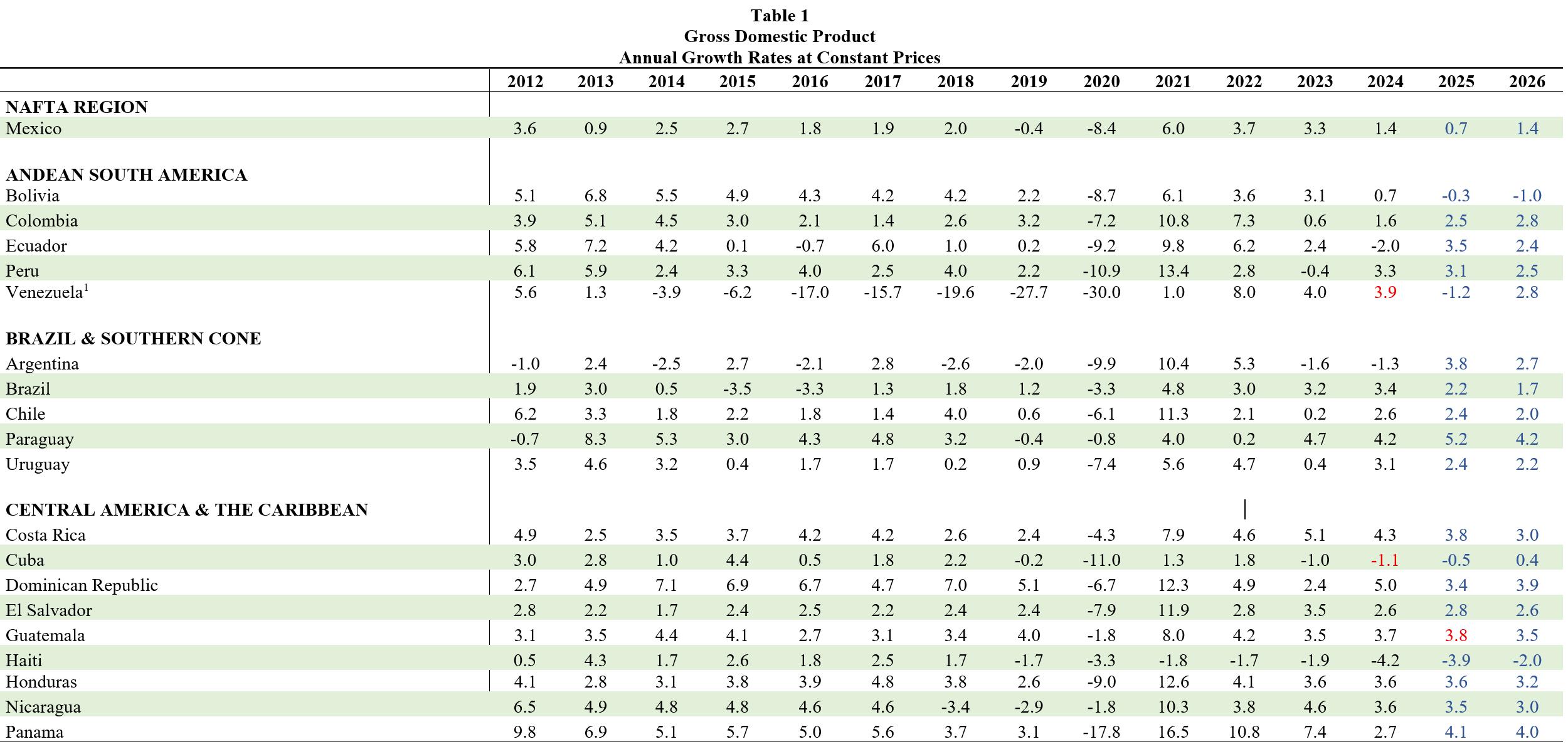
Source: Economic Commission for Latin America and the Caribbean – ECLAC. The Economist Intelligence Unit 2025 provides the data from 2024 -2026. Estimates (red) and Forecast (light blue) 12019-2023 data come from https://www.imf.org/external/datamapper/NGDP_RPCH@WEO/VEN?zoom=VEN&highlight=VEN.
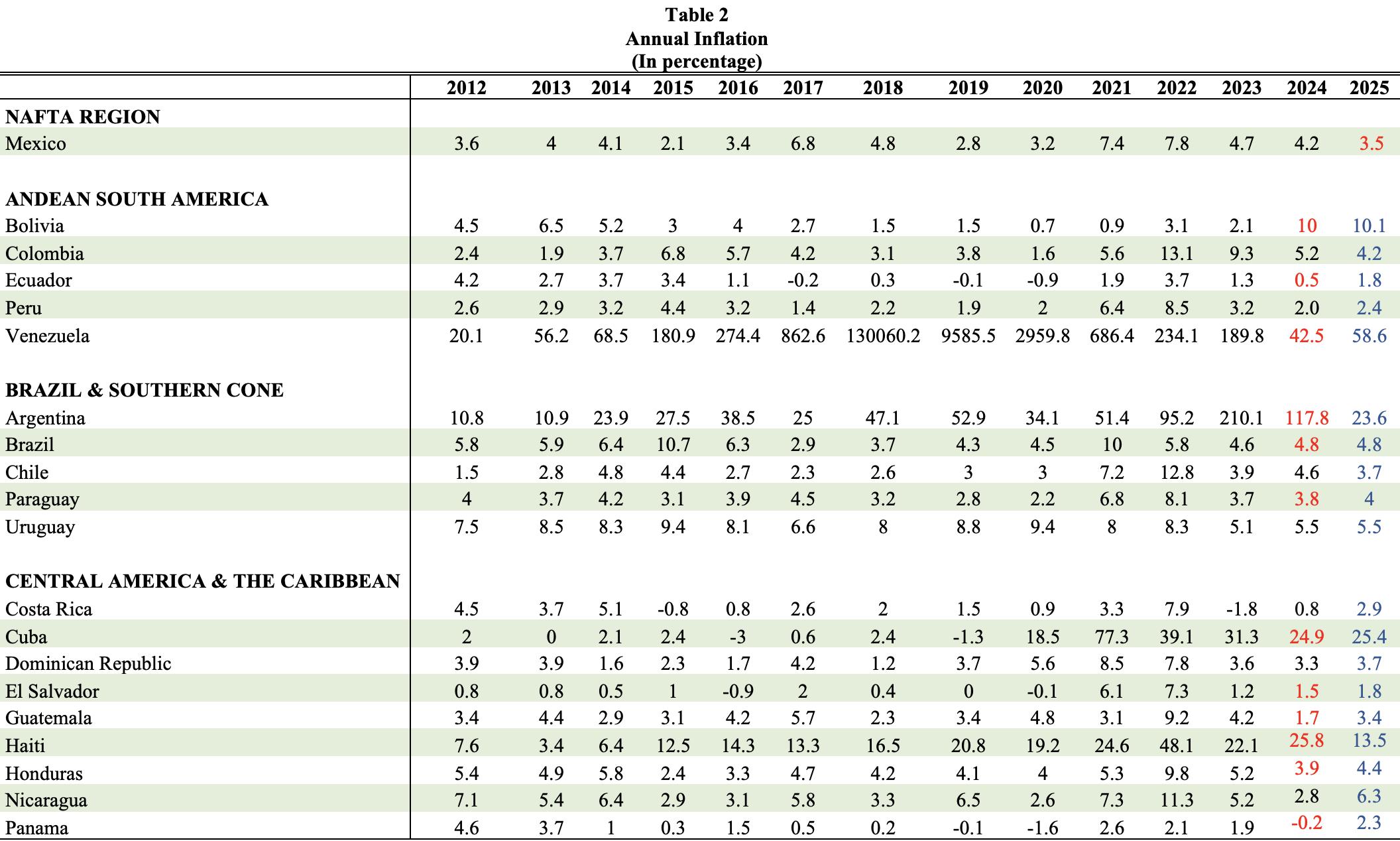
Source:
Economic Commission for Latin America and the Caribbean – ECLAC.
The Economist Intelligence Unit 2025 provides the data from 2024 -2025. Estimates (red) and Forecast (light blue).
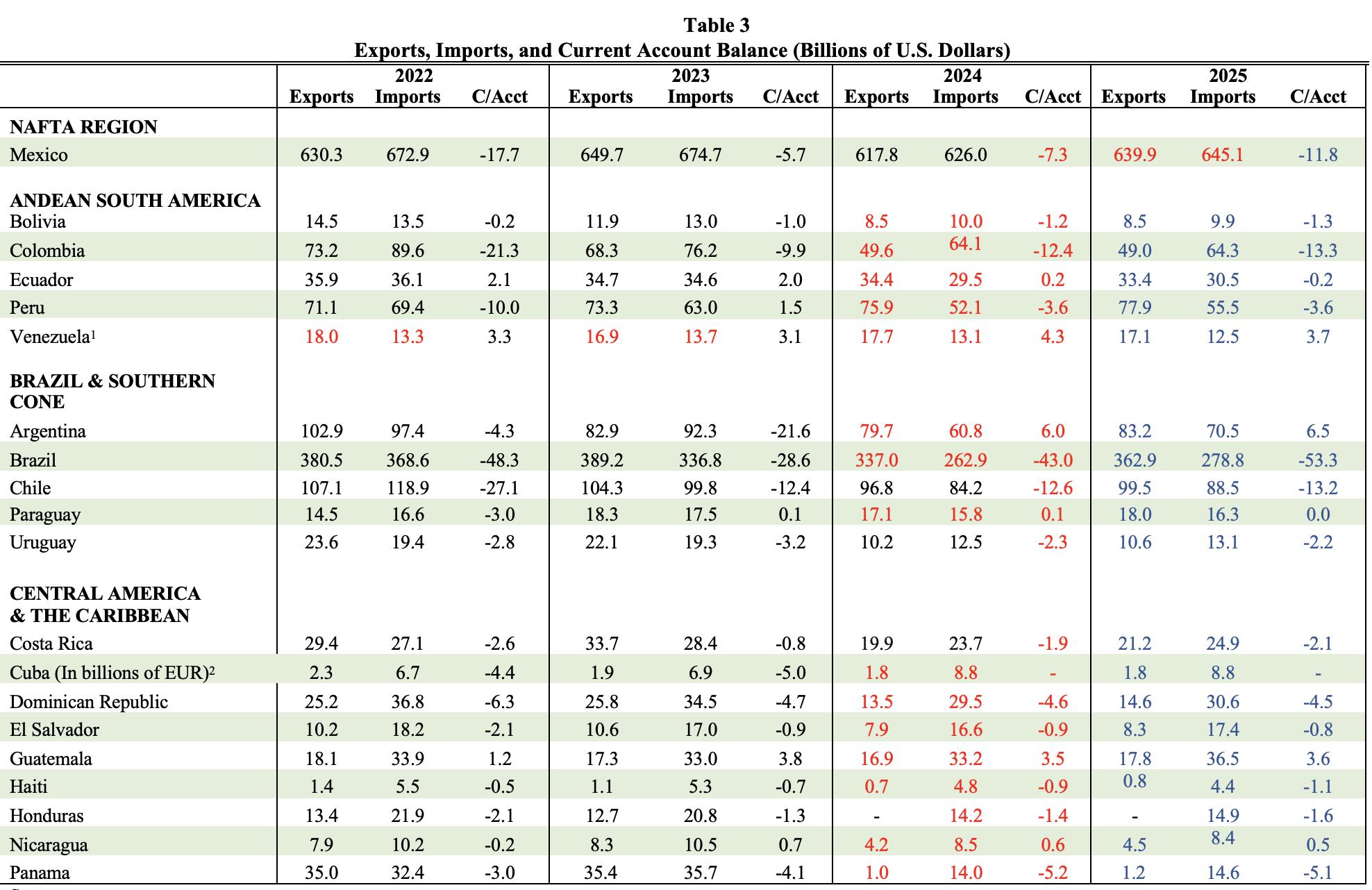
Commission for Latin America and the Caribbean – ECLAC. Export and Imports of goods and services. The Economist Intelligence Unit 2025 provides the data from 2024 -2025. Exports and Imports of good (services not included). Estimates (red) and Forecast (light blue) C/Acct comes from https://prosperitydata360.worldbank.org/en/indicator/WB+MPO+BNCABFUNDCD.
12022-2024 export and import data from The Economist Intelligence Unit 2025. C/Acct from https://www.imf.org/en/Countries/VEN#countrydata
2 Data on exports and imports of total goods come from European Commission at https://webgate.ec.europa.eu/isdb_results/factsheets/country/details_cuba_en.pdf.
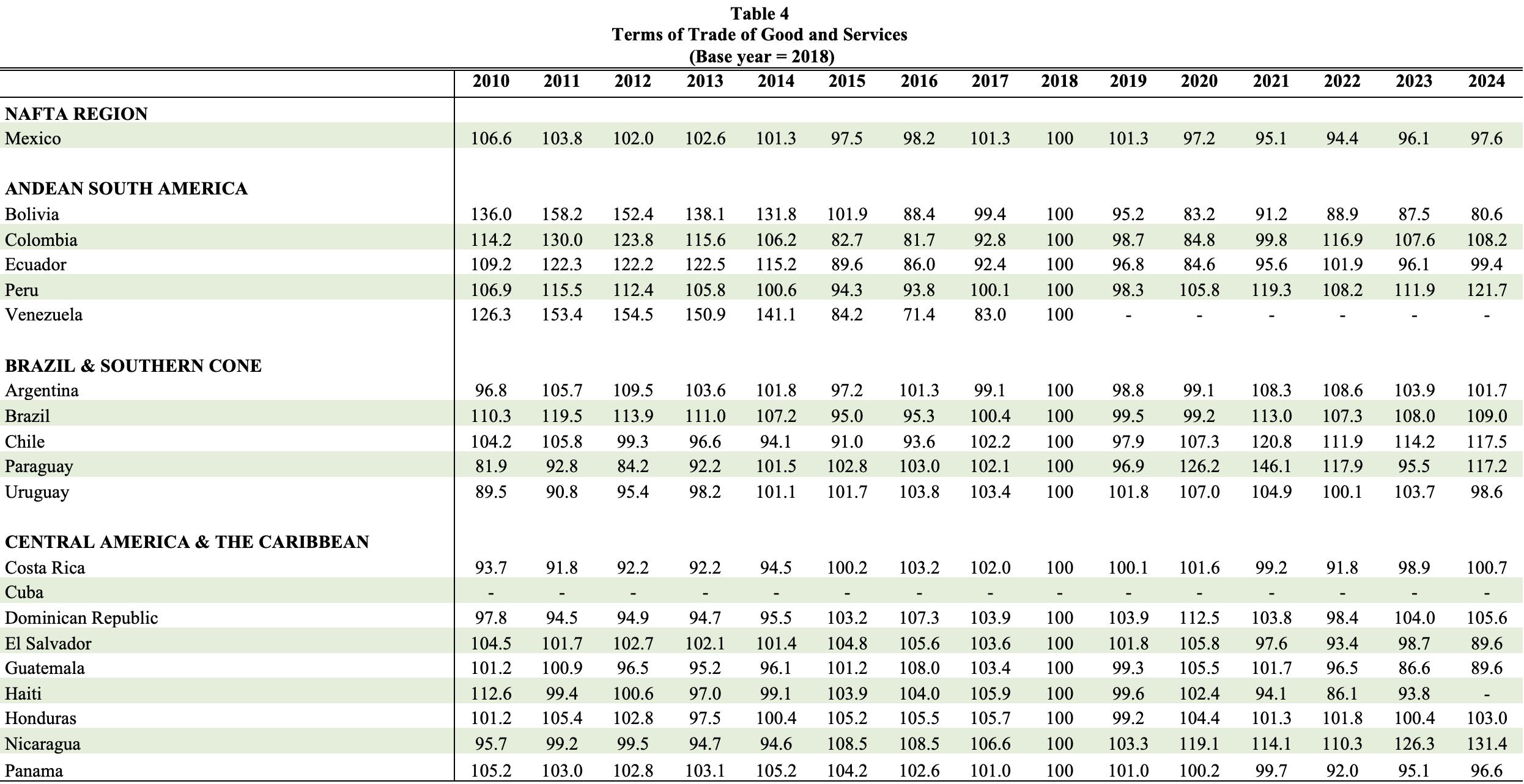
Source: Economic Commission for Latin America and the Caribbean – ECLAC.
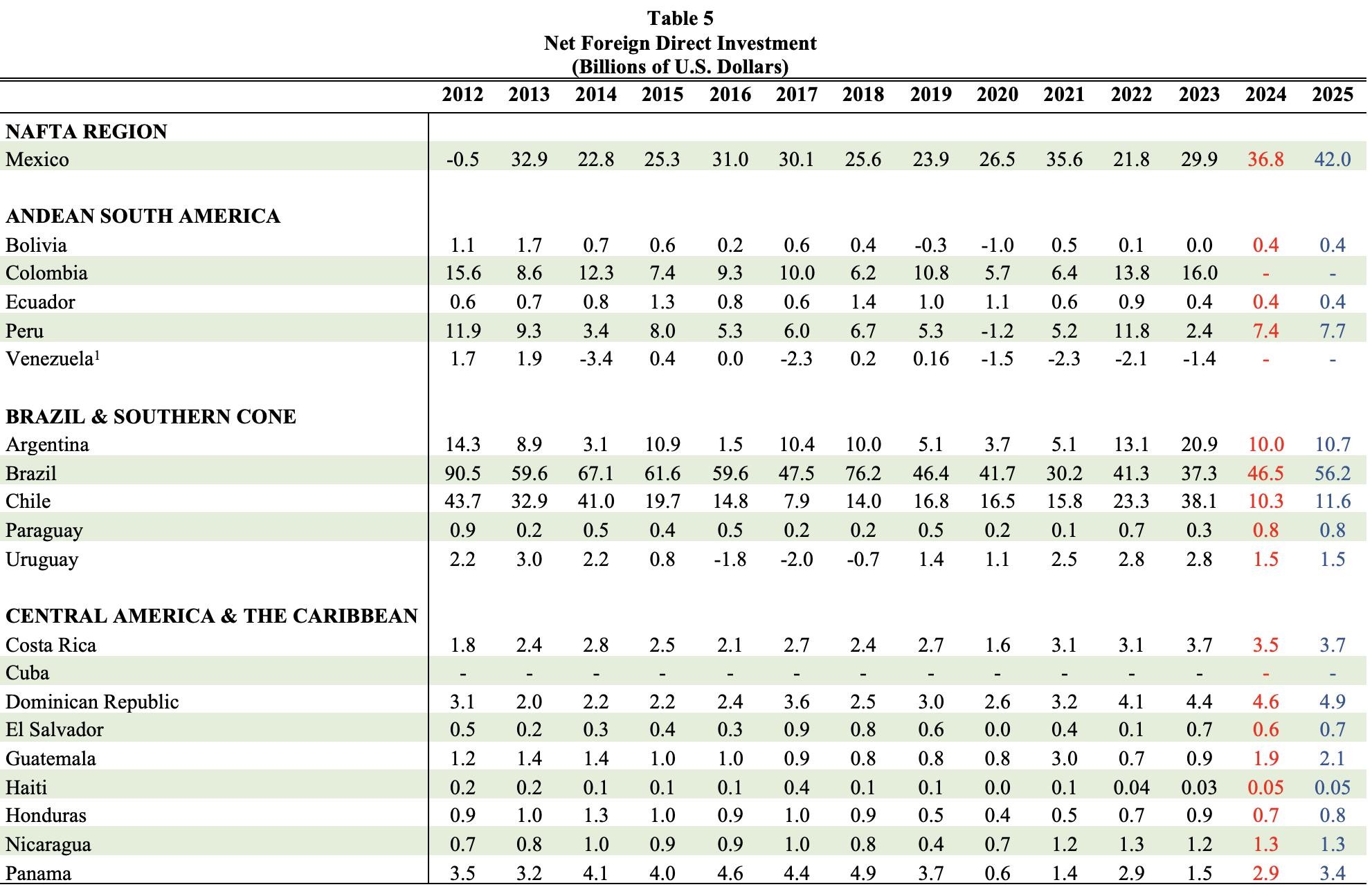
Source: Economic Commission for Latin America and the Caribbean – ECLAC. 12019-2023 data (BoP, current US$) come from the World Bank Group at https://data.worldbank.org/indicator/BM.KLT.DINV.CD.WD?locations=VE. World Bank gives the outflows; we multiplied times -1 to get the inflow. 2024-2025 data come from the Macro Poverty Report at https://www.worldbank.org/en/publication/macro-poverty-outlook. Estimates (red) and Forecast (light blue)
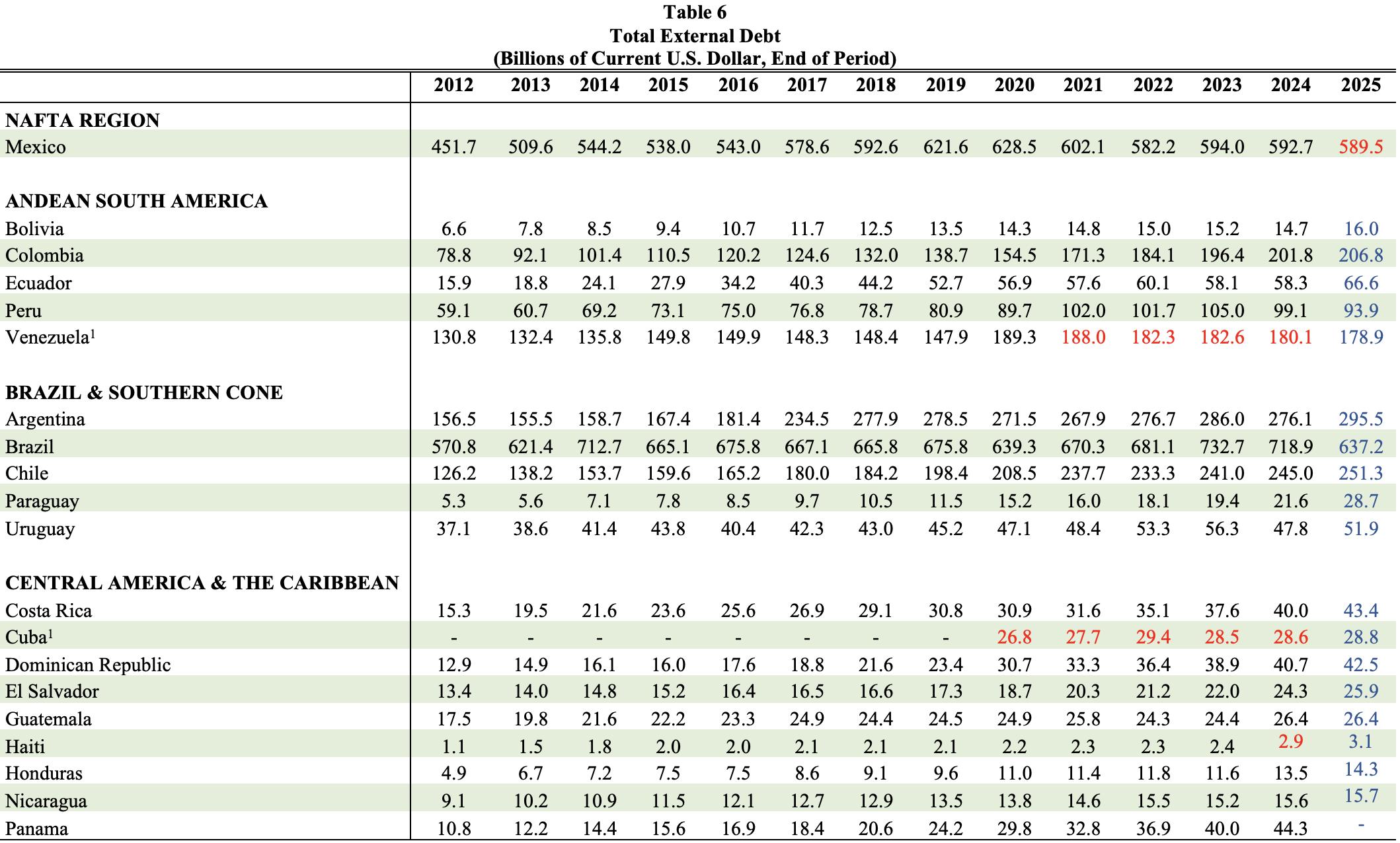
Source:
Economic Commission for Latin America and the Caribbean – ECLAC.
The Economist Intelligence Unit 2025 provides the data from 2024 -2025. Estimates (red) and Forecast (light blue) 12020-2025 data come from The Economist Intelligence Unit 2025
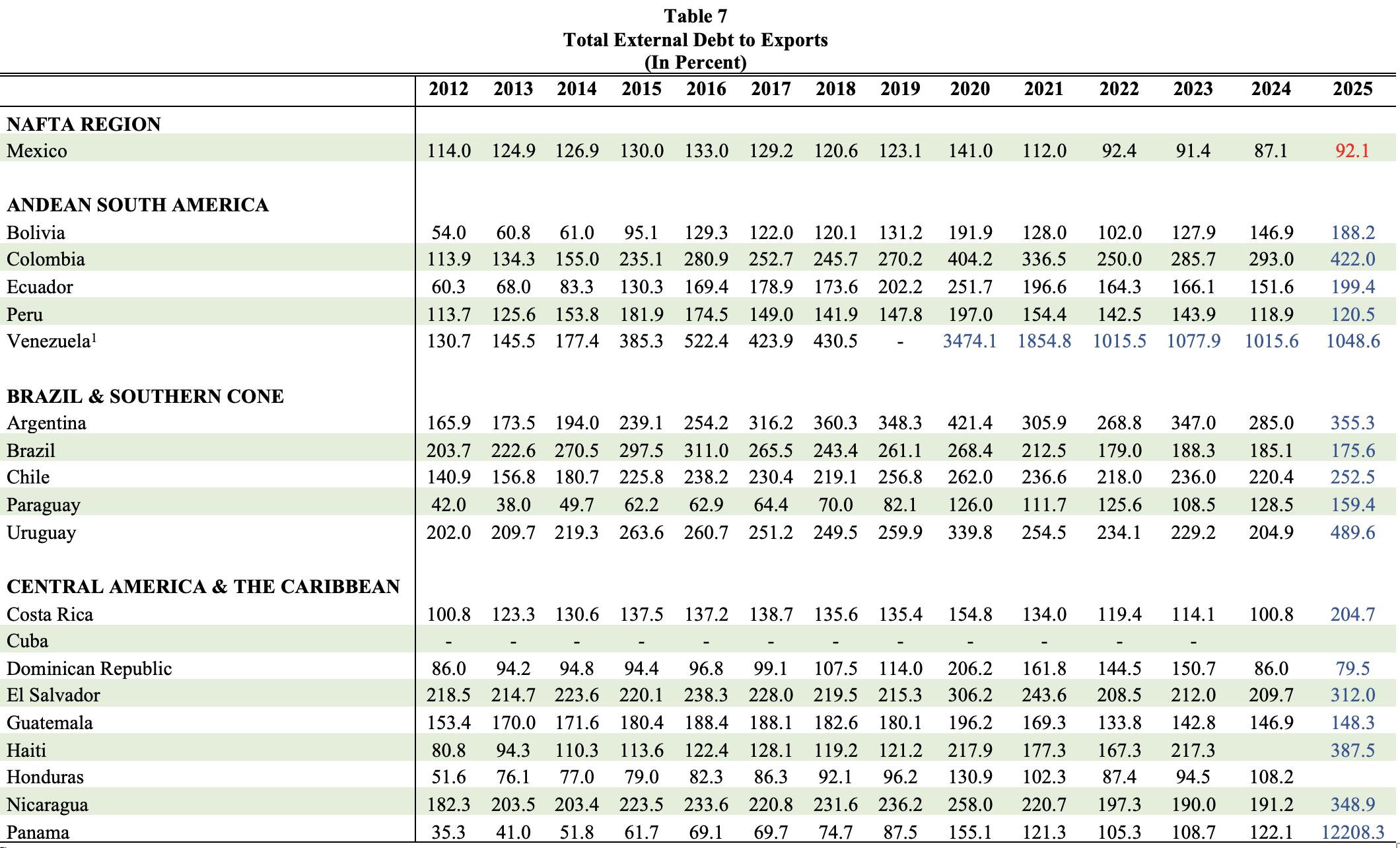
Source:
Economic Commission for Latin America and the Caribbean – ECLAC. Export of goods and services. The Economist Intelligence Unit 2025 provides the 2025 data. Estimates (red) and Forecast (light blue). Exports of goods. 12020-2025 data from The Economist Intelligence Unit 2025. Exports of goods.
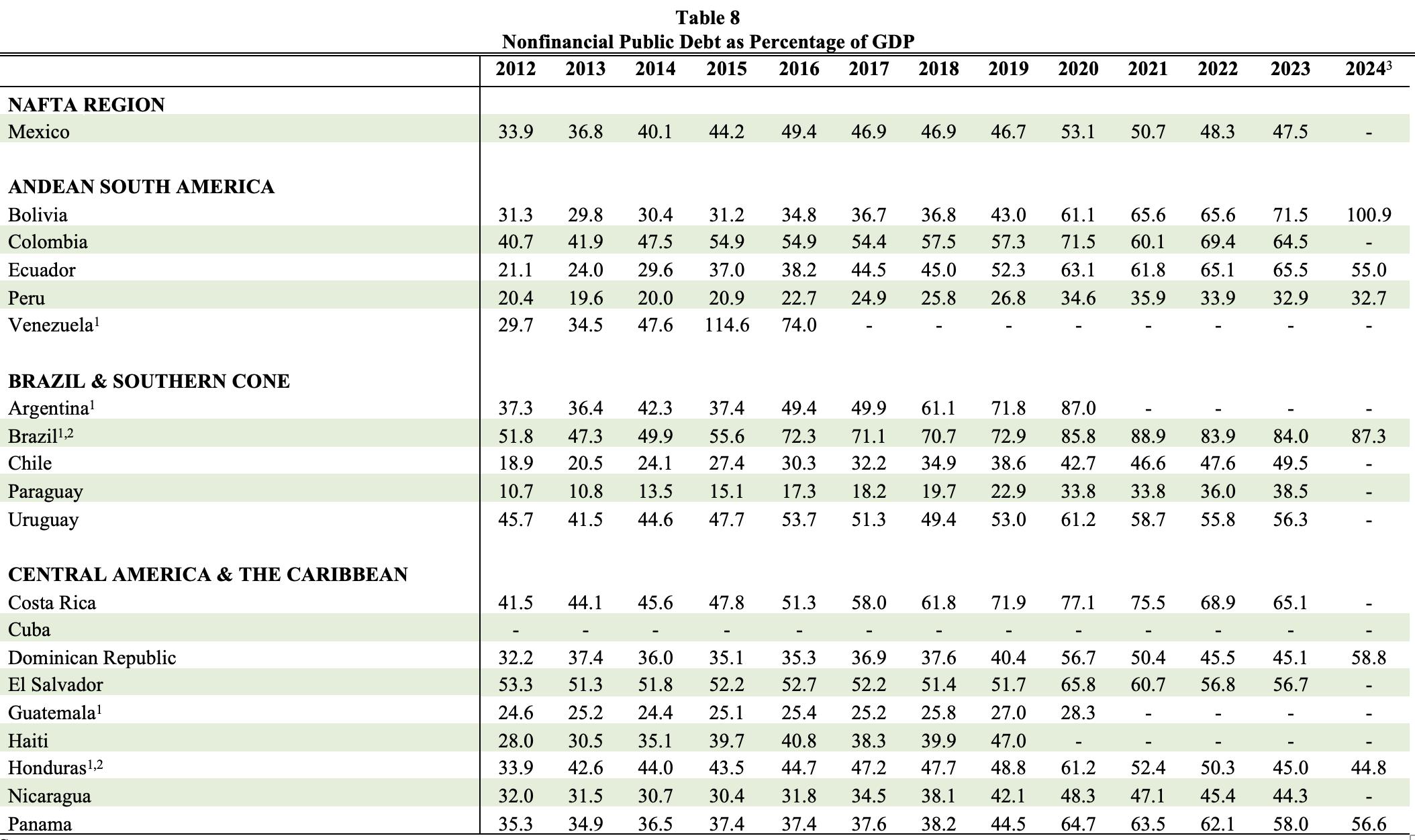
Source:
Economic Commission for Latin America and the Caribbean – ECLAC.
1Manually computing using datasets of Nonfinancial Public Sector Debt and GDP during 2010 and 2020; for Venezuela, only from 2012 to 2016.
2 2021-2024 data come from Global Debt Database (GDD), IMF.
3 2024 data come from Global Debt Database (GDD), IMF.
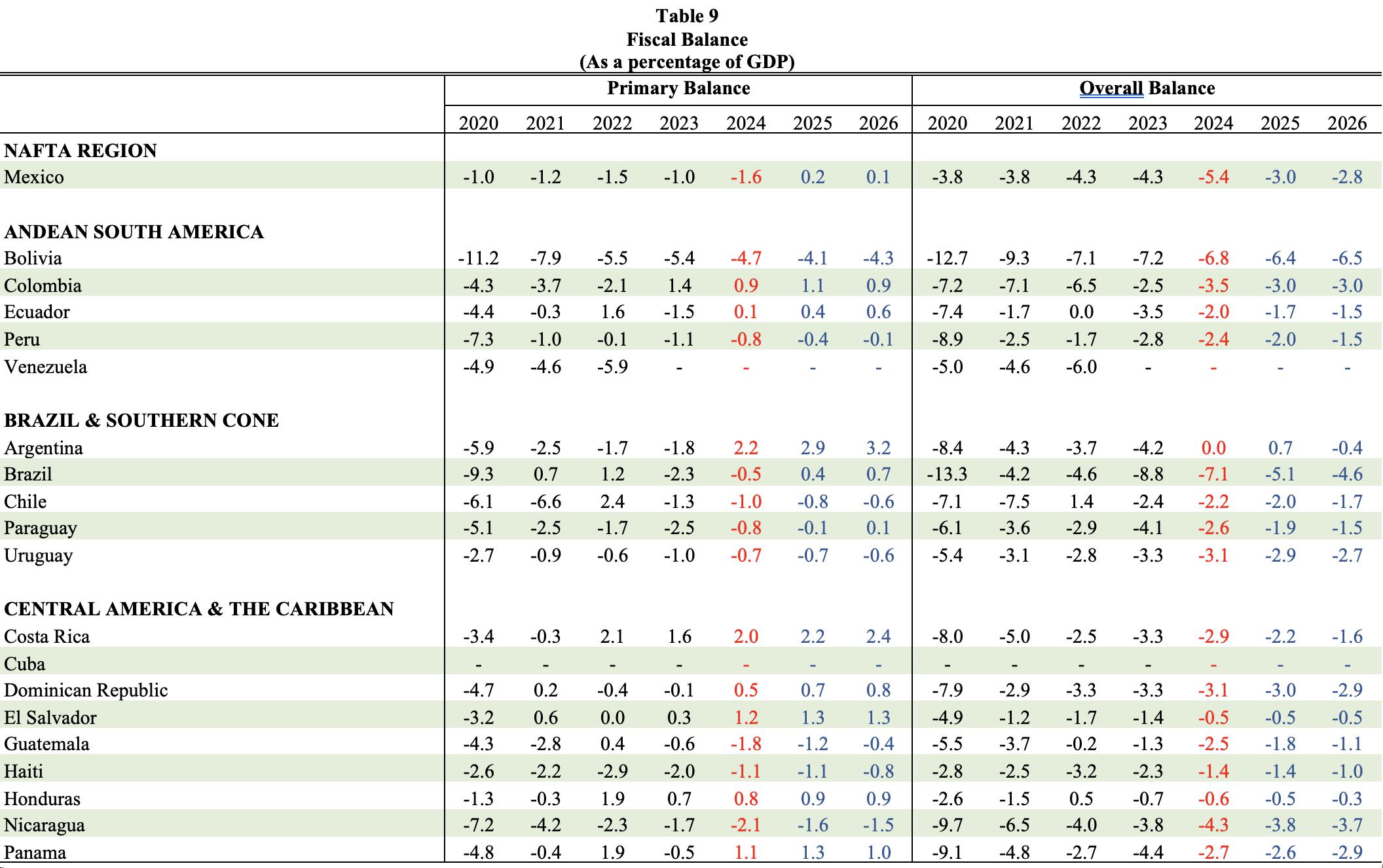
Source: World Bank Group at https://data.worldbank.org/. Estimates (red) and Forecast (light blue).
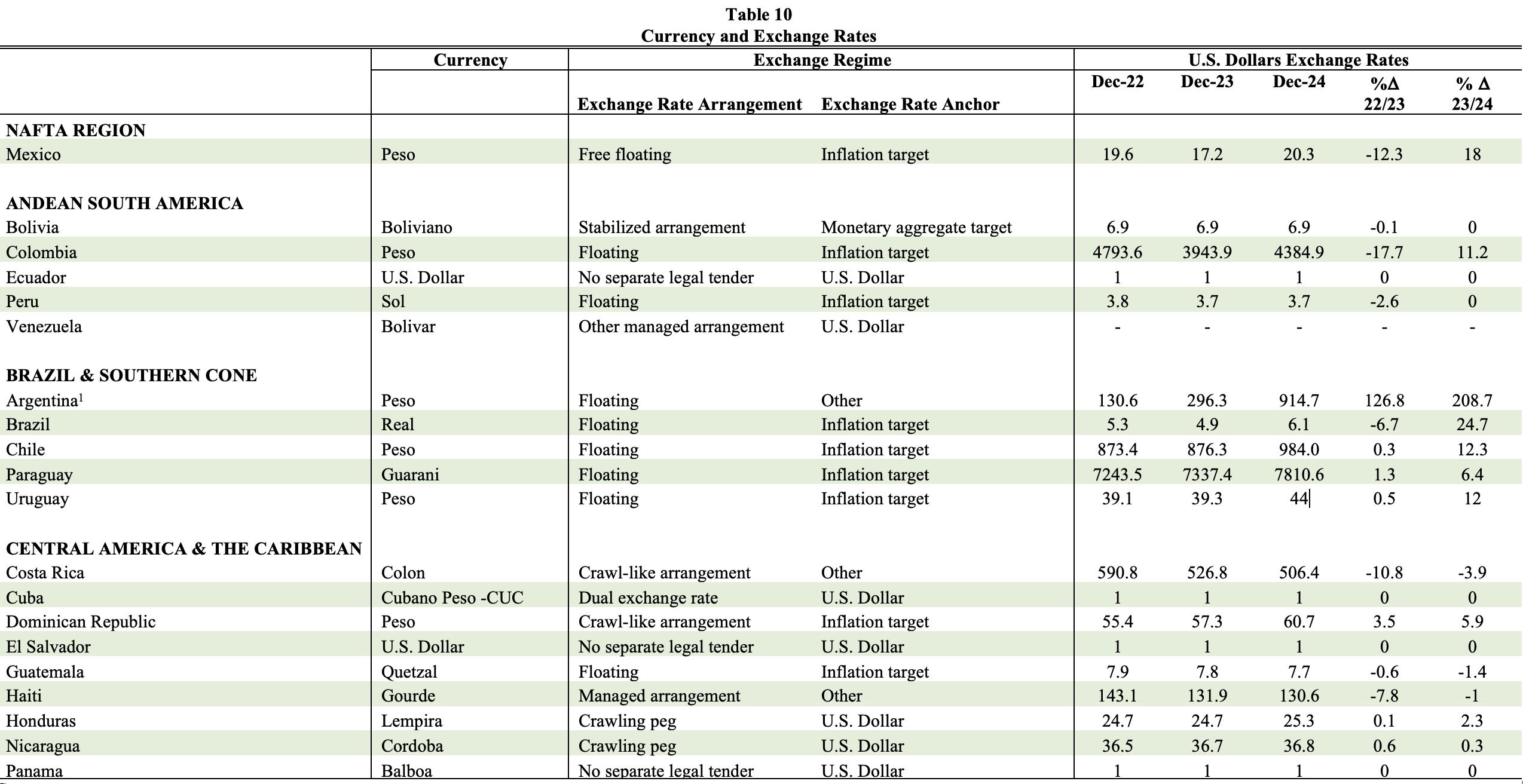
Source:
Economic Commission for Latin America and the Caribbean – ECLAC. 1Data come from the World Bank at https://data.worldbank.org/indicator/PA.NUS.FCRF
Latin American Business
Environment Program
Center for Latin American Studies
University of Florida PO Box 115530
Gainesville, FL 32611-5530
Tel: (352) 273-4706
Fax: (352) 392-7682
go.ufl.edu/las-labe
Center for Government Responsibility
Fredric G. Levin College of Law
University of Florida PO Box 117629
Gainesville, FL 32611-7629
Tel: (352) 273-0836
Fax: (352) 392-1457