Keystone Spring

Page 1


EDITOR-IN-CHIEF

EMMANUELLE KRAMER

MANAGING EDITOR

TRACI DOUGHERTY

LAYA SUBMARANIAN

SONJA MAHNKOPF

VIOLET GORMAN

CONTENT DIRECTOR

TRACI DOUGHERTY

ART DIRECTOR

ARLO DALGARNO PLATT

CONTRIBUTING LEADERSHIP

TRACI DOUGHERTY

CONTRIBUTING WRITERS

ALEENA MARTINO

ANDREW CICALESE

ANNA KOBELL

ARLO DALGARNO PLATT

CORA BENDER

ISABELLA XIE

KATE FOGWELL

LEV WEITZMAN

MAYA GAVRIN

NYLA BLITZ

RAYMOND LUI

JULIA GREGG

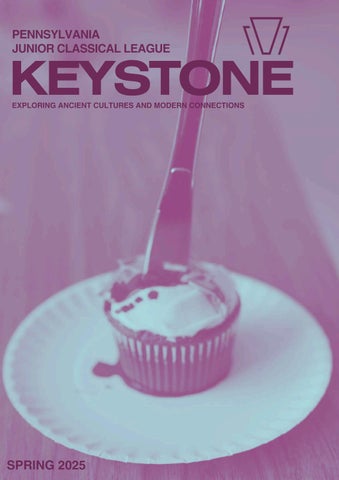
"Et tu, cupcakes?" Harriton High School Latin Club students enjoy themed refreshments during their spirited Ides of March celebration, commemorating the historical assassination of Julius Caesar

CERTAMEN FEATURE

Follow Harriton's Certamen team in this modern academic competition of classical knowledge as they journey to Yale and the National Convention, turning buzzer battles into camaraderie

ANCIENT OLYMPICS

Discover the ancient Olympics, where elite athletes competed in events like wrestling, boxing, and pankration to honor the Greek gods, shaping the origins of today's Games.

TRIUMVIRATE

Discover how the First Triumvirate's alliance between Julius Caesar, Pompey, and Crassus, reshaped Roman politics, setting the stage for internal conflicts and civil war

ULTIMATE BAKE OFF

Witness the ultimate culinary clash as Aphrodite and Athena battle it out in a divine bake-off, blending love, wisdom, and a dash of rivalry to claim the golden whisk trophy!

CONQUERING COLD

Uncover how the Romans ingeniously battled harsh winters with groundbreaking heating systems and architectural innovations.

OLYMPIC CRIME REPORT

Explore the tragic tale of Tantalus, who served his son as a meal to the gods and faced eternal punishment this mythological transgression became a cautionary tale of divine justice

BATHING IN ROME

Immerse yourself in the vibrant world of Roman baths, where relaxation, socialization, and engineering brilliance merged to create a timeless cultural hub.

CHASING DAPHNE

Compare the myth of Apollo and Daphne through the lenses of Parthenius and Ovid, revealing tensions between love, autonomy, and transformation

READING SATYRICON

Uncover the modern relevance of Petronius' Satyricon, the Roman novel that anticipated narrative techniques found in works across centuries, from medieval picaresque tales to The Great Gatsby.

ORIGINS OF LATIN

Trace Latin's evolution as a branch of the Indo-European language family explore its development through Italic languages and uncover the shared roots that connect it to the world's most influential linguistic traditions

QUICK SAND

Step into the blood-soaked sands of the arena through a gladiator’s eyes where survival is fleeting, sacrifice is ritual, and laughter is the only rebellion left

Blossoms frame the Roman Forum, where ancient voices once echoed beneath blue skies

CONTEST UPDATES

PENNSYLVANIA SHINES AT THE NJCL NATIONAL CONVENTION

The results are in for the 2025 NJCL Creative Writing Contest, and Pennsylvania students made a powerful showing across multiple grade levels. With a wide range of imaginative, thoughtful, and artfully crafted submissions, PA Latinists demonstrated the strength and creativity of the state's classical programs

Upper Dublin High School led the charge, with students earning top honors across nearly every category. Harriton High School also had strong representation, adding to Pennsylvania's impressive overall presence in the results.

Special recognition goes to Magistra Traci Dougherty of Upper Dublin High School and Veronica Vladimirova-Cambria of Harriton High School for their outstanding support and guidance of these young writers. The strong performance of PA students highlights the lasting value of Classical studies and the powerful role of creative expression in keeping the ancient world alive.

Congratulations to all the winners! We can't wait to see what you write next

9th Grade

Morgan Keaton (Upper Dublin High School) - 8th place for "Persephone's Seasonal Diary"

10th Grade

Ariana Fields (Upper Dublin High School) - 3rd place with "Hestia's Guide: A Cozy Home"

Julia Gregg (Upper Dublin High School) - tied for 4th place with "Aphrodite vs Athena: The Ultimate Bake-Off"

Aiden Bray (Upper Dublin High School) - tied for 6th place with "The Code of Daedalus"

Maya Gavrin (Harriton High School) - tied for 7th place with "The Cunning of Penelope"

Jacen Glassman (Upper Dublin High School) - tied for 8th place with "The Forgotten Muses"

Andrew Cicalese (Harriton High School) - tied for 8th place with "The Labors of Theseus"

Arlo Dalgarno-Platt (Upper Dublin High School) - 10th place for "Mortal Goddess"

11th Grade

Charlie Donecker (Upper Dublin High School) - 3rd place for "A Sandwich for the Gods"

Joshua Kidorf (Upper Dublin High School) - 5th place with "Asclepius' Cure"

Kyran Talaty (Harriton High School) - 6th place for "Zeus' Lightning Round"

Charlotte Marlow (Harriton High School) - 7th place for "Icarus and the Edge of Space"

Olivia Moriconi (Upper Dublin High School) - 8th place with "The Twelve Labors of Hercules: The Game Show"

12th Grade

Nyla Blitz (Upper Dublin High School) - 1st place with "QuickSand", the top award in her grade level

Sabrina Bauer (Harriton High School) - 3rd place for "Welcome to Hermes Inc"

Matthew Gregg (Upper Dublin High School) - 4th place with "Eternal Flame"

KEYSTONE

Harriton High Competes at the National Junior Classical League Convention

This summer, the National Junior Classical League convention took place in Knoxville, Tennessee, with landmark achievements for Pennsylvania JCL, despite sending only six students

For the first time in state history, our team of four students made Advanced Certamen finals; through tight rounds and fierce competition, we placed first in the country Many delegates also won ribbons for academic tests. Besides academics and Certamen, the National Convention includes recreational activities; delegates participated in kickball, frisbee, and pickleball. There was an NJCL talent show, which awed delegates with impressive acts (including juggling and original performances). NJCL convention also provides students with an opportunity to compete in a Classics decathlon, rewarding top performers with cash

My National Convention experience centered around Certamen All summer, my teammates and I studied with coach Nikhil Ranjan; as a history and literature player, I sometimes studied 6 hours daily, taking notes from textbooks, grinding through flashcards, and playing mock rounds on Zoom and Discord Each evening during the convention, at 8 PM, my team walked across Tennessee's campus to compete

Our rounds varied in competition the first round and semifinals came down to a single question but in others, we dominated In the third preliminary round, we won by 150 points Entering the semifinals, we were the fourth seed Having narrowly won the semifinals thanks to Magistra Cambria's challenges, we advanced to the Finals in a large auditorium. Answering 8 questions, our team clinched victory, whereupon we learned we won $500 for charity and had to make a speech for the convention in 3 hours. (Only after we clinched the victory did we learn we'd be giving a speech later that night.)

Overall, this year's National Convention Certamen contest was successful and fun, and now our state has established a championship reputation that future teams will strive to uphold

Lev Weitzman is a classics enthusiast from Harriton High School He has been very involved in certamen throughout high school, winning the national championship at the advanced level In his spare time, Lev volunteers at the Penn Museum and archaeological sites

COMIC STRIP: CHARON

Laya Subramanian is a sophomore at Upper Dublin High School She likes to play tennis, is a part of the orchestra, and a Scout She plans to pursue a research career after school

CLUB UPDATES

This year, Bishop McDevitt’s club has "campaigned" via various meetings in the pursuit of a better understanding of the Roman language and way of life At our first Fall meeting, our president, Stephanie Do, spoke about courtship practices in ancient Rome in correspondence to our school's upcoming homecoming dance. This provided some sodales (club members) with interesting cultural context about how Romans approached relationships, quite different from our modern customs.

The sodales celebrated Saturnalia in December, exchanging small gifts and enjoying festive meals as ancient Romans did during this winter celebration The next challenge was a competitive game of trivia, answering questions about Roman figures, monuments, language, and gods The winning team of the club claimed prizes in victorious glory (candy and bragging rights) Lately, our group has engaged in intense cardgame sessions, playing "Piscari" (Go Fish) Using Latin vocabulary to communicate, the students employed skills of observation, strategy, and proper Latin pronunciation to advance as victors The Bishop McDevitt Latin club and classes, four centuriae (groups) strong, will continue to pave the way in search of Roman excellence

Bala Cynwyd Middle School is excited to be a new member of PAJCL (Pennsylvania Junior Classical League) and is actively working to grow its chapter This year, we held several meetings where we played Latin games, practiced Certamen (Latin quiz-bowl competition), explored mythology, and even watched a bit of Percy Jackson

We also participated in the Latin League, gaining valuable experience along the way We were thrilled to join Harriton High School and other district middle schools for a mini-celebration of Rome's birthday The event included Certamen matches, a scavenger hunt, an escape room challenge, and plenty of opportunities to learn about ancient Roman culture We wrapped up the day by singing "Felix Dies Natalis" to Rome and sharing cake

Although we won't be attending the State convention this year, we're focused on building our community this spring and preparing for an even stronger year ahead.

BUSINESS & SPORTS

ANCIENT OLYMPICS

In today's modern world, the Olympic Games are widely recognized as the most prestigious and competitive international sporting event, held every four years and showcasing the talents of the best athletes from across the globe But what many people don't know is that these games have roots dating back to ancient Greece, where they held profound religious and cultural significance

The ancient Olympic Games began around 776 BCE as part of a religious festival honoring Zeus, the king of the Greek gods. While myths about divine involvement were common in Greek culture, the games themselves were competitions for mortal athletes, not the gods. The Olympics were one of four Panhellenic Games that brought together participants from various Greek city-states during a sacred truce

While the number of events in ancient times was far fewer than the extensive lineup we see today, the contests were still intense and included challenging events like wrestling, boxing, footraces, discus, javelin, long jump, and chariot racing The athletes competed not only for personal glory but also to bring honor to their city-states and to display excellence (aretē) as an offering to the gods Pankration, in particular, was a fierce combat sport that combined elements of wrestling and boxing, with limited rules. This brutal event prohibited only biting, eyegouging, and certain other unfair attacks that were considered dishonorable

A depiction of a victorious athlete being celebrated at the ancient Olympic Games in Olympia, Greece

TRIUMVIRATE

"Though they were rivals with different backgrounds, these three ambitious men formed a powerful a

The political alliance of Julius Caesar, Pompey, and Crassus dominated Roman politics from approximately 60 BCE until its gradual collapse following Crassus' death at Carrhae in 53 BCE, with the relationship between Caesar and Pompey deteriorating thereafter. This alliance, later termed the "First Triumvirate" to distinguish it from the Second Triumvirate of Octavian, Mark Antony, and Lepidus, was a secret political arrangement between some of Rome's most influential politicians formed in 60 BCE.

These three men utilized their combined influence to advance their agendas despite senatorial opposition, while still working within the constitutional framework The First Triumvirate is considered a misleading term, though, since it was never used in ancient Roman writing This triple alliance was informal and secretive, so contemporary historian of ancient Rome Mary Beard refers to the First Triumvirate as a "Gang of Three " The alliance was further cemented through personal connections - Caesar's daughter Julia married Pompey, creating a family bond between two of the triumvirs

By consolidating their power and resources, these three were able to push their various agendas past the Senate to become the most powerful men in Rome

Busts of Pompey (left), Crassus (center), and Julius Caesar (right).

Caesar sought control of the Roman military and political support, Pompey wanted land for his veterans and formal recognition of his eastern conquests, and Rome's richest man, Crassus, wanted to gain even more wealth as well as military fame

During the Mid-1st century B.C.E., the Roman Senate was split between the optimates, who favored the aristocracy, and the populares, who called for social reforms. Despite Caesar coming from a patrician family that had lost much of its wealth and influence, and Pompey rising from a wealthy but non-aristocratic equestrian background, they both leaned towards the populares due to their political goals The Senate's opposition towards these two led them to form a political alliance with the richest man in Rome, Crassus

When Crassus died in 53 B.C.E. at the Bat Carrhae fighting against the Parthian Empi Pompey felt threatened by Caesar's militar triumphs The Senate allied with Pompey a demanded that Caesar return to Rome and up his troops Instead, Caesar crossed the Rubicon river with his troops in 49 B C E illegal act that constituted treason since no general was permitted to bring an army into proper and sparked a civil war, ultimately to the demise of Pompey

The death of Caesar in 44 B C E led to an civil war where Octavian, great-nephew an adopted son of Caesar, eventually emerge victorious After first sharing power in the S Triumvirate with Mark Antony and Lepidus, then defeating Antony and Cleopatra, Octa gradually transformed the Republic into the Principate, becoming Rome's first emperor the name Augustus

The First Triumvirate was never an official or legal political body it was an informal and secret alliance The Roman Senate never formally recognized it, and it only came to public attention once the three men began using their combined influence to dominate Roman politics

An artistic representation of the First Triumvirate (Caesar, Pompey, and Crassus) meeting in private and informal

ULTIMATE BAKE-OFF: APHRODITE V. ATHENA

When two of the most powerful figures in Greek mythology compete, you'd expect to see dramatic battles with swords and shields. But today, things are a little more... domestic.

In a surprising twist of fate, the iconic goddesses of love and wisdom have been pitted against each other in a bake-off that's sure to stir up some divine rivalry The theme? Greek mythology, of course. The stakes? Divine recognition is one thing, but with a golden whisk trophy that could mean the ultimate bragging rights When gods bake, even the flames of Mount Olympus can't compare to the heat in the kitchen!

The Contestants

In one corner, there is Aphrodite, the goddess of love, beauty, and everything beautiful in an aesthetic perspective

Aphrodite knows how to captivate, whether through charm or culinary creations This same philosophy guides her baking: it is much about the presentation as the taste She will bake something which, rather than just delighting your palate, is guaranteed to make one fall in love at first bite.

The Challenge

In the other corner, there is Athena She stands as the goddess of wisdom, strategy, and war She is disciplined of mind where she focuses absolutely on precision. She is less worried about impressing through beauty, and more concerned that every ingredient has its place and steps perfectly in the calculation.

Athena sees the display of intellectual strength in an ideal baking demonstration, no less than in cooking skills.

The Challenge is to concoct a three-course meal displaying their prowess Strategy, creativity, and mythical flair start as the clock starts ticking

Let the baking begin!

HISTORY AND MYTHOLOGY

Round 2: The Entrée

And here is where things get interesting with Aphrodite. She does lamb with figs and honeywhat can only be described as truly indulgent, high-living Tender the lamb is caramelized with honey, each bite carrying its sweet decadence Aphrodite sprinkles on top a few rose petals; she knows full well even a dish that's savory needs to have romance.

"You can never have too much beauty in the world," she says, winking, setting the dish before the judges. Athena is one who doesn't shy away from complexity, and thus stuffs grape vines with lamb and rice, encasing them in the finest foliage taken from her personal garden in Athens

Each roll was identically perfect to the others, delicately packed and seasoned with herbs and a touch of feta It was a dish that spoke volumes of her strategic mind: every bite a balance of flavors, with every element aligned with one another Athena is confident "Perfection needs deliberate calculation," she says, adjusting her plate.

With each judge's tasting, it becomes obvious which direction the competition has taken The lamb from Aphrodite was rich, over-indulgent, but almost crossing into too-muchness On the other hand, Athena's grape leaves were a triumph of technique, with each subsequent bite more pleasing than the last.

Athena wins again in this round, though one could not deny the charm of Aphrodite.

A beautifully plated lamb dish with rich sauce and herb garnish, showcasing the entrée round's competition between the goddesses

Round 3: Desserts

If there is one round where Aphrodite can dominate, it is dessert She has a sweet tooth, and now it's time to bring in the big guns And so, Aphrodite prepared honey cakes, each one topped with edible glitter in sprinkles of gold and candied rose petals with care Light, fluffy, sweet the very essence of decadence Presentation perfect, flavor intoxicating. She places them on the table with pride and says, "The sweet is in the love inside "

Meanwhile, Athena approaches dessert with the same intellect and strategy as her other courses: she bakes tarts of fig and walnut, each cut to perfect specification, the pastry buttery and flaky, the filling perfectly balanced between figs, honey, and walnuts Athena's tarts were all about balance sweet but with a touch of savory depth "Wisdom teaches that indulgence must always be balanced by restraint," she says, arranging her tarts

The judges, who had tasted the two sweets, really had a hard time making their decision Indeed, there was nothing wrong with Aphrodite's honey cakes; they tasted fine, but Athena's tartlets somehow married their flavors in a most satisfyingly surprising way In a rare turn of events, the judges declare this round a tie for Aphrodite's cakes, since they were divinely sweet, and for Athena's tarts, since they showed such intellectual balance.

The Final Verdict

After three grueling rounds, one thing was sure: the goddesses sure brought their Agame. Aphrodite, of course, shone bright with all her beauty and indulgence, while Athena had it all in her power of precision, poise, and strategy And here comes the verdict The judges declare a tie; hence, the divine bake-off finally concludes on a note where both goddesses are holding the golden whisk trophy. Aphrodite leans in and whispers, "See? Beauty always pays."

Athena just smirks "Balance always wins " As the gods and goddesses of Olympus toast their gastronomical feats, one thing is certain: In baking, there may be no perfect recipe unless, of course, it's one written by two goddesses

Gregg is a 10th-grade student who has been taking Latin since 6th grade at both Sandy Run Middle School and Upper Dublin High School She has been the Treasurer-Elect for the school's Latin club since 2024 She has attended the PAJCL field trip to Penn State for 2 years and hopes to go again a 3rd time She student teaches at her dance studio and hopes to go to school for education In her free time, she dances and does color guard

Julia
A close-up of the desserts featuring Athena's fig and walnut tartlet alongside Aphrodite's honey cake with golden flecks

HOW THE ROMANS CONQUERED THE COLD

“The Romans were Brrr-illiant— conquering not just empires, but the cold itself. ”

The ancient Romans were known for their determination, strength, and dominance They conquered over 2 million square miles of land and ruled for around 1,000 years Impressive feats but one question remains: how did they survive the cold?

Pillars from the hypocaust system in a Roman bathhouse show how hot air was circulated beneath the floors to heat rooms efficiently

LIFESTYLE & CULTURE

OLYMPIC CRIME REPORT: TANTALUS’ DINNER DISASTER

Quirites, gather around because this one is wild.

Picture this: A grand feast on Mount Olympus, golden goblets overflowing, ambrosia on every plate The gods are having a fantastic time until their mortal guest, Tantalus, decides to pull the absolute worst prank in history.

Tantalus, who had been riding high on Zeus’ favor, thought, “You know what would be hilarious? If I chopped up my son, cooked him into a stew, and served him to the gods just to see if they’d notice ” Spoiler alert: They noticed

The second that the dish hit the table, Olympus went silent Zeus looked like he was about to smite someone. Apollo nearly gagged. Hermes started taking notes for what would become the first-ever divine crime report And Demeter well, she was going through some stuff Distracted and emotionally vulnerable (something about Persephone being kidnap again), she absentmindedly took a bite. A si cursed bite

The moment she realized what she’d done? Pure horror. She dropped the fork like it was fire and immediately pleaded temporary insa But the damage was done.

As for Tantalus? Zeus was livid Not only wa banned from Olympus forever, but he was thrown straight into Tartarus with a punishm so ironic it could’ve been written by the gods comedy Now, he stands in a pool of water h can’t drink, under fruit he can’t reach The g who wanted to test divine knowledge is now poster child for “so close, yet so far.”

And that, my friends, is why you don't mess divine dinner parties or let Demeter near sacred food

Tantalus was a king associated with a real ancient city: Sipylus (in modern-day Turkey)

Ancient sources often link him to the region of Lydia, and local traditions even claimed to show his tomb near Mount Sipylus

Demeter realizes something is amiss in her amuse-bouche

LIFESTYLE & CULTURE

BATHING IN BATHS

AQUAE

SULIS, LONDON

A remarkably well-preserved ancient bathing complex built by the Romans around natural hot springs

What do rich patricians, poor plebeians, and the average modern-day person have in common? They all love baths.

More specifically, the Romans loved Roman baths, and the average modern-day person might love a spa or a small bathtub bath No matter the differences between any two time periods of baths, there are always many similarities to compare the two Although to see these similarities, one must know what Roman baths were

LIFESTYLE & CULTURE

There was also an apodyterium, the changing room, and a natatio, an open swimming pool There were also dry and wet sweating rooms, called laconica and sudatoria, which functioned much like modern-day saunas

Last but not least, there were the hot, warm, and cold pool rooms, called a calidarium, tepidarium, and frigidarium, with their temperatures indicated in their names It is understood that each room had a distinct temperature But how did the Romans create such distinct temperatures in these rooms? In ancient times, the Romans used the hypocaust system to heat any rooms of their choosing. Beneath each heated room was an open space that allowed hot air to circulate and warm the floor above.

Tubes within the walls also allowed hot air to rise and heat the upper parts of the room This hot air came from a fire or furnace lit beneath the rooms. The Romans inherited this system from the ancient Greeks but improved its efficiency

Roman baths were more than just baths. They were places to socialize, relax, and exercise just like a spa or gym It can be easy to forget that Roman baths were a key part of Roman daily life Roman baths, though some pools were shallow, offered much more beneath the surface. So dive deeper into the world of Roman baths there’s more than meets the eye

Arlo Ritchie Dalgarno Platt is a Scottish-born sophomore at Upper Dublin High School and serves as the Historian of the Latin Club. In addition to Latin Club, he participates in French Club, Spanish Club, and German Club, although Latin is the only language class he is currently taking Arlo also has a passion for photography, which he enjoys pursuing in his free time

A digital reconstruction of the ancient Roman Baths in Bath, England, showcasing the grandeur and architectural sophistication of public bathing complexes in the Roman world

MODERN & COMPARISONS

CHASING DAPHNE

In mythology, tellings of the same myth can often share many similarities, but they can also differ significantly. The myth of Apollo and Daphne is no exception there are clear similarities and differences in how this myth is told by Ovid and Parthenius

In one version of the myth, written by Parthenius, Daphne is the daughter of Amyklas She is a nymph who frequently hunted in Lakonia and followed the ways of Artemis Leukippos, the son of Oinomaus, falls in love with Daphne. Hoping to win her affection, he disguises himself in women’s clothing and joins her on hunts Daphne and Leukippos become close friends However, Apollo is also in love with Daphne and becomes jealous of Leukippos. When Apollo sees Daphne and her maidens bathing in a stream, he intervenes

Leukippos refuses to join them in bathing, and his true identity is discovered He is subsequently killed. Apollo then pursues Daphne, but she pleads with Zeus to be “translated away from mortal sight ” In response, she is transformed into a bay tree, which is named after her

In Ovid’s version, the story begins with Apollo mocking Eros for using a bow. Eros retaliates by shooting Apollo with a golden arrow that induces love, and Daphne with a lead-tipped arrow that repels it Apollo falls deeply in love with Daphne, but she wants nothing to do with love or marriage, as she is devoted to Artemis.

Apollo chases Daphne, declaring his love for her and begging her to be with him. Just before he catches her, Daphne begs her father, Peneus, to save her He grants her wish by transforming her into a laurel tree Even in this form, Apollo continues to express his love and declares the laurel sacred to him, vowing to honor it forever

Ancient coins bearing images of Apollo reflect how mythology was woven into daily life and currency

KEYSTONE DATES

AUTUMN - DEC 6 WINTER - FEB 7

SPRING - MAR 28 CONVENTION - MAY 30

KEYSTONE

SCHOOLS IN LAST ISSUE: SUBMISSION DATES:

BISHOP MCDEVIT HIGH SCHOOL

BLACK ROCK MIDDLE SCHOOL

CONRAD WEISER HIGH SCHOOL

HARRITON HIGH SCHOOL

OWEN J. ROBERTS HIGH SCHOOL

UPPER DUBLIN HIGH SCHOOL

CONTENT IDEAS:

ANNOUNCEMENTS

CHAPTER NEWS

RESOURCES

ARTWORK

GAMES

EVENT RECAPS

MODERN & COMPARISONS

In both versions of the myth, Daphne is depicted as extremely beautiful and pursued by many suitors She is also shown as highly independent, rejecting the idea of love and marriage. Additionally, both versions portray her as a follower of Artemis. Each version includes the central theme of the god Apollo falling in love with her and chasing her, and both conclude with Daphne transforming into a laurel tree (also known as a bay tree) to escape his advances.

Even though both interpretations of Apollo and Daphne share many similarities, they also reveal several differences In Ovid’s version, Daphne is the daughter of the river god Peneus. Apollo’s love for her is caused by Eros’s revenge, using arrows of love and hate Leukippos is not mentioned, and Daphne prays to her father to save her In response, he transforms her into a laurel tree, which Apollo then honors.

In Parthenius’s version, Daphne’s father is Amyklas Apollo’s love is sparked by her beauty Leukippos, a suitor of Daphne, disguises himself by cross-dressing to get close to her, and his fate becomes a central element of the story In this version, Apollo is also very jealous of Leukippos Daphne prays to Zeus to hide her from Apollo’s gaze, and she is transformed into a tree.

Despite their differences, both versions reflect themes of passion, fate, boundaries, and unrequited love

Gian Lorenzo Bernini's Apollo and Daphne captures the dramatic moment of Daphne's transformation into a laurel tree as she flees from Apollo
Cora Bender is a Latin II student at Conrad Weiser High School She has a passion for the arts; one of her paintings was entered in the Philadelphia Classical Society Annual Latin Week Art Competition, and she is an accomplished clarinetist and singer outside of the classroom She enjoys exploring connections between ancient culture and creativity

THE SATYRICON

THE WILD PARTY SCENES OF THE GREAT GATSBY OWE MUCH TO TRIMALCHIO’S DINNER TABLE

Gaius Petronius Arbiter, the revered Roman author, was born around 27 AD in Massalia The rest of his early life remains a mystery until he emerged from obscurity and entered Emperor Nero’s court From there, he led a successful political career, serving as governor of Bithynia and later holding a consulship from 62 to 63 AD Petronius eventually became close to Nero, earning him the title arbiter elegantiae (director of elegance) in the emperor’s court

However, this close relationship with the emperor did not ensure Petronius a long and prosperous life; it ultimately led to his death Nero’s guard, Tigellinus, grew jealous of the attention and reverence Nero bestowed upon Petronius, and he framed him with a false accusation of treason Arrested and facing a cruel sentence Petronius chose to end his

KEYSTONE

The work was attributed to Petronius, and one can easily see parallels between its crude characters and Emperor Nero himself.

Since the discovery of The Satyricon, the work has influenced countless literary works. Famously, F Scott Fitzgerald’s The Great Gatsby models the character Jay Gatsby after Trimalchio, a rather unrefined and Nero-like figure in The Satyricon Fitzgerald even considered naming his novel Trimalchio, a direct reference to the Cena Trimalchionis episode of the Satyricon. The parallels between the lavish dinners in Petronius’s work and Gatsby’s extravagant parties create a clear connection between the ancient and modern worlds The themes Petronius explores in The Satyricon remain strikingly relevant today.

So why should we read The Satyricon?

Besides its enduring themes and humorous satire, The Satyricon’s influence on countless literary works has made it essential to understanding them fully By reading The Satyricon, one unlocks a new understanding of literature an insight that applies to both ancient and modern works alike High School She has earned multiple medals in Certamen and ash and softball teams and serves as a writing tutor to help

Above and Below Photos: Artistic depictions of scenes from The Satyricon

ORIGINS OF THE LATIN LANGUAGE

"Latin inherits not just words, but grammar and structure from Proto-IndoEuropean — a language we've never even heard spoken."
"quidquid latine dictum sit, altum videtur."
Speed and spectacle: Roman chariot races were the NASCAR of their time, thrilling crowds with daring feats

Spanish, French, German.

These are among the most commonly taught foreign languages in schools across the country But what do they have in common? Latin origins? Not exactly While Spanish and French are both Romance languages deeply rooted in Latin, German is not. So how, then, can their similarities be explained?

The answer lies in a relatively unknown language called Proto-Indo-European, or PIE Latin (and therefore all Romance languages) originates from PIE, along with languages such as Germanic (which gave rise to German and English), Indo-Iranian, Sanskrit, and Ancient Greek But what exactly is PIE, and how did so many languages descend from it? PIE is a hypothesized language, developed by linguists who noticed common traits among seemingly unrelated languages. Many hypotheses exist about when and where PIE was spoken, but most scholars agree that it originated somewhere in Europe, likely spoken between 4500–2500 B.C., and that it spread throughout Asia and Europe as nomads traveled and migrated As it spread, local modifications gave rise to new languages

One of the most striking similarities between PIE and its “children” is its use of nouns. Specifically, PIE uses the same three genders as Latin: masculine, feminine, and neuter

Additionally, many of the same cases (nominative, genitive, dative, ablative, locative, and vocative) appear in Latin, though PIE also included exclusive cases (instrumental and allative) that were eventually absorbed into Latin’s ablative and accusative cases

Latin also similarly treats verbs to PIE: utilizing the same moods (indicative, subjunctive, and imperative), voices (active and passive), and “persons” (first, second, and third) PIE also expressed these traits by modifying verb endings while keeping the root intact. These endings were quite similar, though with subtle differences.

Some PIE vocabulary also closely resembles Latin. For example, mehter and pether, the words for mother and father, look strikingly similar to mater and pater in Latin The same is true for some verbs: kap and ghab, the PIE roots for “seize” and “have,” resemble Latin capio and habeo

PIE and Latin, however, are not the same. Many PIE features were not adopted into Latin For instance, PIE likely used “SVO” (subject-verb-object) word order, whereas Latin favors “SOV” (subject-object-verb), though Latin word order is notably flexible

Although PIE is arguably more “foundational” to linguistics than Latin, studying it is much more difficult due to the lack of written records. Still, Latin rich with poetry, philosophy, epics, comedies, and connections to Roman culture remains a uniquely worthwhile language to study.

Raymond Liu is a junior at Harriton High School He enjoys playing piano, chess, and swimming

QUICKSAND

None of us will ever make it out of here alive, and nobody will care.

The sun blazes overhead as we step into the arena, one of us from each of the three doors The glare obscures the others so they are nothing but silhouettes, dark and monstrous Already, my shield weighs down my arm, and the hilt of my dagger grows slippery with sweat. The walls soar above our heads, barring any chance of escape as the crowds jeer and scream down at us

A ram's horn cuts through the dull fervor, brash and echoing, until the only sounds are the faint clinking of our armor and our ragged breaths The Augur strides in, leading the sacrificial ram to the altar I clench my eyes shut as he slits the helpless animal's throat, hold back the bile rising to my throat. The Augur pronounces the omens favorable and hurries back to the gates, discreetly wiping his hand on his ceremonial red tunica as he goes I wonder why he would try to hide it No one leaves the sands bloodless-- not even the priests.

Again, the ram's horn sounds It's our turn We cross our weapons across our chests, stand at attention under the blazing sun The crowds roar like starving lions above. It's time. Tongue leaden, lungs burning, I chant the Sacramentum Gladiatorum Our fate is in Mars' hands now

I shift my weight from one foot to the other and watch the others, circling, waiting for an opening CLANG The crowd howls as Phylon strikes first, as his gladius screeches across the forks of Aetius' trident, gets caught in the dip of his weapon. The two of them pull away, clash again, probing. I watch, shifting, blood pounding in my head. Wait-- Wait--

Aetius swings his net, catches Phylon in the legs Phylon staggers, blade careening wildly off the trident. They are too close, too fast, too experienced. It doesn't matter. I will not die today

Wait-- Wait-- NOW. I leap into the opening, use my shield to hammer Aetius in the ribs, the force knocks it from my hands Both of us scramble backward, struggling to keep our footing on the bloodied sand. Aetius is wheezing, wind knocked out of him, and Phyllon leaps forward, his gladius tearing through muscle and flesh Aetius is choking, choking on his blood I stare in horror, numbly registering the delight of the crowd. The net falls from his grip, and I can feel a scream building inside

Phyllon staggers to his feet, blood dripping from his sword We stare together at Aetius sprawled across the sand, at the deafening hordes above. I will not die today Once more, I raise my toosmall dagger, falling back to guard position as he turns to face me

Phyllon rushes forward, blade flashing in the afternoon heat Block Parry DUCK Muscle memory takes over, sweep after countersweep

Wait-- Wait--I spring at him, hacking wildly, bracing for the moment when his blade catches mine They crash between us, a flurry of movement and sound and pain My legs burn with the strain, every muscle in my arms in fiery protest. My blade glances off his, slings me offbalance He slips under my guard, blade singing in triumph I lash out, desperately, and he easily parries the wild swing, knocking the dagger from my sweatsoaked grip. A quick slash sends me flying to the ground, my leg collapsing under me My blade lies abandoned a foot away, my cheek stinging Numbly, I touch my face, stare in shock as my hand comes away red, and feel the sand leave angry welts across my cheek. A flash of silver appears again above me

NJCL CREATIVE WRITING CONTEST

"Cedo." He demands, sword in hand, perfectly positioned to make sure I never have to fight again Yield Never

Flailing, lashing out, my foot catches the back of his ankle. Suddenly, we are both on the ground, grappling, swinging hard as we can. His fist catches my bloody cheek, and my elbow sticks in his ribs

I revel in his wheezing breaths, laughing as he flails on the tractionless sand. My chest feels as though it will explode, my breaths ragged His fingernails claw across my arms, raking deep gashes I scramble backwards, desperation building My dagger is within reach Already, Phyllon is rising, preparing to advance again. I lunge for the small dagger, grip it tightly. MOVE.

With a final, guttural cry, I swing my blade, drive it straight up through his ribcage He is dead before he hits the ground My head is pounding, my ribs feel as though they will cave in Scorching sand scalds my bloody knees, my constant companion. I can't catch my breath, gasping for air even as the two beside me cannot Behind me, Phyllon's empty eyes stare at nothing, wide and accusatory Or maybe he was just plain surprised

A solemn ritual unfolds as priest and goat stand at the threshold of divine favor withhin the arena.

Laughter bubbles up through my parched throat, unbidden I giggle as the guards clamp irons around my wrists, carry me across the sea of blood and sweat. It doesn't matter. None of it mattered. Nothing we do will ever matter I wonder what the Augur is thinking now I wonder if he's turned red as his tunic The thought is laughable. I giggle harder, wheeze and pant, and laugh some more

Another group is waiting by the gates for their turn. I wonder if they'll die too. I wonder who will kill them. Maybe one of them will kill me The other gladiators are already being led onto the sand Just like the ram. Just like me. It's so funny that I can hardly contain myself I giggle harder, giggle so hard my ribs feel as though they will collapse, fracture into a thousand million pieces. The ram's horn rings through the arena, unheeding of the spectacle it heralds Maybe it was once a sacrifice, too, out there on the sands. The idea of it sends me into fresh peals, alone among the guards in the cool darkness. Sacrificed animals to signal the sacrifice of animals I laugh and laugh and laugh

And outside the crowd is cheering Still, they bay for more, still their appetite for death is not satiated It never will be-- none of us will ever make it out of here alive, and nobody will care. I snort, gasping at the very idea of it Funny, isn't it? The Plains will claim our souls; Our names will sink into oblivion; The Sands will swallow us whole; And still the Games will begin anew

Nyla Blitz is a senior at Upper Dublin High School She is the Co-President of the Latin Club, the Winds/Brass Ensemble Captain of the Marching Band, Head of Sound for the UD Theatre Department, and the Co-Treasurer of the Library & Media Club In her spare time, she enjoys the swim team, soccer, and going to the beach with friends Next year, Nyla will be pursuing her bachelor's degree in Digital Narrative and Interactive Design at the University of Pittsburgh
A gladius lies fallen, its blade telling the story of a fight not won

HTTPS://TINYURL COM/PAJRCL

STATE OFFICERS

PRESIDENT

ROHA HERIAL

VICE PRESIDENT

SABRINA BAUER

SECRETARY

CHRISTOPHER CHANG

PARLIAMENTARIAN

SOHUM BANDYOPADHYAY

EDITOR

EMMANUELLE KRAMER

CHAIRPERSON

RYAN ZEITZER COMMUNICATIONS

QUINN MCINTIRE CONSTITUTION

KARIN SUZADIIL TECHNOLOGY

TRACI DOUGHERTY

TREASURER

KARIN SUZADIIL PROGRAMS

SARA FLOUNDERS PUBLICATIONS

TRACI DOUGHERTY

KEYSTONE

is the official publication of the Pennsylvania Junior Classical League (PAJCL) It serves as a platform to inform, inspire, and connect members through engaging content that celebrates the study of Latin, Greek, and classical civilizations

Featuring chapter news, event recaps, contest results, and student submissions including educational articles, artwork, and more. The Keystone highlights the achievements and voices of PAJCL members while fostering a shared love for the classics.

Turn static files into dynamic content formats.
Create a flipbook
Issuu converts static files into: digital portfolios, online yearbooks, online catalogs, digital photo albums and more. Sign up and create your flipbook.