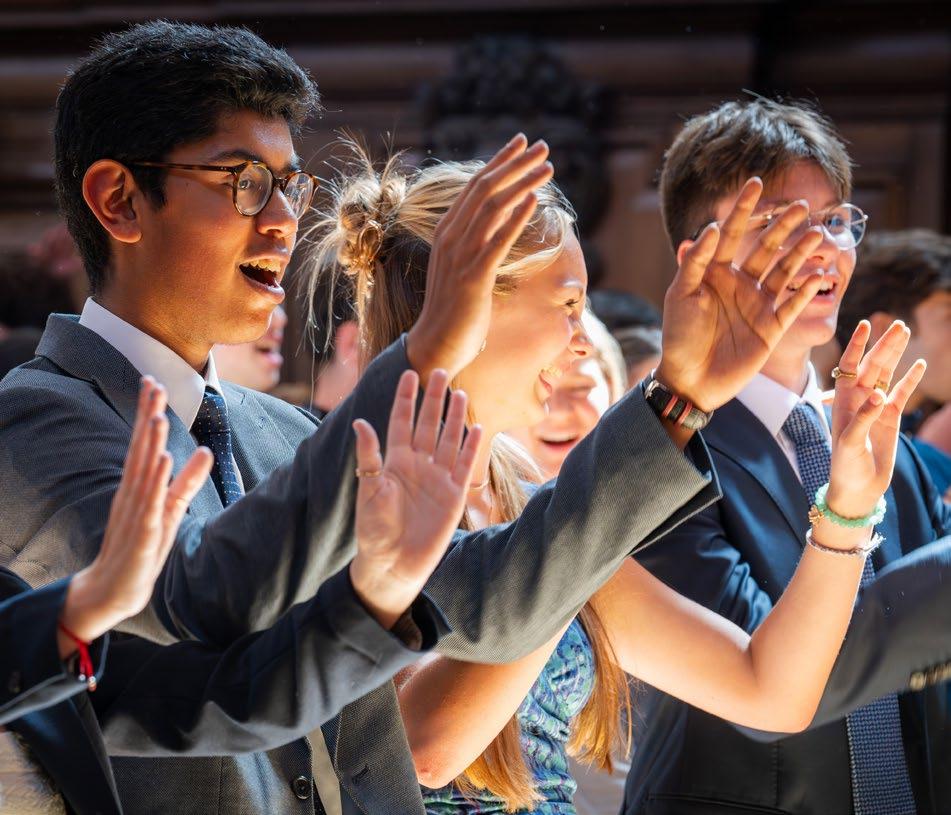
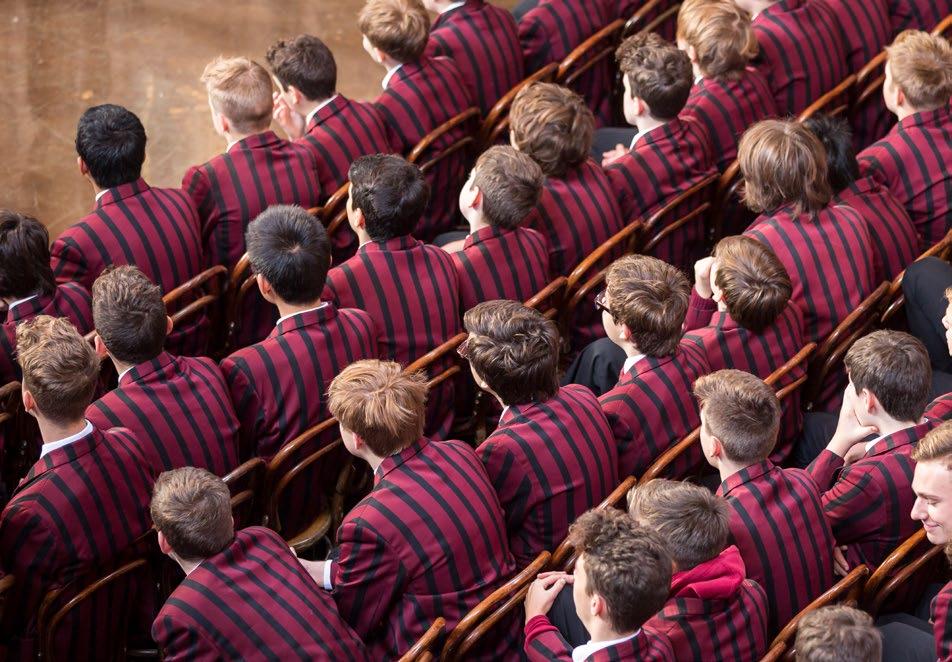
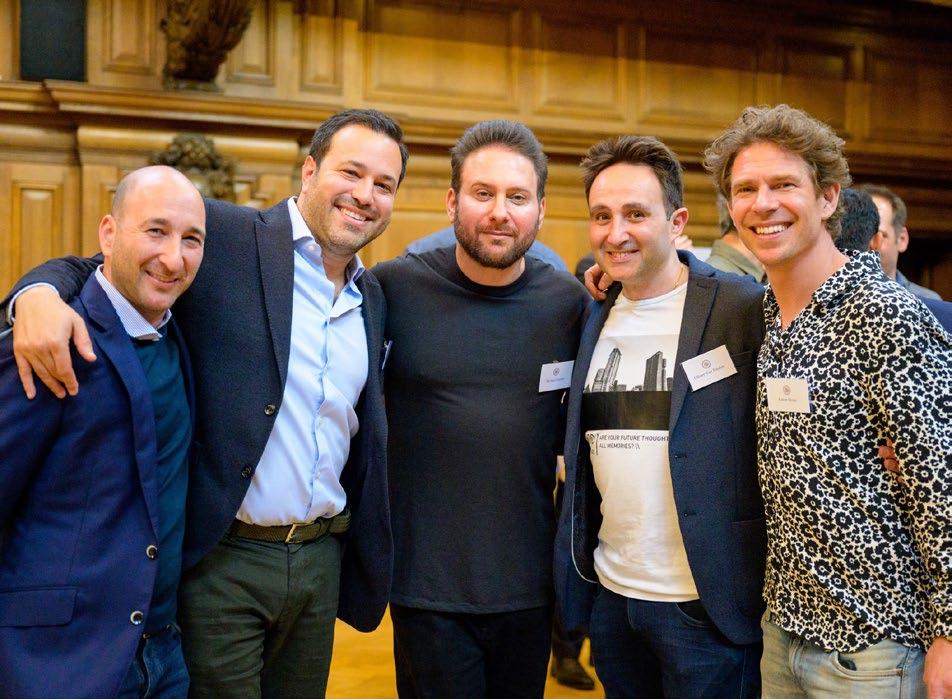
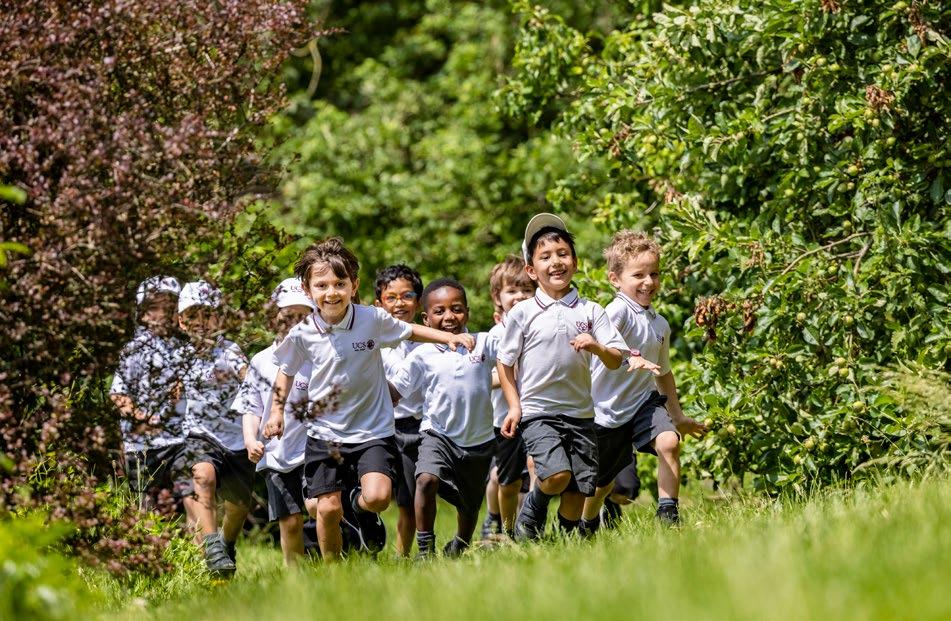
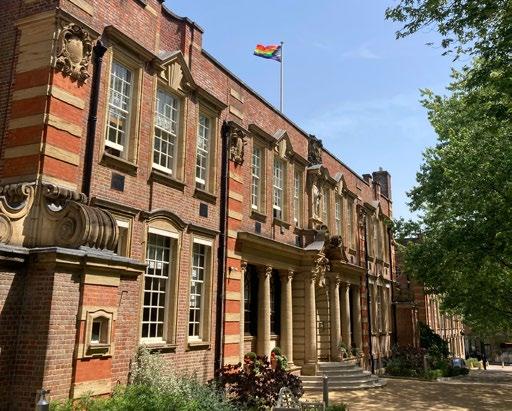
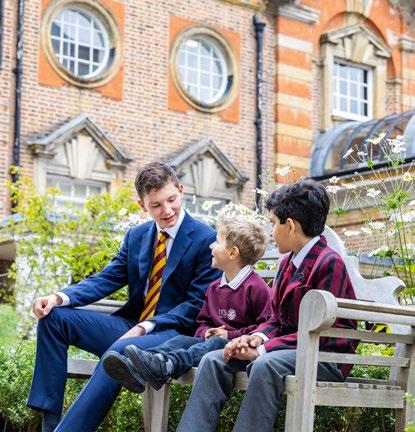
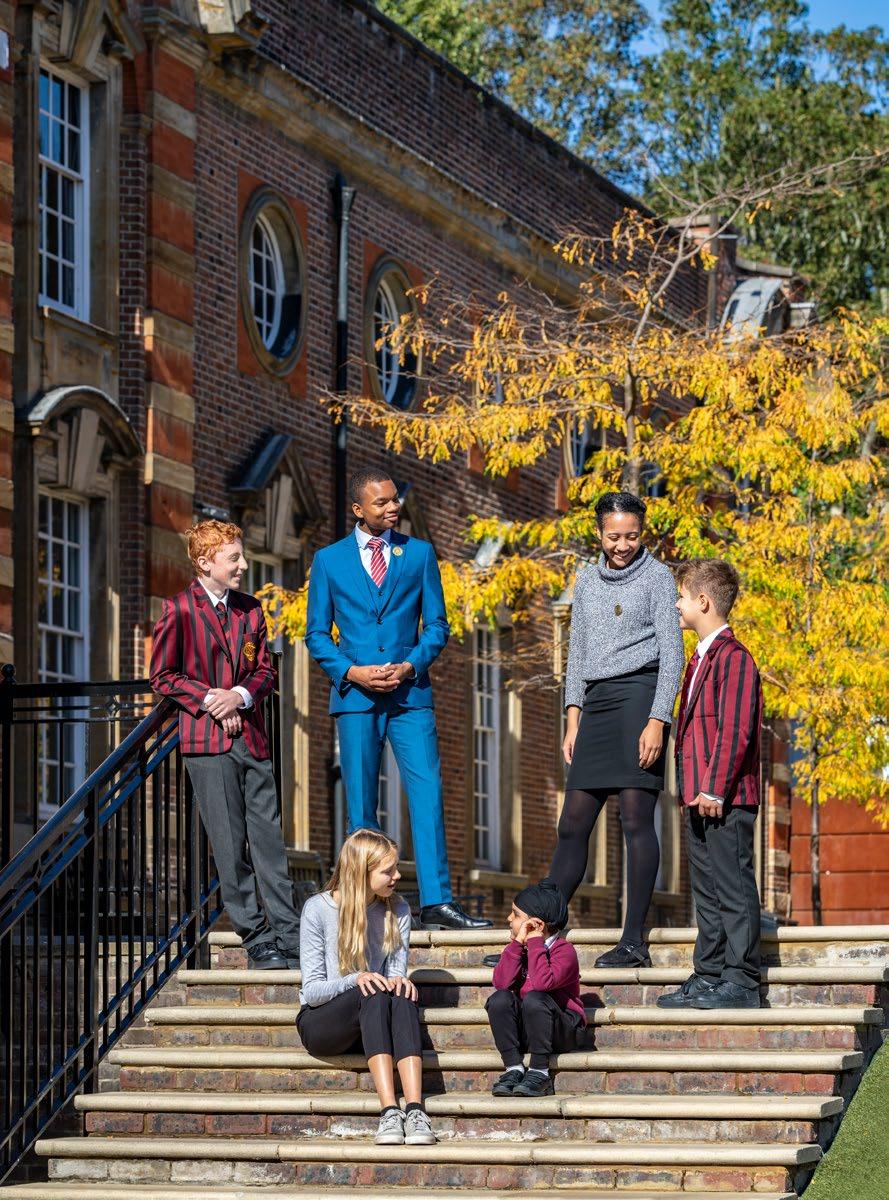
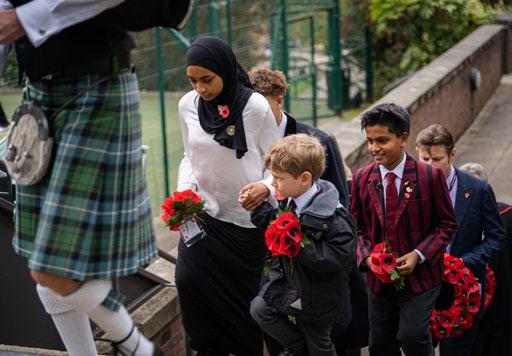
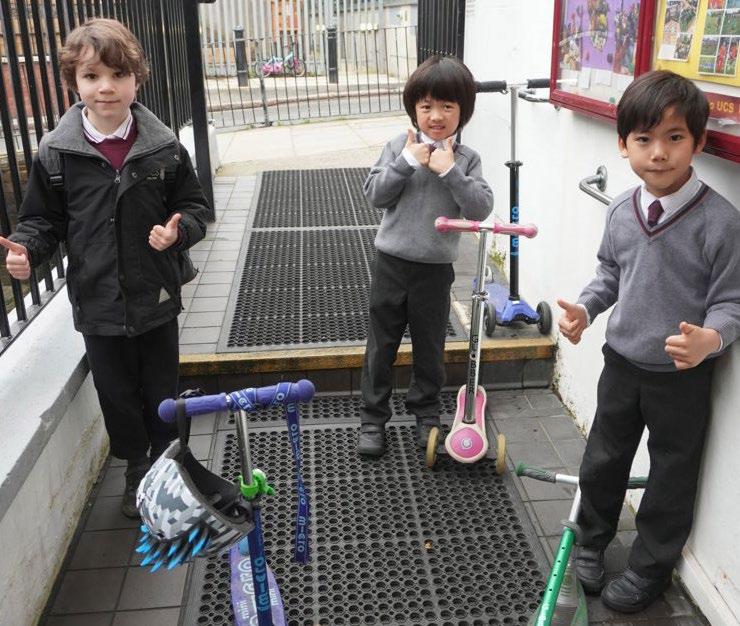
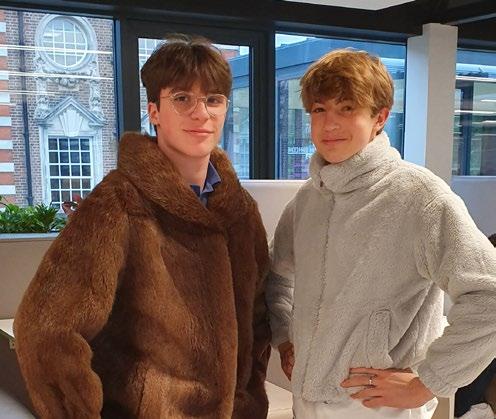
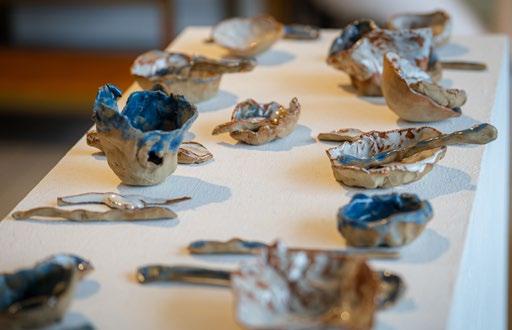
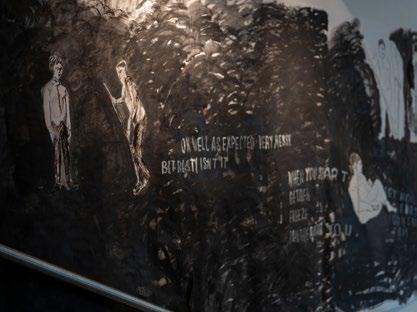
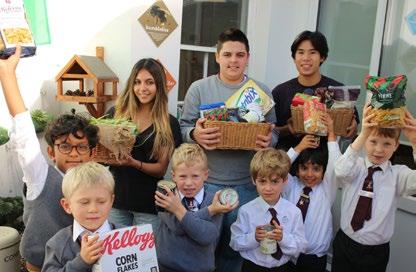
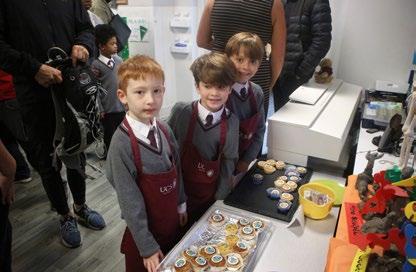
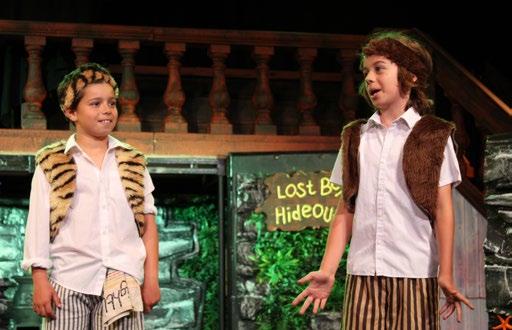
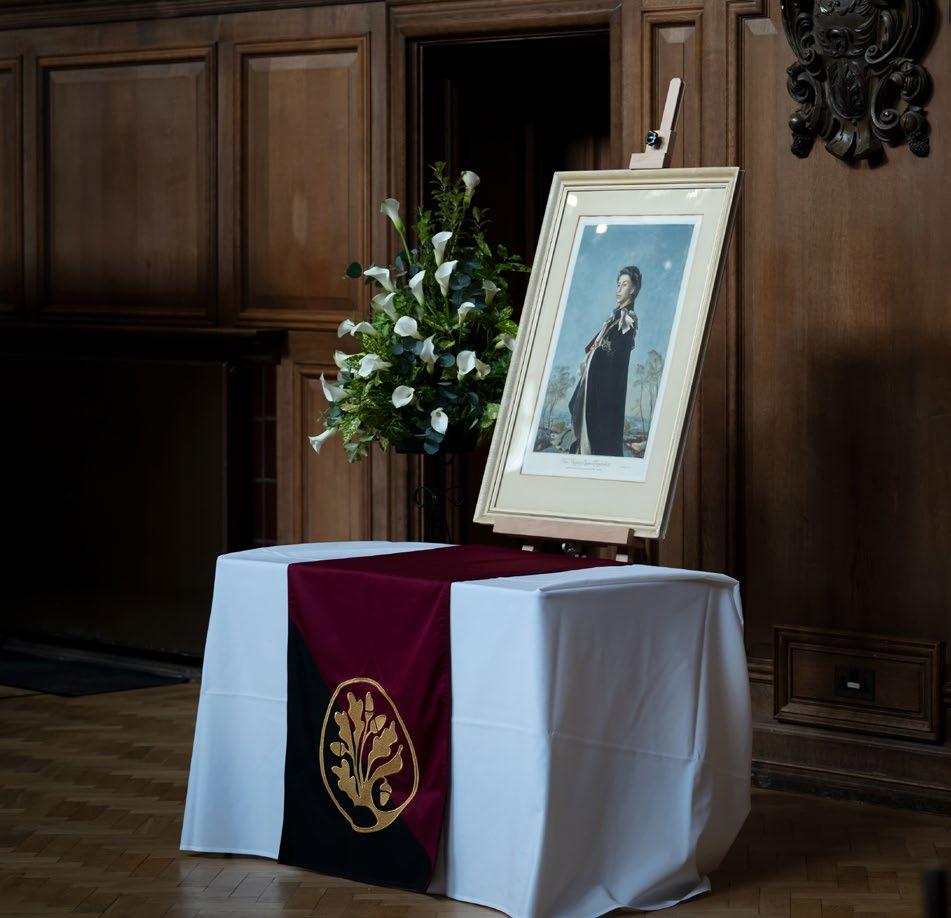
This annual University College School magazine is written for, and shared with, current members of the school community as well as Old Gowers around the world.
We hope you will enjoy reading this latest issue – the second instalment of The Gower since the publication was redesigned and restructured. It is our intention to give readers a feel for life across the UCS Foundation, from Pre-Prep to Junior Branch via Frognal (as the crow flies!), as it unfolded during academic year 2022–23.
Please understand that, because of the school’s commitment to sustainability, The Gower is now only printed for those Old Gowers who requested a hard copy. If you would like to receive a hard copy next year, but did not this year, then please contact oldgowers@ucs.org.uk.
Any feedback on this edition can be emailed to thegower@ucs.org.uk.
The editors would like to express their gratitude to the many people who supplied words and photographs for this edition. Thank you, therefore, to our contributors… and to our readers!
HEADMASTER’S WELCOME
I hope you enjoy reading this sample portrait of UCS life, as experienced by the Pre-Prep, Junior Branch and Senior School communities in 2022–23. I also trust it conveys the fantastic education and amazing opportunities that we endeavour to provide for pupils, as well as their happiness and enjoyment of school: something we set such great store by. If there is plenty of content to leaf through, that merely reflects the very broad educational provision across the Foundation with its plethora of academic and co-curricular offshoots. Our school life is rich and we aspire for it to be well rounded, in order to accommodate, appreciate and fully nurture the many different characters in our pupil body. I would like to think that in the midst of this myriad activity, all of our individual pupils have been able to grow and develop as the best, truest and most authentic version of themselves.
MARK J BEARD Headmaster
WELLBEING
THE RETURN OF TRIPS
UNIVERSITIES & DESTINATIONS
WHAT DOES IT MEAN TO BE AN OLD GOWER?
INTERVIEWS WITH DONORS
INCLUSION AND REPRESENTATION
PUPIL LEADERSHIP
HOUSE COMPETITIONS
ASSEMBLIES
NEW LOWER SCHOOL AWARDS
IWD, LGBT+ HISTORY MONTH, BLACK HISTORY MONTH, PRIDE
ACADEMIC
STEM ENRICHMENT
DEBATING & PUBLIC SPEAKING POETRY
STAND OUT WORK
TEACHERS’ FURTHER STUDY FOR THE LOVE OF READING EPQ
CONTINUING SUSTAINABILITY
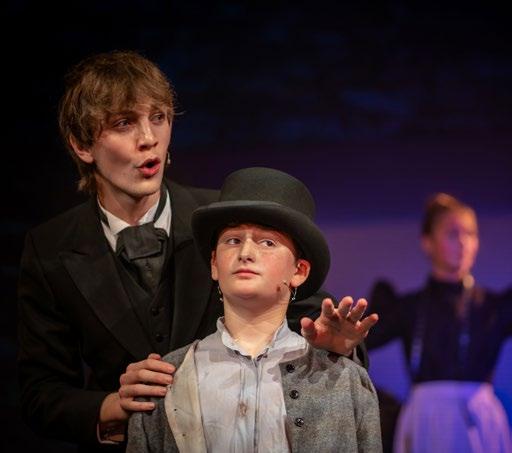
OLIVER! IN THE LUND CHARITABLE FUNDRAISING PARTNERSHIPS BRINGING PUPILS TOGETHER
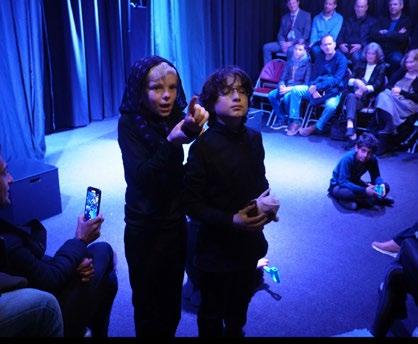
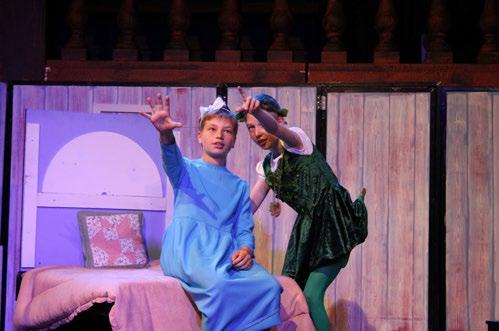
THE DEATH OF HM ELIZABETH II THE PARENTS’ GUILD COMMON ROOM GOODBYES WELCOME TO THE COMMON ROOM
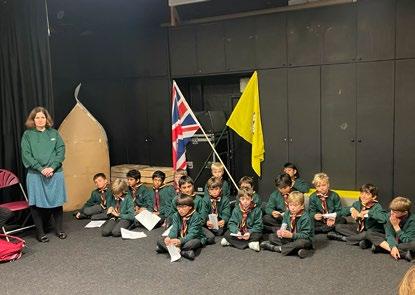
BEAVERS & CUBS DRAMA AT UCS MUSIC
SPORTS REPORTS
CLUBS AT THE JB DUKE OF EDINBURGH VIEW FROM THE ART ROOM
PRESIDENT’S WELCOME DEVELOPMENT AND ALUMNI RELATIONS OFFICE WELCOME
OG SPORT TRAVEL SCHOLARSHIPS
OLD GOWER EVENTS 2023–24
WELLBEING
Wellbeing at the Senior School
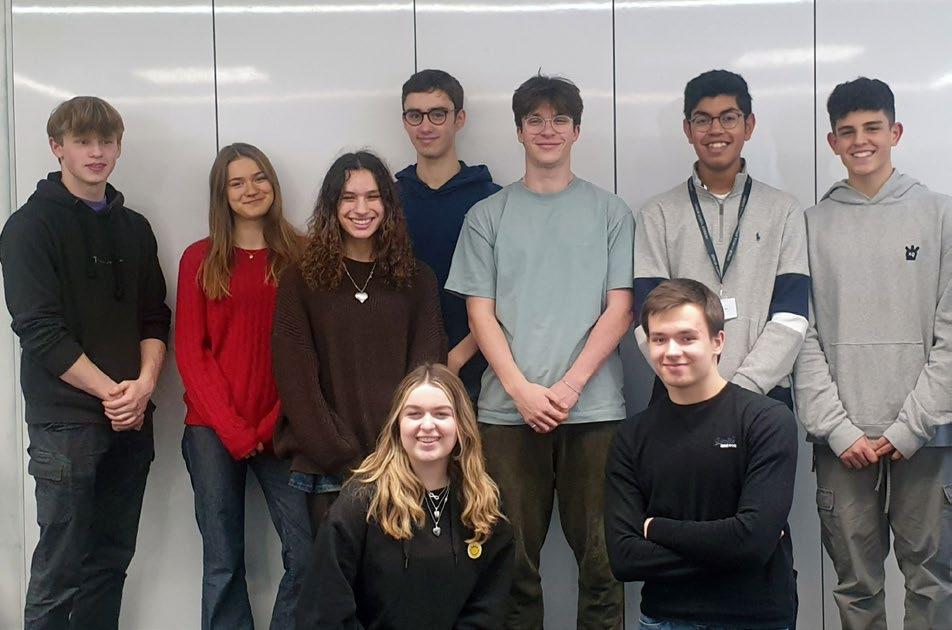
Composed of Transitus pupils, the Student Support Service offers impartial peer support and the opportunity to talk something through with a fellow student. All the volunteers have been trained in how to hold a helpful conversation. Whether it’s a problem with a friend or family member, a worry about school or an issue with work, the volunteers are there to help – they understand what it’s like to be at school, to be teenagers, and to be struggling. Any pupil can contact the service through its dedicated website. As Transitus pupils, the volunteers all have uniquely valuable experiences. They understand that whatever
the issue, regardless of how ‘big’ it feels, there are few things more effective than peer-to-peer support. Since they are acquainted with the trials of joining new schools, social pressures, academic concerns or other difficult circumstances, the volunteers’ personal experiences enable them to help fellow pupils to find a solution or a remedy.
One of the key values at UCS is relationships. We want these values not just to permeate the academic context but to infuse every aspect of school life. Pupil wellbeing is at the heart of UCS and so this year we launched the pupil-inspired Student Support Service. Alongside a Certified Coaching Facilitator,
we provided Transitus volunteers with training on effective questioning, listening well and the art of empathy. The overarching themes of the course included being aware, being curious, being fulfilled, being connected, being accountable and being effective. Throughout this process, the pupils learnt how to have conversations centred around the peer they were talking to, how to do this impartially and how to encourage their peers to look at the different options available to them. The Transitus pupils demonstrated vulnerability and wisdom beyond their years and were passionate about walking alongside fellow students.
ONE OF THE KEY VALUES AT UCS IS RELATIONSHIPS. WE WANT THESE VALUES NOT JUST TO PERMEATE THE ACADEMIC CONTEXT BUT TO INFUSE EVERY ASPECT OF SCHOOL LIFE.
Wellbeing at the Junior Branch
Wellbeing is an essential component of JB daily life and has been embedded into our curriculum so that pupils can reap the benefit from positive mindfulness. It is important that children feel safe at school and that they have plenty of outlets in their daily routines in which to express concerns and worries as well as celebrating achievements.
We teach wellbeing as a stand-alone subject alongside PSHEE with a curriculum that includes an awareness of different forms of mindfulness. Our teachers are trained in how to deliver lessons in a sensitive empathic manner so that children always feel supported. Classes may include varying forms of meditation by listening to calming voices and gentle music. We learn how to breathe rhythmically. These are simple routines that enable and promote the concept of wellbeing at a young age.
We have recently converted a room on the upper floor to a wellbeing sensory room for the benefit of small groups to sit quietly and work in a peaceful environment.
We have a range of extra-curricular clubs such as yoga, gardening and running to help with the balance between physical and mental health. These are well attended. As a result of all these simple but effective initiatives, pupils feel that warm sense of security when in school, and there is an energetic and happy atmosphere around the playground and the classrooms.
Contributions from S.D.B. HALL
Wellbeing at the Pre-Prep
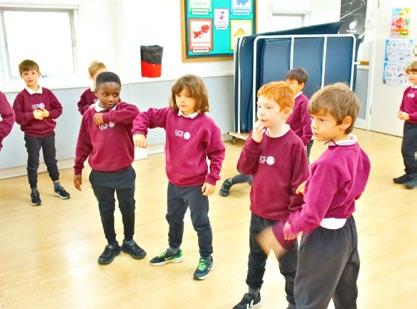
We were thrilled to begin this academic year with the successful reaccreditation of the Wellbeing Award, which emphasised the excellent pastoral care offered to staff and pupils at the Pre-Prep. Particular highlights mentioned in the report included reference to how we work hard to develop pupils’ emotional literacy skills, helping them understand different emotions and confidently express their feelings, as well as being able to name and employ strategies that help them self-regulate when needed. This is certainly something we have prioritised over the past two years at the Pre-Prep, beginning with the introduction of ‘Feeling Zones’. Here, pupils are encouraged to reflect on how they feel and talk about their emotions regularly at school with feeling ‘check-ins’ – i.e. four specific zones to enable them to identify their feeling and choose a self-regulation strategy if necessary.
Pupil wellbeing is paramount at the Pre-Prep, and other notable activities included visits from Dudley the wellbeing pug and our resident chicks and ducklings, the continuation of Miss Pateman’s popular Mindfulness Club, the expansion of the emotional literacy texts in the school library and the ongoing focus on mindfulness as part of each school day. We are committed to using breathing breaks, guided meditations, yoga and stretching to help children feel calm during transitions as well as developing their own self-regulation ‘tool kits’. We also took part in a range of activities for Children’s Mental Health Week, exploring how we are all connected and how these connections can benefit our mental health, raising money for the charity
Beyond with a special pyjama dress-up day. Finally, during Mental Health Awareness Week, there was a special mindfulness workshop on appreciating what is around us and grounding ourselves with our breath. We are excited to see how we can further enhance and develop wellbeing at the Pre-Prep in 2023–24.
Contributions from H. RITCHIE
THE RETURN OF TRIPS
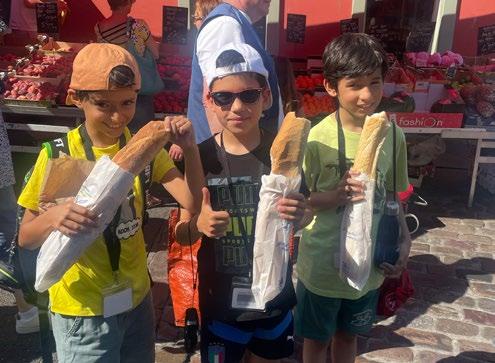
As the world recovers from the challenges of the pandemic, the resurgence of residential school trips has brought a renewed sense of excitement and opportunity for pupils in all of our schools. These immersive experiences not only rekindle the joy of exploration but also serve as vital educational tools for shaping well-rounded individuals and fostering a global perspective. From the rugby trip to Italy for Lower Remove and Remove pupils to the Economics trip to Brussels for the Transitus, these diverse adventures offered Senior School pupils a chance to expand their horizons and deepen their understanding of the world.
Language trips to Valencia, Palermo and Antibes took students beyond the confines of the classroom, enabling them to immerse themselves in the local culture of the cities they visited. Exploring vibrant streets, conversing with native speakers and savouring authentic cuisine, pupils developed linguistic proficiency and cultural understanding. Combining intellectual growth and cultural appreciation, the Maths and German trip to Berlin allowed pupils to witness the real-world application of their skills. Surveying Berlin’s historical landmarks while delving into its mathematical and engineering wonders, pupils sharpened their critical thinking, problem-
solving abilities and intercultural competence. Sixth physicists toured the European Organization for Nuclear Research, CERN, on a visit to Geneva. Pupils witnessed groundbreaking work and were exposed to a wide range of potential STEM careers.
These residential trips hold immense educational value, empowering pupils to go beyond textbooks and exam specifications. They represent opportunities for students to apply their knowledge in practical and real-life situations, promoting critical thinking, problem-solving and adaptability. Drama students engaged in research and development for their A Level coursework in Bristol, and Biology and Geography pupils engaged in fieldwork in Surrey and the Lake District.
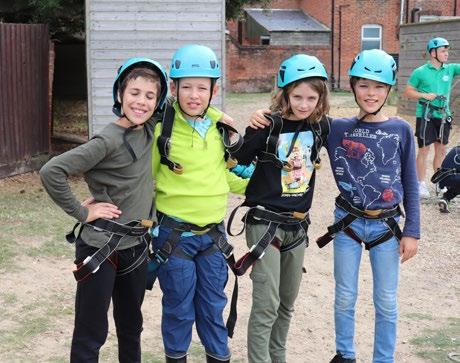
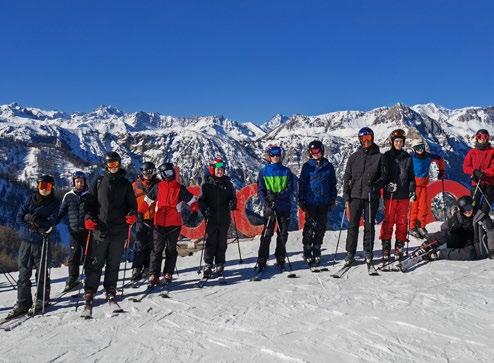
These experiences also create lasting memories and forge friendships. Shared adventures such as those undertaken on the ski trip to Italy, the Entry’s stay at Skern Lodge in Devon and the Shell’s visit to the World War One battlefields to introduce them to their new forms and Demes, invite camaraderie, teamwork and personal growth, nurturing qualities that will serve pupils well throughout their lives.
The
Royal Academy of Arts
(Spanish, Remove)
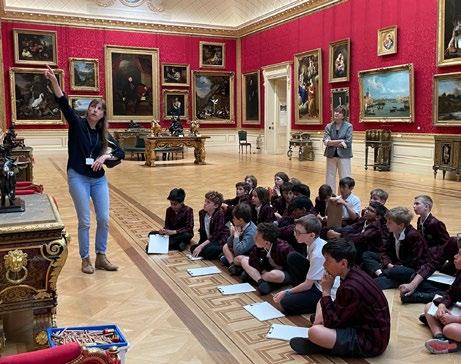
Our day began at morning break when we met outside UCS Active and walked down to Finchley Road Tube. We took the Jubilee Line to Green Park where we gathered, conveniently, by the accordion player (prompting some flamenco dancing from a couple of the boys!) before making our way to the Royal Academy of Arts. As we entered, we immediately saw all of the beautiful ceramics and artwork from Spain and the Hispanic world down the centuries. There were many different types of art and sculpture for us to admire, including Alhambra silk, statues, paintings and even (my personal favourite) brass door knockers! We proceeded through all of the rooms, with everyone competing to finish the quiz first. Once we had done that, a look around the gift shop was a necessity of course! Overall, we all really enjoyed the trip as it was a wonderful way to absorb Spanish culture and history through art and sculpture down the years.
CHARLES ROLLO – REMOVE
Berlin (Maths and German, Transitus)
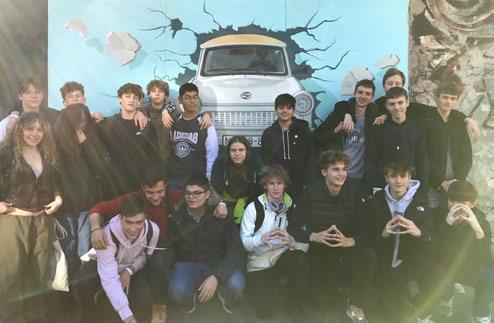
Our Berlin trip was an incredible experience, from the museums via the tours to the hostel, covering a wide range of experiences relevant to both German language and culture and Maths. It started with a guided tour of Berlin: the Reichstag, the Holocaust Memorial, an endearing display of the East German Trabants (the one available car model in the GDR), and finally Checkpoint Charlie, where the iconic “You are leaving the American Sector” sign still stands, albeit right beside the local KFC! There was an additional walking tour of the stunning artwork on what remains of the Berlin Wall.
We also had many opportunities to see the applied Maths throughout Berlin, visiting the Museums of Communication and German Technology, as well as the Zeiss-Grossplanetarium (Great Planetarium). These cultural and mathematical elements were profoundly enlightening; however, perhaps the biggest highlight was touring the BMW factory on our final day. The guide explained both the functionality of the machinery and how the company operated between its many factories worldwide, providing food for thought for both future engineers and future economists.
cultural activities including: tours of Palermo and the coastal town of Cefalù; the beaches there and at Mondello; visiting the Pupi laboratory and theatre where traditional Sicilian puppets are created and brought to life; the Antonio Salinas Archaeological Museum, the Botanical Garden and the Chiesa di San Giovanni degli Eremiti. The language exchange, meanwhile, involved Italian students of English – a great chance to use Italian for a meaningful purpose like… talking to Italians! The most memorable trip had to be the street food tour where we tried panelle (chickpea fritters), crocchete (croquettes) and panini con la milza (spleen sarnies!). We learnt that in the interreligious and cultural melting pot of Sicily, Jews and Muslims would not eat the spleen or lungs of butchered animals so such innards were given to the Christians as food not to be wasted. On the streets of Palermo, you can buy tasty milza sandwiches cheap –just don’t ask what’s in them!
(Italian, Remove)
This was an opportunity for students to immerse themselves in the language and culture of Italy; and a more authentic experience since Palermo isn’t a traditional destination for language exchanges. There were morning Italian lessons at a local language school and afternoons dedicated to
LOUIS WOOF – REMOVE
JAKE ALTMANN – TRANSITUS
Palermo
Geneva (Physics, Sixth)
In January, the Upper Sixth visited the European Organization for Nuclear Research, CERN, and its particle physics research facility in Geneva, Switzerland. We spent our first day exploring the city, including St Pierre Cathedral in the old town, the famous Jet D’Eau fountain, and the Flower Clock. The main event, however, was the tour of CERN. Our guide gave us an overview of the research being conducted at this, the world’s largest particle physics laboratory. We learnt about the Large Hadron Collider and its experiments. We got to see some ‘in repair’ experiments and meet scientists working at the facility. Particularly fascinating was the work in the antimatter factory. The scientists’ main aim here is to study the properties of antimatter, since a fundamental question in Physics is ‘why is there so much more matter than antimatter in the universe?’ It was a once-in-a-lifetime opportunity to witness the vanguard of particle physics research! Finally, we visited the Natural History Museum, with its collection of taxidermy animals and exhibits showcasing the diversity of life on earth. Overall the trip was incredibly enriching and aligned perfectly with the particle physics we were studying.
UCS Pre-Prep had a busy year with classes making off-site visits to many of the museums and education centres in London, including the RAF Museum, the Tower of London and the Natural History Museum, as part of their exciting half-term topics across the different subject areas. There were local walks, too, to learn more about the children’s immediate surroundings, developing their observational skills. Visiting the nearby Waitrose, for instance, was a chance to learn about healthy eating, organise produce and go behind the scenes in a supermarket.
Year 1 visited West Hampstead Fire Station as they had been learning about fire safety, the history of firefighting and the Great Fire of London. The firefighters answered all of the children’s burning questions! Each child was able to sit in and explore the fire truck as well as squirt the hose.
Year 1 had a wonderful trip to the London Museum of Water And Steam at Kew. On this Science trip the children learned all about water filtration with a Victorian-themed educational show named ‘Mrs Tristram’s Wonderful Water Show’. The boys had a guided tour, an interactive play session on a range of water pumps, valves and jets as well as time in the outdoor water exploration zone.
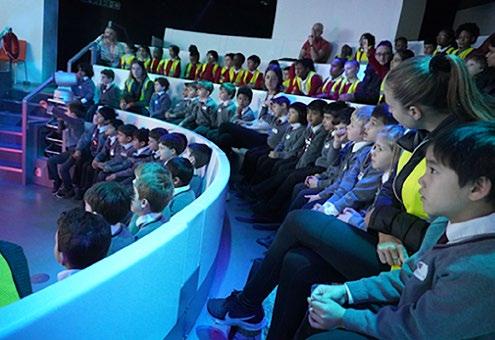
Year 1 and Year 2 visited the Natural History Museum, where the children explored the ocean right down to 2,000m below sea level in a fun interactive show. The trip coincided with the children’s learning of animals in Science and both year groups particularly loved completing tasks set by teachers to learn about different animals such as the giant squid in the fish gallery and an emperor penguin in the bird gallery. Another highlight was being introduced to ‘Hope’ the blue whale in the mammals gallery.
TIA CROWN – SIXTH
Royal Air Force Museum (Year 2)
Tower of London (Year 2)
Camley Street Natural Park, London Wildlife Trust (Reception)
Horniman Museum and Gardens ‘Toys Through Time’ (Year 1)
Belmont Farm (Year 1)
BBC Earth Exhibition (Year 2)
Roald Dahl Museum (Year 2)
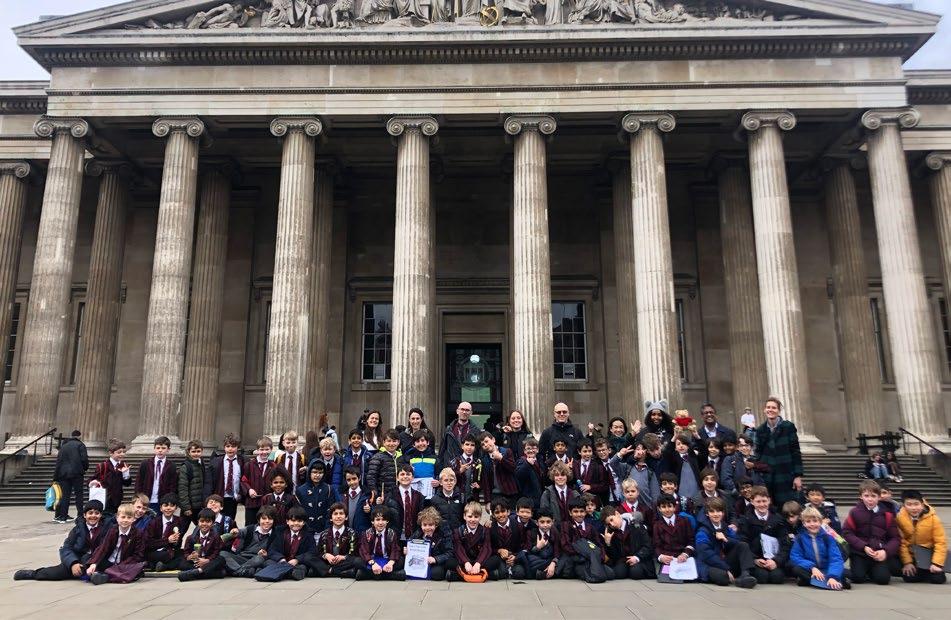
Junior Branch pupils certainly got out and about during 2022–23, with trips that ticked the various curricular, co-curricular and ‘character-building’ boxes. Local ports of call were London Zoo –housing some very rude parrots! – the British Museum and the grippingly historical Tower of London, visits that added technicolour to classroom learning. Year 6 had their traditional Kingswood residential in West Runton, Norfolk, where their activities featured abseiling, archery, climbing and caving, and their studies spanned coast defences –including a World War II pillbox – and topography. The French city of Nice was the destination for the JB Art trip, which took in art museums dedicated to leading artists such as Matisse, Chagall and Picasso. A storm denied the group another dose of Impressionism, at Renoir’s museum, but they
had the consolation of watching The Super Mario Bros. movie… in French! Meanwhile, the metropolis beckoned for the Year 5 and Year 6 rugby trip to Paris. This tour incorporated training sessions at local professional club Racing 92, whose coaches led the sessions, as well as the chance to meet the Racing players and attend a game at their stadium. The boys were sufficiently inspired to win the majority of their tour matches, often against slightly older opposition, and signed off with a resounding victory against the hosts’ all-star team. Finally, French crêpes made way for every conceivable pasta sauce – followed by gelato – on the JB pupils’ rider for the Year 4 and Year 6 ski trip to Passo Tonale, Italy. The school was competing in the IAPS Ski Championships and claimed medals in both age groups.
British Museum (Year 4)
London Zoo (Year 3)
Nice, France (Year 6 art)
Paris, France (Year 5, 6 rugby)
Passo Tonale, Italy (Year 4, 6 skiing)
Tower of London (Year 6)
West Runton, Norfolk (Year 6)
Paris (Rugby, Years 5 and 6)
The Years 5 and 6 rugby teams went on a brilliant trip to Paris where they combined training and playing rugby with sight-seeing. First the sights: Eiffel Tower, Arc De Triomphe and Champs-Élysées. Then the rugby, which started with training at professional club Racing 92’s training ground. Not only were the boys coached by Racing 92 coaches, they then watched the professionals train and later met them in person. That was enough inspiration for UCS’s first set of fixtures against French opposition, of which the JB teams played 12 and won 8. The following morning the group were straight back into training with Racing 92 coaches, before going to see a Racing match at their Paris La Défense Arena. At the end the players came over to sign the boys’ rugby paraphernalia. The final day consisted of a tournament in which the opposition were generally older, and the JB fielded mixed Year 5 and Year 6 teams. It was touch rugby for the first half and contact rugby for the second, and UCS won most of the games. The tournament concluded with UCS’s best team playing against the hosts’ all-stars – a contest the JB contingent won by five tries to one.
Norfolk (Year 6)
Year 6 embarked on a week-long trip to the Kingswood residential and activity centre in West Runton, Norfolk. A tour of the campus showed that the site had pretty much anything the boys could want: laser tag, abseiling, archery, climbing and caving, to name but a few of the available activities. In caving they went inside a renovated World War Two pillbox, initially to learn about WWII posters. In the wall of the pillbox there was a small tunnel that led into a brick cave, rather like a maze. Cue much crawling and roaming around. Abseiling was not for the faint-hearted either, beginning with a 15-metre ascent and requiring real courage to look over the edge at the start of the descent. It wasn’t all play and no work, though, as the boys went to the beach to study coastal defences, rock pools and the topography of the shoreline. Oh, and they saw a crab fight! There was the highlight of a seal-spotting boat tour and the surprise of a movie night too: SpiderMan: Homecoming.
SAUL KRIEGER & SEBASTIAN GOLDBERG – 6C
KABIR BORDOLOI AND WILLIAM LACEY – 6C
London (History, Year 6)
Year 6 ventured to the Tower of London as part of their History studies about mediaeval Britain. As well as walking in the steps of the boy princes Edward and Richard, more commonly known as the ‘Princes in the Tower’, the pupils also explored the depths of the White Tower, commissioned by William the Conqueror. Yeomen Warders dotted the grounds in distinctive regalia and were very helpful in answering the boys’ thoughtful questions. Coronation fever pervaded the Jewel House, while the boys were treated to a crime and punishment session led by actors at the Tower, retelling tales of kings, queens, prisoners and escapees. Overall, it was a delight to see the boys so engaged and enthused by this totem of British history.
J. TOMAS-MERRILL
THE BOYS WERE TREATED TO A CRIME
AND PUNISHMENT
SESSION LED BY ACTORS AT THE TOWER, RETELLING TALES OF KINGS, QUEENS, PRISONERS AND ESCAPEES.
Passo Tonale, Italy
(Ski Team, Years 4 and 6)
The Junior Branch went to Italy to compete in the IAPS Ski Championships in Passo Tonale. This required the boys to work on their skills as a team and to produce their best possible times in this exciting, exhilarating and exhausting sport. In the end, the Under-9s and Under-11s both claimed medals, and could be very proud of their achievements. They celebrated their success with hot chocolate and gelato. Since the racing week took place during term time, the pupils also did their usual lessons, tests and homework. Something only Italy could teach them, however, was that bowls of pasta came in many different shapes and sizes and with every sauce imaginable, from simple pomodoro to sophisticated carbonara, via rich pesto and carnivorous bolognese. They became as brave, technical and tactical in their pasta choices as in their decision-making on the slopes. Fair to say they arrived back in Hampstead a week later exhausted and tanned, yet super happy!
MATTHEW RYAZANTSEV – 5T
(Art, Year 6)
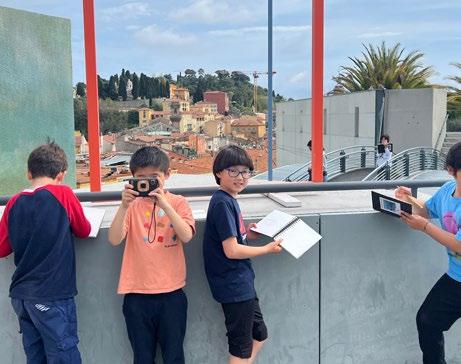
The Junior Branch Art trip to Nice was defined by museums… in a good way, of course! The action started with visits to the Modern and Contemporary Art Museum (MAMAC) and Photography Museum, where the boys sketched photographs that captured their imagination. Next came the (Henri) Matisse Museum, located in the eponymous artist’s former home, which some pupils found especially interesting; and the Musée National Marc Chagall, whose abstract paintings caught the eye. If that wasn’t enough art for a Year 6 student, day three found the group at the Musée (Pablo) Picasso. Stormy weather prevented another dose of Impressionism at the (Pierre-Auguste) Renoir Museum, but there were other highlights like a walking tour of Nice, the Hard Rock Cafe, the local creperie, and The Super Mario Bros. movie at the cinema… in French!
AADHITHYA MUTHUKUMAR – 6L
THE ACTION STARTED WITH VISITS TO THE MODERN AND CONTEMPORARY ART MUSEUM (MAMAC) AND PHOTOGRAPHY MUSEUM, WHERE THE BOYS SKETCHED PHOTOGRAPHS THAT CAPTURED THEIR IMAGINATION.
UNIVERSITIES & DESTINATIONS
This year’s Sixth engaged in the Higher Education process with ambition and enthusiasm, but they also took on board advice to be strategic in their applications. This meant that heading into the summer holidays, 92% of applicants were holding at least two offers, 78% at least three, 51% at least five, and a fortunate 17% five clear offers. Most of the offers this year came from Bristol, Manchester and Leeds, in line with previous years.
Furthermore, entering the summer, 14 UCS students were holding offers from Oxford or Cambridge (nine from Oxford and five from Cambridge) across a
range of subjects – History, Mathematics, English, Chemistry, Geography, Land Economy, German, Engineering and Materials Science. In an increasingly competitive environment, these pupils had much to be proud of.
Equally, we were delighted that UCS pupils broadened their choices, in terms of both courses and universities, and thought more deeply about their options. Pupils applied to institutions as far flung as Scotland, the north-east and the south-west, as well as everywhere in between. We had offers for a diverse range of courses, including Neuroscience,
Biomedical Engineering, Liberal Arts, Film and Creative Writing, Economics and Management with a year abroad, Mechatronics and Robotics, Politics and International Studies and Chinese, Biology and Marine Biology, and the new Economics, Finance and Data Science at Imperial. We also had one student with an offer from East 15 Acting School and another planning to attend BIMM (British and Irish Modern Music Institute) to do Songwriting.
Further afield, ten students were holding offers from the US, from institutions such as Duke University, University of Michigan, Northeastern University, University of Miami, University of Southern California, San Diego University, Villanova University and New York University. There were also a couple of students holding scholarships – for example, one girl had a £25,000 scholarship to attend Tulane University in Louisiana.
Come results day, we were thrilled that our Sixth cohort achieved considerable success, securing some fantastic results and departing to study at a range of prestigious institutions, both in the UK and beyond. At A Level, 73 pupils scored straight A*–As. Meanwhile, 27% of grades awarded were an A* and 72% of grades an A* or A, with 93% of all grades at A*–B.
Overall, 92% of UCS’s 2023 leavers proceeded to undergraduate study, with 84% progressing to their first or second-choice university. Their destinations really did include some of the most renowned institutions in the world; in the final reckoning, ten students took up places at Oxford or Cambridge to pursue courses including Classics, Material Sciences, History and Engineering. Meanwhile,
every prospective medic holding an offer met the conditions of their first-choice university, and ten leavers could confirm their travel plans to overseas institutions, some with highly sought-after scholarships, including the above-mentioned Duke, Miami and New York.
Their undergraduate courses were a true reflection of this generation’s multifarious academic passions, extending as far as Computer Science with AI, Cognitive Science and Aerospace Engineering, and of course, Songwriting. If you are anywhere near Bristol, Manchester, Edinburgh or Imperial, London this autumn, expect to bump into a familiar face or two!
Contributions from L. JENKINS
WHAT DOES IT MEAN TO BE AN OLD GOWER?
A recent visitor to UCS for the Old Gowers’ Summer Drinks Party, albeit not a regular one in the intervening five decades because of his life’s circumstances, Sean Hackett is nonetheless deeply appreciative of the formative years that he spent at Frognal.
School days are not necessarily the outright happiest days of your life, but an ideal scenario is to be able to look back through a lens of gratitude and appreciate that particular time and place. Of course, the curious thing about memories is that they can assume greater depth and clarity the more distant they become in terms of years.
Memory and gratitude were two recurring motifs of the conversation that this publication had with Sean Hackett, a former UCS pupil of the 1970s. Sean joined the school in 1973 for his A Levels, after having attended a boarding school in Hertfordshire – where, in his words, “the staff were pretty good but the kids made for more of a thuggish environment”.
He had been tipped off by a friend of a friend that he “would enjoy UCS” and his own preconception was that “it was a place with high academic achievement and aspiration”. Looking back on his experience in the Transitus and Sixth, the Old Gower said:
“I couldn’t think of anywhere better. My time at UCS coincided with my development as a person. I think the atmosphere was something that inspired you. It was an intellectual environment and it inspired me to work hard, to keep up with the others really. It was encouragement by observation and through being in a constructively curious environment. We were all growing up intellectually, since that 16 to 18 period is a time of great change.”
Academically, Sean studied Physics, Chemistry and Maths (pure and applied as a single A Level) – only regretting “not taking Further Maths too” – and he proceeded to read Physics at Imperial College after a brief flirtation with Civil Engineering. “I decided to switch to Physics on the basis I would never again have the chance to study natural science,” he explained. “As it happens, I have been interested in how things work from a very young age, which perhaps explains why I ended up as a patent attorney.”
The educational system he passed through at Frognal taught more than just the skills and strategies for academic and later career success as a patent attorney on both sides of the Atlantic. It was a culture that opened up horizons. “The liberal ethos and non-authoritarian atmosphere appealed,” he said, “and the school also offered a broader sporting curriculum which was most welcome after the limited choices I’d had before. Pupils were respected for their hard work and talents whatever they were.”
“I THINK THE ATMOSPHERE WAS SOMETHING THAT INSPIRED YOU. IT WAS AN INTELLECTUAL ENVIRONMENT AND IT INSPIRED ME TO WORK HARD, TO KEEP UP WITH THE OTHERS REALLY.”
Indeed, it was at UCS that Sean discovered a talent for rowing that still endures. “I chose rowing and have fond memories of twice-weekly trips to
the river,” he recalled. “We were good enough to represent the school at the Henley Royal Regatta and this introduction gave me the experience to step straight into competitive crews at Imperial College, winning the universities’ event at Henley. I am still rowing today, nearly 50 years after leaving UCS!”
Sean’s coach was Geoffrey Page, a British rowing star of the 1950s: “His influence was important. I liked being out on the water: the peace of the river and being detached and away from interference.” Meanwhile, his “welfare mentor” was John Older, a name memorialised in the Deme system. “I liked the fact the school didn’t seem to take sport too seriously,” he said. “They were happy for people to do what they wanted to do. That was refreshing. I think the change of school made me appreciate what UCS had to offer, because I had something to compare it with. My time at UCS was never something I took for granted.
“Not that my behaviour was perfect,” continued Sean. “I more or less kept within the bounds –though, not being an early person, I could never quite make it to assembly on time! I lived locally in Hampstead and the whole environment was a very pleasant experience.”
Even today, at five decades’ remove from the wider experiences that Frognal afforded him between 1973 and ’75, Sean recognises the importance of the school to his personal and academic development. This appreciation of “the privilege of a UCS education” comes with the caveat “because my father could afford the fees” – and was informed, at the time, by the fact one of his best friends was a scholarship pupil. Now his gratitude for the “crucial part that the school played in where I am today” is expediting a desire to help young people to attend UCS via the bursary programme and thus enjoy what he once had. He explained: “I am minded to give financial support when I can. I regard the school as part of my legacy, which is why I have made provision in my will. I would like to do what I can to help expand the size of the provision, so that more youngsters can attend the school.”
“I AM MINDED TO GIVE FINANCIAL SUPPORT WHEN I CAN. I REGARD THE SCHOOL AS PART OF MY LEGACY, WHICH IS WHY I HAVE MADE PROVISION IN MY WILL. I WOULD LIKE TO DO WHAT I CAN TO HELP EXPAND THE SIZE OF THE PROVISION, SO THAT MORE YOUNGSTERS CAN ATTEND THE SCHOOL.”
INTERVIEWS WITH DONORS
The work of the Development and Alumni Relations Office is all about connection; forging connections, rekindling connections and strengthening connections between Old Gowers, the school, our pupils, staff and parents. This is only possible because of the strength of feeling that exists within our community: that UCS is a special school, and we all have the privilege of giving back as much as we benefit from the school. Richard is a wonderful example of this and we are very lucky to have his support. To find out more about the work of the Development Office, please email development@ucs.org.uk
‘Letter to parents inspired me to donate.’
Old Gower Richard Sehayek explains the motivations behind his decision to donate to the UCS bursary provision. You could say it is a decision 35 years in the making given Richard’s long association with the school as Junior Branch pupil, Senior School student and now proud UCS parent.
BY RICHARD SEHAYEK
UCS has been a core institution for me throughout my life. I attended the school for ten years from 1988–98, and my son has been at UCS since 2015.
When I sat my 7+ exams (a while ago now), I was –to the immense surprise of myself and my parents – offered multiple places at different schools. With a decision to make, my parents and I attended various open days in the hope that one school would stand out.
The only open day I remember was UCS. I found myself sliding off the overly polished wooden chairs (the very same you have all sat on – they have not changed) while the late, great Mr McGregor, former headmaster of the JB, delivered an inspirational speech to a more than receptive audience of prospective parents. Mr McGregor – sensing my unease, and to my disbelief – invited me up on stage to sit with him for the remainder of his talk.
That man and that school embodied what pastoral care meant. I was sold! From that moment, I was going to UCS. I was seven years old and I have never looked back.
Pupils get the whole package at UCS: fulfilling their academic potential in a relaxed, unpressured environment. Every year the admissions team assembles a friendly, go-getting, talented cohort of children. Combined with the extensive sport, music and other extracurricular programmes on offer, UCS provides pupils with some of their fondest lifetime memories as well as unbeatable preparation for the next chapter, whatever that might be.
MORE THAN ANYTHING, UCS IS A COMMUNITY. IT PREPARES YOU FOR LIFE AND MOULDS YOU INTO THE BEST VERSION OF YOURSELF, GIVING EACH STUDENT AN INNER CONFIDENCE AND INQUISITIVE PERSONALITY.
More than anything, UCS is a community. It prepares you for life and moulds you into the best
version of yourself, giving each student an inner confidence and inquisitive personality. Whenever I happen to interview an Old Gower for an internship or permanent job, that unmistakable UCS charm and ebullience is always a give-away well before they confirm to me that they attended the school. That perceptible UCS streak of well-meaning confidence and personality has been a defining characteristic of its pupils since time immemorial and continues to this very day. It is invaluable – far more precious than any academic accolade – and something a wide spectrum of students should experience.
Which brings me onto bursaries…
I only realised the scope and impact of the bursary programme after meeting Stephen Warshaw, Chairman of the Governing Council. I was amazed by the large number of pupils who benefit from the programme and by the school’s admirable desire to expand it even further.
It struck a nerve with me. During my UCS years, I remember a boy who sadly and suddenly had to leave the school because of financial difficulties. Leaving one’s teachers, friends and community must have been hugely distressing.
It was during Covid that I received a letter from the school saying something along the lines of “If you’re having a tough time school fees-wise because of Covid, we’ve got fall-back options”. That letter really hit home to me the financial burden faced by parents and families given the tumult of recent years and reminded me of the situation from my time at UCS all those years ago. I felt I wanted to help to the extent I could and to support such a worthy programme. The special thing about UCS is that my friends today are the same ones I had at school. It’s definitely rare to say that some of your closest friends in your 40s are the same friends from when you were seven or eight years old.
Earlier this year I attended my 25-year UCS reunion which was quite the throwback! Sure, we had all noticeably changed (i.e. deteriorated!) from a physical perspective but, within ten minutes of the proverbial ice-breakers, we reverted to type and the same old characters we used to be, even though we now counted surgeons, fund managers, lawyers, teachers, entrepreneurs, TV producers, musicians and even a diplomat among us. Everyone was genuinely interested in each other and what we had been up to. I think that’s part of the school’s spirit. Look, not everybody was happy all the time, but most UCS students were pretty content most of the time and had a happy childhood here. In fact, at the reunion I saw people I hadn’t seen for 25 years and I was struck by how well we all got on and by the fact that the vast majority of my year were good, decent people.
Now, as a UCS parent, it is heart-warming to see my own son in this same environment. I feel it’s something special for him: he is able to flourish and have a great experience at the same time. There are so many decisions you make for your children and you don’t always know if you’ve made the right ones. However, I have never for one moment questioned the decision my wife and I made to send our son to UCS – much like the decision I made for myself when I was seven. Both were complete no-brainers.
UCS polishes its pupils for whatever comes next in their lives, giving them room to grow into the best version of themselves while instilling that unique UCS confidence and ability to communicate that makes them ready to take on the world. All of this while also allowing them to look back and realise they had a happy childhood.
Somehow, UCS consistently delivers on all fronts. By donating to the bursary fund, you can help others experience some of that magic.
Inclusion and Representation
UCS advocates for total acceptance of diversity in race, creed, gender, sexual orientation and physical ability. Emphasising Inclusion and Representation, the school strives for a richer, more empowering learning setting, fostering innovation, creativity, varied perspectives and effective solutions. This article illustrates the positive impact of such an approach on our compassionate and inquisitive pupils.
UCS rightly promotes an ethos of complete tolerance of differences in race, creed, gender, sexual orientation and physical ability. It champions Inclusion and Representation in order to provide a more diverse, enriching and empowering learning environment, which in turn can lead to greater innovation, creativity, perspectives and solutions. The following accounts explain how such an approach benefits our curious and kind pupils.
Senior School
Inclusion and Representation at the Senior School does not just focus on marking key dates within the calendar, but is central to the pupil experience throughout the school. Subject departments continue to work on embedding the representation of different groups into the curriculums they teach, considering which voices and perspectives are underrepresented in traditional historical, literary and scientific narratives, for example.
Displays throughout the school celebrate academics and thinkers whose contributions may have been historically overlooked for reasons of race, gender, disability and sexual identity. Reading lists, external speakers and assemblies all supplement the material pupils cover in lessons, to provide exposure to diverse and enriching schools of thought and to support pupils in bringing themselves and their experiences to their learning.
PSHE forms another key method of promoting Inclusion & Representation: at all stages of the school pupils learn about the power of language to include or exclude, and how to have meaningful conversations about race and racism, gender and sexism, LGBTQIA+ issues, neurodiversity and more, with a particular focus on helping pupils to understand their responsibilities to the communities of which they are part, as well as to support marginalised groups.
As a corollary to this approach, the new Pupil Champion Course was delivered this year to pupils from the Shell in conjunction with pupils from St Margaret’s School, while Transitus volunteers in the Student Support Service received additional training on how to be effective allies. Pupils also had the opportunity to feed back to the school about their priorities and ideas on how to make UCS as inclusive a space as possible via the Lower and Middle School Councils, the Sixth Form Union and the Inclusion & Representation Committee.
Pre-Prep
The Pre-Prep embraces a culture that promotes equality, diversity and inclusion. When you enter the school, you see a ‘Welcome To Our School Display’ highlighting the various global languages and cultures found within our school. Here you can learn to say ‘hello’ in 17 languages! Additionally, we use texts from different cultures, religions, races and groups of people. There is an impressive rolling selection of books exploring difference, religion and gender across each term, with a particular favourite being our UNICEF ‘Rights Respecting Schools’ book We Are All Different. Additionally we have a range of books celebrating black history and on the subject of racial equality.
An exciting addition to this warm and inclusive culture was the Pre-Prep’s newest learning dinosaur. The inclusion dinosaur, ‘Includadon’, became the sixth such dinosaur and will help to promote and celebrate inclusivity, diversity and kindness.
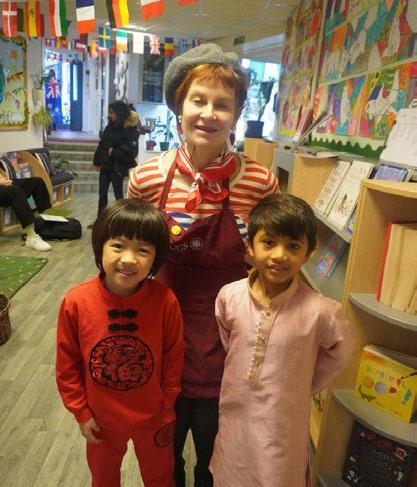
Moreover, we had a wonderful programme of events designed to embrace different cultures and groups of people. For example, on Cultural and International Day, each class was invited to wear traditional dress and we sampled foods from three countries represented within the class. Date pudding from Yemen was an instant hit in Year 1! For International Women’s Day, children learned about iconic female role models throughout history. During Black History Month, they enjoyed drama workshops championing inclusion and tolerance.
Our pedagogy this year, meanwhile, was developed to support and affirm neurodiversity and different learning styles. Indeed, Patrick Milton and external trainer Andrea Smollan briefed staff on how better to support pupils with ADHD or ASD profile.
Encouraging children’s empathy and community skills, KS1 completed the Junior Duke Award with a focus on helping and caring for others and being part of an inclusive community. Other projects to foster equality and inclusion involved learning about the Paralympics, female engineers, and scientists and artists from all cultures. Furthermore, whole-school events like the ‘Now and Beyond’ mental health festival helped create a safe environment for children to share information about their feelings and families.
Pupil Leadership
Pupil leadership is encouraged across the Foundation, beginning in the Pre-Prep and continuing through the Junior Branch and into the Senior School. It runs parallel to the challenging academic curriculum and the stimulatingly multifaceted co-curriculum, with opportunities to step up, volunteer and provide service to the community, both within UCS and beyond. These opportunities for leadership not only help the individual student in their personal development but also leaven the pupil collective by providing examples and role models.
Senior School
The transition into Sixth Form marks a time of significant change for students, with heightened academic challenges, new friendships, and increased freedoms and independence constituting just some of that change. However, one of the most notable shifts is the move towards leadership and assuming roles of responsibility within the school community.
This begins in the Autumn Term when Transitus pupils new to the Sixth Form become mentors to Entry forms, initiate their own clubs and societies, and undergo training to become volunteers for the Student Support Service. However, as the year progresses and Sixth pupils focus more intently on impending exams, the Transitus step in to fill the void created by the departing senior cohort and take up formal positions of leadership – crucial not only to the Sixth Form at large but also to the wider school community. These positions consist of three teams: the Monitors, the Deme Captains, and the Sixth Form Union, each with their own unique responsibilities and influence.
The Monitors, as outward-facing leaders, engage in formal activities such as conducting school tours, communicating with parents, representing the school at events, leading assemblies and participating in student affairs. They maintain a presence in the Middle and Lower Schools, actively engaging in various student events.
On the other hand, the Deme Captains are responsible for organising events within their respective Demes (or Houses), fostering Deme spirit and building a sense of community from Lower Remove all the way up to Sixth. The Sixth Form Union, different again, focuses on promoting inclusion and representation within the school. They arrange fundraising activities, raise awareness about important issues and ideas, and serve as the voice of the Sixth Form. Pupils who aspire to these leadership posts apply for them and approach their responsibilities with the utmost seriousness. Through these positions, they develop crucial
leadership skills, learn the value of collaboration, nurture a sense of responsibility and exhibit a deep commitment to the school community.
The benefits of having student leaders are far-reaching. These young leaders serve as approachable and relatable role models for their peers and younger pupils, inspiring others through their dedication, work ethic and passion for making a positive difference. Moreover, their efforts contribute to the overall development of the school community, championing a spirit of unity, inclusivity and social awareness.
The Monitors, Deme Captains and members of the Sixth Form Union play vital roles in various aspects of school life, offering guidance, support and inspiration. As such, these positions are invaluable opportunities for personal growth, which also benefit the wider community as they encourage a positive and inclusive school environment.
Captains of Monitors
Xavi Mesquita
Minnat Mohammed
Vice Captains of Monitors
Toby Crawcour
Tia Crown
Monitors Team
Cara Willmott
Cameron Bard
Issy Lesser
Taliah Spencer-Jacobs
Sebby Beard
Dylan Ireland
Hugo Kinder
Xavi Mesquita
Tia Crown
Beatrice Harker
Viraj Mehra
Anjelica Ashley
Minnat Mohammed
Toby Crawcour
Daniel Nahum
Oriya Tietjen
Sixth Form Union
Events Officer
Charlotte Marchand
LGBTQIA+ Officer
Axel Cohen & Ruby Isaacs
Diversity Officer
Oduko Soludo
Women’s Officers
Rose DeLeon & Daisy Ellis Thompson
Wellbeing Officers
Scarlet Clements Smith & Ella Goren
Deme Captains
Baxters
Rose Deleon, Charlie Cash, Adam Kassam
Black Hawkins
Ruby Koppel, Lenny Knight, Jasper McNally-Drew
Evans
Hannah Lucas, Skyla Madhvani, Elijah Lifton
Flooks
Ananya Radhakrishnan, Jacob Bor, Louis Myers
Olders
Poppy Stringer, Jake Marchant, Aidan Pick
Underwoods
Tamsyn Alston, Ed Choi, Jonah Howe
Equality and poverty with Ishaan Shah
A different kind of student leader cut an inspirational figure at the Junior Branch when special guest Ishaan Shah spoke at a whole-school assembly about his work as, among other things, a UN Youth Representative and co-founder of Stolen Dreams – a youth-led collective driving action around ending modern slavery.
The 20-year-old activist, whose own dream is that every human being can access basic human rights, discussed his experiences of visiting India several years ago, describing the slums and the families he met that lived in extreme poverty. When he visited the local school, he was deeply moved by the fact that at dinner time the children, who were lucky to get a meal, served Ishaan first.
This one small act of kindness inspired Ishaan to act and he is now a young leader in international human rights, gender equality and climate action. His speech stirred the JB audience, challenging pupils to learn or do something about something they care about. The deepest concern for the pupil body may well be global warming, but Ishaan really gave them something to think about.
Year 6 pupil Baer Bolton Smith said:
“ISHAAN SHAH IS AN AMAZING YOUNG MAN WHO DECIDED TO ACT ABOUT A MAJOR PROBLEM IN THE WORLD. HE
ASKED US TO LEARN MORE ABOUT IT AND TO ACT IF WE WANT TO. WE WERE MOVED BY HIS ASSEMBLY AND
I HOPE MORE
PEOPLE
BECOME MORE LIKE HIM!”
BAER
BOLTON SMITH – Year 6
Pre-Prep House Captains & Deputies 2022–23
Autumn 1
Dragon:
HC – Folajimi D - Jonah
Griffin: HC – Stellan D – Albie
Pegasus: HC – Monty MC D – Zack
Sphinx: HC – Joseph D – Morrie
Autumn 2
Dragon:
HC – Theo D – Arlo
Griffin: HC – Monte TS
D – Christopher
Pegasus: HC – Seth D – Lorenzo
Sphinx: HC – Rafi B D – Leonardo
Spring 1
Dragon:
HC – Theo I D – JJ
Griffin: HC – Monte TS D – William & Jojo
Pegasus: HC – Kemal D – Aaron & Gabriel
Sphinx: HC – Suleiman D – Joseph
Pre-Prep House Captains & Deputies 2022–23
Spring 2
Dragon:
Griffin:
Pegasus:
Sphinx:
HC – Naayel
HC – Ethan
HC – Lukas
HC – Jack
D – JJ
D – William & Jojo
D – Aaron & Gabriel
D – Joseph
Summer 1
Dragon:
Griffin:
Pegasus:
Sphinx:
HC – Jonah
HC – Christopher
HC – Lorenzo
HC – Leonardo
D – Theo I
D – Stellan
D – Seth
D – Rafi B
Summer 2
Dragon:
Griffin:
Pegasus:
Sphinx:
HC – JJ
HC – Albie
HC – Aaron
HC – Eliott
D – Elan
D – William
D – Monty MC
D – Jack
House Competitions
House or Deme competitions are occasions when pupils can find fulfilment in camaraderie, self-confidence and participation. Through being involved in such activities, pupils acquire skills, develop character and discipline, and appreciate the value of collaboration. Besides, these events are often engaging and entertaining riffs on the traditional house system.
Senior School
Deme competitions continued to be a source of camaraderie, competition and fun, providing pupils with the opportunity to represent their Demes in a range of co-curricular activities and to create and strengthen bonds with peers in their own and other year groups. Deme Captains worked hard to support their Wardens in selecting teams to showcase the breadth of talent across the Middle School and Sixth Form. From drama and dance (with a new variety act category) to rugby, chemistry, football, chess, hockey, cricket, swimming, tennis and sports days, these events fostered a strong sense of community within the school.
In the arts, Deme Song and Deme Drama and Dance enabled pupils to unleash their creativity and express themselves on stage. The performances attested to their dedication, hard work and teamwork. Underwoods took the honours at Deme Song and finished joint first with Baxters in Drama and Dance. On the sporting front, the rugby, football, cricket and tennis matches tested pupils’ athletic abilities
and tactical thinking. The chess and chemistry tournaments, on the other hand, challenged students’ intellectual abilities. With every move, they had to think several steps ahead, proving their analytical skills and strategic thinking. Evans prevailed in Middle School Chess, and Flooks in the Sixth Form competition, while Black Hawkins won the Chemistry.
The year climaxed with sports days at the playing fields. Pupils competed in team sports, including cricket, tennis and volleyball, as well as athletics, with victories for Black Hawkins and Evans –joint first! – in the Lower Remove, Black Hawkins in the Remove and Flooks in the Transitus. After months of intramural competition, the deserving winners of the UCS Deme Cup 2023 were Black Hawkins.
Pre-Prep
FROM DRAMA AND DANCE (WITH A NEW VARIETY ACT CATEGORY) TO RUGBY, CHEMISTRY, FOOTBALL, CHESS, HOCKEY, CRICKET, SWIMMING, TENNIS AND SPORTS DAYS, THESE EVENTS FOSTERED A STRONG SENSE OF COMMUNITY WITHIN THE SCHOOL.
In the Pre-Prep, House competitions form an integral part of a vibrant school culture. Infused with spirit, these events build community, foster teamwork and, of course, invite healthy competition among the boys. From the thrilling Swimathon and House Running to the highly anticipated weekly House Cup, these activities unite pupils across the years through collaboration and an eagerness to showcase and appreciate each other’s talents and skills. Additionally, the introduction of the Kindness Cup has promoted compassion and empathy, values at the core of the Pre-Prep.
Vying for victory, the children dive into the pool to compete in one of the most eagerly awaited events, the annual Swimathon at UCS Active. This event spotlights not just the boys’ swimming abilities developed in weekly swimming lessons, but also their understanding of the value of teamwork and perseverance. The Swimathon encourages them to push their limits and celebrate their success together, which builds bonds that transcend the pool.
House Running is no different, as this adrenalinefuelled event brings out the competitive spirit in everyone. With the Holcroft fields abuzz with excited pupils and parents, the boys test their stamina and proudly finish the race representing their Houses in vibrant House colours. The children’s ability to inspire team-mates to give their best is even more remarkable than the running; it is not uncommon for them to cross the line hand in hand.
The weekly House Cup is the cornerstone of the Pre-Prep’s House competitions. This continuous source of motivation for the boys encourages the school community to be the best it can be, in and out of school. Pupils collect House points by striving to be superstars in the classroom, by singing their hearts out on the interactive learning platform Seesaw or by displaying their dedication to their roles in the semi-annual productions. The House Cup truly ignites the boys’ passion for learning, and a drumroll of excitement precedes the announcement of the winners in the weekly Celebration Assembly.
Recognising the importance of promoting empathy and kindness, the Pre-Prep also launched the Kindness Cup. Designed to reward children’s exceptional acts of compassion within the school community, the cup serves as a reminder that kindness is a quality to be nurtured alongside sporting and academic talents. Whether it’s lending a helping hand to a friend, or offering words of encouragement, the Kindness Cup celebrates compassion and reinforces empathy and respect.
Junior Branch
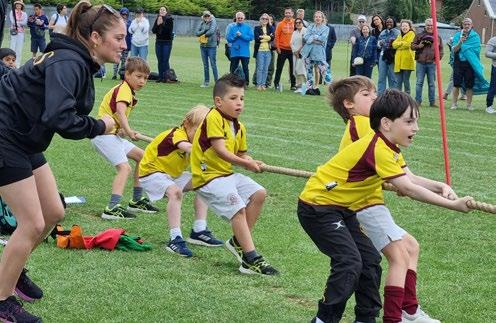
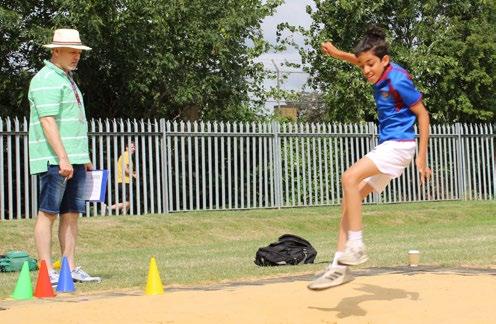
Finally, the Junior Branch sports day saw boys compete in four individual events against children of equivalent ability from other Houses. The events were 50m, 100m (Years 3 and 4), 200m (Years 5 and 6), long jump and throw. The action was rounded off by team relays and tug of war.
Placings in each event were added together for overall House points, with relay and tug of war places worth double points. Once the numbers had been crunched, fourth place went to Bentham on 613 points; Simmons and Eve were joint second on 648 points, and Campbell victorious on 732 points.
Running alongside the athletic events were the House cricket finals in the ‘Super Smash’ format. This fast-paced, high-scoring hybrid has become very popular at UCS, and the highlight here was Alex Pickford (Year 4) scoring 52 runs off five balls!
Contributions from J. LEWIS
R. HOLMES
D. COOK
Assemblies
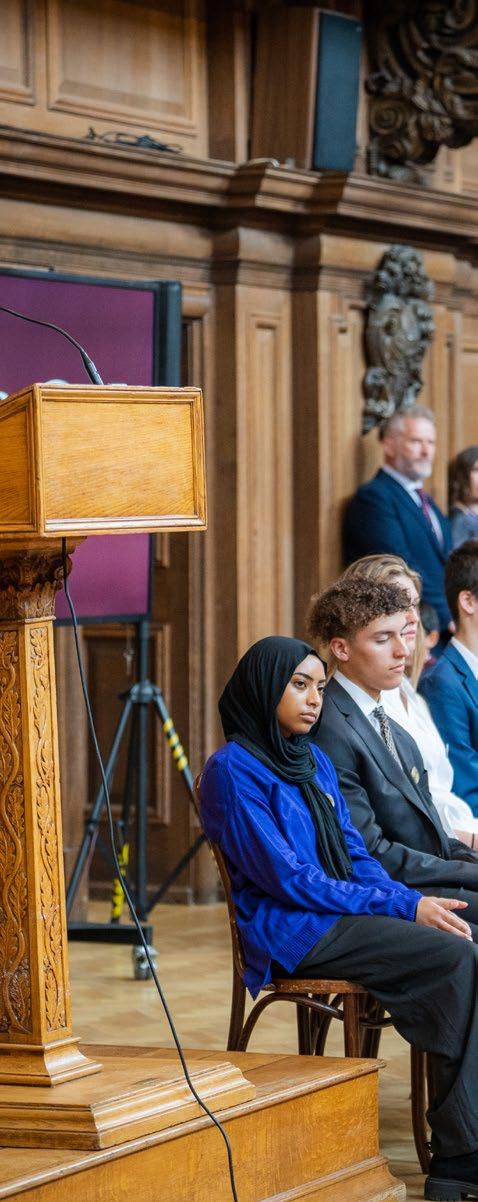
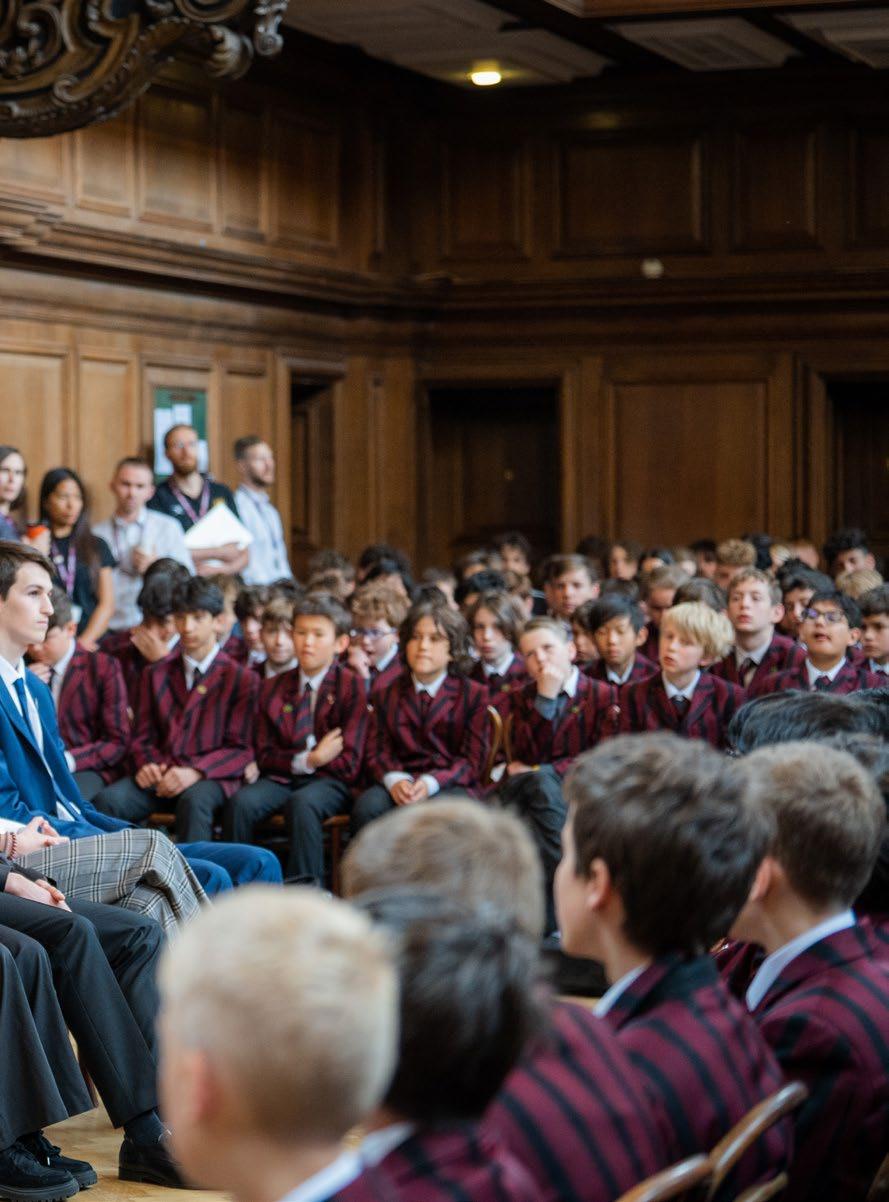
School assemblies are much more than exercises in gathering different year groups at the start of a school day. Rather, they bring together the school community to tackle timely, important and thoughtprovoking issues. They are invaluable opportunities to educate pupils and prepare them to go out into the world and improve the society at large. Here are some examples of the wisdom imparted at these congregations of staff and students, which take place against the backdrop of the majestic Great Hall.
On Holocaust Memorial Day:
I am eternally grateful to be living in London: a prosperous, stable society, not without its problems but generally a more blessed place to live. My family, part of which emigrated to escape Russian pogroms, has prospered here for generations. Yet societies can change: the tone of political discourse leading to violence in the US and, more recently, closer to home makes me increasingly wary that democracy is a gift that needs more care and effort than ever to maintain. That effort will come from individuals promoting respect, tolerance, fighting for the downtrodden and speaking out for the weak; a role that I hope all of us can be proud to play.
G. WAYLAND
On timeless teenage struggles:
The world in which we find ourselves may be very different from when the words of ‘Paulatim’ –“brave souls once walked the halls we tread” – were originally sung. Economic challenges, political
challenges, environmental and societal concerns evolve, but for the past 100 years this building has been occupied by thousands of students who also struggled with homework, friends, the challenges of being a teenager and facing an uncertain world.
A. DAVIS
On LGBTQ+ History Month:
Listening to people’s stories is a way of cultivating empathy. It helps bridge gaps in experience and perspective. Remembering the lives and stories of individuals is a weapon against dehumanisation. Listening to people’s stories, accessing their reflections on what makes them, how they’ve got to where they are, and what has mattered along the way, can be a way of diminishing divisions. As LGBTQ+ History Month begins, I think too of the voices of those we have not allowed to speak, stories that still haven’t been heard. Prejudice diminishes when connections are made, and allowing someone to tell you who they are honours their identity. Give Desert Island Discs a listen, if you have a spare commute, but make the time to listen to each other too.
J. LEWIS
On success and failure:
My call to action is to take chances to fail before it’s too late. Fail constructively where you can – try and answer complicated questions posed by your teacher or try exercises that you aren’t sure of. Put your hand up and be confidently unconfident that you only have part of the answer. Push yourself to a limit and go slightly beyond if you can – just like you might in a sport or hobby. In our Learning Values we talk about resilience – the ability to maintain oneself under difficulties and be able to perform and respond under pressure. Throwing
yourself into situations where you might lose or fail as a chance to grow is one of those times you develop in this core competency. If we embark on these opportunities together with our peers, it compounds the effects of learning under the threat of failing as we know that we will all fail at something at some point, so we might as well get it over with.
M. EDWARDS
On protest and change:
Protest, by its very nature, is uncomfortable for everyone. Standing up and challenging a status quo or an entrenched authority can almost always feel like a losing battle from the very beginning – especially when you have little power and influence. However, this time in history is one of the easiest times for it to come about. The advances of modern communication and spreading information via social networks and social media mean that communities of like-minded changemakers and activists can grow online and their messages can spread rapidly. While this has its downsides, the potential of the digital age as a time for change and upheaval has long been spoken about. It’s also worth recognising that these tools and spaces allow us to create our own power and shift the balance towards the change we want to see. When people take action together, whether as part of community groups or striking unions, the impact can be significant.
A. DAVIS
On allyship and social justice:
I want you to think about the history you are writing or enabling to be written – through your thoughts, your words, your actions. How can you best use your talents and your voice to ensure, for example, that everyone has access to the food and resources they need to be their best selves? How can you be the best ally and supporter of those oppressed by unfair systems and processes –those of minoritised ethnic or racial groups, trans people, refugees, the homeless? What injustice or intolerance do you see in our modern world that needs addressing? From my short time as part of this community, I know there is passion in this room and around the school, and I look forward to seeing and discussing the future ‘histories’ that you seek to enact, the intolerances you want to lay low.
J. LEWIS
New Lower School Awards
Over the past two years, Entry and Shell pupils have pioneered two new ‘character’ awards: the Young Leaders Award and the Headmaster’s Lower School Award. With the first set of graduates emerging from both, Awards Coordinator Mark Reiderman proudly assesses the state of play.
“The first Young Leaders Award (YLA) cohort had to write letters of application, get on the course, attend weekly sessions and contribute to the leadership challenges. Seventeen pupils started when they were in the Entry; 16 completed the course during the Spring Term of the Shell year. One pupil could not continue because of other commitments. Graduates received a nationally recognised Young Leaders Award certificate from the Archbishop of York Youth Trust.
The Headmaster’s Award is different as there is no formal sign-up process. Instead, over the course of 12 months, we encourage pupils to compile a portfolio of evidence of progress in four of the five sections of the Award: academic, adventure, cocurricular, community and sustainability. The onus is on them to be proactive and, yes, go on this trip or do that co-curricular activity. They must also spend time reflecting on how it was useful and the values they developed.
A high-quality portfolio will evidence how the pupil reflected on each activity. About 70 pupils from the year group of 120 achieved the Headmaster’s Award, receiving a certificate and a badge. Anyone who completed either the Headmaster’s Award or the Young Leaders Award or both earned a trip to Thorpe Park. Curiously, the whole idea of Thorpe Park came from a YLA exercise in how to negotiate.
The Young Leaders Award runs from the Summer Term of Entry through the Autumn and Spring Terms of Shell, finishing in time for Shell pupils to focus on Summer Term assessments. The Headmaster’s Award starts and finishes at the same time. There are fewer ring-fenced lessons with the latter; we encourage pupils to look at and add to their portfolios, particularly during form periods.
Young Leaders comprises three modules, each with ten hours of taught content. Every module also has a Leadership Challenge, which the boys come up with themselves. In total, they have 30 hours of taught content and three challenges. The challenges, first time round, were to design an induction activity for new Entry pupils, which the boys carried out with last autumn’s Entry; to design and carry out novel Community Action fundraisers; and to work with Heath Hands conservation charity. For the second cohort, we have not defined the challenges and it will be interesting to see if they wish to take these tasks in different directions once given parameters to work with.
The feedback has been good, with parents almost universally positive about the opportunities for their children. We have worked closely with parents to avoid the timings and schedule preventing pupils taking part.
Furthermore, Lower School pupils are hearing about the Awards from their peers and liking the sound of what they are doing. The YLA brings together a broad variety of characters; not a purely sporty, musical or academic crowd. There is something of everything and part of the course is working with different characters. Pupils learn to adapt their style and approach when working with different people. This is another big selling point!”
ABOUT 70 PUPILS FROM THE YEAR GROUP OF 120 ACHIEVED THE HEADMASTER’S AWARD, RECEIVING A CERTIFICATE AND A BADGE. ANYONE WHO COMPLETED EITHER THE HEADMASTER’S AWARD OR THE YOUNG LEADERS AWARD OR BOTH EARNED A TRIP TO THORPE PARK.
IWD, LGBT+ History Month, Black History Month, Pride
UCS actively acknowledges significant dates in the inclusion calendar, organising events, assemblies and discussions to educate and empower students. Through observance of events like Black History Month, LGBTQ+ History Month, International Women’s Day, and Neurodiversity Celebration Week, the school cultivates understanding and inclusiveness among all community members.
Celebrating diversity
UCS continues to observe key dates in the inclusion calendar, offering a range of events, assemblies and discussion opportunities that aim to empower and educate pupils. By honouring and exploring Black History Month, LGBTQ+ History Month, International Women’s Day, Neurodiversity Celebration Week and more, the school works to foster understanding and inclusivity in all members of the community.
The theme for Black History Month 2022 was ‘Time for Change: Action not Words’, and a series of events within the co-curriculum aimed both to research the history and cultural contributions of black individuals in the UK and beyond and to acknowledge the change needed for equity within society.
The Junior Debating Society, for instance, debated the motion of returning the Benin Bronzes to Nigeria from the British Museum, addressing the
complexities surrounding cultural artefacts and colonial legacies. Cultural Awareness Society held a comparative discussion on race and racism in the UK, the US and South Africa; Lower and Middle School book groups discussed what can be learnt about black history from fiction; Politics Society looked at the Metropolitan Police; and Medical Ethics Society considered racism within medicine, and in particular black maternal health. Feminist Society hosted a meeting analysing the history of women’s suffrage and the exclusion of black women from this movement. These discussions sought to shed light on the intersectionality of gender and race, emphasising the importance of inclusivity in the ongoing fight for equality.
In February, LGBTQ+ History Month took centre stage with the theme ‘Behind the Lens’, focusing on the contributions of LGBTQ+ individuals in film, television and visual arts. Throughout the month, UCS pupils engaged in form-time discussions and whole-school assemblies shedding light on the struggles and sacrifices made by activists, urging the community to learn from history and continue moving forward. QueerSoc and Feminist Society delved into topics such as the Stonewall Uprising and ‘queer female joy’ in music and film. These activities were spaces for learning about, reflecting on and celebrating LGBTQ+ contributions to society.
Additionally, the ‘Warriors’ exhibition at the Lund Gallery showcased artwork by UCS pupils paying homage to figures throughout history who had fought for marginalised communities. The exhibition endeavoured to promote awareness and appreciation for the diverse voices that helped shape our world.
IN FEBRUARY, LGBTQ+ HISTORY MONTH TOOK CENTRE STAGE WITH THE THEME ‘BEHIND THE LENS’, FOCUSING ON THE CONTRIBUTIONS OF LGBTQ+ INDIVIDUALS IN FILM, TELEVISION AND VISUAL ARTS.
In March, UCS pupils organised a concert to honour female artists and composers to celebrate International Women’s Day. The event spotlighted the incredible musical talents of pupils from the Upper Remove, Transitus and Sixth, spanning genres from classical to contemporary pop. This celebration was not only an opportunity to highlight the contributions of female musicians but also to address and challenge the gender imbalances that persist in the music industry.
By exploring different forms of neurodivergence in a whole-school assembly and PSHE lessons, pupils broadened their understanding of disability inclusivity as well.
Through observing these dates within the calendar, we strive to expose pupils to a variety of perspectives and encourage the inclusion and representation of all groups. Through art, music, literature and critical discussions, we invite pupils to become active participants in shaping a more inclusive and equitable society.
BY EXPLORING DIFFERENT FORMS OF NEURODIVERGENCE IN A WHOLE-SCHOOL ASSEMBLY AND PSHE LESSONS, PUPILS BROADENED THEIR UNDERSTANDING OF DISABILITY INCLUSIVITY AS WELL.
Lucius Septimius Severus: Black History at the JB
To celebrate Black History Month at Holly Hill, the Junior Branch welcomed back Adrian Benn, who had previously spoken to pupils about the black community’s history through music (‘Jax’s Jukebox’) and through the strength and achievements of black women in society (‘Herstory’).
This time, in an unforgettable assembly and follow-up workshops, the boys heard the empowering stories of people such as Lucius Septimius Severus, a black Roman Emperor born in Libya, who ascended to the highest position in the empire, playing a crucial role in the fortification of Hadrian’s Wall.
From bringing to light the stories of the people who dared challenge Henry VIII and women who documented and recorded the atrocities of the slave culture, Adrian helped further cement the truth of the dignity and strength of the black community not only in history, but inherently, today also.
IN
AN UNFORGETTABLE ASSEMBLY AND FOLLOW-UP WORKSHOPS, THE BOYS HEARD THE EMPOWERING STORIES OF
PEOPLE SUCH AS LUCIUS SEPTIMIUS SEVERUS.
STEM Enrichment
Academic attainment is always the goal but a complete education extends to enrichment and ensuring a more holistic learning experience. This year was no different as various initiatives provided enriching experiences for pupils –notably the STEM-focused activities available to Lower, Middle and Upper School pupils that contributed to their broad educational journeys.
Importance of science in a changing world
Attainment is undeniably important, but any education must include enrichment in order to give pupils a well-rounded experience. This year was no exception, with various provisions ensuring an enriching education for pupils, including STEMrelated activities for Lower, Middle and Upper School pupils.
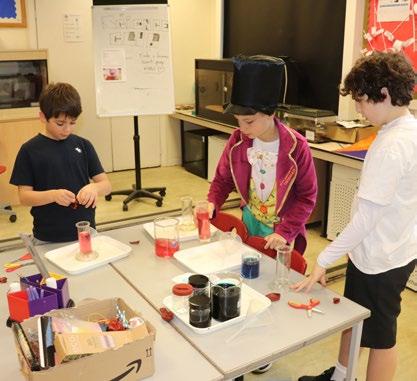
The Lower School had a plethora of options. All three Science (Biology, Chemistry and Physics) Departments hosted the Entry and Shell Science Clubs. Here, pupils had the chance to do experiments they may not have seen in class. Similarly, the Lower School Maths Club improved pupils’ numeracy with exciting puzzles and problems. In November the Maths Department held a House Maths Challenge, while the Faraday Engineering Challenge tasked pupils with designing a device to aid the James Webb Space Telescope.
Middle School had myriad possibilities. Three STEM-related Middle School clubs ran regularly: Middle School Chemistry Breakfast, Middle School Maths Society and Astrophysics Society. This section also took part in competitions like the National Scientific Think contest, the UKMT Intermediate Maths challenge and the Deme Chemistry competition. Furthermore, British Olympiads were organised for all three Sciences and Maths with impressive results. Finally, two pupils progressed to the interview stage of the Arkwright Engineering Scholarship programme.
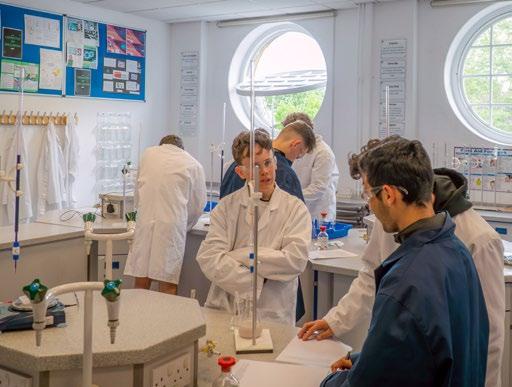
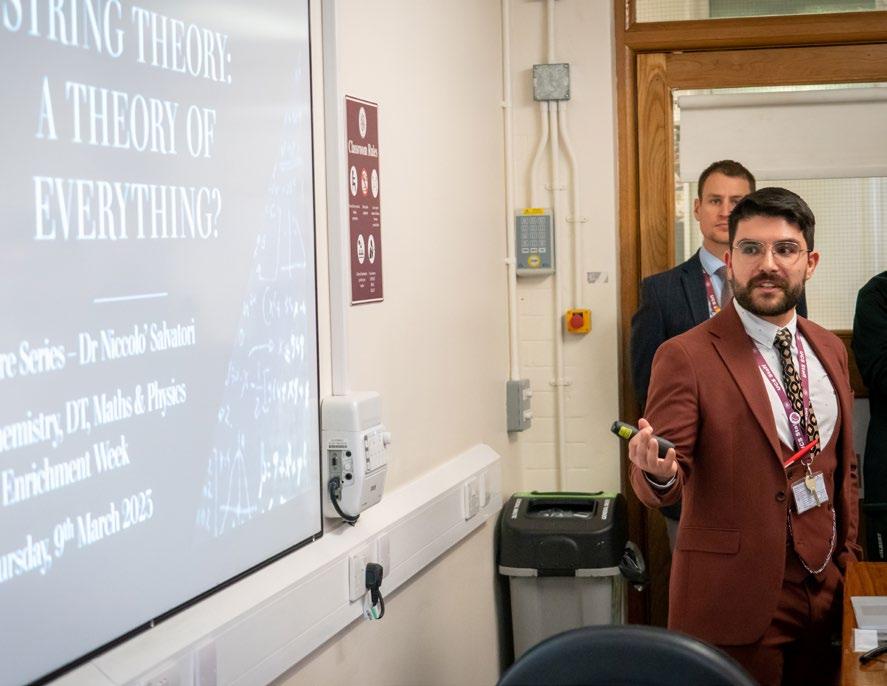
Enrichment opportunities were readily available to Upper School pupils too. All three Science Departments along with Maths arranged British Olympiads. Regular clubs and societies operated for Transitus and Sixth including Medical Ethics Society, Upper School Chemistry Breakfast and Pyrotechnics Club. Additionally, 30 Sixth Form pupils visited Geneva to tour CERN and get close-up experience of cutting-edge particle physics. Finally, this year’s Morris Lecture by Dr Salvatori on String Theory was particularly well received.
Science Week at Holly Hill
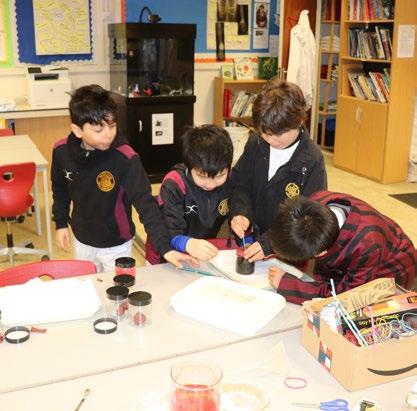
Science caught the imagination of Junior Branch pupils, whose scientific musings peaked during a Connections-themed Science Week. The action started in the Science Lab, with a special lesson in which pupils made hydraulics using syringes and a plastic tube. They then composed a rap about Science which they performed in assembly, with Mr Danvers and the whole school joining in! The boys were equally creative in making artificial heart pumps out of balloons, straws and jars. They cut off the bottom half of the balloons and
stretched the rest over a container full of water, then pierced it with two straws. Next, by pressing the middle, they caused the water to shoot out of the straws. A working heart! Science Week had its own dedicated assembly featuring an inter-House Science quiz. There were fun facts gleaned such as: the language used to classify organisms is Latin; and a sundial is an ancient version of a clock, using shadows to represent the time.
KAI IWAKURA, HUGO GRAHAM & JASPER WONG – YEAR 5
Space exploration in Science Dome
Years 5 and 6 added a galactic dimension to their learning when the Science Dome visited the JB. If the pupils’ first impressions were of a strange black hemisphere , once inside they experienced an amazing show. The “gigantic tent” was, in fact, a fully digital mobile planetarium. Its crew showed the boys all the planets and some of the 181 moons in the solar system. The darkness inside only enhanced the sense of wonder as the pupils observed fantastic and precise images of planets, galaxies and moons. The information presented was awe inspiring, including how NASA is going to build a space station on the moon called ‘The Gateway’; only 12 men ever have walked on the moon, all between 1969 and 1972; while Ganymede, the largest moon in the solar system, has six times more water than Earth.
CALLUM HILL – YEAR 5
THE SCIENCE LAB STAGED THIS ‘HEARTBEAT’-THEMED WORKSHOP IN WHICH PUPILS DISCOVERED THAT THERE ARE 37 TRILLION CELLS IN THE BODY MADE UP OF THREE TYPES OF CELLS: RED BLOOD CELLS, WHITE BLOOD CELLS AND PLATELETS.
Centre of the Cell comes to JB
The Centre of the Cell Science workshop was another fun-filled, curriculum-linked activity, this one teaching Year 6 about the organs and types of cells in a human body. The Science Lab staged this ‘Heartbeat’-themed workshop in which pupils discovered that there are 37 trillion cells in the body made up of three types of cells: red blood cells, white blood cells and platelets. Red blood cells carry oxygen around the body. White blood cells, part of the immune system, help combat things in the body that shouldn’t be there. Platelets help the blood clot to prevent blood loss after injury. An exciting animation illustrated how red blood cells travel through the body, and there was the revelation that even if it feels like your heart is in the top left of your body, it is actually in the middle.
GOLDBERG – YEAR 6
The Doctor calls
The Year 6s’ Science studies into the human body were enlivened by a visit from parent Dr Toni Hazell who talked about her work as a GP. Dr Hazell covered several topics including viruses, lungs, smoking and vaping. The pupils learned that doctors can see if you smoke by looking at your lungs and discovered how vaping is so addictive. Also, did you know that in 80% of the cases where doctors find out what’s wrong, the key is the patient discussing their health history?!
RAPHY COHEN & LEVI BEJERANO – YEAR 6
SEBASTIAN
Full STEAM ahead at Pre-Prep
STEAM is a subject to enthuse young boys –that’s without mentioning their beloved steam trains! STEAM covers Science, Technology, Engineering, Art and Maths and is embedded in play, exploration, curiosity, observation and questioning. The STEAM approach creates an effective strategy for acquiring skills and knowledge.
Yes, it does have a mechanical appeal and Year 1 examined a spirograph made from recycled bike parts while STEAM Club’s building expertise entailed making noisy circuits and constructing a greenhouse.
More artistic elements surfaced when Year 2 produced watercolour paintings of poppies for Remembrance Day and Reception tried their hand at still-life paintings inspired by Cézanne. Year 1’s foray into textile art involved learning how to weave while Year 2 discovered Ancient Greek mosaics but also enjoyed the modern designs of contemporary mosaic artist Jason Dussault.
Finally, it would be remiss not to mention pupil Arlo’s clay coral sculpture inspired by artist Courtney Mattison. Contributions
THE STEAM APPROACH CREATES AN EFFECTIVE STRATEGY FOR ACQUIRING SKILLS AND KNOWLEDGE.
Debating and public speaking
This was a hugely successful year for debating, public speaking and Model United Nations at UCS. Under the leadership of pupils Dylan Ireland and Rose DeLeon, debating inspired an altogether new level of enthusiasm among pupils.
There were encouraging signs as early as October when Jake Altmann reached the finals of South Hampstead School’s autumn public-speaking competition. As winter turned slowly into spring, our two most senior debating teams, consisting of Jake Altmann and Ronny Levy, and Oskar Gershfield and Jacob Shapiro, achieved a level of success that had evaded UCS contestants in recent years by reaching March’s finals day of the Oxford Schools’ Debating Competition.
This was a significant feat. Of the 36 teams participating in the competition’s West London regional round, our teams were two of the seven selected to progress to finals day, where they vied with 100 of the finest debaters from across the UK and as far afield as Singapore. After some impressive results against very tough opposition, our teams were unfortunate not to reach the semi-finals.
The close of the Spring Term brought a further exercise in rhetorical skills with the Transitus Public Speaking Competition. Inaugurated last year and
open to all Year 12s, this event had a field of 18 students who, in the preliminary heats, had to speak for three to four minutes on a subject of their choice. Topics were varied, including whether we should rejudge our relationship with caffeine, the possibility that the moon landings were faked, and why we shouldn’t be afraid of death.
From the heats, four finalists were chosen: Sophie Clapham (on trans rights and the Brianna Ghey murder); Maya Selby (the link between music and emotion); Jake Altmann (the tyranny of English spelling) and Titus Graham (the morality of corporal punishment). Each received extra coaching and help from Mr Pollock, with pointers on stage presence and the pace and structure of talks. The final took place in the Lund Theatre, where the stage crew’s lighting and staging served to create an excellent atmosphere.
All the finalists performed to a formidable standard, being well prepared, articulate and engaging, and leaving the judges seriously impressed by the overall quality. The winner, however, was Titus Graham for his speech on capital punishment. His cameo was extremely well structured, paced and emotive.
The debating season was rounded off by further success in March when Jonah Gold and Markus Chartouni won the South Hampstead School Junior Debating Competition.
Model United Nations, meanwhile, continued to be a popular extracurricular activity under the expert guidance of Adam Kassam. This year UCS
attended three conferences, at Halcyon London International School, St Paul’s School and, biggest of all, Haberdashers’ Boys. During these events, UCS participants showcased the school’s truly international outlook as our delegates represented such diverse nations as Qatar, Ghana, Iran and Mauritius. At St Paul’s, Adam Kassam and Minnat Mohammed won delegate awards, while at Haberdashers’ there were further prizes for Asher Hill, Jonah Howe, Maruf Samad, Jack Harding, Adam Kassam and Minnat Mohammed.
We continue to be deeply impressed by how eloquent and well-informed our pupils are and very much look forward to seeing how Model United Nations at UCS will develop next year under the captaincy of Benjamin Levene.
Overall, these activities are opportunities for students to share their views on important issues and to develop their public-speaking skills. They also get to learn from each other and to be inspired by the work of their peers. Contributions
Poetry
According to one poetic visitor to Frognal this year, the pupils at UCS have poetry running through their veins. Keep reading to find out why these words ring true.
UCS
Poetry Competition & Anthology
It was Philip Larkin who said “novels are about other people and poetry is about yourself”. While readers of Virginia Woolf’s poetic prose or Allen Ginsberg’s prose poetry might dispute this definition, it is hard to argue with Larkin’s claim that, above all, poetry is a personal endeavour. Indeed, the impulse to say something about ourselves is what compels so many of us to write poetry.
This year’s UCS Poetry Anthology, comprising the best 2022–23 competition submissions, is an impressive tribute to this process of turning private thoughts into public verse. It is a joyous and moving collection featuring pupils from every year group. As well as having their works appear in the anthology, our published poets delivered readings of their poems at November’s annual Poetry Evening. Particular congratulations go to the following competition winners, chosen by poet and guest speaker Joe Dunthorne: Sam Downs (Lower School); Finn Kjaergaard (Middle School); Taliah SpencerJacobs and Dylan Ireland (Sixth Form).
The JB showcased rich poetry–writing talent too, with beautifully written verses as well as confident presentations. Amid various themes, Year 3 wrote about the terrible business of witches and potions, using Macbeth as inspiration. Giulio Unti Fontana won in this category with his poem ‘The Death Poison Spell’. Year 4 had an upside-down back-to-front day for their poetry contributions. The winner here was Sammy Lavy with ‘Topsy Turvy Garden’. Year 5’s poems evoked creatures living in arid habitats, as Harry Prevezer prevailed with ‘Gila Monster’. Lastly, Year 6 had the topic of significant objects. William Lacey’s lovely piece about his teddy bear was a worthy winner.
Entry poets shine with ‘Lone Star’
Author, poet and sports consultant Peter Sanderson delivered a poetry workshop to Year 7 pupils. Mr Sanderson asked the pupils for their responses to the theme of ‘stars’ and, in the space of one lesson, they produced a mesmerising collaborative poem with a contribution from each boy. Pupil Tom said: “The poet structured the workshop around the idea of the galaxy and appreciating the natural world in all its beauty. The ideas and facts that the class produced alongside Mr Sanderson’s use of diction helped us construct the poem. The outcome was a beautifully written piece.”
MR SANDERSON ASKED THE PUPILS FOR THEIR RESPONSES TO THE THEME OF ‘STARS’ AND, IN THE SPACE OF ONE LESSON, THEY PRODUCED A MESMERISING COLLABORATIVE POEM WITH A CONTRIBUTION FROM EACH BOY.
Contributions from H. HARDINGHAM
S. D. B. HALL
T. HALL – ENTRY
Mr Sanderson added: “The class were keen to work with a subject about the natural world, so we chose to create a poem around a lone star twinkling in the night sky. I gave the class the first two lines and told them to close their eyes and look deeply into their hearts to feel what the star said to them. They spoke to their partner and they all wrote one or two lines about the star. Clearly, UCS pupils have poetry running through their veins!”
Lone Star
Amidst the velvet night’s embrace,
A lone star winks at me with grace, Marmoreal shine,
Like a blinding beacon outside space and time, For when a star shoots, she dances like silk without a trace. Beckoning us to run and prance at her with pace, Yet within my bosom,
My whole heart yearns to taste this galactic power, Drink the sweetest nectar which lies within her cosmic flower, Her infinite alluring hold, like the endless sky,
Her mystery enduring, behold, a beautiful treasure, like a gentle lullaby, Her wonder and beauty beyond comprehension, Aaaaaaaaaah,
Thank you sister star,
No words or dreams can touch her magnificence, Shining bright on a dark blue sky night, While grandmother moon shimmers silver beside her, rising high, pondering her plight. An elegant blaze,
A white hot diamond, Silently burning, So vibrant,
Shining and glistening, all the night, Never threatening to hurt or fight,
A fiery serpent in the sky,
A fading glimmer about to die,
Sailing towards the invisible ocean of the day, She steps aside like a smiling ghost, Giving grandfather sun the chance to let his music play.
Amidst the velvet night’s embrace, That same lone star winks at me with grace, In the twilight hours, she rises again, Her radiance spreading like an angel’s train,
A tiny fragment in a mighty constellation, Like a buddha on a Tibetan mountain deep in contemplation, Born in a flurry of night and dark, The blazing beacon making her mark, Upon the eeriness of the darkness, A glint of hope in the sky which for some can seem so black, Flourishing and honouring her sacred pact. In her shadow, Gloomy and dull like a murder of crows, In her light,
Part of the glorious orchestra high in the heavens transcending our every woe, Another world full of life and miracles beyond all the clouds, By night so bold and brazen, By day so shy,
Just barely visible in the sea of darkness, yet perfect and proud. Her light, dashing through the starry painting of the night to illuminate many worlds, The heartbeat of the multiverse, Pulsing, pulsing, pulsing, Harsh white light, seeping through into my weak body, A pebble to this giant, Her power unmatched, Then darkness, All-consuming pressing in on me, Oh lone star, Fading, fading, fading. Time to let her be.
EBAN
Stand Out Work
In keeping with tradition, this edition of The Gower showcases examples of standout work by UCS pupils. This year’s sample reflects the breadth of a UCS education by incorporating diverse subjects including, for the first time, Maths problems... and solutions! We hope you enjoy them.
The Wicked Witch
The petrifying, decaying, monstrous creature blundered through the dense, misty forest like an enormous herd of African elephants. This disgusting, slimy beast had a bulky body that was as ginormous as a tree looming over the dark, foggy forest. Her dirty, grey, straw locks whipped through the speedy wind like runners at the Olympics. Perhaps most revolting of all was her tree-bark face, covered in grotesque warts that were bursting with congealed puss. The devilish villain wore smelly, old rags, while her glare radiated out of her red, berry eyes like solar flares speeding from the sun. Even more disturbing was the green, mouldy spit that ejected horribly out of her mouth like erratic cannonballs. Though her ghastly appearance might make children’s skin crawl, it was actually her personality that would make them faint in horror...
ADVAIT CASTURI – 3W
Finding the square root of the square root of -1
In the first lesson of Further Maths, we discover that the square root of -1 is i, but what is the square root of i?
√i = ?
√i = a+bi
(√i)2 = (a+bi)2
i = a2+2abi+(bi)2
(bi)2 = b2 x i2 = -b2 ∴ i = a2+2abi-b2
(0)+(1)i = (a2-b2)+(2ab)i
Comparing coefficients:
a2-b2 = 0
2ab = 1
2ab/2a = 1/2a
b = 1/2a
a2-(1/2a)2 = 0 ∴ a2-1/4a2 = 0
(4a4-1)/4a2 = 0 ∴ 4a4 - 1 = 0 ∴ 4a4 = 1
a4 = 1/4 ∴ ∜a4 = ∜1/4 ∴ a = ±1/√2
When a = 1/√2:
b = 1/2(1/√2) = 1/√2
When a = -1/√2:
b = 1/2(-1/√2) = -1/√2
∴ √i = ±1/√2±(1/√2)i
How far was Truman responsible for the start and development of the Cold War between 1945 and 1953?
Although Truman and his supporters claimed that his foreign policy was a defensive response to Soviet Expansionism, it resulted in severe escalations in the course of the Cold War. The policy of containment made long term cooperation with the USSR impossible, and although the USSR had ruled out permanent coexistence on ideological grounds, the rapid deterioration of relations stemmed in large part from US actions. The Soviets also made fundamental misjudgements as to Truman’s willingness to confront the consolidation of the Soviet bloc, and to defend US interests, as in Korea and West Berlin; which led to further developments of the Cold War. However, many of the factors which contributed to the development of the Cold War were out of the control of either Superpower.
The Truman Doctrine and policy of containment was one of the primary factors in the development of the Cold War. Truman, unlike Eisenhower, saw the USSR as a fundamentally expansionist and imperial power that needed to be contained. As a consequence, conflicts such as the Greek and Chinese Civil Wars (1946-49) were interpreted as part of a Soviet policy of expansionism, despite a lack of evidence. In the case of Greece, the USSR had adhered to the percentages agreement between Stalin and Winston Churchill, and had not intervened in support of the Greek Communists. Truman’s analysis of the Greek Civil War was influenced by opinions in the US Government, which cited the traditional Russian imperial interest in the straits of Bosphorus as a factor in Soviet foreign policy, and of Greece as
JAMES MAN – TRANSITUS
a pawn to control the straits. However, Soviet policy in the Balkans was mainly focused on attempting to bring Yugoslavia into line with the CPSU, as opposed to spreading revolution into other spheres of influence. Similarly, as the Chinese Civil War progressed, the success of the Chinese Communists was blamed on the support of the Soviet Union. However, the Soviets had signed a treaty of alliance and friendship with the Chinese Nationalists, and supported a compromise position which would have divided the country at the Yangzi river. The basic justification for the Truman Doctrine from 1947 onwards was thus based on a number of false assumptions. However, Truman cannot be entirely blamed for this. The Soviet occupation and consolidation of Eastern Europe from 194548 suggested that communist parties throughout Europe still took direction from the CPSU, despite the dissolution of the Comintern. The armed uprising of the Greek Communists was therefore not unreasonably identified with a contiguous communist strategy. There was, without access to the highest levels of CPSU decision making, no way to reliably confirm the Soviet position on Greece. The US intervention in Greece and Turkey was also a reaction to the decline of British influence and power projection in the Mediterranean. Furthermore, the American analysis of the so-called “Fall of China” was more informed by the domestic reaction than by the actual Soviet involvement. Republican lawmakers in particular criticised the perceived failure of Acheson and Truman to defeat the Chinese Communists, which pressed them to pursue a more hardline enforcement of containment in Korea. Truman’s foreign policy directly led to escalations of the Cold
War, but only when combined with incomplete information and a strong domestic pressure to respond to the USSR.
The USSR also contributed to the development of the Cold War through its foreign policy. Despite nominally agreeing to free and fair elections in the Soviet Occupied areas of Eastern Europe, the Soviets organised the de facto takeover of Communist parties either through force, as in Czechoslovakia, or by creating front parties and organisations, like the SED/ National Front in the DDR. This was perceived as an expansionist move by observers in the United States, demonstrating an ideological incompatibility between liberal and communist political systems. Stalin also rhetorically reinforced this idea in his speech at the Bolshoi Theatre in February 1946, which blamed the World Wars on the repeated crisis of capitalist systems; implicitly suggesting that there could be no prolonged coexistence between socialist and capitalist systems. The USSR also made moves that were openly hostile to Western interests, while underestimating the American willingness to defend said interests. The Berlin Blockade was based on an assumption that the Western powers would be both unwilling and unable to force a potential confrontation with the Soviet Union; an underestimation of the strength of the former and overestimation of the latter. The escalation of the airlift and blockade was unlikely to have been predicted by Stalin. In the Korean Civil War, the Soviets kept a deliberately low level of intervention to reduce the chances of direct confrontation.
Throughout the period in question, Soviet foreign policy exacerbated the contradictions between the
US and USSR, but avoided full-scale direct confrontations where there were opportunities, as in Greece and Korea.
Much of the responsibility for the start and development of the Cold War cannot be clearly assigned to either the US or USSR. The structure of international treaties and agreements postwar left numerous contradictions and uncertainties which contributed to the Cold War. The agreements at Yalta and Potsdam were sufficiently vague that while the USSR viewed their postwar actions in Eastern Europe as justifiable, the Americans distrusted them; the end of the war meant the end of personal diplomacy and alliances of convenience, exposing differences in interest. Furthermore, institutions such as the new United Nations Security Council considerably overrepresented the capitalist countries. Out of the other Permanent Members of the UNSC, two were effectively subjected to US foreign policy (UK and the ROC), and one was closely aligned through NATO (France). The very creation of NATO in 1949 demonstrates the lack of faith in institutions like the Allied Control Commission to ensure peace. In the absence of a common enemy, the ideological and practical division of the world became apparent. This also reflects the chaotic world situation that prevailed immediately postwar. The war had destabilised the structures of power, particularly in colonial Europe. Both resistance to and collaboration with Japanese Imperialism had led to the strengthening of anti-colonial forces, and open resistance to the return of European colonisers. The dependence of powers like France on colonial troops had also led to growing nationalist sentiments in North Africa. Destabilisations of colonial order also corresponded to increasing
fear of communism as an equivalent force in the metropole. The utter destruction of much of Europe and the immiseration and displacement of its peoples was seen as a perfect breeding ground for communism. In this light, Truman’s decisions to launch the Marshall Plan, to contain the USSR and to defend US interests abroad appear quite natural, as do the interpretations of every action as part of a broader Moscow directed Communist plot. A significant portion of responsibility can thus be assigned to the degree of destructiveness that WW2 entailed, and the bipolar division of the world established during the war.
While it is certainly true that Truman’s foreign policy contributed in large part to the beginning and development of the Cold War, the blame cannot fully be assigned to him personally. US decisionmaking suffered from a lack of full information about Soviet policies and actions, and consequently they were viewed through an ideological lens. It was assumed that the Soviets held a maximalist position, which to some degree they did, and the Americans pursued a confrontational policy to a high degree. This also must be viewed within the context of shifting social structures in the aftermath of the war, which interlocked with ideology. The blame for the Cold War can therefore be blamed fully neither on Truman nor Stalin/the USSR.
JAMES TAN-KHOO – SIXTH
A Fork in the Road
A barren monolithic rock stood alone with marks made from time. The etching seemed ominous in a way. Adam heaved a laboured sigh. His limbs felt like two cooked noodles. He could see his breath curling up like smoke from a kindling fire. Splitting off from the main road were two paths. His backpack was feeling like somebody had dumped a dead weight on him. His feet were literally freezing. Should he go ‘safe’ with the left path or take risks with the right.
He was already regretting his decision; the right had seemed more hopeful with more chance of rest. His leathery map had shown a safe but excruciatingly long road (about four hours’ walk) leading to a small town to the left and a hilly road with houses dotted along it. Looking up, he could see the sky darkening and to the horizon it seemed as if the snow was touching the land. A storm was brewing. Tall trees swayed, almost mocking his efforts. Gusts of wind spewed snow into his face, playing with his hair. As the wind picked up and the snow swirled around, he stumbled blindly like in an intense game of ‘Marco Polo’ reaching for shelter. He tripped and fell and hit something hard. The suffocating darkness was too much. It was too much work, too much work… then he thought no more.
When he woke, he heard the lullaby of birds. It felt calming, like somebody was gently rocking his crib side to side. He felt at peace with the world, as though he had just opened a door to a different life, a different time, a different world. Everything was spinning like a kaleidoscope of colours flashing before his eyes. Birds sang around his head; stars started to
appear. A cacophony of thoughts flashed through his brain. The snow, storm, crash and cold. The cold. He needed a fire, a warm fire. Checking in his pocket for his flint and steel, all he felt was the flint and the severed end of the rope. Crawling around the small cavern he touched something circular but oddly wet. Turning on his loyal torch he saw something he did not want to see. He screamed. A bone soaked in the poor victim’s blood. Fortunately, he managed to find a twisted steel rod among lots of other bones. Adam managed to put all the bones into a corner and create a spark.
“I remember the day where I decided to take the ultimate test of strength and show my worth. Oh, how wrong it had gone. The fight. The argument. His words. They stung like someone was poking a hot iron rod into my chest, burning my flesh away. The team. The gun. The asset. We only had one job. We failed. Protect the commander. The fateful bullet that went through the man’s chest like butter. I had to leave.”
Something was crawling, no, slithering over his unprotected, naked stomach almost inviting a bite. Using his training, without moving his tummy he reached for his torch. Remembering his breathing, he flashed the torch at the opposite wall and saw a slithering mass of a snake. He almost screamed. Its scales were colourful, and this could only mean one thing. The snake was poisonous. One bite could decide his fate. Somehow he had to break its fangs. Looking closer at the snake he identified its head. All he had to do was grab its head and rip the fangs out. He only had one chance. He had to take it now.
Lunging for the neck he grabbed the snake and pinched right behind the eyes, opening its mouth. Adam could see the shiny dripping fangs lolling out of its thin head. Reaching for the first, he curled his index finger around and yanked the first fang out with a satisfying crack. Reaching for the second he pulled but his finger slipped, nearly spearing his finger on the fang. A close call. Recovering his composure he repositioned his finger and yanked the second. Now standing up, he pushed the defeated snake to the ground and rammed his foot into the floor.
‘Millions in Africa are poorer today because of aid; misery and poverty have not ended but increased’ – DAMBISA MOYO. What do you think
Foreign aid is defined as the international transfer of capital goods or services from a country or international organisation for the benefit of the recipient country’s population (AfroPolitical TV, 2020) . It is often provided by developed countries to less developed countries with the goal of promoting economic development and reducing poverty. It is important to recognise the advantages of aid as it can provide critical support to communities facing extreme poverty, via the provision of basic needs such as food, water, and healthcare, enabling them to improve their quality of life and achieve greater self-sufficiency. However, not all aid programs are effective, and some have even been criticised for perpetuating misery and poverty. Dambisa Moyo, a Zambian economist, raises important questions about the effectiveness of aid programs in Africa, and whether they are contributing to, or alleviating, poverty and hardship. Statistics paint a bleak
picture of poverty and misery in Africa, with more than 34% of the population living below the poverty line with widespread food insecurity, disease, and conflict (UNCTAD, 2021). Despite decades of foreign aid, harsh conditions continue to persist, and many African countries remain mired in economic and social instability. It’s also important to consider that Africa is a vast and diverse continent, and thus, generalising the impact of aid on its entire population can be misleading. The contents of this essay will discuss the impact of foreign aid on misery and poverty in Africa, exploring the arguments presented by Zambian economist Dambisa Moyo and other experts in the field. The essay will also explore foreign aid’s role in reducing poverty and promoting development in Africa, along with alternative approaches.
Many components contribute to the assertion that “millions in Africa are poorer today because of aid,” and one significant contributing factor is the ineffective allocation of aid resources. Critics argue that aid to Africa is often misallocated, with funds not reaching the most impoverished communities and instead being stolen by corrupt government officials or intermediaries. For example, a report by the African Development Bank found that between $148 billion and $192 billion of public procurement funds in Africa are lost to corruption each year (African Development Bank, 2015). Furthermore, according to the Centre for Global Development, one-third of aid to Africa is subjected to corruption that is discoverable and sanctionable (Charles Kenny, 2017), highlighting the large extent to which aid is misused. This misallocation of funds undermines aid’s intended impact, and may even be exacerbating existing problems. For example instead of the aid improving Africa’s
NICOLAS NAVARRO-BALLOCH – 6C
schools, healthcare, and infrastructure the aid is often syphoned off by government officials, therefore perpetuating existing wealth disparities and in turn exacerbating already high inequality rates in the region. To summarise, although aid in Africa is for positive purposes it can have negative outcomes due to its inadequate allocation. Furthermore, wealthy African officials syphoning off aid worsens socioeconomic issues and inequality rates in Africa, ultimately highlighting how aid in Africa can be more negative than positive.
Similarly, another reason why millions in Africa become worse off from aid is due to ineffective aid programs. Many aid programs are not tailored to the specific needs and contexts of African countries, and may not have a significant impact on reducing poverty or promoting economic growth. For example, a study of aid programs in sub-Saharan Africa found that many were focused on short-term, top-down approaches that did not take into account the local context or the needs and perspectives of the communities they were intended to serve (Oxford Policy Management, 2015). This can lead to a disconnect between aid programs and the people they are supposed to help, ultimately reducing their impact on poverty reduction. For instance, the construction of the Merowe Dam in Sudan is an example of a top-down approach that failed to consider the local context and community needs, leading to displacement, loss of livelihoods and increased poverty (MDPI, 2021). These ineffective aid programs not only fail to help recipient countries, but also allow donor countries to profit from giving. This can be seen through the fact that for every dollar of aid rich countries give to poor countries they receive between
7 to 10 dollars back through debt repayments, profit and trade. Furthermore, the UN conference for trade and development reveals the net transfer of wealth is £200 billion per year from poor to rich countries highlighting how international aid can harm recipient countries, rather than help them (Maliha Christhi/ TedX, 2022). To summarise, ineffective aid programs do not address the specific needs of African countries and can ultimately lead to the transfer of wealth from poor to rich nations, therefore, highlighting how it not only does not help the receiving countries but can also make the socio-economic situation worse. Furthermore, aid is never truly altruistic, often driven by motives such as soft power or strategic influence, ultimately highlighting how it’s never given ‘for free’.
However, despite some small-scale drawbacks, overall the impact of aid on Africa has been overwhelmingly positive as it has led to significant improvements in areas such as education, healthcare, and access to basic services. Firstly, aid has increased the enrollment of children in schools and improved the quality of education. According to UNESCO, between 1999-2017, aid helped to increase the net enrollment rate in primary education in sub-Saharan Africa from 61% to 78% (World Bank, 2022). The increased education has helped to lay foundations for a better future for these children by creating a more skilled workforce which in return increases the output (GDP) of Africa. Furthermore, creating more jobs and revenue, thus ameliorating poverty. Similarly, in the health sector aid has played a critical role in expanding access to basic health care services, reducing maternal and child mortality, and controlling the spread of communicable diseases such as HIV/AIDS. According to the World Health
Organization, (between 2000-2018), aid helped to reduce the maternal mortality ratio in subSaharan Africa by 34% (WHO, 2019), meaning they conquered the millennium development goal of maternal mortality and thereby also decreased misery (the pain of losing a child) within the region. Lastly, aid has helped to improve access to clean water, seen through the World Bank which published that (between 2000 -2015) aid helped to increase access to improved water sources in sub-Saharan Africa from 57% to 68% (OECD. 2023). Conversely, although these statistics highlight advancements in Africa’s living conditions there is no clear evidence that the improvements have stemmed from aid. Furthermore, the enhancements could have been sourced from a myriad of other factors such as globalisation, development, or the efforts of local communities.
Likewise, despite the challenges of poverty in Africa, aid plays a crucial role in preventing further damage during emergency situations and poverty would therefore be more severe without the implementation of aid. Aid is particularly important in the context of natural disasters, where communities can be devastated and require immediate support to recover. For example, in 2020, Cyclone Idai caused widespread damage in southern Africa, affecting millions of people. Aid organisations responded quickly to provide emergency assistance, including food, water, and shelter, to over 1.7 million people (United Nations, 2019). This assistance helped to prevent further loss of life and reduce the negative impact of the disaster on affected communities. For example, aid organisations were able to provide clean water reducing the risk of waterborne diseases, shelter to the homeless, and medical treatment to treat tens of thousands of injured
people. Moreover, the provision of aid allowed affected communities to rebuild and improve their living standards, drastically reducing the poverty that would have been induced by the cyclone. To summarise, as seen through the example of Cyclone Idai, aid plays a crucial role in preventing further damage during crises in Africa. Furthermore, the examples highlight its significance in preventing further loss of life and stimulating recovery, ultimately reducing the potential misery and poverty endured in future years.
In conclusion, Dambisa Moyo’s claim that ‘millions in Africa are poorer today because of aid’ is partially correct. In theory, aid should be imperative to Africa and could lead to significant improvements in education, health care, and access to basic services. However, if not implemented correctly, via inadequate allocation of resources and ineffective programs, aid can have no effect on Africa’s poverty and can even exacerbate the situation. Ultimately, to maximise its impact, aid programs need to be well-designed, properly implemented, and tailored to the specific needs and context of African countries. Finally, it is important to discuss other alternatives of foreign aid (aid where money is not just simply given to a country) which are immune to corruption and do not lead to worsening poverty. An example of a more sustainable aid alternative is an investment in education and skills training for the African population. Investing in education and skills training can help people to acquire the expertise and knowledge they need to get better jobs and earn higher incomes, therefore helping to increase economic growth and reduce poverty over the long term.
OLIVER SHAW – TRANSITUS
If I Were King
SHREYAN ANGADALA – PRE PREP – RECEPTION
NEIL SURU – PRE PREP – YEAR ONE Oliver’s Vegetables Story
Middle Aged couple cut off by the tide
On Saturday 8th July a middle-aged couple were plucked by hovercraft from the jaws of hungry seals on wreck sands at Brancaster, Norfolk. They had been stretching their legs when the tide cut them off. A Hunstanton hovercraft arrived to pick them up. Marjory Shields and her husband, Mark Shields, both doctors of psychology and Londoners, had left their children, aged four and five, with some friends namely Lord and Lady Hall of Brondesbury .
Lady Emma Hall then received a call from Mrs Shields saying that they were stuck on an island and the tide was rising. “The water was gushing in fast and there were these seals flopping about and circling us and they were very threatening. We called Emma because the spit of land was becoming very small and we were worried one of those horrible seals would get us,” said a rattled Marjory.
“It was a nerve-wracking moment when I received the call,” said Lady Hall afterwards. “We were two miles up the beach and we had their children with us. Marjory didn’t want us to call the coastguards. I didn’t know what to do for the best, they were running out of battery and their phone was nearly dead with the tide coming in. Luckily I made the right decision and made the call.”
The on-duty coastguard said: “Coastal fog in the area is known to sweep in suddenly and disorientate tourists. Locals know the danger signs but tourists don’t. Only last year we lost a five-year-old boy, Jake Parker, to the sea. So we took this event very seriously
and the hovercraft was deployed. We had already been called out once on the day. We are usually busy about this time of year.
“When we rescued them the tide had risen, almost consuming the island, and the seals were quite agitated. One had even bitten a bit of Mr Shields’ trousers.” The couple had no injuries, however, getting off lightly from what could have been a deadly situation.
WILLIAM LACEY – 6C
Teachers’ further study
The field of education constantly evolves as new knowledge and teaching methodologies emerge. Therefore, teachers must develop their skills and knowledge, and the opportunities for them to engage in professional development at UCS are extensive and diverse. Since the development needs of each teacher differs according to experience, subject and professional interests, our professional development programme is deliberately personalised, allowing significant autonomy.
Professional Development Portfolios (PDP)
Professional Development Portfolios are a unique, progressive and non-hierarchical approach to supporting teachers’ professional development. All staff are expected to complete a PDP, except those in their first year at UCS, Newly Qualified Teachers on their induction year and those undertaking the apprenticeship teacher training programme or a Master’s qualification. Teachers are free to decide on their topic, mentor and how they wish to share their PDP progress. Typically, colleagues have published research, created resources, presented at TeachMeets, even delivered staff training at UCS and partner schools. While there is no prescriptive format, staff are expected to reflect on and discuss their PDP during appraisal meetings.
Rebecca Potter
Best practice through lesson observations
“This year, I observed lessons in Politics, Chemistry, Biology, Maths and Physics. The focus was teaching excellence and, unsurprisingly, I found a wealth of this at UCS. While every teacher had their own style, the common features were excellent teacher-student rapport, high expectations of behaviour and participation, high level of respect between peers, regular teacher feedback and clear routines embedded into each lesson. One particularly effective technique was asking students to analyse anonymised pieces of their peers’ work.”
Courtney Sklar Development of creative writing skills
“I became more serious about my creative writing in 2021, being accepted into Faber & Faber’s ‘Writing Academy’. It is thrilling to put your work out in the world for people to read, and the positive experience I had gave me the idea of setting up the Creative Writers’ Café at UCS. This is a truly safe and free creative writing space that allows pupils freedom of expression coupled with tangible skills and techniques to enhance their writing. I will continue to run Creative Writers’ Café and am considering completing a Master’s in Creative Writing.”
Peter Edmunds
The contribution of whole school cultures to achievement
“My PDP was investigating the role of whole school cultures on student attainment. I visited a local boys’ grammar school with a day of observations focused on the language that teachers used and the independent learning
habits of students. While replicating a culture is difficult, there were aspects I could take back into my day-to-day teaching. For example, I noted how pupils were encouraged to research their own answers to their questions – being asked questions like ‘if we were a strong independent learner, where would we find this information?’. This enabled them to practise their independent learning.”
Further study
As part of the professional development package at UCS, there is funding available to support colleagues in pursuing further academic studies. We currently have six staff members undertaking higher degrees or courses. While it is a significant challenge to combine the academic rigour of postgraduate studies with teaching, those who have done so have found the experience beneficial and rewarding.
Keith
Bugler
MSc
Learning and Teaching, Oxford
“I am in the second year of a Master’s in Learning and Teaching, with two research projects to complete over two years. My first explored student motivation; now I am focusing on feedback strategies. With Google Classroom, teachers can deliver typed feedback or record voice-clips of up to five minutes using a plug-in called Mote for student homework tasks. My research investigates how pupils respond differently to recorded verbal feedback via Mote compared with more traditional written or typed feedback. This is difficult to measure, so through surveys and interviews I have tried to qualitatively measure their perceptions on both feedback methods and monitor if this has shifted over time.”
Emilia Orlans Advanced Diploma in Educational Psychotherapy, Caspari Foundation
“I am studying for an Advanced Diploma in Educational Psychotherapy. The first year covered theoretical concepts with trainees encountering, through reading, seminars, lectures and essays, seminal works of Sigmund Freud, Melanie Klein, Anna Freud, Donald Winnicott, John Bowlby and Mary Ainsworth. I study alongside experienced teachers and an Educational Psychologist, and we discuss and explore the theories in light of the insight they may provide into an individual child’s experience of their learning environment. The course leads to full clinical membership of the UK Council for Psychotherapy as an Educational Psychotherapist.”
Adriane Martini MSc Teacher Education, Oxford
“The MSc in Teacher Education is a professional development course combining practical training for educators with applied academic research. An integral component of this course is its practical orientation, requiring active involvement in training fellow education professionals in various capacities. For example, I developed an inquiry task gathering valuable insights from teachers on the efficacy of homework as a means to enhance learning. This research formed an integral part of the homework review at UCS, leading to policy adjustments that will be incorporated into the upcoming staff CPD programme.”
Philippa McIntosh MA Education, Bath
“I am in the final year of a Master’s degree in Education. The course consists of five modules, followed by a dissertation. As I am an Early Years Teacher, this is where my research has been focused. My first assignment centred on education in an international context, looking at how the Early Years Foundation Stage Curriculum is applied in different educational contexts abroad. I have also carried out research into the role of iPads in enhancing learning, looked at how gifted and talented pupils can be best supported in the early years classroom and most recently undertook research exploring how boys learn to write. I am currently beginning my dissertation on metacognition in the classroom.”
A Year in Research at UCS – from theory to practice
In the ever-evolving educational landscape, research plays a pivotal role in shaping the future of learning. With a focus on evidence-based practices and diverse methodologies, educational research at UCS seeks to address pressing challenges and uncover new insights to improve educational outcomes for pupils. This year we focused on investigating the impact of homework on student achievement. We reviewed a great amount of academic research and carried out internal data collection of staff and student perspectives on homework. Findings suggest homework at UCS is generally welldesigned, purposeful and aligned with classroom instructions. Most pupils seem to understand
and value the work set. The full research and a proposed framework to refine homework practices were shared with staff across the foundation in our first in-person TeachMeet of 2022–23, hosted in the Junior Branch. The review will also be published in the next edition of the UCS Research Review.
As Head of Research at the Senior School, I greatly appreciate opportunities for dialogue with colleagues when it comes to exploring ideas;
Joe Jones and Charlotte Carter, leading educational research at the JB and Pre-Prep, are especially important collaborators. A highlight of our efforts is the termly Journal Club, where staff members from various departments and levels of experience gather to share their thoughts on academic research in education and discuss pioneering articles. Such collective contributions make for a holistic, all-through perspective that would be impossible if we worked in isolation.
Contributions from P. MILTON
A. MARTINI
For the love of reading
Reading has the power to transform lives, so it is incumbent on educators to encourage young people to partake of this always relevant, accessible and exciting activity. In our fast-paced digital age, it is more important than ever to promote reading. And where better for children to learn the ‘organic’ way than in a library – that time-honoured space for intellectual exploration.
The Senior School’s AKO Centre library champions a love of reading for pleasure as well as supplying resources to support the curriculum and providing a place of study. It is well-stocked with the latest fiction to tempt the most reluctant reader. Its librarians readily help pupils and staff find their next read, while library book clubs offer a forum for lively discussion about books and a chance to try new authors.
“I enjoy being in the book group because there are interesting group discussions every week and it challenges me to explore new genres,” said Year 8 pupil Barnaby Lester, with Edoardo Saxby from Year 10 adding: “Book group encourages me to read a wide variety of novels and introduces me to genres I would otherwise not know. It also allows me to get involved in debates on characters and topics.”
Nurturing a love of stories starts young. Lower School pupils have the opportunity to read stories to Pre-Prep boys in the library each week. “Coming to the library is a highlight of the week for many Reception children,” explained Ms Stratton of the
Pre-Prep. “The older pupils read with enthusiasm and humour and our boys gain so much from the experience. They feel ‘grown up’ visiting the library and say it makes them feel calm.” Likewise, the Pre-Prep and Junior Branch libraries strive to engage young minds with a broad range of literature, from captivating fiction to informative non-fiction. Everything from Enid Blyton’s Secret Seven to Shakespeare.
One special feature at the Pre-Prep is that children have the possibility to access the library themselves and select new reading books to take home on a daily basis. To this end, the shelves are filled with books catering to all reading levels, subject areas, genres and authors, each carefully organised following a child-friendly colourbanded reading scheme.
What’s more, tailored book collections for each half-termly topic studied allow pupils to delve deeper into themes explored in class. The alignment of library and curriculum enhances the learning experience and invites children to investigate further through books.
A library involves much more than books, of course. The AKO Centre houses reliable online resources ranging from Encyclopaedia Britannica to university-level databases such as JSTOR. Librarians also offer one-two-one research support to those undertaking research, most notably coursework or the EPQ. Similarly, the ‘Research Pod’ in the Pre-Prep library helps pupils access books that facilitate research projects in History, Science and Geography, promoting independence and inquisitiveness.
“THE OLDER PUPILS READ WITH ENTHUSIASM AND HUMOUR AND OUR BOYS GAIN SO MUCH FROM THE EXPERIENCE. THEY FEEL ‘GROWN UP’ VISITING THE LIBRARY AND SAY IT MAKES THEM FEEL CALM.”
Further down the school foundation, library sessions are cherished moments where children’s curiosity is nourished, and their passion for reading and learning kindled. Therefore, there are many initiatives aimed at developing pupils’ sense of ownership and responsibility in relation to reading. Staff work hard to spark their imaginations and expand their literary horizons.
World Book Day
No two days are the same in a library but annual highlights include the gifting of a free book to every Year 7 boy during the autumn, January’s Charity Book Collection… and World Book Day. While the Senior School observes this yearly event with a dedicated competition, for the younger pupils especially it is an occasion for dressing up. This year at the Junior Branch there were many weird and wonderful costumes on show, with assembly a particular joy as the boys paraded into the hall disguised as their favourite literary characters.
Year 6 pupil Raahil Koshy said: “We asked all the teachers what they were dressed up as, because there were lots of fabulous costumes. I liked Mr Lall-Chopra’s Spiderman outfit!”
Visiting children’s author David Solomons also delivered writing workshops, and the boys responded fantastically. Years 4 and 5 benefited from David’s pearls of comedic wisdom, studied funny-sounding words and examined character
“WE ASKED ALL THE TEACHERS WHAT THEY WERE DRESSED UP AS, BECAUSE THERE WERE LOTS OF FABULOUS COSTUMES. I LIKED MR LALL-CHOPRA’S SPIDERMAN OUTFIT!”
RAAHIL KOSHY
Year 6
and place juxtapositions. Year 3 painted beautiful pictures of Pooh Bear; Year 6 added narration to films they were editing.
“David told us about the structure of writing a book. We got into groups of three and came up with our own stories, like about a person trying to eat a world made of McDonald’s or somebody flushing themselves down a toilet and getting a golden apple! Then everyone got on with their lesson in their costumes,” added Year 4 pupil Brendan Quirke.
All such activities foster a love for books and learning. Just as every Pre-Prep classroom contains a cosy reading corner where books are regularly refreshed, so World Book Day ensures a guarantee of enjoyment for readers. Nurturing environments where children can immerse themselves happily in stories and subjects are paramount if we are to balance the digital and the ‘analogue’ when it comes to pupils’ intellectual development. As Year 11 pupil Finn Kjaergaard commented: “Sometimes there is nothing more peaceful than a lunchtime spent talking with friends about a book.”
“DAVID TOLD US ABOUT THE STRUCTURE OF WRITING A BOOK. WE GOT INTO GROUPS OF THREE AND CAME UP WITH OUR OWN STORIES, LIKE ABOUT A PERSON TRYING TO EAT A WORLD MADE OF MCDONALD’S OR SOMEBODY FLUSHING THEMSELVES DOWN A TOILET AND GETTING A GOLDEN APPLE! THEN EVERYONE GOT ON WITH THEIR LESSON IN THEIR COSTUMES,”
BRENDAN QUIRKE
Year 4
Contributions from P. DAVISON
S. HALL
S. RYAN
EPQ
The Extended Project Qualification (EPQ) is an opportunity for older pupils to undertake a piece of extended research on a topic of their choice. UCS students start the course in the Transitus and finish it in the Sixth. It involves finding relevant scholarly literature from different perspectives, summarising and evaluating it, and arriving at a balanced answer to the research question. To be successful, pupils must write an 8,000word dissertation and give an oral presentation, among other things.
In November 2022, Sixth students submitted their dissertations. They had researched a diverse range of topics, including whether selective education is counter-productive, whether the Lesotho Water Transfer Scheme was successful, and whether the ‘final girl’ can be seen as a figure of female empowerment. On the basis of their presentations in December, the pupils clearly had in-depth knowledge of their subject areas and were able to convey their interest authoritatively. To complete an EPQ in only seven months while continuing to study for three other A Levels is no small feat. A new group of students in the Transitus started the EPQ before the summer, and their project titles looked to be as topical as those of their predecessors below.
Tanya Kendix
Should voice assistants sound like humans speaking with a ‘standard’ accent?
My project found that voice assistants should not sound like humans speaking with a ‘standard’ accent. Rather, the optimal voice design for both user experience and ethicality is an intentionally roboticsounding voice that uses a ‘standard’ accent. The main argument supporting this is that technology should be used as a vehicle by which social issues can be addressed and reduced, rather than simply reflecting them further in an ever-growing aspect of users’ everyday lives. Striving to create a positive impact in users’ lives seems the main aim of product user experience development, and this must include not only the individual but the broader society around them as well. This applies to both issues in humanising VAs (such as gender stereotyping) and issues with using accent associations, whether these be positive or negative.
The most definitive finding of this project was that both traditional finance and behavioural finance will likely remain in existence in capital markets for the foreseeable future as irrationality in capital markets is inevitable granted there are humans, subject to behavioural influences, making decisions in these markets. Consequently, the traditional finance theory will likely adapt to account for behavioural finance, given its current impact on capital markets. The absorption of behavioural finance by traditional finance will likely not eliminate the theory of behavioural finance, but rather recognise its repercussions on capital markets and reflect a change that acknowledges its presence through the means of regulation and education. (‘Will Behavioural Finance Replace Traditional Finance in Capital Markets?’, Rahul Mathur)
“My EPQ explored what voice assistants should sound like: realistically human or intentionally robotic; having a ‘standard’ accent or a regional accent. I found the experience of exploring an academic topic of my choice from both ethical and business perspectives incredibly rewarding, allowing cross-disciplinary work outside of the boundaries of my A Level syllabus. The process of finding relevant academic sources, investigating their reliability and the quality of their analysis, was an invaluable skill in preparation for
a university degree. The EPQ also introduced me to User Experience, helping me to discover a new role in the industry that I hope to pursue a career in. The independence this project allowed me, while still being supported by the school through my EPQ Tutor, was greatly appreciated.”
TANYA KENDIX – SIXTH
“Doing an EPQ in Psychology was a way to explore parts of the subject that I don’t get to look at during the A Level, to produce something I was really proud of and to prepare myself for the type of work I hope to be doing at university. An EPQ is a lot of work; however, it teaches you to manage your time well and work efficiently and, if you can do this and stick with it, you will hopefully produce a piece of work – on something you are very knowledgeable about – that is interesting and you will want to show to people. The presentation is also a chance to talk about this subject and show off how much you’ve learnt. It is a fun way to finish off the process. Overall, I recommend doing an EPQ having found it a rewarding experience.”
DEAN GOLDBERG WOLF – SIXTH
Continuing sustainability
As a Foundation, UCS is making exciting progress in its commitment to sustainability – working successfully both to reduce the three schools’ environmental footprint and to educate pupils about climate responsibilities. The priority is not just to teach young people about what can be done to lessen environmental impact, but also to set an example in tackling emissions generated across the Senior School, JB and Pre-Prep.
Another busy year ended with several standout achievements to report. Green Impact Society completed their third full carbon audit of the UCS Foundation with the support of One Carbon World. We are now in the strong position of knowing with high confidence our annual emissions (1.48 tCO2e per pupil per year) and will be reporting this figure annually with the stated aim of reducing this number by 7% per year as recommended by the UN.
The first step towards tackling our biggest emission area, energy, was taken by switching all energy providers to a 100% renewable energy source in April. Sixth Form students were particularly involved in achieving this step, calling up energy brokers and laying the groundwork for this decision to be made. In the Spring Term’s EcoReview magazine, Head of Estates Sean Sweeney highlighted the importance of individual behaviours for energy efficiency. More broadly, the Estates team continues to upgrade lights to LED, investigate the implementation of PV on the Junior Branch and Senior School buildings, and make
progress with installing further insulation across the school site. Such endeavour has resulted in a 15% reduction in energy usage, and we hope to be able to report next year on the impact of these efforts on our carbon footprint.
Across the rest of the school, Ms Johnson and Green Impact Society ran several major sustainability events, including a popular ‘Swap Shop’ with staff members and Transitus and Sixth. Pupils Anna Meade, Tamsyn Alston, Gioia McKenzie, Tristan Jenkins, Samir Rahman and Oskar Gershfield led from the front. This same team made a detailed proposal to improve the sustainability of school catering, which has now been taken forward to create a new, ‘greener’ menu. Meanwhile, the Upper Remove transport group developed an extremely persuasive campaign to encourage students and staff to cycle to school. With only 30% of pupils being driven into school, they are making excellent progress.
The Junior Branch continued to champion its boys taking green forms of transport through the Independent Travel Scheme, demonstrating that a bit of healthy competition is all that’s needed to encourage students to go green! The pupils also carefully monitored air quality as a pilot school for a monitoring study run by the Universities of York and Cambridge, and had five Rensair air purifiers to assist with their investigations into indoor air quality.
Of particular note was the development and completion of a nature garden that transformed a previously neglected part of the Junior Branch site into a thriving hub for biodiversity. Meanwhile, November’s ‘Switch Off Fortnight’ campaign stirred the JB’s Eco Committees and Eco Monitors into action. They reminded the school community to switch off anything that could be turned off as
part of the energy-saving drive. Pupils presented a dedicated assembly prepared by Year 5, while the Year 3 and Year 5 Eco Committees surveyed the site to see how each area could cut energy consumption and returned mid-fortnight for a progress report.
Not to be outdone, the Pre-Prep continued to steadfastly educate pupils about the environment and sustainability, with all boys invited to be environmental ambassadors and earn ‘Pre-Prep Planet Protector’ badges. From weekly sessions at the eco garden and Frognal allotment to helping monitor air quality – and the pollutant nitrogen dioxide – using semi-permanent filtration tubes, there were many opportunities for the Eco Warriors to get involved.
The aims throughout were biodiversity, reducing energy usage and healthy travel. Successful initiatives included ‘Switch Off Fortnight’, the ‘Big Walk & Wheel’ and ‘Walk to School Week’. With a growing number of children walking, riding or scooting to school, and staff supporting and promoting car-sharing via the HomeRun App, the Pre-Prep received a Gold accreditation as part of TFL’s STARS programme. Sustainability really does influence both the curriculum – e.g. food technology or the boys’ learning about worms, chickens, ducks and bees – and the ethos of the Pre-Prep: If we look after the earth, the earth will look after us!
Finally, Mrs Anthony marshalled her dedicated team from across the Foundation in maintaining and developing the allotment area and promoting biodiversity. Whether it was the sight of 20-plus frogs in the ponds, or Shell pupil Rian Borkakoty setting up a charity plant sale, this area of the school continued to be a particular jewel. Green Impact are looking forward to several further projects such as rewilding a section of the sports fields as they work alongside Hampstead School in creating a wildlife corridor.
Contributions from J. FIRTH
S. LENTON
P. CASEY
“THE JB’S FIRST COMMUNITY CYCLE RIDE TOOK PLACE IN OCTOBER AS APPROXIMATELY 15 PIONEERING PUPILS FROM VARIOUS YEAR GROUPS SET OFF FOR THE THAMES BARRIER IN EAST LONDON. THE ROUTE TOOK IN THE MUSEUM OF LONDON, ST PAUL’S CATHEDRAL AND LONDON BRIDGE AS WELL AS CRÊPES AND DOUGHNUTS IN GREENWICH.”
Year 4
PHILIP MIJATOVIC
In the Lund
Our partnerships projects and initiatives have continued to evolve this year under the direction and leadership of teachers with responsibility for partnership work, notably the Subject Partnership Coordinators. Similarly to last year, these events have developed excitingly in the space of visual arts, as explained below by Ms McVicker and Ms Trinder.
Breaking Character
The exhibition Breaking Character displayed artwork produced by the newly formed Lund Gallery Committee.
The Lund Gallery Committee consists of pupils in the Transitus and Sixth and is open to guest contributors from partnership schools. The guest contributors for Breaking Character were students from London Academy of Excellence, Stratford who took part in a series of drawing workshops led by Teacher of Art Alice McVicker here at UCS.
The exhibition was the first of its kind at UCS. The Lund Gallery Committee collaborated with the cast of Oliver! to make a series of works that were presented alongside November’s whole-school musical. The works exhibited in the gallery were for attendees of the production to view before, during and after the show. Breaking Character aimed to explore subtexts of the story – encouraging the audience to question scenes, look more closely at characters and challenge their understanding of the narrative.
The exhibition included three very large-scale drawings of the actors during rehearsals. These wrapped the walls of the gallery, enveloping the viewer in a panoramic bind. Snippets of audio then offered an insight into the exquisite chaos of pre-production practice, albeit the fades and cuts sliced away any familiarity or fluency of time.
Meanwhile, the ‘X marks the spot’ invited the viewer to stand and direct their gaze towards a passage of text which they could read aloud – thus placing them in the shoes of a character that was hitherto unfamiliar.
The hope was that the experience of exploring the exhibition would prompt opportunities for further inquiry beyond the gallery. The passages of text, questions or conversations might have served as conduits for deeper consideration beyond that night’s theatre. At a time where information is free-flowing yet unreliable, such lines of inquiry may be skills needed to navigate an ever-changing world. What narratives do we live our lives by and what happens when we change the lens by which we view the world?
Breaking Character: partnerships work
At the start of the Autumn Term, members of the Transitus and Sixth partnered with LAE students to create a series of ambitious charcoal drawings that celebrated the performing arts and tapped into ideas of narrative.
The pupils attended four sessions about the art of ‘chiaroscuro’ – the use and treatment of light and shade. They learnt traditional charcoal methods that build up tone, and discovered different types
of artistic composition. The course involved some photography, compositional collage, drawing techniques and research into the art of Caravaggio. There are three important works of his displayed at the National Gallery, each from a distinct point in the artist’s career, showcasing dramatic lighting, expression, gesture and narrative.
The theme of the workshops came from live rehearsals of Oliver! but the pupils also added their own autobiographical elements and takes on the well-known novel and musical. For example, at the top right of one of the compositions, one student included an element from her own musical compositions. Some pupils made smaller drawings they were able to take home, others were excited to work on larger scales (some drawings measured up to two metres), and they were all surprised at how quickly they could build up tone and develop their compositions.
Contributions from V. TRINDER
A. MCVICKER
The pupils involved were absolutely fantastic: ambitious, creative, resilient and responsible. It was such a pleasure and a privilege to work with them, and a huge thanks to all who took part in the programme. The workshops were also designed around them and their interests after they had chosen to work with traditional materials at the end of the last academic year.
Charitable fundraising
Charitable fundraising within the UCS foundation is a wonderfully imaginative amalgam of collective endeavour and community spirit. The fundraising initiatives that took place across 2022–23 at the Senior School, Junior Branch and Pre-Prep attest to the UCS community’s remarkable sense of social responsibility and enthusiasm for doing good.
Senior School
The Community Action initiative was back in full swing after a few years of Covid restrictions. The Deme Captains and Captains of Monitors were keen to launch an exciting programme of events to raise as much money as possible for their worthy causes.
The pupils went above and beyond to make sure that every event was inclusive, sustainable and profitable for their chosen charities. The nine-student nominated charities were: Secondary First (Entry), British Red Cross Ukraine Appeal (Shell), Macmillan Cancer Support (Olders), Child Poverty Action Group (Black Hawkins), Pakistan Floods Appeal (Baxters), Evelina Children’s Heart Organisation (Underwoods), Malala Fund (Flooks), Choose Love (Evans), and Rainbow Migration (Sixth Form).
Each Deme and year group presented an assembly detailing the work of their chosen charity and the impact their initiatives have. These assemblies were
an opportunity to connect the wider student body with the purpose of their fundraising endeavours and ensure a common focus.
Remarkably, the total amount raised was more than £30,000 – an incredible figure achieved by sheer determination and enthusiastic participation by staff and students. The activities ranged from a lucky dip stall to ‘Sponge the Teacher’, via a triathlon and a literary-themed mufti day in which Mr Beard, as Dracula, made quite the entrance to assembly from a coffin!
There were some standout activities, and Olders took the crown for the most lucrative events, namely a Tough Mudder and a ‘Run in the Dark’ which, between them, raised over £9,000. The ‘Flooks To The Moon’ endeavour raised £1,700, the whole-school mufti day £1,900, and the everpopular pizza stall £4,300. The Shell home-bake stall was also very popular, along with ‘Guess the Sweets’ jar and five-a-side football. So many innovative, creative and collaborative events spearheaded and led by UCS pupils – embodying the values of resourcefulness, resilience, relationship and responsibility.
While the majority of Community Action events took place in the autumn, the Summer Term witnessed the Year 7 Disco, a highlight of the school calendar. UCS Year 7 boys were excited to welcome 90 girls from Francis Holland School, South Hampstead High School and Channing School. So hotly contested were the tickets that they literally sold out in minutes!
The dress code was ‘dress to impress’ and the pupils certainly did. From neon 80s-inspired outfits to velvet jackets, they graced the Great Hall, via a red carpet, in all their finery. A professional DJ played top tunes; there were snacks for everyone and even a photo booth to pose up a storm. If the dancing was initially tentative, the Sixth Form assistants instigated a conga to break the ice – and from that point, the dancing did not stop.
Thank you to all staff and Sixth Formers who supervised this great event which raised £3,600. It was a fabulous way to conclude the year’s Community Action endeavours!
Contributions from J. ENEMUWE
S. ALBORN
J. LEWIS
Junior Branch
Community Action at the JB took place in May, with pupils setting up stalls to raise money for the victims of the earthquakes in Syria and Turkey. Years 5 and 6 ran stalls for Years 3 and 4, before the two junior cohorts returned the compliment – affording their older peers the chance to spend pocket money on buying treats and playing games! These included archery, the ever-popular sponge throwing and ‘Spin the Wheel’, and the stalls attracted customers from across the whole school.
One stall alone raised £120 for charity, with Ms McEvoy tasked as ‘banker’ for the day. In the words of pupils Jasper O’Connor and Alex Gehl, “We enjoyed it very much as it was a very good way to raise money for charity.”
JASPER O’CONNOR & ALEX GEHL – YEAR 3
Pre-Prep
UCS Pre- Prep continues to show compassion and concern for other children less fortunate, both in the UK and globally. Our charity days enable pupils to understand the challenges some children face in their daily lives.
Jeans for Genes
Jeans for Genes Day raises money for Gene People. Dr Dunn’s assembly explained the charity’s aims to transform the lives of children with genetic disorders. Funds raised provide vital care and support for thousands of children. In exchange for wearing jeans, the school raised £141.
Macmillan Coffee Morning
Ssptember’s Macmillan Coffee Morning raised a very generous £489 for this great charity. The children thoroughly enjoyed starting the day with House cupcakes and were pleased when they realised the logos were edible!
Parent Guild Quiz
The Parent Guild Quiz was a fantastically fun evening thanks to Jamie Morris’s quiz-masterly talent and compering This challenge of knowledge and skill raised £5,000 for Marcus Rashford Foundation, which supports children in our local community.
NSPCC
All Pre-Prep children participated in the sponsored Mental Maths Challenge for NSPCC. They had a ‘Speak Out: Stay Safe’ assembly where they met Buddy, the green speech bubble, and learnt to recite the Childline number through special actions. The school raised £1,304 for this cause.
Children’s Mental Health Week – Beyond
The theme of Children’s Mental Health Week was ‘Let’s Connect’. The pupils made links between mental well-being and their use of screens as well as how they connect with friends and families. They joined in Beyond’s mental health festival and did activities that aided their understanding of how to be mentally well and where to turn for help. All proceeds from their PJ dress-up day went to Beyond, which supports youth mental health in schools.
Comic Relief
Our activities in support of Comic Relief included the swimathon, ‘Funny Friday’ and ‘UCS Has Got Talent’ – which had everything from kung fu to breakdancing . On Red Nose Day, the children came to school in red clothing or fancy dress. The boys then wowed Mr English, the Vice Master, who visited to hear their best jokes! The school raised over £1,000 for this special cause.
Thank you to all our children and parents for their generosity and time. Together we have raised thousands of pounds for good causes and continue to strengthen our own community spirit. Contributions from
Partnerships bringing pupils together
The idea of community resonates deeply within the UCS ethos and the school continues to prioritise robust connections and close relationships with neighbouring organisations including local maintainedsector schools. These collaborations bring benefits to all parties – and in the case of UCS pupils, they get to work on projects with students from other schools or to gain the invaluable experience of acting as teaching mentors to younger children.
2022–23 was another lively and impressive year for our partnerships programme in the Senior School. Partnerships between UCS and secondary schools in the maintained sector, in particular, really developed in a number of new and exciting directions.
Of course, as the Headmaster said in his introduction to the Partnerships & Community Review 2022–23, this type of endeavour is very much connected to what makes UCS the school we know and love. He reflected: “Community is a central theme running through the life of UCS. As a school, we talk about being a community of individuals bound by mutual respect for our shared humanity. The importance given to strong relationships extends to developing strong ties with our local community, including local charities, organisations and maintained-sector schools.”
The Visual & Performing Arts, Sports Science and Debating all saw considerable growth in partnership participation. One exciting project was the ‘Breaking Character’ project led by Visual Partnerships Coordinator, Ms McVicker, which brought together the UCS Drama and Art Departments to provide a
collaborative Art and Drama workshop for pupils from the London Academy of Excellence (LAE), Stratford. The students were warmly welcomed to attend and participate in a workshop based around building narrative. They reflected on, and responded to, different ways to interact with, or take in, an art exhibition; they considered how what you see helps you come up with your own ideas, how it helps you with your own practice.
In the Drama section, pupils were encouraged to create a character and short play from an image they’d seen. In Art, pupils were introduced to the concept of the uncanny – sharing knowledge and skills at once alien and familiar – and they discussed how this device crops up in film and TV. From these collaborative discussions, pupils experimented with drawing an object as they saw it, an object as they remembered it, and an object as they imagined it. They drew this into their own different scenarios, and used the process of monoprinting to draw from memory or imagination and create their own scenes.
Dance also saw its first partnership project which involved UCS Remove pupils teaching choreography and dance skills to pupils at one of our partnership primary schools, Argyle Primary School, during the Summer Term, in a project spearheaded by Head of Dance at UCS, Mrs Tran. Joseph, a Remove participant in the project, commented: “It was an extremely fun adventure going to Argyle Primary to teach the children what we had been working on this term.
I especially enjoyed teaching our choreographed motifs inspired by urban living and watching them take on board our creative advice as well as adding their own ideas. It was also exciting to take them through a partner exercise in which one of them was the architect and their task was to mould their partner into interesting shapes. They were all very welcoming and enthusiastic. I hope they enjoyed it as much as I did.”
Finally, an exciting and still-evolving initiative is the Sports Science project being undertaken by Middle School pupils at UCS and Westminster Academy, another of our key partnership secondary schools. The project was born out of a desire to provide increased co-curricular options for both sets of pupils and to help develop their collaborative skills. Westminster were the perfect partner for the scheme given their experience both in sports qualifications and in preparing pupils to participate in The Big Bang, the UK’s top science and engineering competition for 11 to 18-yearolds. The partnership is still in its initial stages, but already the ideas are flowing. Both sets of pupils have met to begin planning their studies.
I’m very much looking forward to seeing how the provision grows and reaches new heights under the newly appointed Head of Partnerships, Ms Trinder, from September.
The death of HM Elizabeth II
The news of the passing of Her late Majesty Queen Elizabeth II on 8th September 2022 came as a shock to all members of the school community. As Her Majesty’s death began to sink in, the school came together to discuss various ways in which it could remember her extraordinary life of service to the country. The school flag flew at half mast throughout the period of mourning; meanwhile, a Book of Condolence was sourced in which members of the community were able to pay their own tributes to the Queen via its pages, and this will now become part of the school’s record of the event. We were also proud to be able to display our copy of the famous Annigoni portrait of Her Majesty in the Great Hall and subsequently in the AKO Centre as part of a wider display during that time.
In his assembly to the school in the days following on from the announcement, the Headmaster reminded the community of the Queen’s visit to Frognal in February 1980 to help the school celebrate the reopening of the main buildings after the great fire of two years previously. In her speech in the Great Hall, Her Majesty reminded the school that we are often at our best in adversity, as it provides us all with the opportunity to demonstrate our affection and loyalty to the institutions we hold so dear. We remain as grateful today to Her Majesty for those words and for her visit as we did some 40 years ago and the continued presence of the Queen’s tree outside Frognal’s Giles Slaughter wing is a constant reminder of that link.
Contributions from A. WILKES
Parents’ Guild
The Parents’ Guild worked hard throughout 2022–23 to organise fundraisers and social gatherings for parents and guardians of UCS pupils. These fundraising initiatives supported charities significant to the community and concurrently benefited the school. Additionally, the events put on by the Parents’ Guild were a platform for parents to come together, socialise and enjoy the opportunity of a well-earned break.
The Senior School Parents’ Guild enjoyed a busy year which really flew by. In September 2023 the team hosted its annual Macmillan Coffee Morning at Frognal. This event was very well attended and so many parents commented on how lovely it was to be able to socialise and chat to other parents in a relaxed atmosphere. The pupils were not so relaxed in their excitement to reach the Krispy Kreme doughnuts donated by the Parents’ Guild! A wonderful array of cakes and cookies were served with coffee and hot chocolate. A uniform sale that ran concurrently also proved very popular with the proceeds also going to Macmillan. A total of £3,200 was raised.
November’s fireworks event was held at the school playing fields – an operation that involved food trucks galore as well as sweets and candy-floss stalls run by the pupils. The fireworks display was spectacular and was enjoyed by approximately 1,000 students and parents who bought tickets in the space of 20 minutes to make this the fastest-ever sell-out. The end result was £4,000 raised for Noah’s Ark Children’s Hospice and Feed London.
The annual supper quiz in March always creates a stir as teachers and parents summon their competitive spirit to see who can answer the most questions in Andrew Walliker’s mind-stretching and challenging rounds. Italian food was the theme of the night and, of course, the teachers won the quiz. The good cause to benefit was UCS’s bursary provision and, more precisely, the Bursary Co-Curricular Fund which helps to ensure that all pupils can access without restriction the widest possible range of cocurricular opportunities throughout their stay at the school. The quiz raised £6,000.
Two Old Gowers spoke and explained to the audience that they had been bursary recipients and how, thanks to this fund, UCS had been such a wonderful experience for them. The Guild also staged another gently worn uniform sale which generated £2,000 for the Syria/Turkey earthquake appeal.
As Chair, Tania Levenfiche thanks all Guild members along with Vera and Monica, who hung up her treasurer’s badge in the summer, for all of their support, hard work and endeavour – not forgetting the copious amounts of fun had along the way! Contributions from P. HART
“THE FIREWORKS DISPLAY WAS SPECTACULAR AND WAS ENJOYED BY APPROXIMATELY 1,000 STUDENTS AND PARENTS WHO BOUGHT TICKETS IN THE SPACE OF 20 MINUTES TO MAKE THIS THE FASTEST-EVER SELLOUT. THE END RESULT WAS £4,000 RAISED FOR NOAH’S ARK CHILDREN’S HOSPICE AND FEED LONDON.”
Senior School
Room Goodbyes
This year we bid farewell to a number of colleagues from the teaching and support staff.
Andy Davis
One often refers to a staff member leaving a school as the end of an era. In Andrew’s case, his era at UCS was a very long one! He spent his school days in the familiar UCS maroon and black blazer, had a break from Frognal to go to university, but then donned a suit, returning to UCS as a Maths and Computer Science teacher. Apart from classroom teaching, his career saw him take on additional responsibility as Head of Computer Science and as Head Timetabler. It is clear he loves Maths, puzzles and problem solving, but he always somehow skilfully seemed to avoid being labelled a geek!
As a colleague, Andrew was always supremely calm, considerate and generous with his time and expertise. In fact, it is rare to encounter a person who exemplifies the UCS values of curiosity, confidence or kindness more overtly or more consistently than Andrew. He is someone who gives the impression of wanting everybody to be introduced to, and to enjoy, his subjective experiences of life, and his superb and riveting assemblies allowed us a glimpse of that aspect of his personality.
An Andrew Davis assembly was – simply put – an oasis of calm at the start of a busy day. Andrew spoke about what was important, whether that was a topic or a person; everyone in the Great Hall hung on his every word and left the Hall having something to reflect upon. He leaves a gaping chasm in the staff assembly rota.
Monarchs’ reigns are sometimes measured by how many Prime Ministers they lived through. Andrew’s life at UCS saw him work for three Headmasters and with five Heads of Maths, the first of whom was also his Form Tutor when he arrived at UCS as a boy. I cannot begin to estimate how many pupils Andrew studied with, taught or gave guidance to, but any pupil who found themselves in any of those categories was very lucky.
All schools must continuously evolve, and pupils and staff come and go; UCS is no different. However, the UCS post-Andrew Davis will be missing something just a little bit special.
Christopher Reynolds
Christopher Reynolds
I first met Chris in spring 2012 when I was on a visit to UCS. He was charming, chatty and cheerful. He spoke knowledgeably, proudly and fondly of UCS; of its quirks, its character and the people inside it that made the school so distinctive. Indeed, Chris was an articulate and passionate advocate for UCS, very much the Vice Master in full swing, enjoying something like his eighth year in that role.
Very impressed and rather in awe, I politely asked Chris if he – along with myself – was applying for the Headship that was to be available from 2013 given Ken Durham’s announced retirement. Fortunately for me, Chris stated he was entirely happy in his current role and, indeed, interested to help settle a new Head in. As it happens, this was kind of a reversal of fortune for me. I had applied for the Vice Master post some eight years earlier and come close but with no cigar. Because, of course, Chris was promoted from within and
deservedly so; he had more than proved his worth for five years as a Head of Maths who was able to lead, galvanise and align the Maths Department into the modern era – a feat that seemingly must have been rather like herding Schrödinger’s cats. Chris and I have worked very closely together for ten years, the first seven with him as a loyal hardworking Vice Master, dedicating very long hours to the school, to colleagues and to me. Then the last three as International Director, working tirelessly on a variety of possible ventures from around the globe, seeking to find the way in which the UCS London, of which he is most fond and most proud, could somehow be propagated in a new part of the world. Although that particular vision could not be realised, Chris has been a servant of the school in yet another way these past few months, as Acting Director of Finance and Operations, helping our various support departments do their important work smoothly and effectively. If you add the fact Chris was Acting Headmaster for Ken Durham, first when Ken was Chair of HMC and second when Ken was very ill, you most likely have, in Chris’s CV, a catalogue of the most wide-ranging and most senior roles ever to have been taken on by just one person, ever!
Chris will talk about all this with much modesty: “I’m just a Maths teacher from North London.”
But that’s the nub of it. Chris is a gifted teacher of Maths and Statistics. His classes have always loved him. His most recent Form adored him. The pupils who accompanied Chris on physically and mentally demanding charity work in India and Romania had nothing but deep respect for him; all the Monitors with whom he worked directly for so many years held him in great affection. Chris was also involved in the recruitment of a good many staff, including a substantial chunk of the folk in the current Common Room.
COMMUNITY
The litmus test for Chris was whether or not the applicant would be someone’s favourite teacher. Such an insight gets straight to the heart of the matter. Will there be, somewhere in the school, one or more pupils who will really click with this character; if so, it’s going to be a successful fit. We admire and respect Chris for everything he has done, not only for the institution that is UCS, but for each and any of us who have had the good fortune to work with him, and to benefit from his time, his wisdom, his patience and his perspective. To apply his own litmus test on him, then Chris has not just been someone’s favourite teacher, he has been everyone’s favourite teacher.
Mark Beard
Nick Mugridge
When I asked Nick if I might write a few words about him, his response was comfortingly regular in its length and style: “OK – nothing too soppy.” Typical Nick. He presents as a tall, slightly distant – bluff, even – Yorkshireman who claims teachers are always on holiday and, as the custodian of the school’s finances, complains we are all always spending too much of our budgets.
Indeed, Nick joined eight years ago as the new Finance Director and, extremely quickly, got on top of the numbers, knocking them into user-friendly shapes that us non-accountants could understand and appreciate. For those of you familiar with The Matrix films, Nick reminds me of Neo, able to read and translate scores of reaming numbers into realworld actions, reactions and predictions.
A top notch and dedicated accountant – it’s why Nick left at the end of a financial year rather than an academic one – Nick, for his all time here, demonstrated full mastery of our finances. Fortunately for us, Nick also came with general management experience from his previous firms. So when our previous director of operations retired in early 2019, it was a no-brainer to invite Nick to retain oversight of our finances but to also take on directorship of all our support functions such as HR, Catering, Estates, H&S, Caretaking, Cleaning, IT and Commercial Facilities.
I’m sure Nick has nothing but happy memories of those occasions when being responsible for such areas of school operations meant rolling up his sleeves if a department was short staffed. Setting up exam desks in the sports hall; rearranging chairs in the Great Hall; placing buckets under leaking roofs; or manning the pumps in the crypt. Plugging in power cables just in time to prevent a server from dying or disconnecting cables to prevent a server from melting. Pulling closed the windows at night, pulling them open in the mornings; locking the school up at 10pm, opening the school up at 6am.
All this useful training meant that, when the pandemic hit, Nick was perfectly primed to oversee the implementation of a once-in-a-lifetime set of operational demands placed on schools in order to somehow keep them open. He established Covid Club, a group of senior colleagues meeting weekly after school on a Friday to review the week and consider the next tranche of further dictats handed to us by the DfE for immediate imposition.
I shan’t revisit the horrors of that period; suffice to say the attention to detail Nick gave to every single facet of our operation, coupled with his gentle style of ensuring that the various support departments did whatever they needed to do, meant UCS was able to carry on regardless. And if you needed a further example of how Nick leads by example, I have an abiding memory of him dressed up in full PPE, running the mass covid testing operation we set up in the sports hall, so that every pupil could be tested before coming into school. Nick was almost gleefully patrolling up and down the bank of stopwatches as the various tests timed out, eager to pounce on any positive result.
Nick never flinches from what must be said or done. He has been unstintingly loyal to UCS, working long hard hours to help ensure the school’s success. In fact, I’m not sure he ever took his full holiday entitlement. On a professional level, Nick was an exemplary role model held in very high regard by each and every one of us.
Finally, as our respective roles demanded, I worked very closely with Nick. And that afforded me the privileged perspective of getting to know him very well on a personal level. He is a truly decent and lovely man. I shall miss very much his advice, wisdom and loyalty; above all, though, his kindness and his friendship.
Mark Beard
Alex Hurst
Alex joined us back in September 2016 and was an extremely valued member of the UCS community. Kind, caring and personable, Alex has an ability to make anyone he meets feel heard and appreciated. Without doubt, one of his strengths was in building positive relationships with students and colleagues. In Biology, he was our resident plant science expert, renowned for his creative and thoughtprovoking lessons. He will be remembered for his impressive subject knowledge, wit and charm. In the Sixth Form Team, Alex successfully navigated roles including Head of Overseas Applications and Senior Tutor. Alex leaves to join Sydenham Girls School as Assistant Head of Sixth Form, where I know he will make a huge impact. His departure comes as a great loss to UCS and he will be dearly missed; however, we thank him for all he contributed and wish him the best in his new role.
Kim Ward
Bimba Kumarasinghe Bimba joined the Maths Department in 2018 but in recent years was perhaps best known for her work as our first ever Director of Wellbeing. Bimba’s commitment to this vital work was of huge importance to the school and we thank her most gratefully for everything she did. The introduction of the Wellbeing Society, the Student Support Service and countless other initiatives paved the way for those who will follow on after her. Of equal importance was her whole-hearted commitment to staff coaching, which a great number of colleagues benefited from. Bimba leaves to join the Maths Department at City of London Girls School with best wishes and grateful thanks.
Andrew Wilkes
COMMUNITY
Chloe Thorn
Chloe joined us in September and very quickly became immersed in the bustling Drama Department at UCS. Within two months, she had organised and facilitated the Deme Drama and Dance competition. Chloe also directed the charming Lower School Production The Wind in the Willows. Her upbeat and cheerful direction in rehearsals enthused and excited the cast of Entry and Shell pupils. We thank Chloe for all she contributed to the school and we wish her well as she begins new ventures in primary education.
Connor Abbott
Emma Taylor
Following a break from teaching to complete a master’s degree, Emma joined the Geography Department in September 2013 and contributed a huge amount in her ten years at UCS. A fantastic classroom teacher, she forged extraordinarily strong relationships with her pupils, with many choosing Geography at GCSE, at A Level or as a degree because of their experience of the subject in her classes. Early on, Emma founded the UCS Model UN pathway and took some very successful teams to HabsMUN, helping to cultivate a strong interest in international relations and geopolitics in the Sixth Form especially. The call to return to academia was never too far away, however, and Emma embarked on a part-time PhD in Sociology at LSE in 2016, while simultaneously putting her skills to highly effective use as the school’s first Head of Research. The inaugural UCS Research Review, an in-house journal which harnesses the pedagogical research talent of the teaching staff, made waves well beyond Frognal and serves as
a fitting tribute to her tenure in that role which continues to see UCS lead the pack in terms of inhouse research. Emma leaves us to take up a teaching position on the LSE100 interdisciplinary course; a perfect fit for her skills and talents!
Barney Murphy
George Purves
George packed a huge amount into his year at UCS.
He is a brilliant teacher whose lessons inspired pupils at every level of the school. He also put his MA in Film and TV Production to good use by devising an Enrichment Week programme of study on storyboarding for Lower Remove pupils. As a Form Tutor, he was dedicated to the needs of Remove pupils, who were very sorry to see him go. We wish George well in the next stage of his creative journey.
Henry Hardingham
Giles Barton
Giles joined the Mathematics Department in 2019 and leaves to relocate to leafy Berkhamsted with his family. Giles is one of the most friendly, wellhumoured colleagues to have passed through the department, and his departure leaves us with an absence of dad jokes and dry humour. Giles had a brilliant relationship with every student he taught, and was certainly the favourite teacher of many. Throughout his time at UCS, Giles did a great job working with all of his classes, eliciting the very best of them each lesson. He will be sorely missed; we wish him and his family the best of luck for the future.
Damian Armitage
Holly Levy
Holly joined the History and Politics Department in 2011. I knew immediately that we had made a stellar appointment. She brought extraordinary energy and expertise to everything she did here, teaching both subjects with consummate skill and inspiring students in every year group. She is equally adept at acting out one of Elizabeth I’s progresses for Entry boys as at teaching political ideology to Year 13s. She is the most generous of colleagues, sharing resources and coordinating the IGCSE provision with terrifying efficiency. She brought all of those talents to her work with the Higher Education team, where she oversaw numerous applications to overseas universities as well as advising on hundreds of UCAS applications. She is irreplaceable and we will miss her hugely.
Alun Vaughan
James Firth
James joined the Geography Department in 2016 as a young, fresh-faced teacher full of enthusiasm and vim. He leaves us a little older and wiser, a little less fresh faced, but with that trademark spring-in-his-step still intact! James had a huge impact on Geography at UCS and on the school more broadly. A fantastic classroom teacher, he filled our department with ideas and consistently modelled excellent practice, most recently acting as a superb mentor to newer in-service colleagues. James was also a wonderful Form Tutor (taking an Underwoods form from Year 9 to 13), set up and ran the hugely successful UCS Running Club, coached hockey and tennis, and very successfully oversaw the DofE programme. He also became UCS’s first Foundation Environmental Impact Coordinator, driving the school forward in terms
of sustainability (including achieving carbon neutral status). James leaves for St Albans High School for Girls and our loss is their gain! We wish him the absolute best in the next stage of his career.
Barney Murphy
Kim Ward
Kim joined UCS as Head of Biology in September 2016. She brought energy, vision and a forwardthinking and dynamic focus to her department’s outlook. She quickly developed a collaborative team spirit and the strong uptake for the subject at all levels was indicative of the work Kim undertook in her time here. She is an excellent teacher of Biology and always placed a strong focus within the department on teaching and learning and the pupil experience in the subject and the school. Kim will be greatly missed by the Biology Department, pupils and all UCS colleagues. We wish her every future success.
Tom Underwood
Matthew Wellard
Matthew joined the Mathematics Department in 2018 and leaves to focus on his acting career. Matthew is a superstar mathematician who puts on quite the show for his classes; all of his pupils speak very highly of his lessons and his teaching style. During his time at UCS, Matthew played a significant role in launching and running the Senior School Maths Society, going the extra mile to make Maths cool. Matthew will be missed greatly; we wish him every success and look forward to spotting him on the big screen soon!
Damian Armitage
COMMUNITY
Maud Fournier-Bidoz
Maud only joined UCS in September 2022 but her infectious smile and enthusiasm will be missed by colleagues and students alike. She put maximum effort into her role as a French Assistant, which despite her teaching experience (Maud is a teacher of English in France) was a new challenge for her. She joined with no previous knowledge not only of the French AQA syllabus but also of the English educational system! She proved admirably proactive in learning about her role and, impressively quickly, became an expert in the GCSE and A Level French speaking exams. On top of that, she stepped in to teach Lower Remove and Remove groups in the absence of colleagues, leaving an extremely positive impact on pupils. We are very grateful for everything Maud did for the students of the French Department and wish her all the very best for her future adventures.
Karolina Cieslak
Max Humberstone
Max joined the Mathematics Department in 2020 and leaves to undertake an MSc in Philosophy of Science. Max is one of the best mathematicians to have passed through UCS and did a phenomenal job of working with the top end, stretching them to their fullest. In his final year, Max coached the Hans Woyda team to a plate final, and led a class of advanced Sixth mathematicians, three of whom received Oxbridge offers to read Mathematics. Max also did an excellent job of bolstering the department’s social life and of ensuring colleagues kept their environment tidy! We wish Max the
best of luck, and hope he will visit us to deliver an enriching lecture in Philosophy.
Damian Armitage
Pasan Fernando
Pasan joined UCS as Head of Economics in September 2019. His enthusiasm, commitment and dynamic focus saw student numbers increase as the department expanded under his leadership. In addition to being an innovative classroom teacher, Pasan also introduced us to the wonders of escape rooms and board games and developed a strong co-curricular offering, most recently leading a trip to Brussels. Always seeking to offer pupils new ways to think about Economics, Pasan’s energy will be greatly missed; we wish him every future success.
Kirti Shah
Sarah Alborn
Sarah began working in the Drama Department at the Senior School in 2020 and excited pupils of all ages with her outstanding teaching. Sarah’s skilful direction of two Middle School Productions (Shakespeare in Love and Lord of the Flies) no doubt forged lasting and meaningful memories for the pupils who worked on her spectacular shows. Sarah’s creative and meticulous approach to her work led to invaluable contributions in other areas of the school too. She oversaw the organisation of open evenings and, as Community Action Coordinator, she managed the many pupil-led charitable initiatives. Sarah is now relocating to Gibraltar and we are sad
to see her go, thanking her for her enormous and varied contribution to UCS.
Connor
Abbott
Junior Branch
Andrew Walliker
Andrew joined the school before the beginning of time, when dinosaurs roamed the earth! The Junior Branch was a fully fledged prep school back then, with pupils going up to 13+. He has played an immense role in the day-to-day running of the school as well as living and breathing UCS for many years. He certainly has UCS blood running through his veins. In his time, he has taken the lead in many departments: Head of Geography, Head of History, running the coaches for the whole foundation, as well as being the main organiser of residential trips. Not to forget that he set up a thriving ‘Rock Band’ after-school club. And, of course, for many years he was Head of Games. Sport has thrived under Andrew’s stewardship. With a principle of sport for all, the Junior Branch has a healthy competitive streak in many sports, including rugby, cricket, hockey and swimming. He is also a life saver, has the badges to prove it, and famously saved a boy from choking to death with a swift and accurate use of the Heimlich manoeuvre, which set him apart from the average and places him firmly on the pedestal of UCS greats. If we had room, there would be a statue! As a footnote, it is an interesting fact that he featured as the love interest in Helen Fielding’s novel Mad about the Boy. Often compared to Daniel Craig, Andrew Walliker is truly irresistible… sorry, irreplaceable.
Harriet Tipper
Harriet joined the school in September 2013. She has been Head of Maths for ten years and was latterly promoted to Senior Teacher as part of the Junior Branch senior management team. She worked tirelessly for the betterment of her department and achieved many accolades through national Maths competitions, with her Maths teams taking home numerous trophies. She is meticulous in her pursuit of achieving higher standards. The Maths Department has thrived under her stewardship and she will be greatly missed. Her immaculate attention to detail led her, in recent years, to develop a programme for the school timetable. This was and is often a very complicated and somewhat thankless task, but undeterred, Harriet is a character of great resolve and determination. She also set up the remote parents’ evening schedules on Zoom during the lockdown. Thank you, Harriet, for your dedication and fortitude of spirit.
Simon Hall
Teddy Walliker
Simon Hall
Teddy has worked at the Junior Branch in many incarnations. He has latterly been employed as a Geography, History, Science and Games teacher, doing so for two years. He started here in 2021–22 and quickly proved himself a very talented and dedicated teacher, much respected by the boys and his fellow teachers alike. He has been a great colleague, a team player; someone who has acquired wisdom beyond his years. He was, earlier in his life, a student at the school. He came to us in Year 5 and fitted in perfectly, a UCS boy through and through. Several years later, after finishing his A Levels at the Senior School, he joined us as a gap student. We will miss Teddy very much and wish him all the best.
Simon Hall
Pre-Prep
Alfie Clarke
Alfie joined the Pre-Prep family in September 2022 as a Teaching Assistant and was an invaluable member of the Year 2 team, forming excellent relationships with the boys who benefited from his sporty and musical talents! We bade a fond farewell to Alfie this July and wish him all the best as he ventures forth in pursuit of a career in performance.
Sophie Ryan
Welcome to the Common Room
We are
delighted to
welcome new colleagues to the Common Rooms of each of our three schools this year.
Senior School
New staff members
Tayzuki Ahilan
Tayzuki joins the Chemistry Department as an ECT having just completed her PGCE at University College London. She has an MSci in Chemistry from the University of Bristol and prior to commencing her PGCE, worked as a Science teacher at Hatch End High School.
Ahmed Abokor
Ahmed joins UCS as a Teacher of Computer Science (Second in Department). Ahmed has a first-class degree in Computer Science from the University of Westminster and arrives from St Paul’s Way School.
Abby Spreadborough
Abby comes to the English Department as an ECT having just finished her training through Teach First at Haggerston School. Abby has a first-class degree in English from the University of Birmingham and enjoys writing poetry in her free time.
Darragh Woods
Darragh reinforces the Geography Department, also as an ECT. He has a degree in Geography from Royal Holloway and is currently completing a part-time Master’s in Learning and Teaching at the University of Oxford. Darragh is also a hockey coach and joins us from Hurstpierpoint College.
Toby Brown
Toby is the first of three new members of the Maths Department. This is Toby’s first job in teaching, moving away from a career as an actuary. Toby has an MA in Mathematics and an MA in Management Studies, both from the University of Cambridge.
Cecilia Zhu
Cecilia is another Maths recruit. She has just completed her PGCE and also has an MA in Mathematics Education from the Institute of Education and a BSc in Mathematics and Applied Mathematics from Yangzhou University. Before starting her Master’s, Cecilia did a four-month placement as Year 11 Maths Teacher at Qianhuang International College, China.
Michael Taktak
Michael joins the Drama Department from Grey Court School where he completed his ECT years. Michael has an MA in Acting from Arts Educational Schools, London and a BA in Politics and Philosophy from the University of Sheffield. Besides his love of Drama, Michael is also a keen sports fan.
Eve Barclay
Eve arrives in the Drama Department from Wellington School where she did her first ECT year. She has a BA in Acting from Arts University Bournemouth and a PGCE from the University of Buckingham.
Izumi Kurokawa
Izumi is our new teacher of Psychology. Izumi has a BSc in Psychology from the University of Bristol, an MA in Social and Cultural Psychology from LSE and a PGCE from the University of Worcester. Izumi moves from Christ’s School where she was Head of Psychology and a Teacher of Maths.
Sooltanah Codobaccus
Sooltanah is the third new member of the Maths Department and joins from East Barnet School. Before starting teaching in 2009, Sooltanah was an information system analyst. Sooltanah has a BSc in Information Systems Engineering from the University of Westminster and a PGCE from Middlesex University.
Charlotte Moore
Charlotte is a new face in the Biology Department. She successfully completed her ECT years at d’Overbroeck’s Oxford and now moves back to London where she grew up. Charlotte has a BSci Biology from Queen Mary University.
Audrey Lau
Audrey also bolsters the Biology Department. In addition to a BSc in Biology from the Chinese University of Hong Kong, Audrey has just finished an MSc in Psychology at the University of Reading. Prior to moving to the UK, Audrey taught Biology for four years at Leung Shek Chee College.
William Oliver
William joins the History Department from Lord Grey Academy. He has an MA in History from the University of York and a PGCE from the University of Cambridge. William also has a keen interest in music, theatre and languages.
COMMUNITY
Hin-Chee Wong
Hin-Chee arrives as a Teacher of Economics from Watford Grammar School. He has a Bachelor of Economics from the University of Hong Kong and an MA in Philosophy from Kings College London. Before teaching, Hin-Chee worked as a textbook editor in Hong Kong.
Peter Vigilante
Peter is a new addition to the Geography Department and has most recently worked at the Australian Independent School in Singapore. Peter has a BA in Geography from the University of Melbourne and a Bachelor of Applied Science in Urban and Regional Planning.
Vinit Patel
Vinit joins the PE Department as the new PGAT. He has just completed his MSc in Sport Performance at the University of Portsmouth. Vinit is also a qualified coach in strength and conditioning, cricket and rugby.
Emma Leconte
Emma is UCS’s new French Language Assistant, transferring from St Paul’s School where she has worked for the last three years. Emma has a degree in English from Université de Reims ChampagneArdenne.
Lea Boehme
Lea is our new SCITT trainee working in Modern Foreign Languages. She is being supervised by Baz Timpson.
Senior School
New support staff
Victoria Heeley – COO
Victoria has joined the school as our new Chief Operating Officer, succeeding Nick Mugridge. Victoria comes to UCS from being director of finance and operations at King Alfred School. She is a chartered accountant and has a degree in Maths from the University of Bristol.
Salam Miah – Finance Manager
Salam has recently joined the Finance team, having previously worked as a management accountant for an educational charity. Salam has a BA in Accounting and Finance from Middlesex University.
Rebecca Barrie – Communications Manager
Rebecca joins as the first Communications Manager at UCS. Previously Rebecca has worked as senior marketing director for Corinthia Hotels and head of global planning, strategy and performance at British Airways.
Chante Bembridge – HR Assistant
Chante links up with the HR Department having recently worked in various HR administrative roles. She has a BA in Theatre Arts: Design and Production from Middlesex University.
Balmore Mannings – Biology Technician
Balmore comes in from Eltham Hill School where he was a Science Technician. Balmore has a Diploma in Teaching and a BTech from the College of Agriculture, Science and Education.
Azra Zeiae – Senior Biology Technician
Azra is a highly experienced science technician who joins UCS from Lea Valley Academy. Azra has a BSc in Chemistry from Al-Zahara University.
Beavers & Cubs
Not content with introducing UCS’s first ever colony of Beavers back in January 2022, this year the Pre-Prep welcomed the Foundation’s inaugural pack of Cubs. The pupils also encountered an Explorer Scout and veteran of the World Scout Jamboree, so it is fair to say that the scouting movement continues to go from strength to strength at UCS.
Scouting at UCS
Following on from the opening of the inaugural UCS Beavers colony in January 2022, we were delighted this year to extend the scouting provision at UCS to Cubs. The ‘pack’ comprising Year 4 and Year 5 pupils at the Junior Branch started life in September with members taking part in their investiture ceremony a few weeks later. All of the Cubs have worked hard to achieve a range of badges such as the ‘Teamwork Challenge’ and ‘Our World Award’ as well as pursuing badges based on their interests. A highlight of the year was a Cub sleepover and ‘camp out’ at the JB where the boys toasted marshmallows while playing campfire songs. They also went to the local pizzeria and ordered and paid for their meal, which they munched merrily, saving room for snacks to accompany the subsequent film they watched. When bedtime came there was great excitement but soon the giggles and rustling subsided and sleep descended upon some very tired boys!
Meanwhile, the Beavers also completed numerous badges including gardening, sports, first aid, navigation and science. Where else can you get to experience so many diverse and fun activities in one club? A further memorable moment was when the Beavers were fortunate to welcome Upper Remove pupil Jacob, who is an ‘Explorer’ and young leader. Jacob came to talk to them about his trip this summer to the World Scout Jamboree in South Korea. The boys learned all about the Jamboree, where scouts from across the world get together over two weeks in August. Jacob promised to return in the Autumn Term to let the Cubs and Beavers know all about his adventures.
It is wonderful to have scouting opportunities for the boys at UCS and for them to explore life skills from Year 2 through to Year 5. Based on the success of this excellent start, we hope to be able to offer a scouts group at the Senior School in future years.
“BEAVERS IS GREAT! I REMEMBER DOING THE SPARKLERS AND MAKING OUR OWN FIRES.”
YEAR 2 BEAVER
“IT WAS GREAT BEING ABLE TO SLEEP IN TENTS NEXT TO OUR FRIENDS AND HAVE LOTS OF YUMMY SNACKS ON THE CAMPFIRE. IT WAS FUN BUT UNUSUAL WAKING UP AT SCHOOL!”
YEAR 4 CUB
Contributions from Z. DUNN
S. RYAN
Drama
at UCS
The year’s dramatic output was hugely impressive, with major productions in all three schools of the UCS Foundation, involving all year groups and including the Senior School musical Oliver! UCS pupils also appeared at the Edinburgh Festival Fringe under the guise of the ‘Lund Company’ while the inaugural GCSE Dance cohort were the stars of inhouse Dance show In Motion.
Senior School
The Senior School enjoyed a busy, varied and dynamic year of co-curricular Drama. The Lund Theatre hosted an array of theatrical performances, beginning in the Autumn Term with Oliver!, UCS’s first-ever whole-school musical and most ambitious endeavour to date. The Middle School production, The Lord of the Flies, gripped audiences in the Spring Term with its excellent performances and outstanding scenic design; pupils from Years 9 to 11 transported audiences to a desert island as the ensemble cast battled for control of a conch atop the wing of a fallen aircraft. The Lower School’s charming The Wind in the Willows rounded off an eclectic year of main productions in the Lund with the cast’s hilarious and committed interpretations of the play’s woodland creatures.
The year in performance also included the outstanding duologues and devised pieces of the 100 pupils studying the Trinity Acting course. This annual showcase of acting excellence was performed over two nights to a packed Lund Theatre. Moreover, 2022–23 heralded our inaugural Dance show, In Motion, which revealed the fantastic work of the GCSE Dance cohort. Live performance continued until the penultimate day of Summer Term, when UCS Drama’s Edinburgh company, Lund, performed their innovative and chilling new play about (and co-written by) AI, CTRL before its Edinburgh Festival Fringe run in August.
However, the year’s biggest story was November’s production of Oliver!. Not only did the UCS musical return after a three-year hiatus, but this was a first whole-school production. More than 100 pupils tried out for a role, in an audition process lasting three months. Oliver! featured a cast and crew of over 50 pupils, the largest assembled in the Lund Theatre.
Running parallel to the musical, the Drama and Music Departments collaborated with the Art Department in working with pupils from UCS and partner school LAE, Stratford to create the exhibition Breaking Character. This exhibition was inspired by the rehearsal process of Oliver! and went on display in the Lund Gallery during the show’s run. Evidently, the UCS musical continues to grow as a school-wide, inclusive and leading co-curricular event.
Musicals here have a tradition of reinventing classics, of redefining and refreshing the musical canon. Oliver! was no exception. Set designer Carys Bedford created a stunning backdrop of a moon-drenched Victorian London, somewhere
between being torn apart and rebuilt by industrial revolution. The unveiling of the set model in the first rehearsal elicited a chorus of “woahs”. Martin Hutchings and the stage crew worked tirelessly to deliver the most technically ambitious production ever attempted at UCS.
Of course, the sheer scale and ambition of the project presented the cast and crew with numerous logistical and creative complications. Such challenges were overcome by the pupils’ talent, resilience and good humour.
At its core, Oliver! was about a young boy in search of belonging. So, perhaps fittingly, the defining aspect of this production for me, as director, was the sense of belonging that it nurtured. From the first rehearsals in September until the final curtain in November, pupils from every year group gathered after school to dance in unison, sing together and act side by side, with younger pupils raising their game to meet the example of older peers. Oliver! was crafted by pupils who, regardless of age, Deme or year group, shared a restless dedication to the performing arts.
Junior Branch
Up at the Junior Branch, the superb Year 6 production of Peter Pan also united pupils as they experienced the joy of creating something special together. Over three nights in June, each Year 6 class took a turn at being the cast. Behind the scenes, the magic took hold as costumes were donned – especially the croc’s! – and props sorted. Once the play started, it was clear all the rehearsals had paid off and everything went brilliantly. “It was amazing to be on stage in costume, moving and speaking as Peter Pan,” said pupil Baer Bolton Smith. “I really felt like I was the character.” Indeed, the whole show felt magical with its incredible stage, costumes, music and lighting. It was over all too quickly, though, as the boys took a bow to ringing applause.
This year’s Black Box, meanwhile, was a truly experimental and at times conceptual show as Year 5 experimented with the dynamics and diagonals of a stage set on three sides of a square. The Drama studio itself was a black box and the boys performed in the centre of the room, acting to all three corners. The show was a selection of scenes and sketches taken from Holes, which the boys had studied in class, and scenes from The Wind in the Willows. There were other intermittent allusions to water (or the lack of it) with a recital of the poem Kubla Khan by Samuel Taylor Coleridge. Humour and farce came in the form of a ‘burst pipe’ of nonsense and an errant sweeper-upper who offered the benefit of his wisdom when tidying the stage between acts. The boys had enormous fun making, performing and producing this play. They learned lines, discovered stagecraft and acquired confidence from putting on a performance to an audience.
“IT WAS AMAZING TO BE ON STAGE IN COSTUME, MOVING AND SPEAKING AS PETER PAN,”
BAER BOLTON SMITH
Pre-Prep
There was further theatrical joy at the Pre-Prep’s seasonal production of the classic tale Puss in Boots. The audience was entertained by a fantastic array of intelligent felines, a fierce ogre, some sweet wild rabbits and a wonderful pet emporium. All the boys did themselves proud with their singing, dancing and incredibly creative dramatic skills. A highlight of this show was the unforgettable dance to the song ‘These Boots Are Made For Walkin’’.
Other performing-arts traditions included the ever popular ‘UCS Pre-Prep Has Talent’ show and the Year 2 Instrumental Recital. The boys never cease to amaze with their confidence and poise at these events, as well as with the talent they offer at such a young age.
In response to the passion for historical events at the Pre-Prep, Robin Hood was the theme for the summer production. The script and songs paid homage to certain legends surrounding the main character but also explored key historical events from this mediaeval period. It was astounding to observe the progress that all the boys had made with their performance skills; however a special mention goes to the wonderful Year 2 leavers who portrayed the villains and heroes of the piece.
ALL THE BOYS DID THEMSELVES PROUD WITH THEIR SINGING, DANCING AND INCREDIBLY CREATIVE DRAMATIC SKILLS.
Contributions from C. ABBOTT
BAER BOLTON SMITH
S.D.B. HALL
S. PATEMAN
Music is an irresistibly central pillar of the cocurricular life of UCS, with typically a musical event organised for every week of the academic year. In 2022–23 the exceptional talent pool across the Foundation included a BBC Young Musician finalist and a National Youth Orchestra member. To paraphrase Rihanna, there definitely was no stopping the music!
The 31 events curated by the Senior School Music Department in 2022–23 reflected the joint efforts of more than 160 pupils regularly involved in ensembles, bands or choirs, with end-of-term concerts regularly featuring 90 pupils, as well as the contribution of over 150 solo performers in lunchtime concerts and performance platforms. However, in a year of wholehearted collective endeavour, it is also appropriate to spotlight some individuals for their outstanding achievements.
Foremost among these was Transitus pupil Jaren Ziegler, who competed in October’s televised Grand Final of BBC’s Young Musician 2022. Jaren was the first ever viola player to reach this stage of the competition, a historic feat, and his performance of William Walton’s Viola Concerto with the BBC Philharmonic Orchestra under conductor Mark Wigglesworth will stick long in the memory.
Further exceptional feats from UCS musicians include;
• Leo Hall (Sixth) – accompanied Chris Martin on the keyboard at Coldplay’s Wembley Arena concert in August 2022.
• Joseph Sainsbury (Lower Remove) – acquired a hat-trick of Grade 8 ABRSM distinctions in recorder, piano and oboe.
• Finn Kjaergaard (Upper Remove) – became a regular in the first violin section of the National Youth Orchestra of Great Britain, including performances at the BBC Proms and Barbican.
• Bice Sharp (Transitus) – scored a phenomenal 148/150 in her ARSM Cello Diploma.
Large-scale ensemble music-making at UCS is thriving and expanding, with Symphony Orchestra equipped with the heavyweight string section that enabled us to programme Rachmaninov and Brahms symphonies and provide luxuriant support to Sixth concerto soloists Issy Lesser (Bruch Violin Concerto) and Ananya Radhakrishnan (Elgar Cello Concerto). Likewise the 50-strong Concert Band continued to pack a punch in thrilling performances of film scores, including a memorable rendition of John Williams’ Catch Me If You Can featuring Oliver Schultz as saxophone soloist, as well as the challenges of advanced 20C repertoire like Copland’s Appalachian Spring
But there is plenty of room for smaller ensembles too. Chamber Music remains an area of real strength, with nine groups operating across the age spectrum, and we were delighted when the Maruyama String Quartet reached the finals of the South East Schools Competition for a second straight year. Jazz continued to thrive under the energetic direction of Mr Da Silva, with the Lower/Middle School Big Band established as a major force and Senior Jazz contributing a string of memorable moments, including a pulsating rendition of Duke Ellington’s Caravan in the Spring Concert. Rock Music is also firmly established as a key component of the provision and there is every sign that the super talented Remove Band are taking on the mantle of the departing legendary Sixth Band (aka Fudge).
CHAMBER MUSIC REMAINS AN AREA OF REAL STRENGTH, WITH NINE GROUPS OPERATING ACROSS THE AGE SPECTRUM, AND WE WERE DELIGHTED WHEN THE MARUYAMA STRING QUARTET REACHED THE FINALS OF THE SOUTH EAST SCHOOLS COMPETITION FOR A SECOND STRAIGHT YEAR.
Senior School Concert Programme 2022–23
Autumn Term
October
New Arrivals’ Concert
Deme Song
November
Lunchtime Concert (Sixth)
Lunchtime Concert (Shell)
Upper Remove Performance Platform
Lunchtime Concert (Transitus)
Lunchtime Concert (Lower Remove)
Oliver!
Ensembles Concert
December
Lunchtime Concert (Remove)
Autumn Concert
Carol Concert
Spring Term
January
Sixth Performance Platform
Lunchtime Concert (Entry)
February
Lower Remove Performance Platform
South East Schools Chamber Music Competition
Chamber Music Concert
March
Lunchtime Concert (Transitus)
Ensembles Concert
South East Schools Chamber Music Competition
Final
Spring Concert
Vocal and Choral Concert
Summer Term
May
Lunchtime Concert (Lower Remove)
Lunchtime Concert (Flute)
Lower School Performance Platform
Lunchtime Concert (Remove)
Transitus Performance Platform
June
Rock Concert
Summer Concert
Leavers’ Concert
Junior Branch: A Year in Music
The Autumn Concert set the bar high for the Junior Branch’s musical year. Parents new to the JB may not have known what to expect when entering the Great Hall at Frognal, but the JB Orchestra swept them up into a world of musical riches, brimming with excitement and energy. From the clarity of the Year 3s’ uplifting class repertoire to the sophistication of the Year 6s’ three-part harmony, the audience witnessed the rapid musical development that boys undergo at Holly Hill.
The pupils also showcased their various instrumental ensembles: woodwind, recorders, strings, guitars, Big Band, Recorder Ensemble and String Ensemble. The programme was engaging and eclectic, from Year 5 delighting us with songs from Cuba, Congo and India, through songs charting the development of traditional American music, to new compositions for young choristers like the Year 3s. Pupils handled complex music with apparent ease, notably the Year 6s and the String Ensemble’s sumptuous Elton John tribute. The two choirs delivered pristine and stirring performances, notably Smile and Fauré’s Panis Angelicus (retranslated as ‘Peace, Love and Harmony’) but perhaps the overall highlight was Senior Choir’s stirring Pick Out a Simple Tune with accompaniment from Guitar Ensemble. The same spirit of joy and love of music suffused the JB’s two annual Spring Concerts. The first of these was a platform for the emerging artistry of Year 3 and Year 4 musicians as well as Woodwind Ensemble, Recorder Ensemble and Junior Choir, while the second showed off the sophistication
of Year 5 and Year 6 instrumentalists, plus JB Orchestra, Big Band, String Ensemble and Senior Choir. With nearly 60 boys giving solo performances at each concert, they all deserved rapturous applause for their hard work and thoughtful playing. While there isn’t room to effervesce about every single performance, the older soloists were true role models to any young pupil with similar aspirations, revealing a depth of musical understanding beyond their years.
These concerts remind us what every boy can achieve with daily practice, care and a passion for music. The fact pupils are willing to devote their individual time towards something greater than themselves is truly noble. This applied particularly to the ensemble pieces, like Mambo No. 5 (Big Band), Sweet Dreams (Woodwind Ensemble), Inspector Clouseau’s Theme (Orchestra) and Six Ribbons (Recorder Ensemble). Kudos too to Senior Choir who paid tribute to the late Stephen Sondheim with Vois sur ton chemin and Stevie Wonder’s Don’t You Worry ‘bout a Thing– leaving the audience gasping in wonder at their expression, harmony and rhythmic drive. The Spring Concerts also attested to music’s unique power to bring people together. On such occasions, the boys, their families and the staff prove that the Junior Branch is a truly authentic, supportive and encouraging community.
Contributions from C. DAWE
S. LANIGAN-O’KEEFFE
Sports Reports
The rich and varied sporting life of the school has something for everyone with all ages, abilities and interests catered for – and this year, that included local, regional and national success for UCS competitors in table tennis, cricket and tennis. Whatever the result though, sport continued to be a crucible for much camaraderie, teamwork and personal development.
Senior School Rugby
The rugby season was exceptionally busy and successful. In all, 196 matches were played across the foundation and it was pleasing to see so many pupils represent the school. Among the most notable performers were the unbeaten Under-15Bs, who rounded off their season with a big win over Mill Hill. However, the most improved team were the 1st XV. The boys were excellent role models and it was pleasing to witness their progress. Departing Sixth pupils Sho Ishizuka-Wright, Shunta Goto, Alexander Christensen, Jacob Bor, Jasper McNally-Drew, Yuji Ishizuka-Wright, Alexander Benson, Ianni Melikian and Hugo Kinder all made excellent contributions to UCS rugby.
D. BROWN
Football
In one of the busiest terms in recent memory, 46 football teams played in 152 fixtures, averaging around 15 fixtures a week. The Year 7s played the largest fixture on record against Cardinal Vaughan, with eight teams and 96 pupils contesting matches in a single afternoon. One team of real promise were the Under-13As, winning eight of their 13 fixtures. The Girls 1st XI also made superb progress with four wins from seven games and just two defeats in cup competitions. A highlight for the Boys 1st XI was a victory over KCS Wimbledon in the London Schools Cup. Sam Harding’s long throws and Charlie Gordon’s finishing took the game to extra time and penalties, with keeper Alex Clarke the hero. Kudos to Upper Remove pupil Joseph Spitz for appearing 12 times for the 1st XI.
R. SOUSA
Netball
UCS had another successful, joyful netball season, rounded off by an inaugural Netball Awards Dinner where many varied talents were celebrated over pizza. The players’ player award went to vice captain Cara Willmott, a super playmaker and GA, and coach’s player to Issy Spooner, a tremendously fit and fast centre. Tournament play proved popular, so next season we want to take part in and progress further in these multi-match competitions, building on finishing runners-up in the Highgate tournament. We bid farewell to some outstanding players, including defensive trio Bea Harker, Carys Nicholas, and captain and UCS GOAT Skyla Madhvani, who hands over to top shooter Talia Kermisch for 2023/2024.
C. HAWES
Hockey
It was a successful year for UCS hockey, especially for teams in the Lower and Middle Schools. While all age groups performed well in the London schools’ competitions, the Under-12s reached finals day – narrowly missing out on a semi-final due to incredible goalkeeping from Royal Russell – and the U14s won their London schools’ event at Mill Hill, playing fantastic hockey. The 1st XI had debutants from as young as Shell, with Sahil Prasad becoming UCS’s youngest-ever 1st XI player, and signed off with a victory over the Old Gowers. Oscar Sharland played in the England Hockey League for Hampstead and Westminster 2nd XI, and several others represented Middlesex and London at regional level.
J. HILLYER
Cricket
The cricket season was a great success. The 1st XI posted five straight wins before half-term and kept up their fine form to win their Area Cup final against Alleyn’s School. Next came the highlight of a cricket festival at Birkenhead School. UCS took 14 boys from four year groups and signed off with victories over George Watson’s College and hosts Birkenhead. A good mix of youth and experience helped the team to nine wins from 14 games in all. Individually, spinners Jacob Bor and Will Nesbitt each surpassed 20 wickets and, with the bat, Jacob hit two brilliant centuries. Meanwhile, the Under-15As won the London section of the English Schools Cricket Association Cup, beating Westminster School and Latymer Upper on Finals Day in Dulwich College, and also distinguished themselves in the subsequent inter-regional competition. Players from this side appeared for the 1st XI, indicating the cricketing talent coming through the ranks, which also included UCS’s U13 London Cup finalists.
WILL NESBITT & J. COOKE
Tennis
The senior tennis team, consisting of Year 10 and Year 11 players, excelled in reaching the last 16 of the National Schools Tennis competition. Their reward: a week mixing it with the country’s best sport and tennis schools at the LTA Nottingham Tennis Centre. Congratulations to Leo Silverston, Alex Shuckburgh, Zeb Imber, Max Silverman and Ruben Sinanyan for their skill, ability, commitment and mental strength. Their success proved contagious as, together with the Under19s, the U13 and U15 teams remained unbeaten all season. In fact, the U13 pairing of Dash Green (a top-ten singles player nationally) and Ruben Michaud played tennis of the highest quality to win the Independent Schools Tennis Association Tournament at Eton in July – a first for UCS!
O. BIENIAS
Basketball
UCS’s 1st team, ‘the Ringers’, made great progress and got to the semis of the LISBA Under-18 league – a great achievement. They narrowly lost to Mill Hill, a team they had beaten previously. Captain Tom Freedman led with efficiency; Adam Hoff’s technical expertise was increasingly influential, helping the team improve with each game; and top scorer Sam Wang ensured they won far more than they lost. Credit also to the side’s only Sixth former, Hector Hills; he departs, but expect great things when the rest come of age.
E. SAWTELL
Table Tennis
The Under-13 boys were crowned national champions at Table Tennis England’s Butterfly Schools Team Championships. Remarkably, they went unbeaten through the competition’s four stages, exhibiting resourcefulness, responsibility, relationships and resilience! This was particularly apparent in the final-tournament decider against Dorothy Stringer School, where they trailed three times in the match, only to win three straight games and prevail 5-3. The U19s also came fourth at the same finals weekend in Wolverhampton – in what for players Toby Crawcour and Ben Barbarash was a fourth appearance at the national finals.
J. ENEMUWE
Swimming
A busy swim season peaked at the finals of the Herts Middlesex League where UCS won two golds – one each for Oscar Williamson (junior BR) and Adam Hoff (intermediate FLY). UCS had an excellent team but the hard part was getting the whole squad to a gala at the same time. Led by veterans Billy Shepherd and Sam Harding, the team largely overachieved. The intermediates had the brilliant Ridard-Wang-Hoff trident but the true stars were the junior squad. Outrageous talent, in Jason Gholami and Oscar Williamson, combined with granite will to dominate league fixtures as well as help out the older groups. Indeed, the juniors filled in for missing inters and seniors, helping the team earn valuable league points en route to the finals.
P. DILLON
Bouldering
Bouldering reached new heights in 2022–23 with over 50 pupils coming weekly to train and develop – enabling the team to grow in strength, technique and problem-solving ability, and fostering real camaraderie. The 1st team entered their first inter-school competition where the eight UCS climbers performed exceptionally. Sixth Formers Toby Fung and Sophie Andreae came first and second in their categories while Ben Kay and Tyler Ward were joint fourth, just missing out on the podium. Inspirational captain Toby Nathan has championed the sport and built a strong community. His team’s success was rewarded with a travel scholarship and they duly headed to Fontainebleau, France’s famous bouldering region.
H. FRANKS
Cycling
The highlight of the Frognal Flyers’ second year at Herne Hill Velodrome was the interschools championships in March. The efforts of Ollie Schultz and Cameron Bard, allied to the indestructible spirit of the Upper Remove cohort, helped UCS come fourth in a competitive field of 12 teams. If you asked Mr Mee how the event went, he’d have no hesitation in comparing it to an epic battle depicted in one of his History of Art lessons, pointing to the team’s strategic mindset and overwhelming determination. To illustrate: Paul Opie (Transitus) and Joseph Hayes (Upper Remove) raced in a team pursuit ideally requiring three cyclists, and the pair’s hunger enabled them to match up to other, larger teams. Needless to say, the pinnacle of the Frognal Flyers’ development as a velodrome outfit occurred that day, suggesting the podium may be in sight come 2024.
A. MEE
Rowing
UCS is reviving rowing as a sports option and this year opened up opportunities for the lower years to access the sport, in Brentford on Mondays. If the vision is that this cohort of roughly 15 young oarsmen will continue rowing as they move up the school, at senior level a strong group of about ten boys from Years 11–12 and two girls from Year 13 rowed out of Team Keane Watersports in all conditions and successfully navigated the tideway! The group had wins at the inter-school regatta held by Team Keane, a top-five finish at the National Junior Indoor Rowing Championships, and several members joined Lea Rowing Club to compete at a national level. In 2023–24 we will continue growing Middle and Upper School numbers, introduce a more organised structure, source kit, expand sessions (indoor and outdoor) and look into UCS rowers competing in winter Head races.
C. SPENCE-HILL
Junior Branch
Football
The boys had an incredible season of growth, teamwork and unforgettable moments. They showed dedication, sportsmanship and passion for the game. They embraced training, improved their skills and displayed exceptional team spirit. We are proud of their progress and the positive values they exemplified. Their hard work, resilience and commitment to fair play made it a remarkable campaign for everyone.
The numbers were equally impressive. Year 3 had a wonderful season, winning 14 matches from 22 played. Year 4 won 24 of their 32 matches. Year 5 played 28 games, winning 15, while Year 6 played 44 games, winning 19. The latter two year groups signed off with a successful trip to Malaga, Spain, accompanied by teachers and parents. We enjoyed our football and are very proud of the boys’ achievements.
A. TYSON
The Haberdashers’ 7-a-side Football Tournament
Two UCS Under-9 teams went to the Haberdashers’ seven-a-side football and, despite being drawn in the same group, came away with plaudits. The U9A team led by Mr (Andrew) Walliker began with a 2-1 win against the U9Bs led by Mr (Teddy) Walliker. Joshua Reiss then scored again as Belmont were dispatched 2-0, and once more against Berkhamsted – his goal enough thanks to Hugo Landau’s last-minute penalty save. The final pool match was a derby against Highgate
that UCS dominated. The concession of a last-gasp equaliser, after Francesco Clint’s strike, did not affect the standings and UCS A were in the final versus hosts Habs. Here, their assured display was sealed by a Bertie Edwards double that clinched victory. Meanwhile, the B team beat St John’s As in their playoff to reflect the strength-in-depth in the year group.
Hockey
The UCS Hockey Tournament at the sports fields in March culminated in a thrilling success for the UCS Under-11A team in the plate final against Highgate. The team narrowly lost their first two matches, against St John’s and St Anthony’s, before regrouping to beat the UCS Under-10As 5-0 and qualify for the plate tournament. Here, they overcame Highgate 2-1 with a last-minute Even Chaitowitz goal to reach the semis.
The U11s promptly brushed aside UCS’s 3rd team 5-0, courtesy of strikes from Kabir Bordoloi, Reuben Pushpananthan and Peter Hazell, and booked a final rematch with Highgate. This close contest finished 0-0, requiring not just penalty shuffles but suddendeath ones, where goalkeeper Levi Bejerano denied the Highgate captain to clinch victory.
KABIR
BORDOLOI – YEAR 6
Cricket continued to grow in popularity. The boys’ enthusiasm was fed by the term-long ‘super smash’ tournament. This high-scoring, fast-paced format is enjoyable for boys of all abilities. In terms of more formal cricket, UCS impressed by winning 17 out of 23 matches. The Year 5 six-a-side team (Aditya Bharadwaj, Ethan Blades, Hari Sarkar, Iain Macauley, Milan Sojitra and Anshh Dani) won the bowl competition at the Reigate festival against very strong opposition. The individual highlight came from Year 6 pupil Jimmy Nagel, a regular fixture in the Under-12A team that reached a London schools cup final.
D. COOK
Rugby
This was a very successful rugby term, with UCS the school to beat in North London, and only St Paul’s finding success against JB teams. Year 3 had an excellent first year with the oval ball, losing just two fixtures. If RFU rules allowed, they would have been crowned winners of the Gayhurst Festival. Year 4 were another strong group, losing only four fixtures. Like at Gayhurst, the A team were unbeaten and would have won their Habs Festival. The turning point for the A and B teams in Year 5 was the rugby tour – across the year group, just two fixtures were lost. In Year 6, the only defeats came against St Paul’s, and overall this cohort won or drew 26 out of 31 fixtures, also being unbeaten in France against Year 7 equivalent opponents. The new format of carousel teaching certainly helped UCS become stronger at all levels.
D. COOK
Year 3 Gayhurst Tag Rugby Tournament
The Year 3 rugby team performed with distinction at a tag rugby tournament at Gayhurst School. An excited squad – Jacob Vogl, Ryker Vance, Raphie Ljungberg, Natan Dushnitsky, Harry Glatman, Idodi Bethlehem, Thomas Tobin and Eliyah Kardos – recovered from losing their opening match to show great confidence and teamwork and win all of their remaining games.
ELIYAH KARDOS – YEAR 3
Chess
Year 5 pupil Callum Hill went to Liverpool to take part in a two-day England Under-11 chess squad trial. This involved playing six games of two hours each at Liverpool College. Callum was confident about his efforts on the first day but, in his own words, “felt extremely tired and found it difficult to concentrate” on the second. A late comeback was not enough for the JB pupil to gain selection, though he was happy to see his friends picked for the squad. Moreover, the selectors told him not to give up. “I was one of the youngest players in the trial and hope to qualify and be invited again next year. Overall, this trial was by far the toughest tournament I’ve ever played, but I had a great experience!”
CALLUM HILL – YEAR 5
English Primary Schools Chess Association Challenge
It was an amazing experience when the Junior Branch won their English schools chess challenge. UCS finished on 22 points out of 25 to ensure a strong chance of success. When they learned that they had done it, the boys were delighted. Highgate came second on 17 points. The scoring system was one point for a win and half a point
for a draw, and everyone scored highly: Callum Hill 5/5, Freddie Fenton 4/5, Sam Bradshaw 5/5, Akshay Sakhrani 5/5, Peter Hazell 4/5 and Yonatan Fais 4/5.
PETER HAZELL – YEAR 6
Skiing
UCS won medals at the Satips indoor skiing championships for schools at the Hemel Hempstead Snow Centre. This was an annual event for schools from London and the Home Counties, and UCS entered teams in the Under-9 and U11 categories. The team event involved two runs, and the JB won silver and bronze in the U9 category and bronze in the U11 section. “The boys thoroughly enjoyed the experience,” said Mr Lall-Chopra, “and we would like to express our gratitude to the parents for their support.”
M. LALL-CHOPRA
Fencing
Year 3 pupil Max Erturan represented UCS in Inspion Sports’ London schools fencing competition. Max, the lone UCS Under-8 contestant, competed in a ten-strong round-robin group stage. After a confidence-boosting 3-2 opening victory over Hill House, he won his other eight matches to top the leaderboard and qualify for the final, against the second-placed fencer representing Bickley Park. In his words, “tough battle” ensued, but Max prevailed 5-1 to win his section and receive his medal from an Old Gower.
MAX ERTURAN – YEAR 3
Badminton
Badminton Club members finished the year by taking on a staff team. There were some very close matches, and the staff were very impressed with the ability of the boys. Thank you to Mrs Sahota, Mr Tyson, Mrs Crossley and Donna for stepping up to the challenge!
D. EDWARDS
Bridge
During a whole-school assembly, the boys enjoyed an introduction to bridge, kindly given by special guest Sue Johnson. Sue used various fruits and vegetables to illustrate the situations players are likely to encounter at any given hand. This was followed by a taster session at the library. Sure enough, the situations that Sue described really did come up!
NEALE HINDIA – YEAR 6
Pre-Prep
At College Crescent, the year started with the annual House Running for KS1. The children eagerly donned their House t-shirts after several PE lessons devoted to pacing and practice. The emphasis on collaboration and team spirit was discernible as the House teams did an incredible job of keeping their energy and enthusiasm for the entirety of the race, with teachers imparting tactics and everyone cheering on fellow House members. The results were shared in the next achievement assembly: a win for the orange team, Sphinx. Collectively, the children ran an impressive 117.2km.
Spring Term called on the boys’ competitive streak with the Sports Challenge Cup. They prepared diligently for the various sporting skills required, culminating in a week of agility, balance and coordination challenges. The purple team, Pegasus, triumphed for a second straight year. The end of term also saw the highly anticipated Swimathon, as children entered the pool displaying House-coloured hats. They swam continuously for 10, 18 and 20 minutes (Reception, Year 1 and Year 2 respectively). The atmosphere pool-side was electric! Collectively, they swam a staggering 33.1km, and in a close contest the green team, Dragon, showed great stamina to deny Pegasus a third Swimathon title.
Meanwhile, summer could only mean one thing: Sports Day! The 50m track was marked out at the playing fields and PE lessons honed athletics skills for the big day. With all eyes on the Sports Day House trophy, the boys competed with
immense energy on a day of huge performances and even bigger smiles. Dr Dunn revealed the winners and it was congratulations to Sphinx. A special thank you to Samir, Charlotte, Evan, Sammi, Oskar, Nikolai, Ronny, Joseph, Eleonore, Isabella and Nathan (Transitus) for giving up their time to help. The final event of the year was KS1 House Cricket, a tournament for high spirits and high scoring. Griffin, the blue team, retained their crown with an outstanding 322 runs, amid unbelievable batting and fielding from all teams.
Finally, a surprise hit at the Pre-Prep has been skipping, with the gym club inadvertently turned into a competitive KS1 skipping club. Week on week, the boys strive to better their scores and gain the title of ‘Pre-Prep Record Holder’. At the time of writing, Leo held that accolade with a remarkable 234 jumps in long skipping and 225 in individual skipping. Collectively, they have mastered ‘double unders’, ‘cross skip’; they have skipped together in pairs and small groups, and even tried Double Dutch skipping.
Contributions from R. GARBETT
Clubs at the JB
The Junior Branch’s extensive programme of activities delivers an exceptional level of choice, from Mandarin to debating, meaning that every boy should find a club or society to suit his interests. Here are just some of the 2022–23 highlights.
Y4 Racing Cars
In Design & Technology, Year 4 boys made racing cars from a block of wood. The woodwork was challenging and fun, and once the cars were completed, the pupils had a class race to decide who would qualify for the final, scheduled for the next school assembly. Noam Bethlehem was one of the finalists in the big assembly, where one by one the boys put their cars on a ramp and let them slide down. “It was a lovely sensation to be part of this event,” he said. Even better was that Noam’s car drove furthest down the ramp, making him the winner. “Everyone in the hall was shouting with excitement,” he added. “It was a magnificent feeling.”
NOAM BETHLEHEM – YEAR 4
Y6 Cooking Club
Cooking Club made dishes from every corner of the world, expanding pupils’ culinary abilities to try everything from Spanish omelettes to linguini with seafood. Thanks to teachers Donna and Miss McEvoy, we learned sophisticated cutting skills (including different knife grips!) and various ways to cook food; we could not have imagined what we would accomplish when we first started at this club. Everyone thoroughly enjoyed staying late after school on Wednesdays to test different recipes from different cuisines worldwide. Long live the cooking revolution in 2023–24!
ALFREDO FRAGOMENI
ALEXANDER AVIGDORI
PAVEL KINTON
TIMOTHY KÜENDIG
– YEAR 6
In the Wildlife Club for Years 4–6, the boys dissected regurgitated owl pellets and, using an animal skeleton key chart, identified which bones belonged to which animal. Their emotions ranged from disgust to delight as they laid out the animal bones on paper and slowly discovered the dietary secrets of owls.
A. WALLIKER & T. WALLIKER
Science Club
The latest creation of JB Science Club were hands that pupils made out of paper. The boys added straws that acted like bones and weaved string through them. When they pulled the strings attached to the end of the paper fingers, the hands moved! This was a very instructive representation of how our fingers move.
ALEXANDER GROELL – YEAR 6
National General Knowledge
A JB team qualified for the final of a national quiz competition after winning a thrilling semi-final. The Quiz Club General Knowledge Semi-Finals took place online on 4th May and the pressure was on a UCS team featuring: Dhruv Srivastava (6P), Callum Hill (5D), Bertie Edwards (4G) and Thomas Tobin (3W), along with mentor Mr Cook. They had a rocky start, falling five points behind the leaders and ending the first round in fifth place. Undeterred, UCS climbed the leaderboard: to third, to second and, finally, after five rounds, into first! However, the sixth round was toughest of all, with each question worth maximum points and a wrong answer spelling elimination. UCS held firm to come first out of 58 teams! From a
possible 2,000 points, they got 1,995. “It was an amazing experience, representing the school and coming first,” said Dhruv Srivastava. Next stop: Oxford University for the finals.
DHRUV SRIVASTAVA – YEAR 6
‘This house believes the voting age should be lowered to 12’
In February, members of Thursday-morning Debating Club showcased one of their debates in assembly. The proposal, ‘This house believes the voting age should be lowered to 12’, saw two teams of three come together in a formal debating format. The proposition for the motion consisted of Freddie Faulkner, Peter Hazell and Neale Hindia. The opposition comprised Aadhithya Muthukumar, Chandrashekar Singh and Sahir Rajagopal. Each side had two minutes to argue their case, support it with evidence, and elaborate further. One of the proposition’s arguments concerned the abilities of people aged under 18: to win a Nobel Prize, conduct cancer research, work for NASA, pay taxes, get married and contribute to the household economy … yet still not to have their say on the future of the country. One of the opposition’s arguments was that children’s cognitive abilities are less developed at 12, citing Cambridge University research, and how they have not gained substantial knowledge or education about politics and what each party represents. Overall, after a whole-school vote, the opposition won by the narrowest of margins.
– YEAR 6
CHANDRASHEKHAR SINGH & NEALE HINDIA
Y3–6 Mandarin Club
In Mandarin Club, pupils from Years 3–6 focused on numbers – including counting, writing and singing them with movement, to encourage multisensory learning. Research suggests that numbers are a good start for learning Mandarin, with one book, The Number Sense: How the Mind Creates Mathematics, explaining why Maths may be easier to learn for Chinese speakers than for English speakers from a language perspective. The boys compared numbers in the languages they know, such as Spanish and Italian, and one pupil pointed out that the number one in Hindi is ‘ek’, a little similar to its sound in Mandarin. By making such connections, boys showed creativity in developing their Mandarin pronunciation. Also, Halloween was the prompt for Mandarin Club members to learn about a similar event in China, the Zhongyuan (or Ghost) Festival. To help make language learning relevant to the boys’ life experiences, they shared their own experiences of celebrating Halloween.
Y. LI
THE BOYS COMPARED NUMBERS IN THE LANGUAGES THEY KNOW, SUCH AS SPANISH AND ITALIAN, AND ONE PUPIL POINTED OUT THAT THE NUMBER ONE IN HINDI IS ‘EK’, A LITTLE SIMILAR TO ITS SOUND IN MANDARIN. BY MAKING SUCH CONNECTIONS, BOYS SHOWED CREATIVITY IN DEVELOPING THEIR MANDARIN PRONUNCIATION.
Duke of Edinburgh
UCS pupils continue to strike bronze, silver and gold in pursuit of Duke of Edinburgh’s Awards as the ever-popular awards programme maintains its appeal among the Middle and Upper Schools.
On Friday 19th May, past and present UCS students joined 6,000 other Duke of Edinburgh’s Award participants at Buckingham Palace to celebrate the completion of their Gold Award. After a threeyear, Covid-inflicted hiatus in ceremonies such as this, it was an opportune moment to reflect on the DofE provision at UCS and its importance within the school. With more than 300 pupil participants, the DofE continues to be a fundamental part of the school’s extra-curricular offering and inspires pupils to take advantage of the wide-ranging programme beyond the core academic curriculum. The DofE champions resilience, adventure, skills and service, with students committing several hours each week
to the scheme. Pupils continue to volunteer with local charities and organisations, in addition to their overnight expeditions during the Summer Term, and last year’s DofE cohort contributed over 2,500 volunteering hours in support of North London-based organisations.
The Lower Remove, who have more than 90 pupils starting the Bronze Award this September, have made formidable progress with the aid of Miss Harris. Pupils have been volunteering an hour of their week to help out in charity shops, local schools and other community organisations. Furthermore, it was great to see the boys cope so well with the challenging expedition phase (which was particularly muddy in March!).
The Silver and Gold Award groups continue to demonstrate excellent resilience in seeing their
respective activities through to the end, with Gold Award participants devoting, in some cases, one hour per week for fully 18 months to their volunteering endeavour. The outgoing Sixth Form had a brilliant week in Snowdonia last August, wild camping in glorious sunshine to cap off their Gold Awards, and they leave UCS with one of the school’s highest completion rates in recent history. My thanks go to Mr Liddiard-Williams and Miss Harris for their tireless work in coordinating the Award, and I finish with congratulations for all those who have secured DofE Awards this year. These are significant achievements that will equip you with skills for life.
WITH MORE THAN 300 PUPIL PARTICIPANTS, THE DOFE CONTINUES TO BE A FUNDAMENTAL PART OF THE SCHOOL’S EXTRA-CURRICULAR OFFERING AND INSPIRES PUPILS TO TAKE ADVANTAGE OF THE WIDE-RANGING PROGRAMME BEYOND THE CORE ACADEMIC CURRICULUM.
Contributions from R. GARBETT
View from the Art room
Senior School
The focus this year in the Senior School Art Department was to celebrate drawing and painting, merging traditional skills with progressive ideas. Having artists Jeanette Barnes and Adam Hennessey deliver workshops to Shell and Lower Remove where drawing was used both expressively and as a form of communication was hugely beneficial for all pupils studying Art in those year groups. The work of Remove and Upper Remove was particularly thoughtprovoking; June’s Summer Exhibition celebrated the work of all Upper Remove Art artists, while the Lund Gallery showcased their Sixth Form counterparts. Alfie Kaufman’s digital portrait paintings were beautifully crafted, displaying sensitivity towards mark making and texture.
Taliah Spencer-Jacobs captured light in stunning fashion, evoking nostalgia through depicting scenes at once familiar and mysterious. Finally, Lawrence Fung-Roviras captured the local Hampstead landscape ever so gracefully. For further information about the Art Department please follow the Instagram handles @ucs_art_department_ and @thelundgallery
By Alfie Kaufman
By Lawrence Fung Roviras
By Lawrence Fung Roviras
By Taliah Spencer- Jacobs
Lower Remove workshop with Adam Hennessey February 2023
Lower Remove workshop with Adam Hennessey February 2023
Lower Remove workshop with Adam Hennessey February 2023
By Alfie Kaufman
Junior Branch
The boys of the Junior Branch surpassed themselves in 2022–23 with their fabulous artwork. From Year 5’s beautifully painted self-portraits to the colourful ceramic rainforest birds created by Year 3 – via Year 6’s lino prints inspired by their Kingswood residential – the school corridors exhibited so many stunning pieces. I finished the year working out where to place the amazing Year 3 paintings on the theme of Mexican Still Lives, after all Ms Psenak’s hard work developing this cohort’s skills.
I always like to do clay with every year group and the Year 5s learnt about the fragility of coral reef while constructing beautiful coral-inspired sculptures which are now in the glass cabinet outside the lunch hall. Meanwhile, I received so many compliments about the ceramic African masks made by Year 4 that I absolutely have to do this project again next year.
Probably my favourite project, and without doubt the most challenging, were the Grayson Perryinspired vases that were so carefully constructed and glazed by our talented Year 6s. Since these were completed just in time for the end of term, they went straight home and sadly could not be displayed around school. Like the clay vases, I was sad to say goodbye to Year 6 – such a strong year group with so much artistic talent. I wish them all the best as they continue their creative journey at the Senior School.
Drawing is always the main focus in every project and this has been further enhanced by Mr Lambe’s successful Sketching Club. I would like to thank him as well as Jack Casey, our visiting ceramicist, and Ms Psenak for enriching the wealth of clubs and artistic opportunities at the JB. Furthermore, the Year 6 oil painters filled the Art room with stunning canvases, some of which I have photographed and showcased in the main building. I look forward to welcoming the new cohort of budding Year 6 painters.
Finally, thank you to all who managed to attend the Art Show at the end of Summer Term. It was great to see so many parents there and I loved watching the boys show off their artwork with such enthusiasm and pride.
Contributions from E. CROSSLEY
By Even Chaitowitz
By Jacob Lee
By Logan Crossley
By Year 3
By Year 5
By Year 2
By Year 2
By Year 2
By Year 2
By Year 2
By Year 2
By Year 2
President’s Welcome
A warm welcome to the Old Gowers section of the magazine. We – the Old Gowers – are the largest component of the UCS community, comprising every former pupil of the school. We currently have over 7,000 members, ranging from those newly graduated from the wonderful ‘Class of 23’ all the way back to those that left UCS in the 1950s.
As the new President of the Old Gowers’ Association, I want to introduce you to our family and tell you a little about the aims and objectives of the Old Gowers. I use the word ‘family’ because UCS has always felt like a family to me, both as a pupil, as an active member of the OG sports clubs and more recently as a parent. The caring, supportive and trusting nature of UCS continues to define the school and its pupils today, just as it did in my day, and marks UCS out from the crowd in such a unique and distinctive way.
The interest in nurturing and celebrating the individuality of each person and championing kindness begins at the Pre-Prep, is present throughout the JB and Senior schools, and is a defining feature of the OG community. No matter who you are, what you do or where you live, the Old Gowers are open to you and want to hear your story.
As with so many established boys schools in the UK, the Old Gowers traditionally revolved around their sports clubs, offering competitive and local sports teams to all alumni. The Old Gowers rugby and cricket clubs date back to the late 1800s and over the last century have expanded to include golf, hockey, football, fives, tennis and rowing clubs, among others. These continue to thrive today and will expand to include netball and women’s football this year, providing a home to the last 15 years of former female pupils. We also offer Old Gowers access to state-of-the-art gym facilities and classes at UCS Active. Alongside the on-field sporting action, these clubs are, at heart, simply communities of friends. They have a strong social and pastoral side, affording former pupils and their friends a place to congregate, activities to participate in, a network of help and support, and most importantly life-long friendships. I would urge all OGs, whether 18 or 80, to seek out one of our sports clubs and come along to play, support or just socialise.
In addition to its historical connections with sport, the Old Gowers’ Association today has grown and evolved into something far bigger and more diverse. Indeed one of my primary interests in taking on the role of President is to further develop and build on the work of the Old Gowers in offering career mentoring schemes to all current and former pupils and to help increase financial assistance to gifted pupils from backgrounds where school fees constitute a barrier to the educational opportunities inherent at
UCS. As former pupils we have all, in unique and distinct ways, benefited enormously from having had a UCS education and the opportunities and experiences that attend it. It is incumbent on each and every one of us to use this privilege to make a positive difference to the society we live in.
Through the Old Gowers’ Association you will find people from all walks of life, covering every conceivable profession, willing to generously offer time, advice and professional support to those who seek it. Your starting point for this careers service is UCS Connect – www.ucsconnect.org.
uk – a unique platform linking our entire database of former pupils and teachers. In a world that is changing at a frightening pace, where employment no longer comes with job security or defined career progression, where technology allows us new freedoms but often takes away the customary community and shared experiences of a workplace, there is as great a need now as ever for a network like the Old Gowers – a community of thousands of motivated, ambitious and engaged alumni who come together to support each other and the communities we live in. Whether it’s professional career advice, sporting opportunity, music or drama groups, news about your old school, or just an occasional coffee or beer, we are here. And if there is one thing I can guarantee you, it’s that the Old Gowers are a family of friends whose door is always wide open.
I hope over the next few years we can build and grow every single part of the Old Gowers’ Association and create something that all schools will strive to emulate. Enjoy the magazine, subscribe to our regular Bentham newsletter, sign up to UCS Connect and look out for news of forthcoming events from our wonderful team at the school. If you want to get in touch with the Old Gowers, please email: oldgowers@ucs.org.uk
MARK ALDEN
Development and Alumni Relations Office Welcome
The primary aim of UCS is the education and nurturing of young people. But it is important to note that, while it changes, our relationship with pupils does not end upon graduation. All pupils become Old Gowers (named after the school’s original site on Gower Street) and remain an important part of the UCS community. From the Old Gowers’ annual dinner through to the sports provision, there is a long-established programme that seeks to engage Old Gowers in the life of the school.
As of January 2023, we have been reshaping, refocusing and growing the Development & Alumni Relations Office (DARO). This means we are very keen to add to the opportunities for Old Gowers to connect with school as it is now. These include more targeted activities for the 14 years of female Old Gowers among our community, dedicated networking events, and an improved communications programme. This is all underpinned by UCS Connect, our dedicated social media platform for the Old Gower community. If you haven’t already signed up,
please visit https://ucsconnect.org.uk/ or email oldgowers@ucs.org.uk.
Alongside this focus on engaging our Old Gower community, we are redoubling our fundraising efforts ahead of the school’s 200th anniversary in 2030. In last year’s edition of The Gower, we spoke about the life-changing bursary provision, and this remains central to what we are trying to do. UCS offers an incredible education and experience to young people, and we want to remove barriers to access this for young people from a range of different backgrounds. We currently have just over 50 bursary award holders at the school, and we would like to grow that number to 60, to provide transformative support for them, and to secure this support for other deserving recipients into the future.
As well as this, we have exciting capital plans in store for the Frognal site. Our particular focuses here are pastoral and wellbeing provision for pupils, and extending our performing arts offering. Conversations with Camden Council are progressing well, and are ongoing, so watch this space!
It is a privilege for the DARO team to do the work we do in support of a wonderful school. We welcome any and all opportunities to engage with members of the UCS family, so please do get in touch to hear more about our plans, to come and visit the school, to share an idea for an event, or to learn more about our fundraising initiatives. The best way to contact us is development@ucs.org.uk Meeting parents and Old Gowers is the highlight of our days, and we are excited to work with members of our community in support of the school’s vision. Thank you for your support.
“UCS OFFERS AN INCREDIBLE EDUCATION AND EXPERIENCE TO YOUNG PEOPLE, AND WE WANT TO REMOVE BARRIERS TO ACCESS THIS FOR YOUNG PEOPLE FROM A RANGE OF DIFFERENT BACKGROUNDS.”
OG Sport
Gower FC
This has been a season of mixed emotions for Gower FC. We took the tough decision to fold our second team, Gower Phoenix. Thank you to all those players and managers who gave their time and energy to the team over the years – we will share more about this in an upcoming edition of The Bentham. Our first team reached two semi-finals and narrowly lost both, which has fuelled a big desire to go one step further next season.
We are always looking for new OG players to join our first team, Gower Allstars, on a Sunday morning, playing at the highest amateur level in London, namely the Barnet League’s Premier Division. If you play at a good level, love football and want to watch yourself on YouTube every week, we would welcome you to join the squad.
For more information on anything related to OG soccer, please contact Phil Glyn on 07956 310610.
PHIL GLYN (OG 1986–96)
UCS RFC
UCS RFC is a thriving rugby club based at the school fields in West Hampstead, founded in 1892 to provide rugby for UCS alumni and their friends. We train every Tuesday evening from 7pm at the fields and are an open club, meaning OGs can bring their non-OG friends and colleagues to join and play.
We have welcomed numerous notable players to our ranks down the years, including plenty of internationals – even a couple of All Blacks captains – and are proud to offer both competitive league and cup rugby and more social rugby, including a Vets side for over-35s. We have recently added a Touch and Tag rugby side, so are delighted to be able to accommodate both male and female alumni.
Beyond playing the sport we love, we have a vibrant social calendar and pride ourselves on our community spirit, helping members stay in contact with UCS as they take their first steps in their careers and adult lives. Please come to training, bring your friends and make new ones, and remember that the Old Gowers Sports Club is happy to sponsor new UCS leavers’ membership fees.
JOE SAMUEL
(OG 1989–96)
Tennis
Old Gower tennis continues at UCS with a fixture list of some 20 matches through the summer. Home matches are played on the astroturf courts at the playing fields. We have two teams in the Middlesex leagues, one run by Charles Hollander and the other by me. It was too early, at the time of writing, to report on our 2023 league results, though both teams faced increasingly competitive opponents this summer.
Last year (2022), the first team were relegated from Division 3 after a hard fought but ultimately unsuccessful campaign. The second team were more successful in Division 5 and with a strong esprit de corps under Charles finished mid-table. We also play pre and post-league season friendlies against the Senior School 1st VI – some of the exceptionally talented boys reappearing in club teams – plus several local clubs and a prized grass-court fixture against Reigate Priory LTC which goes back over 50 years. Beyond the summer, there are regular 4s played at local clubs.
“BEYOND PLAYING THE SPORT WE LOVE, WE HAVE A VIBRANT SOCIAL CALENDAR AND PRIDE OURSELVES ON OUR COMMUNITY SPIRIT, HELPING MEMBERS STAY IN CONTACT WITH UCS AS THEY TAKE THEIR FIRST STEPS IN THEIR CAREERS AND ADULT LIVES.”
We are always looking for Old Boys to join us and hope to work more closely with the school to achieve that. There is opportunity for a variety of standards, for league and friendly matches and out-of-season games. Please get in touch with me on 07802 608580 or with Charles on 07779 666880
TONY HULSE (OG 1961–69)
Travel Scholarships
The breadth of education at UCS promotes a global perspective, and the travel scholarships available to pupils further enable students to expand their horizons. As the following accounts show, pupils have visited, and written about, countries as diverse as Guyana and Nepal, among other outposts. The variety of purposes that underpinned their travels also attest to the independence of mind and spirit that is typical of the UCS student.
Nepal Escapades
Marshall Gould & Theo Aveline
Theo and I were extremely lucky to receive the Northcott Travel Scholarship in 2021, enabling us to travel to volunteer in, and explore, Nepal. Unfortunately, due to a severe Covid outbreak in Nepal during summer 2021, Nepal was deemed a ‘red-list country’, delaying our trip until the following summer. By the start of 2022, flight fares had spiked and fewer flight routes were available to Nepal because of reduced demand after the pandemic. Nevertheless, we were determined to embark on our journey to Nepal, even if it required four separate flights. We flew from London to Dusseldorf, onto Vienna and then Kuwait City, eventually reaching Nepal at 6.45am two days later.
Nepal is an extremely mountainous country with a very varying topography. The average altitude is 3,265m above sea level. Nepal is also landlocked, with months of monsoon, flooding, landslides and earthquakes. The country’s challenging geography has caused many setbacks to its economic growth, with a 2015 earthquake still showing its effects. Nevertheless, the Nepalese people are kind-hearted and knowledgeable, welcoming tourists with tea and a warm greeting.
Our trip consisted of three legs. The first leg comprised exploring the capital city, Kathmandu. We saw a few temples including Swayambhunath, the so-called ‘Monkey Temple’. This was a real treat as the temple did genuinely live up to its nickname: there were monkeys every which way you looked!
We visited the National Art Museum of Nepal, containing beautiful traditional Newar art, largely portraying the Hindu deities: Brahma, Vishnu and Shiva. As we delved deeper, we began to see more modern and less religious-focused art, depicting the struggle of the current Nepalese citizen. This helped us to understand how learning English and becoming part of the tourism industry provided one of the only routes out of poverty – which, for us, amplified the importance of our volunteering.
On the last day of the first leg, we hiked up Chandragiri hill, which stands 2,551m tall. The view at the top stretches as far as the Himalayas, and on a clear day can take in Mount Everest. We were about to start the hike when we realised the official trail was overgrown and would require a machete. Rather than give up, we chose to walk up the road that wound its way to the summit. Google Maps indicated this would take roughly three hours – little did we know how inaccurate this estimate was!
After a couple of hours’ following this steep road, we realised we weren’t making much progress. We heard a bus approach and, unaware where it would take us, we got on. The bus stopped near the top of the hill and everyone got out. We were a bit confused because we couldn’t see a trail and yet we were literally at the end of the road. Then the locals started climbing a cliff face, precariously holding onto the ropes positioned by other climbers. Theo and I realised we did not have a choice if we wanted to get to the summit of Chandragiri and so began climbing. For the locals, this was a daily necessity to ascend to their village; they were cool and collected. For us, it was intense, but despite the occasional slip and grimace, we made it to the peak. The picturesque views and local Nepali food that awaited us made this gruelling experience, and six-hour trek, thoroughly worthwhile.
Leg two of our trip involved volunteering with Love Volunteers, the core of our trip. Love Volunteers had connected us with a Nepalese man named Keshab, who was the principal of a local school in Surabaya, in the Kathmandu Valley. We spent one full week volunteering there. It happened to be a holiday week, but education is so important to breaking the poverty cycle in Nepal that the children specifically requested an optional extra week of school during their holiday, which is when Marshall and I taught. We taught English, Maths, Science and Geography with a mix of fun games and dancing that the children loved.
Keshab arranged a family homestay for us, where seemingly we were the only guests, with it being the rainy season. The hospitality was great, the family was lovely, but unfortunately I (Theo) got really ill. Thankfully, I recovered swiftly enough and we had a fun and rewarding week teaching the children. It felt like they were genuinely enthused to be taught by us and were learning rapidly. We also managed to explore the protected ancient town of Bhaktapur in which our homestay was located. Bhaktapur is beautiful and boasts a plethora of traditional Nepali pottery shops, from which we brought back intricate gifts for our families and lifetime souvenirs.
For the last leg of our journey, we went to Chitwan National Park with its subtropical rainforest. We had been warned not to set foot in Chitwan in the summer, given the sometimes harsh Terai landscape and climate. Instead, we were met with beautiful clear-blue skies and amazing scenery. Chitwan is a conservation site for many animals, most notably elephants, tigers and rhinoceroses –recording the second-highest number of onehorned rhinos in the world.
Walking down a main street in Chitwan one day to get fresh fruit and embrace the local culture, we actually saw a wild one-horned rhino casually strolling along. Wondering whether this was a common occurrence or not, we spoke to the locals who informed us that rhinos spotted in such surroundings would have lost their territory in a fight with another rhino. The town of Chitwan acts as a buffer zone and refuge for rhinos that have lost territory. Even so, it was a once-in-a-lifetime experience to see such a potentially dangerous animal acting with such docility. A moment to treasure.
Overall, we were extremely thankful that we were afforded the chance to visit Nepal and volunteer as teachers by the Northcott Travel Scholarship. It was a rewarding and eye-opening trip that balanced fun with the difficulties of being 4,000 miles from home (and the character building that accompanies it). We were fortunate enough to gain experiences that I know we will never forget, teaching the children and befriending them, seeing wild rhinos roam the streets as well as the famous hike described above.
We would love to return to Nepal in the future because the culture, food and people are so welcoming. There is much volunteering work to be done there and any number of opportunities to help, so we encourage other pupils to volunteer in Nepal should they get the chance. We have kept in contact with Keshab, the school principal, and hope to go back and assist him one day.
Nepal Studying Sustainability of the Fishing Industry in Galicia, Spain
Nerea Lopez
Thanks to the Northcott Travel Scholarship, I had the opportunity to visit the autonomous community of Galicia in northwest Spain. My research project centred on sustainable economic growth as a continuous boost to the country’s standard of living, including future projections. I will refer to cofradías, which are the fishing guilds that audit and regulate fishing activities along a certain coastline. During my time in Galicia, I interviewed various such stakeholders in order to answer my question.
One key finding of my research was that different fishing ports in Galicia are experiencing different changes in their fish stock, quantity of fishers and economic prosperity. For example, from interviewing the cofradía of Do Pindo (a small village in the far west of Galicia), the inference was a declining rate of fishers along their coast, less fish and not much outside interest (e.g. from students investigating sustainability) in what more could be done to help them. By contrast, from the cofradía of Noia (a larger town with lively summer festivals), I learned about a growing number of fishers and a relatively sustainable quantity of fish in their ports. Students from the nearby city of Santiago de Compostela also visit the area frequently to engage in efforts to maintain economic, environmental and social prosperity.
Another important finding was the tensions between the cofradías and fishers in Galicia. Among my interviewees was a fisherman from the city of La Coruña, who was on strike. He said most fishers support sustainable fishing and understand its importance, but they feel there is not enough being done to support fishers; for example, there are not enough controls on those who do not dedicate their livelihoods to fishing but come along in peak season to fish and make an extra income – a sort of hit-and-run market situation which hurts full-time fishers. Nor do fishermen receive compensation for accidents or injuries at work, unless they die, and if their bodies aren’t found then compensation doesn’t happen until five years later. This is seen as unfair on affected families given that many fishers are the main family breadwinners. Yet according to the secretaries of the cofradías, there is only so much that can be done using watchmen to monitor and prosecute illegal fishers, and also in terms of projects that certify local seafood and look after marine life.
I found my time in Galicia to be very insightful, inviting further questions about the help that cofradías, fishers and fish need from Spain and national allies such as the European Union. Unfortunately, it proved easier to contact these artisanal cofradías than ones with more international links to Portugal and the UK. There are also complex factors pertinent to each port in Galicia and their respective situations, e.g. physical isolation and the types of fish/shellfish in different parts of the coast. The goal of sustainable economic growth differs according to current levels of progress at a local scale, and that should be considered when researching sustainable fishing.
I am grateful to this programme for giving me the opportunity to expand my knowledge of the fishing industry. I am already using these new insights in seminars, and I have appreciated the chance to professionally network with the secretaries of the cofradías and work on a scaledup version of this project independently. I would highly recommend a travel scholarship to all students.
I FOUND MY TIME IN GALICIA TO BE VERY INSIGHTFUL, INVITING FURTHER QUESTIONS ABOUT THE HELP THAT COFRADÍAS, FISHERS AND FISH NEED FROM SPAIN AND NATIONAL ALLIES SUCH AS THE EUROPEAN UNION.
OLD GOWERS
Discovering the Roots of the Italian Renaissance
Georgia Adams & Felix Brem
The Italian Renaissance, spanning the 15th and 16th centuries, has been described as “the fertile ground for a cultural revolution” in modern-day life. We endeavoured to learn more by visiting various towns, cathedrals and prominent sites to understand the astounding influence of the Renaissance on Italian art, culture, literature and architecture. In doing so, we followed the path of Piero Della Francesca, Giotto, Masaccio and Fra Angelico, pre-eminent figures of the time.
Pisa
We landed in Pisa early on a Sunday morning and went straight to visit the Leaning Tower situated in the Piazza del Duomo; this iconic ‘Square of Miracles’, surrounded by magnificent architectural masterpieces including the Baptistery and the Cathedral of Santa Maria Assunta, symbolised the intellectual and cultural awakening of Italy during the Renaissance. In its blending of the classical traditions of ancient Greece and Rome with the innovative ideas of the contemporary era, the Piazza del Duomo represented the pinnacle of Renaissance art and architecture. We quickly learnt that the Italian Renaissance was a period of great progress, characterised by a revival of classical learning, the growth of commerce and trade, and the flourishing of the arts and sciences (Wackernagel, 2011). It was also a time when artists and architects rediscovered the ancient ideals of beauty and harmony, and applied them to their own works (Baxandall, 1972).
This was clearly evident in the square whose buildings exuded a sense of symmetry and proportion, reflecting the Renaissance belief in the harmony of the universe. The Cathedral was also a prime example of the Renaissance style. Built between the 12th and 14th centuries, it featured a mix of Romanesque and Gothic architectural elements, but it was during the Renaissance that the facade was completed in the style of the day. This facade, with its classical columns and rounded arches, attests the Renaissance revival of ancient forms, while the intricate sculptures and reliefs that adorn the surface reflect newer ideals of beauty and harmony. The Baptistery, located to the left of the Cathedral, was another magnificent example of Renaissance architecture. Built in the 12th century, it was embellished during the Renaissance with classical elements such as its round arches and dome, which is covered in intricate geometric patterns. The interior of the Baptistery is also a masterpiece of Renaissance art, with its frescoes and sculptures depicting the ideals of the day. We agreed, however, that the Leaning Tower remained the most iconic and recognisable landmark of the Piazza. Originally intended as a bell tower for the Cathedral, it was constructed between 1173 and 1372 and is famous for its distinct tilt caused by an inadequate foundation. Despite such imperfections, the Tower is a symbol of the Renaissance, reflecting beauty and harmony, even in the face of imperfection.
Florence
Florence was probably the epicentre of the Italian Renaissance, so we stayed there for four days. It led the Renaissance by producing some of the era’s foremost influences including Leonardo da Vinci, Michelangelo, and Galileo Galilei, but also because of its thriving economy which allowed for the establishment of a vibrant artistic and cultural community. This was most evident when we visited the Boboli Gardens right beside the Pitti Palace, home of the Medici family. Here, we learnt how one singular family controlled most of Florence’s Renaissance pursuits, creating a supportive environment for the arts, sciences and intellectual pursuits. Georgia (who studies Education) was particularly interested in Florence as a destination due to its spearheading the humanist movement in education; not too dissimilar to our British educational values today.
The many galleries and places of academic interest that we visited made clear that Florence seriously prioritised education during this period. Galleries like the Uffizi and the Galleria dell’Accademia showcased the artistic and architectural endeavours of Renaissance artists. Moreover, the architects of the day evidently combined classical ideals of beauty and harmony with contemporary scientific knowledge and innovative techniques to create works of art that were both beautiful and technologically advanced. We particularly enjoyed the Uffizi, spending nine hours there. One of the world’s oldest and most famous art museums, it houses an extensive collection of Renaissance masterpieces including works by Botticelli, da Vinci, Michelangelo and Raphael. Our favourite piece was Botticelli’s ‘The Birth of Venus’ which exemplifies the intellectual and artistic achievements of the age. The painting depicts the goddess of love and beauty emerging from the sea,
and is considered a masterpiece for its graceful composition, delicate colours and sensuous form. It reflects the renewed interest in classical learning and ideals of beauty, and is testament to the power and beauty of this period in Italian history.
At the Galleria dell’Accademia we saw Michelangelo’s iconic ‘David’ statue. Finally, we dedicated our last day in Florence to the 14thcentury Cathedral of Santa Maria del Fiore, rated one of the great masterpieces of Gothic architecture. The cathedral’s 15th-century dome, designed by the architect Filippo Brunelleschi, is a remarkable feat of engineering and witnesses to the innovative spirit of the Renaissance. Brunelleschi’s design, deemed impossible to build at the time, was a triumph of mathematical precision, technical expertise, and artistic vision. Astonishingly, the dome took only 16 years to complete and remains one of the largest brick domes in the world. With its intricate geometric patterns and ornate details, it symbolises the artistic and architectural merits of the Renaissance and evokes the intellectual and cultural richness of the period. Beyond its architectural significance, the Cathedral also had an important role in the cultural and religious life of powerful and prestigious Florence, playing host to major religious and civic ceremonies. It was also a place where artists and intellectuals gathered to discuss ideas and innovations in art, science and culture.
Arezzo
Next stop: Arezzo, which too had a significant part in the Italian Renaissance. One of the most notable examples of Renaissance architecture in Arezzo was the Duomo, a grand 12th-century cathedral. The Duomo contains impressive frescoes, including Piero della Francesca’s ‘Mary Magdalene’, regarded as one of the masterpieces
OLD GOWERS
of Renaissance art. The fresco was striking in its realism and intricacy, its depiction of Mary Magdalene capturing the elegance and beauty of the Renaissance. Another important religious structure in Arezzo is the 14th-century Basilica of San Domenico. This church was particularly memorable for its impressive painted crucifix by the medieval artist Cimabue. The crucifix is a foremost example of early Italian Renaissance art, with its intricate details and naturalistic depiction of the human form. The Basilica of San Francesco was yet another Arezzo marvel, as we viewed Piero della Francesca’s stunning ‘The History of the True Cross’ sequence of frescoes. These frescoes featured scenes from the legend of the True Cross, catching the eye with their pristine details, vivid colours and, again, striking realism. The highlight of Felix’s time in Arezzo was visiting the burial place of Botticelli, whose artwork we had so admired on the trip.
Assisi
The penultimate leg of the tour was Assisi. Located in the Umbria region of Italy, Assisi holds a key place in the history of the Italian Renaissance. The city was home to Saint Francis, one of the most influential figures of the early Renaissance period; we learnt that Assisi remains a popular pilgrimage destination globally. The city’s two main architectural landmarks, the Cathedral of San Rufino and the Basilica di San Francesco, provided us with a tangible connection to the cultural and religious developments of the age. The cathedral was built in the 12th century, predating the Renaissance, and underwent significant renovations in the 13th century. Its façade was adorned with
sculptural reliefs and carvings showing scenes from the life of Saint Francis. The sculptures, created by artists such as Giusto de’ Menabuoi and Cimabue, offered a glimpse into artistic and cultural developments. The Basilica di San Francesco, dating to the 13th century, was built in honour of Saint Francis and is one of Italy’s premier examples of Gothic architecture. The interior was covered in frescoes and paintings by artists such as Giotto, Simone Martini, and Cimabue. These works portrayed the life of Saint Francis and afforded a visual representation of the religious and cultural ideals of the time. On the last day we climbed the Rocca Maggiore hilltop fortress and enjoyed stunning views of Assisi’s architecture before heading to Siena, our final stopover.
Siena
Siena was a fitting place to finish up because it is where much of the artwork from the period was stored in the years following the Renaissance. One of the most iconic landmarks in Siena was the Piazza del Campo, which served as a hub for political and cultural activity in the city during the Renaissance. This large public square was the site of the city’s political and social gatherings, and the centre of its daily life (Carboni, 2014). The Piazza is renowned for its unique shell-shaped design and its stunning Gothic palazzos, which reflect the city’s architectural achievements during the era.
Next we visited the Duomo di Siena, constructed in the 12th and 13th centuries and considered one of Italy’s finest examples of Gothic architecture. The cathedral demonstrated the high level of artistic skill and creative talent that was present in Siena
during the Renaissance. A personal favourite of Georgia’s was the cathedral’s Museo dell’Opera; another important cultural institution that reflected the city’s connection to the Renaissance, housing a collection of artefacts and works of art peculiar to Siena’s Duomo.
Sampling Spanish Civil War history
Sam McQuaid
At the end of academic year 2021–22, I was lucky enough to be given an amazing opportunity for learning and discovery with the UCS prize fund and this came to fruition when I flew to Spain with friends. I had some interest in the poets, authors and other artistic figures who participated in and wrote about the Spanish Civil War, with such works as Orwell’s Homage to Catalonia or Hemmingway’s For Whom the Bell Tolls, and the fact so many had made the journey during the war interested me further. My goal was primarily to learn more about what these authors did in Spain and the ‘unique atmosphere’ during the conflict that they wrote about. If possible, I also wanted to examine the broader topics of more recent artistic emigration to Spain or indeed Spanish perspectives on the conflict and wider literature itself.
My first discovery was a chance encounter in Madrid with an Irish pub called The James Joyce, which piqued my literary interest. While Joyce, to my knowledge, never even went to Spain, this did prompt me to research why his name appeared on such a pub and led me down a couple of diverse paths, from distinct Spanish criticism of Joyce’s translated works to historical discussion on Spanish censorship laws at the time of his writing. While I would have loved to stay in Madrid, I then
moved on to Barcelona, the main destination of the trip. Orwell described the atmosphere in the city as “startling and overwhelming” whereas I found this lively city to be quite an exciting change from London. I was particularly struck by the number of Catalan flags flying from windows and balconies, clearly showing that certain tensions which I had read about were still pertinent in present-day Spain.
I first decided to visit the anti-aircraft gun emplacements used during the Civil War to defend the city from aerial attack. Although the actual weapons had been removed, the rest of the concrete structures remained (albeit with more graffiti!) and this, alongside a descent into the claustrophobic interior of the gunners’ quarters, offered a striking insight into the experiences of communist fighters that Orwell describes. It also provided an amazing view of the city and a great spot for a scenic lunch!
However, I did not only focus on the war, deciding to try to find out more about the everyday experiences of those authors outside of the war. Hemmingway, for example, enjoyed watching bullfighting, so I went to the bullfighting arena
OLD GOWERS
turned shopping centre, Las Arenas de Barcelona. Though no longer serving its original purpose, it nonetheless offered a sense of the scale and grandeur of such an arena, and an information plaque helped me imagine the spectacle of 15,000 people watching a fight, as Hemmingway would have experienced.
Nearby I visited the Museu Nacional d’Art de Catalunya, which together with a later visit to Gaudí’s Sagrada Familia gave me a greater understanding of Spanish and also distinctly Catalonian art. I also saw many signs around the city advertising exhibitions of works by international artists from Warhol to Kusama, evidencing the tradition of foreign artists visiting and making works about the country, even if my trip wasn’t long enough to fully investigate this.
Overall I had an amazing educational time in Barcelona thanks to the generous donation of the UCS prize fund and look forward to potentially revisiting the place in the future.
Clear manifestations of Catalan identity Alex Evers
Thanks to a generous UCS travel scholarship, I was able to visit Barcelona and explore the differences between the Catalan city and the rest of Spain in light of the Catalan independence movement. The most striking difference between Barcelona and the rest of Spain was the language – virtually every shop sign and public notice was in Catalan rather than Spanish. Despite this, the vast majority of the people I encountered on the street spoke Spanish as opposed to Catalan – an interesting contrast with the physical environment!
A good example of the difference between Spanish identity and Catalan identity was when I visited Las Arenas shopping mall, a former bullring turned into a shopping centre following Catalonia’s decision to ban bullfighting in 2010 on the grounds it was incompatible with Catalan tradition. As of today, Catalonia is the only mainland autonomous community to have banned bullfighting, highlighting the differing cultural values between the north-eastern region and the rest of Spain. Interestingly, however, I noticed that they were showing a bullfight on TV in a restaurant, which suggests there are still a number of Catalans who like the sport. Nonetheless, it was intriguing to see how this space had been reclaimed by the people of Barcelona.
One of the last stops on the trip was the Catalan government building, where the 2017 independence vote was passed, after an overwhelming 92% of Catalans voted for independence from Spain.
Although the vote was blocked by the Spanish government, the result underlines the divide between Catalonia and the rest of the country, with the Catalan government building a symbol of this divide. Overall, I learnt that there was a clear sense of Catalan identity in Barcelona, which was notably evident in the physical environment.
THANKS TO A GENEROUS UCS TRAVEL SCHOLARSHIP, I WAS ABLE TO VISIT BARCELONA AND EXPLORE THE DIFFERENCES BETWEEN THE CATALAN CITY AND THE REST OF SPAIN IN LIGHT OF THE CATALAN INDEPENDENCE MOVEMENT.
Amazon’s animal life surveyed Benedict Johnson & Samuel Pickett
During our time with the biodiversity and climate research organisation Operation Wallacea, we spent two weeks in the depths of the Guyanese Amazon. Our goal: to help document the species around the Warapoka indigenous community. We opted to assist with manageable birds, mammals and herps (reptiles/amphibians), and with the help of local experts and our expedition leaders – and with hopes and spirits high – we set out in the name of science.
In reality, our ornithological surveys spanned every waking hour, though formally they consisted of point counts and mist nets. We spent our early mornings hiking along specific transects, frantically recording data about any birds we found along the way. This seemed to give us an accurate impression of which birds were most common to the region, and didn’t come without its surprises. Birds like the black hawk-eagle and tufted coquette, both rare, showed up here regularly. However, these point counts failed to tell us about any of the especially quiet or timid birds that were unlikely to emerge from the safety of the undergrowth. To find these birds, we turned to the mist nets.
We set up wide mesh nets across the rainforest, checking them every half-hour, in the hope of finding birds that had flown into the net and become entangled, which we would swiftly process before releasing back into the bush. With the help of our guides we could record the sex, age, moult and wingspan of the birds, giving us more data than we knew what to do with. Altogether we documented over 130 bird species, providing undeniable proof of the value
of Warapoka as a hotspot of ornithological diversity, and even inspiring us to take up local bird ringing ourselves.
By contrast, the mammalian surveys combined camera traps, opportunistic surveys and track spotting. Our camera traps were set deep in the jungle, requiring countless long and swampy walks to retrieve, but always providing a sickening sense of anticipation at the prospect of having captured something unexpected. We were rewarded for our efforts with an ocelot, a tayra, a giant armadillo as well as a nine-banded armadillo, brocket deer, agouti, and paca aplenty. We even encountered two species of opossum just by crossing their path as we travelled through camp, not to mention the local troupe of saki monkeys that took us by surprise.
These surveys gave us great insight into the realities of mammal watching. Mammals are secretive at the best of times, but with the Amazon Rainforest at their disposal, they are practically invisible.
This brought out the value in our track surveys. Through half-formed prints in the mud, we watched nocturnal jungle dramas play out: a family of peccaries pass by, snorting loudly, searching for fallen fruit; an ocelot pursues an agouti 50 feet down the path, vanishing into the undergrowth. Learning to read this written language hinted at a world beyond ours.
After nightfall came the bat surveys. Much like the mist netting technique used to survey the birds, we would go out every half-hour from dusk until midnight, processing any bats along the way. It became clear, however, that the bats were far cannier than their feathered cousins, and we were forced to move the nets often to maintain our catch. In actual fact, these ‘bat’ nets also caught their fair share of birds too. One notable night blessed us with the enigmatic Momotus motmota motmota, or in more boring English, the blue-crowned motmot. Here was a bird with heartstopping emerald turquoise plumage, matched by a tail that would make anyone question the practicality of evolution itself. Furious serrated bill aside, this find ranked among the trip highlights. The night was still young though, and our failure to find any bats was vastly compensated by a pair of yellow-billed jacamars and a nocturnal pauraque, a bird closely resembling a nightjar but with an extra dose of froggish ambivalence.
Our herpetological surveys also took place at night, either in the form of boat trips or walks (swims) through the swamp, staying alert for any subtle glint of an eye that might betray the presence
of a reptile or amphibian, or indeed another unremarkable spider. Despite only surveying the herpetofauna on a few occasions, the diversity we witnessed was staggering. We saw 11 species of snake, for example, and even our resident expert admitted this was unprecedented in his career. We were profoundly spoiled, as what we considered wishful thinking soon became low bars for success. Our targets fell one by one, in the shape of legends like the green anaconda and black caiman, while species like the rainbow boa and barinas swamp snake had us marvelling at their unique reptilian beauty. One morning, a call of “Bushmaster!” from a local village sparked a chaotic frenzy of cameras and snake hooks, as a small party of six poured into a speedboat to catch a glimpse of the world’s largest viper. When the boat finally returned to greet us waiting at the docks, the atmosphere had changed, and we soon heard that a nervous father living nearby had taken a machete to the creature, leaving it limp and headless. Even in death, spread out over two metres on the stone steps, its charisma was undeniable, and the reality of the conflict between snakes and people in the area became a tough but necessary pill to swallow.
Within the two weeks of our expedition, the ‘Opwall’ team conducted an extensive biodiversity survey and used it to produce a detailed leaflet designed to encourage ecotourism to the area, thus boosting the economy of Warapoka and even ensuring its longer-term protection. This was a team we were proud to belong to, and we owe our gratitude to both staff members and local guides who helped us. We experienced first-hand a wonderful example of how real and meaningful science is carried out.
DESPITE ONLY SURVEYING THE HERPETOFAUNA ON A FEW OCCASIONS, THE DIVERSITY WE WITNESSED WAS STAGGERING. WE SAW 11 SPECIES OF SNAKE, FOR EXAMPLE, AND EVEN OUR RESIDENT EXPERT ADMITTED THIS WAS UNPRECEDENTED IN HIS CAREER.
OLD GOWERS
UCS climbing team in France
Toby Fung, Toby Nathan, Ben Kay, Tyler Ward & Sophie Andreae
This summer, the UCS climbing team visited Fontainebleau, Europe’s most popular bouldering destination and a must-visit place for any climber. It was a trip facilitated by a school travel scholarship and a challenging experience for which the team were incredibly grateful. Here is a video made by pupil Toby Fung documenting the visit. https:// youtu.be/2ihaO7r7qsI?si=HjffukgvibTWveK3
Old Gower Events 2023–24
Each year we hold events and reunions for Old Gowers, and we would love to see you there. Please visit https://www.ucs.org.uk/community/alumni-events/ to register. You can also email oldgowers@ucs.org.uk for more information.