p.1 Rebecca Ross
p.4 Ishbel Tunnadine
p.9 Raju Rage
p.12 Guglielmo Rossi
p.17 Sé M. Nomyo


p.19 Leah Lovett and Ben Campkin
p.22 Ishbel Tunnadine, Heiba Lamara and Sofia Niazi
p.26 Sofia Niazi
p.30 Rayya Khuri
p.1 Rebecca Ross
p.4 Ishbel Tunnadine
p.9 Raju Rage
p.12 Guglielmo Rossi
p.17 Sé M. Nomyo
p.19 Leah Lovett and Ben Campkin
p.22 Ishbel Tunnadine, Heiba Lamara and Sofia Niazi
p.26 Sofia Niazi
p.30 Rayya Khuri

p.37 Aislinn Evans and Charlie Hurst
p.40 Arsalan Isa and Ed Taylor
p.42 Pablo Sendra
p.48 Sagal Abdullahi
Urban Pamphleteer #12
We are delighted to present Urban Pamphleteer #12
In the tradition of radical pamphleteering, this series confronts key themes in contemporary urban debate from diverse perspectives, in a direct and accessible — but not reductive — way. The broader aim is to empower and inform citizens, professionals, researchers, institutions, and policy-makers, with a view to positively shaping change.
This issue charts the presence and power of independent, community-oriented, radical publishing in east London, and its catalytic role within urban change.
The contributions highlight contemporary and historical grassroots presses and practices in the region. They draw incoming East Bank organisations and their audiences’ attention to long-embedded cultures and facilities. In a funding landscape that highlights economic uplift through emphasising new technologies, this issue offers a long-survey and recent snapshot of existing, often analogue, practices.
Artists, independent printmakers, grassroots publishers, community organisations, archivists, policymakers and researchers have made contributions. They discuss a resurgence of interest in traditional print media among younger generations. At the same time, in the process of developing this issue, we observed a lack of visibility of printing and independent publishing in London-wide data on cultural infrastructure. The collection intends to provoke conversations about how independent print-related creative and cultural activity might be recognised and nurtured in the context of the Olympic legacy and establishment of the East Bank.
This will require consideration of the challenges faced by printmaking facilities and collectives as local authorities and the creative sector adjust to economic pressures, such as rising rents and energy costs, impacting on the provision of creative spaces.
Instigated by funding geared towards economic uplift through creative entrepreneurship, in an institution that increasingly prioritises Open Access to knowledge, the issue asks how the perspective of local publishing shifts our understanding of these terms.
Leah Lovett, Rebecca Ross, Ben Campkin









Given the focus of this issue on independent and grassroots publishing, it is important to acknowledge that Urban Pamphleteer does not sit comfortably within this category, though it has certain things in common with some of the other publications featured. At the same time, though it is a publication of the University College London Urban Laboratory, it has never looked or functioned like the conventional outputs of a university department. Urban Pamphleteer is neither unencumbered by institutional constraints and agendas nor is it fully subject to them. As one of the founding editors — with Ben Campkin — and as an academic who spans across graphic design and urbanism, this tension is precisely what has made Urban Pamphleteer significant for me.
The editorial and design mission, as stated on the inside cover since our first issue published in 2012, has been to bring together ‘key themes in urban debate’ as they are negotiated between differently situated individuals and organisations who are not always sufficiently or generatively in conversation with one another, and to contribute ‘to positively shaping change.’ In the original funding application, this was framed in reference to the history of independent publishing:
Radical pamphleteering and experimental publication traditions have historically had an important function in stimulating new and creative understandings and uses of the built environment. Each illustrated pamphlet in this series will collate and present expert voices, across disciplines, professions, and community groups, around one pressing contemporary urban challenge. Complexities and difficult questions will be drawn out and confronted from diverse perspectives…
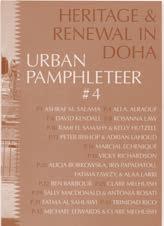
In its own light-footed way, Urban Pamphleteer has drawn various bridges between institutions and communities in a manner that has, at times, been surprising. Issue 2, on regeneration — which included contributions from community groups such as Just Space and Southwark Notes Archive Group — was reviewed by members of the Greater London Assembly as they were developing new policies around regeneration, and was considered as evidence in two public inquiries into the compulsory purchase and demolition of the Aylesbury Estate. Another issue on heritage in Doha, which represented the spatial experiences of marginalized non-citizens, received a positive response from Qatari officials. The authors featured in
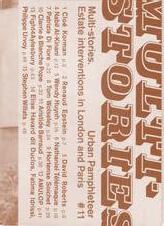
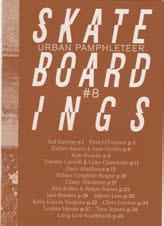
Urban Pamphleteer who include a mix of activists, community members, professionals, and creative practitioners, in addition to academics, are indicative of the range of positionalities that the Urban Lab engages with and serves. Contributions are capped at around 1,000 words. Creatively oriented and visually experimental pieces are encouraged. Although produced with a limited budget, a careful approach has developed over time regarding the provision of honoraria to unsalaried contributors. Our approach to licensing rather than claiming ownership over the intellectual property of our contributors has also changed over time with new developments around licensing for open access. Contributors are asked to write in an accessible style, without being reductive, catering to audiences across non-academic and academic contexts. Although Urban Pamphleteer can generally be obtained for free in print, or online, and is therefore open access in the sense of there not being a paywall, writing style is also an important aspect of making it more accessible. For similar reasons, there is an investment in graphic design and editorial typography as a form of care for the contributions, which goes beyond anything that is typically able to be provided by conventional publishers of journals or even academic books who — driven by efficiency logics — typically rely on generic design templates. It is produced affordably — normally in black and white plus a single spot colour on an offset printing press — and at different times has been constrained to the use of specific printers, depending on the relevant and evolving procurement policies at UCL. Occasionally, print workers have been excited to collaborate with us to try something experimental or unusual that stands out amongst their typical corporate-facing work. Where peer-review associated values, such as the provision of supportive feedback to contributors to help strengthen their work, are implemented, there is no double-blind review process. For this reason, and because of length, it would be unlikely for a contribution by an academic to ‘count’ as a formal research output in regulatory terms or for the purposes of promotion. Urban Pamphleteer came from a UCL internal competition designed to stimulate new approaches to demonstrating research impact — the particular focus, in this case, was on global challenges for sustainable cities — at a time when an explicit demonstration of impact was still bedding in as a requirement for the conduct of funded research, and this is now even more important. Subsequent issues have been supported by internal funding, at UCL and Central Saint Martins (my main workplace), with various thematic issues incorporated into larger funded research and knowledge exchange activities. For the most part Urban Pamphleteer has been distributed for free in print and digitally on an ad hoc basis, though there was a time when we experimented with selling via independent bookstores and magazine shops on consignment and collecting donations to feed into future issues. The funding and distribution models are something we continue to experiment with and develop in relation to, and in spite of, changing bureaucratic, technical, academic and financial conditions. Policy and infrastructure around open access have developed
significantly over the past decade. As new norms such as author-pays models become institutionalized within academia, Urban Pamphleteer remains a vehicle for not only reducing barriers for audiences, but for contributors.
As UCL celebrates is bicentennial and the Urban Lab turns twenty — and considering its new facilities in the Olympic Park forming part of the East Bank regeneration project, and the opening of the Urban Room — it is worthwhile to reflect on what has been learned through Urban Pamphleteer. Writing, design, printing and publishing can be extraordinary tools for negotiating within, between, around and through institutions of varying scales, agendas, and complexity. Although an outlier when it comes to both grassroots and academic publishing, an unexpected but important goal for Urban Pamphleteer has become to model a way of leveraging an unsettled position in relation to both. As the role and value of higher education within wider professional and community contexts comes under increasing scrutiny, from this vantage, Urban Pamphleteer becomes a laboratory for exploring how academic publishing could be genuinely more public.










East London has a long tradition of grassroots and radical publishing, from Sylvia Pankhurst distributing suffragette pamphlets, to printed firsthand accounts of the Battle of Cable Street (1936) circulated through working-class networks, and to community run newspapers publicising protests and community meetings during Brick Lane’s Bengali community organising against the National Front in 1978. In these moments, print did not simply record social struggle; it was part of it. Histories of radical publishing intersect with social struggles, reverberating through print.
Grassroots publishing occupies a specific position within this history. Embedded within communities, it produces printed matter that carries local voices beyond their immediate context, forging new relationships, solidarities, and networks of struggle. The term ‘grassroots’ itself suggests roots, rhizomes, and lateral connections — growth that is organic and collective rather than top-down. Publishing within this context is never neutral but a political practice: a way of writing oneself into history, circulating experiences that rarely appear in official records, and creating the very networks that sustain grassroots organising. In this sense, print and struggle are inseparable — one informs the other.
The politics of grassroots publishing lies in this co-constitution. Media theorist and former member of See Red Women’s Workshop, Jess Baines, has documented the histories of radical and community print collectives through the open-access archive radicalprintshops.org.1 Baines notes, ‘the freedom of the press belongs to those who own the press.’ To self-publish is to write histories and experiences on one’s own terms — it is not only a means of circulating, but a tool for organising. Community networks make publishing possible, and publishing in turn strengthens and expands them.
From the 1960s onward, east London witnessed the emergence of a constellation of print cooperatives, including Lenthall Road Workshop, Chats Palace Community Printshop, Hackney Flashers, and many others. Distinct in their practices but united by a commitment to ‘cultural democracy,’2 these projects sought to widen access, and to ‘democratise culture not by providing increased access to “official” culture (“high” art and literature) — that is by democratising consumption, but by democratising production.’ 3 This shifted the role of people from passive readers to active makers,
building spaces where communities could produce, print, and share their own stories.
Among these, Centerprise, the radical bookshop in Dalston, was pivotal. Founded by African-American activist and publisher Glenn Thompson in 1971, it combined a non-hierarchical bookshop and community centre. Robin Simpson, an active member in the 1970s, recalls being told that a bookshop would never succeed in the East End because ‘working-class people didn’t read’ — an assumption Centerprise would decisively prove wrong.4 The name Centerprise reflected its dual ethos of community and enterprise.5 Politically, it rejected the patronising ‘philanthropy of well-meaning outsiders.’6 Instead, it embraced a horizontal structure, where workers were cooperative members and local residents, and decisions were made collectively. The bookshop functioned as a resource and community space, hosting workshops, community groups and publishing projects, aiming to act as a ‘a catalyst for cultural and social action carried out by local people by themselves and for themselves.’7
One striking example, held in UCL Special Collections, is Poems by Vivian Usherwood, written by a 12-year-old Jamaican student at Hackney Downs Boys’ School. Ann Petit and Ken Worpole — both active Centerprise members and local teachers at the school — recognised his talent and helped publish the collection in 1972.
On the Record, an oral histories initiative, has done extensive and important work to document the oral histories of Centerprise members, producing a website, Hackney Autobiography. Here, they interview Mariam Gosling, the school librarian about how Vivian Usherwood’s work came to be published:
Ann Pettit came in to the library with this bunch of papers and said, “I’ve got this little boy in my class,” she said, “He’s such a handful, he’s lovely, but he’s up and down and bouncing around the whole time. And the only way I can calm him down is to say, “Go and sit on the windowsill and write a poem, Vivian.”
And she said, “I’ve got this bunch of poems, and some of them are lovely.’’8
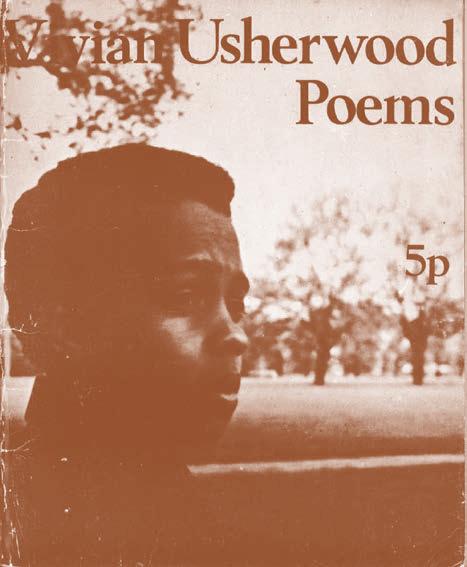
The response to the book was immediate: the first five-hundred copies sold out within two months. By 1979, over 8,000 had been sold, with teachers using the poems in the English syllabus across the country.9
Just a year earlier, and only three miles away, another group of young writers had produced a pamphlet of poems that would spark upheaval. Chris Searle, a teacher in Stepney, had been encouraging his students to write poetry. At first the school board had been supportive. However, ‘the young poets’ conception of the real and concrete world around them […] did not fit with the governors’ view of the world, and they objected to what they declared was an “unbalanced”, “gloomy” and “drab”’ depiction of the East End.10 Undeterred, Searle, with support from the local community, including fundraising from a local plumber, librarian, retired docker’s leader, proceeded to publish the anthology anyway as a community publication.11 This led to Searle’s dismissal. In response, more than 800 pupils from local schools walked out in protest, marching from Stepney to Trafalgar Square.12 The poems travelled further still: shared widely, and eventually reprinted by Centerprise, in 1973. Searle emphasised that the ‘strike was the students’ answer to having their work demeaned in this way.’13
Although Searle was reinstated, he stresses that while poetry ‘had provoked their cultural and collective action, with strong support of parents, school cleaners and other local people […] it was primarily through [the students’] own intervention’ that they secured the success of the strike.14
Ken Worpole, draws attention to the political and geographical connection between the Usherwood and Stepney Words anthologies:
Stepney and Hackney are only three miles apart, yet at that time, neither initiative knew of the other’s existence, although it didn’t take long for them to meet up, and recognise the common ground on which they were working. Thought about carefully, it would be a mistake to describe the timing and place of these two projects as coincidence. Both had, in different ways, identified a real need in deliberately neglected inner city areas like Stepney and Hackney, which was a lack of any kind of provision by which working class people could participate in the world of books, either by having a wide choice to buy from locally, or having the chance to have published things they themselves had written.15
While it is unknown whether Vivian Usherwood participated in the Stepney School strike, Stepney Words certainly echoes its mood in his poem SCHOOL STRIKE.
The resonance between Usherwood’s Poems and Stepney Words reveals how these publications function as what John La Rose would call ‘vehicles for self-representation’. They circulate experience, connect networks, and preserve moments that might otherwise have remained ephemeral. In doing so, these pamphlets illustrate how print moves through place: linking Hackney and Stepney,

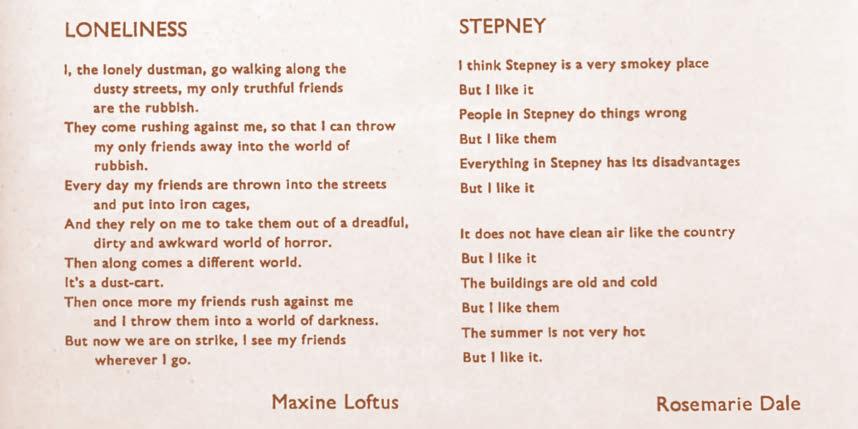
ABOVE Loneliness, Maxine Loftus and Stepney, Rosemary Dale. Chris Searle, Stepney Words I & II (1971), Digital Collections, FWWCP. BELOW The Lea and School Strike. Vivian Usherwood, Poems (1972), Digital Collections, FWWCP. (The Federation of Worker Writers and Community Publishers).
Poems reproduced with permission from FWWCP Digital Collections for educational purposes, with copyright attribution to the author and FWWCP.
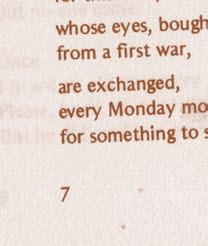
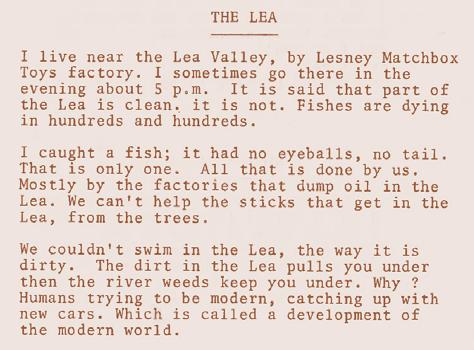
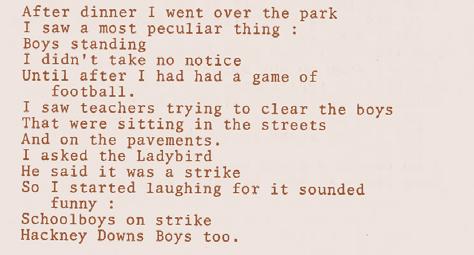
schools and bookshops, classrooms and the streets.
To trace these histories is to understand grassroots publishing as fundamentally relational. The act of making print and the networks it creates cannot be separated. Grassroots publishing is not a static artefact but a social process, one in which making, organising, and circulating, are entwined. Print carries struggle; struggle gives print its meaning.
1 Jess Baines, ‘Radical Printshops Directory,’ Radicalprintshops.org, 2018, https:// radicalprintshops.org
2 Jess Baines, ‘The Freedom of the Press Belongs to Those Who Control the Press: The Emergence of Radical and Community Printshops in 1970s London.,’ in N. Carpentier, P. Pruulmann-Vengerfeldt, R. Kilborn, T. Olsson, H. Nieminen, E. Sundin, and K. Nordenstreng, Communicative approaches to politics and ethics in Europe, Brussels: ECREA 221 (2009).
3 Baines, ‘The Freedom of the Press Belongs to Those Who Control the Press (2009)
4 Dominic Simpson, ‘Centerprise — the Radical Past of a Much Missed Hackney Institution’, Hackney Citizen, September 12, 2013, https://www.hackneycitizen. co.uk/2013/09/12/centerprise-history
5 Rosa Schling and On The Record, The Lime Green Mystery: An Oral History of the Centerprise Co-Operative (London: On The Record, 2017), p. 18
6 Schling and On The Record, The Lime Green Mystery (2017), p. 19.
7 Schling and On The Record, The Lime Green Mystery (2017), p. 19.
8 Schling and On the Record, The Lime Green Mystery (2017), p. 103
9 Schling and On the Record, The Lime Green Mystery (2017), p. 103.
10 Chris Searle, None but Our Words (Open University Press, 1998), p. 20.
11 Searle, None but Our Words (1998), p. 20.
12 Alan Dein, ‘Fifty Years since the Stepney School Strike,’ Spitalfields Life, May 28, 2021, https://spitalfieldslife.com/2021/05/28/ fifty-years-since-the-stepneyschool-strike
13 Searle, None but Our Words (1998), p. 6.
14 Searle, None but Our Words (1998), p. 6.
15 Ken Warpole, Local Publishing and Local Culture: An Account of the Centerprise Publishing Project 1972-1977. (Centerprise, 1977).
Acknowledgement:
This work uses material from the FWWCP Digital Collections. The author thanks the FWWCP for enabling access to these materials in line with their ethos of educational, non-profit use, and acknowledges the original authors.
Ishbel Tunnadine is an imagebased artist working with experimental photographic processes, writing, zinemaking, and film. Her work is often site-specific, with an interest in grassroots histories and struggle, and the politics of archival practices.








Radical histories live in our bodies, streets, voices, in the memories we must unearth from what gentrification tries to bury.
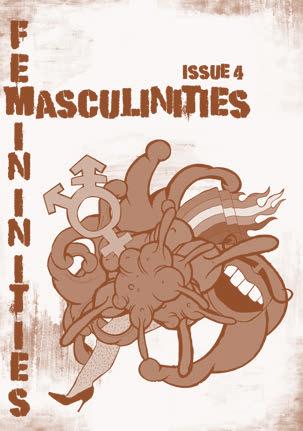
Walking down Dalston High Street in the early 2000s, the air thick with stories printed over each other in multiple eras. Strolling by Arcola Street, where the old textile factory became the first home of the Arcola Theatre, its walls once humming with machinery, later with actors’ voices. The tempting scent of charcoal sizzling kebabs drifted from Mangal Ocakbasi, Dalston’s first Turkish restaurant, amongst many that followed, mingling with fumes of double-decker buses that hissed along the curb. Cyclists swerving, tyres screeching against the concrete, as Art Deco Rio Cinema glowed on one side and Centerprise Bookstore stood sentinel on the other. Ahead, the clatter and call of Ridley Road Market, was a symphony of vendors’ cries, reggae basslines, scents of ripe fruits and stench of fish. Turning left into Dalston Lane, the city shifted, rows of squats rising like rotting teeth, the first a large, cavernous crown once known as the Labyrinth, beloved by ravers and before that the legendary Four Aces Club, where Black music thrived, from lovers’ rock to jungle. I’d keep walking, drawn by the pull of the Rainbow Bakery just after the junction, a warm pattie in hand, cassava cake soft against my mouth. I’d slip into Forest Road, where I lived in a council flat, since demolished to make way for gleaming new blocks for a wealthier few. Eventually, I’d circle back to Dalston Lane, where numbers 56 to 46 once stood in defiant decay: Georgian houses collapsing into themselves, occupied by queer anarchist punks — comrades — who called them home and more. For decades these abandoned shells became the heartbeat of a dissident Dalston: WANC at The Chinaman, Q&A Café at The Morgue, Behind Bars parties.1 Each a small rebellion, every doorway a reminder that, even in ruin, community found a way to live, speak and organise. It was between these streets and the gatherings that weaved through the remnants of squatted places that I discovered spaces where gender could be reimagined. I began excitedly unfolding my queerness. What emerged was Masculine Femininities 2 — ‘a free zine about gender identities, stories, poetry, images and all
those things that don’t get discussed, all those gender minorities that do not get enough recognition.’ 3 This collective exploration held in photocopied pages printed with ‘borrowed’ ink and paper was pieced together during shifts at my local Council job; a small act of publishing as resistance, stitched together through conversation and from re-purposing resources. This zine, like others, travelled in and out of Hackney, passed hand to hand at zine fairs and historic events like ‘Queeruption, where alternative, radical, and disenfranchised queers could meet, create, and exchange ideas’ but also, locally at spaces like the infamous vegan Pogo Café on Clarence Rd, which queer elders told me they frequented in the ‘80s when it was called ‘Pumpkins’.4
Dalston: a palimpsest, its streets layered with the traces of those who came before and those still holding on.
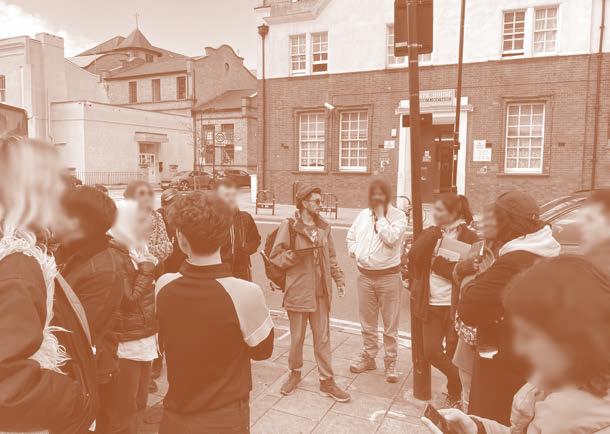
In 2023, years later, I led a walking tour 5 through its shifting geography, a kind of unarchiving and collective memory making methodology I was developing where together, we traced the faint outlines of what remained: of the squats and self-organised community spaces, kitchens that once nourished migrants and squatters, and the surrounding radical cinema, theatre and bookstore that shaped our political imagination. With each step, we named what had been and vanished; the spaces shuttered, the communities displaced, the quiet erosion of foundations once built for the vulnerable. Yet in walking together, speaking their names aloud, we imprinted these stories back into the landscape, if only momentarily.
It was around that time I met Claudia Manchanda, a radical herbalist, working together on a zine
1 ‘Women’s Anarchist Nuisance Cafe.’ London: Dalston Hackney, 2005
2 Rage, Raju. Masculine Femininities. Accessed 2025. https://masculinefemininities.wordpress.com
3 Grassroots Feminism. Accessed 2025. https://www. grassrootsfeminism.net/ cms/node/240
4 Queer Zine Archive Project. Accessed 2025. https://gittings.qzap.org/queeruptionthe-value-of-documentingand-archiving-hard-conversations
5 'Department of Unruly Histories, Meera Shakti Osborne and Cubitt Gallery' (London: Dalston Hackney, April 15, 2023).
Raju Rage is a visual artist, writer and independent scholar working across creative nonfiction, centring dissident narratives while blending personal and collective memory. They have a long history of activism and collective organising in queer, transgender, and people-of-colour movements worldwide.
called ‘Radical Remedies’. We realised our paths had already crossed in Hackney’s radical landscape. We spent time in Claudia’s flat reminiscing about good ol’ Hackney. She recalled working at Centerprise bookstore in the ‘80s. Its original site was on 32 Dalston Lane, the same row as the squats. She explained that it was so much more than just an independent bookstore, as I knew it, but was a cooperative and community hub with meals, a youth club, literacy classes, legal advice and its own community publishers. Of course, we both divulged the gossip about dramas that ensued — conflicts that all collectives inevitably create and hopefully resolve — as well as these hubs’ eventual demise due to property disputes with the reputedly corrupt local council.
In fact, the whole of Dalston Lane had once been marked for demolition — houses, social centres, and their histories reduced to plots on a development plan. Yet before the bulldozers came, something remarkable had already taken root. In the cracks of neglect left by austerity, communities organised and made something lasting from what was supposed to be temporary. The countless leaflets, posters, books and zines — printed matter by community, for community, passed hand to hand through shared spaces, became blueprints for survival, mapping how people might continue to live and make meaningful art together in a hostile cityscape.













I have worked on the design of Urban Pamphleteer since issue # 1. The design of each issue draws relationships across the featured content, through a material form that connects with the overall theme, and which is determined by editorial, design and print production processes as well as budget and time constraints. Certain aspects inform the physical qualities of every issue: its size and page extent, the colour palette and the paper stock used, its print run, etcetera. As this contribution looks at the relationship between publishing practice and publishing form, it seems appropriate to begin with this reflection on the series. The printed page and its margins, typography, images, and the space surrounding them, are the interface which mediates content, determining what the knowledge individual contributors present looks like, and how it communicates. Discussing the materiality of scholarly texts in broader terms, Janneke Adema notes (2021) that different ‘structures of knowledge production and discursive formations’ shape formats, debates, and the types of knowledge that are possible.1 The name of the series — Urban Pamphleteer — spells out another type of relationship: between a publishing form (the pamphlet), and the public (urban) environment. Briefly pointing at this aspect in the opening of One-Way Street, first published in 1928, Walter Benjamin states that:
Significant literary work can only come into being in a strict alternation between action and writing; it must nurture the inconspicuous forms that better fit its influence in active communities than does the pretentious, universal gesture of the book — in leaflets, brochures, articles, and placards.2
Benjamin’s quote draws a compelling relationship between the ephemeral nature of publishing forms that are commonly disseminated in the streets and visible in public spaces, and informal voices of everyday people evading top down, or normative communication systems. At the same time the quote also hints towards the strong relationship between the written word, protests and activism. With these perspectives in mind, I have selected four images to help illustrate and expand on the correlation of publishing and public space. Although their relationship to the context of east London varies, as a set, these images offer glimpses into the area’s radical publishing
past. They illustrate a range of ‘inconspicuous forms’ and publishing approaches at different moments in time. They also provide examples that trouble, or destabilise, the fixity that is commonly associated with print. They point towards forms of knowledge production and creative processes that contribute to grassroots publishing and organising, developing print culture in experimental ways, and at times pushing the boundaries of what we consider and understand as publications. Developing Benjamin’s statement towards an understanding of the role and function of different publishing forms, the images illustrate processes and interventions that disrupt ‘the universal gesture of the book’, embodying qualities that later became attributed to self-, do-it-yourself, and do-it-with-others publishing.
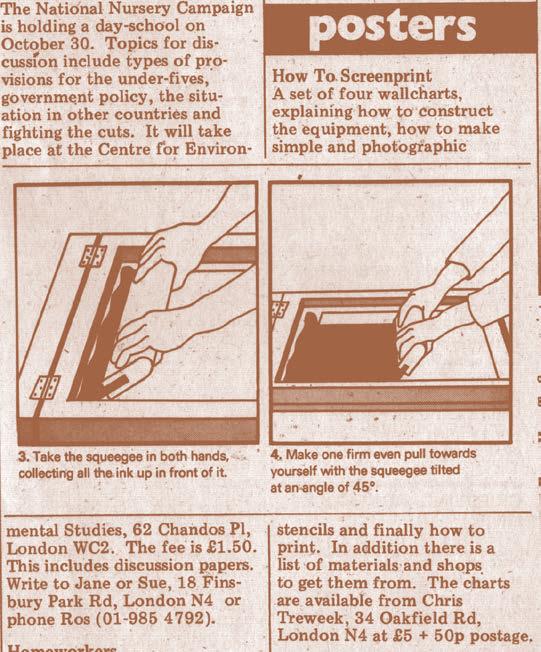
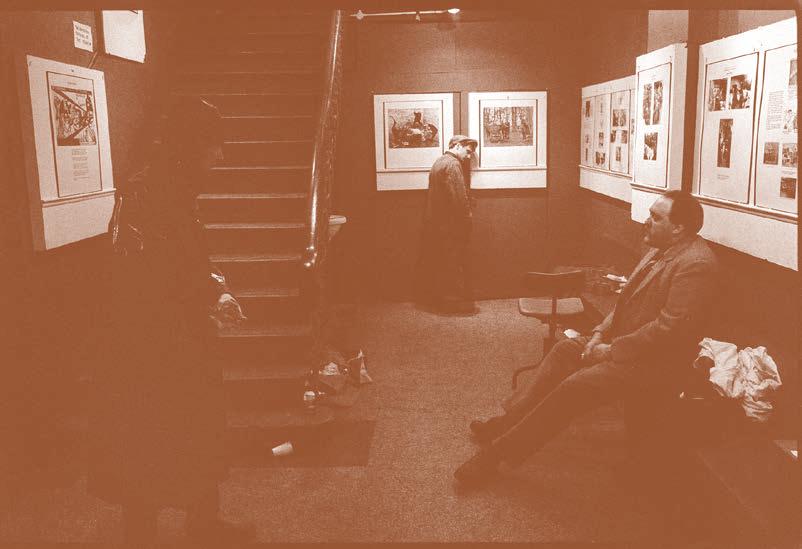
The first photograph shows the print room of Freedom, the world’s oldest anarchist newspaper, founded in 1886 and still published today from the Freedom Press Bookshop in Angel Alley, 84b Whitechapel High Street. The second image, taken by Tony Bock, illustrates the opening of Tower Hamlet Arts Project (THAP) bookshop on Witney Street, near Shadwell, in April 1977 The third picture is an illustration by artist and designer Chris Treweek, published in 1976 in the ‘Shortlist’ section of the feminist magazine Spare Rib. The publisher’s address for that issue of the magazine was still in Central London, though they moved to Clerkenwell Close, closer to the city’s east end, the following month. The drawings are part of a set of wall-charts titled ‘How to screen print’. The last image documents an exhibition display at the Half Moon Theatre in Stepney Green and is by photographer Mike Goldwater. The theatre is where The Half Moon Photography Workshop (HMPW) collective organised over fifty exhibitions combining photos and text using laminated panels, between 1975 and the early 80s.3
Together, these images illustrate a range of formats, production processes and publishing strategies. These were used by socially engaged artists, community activists and revolutionaries, to produce dissenting newspapers, instruction manuals teaching non-professionals how-to print your own content (political propaganda, newsletters, poster, leaflets, etc.), and public interventions like the walking picture shows of photographs by local communities, recording everyday life in the area. If the amount of literature on the history of grassroots printing and publishing has grown substantially over the years, with an increasing amount of archival material digitised and made available online, it is nevertheless rare to come across images like these — that is, images that illustrate making processes and making spaces, and that portray people, materials and some of the tools that were so important to past print cultures.
1 Janneke Adema, Living Books: Experiments in the Posthumanities (Cambridge, Massachusetts: MIT Press, 2021), p.2.
2 Walter Benjamin, One Way Street (London: NLB, 1979), p.43. I came across this reference reading the pamphlet ‘To nurture the inconspicuous form’ by Anthony Iles.
3 The Half Moon Gallery was initiated by American Photographer Wendy Ewald in 1972 Membership of the Half Moon Photography Workshop collective varied over the years, Jo Spence and Terry Dennett left in 1977, Paul Trevor in 1978, Mike Goldwater and Ed Barber in 1980. HMPW was renamed Camerawork in 1981
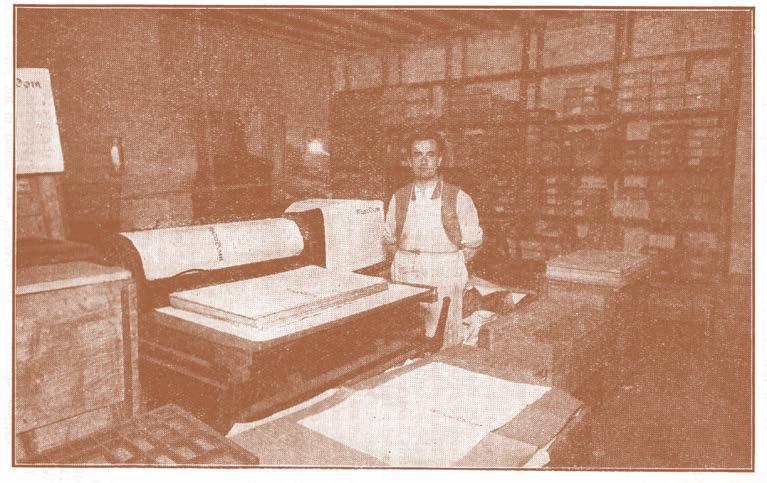
Founded in 1886, Freedom Press has been based in Angel Alley (E1) since 1968. The image here, from the 1920s, shows Freedom’s composition room, an issue of the paper ready for printing, and printer P. J. Meacham, who worked on the paper with editor Thomas Kheel (not in the photograph). The Freedom Press publications and bookshop have for decades been a point of reference for anarchist groups and people invested in radical politics. When printing facilities in the building were considered too old, the printing of Freedom was outsourced, until the worker’s co-operative Aldgate press (1981 2024) was established next door with the aim of providing printing resources for Freedom’s publications. Aldgate Press moved to Bow in 2015, and was recently renamed Angel Press, it still prints Freedom today. The image reproduced here is from a pamphlet titled Pioneers of Anti-Parliamentarism (The Strickland Press / Bakunin Press, 1940). For a detailed history or Freedom press see Rob Ray, A Beautiful Idea: History of the Freedom Press Anarchists (2018), and John Quail, The Slow Burning Fuse: Secret history of the British Anarchists (2019).
This photograph by Tony Bock shows the street party celebrating one year of THAP (Tower Hamlets Arts Project) and its bookshop opening on 2 April 1977. Alan Gilbey, young local poet and one of THAP’s employees, is portrayed as a ‘walking picture show’. THAP offered workshops on art, drama, video, writing, and events for children, young people, the unemployed, pensioners and community groups throughout the borough. Staffed by
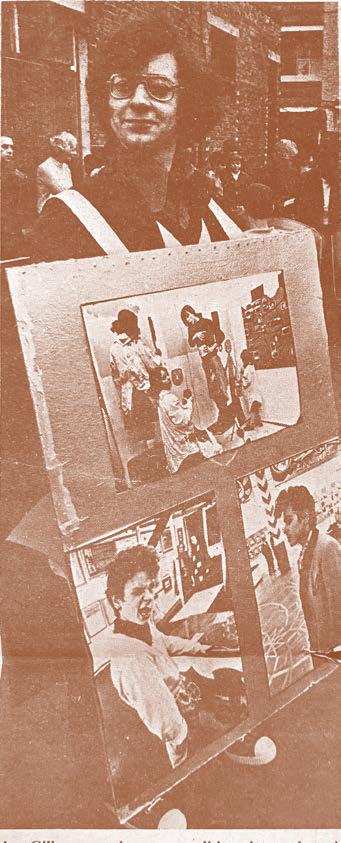

full-time, part-time and voluntary workers, from local school leavers to trained artists, to pensioners, THAP published writing, local history and artworks made by people in the area. It also ran a printing press, a video editing room, a meeting space, an exhibition space, and a café. When THAP’s bookshop first opened on Watney street, it was the first bookshop in Tower Hamlets, and stocked writing by local authors, AfroCaribbean and Asian fiction, gay writing, feminist non-fiction, and books on health, and global studies. The image is from the Essex & East London Newspaper (Friday 8 April 1977).
These illustrations were published in the November 1976 issue of Spare Rib (no.52), a women’s liberation magazine. The drawings are part of a set of four poster charts created by Chris Treweek which illustrate a step-by-step guide to screenprinting. Together with providing an example of what the illustrated instruction manual looked like, these images, which were also sold as wall charts, clearly illustrate the act of printing: ‘Take the squeegee in both hands … Make one firm even pull towards yourself …’. Chris Treeweek was involved, together with Jonathan Zeitlyn, in the community resource and print centre, Islington Bus Company, active in the London Borough of Islington (1972 1988). In 1983, the two authored The Alternative Printing Handbook, published by Penguin. In a different publication titled Print: How You Can
Do it Yourself (1975), Zeitlyn describes screen printing as an ‘easy to do’ manual process to print big posters with large areas of colour, allowing the achievement of high-quality results despite its relatively simple process.
Acknowledgments: Thanks to Chris Treweek, Mike Goldwater and Tony Bock for allowing the reproduction of their images, and to the Tower Hamlets Local History Library and Archives, and MayDay Rooms.
Guglielmo Rossi teaches graphic design at Camberwell College of Arts, works as a designer under the moniker Bandiera, and publishes pamphlets with the imprint Interrobang
This is a photograph documenting a photography exhibition at the Half Moon Theatre, Stepney Green, a former synagogue established as a gallery space in 1972. It was taken by Mike Goldwater, a member of the Half Moon Photography Workshop (HMPW) and co-founder of the radical photography magazine Camerawork. As well as functioning as a research platform on socially engaged photography, HMPW established an archive of slides and prints available for loan for campaigns, lectures, educational projects and arts use, it promoted collective and alternative photographic practices, critical use of photography and self-published material. Between 1976 and 1984, HMPW produced more than 50 exhibitions that travelled across public libraries and bookshops, schools and teaching centres, local authorities, campaign groups, colleges, universities, adult education institutes, and community centres. The group created exhibition panels using a cheap laminating machine. This technique allowed for the easy exhibition of photographs, without the need for expensive glass frames. In this way, a thirty-panel exhibition could be packed into a box, shipped, and quickly installed, making exhibitions and photography accessible to wider audiences.
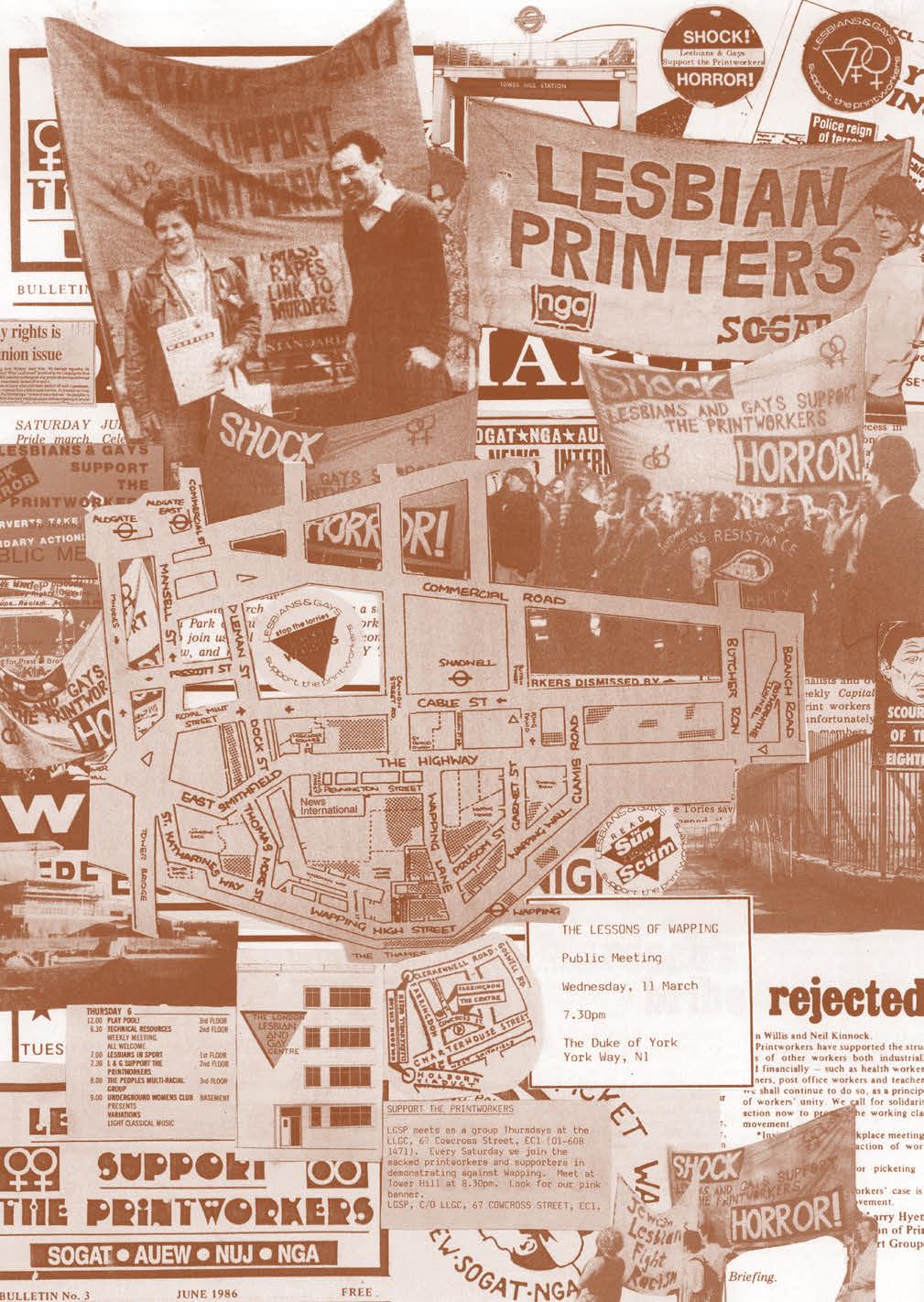
Printers’ banner for International Women’s Day March
Booth and LGSP member in front of their banner at London Lesbian & Gay Pride 1986
LGSP banner marching with ‘Women’s Resistance and Solidarity’
LGSP organised a public meeting on lesson learnt at Wapping
banner marching with ‘Jewish Lesbians Fight Racism’
‘Gay Rights is a Union Issue’ a letter written to SOGAT
NGA and LGSP banners marching together at the Lesbian & Gay Pride March 1986
Map of Wapping plant, residential areas in grey
Map and directions for LLGC
LLGC November 1986 schedule, including LGSP meeting Fortress Wapping
Directions to attend meetings at LLGC and find LGSP at marches
Leah Lovett and Ben Campkin
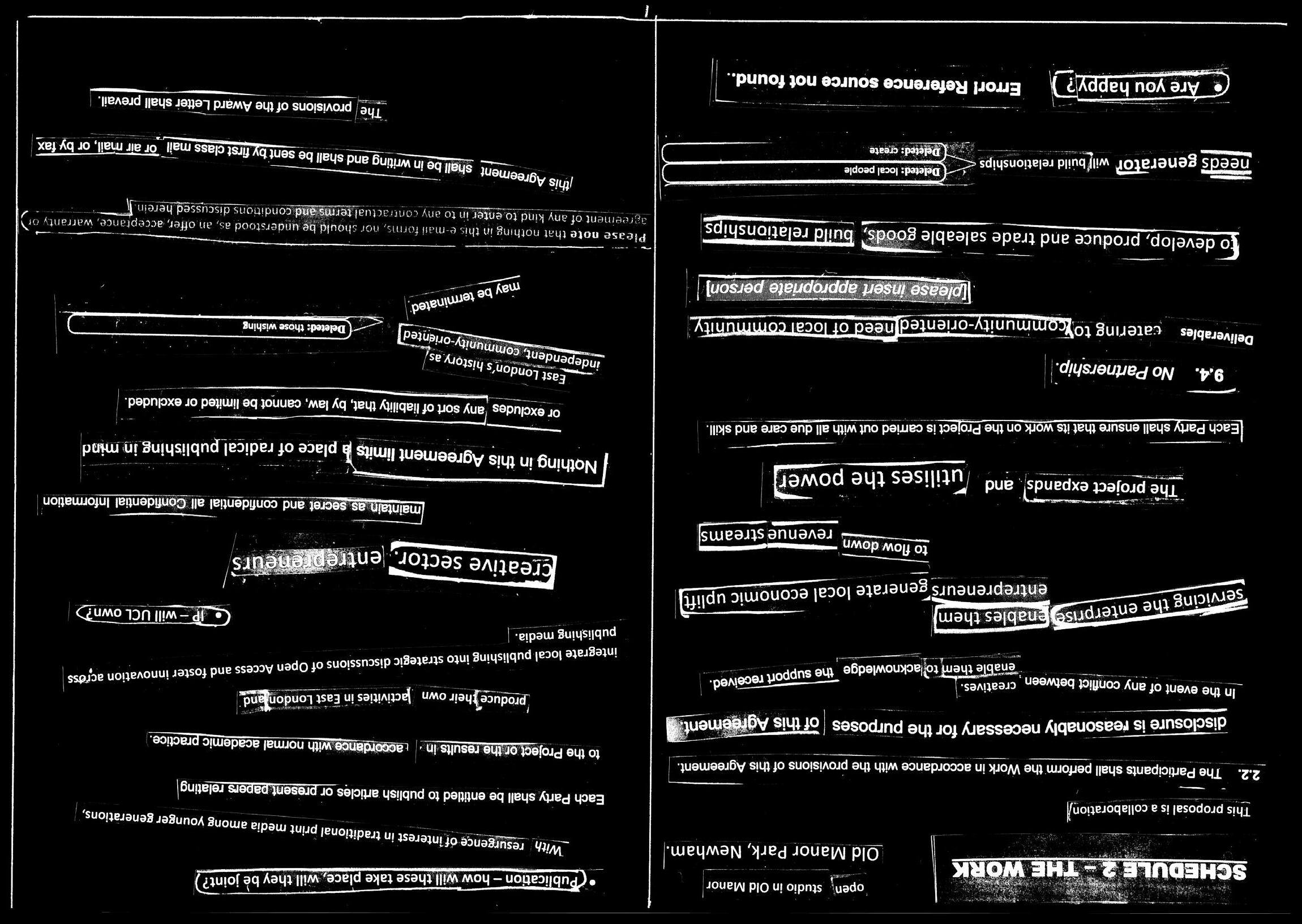
The poster overleaf revisits the administrative language that enabled the WE RISO project (see pp. 21—23). It works back through the funding applications, contracts, correspondence and institutional statements that we had to produce to secure funding to work with a local grassroots press and to commission local artists. In cutting up and reassembling these documents, we draw attention to institutional rhetoric, the affect that this produces, and the small acts of adjustment and codeswitching required to make such language ‘work’. As the philosopher Sara Ahmed, in her account of the language of diversity in universities, suggests:
What a statement is doing will be dependent on the situation in which it is made. In different situations the same words will have a different force... If we do things with words (by or in saying something), then what those words do depends on the circumstances in which they are said.1
Our detourned text tests this contingency by lifting phrases from their institutional settings, defamiliarising them by placing them in a new context. We have changed the emphases and the order of words and phrases to create a hybrid fictional contract. The displacements of words and meanings undermine the precision of formal language. They expose multiple — sometimes contradictory — voices, and procedural habits, gesturing to how power and organisational culture are reproduced.
Reading the texts closely, with the intention of alienating them from their original purpose, elicited an incidental administrative poetics that might usually go unnoticed. This included, for example, an awareness of metaphor, in phrases such as ‘revenue streams’, and the persistent reliance on outmoded forms of communication. An example would be the anachronistic suggestion that the agreement should be sent by fax. Re-reading also highlighted an anxiety embedded within these documents regarding the ownership of intellectual property, in tension with an ethos of open access.
‘Schedule 2 — The Work’ also attests to our tactical participation in institutional processes, using performative language to redirect resources while also recognising the ways such speech acts shape the project materially, and define its subjects in ways that we find jarring. The collage is both a record of the invisible structures behind the project and an attempt to make governing languages strange. In the process of re-reading documents that are not normally re-read, we experienced some alarm and discomfort with their heavy-handedness and dehumanizing qualities, in contrast with the softer and more public facing tone of institutional communication.








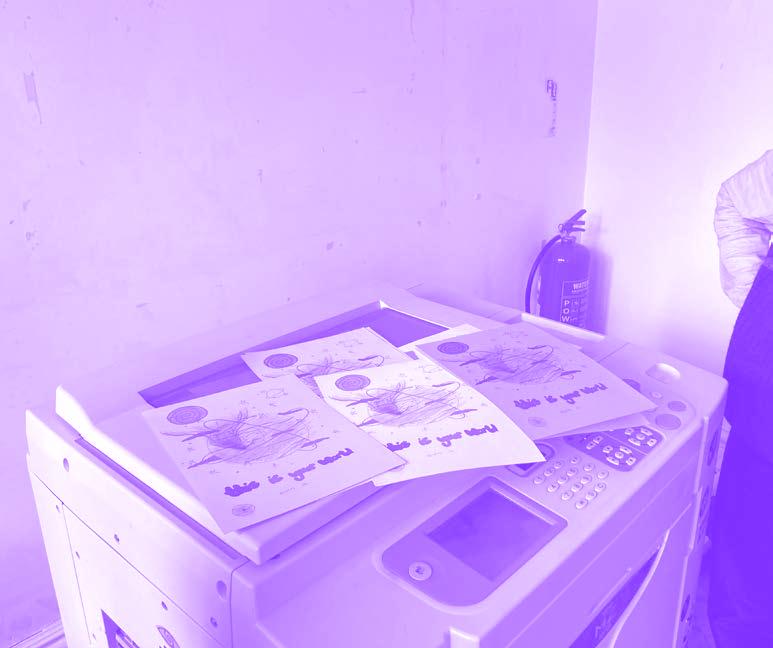
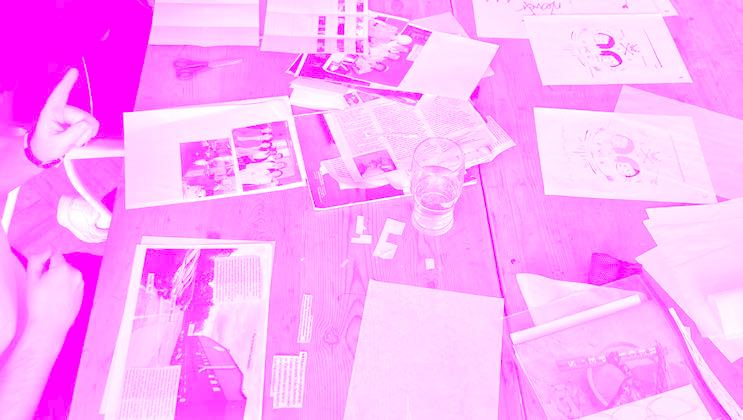
Residents work during the UCL Urban Room x Rabbits Road Press Residency, March 2024
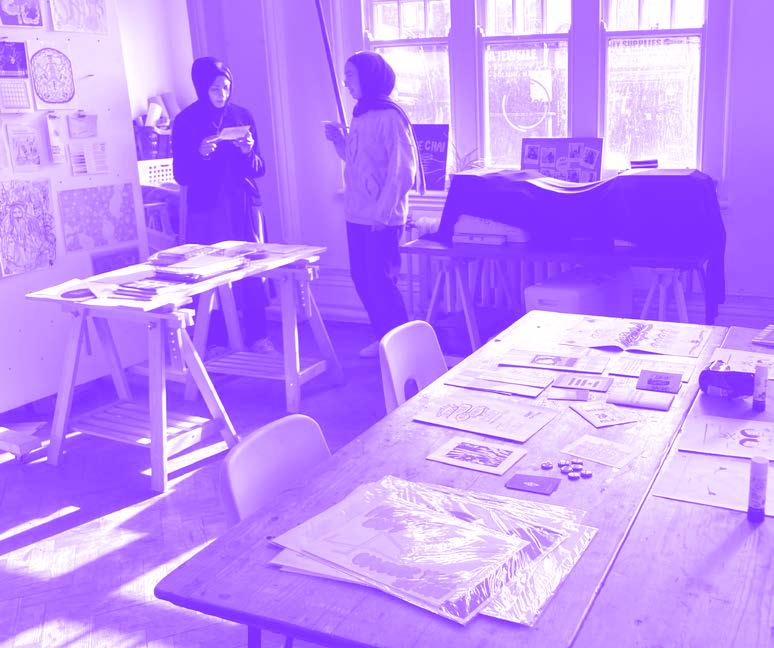
In March 2024, Rabbits Road Press and UCL Urban Room hosted a residency inviting east London creatives to make and print works supporting their practices or local organisations. Founded in 2017 by the publishing collective, One of My Kind (OOMK), Rabbits Road Press is a community-focused Risograph studio and small publishing press in Manor Park, Newham. OOMK was established in 2013 by Rose Nordin, Sabba Khan, Sofia Niazi, and Heiba Lamara (who joined after the first issue), and its work is rooted in accessibility and the politics of grassroots publishing. Through open access Riso printing, residencies and workshops, Rabbits Road Press supports artists, writers, and members of the local community. This approach to publishing is articulated in OOMK’s manifesto, which cites John La Rose, founder in 1966 of New Beacon Books, the first specialist Carribean publishing Company in Britain:
Publishing is a vehicle to an independent validation of one’s own culture, history, politics and sense of self.
With this as a starting point, Ishbel Tunnadine sat down with Heiba Lamara and Sofia Niazi to discuss self-publishing, locality, and grassroots community.
Ishbel: Can you tell me how Rabbits Road Press began?
Heiba: Rabbits Road Press grew out of our publishing practice as OOMK. We’d been publishing a biannual zine and running fairs and workshops when Create [a UK Charity that develops collaborative cultural and public-space projects] approached us to propose a community project for their shared space with Bow Arts at Old Manor Park Library.
We’d seen a lot of Risograph prints at zine fairs and wanted to explore the process ourselves. Around then, university fees had also risen to £9,000, and many people were priced out of art school. We asked: where can people develop a practice outside of formal education? So we pitched a community-focused press — a place where people could learn to use the machines and make work. The funny thing is, at the beginning, only Rose had Riso experience.
Ishbel: Maybe that made it more collaborative — everyone learning together?
Heiba: Exactly. We started with a one-drum machine and an open-access model. It was chaotic, but it built community. With start-up support from Create and Arts Council England, we developed through neighbourhood commissions and workshops — that was seven years ago.
Ishbel: How did you both personally get into grassroots publishing?
Sofia: I got into making comics and little books in art school. I loved the book as a container for exploring ideas since it had a beginning, middle and end, and it was a cheap way to make and distribute art. It’s a format that everyone understands and something I could easily continue after I left art school. I started selling my comics and zines with Sabba Khan under the name ‘Walrus Zines’. Our first fair was the Alternative
Press Fair [a zine and independent publishing fair in London]. It was a great fair, everyone was so friendly. That was the first time I started thinking of my books as zines and situating them within a wider culture of grassroots publishing.
Heiba: My background is in English Literature, and I was really interested in how books were made. I found zines through the early days of Tumblr — though many, like Riot Grrrl, felt distant, white and American. Things clicked when I volunteered at the George Padmore Institute, the archive of New Beacon Books. Seeing letters, drafts, and covers from a grassroots Black radical publishing house was transformative. Around then, I also went to the launch of OOMK’s first issue, started volunteering, then joined their Kilburn studio and became assistant editor. That’s when the way to publish independently began to feel clearer to me.
Ishbel: I’ve been thinking a lot about the John La Rose quote in your manifesto, and about how certain, often white-centred, feminist zine cultures don’t always feel inclusive or accessible. How has La Rose influenced your work?
Heiba: OOMK’s work, especially during the period of increasingly Islamophobic policies under the Coalition government from 2010 onwards, was about creating space for Muslim women to publish and represent themselves artistically and politically on their own terms — that’s why that quote resonated, even though La Rose was speaking about the Caribbean. The See Red Women’s Collective was another influence. We asked: ‘Who are our publishing predecessors? What print cultures do we come from?’
Ishbel: My own research started with See Red, which led me to Centerprise in Dalston and other east London collectives. It’s hard to separate grassroots publishing into one movement, but there is also something so geographical about this, the networks are so interconnected.
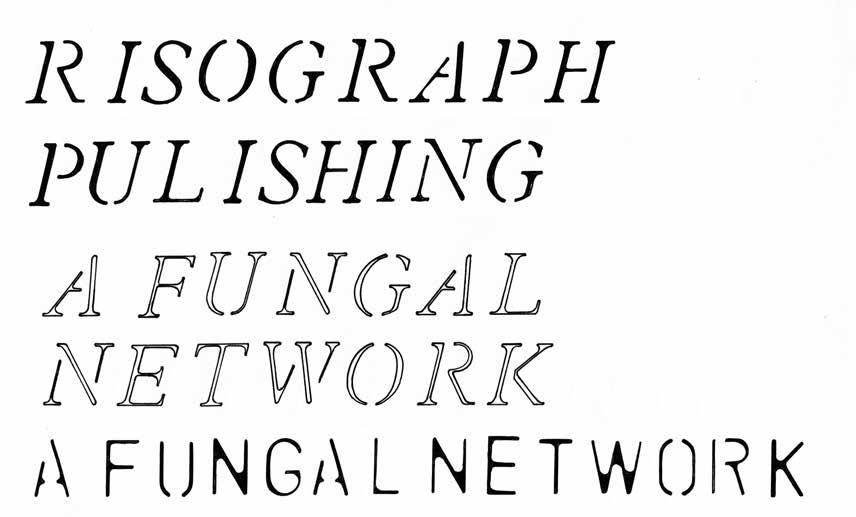
Heiba: Totally. I was interested in the mobility of zines — how printed material moves and creates organic relationships. Grassroots publishing is like a fungal network: material, personal, and always growing.
Ishbel: There’s often talk of ‘creating community’ through art, but communities already exist — it’s more about drawing them together, right?
Sofia: Yes and no. With art you get to show parts of yourself that are difficult to show in other ways. For me, making zines and putting my work into the world allowed me to connect with people who I wouldn’t otherwise. It’s how I met Rose Nordin, Arwa Aburawa and Abeera Kamran. We met Heiba through OOMK issue 1. That’s community to me, those people are now my art world. Meeting people at zine fairs and coming across work online has allowed us to make lots of connections and collaborations and I think that’s the kind of culture we want to contribute to and nurture.
Heiba: Exactly. In our early days in Kilburn, we worked from a crumbling portacabin, but it brought lots of people together in real life. For each OOMK issue, we’d host open sessions where anyone could pitch ideas — so many lasting collaborations and a new ‘community’ came from that.
Ishbel: How has it been moving to Newham?
Heiba: A lot of our activity was already in east London — with collaborations with Book Works, Rich Mix, and the London Centre for Book Arts — so the move felt natural, though Newham is even further east than they are. Our building, in Manor Park, sits between Barking and Ilford (we have connections with both), so it made sense geographically and socially.
Sofia: Working in Newham made us rethink the relevance of print. We’d done lots of workshops in galleries and institutions, so normally for arts audiences and in spaces that felt quite transient. Setting up a print workshop in an old library on Romford Road posed a lot of questions. We really had to figure out if and how a printing resource could be useful for the people who live here. When we host schools or parent groups, we ask what they’re already doing and make Riso useful for them — like designing posters about inspirational women or creating seed packets for a community garden. Embedding ourselves here has made us think more specifically about audiences. When a gallery hires us, the workshops can be general, but here, working with the same people over time, we can tailor things and go deeper.
Ishbel: That’s a different model from typical art spaces.
Sofia: We hope so. We’re a functional print space where people can learn a skill. A blank, open-ended art space can feel alienating. Parameters make things more accessible.
Heiba: And Riso itself bridges ‘art’ and ‘not-art.’ It was once just office equipment, but now it’s a creative tool. People come here to learn, collaborate, and experiment.
Ishbel: What has been the biggest challenge?
Sofia: Learning on-the-job and working with second-hand Riso machines has been tricky — they can be unreliable and when you only know the basics, it’s daunting to wrestle with them. Over time, we adapted, running collage clubs and summer schools that didn’t always rely on printing. Constancy is key — and being committed to learning and improving has allowed us to really grow along with the press and our members. We also have to remind ourselves that success doesn’t always mean expansion, continuing meaningfully over time is what we’re aiming for.
Heiba: Life changes, but we keep asking: who has the energy this year, and what do we want to do? That flexibility keeps it alive.
Sofia: The most rewarding thing is the ecosystem that’s grown around the press. Projects like architect Sahra Hersi’s summer school, which began here, show how the space enables others to create. That’s what it’s all about — making space for people to make.
Ishbel Tunnadine is an image based artist working with experimental photographic processes, writing, zinemaking, and film.
Sofia Niazi and Heiba Lamara co-run Rabbits Road Press with Rose Nordin in Old Manor Park Library, Newham.
Rabbits Road Press during the UCL Urban Room x Rabbits Road Press Residency, March 2024.
Sofia Niazi is an artist and educator based between Birmingham and London. She currently co-runs Rabbits Road Press with Rose Nordin and Heiba Lamara in Old Manor Park Library, Newham.

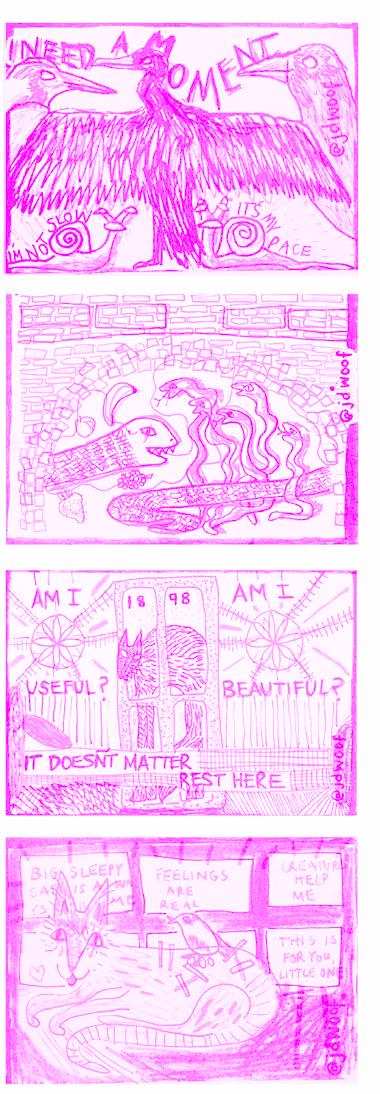
Four sets of postcards by artists commissioned as part of Rabbits Road Press’s Drawing on Heritage project, 2025, funded by Newham Heritage Month.
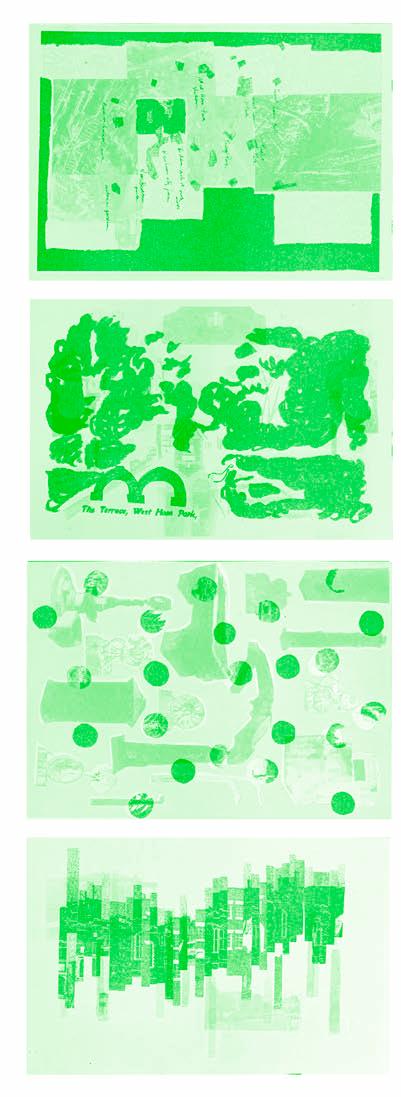
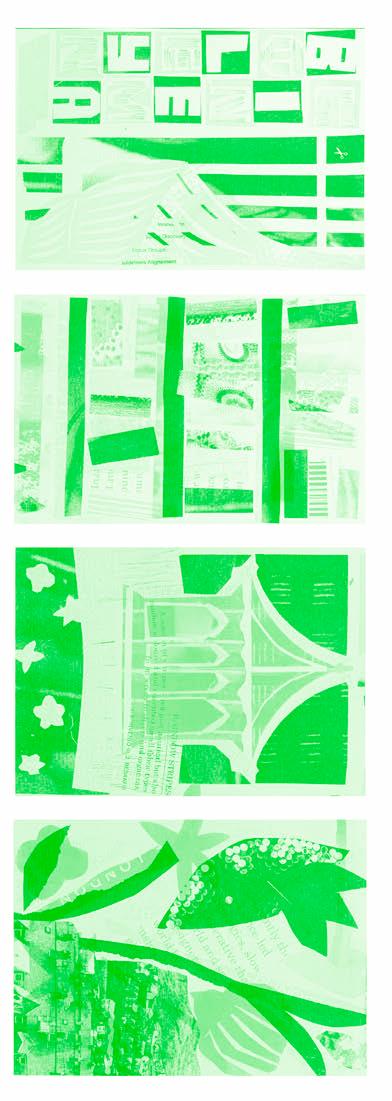
You can learn more about the Drawing on Heritage project through the eyes of the commissioned artists in the blog series at https://www.rabbitsroadpress.com/blog
In the summer of 2025, Rabbits Road Press commissioned four local artists to develop a set of Risograph printed cards celebrating any aspect of Newham’s heritage that spoke to them. Supported by Newham Heritage Month, the project, Drawing on Heritage, was inspired by the work of celebrated local outsider artist Madge Gill (1882—1961) who created many drawings on postcards. As part of their artist residency, each of the commissioned artists — Amandine Forest-Aguié, Maryam Huq, Jo Wood, and Maryam Adam — spent one month visiting local sites and resources, including Newham Archives, where many of Gill’s works are held. At the archives, they were shown a selection of postcards that Gill had drawn on along with other material connected to various aspects of Newham’s heritage. Later, at Rabbits Road Press, they learned about Risograph printing and began to develop their own lines of enquiry, translating their work and ideas into designs for a set of Risograph printed postcards.
As the project lead, from my point of view, there were several happy coincidences that led to this project. I work as a print technician at Rabbits Road Press, and I am an artist who uses Risograph printing a lot. I had just finished making a set of postcards for a project relating to religious lodges when I came across an exhibition of Madge Gill’s work at Midlands Arts Centre in Birmingham. I was immediately drawn to ‘Newham Council’ in the exhibition text and saw there were a lot of drawings on postcards in the show. I learned more about Madge’s work with its links to mediumistic activity and Theosophy. When a call out for Newham Heritage Month went out, it seemed like the perfect opportunity to delve a little deeper and bring her work to the attention of more people in Newham.
The pace of making art in London can feel lightspeed, so the opportunity to slow down and look back at a local artist who worked prolifically across a range of mediums completely on her own terms felt precious. Although relatively unknown during her lifetime, her work is receiving a lot of attention recently, with many large-scale shows featuring her drawings and embroideries. Gill was not in the habit of selling or parting with her art. Her life’s work was thus kept together and stored in her attic. After her death, her son Laurie donated hundreds of her works to what is now Newham Council. Inviting people from Newham to see and engage with her work in an open-ended way seemed to capture the spirit of autonomy in Gill’s practice. Drawing on Heritage allowed the work of a significant local artist to inspire the development of new work which was distributed for free to local people.
Gill reminds us that art and artmaking can flourish in many places despite the odds. Whether it’s in the privacy of one’s home or in a printing press, whether the audience is hundreds of people or just your close friends and family, art is an adventure worth embarking on. At Rabbits Road Press, we hope projects that shine a light on the art and achievements of a diverse range of artists and makers from the past can contribute to a legacy and living culture of working-class artistic activity in Newham and beyond.
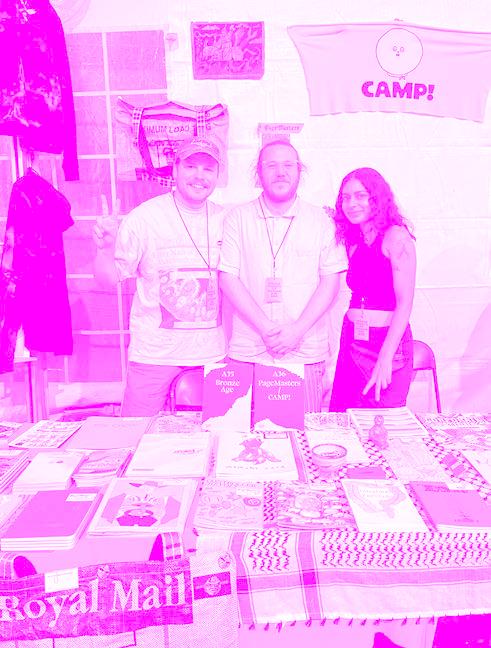
Justin (Bronze Age & PageMasters), Anu (CAMP!) & Jordan (PageMasters) at New York Art Book Fair 2025, in the zine tent.
Rayya Fadlo Khuri is a Brooklyn and London-based Arab-American artist, writer and independent publisher whose written-based practice deconstructs her world view and whose painting-based practice re-interprets contemporary landscape painting.
Rayya Khuri
As the east London independent publishing scene expands, I sat down with Jordan Taylor of PageMasters for an interview. PageMasters is an independent press that has been printing and publishing for 8 years. Jordan started at Hato Press in 2013, at the height of ‘the print is dead’ craze. The print is dead craze was a period of time when print was in incredible decline as people were quickly adapting to digital resources for information.
As Jordan put it, ‘Publishing is really interesting because it’s a meeting place of many different genres or mediums, whether you’re a photographer, painter’. Publishing is a collaborative activity because people can reproduce their work and swap with others as well as participating in book fairs and sales.
As the medium of print expands, it universally draws in writers as well as artists. For some, it is the act of collecting over time — perhaps photo books or printed ephemera. Printed matter is one of the most accessible forms of physical ephemera. For others, print is a live medium; take Toerag (December 2023) or New Papers (2025), both of which only started publishing magazines last year, but their readings were full to the brim from the very first imprint. These types of live literary events draw artists and writers to various galleries and venues. This attraction to live readings, events, and the growth of grassroots publishing, is symptomatic of reading regaining an audience in Gen Z and Millennials.
For me, the draw towards south east London and publishing was its physicality, the possibility of discovering authors and artists who were experimenting with printmaking. In an age where digitization is unavoidable, there’s something so expansive and freeing about the materiality of a blank sheet of paper. I began as someone printing for Cairo Art Book fair, and then kept coming back to see what they were printing — and what new authors they were drawing to the forefront.
Jordan expressed that, as time goes on, there is an increasing demand for print since they started, specifically RISO printing. As tech becomes more intrinsically linked with our life, ‘it’s like we are trying to restore some order in this chaos — not even on purpose. It’s just happening naturally, people needing a break from AI slop, and actually wanting to have some sanity.’ In London, an interest in tangible printed artefacts has seen a huge increase. Offprint London, an annual fair held at Tate Modern, drew 20,000 visitors in three days to its May 2025 event on its tenth anniversary of the book sale.
As AI and social media increase their hold over time, the relatively small group of grassroots publishers have expanded internationally. A huge part of the independent publishing scene is book fairs — both locally, such as PageMasters print fairs or Offprint — as well as globally — such as Offprint Paris, Tokyo Art Book fair, New York Art book fair. All these book fairs have been created as ‘offfline networks’.
The ethos behind independent publishing, and east and south-east London publishing, is ultimately this unspoken community linked by this desire to rebut — not just big tech, but this larger mono-culture. It’s about investing local and personal stories. The independent scene is filled with intellectuals attempting to rebut many of the culture’s larger narratives — take Jordan’s favorite commission, Seized Books: LGBTQ+ books and censorship in 1980s Britain, a catalogue to an exhibition, by Sarah Pyke and Leila Kassir.
‘It resurrects titles that were seized during the era of Section 28 — the 1988 legislation that silenced positive representation of LGBTQ+ lives. By bringing these books back into circulation decades later, the authors reclaim what was censored and transform erasure into a physical act of resistance.’
As the demand for tangible and analogue work increases, we can see independent publishing expanding. For instance, the publishers of Cairo Art Book fair have begun their own bookstore focused on independent publishing which adds a new layer of printed matter to the scene there. As Jordan puts it, ‘We treat it as a silly thing as, oh I’m doing this, aren’t I mad? But no, there’s an international [scene]. I’ve seen some publishers three times this year, once in London, in New York and I’ll see them again in Tokyo… that’s commercial, that’s globalized! This is the cutting edge. We have a globalized network of really interesting, nerdy people that have a real passion that they’ve pulled off.’ As the fair’s reputations increase, so does the globalization of printed media.
The expansion of these book fairs has created a stronger network of publishers and has meant that the publishers travel beyond east London, bringing with them samples from a variety of different authors from the independent publishing scene. Publishing at its core is about sharing, and at this moment, when news sources are failing us, it offers a real alternative, writers sharing stories, books signed by authors, and prints made by artists.
The sharing of information and resources makes London, an increasingly expensive city to visit, more affordable. Many publishers complete projects through traveling together, carrying each other’s books, splitting rooms and table fees, staying on couches with friends, all in order to expand their reach, or to find the right RISO printer. It’s also a typical process for them to have a table for each other, and in that way, the concept of community expands. It’s an affordable art form that brings new voices each year and refuses the concept that print is dead.
The demand for RISO , specifically, a printer that has the immediacy of CMYK and the style of silkscreen — has been growing and its skill, in turn, has been growing with each new update. In fairs like Offprint London and Paris, there is often an additional section just for these limited edition prints, but as the demand rises so does the commercialization. The solution is people coming together, and realizing what is at stake. This famously low-key and low cost medium expands at the risk of being commodified. Jordan concludes that: ‘Capitalism is so slick — whatever comes against it, it absorbs and transforms. It’s incredibly good at co-opting the very tools meant to resist it — which is why creating our own propaganda, our own systems that are successful outside of it, is the hardest battle.’
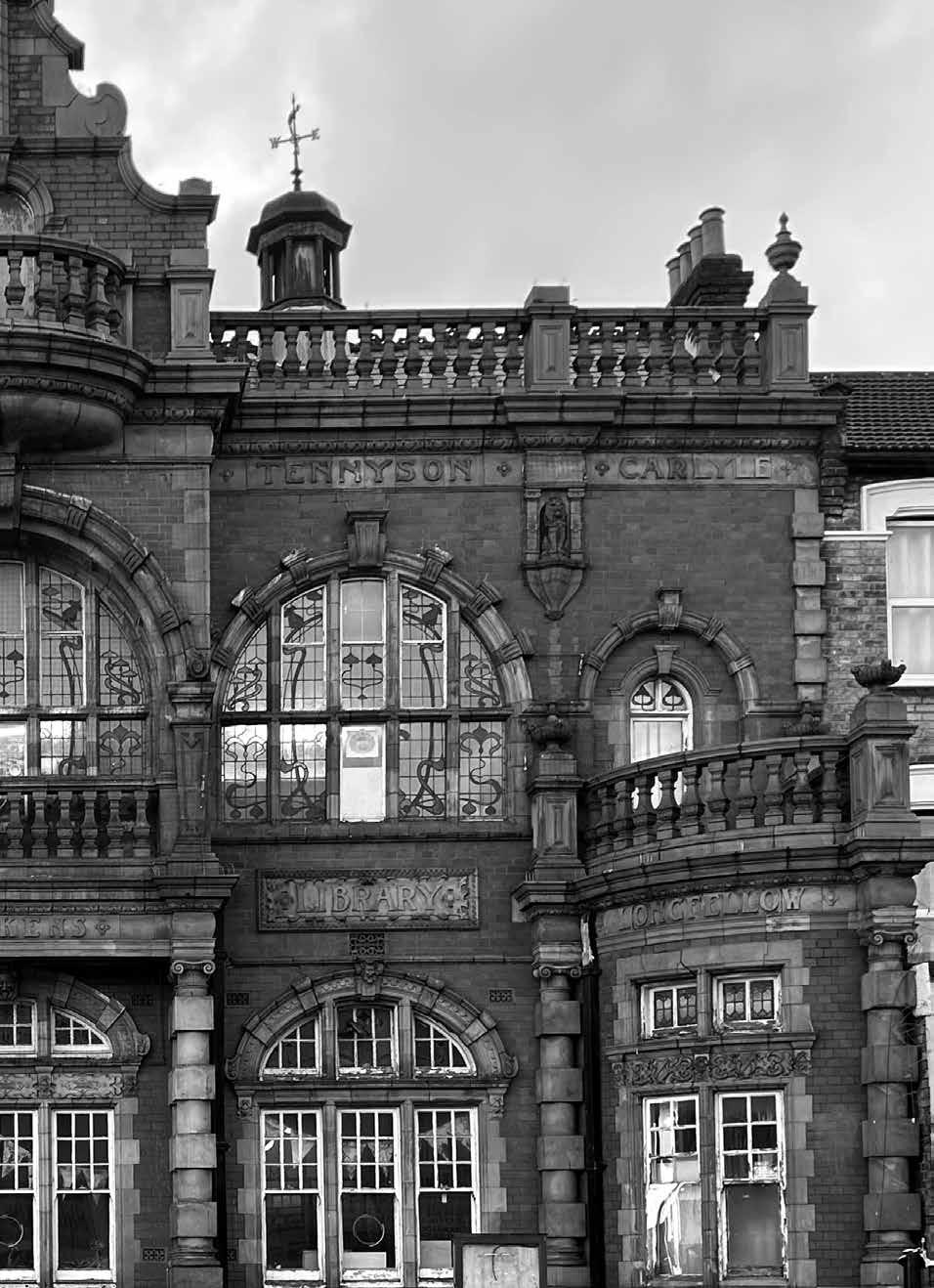
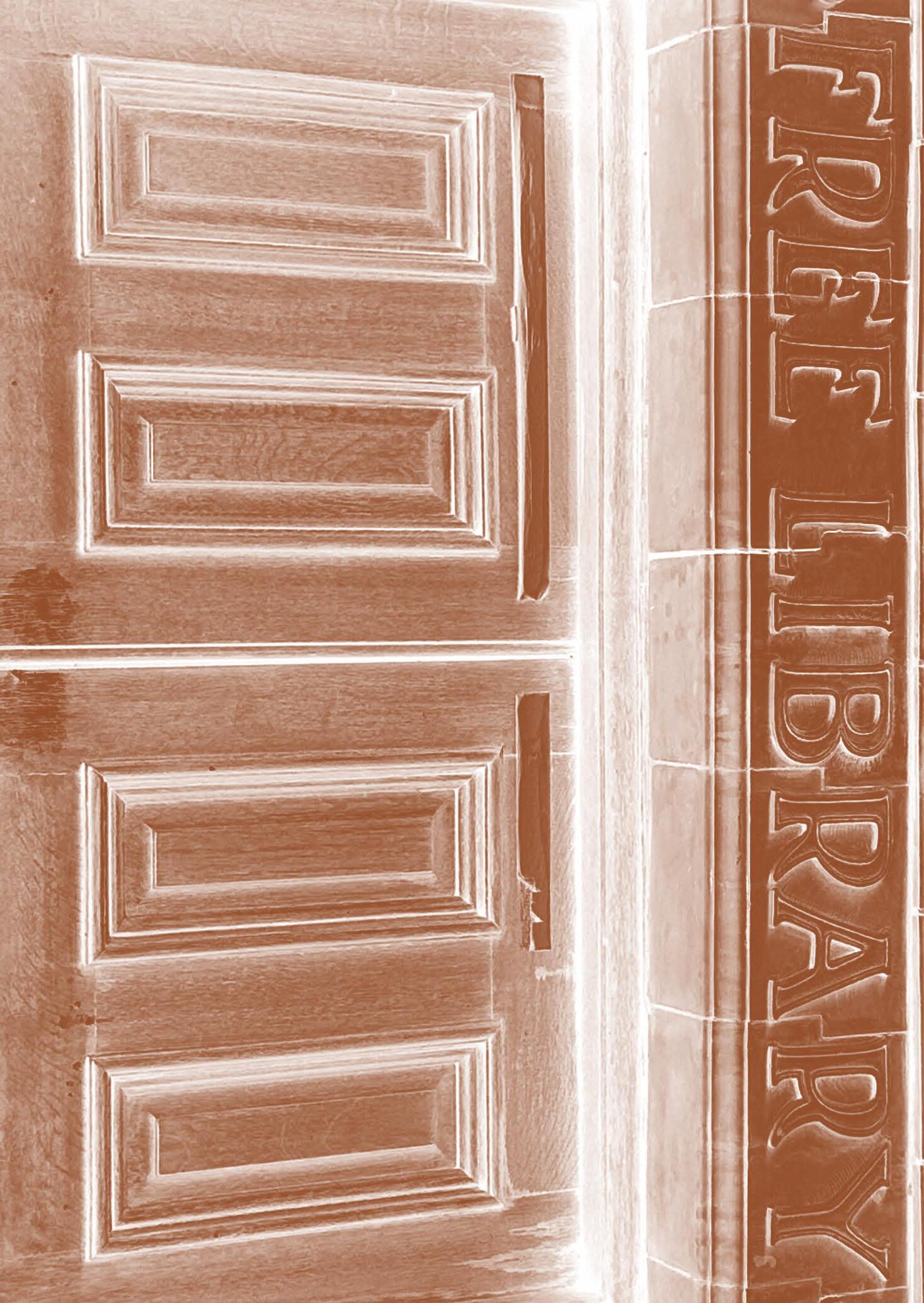
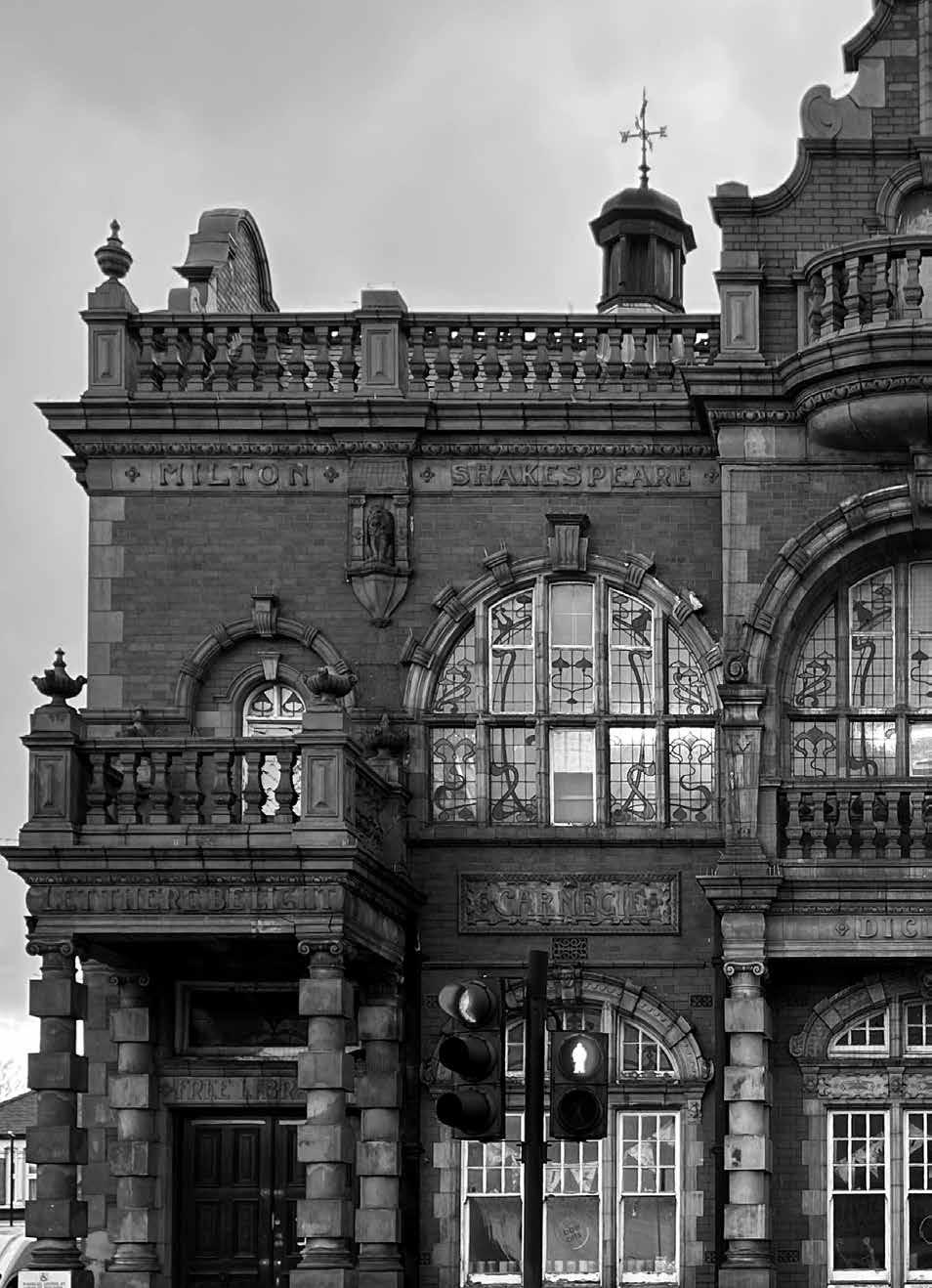
The contracts situate the project through reference to the address of Rabbits Road Press, at Old Manor Park Library, formerly a public library, in east London, now operated by Bow Arts Trust as artists’ studios. The façades of this Carnegie Library are adorned with a frieze, with reliefs of the names of canonical writers — such as Milton, Shakespeare, Tennyson, Dickens — included for their edifying impact. In words and phrases that surfaced as we cut the documents up, we detected echoes of this history of east London as a focus for social reformers, and the moralising, saviourism in the language of such endeavours.
1 Sara Ahmed, On Being Included: Racism and Diversity in Institutional Life (Durham, NC: Duke University Press, 2012), 56
Ben Campkin is one of the founding editors of Urban Pamphleteer and is the author of Remaking London: Decline and Regeneration in Urban Culture (2013) and Queer Premises: LGBTQ+ Venues in London Since the 1980s (2023).
Leah Lovett is an artist and Senior Research Fellow in Connected Environments at The Bartlett Centre for Advanced Spatial Analysis. Her practice and research engage methods of digital co-creation to address questions of spatial and environmental justice.





Recent scholarship has seen renewed attention to lesbian histories, yet the role of lesbian printers and strikers during the Wapping Dispute (1986 1987), remains largely overlooked. This was an industrial conflict between print unions and Rupert Murdoch’s News International, following the company’s relocation of printing operations from Fleet Street to Wapping, making thousands of printworkers redundant overnight. Through Lesbians and Gays Support the Printworkers (LGSP), a London-based solidarity group, lesbian participation in the dispute was often fleeting, dispersed, and partially obscured. These moments of engagement, however, represented deliberate acts of placemaking — networked, relational, spatialised and overlapping practices — that contributed to the formation of lesbian and feminist organising spaces in 1980s London.
For over a year, during the dispute, strikers and their supporters gathered on picket lines, marched, and produced their own bulletins in defiance of anti-union legislation. The strike took place within an industry dominated by homophobic newspapers that frequently marginalised lesbians and gay men, and LGSP
saw the printworkers’ strike as opportunity to challenge Margaret Thatcher’s attack on unions and on their community. LGSP Bulletins, produced by striking LGSP members for other strikers, offered alternative accounts of the dispute, and provided positive representations of lesbians and gays, leaving some traces of lesbian involvement. LGSP formed part of a growing network of lesbian and gay solidarity groups that followed the momentum of Lesbians and Gays Support the Miners (1984 1985). However, lesbian printers and strikers at Wapping remain absent from histories of either labour or lesbian and gay organising. Many of the women in LGSP were printers themselves, working within an industry long resistant to female and lesbian participation. Their contributions ranged from designing flyers and printing posters to carrying banners, wearing badges, and attending marches and pickets. Lesbians recognised one another in passing — on picket lines, at union meetings, or later at feminist and lesbian events — and these encounters created moments of solidarity.
The Lesbian Printers banner, first carried on the International Women’s Day march in 1986, was a public declaration of lesbian presence within the printworkers’ strike. Not affiliated with a formal organisation, it represented an informal network of lesbian screen printers from the National Graphic Association and the Society of Graphical
and Allied Trades, asserting visibility within a male-dominated trade. Its message signalled both participation in broader labour and feminist organising and the distinct presence of lesbians throughout the dispute. Appearing later at protests against Section 28 and Lesbian Strength marches, the banner demonstrates how lesbian organising was relational, networked, and overlapping. As a mobile gathering point, it enabled lesbian printers to see one another. The banner foregrounds the intersection of lesbian feminism, labour organising, and print culture during the dispute, materialising a collective assertion of the presence of lesbian printers. Moving fluidly across sites of struggle, it enacted solidarity through both its making and its circulation.
Photographs from demonstrations show the Jewish Lesbians Fight Racism and Women’s Resistance and Solidarity banners in close proximity to the LGSP banner, spatially enacting solidarity. Both banners emphasised women’s and lesbians’ visibility within organising, asserting identities often marginalised within labour and lesbian and gay movements. Together, these banners, orbiting the LGSP banner, visualise organising relations: a temporary yet powerful alignment of distinct groups whose shared visibility amplified each other’s causes without collapsing their differences.
A further photograph depicts lesbians and women positioned beside the LGSP banner, including Cath Booth, a lesbian printer and member of LGSP, at London Lesbian and Gay Pride in 1986. This demonstrates that, although the presence of some lesbians was documented, many others likely participated beyond the photographic frame. Such visual traces reinforce the argument that lesbians gathered around the banners in ways not fully recorded, revealing the opaque and
ephemeral spatial negotiations of lesbian feminists within LGSP and the dispute.
Badges also functioned as small yet powerful emblems of solidarity. Among them one bore the lesbian symbol of two interlocking female signs within a triangle. This lesbian-specific badge created embodied and mobile sites of encounter. The badge made politics wearable, embedding solidarity into everyday encounters and reflecting the tactile materiality through which lesbian identity and labour organising intertwined during the dispute.
While the strike was unsuccessful, LGSP felt that through their solidarity, the group gained recognition of lesbians and gay men within the print unions, paving the way for change. Lesbians inscribed themselves into the city’s spatial and political fabric. Even as mainstream narratives erased them, their actions were part of broader networks of solidarity. Reassembling these traces in collage form gestures toward a broader understanding of placemaking, one that recognises lesbian printers during the dispute, and how even fleeting moments of solidarity can produce enduring spatial and emotional resonances.
Aislinn Evans and Charlie Hurst






How do we first encounter print cultures, and what impression do they make? In this interview I (Aislinn) speak to a new technician (Charlie Hurst) at my old college, New City College Ardleigh Green, to hear how young people in east London are encountering print today. This college is in Havering and takes students from across east London and from Essex, primarily studying alternatives to A-levels. It has a dedicated print studio, which is a rarity to access at that age.
How long have you been a technician at Ardleigh Green?
I think I joined them in May. We’ve had summer since then, so it hasn’t been a full academic year yet. The facilities are mad. When I went for the interview I had to do a mini-teach. I thought I was gonna have a little rolling pin to do the teaching. I walked into the room and I was like ‘WHAT THE HELL?’ I didn’t have that standard for my foundation equivalent at all, let alone my A-levels. Like my A levels were in a cupboard.
What processes have you taught so far?
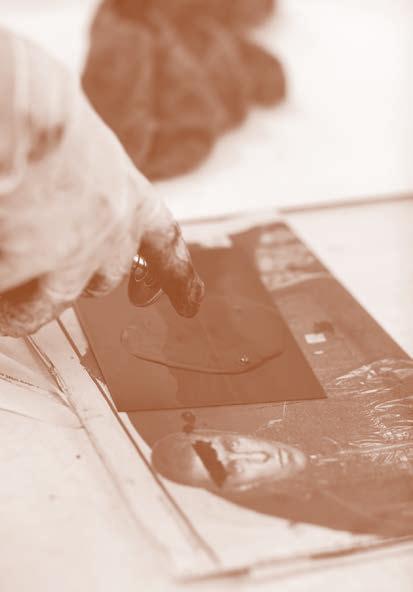
There’s been so many! A lot of monoprinting, textured monoprinting, lots of different reliefs — letterpress, mountboard, lino — acetone and photocopy transfer, silkscreen. We’ve just started doing drypoint in the last few weeks. This week it’s been really exciting to do photopolymers, which I haven’t done much at all … We also do bits with graphics and photography students; I’m really trying to think about it in a multidisciplinary way as well.
Do you feel that printmaking has a unique advantage there over like ceramics or sculpture, which maybe have a higher skill curve? There’s so many things in printmaking where you can make something that is gorgeous by being incidental. I used to make prints of the smears of purple and blue when cleaning up the ink — it’s so accidental.
Those can be called ‘wash up prints.’ I think that about the inks when I’m cleaning them up too. The incidental thing — you may have done all the process correctly, but for whatever reason it pulls a print you’re not happy with. That’s the nature of the beast with printmaking. Mistakes will happen. And they can be interesting. They can be generative, and with a lot of processes you can go again quite quickly and easily (well, aside from etchings). So with relief; you can pull perhaps eight prints in an hour. That’s really good for building a practice — practice over performance!
Through printmaking you’re making this stack of images, you’re directly manipulating what you’ve seen. From your opinion as a printmaker and a facilitator — what is the social and political use for print on paper for young people today?
If I really look at the young people I’m working with, it’s not speaking to that question a whole lot. There is some interesting work. I’ve seen one piece I quite liked, a student working with their family archive, making a ‘corrective’ image. Their brother had put them in this problematic costume as a baby, drawn something really problematic on their forehead.
Using acetone transfer, they’d reworked this photograph — asserting text over the top — re-authoring or re-issuing it. I thought that was a very strong work, it surprised me.
When I think of the social and political use of print, what I’ve felt really heartened by is Lu Williams and Grrrl Zine Fair, having kept this thing going for ten years. It’s having iterative events like those fairs — that keep bringing people together, building networks over time.
There are these indirect ways political work, organising and self-education happen when building these networks loosely organised around art expressions too. I met Pen Fight Distro at this year’s fair who kindly hosted me in Manchester for The World Transformed! It’s these associated ways that the meetings of minds happen which feel so hopeful-making. For me I reckon that is what essentially underpins and sustains the social justice work I want to keep doing in my life. As I’m getting older, what I’m realizing is EVERYTHING really is relational.
Re. Lu’s zine fair, it’s branching out too! They’re doing residencies, with people coming from outside of the UK for it… Lu has digitised a lot of stuff too, so it’s accessible.
Is this a resource you’d introduce the young people to? Have zines come up much?
Not a tonne. I do wanna feed it in more, but there’s not a big culture of it. Probably more in graphics and photography. Bringing it over to the fine art side would disrupt the idea of what fine art can be, using publications in a fine art context.
You don’t normally get presented with that until uni, if at all. There’s the concept ‘publication is making a public.’ Being presented with printmaking at Havering gave me access to things like Rabbit’s Road Press in Manor Park. I’d go to zine fairs and stuff to start building community. I think that’s valuable for young people. The first thing is you have a physical item in your hand that you have control over, and the second is connection to other people.
I want to do a zine mini-teach: a papermaking one, and bookmaking one. My way into print was through bookbinding first, and then printmaking second. I think my introduction to zines and publications felt quite guarded in a way. Someone from uni introduced me to it. The idea of going to a zine fair felt incredibly expensive to me — all you’re doing is going to spend all your money! And then I’d feel bad like reading those zines and then putting them back.
That’s why we need zine libraries!
I am a library-head, definitely. Maybe there’s something in the mix here to talk about libraries in general. More and more public libraries are taking on more self-published stuff, more zines.
Maybe the print studio needs to have a zine library.
We don’t have much out, but one of the things I really want to have is a display that changes every week. Literally, just opening books up on a different page is like having a whole new gallery install but on a shelf! As an artist you need stimuli to look through. I found this amazing book of different letterpress types last week, and seeing that as a student would make me want to try it. The tangible, the physical; thinking, ‘if this thing
Aislinn Evans is an artist from east London or Essex, depending on who you ask, putting down roots in southeast London. She makes videos, zines, prints, videos with prints in them, prints from videos, and writing and stuff. Charlie Hurst is a visual artist and educator based in Essex. He graduated from the Slade School of Fine Art, UCL, in 2019 and is currently a resident artist at Blokhouse Studio, Southend.
exists in this room, I can make another thing that exists in this room.’
Finding those gateways. Final question — you’re sitting down with a student who’s not sure about the print workshop, and you want to tell them why you love print, and why they’ll love print.
In a way, print is a lot less lonely. My friend told me this phrase that made me laugh yesterday ‘the writer/the painter dies in their room’. Right?! They’re making art at arm’s length from life — it’s an isolating process, writing, painting. Printing on the other hand? You’re doing something where you need facilitation. You’re gonna have conversations while you’re making. The technician, they’re gonna be telling you an awful lot about their accumulated knowledge — all while you’re making! You get two things out of the process, you get to weave in this other thread of ‘the social’; the transmissions of ideas, knowledge and expertise, along with making your prints.
It’s not a practice you can really do on your own. You have to go to this space with large machines often, which can mean a more communal practice.
Yes — though inside of that, I can see there’s another question over who ‘owns the means of production,’ right? It’s quite hard to access these facilities on the cheap. Where do people go after they leave [college]?
I’m gagged that these facilities exist, I’m almost waiting for someone to walk along and take them away.
That nearly happened! When they merged with NCC there was a plan to only have one art department, and everyone was scrambling to make sure it was Ardleigh Green, the print studio was the precious gem to protect. Especially because everything’s so cheap or free.
It’s a really big deal. There’s a bit of a balance, I want to give and give with resources but staff who’ve been here a while seem to worry about things running out. But we have a budget, we can replenish. Students need to feel like there’s stuff being given to them, an abundance mindset — so they can feel empowered to test stuff out.
Arsalan Isa and Ed Taylor




ED and ARSALAN have stopped by their local café for coffee. They walk to a nearby park and find a bench. ED is pensive, mulling over a move back to Leicester, his hometown.
ARSALAN So, a printshop called Print 98. How’d it come about? Are you going to be the next Murdoch?
ED I’m fed up with hearing messages that I don’t agree with. And I want to take control of some of that — even on a small scale.
ARSALAN Leicester is one of the cities on Reform’s agenda. A lot of disenfranchisement and a large immigrant population that is being used for scapegoating. A loss of local manufacturing, the shutdown of established institutions, the exporting of traditional print hardware to former colonies. How do you see all of that?
ED It comes from poor policy decisions in the past, which Reform is capitalising upon. It’s about the general globalisation of everything and a shift away from local production. So, it’s about disinvestment in local businesses and in small scale producers for their local areas.
ARSALAN Is this the end of the English printing press?
ED How could I know? I have so little experience. I’m so new to this. Maybe there’s a reset coming.
ARSALAN Good time to get into print?
ED Looks at ARSALAN
ARSALAN When you think about the evolution of English print presses, from what they once were to what we have now, and where things seem to be heading, towards a small number of conglomerate-style printers pushing everyone else out, you said that we cannot all compete for highly specialised output.
ED In my experience you generally need to develop a new market or niche to be able to
justify returning to a traditional process like a letterpress now. Most people would find that market through things like wedding invites or greetings cards all sold through Etsy.
I think there’s a compelling reason to use a tool like a letterpress in this moment — it’s different to everything out there mainstream but still scalable enough to make an impact.
ED And I’m fed up with online channels being the way that most people consume their information, because those are owned by big businesses. So, everything you see is influenced by those businesses’ agendas and needs rather than the needs of local people and local economies.
ARSALAN Where did all the printers go?
ED If the press goes ten times faster, you don’t need so many machines — the old metal machines have been mostly exported or destroyed. Many have been exported to print gullies as there’s still a big trend of local printing in India and Pakistan. Instead of machines built to last a century we’ve ‘upgraded’ to flimsy plastic covered copiers with pay per click software and a toner subscription model.
If you look hard enough there’s still equipment available though. Mine is a Heidelberg — a German machine — but there’s RotaPrint, Ryobi, and AB Dicks locked away in garages all over the world
ED I’m excited because in theory my output could be exclusively consumed offline.
ARSALAN If you own the means of production, then you can decide what to print. You can’t be shut down.
ED As long as you have space

and machinery. I think that’s one of the other reasons for it not being in London. In a city like London, the space is prohibitive to allowing people access to these tools.
ARSALAN We have less in-person community. We have fewer places, which we can invest in and get together, like the so-called town hall idea, which is being negotiated through algorithms, which push us to certain decisions.
ED Meeting in person is quietly disappearing. I would agree with that. It feels increasingly hard to have the time to talk. Community is found in fleeting moments of interest or commonality.
ARSALAN There are pockets in east London. We’re in one now. You’ve got a High Street where there’s a community and people hold community events. They’re trying to make it a village. We were talking about putting together a bookshop or a way to design those conversations, print those conversations and then distribute them. And bringing all of that into one space where every part of that process is equally integral to its output. But we were blocked by the high fixed costs, business rates.
ARSALAN Yet we also see a new wave of local printing and print fairs… Is physical print media now being seen as a way to bypass big data and political curation driven by algorithms and SEO?
ED Print speaks to this desire to connect the way that we used to online. You could basically just put whatever you felt up onto the internet and people would either resonate with it, or not. It was cheap and easy to do that. You could get listings and visibility for any interest base.
And I think the internet is starting to become less and less usable. In that way, the internet as a space, is becoming five or six companies. So, all that information that you’re putting up, is being filtered through those companies. And then even finding authentic information or user generated content, seems increasingly difficult. It’s even harder to find it because then the engines that index, also have their own algorithms. So, all of this information flow is becoming increasingly managed and controlled. This potentially fractures communities and amplifies disinformation and underlies the change in politics at the moment, the rise of the far right, for example. It feels like it allows space for that to accelerate in these echo chambers. It’s wrong. It’s not what the project of the internet was originally about when it was founded.











The built environment of east London distinctively articulates the history of urban transformation in London: regeneration processes, social movements, and the city’s connections to — and colonial relationships with — the rest of the world. The region has recently gone through renewal processes that have caused dispossession, displacement, and the erasure of social infrastructure. At the same time, it has historically been a place rich in activism, where topdown regeneration schemes have been contested by social movements.1
This article discusses a pedagogical project inspired by east London’s history of activism, art, community-led planning, and radical publishing. As part of the MASc in Global Urbanism at the UCL Urban Lab, Ben Campkin and I designed a postgraduate module to explore London’s transformations and its global connections through learning from east London. Students visit different areas of east London that are undergoing transformation, interact with community organisations, and discuss key authors and ideas associated with the area. In collaboration with UCL Special Collections and the UCL Urban Room, they explore the history of radical publishing in east London, having access to rare self-published artifacts that grassroots organisations have created over the decades. For their assignment, students produce a zine that engages with a specific area: Queen Elizabeth Olympic Park, Stratford and Hackney Wick, the Docklands, Poplar, Barking Riverside, or Ilford. They identify a challenge, investigate this in depth, and elaborate a proposition to address it, through a zine.
During the site visits, lectures, and seminars, we discuss past and present (hi)stories of grassroots contestation to top-down regeneration processes in these areas. Contestation has taken place through forms of insurgent planning and activist art, and often through a mix of both. Urban planning scholar Faranak Miraftab defines insurgent urbanism as ‘radical planning practices that respond to neoliberal specifics of dominance through inclusion’, ‘characterised […] as counter-hegemonic, transgressive and imaginative.’2
In the 1980s, the Royal Docks in Newham were the stage for a community-led planning process that brought together grassroots organisations in
Community Poster Project. Images: ‘No Locks on the Docks’ © Dan Jones. Other images © Peter Dunn and Loraine Leeson, Docklands Community Poster Project.
People’s Plan for the Royal Docks , Newham Docklands Forum and the Greater London Authority Popular Planning Unit, 1983 . Design by Sandra Buchanan,
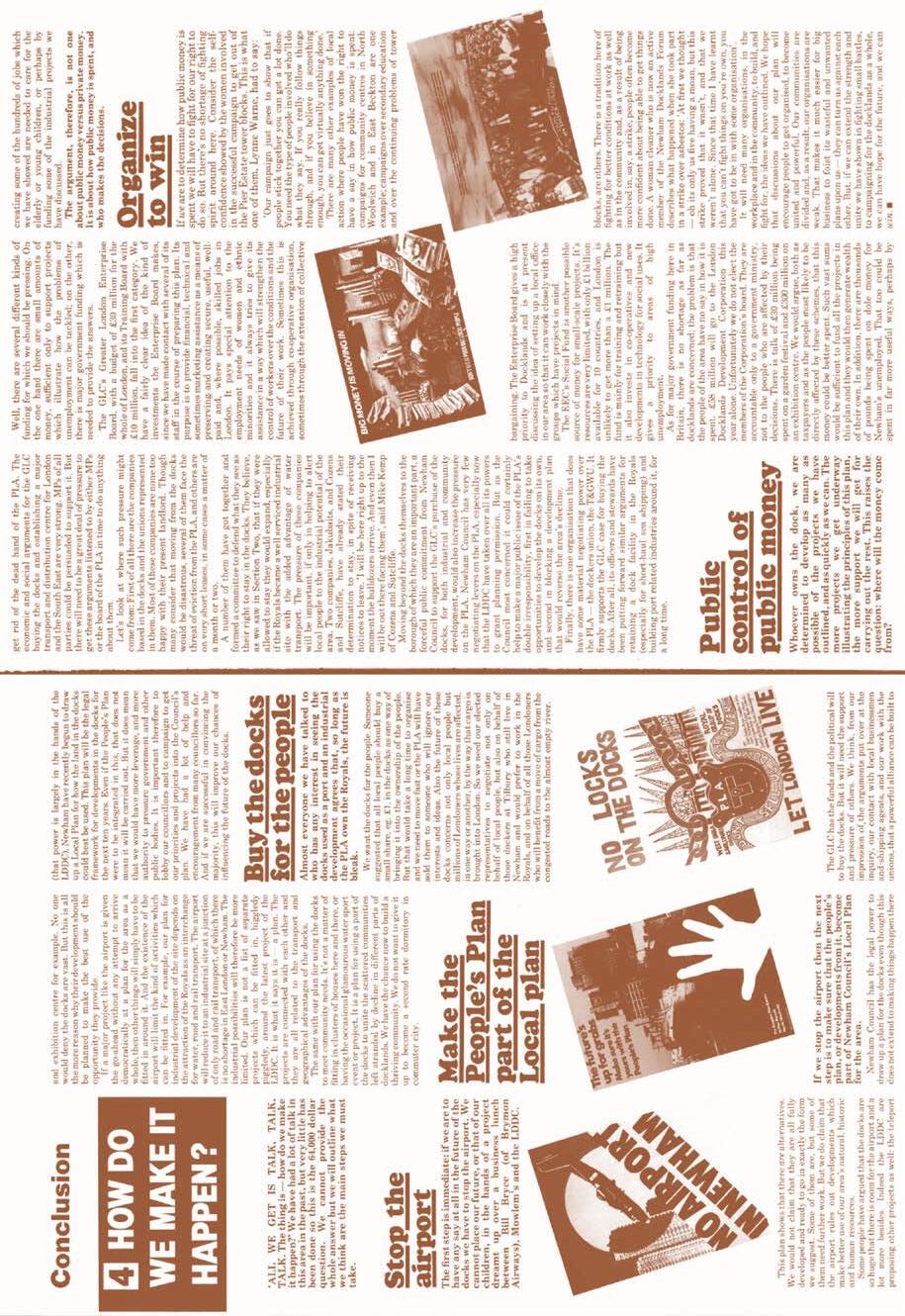
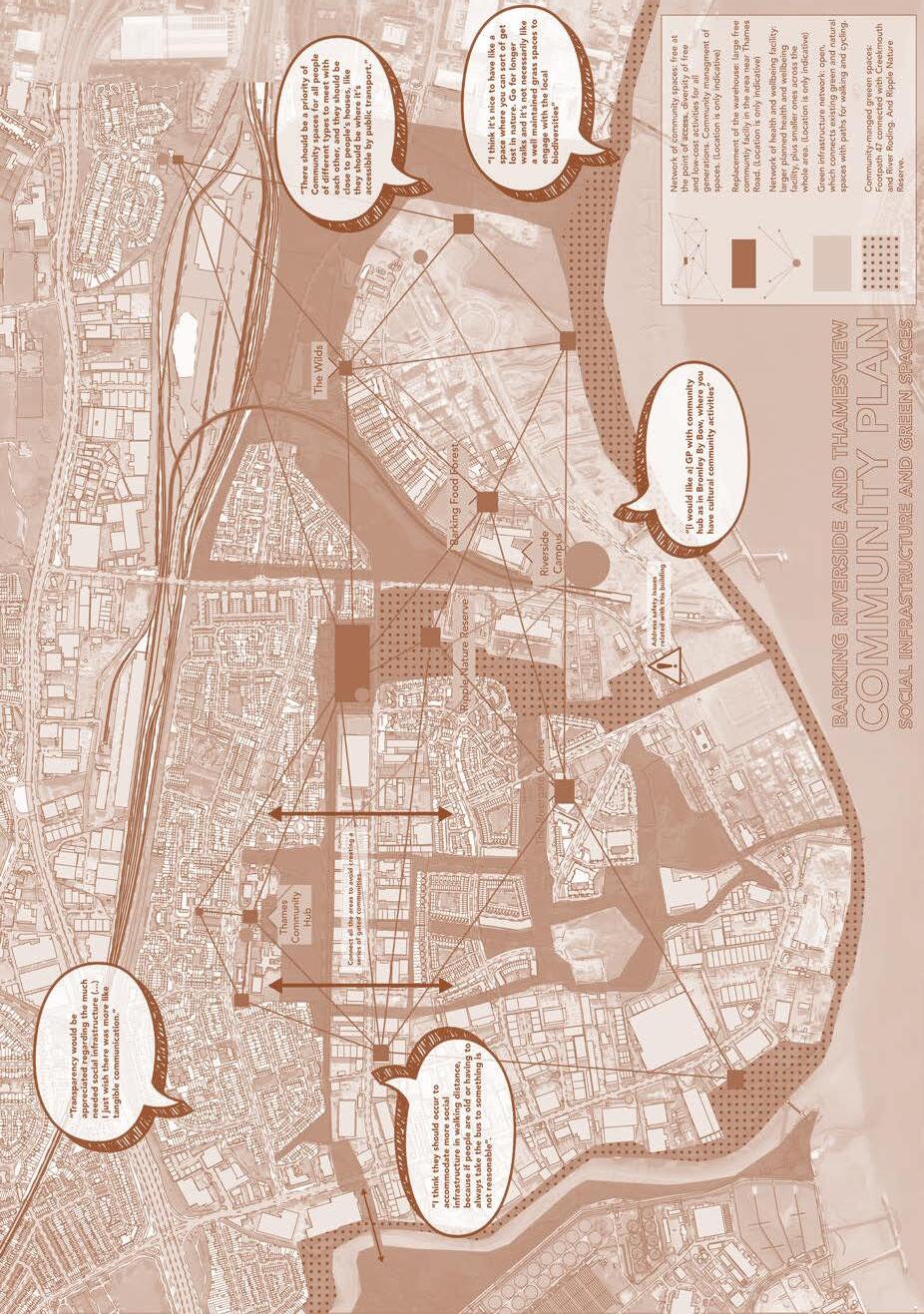
Barking Riverside and Thames View Community Plan for Social Infrastructure. Image by Pablo Sendra, 2024
Newham and the Greater London Council’s Popular Planning Unit to draft the People’s Plan for the Royal Docks. The People’s Plan emerged as a counter proposal to the London Docklands Development Corporation’s plans to build the STOL Airport (the earliest iteration of what would become London City Airport). An assemblage of community organisations, with the support of the local and metropolitan authorities put together a proposal that focused on local economic development and employment, housing, cooperatives, and community infrastructures for social reproduction.3 This insurgent planning initiative happened in the same period as — and connected with — the Docklands Community Poster Project (DCPP, 1981—1991), where artists worked with community groups to create posters and performative protests to critique the speculative developments taking place at the docklands. The connections between the Royal Dock’s People’s Plan and the DCPP show the relationship between insurgent planning and art activism: ‘The DCPP designed posters, provided a shop sign and promotional board for the (People’s Plan) centre. […] DCPP designer Sandra Buchanan designed the lengthy proposals into a visual and accessible illustrated (document).’4 This collaboration resulted in a document that combined the aesthetics of a planning document and a pamphlet, using popular cultural forms and references, which echoed grassroots organisations visual and typographic language.
We can see echoes of the 1980s connections between community-led planning and art in the tactics of recent community groups. Fearing that development in their area would lead to displacement, at Custom House, just north of the Royal Docks, the People’s Alliance for Custom House (PEACH) succeeded in getting funding from Big Local (established by National Lottery Community Fund) and employed community organisers and community architects to create their own Community-Led Alternative Plan.5 They also engaged with the artist Jessie Brennan in the mural project ‘Custom House, Our House’.6 A bit further east, Barking Riverside and Thames View Community Plan for Social Infrastructure also has a plan/illustration of community-led proposals that follows a pamphlet aesthetic.7
These east London stories, as well as east London’s history of radical publishing discussed in this Urban Pamphleteer issue, inspired the use of the zine as a pedagogical tool that works across social sciences and arts and humanities. During the four years this course has been running, students have engaged through a variety of aesthetics that mix craft and insurgence, which echo both the artifacts and small print publications they see during the zine workshop with the UCL Special Collections, and the community-led initiatives we explore in lectures. Students use a wide diversity of techniques to find their own voice. For example, Lily Flashman took an objet trouvé approach to create a memory archive in Chrisp Street Market, an area of Poplar about to be demolished and redeveloped. Flashman found objects, scanned them, and assembled them with quotes from residents’ and traders’ campaigns to create an archive that ‘holds the stories of the dispossessed.’8 Kwang Lin Wong engaged with the idea of subverting the use of the public realm through a guide to occupying Privately Owned Public Spaces
‘We



(POPS) in Canary Wharf, using a toolkit format that invites the reader to take action.9 Sagal Abdullahi explored the unplanned and spontaneous use of the public space in front of the Marshgate Building at UCL East by roller-skaters, discussing the lack of spaces for young people and proposing to empower them in reclaiming their right to play.10 Students consider who their audience is, how the zine might be distributed, and how the artifact may invite the reader to transform the space or engage critically with it. The diverse type of crafts used results either in zines that could be photocopied and easily reproduced, or in art pamphlets that work as a unique piece.
These types of projects, which engage with research, critical reflection, craft and activism are a form of ‘engaged pedagogy’ — described by bell hooks as a combination of theory, critical reflection, and personal experience — in a process of learning from the bottom up.11 In the current context, it is important to reflect on the kind of engaged urbanists our cities need to address the challenges of inequality and climate emergency.
‘Pops Off: A Rough Guide to Publicly Occupying Private Space in Canary Wharf’. Kwang Lin Wong’s zine for East London Lab, 2023
1 Pablo Sendra and Richard Sennett, Designing Disorder (Verso, 2020).
2 ‘Faranak Miraftab, ‘Insurgent Planning: Situating Radical Planning in the Global South,’ Planning Theory, 8, no. 1 (2009), p. 32. https://doi.org/10 1177/ 1473095208099297
3 Pablo Sendra and Daniel Fitzpatrick, ‘People’s Plan: The political role of architecture and urban design for alternative communityled futures’. In N Bobic & F Haghighi (Eds.) Routledge Handbook of Architecture, Urban Space and Politics, Vol II (Routledge, 2024): 434–450.
4 Loraine Leeson, cSPACE. ‘The People’s Plan for the Royal Docks,’ cSPACE, accessed February 10, 2026, https://cspace.org.uk/archive/peoples-plan
5 Pablo Sendra and Daniel Fitzpatrick, CommunityLed Regeneration (UCL Press, 2020).
‘Reclaiming Spaces for Play: Rollerskating Subcultures & the Right to the City’. Sagal Abdullahi’s zine for East London Lab, 2024
6 https://www.jessiebrennan.co.uk
7 Pablo Sendra, Fernanda Sobreiro, Cristobal Díaz Martínez, Tommaso Gabrieli, Barking Riverside and Thames View Social Infrastructure Community Plan (UCL, 2024).
8 Lily Flashman, ‘We were here before you’, zine for East London Lab (UCL, 2023), p. 2.
9 Kwan Lin Wong, ‘Pops Off: A Rough Guide to Publicly Occupying Private Space in Canary Wharf’ (UCL, 2023).
10 Sagal Abdullahi, ‘Reclaiming Spaces for Play: Rollerskating Subcultures & the Right to the City’ (UCL, 2024).
11 bell hooks, Teaching to Transgress (Routledge, 1994).
Pablo Sendra is an architect, urban designer, writer, researcher, and educator, specialised in citizen-led planning and bottom-up urbanism. He is Professor of Urban Design and Public Participation at The Bartlett School of Planning, UCL, and Director at the urban design firm Lugadero.












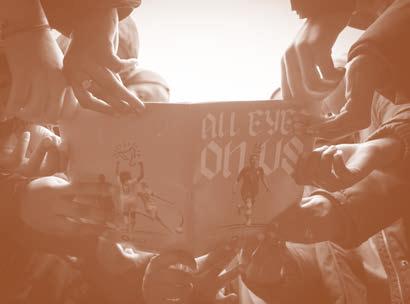





Back in 2022, I came across an inspiring story written in The Grassroots Post about FC Leytonstone and their girls’ team, coached by Sabah Mahmood. Only a few months into co-founding my own grassroots women’s club in West London, I was moved by their dedication to challenging the barriers faced by South Asian women and girls. My attention was caught by another article and before long I was immersed in heartwarming testimonials from players and thought-provoking writing on the future of the grassroots game. I quickly realised just how deeply intertwined independent publishing and community football are.
The Grassroots Post was established in 2020 as an independent monthly online and newspaper-style print zine distributed across grassroots football venues in the UK. The driving mission to encourage participation in the local game by shining a positive light on the diverse stories of those involved is a great example of the publishing-football ecosystem. Through high quality, freely accessible publications, the publication aims to represent the inclusive community feel of the beautiful game. Their content ranges from documenting new teams and exciting players to covering heartfelt personal stories, ‘how to’ guides on starting a grassroots club, as well as insightful writing on using digital tools to foster local connections and develop club sustainability
long-term.
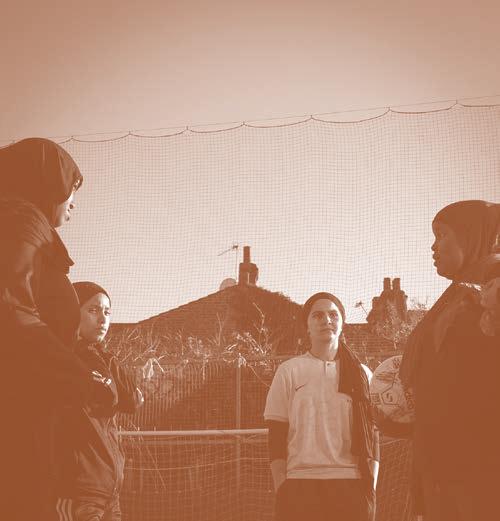
Grassroots football in London has long thrived within an ecosystem of community care sustaining its survival — from managers, coaches and physios, to fans, local vendors and kitmen. Rooted in working-class culture, generations of Londoners like myself have found community in the grassroots game, with Sunday League matches becoming a staple of weekly life. Historically, football’s popularity in England can be traced back to working-class factory and railway labourers in the Victorian era organising matches against opposing workplaces, creating solidarity amongst workers. Football quickly became integrated into the working man and woman’s local identity and sense of community. Despite the emergence of the professional game and its subsequent commercialisation since the early 1990s, with the average premier league team now worth over £ 1 billion, grassroots football persists as a symbol of working class camaraderie and collective identity.
Like most bottom-up initiatives led by everyday people, local clubs and independent publishers alike rely on member fees, donations, sales and funding to stay afloat. For Sunday League clubs, grants from national bodies such as the Football Association (FA) and Sports England are critical to paying coaches, covering pitch fees, as well as the myriad costs associated with running numerous teams across age and genders. These costs include designing and purchasing kits in various sizes, yearly paid affiliation to local leagues, referee salaries, equipment and insurance. Sadly, this already fragile financial reality has worsened from cuts to public sector and FA funding in recent years. The COVID-19 pandemic and government lockdowns further added to this, resulting in heightened financial pressure and the closure of numerous grassroots clubs across the country. Given the importance of these clubs as a lifeline for communities severely impacted by the continuing legacy of austerity, this is deeply concerning. In east London especially, an area already reshaped by privatization, speculative urbanism and gentrification, where public sports courts are being demolished as part of regeneration projects or converted to payto-play pitches,this disinvestment of the grassroots game mirrors a wider erosion of infrastructure for working-class communities.1 When I began research for this article a few months ago, I

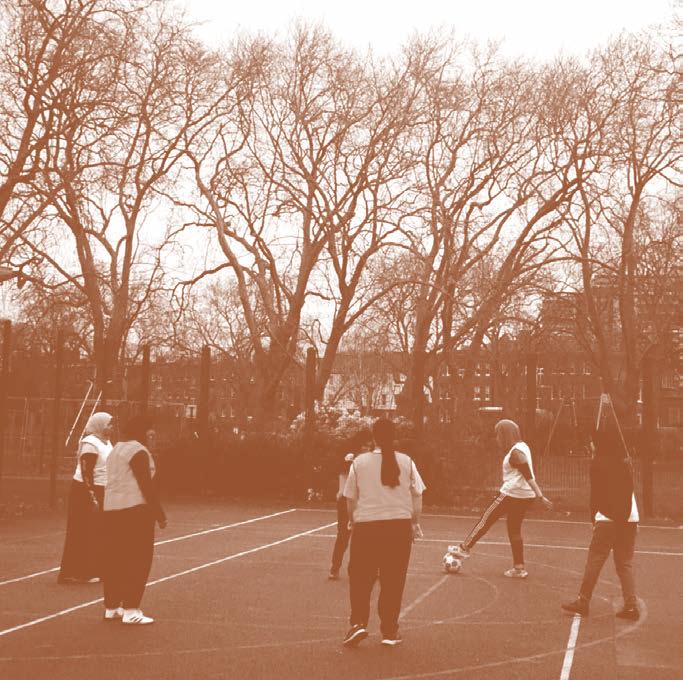
was excited to return to The Grassroot Post’s website and fall down another rabbit hole. To my disappointment, they are now out of print and have stopped publishing new articles as of March 2022. It’s a quiet but significant loss. The disappearance of a publication that centred authentic storytelling — documenting and celebrating a vibrant community.
Even so, The Grassroots Post represents just one node in a wider network of people-led social infrastructures keeping the game alive.
Returning to east London, one small club stands out as a model for teams fighting to survive the hostile economic climate: Clapton Community Football Club. Known for their vibrant, family-like atmosphere, working-class identity and anti-fascist principles, they are a 100% fan-owned club based in Forest Gate who offer flexible membership rates for their largely working-class fans.
Significantly, they maintain the long-standing relationship between grassroots publishers and clubs, working with R.W.Hart LTD, a local Walthamstow print shop established in the 1980s. Through their beautifully designed matchday programmes and zines, they echo The Grassroots Post’s commitment to platforming local players and celebrating the diversity of the local community.
In the face of financial pressures, these resistant acts of storytelling preserve the rich, everyday narratives of grassroots football in east London and the communities who sustain it.
Nevertheless, both grassroots clubs and small publishers face similar challenges moving forward. With the increasing use of technology and social media, alongside the dominance of online forms of media, both must adapt and attract a newer, more chronically online generation. The resurgence of zines, DIY publishing and calls for more third-spaces offers a hopeful look towards the future. Perhaps, this is simply another chapter to add to the long history of working-class communities resisting erasure and maintaining lifeaffirming structures from the ground up.

1 Luke Billingham, Fraser Curry and Stephen Crossley (2024), ‘Sports Cages as Social Infrastructure: Sociality, Context, and Contest in Hackney’s Cages’, Antipode, 56: 2021-2041, p. 2036.
Sagal Abdullahi is a creative producer, researcher and co-founder of Barakah LDN, working at the intersection of community, culture, and play in cities.
Screenshot of a UK National Careers Service advert for Print operators, 2026. https://nationalcareers.service.gov.uk/job-profiles/pre-press-operator
Series Editors
Ben Campkin
Rebecca Ross
Issue Editors
Leah Lovett
Rebecca Ross Ben Campkin
Editorial Assistant
Ishbel Tunnadine
Design
Guglielmo Rossi bandiera.co.uk
With Gratitude
Urban Pamphleteer is supported by the UCL Urban Laboratory. This issue documents work produced with a grant from the UCL HEIF Knowledge Exchange and Innovation Fund (HEIF RIF23-RIF-11).
Printing
TW Graphics and PageMasters
Contact urbanpamphleteer.org email@urbanpamphleteer.org
Urban Pamphleteer
UCL Urban Laboratory
Gordon House
29 Gordon Square London WC1H 0PY
Cover
Old Manor Park Library, London, 2026. Photograph by Leah Lovett.
May 2026
Back Issues
# 1 Future & Smart Cities
# 2 Regeneration Realities
# 3
Design & Trust
# 4 Heritage & Renewal in Doha
# 5 Global Education for Urban Futures
# 6 Open Source Housing Crisis
# 7 LGBTQ+ Night-time spaces: Past Present & Future
# 8 Skateboardings
# 9 Reimagining the Night
# 10 Museums, Cities & Cultural Power
# 11 Multi-Stories: Estate Interventions in London and Paris
Available online at urbanpamphleteer.org
Thanks!
Central Saint Martins Graphic Communication Design
The Bartlett, UCL Faculty of the Built Environment
UCL Urban Room
UCL East Community Board
OOMK (One of My Kind).
© 2026 All content remains the property of Urban Pamphleteer’s authors, editors and image producers. In some cases, existing copyright holders have granted single use permissions.
ISSN 2052–8647 (Print)
ISSN 2052–8655 (Online)