Capitalist Realism: Influence and Shaping Contemporary Architecture
Erhang Wang
Capitalist Realism: Influence and Shaping Contemporary Architecture
To what extent are current architectural and engineering practices haunted by unbuilt architecture within the framework of Capitalist Realism?
Module: Engineering and Architecture Dissertation (BARC0170)
Candidate Number: NYRX2
Supervisor: Shaun Murray
Date of Submission: 20.04.2025
Word Count: 9814
Abstract:
Architecture in the 21st century has become a discipline and an industry increasingly driven by market demands, bureaucracy and political agendas with lack of imagination in envisioning an alternative future to the current society. This caused a shift in architecture’s fundamental role as it is no longer to empower people and creating more enriching and uplifting spaces. This phenomenon reflects the influence of ‘Capitalist Realism’ in architecture, an idea proposed by Cultural Theorist Mark Fisher which forms the core theoretical framework of this paper.
This dissertation investigates to what extent contemporary architecture is influenced and shaped by the 21st century problem - Capitalist Realism. Through strategical case studies of the avantgarde case studies of the architectural projects in the 20th Century and a series of interviews with leading architects and theorists including Bryan Cantley, Perry Kulper, Nat Chard and others, this research examines the haunting influence of unbuilt projects and how the participants respond to the influence of capitalist realism in shifting architecture through their practice. Complementing these insights, a digital archival platform was proposed to communicate alternative voices in relation to speculation to underpin the communication of radical ideas in respond to the tension between architecture and Capitalist Realism.
Key findings reveal while capitalist pressures hinder the production of experimental ideas, speculations continues to keep architectural imagination alive and give architects opportunities to critically discuss the future of the discipline. The research suggests that speculation should be more widely embodied and taught in architecture schools to resist the political winds that student may face in the future. It underscores the need for new channels and platforms of discussion of speculations apart from traditional education and practice.
Through the proposal of my dissertation, I became an active seeker of the disguised truths within contemporary architecture so it can reclaim its role in imagining transformative futures in combat with the confines of Capitalist Realism.
1. Introduction:
The problem
Capitalist realism, as popularised by the cultural theorist Mark Fisher, suggests that it is easier to imaginetheendoftheworldthantheendofcapitalism.TheideologyofCapitalistrealism critiques the deeply ingrained influence of Neoliberalism and Post-modernism in contemporary society, resulting a reality where we are unable to imagine any alternative socio-economic structures and haunted by an unrealised future. First, neoliberalism as a political philosophy that reappeared in the late 20th century prioritises freedom of individuals and encourages competition among people and cooperation within a free-market economy. Originally, the logic behind this political philosophy is aimed to create an economy that better addressed people's needs as competition and individualism were promoted with limited government intervention. However, as Fisher argues, neoliberalism now primarily functions to generate capital for its own sake, with the increasing GDP no longer translating into improved quality of life for individuals. Second, post-modernism functioning as a critique of Modernism, repurposes ideas from the past rather than generating new visions for the future. Looking at the field of art today, including science fiction films that incorporate themes like space travel, often reuses ideas introduced in the early 20th century, utilising 21st-century technology. This trend signifies a diminishing capacity for imagination and reflects a broader phenomenon in which creativity is increasingly undervalued. 1Architecture, as an art form that actively engages with scientific rigor, could be seen as significantly influenced and possibly haunted by unrealised building projects within the framework of capitalist realism, a concept that will serve as the core focus of this dissertation.
In architecture and engineering, the hall marks of capitalist realism: economic constraints, bureaucracy and the gradual loss of capacity to envision a truly new future limit the range of acceptable design solutions to those that are more marketable and align with the current social constraints. Imagination and creativity appear to be diminishing in architectural practice, as ambitious and experimental projects are often pushed aside if they do not conform to capitalistic principles New-built designs seem to be more predictable as they have to balance financial feasibility, functionality and aesthetics, resulting a high degree of similarity in spatial experience that they deliver. These constructions, described as “non-places” by the French anthropologist Marc Augé2 , raise important questions about the limitations of contemporary architectural and engineering practices, as more innovative, joyful, socially beneficial or ecologically sustainable projects remain unrealised when they challenge the commercial imperatives of capitalism. This dissertation investigates how capitalist constraints shape and influence contemporary architectural practice, architecture and its role in the society
1 Fisher, Mark ,Capitalist Realism (Zero Classics, 2022)
2 Augé, Marc ,Non-Places: Introduction to an Anthropology of Supermodernity (Verso, 1995)
Definition of Key Terms:
Key terms are clarified as follow to be used rigorously in the arguments of this dissertation.
• Capitalist Realism - The wide spread of ideology that capitalism is the only viable socioeconomical system and any alternative to it is impossible to imagine and achieve. In the context of architecture, it indicates that market demands and bureaucratic constraints as a main driver of design intent, limiting the scope of alternative design ideas.
• Contemporary Architecture - The architectural practice of the present day, marked by the use of modern technology, awareness of sustainability and the influence of globalisation
• Haunted – Lasting Influence of unbuilt architectural projects on the design practice of today. The unfulfilled design visions can be seen as a missed opportunity and also an alternate future that could have taken place.
• Unbuilt Architecture - Architectural projects that propose alternative future to the built environment, often pushing the boundaries to reimagine spatial and material possibilities. They are often used to critique mainstream practices and established social structure
Aims and Objectives
The research aims to identify key unbuilt architecture projects and analyse how they influence the field of architecture back then and today. Using the study result and interviews with experts ranging from industry to academia, the dissertation will assess the value of doing speculative architectural work in the present day of Capitalist Society. Moreover, the study will examine the impact of economic and bureaucratic limitations on architectural and engineering practices, evaluating how radical design strategies are suppressed. The influence will be assessed through qualitative analysis of the interview response and visual studies of architectural work produced both by the interview participants and myself. Ultimately, the dissertation seeks to offer critical reflections on not only my own design practice, but also potentially impact the careers of many other young designers at the crossroad of their lives and offer a platform for continuous discussion about architectural speculation to underpin radical design ideas.
Importance of Research
The significance of the topic explored in this paper lies in the growing commodification of architecture in an age of capitalist realism. By studying the unbuilt visions of architecture which often challenge and transcend the current economic and social norms, the paper can highlight a boarder potential for this profession once it's freed from the profit driven constraints, social pressures and regulatory restrictions. Further, it can also raise awareness among the body of designers and offer them insights into the value of doing speculative design. Gaining a deeper understanding of the limitation to the current architecture practices can stimulate critical reflection within the architecture profession and providing insight of how it can evolve to obtain more sustainable, imaginative and socially responsible design solutions.
2. Literature Review:
To position my research in the academic context of existing work in the field of architecture and political philosophies, I carried out the following literature review through three interconnected themes, building a foundation for my future argument:
A. Theoretical foundations of Capitalist Realism and its influence on Architecture:
Drawing on Mark Fisher’s capitalist realism theory and literature referenced in the book Capitalist Realism: Is there no alternative, such as Slavoj Zizek and Alain Badiou, to gain the fundamental understanding of modern socio-economic system and how it affects arts and cultures.
Table 1: List of Literature for Section A - Theoretical foundations of Capitalist Realism and Architecture
Book Title Author Relevance
Capitalist Realism: Is there no alternative Mark Fisher
Non-Places:
Introduction to an Anthropology of Supermodernity Marc Auge
The Sublime Object of Ideology3 Slavoj Zizek
The communist hypothesis4 Alain Badiou
A Brief History of Neoliberalism5 David Harvey
The Selfish Capitalist: Origins of Affluenza6 Oliver James
Architecture and Utopia: Design and Capitalist Development7 Manfredo Tafuri
Provides the foundational framework of how capitalism limits and suppress the creation process of arts, shifting to reusing old ideas and erases the possibilities of an alternative future
Explores modern architectural spaces becoming more transient and dehumanised, as consequences of globalisation and capitalist values
Explores Ideology as an unconscious structure that usually reflects rather than challenges societal power dynamics, suggesting the invisible control within the design process
Challenges the inevitability of capitalism and reflects on its contradictions
Analyses the phenomenon of shifting to neoliberal policies globally and provides the historical context of architecture practices under capitalism pressures
Discusses the psychological impact capitalism brings which can be reflected in how architecture can influence social well-being
Critiques modernist architecture and suggests utopian architectural visions which provides a key perspective for understanding the tension between experimental design and capitalist limitations.
3 Zizek, Slavoj, The Sublime Object of Ideology, (Verso, 2008)
4 Badiou, Alain, The Communist Hypothesis, (Verso, 2009)
5 Harvey, David, A Brief History of Neoliberalism, (Oxford, 2005)
6 James, Oliver, The Selfish Capitalist: Origins of Affluenza, (Vermilion, 2008)
7 Tafuri, Manfredo, Architecture and Utopia: Design and Capitalist Development, (The Massachusetts Institute of Technology, 1976)
B. Utopian Visions of Unbuilt Architectural Projects:
This section examines classic unbuilt projects such as Archigram’s Plug-in City and Lebbeus Woods’ Zagreb Free Zone and how they continue to influence architectural practices.
Table 2 : List of Literature for Section B - Utopian Visions of Unbuilt/Unrealised Architectural Projects
Book Title
Lebbeus Woods
Author Relevance
Experimental Architecture8 Tracey Myers
Archigram9 Peter Cook
Examines the speculative projects of Lebbeus Woods which challenges the conventional architectural practices. It shows how architecture can be used to critique political environment of its context
Archigram’s experimental work shifting architecture to embody machine modernism, adaptability and futurism during the post-war period that influenced many architecture projects of the present day.
Archigram Architecture without architecture10 Simon Sadler
The situationist city11 Simon Sadler
Neo-avant-garde and postmodern: Postwar Architecture in Britain and Beyond12 Mark Crinson
Lost Architectures13 Neil Spiller
Radical visons of a future that never arrived14 Christopher Beanland
Indicates that Archigram’s work critiques the acceptance of rigid and functionalist approach of architecture and comments on them reimagining architecture as an dynamic and imaginative practice that provides alternative visions for the post-war era
Advocate playful and experimental interactions within cities rather than pure economic imperatives, introducing strategies like psychogeography and detournement, critiquing capitalist urbanism.
Focuses on the conflict between the post-war neo avant-garde’s experimental ideas and the capitalism’s practical demands and regulations.
Highlights that speculative nature of some architectural projects and why they remain speculative due to economic, social and technological constraints
Discusses the projects that were abandoned or unbuilt in the 20th century, and emphasises their ideology and cultural significance
8 Myers, Tracey, Lebbeus Woods Experimental Architecture, (Pittsburgh, 2004)
9 Cook, Peter, Archigram, (New York: Princeton Architetcural Press, 1999)
10 Sadler, Simon , Archigram Architecture without architecture10 , (Cambridge, 2005)
11 Sadler, Simon, The Situationist City, (Cambridge, 1998)
12 Crinson, Marc, Neo-avant-garde and postmodern: Postwar Architecture in Britain and Beyond, New Haven, 2010)
13 Spiller, Neil , Lost Architectures, (Willey-Academy, 2001)
14 Beanland, Christopher, Radical visons of a future that never arrived (Batsford, 2021)
C. Contemporary Architecture Practice Under Capitalist Constraints:
Focusing on leading design practices like Zaha Hadid Architects and Bjarke Ingels Group, this section analyses how their projects reflect the tension between creativity and market constraints
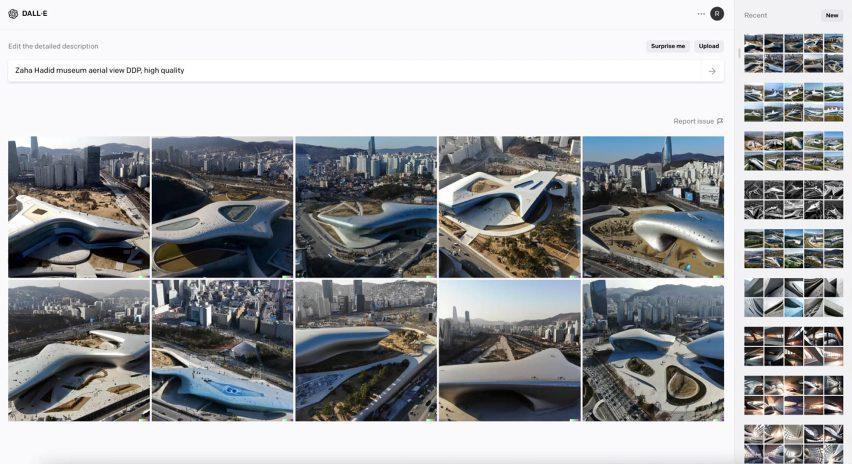
Zaha Hadid Architects (ZHA) is known for its embracement of parametric design methodologies which results into its distinct design language. However today, architectural firms including ZHA are using AI as a tool to generate ideas to win projects according to the Dezeen article16 By using text-to-images AI tools such as DALL-E and Midjourney, they can generate ‘Zaha Style’ design ideas efficiently to meet client’s demands. This approach reflects the possible conflict between creativity and economic pressure that they are facing: while reusing the established brand image and design styles can be profitable, it may sideline true innovation. It also shows that creativity in how architects practice today is shifting to form finding by using a computer model or AI tools, a design method that often lacks rigour and not pushes spatial enquiry. I argue that AI makes a mockery of the creativity process, and intellectual rigour and foresight on contemporary space making is gradually lost, like Mark Fisher’s argument of the slow erasing of the possibility of imagining alternative futures.17 This raises a pivotal question for the research to unpack further: Does creativity still hold its value today?
15 Figure 1: Barker, Nat ZHA developing "most" projects using AI-generated images says Patrik Schumacher, (Dezeen, 2023)
16 Barker, Nat, ZHA developing "most" projects using AI-generated images says Patrik Schumacher, (Dezeen, 2023)
17 Fisher, Mark, Capitalist Realism (Zero Classics, 2022)
Figure 1 ZHA using DALL-E15
Key Findings of Literature Review:
The literature review provides the theoretical framework of how capitalist pressure is limiting the imaginative possibilities of architecture, a heavily commodified discipline. While theorists such as Mark Fisher and Manfredo Tafuri highlights these limitations, Architects like Archigram and Lebbeus Woods demonstrate how radical designs may respond to these pressures and cause shifts to how architects practice and what architecture is. Reading about contemporary practices such as ZHA and BIG allows me to understand a new wave of shift since creativity is often subjugated by profitability in their projects as they heavily focus on form finding through AI tools rather than empowering people with their designs.
This results me to introducing the Three Shifts in the field of architecture supported by Y. Mansour’s paper18 and use them as guidance to my future arguments
1. Shift in what architecture is
The transformation of what defines architecture: from being perceived just as spaces defined by physical structures to embodying intellectual concepts; from adaptive systems such as archigram’s structures to whimsical forms that computers produce. This shift reflects the importance of architecture as a discipline to work with cultural, philosophical, and technological contexts, and questions the future of architecture under capitalist realism’s ideology as it claims that there is a loss of ability to imagine alternative futures
2. Shift in how architects’ practice
Architects’ practices continuously evolve through shifts in knowledge, beliefs, technological advancements and political influences such as bureaucracy discussed in this paper. This shift raises uncertainties about the future of architectural practice, considering the progression from the loss of analogue techniques in many architects’ practices to the emphasis on parametric design tools and currently AI software driven by form-finding.
3. Shift in how architecture’s primary role is empowering people.
The general progression of architecture’s role from being functional to incorporating sustainable and ecological considerations between humans and nature as core principles However, this shift questions architecture’s role today, whether focused on creating spaces that empower their communities, or is it driven by profit and exclusivity?
My argument will always refer to these shifts to in response to the topic of this paper, influence of Capitalist Realism on architecture today and critically reflects the value of creativity and speculation in today’s society.
18 Y. Mansour, THE PHILOSOPHY OF PARADIGM SHIFT ACROSS THE HISTORY OF ARCHITECTURAL PRACTICES, (Engineering Research Journal, 2021)
3. Methodology:
This dissertation uses a qualitative and cross-disciplinary approach, incorporating case studies, interviews with experts from industry to academia, and personal reflection on my design practice, to formulate a proposal responding to the influence of Capitalist Realism on contemporary architecture.Bothprimaryandsecondarysources ofresearchareusedinthispaperwhichincludes:
• Primary Sources:
o Interviews with academics working in the architecture industry including Nat Chard, Perry Kulper, Bryan Cantley and Mark West
o Interviews with architects and engineers working in the industry, including firms such as Arup and Atelier Ten.
o My owndesign explorationat theBartlett School ofArchitecture including projects from year three and year four.
• Secondary Sources:
o Books such as those by Mark Fisher, Slavoj Zizek, Peter Cook and Simon Sadler
o Journal Articles commenting and criticising different architecture practices
o Drawings of Architecture Projects
Casestudiesonclassicspeculativearchitectureprojects willfirstbeconductedtorevealthetension between speculation and capitalist constraints. Unbuilt architectural projects such as those by Archigram will be selected to analyse why these radical ideas remain speculative, how economic forces prevent experimental designs from materialising, and how these speculations caused shifting influence of architecture within their historical context The case study results will be presented in a series of Top Trump Cards, and this format of presentation is selected due to various reasons:
1. It allows direct comparison between unbuilt projects based on key criteria, demonstrating how different projects influence architecture practices differently.
2. It simplifies complex information into clear and concise categories making the study result concise and can better engage the reader to make an impact.
3. It serves as archival catalogues of the avant-garde speculative projects to preserve their value and influence This is partly inspired by the AA archive which holds unbuilt projects and allow academics to have an easier access if they want to track theirinfluence over time.
Importantly, critical analysis and explanations will be used to supplement the cards in this dissertation to justify their relevance in depth
After establishing a theoretical foundation of historical unbuilt projects, the core arguments raised in this dissertation will be rooted in the answers from the interviews that I am carrying out. In preparation for obtaining constructive and purposeful answers with the interview participants, I studied interview and reporting skills in a systematic manner There are three sections of questions
in the interview which are influence of unbuilt objects on architecture, influence of built project on architecture and finally how architecture is haunted in the larger social context today. I tried to include three to four questions for each section to ensure the conciseness, with the first question to position the interviewee, second question to confirm their interests and final questions to provoke their opinions. Questions should not be biased and misleading, but open-ended to ensure the objectivity of the research. During the interview process, I need to be an active listener which means that the interviewee’s response should not be interrupted. Prompts such as nods and follow up questions should be used at suitable points to encourage the speaker to elaborate on their ideas. Effective note taking with recording are essential to capture key ideas raised in the interview for further analysis. After the interview, I should summarise and synthesise the responses systematicallybyidentifyingoccurringthemesbroughtupintheconversationandlinkingdifferent ideas across different interview together to fit in the theoretical analytical framework of this dissertation, i.e. speculative design and capitalist realism.
Asthispaperreflectson myspeculativeprojectsprevious completedattheBartlett,Iwillintroduce some of my own design projects as a form of research through design. The projects can serve as means of exploration that bridge the gap between theory that we learn in class and the practical world.Thepaperalso makes aproposal by prototyping adigital platformforcontinuous discussion forarchitecturalspeculationtoempowermoreradicalideas. Itwillput forwardadesignmanifestos, integrate expert dialogues, archives unbuilt projects and encourage publish engagement. This dissertation serves as an experimentation to discover the relationship between capitalist realism and architecture, therefore certain limitations should be acknowledged. The utilisation of qualitative data through case studies, interviews and research through design introduces subjectivity to the analysis. The research is limited to the range of available interview participants and the number of unbuilt projects that can be included to be used in the analysis. However, these limitations are mitigated in dissertation by using critical reflection and rigorous analysis, and participants from a diverse range of background (from theoretical realm to practical world).

Figure 2 Flow diagram of Methods
4. Case Studies
In this sections, three classic avant-garde unbuilt architecture projects from early, mid and late 20th century are strategically selected from a specific time when built architecture struggle to inspire I will study and analyse their design visions in relation to the three shifts, i.e. shift in what architecture is, shift in how architects practice, and shift in architecture’s primary role to empower people, and evaluate their speculative value The studies are summarised and presented in theform ofTopTrump Cards as mentionedabove,andtomeasuretheirinfluencein asystematic method, several parameters are implemented to provide a comprehensive overview which include:
1. Capitalist Constraints: Measures to what extent capitalist structures hinders the realisation or construction of these projects as many radical architectural works remain unbuilt due to financial or political obstacles
2. Economic Viability: Assesses whether the project could have been funded or constructed within the existing financial model such as financial restructuring or state intervention
3. Cultural Relevance: Measures how much the project reflects or criticises the social context when the work was conceived and its lasting influence on movements and theories within architecture
4. Experimental Value: Evaluates to what extent the projects pushed boundaries of design such as testing of new materials, forms, theories, and methods that prioritise the value of exploration process which often challenge the status quo
5. Radicality: Measures to what extent the project challenges the conventional design strategies by reimagining fundamental assumptions and agreements within architecture suchas form and function androle in thesocietyandpotentially disrupt existing market and bureaucratic norms.
6. Constructability: Evaluates the technical feasibility of the project including the material, technology, and engineering competency at the time of the project
7. Aesthetic Appeal: Rates on the visual and artistic impact of the project: whether it explored compelling architectural language or representation to engage the audience and architecture professionals
8. Speculative Value: Measures the intellectual and theoretical value of the provoke thought and contribute to the architectural theory
Each project will be rated from 0-100 for each of these categories and supplemented by critical analysis to explain and evaluate their influence and value in depth.
A. Citta Nuova – Sant Elia
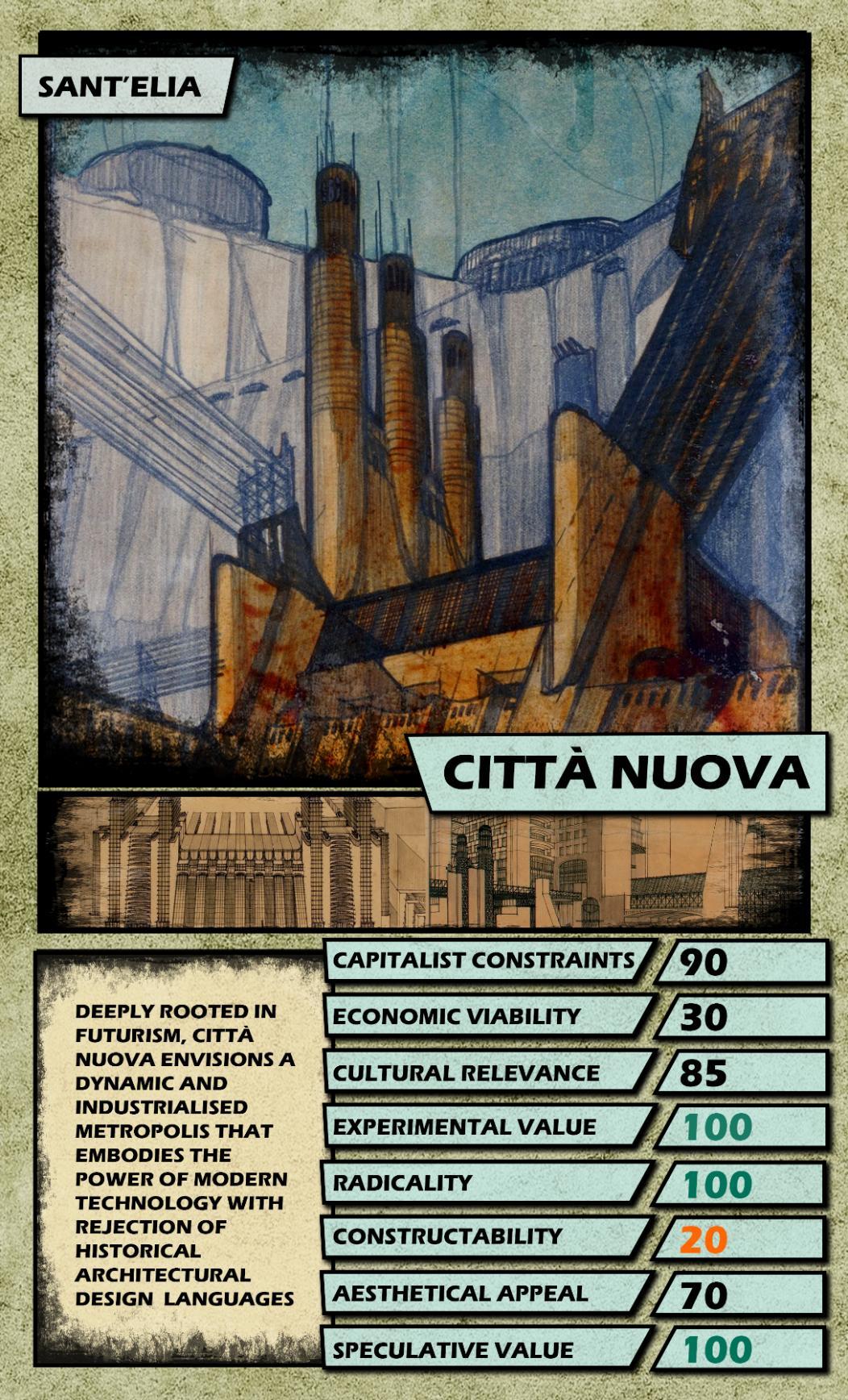
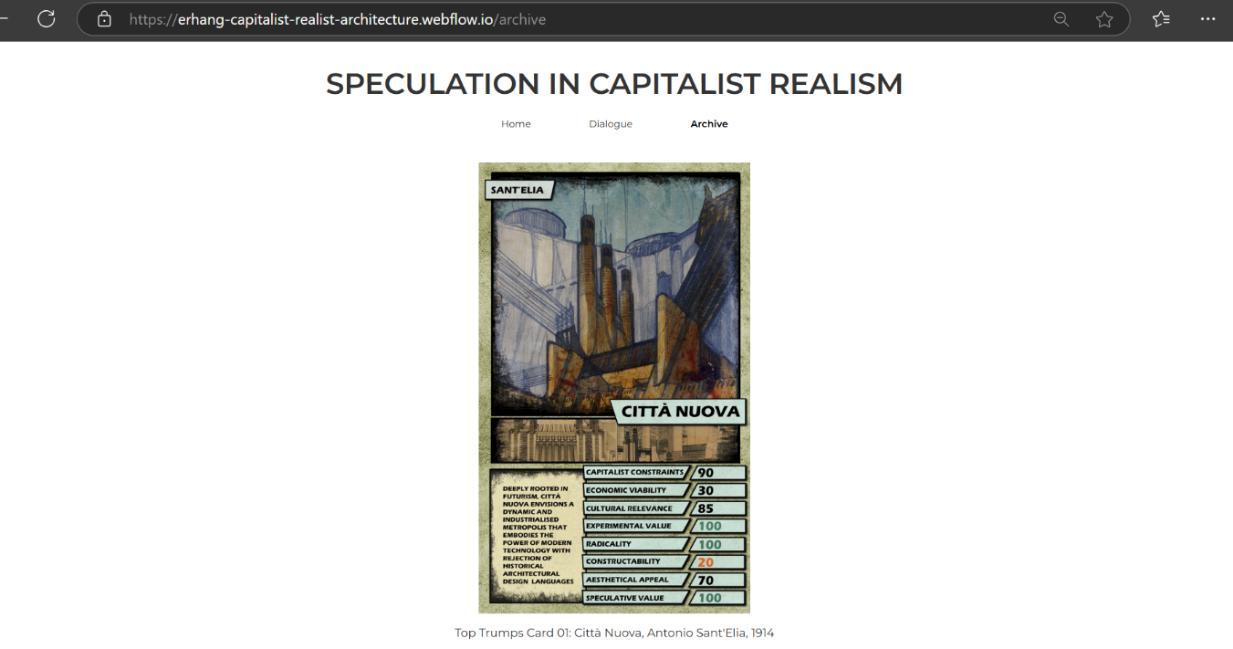
Figure 3 Design of Top Trump Card of Citta Nuova
Antonio Sant ’Elia’s Citta Nuova designed in 1914 is one of the most radical urban design projects in the early 20th century. Deeply rooted in futurism, Citta Nuova - New City, envisions a dynamic and industrialised metropolis that embodies the power of modern technology, allowing me to understand its influence to modernist and brutalist architecture in the early 20th century when classical ornamental architecture projects struggle to inspire.
The unique aspect of Citta Nuova is that not only did it modernise the existing models but completely rejected classical references, with no ornaments, no symmetry and no nostalgia which caused a radical shift in what architecture is. Sant ’Elia proposed a city that is monumental with machine-like structure and incorporating multi-level transportation systems such as bridges and passageways suspended from buildings He tries to minimise the importance of facades, an aesthetical mask that historical building value. It highlights the beauty of nudity by revealing the own skin of the machines as the essence of the architecture, made of raw concrete with exposed structures and efficient circulation systems. 19 This inevitably drive architects to embody a more streamlined, function-driven approach in practising architecture, due to the machines, speed and efficiency that Sant ‘Elia emphasises The work heavily influenced the international style movement including the work of Bauhaus and Le Corbusier who put forward principles of designs that we still use today one hundred years later. 20
I argue that this shows the nostalgia of the 21st century. As Mark Fisher argues in his book, nostalgia is the idea that the art in the 21st century reuses and recycles ideas from the 20th century. Ideas in Sci-Fi films such as Blade Runner 2049 and Ghost in the Shell which include stacked urban layers and massive corporate-dominated cityscape can all be seen as reusing ideas from the 1927 film, Metropolis, a movie heavily influenced by Citta Nuova. This shows the long-lasting influence of this project as it continues to inspire today’s art and architecture production while failing to imagine an utterly new and visionary alternate future to the current capitalist dominated society. The architecture once aimed to empower people and improve their lives through accessing advanced modern technology, now falls short, as we continue to recycle ideas from the past instead of creating alternatives that would truly benefit the society.
Overall, Citta Nuova profoundly influenced the architecture and the arts in the 20th century from the film of Metropolis to international movement of modernism and shaped how architects use a more efficient method of practising. It was a blueprint for a powerful futuristic vision that still haunts architectural and artistic discourse of the present day which shows the strong presence of Mark Fisher’s ideology of Capitalist Realism.
19 Joseph Gardella, Antonio Sant’Elia: La Città Nuova, (2024)
20 Farhan Asim, Venu Shree, A Century of Futurist Architecture: from Theory to Reality, (Civil Engineering and Environmental Systems, 2018)
B. Plug-in City – Archigram
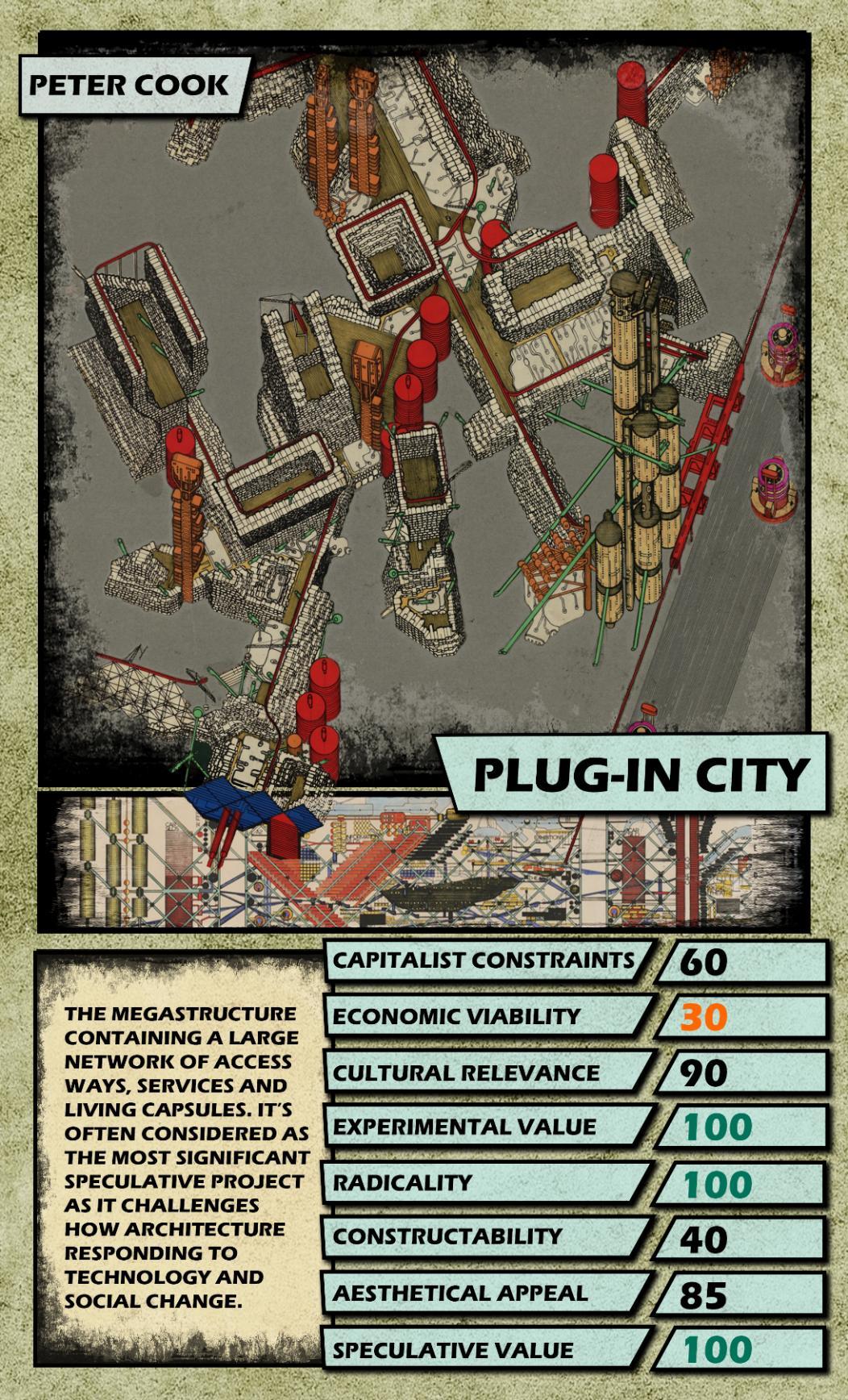
Figure 4 Design of Top Trump Card of Plug-in City
Like Sant ’Elia’s futuristic vision of urbanism, Peter Cook within the group of Archigram stands as oneofthemost influential pieces ofspeculative urbanism in the 1960’s. Theirdesign ideas often reflect the technological advancement, mass production and optimism appeared during the postwar period. Through analysis of the iconic Plug-In City, Ican examine its experimental aspirations and its relation to the three shifts mentioned previously.
Plug-In City challenges how architecture is traditionally considered as a static structure by experimenting how cities can become an ever-evolving living organism. The terrain adaptive megastructure constitutes of a large network of access ways, essential services and infrastructure with residential and commercial capsule to be replaced in the future with planned obsolescence These capsules are moved and served by using cranes operating from a railway; and the badweather balloons and lift overruns are exaggerated to show the dynamic and high-tech approach to urban living. The design of the Plug-In City turned the architecture inside-out which heavily influenced the High-Tech movement took place later in the 70’s, and inspired projects including Habitat 67 that showcases modularity in designing megastructures
The project also shifts the role of architecture in the society by responding to the slow bureaucratic development. It offers an alternative form of city in perpetual flux where architecture is designed to respond to the public needs and require active engagement from the community. The concept of ‘Plug-In’ promotes the idea of architecture as an event that comes and goes and could only be realised by the involvement of its residents. The truly utopic alternative future to architecture is imagined here to be operated on the same principles as automotive or electronic industries where spaces are upgraded, improved, and tailored to specific needs and advancements.21
Plug-In City embraces technology as a core part of architecture, which heavily influences on how architects practice. The project envisions on the use of digital tools and automation which are reflected in the workflow of many architects today. However, it also brings in America’s consumerism in a playful way as it requires continuous upgrades and modular replacements. 22 This also heavily changed how architects practice as architecture becomes more centred around providing a service that meets consumer needs and trends.
Despite the potential problem raised above, plug-In City remains to be one of the most iconic speculative architectural projects due to its influential explorations in architecture as an evolving system The ideas of using modern technology, automation and modularity in designs became materialised in many architectural projects and architects’ practices.
21 Simon Sadler, Archigram Architecture without architecture21, (Cambridge, 2005)
22 Simon Sadler, Archigram Architecture without architecture22, (Cambridge, 2005)
C. Zagreb Free Zone – Lebbeus Woods:
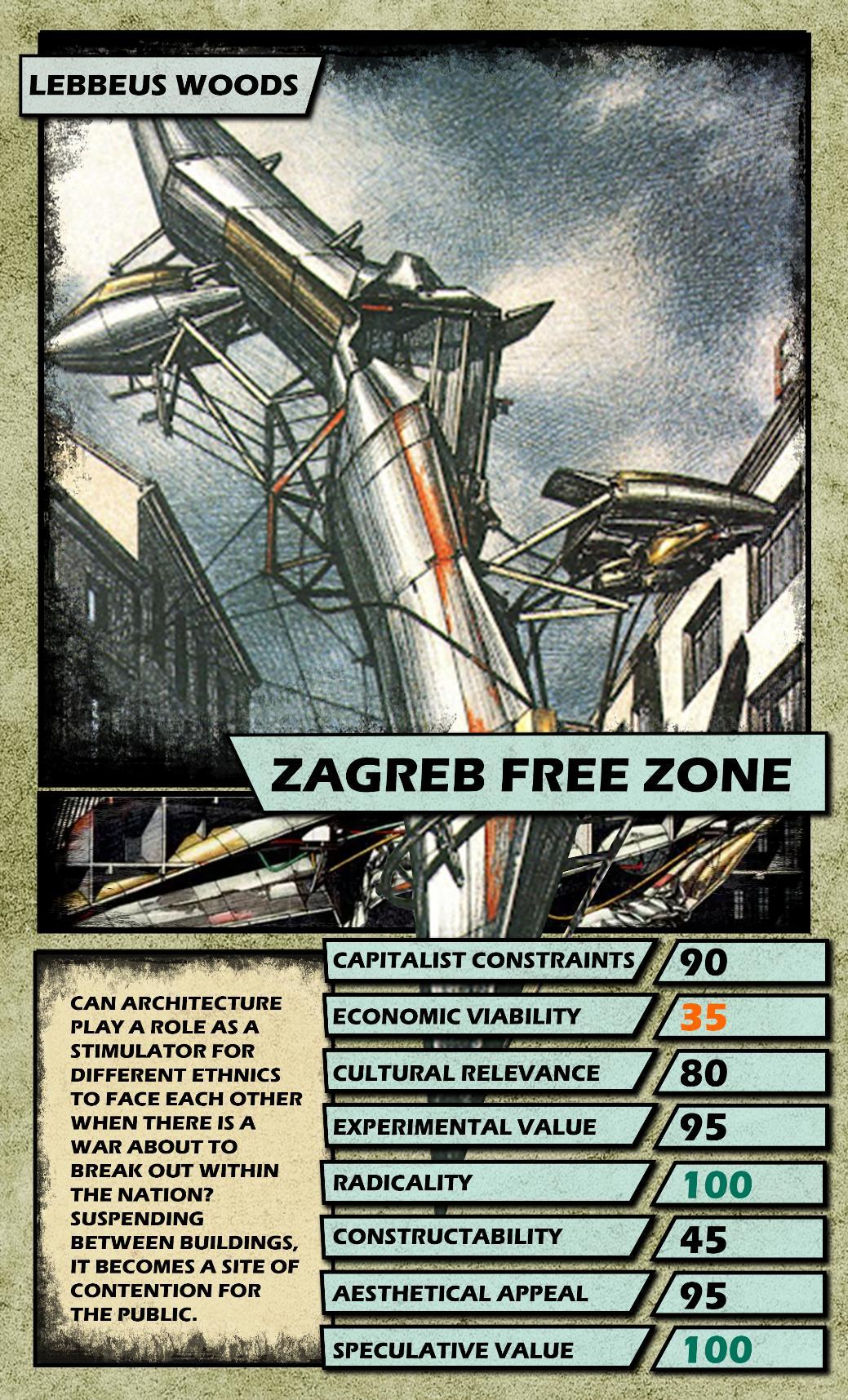
Figure 5 Design of Top Trump Card of Zagreb Free Zone
LebbeusWoods’architecturaldrawingsalsoofferradicalalternativestoconventionalurbanspaces that one can see in science-fiction films. Studying Woods work, namely Zagreb Free Zone will allow me to understand how design ideas can linger as alternative possibilities and examine whether architectural speculations are progressed in the 21 century or reuse ideas as argued by Mark Fisher.
Zagreb Free Zone fundamentally questions architecture’s role in the society by proposing a public conversation stimulator. Suspending between buildings on a public square in the 90’s Yugoslavia, it naturally becomes a site of contention for the public. The project embodies the radical language of fragmentation and disorder which reflects the scars left by the Yugoslavia war in Zagreb, therefore creating a connection between architecture and its social-political environment. The proposal encourages different ethnics to face each other when there is a war breaking out within the nation. It challenges architecture’s role to comply economic principles in its context, i.e., urban spaces should be governed for profitability but alternatively taking it up to create a temporary ‘freespace’ for the citizens to debate about the city’s future.23
A critical aspect of Zagreb Free Zone is its refusal to consider about the immediate functionality and constructability of the proposal which shift what is considered architecture. Rather than a practical output, the project was more intended to be a speculative resistance, demonstrating how architecture can serve as a critique of the society rather than commodity. The emphasis of experimental structural framework with fractured abstract volumes inevitably results in low constructability. It intentionally rejects the smooth and clean design language that is harmonious to the surrounding but becomes a protagonist in the square. In Fisher’s terms, the project embodies a ‘haunting’ of unbuilt alternatives that keeps influencing architectural ideas produced today.24
Woods practice focuses on using drawing as the medium of architecture rather than using it as a tool for making design proposals which influenced generations of architects’ practice. His intricate drawings and sketches redefine how architects engage with spatial ideas, moving architecture to realise the importance of narrative and theoretical design approaches. Influences can be seen in architects who I am going to interview, such as Perry Kulper and Bryan Cantley who’s design practice is centred around analogue drawings as mode of architectural exploration.
To conclude, Woods’ work including Zagreb Free Zone, pushes the boundaries of architecture by empowering people to envision alternative futures for their nations, and act as a tool for political critique rather than purely practical solutions. Zagreb Free Zone along with his projects in Berlin and Bosnia are touchstones for architects today who has analogue-driven architectural practice
23 Tracey Myers, Lebbeus Woods Experimental Architecture, (Pittsburgh, 2004)
24 Lebbeus Woods, ANARCHITECTURE: Architecture is a Political Act, (St. Martin’s Press, 1992)
5. Interview Analysis
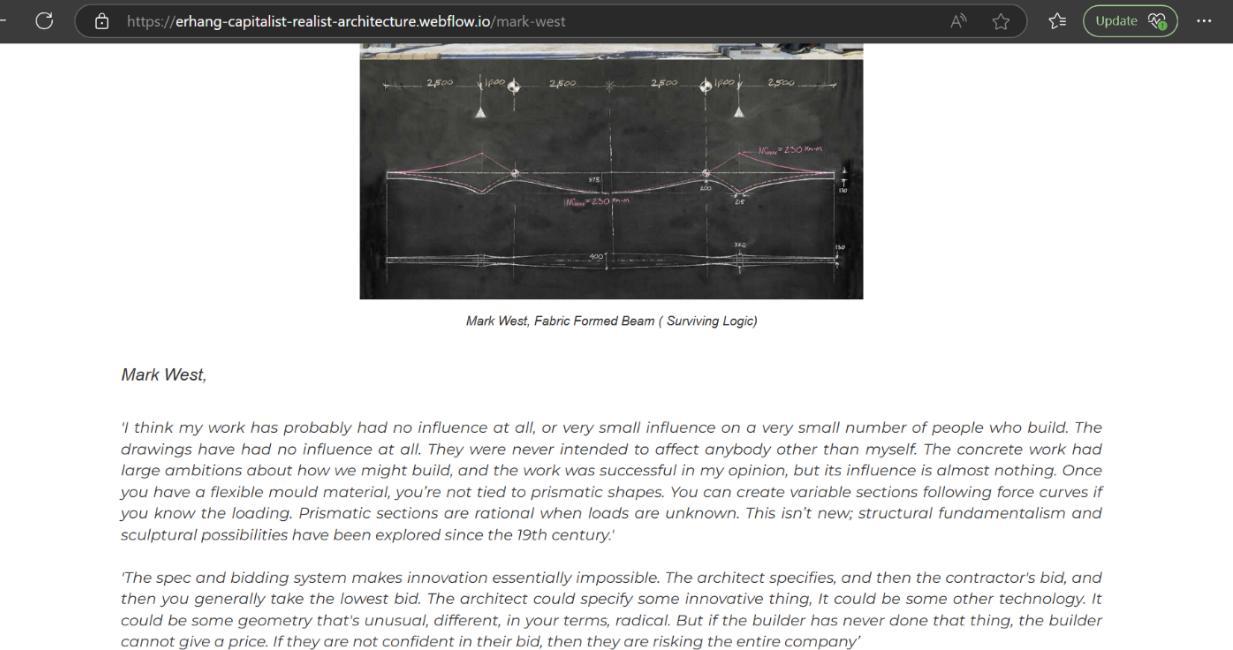
Figure 6 Mark West, Fabric Formed Beam ( Surviving Logic)25
Figure 7 Hanil Visitors Centre and Guest House by BCHO, supported by Mark West26
25 Figure 6: West, Mark, Fabric Framework, (Surviving Logic)
26 Figure 7: Ethrington, Rose, Hanil Visitors Centre and Guest House by BCHO, (Dezzen, 2010)
This section provides an in-depth analysis of the interview conducted with architects and academics who have a wide range of projects from built architectures to unbuilt speculations. It examines their perspectives onhow architecture, architectural practiceand architecture’s role is changed under the capitalist realism ideology proposed by Fisher. The analysis first investigates the material and construction constraints, where efficiency and standardisation often sideline structural performance and innovation in architecture.
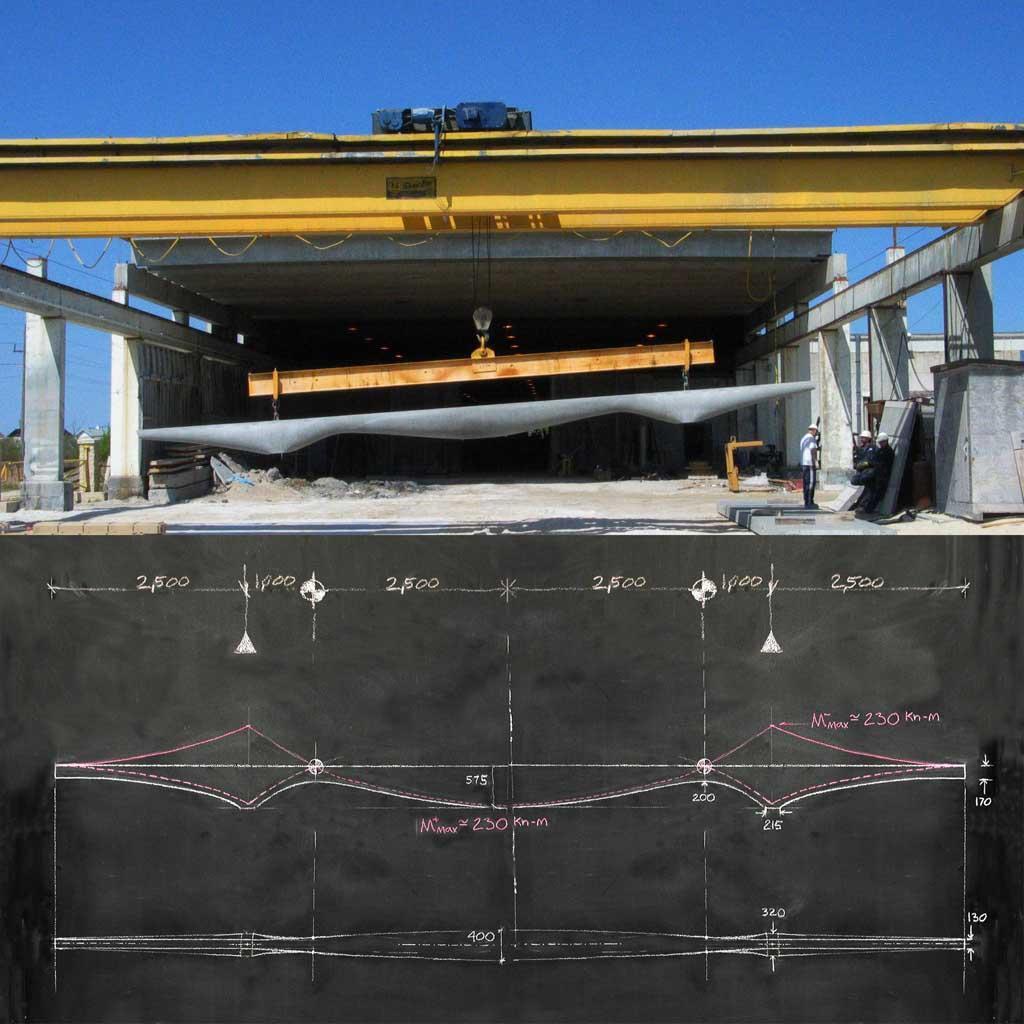
Mark tried to create a shift in what constituents a structural element in architecture through his practice, from standardisation to performance. Structural components in the building industry are usually produced in standardised section profiles such as I beam or hollow shapes as they can be more efficiently transported and produced. However, it is known that components of the shape that follow the bending moment diagram have a better structural performance. Architect Mark West uses a pioneering fabric forming technique to manufacture structural elements that vary in section sizes including beams, columns, trusses and panels as shown on Figure 6. (Appendix 9.1.1, P45) The fabric used as the mould is made of polyethylene, which is cost effective and strong, so the casted structural components will be highly performative and ecologically sound.27 This construction method challenges the idea of standardisation and rigidity in structural components by attempting to transform them to into more adaptable, performative and experimental options.
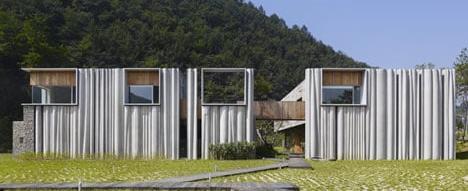
West tried to simplify the building process in his career, indicating a shift in how architects approach the practice of construction West claims that fabric forming is a construction method that is easy to master. To make it even more friendly, he put a constraint that only a single sheet of fabric can be used as the mould, so the contractors do not have to tailor it in-situ. Despite its potential to the industry, fabric forming remains relative niche. (Appendix 9.1.1, P46) A rare example can be seen on the Hanil Visitors Centre and Guest House by BCHO, a built project under the help of West’s expertise, where the elegant façade is built by using fabric formed concrete, West explains that the main constraint in making such construction method to be more influential is the bidding process: today’s construction industry still largely relies on traditional materials and construction methods, whereas fabric forming would be viewed as too risky for the contractors,
‘If the builder has never done that thing, the builder cannot give a price. If they are not confident in their bid, then they are risking the entire company’
Despite the influence of West’s practice to transform what constituents the structures of architecture and how architects practice towards the realm of construction, the bureaucracy and the conservative culture among builders makes any novel techniques nearly impossible to compete with established methods This phenomenon ties back directly to the idea of capitalist realism proposed by Fisher as short-term economic gains sideline the long-term benefits of the society.
27 Mark West, (Surviving Logic, Fabric- Formed Concrete and Fabric Formwork Construction - Surviving Logic)
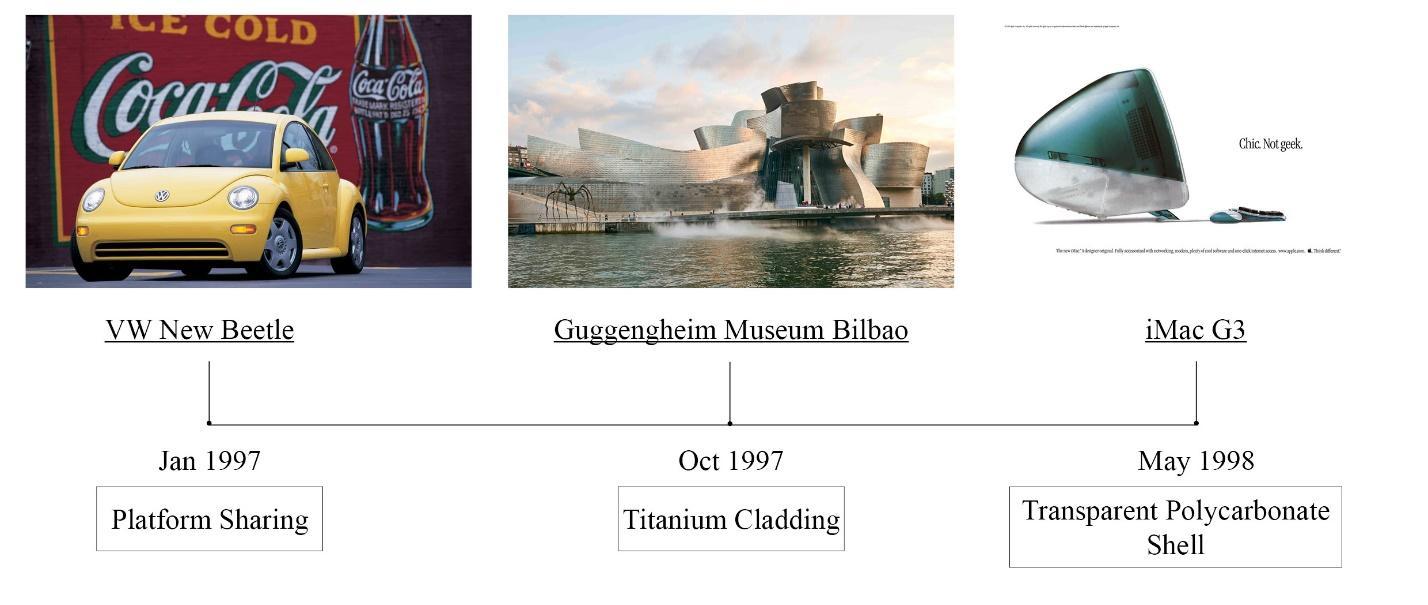
Figure 8 Launch of Iconic Designs at similar time frames: New Beetle by VW, Guggenheim Museum by Frank Gehry and iMac G3 by Apple
Figure 9 Annotated Bryan Cantley, Palimpsest Relationships28
28 Figure 9: Bryan, Cantley, Palimpsest Relationships, (Bryan Cantley)
While maximising profits is normally seen as the main goal for many architectural practices, both architects and the public should explore and appreciate experimental speculative work to drive the discipline of architecture going forward. Architect Bryan Cantley claims that,
‘Without experimental work, we really limit the depth of how well we can develop the discipline of architecture’.
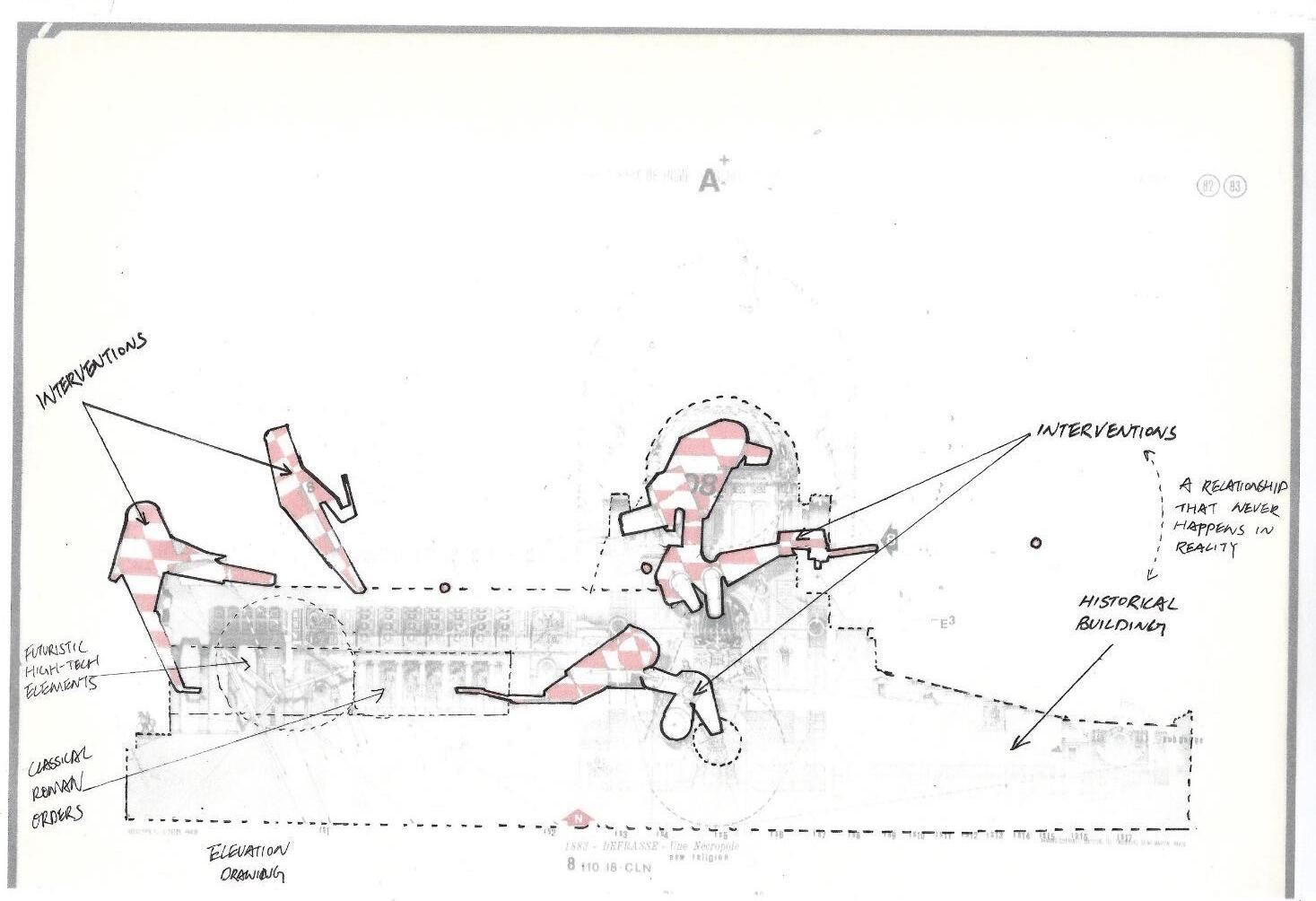
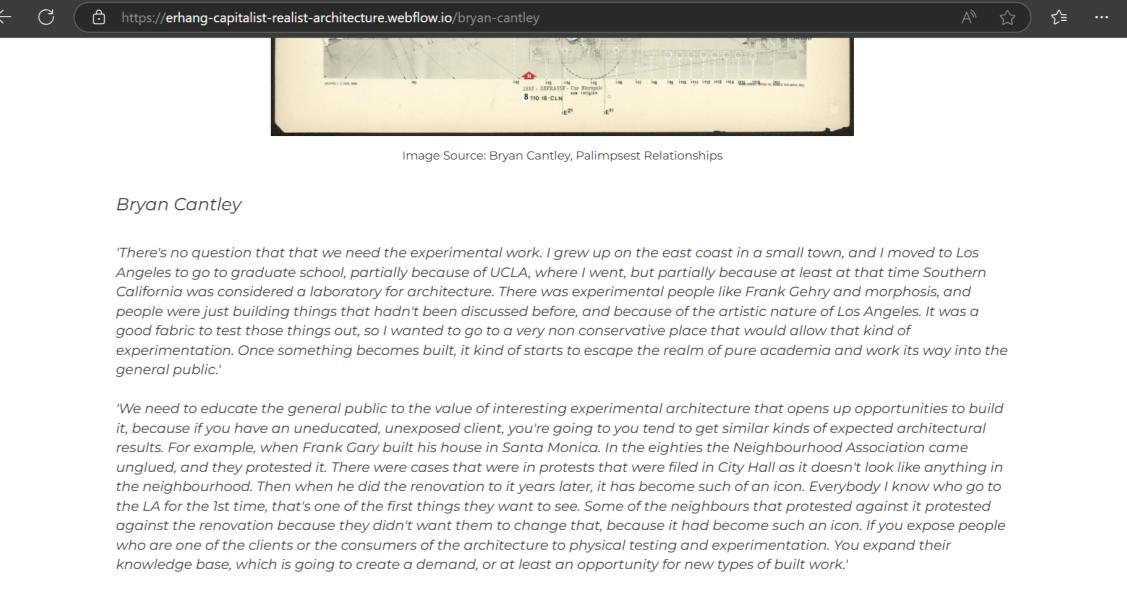
As Cantley explains in the interview, from built reality to speculative exploration of architecture is what he values the most in his practice. He argues that speculations are not meant to have an immediate effect to the built environment, like concept cars to the automotive industry, in which design languages can be tested and designers who work on mass produced vehicles can get inspired. The value of speculation lies in the design dialogue generated between architects, designers, and the public to explore their political and social engagement, their materiality and all aspects that are considered in architectural projects. These works are often put into hyper fantasy settings to test ideas without considering any immediate practical effect to the industry but intended to influence the decision makers in the future which (Appendix 9.1.2, P47)
Cantley emphasises the importance of shifting architecture’s role from serving clients to empowering people to build up a cultural identity. When architects working with uneducated and unexposed clients or the public, the architectural outcome would be inevitably expected. Exposing or educating them with architectural experimentation, physical testing and unusual methods of problem solving would lead to more radical built work. An example can be seen in Gehry’s Residence in Los Angeles, which was first protested by the residents as they claimed it destroying theneighbourhoodbut finallybecamethearchitectural andcultural iconin LosAngeles, showing the importance of exposing the public with architectural experimentation (Appendix 9.1.2, P50) This argument in sum reinforces the value of speculation and challenges the primary role of architecture in the capitalist framework: whether to prioritise commercially viable designs with high investment returns to satisfy preconceived notions or educating clients and the public through speculation and experimentation, to foster greater societal acceptance of radical ideas
Even though market-driven forces can limit experimentation, it is important to note that they can often foster creation of new materials and technologies which change how architects practice. Examples can be seen in the design of The VW Beetles, iMac G3 and Gehry’s Guggenheim Museum in Bilbao, all launched to the public between 1997 and 1998 due to technological advancements namely: monocoque car body, transparent polycarbonate shells, and the software of CATIA for achieving complex geometries for the Guggenheim. (Appendix 9.1.2, P51) It shows that capitalist forces can sometimes foster the creation of new materials and technologies which are gradually integrated to architects’ practice. It expands the possibilities of architectural expressions, allowing designs to be materialised that was previous considered unachievable.
29
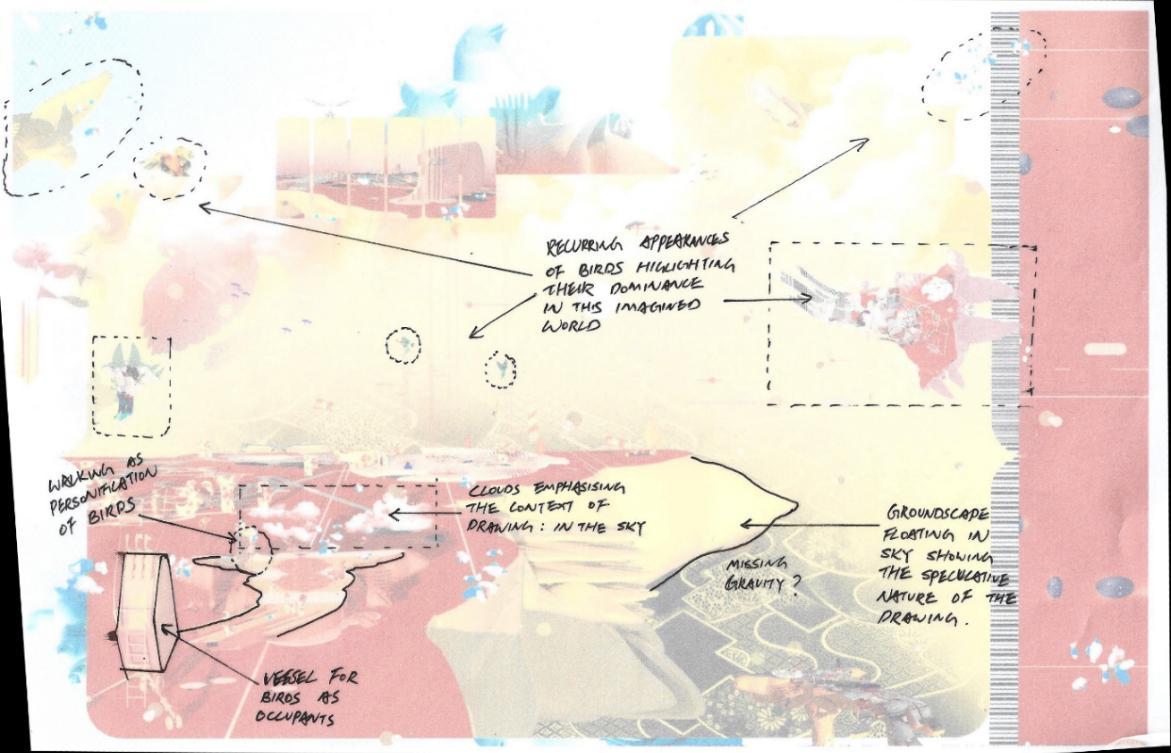
Figure 10 Annotated Perry Kulper, El Dorado: Floating Bird Motel, Peachcraft’d Overtones, 2017
Figure 11 Perry Kulper, El Dorado: Floating Bird Motel, A World of Illusionary Details, 201729
Figure 10, Figure 11: Kulper, Perry El Dorado: Floating Bird Motel, Peachcraft’d Overtones, (Architecture Image Studies Scientific Journel, 2017)
Architect Perry Kulper also argues that speculative architecture does not need to be built to have afar-reaching influenceonarchitectural thought andit shouldbeintegral to architectureeducation, necessitating the evolution of practice methods,
‘Projects are more important because they're unbuilt. Their contributions are more far reaching. We can do a lot of things when we work in representation that we can't do when we build. I'm happy to not build What I would like to do is figure out how to structure some things through material that interest me.’
Kulper urges a transformation in how design methods are taught in universities to have alternative forms of architecture practices. Design methods such as ‘Form to Programme’ that challenges the existing contemporary belief of ‘Form Follows Function’ is vital but normally missing in architecture education (Appendix 9.1.3, P62) In Kulper’s practice, he would set conditions such as missing gravity and folded temporalities, normally resulting in underdevelopment of his work to be delivered on the constructed level. However its contribution is much more impactful due to its representational nature, which will be elaborated further through analysing one of Kulper’s projects below. Such practices are often limited by inheritance such as accreditation and mandates of licensure which agrees with the key argument of ‘Bureaucracy’ that stifles innovation by Mark Fisher in his book.
Kulper criticises ‘The Naming Problem’ within architecture which consolidates the established definition of architecture which should be progressed. Kulper indicates that the creative process of a project is 90% concluded when we name it by existing architectural vocabularies such as foyer, library and bedrooms. Architecture can be reimagined when architects work on more thought-provoking ideas such as ‘dream estate’ or ‘Nutrition and Hygiene’. (Appendix 9.1.3, P58) An example can be seen in Kuper’s drawing of Floating Bird Motel as it presents a surrealist illusional resorts for birds and incorporates metaphorical human-centric programs such as spa, ball rooms and gardens. This project functions as a representational tool that challenges anthropogenic design by effectively examine the existing hierarchy of human to animal and prompts the audience to critically reflect human’s dominance over other species. It challenges the capitalist values of prioritising human needs over nature. By breaking through traditional nomenclature, designers can envision architecture beyond established functions and definitions that is heavily influenced by capitalist pressures and reflects the crucial role of speculation which resonates with Cantley’s core ideas analysed earlier.
This argument on balance shows that architecture practices in the present day is heavily influenced by capitalist forces. Architecture schools should put a greater emphasis on teaching speculative design methods to support the emergence of new alternative forms of practices. Speculation that challenges traditional nomenclature progresses what defines architecture which is crucial for envisioning alternative futures.
30
31
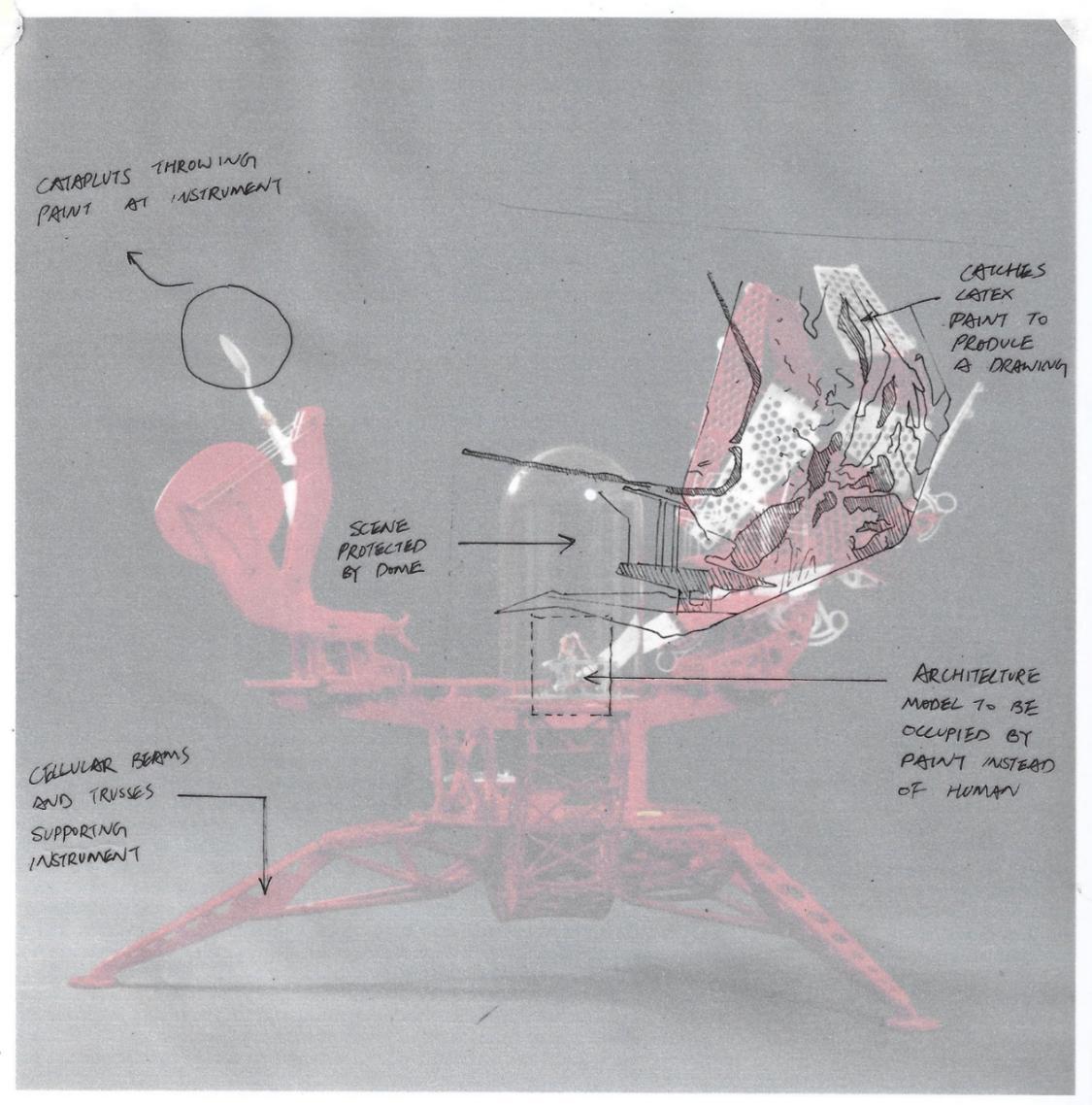
Figure 12 Annotated Nat Chard, Instrument Five, 202030
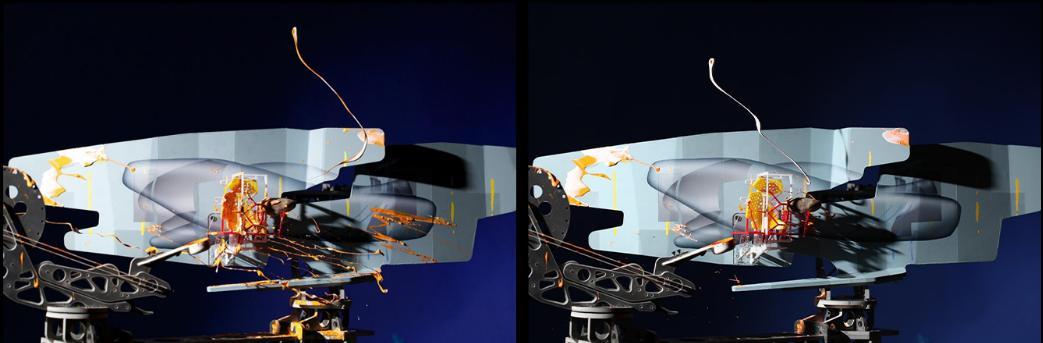
Figure 13 Nat Chard + Perry Kulper, Instrument Eight, 202031
Figure 12: Chard, Nat, Instrument Five, (Nat Chard | Drawing Uncertainty, 2020)
Figure 13 Chard, Nat, Kulper, Perry, Instrument Eight, ( Nat Chard | Drawing Uncertainty, 2020)
Similar to Kulper’s practice, Architect Nat Chard challenges the human-centric definition of architecture by using material agency as an occupant in his models. Through a series of instruments, he projects this onto folding picture planes, producing drawings that serve as a means of constructing tacit knowledge This practicing method challenges conventional representational techniques as it shifts the focus from human occupation to material agency, allowing people to reexaminehowarchitecture is conceivedandcommunicated. (Appendix 9.1.4,P71)As Chardpushes forexperimentation in hiswork, hebelieves that weareliving throughaperiodofcultureboredom.
‘I think architectural practice now is certainly the most conservative I’ve seen in my lifetime.’
In the Thatcher era, practices would compete on quality rather than on price which allowed them to have the possibility to embody more adventurous speculation, but the profit margin is too tight to focus on anything else than making money today.
Chard advocates for a route for communication of architectural drawings and speculations that is truncated in the present day which can change how architects practice Looking back at history: post-modernism, constructivism and high-tech are architectural and cultural movements that incorporate drawn works that could captivate people’s imagination, but it seems to be less clear today from Chard’s perspective. Specifically looking at the AA in the 80’s, architects who worked there such as Peter Salter, Peter Wilson, Daniel Libeskind and Zaha Hadid explored the subjects by using drawings, which were influential yet being built to certain degrees. However today, the culture of publishing people’s work in magazines and exhibitions to be then discussed seems to be gradually disappearing, creating a truncated path. (Appendix 9.1.4, P69)
Chard also reveals a disempowerment of architects and the public in shaping the built environment due to the bureaucratic systems such as the LEED process in the US. It is widely used rating system that purports to assess the sustainability of buildings, but profit maximisation is their primary objective. Chard explained that one of the LEED Platinum Buildings (highest possible sustainable level) he had experienced achieved this rating due to the client subsidising their employees to buy more hybrid cars. Instead of exploring how to maximise local resources, the mechanism behind it relies on buying additional photovoltaiccells orinsulation materials. It shows a market-driven approach to sustainability and enhancing well-being in architecture in the US, where ecological considerations are secondary to financial incentives. (Appendix 9.1.4, P67)
Overall, the argument for the urgency of having a channel to discuss architectural speculation is key which can be reflected in my proposal I will present below. Also, the disempowerment of the public and architects proves the influence of the idea of Capitalist Realism where the urgent necessities such as sustainability are absorbed into its own metabolism system to reinforce its dominance and illusion of progress.
Having Interviewed architects and academics who have built projects to different extent, it is essential now to obtain responses from designers who are currently working in the industry so a balanced analysis can be ensured. Therefore, the interview carried out with Samuel Miselbach and Julia Torrubia (Atelier Ten) and Angela Crowther (Arup) will be analysed below. These interview participants are strategically selected to have experience at the crossroad of architecture and engineering to unpack the true inside story of the industry from a comprehensive angle.
32 Figure 14: Using simulation to reduce the carbon footprint and provide more utility for users, (Siemens)
33 Figure 15: Feng Zengkun, Inspired by nature: the secret behind Atelier Ten’s intelligent green buildings, (EcoBusinuess, 2022)
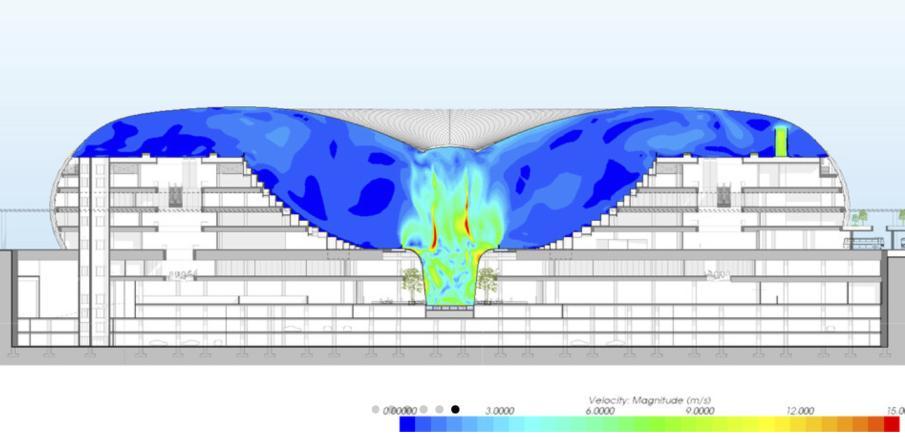
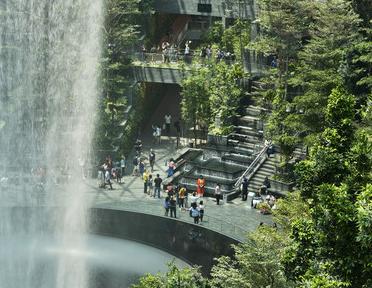
Figure 14 Atelier Ten, CFD Model of Jewel Changi Airport, 201932
Figure 15 Atelier Ten, Interior View of Jewel Changi Airport, 2019
Torrubia and Miselbach as industry practitioners claim that architecture is not only about creating tangible buildings but shifting ideas and design approaches that influence the field over time. Designers working in the industry continue to reference the ideas proposed in classic speculations. They explained that these speculations being unbuilt due to either low construction feasibility or limited economic viability represent a significant missed opportunity for materialising these experimentations, but the strategies that they propose are kept through to the designs today. Their creativity is not lost but transformed into constructed projects Many of which are embodied in the details of a building project and often are confidential, making it challenging for the outsiders to learn these intriguingly innovative design decisions. (Appendix 9.1.5, P75)
One example can be seen in the design of the world’s largest water wall in Singapore’s Changi Airport. Guided by the utilisation of CFD modelling, the environmental team at Atelier Ten designed a one-meter-tall Balustrade to reduce water vapour rising and entering the dry zone, effectivelyimplementing theconceptofamonumentalwaterwall attheheartofanairport terminal.
Torrubia and Miselbach stress the importance of bridging the gap between speculative, unbuilt ideas and practical, built projects in contemporary design practice From their experience of practising,experimental designteachesarchitects anddesignersawayofthinkingandapproaching to solving a problem which is invaluable. However, they state that the design field is filled with a strong sense of individualism among both academics and practitioners. Bringing together the speculative and practical approaches from both sides is the key. Bridging this gap to allow experimental ideas transform into feasible built projects is where the true potential and beauty of architecture lies from their perspectives. (Appendix 9.1.5, P84)
Mieselbach discusses that profit-making is the primary role for many projects from his experience which sometimes haunts his practice due to these unrealised futures,
‘The decisions that influenced us a lot are driven financially and commercially, and that can be a real frustration. You don’t always see the industry moving in the right direction.’
The design brief they receive is often purely based on ‘pound per square meter’. Further, due to the current funding model in the industry, especially in the realm of commercial offices, there is an expected return in investment in a certain year, leading to design decisions that focused on maximising profitability in the short term, rather than the long-term benefit to the community
These arguments on balance focus on merging speculation and built projects together to reshape architectural practices. However, the main obstacle to create spaces that benefit the community and the environment is the economic imperatives, leaving the current architecture practices haunted by the unrealised futures or the profit-driven decisions they made in the past
34
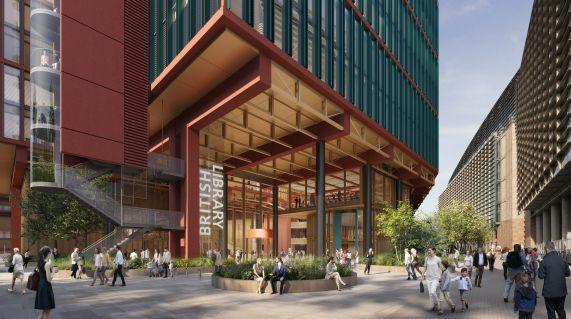
Figure 16 Exterior View of British Library Extension by Arup and RSHP, 2025
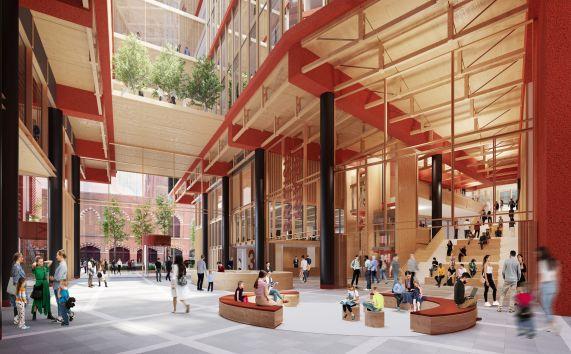
Figure 17 Interior View of British Library Extension by Arup and RSHP, 202534
Figure 16, Figure 17: (British Library Extension, 2025)
Drawing on her extensive experience in both architectural and structural design, Crowther offered a thorough discussion on the realities of speculative projects currently in the industry, highlighting factorsbeyondthecontrolofdesigners comingtorealisingadesignprojectandproposingpotential possibilities for progress within a capitalist society.
Crowther identifies that the ‘big ideas’ can shift and evolve into many projects when her team participate in speculative competition. Architectural practices must be profitable to be kept running, but competitions provide an opportunity to allow the team to work in a less financially constrained world and explorethe more radical ideas.Many oftheseideas may not be kept through in one project but get a chance for them to evolve and find new expression in many other projects. It reimagines architecture as a fluid and metabolic system to push boundaries within the built environment Sadly, in many cases these big ideas that were initially promising may get reduced due to many reasons such as the long waiting period of planning and the political wind. (Appendix 9.1.6, P 88)
In responseto Cantley’sideathat clients needto be educatedforthe industryto progress, Crowther added that it is crucial to empower society to express their needs under the help of both architects’ and engineers’ articulation. (Appendix 9.1.6, P 90) As mentioned previously developers tryto minimisetheirrisk whendesigningandconstructing abuilding project.Therefore, If the developers see the public recognising the value of natural spaces, biodiversity in city, then they would realise the importance of integrating these elements into their projects.
Crowtherclaims that design is only atinypartmakingaproject happen when comparing to politics and economic factors, this insight suggests the importance of architects being political aware within their practices
‘The bit that I enjoy is that if you understand those things then you can learn to navigate those things to try and get your ideas through, and the designs to have more power, whereas if you just blindly push from your design perspective, you are going to hit walls that you don’t understand.’
large public projects such as railways, hospitals or educational infrastructure that are truly beneficial for the society may get lost through the design process due to who is in political power, continued Crowther It proves that the architectural practice of the present day is so entrenched in bureaucracy that design on itself has a limited power. (Appendix 9.1.6, P 90)
On balance, Crowthers responses highlight that architecture, and design can be flexible and dynamic ideas that transform between projects that should meet the societal needs of the community. Becoming more politically aware in my future design practice should be an area that I need to explore more into.
Thefollowing table summarises themain points arguedin the interview analysis section in relation to the Three Shifts introduced previously. It will also function as foundational principles for the reflection of my own practice and the proposal
Table 3 Summary Map of Ideas Raised in the Interview Phase
Shift 1
Participant
Mark West
Bryan Cantley
Perry Kulper
Shift in architecture
More performative, sustainable and experimental structural constituents of architecture
Speculation to test new ideas, design languages and create dialogues between designers
The need to break through The Naming Problem to redefine architecture and reimagine ecological relationships
Nat Chard
Julia Torrubia, Sam Miselbach
Angela Crowther
Transforming humancentric definition of architecture to occupying through material agency.
radical ideas that normally hide in the details normally reference classic speculations instead of tangible buildings
Radical ideas that evolve and reborn in many projects, however they can be affected by many political factors
Shift 2
Shift in how architects practice
More experimental and less bureaucratic construction method and process in the industry
New materials and technologies changing how architects practice to materialize classic designs
Shift 3
Shift in architecture’s role to empower people
More tailored to Individuals needs instead of standardization in architecture
From a service that meet the clients’ needs to educating them to push for radical design ideas
Alternative forms of practice through learning experimental design methods and embodying speculation from the stage of education spaces beyond their conventional use can change how people engage with architecture, not just as passive users but as participants in shaping its meaning.
Having a route for architectural drawings and speculations to be discussed and built to certain degrees
Bridging the gap between speculative architects and industry practitioners to be more integrated to materialise radical ideas
The needs to be more politically aware through one’s practice to achieve built projects that are beneficial to the public
Market driven approaches such as LEED ‘dispower’ architects and the public to have sustainable solutions
Economic imperatives restrict the potential for environmentally progressive architecture, leaving the field "haunted" by unrealised futures
Empowering the society to express their needs under the designer’s articulation to influence the developers
6. Personal Reflection and Proposition
Having developed a comprehensive understanding of how capitalist realism influenced the shifts in contemporary architecture through a historical Lense and the lenses of the experts interviewed, I now find it essential to be reflective of the purpose of doing this research and how it impacts my own design practice.
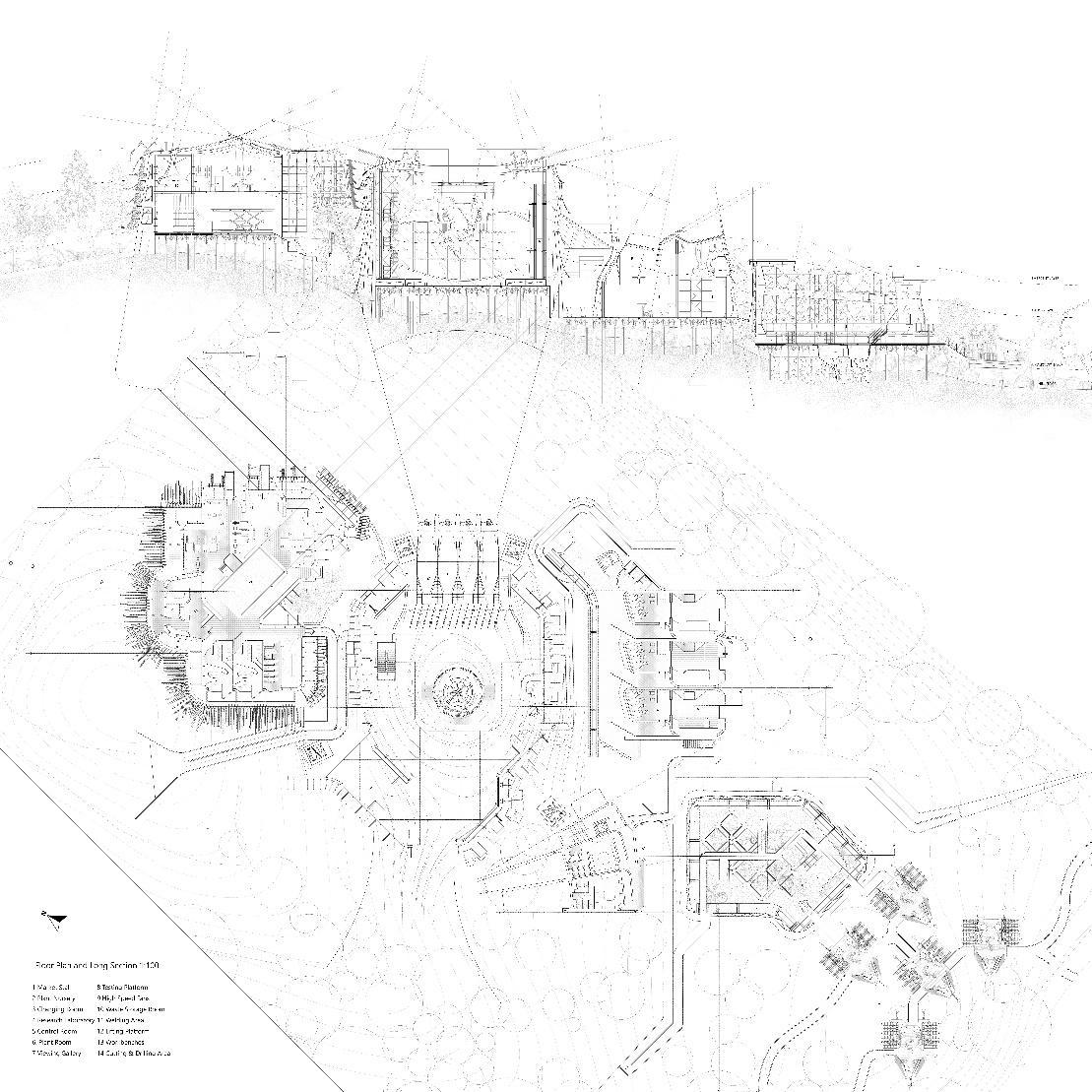
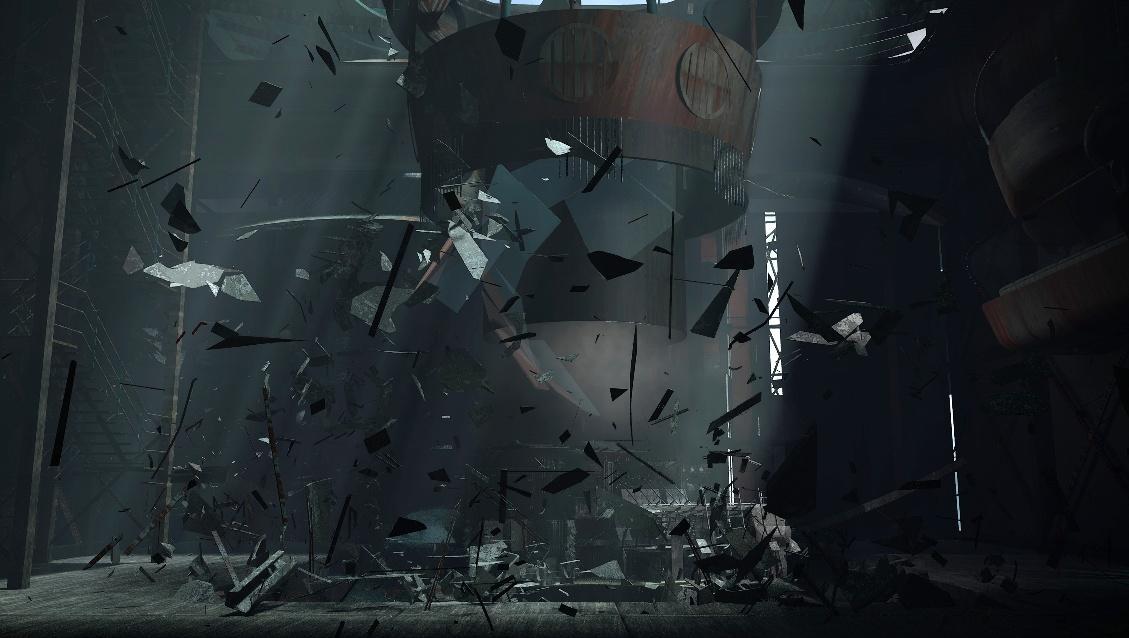
Through researching into this topic, I understood the importance of embracing speculation in my education and practice in the future and realised architecture does not need to be built to have a long-lasting influence. Speculation is not abstract exercise as your tutors demand you to do a complex drawing, it is a way to test new ideas, challenge existing architectural conventions and envision an alternative future An example that I tried to push boundaries can be seen in my thirdyear design project ‘The Wandering Earth: Pre-braking Era’ as shown on Figure 18 and 19: a tornado institute envisioning a future that extends beyond capitalism's influence when the Earth itself is approaching to its demise. Incorporating cutting edge technologies in the design of façade systems and stilt-flooring structures, the project advocates an optimistic approach to life before the descent into underground cities. Having studied and understood architectural speculation’s historical significance, I recognise that working on speculative projects with tutors, like this one, serves as a 'slow bake' of ideas, gradually shaping future solutions in practice and influencing the built environment over time as put forward by Cantley (Appendix 9.1.2, P49)
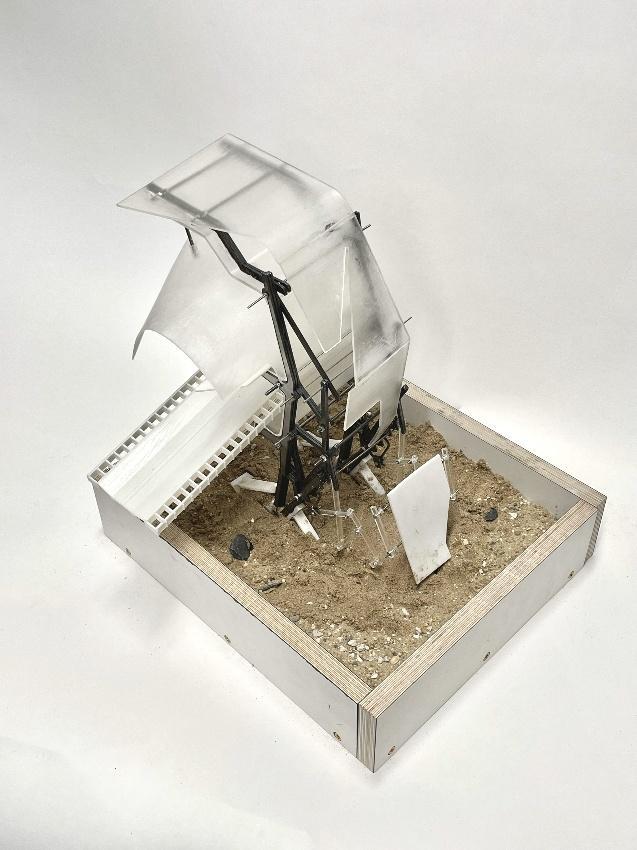
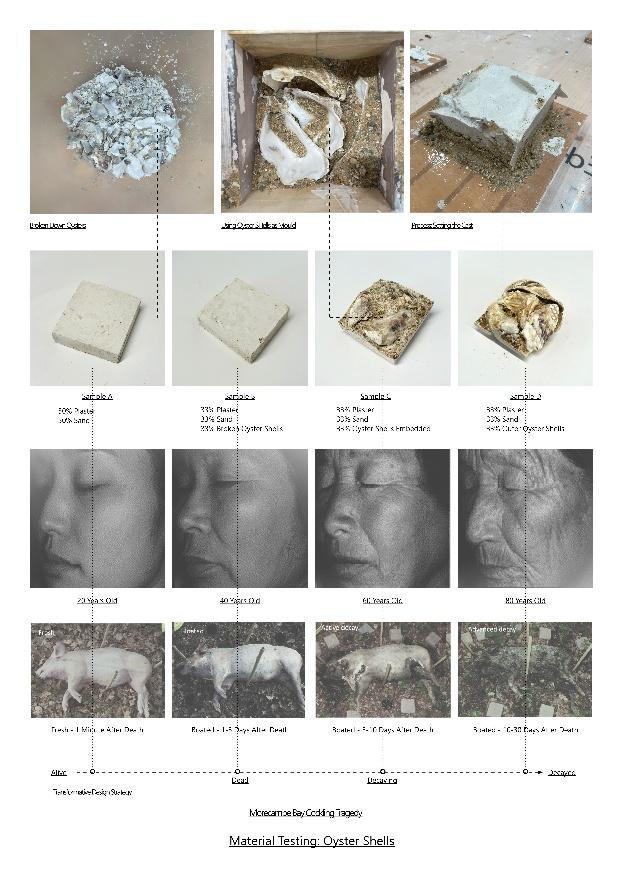
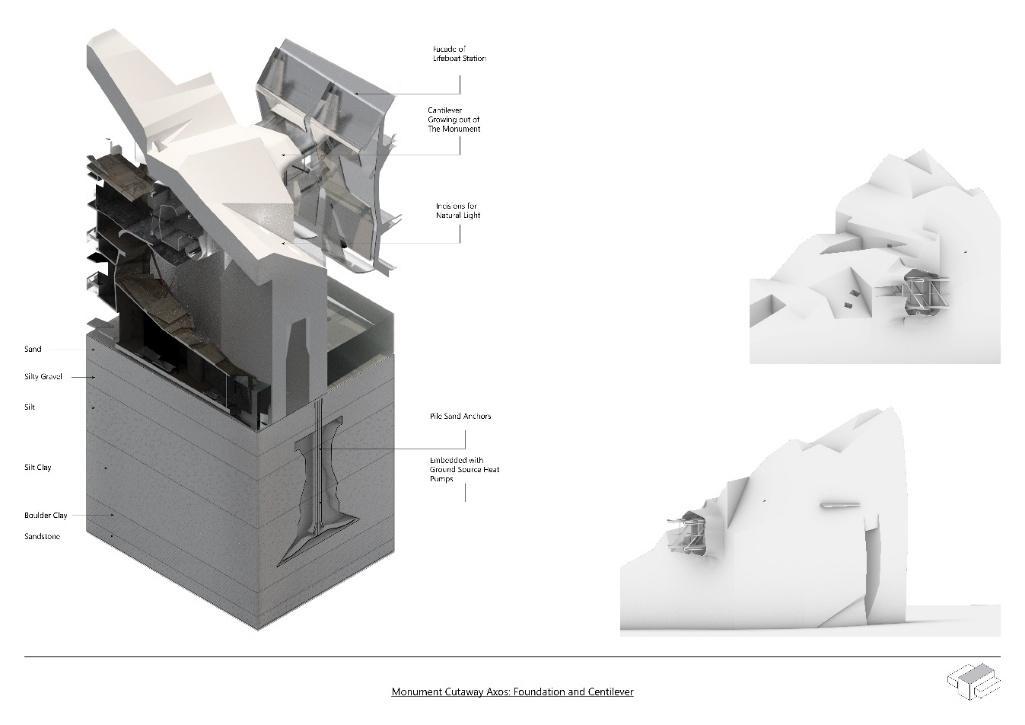
I also acknowledged the difficulty of transforming radical ideas into buildable projects within the practical world. It is challenging to keep hold of the ideas that is truly to benefit people in practice especially when some projects are so commercially driven that making profit is their primary role as discussed by Miselbach (Appendix 9.1.5, P77). Figures 20-22 presents my project ‘The Lost Boys: It’s OK to cry’ a memorial for the 2004 Chinese Cockling Tragedy on Blackpool Beach. Through modelling and material testing, I investigated viable solutions for the shifting sands to help prevent similar disasters. Such project will likely get sidelined compared to developments like the Eden Projects in Morecambe, which attracts capitalist investments but may nottrulybenefitthecommunityinLancashire. Interdisciplinarycollaborationbetweenarchitecture and engineering, academia and industry are crucial to integrate experimental ideas into real-world projects to move the industry in the right direction, an approach I should advocate in my proposal
Further, learning to challenge dominant industry norms in relation to capitalist goals and regulatory constraints through political and philosophical engagement in my practice is crucial. It is important to understand this and embrace in my practice because political winds, profit-driven demands and regulatory systems shifted architecture to be overly conservative and become less beneficial to the people as suggested by Chard’s and Crother’s discussion. (Appendix 9.1.4, P72) Integrating thoughts such as Fisher’s Capitalist Realism into my practice to empower the communication of radical ideas and understand how they manifest in architecture decision-making is essential, rather than blindly pushing my designs which will hit walls
Figure 18 1:50 Plan and Section of Project ‘Wandering Earth: Pre-Braking Era’
Figure 19 Interior Perspective of Tornado Testing Chamber, Project ‘Wandering Earth: Pre-Braking Era’
Figure 21 Material Study of ‘The Lost Boys’
Figure 22 Cutaway Axonometric Diagram of ‘The Lost Boys’
Figure 20 Façade Model of ‘The Lost Boys’
Having reflected on my personal practice of architecture based on the interview findings, I suggest the term 'Capitalist Realist Architecture' to describe the contemporary trend in architecture and architectural practice which is heavily influenced by Capitalist Realism and deeply haunted by unrealised projects and visions In response to this phenomenon, I believe there is an urgent need for my practice to more actively engage with speculation, integration, and political and philosophical thought, as outlined earlier. To address this, I propose to etablish a platform for alternative voices in relation to speculation, aimed at empowering the communication of radical ideas. The platform can be in the form of a website due to its strength in its global accessibility and the potential to broaden the conversation with diverse audience who may not be part of mainstream architectural discourse. The platform will include the following sections as the core structure:
1. Design Manifesto – As the homepage of the platform, an impactful short piece of text that outlines the principles for designers, students and the public to recognise the importance of speculative design for their practice and lives to challenge social norms such as the influence of capitalist realism
2. Dialogues of Speculation – A page presenting the most powerful extracts of the conversations I did with the interview participants as their key message or insight to the world. This will evolve into an ongoing project that extends beyond this paper, expanding the conversation into various communities including academics, industry practitioners and students, to reveal the hidden forces that shape architecture such as capitalist realism
3. Archive of Unbuilt Architectural Projects – A linked page that records classic avantgarde unbuilt projects that align with the findings of this dissertation which will be presented in Top Trumps form. It acts as a source of inspiration and evidence to influence future generations to push for experimental speculations
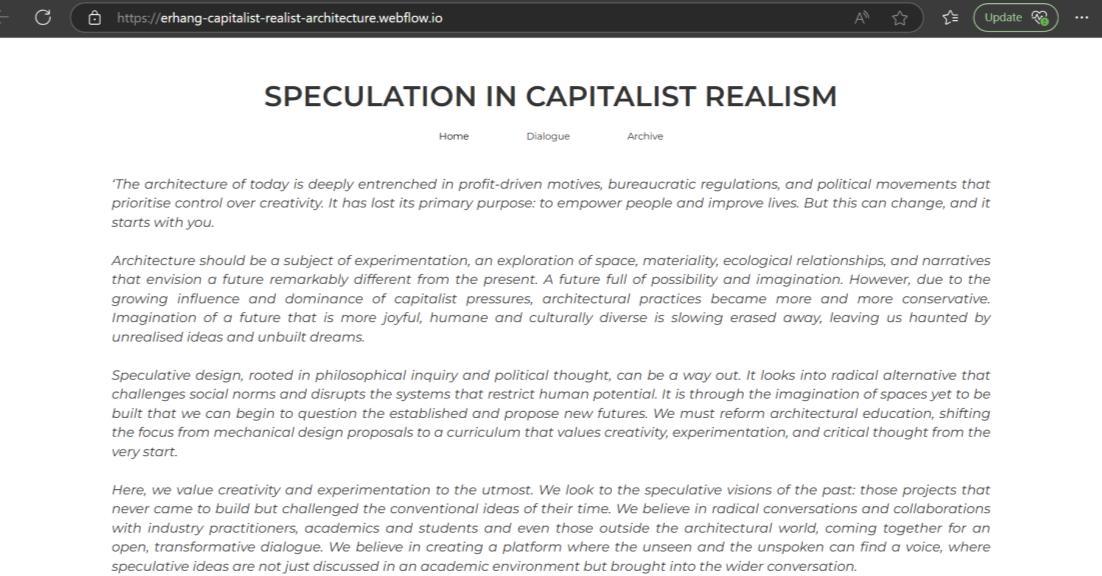
Figure 23 Manifesto Page of Proposed Platform
Proposed Manifesto:
‘The architecture of today is deeply entrenched in profit-driven motives, bureaucratic regulations, and political movements that prioritise control over creativity. It has lost its primary purpose: to empower people and improve lives. But this can change, and it starts with you.
Architecture should be a subject of experimentation, an exploration of space, materiality, ecological relationships, andnarratives thatenvisionafuture remarkably different from thepresent. Afuturefull ofpossibility andimagination. However, dueto thegrowing influence and dominance of capitalist pressures, architectural practices became more and more conservative. Imagination of a future that is more joyful, humane and culturally diverse is slowing erased away, leaving us haunted by unrealised ideas and unbuilt dreams.
Speculative design, rooted in philosophical inquiry and political thought, can be a way out. It investigates radical alternative that challenges social norms and disrupts the systems that restrict humanpotential.Itisthroughtheimaginationofspacesyettobebuiltthatwecanbeginto question the established and propose new futures. We must reform architectural education, shifting the focus from mechanical design proposals to a curriculum that values creativity, experimentation, and critical thought from the very start.
Here, we value creativity and experimentation to the utmost. We look to the speculative visions of thepast: thoseprojects that never cameto build but challenged the conventional ideas oftheirtime. We believe in radical conversations and collaborations with industry practitioners, academics and students and even those outside the architectural world, coming together for an open, transformative dialogue. We believe in creating a platform where the unseen and the unspoken can findavoice,wherespeculativeideasarenotjustdiscussedinanacademicenvironmentbutbrought into the wider conversation
Whether you are an architect, a student, a client, or someone who simply inhabits a built space, you are part of this conversation. It is not just a call to action; it is a call to resist: resisting the forces that drive architecture into just serving capital and political agendas. It is also an invitation to ask you to step back and reflect on the architecture around you. What are the forces shaping the spaces you live in? How are these spaces limiting or empowering you? We ask you to open your mind to a new world of speculative thought.
The time for passive observation is over. We must act now to create spaces that are alive, full of possibilities and free from the constraints of capitalist realism.’
Proposed Platform Design:
Link to Website: erhang-capitalist-realist-architecture.webflow.io
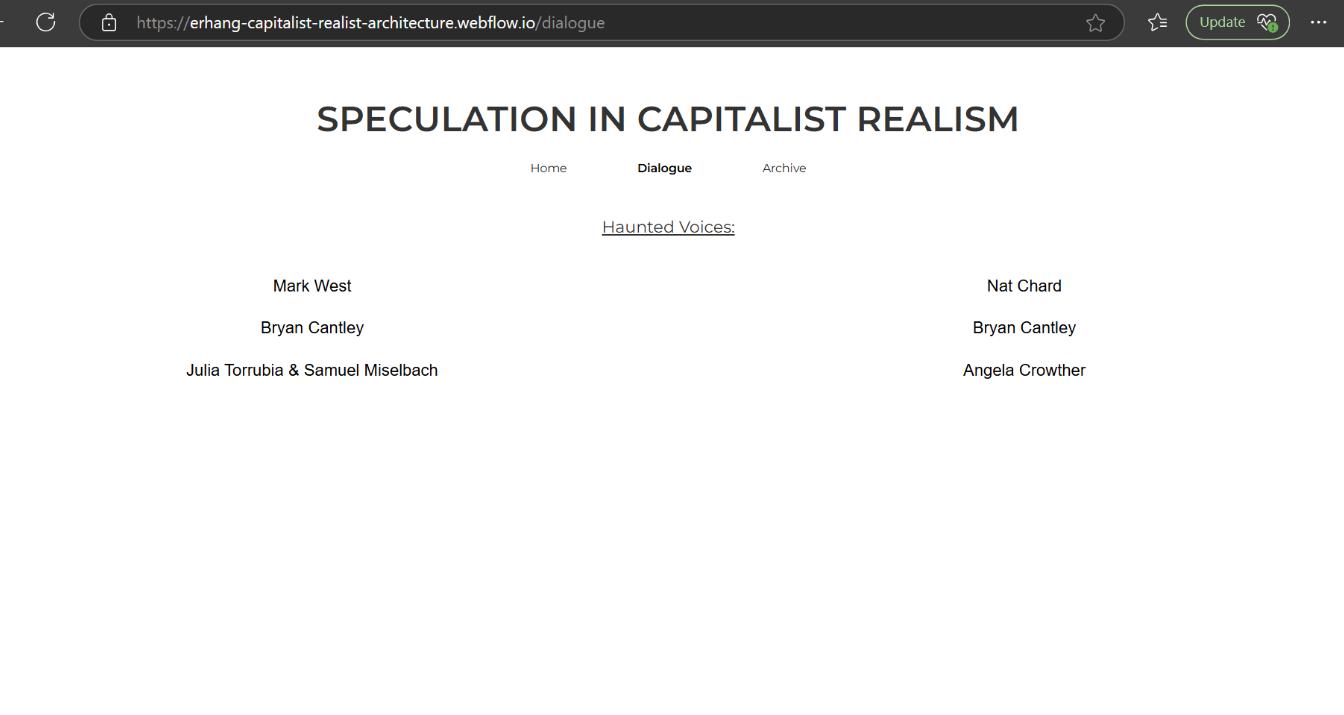
Figure24 shows the page forthe platformguest to select specificdialogues Idid with theinterview participants There are currently six options, and the number will get build up as I carry out more interviews in the future. It is aimed to create a greater impact to the public in the future by interviewing influential figures in architecture, as well as alternative voices that are often underrepresented, such as students and the public.
Figure 24 Proposed Platform, Dialogue Selection Page
Figure 25 Proposed Platform, Personal Dialogue Page, Mark West
Figures 25 and 26 present the specific extracts of the dialogues with Mark West and Bryan Cantley as an example. Now, it only outlines the most impactful responses in terms of the shifts in architecture. The section can be transformed into a weekly or monthly interview report to include all detailed conversations in the future.
Figure 27 shows the archive page of unbuilt projects currently focusing on the most influential works of the 20th century such as Citta Nuova. In the future, it can start to record selected projects from the 21st century, documenting the gradual shifts in architecture for the future generations to reflect and revise.
Figure 26 Proposed Platform, Personal Dialogue Page, Bryan Cantley
Figure 27 Proposed Platform, Archive of Unbuilt Project Page
7. Conclusion
The paper studies the influence of historical unbuilt architectural projects in the 20th century and obtains insightful interview responses from participants ranging from academia to industry to evidently show that contemporary architecture is influenced and shaped by the ideology of Capitalist Realism to a great extent, leaving us deeply haunted by unrealised visions and dreams of the past.
Those unbuilt projects in the 20th century hugely influenced architecture and the built environment of their times and still impact how architecture is taught and practiced today, revealing their haunting presence. Sant ’Elia’s Citta Nuova revolutionised what architecture is by embodying futurism, advanced technology of the early 20th century, and the rejection of classical features which is still empowering many sci-fi art and architectural projects today. Peter Cook’s Plug-in City represents the optimism of the post-war period by re-imagining architecture as an everevolvingorganismthatencourages activeengagementfromthepublic.Thisconceptistransformed and applied into many megastructures including Habitat 67. Zagreb Free Zone by Lebbeus Woods critically shifted architecture’s primary role to stimulate public discussion of a city’s political future, pushing architecture to be speculative resistance rather than commodity.
However, after interviewing with experts in the field, I understood that the optimism, spirit of experimentation, and ability to envision a truly alternative future in respond to the current society has been lost in today's architectural world due to the emergence of the 21st century problem –Capitalist Realism. Across conversations with figures such as Nat Chard and Mark West, a recurring message is put forward: the current field of architecture is extremely conservative. Established bidding process is a crucial factor that hinders innovative construction methodologies such as fabric forming to have a greater influence in the built environment. As mentioned by Samuel Mieselbach, design briefs that are overly focused on profit gains is another factor that causes the industry to move in a wrong direction: designing for economic imperative rather than to empower people to benefit from the design. Through discussions with Perry Kulper, I learnt that this conservativeness starts from education as over 90% of architecture schools avoid teaching experimental and speculative design. The Naming Problem further restricts innovation and experimentation in architecture as the designs reinforce the established structures in relationship to the given name of them such as ‘Library’ instead of reimagining its spatial realm for the future.
Interviews with Angela Crowther and Bryan Cantley reveal the problem of bureaucracy in contemporary architecture Crowther highlights the importance to be aware of the political winds in the industry as it is much more powerful than the design itself, which provides deep insights to students and young designers. Cantley encourages us to reflect the setup of design practices by prompting architects taking a leading role to educate the clients and the public to push for the radical design ideas in response to the established bureaucratic system. However, it is important
to note that Cantley acknowledges how capitalist drivers can, at times, foster the development of new technologies, enabling ideas to be materialised that once seemed impossible.
In response to these factors that influence and shape architecture under the framework of Capitalist Realism, several interview participants acknowledge the importance of practising speculative design and discuss them through an open and consistent channel. Speculation expands the scope of architectural development as a discipline, by testing new design languages that can be opened for public discussion. It also offers the opportunity to explore ideas that cannot be realised in the built environment and keep architectural imagination alive in response to bureaucracy and market driven feasibility and potentially transcend the Naming Problem. As argued by Chard, it is important now to provide a route for discussions for these speculative ideas, such as magazine and exhibitions, which have largely been lost in today’s architectural culture but were once a vibrant part of the discourse in the 1980s. This insight has inspired me to propose a website as a platform to expose the influence of capitalist realism in architecture, while also giving space to alternative voices in speculative discourse to strengthen the communication of radical ideas.
The proposed platform formed of a design manifesto to the public, continuous dialogues with haunted people and archive of unbuilt architectural projects experiments to resist to the influence Capitalist Realism and the wider political and societal context by making more people aware of the importance of speculation. Not only will it include the dialogues between me and the interview participants, but it is also aimed to become a more impactful ongoing project that seeks selected voices from various communities including academia, practice, student bodies and the public. This project aspires to become an influential platform by publishing these interviews on a weekly or monthly basis, aiming to bridge the gaps between these communities. Through this collaboration, it seeks to reveal and resist the hidden forces that that drive architecture into just serving capital and political agendas, and to restore its fundamental purpose of enriching and uplifting the human experience of spaces.
It is hoped that all groups will gain valuable insights from the findings and proposals presented in this paper. Students and emerging designers may better understand the struggles of the discipline of architecture under the influence of capitalist realism, and learn to incorporate speculation within their practice, rather than designing solely for economic gains. Researchers in academic settings and practitioners in the industry are encouraged to set aside preconceptions and open their minds to the transformative potential of speculative work. Clients and the public may come to recognise thesignificanceofspeculation,extendingbeyondtheirimmediatespatialexpectations,andsupport it, thus encouraging developers to back more radical, experimental, and beneficial projects.
Ultimately, this paper has also transformed my own perspective on my design practice, attitude towards my education and the understanding of speculation. I have come to realise that the deeper purpose of speculation is beyond my tutors advised me to but uncovers a range of issues that are often absent from architectural education, such as the extent to which design is swayed by political
forces. I now see myself as an active seeker of the disguised truths within contemporary architecture, helping the society to recognise the value of speculation - a concept that is often marginalised and dismissed as unbuildable, yet continues to impactfully shape architectural imagination, not by building faster, but by building futures in thought, resisting the pervasive influence of capitalist realism.
8. Bibliography
• Fisher, Mark, Capitalist Realism (Zero Classics, 2022)
• Augé, Marc, Non-Places: Introduction to an Anthropology of Supermodernity (Verso, 1995)
• Zizek, Slavoj, The Sublime Object of Ideology, (Verso, 2008)
• Badiou, Alain, The Communist Hypothesis, (Verso, 2009)
• Harvey, David, A Brief History of Neoliberalism, (Oxford, 2005)
• James, Oliver, The Selfish Capitalist: Origins of Affluenza, (Vermilion, 2008)
• Tafuri, Manfredo, Architecture and Utopia: Design and Capitalist Development, (The Massachusetts Institute of Technology, 1976)
• Myers, Tracey, Lebbeus Woods Experimental Architecture, (Pittsburgh, 2004)
• Cook, Peter, Archigram, (New York: Princeton Architetcural Press, 1999)
• Sadler, Simon, Archigram Architecture without architecture1, (Cambridge, 2005)
• Sadler, Simon, The Situationist City, (Cambridge, 1998)
• Crinson, Marc, Neo-avant-garde and postmodern: Postwar Architecture in Britain and Beyond, New Haven, 2010)
• Spiller, Neil, Lost Architectures, (Willey-Academy, 2001)
• Beanland, Christopher, Radical visons of a future that never arrived (Batsford, 2021)
• Mansour, Y. THE PHILOSOPHY OF PARADIGM SHIFT ACROSS THE HISTORY OF ARCHITECTURAL PRACTICES, (Engineering Research Journal, 2021)
• Asim, Farhan, Venu Shree, A Century of Futurist Architecture: from Theory to Reality, (Civil Engineering and Environmental Systems, 2018)
• Hopkins, Owen, Dezeen’s Introduction to High-Tech Architecture, (Dezeen, 2019)
• City A.M., 'Eden Project losses nearly double despite visitors spike', (City A.M., 17 November 2023)