Newham Community Research Network
Voices Behind the Digital Divide Understanding the digital challenges and benefits of technology for migrant women
Zam Zam Citizen Social Scientist
About the Newham CRN In December 2024 the UKRI and The Young Foundation announced new groundbreaking engagement investment in nine ‘community research networks’ across the UK - collaborations led by community organisations alongside academics, local authorities and local residents. The networks span the length of the UK, from the north of Scotland to the Isles of Scilly, and the only successfully-funded network in the south east is here in Newham! For the Newham Community Research Network, Compost London are leading a ‘network of networks’ based in various wards across our ethnically diverse and innovative borough. The three recruited networks cover migrants and refugee communities, marginalised women, and young people with special educational needs who live, work and go to school in Newham. The five-year project is supported by University College London’s Citizen Science Academy, based in the Institute for Global Prosperity, which has strong experience running citizen science (community research) projects in east London and across the world. Local residents from the three different networks are being trained in research ethics, methods, and project planning, and then supported to carry out qualitative research across east London. Newham Council are also providing support across all three networks, and placement opportunities within the Council will be available for some of our alumni.
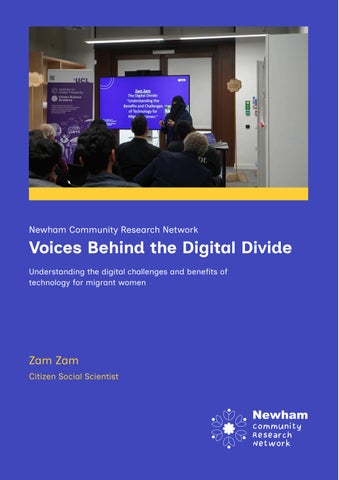
The first cohort of citizen social scientists from the Migrants and Refugees Network at their graduation at UCL East.
About the Migrants and Refugees Network Newham is not just a borough; it is one of the most culturally diverse places in the UK, full of fascinating stories. Yet for too long, research into communities like ours has been done to people, rather than with them – let alone by them. Researchers have often arrived from outside, collected data through surveys or observations, and then left to publish findings the community never sees. This research represents a fundamental shift in that dynamic.
The twelve citizen social scientists in the network’s first cohort, supported by the Newham Community Project, are not professional academics looking in from the outside. They are mothers, students, economists, volunteers and artists whose connection to Newham is lived every day. They were trained by UCL’s Citizen Science Academy in research ethics and methods, and brought something no university degree can provide: lived experience expertise. Their research reflects the true face of our borough. Lomembe investigated the structural causes of food poverty, while Halima and Saif explored how food connects to mental health and cultural identity. Hamdan, Prasanna and Almas looked at the hurdles migrants face in entrepreneurship, employment and higher education. Sara and Nahid shone a light on the hidden struggles of accessing healthcare and the mental load of parenting in a new culture. Esah and Ammar explored loneliness and the ‘invisible rules’ of social behaviour that can alienate newcomers. And Zam Zam and Ruqsar investigated how struggles with technology and immigration status can leave the most vulnerable behind. Together, they tackled some of the biggest challenges of our time – housing, employment, social isolation and integration – with a nuance often missing from traditional policy reports. We invite you to engage with their work, listen to their findings, and support them as they rewrite the rules of research in east London. Published November 2026.
CONTENTS
4
Introduction
5
What is Research?
7
Interview 1: Community & Technology
9
Interview 2: Organisational Perspective
11
Interview 3: Lived Experiences
13
The 4 Main Themes
16
Statistics
21
Voices Behind the Digital Divide
23
Conclusion
26
Personal Reflection
27
Signposting & Community Support
29
Acknowledgements
30
Voices Behind the Digital Divide
INTRODUCTION Hi, I’m Zam Zam! I have lived in Newham for over five years, and in that time I have grown to love the resilience and “Newham spirit” of our borough. My background is in Economics and Digital Marketing – I have an MBA, and I work with technology every day. But living here has shown me that for many people, the digital world is a barrier rather than a tool. I have a strong connection to the South Asian and Muslim communities here, and I often see women – especially mothers and older residents – struggling to access basic help. Whether it is booking a GP appointment, keeping up with school updates or applying for housing, a lack of digital confidence is leaving many migrant families behind.
↓ that’s me!
Technology now shapes everything, from GP bookings to benefits, housing and immigration. So my research asked a simple but essential question:
Who is being excluded when systems go digital? Voices Behind the Digital Divide
5
My research looked at the digital challenges migrant women in Newham face, both the benefits and the barriers. Is the problem language, access to devices, or simply a lack of training? My goal was to use my own skills to help close this gap, and to find simple, practical support that helps women use these systems with confidence. I’m a very people-first learner: I learn best through conversation, listening and lived experience. Before this project, I supported South Asian women’s mental health research sessions, so this was my second community research journey. I’m especially concerned about pregnant refugee women living in hotels with no recourse to public funds, who are often left without clear information or support.
How I did my research
I carried out informal, respectful qualitative interviews with: an academic researcher working closely with communities a community organisation supporting refugee and asylum-seeker families migrant women living in Newham with different levels of digital confidence. These conversations helped me look beyond access alone, at confidence, trust, language, health, support and lived experience. Everyone was told about the project and gave their consent. Taking part was voluntary, and people could withdraw at any time. Conversations were audiorecorded or written down, and personal details were kept confidential and anonymised unless participants chose otherwise.
6
Voices Behind the Digital Divide
My learning
WHAT IS RESEARCH? Before heading out to do her own research, Zam Zam mapped out what research is, and how communities and researchers can work together to create real, meaningful knowledge.
“How communities and researchers work together to create real, meaningful knowledge” – mind map by Zam Zam
Voices Behind the Digital Divide
7
My research
WHO I SPOKE TO I carried out informal, respectful interviews with four people who see the digital divide from very different sides: as a researcher, as an organisation, and as migrant women living with it every day.
Dr Jones
University research fellow er Artist, academic, community research and mother INTE RVIE W 1
“Adina”
Migrant woman living in Newham INTER VIEW 3
Atia Lokhat
Founder & CEO, Zubeda Welcome Supports refugee and asylum-seeker families, particularly children INTE RVIE W 2
“Halima”
Migrant woman living in Newham INTE RVIE W 3
Adina and Halima are not their real names, to keep their identities private. 8
Voices Behind the Digital Divide
Interview 1
COMMUNITY, TECHNOLOGY AND HUMAN CONNECTION Dr Jones
Role: University research fellow Background: Artist, academic, community researcher, mother.
Human support
Co-creation
Community-led tech
Dr Jones’s work focuses on digital co-creation with communities. She leads a software project: a community mapping platform that lets people tell stories about where they live through text, audio, and images. In simple terms, it works like WordPress, but with maps. However, she explains that there is a high barrier to independent use. This is not about age limits, but about complexity. To overcome this, her team runs facilitated sessions, online and in person, in community centres, youth centres, and online rooms, supporting people step by step. She strongly believes in person-to-person collaboration: digital tools work best when combined with human support. She contrasts this with systems like Universal Credit or utility billing, which are often impersonal and frustrating.
“ It’s not about what comes out at the end, but how technology brings people together.
Voices Behind the Digital Divide
9
AI AND DIGITAL ENGAGEMENT Dr Jones explains that AI is now part of the world and cannot be undone. However, she raises concerns about deskilling. If people offload thinking to AI, what skills are they no longer developing themselves? She shares an example of trying to book activities for her child, where there was no human support – only AI – and it gave contradictory answers.
“ What skills are they no longer developing themselves?
“ It promises accessibility but breaks down when you ask deeper questions.
LANGUAGE, ACCESS & REPRESENTATION The software is web-based and doesn’t yet include translations, due to time and funding, but it can support translation if this becomes a priority for the community. Other projects, like a map co-created with girls in east London, included multilingual content and supported intergenerational learning, storytelling, and representation. The platform is for everyone, but its effectiveness depends on how communities use it.
10
Voices Behind the Digital Divide
Interview 2
ORGANISATIONAL PERSPECTIVE ON DIGITAL INEQUALITY
Atia Lokhat Founder & CEO of Zubeda Welcome Supports refugee and asylum-seeker families, particularly children
From the organisational perspective, digital access is not about convenience – it is about survival. Asylum seekers have no right to work and no income, yet are heavily dependent on increasingly digital systems. Those with language skills, digital literacy, or device access are at a clear advantage.
“ Those who were computer literate or had
access to devices were at a much greater advantage than those who weren’t.
Voices Behind the Digital Divide
11
“Even if they had devices, if they didn’t know how to use them, what’s the point?”
Her organisation often had to visit hotels in person to help people complete online forms. Each application could take around 20 minutes, slowing work significantly. Due to limited capacity, safeguarding, and funding constraints, the organisation cannot provide ongoing hands-on digital support. Instead, they rely on signposting, partnerships, and regional spreadsheets. Outreach is essential because many asylum seekers are isolated in hotels, feel unsafe going out, and have limited access to information unless they attend college or their children go to school.
“ That’s why outreach support is essential – we go where the refugees are.
12
Voices Behind the Digital Divide
Interview 3
“ADINA” & “HALIMA”: LIVED EXPERIENCES OF MIGRANT WOMEN Adina: gradual confidence through support Adina describes technology as difficult at first, but manageable with time and practice. “To start it up is a bit kind of difficult… but when you use it, it’s not that hard.” Her daughter initially helped her, but Adina wanted independence. She highlights frustrations with digital health systems, information overload, and confusing council websites.
“ I just need a little bit of
training, and I know I can do it without your help.
“ Sometimes you submit things, but they don’t receive them at the other end.
Voices Behind the Digital Divide
13
Halima: digital confidence without comfort Halima is digitally confident, but emotionally resistant to technology. She prefers physical materials due to health reasons, including migraines and light sensitivity. “Because everything is digital now, it has affected my health.” She believes digital support should be ongoing, not one-off.
“ When I hear the word technology, I honestly feel like running away.
“ Digital support should be an ongoing project, not one-off sessions.
14
Voices Behind the Digital Divide
Technology is not the end goal. It’s a tool to bring people together.
– from Zam Zam’s research conversations
Voices Behind the Digital Divide
15
THE 4 MAIN THEMES Across all four interviews – Dr Jones, Atia, Adina and Halima – four big themes came through.
1
Digital access does not mean digital inclusion
Human support is essential in digital systems
3
4
Digital systems create stress, frustration and exclusion
16
2
Voices Behind the Digital Divide
Digital inequality is structural, not an individual failure
Theme 1
DIGITAL ACCESS DOES NOT MEAN DIGITAL INCLUSION All four interviewees highlighted a critical distinction: simply having a device or internet access does not automatically mean digital inclusion. Owning a smartphone or laptop is just the first step in a much longer journey. Atia described refugees who, despite having devices, often cannot complete basic online tasks alone – a simple government form could take hours. Adina explained that digital literacy grows slowly, with practice and patience. Halima is digitally capable but often overwhelmed by poorly designed systems.
“ It’s not just about logging in. Without guidance, people quickly get lost or frustrated. – Dr Jones
What’s similar Everyone agreed that access alone is not enough.
What’s different Migrant women speak from personal, emotional experience; academics and organisations see a structural failure.
Voices Behind the Digital Divide
17
Theme 2
HUMAN SUPPORT IS ESSENTIAL IN DIGITAL SYSTEMS Technology rarely works in isolation. Across interviews, human support emerged as an essential part of digital inclusion. Dr Jones argued that technology should complement, not replace, human interaction. Atia gave vivid examples of staff sitting with refugees to guide them through online applications – building confidence and reducing mistakes. Adina relies on family and community networks, especially at weekends when services are closed. Halima stressed that face-to-face conversations reduce anxiety and let questions be answered in real time.
What’s similar Human support builds trust, understanding and confidence in digital spaces.
18
Voices Behind the Digital Divide
What’s different Organisations see it as a resource challenge; migrant women see it as essential for dignity and independence.
Theme 3
DIGITAL SYSTEMS CREATE STRESS, FRUSTRATION AND EXCLUSION Rather than simplifying lives, digital systems can increase stress and feelings of exclusion. Dr Jones reflected on impersonal systems like Universal Credit and AIonly platforms. Atia described the strain: digital systems slow down support work and disadvantage those with low literacy. Adina painted a picture of constant “information overload” and system errors. Halima revealed the physical and mental toll: digital navigation can trigger migraines, anxiety, and chronic stress.
“ When I hear the word technology, I feel stressed and confused.
What’s similar Digital systems are often confusing, impersonal and unforgiving.
What’s different Migrant women feel emotional and health impacts; organisations feel operational pressure.
Voices Behind the Digital Divide
19
Theme 4
DIGITAL INEQUALITY IS STRUCTURAL, NOT AN INDIVIDUAL FAILURE Across all four interviews, digital exclusion was framed as a problem with systems, not with people’s ability or effort. Dr Jones highlighted the lack of funding, language support and inclusive design. Atia pointed to gaps in policy and onboarding, and underresourced frontline organisations. Adina explained how limited service hours and poor communication exclude parents juggling work and family. Halima noted that health needs and accessible formats are often ignored in system design.
What’s similar Exclusion comes from systems built without real thought for the people using them.
20
Voices Behind the Digital Divide
What’s different Migrant women feel dependency, stress and lost opportunities; organisations feel overload.
STATISTICS I asked the people I spoke to: how comfortable do you feel with digital technology, from 1 to 10? Each bar is one person’s answer.
10 8
9
8 6
6
7
7 5
8
7
6
4
4 2 0
1
2
3
4
5
6
Interviewee
7
9
4
was the highest rating, showing strong confidence
8
9
10
median = 7
6–8
is where most people rated themselves: moderate to high comfort
7
was the median and the most common rating
was the lowest rating, suggesting lower confidence
The chart shows patterns in digital confidence, and how much self-assessed ability varies from person to person.
Voices Behind the Digital Divide
21
A research conversation in Newham.
In their words
VOICES BEHIND THE DIGITAL DIVIDE For many migrant women in Newham, technology is no longer a choice. It is how life is managed: how doctors are contacted, schools communicate, immigration systems respond, and support is accessed.
“ Everything is online now, even the doctor.
What should feel simple often feels heavy. Screens are crowded. Instructions are unclear. Buttons feel risky.
“ I was scared to press the wrong thing.
For women arriving from other countries, the shift can feel sudden. There is little time to learn slowly.
“ The technology used in the UK was very
different from what I was used to in my home country.
Pages lead to more pages. The information exists, but finding it takes time, confidence and patience.
“ Filling out online forms or searching for information can be very complicated… it takes a long time to find what you need.
Voices Behind the Digital Divide
23
Sometimes, what would take minutes face-to-face takes hours online.
“ If you do it face to face, you go there, get the information, and you’re done.
Language becomes a wall. Most systems assume fluency in English and a laptop, but many women rely only on their phones.
“ Most of the websites are only in English. Most people only have a phone, not a laptop.
Learning happens slowly. By repeating, watching, trying, asking for help.
“ At first it was difficult, but slowly I learned.
Children often become guides. At first, they do it for their parents. Later, they step back.
“ My daughter introduced me to an app… the first few things she did for me, and then I got used to it.
For some women, confidence grows, and they begin to help others.
“ If someone doesn’t know how to do it, I try to help them.
24
Voices Behind the Digital Divide
For others, long hours on screens bring headaches, confusion and exhaustion.
“ I wasn’t used to spending so much time on screens… it caused headaches and pain.
Even reaching support means navigating digital systems first. Community organisations and libraries become lifelines.
“ The Newham Community Project helped me a lot,
and now I feel much more confident using digital systems.
New tools promise ease, but fear lingers. And not everyone needs the same kind of help.
“ QR codes are helpful, but people are scared to scan them.
“ Younger people need advanced sessions. Older people need basic ones.
What lasts is human connection.
“ We need ambassadors – real people who talk to people.
Because behind every screen is a human story.
“ If you don’t keep up with technology, you are left behind.
Voices Behind the Digital Divide
25
CONCLUSION Across all interviews, one message is clear: the digital divide is not about laziness or lack of effort. It is about systems that assume users are confident, ignore the need for human support, and leave migrant women to navigate complex digital landscapes alone.
The stories of Dr Jones, Halima, Adina and Atia show that tackling digital inequality needs more than access. It needs
empathy, guidance and inclusive design.
26
Voices Behind the Digital Divide
PERSONAL REFLECTION This research showed me that the digital divide is not just about access, but about how systems are designed and who they are designed for. Technology can empower, but without human support, it can also exclude.
Voices Behind the Digital Divide
27
A proud moment
GRADUATION DAY!
Zam Zam receiving her UCL Citizen Science Certificate at the graduation at UCL East, with Elyas Ismail from the Newham Community Project (left) and Sandra White from Compost London (right). The certificate recognises the research skills citizen scientists build through the UCL Citizen Science Academy, from research ethics and methods to working with communities and sharing what they find.
28
Voices Behind the Digital Divide
Where to find help
SIGNPOSTING & COMMUNITY SUPPORT Places that can help
Libraries (limited but available support) Community centres and coffee mornings Trusted organisations offering workshops Outreach programmes Family Navigators (often under-publicised!)
Useful links Newham Community Project
www.newhamcommunityproject.org
Zubeda Welcome Project www.zubedawelcome.org
Libraries, arts and culture (Newham Council) www.newham.gov.uk/libraries-arts-culture
Newham Data Skills (Newham Council)
www.newham.gov.uk/newham-data/newham-data-skills
The Children’s Society
www.childrenssociety.org.uk
Scan me!
One scan. Real support. Real opportunities. linktr.ee/connectivemarketing.uk
Voices Behind the Digital Divide
29
Thank you
ACKNOWLEDGEMENTS I would like to thank everyone who contributed to this project by sharing their time, experiences, and insights. Special thanks to Dr Jones, Atia from Zubeda Welcome, Halima, Adina, Nazia, Rosie, Shabeena, Sara Umama, Boglarka, and Marilyn from Compost London – your openness, honesty, and trust have been invaluable to this research. I would also like to express my sincere gratitude to Joseph Cook, Twinkle, and the wider Citizen Science Academy team for their guidance, encouragement, and belief in community-led research. My heartfelt thanks go to the Newham Community Project team, especially Mr Elyas Ismail and Rozina Iqbal, who believed in me and supported this research from the very beginning. Finally, I am deeply grateful to all my Citizen Social Scientist colleagues, whose support, solidarity, and shared learning have been a constant source of strength throughout my journey.
30
Voices Behind the Digital Divide