The Safety of Female Shift Workers on the Kilburn High Road Lesley Mortell July 2026
Résumé About me I have lived in the West Hampstead and Kilburn area for over 30 years, the past 23 as a Camden Council Leaseholder in Kilburn. Following a couple of redundancies, I was looking for a career pivot from 30 years of corporate IT jobs and was given the opportunity to become a Citizen Scientist in residence for Kilburn at Camden Council. I felt this was a great way to get more in touch with my local community and research a subject that should be a priority for everyone. I had a job interview at my local Sainsbury’s where I was informed by the interviewer that female staff were feeling particularly unsafe arriving for 6am shifts and leaving at 11pm and this sparked my project idea. I was particularly interested in the research topic due to feeling uneasy lately when using the Kilburn High Road in the darker hours and wanted to discover if this was a widespread sensation or just me.
1
Research The Safety of Female Shift Workers on the Kilburn High Road. The recruitment of participants To explore how women experienced Kilburn High Road during early and late commutes, I developed a survey and distributed it through local shops, gyms and bars. This helped gather insights from women travelling to work in those places, while participating managers also shared anecdotal evidence about how safe the high road felt for their staff. I then deepened the research through walking ethnographies with women who used the high road at the beginning or end of the working day, allowing their experiences to be understood in the places where they occurred. Finally, I used photo-elicitation based on locations raised during the survey and walks, encouraging participants to reflect more closely on the specific places that shaped their sense of safety. .
2
Results Reoccurring Themes The reoccuring themes that emerged from the research focused on making Kilburn High Road feel safer and more supportive for women travelling to and from shift work. The main perception is that there is no visible police/safety presence on the street at the times when women were most likely to feel vulnerable, particularly around 6am and 11pm. As one participant put it, “I don't see why you can't at 6:00 in the morning have police on the street. Everyone else does rota systems. that's the way life is.” Participants also highlighted the importance of poor street lighting particularly in conservation areas and down side steets where trees, although valuable for the environment, can create dark patches along the pavement. One person described the value of lighting that guides people along the street, saying, “You've got things that guide you along the way that give you ambient light. So we've got light going up without having to come down.” Finally, the research pointed to the need for better education for young boys around respect for women and girls, challenging the excuses often made for poor behaviour. As one participant reflected, “They grow up and they've been given so many excuses to behave badly and never been pulled up on it…”
3
Recommendations What could be done 1. For the Met Police and Camden Council Community Safety Teams: A more visible ‘police’ service on the streets at around 6am and 11pm “I don't see why you can't at 6:00 in the morning have police on the street. Everyone else does rota systems. that's the way life is.’ 2. For Camden and Brent Council Planning Teams: Consider low level street lighting, especially in conservation areas where trees, even though great for the environment, create dark areas on the pavements. “You've got things that guide you along the way that give you ambient light. So we've got light going up without having to come down.” 3. For Camden Council Participation, Community and Educatiion Teams: Better education for young boys around respect for women and girls “They grow up and they've been given so many excuses to behave badly and never been pulled up on it…”
4
Reflections Not so much unsafe more unsettled Reflecting on the project, I found it important to distinguish between feeling unsafe and feeling unsettled. Unsafe refers to an environment that poses a direct physical risk to wellbeing, while unsettling describes an atmosphere that creates unease, disorientation or disturbance, even when no immediate danger is present. Much of what emerged through this research sat within that unsettled space. For example, the number of small vape shops on Kilburn High Road, which I last counted at 43, combined with groups of men often standing outside, contributed to a feeling that the high street was not as well regulated as it should be. I also realised that my community connections were not as strong as I had assumed. The survey did not gain as much traction as I had hoped, and with more time I would have approached participant recruitment differently. However, the course has also given me greater confidence and helped me become more connected to my local community. Since completing the project, I have begun volunteering with a local charity, which feels like a positive continuation of the work.
5
Recognitions I would like to thank The rest of my Citizen Scientists Alex, Aysha and IGP Camden Council officers Kilburn State of Mind The anonymous participants
6
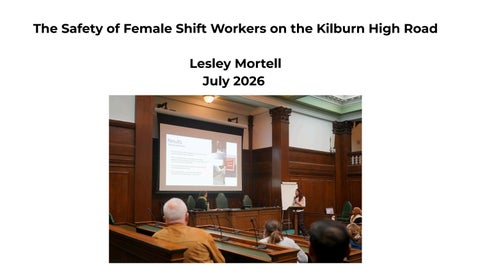
This research was part of a wider project called... Women and Girls’ Safety in Public Spaces - A Citizen Science Project Following many successful collaborations, including the Good Life Euston, Euston Young Voices, and previous residency programmes, Camden Council teamed up with the Institute for Global Prosperity at University College London (UCL) and Camden Giving to deliver a Community Infrastructure Levy-funded project focused on safety in public spaces. This zine is one of the outputs from this programme. Ten local residents were employed by Camden Council to conduct research informed by their own lived experience, focusing on the safety of women and girls in public spaces around the borough. As part of their residency, the cohort completed a bespoke 12-week paid training programme with the UCL Citizen Science Academy, using methods such as photo elicitation, walking ethnography, workshops, and interviews. The residents developed ten distinct research questions exploring intersectional challenges - ranging from global majority communities accessing essential services and the safety of women travelling with children, to Islamophobia and the experiences of female shift workers. Through practical training and supported fieldwork, the resulting recommendations and findings were presented at a celebration event in the Council Chamber at the Town Hall in June 2026, supporting the wider goal of promoting citizen-led policymaking and connecting residents with local government.
7