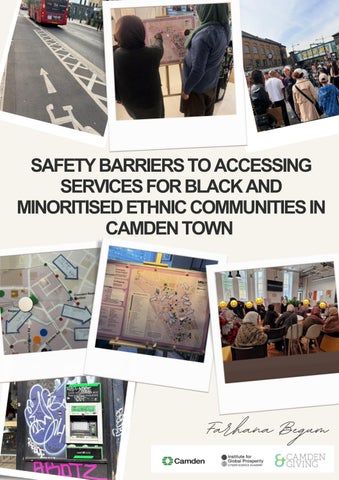
SAFETY BARRIERS TO ACCESSING SERVICES FOR BLACK AND MINORITISED ETHNIC COMMUNITIES IN CAMDEN TOWN
Farhana Begum
WOMEN AND GIRLS' SAFETY IN PUBLIC SPACES – A CITIZEN SCIENCE PROJECT Following many successful collaborations, including the Good Life Euston, Euston Young Voices, and previous residency programmes, Camden Council teamed up with the Institute for Global Prosperity at University College London (UCL) and Camden Giving to deliver a Community Infrastructure Levy-funded project focused on safety in public spaces. This zine is one of the outputs from this programme. Ten local residents were employed by Camden Council to conduct research informed by their own lived experience, focusing on the safety of women and girls in public spaces around the borough. As part of their residency, the cohort completed a bespoke 12 week paid training programme with the UCL Citizen Science Academy, utilizing methods such as photo elicitation, walking ethnography, workshops, and interviews. The residents developed ten distinct research questions exploring intersectional challenges - ranging from global majority communities accessing essential services and the safety of women travelling with children, to Islamophobia and the experiences of female shift workers. Through practical training and supported fieldwork, the resulting recommendations and findings were presented at a celebration event in the Council Chamber at the Town Hall in June 2026, supporting the wider goal of promoting citizen-led policymaking and connecting residents with local government.
2
TABLE OF CONTENTS FOREWORD
02
CONTENTS PAGE
03
SUMMARY
04 - 05
ABOUT THE RESEARCH
06
WHO I AM
07
WHERE WE FEEL UNSAFE
08
SAFETY IS MORE THAN PHYSICAL SAFETY
09 - 11
TRUST, REPRESENTATION AND CULTURAL SAFETY MATTER
12 - 14
EMOTIONAL SAFETY SHOULD BE RECOGNISED AS A PUBLIC HEALTH ISSUE
15
BEYOND PHYSICAL SAFETY: THE HIDDEN BURDEN OF ADAPTING EVERYDAY LIFE
16 - 17
COMMUNITY SPACES CREATE SAFETY AND CONNECTION
18 - 21
WHERE WE FEEL SAFE AND WHAT WE FOUND
22 - 24
SAFETY BEGINS AT HOME
25 - 26
RECOMMENDATIONS
27 - 30
BACKGROUND
31
ACKNOWLEDGEMENTS
32
3
SUMMARY This research explores the safety related barriers that prevent Black and minoritised ethnic communities from accessing community spaces and vital services in Camden Town, particularly along Camden High Street and surrounding areas. Using surveys, focus groups and participatory mapping, the project centres lived experiences of safety, racism, inclusion and trust within public spaces and local services.
The research aims to identify how environmental, cultural and emotional factors influence engagement with support services and community participation. The findings will support Camden Council, community organisations and local stakeholders to develop more inclusive, culturally responsive and accessible services that better meet the needs of diverse communities.
4
5
6
Who I am
I am Farhana, a community development and inclusion practitioner born and raised in Camden, where I now continue to live and work. My professional background spans education, safeguarding, mental health, training and community engagement, with a strong focus on reducing inequalities and improving access to support for underserved communities.
Through both my lived and professional experiences in Camden, I have developed a deep understanding of how safety, trust and inclusion shape people’s ability to access services and participate in community life. I am passionate about co-production, community voice and creating environments where people feel culturally understood, respected and safe. 7
8
Safety is more than physical safety Through my research, I discovered that safety is much more than protection from crime or physical harm. For many women from Black, Minority Ethnic (BME) communities in and around Camden Town, safety is also emotional, cultural and psychological. Participants described feeling unsafe not only because of actual incidents but because of how spaces made them feel. Factors such as poor lighting, graffiti, rubbish, overcrowding, antisocial behaviour and visible alcohol or drug use all influenced perceptions of safety. The ethnographic walk highlighted how environmental conditions shape people's experiences of public spaces. Areas that appeared neglected or poorly maintained often felt less welcoming and more intimidating. Participants frequently mentioned dark spaces, particularly around canal pathways and under bridges, as places they would avoid, especially during the evening. While CCTV cameras provided some reassurance, participants noted a lack of visible community safety officers and trusted people they could approach if they felt vulnerable.
The survey findings reinforced these concerns. Most participants reported that their sense of safety changed depending on the time of day, with evenings and darkness significantly increasing feelings of vulnerability. Many women stated they actively avoided certain locations or services because they did not feel safe travelling to or from them. This finding is significant because it demonstrates that access to services is not simply about availability. A service may exist, but if people do not feel safe reaching it, it remains inaccessible. “Under Camden Lock Bridge, it’s quite dark and crowded. Even during the day it feels a bit enclosed, so in the evening it would feel worse.” Ethnographic walk participant
9
The participatory mapping exercise revealed an important contradiction. Camden High Street and Camden Town Station were repeatedly identified as places where participants felt unsafe, yet these same locations contained essential transport links, community facilities and public services.
“Everything there is for tourists.” The research also revealed that safety is closely linked to a sense of belonging. Participants described some areas of Camden Town as being dominated by tourism, nightlife and mobile populations. While these spaces are economically vibrant, some local women felt they were not designed with residents' needs in mind. This created feelings of exclusion and discomfort, particularly for older women, mothers, and those from more conservative cultural backgrounds. Accessibility should therefore be understood as more than geographical proximity. Traditional measures often focus on how close services are to where people live or whether transport links exist. However, this research suggests that emotional and perceived safety are equally important determinants of whether people are able or willing to engage.
Focus group 2 participant Rather than avoiding them altogether, participants described adapting their behaviour by travelling only during daylight hours, changing routes, relying on family members or limiting how frequently they attended services.
10
This suggests that many services remain technically available but functionally inaccessible because the journey itself creates barriers.
Overall, the research showed that people's experiences of safety are shaped by both physical environments and social experiences.
Improving access therefore requires commissioners and service providers to think beyond buildings and opening hours towards creating environments where people feel sufficiently safe to travel, participate and return.
Clean, welcoming and accessible spaces encourage participation, while neglected or intimidating environments can discourage people from engaging with their communities and accessing support services
“When places look clean, tidy, and bright, it feels more appealing to go to.” Ethnographic walk participant
11
Trust, representation and cultural safety matter A key finding from the focus groups was that many women viewed safety through the lens of trust, representation and cultural understanding. Participants repeatedly explained that feeling safe was not just about being physically protected; it was about feeling respected, understood and welcomed. Many women discussed barriers that prevented them from accessing services even when those services were available nearby. Language barriers, concerns about discrimination, and a lack of culturally appropriate provision all influenced whether people felt comfortable seeking support. Several participants described situations where they felt misunderstood or invisible within mainstream services. These experiences reduced trust and made them less likely to return or seek help in the future. The research highlighted the importance of representation. Participants reported feeling more comfortable when staff reflected the communities they served or demonstrated genuine cultural awareness.
“Seeing staff from your own community can make communication easier.” Focus group 3 participant
Women spoke positively about services that recognised different cultural experiences and adapted their approaches accordingly. Trust was strengthened when organisations listened to local communities and involved residents in decision making. The findings suggest that emotional safety is a crucial but often overlooked part of service accessibility. Services may technically be open to everyone, but if people do not feel represented, respected or understood, they are less likely to engage. This contributes to inequalities, particularly when individuals delay seeking support until problems become more severe.
12
13
14
Emotional safety should be recognised as a public health issue By recognising emotional safety as A recurring finding throughout the part of prevention, organisations can research was that participants rarely separated physical safety from emotional begin addressing upstream factors safety. Instead, they described safety as that influence wellbeing before individuals reach crisis point. a combination of trust, belonging, dignity and confidence. The research therefore challenges traditional assumptions about For many women, repeated exposure to accessibility. Access is not simply intimidating environments, discrimination about opening doors or providing or exclusion created a cumulative information. It also requires building psychological burden. Even where no trust, creating inclusive environments direct crime had occurred, and recognising the different environmental neglect, visible experiences that shape how antisocial behaviour and experiences communities interact with services. of racism contributed to chronic vigilance and anxiety. Participants frequently described modifying their daily routines to minimise perceived risk, avoiding particular routes, limiting evening activities and postponing access to services.
These findings suggest that emotional safety should be understood as an important determinant of health. Feeling unable to access community spaces, preventative services or social networks may contribute to isolation, reduced physical activity, poorer mental wellbeing and delayed help seeking. This is particularly relevant within communities already experiencing health inequalities.
15
Beyond Physical Safety: The hidden burden of adapting everyday life One of the most striking findings from this research was that many women had adapted their everyday lives to manage safety concerns. Rather than avoiding places altogether, participants described making constant adjustments to reduce risk. These adaptations had become routine, yet they illustrate the hidden effort required to navigate public spaces safely. Participants regularly assessed risk before travelling. Decisions about attending appointments, using community spaces or accessing services were influenced by the time of day, lighting, transport options and whether they would be travelling alone.
The responsibility for staying safe often fell on women themselves. Remaining alert, avoiding certain areas and planning journeys carefully had become normal parts of everyday life rather than exceptional responses. These adaptations have wider implications for health and wellbeing. Limiting participation in community activities or delaying access to services can increase social isolation and reduce opportunities for early intervention and preventative support. The findings suggest that improving access requires reducing the need for people to adapt their lives around unsafe environments.
“There are no buses going directly through some parts anymore, and that makes travel difficult and unsafe.” Focus group 3 participant
Safety concerns changed how people accessed services rather than whether they needed them. Many participants continued to use important locations despite feeling unsafe, adapting by changing routes, travelling during daylight hours or arranging alternative transport.
Creating welcoming, inclusive and trusted public spaces would enable communities to participate more freely, confidently and equitably.
16
17
Community spaces create Safety and Connection Despite identifying many challenges, participants also highlighted examples of spaces where they felt safe, connected and valued. Parks, community centres, libraries and other community led environments were consistently identified as positive places. These locations provided opportunities for social interaction, support and belonging. The participatory mapping exercise revealed an important pattern. Some of the places that participants considered unsafe were also places they used regularly because they contained essential services, transport links or community resources. This demonstrates that people often continue using important spaces despite feeling uncomfortable or vulnerable within them. Rather than simply avoiding unsafe areas, many women develop strategies to manage risk, such as travelling only during daylight hours, avoiding certain routes, or relying on others for support.
The research also demonstrated that community spaces play an important preventative role in supporting health, wellbeing and social connection. Participants consistently described community centres, libraries, parks and locally trusted organisations as places where they experienced familiarity, acceptance and belonging. These spaces offered opportunities to develop relationships, reduce isolation and access information before difficulties escalated into crisis. Unlike formal statutory services, community settings were often viewed as less intimidating and more approachable, creating environments where individuals felt able to seek advice, share concerns and build supportive social networks. This created a sense of collective safety that formal security measures alone could not provide. “There should be community hubs for Asian and minority women.” Focus group 2 participant
18
An important finding was that trusted relationships often influenced engagement more than the services themselves. Participants spoke positively about familiar staff, community leaders, volunteers and local organisations that had established credibility within their communities over time. These trusted relationships acted as informal bridges into wider systems of support, helping individuals navigate services that might otherwise have felt inaccessible. This highlights the important role of community organisations as connectors between residents and statutory services, particularly for communities who have previously experienced barriers to accessing support.
Perhaps most importantly, participants emphasised that creating safer communities requires collective responsibility. Feedback from the Black British Peer Support Group challenged the assumption that women alone should adapt their behaviour to remain safe. Instead, participants argued that meaningful change also requires engaging men and boys in conversations about respect, accountability and prevention. This shifts the focus from individual responsibility towards community responsibility and recognises that sustainable improvements in safety depend upon stronger relationships, shared ownership and inclusive dialogue. Together, these findings suggest that investment in community development, coproduction and trusted local relationships should be viewed as integral components of community safety rather than separate policy priorities.
19
An additional finding emerged through feedback from the Black British Peer Support Group. Participants highlighted that discussions about safety should not focus solely on women adapting their behaviour. Instead, they argued that men and boys should be actively involved in conversations about respect, accountability and community responsibility. They emphasised that women should not carry the burden of managing safety risks alone.
Ultimately, the findings suggest that safer communities are built through relationships, trust and inclusion. While improvements to infrastructure are important, creating welcoming, representative and community led spaces may be equally important in improving access, wellbeing and social connection.
20
21
22
23
24
Safety begins at Home An unexpected finding that emerged during one of the focus groups was that several women questioned why the research focused primarily on Camden High Street when they did not feel safe in their own homes. While public safety was recognised as important, many participants explained that the risks they experienced within and around their homes had a greater impact on their daily lives. Participants described a wide range of housing related safety concerns, including damp and mould, overcrowding, poor lighting in communal areas, broken entry systems, antisocial behaviour on estates, drug use, poorly maintained communal spaces, fly tipping, broken lifts, inaccessible buildings, inadequate security, and concerns about harassment or intimidation from neighbours. Others spoke about feeling isolated within their homes because they did not feel confident using communal areas or leaving the property after dark.
These discussions highlighted that safety cannot be understood solely through the lens of public spaces. For many women, experiences of safety are shaped by the environments in which they live as much as the places they travel through.
The findings suggest that improving community safety requires a broader place based approach that considers housing, neighbourhood design and the quality of residential environments alongside public spaces. Participants consistently emphasised that feeling safe should begin at home, as this forms the foundation for confidently engaging with community life, accessing services and maintaining wellbeing.
25
26
Recommendations The findings suggest that improving safety for women from BME communities requires a holistic approach that addresses both physical and emotional safety. Safety should be understood as a community wellbeing issue rather than solely a policing issue. The recommendations emerging from this research should not be viewed as isolated interventions but as interconnected actions that strengthen the wider system supporting community wellbeing. Improving lighting alone, for example, may increase perceptions of safety in particular locations, but greater impact is likely to be achieved when environmental improvements are combined with culturally responsive services, stronger community partnerships and meaningful opportunities for participation. Similarly, increasing service provision without addressing trust, representation and emotional safety is unlikely to remove the barriers that many participants described.
The findings support a preventative, place based approach to improving access. Investing earlier in community spaces, trusted relationships and culturally appropriate services has the potential to reduce isolation, encourage earlier help seeking and decrease reliance on crisis interventions. Community organisations, faith groups and local residents already play an important role in connecting people to support, particularly where statutory services may feel unfamiliar or inaccessible. Strengthening these existing assets through partnership working and co-production offers opportunities to improve outcomes while ensuring that solutions remain grounded in lived experience.
27
First, improvements to the physical environment are needed. Better lighting, safer walking routes, clearer signage, improved maintenance and visible safety measures would help reduce fear and increase confidence when moving around Camden Town, particularly during evenings and winter months. Second, there is a need for more women only and culturally responsive spaces. Participants consistently highlighted the value of environments where they feel understood, represented and able to discuss wellbeing without judgement. Expanding women only wellbeing groups, peer support programmes and community activities could help reduce isolation and improve access to support. Third, services should invest in representation and cultural competence. Recruiting diverse staff, improving anti-racism training and strengthening multilingual communication would help build trust and make services more accessible. Representation should not be treated as an optional addition but as a key component of effective service delivery.
Fourth, community organisations, faith groups and local residents should be involved in shaping services and safety initiatives. Coproduction ensures that solutions reflect lived experience and address real barriers faced by local communities. Community led approaches are more likely to build trust and create sustainable change. Finally, safety conversations should include men and boys. Participants emphasised that responsibility for safety cannot rest solely with women. Preventative work should include education, dialogue and community based initiatives that challenge harmful behaviours and promote collective responsibility. The overall recommendation is clear: improving access requires more than increasing services. It requires creating environments where people feel safe enough to use them. By combining environmental improvements, culturally responsive support, community participation and stronger relationships, Camden can create a more inclusive, accessible and safer community for everyone.
28
29
30
Background Camden is one of London’s most diverse boroughs, yet significant inequalities remain in relation to access, wellbeing and trust in public services among Black and minoritised ethnic communities. Research consistently shows that experiences of racism, discrimination, exclusion and fear can affect how individuals engage with community spaces and support services. While services may exist geographically close to communities, emotional safety, cultural responsiveness and perceptions of belonging can strongly influence whether people feel able to access them.
The study used mixed methods, including ethnographic walk, surveys, focus groups and participatory mapping, to gather both quantitative and qualitative data. By combining statistical information with personal narratives and visual mapping, the research sought to build a richer understanding of how safety concerns intersect with race, identity, gender and community belonging.
This research focuses specifically on Camden High Street and surrounding areas, exploring how people experience safety in public spaces and whether these experiences impact engagement with vital services. The project draws on themes linked to community safety, contextual safeguarding, mental health equity and inclusive service delivery. It also reflects wider conversations around place based inequalities, barriers to participation and the importance of lived experience in shaping policy and practice.
The project is informed by coproduction approaches that prioritise the voices of those directly affected. It aimed to produce practical recommendations that support Camden Council, community organisations and local stakeholders in improving inclusion, accessibility and trust within local services and public spaces.
“The area feels more unsafe now than before.” Focus group 3 participant
31
ACKNOWLEDGMENTS I would like to thank the Citizen Science Academy, Participation and Planning Team at Camden Council, Camden Giving, community organisations and local residents who supported and contributed to this research project. Thanks to Jane Debono, Principal Planning Officer for providing the map. I am especially grateful to the community members who shared their lived experiences, insights and perspectives with honesty and trust.
Special thanks to Joseph Cook, Citizen Science Academy Lead for bringing my mapping vision to life, which became a central tool for participant engagement and caputuring rich, place based insights throughout the research. Finally, a huge thank you to our tutor Alex Albert and teaching assistant, Aysha Ahmed, at UCL for their guidance and support throughout this important and much needed piece of work.
32
#CSA
33