Newham Community Research Network
Black British Caribbean Girls’ Experiences in Education Discipline and consequence in Newham’s secondary schools and colleges Nadina Smith
Citizen Social Scientist
About the Newham CRN In December 2024 the UKRI and The Young Foundation announced new ground-breaking engagement investment in nine ‘community research networks’ across the UK - collaborations led by community organisations alongside academics, local authorities and local residents. The networks span the length of the UK, from the north of Scotland to the Isles of Scilly, and the only successfully-funded network in the south east is here in Newham! For the Newham Community Research Network, Compost London are leading a ‘network of networks’ based in various wards across our ethnically diverse and innovative borough. The three recruited networks cover migrants and refugee communities, marginalised women, and young people with special educational needs who live, work and go to school in Newham. The five-year project is supported by University College London’s Citizen Science Academy, based in the Institute for Global Prosperity, which has strong experience running citizen science (community research) projects in east London and across the world. Local residents from the three different networks are being trained in research ethics, methods, and project planning, and then supported to carry out qualitative research across east London, tackling questions and issues they feel are important to their network communities. Newham Council are also providing support across all three networks, and placement opportunities within the Council will be available for some of our alumni.
About C.R.O.W.N The second cohort of citizen scientists, were trained in summer 2026, and supported by the marginalised women sub-network members, including the East London Black Women’s Organisation (ELBWO). This subnetwork - CROWN (Collaborative Research and Outreach for Women) - works collaboratively to drive trauma-informed, inclusive and culturally responsive change, so that services genuinely reflect the realities of marginalised women and girls. Throughout the programme, the citizen scientists from CROWN have taken part in training, discussions and practical research activities. They have worked incredibly hard, supported one another and brought their own experiences, perspectives and strengths to the group. We hope you enjoy reading their research.
Published October 2026.
Black British Caribbean Girls’ Experiences in Education
3
Contents Introduction
4
Purpose
5
Methodology
7
Findings
11
Creative Output
19
Recommendations
21
Acknowledgements
26
Citizen scientists from the CROWN network at their showcase event at ELBWO in September 2026
4
Newham Community Research Network
Introduction My name is Nadina Smith, and my research title is: Exploring the Black British Caribbean Girls’ Educational Experience in Newham Secondary Schools and Colleges, Focusing on Discipline and Consequence. This research speaks to me; I am a Black British Caribbean girl who was educated in Newham up until the age of sixteen. I then worked in both formal and informal education in Newham secondary schools and colleges for 25 years. Unfortunately, I have experienced and witnessed a plethora of microaggressions, and racist and disproportionate treatment of Black children, in these educational spaces. What I want to explore is how this plays out for Black British Caribbean girls specifically. There have been national headlines around the failings and disproportionate exclusions of Black Caribbean boys, rightly so; however, there is limited explicit study that I have found which looks at the educational experiences of Black British Caribbean girls, which is concerning. Despite evidence which proves there is institutional racism in education, a lack of representation in both staffing and the curriculum, as well as the attainment gap, their experience is largely missing. Not being considered in the conversation about something as important as education marginalises Black girls, and subsequently Black women. As a result, there could potentially be generations of Black Newham women whose mental wellbeing has been negatively affected, and whose education and career trajectory has been impeded. This research resonates with me as a marginalised woman in Newham. I recognise I am not just asking questions; I am being trusted with real experiences of navigating education, discipline and consequence as Black girls and young women in Newham. I am committed to listening with intention, representing their voices truthfully, and ensuring this research does not just extract stories, but honours them.
Black British Caribbean Girls’ Experiences in Education
Purpose Newham is one of the most diverse boroughs in the United Kingdom; outwardly it celebrates this diversity and richness, but as a lifelong resident I don’t feel this is reflected internally for many communities that call Newham home. Education is a fundamental aspect of any community and borough. Newham has in recent years been celebrated for its above national average A-Level results and Oxbridge acceptances. But there is not the same energy when tackling the high rates of exclusions – the highest in London in 2018 – and Newham has not moved out of the top eight since. And of those who were excluded from education, Black British Caribbean children are top of that list; this has not changed since records started. Black British Caribbean children are suffering in educational spaces in Newham. In 2023 the organisation I worked for was commissioned by the Newham Scrutiny Commission to undertake research into ‘The Relationship Between Black Boys and the Borough’. This was a direct request from Councillor Anthony McAlmont, Chair of Newham’s Overview and Scrutiny Committee, who said: “I am gravely concerned that the narrative concerning Black boys has not changed in the forty years I have lived in the UK. It’s always about underachievement in areas such as educational attainment, social and economic wellbeing and overrepresentation in the criminal justice system and mental health issues.” By definition, Black British Caribbean girls are considered marginalised. They are a group facing systemic exclusion and discrimination, and often have reduced power and influence in education, the workforce, receiving healthcare and politics. Education is fundamental to thriving in any society, so if this is being hindered due to being marginalised, it will have a direct impact on the trajectory of their lives. Education is such a vast topic that it was necessary for me to narrow down the age range as well as the educational spaces. I chose secondary school and college experience. I initially wanted to look at four areas within education:
5
6
Newham Community Research Network
Safety – How safe do Black British Caribbean girls feel in their school or college environment? Exploring experiences of belonging, racial microaggressions, contextual safeguarding and emotional wellbeing. Discipline and consequence – Examining disproportionate exclusion rates, behaviour policies and how disciplinary practices impact academic trajectory. Representation – Visibility in the curriculum, staffing diversity, and whether students see themselves reflected in their educational experience. Opportunities – Access to enrichment, mentoring, career pathways and the structures that either enable or limit aspiration.
Due to feedback after the presentation and time constraints, I decided to focus on one area: Discipline and Consequence. I feel this was the area that had the most crossover. For example, if a Black girl is receiving disproportionate consequences like exclusion, she immediately becomes vulnerable and her safety is compromised. The lack of representation, especially in decisionmaking roles, can lead to unfair consequences. And you may not be given educational opportunities if you are labelled “aggressive” and “loud” as a consequence of microaggressions and stereotyping. I would like Newham to commission the same research for Black girls that they did for Black boys and their relationship with Newham. I would also like there to be a conversation in the right rooms.
am not just asking questions; I am “ Ibeing trusted with real experiences.
”
Black British Caribbean Girls’ Experiences in Education
Methodology My research uses a mixed-methods design, combining online and paper surveys with face-to-face interviews. I used these approaches as I thought they were well suited to sensitive, identity-based educational research. They allowed me to gather both breadth, including patterns and themes, and depth, through rich personal narratives.
Surveys: The quantitative component of my data was the surveys, capturing patterns in disciplinary experiences, perceptions of fairness, frequency of consequences, and demographic context. The participants were women aged 18 and over, of all ethnicities and religious denominations, who had been educated in a Newham secondary school or college. This was deliberately open to all to ensure I could make comparisons of experiences. Initially I created an online survey, as I felt this would be easier to access with a code and email link. I had 20 multiple-choice questions and 4 additional optional questions which required sentences. When discussing the number of questions, I was advised this may be too many and that participants may not engage with the survey. I sent out 5 test surveys for feedback. All 5 participants fed back that the number of questions was fine, and that the additional questions allowed them to elaborate on the multiple-choice questions they had previously answered. Armed with this feedback, I proceeded with the survey in its entirety. I approached a staff member at NewVic College and asked if I could arrange a focus group and share the link with the 18-year-old female students. Unfortunately, the powers that be were not keen on me coming into the college to talk to the girls. They requested more information on top of the information I had provided, and they also wanted some of the questions changed. This was due to the topic, and because the recent merger with Newham College meant there was new management and new protocols in place. I was told that the surveys would need to be printed, in line with their GDPR process.
7
8
Newham Community Research Network
I was not feeling confident about printing the surveys. The test surveys were successful online, but I had not tested 20–24 questions printed in black and white on A4 paper. Visually, I can see how this is daunting or ‘long’. Fortunately, the students were more than willing to complete the survey and the additional questions, and I gained some valuable insight. They noted that this was the first survey they had taken part in that looked at “them” specifically, or that focused on the female experience outside of medicine.
Interviews: For the qualitative component I carried out semi-structured interviews exploring professionals’ points of view, lived experiences, emotional impact, relationships with parents and other professionals, and interpretations of disciplinary events. I created a set of 7 to 8 open-ended questions, which acted as prompts; the questions varied slightly depending on the interviewee. All questions followed a theme, rooted in the philosophy of Michel Foucault, which addresses the relationships between ‘power, knowledge and liberty’ and how they are used as a form of social control through multiple institutions, including education. I structured my questions around: Rules and Behaviour Surveillance and Observation Rewards, Punishment and Compliance Voice and Power Reflection and Wellbeing Using this structure helped both the interviewee and me stay on course and explore relevant information. Initially I had wanted to interview head teachers, specifically the only Black Caribbean female head in the borough, and the council lead for Education and Culture. While I was finalising my interviews, I interviewed a school governor, and during this interview I realised that the responses to the questions were very corporate and by the book. I realised that this would probably be the theme, and I did not want a code of conduct or staff handbook read back to me. I opted instead to interview staff who work directly with Black Caribbean girls in educational, mental health and youth justice settings. I believe this was a good choice.
Black British Caribbean Girls’ Experiences in Education
Using two different styles of data capture, I was able to compare what students reported in surveys with what was described in interviews. Interviews were audio-recorded with consent and later transcribed using technology. I also made notes of things that stood out for me, some of which were used to make my creative output.
Ethics: There were many ethical considerations for my topic, as it involved race, gender and disciplinary experiences. I used trauma-informed interviewing techniques, such as avoiding leading questions, allowing breaks and validating emotions. I also sent a follow-up email to the participants to thank them, and to check whether they needed signposting because of any triggered memories. All participants signed a consent form and participation form. This outlined: An explanation of all parties involved and an overview of my research project A clear explanation of confidentiality and anonymity The right to withdraw at any time Secure storage of data These measures protect participants and strengthen the credibility of my findings.
9
Nadina’s creative output, The Headscarf – Resistance, on display at the CROWN showcase at ELBWO.
Black British Caribbean Girls’ Experiences in Education
Findings My research exploring the educational experiences of Black British Caribbean girls in Newham secondary schools and colleges, with a focus on discipline and consequences, sparked many issues and concerns; however, there were four themes which were echoed. I used two styles of data capture, surveys and one-to-one interviews, and both gave interesting insight.
Theme 1: Surveillance, Discipline and Behaviour Management This theme explores how Black British Caribbean girls experience monitoring, behavioural expectations and disciplinary practices within schools and colleges. Drawing on Michel Foucault, it examines how institutional systems of observation, rules and sanctions shape students’ behaviour and sense of belonging. Concerns: Experiences of detentions, exclusions and isolation Perceptions of fairness and consistency in disciplinary decisions Behaviour policies and their implementation Feeling watched, monitored or targeted Power relationships between students and staff
66% of the students who participated in the paper survey felt watched, monitored or targeted throughout their educational experience. This was in contrast to the online participants, who had left education more than 10 years ago: they didn’t feel watched or monitored, but some felt targeted, and when looking at the data, these were the responses of Black British Caribbean and African women. It is important to mention that CCTV and ID cards have been the norm since the late 1990s and early 2000s, so monitoring won’t look the same to the different generations. 88% of the online participants had been out of Newham secondary school or college for 10 years or more; therefore, their responses were a reflection of their time in education. Although I cannot be sure how far back, it is important to take into consideration the introduction of key legislation: the Education Acts of 1996 and 1998 were not explicit about race or
11
12
Newham Community Research Network
discrimination; the Race Relations (Amendment) Act 2000 promoted racial equality in schools and aimed to prevent racial discrimination; and the Equality Act 2010 went a little further. 78% of paper survey participants felt that they could be themselves, but knew there were consequences for doing so.
Visitors engaging with Nadina’s headscarf display at the CROWN showcase at ELBWO.
Theme 2: Adultification, Bias and Racialised Gender Expectations This theme investigates how race and gender intersect to influence disciplinary responses towards Black British Caribbean girls. It considers whether they are perceived as older, more aggressive or less vulnerable than their peers, leading to disproportionate consequences. Concerns: Adultification bias Stereotyping (e.g. “loud”, “aggressive”, “argumentative”) Differential treatment compared with other ethnic groups Experiences of racism and sexism Staff assumptions and unconscious bias
Adultification as a term is newer, especially in the British education space. It considers whether Black girls are perceived as older, more aggressive or less vulnerable than their peers, leading to disproportionate consequences and less safeguarding.
Black British Caribbean Girls’ Experiences in Education
The term was popularised in the UK by Dr Jahnine Davis, so the majority of the online participants, who left education more than 10 years ago, would not be familiar with the language, but had witnessed or experienced it. In my interview with an ex-Youth Justice officer, now working with vulnerable and at-risk families, he spoke at length about the adultification of Black girls: “I have seen this from school to PRUs to the criminal justice system. Black girls are dealt with differently, from the way they are spoken [to], to their consequences. Parents are not informed as quickly as other races; this means the girls are left to navigate this on their own, without the tools, and a lot of emotions.” According to all participants, staff assumptions, unconscious bias and stereotypes like “loud”, “aggressive” and “argumentative” are tropes which are still used in the education space regarding Black girls. This comes from staff and peers, and is also reinforced by wider society. One participant wrote: “my form tutor told me that all the Caribbean girls were put into the same class to be controlled”. For Black British girls, their experiences are shaped not only by race or gender alone, but by the interaction of race, gender, age, class, disability, faith, neurodivergence and socioeconomic background. Differential treatment compared with other ethnic groups came up in all but one interview. That interview was with a school governor, who felt that the exclusion process was fair. When I asked what the statistics were, she said that “Black girls are not given same chances as other girls for e.g. easier for Black females to be suspended”.
Theme 3: Identity, Voice and Emotional Wellbeing This theme explores the impact disciplinary experiences have on Black girls’ identity, confidence and wellbeing. It focuses on whether the girls feel, or felt, heard and respected, have a sense of belonging, and are able to express themselves within educational environments.
13
14
Newham Community Research Network
Concerns: Sense of belonging Self-esteem and confidence Relationships with teachers and peers Emotional responses to sanctions Opportunities to challenge or explain disciplinary decisions
In an interview with a British Caribbean woman aged between 55 and 59, she recalled a time in primary school when the only Black teacher – whose name she remembered, and who was vivid in her description – made her feel “safe and seen” by “tying my hair back into place because none of the White teachers wanted to touch me or my hair”. This was some 45 plus years ago, and she said: “I think about it till this day, and this impacted how I sent my girls to school, immaculate, in styles that couldn’t or wouldn’t come undone. I didn’t want them to feel that way, even though I would be straight down the school, the damage would have already been done.” “A rule was implemented where my school used to measure Black girls’ braids and we had to cut them if they didn’t meet the standard length.” This statement came from a student at the college, so I was not able to get the context, or the school attended. Regardless, this was an experience of a Black British Caribbean girl in the last 2–3 years in Newham. This is a deeply problematic practice for many reasons. Black women’s hair has historically been politicised. It is more than just aesthetics; particular hairstyles traditionally reflect identity, including age, marital status, social standing and spirituality. Throughout history Black women were forced to shave their hair to strip them of their dignity and cultural heritage, and later forced to cover it up because White women found their “elaborate” hairstyles intimidating. There is also a monetary element to hair in the Black African and Caribbean community: braids can cost between £60 and £250 plus. Being told to cut them off to fit into a Eurocentric beauty standard further marginalises Black girls. I can see how this would cause friction between the school and the student.
Black British Caribbean Girls’ Experiences in Education
Both examples highlight themes of lack of belonging, poor relationships with teachers and peers, and how the lack of care and racism negatively affect self-esteem and confidence, even decades and generations later. 85% of the students who completed the paper survey said that they would have liked the opportunity to challenge disciplinary decisions, or to have the process explained, so that it is fair and transparent. This would go a long way in teacher, student and parent relations; this is something that happened with other racial and cultural groups. “Understanding differences instead of erasing identities” was a powerful response to the question “What would a more supportive and respectful approach to discipline look like?” I framed the question like this because previous research regarding children and discipline in schools, from organisations such as the Runnymede Trust, said there was a distinct lack of support for Black families, and a lack of respect, throughout the discipline process.
Theme 4: Educational Outcomes, Support and Pathways Forward This theme examines how disciplinary experiences influence educational engagement and future opportunities, while also identifying protective factors that promote positive outcomes. Concerns: Attendance and engagement Academic achievement Exclusions and managed moves Access to pastoral and safeguarding support Recommendations for creating more equitable disciplinary practices
Every professional I interviewed highlighted that the disproportionate exclusion rates of Black Caribbean children nationally have been a problem for decades. This is also the case for Black Caribbean girls; however, when speaking to one interviewee, he said: “In recent years Asian girls, British born Bangladeshi and Pakistani girls, are in more violent altercations, with peers including boys and teaching staff than any other girls but is not reflected in the stats.” When I asked why that was, he said: “maybe because parents are involved sooner, things are
15
16
Newham Community Research Network
explained in depth. But I’ve heard teachers say that the behaviour is out of character, and maybe something is going on for them.” This is not the narrative for Black girls; they are seldom given the benefit of the doubt. This raises concerns around safeguarding. Why is there no investigation into why a Black girl is in an altercation? Instead, they are presumed angry or aggressive, with no pastoral support. Another interviewee shared that she had worked in education for over 30 years, and said: “I definitely went out of my way to support Black children, and tried to reason with parents and grandparents, telling them how to play the game and what was happening in the classroom”. She shared that most parents and carers didn’t fully understand the jargon that was used in education, but Black children, and specifically Caribbean families, were at a disadvantage as they were rarely offered an advocate or support service. Families from other countries, where English was not their first language, were encouraged to have an interpreter, and rightly so; but with this interpretation came a level of transparency, a step-by-step explanation of the disciplinary process and decision, which was not afforded to Caribbean parents. Because they are English speakers, this transparency is missed. Together, these four themes provide a coherent framework for analysing how discipline and consequence are experienced by Black British Caribbean girls in Newham, while recognising the influence of institutional power, intersectionality, racialised gender bias and educational equity. They also align well with theoretical perspectives from Kimberlé Crenshaw on intersectionality and Michel Foucault on discipline and institutional power.
differences instead of “ Understanding erasing identities. A survey participant
”
Moments from the CROWN showcase at ELBWO: Nadina presenting her research, and visitors engaging with her headscarf display.
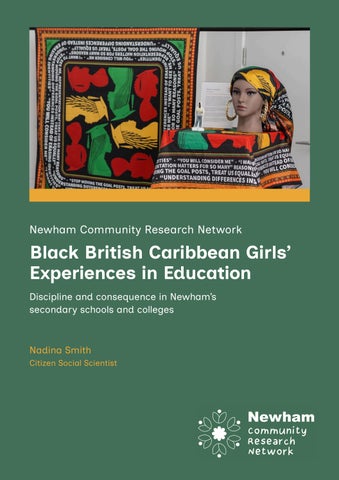
Nadina’s headscarf design, The Headscarf – Resistance, using Pan-African colours and words taken directly from her interviews and surveys.
Black British Caribbean Girls’ Experiences in Education
19
Creative Output The Headscarf – Resistance My research into Black British Caribbean girls’ experiences in secondary and college education in Newham found that Black girls’ hair and appearance were repeatedly policed. Participants described being reprimanded for hairstyles, hair colour and hair length, with one stating: “a rule was implemented where my school used to measure Black girls’ braids and we had to cut them if they didn’t meet the ‘standard’ length”. These findings reveal how educational environments can regulate Black identity and reinforce narrow expectations of acceptable presentation. My research also highlighted the lasting impact of these experiences on Black women’s self-esteem, identity, perceptions of beauty and decisions around acceptable appearance in the workplace. This connects to the 1786 Tignon Law in Louisiana, which forced Black women to cover their hair as a form of racial and social control. Black women transformed this oppression into a symbol of beauty, pride and resistance. My piece responds to these findings through culturally representative imagery: Black hairstyles, a graduation cap symbolising education, Pan-African colours, and words taken directly from my interviews and surveys.
moving the goal posts, treat us “ Stop equally. A research participant, printed on the headscarf
”
The headscarf, printed with Nadina’s design and words taken directly from her interviews and surveys.
Black British Caribbean Girls’ Experiences in Education
Recommendations This research has allowed me to have frank and sensitive insight into the lived and living experiences of Black British Caribbean females. It has also allowed the same for African, Mixed heritage, Asian, White British and Eastern European women and more, giving me a range of voices and experiences of Newham’s secondary schools and colleges. It is clear from the data and feedback collected that Black girls, inclusive of Caribbean, African and Mixed heritage, are not having the same experiences as their White British, European or Asian peers. This has had, and is having, a detrimental effect on their confidence, their wellbeing, and their relationship with education, further education and career trajectory. We spend 15 years in compulsory education or training; these are our most formative years. It is imperative that this is a safe and nurturing space for all. There have been significant strides in how Black British Caribbean children are treated due to the Equality Act 2010. However, the bar was set very low in the 1970s and 80s, as explained in Bernard Coard’s How the West Indian Child is Made Educationally Sub-normal in the British School System, published in 1971. The women I had conversations with and interviewed, who are now in their 50s and 60s, did say that teachers spoke to them in derogatory ways and, from their recollection, used corporal punishment more on Black children than any others. This could not happen today in any school in the UK, but there is a link to the disproportionate consequences for Black children, girls included. The disturbingly sad case of Child Q in 2020 is a reminder of this. Adultification and intersectionality were common themes throughout the interviews, with some naming them specifically, and some naming the intersections, such as race, neurodiversity and socioeconomics, or incidences of Black girls being adultified by way of consequence. There is more work to be done.
21
22
Newham Community Research Network
My recommendations are as follows: For professionals working with Black British girls, adopt an intersectional and humanistic approach. Recognise individual experiences rather than relying on stereotypes; no collective punishments. No public punishment; take the child to a different space and talk to them. Regularly reflect critically on unconscious bias; training required. Create environments where Black girls feel genuinely seen, heard and valued. Ensure there is a culturally responsive safeguarding and equitable behaviour policy being practised, not just written in the staff handbook. Representative curricula and staff, especially at senior and decision-making levels. Trauma-informed practice that acknowledges how race, gender and other identities shape children’s experiences. External scrutiny and best practice events for school leadership. Improved transparency in disciplinary processes for all, including parents and carers. All schools must practise fair and consistent consequences. My actionable recommendations from this research are very similar to those recommended previously to Newham Council in the ‘Black Boy Relationship with LB Newham’ report in 2022: “More Black Caribbean and African representation within SLT in educational establishments, schools, colleges, universities – a review of the recruitment and retention practices across education organisations, schools, academies, trusts in Newham.” “An annual external review of equality, diversity and equalities proactivity across statutory sector services, measured against Equality Act 2010 or agreed plan of London Standards.” “One EDI department within the council and EDI departments within HR in each school.” “Newham’s commitment to EDI and anti-racism is enshrined in a charter mark for education, health, police, social services, libraries etc.”
Black British Caribbean Girls’ Experiences in Education
This shows me that Newham Council are aware of these issues, and should be working towards these recommendations, as they are coming from the community they serve.
Future Research: I would like to extend this research with more women in Newham who were educated from primary right through to college. This will give me the chance to see at what stage education and educational spaces stopped being nurturing and became hostile for some groups. I would also like to look at home-schooled girls in Newham, to compare experiences, both positive and negative. I hope the next cohort of citizen scientists look at SEND, Black children, discipline and consequences, as these issues were mentioned in my interviews and conversations. This has been a great experience; I want to do more and want to see change.
23
Nadina presenting her recommendations to the audience at the CROWN showcase at ELBWO.
Nadina’s recommendations to the London Borough of Newham, from her final presentation at the CROWN showcase.
26
Newham Community Research Network
Acknowledgements I appreciate the invaluable input from my interviewees. Thank you for being candid; I understand some of the questions may have made you feel uncomfortable, but you pushed through. I would also like to acknowledge those who completed my very long survey; it was very useful. I would like to acknowledge everyone who supported me throughout this experience, especially my sisters in the C.R.O.W.N Citizen Scientists group, for bouncing ideas off each other and encouraging our visions. Thank you Joseph, Twinkle and Natalie for your patience and care.