Newham Community Research Network
Our Newham
Women crafting and mapping belonging, memory and wellbeing
Loubna Bijdiguen
Citizen Social Scientist
About the Newham CRN In December 2024 the UKRI and The Young Foundation announced new ground-breaking engagement investment in nine ‘community research networks’ across the UK - collaborations led by community organisations alongside academics, local authorities and local residents. The networks span the length of the UK, from the north of Scotland to the Isles of Scilly, and the only successfully-funded network in the south east is here in Newham! For the Newham Community Research Network, Compost London are leading a ‘network of networks’ based in various wards across our ethnically diverse and innovative borough. The three recruited networks cover migrants and refugee communities, marginalised women, and young people with special educational needs who live, work and go to school in Newham. The five-year project is supported by University College London’s Citizen Science Academy, based in the Institute for Global Prosperity, which has strong experience running citizen science (community research) projects in east London and across the world. Local residents from the three different networks are being trained in research ethics, methods, and project planning, and then supported to carry out qualitative research across east London, tackling questions and issues they feel are important to their network communities. Newham Council are also providing support across all three networks, and placement opportunities within the Council will be available for some of our alumni.
About C.R.O.W.N The second cohort of citizen scientists, were trained in summer 2026, and supported by the marginalised women sub-network members, including the East London Black Women’s Organisation (ELBWO). This subnetwork - CROWN (Collaborative Research and Outreach for Women) - works collaboratively to drive trauma-informed, inclusive and culturally responsive change, so that services genuinely reflect the realities of marginalised women and girls. Throughout the programme, the citizen scientists from CROWN have taken part in training, discussions and practical research activities. They have worked incredibly hard, supported one another and brought their own experiences, perspectives and strengths to the group. We hope you enjoy reading their research.
Published October 2026.
Our Newham
3
Contents Introduction
4
Purpose
7
Methodology
10
Findings
15
Recommendations
19
Acknowledgements
22
Citizen scientists from the CROWN network at their showcase event at ELBWO in September 2026
4
Newham Community Research Network
Introduction My name is Loubna and I am a Maghrebi Arab Muslim woman, mother, community researcher and teacher whose personal and intellectual formation has crossed five countries: Morocco, France, Saudi Arabia, Egypt and the UK. For over twenty years, I have lived and worked in East London, the last seven in the charity sector in community health engagement and cancer awareness campaigns across ten London boroughs, having thousands of conversations with women in their own community spaces. I have also been involved in peer and community research for the past few years. My research asks a simple question with a complicated answer: how do women in Newham – particularly women from marginalised backgrounds – experience, remember and give meaning to the borough where they live, and why does so much of their cultural and creative life go unseen? This matters because, by the council’s own figures, 44% of Newham adults attended no arts event or activity last year, against 27% in neighbouring Hackney – placing Newham in the bottom ten local authorities in England for cultural participation. Yet the women I have worked with are not culturally absent. They are culturally unseen – absent from the categories that count culture at all. My research uses walking ethnography, participatory photography, creative workshops and community mapping to surface the cultural and creative life of women’s community spaces. Rather than only asking women about culture, I invited them to walk their borough, photograph what mattered to them, and build collages and a shared memory map from their own images and their own words – so the research itself became an act of the everyday “small-c” culture I set out to make visible. This work is personal. I have known women-only community spaces from the inside since childhood – faith spaces, family gatherings, women’s circles – the places where culture and art are taught and inherited, where oral stories are passed between generations of women, and wellbeing is cared for through company, craft and conversation. This is knowledge that has never been written down in any cultural strategy about Newham – and much of what my walks and workshops surfaced was
Our Newham
exactly this kind of everyday, uncounted creative life. It is also personal because my own voice and lived experience were, for years, dismissed in academic settings as “too subjective,” “anecdotal,” or “not rigorous” – an experience of what would be called knowledge supremacy. This research, and its creative, women-led methods, is part of a longer commitment to challenging whose knowledge counts and how it is produced. This is where my research meets CROWN’s mission to strengthen community power and drive culturally responsive change that reflects the realities of marginalised women and girls. Marginalisation is not only social and economic but cultural and spatial: these women are shut out of culture and the arts twice – from the spaces where “official” culture happens, and again because the culture they make, and the way they experience their own borough, is not counted. Walking the borough together, photographing it, and mapping it in the women’s own terms brings their voices and creative practices into view, and carries them towards the institutions – the council, funders, cultural bodies – with the power to recognise and resource them. They have always been producing culture and knowledge. The task now is simply to start counting it. Above all, this is research done with communities rather than about them – treating women as knowledge producers and co-authors, not data sources, in the spirit of the ‘us mentality’ I have carried from my community work.
5
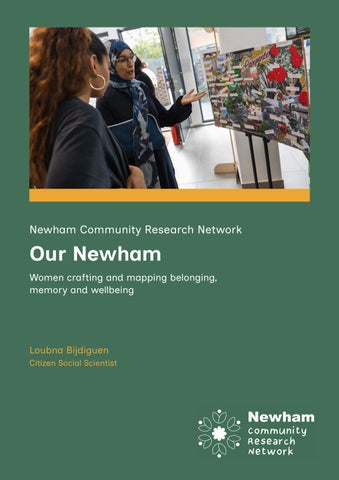
Loubna talks a visitor through one of the three collages the women made from their own photographs and words, at the CROWN showcase at ELBWO.
Our Newham
Purpose The question of whose culture counts is an old one. For most of modern history, “art” and “culture” have been defined from above – housed in galleries and museums, funded through formal institutions, shaped by those with the wealth and access to take part. This is what can be referred to as knowledge supremacy: certain forms of knowledge and culture are treated as superior, while the everyday cultural life of ordinary people – arts and crafts, storytelling and more – is dismissed as informal, or simply not counted as culture at all. The national picture confirms this. Research cited by the Wellcome Trust and reported by Catch22 finds that the wealthiest and least ethnically diverse 8% of the UK population is the most culturally active. Cultural participation, as it is currently measured, tracks wealth and whiteness, and the people most likely to be counted as culturally engaged are the most privileged. Government participation survey data (2023–24) confirms Newham sits below the London and England average for arts engagement, echoing the same pattern. Newham calls itself the “beating heart of London culture,” anchored by the East Bank, the Royal Docks and the Olympic legacy. Yet its own cultural strategy (Building Newham’s Creative Future 2022–2037) reports that 44% of adults in Newham did not attend any arts event, museum or gallery, or take part in any arts activity, over a year, compared with 27% in neighbouring Hackney. Newham sits in England’s bottom ten for cultural participation. Yet Newham is also the borough most likely to be missed by these measures: 44% of residents were born outside the UK – the highest proportion in England – and over a hundred languages are spoken. The strategy even admits that “funding models, rather than community needs, are driving development,” with most investment concentrated away from the most marginalised communities. Tellingly, the council’s own strategy already names two kinds of culture: capital-C Culture – formal, funded, commissioned – and small-c culture, the everyday religious, linguistic, culinary and artistic traditions that shape identities in Newham. Recognising small-c culture in principle is one thing; funding and counting it is
7
8
Newham Community Research Network
another. My work sits directly alongside this shift, and my purpose is to close that gap – to make visible the arts and culture already there in women’s community spaces, and to give Newham’s women a rightful place in the story their borough tells about itself. My purpose is not to bring culture to women who supposedly lack it, but rather to make visible the culture that is already there – in women-only and women-centred community spaces, in the way women walk, see, remember and give meaning to their borough. By using walking ethnography, participatory photography, creative and discussion workshops and creative mapping, the research treats women as knowledge producers, and their creative practice as evidence in its own right, so the method itself enacts the small-c culture-making it sets out to document. The aim is to close the gap between what the council says it values and what it actually counts, and to carry marginalised women’s cultural and creative life into the borough’s cultural record, on the women’s own terms. This connects to a longer purpose in all my work: challenging knowledge supremacy, insisting that meaningful and impactful research is done with communities rather than about them, and recognising that the gap between research and people’s lives is most often a gap of power, not of knowledge.
women I have worked with are not “ The culturally absent. They are culturally unseen.
”
Loubna in conversation with a visitor at the CROWN showcase at ELBWO.
10
Newham Community Research Network
Methodology I chose participatory, creative and visual methods because they fit both the topic and the women I was working with. To understand how women experience culture and creativity in Newham, it made sense to let them be creative in the research itself, rather than only answering questions. Photography, walking ethnography, collage and mapping put the tools directly into women’s hands – they decided what to photograph, what their images meant, and how their words sat alongside them. This reflects the principle at the heart of my approach: women as knowledge producers and co-authors, not subjects to be studied. These methods are also accessible and welcoming for multilingual women who may not feel at ease with written or interview-based research. A walk, a camera, a photograph and a conversation lower the barrier far more than a survey or a formal interview would. The design also enacts my wider argument: using creative practice as the method means the research itself becomes an act of the small-c culture-making it sets out to make visible. Practically, my research involved:
Photo Walks: The project began with a creative-writing focus, built around existing storytelling workshops. When those did not yield participants in the timeframe, I adapted – and the shift proved more powerful, because it generated my own workshops and participants directly. I ran two creative photography walks, meeting the women outside Stratford Station (by the Victorian steam locomotive) and walking together through the streets, the Olympic Park and green spaces. I gave an open, deliberately non-directive prompt: “Photograph the things in Newham that mean something to you, or carry a story for you, especially the things most people walk past.” We used both mobile phones and Polaroid cameras.
Our Newham
Stops on the photo walk route: the Stratford locomotive, the steel sculpture and Carpenters Community Garden.
Discussion Workshops: Straight after each walk, we gathered over refreshments for a group discussion workshop at UCL East, where each woman talked through her photographs and shared her stories. I used open questions for the images – “Tell us about this photograph; what’s the story behind it; why this, and not something else?”, “How did it feel to be the one deciding what was worth photographing?” and “What do you wish more people could see, or see differently?” These discussions were recorded with consent and became a central data source; from them I drew the women’s own words as anonymised quotes.
Polaroid stories: the women’s photographs of the Newham most people walk past, with their own handwritten words.
11
12
Newham Community Research Network
Collage Workshops: After sorting their images into categories (People, Buildings, Station, Parks & Greenery, Art & Sculpture), the women worked with prints of their own photographs and their own quotes, cutting, arranging and gluing them onto shared boards, and adding colour, felt, stickers and materials to express feeling. They worked collaboratively to produce three collages with their own quotes taken from the previous discussion workshops. Memory Mapping: The final session gathered everything into a hand-made memory map of Newham – built from tissue paper, modelling clay, the women’s images and quote cards – showing the borough as they remember and feel it, with a colour key the women gave meaning to themselves (belonging and community, wellbeing, hidden gems, stories, and what is forgotten or neglected).
In the workshops: building collages from the women’s photographs and quote cards, and modelling the memory map in tissue paper and clay.
Participants: I worked with a total of 18 women, recruited through community networks and neighbours rather than formal sampling. This was deliberate: depth and trust matter more than numbers. Participants were women living in Newham, from diverse and largely minority and migrant backgrounds. The sessions built on one another: photographs fed the discussions, discussions produced the quotes and stories, quotes and photos fed the collages, and everything gathered into the final creative map, so
Our Newham
the women could see their contributions growing into something collective.
Reflections: The creative methods lowered barriers to taking part and clearly gave women pleasure and ownership. They enjoyed the walking, the photography and the making. The discussions were rich and honest, often deeply moving, surfacing experiences of belonging, exclusion, memory, wellbeing and care. They included painful material around housing, racism and neglect that a questionnaire would never have reached. Building each session on the last meant the research accumulated into shared artefacts (the collages and the memory map) that belong to the women, not to me. The final map made the collective visible: patterns like the “two Newhams” that no single woman could see alone emerged when their images and words were laid over one shared surface. Recruitment was the most challenging part, and the early collapse of the creative-writing plan cost me time. In my future work, I would build recruitment through trusted community organisations from the very start. Given the short timeframe for the project, I would also plan with tighter deadlines, as this helps to shape the research timeline.
13
A visitor reads the Polaroid stories alongside one of the women’s collages at the CROWN showcase at ELBWO.
Our Newham
Findings The clearest thing I heard, across both walks, was that the women were describing two Newhams at once – a borough they love and belong to, and one that is leaving many of them behind – and that the tension between the two is the data. As one woman put it, “It’s really jarring how people can live in the same borough but have a completely different experience of it.” Everything else sits inside this.
The Memory Map: The creative map was not made in a single sitting but grew out of everything the women had done together over the preceding weeks. On the two photo walks, the women photographed the Newham that was meaningful to them – the steam locomotive, the community garden, the high-rises, the murals, the fountains, the former university campus, the empty building with its lights still on. By the time we came to the map, the raw materials were already the women’s own: their images, and their voices. Building the map itself was a collective, hands-on process. Working together around one large surface, the women placed their photographs where those places sat in their own sense of the borough – not according to a street plan, but according to memory and feeling. Alongside the images they positioned the quote cards, choosing which of their words belonged with which place, and adding new ones where something had no photograph. They then gave the map its emotional language through colour: working in torn tissue paper and modelling clay, they built Newham up in layered greens, edged its rivers in blue and violet, and modelled the Olympic sculpture at its heart. Across the surface they added clay markers in colours whose meanings they had agreed themselves: Red – community happens here, we come together Yellow – I belong here, this feels like home Green – green and growing, good for wellbeing Violet – hidden gems Pink – a story lives here Grey – something is forgotten or neglected
15
16
Newham Community Research Network
What made the process significant was that the women were doing their own analysis as they worked. Deciding where a photograph belonged, which quote sat beside it, and what colour a place deserved were all interpretive acts – and because they were working on one shared map, patterns emerged that no single woman could have seen alone. The same place could end up marked as “home” by one woman and “neglected” by another, and rather than resolve that contradiction, the map was allowed to hold it. The map was not an illustration of the research produced afterwards; it was the research, made by the women’s own hands, and it stands as both the culmination of the project and one of its clearest findings.
The finished memory map: Newham as the women live it. Not to scale, made by hand, in the women’s own colours.
Three themes tell the story.
1. Two Newhams – a borough loved and unequal at once: The women claimed deep belonging (“Newham is part of my identity – I can’t see myself anywhere but Newham now”) while naming what leaves them behind (“This area is very good at focusing on the gentrified communities – the graffiti at the back is forgotten, almost invisible”) and the exhaustion of proving they belong (“We’re fed up of saying ‘we belong, we belong.’ It’s so exhausting”). These are women claiming belonging in a place that does not always claim them back – and this belonging never appears in a participation statistic. The map is the proof: yellow
Our Newham
“belonging” markers sit beside grey “forgotten” ones, sometimes on the very same place. The two Newhams are not my argument – the women mapped them, in their own colours, onto one borough.
2. Everyday culture and creativity as wellbeing – the uncounted small-c culture: The women described gardening, food and memory as survival, not leisure: “When I’m gardening, I lose track of time – I’m really in the flow zone”; “It’s my time to mentally unload”; “We express ourselves a lot through food – feeding someone, that’s a love language.” They tied it to mental health and motherhood: “When women are mentally well, they take better care of the kids – it’s a ripple effect on all of society.” These are exactly the everyday cultural practices that official cultural measures never count. The map makes this literal – the whole borough is built up in green, their colour for growing and wellbeing, studded with violet “hidden gems” and pink “a story lives here.” When asked to map Newham as they feel it, the women made wellbeing and story the ground of the entire place. 3. What is forgotten, and the longing for shared spaces: The women described a borough that forgets its elders and youth: “The elderly are almost forgotten – there is nothing here, and they built this area”; “The youth huts closed – that’s why crime is prevalent.” They also named exclusion: “Even if something is free – is it really accessible?” These are not complaints but analysis: the women naming, precisely, where the borough’s cultural investment does and does not reach them. Against this ran a clear wish for women-only and crosscommunity spaces: “There’s a need for more spaces for women specifically”; “I wish there was a community thing that’s not just for one group of people.” On the map, the grey markers name exactly where the borough is failing them – and the women’s own framing points to the remedy: “harnessing our collective, getting together to create change from the bottom up.” Why the Creative Approach Worked: The women themselves reflected on why the creative approach worked: “Through the camera we can express things we may not be able to express by writing or speaking”; “Personal experience is what matters now”; and, powerfully, “It goes back to uniting, harnessing our collective, getting together to create change.” Hearing participants articulate the point of participatory, community-led research – in their own words – is itself a finding.
17
A detail of the co-created collage made with workshop participants.
Our Newham
Recommendations This research showed that the women of Newham are not culturally absent – they are culturally unseen. Their everyday creative life – food, gardening, craft, memory, faith, gathering – sustains their wellbeing but is never counted. Newham is, for them, loved and unequal at once, and the memory map holds both truths on one surface. For Newham Council, my recommendations are specific:
1. Count small-c culture: The strategy names everyday culture as essential but measures only formal attendance. Develop a measure of community-based participation, so the 44% recorded as “not participating” are no longer invisible.
2. Invest in women-only and cross-community spaces: The women were specific and unanimous: “There’s a need for more spaces for women specifically – to connect, be creative, express themselves,” and “I wish there was a community thing that’s not just for one group of people.” Fund at least one flexible, low-cost or free women-centred community space east of the Olympic Park, where cultural investment is currently thinnest. 3. Reopen and resource provision for the forgotten groups – elders and youth: The grey “forgotten” markers on the women’s map cluster around closed youth clubs and absent services for elders. Restore youth and intergenerational provision in the neighbourhoods that have lost it, and audit services for older residents in those same areas.
4. Make cultural offers genuinely affordable for residents: Women repeatedly hit the access barrier: “£22 a person – why isn’t there a lesser fee to make it accessible for residents?” Introduce a resident concession or free-entry scheme for Newham’s major cultural venues and exhibitions, and publicise it in community languages.
19
20
Newham Community Research Network
5. Bring marginalised women into cultural decision-making, not just consultation: The women asked to be heard as knowledge-holders: “We live the realities of everyday life – we have a different reality from the people in power.” Ensure the Culture Within Newham Community Voices panel and equivalent bodies include marginalised and minoritised women, paid for their time, with genuine influence over what gets funded. 6. Return findings to the community: Commit to showing this map and these recommendations back to the participants and displaying them locally, so residents see that their voices reached the council and shaped something. For the wider community and cultural sector, I ask that everyday creativity be recognised as culture worth funding and archiving, and that spaces be judged by the connection and wellbeing they create, not only by attendance. Future research could extend this method across Newham’s neighbourhoods and communities, building a borough-wide picture of small-c cultural life. But the central message is simple: the women of Newham have always been producing culture, in rooms nobody was looking at. The task now is to count, fund and honour it. I began expecting to document women’s culture; I came to see the research itself as a site of that culture. The women did not just describe their creative life – they produced a piece of it, together.
the realities of everyday life. We “ Wehavelivea different reality from the people in power.
A participant, photo walk discussion
”
Moments from Loubna’s workshops: Polaroid stories, collage-making and building the memory map together.
22
Newham Community Research Network
Acknowledgements This research would not have been possible without the women of Newham who walked, talked, photographed and created alongside me. I am deeply grateful to every participant who gave her time, her stories and her trust – who shared memories, joys and difficult truths, and who allowed their words and images to become part of this work. This project is theirs as much as mine. I thank the Newham Community Research Network, and the collaboration between CROWN, ELBWO and the UCL Institute for Global Prosperity’s Citizen Science Academy, for the training, the framework and the space to carry out this research. I am especially grateful to the programme leads for their guidance and their belief in community-led knowledge, and to the community organisations and colleagues across Newham and East London whose goodwill made the fieldwork possible. Finally, I thank my family for their patience and care while I did this work – and the women who came before me: my mother, my grandmothers, and the strong women I have known since childhood, who taught me that culture, knowledge and care have always lived in women’s hands and women’s spaces. This research is, in the end, a small act of recognition for them too.