Newham Community Research Network
Creative Pathways
How Black girls and young women experience creative opportunities in Newham
Lizzy Lambie
Citizen Social Scientist
About the Newham CRN In December 2024 the UKRI and The Young Foundation announced new ground-breaking engagement investment in nine ‘community research networks’ across the UK - collaborations led by community organisations alongside academics, local authorities and local residents. The networks span the length of the UK, from the north of Scotland to the Isles of Scilly, and the only successfully-funded network in the south east is here in Newham! For the Newham Community Research Network, Compost London are leading a ‘network of networks’ based in various wards across our ethnically diverse and innovative borough. The three recruited networks cover migrants and refugee communities, marginalised women, and young people with special educational needs who live, work and go to school in Newham. The five-year project is supported by University College London’s Citizen Science Academy, based in the Institute for Global Prosperity, which has strong experience running citizen science (community research) projects in east London and across the world. Local residents from the three different networks are being trained in research ethics, methods, and project planning, and then supported to carry out qualitative research across east London, tackling questions and issues they feel are important to their network communities. Newham Council are also providing support across all three networks, and placement opportunities within the Council will be available for some of our alumni.
About C.R.O.W.N The second cohort of citizen scientists, were trained in summer 2026, and supported by the marginalised women sub-network members, including the East London Black Women’s Organisation (ELBWO). This subnetwork - CROWN (Collaborative Research and Outreach for Women) - works collaboratively to drive trauma-informed, inclusive and culturally responsive change, so that services genuinely reflect the realities of marginalised women and girls. Throughout the programme, the citizen scientists from CROWN have taken part in training, discussions and practical research activities. They have worked incredibly hard, supported one another and brought their own experiences, perspectives and strengths to the group. We hope you enjoy reading their research.
Published October 2026.
Creative Pathways
3
Contents Introduction
4
Purpose
6
Methodology
8
Findings
12
Creative Output
17
Recommendations
21
Acknowledgements
26
Citizen scientists from the CROWN network at their showcase event at ELBWO in September 2026
4
Newham Community Research Network
Introduction Certain communities are often described as hard to reach, yet throughout this research I found myself questioning whether it is communities that are difficult to reach, or whether institutions have not always created the right conditions for meaningful, authentic relationships to develop. This question became the starting point for my research into the experiences of Black girls and young women accessing creative opportunities in Newham. My personal and professional background is in enterprise education and community engagement, where I have spent many years working alongside young people, educators, businesses and creative organisations. I also work in creative disciplines, have my own creative community, and have seen and experienced first-hand the challenges of sustainable progression. Through this work I have met several young people who are talented, ambitious and creative, yet many have spoken about feeling unsure whether and how to turn those talents into sustainable careers. Their uncertainty rarely appeared to stem from a lack of ability. Instead, conversations repeatedly centred on confidence, visibility, representation and whether they felt the creative industries were genuinely open to people like them. These conversations made me curious to explore whether similar experiences existed within Newham, a borough that has become one of London’s most significant centres for creative and cultural investment. Newham is home to an extraordinary concentration of creative organisations. Through developments such as East Bank, the borough now hosts institutions including the BBC, London College of Fashion, V&A East and Sadler’s Wells East, alongside longestablished organisations such as Theatre Royal Stratford East and a wide range of grassroots community organisations. Significant public investment has transformed the physical landscape, but this research sought to understand whether that investment is equally visible in the lives of local Black girls and young women.
Creative Pathways
When I first developed this research proposal, I expected the project to focus largely on gathering evidence that could help influence policy and improve opportunities. As the research progressed, however, my understanding of citizen science changed. I realised that the process was not simply about collecting information to present to decision-makers. It was equally about creating space for conversations that do not always happen, bringing together voices that are often heard separately, and recognising the value of lived experience alongside professional expertise. This research aligns closely with the wider aims of the CROWN programme, which seeks to amplify the voices of marginalised women and encourage communities to become active contributors to research rather than passive participants. Black girls and young women continue to experience barriers across many sectors, including the creative industries, yet their experiences are often discussed without their direct involvement, and without a deeper understanding of their voices. I wanted this research to create an opportunity for those voices to be heard, while also exploring the perspectives of educators, community organisations and creative professionals working across the borough. Rather than beginning with assumptions, I approached this project with curiosity. I wanted to understand how people experienced creative opportunity, what barriers they perceived, what support already existed and what could be strengthened. Although I had my own experiences, I had to start from the position that everyone’s experience will not only be different, but different for different reasons, at a different time, within a different landscape. My intention was not to prove a particular argument (although I already had my ‘presumptions’), but to listen carefully to different perspectives and identify where experiences overlapped, where they differed and what those differences might tell us. Ultimately, this research became about much more than creative careers. It became an exploration of belonging, visibility, trust and opportunity. It asked whether living alongside world-class creative institutions automatically creates access, or whether meaningful access depends on something much deeper, such as relationships, sustained engagement and communities feeling that they genuinely belong within those spaces.
5
6
Newham Community Research Network
Purpose The creative industries have become one of the UK’s fastestgrowing economic sectors and are increasingly recognised as important contributors to economic growth, innovation and cultural identity. National policy has consistently highlighted the value of creativity, while organisations such as the Department for Culture, Media and Sport (DCMS), Arts Council England (ACE) and the Creative Industries Policy and Evidence Centre have continued to emphasise the need to improve diversity, representation and social mobility across the sector. Despite this commitment, research continues to suggest that opportunities are not experienced equally, and that barriers remain for many people from underrepresented communities. These national conversations provide an important backdrop to Newham. Few boroughs have experienced such significant cultural transformation in recent years. East Bank has brought internationally recognised institutions into the heart of the borough, while developments such as Here East have strengthened Newham’s position within London’s creative and digital economy. Alongside this new investment sits a long history of community-based creativity. Organisations such as Stratford East have spent decades working alongside local residents, while many smaller community organisations continue to provide opportunities that are often less visible but equally important. This contrast between large-scale investment and communityled creativity became one of the reasons I chose this topic. It raised an important question: if so much creative opportunity now exists within Newham, how is that opportunity experienced by the people living there? More specifically, how do Black girls and young women navigate these spaces, and do they feel they are genuinely benefiting from the changes taking place around them? At the beginning of this project, I was interested in understanding pathways into the creative industries because, as an individual, I couldn’t see the pathway myself. However, as I began reading existing research and speaking to people involved in education, community engagement and creative practice, I realised that pathways are rarely straightforward.
Creative Pathways
Lizzy presenting her research at the CROWN showcase at ELBWO.
Entering the creative industries is influenced by far more than talent alone. Confidence, family expectations, financial circumstances, representation, networks, mentoring and knowledge of available opportunities all appeared to play important roles. Rather than focusing solely on whether opportunities existed, the research gradually shifted towards understanding how people experienced those opportunities and whether they felt able to access them. The citizen science approach was particularly valuable because it challenged traditional ideas about who produces knowledge. Rather than relying only on published research or institutional perspectives, this project placed equal value on lived experience. Teachers, community practitioners, creative professionals and young women each brought different forms of expertise. None of these perspectives alone could provide a complete picture, but together they offered a richer understanding of the challenges and opportunities within Newham’s creative landscape.
7
8
Newham Community Research Network
Methodology This research adopted a qualitative citizen science approach to explore how Black girls and young women experience pathways into the creative industries within the London Borough of Newham. From the outset, I wanted the research to prioritise people’s experiences rather than simply measure participation through statistics. Whilst national data can highlight trends, it cannot fully explain how people experience opportunity, what influences their decisions or how they make sense of their own journeys. For this reason, qualitative methods felt most appropriate, as they allowed participants to tell their own stories in their own words. My original research proposal outlined a broad range of participants, including teachers, careers leads, school leaders, creative organisations, cultural institutions, political leaders and young Black women aged between 18 and 30. The intention was to compare perspectives across education, community organisations and the creative industries, to identify where experiences aligned and where they differed. This remained the overall aim of the project, although the way in which I gathered data developed as the research progressed.
Adapting to Access One of the first challenges I encountered was access. As is often the case in community research, securing interviews within the available timeframe proved more difficult than anticipated. Many organisations were supportive of the research, but competing priorities, limited availability and the practical realities of arranging interviews meant that several conversations were not possible within the timeframe of this project. Rather than viewing this as a weakness, it became an important lesson about conducting research within communities. Research plans often need to adapt to the realities of people’s lives, particularly when participants are balancing demanding professional and personal commitments.
Creative Pathways
An Unexpected Workshop A second development had a much greater influence on the direction of the research. During the project, I attended what I believed would be a single interview with a community organisation. Instead, I found myself participating in a workshop involving young people, creative practitioners and community representatives. This unexpected opportunity generated a rich source of qualitative data that had not formed part of my original methodology. Rather than relying solely on one-to-one interviews, I was able to observe discussions as they unfolded naturally, listen to different perspectives being shared and reflect on how participants interacted with one another. These conversations provided insights that may not have emerged through a more structured interview format. Reflecting on this experience, I realised that one of the strengths of citizen science is its flexibility. Rather than following a rigid research design, the process encourages researchers to remain open to opportunities that emerge through community engagement. Instead of forcing the research back towards my original proposal, I allowed it to develop in response to the knowledge being shared. Looking back, this became one of the most valuable aspects of the project.
Methods The research therefore drew upon a combination of semistructured interviews, community discussions, workshop observations, documentary analysis and reflective field notes. Throughout the process I kept detailed notes, not only about what participants said but also about my own reflections as the research developed. These reflections became an important source of data in themselves, helping me to recognise how my own assumptions and understanding were changing over time. Ethics Ethical practice remained central throughout the project. Before each conversation, participants were informed about the purpose of the research, how the information would be used and their right to withdraw at any stage. As the research explored personal experiences relating to identity, opportunity and representation, protecting confidentiality was particularly important. Participants have therefore been anonymised throughout this report. Rather than identifying individuals or organisations unnecessarily,
9
10
Newham Community Research Network
quotations are presented using participant descriptions such as Young Black Creative, Facilitator, Community Organisation Representative or Creative Professional. This approach protects participants while still allowing the reader to understand the range of perspectives represented.
Reflexivity Throughout the research I remained conscious that my own professional background in enterprise education and community engagement influenced the questions I was interested in exploring. Before beginning the project, I expected the research to focus largely on identifying barriers that could be addressed through policy recommendations. However, as conversations developed, I became increasingly aware that many organisations were already working hard to improve access. The issue was often less about a lack of activity and more about fragmentation. Different organisations were doing valuable work, but they were not always connected, and many young people remained unaware of the opportunities already available. This realisation changed the way I interpreted the data. Rather than looking for a single explanation, I began viewing the creative landscape as a network of different organisations, schools and communities, each holding part of the picture. In this sense, the research process itself reflected one of the core principles of citizen science, by recognising that knowledge is created collectively rather than owned by any one individual.
Limitations Like all qualitative research, this project has limitations. The relatively short research period meant it was not possible to interview every participant originally identified within the proposal. Direct interviews with girls under the age of eighteen were not undertaken, meaning younger perspectives were explored through educators, community practitioners and observations rather than directly. Nevertheless, the diversity of participants, together with the depth of the qualitative conversations and workshop observations, produced a rich body of data that allowed clear patterns and recurring themes to emerge.
Lizzy in conversation with a visitor at the CROWN showcase at ELBWO.
12
Newham Community Research Network
Findings The data presented in this report draws together evidence collected through semi-structured interviews, community conversations, workshop observations, documentary analysis and reflective field notes recorded throughout the research process. The primary data included conversations with young Black women interested in or pursuing creative careers, educators, creative practitioners, community organisations and individuals involved in supporting young people across Newham. Participants represented different ages, professional roles and lived experiences, providing a broad range of perspectives on creativity, participation and progression. Although participants came from different sectors and often worked independently of one another, many described similar experiences. This consistency became one of the strongest characteristics of the data, and increased confidence that the findings reflected recurring patterns rather than isolated opinions. Alongside the planned interviews, observations made during a community workshop became a significant source of evidence. Unlike in formal interviews, participants spoke naturally with one another, responding to each other’s experiences, agreeing, challenging ideas and expanding upon discussions as they unfolded. This created a more conversational form of data that revealed not only individual experiences but also how shared understandings developed collectively. These observations were captured through voice recordings and detailed reflective field notes immediately after the workshop, ensuring that discussions were documented accurately while protecting participants’ anonymity. Documentary analysis also provided important context. National reports from the Department for Culture, Media and Sport, Arts Council England and the Creative Industries Policy and Evidence Centre were reviewed alongside local information relating to East Bank, Newham’s cultural investment and community engagement strategies, such as funding and programmes through Foundation for Future. These documents were not used to validate or challenge participants’ experiences directly. Instead, they
Creative Pathways
provided an opportunity to compare policy ambitions with the realities described by those living and working within the borough. Across all the interviews, participants repeatedly referred to creativity, opportunity, confidence, representation, visibility, relationships, belonging and community support. There was also widespread recognition that Newham is a borough rich in creativity, talent and cultural investment. Creativity was rarely viewed as the problem. Participants consistently described creativity as something already embedded within families, schools and communities. Instead, discussions focused on navigating creative pathways, understanding available opportunities and developing the confidence, networks and support needed to progress. There was broad agreement that talent alone was rarely enough to sustain a creative career. Importantly, participants did not just describe challenges. They also identified examples of good practice, reflected on successful experiences and suggested practical ways of strengthening creative pathways across the borough. Throughout the analysis, I was careful not to treat individual experiences as representative of all Black girls and young women in Newham. Instead, the analysis focused on identifying recurring patterns that emerged across multiple participants and different sources of evidence. While participants’ individual experiences differed, there was remarkable agreement on one point: opportunity alone is not enough. Meaningful participation depends on people understanding the pathways available, feeling that they belong within creative spaces, and having trusted relationships that support them along the way. Three interconnected themes emerged consistently across the data.
Theme One: Access Exists, but Belonging Does Not One of the strongest themes to emerge was that participants rarely described a complete absence of opportunity. Instead, they spoke about a disconnect between living alongside significant creative investment and genuinely feeling included within it. Newham has become home to internationally recognised cultural institutions and creative organisations, yet several participants questioned whether proximity automatically translated into access. As one young creative explained: “You walk past these amazing buildings every day, but they don’t necessarily feel like they’re for people like you.”
13
14
Newham Community Research Network
Research Participant
Another participant reflected on growing up close to creative organisations without ever feeling encouraged to enter them: “They’ve always been there, but nobody really showed us how to be part of them.” Research Participant
These reflections suggest that access should not simply be measured by geography or the number of programmes delivered. Although opportunities may physically exist within a community, participants described feeling uncertain about how to engage with them or whether they belonged within those spaces. Facilitators also recognised this challenge: “Students often know the buildings, but not necessarily what happens inside them or how they can get involved.” Research Participant
This distinction between access and inclusion became increasingly important as the research developed. Existing policy often celebrates investment and participation, but participants reminded me that inclusion is also about confidence, visibility and feeling welcome. Simply placing opportunities within a community does not guarantee that the community experiences them as accessible, nor does it tell people how to access them. Reflecting on this theme, I realised my original research question focused on access. As I listened to participants, the conversation shifted towards belonging. The research suggested that people do not simply need opportunities to exist; they need to feel that those opportunities were created with them in mind.
Theme Two: Relationships Build Pathways Better Than Projects While participants valued creative programmes and outreach activities, they consistently returned to the importance of trusted relationships. Many described individual conversations, mentors or community organisations as the moments that gave them the confidence to pursue creative opportunities. One participant explained: “Seeing someone who looks like you helps, but having someone believe in you makes the difference.”
Creative Pathways
Research Participant
Another reflected: “It only took one person to say, ‘You can do this,’ and suddenly it felt possible.” Research Participant
Community organisations repeatedly described the challenge of short-term funding: “Funding often ends just as trust begins.” Research Participant
Another practitioner explained: “Young people don’t build trust in six weeks. Relationships can take years.” Research Participant
One of the strongest findings from this theme was that participants rarely discussed isolated projects; instead, they spoke about people. Teachers, youth workers, artists and community leaders were remembered long after individual programmes had ended. This finding challenged my own assumptions. I began the research interested in creative opportunities, yet participants consistently redirected the conversation towards relationships. It became clear that opportunities were most effective when they were supported by trusted adults, consistent organisations and long-term engagement.
Theme Three: Communities Already Hold the Knowledge Needed for Change Perhaps the most significant lesson from this research was that communities were not simply identifying problems; they were also proposing solutions. Throughout interviews, workshop discussions and observations, participants demonstrated a detailed understanding of the barriers they experienced, while also offering practical ideas for improving creative pathways. One participant reflected: “People spend a lot of time asking us what’s wrong. They don’t always ask us what would actually help.” Research Participant
15
16
Newham Community Research Network
A facilitator commented: “Schools have one piece of the puzzle. Community organisations have another. Young people have another.” Research Participant
A young participant explained: “Stop designing things for us without speaking to us first.” Research Participant
This theme also became a personal turning point in my own research journey. At the beginning of the project, I viewed the research as a way of collecting evidence that could be presented to decision-makers. By the end, I had come to understand that citizen science is just as much about bringing people together to learn from one another. The knowledge already existed across communities, schools and organisations. What often appeared to be missing was a mechanism for connecting those different perspectives, and then deciding what to do with it afterwards.
Creative Pathways
17
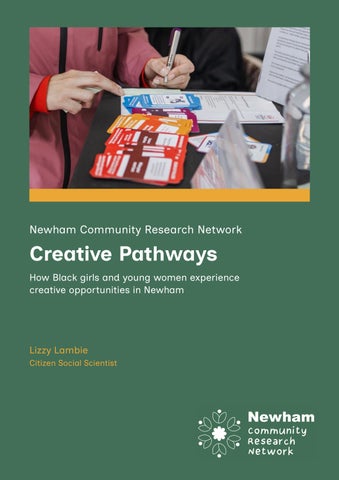
Creative Output Creative Pathways Cards These cards were created from my citizen science research exploring how Black girls and young women experience creative pathways in Newham. Through interviews, community conversations, workshops and research, I heard about the opportunities people encounter, the barriers that can hold them back, and the importance of confidence, relationships, support and feeling that you belong. I turned these findings into an interactive card deck because I wanted the research to be something people could use, discuss and respond to, rather than simply read in a report. The cards represent parts of a creative journey, which players use to explore different pathways, overcome challenges and start conversations about what helps people move forward. At its heart, the deck reflects one of the strongest messages from my research: opportunity matters, but access alone is not enough. People also need pathways, relationships and belonging.
How the Cards Work
Career The Performer
Barrier Not Belonging
Growth Visibility
Option Internship
The blue cards represent creative careers and identities. The Performer asks: “How do you express yourself?” That’s where the journey starts – not with asking someone “What job are you going to do?”, but with getting them to think about who they are and where their creativity might take them.
18
Newham Community Research Network
But having an ambition doesn’t mean the pathway towards it is straightforward. The red cards represent the barriers that came through the research. Not Belonging includes a direct voice from the research: “You walk past these amazing buildings every day, but they don’t necessarily feel like they’re for people like you.” Its question asks: “What makes a space feel like it is for you?” The research doesn’t end with me telling people what I found. It starts another conversation. The research wasn’t only about barriers. The purple cards represent Growth – what actually helps people move forward. Visibility says: “Opportunities have greater impact when people know they exist and can see themselves within them.” The orange cards are the Options. An Internship is a chance to learn by working alongside professionals, and asks: “What could you learn from being inside the industry?” So the cards turn the findings into a journey: Career, Barrier (usually more than one), Growth, Option. Different combinations create completely different conversations. How to Play Players: 3–7. Aim: Build your creative pathway by overcoming barriers, making the most of opportunities and growing through conversation. Set up: Shuffle the Barrier, Option and Growth cards together. Deal each player 2 Barrier cards, 1 Option card and 1 Growth card, and place the remaining cards face down in the centre. Each player chooses one Creative Career card.
1. The first player introduces their Creative Career, reads the card aloud, imagines they already have that role and explains what they would do in it, then answers the reflection question. 2. The player to their left chooses the card from their hand that best fits their situation – an Option, a Barrier or a Growth card – and reads it aloud. The first player adds it to their pathway, follows the game action, and explains how that card affects their creative journey. 3. Play continues clockwise, with each player taking a turn as the focus while everyone else helps build (or challenge) their pathway. The Game Winner has removed all their Barrier cards, built the strongest creative pathway and finishes with the fewest cards. The Conversation Winner is everyone – when everyone has shared their ideas, different experiences have been heard and new perspectives discovered. There are no right or wrong answers. Every creative journey is different.
A selection of Creative Pathways cards. The full deck has 50 Career, Option, Barrier and Growth cards, each with a reflection question drawn from Lizzy’s research.
The Career Card Illustrations
The drawings on the blue Career cards, such as The Maker, The Storyteller and The Visionary, were created by a local young creative. Their illustrations bring another young Newham voice into the deck, reflecting the creative talent that this research found already exists across the borough.
A visitor plays with the Creative Pathways cards at the CROWN showcase, writing her own response for the conversation jar: “Every pathway begins with a conversation.”
Creative Pathways
Recommendations 1. Shift the measure of success from access to belonging. One of the most significant findings from this research was that physical access to creative spaces does not automatically create inclusion. Many participants lived alongside internationally recognised cultural institutions, yet still questioned whether those spaces were intended for people ‘like them’. This suggests that measuring success purely through attendance figures, postcode data or participation numbers provides only a partial understanding of inclusion. Future evaluation frameworks should include qualitative indicators alongside quantitative measures. Questions around belonging, confidence, progression, trust, representation and long-term engagement should become equally important measures of success. Organisations should ask not only How many people attended? but also Who returned? Who progressed? Who felt welcomed? Who developed meaningful relationships? Only by measuring these experiences can organisations begin to understand whether investment is creating lasting change rather than temporary engagement.
2. Create a Newham Creative Pathways Partnership that brings together the whole ecosystem. Throughout the research, participants rarely criticised individual organisations. Instead, they described a landscape in which many organisations were doing valuable work independently, but where the opportunities on offer were often difficult to navigate. Educators described one perspective, community organisations another, and cultural institutions another again. Young people – the actual users – frequently sat between these systems without understanding how they connected. Rather than creating additional programmes, Newham could strengthen the existing ecosystem by establishing a boroughwide Creative Pathways Partnership. This should include representatives from schools, East Bank organisations,
21
22
Newham Community Research Network
grassroots community organisations, youth services, higher education, local businesses, artists and, importantly, young people and creators themselves. The purpose is not another networking event, but a shared space to coordinate outreach, identify gaps, reduce duplication, share learning and develop clearer progression routes across the borough, so that the messaging and offers are clear. One of the strongest findings from this research was that the answers often already existed, but they were held by different people who were not always connected.
3. Move beyond short-term engagement towards long-term relationships. Participants consistently described trust as something that develops over time. While they valued existing outreach programmes, they reflected that projects often ended just as relationships were beginning to develop. This created a cycle of repeated introductions rather than sustained progression and impact. Future investment should place greater emphasis on continuity rather than isolated activity, moving from project-based support to support for the entirety of a required cycle. Organisations should consider how young people move from initial engagement into mentoring, volunteering, paid opportunities, leadership and employment. Progression should be viewed as a journey rather than a collection of individual events. It should also be measured from the position the young person is starting from, rather than from fixed start points. This may also require funders to reconsider how impact is measured. Longer-term investment may appear less productive in the short term, but has greater potential to build trust, confidence and lasting participation.
4. Place lived experience alongside professional expertise when shaping future policy – genuinely. Perhaps the most important finding from this research, but also the most commonly known, was that communities already possess valuable knowledge about both the challenges they experience and the solutions they believe would make a
Creative Pathways
difference. Educators, community practitioners, creative professionals and young women frequently identified similar issues, despite approaching them from different perspectives. Citizen science has demonstrated that lived experience should not simply inform policy after decisions have been made. Communities should be involved throughout programme design, implementation and evaluation, and their input should be acted on. This means creating genuine opportunities for shared decision-making, rather than consultation alone. Future strategies relating to creative participation should therefore include ongoing citizen panels, youth advisory groups and community researchers who continue contributing beyond individual projects.
5. Develop clearer progression pathways rather than isolated opportunities. Many young people encounter individual creative opportunities but struggle to understand what comes next, or where to go. Participants described workshops, performances and outreach activities positively, yet often found it difficult to identify a longerterm route into education, employment or enterprise. Organisations should work collaboratively to map progression routes across the borough, helping young people understand how one opportunity can lead to another. This may include stronger links between schools, further and higher education, cultural organisations, freelancers, employers and enterprise support. Rather than asking how more opportunities can be created, future work should ask how existing opportunities can become more connected, visible and sustainable.
6. Continue embedding citizen science within community decision-making. One outcome of this research was not simply the findings themselves, but the process through which those findings emerged. Bringing together different voices generated a new understanding that would not have been achieved through policy documents or organisational reports alone. The borough is rich with different communities and different experiences. Newham should continue exploring citizen science as a longer-term, coordinated approach to understanding
23
24
Newham Community Research Network
complex social issues, recognising community members not simply as consultees but as researchers, collaborators and producers of knowledge. By investing in community-led research, the borough has an opportunity to create policies informed not only by evidence, but also by the lived realities of those they are intended to benefit, gathered by trusted community members themselves. The recommendations in this report are not intended as criticism of the work already underway across Newham. On the contrary, this research found considerable passion, commitment and creativity across the borough. The challenge is not whether good work exists, but how that work becomes better connected, more visible and more deeply rooted in the communities it is designed to serve.
Lizzy talking a visitor through the Creative Pathways cards at the CROWN showcase at ELBWO.
“
Every pathway begins with a conversation. Lizzy Lambie, Creative Pathways
26
Newham Community Research Network
Acknowledgements I would like to thank everyone who shared their time, experiences and perspectives throughout this research. Without their flexibility, openness and willingness to contribute, this project would not have been possible. My thanks also go to the organisations, educators, community practitioners and creative professionals who supported the research and created the opportunity for conversation. I am particularly grateful to those who welcomed me into community spaces and allowed me to observe discussions that ultimately shaped the direction of this project. I would also like to thank ELBWO, the UCL Citizen Science Academy and the CROWN programme for encouraging me to approach research differently. This experience has strengthened not only my understanding of citizen science, but also my appreciation of the knowledge that already exists within communities, the responsibility we hold for this knowledge, and what we choose to do with it afterwards. Finally, I would like to thank my fellow Citizen Scientists, my tutors for being patient with me and my ‘usual’ style of working, and everyone who has supported me throughout this journey. This project has reinforced that research is rarely carried out alone. It develops through collaboration, reflection and the willingness of people to share their experiences, in the hope that they might contribute to positive change through a collective voice from the ‘bottom up’.