This project was generously funded through the UCL Grand Challenge of Climate Crisis programme
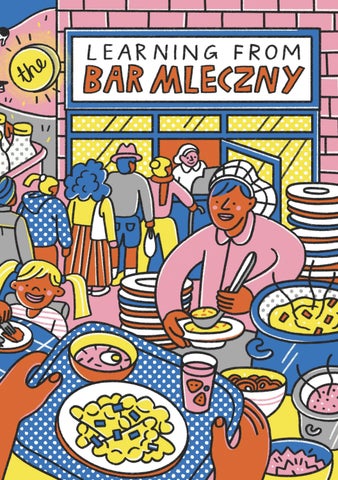
Learning from the Bar Mleczny
Edited by Hanna Baumann & Joseph Cook UCL Institute for Global Prosperity
Anna Chworow & Abigail McCall Nourish Scotland
Foreword As the UK faces deep, overlapping challenges in public health, climate, and economic security, it is clear that relying entirely on the free market to address these isn’t making our societies particularly liveable. At the UCL Institute for Global Prosperity (IGP) and the UCL Citizen Science Academy, our work focuses on what it actually takes to build prosperity, or a “good life”. We often talk about Universal Basic Services (UBS) – the idea that life’s essentials, like healthcare and education, should be treated as public infrastructure built on equal rights and solidarity. What makes a service basic in this sense is that it is universal: open to everyone on the same terms, as a matter of right rather than need – which is precisely what distinguishes it from charity. Perhaps due to the massive increase in the cost of food items (40% over the past five years in the UK), food is currently emerging as an essential part of that conversation. The 2024 exhibition Municipal Kitchens, co-curated by IGP researcher Hanna Baumann, brought artists and activists into conversation to imagine public canteens as an urban infrastructure. Around the same time, Nourish Scotland began its campaign for public diners – restaurants that operate with state support. Since they form part of public infrastructure alongside parks, leisure centres, pub7
lic transport, and libraries, we found a lot of common ground between the agendas of the IGP and Nourish. Based on a process of co-design and community-based research (both on international state-subsidised canteens and on historical antecedents in the UK), Nourish have been developing a public diner model that’s suited to communities’ needs today. This learning will be reflected in a pilot diner opening in Dundee in 2026. This collection, Learning from the Bar Mleczny, looks at an existing example of a publicly subsidised canteen, the Polish ‘milk bar’,or bar mleczny, to inform the developing debate in the UK. The project – a collaboration between the IGP and Nourish Scotland – trained local citizen scientists to carry out fieldwork within Glasgow’s Polish community. By exploring the history, organisation, and everyday experience of the bar mleczny, our researchers wanted to see how affordable, subsidised, and universally-accessible dining spaces can decommodify food, shifting it from private purchase to public good. Crucially, the milk bar feeds everyone at the same counter and the same price – students and office workers alongside pensioners and those in real need – so that eating cheaply carries no stigma. In this, it is almost the mirror image of the food bank: ordinary rather than exceptional, a place open to all rather than one reserved for the desperate. The bar mleczny offers a fascinating historical blueprint. First appearing as a private, dairy-based venture in 1890s Warsaw, milk bars grew into a state-subsidised institution over the following century. They became a community lifeline through the economic crisis of the 1930s and the long decades of shortage under state socialism. They prove 8
that simple, traditional food can be nourishing, transparently priced, and accessible without sacrificing taste. Their menus were historically built around milk, eggs, grains, and vegetables, with little or no meat – a frugality born of cost that, read today, also describes a low-carbon way of eating. A model designed to be cheap turns out, almost incidentally, to be sustainable. This project connects with a broader global history of communal eating – from the UK’s own wartime British Restaurants to Singapore’s Hawker Centres and neighbourhood canteens in China. It also builds directly on previous research by the UCL Institute for Global Prosperity into radical food futures and the power of communal kitchens, such as the Another Provision project with food insecure Londonders and the research on addressing food insecurity in the UK in the longer term (Moore & Norman 2025). The five pieces in this zine move past abstract policy to focus on the human reality of these spaces. Jagoda Sadowska tracks the timeline of the milk bar, from its massive popularity under communism to its struggle against Western fast-food chains, and its current revival driven by a mix of nostalgia and a modern need for home-style meals. Evelyn Anderson takes a “rhythmanalytic” approach, mapping the daily routines of cooking and care to show how a busy diner can turn a basic room into an affectionate “field of care”. Kaska Hempel uses oral histories to challenge cinematic stereotypes, contrasting a popular Polish satirical film with the actual, warm memories of people who lived through the 1980s and ‘90s. Anna Koch uses her background in catering management to look at the logistics, showing how the minimal design and self-service model of traditional milk bars can keep costs low while respecting diners’ dignity. Finally, Steph 9
Marsden looks at the “choreography” of these canteens, identifying a core set of values – honesty, comfort, familiarity, and community – that can translate into modern Scottish community initiatives. However, translation is rarely frictionless. What made the milk bar work also rested on a particular political settlement, and part of the task going forward will be to tell what is portable (universal access, dignity, the sheer ordinariness of the space) from what is bound to its time and place. We are incredibly grateful to the local citizen scientists who brought their time, insights, and training to this project. A special thanks goes to Jagoda Sadowska, whose illustrations bring these written narratives to life. Most importantly, our sincere thanks go to the members of Glasgow’s Polish community. By sharing their memories, stories, and heritage, they have made this research possible and opened up new directions for our collective imagination. The publication is rounded off by a contemporary look at the milk bars operating in Warsaw today. A photo essay by Another Provision, the collaborative creative practice of Hanna Baumann and artist Johann Arens, shows milk bars as enduring spaces of public value, marked by both functionality and community. What the milk bar finally offers is modest but radical: proof that feeding people well, affordably, and in common is not a utopian idea but a living tradition, sustained across more than a century of upheaval. The memories and expertise shared by Glasgow’s Polish community keep that tradition within reach – knowledge to think and build with as the UK considers the urgent question of what a more sustainable and just food system might look like here. 10
HANNA BAUMANN is a Principal Research Fellow at the Institute for Global Prosperity, University College London. An interdisciplinary urban scholar, she studies how public infrastructures shape urban participation, especially for non-citizens.
JOSEPH COOK leads the UCL Citizen Science Academy, based at the Institute for Global Prosperity, University College London. An anthropologist by training, his research covers urbanism, user-centred design, and understanding prosperity through co-creation methodologies.
ANNA CHWOROW is Deputy Director of Nourish Scotland. Anna’s background is in community development and systems thinking. She is interested in using thinking tools and participatory methods to help achieve lasting change. She led the development of the public diners concept.
ABIGAIL MCCALL is the International Liaison at Nourish Scotland. Abigail coordinates a network that facilitates research and development of public restaurant schemes across the world. Her background is in macroeconomics, journalism, and food policy.
11
Photos from the project workshops
12
We are grateful for the involvement of a small but passionate group of local residents with memories of working or eating at milk bars. Joining us at the Sikorski Polish Club in Glasgow, their input drove the research presented in this publication.
13
Sharing a meal at the Sikorski Club demonstrated the role of food and shared dining to bring people together, open up conversation, and form ties across generations and experiences.
14
15
A lunch & learning event at Glasgow’s Civic House proved an invaluable opportunity to present research back to the local community, and have further discussion on how the Bar Mleczny could be implemented in a local context.
16
17
18
Milk bars (bary mleczne) Over the Years As a Polish person born in 1994 who moved to Scotland at the age of twenty, I never really experienced Milk Bars firsthand. As a teenager, I walked past them without realising their significance or understanding how important they once were in everyday life. Before starting this research, the words Milk Bars felt familiar, something vaguely recalled from conversations with older generations or from scenes in old films. It has been a privilege to learn about these spaces that fed such a large part of Polish society. Through this research, I not only gained insight into Milk Bars themselves but also developed a deeper understanding of my own culture and the importance of preserving this model. Through group workshops and individual interviews, I realised that the status of Milk Bars has changed significantly over time. Their meaning shifted depending on generation, geography, and political context. Poland underwent major societal and political changes that shaped behaviours and attitudes, and Milk Bars were deeply affected by these shifts. Some aspects changed dramatically, while others remained constant. Milk Bars first appeared in Warsaw in late 1800s but became widespread in the 1950s. Until 1989, they were extremely busy and accessible to everyone, including students, workers, pensioners, and professionals. Interviewees repeatedly said that everyone used to go to Milk Bars. These spaces were fast paced and functional, designed for efficiency rather than comfort. People came to eat and leave quickly, resulting in long but fast moving queues. 19
Research quotes from project interviews. Illustration by Jagoda Sadowska.
Despite limited access to ingredients, the food was described as delicious and high quality. Everything was cooked from scratch, often using produce from local farmers. Milk Bars served breakfast and lunch, with lunch being the most important meal of the day in Polish culture. They were heavily subsidised by the government, making them extremely affordable. Compared to restaurants, meals could be up to ten times cheaper. At the time, restaurants were rare and food culture was relatively uniform. After 1989, the end of communism brought significant change. The arrival of fast food chains such as McDonald’s introduced new experiences, especially for families and children. Milk Bars could not compete with marketing, toys, and play areas. For younger people, eating in Milk Bars became associated with lower social status or with memories of communism. Government subsidies were reduced or removed, leading to the closure of many Milk Bars, although some remained busy and continued serving freshly prepared meals. Since around 2010, Milk Bars have experienced renewed interest, particularly among younger generations. Nostalgia for the Polish People’s Republic era has grown, and Milk Bars are now featured on social media and food platforms. They remain busy, especially at lunchtime, serving takeaway meals to workers and attracting a diverse clientele. They are still used by schoolchildren, families, pensioners, and people supported by social welfare. Today, Milk Bars remain affordable and valued for their nourishing food. Some are still subsidised, often through funding specific meals. Traditional Polish dishes are time consuming to prepare at home, making
22
Milk Bars an important resource for people with limited time or energy. While interiors remain modest, many have been subtly updated. When considering whether a similar model could exist in Scotland, it is important to recognise the unique conditions that allowed Milk Bars to thrive in Poland. Post war Poland was facing widespread poverty and economic hardship. Class divisions were less visible, and most people shared similar struggles, diets, and daily experiences. Milk Bars were used by everyone, despite their modest and informal character. While a direct translation may not be possible, I personally think a community-led approach makes this an idea worth trying in Scotland, offering numerous social and cultural benefits.
JAGODA SADOWSKA is a Polish illustrator and designer based in Glasgow, whose practice is rooted in curiosity and storytelling. Her work is driven by a commitment to education, community engagement, sustainability, and grassroots activism. www.jagodasadowska.com
23
24
A Rhythmanalysis for a Viable Glaswegian Model When I met Danusia, she was surprised by how much she still remembered. At sixteen years old, she worked in a Bar Mleczny in Poland in the late 1960s. After a car accident later in life, she believed many of those memories were lost. Yet as we talked, and as I showed her archival photographs of milk bars, details began to return. The white tiled walls; the serving window - anchors for her temporal identity. The steady movement of bodies and hands; the rhythm of the day: a ‘rhythmanalytic’ exercise. This act of remembering reflects what the geographer Yi-Fu Tuan described as the transformation of space into place. A ‘space’ becomes a ‘place’ when it is known through experience, affection, and time. For Danusia, the milk bar was never just a functional interior. It became a ‘field of care’: an ensemble of traits with history and meaning, friendly, family-like, shaped as much by people as by walls and furniture. She was the youngest member of an all-female team, affectionately called their “Pearl”. On her first day she made a mistake with a pasta dish, but instead of being reprimanded, the older women stepped in to help. That small moment stayed with her, marking the milk bar as a place of friendship and mutual support rather than discipline and profit. The days followed a clear pattern. Breakfast preparation began early, flowing directly into lunch service. There were no formal breaks, so staff 25
ate when they could, often on the move - the body as metronome. Without refrigeration, everything was cooked fresh each day. Leftovers were transformed rather than wasted. Potatoes became dumplings the next morning. These repeated cycles gave the space its pulse. Sociologist Henri Lefebvre believed that in such patterns where time, place, and energy meet, rhythm emerges. Danusia’s milk bar was shaped by overlapping rhythms. Linear rhythms imposed by the state, such as inspections, shifts, and rules about appearance. Hair had to be tucked away. Nail polish was forbidden. The walls had to be white. Yet alongside these were cyclical rhythms rooted in bodies and routines. Cooking, serving, cleaning, and beginning again. The milk bar was busy, sometimes crowded, but Danusia never experienced it as oppressive. People arrived in familiar waves tied to local routines. Some ate quickly. Others stayed longer. One elderly man came every day, sitting for hours, watching people and telling stories. His presence became part of the daily rhythm, as expected as the first batch of food. Lefebvre called a harmonious balance of rhythms ‘eurhythmia’. Danusia’s memories suggest that despite the pace, the milk bar achieved this balance. Work was hard, but made sense. Time was shared rather than fragmented. When we spoke about the viability of milk bars today, Danusia was uncertain. Echoing Lefebvre’s concerns that people are moved around rather than allowed to linger, she felt that modern life has lost something important. People, she said, are too busy. Too focused on making money rather than sharing it. Too drawn to fancy meals and status rather than simple, home-style food. In her view, today’s world values speed and profit over presence. The rhythms no longer allow for stories.
26
As the interview continued, Danusia noticed something unexpected. Recalling the timings, routines and textures of the milk bar helped her memory return. The rhythms of that place seemed to steady her own sense of time and self. Thinking about public dining in cities like Glasgow, Danusia’s doubts are as important as her memories. Tuan reminds us that places lose meaning when their human connections fade. Lefebvre reminds us that spaces must move in time with the people who use them. A successful public diner: not just well designed. It listens - to the tempo of the city around it. Danusia’s milk bar mattered because it nourished people rather than rushed them. That rhythm, built from care, routine, and shared presence, may be difficult to recover, but it is worth listening to.
With deepest thanks to Danusia.
EVELYN ANDERSON is an educator and information manager working in local government.
Sources: Lefebvre, H. (2004) Rhythmanalysis: Space, Time and Everyday Life. Translated by S. Elden and G. Moore. London: Continuum. Tuan, Y.F. (1977) Space and Place: The Perspective of Experience. Minneapolis: University of Minnesota Press.
27
Research quotes from Evelyn’s interviews. There were double-shifts; 6am-2pm, then the shift till late. I did the early shift - I cleaned and was the kitchen porter and prepared the products like peeling potatoes...everything was made from scratch.
There were no fridges - we prepared everything day by day... and there was no self-service areas...everything was handed out through the window - if someone came for breakfast, they were served immediately because we had already prepared everything - this self-catering stuff came later.
You couldn’t have any outdoor seating because of sanitary regulations...there were no toilets for customers or disabled access - no one thought about stuff like that back then, but everybody helped out, of course.
28
There were frequent government inspections at least once a month...everything was very, very controlled by the government ...we never were caught out by these inspections because everyone was prepared and everyone had their responsibility to keep order and do their job well (at least in my bar).
There was an elderly gentleman with crutches, on his own, he was there every day, telling stories to all of us...he came every day for breakfast of buttered rolls and cheese and a cup of cocoa, and sat there for hours just observing people... I think he lived alone and just needed some company and not to sit alone in the house.
I think some people did work there their entire lives!
The portions were pretty generous...not as small as now... but there was still little waste...anything that was not eaten would be packaged for the farmer to take away in exchange for fresh products.
I don’t think it was even a thought in anyone’s head to put a vase of flowers out...only ashtrays!” (laughing) “Everyone was smoking, all the time, everywhere!...weird times!
The atmosphere was fantastic - for the people who worked there, and for the people who came...it’s not like today when people are circulating and you don’t know who is who...
29
30
Truth or Fiction? The Milk Bar in Film. This text is accompanied by a video combining interview quotes with footage from Miś and archival news coverage of milk bars. To view the video, you can scan this QR code, or visit https://tinyurl.com/mwhxnc4n
Metal bowls screwed down to the table, and cutlery on chains rattling as people scooped slop into their mouths, avoiding eye contact in an overcrowded room. That was the scene that sprang to mind for many when I described my involvement in a project gathering oral histories of Polish milk bars to inform the development of Public Diners in Scotland. The common factor? We were envisaging the Poland of the 1980s and 90s. The scene matches that from the cult comedy Miś, directed by Stanisław Bareja and released in 1981, during a crisis period for communist Poland shortly before the introduction of martial law, and the transition to capitalist ‘freedom’ in 1989. Recounting such a scene was however inevitably followed by a hurried disclaimer: “It was not like that. Not even remotely.” 31
Such a negative vision, in Ania’s words, “ wouldn’t do any favours to [the] public diners that we’re trying to resurrect”. But surely as a famous satire – the scene from Miś must contain at least a grain of truth? In contrast to the grim film scene, the interviews we conducted for the project during our day at the Polish Sikorski Club in Glasgow painted an overwhelmingly warm and positive picture. Were our memories coloured by nostalgia and longing for familiar home-cooked food? I used the Miś scene as an interview prompt, speaking with Jarek, Ania, Dorota and Michal who had experienced milk bars in the 1980s and 1990s, asking what was true and what was fiction. Everyone agreed that the bowls screwed down to tables and chained cutlery was pure fiction. And the milk bar food, although cheap and simple, was more like a tasty and traditional three-course dinner grandma would serve you at home rather than the amorphous slop portrayed in the film. However when we delved more deeply into our memories many elements of the film clip rang true: female staff in hairnets and polyester aprons, simple furniture, queues at lunchtime, and drab clothing. Even the server’s make up of the heavy blue eyeshadow seemed authentic. Brisk service by ‘disgruntled women’, using simple, ‘not very polite’ language also felt realistic. As Ania said, “staff was more important than customers. When you went to eat out, you had to expect a fight. You had to fight for your food.”
32
Stills from the movie “Miś / Teddy Bear”, dir. Stanisław Bareja, 1981.
33
But Jarek had fonder memories of the ‘milk bar ladies’, saying “I liked them, they were good hearted. They were friendly in a way.” Memories diverged on atmosphere. Some did not recall people as unhappy or gloomy, while others remembered anonymity and lack of conversation: “being together, totally isolated.” Michal and Jarek remarked that look, feel, and food of the milk bar was standardized across the country.
“You could potentially take a photo of the food and just a table. And most people my age would say that’s a milk bar.” “ The design of milk bars was all the same. You could recognize it even if you were deaf or blind, you could still, using your nose, recognize that you’re inside a regular milk bar.” This standardisation reflected an efficiency-driven, one-size-fits-all approach to culture, including Polish cuisine, under communism.
34
Cookbooks such as Kuchnia Polska, which still sits on my shelf, were widely used in households and promoted a uniform repertoire of dishes, stripped of regional flavours, likely mirrored in milk bars. The memories I gathered for this project suggest a functional, standardised institution offering decent food, where warmth emerged from individual human interactions rather than system design - an important consideration when drawing inspiration for future Public Diners in Scotland.
KASKA HEMPEL is an audio storyteller, trainer and facilitator passionate about using storytelling and conversation to inspire community momentum towards creating a better, fairer and greener future for everyone. She is currently a producer of SCCAN’s 1000 Better Stories podcast and works as a freelancer.
35
The Milk Bar as “a Place for Everyone” Milk Bars (Bary Mleczne) are iconic Polish cafeterias that originated in Warsaw in 1896. Initially focused on dairy-based meals, they evolved into affordable eateries serving traditional Polish dishes. Historically, they provided sustenance during economic hardship, making them accessible to workers, students, and families. Today, they remain cultural institutions that emphasize simplicity, affordability, and inclusivity. Cultural Significance and Atmosphere Interviews I conducted confirm that Milk Bars were perceived as spaces for everyone: students, elderly individuals, families, and workers. Natalia recalls an “open atmosphere where everyone felt comfortable.” while Magdalena emphasizes their casual nature “you could wear whatever you wanted.” Staff traditionally wore white hats and aprons, and customers queued at service windows rather than receiving table service. Décor was minimal, plain pastel colours, simple tablecloths, and no flowers or art - reinforcing practicality over luxury. Menu and Dining Experience Menus offered hearty, traditional Polish cuisine. Common dishes included soups such as tomato and pickle soup, crepes with cottage cheese or marmalade, pierogi, and potato dumplings (pyzy) served 37
with butter or sour cream. Meat options were limited but included patties (kotlety mielone) and meatballs in tomato or dill sauce, often paired with mashed potatoes. Desserts were simple, like jelly with cream, and drinks were typically “compote” a sweet fruit beverage. Magdalena noted that food was traditional without preservatives, and prices were clearly displayed on boards, making affordability transparent. Vegetarian options were rare, and special diets were not catered for, reflecting the historical focus on simplicity and cost-efficiency. Inclusivity and Social Role The interviews reinforce the Milk Bar’s role as a democratic space. Magdalena stated, “For everyone - the main reason was very good food at affordable prices; you could take your kids with you.” Natalia echoed this sentiment: “For all age groups, anyone could attend.” Communal seating was uncommon; tables were mostly individual, but the shared experience of queuing and dining created a sense of community. Historically, Milk Bars served as lifelines for those who found cooking at home difficult, such as students or elderly individuals. Modern Adaptation and Global Potential Research suggests introducing Milk Bars in the UK could address the need for low-cost dining while celebrating cultural diversity. Strategies include: - Menu Design: Combine Polish classics with British favourites. - Pricing: Maintain affordability through local sourcing and potential subsidies. 38
- Operational Model: Adopt self-service to reduce costs. - Community Engagement: Host cultural events and cooking classes to build connections. Successful examples like Bar Mleczny Prasowy in Warsaw and Christina Tosi’s Milk Bar in New York highlight the importance of strong branding, consistency, affordability, and cultural engagement. Conclusion Milk Bars are more than eateries - they are cultural institutions that champion affordability, tradition, and inclusivity. Their ethos of being “a place for everyone” resonates today, offering a blueprint for sustainable, community-oriented dining experiences that preserve heritage while adapting to modern needs.
ANNA KOCH is a Hospitality Team Manager with experience in catering operations, menu development, and event management. She has progressed through diverse roles within Fife Council, supporting nutritional compliance and sustainability initiatives. I’m passionate about improving school meals and fostering food culture through collaborative projects and innovation.
39
A Menu of Values In the summer of 2025, I ate more Polish food than I ever had previously! I was keen to learn from historical models of Bar Mleczny to explore how they might inform future models of public food provision in Scotland. Inspired by lively discussion with participants at our initial workshop at Glasgow’s Sikorski Centre, I began to think about the flow of customers and food in canteens like a dance, or choreography. I paid closer attention to the atmospheres of public spaces more broadly: noises on a train platform, the way queues were managed in busy public toilets. My research diary included sound samples from different spaces, alongside reflections on more embodied experiences: the race to try to visit a venue after work before it closed for the summer, or the awkwardness of dining alone in a packed street food market. Alongside documenting visits to spaces serving Polish food, I analysed online reviews, which led to the discovery of a new Polish business in Edinburgh intentionally modelling itself on the values of a traditional Bar Mleczny. I used a structured interview to learn more about this Edinburgh business and what drew the founders to model their venture on Polish milk bars within the contempo41
rary Scottish foodscape. In Val’s responses, certain themes became prominent, which I describe as a “menu of values”. These values shape a vision for their enterprise that could also be used as a framework for successful future public diners: honesty, comfort, familiarity, and community. Honesty - Honesty emerged through an emphasis on simplicity and value, expressed in phrases such as “good grub,” “honest ingredients,” and “simple, hearty food.” These align with Polish working-class traditions where food is valued for nourishment and transparency. Honesty serves as both a culinary and aesthetic principle within the canteen format. Comfort - References to memory, everyday sustenance, and grandmotherly cooking position the milk bar as a site of care: “Every culture has its own comforting, homey meals... nourishing and filling.” Thoughtful touches like coloring books for children nurture this feeling. Familiarity - Familiarity creates welcoming spaces that recreate home nostalgia publicly. It offers a useful alternative to ‘authenticity,’ allowing personal adaptations of recipes that maintain cultural continuity. The canteen’s aesthetic taps into 1980s nostalgia with posters and checkerboard patterns—an aesthetic currently resurging in street food trends. Community - Community also emerged as a prominent value, formed as praxis through daily interactions, shared meals and regular presence. The Wester Hailes canteen was described as serving mostly local residents, Polish ex-pats, and working families. Wester 42
Hailes is framed as “laid-back, cozy, and welcoming, more like a home away from home than a typical café.” However, at Edinburgh Street Food, Val describes a different demographic: “a bunch of young folks from all over the city… locals, tourists, and everyone in between,” creating a lively and energetic atmosphere driven by her team. Though the menu may be similar; the core values are fluid, allowing for translations to different spaces, places and audiences with community at the heart.
With thanks to Val and the team at Bar Mleczny, Edinburgh.
STEPH MARSDEN is a food writer with a background in design and a MSc in Gastronomy. She manages a community-owned greengrocer in Edinburgh.
43
Milk bars of Warsaw / Bary mleczne Warszawy Another Provision, 2025
44
Poland’s milk bars are reminders of a bygone system and at the same time demonstrate a now-radical idea: that food can be a public good. Born in the late nineteenth century as modest eateries serving milk, cheese, and soup to workers, they became, under socialism, a cornerstone of egalitarian nourishment. By the 1970s, there were tens of thousands across the country, feeding students, labourers, and pensioners alike. Queues formed for beetroot soup served on metal trays; conversation filled the tiled halls. Yet in the People’s Republic they also acquired a reputation for drabness and undersupply, as the famous scene in Miś shows, where diners eat from bolted metal plates and spoons chained to tables to prevent theft. After 1989, as private restaurants and multinational chains opened across the country, most milk bars closed. Only around 150 remain today, still subsidised by the state, which covers about 40 per cent of the cost of selected ingredients. Each time subsidies are cut or milk bars threaten to close, protests erupt in Warsaw or Kraków to defend what many see as a last vestige of solidarity in increasingly commercialised cities.
45
These canteens, once derided as symbols of scarcity, are now embraced by a new clientele. Students and young professionals crowd in for nostalgia-tinged pierogi, finding charm in the pared-back interiors and communal tables. Milk bars endure as a kind of urban commons – reminders that even the most ordinary meal can point towards another politics of sharing. The photo series emerged from a tour through the many milk bars of Warsaw. We found them to be places of nurture and sustenance, for company and community, attention and refuge, open to all from breakfast to dinner.
46
47
48
49
50
51
52
53
54
55
56
57
58
www.anotherprovision.org
59
To learn more about Public Diners... This publication—a joint initiative between the UCL Institute for Global Prosperity (IGP) and Nourish Scotland—forms part of broader research and campaigning advocating for the establishment of Public Diners across the UK. Nourish Scotland champions public diners as vital civic and social infrastructure. Rooted in the belief that access to good, nutritious food is a fundamental human right, the Public Diners campaign proposes state-supported, universal, non-stigmatising spaces where everyone can eat affordably, connect with their community, and enjoy dignified meals. By exploring international models like Poland’s Bary Mleczne (Milk Bars) alongside the UK’s own history of wartime British Restaurants, this collaboration highlights how public dining can simultaneously address food insecurity, tackle isolation, support local food economies, and build climate resilience. The research and community insights gathered in this publication directly inform ongoing policy work to turn public dining into a reality for Scottish and UK towns and cities. To explore Nourish Scotland’s vision, policy framework, and research on public dining, you can visit www.publicdiners.org
60
Edited by: Hanna Baumann & Abigail McCall Anna Chworow Joseph Cook Illustrations by: Jagoda Sadowska www.jagodasadowska.com Graphic Design by: Joseph Cook Printing: Mixam Contact: igp@ucl.ac.uk University College London Gower Street, London WC1E 6BT info@nourishscotland.org.uk Nourish Scotland 1 Summerhall Place EH9 1PL, Edinburgh Midlothian United Kingdom
61