Newham Community Research Network
Struggles in Moving Out Young Why leaving home at 20–27 is harder than ever in Newham Kaylisha Rozendaal
Citizen Social Scientist
About the Newham CRN In December 2024 the UKRI and The Young Foundation announced new ground-breaking engagement investment in nine ‘community research networks’ across the UK - collaborations led by community organisations alongside academics, local authorities and local residents. The networks span the length of the UK, from the north of Scotland to the Isles of Scilly, and the only successfully-funded network in the south east is here in Newham! For the Newham Community Research Network, Compost London are leading a ‘network of networks’ based in various wards across our ethnically diverse and innovative borough. The three recruited networks cover migrants and refugee communities, marginalised women, and young people with special educational needs who live, work and go to school in Newham. The five-year project is supported by University College London’s Citizen Science Academy, based in the Institute for Global Prosperity, which has strong experience running citizen science (community research) projects in east London and across the world. Local residents from the three different networks are being trained in research ethics, methods, and project planning, and then supported to carry out qualitative research across east London, tackling questions and issues they feel are important to their network communities. Newham Council are also providing support across all three networks, and placement opportunities within the Council will be available for some of our alumni.
About C.R.O.W.N The second cohort of citizen scientists, were trained in summer 2026, and supported by the marginalised women sub-network members, including the East London Black Women’s Organisation (ELBWO). This subnetwork - CROWN (Collaborative Research and Outreach for Women) - works collaboratively to drive trauma-informed, inclusive and culturally responsive change, so that services genuinely reflect the realities of marginalised women and girls. Throughout the programme, the citizen scientists from CROWN have taken part in training, discussions and practical research activities. They have worked incredibly hard, supported one another and brought their own experiences, perspectives and strengths to the group. We hope you enjoy reading their research.
Published October 2026.
Struggles in Moving Out Young
3
Contents Introduction
4
Background
7
Becoming a Citizen Social Scientist
8
Methodology
11
Findings
13
Ideas for Change
16
Acknowledgements
18
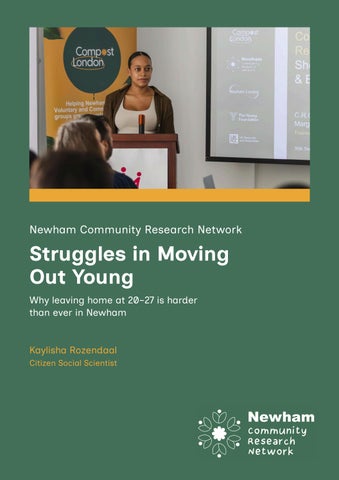
Citizen scientists from the CROWN network at their showcase event at ELBWO in September 2026
4
Newham Community Research Network
Introduction My name is Kaylisha, and my research topic is the struggles of moving out between the ages of 20 and 27. I look at the factors that cause this, whether it’s the cost of moving, cultural background, or simply not being ready. I think this topic is important because it gives not only me but you an insight into why moving out has become so hard over the years – and there are so many reasons. This topic is personally important to me because it is a reality I am currently living. It’s not that I don’t want to move out; it’s that I can’t, unless I go through social housing, and even that can take several years. That is the reality for so many other people my age too, who are stuck at home saving to be able to rent or buy. Our parents or older siblings often hit milestones like moving out and having their own independence by 25. Today, those same milestones feel like a luxury. I want to document and acknowledge the real struggles of being able to afford to move out in this economy. My topic relates directly to the borough of Newham, where the cost of rent is skyrocketing, forcing people to move not only out of the borough but out of the city, to places where rent is considerably cheaper. Newham is at the absolute breaking point of the UK housing crisis. I believe it’s important that local people feel understood in their struggles to find a home, so that they know they aren’t alone.
The Purpose of My Research The purpose of this research is to acknowledge the struggles that so many people go through daily. I wanted to compare what I found with the experiences of people twenty or so years ago, to get a better understanding of what is actually going on, and to put into perspective how drastically everything has changed. The purpose I am trying to achieve isn’t something grand yet. I want to focus on giving people a voice, and giving insight into the situation at hand.
Kaylisha hosting the CROWN showcase and exhibition at ELBWO on 30 September 2026.
“
It’s not that I don’t want to move out; it’s that I can’t. Kaylisha Rozendaal
Struggles in Moving Out Young
7
Background The Housing Picture in Newham The figures I found while planning my research show the scale of the problem:
21.5%
of Newham households do not have enough rooms – around 123,000 people, or a third of the borough
42%
of families with children in Newham live in overcrowded homes
£1,918
average monthly private rent, after a 7.1% rise – the biggest in London
Experts from the London School of Economics have shown that working-class and ethnic minority families are much more likely to have adult children living at home. Their research also shows that this causes major stress, arguments over space and hidden poverty within the household.
Why This Matters for Marginalised Women Marginalised women in Newham are disproportionately affected by the ‘stay at home’ trap. In many Black, Asian and minority ethnic households, the cultural pressure to stay at home until marriage, or until you are successful in a job, combines with today’s economic reality. Unlike their male peers, these young women often pick up a ‘second shift’ of domestic labour and caregiving while living at home. This limits their ability to focus on the side hustles or extra hours they would need to save for an entry-level flat in the borough.
59 in 1,000 households are homeless and in temporary accommodation – the highest rate in the capital
8
Newham Community Research Network
Becoming a Citizen Social Scientist Before beginning my own project, the training with the UCL Citizen Science Academy asked us to think about what research is, whose knowledge counts, and what responsibilities come with researching your own community. These are some of my reflections.
What is Research? Research is the systematic process of investigating a topic, problem, situation or subject to produce new knowledge. A researcher can be anyone carrying out organised investigation to discover new information. Qualitative research focuses on the meaning and understanding that people give to the world – beliefs, attitudes and social relationships – and can be carried out through interviews, focus groups and observations. Quantitative research uses statistics and numbers to report on large populations, for example through surveys. Learned Knowledge and Lived Experience Knowledge is the understanding and awareness of an act, a fact or the truth, adding meaning to data. Learned knowledge is information that is taught, and skills acquired through study. Lived experience is personal to a specific person, gained through direct, first-hand encounters, and linked with emotion and depth. Citizen social science involves the public in answering complex questions about human behaviour and how communities are organised – for example, understanding lived experiences of inequality and poverty. The relationship between researchers and the public can range from ‘crowdsourcing’, where citizens provide raw data, to ‘extreme citizen science’, where they are full partners in defining problems and analysing results.
Struggles in Moving Out Young
What working with communities creates Lived experience: understanding what life is actually like in a specific place, rather than just looking at statistics. Hidden insights: uncovering local issues that others might miss or not take into consideration. Power for change: learning how to use local evidence to push the council or government to make better decisions.
Researching Your Own Neighbourhood Research must be done with care and trust from the community, ensuring dignity, privacy and safety. The community should be treated as participants who help decide how a study is run, rather than as test subjects, and should receive real benefits from the project. This starts with informed consent that clearly states the purpose of the project, any risks, the type of questions that will be asked, how notes and recordings will be kept, and that participants can withdraw at any time. As a citizen social scientist doing research in my own neighbourhood, there are particular challenges. Trying to be both a researcher and a neighbour, it can be tricky to stay fair and unbiased. It may be hard to get real permission when neighbours think they are just having a friendly chat, and in a small area, just a few details could reveal who someone is. You also have to keep living in the community after the project has ended. To manage these challenges, I think researchers need clear boundaries: signalling when you are in ‘research mode’; checking consent when a casual conversation turns into a great piece of data (“That is a great point – can I include that in my notes for my study?”); and protecting privacy by generalising local details when writing up findings.
9
Moments from the CROWN showcase and exhibition at ELBWO, which Kaylisha hosted, as her fellow citizen scientists shared their research with visitors.
Struggles in Moving Out Young
Methodology At the beginning of this project, my initial idea was to focus on loneliness among elderly people, as it was something I felt sympathetic towards and wanted to help make a difference. However, the difference I wanted to make felt like too big an idea to wrap my head around, and it was something I did not have much prior knowledge of, beyond the stories my mum would tell me. So I came up with the topic I have been working on since: the struggles of moving out. This is a topic I know about personally, through the people around me and through my own experience.
Interviews When it came to conducting my research, the method I chose was very simple. I carried out in-person interviews, with a set of questions I wanted to ask each interviewee, and I took notes. I did not record any of the interviews, at participants’ request, which was completely fine. I preferred this method because I could fully grasp what the person was saying through their facial expressions, and it felt more like a conversation than a formal interview. I spoke to four people. My topic is so broad, because there are so many individual reasons for not moving out, that I wanted my research to be targeted. I chose participants from four categories: A university student who had to move out and find somewhere to live Someone who wants to move out but has not yet been able to Someone who moved out young in the 2000s and later moved country Someone aged between 24 and 27 who has not moved out yet
Reflections Overall, I think the process went well, as I got the information I needed. Looking back, I think I could have interviewed one other person in each group to get more perspective, which would have added more depth to my research.
11
“
Moving out is no longer a normal step into adulthood. It has become a luxury. Kaylisha Rozendaal
Struggles in Moving Out Young
Findings The interviews show a massive shift in what it means to grow up. For some, staying at home is a smart choice to protect their pockets. One person explained that their parents’ loft conversion acts as a private space for them, letting them leave a stressful job to volunteer, and not having to focus on a market where renting feels like “flushing money down the toilet”. However, those who are trying to rent are struggling. The student I interviewed described the stress of house hunting on a budget: dealing with houses and flats with mould and holes in the walls, and with agents treating them like kids, as if they don’t know anything. Looking back twenty years, the older generation agrees that the current housing system is horrible. I interviewed someone who easily rented a flat in the early 2000s on a hairdresser’s wage. They said they were shocked, but not surprised, to see 27-yearolds still living at home, because renting even a studio is now so expensive. This leaves many young people stuck, and getting a property from the council can take years. One participant shared that seeing a one-bedroom flat priced at £1,300 a month makes them feel as if their life is on pause, because that price is ridiculous for someone who isn’t even moving out with a roommate. Ultimately, the data shows that moving out is no longer a normal step into adulthood. It has become a luxury you can only afford if you inherit money, or can live with your parents for free.
Theme 1: The housing market is unfair and broken Every person I interviewed agreed that the housing market is completely broken. The first participant living at home called the current market a “complete mess”, because the prices are so high they are a joke. The university student, who is directly affected, described house hunting as “stressful”. The older participant completely agreed, saying that calling the system just ‘pricier’ is a joke, because it is actually “totally f***ed”. And the participant who wants to move out but can’t pointed to a standard one-bedroom flat in Newham costing £1,300 a month, and asked how anyone their age can afford to live on their own.
13
14
Newham Community Research Network
This puts into perspective that I am not the only one who thinks the current housing crisis is a mess. It really leaves people stuck on what to do.
Theme 2: The main goal is to buy, not rent Two of my participants said that their main goal is to buy a home. The first said they refuse to move out because they feel renting is just “flushing money” to pay off the landlord’s mortgage. The university student even puts money from their student finance aside to save for their future. The older participant pointed out that twenty years ago, the normal step for their friends was “renting and buying our own places”. This is the same goal as the participant who wants to move out but can’t, who, as much as they want to leave now, says their end goal “is to own and buy their own home”. Theme 3: Relying on relatives Across all four interviews, another theme was that young adults are put in a position where they rely on family support to get by. The participant who doesn’t want to move out relies entirely on their parents – which is not a bad thing, as they are trying to save to buy a house. Even the university student who has moved out still struggles with high costs, and has had to ask their parents and partner for money when they run out. The older participant explained that today’s high prices force career-driven adults to stay in their family homes, because independent renting is impossible. This matches the reality of the participant who wants to move out, who stays at home to save, and admits that getting onto the property ladder today is next to impossible “without inheritance”. There are so many other individual reasons why someone does or doesn’t move out. The four people I interviewed are far from the only people who see and understand the struggle.
“
Renting feels like flushing money down the toilet. Research participant
16
Newham Community Research Network
Ideas for Change Young adults in Newham need better housing opportunities and schemes to give them a leg up into ‘adulting’. For those who want to move out, this would be such a great opportunity. These are my ideas for what could help.
1. Intergenerational Housing Grants Newham Council could offer grants to help working-class families adapt their current homes – for example through loft conversions or extensions – to create private micro-studios for adult children who are stuck at home. As one of my participants showed, a loft conversion can give a young adult the private space and independence they need while they save. 2. More ‘save to buy’ and ‘rent to buy’ schemes Most of the young people I spoke to want to own a home one day. More ‘save to buy’ and ‘rent to buy’ schemes would give the younger generation more opportunities. The only rent-to-buy scheme I know of at the moment is run by L&Q. 3. Support for those caught in the middle The Council should look at what it is doing for young adults who earn too much for social housing, but too little for private rent – and share local data on how many 20–27-year-olds are on the social housing waiting list. Future Research In future, I would like to speak to the Council and to landlords to hear their perspectives on the issue, and to explore some of the questions I didn’t have time for: Sharing space: how do young adults find privacy, or act like adults, when they are sharing a cramped house with their whole family? The ‘digs’ economy: how does it feel for adult children to pay informal rent to their parents? Does it help the family survive, or stop the young person from ever saving enough to move out? The long-term impact: how does staying at home for years change a young woman’s choices about relationships, her career goals, and whether she wants to have children of her own?
Kaylisha, second from left, on the panel at the CROWN showcase at ELBWO.
18
Newham Community Research Network
Acknowledgements I just want to give a big thank you to everyone who allowed me to interview them. Thank you as well to the leaders of the UCL Citizen Science Academy, Joseph and Twinkle, and another thank you to Natalie at ELBWO.
The panel discussion at the CROWN showcase at ELBWO, with Kaylisha second from left.