Newham Community Research Network
Wellbeing through Gardening
How gardening supports women’s mental health and wellbeing in Newham Gintare Zukauskaite Citizen Social Scientist
About the Newham CRN In December 2024 the UKRI and The Young Foundation announced new ground-breaking engagement investment in nine ‘community research networks’ across the UK - collaborations led by community organisations alongside academics, local authorities and local residents. The networks span the length of the UK, from the north of Scotland to the Isles of Scilly, and the only successfully-funded network in the south east is here in Newham! For the Newham Community Research Network, Compost London are leading a ‘network of networks’ based in various wards across our ethnically diverse and innovative borough. The three recruited networks cover migrants and refugee communities, marginalised women, and young people with special educational needs who live, work and go to school in Newham. The five-year project is supported by University College London’s Citizen Science Academy, based in the Institute for Global Prosperity, which has strong experience running citizen science (community research) projects in east London and across the world. Local residents from the three different networks are being trained in research ethics, methods, and project planning, and then supported to carry out qualitative research across east London, tackling questions and issues they feel are important to their network communities. Newham Council are also providing support across all three networks, and placement opportunities within the Council will be available for some of our alumni.
About C.R.O.W.N The second cohort of citizen scientists, were trained in summer 2026, and supported by the marginalised women sub-network members, including the East London Black Women’s Organisation (ELBWO). This subnetwork - CROWN (Collaborative Research and Outreach for Women) - works collaboratively to drive trauma-informed, inclusive and culturally responsive change, so that services genuinely reflect the realities of marginalised women and girls. Throughout the programme, the citizen scientists from CROWN have taken part in training, discussions and practical research activities. They have worked incredibly hard, supported one another and brought their own experiences, perspectives and strengths to the group. We hope you enjoy reading their research.
Published October 2026.
Wellbeing through Gardening
3
Contents Introduction
4
Purpose
6
Methodology
9
Findings
13
Recommendations
20
Acknowledgements
22
Citizen scientists from the CROWN network at their showcase event at ELBWO in September 2026
4
Newham Community Research Network
Introduction I love gardening. My best memories from my childhood are of when the women in my family were working in the fields. They shared their life experiences, laughs, life events, problems and worries. It wasn’t just work; it was a kind of togetherness session. Gardening is not only a physical activity, but a social and emotional space that can improve women’s wellbeing. My research explores how gardening can support mental health and wellbeing in Newham, particularly within communities facing a lack of green space, everyday stress, isolation, overcrowding and financial pressure. This topic is very personal to me because I love gardening, and I can see how it helps me to deal with everyday problems, gives me joy, relaxes me and helps me to look forward to the future. In a busy urban area like Newham, many women experience stress, isolation, financial pressure, overcrowded housing and limited access to green space. In a borough where many people live without easy access to private green space, community gardening can become more than a hobby – it can be a form of emotional support. Gardening projects and community gardens can provide a small but meaningful way to improve mental health, create social connections and build a sense of belonging. I chose this topic because I am interested in how everyday community activities can support wellbeing and mental health in practical ways. Gardening is not only about growing food or flowers. It can also create routines, reduce loneliness, encourage physical movement, and help women feel calmer and more connected to others. I am passionate about highlighting how simple, local activities can improve wellbeing and strengthen communities in meaningful ways. I also chose this topic because Newham is very diverse. Women from many cultures and backgrounds live here, and I want to understand how gardening is impacting women’s everyday lives.
Gintare (in the blue dress) taking part in the panel discussion at the CROWN showcase at ELBWO.
6
Newham Community Research Network
Purpose Across the UK, mental health challenges such as anxiety, stress and depression have increased significantly, particularly since the COVID-19 pandemic. Mental health in Newham is among the poorest in London. Moreover, Newham has significantly less green space than the rest of London. While Greater London is about 39% green, with over 20 square metres of green space per person, Newham is roughly 13.1% green, providing just 8.2 square metres per resident. A lack of green space can have a really big impact on people’s mental health. In response, organisations including the NHS and the Mental Health Foundation have promoted “green social prescribing”, where people are referred to nature-based activities such as gardening, walking and conservation projects to improve their wellbeing. Research from NHS-backed programmes found that gardening and outdoor mindfulness activities improved happiness levels and reduced anxiety within just 12 weeks. In Newham, local social prescribing projects such as Cody Dock community garden and Hope Gardens already show the positive impact gardening can have. Newham’s wellbeing programmes also connect residents with gardening groups and community support through initiatives such as Well Newham. Together, these examples show that gardening is increasingly recognised not only as recreation, but as an important public health and community wellbeing tool. Historically, too, the connection between nature and the mind was put into practice long before modern psychiatry. In medieval times, monasteries often integrated cloisters and green turf to refresh the senses. It was widely believed that green grass and fragrant flowers soothed a “weary mind” and restored “dull spirits”. In the 1800s, new psychiatric asylums purposefully integrated extensive farms and market gardens, and medical superintendents noted that digging in a garden distinguished patients who recovered from their mania from those who did not. Florence Nightingale, in the 1860s, believed that environmental conditions were critical for recovery, and early hospital wards featured garden terraces and airing courts to expose patients to light and fresh air.
Wellbeing through Gardening
7
I would like to hear real people’s stories about how their lives changed when they started, or continued, gardening, and to understand how gardening affects their daily lives and sense of wellbeing.
Manor Park Community Garden, one of the community gardens Gintare visited during her research.
wasn’t just work; it was a kind of “ Ittogetherness session.
”
Gintare in a community garden on one of the many rainy days of her fieldwork. The weather was the biggest challenge of her research.
Wellbeing through Gardening
Methodology I chose to use interviews for my research. I visited community gardens around the area and listened to people’s stories. I decided on this because engagement with online research can be low, and people’s experiences wouldn’t be heard.
Community Gardens: I visited 5 local community gardens. Over the period of my research, the big issue was the weather. Some days the rain was so bad that it was difficult to meet anybody who was gardening or visiting the community gardens. I still walked around the gardens, making notes of the facilities and the plants they were growing.
Raised beds and shared seating in one of the five community gardens Gintare visited during her research.
The Gardening Trail: I attended a ‘Gardening Trail’ and met very interesting people there. It was a two-day event where people shared the beauty of their own gardens. You can walk around the gardens, talk to the hosts and share the experiences that gardening brings.
9
10
Newham Community Research Network
Details from the gardens Gintare visited: a fig tree above lavender and herbs, a fruiting cherry tree and artichokes growing in colourful tubs.
Reaching People: I tried to reach local people through social media platforms, and sent emails to gardening communities and to places where mental health sessions were taking place, but I didn’t reach them. My emails were forwarded to people who would be good to speak to, but I didn’t get a response. That’s why I used a simple walking-and-talking method. I also reached out to my Lithuanian community. I contacted and interviewed women whom my friend recommended I speak to. It was hard to talk to people or make contact with them as a shy person, but the people who talked to me were very nice and supportive. I talked to more than 10 people, and 7 of them gave me interviews and the wider story of their lives and experiences.
Reflections: In future, I would prepare simple question forms for the people I met to fill in, because it was difficult for me to disturb people with long interviews and to talk about sensitive topics like mental health, or to ask them to share opinions openly.
A garden on the Gardening Trail, a two-day event where residents opened their own gardens to visitors.
A wooden boardwalk winds through wildflowers in one of the community gardens Gintare visited.
Wellbeing through Gardening
Findings In my research I heard that people see gardening as a normal part of life, seeking a little beauty around them, or changes they feel they need to make. Not all women start to garden or change their lives on purpose; they just go where their heart takes them, and with that, over time, they grow a hobby, a routine and a community around gardening. The improvement in wellbeing is great, but it is unconscious, natural and barely noticeable in their world. They were surprised by the question “Did your mental health improve after you started gardening?”, and this question made them notice that it actually did improve, and that there really might be a sense of healing through gardening. Gardening helps women cope with stress, anxiety, loneliness, depression, grief and life changes. It provides a sense of peace, purpose and emotional balance. Women find their identities and connect with nature, and they do it unconsciously. When you see so much beauty around you, it is hard to be upset. Taking care of something helps women to feel needed. Three themes came through in the stories I heard.
Theme 1: Belonging Gardening helps women gain friendships, find jobs, fight loneliness and have a sense of importance. Maria describes her garden as a peaceful space where she never feels lonely, and found friends in the community garden. Daja found her community in a new neighbourhood through gardening. Lina found that gardening became her safe space, where she could escape stress and find peace. She had never heard about community gardens. Jane found a workplace that she loves. Grace, even though she can’t garden herself, still enjoys just observing and giving advice to others.
13
14
Newham Community Research Network
Shveata found her community outside university, and feels that she belongs in Newham more. Ruta is considering joining a community garden, even though she is not sure about her English language skills.
Named plots in the community gardens: each bed is cared for by a local resident.
Theme 2: Wellbeing Gardening helps women cope with stress, anxiety, loneliness, depression, grief and life changes. It provides a sense of peace, purpose and emotional balance. Jane overcame depression after years of unemployment and found purpose through gardening. Lina used balcony gardening to manage anxiety and feel calmer after immigrating. Maria describes her garden as a peaceful space where she never feels lonely. Grace noticed her mental health decline after she could no longer garden. Daja became less stressed and learned to appreciate everyday moments. Ruta found hope, healing and emotional expression through gardening. Shveata uses gardening to reduce anxiety and university stress.
Wellbeing through Gardening
15
As Ruta told me: “How plants grow every day, that’s how you are growing with nature. One broken branch can’t kill the tree.” When you put it in this perspective, life becomes easier to deal with.
Theme 3: Identity Women found their identity, and found a connection with nature and with their heritage. Jane found purpose through gardening. Ruta preserves and reconnects with her roots through gardening. Lina overcame childhood trauma connected to hard work gardening, and now loves it. Shveata finds gardening a distraction from university stress. Daja teaches children how to garden, and it is a really big joy. Maria turned her hobby into a lifestyle in her retirement.
“ Gardening is in women’s DNA. Shveata
It was amazing to research and walk around Newham’s community gardens, and to be a part of the Gardening Trail. It really makes me happy to see what people can create when they come together. It has definitely made me consider becoming part of one of the community gardens. It is a bit difficult, though, to reach some of the community gardens by public transport.
”
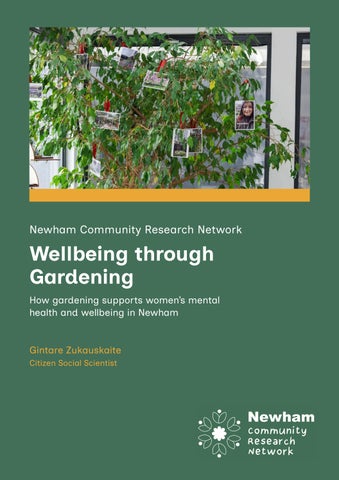
Gintare’s creative output: a tree decorated with words and photographs from her research, shown at the CROWN showcase at ELBWO.
“
How plants grow every day, that’s how you are growing with nature. One broken branch can’t kill the tree. Ruta, interviewed for this research
A visitor looks at the words and photographs hanging from Gintare’s tree at the CROWN showcase at ELBWO.
Photographs from the gardens Gintare visited during her fieldwork.
20
Newham Community Research Network
Recommendations We are all very different and very important. Everybody finds peace and happiness in different ways. The people I spoke to found it in gardening – some by remembering their ancestors, some with the community’s help – but the main thing is to find it. Green spaces help us to relax: the more green spaces there are in the area, the more people can find a way to try things and discover what they like.
1. Protect existing community gardens: Don’t let anybody redevelop them. Make community gardens accessible by public transport, and make them disability friendly. 2. Introduce gardening in community centres: Gardening should be introduced in all the community centres around Newham. 3. Promote community gardens more widely: Promote gardens more, for example in libraries, GP surgeries, schools and on social media. People don’t know much about what’s happening in their area without advertising. 4. Encourage culturally diverse gardening projects: Celebrate plants, foods and gardening traditions from different cultures. 5. Fund school gardening projects: More funding is needed for school projects, and for encouraging children to grow something from a young age. 6. Spread gardening events across Newham: The Gardening Trail and the Green Trail were amazing initiatives, but they were held on the same day, so it was hard to attend both gatherings, when both are great. These initiatives could also be held in other areas of Newham. 7. Open community garden markets: Open Community Garden Markets would be an amazing addition to promote community gardening. Please don’t forget, and do appreciate, the green spaces in Newham!
Gintare’s decorated tree, hung with words and photographs from her research, at the CROWN showcase at ELBWO.
22
Newham Community Research Network
Acknowledgements I would like to thank Natalie from ELBWO for the opportunity to be a part of this project, and for her support in every way. I would like to thank Joseph and Twinkle for teaching us skills and how to carry out research. I would like to say thank you to the people I have spoken to, for their openness and participation. I would like to say thank you to my family and my colleagues, who supported me in this process. And I would like to thank myself for not giving up, and for pushing myself to talk to people and do this research.