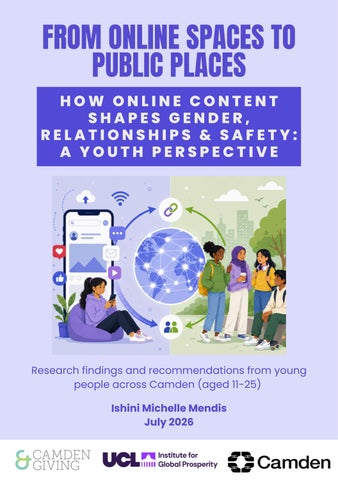
FROM ONLINE SPACES TO PUBLIC PLACES HOW ONLINE CONTENT SHAPES GENDER, RELATIONSHIPS & SAFETY: A YOUTH PERSPECTIVE
Research findings and recommendations from young people across Camden (aged 11-25) Ishini Michelle Mendis July 2026
LIST OF CONTENTS 01. Introduction (Page 1) 02. Why This Research Matters (Page 2) 03. Methods (Page 3)
Mapping (Page 4-5) Workshop (Page 6-7) Survey (Page 8-9) Interview (Page 10-11)
04. Recommendations from young people (Page 12-13) 05. Conclusion and Acknowledgements (Page 14-15) 06. Background (Page 16) 07. Support
INTRODUCTION Hi, I’m Ishini! I’m a youth worker and community researcher who has spent the last few years working alongside children and young people across Camden. Through youth clubs, schools, community projects and outreach, I’ve had lots of conversations with young people about relationships, gender, safety and what it feels like to grow up in Camden as a young person. But these conversations got me thinking about another space young people spend a lot of their lives: online.
Young people today are growing up surrounded by social media, where they can encounter thousands of messages about what relationships should look like, how men and women should behave, what is attractive, what is “normal” and how we should treat one another. Having my own lived experience of Violence Against Women and Girls (VAWG) as a young person made me particularly curious about young peoples perspectives. I started wondering: Do the things young people see online stay online? Or might some of these messages influence how young people understand gender, relationships, behaviour and safety in the world around them? That question became the starting point for this research.
1
WHY THIS RESEARCH MATTERS None of us grows up in isolation. The way we understand ourselves, other people and the world around us is shaped by our experiences - our families, friendships, communities, culture and the environments we spend time in. Today, that environment includes the online world too. Research from the 5 rights foundation found that almost all 3-17year-olds go online in the UK, mostly to watch videos, play video games, send messages to their friends and stay connected via social media. I wanted to explore this research from both a psychological and sociological perspective - looking beyond individual behaviour to think about the wider social environments that can influence how young people develop their identities, attitudes and expectations.
Three ideas helped me think about this: WE LEARN FROM WHAT WE SEE Bandura's (1977) Social Learning Theory suggests that people can learn by watching others. This made me curious about what young people repeatedly see online and what messages they might take from it. WE LEARN THROUGH OTHER PEOPLE Vygotsky's (1978) Sociocultural Theory reminds us that our understanding of the world develops through social interaction, language and culture. Social media is now another space where those interactions happen. WE ARE SHAPED BY MORE THAN ONE ENVIRONMENT Bronfenbrenner's (1979) Social-Ecological Theory looks at how different parts of our lives connect - from family and friendships to schools, communities, culture and wider society. For young people today, online spaces sit within this wider social environment too.
2
METHODS I wanted to understand How young people's online and offline worlds interact - and what could this mean for gender, relationships and safety in public spaces? Research Mapping
What are young people experiencing in Camden Town?
Workshop
Survey
Interviews
Where might these behaviours, attitudes and expectations be coming from?
How common are these experiences across a wider group of young people?
How do young people interpret and experience the relationship between online spaces and public spaces?
I wanted young people’s experiences to guide the research, rather than starting with assumptions about what I might find. To do this, I used four different methods, with each stage building on what I learned from the one before. Mapping helped me begin with young people’s lived experiences of Camden; the workshop allowed us to explore some of the possible influences behind these experiences; the survey helped me see whether emerging themes were shared more widely; and the interviews gave young people space to explore these ideas in greater depth. Using different methods also meant young people could contribute in different ways - through maps, group conversations, anonymous survey responses and more in-depth discussions. This was important because not everyone feels comfortable expressing themselves in the same way.
3
RESEARCH MAPPING WITH YOUNG PEOPLE I started offline.
Before asking young people about social media, I wanted to understand how they actually experience the public places around them. 25 young people across Camden were invited to map the places they spend time, avoid, feel comfortable or uncomfortable in, and think need to change.
Using coloured stickers made it possible for young people to show me their experiences visually while the conversations around why they chose each place helped me understand the stories behind the dots. Meaning of the Stickers: Green sticker = place young people go / spend time Red sticker = places young people avoid Blue sticker = places that feel comfortable Orange sticker = places that feel uncomfortable Yellow sticker = places that need to change or improve
4
WHAT YOUNG PEOPLE SAID
The mapping showed that male and female participants talked about and navigated public space differently. Male participants shared: ‘I don’t feel unsafe’
Female participants shared: ‘I have to think about my route’
Male participants generally said they didn’t feel unsafe in public spaces. However, conversations also revealed a perceived need to appear tough or masculine on the streets raising questions about whether feeling safe and needing to appear tough might exist alongside each other.
Female participants described considering multiple factors before travelling alone, including where they were going and the route they would take. Safety could therefore shape decisions before the journey had even begun.
This left me wondering: Where do our ideas about gender, relationships and how we should behave come from?
5
WORKSHOP
The mapping raised questions about gender, safety and the expectations young people experience in public spaces. So, I wanted to explore where some of these ideas might be reinforced.
So, the next stage explored what young people see online. I worked with 8 young people (4 male and 4 female) from Ampthill Young Guardians to explore the social media trends they were seeing and discuss what those trends meant to them. Together, we followed the journey from:
Online Content
Underlying messages that online content sends to young people
How that message from the online content might appear in everyday life
Which led to us discussing: What messages are young people receiving online? What does social media tell us it means to be a man/ woman? Could these messages influence how we think or behave in public spaces?
6
WHAT DID THEIR SOCIAL MEDIA FEEDS REVEAL? Working first in male and female groups, young people explored the social media trends they were seeing on their personal feeds. We then came back together to discuss the messages behind them and how these might show up in everyday life.
Online Social Media Themes Male
Female
TOUGHNESS STATUS DOMINANCE LOOKSMAXXING MASCULINITY
APPEARANCE RELATIONSHIPS SEXUALISATION EXPECTATIONS OF WOMEN SAFETY
GENDER & RELATIONSHIPS Young people identified content carrying strong messages about masculinity, femininity and relationships. Discussions included key meme and polarising expectations around how men and women should behave. HARMFUL CONTENT WAS FAMILIAR Young people also raised harmful and sexualised content themselves..
100% female participants indicated that they had experienced some form of Violence Against Women and Girls (VAWG) by the age of 15.
7
SURVEY
The workshop raised an important question: were the messages discussed by those young people showing up for others too? The survey explored whether the issues raised in the workshop appeared across a wider group of young people. I surveyed 20 young people aged 12–25 across Camden, with an equal number of male and female participants. The survey explored: What content they encounter online When they first remember seeing certain types of content How it reaches them (Via specific platforms) and whether they think online messages can influence behaviour offline.
75% 75% 88%
GENDER MESSAGES START YOUNG of respondents (male & female)remembered encountering messages about boys being dominant, unemotional or in control by age 15. CONTENT CAN FIND YOU of respondents said concerning content appeared when they weren't looking for it. This matters because young people do not always have to actively search for content to come across it - it can appear as part of the feeds they already scroll through. FROM THE SCREEN TO REAL LIFE? believed online messages affect how people behave towards others in real life.
8
WHAT WORRIES YOUNG PEOPLE
When asked what online content worried them most, young people raised concerns about sexual content, unhealthy relationship advice, appearance pressures, aggression, manipulation and the way women and men are portrayed online.
“Content that belittles/shames women especially for the most minor/ridiculous things. Example: A man in a podcast stated that women wearing abayas should not wear coat because it shows their figure
“The unhealthy relationship advice is the most concerning to me”
“Pornstars used to only be on porn sites - now they’re on social media”
“Flexing money made of fraud and drugs”
Some responses suggested concern wasn't just about seeing harmful content, but about the messages young people might learn from it. The survey could show me what young people were encountering and what they believed - but not how they actually interpreted those messages. So I wanted to dig deeper.
9
PHOTO ELICILATION INTERVIEW
The interview was a semi-structured paired photo-elicitation interview with two young people. Both participants requested that they’d feel more comfortable being interviewed together.
THE SAME CONTENT CAN MEAN DIFFERENT THINGS One participant saw some fitness and “alpha mindset” content as motivation and encouragement, while recognising that someone else could interpret the same message as pressure. Young people are not passive viewers - the same post can mean different things to different people. YOUNG PEOPLE DON’T JUST ABSORB MESSAGES - THEY CAN REJECT THEM TOO Participant 2 described appearance-focused content affecting her confidence when she was younger. But she also spoke about recognising when those expectations no longer felt right and choosing to move away from them.
10
ONLINE IS ONLY ONE PART OF THE PICTURE Participants recognised that family, school, friendships and positive experiences can help young people question what they see online. Where those protective relationships are weaker, harmful messages may have a greater influence. MASCULINITY WASN’T JUST ABOUT LOOKING STRONG The interview suggested that masculinity can also involve pressure to hide vulnerability or appear emotionally in control. One participant described the concern that showing emotion could make someone look “weak or vulnerable”.
ONLINE IDEAS CAN BECOME REAL RELATIONSHIP PRESSURES The idea that “a real man provides” was not discussed only as an online message. One participant described feeling pressure around who should pay within a relationship, showing how wider gender expectations can enter everyday decisions.
The impact of online content may depend partly on what - and who - surrounds the young person offline.
11
RECOMENDATIONS
These are recomendations From young people across Camden to help make Camden safer, more supportive and more youth-friendly:
AWARENESS AND PREVENTION More support for boys around emotions and masculinity.
More honest conversations
Create youth-led campaigns
Education health workshops on
Around safety, support and awareness
relationships & online safety
YOUTH FRIENDLY SPACES Develop a youth-friendly outdoor gym.
Promoting connection through fitness
Annual Youthled event on Camden High street
Introduce a Camden Young Resident card.
Discounts to help young people access local places.
12
EMBED YOUTH VOICE Set up a regular VAWG Youth Safety Group
Build youth voice into Camden Town High Street redesign
Embed youth steering groups in wider council decisions
e.g. Young Guardians
which affect young people
SAFER STREETS Improve Lighting/security
Improve safer night-time travel
Trusted Adults in the community
in hotspot areas
e.g. Night Hail & Ride Bus
e.g.Youth Workers, Community Safety Officers
These recommendations need different teams working together with young people, including: Camden Council's: Youth Service, Community Safety & VAWG Team, Schools & Education, Public Health, Parks & Public Realm, Events & Culture, Planning & Regeneration, High Streets & Economy, Local businesses, TFL, Police & transport partners.
WHO COULD HELP MAKE THIS Young people should be involved throughout the HAPPEN? process of implementing these recommendations not just consulted!
13
CONCLUSION
This research began with a simple question: could the things young people see online influence how they understand gender, relationships, behaviour and safety offline? Across the mapping, workshop, survey and interview, one message became clear: online and offline worlds are not separate, but interconnected.
MAPPING
WORKSHOP
Young people described different experiences of safety in Camden’s public spaces.
Young people identified different messages about masculinity, apperance,relationships, status & saftey in their feeds.
SURVEY
INTERVIEW
Many believed online messages can shape offline behaviour, and concerning content often appeared without being searched for.
Young people showed that the same message can motivate, pressure or be rejected - depending on the context.
The things young people see online do not simply disappear when they put their phone down. Repeated messages can become part of the wider social environment shaping what feels normal, acceptable, attractive or expected - influencing values, social norms and how young people understand themselves, other people and relationships.
14
PREVENTION NEEDS TO BEGIN BEFORE HARM HAPPENS Young people described seeing repeated messages about gender roles, masculinity, femininity, appearance, relationships, status and safety. Young people may not always be consciously aware of this influence. Some messages are obvious, while others appear through humour, trends, influencers, appearance ideals, relationship advice and repeated ideas about what men and women should be like. But online content does not affect everyone in the same way. VAWG prevention needs to begin upstream - before harmful attitudes become accepted norms, and before those norms develop into harmful behaviour. Prevention cannot focus only on young people's screens. It also means strengthening the environments around them through healthy relationship education, critical digital literacy, trusted adults, support for boys and young men around emotions and masculinity, support for girls and young women to feel safe and heard, and spaces where young people can question harmful messages rather than simply absorb them. This research does not show that social media directly causes VAWG. Instead, it suggests that prevention needs to pay attention to the wider environments in which ideas about gender, relationships, respect, power, emotions and safety are learned, reinforced, challenged and normalised - both online and offline. Throughout this research, young people did more than identify problems. They challenged assumptions, reflected on their own experiences and proposed solutions. If we want safer online and public spaces, young people need to be part of creating them.
15
ACKNOWLEDGEMENTS Thank you to all the young people who participated in this research including: Ampthill Young Guardians Regent’s Park Young Guardians Somers Town Youth Centre - Count Me in Project South Hampstead & Kilburn Partnership: ARC Youth Club through mapping, workshops, surveys and interviews. A special thank you to: Scarlet, Peaches, Amelia, Ameera, Zuhura, Fatima, Mahfuz, Yaya, Jessica, Yakel, Aya, Hydayt, Irfan & Shay. Thank you to the Camden Council teams and partners for supporting this work.
16
BACKGROUND
WOMEN AND GIRLS' SAFETY IN PUBLIC SPACES – A CITIZEN SCIENCE PROJECT
Following many successful collaborations, including the Good Life Euston, Euston Young Voices, and previous residency programmes, Camden Council teamed up with the Institute for Global Prosperity at University College London (UCL) and Camden Giving to deliver a Community Infrastructure Levy-funded project focused on safety in public spaces. This zine is one of the outputs from this programme. Ten local residents were employed by Camden Council to conduct research informed by their own lived experience, focusing on the safety of women and girls in public spaces around the borough. As part of their residency, the cohort completed a bespoke 12-week paid training programme with the UCL Citizen Science Academy, using methods such as photo elicitation, walking ethnography, workshops, and interviews. The residents developed ten distinct research questions exploring intersectional challenges - ranging from global majority communities accessing essential services and the safety of women travelling with children, to Islamophobia and the experiences of female shift workers. Through practical training and supported fieldwork, the resulting recommendations and findings were presented at a celebration event in the Council Chamber at the Town Hall in June 2026, supporting the wider goal of promoting citizen-led policymaking and connecting residents with local government.
SUPPORT You don’t have to deal with it alone.
If anything in this zine has made you think about something you or someone you know has experienced, support is available. Speaking to a trusted adult, youth worker, teacher, GP or safeguarding lead can be a good first step.
IF SOMEONE IS IN IMMEDIATE DANGER, CALL 999. Organisation
How to contact/access support 24/7 Mental Health Crisis Line Free, 24/7 support for anyone experiencing a mental health crisis in Camden. Call: 0800 151 0023 Call 116 123 24/7 or https://www.samaritans.org/ Text SHOUT to 85258 for confidential 24/7 crisis text support. Call 0800 068 41 41 or text 07860 039967. Open 9am–midnight, 365 days a year. Call 0808 808 4994, 11am–11pm every day. Online/email support is also available. Free, safe and anonymous online mental wellbeing support, including live chat and wellbeing resources. Call 0800 1111 anytime, or use online chat with a counsellor.
18