Newham Community Research Network
A Space of Our Own
The loss of Caribbean-led community spaces in Newham and the impact on marginalised women
Carollyn Lascelles
Citizen Social Scientist
About the Newham CRN In December 2024 the UKRI and The Young Foundation announced new ground-breaking engagement investment in nine ‘community research networks’ across the UK - collaborations led by community organisations alongside academics, local authorities and local residents. The networks span the length of the UK, from the north of Scotland to the Isles of Scilly, and the only successfully-funded network in the south east is here in Newham! For the Newham Community Research Network, Compost London are leading a ‘network of networks’ based in various wards across our ethnically diverse and innovative borough. The three recruited networks cover migrants and refugee communities, marginalised women, and young people with special educational needs who live, work and go to school in Newham. The five-year project is supported by University College London’s Citizen Science Academy, based in the Institute for Global Prosperity, which has strong experience running citizen science (community research) projects in east London and across the world. Local residents from the three different networks are being trained in research ethics, methods, and project planning, and then supported to carry out qualitative research across east London, tackling questions and issues they feel are important to their network communities. Newham Council are also providing support across all three networks, and placement opportunities within the Council will be available for some of our alumni.
About C.R.O.W.N The second cohort of citizen scientists, were trained in summer 2026, and supported by the marginalised women sub-network members, including the East London Black Women’s Organisation (ELBWO). This subnetwork - CROWN (Collaborative Research and Outreach for Women) - works collaboratively to drive trauma-informed, inclusive and culturally responsive change, so that services genuinely reflect the realities of marginalised women and girls. Throughout the programme, the citizen scientists from CROWN have taken part in training, discussions and practical research activities. They have worked incredibly hard, supported one another and brought their own experiences, perspectives and strengths to the group. We hope you enjoy reading their research.
Published October 2026.
A Space of Our Own
3
Contents Introduction
4
Purpose
7
Methodology
11
Findings
15
Food as Living Heritage
24
Creative Output
26
Recommendations
31
Acknowledgements
34
Citizen scientists from the CROWN network at their showcase event at ELBWO in September 2026
4
Newham Community Research Network
Introduction My name is Carollyn. I am a woman of Caribbean descent and a citizen scientist. This research project is personal to me. Growing up, I watched the places where my family and community gathered – the social clubs, shebeens, pubs and venue spaces – close one by one, with no replacement. I am an unpaid carer. I have seen unpaid carers in my own family – women who gave up careers, social lives and their own mental health – look after elderly relatives. They had nowhere to go for respite. No space where the food was familiar, the music was recognised or someone understood the patois. I have seen Nine Nights (traditional Caribbean wakes) being held in church halls that shut early, or in places where you cannot serve alcohol or play music loud. That is not how we say goodbye. That is how we suppress culture. I have seen the decline in opportunities for people to gather and play dominoes. I am tired of being told to assimilate. I am tired of my culture not being acknowledged within Newham. Newham is a diverse borough. Over 70% of residents are from Black, Asian and ethnically diverse communities, in a total population of approximately 350,000. But diversity without dedicated spaces to support each unique culture can lead to isolation, not integration. There are over 13,000 people identifying as Caribbean living in Newham. That is a community with a strong cultural identity and generations of contribution to British society, and especially to Newham. Yet I have watched our spaces disappear. There are more than 24,000 unpaid carers living in Newham. Most of them are women. Many are caring for elderly relatives with dementia. As dementia gets worse, some elderly Caribbean people revert to patois. In generic care homes or day centres, nobody understands. The food isn’t right. The music is not recognised.
A Space of Our Own
Alignment with CROWN This research aligns with the mission of CROWN (Collaborative Research & Outreach for Women in Newham) in a number of ways: Strengthening community power by giving Caribbean women a platform to articulate their needs, frustrations and visions for change. Reflecting lived realities and driving trauma-informed change by giving a voice to unpaid carers – women who are often overlooked, exhausted and unsupported. Advocating for culturally responsive services by campaigning for a space that is Caribbean-led and able to accommodate all the facilities and services highlighted by this research. This is not advocacy for a segregated space: it would be culturally vital for the Caribbean community and open to all. Positioning women and girls as experts in their own lives, best placed to know what works for them.
5
Carollyn in conversation with a guest at the CROWN showcase at ELBWO.
A Space of Our Own
Purpose The History: Caribbean Migration and Community Building in Newham Although people from the Caribbean lived and worked in the UK before the World Wars, numbers increased significantly after the Second World War. The Windrush generation – those who arrived between 1948 and the early 1970s – came to Britain in response to a call to help rebuild the country. According to the 2001 Census, Newham had the largest proportion of non-white ethnic groups in the country, with 61% of its population identifying as non-white. These communities settled in the borough and established spaces to gather, support one another and preserve their culture: The Newham African Caribbean Centre was incorporated in 1986, providing resources and support to African and Caribbean community and faith organisations. It is now the Barking Road Community Centre, a general-use venue for hire. The Hibiscus Caribbean Elderly Association was founded in 1988 and secured a lease from Newham Council in 1994. It was established in direct response to the lack of social and leisure facilities for older African and Caribbean people in the borough.
The National Crisis This problem is not only happening in London; it is happening across the UK. The Baobab Foundation estimates that less than 1% of UK charitable grant funding goes to ethnic-minority-led organisations. During the COVID-19 pandemic, over 90% of ethnic-minority-led organisations were at risk of closure, despite being vital to their communities. A review commissioned by the Baobab Foundation found that few such organisations had longterm strategic funding, and few funders were explicit about addressing racial inequalities in their strategies. In Newham Newham is London’s second most ethnically diverse borough, with 42.3% of residents identifying as Asian, 17.4% as Black, Black British, Caribbean or African, and 30.8% as White. Yet the spaces that helped build that diversity are disappearing. The Hibiscus
7
8
Newham Community Research Network
Community Centre, which served African and Caribbean elders for decades, has faced significant challenges and is at risk of closure. The Windrush Voices project captured interviews with over ten Caribbean migrants who lived and worked in Newham from the 1960s to the early 1970s. These interviews reveal powerful stories of resilience and community, but those stories are becoming increasingly disconnected from the physical spaces that once existed in Newham.
From Carollyn’s presentation: cultural spaces closed or under threat in Newham.
My Research Objectives This research is driven by the urgent need to document the loss of Caribbean-led community spaces in Newham, and to provide hard evidence for the creation of a new, multifunctional, selfsustaining hub. My key objectives were: Mapping the disappearance of Caribbean community spaces over 30 years, and comparing the infrastructure available to Caribbean communities with that of other faith and cultural groups in Newham.
A Space of Our Own
Giving marginalised women a voice by listening to and sharing their need for support, especially women caring for elderly relatives with dementia, whose needs are not met by existing generic services. Making the economic case for a Caribbean-led hub. Making a case for action: providing a solution to the problem, and aligning the findings with Newham Council’s current commitments to community wealth building and inclusive growth. This research project is a direct response to a crisis being experienced by a marginalised community, and in particular by Caribbean women in the borough.
9
Carollyn presenting her research at the CROWN showcase at ELBWO.
A Space of Our Own
11
Methodology When I started this research, I knew I needed to gather evidence that would be credible to Newham Council and meaningful to the Caribbean community in Newham, especially women. I did not want my data to be seen as just quotes and anecdotes, and I wanted to make sure I was accurately recording the lived experiences of the people I interviewed. So I used a mixedmethods approach: Method
Purpose
Focus group
Encouraged discussion, interaction and collective ideas
Semi-structured interviews
Captured emotions and personal stories
Document analysis
Council strategies, census reports and published data
Mapping
Documented community, cultural and social spaces through site visits and photographs
Investigative calls
Enquired about hire costs, terms and policies at community spaces across the borough
Media engagement
Questions posed live on air, generating call-ins to a radio station that I could record
Focus Group I hosted one focus group on Thursday 25 June 2026 at ELBWO. 22 people registered via Eventbrite, and 17 attended on the day. I recruited participants through Eventbrite, posters in Forest Gate and Stratford libraries, Woodgrange Baptist Church, All Saints Church in Manor Park, and word of mouth. Free light refreshments and soft drinks were provided. The session began with an introduction explaining the purpose of the research, confidentiality, the right to withdraw, and ground rules. This was followed by a group discussion with open-ended
12
Newham Community Research Network
questions, and an interactive activity, Design Your Ideal Space, in which participants formed five small groups and wrote down the resources, services and facilities they would want in a Caribbean space in Newham. I finished with one final question: “What would you say to a council officer who asked: ‘Why do Caribbean people need their own space?’” Each participant’s response was recorded. The session was audio recorded using a laptop and mobile phone. However, both devices kept timing out and I had to restart recording several times, so I believe I missed some data. To avoid this in future, I switched to using a dictaphone.
Media Engagement Quincy ‘The Cockney Prince’, a comedian, actor and radio host, attended the focus group and shared his experiences of this topic, including those of the women in his life. The next morning, on his Supreme Radio show, he mentioned the focus group and its subject, and listeners phoned in with their thoughts, experiences and wishes, all relating to the decline of Caribbean spaces in the borough and the effect on marginalised women. Quincy then agreed to a one-to-one interview with me, to dedicate more time to the topic on his show the following week, and to put questions I provided to his listeners. Most callers were from Newham, and I was able to listen in and transcribe responses. This significantly increased my reach and provided a platform for Newham residents who could not attend the focus group.
Semi-structured Interviews I conducted interviews, each lasting approximately 30–40 minutes, with unpaid carers of elderly relatives with dementia; older people aged 70 and over; young and older creatives who have struggled to find affordable exhibition space; and women who had tried mainstream women’s services or spaces and felt unwelcome. I recruited through churches, word of mouth, posters in Forest Gate and Stratford libraries, ELBWO’s network and Eventbrite. Mapping Activity During the focus group, I asked participants to identify former Caribbean community spaces that existed 30 years ago, and the spaces currently used by the Caribbean community. Twelve
A Space of Our Own
13
spaces were identified through participants’ collective memory – a strength of this research, capturing community knowledge that official records may have lost.
What Worked Well Aspect
Outcome
Attendance
22 registered, 17 attended
Participant engagement
Open, respectful and eager to share
Design Your Ideal Space
Generated excellent visual data
Final question
Produced powerful, quotable evidence
Media interest
Significantly increased the research reach
Diversity of participants
A mix of ages, genders and experiences
Carollyn presenting her research at the ‘Research to Policy’ event at Forest Gate Library.
A Space of Our Own
15
Findings Key Findings
67%
4
13,586
24,600+
74%
£14–28m
of Caribbean community spaces lost (8 of the 12 identified)
unpaid carers in Newham, 57.5% of them women
Caribbean-led spaces remain – none fully multifunctional
of residents would spend money at a Caribbean hub
Three key themes emerged from the focus group, interviews and media engagement. Together they tell a very clear story about the decline of Caribbean-led community spaces in Newham and the impact on marginalised women.
Theme 1: The Loss of Space Caribbean community spaces have disappeared over 30 years, leaving a huge gap that existing organisations cannot fill. Participants identified 12 former Caribbean community spaces that existed 30 years ago. Only 4 remain – a loss of 67%. “There used to be a few social clubs. Now? Nothing. You have to go to Hackney or Tottenham if you want a proper Caribbean night out.” Elder, 70+, East Ham
“I remember my mother taking me to the old Caribbean centre on Barking Road. It was buzzing. Now it’s just a hall you can hire. It’s not the same.” Woman, 45, Plaistow
“My mother’s Nine Night was in a cold church hall. They turned the lights on at 8pm and told us to pack up. My mother deserved better. Our culture deserves better.” Woman, 52, Forest Gate
Caribbean residents in Newham (2021 Census)
estimated annual spending leaving Newham
16
Newham Community Research Network
“I had to travel all the way to Ilford for my mother’s wake because there was nowhere in Newham that would let us have music after 10pm. That’s not right.” Radio caller, Newham resident
From Carollyn’s presentation: the disappearance of Caribbean community spaces in Newham over 30 years.
The loss of Caribbean spaces is not just nostalgia; it is a reality that participants feel strongly. The mapping activity shows the scale of the loss, while interviews and radio phone-ins reveal the emotional toll: the inability to hold a proper Nine Night, the loss of social connection, and the feeling that Caribbean culture is being erased from Newham.
Theme 2: The Invisible Carers Unpaid carers, particularly women caring for elderly relatives with dementia, are isolated and unsupported by culturally appropriate services. “I care for my mum full time. She has dementia. She reverts to patois now. She says things like nobody understands. I can’t take her to a normal day centre. The food is wrong. The music is wrong. They don’t speak her language.” Carer, 58, East Ham
A Space of Our Own
“There is nowhere I can go with my mother where she feels safe and I feel understood. I just want somewhere where she can hear old lovers rock and eat her rice n peas and brown stew chicken. That’s not too much to ask.” Carer, 62, Plaistow
“I gave up my job to care for my husband. He has dementia and speaks patois. I can’t leave him with anyone who doesn’t understand. It’s exhausting. I need a break but I can’t find one that works for him.” Carer, 67, Forest Gate
Asked what they would say to a council officer who asked why Caribbean people need their own space, participants said: “Because my mother deserves to be understood. She deserves to hear music she recognises and eat food she knows. That’s dignity, not segregation.” Focus group participant
“If you don’t give us a space, you’re telling us our culture doesn’t matter. And that’s not a message you want to send.” Focus group participant
The data shows a clear and urgent need for a culturally appropriate respite space for unpaid carers. The link between dementia and language loss (patois) is a specifically Caribbean issue that existing generic services are not equipped to address. Carers are exhausted, isolated and desperate for support.
17
18
Newham Community Research Network
From Carollyn’s presentation: the impact on marginalised women in Newham, and the solution.
Theme 3: The Economic Leak Caribbean residents are spending their money outside Newham because there is nowhere suitable to spend it locally. When asked “When you go out for entertainment, do you spend that money inside Newham or outside?”, 12 focus group participants said outside Newham (the West End, Hackney, Tottenham, Barking or Romford), 2 said inside Newham, and 3 said both equally. “I went to the West End for an exhibition last month. I spent £100 on dinner and drinks. I wish I could have spent that money in Newham, but there’s nowhere that offers what I want.” Woman, 55, Forest Gate
“We used to have a pub in Plaistow that played reggae and soca. We’d go there every Friday. It closed five years ago. Now we go to Hackney.” Man, 60, Plaistow
Based on an average spend of £40–£60 per outing, two to three times a month, the estimated annual leakage is £1,000–£2,000 per person. Across Newham’s Caribbean population of 13,586,
A Space of Our Own
that is an estimated £14–28 million every year.
From Carollyn’s presentation: where Caribbean residents’ money goes, and how many would spend it at a hub in Newham.
Caribbean residents are not avoiding Newham. They are being pushed out by a lack of suitable venues. This represents a significant economic opportunity for the borough: a Caribbeanled hub would keep spending in Newham, create jobs and support local businesses.
What the Community Wants During the Design Your Ideal Space activity, participants independently identified the same core needs:
19
20
Newham Community Research Network
Category
Features requested
Food and drink
Somewhere to eat and drink, a licensed bar and eatery, kitchen facilities
Space and facilities
Function space, community halls with stage and banquet space, space for celebrations, funerals and wakes, parking
Cultural
Cultural space, space for Nine Nights, a permanent museum of Caribbean heritage
Family and young people
Child-friendly, park and garden area, children’s activity clubs, learning centre, youth space
Health and wellbeing
Wellbeing corner, counselling, chill-out zone, coaching, a quiet room for carers, dementia-friendly space
Creative
Creative space for the arts, exhibition space for local artists, a media centre
Community
An accessible community hub for regular events and socialising
Comparison with Other Faith and Cultural Groups Newham has 416 mapped community facilities across the borough, around half of which are places of worship – over 200 in total, including more than 52 mosques. By comparison, just 4 Caribbean-led spaces remain. Other communities have maintained significant infrastructure, while Caribbean spaces have been allowed to disappear. A place of worship is for the soul; a multifunctional Caribbean-led community space is for the community. They serve different purposes, and both are needed.
A Space of Our Own
From Carollyn’s presentation: the four remaining Caribbean-led community spaces in Newham.
Of the four remaining spaces, none is able to meet all the needs of the Caribbean community. ELBWO supports women in crisis, such as those facing domestic violence or parenting difficulties; The Lamb is a Caribbean-led pub, and does not offer support services or resources; and the Barking Road Community Centre, previously the African Caribbean Centre, is now a general community space for hire.
Newham Council’s Own Commitments Newham Council has made a number of public commitments that this research directly relates to: Community Wealth Building Strategy aims to “address poverty in the borough” and “tackle injustices residents face with an unrelenting focus on addressing racial and gendered disparities”. Newham Growth Plan (2025–2030) identifies creative and cultural industries as key sectors that will define the borough’s long-term success, and promises “inclusive growth that benefits all residents”.
21
22
Newham Community Research Network
TRID Programme (Tackling Racism, Inequality and Disproportionality) pledges to “reclaim the rich, important and diverse history in our local heritage”. However, the programme is currently being reviewed and mainstreamed due to savings pressures. Cultural Strategy acknowledges that “culture has a direct, positive economic impact for Newham by delivering investment and encouraging visitors to the borough”. Lucel Tate’s legacy: Lucel Tate was the first chair of the Hibiscus Caribbean Elderly Association and founder of the Hibiscus Community Centre. Her work focused on moving away from a ‘one size fits all’ approach to social care and housing, based on her understanding of the specific needs of African-Caribbean elders. Her legacy is now under threat.
How My Opinions Have Changed When I began this research, I was certain the only reason we don’t have a Caribbean-led multifunctional hub was that the council was unaware of the need, and that there was a lack of suitable spaces in the borough. What I now know is that the council does not fully understand what Caribbean culture is, nor does it recognise us as actually having a culture. My evidence has also led me to the conclusion that there is a purposeful aim to ensure there is not one, and that instead we are being pushed to hire spaces from others or to ‘team up’ with another organisation. Often those organisations do not understand, or want to understand, Caribbean culture. They just see it as a business transaction. I have also come to understand that the issue is not just about buildings. It is about dignity, identity and the right to exist in a public space without having to assimilate. The issue is not whether Caribbean people can integrate, because we have done so for years and generations. The issue is whether Newham Council will allow us to have a space where we can simply be.
“
We’ve assimilated for generations. We’ve welcomed everyone. Now we’re just asking for one space where we don’t have to explain ourselves. Focus group participant
24
Newham Community Research Network
Food as Living Heritage This piece was written by Carollyn for an upcoming zine published in collaboration with UCL and the London Museum.
I am a woman of Caribbean descent. I am a citizen scientist. I am an unpaid carer. I have watched the places where my family and community gathered close with no replacement and very little explanation. What I found through my research is that food is never just food. It is memory. It is identity, and it is the way we say I love you, I remember you, you belong here.
The Kitchen as Living Heritage In Caribbean culture, food sharing is not a ‘nice thing to do or have’. It is the infrastructure of community life. A 2024 study of food-sharing practices across Caribbean countries found that these practices “had a central role within the social fabric of all participants, contributing to their mental health and well-being”. One participant in that study put it simply: “It represents family time, it represents love, it represents friendship, closeness, togetherness and unity, that’s what sharing food represents, it’s happy times.” This is what I believe we are losing. When Caribbean families gather, whether for a Sunday dinner, a christening, a birthday or a Nine Night, the food is the gathering. A traditional Caribbean Sunday dinner is a family affair, where large quantities of rice n peas, chicken or lamb (sometimes both), vegetables, mac n cheese, roast potatoes, coleslaw, salad and gravy are prepared, and family and guests squeeze themselves around the table. And when someone dies, we gather for nine consecutive nights. The Nine Night is a traditional Caribbean wake rooted in West African spiritual traditions, where family and friends come together to swap stories, eat and drink. You cannot hold a Nine Night in a venue where alcohol is banned or where food must be prepared in a licensed kitchen.
The Care Home and Day Centre Problem The food crisis facing Caribbean elders in care settings is daily and devastating. A 2024 report from the Care Quality Commission on culturally appropriate care for people of Black Caribbean heritage identifies ‘meals and dietary considerations’ as one of five key principles. But in practice, this rarely happens.
A Space of Our Own
25
One Healthwatch report found that in care homes with residents of Caribbean heritage, “many family members bring in Caribbean food for their relatives”. I have done this myself on many occasions for relatives in care or hospital. “My mother reverts to patois now. No one at the day care centre understands her. She won’t eat the food because it is bland. The music she likes is never played. There is nowhere for her or for me to find culturally appropriate respite.” Unpaid carer
A Recipe for Connection This recipe is not from a cookbook. It is from memory. It is how my family makes banana fritters. Growing up, my mother, grandmother and aunts would often make them for breakfast or a mid-afternoon treat, mainly on a Saturday. I still make them now, as my family always has – on a Saturday!
Banana Fritters Ingredients 3 ripe bananas 1 egg 3 tbsp brown sugar (2 tbsp if using white) ½ tsp ground nutmeg ½ tsp ground cinnamon 1 tsp vanilla essence 130g self-raising flour Pinch of salt A little oil for frying
Method 1. Mash the bananas with a fork in a bowl. 2. Beat the egg, add it to the bananas and mix well. 3. Add the sugar, cinnamon, nutmeg, vanilla and salt. 4. Sift in the flour and stir until fully combined. 5. Heat a little oil in a frying pan over a medium heat. Once hot, drop in the batter a spoonful at a time. 6. As each turns golden, flip and cook until both sides match. 7. Enjoy hot or cold.
This is a dish that says ‘It’s Saturday morning!’ – and it is just one of many dishes that has nowhere to be served in Newham, unless we have a Caribbean-led multifunctional space.
26
Newham Community Research Network
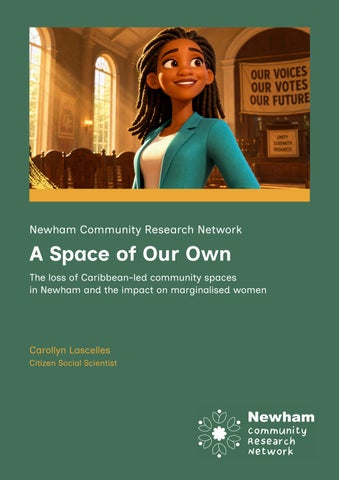
Creative Output The Decline of Caribbean-Led Spaces in Newham: An Animation For her creative output, Carollyn created an animation to highlight this issue, because it brings the data and lived experiences to life in a more accessible, engaging and hard-hitting format. The animation follows a Caribbean citizen scientist as she tells the story of the research: the spaces that have disappeared, the unpaid carers with nowhere to turn, the money leaving the borough, and her recommendations to Newham Council. Throughout, viewers hear statements taken directly from the people Carollyn interviewed – their words, verbatim. At the CROWN showcase, the animation was shown alongside her report and a comic strip made from stills of the animation, which visitors could read and listen to on headphones.
Carollyn’s display at the CROWN showcase at ELBWO: the comic strip, headphones for the animation, an exhibition label and her full report.
Stills from Carollyn’s animation, arranged as a comic strip: the title page, and the opening of the story.
The focus group and the invisible carers: words taken directly from the people Carollyn interviewed.
The economic leak, and the vision of a multifunctional Caribbean-led hub for Newham.
“It is about a home. A place to preserve our recipes, our stories, our patois.” The animation closes with Carollyn’s recommendations to Newham Council.
A Space of Our Own
Recommendations The evidence gathered through a focus group, interviews, reading previous studies and participatory mapping shows a very clear story. Over three decades, the Caribbean community spaces in Newham that we used to rely upon have disappeared. The loss of these spaces has impacted heavily on marginalised women: unpaid carers who provide over 50 hours of care a week, women with no culturally appropriate respite, and families with nowhere to hold cultural events like Nine Nights without restrictions. There is an economic cost too. An estimated £14–28 million leaves Newham each year as Caribbean residents travel outside the borough for entertainment, dining and cultural events – money that could be recaptured by a multifunctional community hub in the borough, creating jobs and supporting local businesses. My recommendations for Newham Council are:
1. Adopt a Community Asset Transfer policy for culturally specific spaces Newham Council should adopt a specific Community Asset Transfer (CAT) policy that prioritises culturally specific community spaces, especially those serving marginalised groups. This policy should include clear criteria, a streamlined application process and a dedicated officer to support community groups. The Council should also commission a comprehensive audit of community infrastructure in the borough, categorised by culture and faith group, to identify gaps in provision, with a specific focus on spaces serving marginalised women. This research has identified a clear disparity between the infrastructure available to Caribbean communities and that of other faith and cultural groups; a formal audit would provide the evidence base for strategic decision-making.
2. Support a pilot community hub Newham Council should identify a suitable council-owned building for a six- or twelve-month pilot community hub, operated by a Caribbean-led organisation such as NuDawn CIC. The pilot would test the model of a multifunctional, selfsustaining hub with:
31
32
Newham Community Research Network
A licensed bar and eatery Creative studios Exhibition space Respite facilities for carers A museum dedicated to Caribbean history This research has demonstrated strong community demand, with 74% of participants saying they would spend money at a Caribbean-led hub in Newham. A pilot would provide the evidence needed to scale up the model.
3. Appoint a dedicated officer for community-led spaces Appoint a named officer within the Community Neighbourhoods or Regeneration team to act as a single point of contact for community groups seeking to establish or maintain communityled spaces, providing advice on asset transfer, leasing, funding and governance. Community groups consistently report confusion about who to contact at the council and how to navigate the asset transfer process. A named officer would remove this barrier. 4. Establish a ring-fenced fund for ethnic-minority-led community spaces Create a small grants fund specifically for ethnic-minority-led community organisations seeking to establish or maintain community spaces. The fund should be accessible, with a simple application process and minimal bureaucracy. Nationally, less than 1% of UK charitable grant funding goes to such organisations, and during the pandemic over 90% were at risk of closure. A ring-fenced fund would help address this systemic inequality. References
Baobab Foundation (2021). Digging Deeper: Insights on tailored funding to organisations led by Black people and communities experiencing racial injustice in 2020. London Borough of Newham (2025). Newham Growth Plan 2025–2030. London Borough of Newham. Community Wealth Building Strategy. London Borough of Newham. TRID Programme – Tackling Racism, Inequality and Disproportionality. Office for National Statistics (2021). Census 2021 – Ethnic Group, Newham. Office for National Statistics (2011). Census 2011 – Unpaid Carers, Newham.
Carollyn in the audience at the CROWN showcase at ELBWO, celebrating the work of her fellow citizen scientists.
34
Newham Community Research Network
Acknowledgements I want to thank the residents of Newham who participated in my focus group and interviews. They shared their stories, frustrations, needs and hopes with honesty and clarity. They trusted me with their experiences, and I feel a huge responsibility to translate the data and evidence correctly in my final report. I am grateful to the unpaid carers who spoke with me. I understand and can empathise with their struggles. A big thank you to ELBWO for the opportunity to take part in this course and for allowing me to use their space to host my focus group. An especially big thank you to Natalie for this opportunity, her support and her belief in my abilities. I am very grateful to UCL and C.R.O.W.N for providing me with the training, support and platform to conduct this research. I have learned so much, especially about what it means to be a citizen scientist, and I have enjoyed the process of turning lived experience into evidence, and evidence into action. I want to thank Joseph and Twinkle for their time, support and sharing of knowledge, and for listening to my random conversations! Thanks to Compost London and UK Research and Innovation (UKRI) for funding this programme and understanding the importance and value of community-led research. A very special thank you to Quincy ‘The Cockney Prince’ for attending my focus group, dedicating part of his radio show to this topic, and agreeing to ask some of my questions live on air so that I could transcribe the responses. His show enabled me to reach a much wider audience across Newham. Thank you to former Councillor Lew Boyce for his time, encouragement and invaluable insights into the workings of Newham Council and the history of community spaces in the borough.