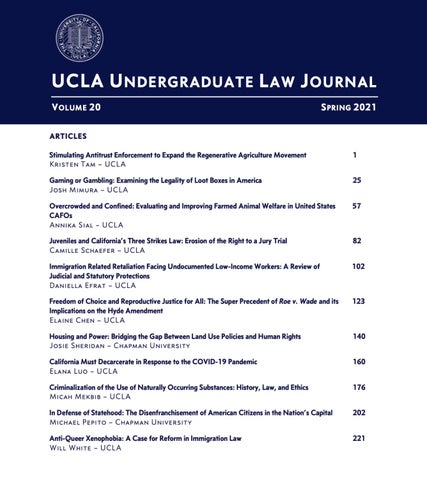
UCLA UNDERGRADUATE LAW JOURNAL VOLUME 20
ABOUT THE CONTRIBUTORS
SPRING 2021
Olivia Bielskis is a second year at UCLA from Walnut Creek, California studying political science and human biology and society. She hopes to attend law school and learn more about the intersection of science and the law, focusing particularly on public health or biotechnology policy. Outside of school and law journal, Olivia loves cooking, running, and getting involved on campus with Bruin Democrats, UCLA Cub Tours, and volunteering with UCLA UniCamp. Elaine Chen is a fourth-year political science student at UCLA. In addition to her involvement with the Undergraduate Law Journal, she is also an opinion columnist with the Daily Bruin. She would like to dedicate this article to the grassroots organizing efforts that continue to amplify the injustices of the Hyde Amendment, namely from the Black Women’s Health Imperative, American Civil Liberties Union, and Planned Parenthood. Angela Chizhikyan is a third year political science major and entrepreneurship minor at UCLA. She plans to graduate in the spring and attend law school the following year. She would like to thank Michael for his dedicated research and thoughtful insight on an issue affecting thousands of Americans. Sara Eckmann is a sophomore studying history at the University of California, Los Angeles. In addition to her involvement with the Undergraduate Law Journal, she is a member of the Pre-Law Society Executive Board and an editor of the Quaestio UCLA History Undergraduate Journal. Sara hopes to attend law school after graduating from UCLA. Daniella Efrat is pursuing a bachelor’s degree in political science and minoring in labor studies and public affairs. She serves as a member of JusticeCorps in Los Angeles, and volunteers at the Employment Rights Clinic at Bet Tzedek. Previously, Daniella interned with the U.S. Equal Opportunity Commission, and in the Wage Unit of the California Labor Commissioner. She is currently a UCLA Research Fellow, where she conducts research on immigration-related employer retaliation experienced by undocumented workers in California. After graduation, Daniella plans to pursue a dual JD/Ph.D. in Sociology program. Maya El Jawhari is a fourth-year political science major and public affairs minor at UCLA. On campus, Maya has worked with different organizations to increase student engagement in politics. Outside of class, she is interning with the
UCLA UNDERGRADUATE LAW JOURNAL VOLUME 20
ABOUT THE CONTRIBUTORS
SPRING 2021
Planned Parenthood Advocacy Project (PPAP) to help make sex and reproductive healthcare more accessible to the Angeleno community. Maya is excited to graduate in the spring and focus on a career in education and healthcare policy. Natalie Isayan is a UCLA alumna from the Department of English and the Department of Classical Civilizations. When she’s not editing Elaine's fantastic writing, Natalie spends her time working at a Los Angeles law firm and involved in local community cultural projects. Natalie Jiang is a second year studying political science and philosophy at UCLA. Outside of the Journal, she is also involved with the UCLA Mock Trial team and the USAC Office of the President. She hopes to attend law school one day. J.T. Keane is a third-year Political Science major with minors in History and Labor Studies. J.T. is the incoming President of the UCLA chapter of Phi Alpha Delta, the largest law fraternity in the nation, and this is his second year working on the Journal. He plans on applying to law school in the fall and hopes to work in criminal defense or labor/employment law. Amanda Kim is a junior political science major at UCLA. She is eager to attend law school in order to pursue a career in digital law. Elana Luo is a third-year student studying English at UCLA. She plans on attending law school in the future. Elana would like to thank her editor, J.T., for his thoughtful feedback and support on this article. Micah Mekbib is a third-year political science and philosophy student at UCLA. Micah’s interests are informed by her campus involvements in Kappa Alpha Pi Pre-Law Co-Ed Fraternity, Hip Hop Congress, Cub Tours, and as a New Student Advisor. One of her career goals is to combat mass incarceration while advocating for transformative justice. Her other passions include picnics, creating art and artivism, and personality tests. Micah thanks her editor, Anna Sharudenko, for her diligent commitment and invaluable contributions to making her article the best it can be.
UCLA UNDERGRADUATE LAW JOURNAL VOLUME 20
ABOUT THE CONTRIBUTORS
SPRING 2021
Josh Mimura is a third year undergraduate student pursuing a major in public affairs and minor in digital humanities at UCLA. He is an aspiring lawyer who is passionate about ensuring an equitable legal transition into the digital future. Michael Pepito is a first-year student at Chapman University triple majoring in economics, political science, and peace studies. Originally from Fairfax, VA, this is Michael’s first year writing for the UCLA Undergraduate Law Journal. In the future, Michael plans to attend law school to specialize in international law or economics. Michael would like to dedicate his article to Congresswoman Eleanor Holmes Norton for all the work she’s done fighting for D.C statehood. Finally, Michael would like to thank Angela for her constructive feedback and camaraderie during the editing process. Madelyn Romberg is a third year at UCLA, double majoring in Atmospheric and Oceanic Sciences and History. Beyond the Undergraduate Law Journal, Madelyn is a Learning Assistant for various courses at UCLA and is the President of The Bruin Experiment, a non-profit organization that mentors students in the Los Angeles region. After she graduates, Madelyn plans to pursue a law degree and launch her campaign for public office. Camille Schaefer is a third-year UCLA student majoring in Public Affairs and minoring in Education Studies. Outside of the Undergraduate Law Journal, Camille is involved with UCLA's Mock Trial Team, she is a UCLA Campus Tour Guide, and she's a member of the University Catholic Center. After graduation, Camille plans to attend law school and pursue a career in criminal law. Camille wants to thank her editor, Niabi Campbell, for her diligent and comprehensive assistance in making this article possible. Anna Sharudenko is a fourth-year English undergraduate student at UCLA, originally from Moscow, Russia. Previously, she was also a copy editor at the Daily Bruin and some of her poetry has appeared in FEM and Westwind. She is interested in social justice and plans to attend law school after graduating from UCLA. Josie Sheridan is a third-year Political Science and Strategic and Corporate Communication student at Chapman University. In addition to her involvement with the Undergraduate Law Journal, she is the President of Chapman's Pre-Law Society, member of the Chapman Real Estate Association, and works at a
UCLA UNDERGRADUATE LAW JOURNAL VOLUME 20
ABOUT THE CONTRIBUTORS
SPRING 2021
litigation firm in the Bay Area that has given her over three years of valuable legal experience. Josie plans to apply to law school and further pursue her profound passion for law. Annika Sial is a third-year English major, with a planned minor in Conservation Biology, at UCLA. In addition to her work with the Undergraduate Law Journal, she is a contributor at the Daily Bruin and an associate editor at UCLA's literary journal, Westwind. Annika hopes to continue researching public interest legal issues in the future. Kristen Tam is a second year studying environmental science at the University of California, Los Angeles. She is also a team leader on the UCLA Sustainability Action Research ASUCLA Licensing team. Kristen is interested in creating climate mitigation solutions through increasing the implementation of regenerative farming techniques. She hopes to do so through studying law and policy and advocating to increase antitrust enforcement, and subsequently bolster government support and frameworks that support regenerative farming practices. Will White is a History major and does debate on the side. Will ranks in the top 4 in the nation in NPDA style debate. Moreover, Will intends on applying to law school this coming cycle and is excited to apply everything he’s learned with the journal.
DANIELLA EFRAT
Immigration Related Retaliation Facing Undocumented Low-Income Workers: A Review ofJudicial & Statutory Protections ABSTRACT. Wage theft, the illegal refusal by an employer to pay workers' wages and benefits that they have earned, disproportionately impacts undocumented, immigrant workers. Undocumented workers encounter significant and unique obstacles when asserting wage claims, often having to balance whether they want to keep a low profile and avoid attracting attention from the authorities, or whether they should assert their legal rights and file a claim with a government agency. Arguably, the most significant barriers impeding undocumented immigrant workers' ability to assert claims of labor violations is the threat of immigration related retaliation by their employer. This article reviews federal statutory provisions and judicial precedent addressing retaliatory actions by employers against undocumented workers asserting a wage claim. It finds that federal statutory law protects undocumented workers from employer's retaliation when asserting wage claims, as it prohibits employers from reprisals when workers engage in protected workplace activity, regardless of the worker's immigration status. Similarly, federal courts have broadly interpreted federal law to prohibit employers from engaging in immi gration related retaliation against undocumented workers. Findings suggest that, although undocumented workers do not have the legal protections to work in the United States, they are seen as equally protected under the law from retaliatory actions by their employer. The article concludes with suggested reform provisions designed to ensure federal law continues to promote dignified employment conditions for workers, regardless of immigration status.
102
Demo6 (Do Not Delete)
5/4/2021 6:39 PM
UCLA UNDERGRADUATE LAW JOURNAL Elaine Chen
Freedom of Choice and Reproductive Justice for All: The Super Precedent of Roe v. Wade & its Implications on the Hyde Amendment ABSTRACT. For decades, the United States Supreme Court has affirmed the constitutional right to access a safe and legal abortion in the landmark decision of Roe v. Wade. Yet, the Court has also stripped that right away from low-income individuals through their decision to validate the Hyde Amendment. The Hyde Amendment prevents the funding of abortions for Medicaid recipients, a group considered to be the nation’s most financially vulnerable demographic. Taking away such a fundamental right from this class not only disproportionately burdens them financially, but directly contradicts the right to freedom of choice every person is promised. This article will argue against the legality of the Hyde Amendment by advancing a legal theory known as “super precedent” and applying it to the Supreme Court decision in Roe v. Wade. In addition to establishing Roe as super precedent and deeming it contradictory to Harris’s decision, I will discuss how the Hyde Amendment introduces an undue burden on the path to abortion, which deliberately targets and discriminates against the poor. To conclude, I will argue for the immediate repeal of the law, first by exploring how the Supreme Court should reexamine the Hyde Amendment and then by proposing efforts from Congress to pass a law striking it down.
Introduction During the Senate confirmation hearings for her nomination to the Supreme Court, Amy Coney Barrett remained largely tight-lipped with regard to how she
123
Demo6 (Do Not Delete)
5/9/2021 12:13 PM
UCLA UNDERGRADUATE LAW JOURNAL Michael Pepito
In Defense of Statehood: The Disenfranchisement of American Citizens in the Nation’s Capital1* ABSTRACT. Even though the federal government remains reluctant to grant statehood to Washington D.C., the Constitution obliges Congress to enfranchise the district’s citizens. The original Framers of the Constitution did not envision D.C. becoming a large metropolitan city, therefore living constitutionalism is necessary in discussing the issue of D.C. statehood. Though originalists claim that the status quo protects the integrity of the Constitution, they fail to acknowledge that to grant statehood is to restore constitutionally guaranteed civil liberties. Additionally, the capital territory practices several state-like norms, such as seeking consent of the electorate for D.C. statehood and sharing the federal tax burden, that render it worthy of statehood. Moreover, the enumerated powers of the legislative branch in Article 1, Section 3 of the Constitution provide a non-judicial pathway to statehood. Legally, D.C. deserves the right to statehood. To that end, this paper recommends immediate congressional approval of H.R. 5803 and the subsequent ratification of a 28th Amendment that would restore voting privileges to citizens living in the nation’s capital.
1
* This article was written between December and February, 2020-21. On April 22, 2021, HR 5803 was passed by the House of Representatives (216-208), demonstrating a significant step towards D.C. statehood.
202