UCI-OC Poll

JUNE 30, 2026
JUNE 30, 2026
Orange County residents question who benefits from county government but remain divided on how much change is needed.
When Americans declared independence 250 years ago, they embraced a founding principle: that government derives its just powers from the consent of the governed. This summer, as the nation marks that anniversary, the UCI-OC Poll asked Orange County residents how much they trust the government closest to them and whether they believe it is working for people like them.
The answers cut in two directions at once Orange County residents express more trust in local government than in Washington, and views of local government are less divided by party than many of the issues the UCI-OC Poll has examined. At the same time, many residents question whether local government is working equally for everyone. Half of OC residents say county government is run by a few big interests looking out for themselves rather than for the benefit of all people
The findings offer an important comparison with neighboring Los Angeles County, where a recent survey from Loyola Marymount University found even stronger concerns about whether county government represents ordinary residents In Los Angeles, those concerns helped produce broad support for structural reform Orange County residents are also open to change, including expanding the Board of Supervisors and creating an elected County Executive, but many are still deciding whether reform is needed.
institutions,
Trust in government depends heavily on which institution residents are asked about. Six in 10 residents (60%) say they trust their local police department always or most of the time, and a majority (52%) say the same about local community organizations Confidence declines for county and city government, where roughly 4 in 10 residents express that level of trust 42% for county government and 40% for city government. The federal government, often viewed as the most distant level of government, earns the lowest trust of any institution tested at 25%.
These results continue a pattern seen in previous UCI-OC Poll findings: residents are consistently more positive about institutions they encounter directly. Trust falls steadily as government becomes more removed from daily life.
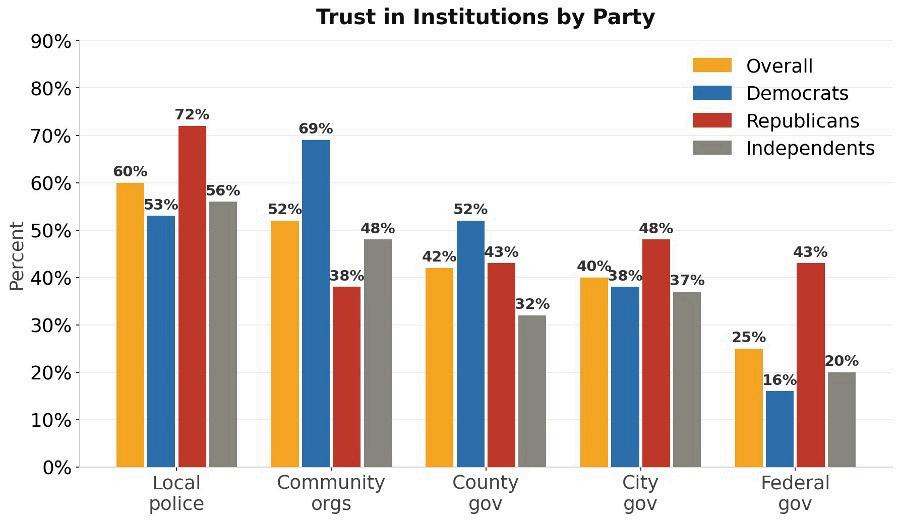
Residents differ significantly by partisan identity, except in their trust of county and city governments.
Similar to previous findings from the UC-OC Poll, Democrats, Republicans and Independents differ significantly in their trust of institutions Whereas 43% of Republicans in Orange County trust in the federal government, only 16% of Democrats and 20% of Independents do. Conversely, 69% of Democrats trust community organizations compared to 38% of Republicans and 48% of Independents.
However, residents’ views of local governments are different On trust in city governments, Republicans (48%) and Democrats (38%) are within 10 points of each other a modest gap by the standards of this survey. On county government, the gap is about the same.
Independents stand out across local institutions as the most consistently skeptical group, with trust in county government at just 32% lower than either Democrats or Republicans In a county where Independents make up more than a third of residents, that persistent skepticism is a significant part of the civic landscape.
A
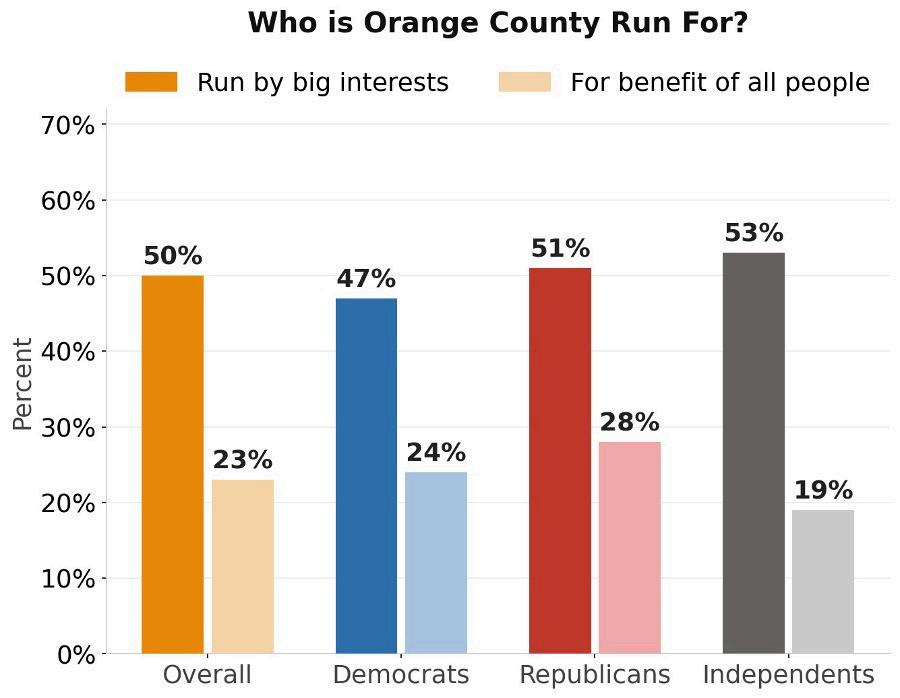
majority say county government works for the
few, not the many — and on this, party differences nearly disappear.
Beneath even the modest partisan differences on local trust lies a more broadly shared concern Half of Orange County residents (50%) say county government is run by a few big interests looking out for themselves, compared with just 23% who say it works for the benefit of all people. This skepticism is shared across party lines almost entirely: Republicans (51%), Democrats (47%), and Independents (53%) land within a few points of each other.
Age matters more than party here Millennials are the most likely to say government serves big interests (57%), while Gen X (49%) and Boomer (48%) residents are somewhat less likely to share that view. Surprisingly, those youngest residents those ages 18-29 are the least likely (45%) to say the county government is run by a few big interests.
This pattern echoes what LMU’s StudyLA found in Los Angeles, where nearly 80% of registered voters said county leaders were more connected to big money interests than to regular people. Orange County’s numbers are less dramatic but point in the same direction a concern that cuts clearly across the county’s partisan divide.
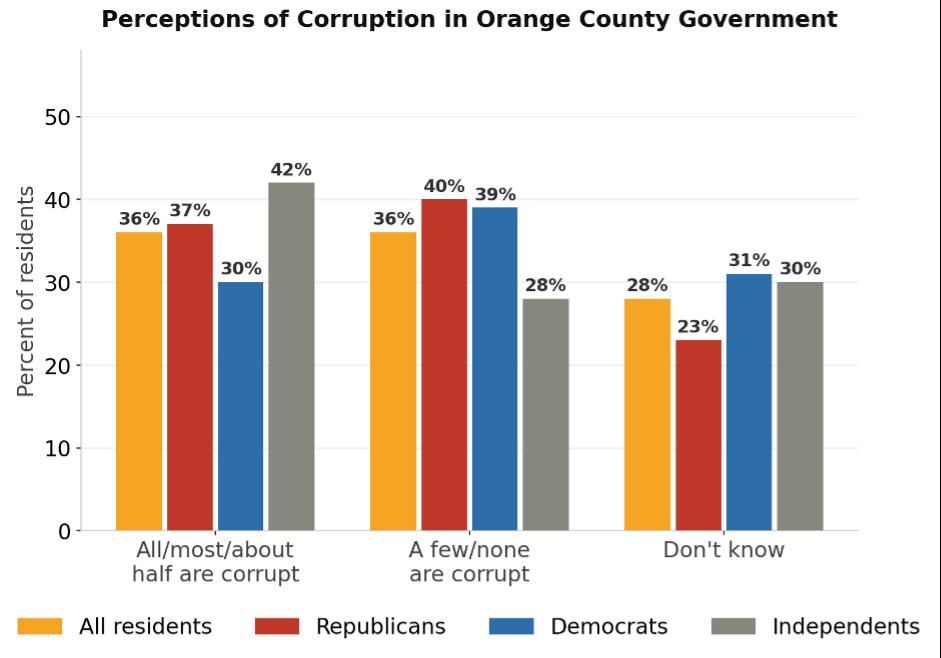
Despite a recent high-profile corruption case, most residents do not see corruption as widespread throughout county government.
Following a federal corruption case involving a former Orange County Supervisor, residents were asked how widespread they believe corruption is in county government Their answers show concern, but not a broad loss of confidence in the institution Thirty-six percent say all, most, or about half of the people running Orange County government are corrupt. By contrast,
nearly two-thirds of residents do not go that far: 36% say only a few officials or none are corrupt, while 28% say they are unsure
Views of corruption also do not follow the same partisan patterns seen on many national issues. Independents are the most skeptical, with 42% saying at least half of county officials are corrupt, compared with 37% of Republicans and 30% of Democrats At the same time, even among Independents, a majority either believes corruption is limited or says they do not know.
The findings underscore a distinction running throughout the survey: Orange County residents question whether county government works equally for everyone, but most stop short of saying corruption is widespread
Residents support a larger Board of Supervisors and elected County Executive, but many are undecided — and OC’s appetite for reform falls well short of LA’s.
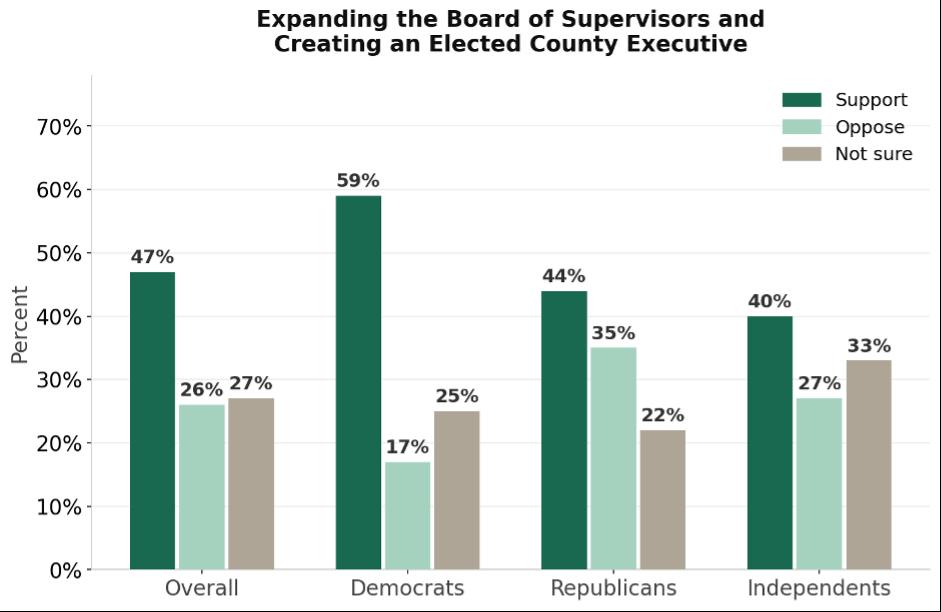
Orange County residents are open to changing the structure of county government. Asked about expanding the Board of Supervisors and creating an elected County Executive, 47% support the proposal and 26% oppose it But 27% say they are not sure among the largest undecided shares on any question in this survey suggesting the idea has not yet registered as an urgent need for many residents.
The contrast with Los Angeles is striking. In the LMU StudyLA survey, 88% of voters supported expanding the Board of Supervisors, a proposal they later approved through Measure G While dissatisfaction in Los Angeles translated into overwhelming support for structural change, Orange County residents remain somewhere in between: concerned about how county government operates, but not yet united behind a specific reform. For that matter, there are significant partisan differences in the appetite for change in Orange County, with Democrats strongly (59%) supportive compared to Republicans (44%) and Independents (40%) Notably, opposition fails to register above 35% regardless of partisan identification.
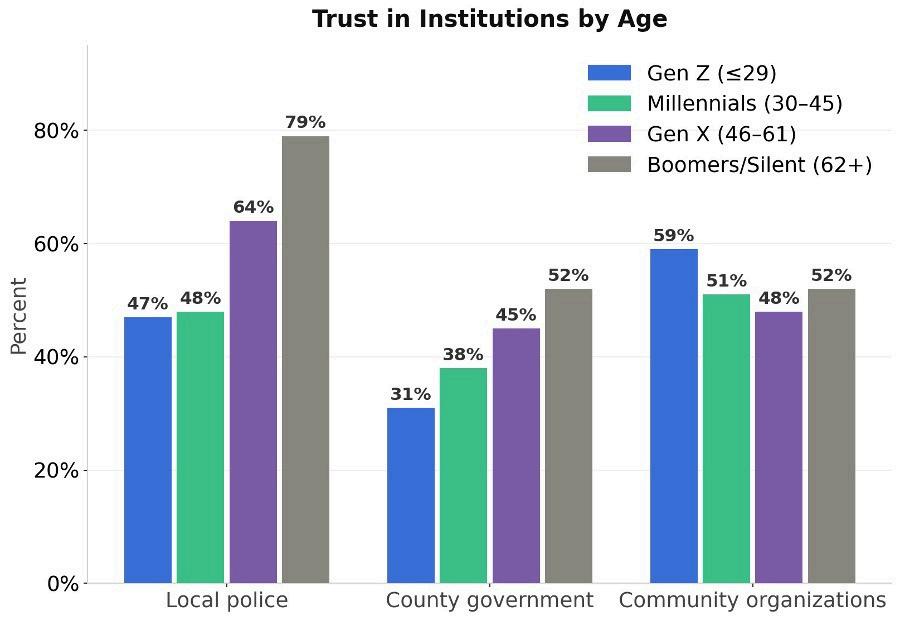
Age is one of the strongest predictors of trust in local institutions, with differences especially pronounced on policing Nearly 8 in 10 Boomer and Silent Generation residents (79%) trust their local police department always or most of the time. That figure falls to 64% among Gen X, 48% among Millennials, and 47% among Gen Z a 32-point gap between the oldest and youngest cohorts. A similar gradient holds for county government, where trust runs from 52% among Boomers down to 31% among Gen Z.
Younger residents have not disengaged from local civic life entirely, however Gen Z residents trust local community organizations at 59%, higher than the county average of 52% and higher than any other age group. Thus, the picture is not one of blanket distrust. It reflects a generational difference in which younger residents are more skeptical of government and law enforcement while maintaining greater confidence in grassroots community organizations
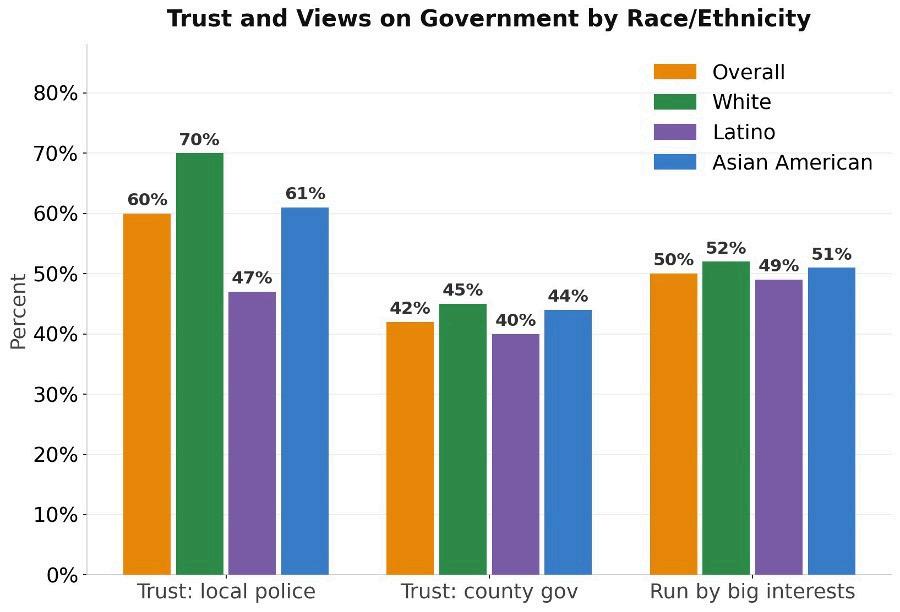
Racial and ethnic groups differ in their trust of local policing. They largely converge, though, on county government.
Race and ethnicity shape trust in some institutions more than others The widest differences appear on policing: 70% of White residents trust their local police department always or most of the time, compared with 61% of Asian American residents and 47% of Latino residents a 23-point gap between the highest and lowest groups
Those differences narrow sharply on local government Trust in county government is relatively similar among White (45%), Latino (40%), and Asian American (44%) residents. On whether county government serves powerful interests over ordinary people, the groups converge almost entirely roughly half of White, Latino, and Asian American residents share that concern, with differences of just a few percentage points
The divide on policing is real and significant. On the broader question of government accountability, Orange County’s racial and ethnic communities are telling much the same story.
The Orange County Poll was conducted by the University of California, Irvine in partnership with TrueDot, which fielded the survey. Researchers interviewed 1,202 adults residing in Orange County, California from March 24–31, 2026 The survey was offered in both English and Spanish, with 70 interviews completed in Spanish.
The survey employed a hybrid sampling design. A total of 695 interviews were conducted with registered voters sampled from the Orange County voter file and reached via text message. An additional 507 interviews were completed with adults recruited through online survey panels. Responses from both samples were combined for analysis
To ensure the sample reflects the adult population of Orange County, post-stratification weights were applied along key demographic dimensions, including age, race/ethnicity, educational attainment, and gender. Weights were further calibrated to align with results from the 2024 general election.
The modeled error estimate for the full sample is ±33 percentage points at the 95% confidence level. The modeled error estimate accounts for the complexity of the sampling design, including weighting and the use of non-probability panel sources, and should be interpreted as an approximation of total survey error rather than a traditional margin of sampling error. Subgroup estimates carry larger modeled errors.
Comparisons to the Loyola Marymount University StudyLA survey refers to a poll of Los Angeles County registered voters conducted October 16–28, 2025, with a margin of error of ±3.1%.