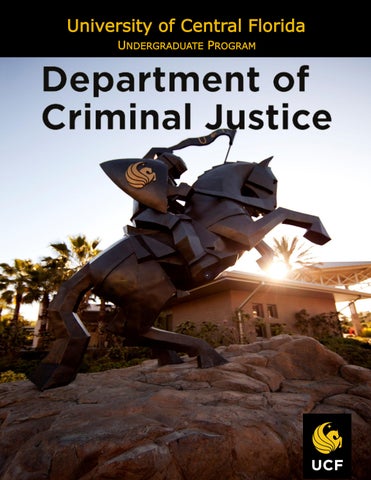
University of Central Florida UNDERGRADUATE PROGRAM
The Department of Criminal Justice at the University of Central Florida provides excellence in teaching, research and service. Dedicated to its students, the faculty delivers outstanding instruction at the undergraduate and graduate levels, incorporating learning, service, and inquiry. The department also conducts quality research and pursues local, state, and federal funding to advance knowledge in our discipline. By actively developing meaningful partnerships, the department provides exemplary service to the university and the broader professional and academic community. BACHELOR OF ARTS/ SCIENCE IN CRIMINAL JUSTICE
MASTER OF SCIENCE IN CRIMINAL JUSTICE
The criminal justice undergraduate program at UCF is designed to provide students with a broad understanding of crime and society's control mechanisms, as well as to prepare them for professional careers in criminal justice and related professions. Many students use this degree as preparation for graduate school.
The department offers a Masters of Science in Criminal Justice that prepares future criminal justice organizational leaders to be consumers of research and to be able to summarize and present organizational information.
CERTIFICATE PROGRAMS UCF offers many certificate programs to supplement existing programs and to provide specialized knowledge in various disciplines. In addition to undergraduate and graduate degree programs, the department offers nine certificate programs.
The fields of public administration and criminal justice are closely connected, and they can overlap in public, non-profit, and private organizations. This program emphasizes research, theory, policy, and organizational administration in both fields and prepares students for leadership roles.
INTERNSHIPS
DOCTOR OF PHILOSOPHY IN CRIMINAL JUSTICE
The department provides undergraduate students an opportunity to participate in an internship experience in various criminal justice settings. Internships allow students to apply concepts and issues learned in the classroom and engage in experiential learning that may affirm their career decisions.
DUAL MASTER OF PUBLIC ADMINISTRATION & CRIMINAL JUSTICE
The Doctoral Program in Criminal Justice prepares social scientists in the scientific method and analytical techniques in relation to criminal justice theory and institutions. Students choose a specialty in policing, correctional, or juvenile justice theory and research..
University of Central Florida College of Community Innovation and Education Department of Criminal Justice 12805 Pegasus Dr., Bldg. 80, Suite 311 Orlando, FL 32816-1600 407-823-2603 ccie.ucf.edu/criminaljustice
1
CRIMINAL JUSTICE FACULTY
FACULTY DISTINCTIONS Top 10 in Article Market Share for Criminology Journals
450+ Graduates each year
Distinguished Scholar award winners National and International research partners
UCF CJ FACTS
Online Degrees
Eugene Paoline III, Ph.D. Professor and Department Chair William Moreto, Ph.D. Associate Professor and Graduate Programs Director Thomas Baker, Ph.D. Associate Professor and Undergraduate Program Director Cory Watkins, Ph.D. Associate Professor and Internship Coordinator Professor Jacinta Gau, Ph.D. Matthew Nobles, Ph.D. Lee Ross, Ph.D. Ross Wolf, Ed.D. Associate Professor Michael Caudy, Ph.D. Kristina Childs, Ph.D. Stephen Holmes, Ph.D. Karol Lucken, Ph.D. Jennifer Peck, Ph.D. James Ray, Ph.D. Jill Viglione, Ph.D. Assistant Professor Zachary Buckner, Ph.D. Senior Lecturer Gail Sears Humiston, Ph.D. Mark Winton, Ph.D. Associate Lecturer Todd Bricker, Ph.D. Debra Ross, Ph.D.
Bachelor of Arts/Science in Criminal Justice Master of Science in Criminal Justice Dual Master of Public Administration/Criminal Justice Undergraduate and Graduate certificates
Lecturer Nicholas Paul, Ph.D. Jon Gurney, J.D., Ed.D. Senior Instructor Iryna Malendevych, M.S. Instructor Bruce Vail, M.S.
2
BACHELOR OF ARTS OR BACHELOR OF SCIENCE IN CRIMINAL JUSTICE
The Department of Criminal Justice at the University of Central Florida offers an undergraduate program leading to a Bachelor of Arts (B.A.) or a Bachelor of Science (B.S.) in Criminal Justice. The program is designed to provide students with a broad understanding of crime and society’s control mechanisms, as well as to prepare them for professional careers in criminal justice and related agencies. As a multidisciplinary field of study, criminal justice incorporates the substance and perspectives of psychology, sociology, political science, and law. The department also provides an opportunity for an internship experience in various criminal justice settings, which gives students the opportunity to affirm their career decision as they relate class material, presentations and discussions to practical issues. Many students also use the degree as preparation for graduate school. Bachelor of Arts students are required to complete a one-year, college-level proficiency in a foreign language. General Requirements • Completion of the UCF general education program (GEP) requirements (including foreign language requirements) • Two years of one foreign language in high school, or one year of one foreign language in college (or equivalent proficiency exam) prior to graduation. Two years of one foreign language in high school satisfies the BS in Criminal Justice language requirement • Completion of the following prerequisite course work (suggested, but not required): - American National Government - Introduction to Sociology - Introduction to Psychology - Economics Application Procedures Submit an application to the undergraduate office by the appropriate deadline listed in the catalog. Admission There are no other requirements for admission to the undergraduate program. However, students must formally declare a major in criminal justice to be eligible for a degree.
For further information: Department of Criminal Justice University of Central Florida 12805 Pegasus Drive HS1, Suite 311 Orlando, FL 32816-1600 407-823-2603 www.ccie.ucf.edu/criminaljustice
General advising services: Undergraduate Student Affairs 407-823-3723 Internship information: www.ccie.ucf.edu/criminaljustice /internships
UCF undergraduate application: Office of Undergraduate Admissions 407-823-3000 http://www.ucf.edu/admissions Financial aid and scholarship information: Office of Student Financial Assistance 407-823-2827 www.finaid.ucf.edu Other resources: Academy of Criminal Justice Sciences www.acjs.org American Society of Criminology www.asc41.com
3
CRIMINAL JUSTICE PROGRAM
Criminal justice is an interdisciplinary field of study that focuses on police, corrections, courts, juvenile justice, security, as well as psychology, sociology, and the political nature of crime-control agencies in the criminal justice system. The curriculum reflects the dynamic nature of the field and prepares students for challenging careers in public service.
DEGREE REQUIREMENTS: 1. General Education Program (GEP) requirements (see Undergraduate Catalog at https://www.ucf.edu/catalog 2. Special college and/or department requirements (see Undergraduate Catalog) 3. Required Criminal Justice CORE courses (30 hours): A "C" (2.0) or better is required in each core class CJE 3001 Careers in Criminal Justice CCJ 3014 Crime in America CCJ 3024 Criminal Justice Systems CJE 4014 Police and Society CJL 3510 Prosecution and Adjudication CJC 3010 Corrections and Penology CCJ 4678 Race, Ethnicity, Equity, and (In)justice CCJ 4701 Research Methods in Criminal Justice
(CCJ4701 Research Methods and CCJ4746 Data Analysis cannot be taken together)
CCJ 4746 Data Analysis for Criminal Justice (PR: CCJ 4701) CCJ 4054 Capstone: Criminal Justice Ethics
(Students must complete all other CORE classes before taking this course)
4. Criminal Justice Restricted electives (21 Hours): 21 additional hours of upper-division CCJ, CJC, CJE, CJJ, CJL, CJT, DSC or SCC course work. Seniors may satisfy up to six hours of this requirement with internships and up to six hours with directed independent study; however, the combination of these non-class options shall not exceed nine hours. Program standards must be met to be eligible for either internships or independent study credit. 5. Criminal Justice Supportive electives (9 Hours): 9 additional semester hours of upper division criminal justice course work or supporting courses. Any combination of additional criminal justice electives or supporting elective course work may be used to meet the 9 hours. Supporting electives courses should be selected from an approved list provided by the department. These courses may vary from student to student depending upon individual needs or objectives. The supporting course requirements may also be met by using 9 hours from a completed minor in another program approved by the department. Students are responsible for the requirements of a second major or minor limiting overlapping credit hours between two or more programs. 6. Students must take a minimum of 36 hours in criminal justice at UCF and complete a total of 120 unduplicated credit hours. For the most complete, up-to-date degree and program requirements, Undergraduate Catalog
4
Criminal Justice BA/BS Degree CORE and Restricted Electives CORE: 30 credit hours
Restricted Electives: 21 credit hours
For the most complete, up-to-date degree and program requirements, see the official UCF undergraduate catalog at https://www.ucf.edu/catalog All listed courses are 3 credit hours each
Course
Title
Course
Title
CJE 4012
Crime, Place, & Prevention CJ Information Technology & Data Management Criminal Profiling In CJ
CJE 4352
Policy Dev. In Law Enforcement
CJE 4572
Justice Agency Operations
CJE 4610
Criminal Investigations
CJE 4630
Serial Murder & CJ
CJE 4654
CJE 4694
Crime and Place Crime Mapping and Pattern Analysis Cybercrime And The CJ System
CJJ 4564
Juvenile Justice System
DSC 4012
Terrorism
DSC 4013
Homeland Security & CJ
CCJ 3007
Origins Of Criminal Justice
CJE 3444
CCJ 3450
Criminal Justice Management and Liability Issues
CJE 3662
CCJ 3604
Mental Illness, Crime, and CJ
CCJ 3667
Victims and the CJ System Crime Intelligence and Investigative Support Analysis Interviews & Interrogations Punishment & Torture Death Penalty Ritualistic Crime & Investigation Older Adults & The CJ System Organized Crime Drugs & Crime
CCJ 4076 CCJ 4195 CCJ 4334 CCJ 4361 CCJ 4611 CCJ 4632 CCJ 4641 CCJ 4651 CCJ 4670
CJE 4663
CCJ 4690 CCJ 4941
Women & Crime Domestic Violence & The Justice System Sex Offenders and The CJ System Criminal Justice Internships
CCJ 4955
Study Abroad
CCJ 4681
CHARGE ON IS A CHALLENGE
TO DO
EXTRAORDINARY THINGS
5
Criminal Justice Supportive Coursework 9 credit hours (3 courses) Supportive Course Work- 9 hours of APPROVED upper level coursework OR any Minor Discipline Accounting
Course ACG 2021 ACG 2071
Anthropology
Chemistry
ACG 3501 ANT 4183 ANT 4481 ANT 4521 CHS 3501 CHS 3505 CHS 3511 CHS 3530 CHS 3595 CHS 4515
Communications COM 3011 COM 4014 COM 4416 COM 4461 COM 4462 MMC 3200 SPC 3301 SPC 4331 SPC 4426 Computer ScienceCGS 2100 CGS 2545 Writing
Health Sciences Statistics
Nursing Political Science
ENC 3241 ENC 3250 ENC 3314 ENC 3315 ENC 3331 ENC 3373 ENC 4353 HSA 3111 HSA 4201 STA 2023 STA 4163 STA 4164 NUR 4516 INR 4076 INR 4114 INR 4351 INR 4363 INR 4401 INR 4764
Title Principles of Financial Accounting Principles of Managerial Accounting Financial Accounting for Gov't and Nonprofit Org. Archaeological Sciences Anthropology of Drugs and Addiction Forensic Anthropology Introduction to Forensic Science Forensic Microscopy Trace Evidence Forensic Analysis of Controlled Substances
Discipline
Course
Title
Contemporary Revolution and Political Science (cont.) CPO 3057 Political Violence POS 3233 Political Opinion POS 3234 Protest in American Politics POS 3235 Mass Media Politics POS 4284 Judicial Process & Politics POS 4407 The Intelligence Community POS 4603 American Constitution Law I POS 4604 American Constitution Law II POT 3204 American Political Thought POT 3302 Modern Political Ideologies Philosophy PHI 3638 Ethical Issues in the 21st Century Psychology CLP 3143 Psychopathology CLP 4390 Forensic Psychology Forensic Science in the Courtroom DEP 2004 Developmental Psychology Forensic Crime Scene EXP 3304 Motivation and Emotion Investigation PCO 4203 Interviewing & Counseling Communications and Human PPE 3003 Personality Theory & Research Relations PSB 3002 Physiological Psychology Gender Issues in Communications SOP 3004 Social Psychology SOP 3724 The Psychology of Prejudice Terrorism & Communication SOP 3751 Legal Aspects of Psychology Intercultural Communication Public Administration PAD 3003 Public Administration in America Conflict Management Professional Administrative Mass Communications Law Interpersonal Communication PAD 3733 Writing in the Public Sector Nonverbal Communication The Administration of Public Group Dynamics PAD 4034 Policy Computer Fundamentals for PAD 4104 Administrative Theory Business Applications PAD 4204 Fiscal Management Database Concepts PAD 4414 Human Resource Administration Writing for the Technical Human Behavior and Social Professional Social Work SOW 3104 Environment I Professional Writing Human Behavior and Social Writing & Rhetoric Foundations SOW 3111 Environment II Argumentative Writing Sociology SYA 3110 Social Theory Rhetoric & Civic Engagement Cultural Rhetorics SYG 2010 Social Problems Writing for Social Change SYO 3410 Mental Health in Society US Health Care Systems SYP 3510 Sociology of Deviant Behavior Community Health SYP 3511 Sociology of Murder Statistical Methods I SYO 3530 Social Power and Inequality Statistical Methods II SYP 3540 Sociology of Law Statistical Methods III SYP 4004 Constructing Social Issues Crisis in Intervention SYP 4521 Crime Victims in Society Global Drug Policy SYP 4536 Gangs and Society American Security Policy SYP 4550 Patterns of Drug Abuse in Society International Environmental Law Intell. Analysis & Reporting International Law 3 Cyberwarfare Policy
6
CRIMINAL JUSTICE SCHOLAR’S TRACK (BA OR BS) The Criminal Justice Scholars’ Track (BA or BS) at UCF distinguishes high-achieving undergraduate students by recognizing their academic excellence and commitment to scholarship. By meeting departmental requirements, students can apply nine elective credits (5000-level courses) from the Criminal Justice Master’s program toward their undergraduate Criminal Justice degree. This dual credit system allows students to make progress toward their graduate studies while completing their bachelor’s degree. For students considering a graduate degree, this track allows you to explore a graduate degree without committing fully. Students experience what the UCF Criminal Justice graduate program offers without immediately enrolling in a master’s program. Whether you’re aiming for a career in criminal justice or simply want to expand your horizons, the Scholars’ Track provides a unique pathway to both undergraduate and graduate success.
ADMISSION REQUIREMENTS •
An application is required. Applications for this program should be submitted in student’s first semester of junior year. Minimum major and overall GPA of 3.2 for admission.
•
Applicant must declare this specific track with the aid of an advisor. Before being admitted into the track, an Acknowledgment of Policies form must be signed and returned to the program advisor.
•
A grade of “B” (3.0) or better in ENC 1101 and ENC 1102 is required.
•
Students whose major or overall GPA falls below 3.2 out of a possible 4.0 will not be permitted to continue in the track and will be transferred to the Criminal Justice BA/BS degree.
DEGREE REQUIREMENTS •
Students who change degree programs and select this major must adopt the most current catalog.
•
Students should complete the General Education Program before transferring within the Florida College System or State University System.
•
Students must complete three (3) Criminal Justice graduate courses (5XXX), each with a grade of “B” (3.0) or better for a total of nine (9) credit hours; courses are selected under the direction of an advisor. A "B-" does not satisfy this requirement.
Students must earn a grade of “C” (2.0) or better in each undergraduate core course and have an average overall GPA of 2.0 or better in undergraduate courses used toward the restricted electives.
Questions? Contact:
Dr. Gail Humiston Senior Lecturer 407-823-2603 Gail.Humiston@ucf.edu
University regulations regarding the Senior Scholars programs can be found in the UCF Graduate Catalog under Policies > Master’s Program Policies > Senior Scholars
7
CRIMINAL JUSTICE PROFESSIONAL TRACK The Professional Track is designed to provide students with a broad understanding of crime and society's control mechanisms, as well as to prepare them for professional careers in criminal justice and related agencies. As a multidisciplinary field of study, criminal justice incorporates the substance and perspectives across the social sciences. The Professional track requires full-time attendance and is structured to serve both first time in college and Florida College System transfer students (e.g., Direct Connect). The track creates a workforce readiness path for Criminal Justice majors directly from UCF to the criminal justice communities throughout Florida. The Professional Track allows student to pursue the B.A. or B.S. Criminal Justice degree program. Students must complete a total of 60 credit hours: Core 30 hours, CJ Restricted Electives 27 hours, and Supporting Electives 3 hours. The CJ Restricted Electives includes an academy driven internship (12 credit hours), Criminal Justice Management and Leadership Certificate (12 credit hours + 3 credit hours Supporting Electives), and the choice of one additional CJ Restricted Electives.
ADMISSION REQUIREMENTS •
An application is required. Applications for this program should be submitted in student’s first semester of junior year. Minimum major and overall GPA of 2.5 for continuation in the program.
•
Applicant must declare this specific track with the aid of an advisor.
•
Student must have completed the General Education Program (GEP) prior to declaring this track
•
Students whose major or overall GPA falls below 2.5 out of a possible 4.0 will not be permitted to continue in the track and will be transferred to the Criminal Justice BA/BS degree.
•
Student must contact department to sign Acknowledgement of Policies before admitted into track.
DEGREE REQUIREMENTS •
Students who change degree programs and select this major must adopt the most current catalog.
•
Courses designated in the General Education Program may be taken at a Florida College System institution.
•
Students must complete 36 credit hours of study in the Department of Criminal Justice.
•
Students must earn a grade of “C” (2.0) or better in each Core course.
•
Students must earn a minimum 2.5 overall and Criminal Justice GPA.
Questions? Contact:
Dr. Cory Watkins Associate Professor 407-823-2603 Cory.Watkins@ucf.edu
For the most complete, up-to-date degree and program requirements, see the official UCF Undergraduate Catalog
8
CRIMINAL JUSTICE UNDERGRADUATE CERTIFICATE PROGRAMS Crime Scene Investigation Coordinators: Department of Criminal Justice: Dr. Mark Winton, mark.winton@ucf.edu Department of Sociology and Anthropology: Dr. John Schultz, jschultz@mail.ucf.edu Crime scene processing is increasingly becoming a multi-disciplinary endeavor with the application of technology advanced methods. Treatment of the initial crime scene is fundamental not only to the pursuit of offenders, but also to the presentation of the prosecutor’s case once offenders have been apprehended. The certificate program is a means of organizing information required to perform basic crime scene investigations. It provides theoretical and practical information used to assess crime scenes, the technology available and the procedures to employ in order to produce a forensically valuable product. This certificate program requires 15 credit hours of undergraduate coursework.
Credit Hour Requirements: 15 hours
Restricted Upper-Division Electives- 3 hours Select one
ANT 4521 Forensic Anthropology (Summer/Fall) ANT 4183 Archaeological Sciences (Spring only) CJE 4012 Criminal Profiling in Criminal Justice CJE 4610 Criminal Investigations
CJE 4630 Serial Murder and CJ System CCJ 4195 Interview and Interrogations SYP 3510 Sociology of Deviant Behavior CHS 3510 Introduction to Forensic Science ANT 4115C Archaeological Method and Theory
Required Courses- 12 hours
Criminal Justice Management and Leadership
Coordinator: Dr. Todd Bricker, Todd.Bricker@ucf.edu
Management and Leadership skills are required for personnel seeking to move into positions of authority within criminal justice agencies across local, state, federal, and international jurisdictions. Leaders of these agencies should be prepared to meet the challenges of the 21st century regarding administration of human resources, personnel supervision, development, implementation and evaluation of policies, and fiscal management including budgeting and planning. The Undergraduate Certificate in Criminal Justice Management and Leadership is designed to provide a theoretical and practical knowledge-base for students with a desire to gain skills necessary to advance their careers in criminal justice agencies. This certificate program requires 15 credit hours of undergraduate coursework.
Credit Hour Requirements: 15 hours Required Courses- 12 hours
CCJ 3450 The Criminal Justice Management & Liability Issues CJE 4352 Policy Development in Law Enforcement CJE 4572 Justice Agency Operations CCJ 3667 Victims and the Criminal Justice System
Criminal Profiling
Restricted Upper-Division Electives- 3 hours Select one PAD 3003 Public Admin in American Society PAD 4104 Administrative Theory PAD 4204 Fiscal Management PAD 4414 Human Resource Admin
Coordinator: Dr. Mark Winton, Mark.Winton@ucf.edu
Criminal profiling is quickly emerging as a legitimate adjunct to crime investigation services. More sophisticated techniques and tools of criminal investigation are being developed to assist in meeting the challenges facing today’s law enforcement officers. One area that is becoming formalized in law enforcement is criminal profiling, which has recently soared in popularity in practical use and media portrayals. Profiling is a discipline that demands adherence to the principles of teamwork between all elements of the investigation. The certificate program provides both theoretical and practical information related to the types of crimes for which profiling is most useful. This certificate program requires 15 credit hours of undergraduate coursework.
Credit Hour Requirements: 15 hours Required Courses - 12 hours
Restricted Upper-Division Electives- 3 hours Select one
CCJ 3604 Mental Illness, Crime, and Criminal Justice CJE 4630 Serial Murder and the CJ System CCJ 4690 Sex Offenders and the CJ System CJE 4012 Criminal Profiling in Criminal Justice
DSC 4012 Terrorism CJE 4610 Criminal Investigation CCJ 4195 Interview & Interrogations in CJ CLP 3143 Psychopathology
9
CRIMINAL JUSTICE UNDERGRADUATE CERTIFICATE PROGRAMS Victim Advocacy
Coordinator: Dr. Jon Gurney, jon.gurney@ucf.edu
The criminal justice system can be difficult for crime victims to navigate. This Certificate in Victim Advocacy provides a theoretical and practical knowledge base for professionals in various fields who work or plan to work with and advocate for crime victims. This certificate program requires 15 credit hours of undergraduate coursework.
Credit Hour Requirements: 15 hours Required Courses - 12 hours
Restricted Upper-Division Electives- 3 hours Select one
CCJ 3667 Victims and the CJ System CCJ 4632 Older Adults and the CJ System CCJ 4670 Women and Crime CCJ 4681 Domestic Violence and the CJ System
CJJ 4564 Juvenile Justice CCJ 4690 Sex Offenders and the CJ System CCJ 4129 Cultural Diversity in Criminal Justice SYP 4521 Crime Victims in Society NUR 4516 Crisis Intervention SOW 4754 Forensic Social Work Theory
Criminal Justice Prefix Courses Criminal justice prefix courses used in a certificate CAN be used toward the criminal justice major requirement of restricted electives or toward restricted electives for the criminal justice minor. Please see your adviser if you have any questions. All listed criminal justice certificate courses are 3 credit hours each. Other Requirements The following is a list of additional requirements that apply to all certificate programs within the criminal justice undergraduate program: -A minimum overall GPA of 2.0 is required in courses used to satisfy the certificate. -Grades less than “C” (2.0) or “S” from other institutions are not accepted. -At least 12 hours in the program must be earned at UCF. -No credit by exam (CLEP, TSD, military credit) may be used. -Internship or Independent Study credit may not be used toward the program. -Certificates must be declared when completing the intent-to-graduate form. Certificates will be awarded only at the time of degree completion.
10
CRIMINAL JUSTICE INTERNSHIP The Criminal Justice Internship provides students with an opportunity to engage in active experiential learning through placement in a criminal justice agency. Students who qualify may earn three, six or nine upper level criminal justice credit hours through the completion of an internship.
Experiential learning to increase understanding and strengthen community ties BENEFITS OF AN INTERNSHIP EXPERIENCE Gain hands-on skills, insight, and a richer understanding of the operations in a criminal justice agency Opportunities to make professional contacts Gain fuller understanding of the connection between theoretical foundations and practical application Tasks performed prepare students for later employment Some student interns are offered employment and/or or directed toward career paths
ELIGIBILITY
2.5 minimum GPA In last 30 credit hours of study Completed all criminal justice core courses with a “C” or better in each
A full range of internship placement possibilities are available. Possibilities include local, state, and federal law enforcement; court services and correctional agencies; and private agencies, including security, counseling and corrections, and loss prevention placement. Some possible sites include: Federal Internships U.S. Marshals Service U.S. Pretrial Services Dept of Homeland Security U.S. Postal Inspection State Internships FL Dept of Juvenile Justice Dept of Children and Families FL Dept of Law Enforcement Office of Attorney General County Internships State Attorney's Office Brevard/Orange/Seminole /Osceola Sheriff Office Public Defender’s Office Orange/Seminole/Lake County Probation Local Internships Orlando Police Dept Ocoee Police Dept Prosecution Alternative for Youths UCF Victim Services
11
HOW TO APPLY?
Confirm academic eligibility with CJ Internship Coordinator Find an internship placement location Students are responsible for finding their own placement, but leads can be provided. Based on your interests, time constraints, location and other relevant needs, choose several alternatives that are appealing Visit CJ Department site to view a list of internship options. Click on local, county, statewide or federal to view some of the contacts. You are not limited to these possibilities. These are sites that have used student interns in the past and have expressed interest in being a placement site for future interns from the department. All other intern locations sites must be approved. Everything possible will be done to assist you in finding a good fit. Your interests will be matched with the needs of the community. It is highly suggested (but not required) that you make an appointment with the internship coordinator to discuss all possible options. Contact the agency representatives, by e-mail, mail, phone or in person. Inquire as to the internship application procedure. Follow through with the application process. Upon confirmation of an internship placement, make an appointment with the internship coordinator. The internship coordinator must override you into the system so you can register for your internship.
Internship Coordinator:
Dr. Cory Watkins
Associate Professor Internship Coordinator 407-823-2603 University of Central Florida Department of Criminal Justice HS1- 311
Disclaimer: Individual placement sites may impose stricter restrictions or require additional standards. The Department of Criminal Justice works with many internship sites and has contacts with the agencies and respective site supervisors to ensure this website is up to date and host sites continue to possess interest in offering UCF student internship experiences. The University of Central Florida does not insure you during your internship experience or does it vouch for the safety of your internship experience. Every internship opportunity can involve some risk and you are asked to identify and acknowledge these risks with your internship site supervisor at the beginning of your experience. This is to make the student is aware of any circumstances that might result in a potential harmful situation.
12
Study Abroad Offered occasionally Contact program director for details and offerings
COMPARATIVE POLICING IN THE UNITED KINGDOM
13
CRIMINAL JUSTICE HONORS UNDERGRADUATE THESIS The Department of Criminal Justice offers honors undergraduate thesis to eligible criminal justice majors. This program is designed to encourage the best juniors and seniors to undertake original and independent work in their major and gives students the opportunity to enhance their credentials. OVERVIEW Working closely with a faculty committee, students design an honors thesis or project. Students will conduct research in an area of their choice and prepare and defend a written thesis. This option provides serious students with an invaluable experience to better prepare for graduate or law school. The student’s completed and defended written thesis will be published in the University of Central Florida library. Further, the distinction of “Graduation with Honors in Criminal Justice” is indicated on each student’s degree and transcript. THESIS COMMITTEE STRUCTURE The thesis committee consists of a total of three faculty members. One is from the student’s major program or department, who serves as the thesis committee chair. This faculty member must be tenured or tenured track faculty member and must also hold a Ph.D. A second is also from the student’s major or department and hold a Ph.D. The third is from another program or department. Depending upon the research interest of the student, a fourth member could be appointed. This could be an instructor, adjunct faculty member or member of the community with specialized training or knowledge in the student’s field of interest. The chair is responsible for all course grading. SCHOLARSHIPS A limited number of scholarships are available to students pursuing Honors Undergraduate Theses. These scholarships are awarded competitively. Prospective students are encouraged to contact Dr. Jennifer Peck (Program Coordinator, information below), concerning the application process and deadline.
Eugene Paoline, Ph.D., Department Chair Jennifer Peck, PhD. Honors Coordinator Eligible to Serve as HIM Committee Chair Thomas Baker, Ph.D. Todd Bricker, Ph.D. Zachary Buckner, Ph.D. Michael Caudy, Ph.D. Kristina Childs, Ph.D. Jacinta Gau, Ph.D. Stephen Holmes, Ph.D. Gail Humiston, Ph.D. Karol Lucken, Ph.D. William Moreto, Ph.D. Matt Nobles, Ph.D. Eugene Paoline III, Ph.D. Nicholas Paul, Ph.D. Jennifer Peck, Ph.D. James Ray, Ph.D. Debra Ross, Ph.D. Lee Ross, Ph.D. Jill Viglione, Ph.D. R. Cory Watkins, Ph.D. Mark Winton, Ph.D. Ross Wolf, Ed.D.
CONTACT Dr. Jennifer Peck Honors Undergraduate Thesis Program Coordinator, Criminal Justice University of Central Florida Department of Criminal Justice Jennifer.Peck@ucf.edu
All CJ faculty are eligible to serve as HIM Committee Members
14
ALPHA PHI SIGMA The National Criminal Justice Honor Society Founded 1942 Local Chapter: Phi Theta Omega
“Alpha Phi Sigma recognizes academic excellence of Undergraduate and Graduate students of Criminal Justice, as well as Juris Doctorate students. The goals of Alpha Phi Sigma are to honor and promote academic excellence, community service, educational leadership, and unity.” DO YOU QUALIFY? Undergraduate Enrolled at UCF at the time of application Declared a major, minor, or equivalent in the criminal justice or related field Have completed at least 45 credit hours A minimum of four courses of the above coursework must be in the criminal justice field GPA of 3.3 or higher, overall and in the major (criminal justice or related) Graduate Must be accepted and enrolled in a criminal justice or related graduate program at UCF Must have completed four criminal justice or related classes prior to applying, at least one at UCF Cumulative GPA of 3.4 or higher, overall and in the major (criminal justice or related
REQUIREMENTS: Pay a one-time application fee of $85 [$95 for online-only students] Pay the chapter fee each semester ($20) Attend all bi-monthly meetings Complete ten hours of community service Membership dues pay for a membership certificate, pin, and graduation cord HOW CAN APS BENEFIT ME? Excellent resume builder Getting involved with UCF Meet peers with same interests Networking with criminal justice professionals Attend conferences Leadership roles Volunteer opportunities
HOW TO JOIN? Email Debra.Ross@ucf.edu to request an app application. Email the completed application to Dr. Ross Dr. Ross will verify the application and send further instructions
Questions? Faculty Advisor: Dr. Debra Ross President
Debra.Ross@ucf.edu APS@ucf.edu
Join our Facebook group! @Alpha Phi Sigma at UCF Affiliated with the Academy of Criminal Justice Sciences
Member of the Association of College Honor Societies
15
LAMBDA ALPHA EPSILON DZO CHAPTER
UCF’s Pre-Professional Criminal Justice Fraternity LAE is a Co-Ed professional fraternity focused on preparing its members for their futures in Criminal Justice and related fields. Members participate in: Bi-weekly professional business meetings (guest speakers from various criminal justice and related agencies) External professional social events (conferences, competitions, and more) Fun social events (board games, sport activities, and more) Big/Little pairings (new member-current member team) Members organize two annual events: Domestic Violence Awareness and Charity Auction Criminal Justice & Public Service Conference
Community service events Guest Speakers!
Volunteer & Social events!
WHAT CAN LAE OFFER YOU? Active involvement in career and social college life Development of knowledge and employable skills Professional networking Peer mentoring and friendships ELIGIBILITY: UCF Student Professional Interest in the Criminal Justice field (open to all majors) 2.0 cumulative GPA (undergraduate students) 3.0 GPA (graduate students) MEMBERSHIP FEE (semesterly): $105 new members $80 returning members Questions? LAE@ucf.edu Faculty Advisor: Iryna Malendevych Facebook UCF Lambda Alpha Epsilon
16
UNIVERSITY SCHOLARSHIPS
How do I find a scholarship? There are countless public and private scholarships available to college students. Scholarships are awarded for a variety of reasons including academic achievement, financial need, campus and community involvement, and leadership experience, and generally do not need to be repaid. Use Access 2 Opportunities (A2O), UCF’s scholarship application system to search for scholarships. By completing a one-time application, you will be considered for more than 200 scholarships offered by the university and gain access to hundreds of external scholarships, too. Some scholarships are exclusively for Criminal Justice and College of Community Innovation and Education students!
How to apply • • • •
Begin by logging into A2O and completing a short general application. Afterwards, A2O will automatically match you with college scholarships you qualify for. Search for other scholarship opportunities by browsing scholarships awarded through the Office of Student Financial Assistance. Under opportunities, select "ours" for UCF scholarships and external for non-UCF affiliated opportunities. Carefully read the scholarship application criteria. Complete the required actions. For example, upload an essay or resume if required.
Criminal Justice Scholarships • • • • • • • •
Amy Kuritar Lohrmann Memorial Endowed Scholarship Criminal Justice Memorial Quasi-Endowed Scholarship Margaret M. Samet Memorial Endowed Scholarship Fund George DeSalvia Memorial Endowed Scholarship Jallad Family Endowed Scholarship The Detective Barry Pruette Memorial Endowed Scholarship The Jennifer Kesse Criminal Justice Endowed Scholarship Lawrence M. Gerrell Memorial Endowed Scholarship
More information and tips for success at https://www.ucf.edu/financial-aid/types/scholarships/
17
IMPORTANT UCF AND DEPARTMENT OF CRIMINAL JUSTICE POLICIES
Late Add/Drop/Swap Petition • •
•
Limited to students in their final semester and a course necessary to graduate, adding an internship/independent research course, or ROTC. A complete late add petition must be received by Thursday at 12 noon (Eastern Time) of the second week of classes. o A complete petition includes the petition form with both faculty and advisor signatures, a letter of support from the instructor of record, and any supporting documentation. No petitions will be accepted and processed by the Department of Criminal Justice after this deadline.
Withdrawal Policy • •
Students may only withdraw from a course twice. A maximum of three course withdrawals are allowed from 3000+ level courses.
Minimum Credit Hours • •
Students must take a minimum of 36 hours of criminal justice courses at UCF. Students must complete a minimum of 120 unduplicated hours to earn a bachelor's degree at UCF.
Criminal Justice Core Courses •
Students must earn a “C” (2.0 GPA) or better in each core class. o A “C-” (1.75 GPA) does not satisfy this requirement.
Questions?
Contact a Criminal Justice Advisor https://ccie.ucf.edu/criminaljustice/advising/ Find the most up to date polices in the Undergraduate Catalog https://www.ucf.edu/catalog
18
WHAT CAN I DO WITH A CRIMINAL JUSTICE DEGREE? So you are interested in Criminal Justice and you don’t know what you want to do when you leave UCF?
HERE’S WHERE TO BEGIN 1. Consider a few questions: • Do you want to work in the public or private sector? • Do you want to work at a local, state or federal agency? • Do you want to be a sworn officer (with arrest powers, usually carrying a gun and a badge) or work as a civilian employee or conduct research? 2. Research various organizations in each category and search their websites. 3. Build your resume and cover letter by visiting UCF Career Services (career.ucf.edu). Attend workshops and career fairs. 4. Consider internship or volunteer positions 5. Apply for exciting criminal justice careers and employment opportunities. This is a competitive field but with preparation, you can land a great job.
CAREER BUILDER SITES www.linkedin.com www.careeronestop.org www.monster.com www.resume-place.com
FEDERAL JOBS www.usajobs.gov www.opm.gov
STATE JOBS jobs.myflorida.com www.employflorida.com
Need more direction? Have questions? Contact a Criminal Justice Advisor HS1, Building 80, Room 311 407-823-2603
UCF RESOURCES Cooperative Education Co-Op and Internships, Service Learning, and Professional Skills Modules Criminal Justice Internships Local, State, Federal. Private Sector internships
explearning.ucf.edu ccie.ucf.edu/criminaljustice/internships
UCF Career Resource Center Explore careers, Prepare for Interviews, Build Resume and Cover Letter, Handshake
career.ucf.edu
Graduate School Continue your education with a Criminal Justice Master’s or Certificate program
graduate.ucf.edu
Lambda Alpha Epsilon Pre-Professional Criminal Justice Fraternity
LAE@ucf.edu
Alpha Phi Sigma National Criminal Justice Honor Society
APS@ucf.edu
19
FEDERAL AGENCIES In the federal sector sworn and non-sworn jobs are available: agent, inspector, investigator and crime analyst are just a few examples. www.gov.com/agency Defense Air Force, Army, Coast Guard, Marines, Navy and Civilian positions
www.defense.gov
Agriculture Forestry Service, Office of the Inspector General, Food Safety and Inspection Service
www.usda.gov
Health and Human Services Food & Drug Administration (FDA), Center & Disease Control (CDC)
www.hhs.gov
Homeland Security www.dhs.gov Transportation Security Administration (TSA), Border Patrol, US Customs Service, Citizenship & Immigration Services, Federal Emergency Management Agency (FEMA) Justice
www.justice.gov
Drug Enforcement Agency (DEA), Federal Bureau of Investigation (FBI), Bureau of Prisons (BOP) State Bureau of Diplomatic Security, US Intelligence Community, Peace Corps
www.state.gov
Treasury www.treasury.gov Alcohol, Tobacco, Firearms & Explosives (ATF), Internal Revenue Service (IRS), US Secret Service US Courts Probation & Pretrial Services
www.uscourts.gov
STATE AND LOCAL AGENCIES These agencies have similar positions to the federal sector; investigators, uniform patrol, analysts, forensics, and court liaisons are some of the various career paths in state and local agencies. Florida Department of Law Enforcement
www.fdle.state.fl.us
Florida Department of Corrections
www.dc.state.fl.us
Orange County Sheriff’s Office Orlando Police Department
www.ocso.com www.cityoforlando.net/police
PRIVATE SECTION/NON-PROFIT The private sector is a quickly growing field. Some positions that you may see when working in this sector are: private investigation, risk management, loss prevention; graduate degrees may lead into research positions at universities or other research institutions. ASIS (A networking organization of private sector employers) G4S Disney Security Loss Prevention Employment Victim Service Center
www.asisonline.org www.g4s.us www.disneycareers.com www.lpjobs.com www.victimservicecenter.org
20
CAMPUS RESOURCES See catalog for detailed information on each services as well as complete listing of campus resources
ACADEMIC SERVICES
Millican Hall, Room 210
407-823-2691 undergrad.ucf.edu/as
CAREER SERVICES
CSEL, Room 140
407-823-2361 career.ucf.edu
CJ ADVISORS
HS1, Room 311
Responsible for administering academic policies pertaining to academic record changes, curriculum file management, the degree audit program and University-wide undergraduate graduation requirements. Sponsors expos and fairs, career planning classes and employer recruiting visits. Provides information on Occupation Outlook for various careers.
407-823-2603
ccie.ucf.edu/criminaljustice
Provides information about Major/Minor requirements, career opportunities, academic overrides and extracurricular career related activities.
COUNSELING AND PSYCHOLOGICAL SERVICES CAPS, Room 101 407-823-2811 caps.sdes.ucf.edu Provides psychological and academic testing. Mental health counselors and test administrators help students explore and resolve issues / concerns.
GENERAL ADVISING
EDU, Room 110
407-823-3723
ccie.ucf.edu/undergraduate-affairs
Provides general academic advising for students in CCIE Majors. Assists with orientation, registration, graduation and provides workshops tor students on academic probation.
FINANCIAL AID
Millican Hall, Room 107
407-823-2827
finaid.ucf.edu
Provides program eligibility chart and requirements for scholarships, grants and other financial aid questions. The website also includes access to forms and information about FAFSA and work study requirements and opportunities.
KNIGHTS PANTRY Ferrell Commons, Room 171 407-823-3663 studentunion.ucf.edu/knights-pantry Offers food, clothing, shoes, toiletries and other donated items at no cost to students.
MATH LAB
MSB, Room 113
407-823-3489
Assists students with tutoring support for many UCF math classes.
STUDENT ACADEMIC RESOURCE CENTER
sciences.ucf.edu/math/success-center
TCH, Room 117 407-823-2051 https://sarc.sswb.ucf.edu/
Provides academic support programs, supplemental instruction, tutoring and academic advising. Assists in improving time management, note taking, test taking, memory, creative and critical thinking and offers test anxiety workshops.
STUDENT ACCESSIBILITY SERVICES
Ferrell Commons, Room 185 407-823-2371 sas.sdes.ucf.edu
Provides information and individualized services for students with documented disabilities. Services include assistance with registration, disabled parking decals, counseling and referral to campus or community services.
STUDENT HEALTH SERVICES
HC building
407-823-2701
studenthealth.ucf.edu
STUDENT LEGAL SERVICES
SU, Room 304
407-823-2538
sls.sdes.ucf.edu
UCF IT SUPPORT CENTER
CSB, Room 103
407-823-5117
it.ucf.edu
UNIVERSITY WRITING CENTER
TCH, Room 109
407-823-2197
uwc.cah.ucf.edu
Provides quality care for illnesses and accidents with an aggressive health education and lifestyle enhancement program.
Provides a variety of legal services, at no cost, to UCF students.
Provides a variety of computer support, e-mail password assistance and canvas questions.
Assists students who would like to improve their college-level writing skills.
VETERAN’S ACADEMIC RESOURCE CENTER Arena, Room 100 407-823-2707 varc.sdes.ucf.edu Provides information regarding educational benefits for veterans and their dependents. Provides counseling for personal and academic concerns, tutoring and referral to community agencies. Monitors the academic progress of all students receiving DVA educational benefits.
VICTIM SERVICES
JTWC, Room 108
407-823-1200
victimservices.ucf.edu
Provides free, comprehensive victim advocacy services to students, faculty, staff and visitors to campus who have been impacted by crime.
21
UCF CARES We want all students at the university to know that UCF not only cares about their academic success, but their overall wellbeing. Life can get difficult at times, especially while in college. Many students are faced with stressors and challenges that begin to impact their success as a student. These stressors can appear in many different forms: difficulty adjusting to university life, family issues, financial difficulties, abusive relationships, etc. Our goal is to “build a culture of care, one knight at a time, where every UCF Knight cares about the health and safety of one another.”
UCF Cares Focuses on: o Safety and Wellbeing Services o Violence Prevention o Mental Health Support Offering Services in: o Student Care Services o Getting Enough to Eat o Financial or Housing Crisis o Knowing Victims’ Rights and Options o Resources for stalking, harassment, and sexual assault o Counseling Services o Healthcare and Psychiatry o Substance Use Disorders o Legal Guidance o Veterans and Dependent Resources o Academic Accommodations through Student Accessibility Services o Knights Academic Resource Services
407-823-5607
https://cares.sdes.ucf.edu
caremanager@ucf.edu Trevor Colbourn Hall, Suite 133
22
CRIMINAL JUSTICE MINOR
ADMISSION REQUIREMENTS •
The criminal justice minor is available to all UCF undergraduate students. It is well suited for students looking to gain a deeper understanding of the criminal justice system, as well as examine policing, corrections and prosecution practices in our society.
•
Student can declare a minor by logging into their myUCF account, navigating to the Student Self Service tab, selecting "Add/Change Major" and following the instructions on the screen. Student can also stop by the Undergraduate Affairs Office to complete and submit a minor declaration form.
DEGREE REQUIREMENTS- 18 CREDIT HOURS •
Complete the following:
CCJ 3024 Criminal Justice System CCJ 3014 Crime in America •
Complete at least 2 of the following:
CJL3510 Prosecution and Adjudication CJC3010 Corrections and Penology CJE4014 Police and Society •
Complete at least 6 credits from Criminal Justice Restricted Elective courses (see page 5&6, select with aid of an advisor). Up to 3 internship credits may be applicable.
Students must earn a grade of "C" (2.0) or better in each required course used to satisfy the minor. Grades less than "C" (2.0) cannot be used towards the minor. At least 15 hours used in the minor must be earned at UCF within the Department of Criminal Justice. No credit by exam (TSD, Military credit) may be used.
Questions? Contact:
CJadvise@ucf.edu University of Central Florida Department of Criminal Justice HS1- 311 407-823-2603
For the most complete, up-to-date degree and program requirements, see the official UCF Undergraduate Catalog
23
Health Sciences I, Suite 311 407-823-2603 ccie.ucf.edu/criminaljustice