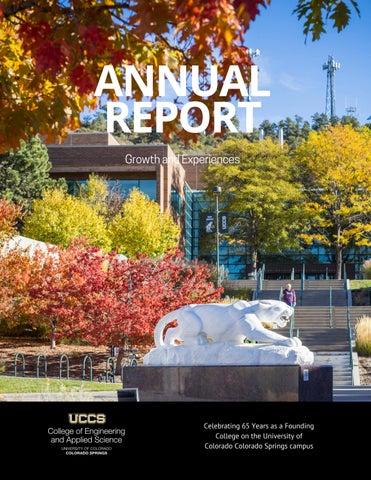
ANNUAL REPORT Growth and Experiences
Celebrating 65 Years as a Founding College on the University of Colorado Colorado Springs campus
WELCOME
Engineering growth for the future Leading purposeful change with an eye to the future Focused change leads to new opportunities. As we prepare to start the renovation, modernization, and expansion of the original Engineering Building, we celebrate our 2024-2025 successes. The college developed a 2+2 BS in Civil Engineering with our two sister campuses to meet regional hiring needs, added an Associate Dean of Research and Graduate Studies, and updated the college’s strategic plan. Staff expanded career programming for students, and faculty increased research funding and awards to a total of $15.3M, while mentoring students in new research areas and applied endeavors at UCCS. Students reached new heights in research, collaborations, competitions in cybersecurity, and experimentation. Two teams sent experiments into space through NASA RockSat and the SSEP experiments program on the International Space Station.
Ying Shang, Dean UCCS College of Engineering and Applied Science
Engineering Mountain Lions are moving forward! Join us.
QUICK STATS Undergraduate Students
Graduate Students
1,362
84%
16%
27%
374
238
137
Undergraduate Students Degree Seeking Full/Part-Time
Colorado Residents 16% Non-Resident
First Generation Students
Military Affiliated Students
Graduate Students On Campus & Online
Graduate Students Engineering Degrees
Graduate Students Computer Science & Cybersecurity Degrees
Page 02
Annual Report
Spotlight Dean’s Award for Excellence
“I’m grateful—to the faculty who invested in me, the mentors who guided me, and the students who inspire me to stay connected. I’m proud to be part of the UCCS community and excited to see where the next generation of engineers takes us.”
Blake Smith, Engineering Manager Jaxon Engineering and Maintenance
4 Questions for Blake Smith
Page 03
You’ve been recognized by the college! Congratulations!
What does it mean to you to represent the engineering industry to students?
I’m truly honored. UCCS played such a big role in shaping my education and career, so to be recognized by the college feels like coming full circle. It’s a meaningful reminder of the strong connection between alumni, students, and the university.
It’s both a responsibility and a privilege. I want students to see how their hard work in the classroom translates into real-world impact, and to show them the wide range of opportunities open to them in engineering.
Why do you engage with UCCS and the college?
What stands out to you in your connection to UCCS?
I know firsthand the value of a UCCS education. Staying engaged gives me the chance to give back—whether through mentoring, supporting students, or helping strengthen the connection between industry and the university.
The sense of community. Faculty, staff, and students genuinely support one another, and that continues well beyond graduation. I see it every day in the number of UCCS alumni I work with and mentor at Jaxon Engineering. Annual Report
Engineering and Applied Science Building Renovation
Retooling Infrastructure All building renderings courtesy of HDR
The original Engineering and Applied Science Building expanded and re-imagined for the next generation of students An innovative architectural design dramatically changes the 40-year old Engineering and Applied Science Building for a planned 1.5-2 year renovation. The exciting project adds space, modernizes learning environments, creates innovative labs, and transforms the entire building with collaborative spaces to create cutting-edge learning experiences for students. Page 04
The renovation extends the front atrium space and creates an expansive multi-purpose collaborative and community event space. Modernizing and moving the Level 1 cleanroom to the cybersecurity building captures two floors of existing air handling and filter space, and expansion to the back patio area translates to new experiential student classrooms and labs. Coming on the heels of the 2024 completion of two new buildings (Anshutz Engineering Center and the Design and Prototyping Center), the college’s footprint now encompasses five buildings on campus. As a founding college of UCCS, the timing is especially meaningful as the Colorado Springs campus celebrates 65 years as a satellite campus. Annual Report
College Highlights
Faculty News Retirements Terry Boult – Distinguished Professor, CS Albert Brouillette – Associate Teaching Professor, CS Leal Lauderbaugh – Associate Professor, MAE John Lindsey – Teaching Professor, ECE Michael Larson – Associate Professor, MAE James Stevens – Professor, MAE Tim Chamillard – Associate Professor, CS
NSF CAREER AWARD
Philip Brown, Associate Professor, Computer Science Department, received the National Science Foundation (NSF) prestigious faculty early career award. His research project is NSF CAREER: Foundations for Real-Time System Security.
New Faculty Brandon Collins, Assistant Teaching Professor, CS Qiang Guo, Assistant Professor, MAE Justin Miller, Assistant Teaching Professor, CS George Ott, Assistant Teaching Professor, ECE Feyza Ozerinc, Assistant Professor, MAE Sezer Ozerinc, Assistant Professor, MAE Promotions Philip Brown, Associate Professor w/Tenure, CS Yanyan Zhuang, Associate Professor w/Tenure CS Steve Tragesser, Professor, MAE Ben Wilcox, Associate Teaching Professor, MAE Awards
RESEARCH FUNDING
Byeong Lee, Tenure-Track/Tenured Outstanding Teacher Yanyan Zhuang, Outstanding Pre-Tenure Researcher Jena McCollum, Outstanding Post-Tenure Researcher Pam Russell, IRC Outstanding Teacher Notable Awards 2024-2025 Gedare Bloom (PI) and Yanyan Zhuang (co-PI), NSFPOSE, National Science Foundation Michael Trimboli (PI) and Gregory Plett (co-PI), (ASPIRE) Advancing Sustainability through Powered Infrastructure for Roadway Electrification, USU Shouhuai Xu, MDR: A High-Fidelity Multi-Domain Range Infrastructure for Conducting Cyber Wargaming and Generating Data, DoD Jugal Kalita, Detecting Fatigue and Assessing Cognitive Performance in Video-Based Meetings, NIH Armin Moin, Quantum Dev (Q-Dev), CU Boulder Todd Bredbenner, Heterogeneous Pathways to Bone Strength Decline and Hip Fracture, University of Michigan Ann Arbor Philip Brown (PI) and Josue Cardoso dos Santos (coPI), SF24B-T011-Deriving Intent from Orbital Data Using Game Theory
Page 06
STRATEGIC PLAN 2030
RESEARCH DEAN
At the annual meeting this fall, Dean Shang shared statistics and outcomes from the 2024-2025 academic year. She reported that research expenditures maintained in the college increased to $15.3M.
Incorporating new UCCS pillars that further define the UCCS Strategic Plan, the updated College of Engineering and Applied Science 2025-2030 Strategic Plan will be published online and has action items for the plan, to be updated yearly.
Heather Song, Ph.D., Professor, was appointed to the position of Associate Dean of Research and Graduate Studies. This position is new to the college. Dr. Song will be a mentoring resource for faculty in grant writing, opportunities, and collaborations. Annual Report
Faculty Profile UCCS Researcher of the Year
Cyber Visionary: Shouhuai Xu’s Mission to Shape the Future of Digital Defense Shouhuai Xu inspires UCCS College of Engineering and Applied Science students to do more. Since joining UCCS in 2021, Xu has advanced the cybersecurity movement at UCCS. His arrival generated a step-up in cyber research and activities: more students engaging in high-level research, publishing papers, and competing in national cybersecurity competitions. Students flock to his cyber-focused events which offer more than an opportunity to present research. They provide a gateway for academic and professional opportunities in a globally critical threat landscape. Xu wears many hats as the Gallogly Endowed Engineering Chair in Cybersecurity, Interim Chair of the Computer Science Department, and Computer Science Professor. In 2022, Xu entered the “$1M Club” for research funding at UCCS and earlier this year, he received the UCCS Faculty Award for Excellence in Research, in recognition of the impact and contributions of his research. Under Xu’s leadership, UCCS achieved a major milestone: becoming the first university in Colorado to earn the National Security Agency’s designation as a Center of Academic Excellence in Cyber Research (CAE-R), adding to the existing Cyber Defense designation. This dual recognition places UCCS at the forefront of cybersecurity education and research. With a 25-year record in research, Xu is the founding Director of the Laboratory for Cybersecurity Dynamics (LCD). The lab explores the foundation for the emerging Science of Cybersecurity, and tackles problems in a holistic way, while creating solid technological foundations. There’s much more to this story...read more Page 05
Shouhuai Xu, Interim Chair, Professor, Gallogly Endowed Chair in Cybersecurity Computer Science Department
Cybersecurity Ecosystem at UCCS College of Engineering and Applied Science Undergraduate & Graduate Research NSA CAE-Cyber Defense NSA CAE-Research Industry-UCCS Research Exchange Days Cybersecurity Significant Speaker Series Cybersecurity DoD Competitions USCYBERCOM, VICEROY Conferences with Research Posters, Papers, Publications, Presentations, Workshops CyberCorps Scholarship for Service DoD Cyber Service Academy Cyber Clubs - CTF and WiCyS VICEROY Cyber Grant & Fellowship UCCS Cyber Programs Office-campus wide cyber programming
https://tinyurl.com/3hnj88da Annual Report
Faculty Profile Outstanding Post-Tenure Researcher
PFAS‑Free, Performance‑Ready Jena McCollum’s research tackles two linked problems in modern materials: how to make high‑performance plastics without PFAS, and how battery‑relevant polymers hold up under mechanical effects. Dr. McCollum’s goal is to prove that it’s possible to have both sustainable materials and high performance. She believes that society doesn’t need to accept a trade-off between environmental stewardship and technological advancement. On the plastics side, her team studies thermoplastics made through PFAS‑free synthesis routes. They use polymer reptation modeling to assess viscoelastic differences in thermoplastics synthesized in different ways, using rheology on these thermoplastics. McCollum leads a collaboration with Dr. Cindy Yee (UCCS, machine learning) and Dr. Brandon Runnels (ISU, inverse modeling), funded by Los Alamos National Laboratory. Most PFAS work is focused on remediation, detection, and destruction. McCollum’s research is unique because she is ultimately focused on how to maintain material supply chains for globally critical technologies while moving away from PFAS in polymer synthesis. “Many of the highest-performing materials have environmental drawbacks and developing replacements that don’t compromise function is a major challenge.” Her second line of work focuses on solid polymer composite electrolytes (PEGDA). The team synthesizes silica nanoparticles and assesses ionic conductivity and mechanics of composite electrolytes using rheology and electrochemical impedance spectroscopy (EIS). The key focus is on ionomechanics – the coupling of electrochemical processes with mechanical loading conditions. This research expands the conversation beyond Page 07
Jena McCollum, Associate Professor Mechanical and Aerospace Engineering Department
conductivity and stability into understanding coupled mechanical–electrochemical behavior, for practical device reliability. This research also broadens student research. Through her NSF CAREER Award, McCollum is integrating course‑based undergraduate research experiences that will test the mechanical resilience of 3D‑printed thermoplastics. Students get hands‑on exposure to advanced manufacturing and rheology, with projects tied to national priorities in materials and sustainability. A recurring lesson in her lab is that “failure” is not a bad word, but a part of increasing creativity and navigating problem-solving to help train and grow resilient engineers and scientists. The implications are easy to see. PFAS‑free plastics help industry manage regulatory and supply‑chain risk without sacrificing performance. And composite electrolytes target next‑generation batteries and flexible electronics where mechanical durability and electrochemical performance come together. Annual Report
Faculty Profile Outstanding Pre-Tenure Researcher
Safeguarding medical data: Yanyan Zhuang takes on AI data retraining Yanyan Zhuang, Ph.D., is part of a team that is trying to make medical Artificial intelligence (AI) systems and machine learning more trustworthy. This fall, Zhuang received funding as a co-principal investigator with the University of California-Los Angeles for their innovative project titled “A Data Provenance Framework for Medical Machine Learning Research,” sponsored by the National Science Foundation (NSF). The research looks at one of the most challenging issues in healthcare technology: ensuring that medical data used as input into AI models and used to train AI models remains secure and verifiable throughout its lifecycle. “This project tracks how medical data is used throughout its lifetime, finds machine learning models that were trained on corrupt datasets, and efficiently unlearns and removes compromised data points without retraining,” Zhuang explained. The research aims to protect AI systems from adversarial data poisoning while maintaining patient privacy and performance for medical researchers. “Unlike static datasets, clinical notes and images are often unstructured, dynamically updated, and sourced from multiple healthcare providers,” Zhuang said. “Both the removal of compromised data and dynamic updates would result in the full retraining of an ML model.” All these facts further complicate source data tracking and security enforcement. Addressing these challenges requires novel techniques for safeguarding AI models against adversarial data poisoning, ensuring verifiable data sourcing and implementing privacy-preserving mechanisms. This is all done without compromising the ability of the model to work or incurring high overhead. Page 08
Yanyan Zhuang, Associate Professor Computer Science Department
For Zhuang, this work is personal and important. “As someone who has recently gone through a lot of expensive medical treatments, developing robust provenance solutions for medical applications can enhance the trustworthiness and reproducibility of newer discoveries in healthcare while enhancing patient confidence,” she said. “The latter is even more important to me.” The impact of this research is clear. “This work directly benefits multi-institutional research collaborations, national health data initiatives, and academic medical research environments, where data is sourced from diverse, distributed, and constantly evolving repositories,” said Zhuang. There’s much more to this story...read more
https://tinyurl.com/24jxctcm
Annual Report
Student News Community Space Experiment
The Society of Women Engineers designed, built, and raced a cart for the annual Manitou Springs Coffin Races, coming in 28 out of 52 competitive racing teams.
In a first for the college, a studentdesigned NASA-level experiment flew on the International Space Station as part of the Student Spaceflight Experiments Program (SSEP).
Research ICCV Workshop
In another first, a student research team sent crickets to space, as part of the NASA RockStat-C suborbital rocket experiment process.
Page 09
CS PhD student Ali AlShami organized a workshop at the International Conference on Computer Vision (ICCV) for global researchers researching autonomous driving safety.
Annual Report
Student Profile Ph.D. in Security
U.S. Army LTC Ekzhin Ear Applies Cybersecurity Dynamics to Space Cyber Risk Management U.S. Army Lieutenant Colonel (LTC) Ekzhin Ear pursued his PhD in cybersecurity at UCCS under advisor Shouhuai Xu, motivated by Xu’s research works, the Laboratory for Cybersecurity Dynamics, and Xu’s ambition to treat cybersecurity more as a science rather than an art, as industry does. LTC Ear’s research directions and dissertation focused on quantifying cyber risks for space infrastructures, a domain where “operational data are sparse and systems are highly specialized.” Applying Xu’s cybersecurity dynamics to space cyber risk management provided an inherently systematic, quantitative, and multi-perspective approach to problems. His Ph.D. journey resulted in an impressive 14 published papers in multiple peer‑reviewed publications, including IEEE Communications and Network Security, IEEE Cyber Security and Resilience, and IEEE Security and Privacy. LTC Ear said one of the biggest challenges in the cybersecurity field is cybersecurity metrics. “We continue to struggle with what metrics we should be measuring versus those metrics that we can measure.” LTC Ear’s career military role shaped the relevance of his work. He engaged with local commands, Space Operations Command, U.S. Space Command, and U.S. Army Space and Missile Defense Command. Research helped him to better contribute to the modernization and advancement of the Army’s mission. Beyond publishing, LTC Ear mentored VICEROY cybersecurity fellows and led teams in the U.S. Cyber Command’s CyberRECON challenge, earning the 2024 Hunter Award. Page 10
U.S. Army Lieutenant Commander Ekzhin Ear Ph.D. graduate in Security
As he completed his Ph.D., he reflected on his experiences and especially valued the ability to accomplish “a lot of research in a lot of different directions because of my fellow lab mates that pushed the state-of-the-art. This was very different compared to my prior studies, from my undergrad times to my graduate studies, to industry trainings and certifications, where most of the emphasis was on memorizing content. I especially treasured the opportunity to provide novel contributions to the community.” For LTC Ear, the degree also carried personal significance, reflecting his and his family’s perseverance through life’s challenges. After completing his degree in May, LTC Ear was selected to take the directorship of the U.S. Army Regional Cyber Center that secures, operates, and maintains the Army Department of War Information Networks (DoWIN) for the Pacific theater, an appointment consistent with his research trajectory.
Annual Report
Two Perspectives, One Goal - Confidently Navigate Careers When it comes to preparing for life after graduation, two voices —one from a career professional and one from a student—agree on one thing: using the college career center can make all the difference. Megan Zoller, Career and Industry Program Director, says her goal is simple: “I want students to see this office as a trusted resource and feel confident in their career development.”
After attending resume prep workshops and career fair sessions, he landed a summer internship with SAIC. His advice to other students? “Make the time to attend at least one, if not multiple, resume review/career fair prep sessions. The guidance provided…is a step above what I was able to find online.” Megan Zoller, Career and Industry Program Director Spencer Christian, Junior, BS Computer Science
She’s built tools like an online Career Resource Center and a faculty Career Teaching Toolkit to ensure students have “24/7 access to career materials”. and faculty can integrate career readiness into the student academic experience. For her, career development isn’t just about finding a job, it’s about building skills and confidence before graduation.
“Career success doesn’t happen by accident. It takes planning, guidance, and action.”
From the student perspective, Spencer Christian thinks the impact is clear. “I first began to attend EAS Career Office events…with the hopes of landing a paid internship,” he explains.
Deep Knowledge the STEM Careers Career Advising Online and In-Person Resources Faculty Resources Employers - Events, Fairs, Custom Career Speakers and Industry SMEs Resume Reviews, Interviewing, Networking, Handshake, Job Boards, Research Opportunities, Connections
Page 11
College Career Office A Launchpad for Success
Both agree that career success requires effort and strategy. Zoller emphasizes the college’s employer engagement, events, and partnerships, while giving practical tips for students: “Think of the resume as an appetizer for the recruiter. Its purpose is to land the interview, not to get the job on its own.” Students benefit from the close relationships that the college develops with local, regional, and national employers. Whether it’s learning how to navigate AI applicant tracking systems or connecting with industry professionals, Zoller and these resources help students separate themselves as a candidate and prepare for a competitive job market.
Annual Report
1420 Austin Bluffs Pkwy Colorado Springs, CO 80918 eas@uccs.edu 719.255.3543 eas.uccs.edu
COLLEGE DEPARTMENTS AND BUSINESS UNITS Dean’s Office Computer Science Electrical and Computer Engineering Mechanical and Aerospace Engineering Online Graduate Programs BUILDINGS Engineering and Applied Science Building Anschutz Engineering Center Design and Prototyping Center Osborne Center for Science and Engineering Kevin W. O’Neil Cybersecurity Education and Research Center
UNDERGRADUATE PROGRAMS Bachelor of Science (BS), Innovation™ (BI), or Arts (BA), or Certificate (C) Aerospace Engineering (BS) Civil Engineering (BS) Computer Engineering (BS) Computer Science (BS, BI, BA) Computer Security (BI) Data Analytics & Systems Engineering (BS, BI) Electrical Engineering (BS) Engineering Education (BS) Game Design and Development (BI) Mechanical Engineering (BS) Applied Cybersecurity (C)
GRADUATE PROGRAMS Master of Science (MS) or Engineering (ME), PhD, or Certificate (C) Computer Science Department Computer Science (MS, PhD) Computer Science: Games & Media Integration (MS) Cybersecurity (ME) Engineering Secure Software (C) Network System Security (C) Security (PhD) Software Engineering (ME, C) Electrical and Computer Engineering Department Electric Drivetrain Technology (C) Electrical Engineering (MS) Power and Energy Systems (C) Engineering (PhD): Electrical Engineering Mechanical and Aerospace Engineering Department Aerospace (MS) Mechanical Engineering (MS) Engineering (PhD): Mechanical Engineering Online Graduate Programs: Engineering Management (ME, C, Online) Space Operations (ME, C, Online) Systems Engineering (ME, C, Online)