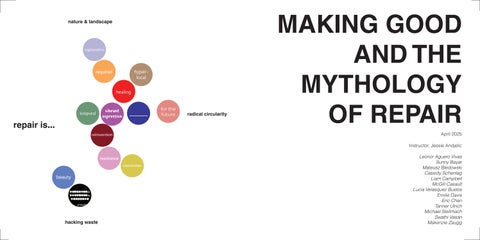
nature & landscape
regenerative
hyperlocal
required
healing
temporal
repair is...
for the future
vibrant expression
radical circularity
MAKING GOOD AND THE MYTHOLOGY OF REPAIR April 2025
reinvention
Instructor: Jessie Andjelic resistance
connection
beauty
gruesome
hacking waste
Leonor Aguero Vivas Sunny Bayar Mateusz Bledowski Cassidy Schentag Liam Campbell McGill Casault Lucia Velasquez Bustos Emilie Davis Eric Chen Tanner Ulrich Michael Stellmach Swathi Vasan Makenzie Zaugg
This studio engages with brokenness, framing repair as a vital cultural act and a foundation for our built future. In its second iteration, it turns toward ethical materiality, confronting the hidden systems of forced and exploitative labour embedded in architectural materials, and seeking more responsible ways of building.
Glass
Mica
Brick
12 WORST OFFENDERS Mica
Mined extensively in countries like India and Madagascar, mica often involves child labor and hazardous conditions in unregulated, informal mining sectors.
Glass
The production of glass, particularly in regions with poor labor oversight, can involve exploitative labor practices in raw material extraction and factory work.
Textiles
)URP UDZ ƂEHU FXOWLYDWLRQ WR IDFWRU\ VHZLQJ OLQHV IRUFHG ODERU LV SUHYDOHQW DFURVV WKH WH[WLOH VXSSO\ FKDLQ HVSHFLDOO\ LQ IDVW IDVKLRQ DQG GHFRUDWLYH EXLOGLQJ ƂQLVKHV
Steel
Steel production relies on raw materials such as iron ore and coal, often sourced from mines where forced and bonded labor are common.
Timber
Illegal logging operations and poorly regulated forestry industries have long been associated with exploitative labor practices, including debt bondage.
Textiles
Rubber Steel
Polysilicon and Solar Panels Electronics Timber
Polysilicon and Solar Panels
Paints and Dyes
Polysilicon has been linked to forced labor in Xinjiang, China, raising serious concerns for the renewable energy sector.
Copper
Mined in countries with high corruption and weak labor laws, copper extraction frequently involves forced labor, particularly among migrant workers.
PVC
The supply chain for PVC involves chemicals and raw materials sourced through labor-intensive processes where unsafe working conditions and labor exploitation are reported.
Stone
Natural stone used in construction and countertops is often quarried under dangerous and exploitative conditions, particularly in South Asia and the Middle East.
Paint and Dyes
The pigments and chemicals in paints and dyes are often manufactured in regions where child labor and hazardous working environments persist.
Rubber
Rubber tapping and processing, especially in Southeast Asia and West Africa, has long been associated with child labor and exploitative labor systems.
Brick
Brick kilns, particularly in South Asia, are notorious for bonded labor practices, where entire families may be trapped in cycles of debt and coercion.
Copper
Stone Plastic
Lucia
~
ExModern Repair is for the future
EXMODERN - LIAM CAMPBELL EXMODERN - LIAM CAMPBELL
The project’s improvised organization rejects the rigid separation of commercial, residential, and industrial spaces, challenging contemporary architecture’s programmatic segregation and advocating for functional integration. Its locationconscious consumption— sourcing and producing goods locally—reduces reliance on distant markets and forced labour. By valuing makers, we free ourselves from opaque supply chains and revive local production. While globalization brings economic benefits, reducing our dependence limits exploitative business models. Ex Modern envisions communities shaping their surroundings through skill and ingenuity, not globalized systems.
Self Supported Supply Chain
Globalized Dependant Supply Chain
Calgary
April 18th 2025 - Supply chains collapse, causing widespread scarcity as essential goods—food, textiles, electronics, and construction materials—vanish from markets. With mass production no longer viable, economies rapidly localize, creating a world where survival depends on repurposing, repairing, and making. The culture of consumption is replaced by one of production, where value is derived from contribution rather than ownership.
Ex Modern is a speculative exploration of society’s adaptation after the abrupt end of forced labour. Using a design fiction methodology, our society is confronted with our dependency on forced labour and can set targets to reorient values, based on the observations of the exercise, to decrease this dependency.
molting walls GHFD\ LV QRW D ÀDZ Repair is temporal Makenzie Zaugg
brewery rail lands boundary
lan
ds
bo
un
da
ry
existing
bre we
ry
rail
cyclical material re-use for the future neighbourhood addition of enduring materials from off the site
10 years
engage the community in spaces reserved for the public enduring material remnants from the site
draw the public in from the street
3
hharvest ar st materials m tteeriials for f r urban rban redevelopments red e p pm nts
resources for urban mining
1 2
the ephemeral
ENDURING
CYCLICAL
EPHEMERAL
Not grown, not harvested, but relocated or imoveable: structural artifacts from near and far that are embedded into the site as memorials. This turns the site into a landscape of respect and memory, history is extracted, material is planted, and time is composed spatially.
Materials from past demolition cycles — bricks, wood, infrastructure scraps — are harvested, repositioned, and adapted into new cyclical interventions.
Ephemeral elements are grown or assembled, lasting only temporarily in soft zones — compostable, light. Changing with the seasons.
l
fall
ia
summer
Rather than resisting time, this architectural approach is conceived as a living system that operates across multiple temporal scales— short-term engagement, mediumterm transformation, and long-term FRQWLQXLW\ $V WKH VLWH HYROYHV WKH EXLOW HQYLURQPHQW HYROYHV ZLWK LW HPEUDFLQJ GHFD\ DV D SDWKZD\ WR UHQHZDO ,Q GRLQJ VR WKH SURMHFW reimagines architecture not as static permanence, but as an ongoing QHJRWLDWLRQ EHWZHHQ PDWHULDO OLIH community need, and the passage of WLPH
existing
sorting & processing
l ia er at cal pi ty
winter
spring
urban mining enduring thetheenduring
m
the ephemeral
l
INT.
3
ca
the cyclical EXT.
pi
hours (h) minutes (m) seconds (s) milliseconds (ms)
existing
historical monument storical preservation, press
ty
weeks (wk) days (d)
2
er
the enduring
the cyclical
Ephemeral elements are grown or assembled, lasting only temporarily in soft zones — compostable, light. Changing with the seasons.
at
Molting Walls - Makenzie Zaugg
centuries decades years (y) months (mo)
EPHEMERAL
Materials from past demolition cycles — bricks, wood, infrastructure scraps — are harvested, repositioned, and adapted into new cyclical interventions.
Not grown, not harvested, but relocated or imoveable: structural artifacts from near and far that are embedded into the site as memorials. This turns the site into a landscape of respect and memory, history is extracted, material is planted, and time is composed spatially.
m
What if architecture, like nature, could embrace GHFD\ QRW DV IDLOXUH EXW DV UHQHZDO" 0DWHULDO OLIHVSDQ PLVDOLJQPHQW²D FRQGLWLRQ LQ ZKLFK EXLOGLQJ FRPSRQHQWV age at different rates—emerges as a core inefficiency in the construction industry, often leading to premature demolition DQG XQQHFHVVDU\ ZDVWH <HW LQ QDWXUH WKLV PLVDOLJQPHQW H[LVWV HYHU\ZKHUH /L]DUGV VKHG WKHLU VNLQ WUHHV UHQHZ WKHLU EDUN FUDEV PROW DQG JURZ 7KHVH F\FOHV DUH QRW VLJQV RI GHWHULRUDWLRQ EXW DFWV RI UHQHZDO :LWKLQ WKH %UHZHU\ 5DLO /DQGV LQ ,QJOHZRRG Calgary—a site in flux, marked by vacant industrial buildings and plans for redevelopment—this project embraces change DV D JHQHUDWLYH IRUFH 7KH FRQFHSW LQWURGXFHV D OD\HUHG DQG interconnected system of ephemeral and enduring structures HPEHGGHG ZLWKLQ D F\FOLFDO IUDPHZRUN 7KH ephemeral serves as immediate community assets—spaces for gathering, play, DQG H[SUHVVLRQ²ZKLOH WKHLU LQHYLWDEOH GHFD\ JLYHV ZD\ WR QHZ VSDWLDO UHODWLRQVKLSV DFURVV VHDVRQV 7KH enduring persists as community anchors, preserving memory and reserving public space through cycles of urban redevelopment (the cyclical
CYCLICAL
performance
ENDURING brewery rail lands boundary
performance
1
temporary e po r community c m n ty activator tiv tor
site for enduring material memories
20 years
age
urban mining
transformation & refurbishment acknowledge enduring materials
sorting & processing
enable future
age adaptability & reuse
integration into new buildings
design for adaptability design for disassembly archive & catalogue memory
sustain the emotional ecology
transformation & refurbishment
enable future adaptability & reuse
acknowledge enduring materials integration into new buildings
transform into artefact's & monuments embed in a landscape of reflection design for disassembly archive & catalogue memory
connect with future time design for adaptability sustain the emotional ecology
Molting Walls - Makenzie Zaugg
Cassidy
Drifting Clusters Repair is Regenerative Cassidy Schentag
Y
30-60cm
30-60cm
Heartleaf Arnica
Arnica cordifolia
Y Y N Y Y Y Y Pollinator
60-90cm 60-120cm 60-120cm 60-90cm 30-90cm 45-75cm Height
Yarrow
30-45cm
Achillea millefolium
Y Y
Little Bluestem
Schizachyrium scoparium
45-60cm
Y
Wild Bergamot
Monarda fistulosa
60-90cm 30-60cm
Rudbeckia hirta
Black Eyed Susan
N Y
Ratibida
Prairie Coneflower
30-60cm
Y
Common Name
45-60cm
Linum lewisii
Wild Blue Flax
Scientific Name
Spread
Twisted Seed Pockets Woven Panels Seed-Knot Pockets
Native
Flax woven-rope installations designed with embedded seeds and seed pockets, releasing flax seeds as rope decomposes
Subsoil Layer Drainage Layer Sandy Layer Sandy Topsoil
Drifting Clusters is a project that reimagines urban architecture as a means of reconnection— with land, ecology, and culture. As cities expand, industrialization has increasingly replaced natural environments with hardened, colourless infrastructure, severing our ties to Indigenous knowledge systems that have long nurtured the earth. This project proposes biodegradable, rope-based architectural interventions made from wild blue f lax—a prairie-native plant historically used by Metis communities for weaving—as a way to reintroduce native species and foster landbased relationships in urban settings. The flax is processed into rope and knotted into macramé-like, semi-permeable surfaces that become shading devices, seating, and playful structures. These interventions are embedded with flax seeds, designed to slowly decompose and germinate, transforming the site over time into self-sustaining urban flax meadows.
Step 1.
Step 2.
Choose a Site that is:
Prepare Soil:
Sta
Sta
ge 1
Sunny
ge 2
alt
h Asp
Space for growth Underutilized
al ov
ce rfa
Su
Surface Preparation Sta
Sta
ge 4
ge 3
th row
xG Fla
Step 3.
Implement Rope Installations:
m Re
alt
h Asp
Step 4.
Mix
ge 1
Sta
ge 2
Shading Flax, Rope, Meadow Sta
ge 4
Shelter Play
Sta
ge 3
m
oa
yL
nd
Sa
Plant Growth:
Sta
Seating
in
By merging ephemeral architecture with regenerative planting, Drifting Clusters encourages a gentle rewilding of the city—creating space for ref lection, gathering, and coexistence with humans, plants, and animals. By working with wild blue f lax – a material rooted in both prairie ecology and Metis heritage – this project shows how even the small interventions can have an effect – transforming vacant spaces into vibrant meadows, and hardened cities into living systems. It invites us to reconsider not only how we build, but how we return things to the earth – with intention, beauty, and reciprocity.
Centre Street S
Woven-Rope Installation Examples
11th Avenue SW
0m
5m
10m
Test Site: An underused surface lot in Calgary’s Beltline
Emilie
MATERIAL MEMORY
Repair is Hyper-Local Emilie Davis
4
WOO
SHER
Final Build
D DR
Construction
AIL N
Process Cutting
EE TR
Quarried Stone
SARC
NW
3
W
Concrete and steel have replaced stone as the primary building materials in our landscapes, contributing to 30% of Canada’s carbon emissions while supporting ethically compromised supply chains. Our contemporary construction practices prioritize costs and speed over longevity, fueling a cycle of demolition and replacement that erases both material memory and craftsmanship. This project challenges that cycle. It asks whether the enduring strength and beauty of stone, tested by the Japanese, Greeks, Egyptians, and Incas, can disrupt our impermanent building culture. The design proposes an in the round, open-air, community center inspired by radical masonry techniques, reclaiming drystone construction as viable assembly method. It explores cyclopean cannibalism, a construction theory predicting how new structures consumes old or existing materials. The landscape is treated as an active collaborator, not as a backdrop. The design exists in limbo between architecture and terrain. Stone’s natural properties dictate the form. Light dapples through irregular gaps, and sound reverberates across textured surfaces. This is a hyper-local approach where the land becomes both material and method. It’s a system of construction that can be shaped by hand. If a wall needs repair, the earth provides. If change is QHFHVVDU\ WKH VWUXFWXUH LV UHFRQÀJXUHG
Deconstruction
5
moving stones
lift & carry
stone dimple
mechanical advantage
2
site plan 1 Performance Pavilion 2 Fire Pits
3 Bus Shelter
1
6
4 Viewpoint
5 Public Washrooms earth as a fluid tool
“neke-neke” fridge walk
6 Stone Climbing Park
7
7 Community Drystone Wall Building
0
20
40
contractors salvaged wood
Leonor
advertising
community
Patches in waiting Repair is connection Leonor Aguero Reimagining Wood: From waste to shelter A short documentary
Anatomy of soft infrastructure
bus stops with shelter
bus stops with no shelter (more than 70% within the site)
current approved construction permits/new developtment sites
prioritizing circularity
circulation opportunities
CRD* Waste that might be too expensive/time consuming to sort trhough
Hand split roofing shakes Crafted from a mix of salvaged wood, each shingle highlights the natural grain, texture, and patched repair. Turning wood waste into a visible record of reuse and care. Roofing Rafters 2x2 dimensional lumber recovered from wall framing, plates, sills, and blocking.
1
Retrieving the materials
Structural Framing
Inititive would be contacted by contractors to provide sorting and collection of wood waste from sites across calgary.
The frame is built entirely from 2x4s, stacked and aligned to maximize strength and support. Beams are oriented vertically where load-bearing is needed and horizontally for bracing and stability. At the base, each structural 2x4 is sandwiched between two horizontal 2x4s to create a simple but effective foundation system.
proposed application — built up, boulevard
2 2020
2021
2022
2023
2024
1,600,000
population
Each year, large amounts of wood are discarded through construction and demolition. This project reclaims that waste to build a modular bus shelter; an equity shelter that offers both protection and pause. Combining timber reuse with repair urbanism, it supports sustainability, access, and inclusive mobility in Calgary’s evolving public realm.
Cleaninng and making sure the materials are free of any nails or any other materials so they can be cut and prepped for assembly.
1,500,000 1,450,000 1,400,000 1,350,000
3
A custom sticker system also supports material collection by marking safe, approved pickup sites, encouraging responsible reuse and community participation.
a. structure
a
b
Patches in waiting | Leonor Aguero
Repairing the materials
1,550,000
b. foundation
As Calgary grows and shifts toward more sustainable transit, the infrastructure that supports it must evolve too. While ridership rises, many stops—especially in communities like Capitol Hill—remain uncovered and inequitable. This project introduces a modular equity shelter built from reclaimed wood, offering a gentle pause in the urban flow. Through a strategy of soft repair, it reimagines discarded material as care-focused infrastructure—responding to rising demand with a locally sourced, climate-conscious, and community-scaled solution that supports safety, equity, and environmental responsibility.
Equitable, accessible transit connects underserved communities to opportunity, improving overall well-being and reducing citywide disparities. Assembling the materials Weather sheds would be built from collected salvaged wood and placed throughout the city.
transportation usage 84% 35% 8%
43% 22%
4
8%
Repair through community
current usage
projected usage following Calgary’s Safety In Motion Plan
Community outreach program would include workshops and collection runs for any repair needed, bringing awareness to the easy repair inititive.
Patches in waiting | Leonor Aguero
Repair is Required
Michael
QR
Confechitecture
0 5
10
Hemp
20m
CONFECHITECTURE - M. STELLMACH
36
Lime 90km
Calgary
m 0k 27
The architecture itself presents as an ephemeral visage- ostensibly solid yet vulnerable to the slightest change in elements. Observed at different moments in time, the structure evolves; CONFECHITECTURE - M. STELLMACH the remnant shape of the solid mold on the interior exposes the variable flowing nature of the contrasting elements on the exterior. This tangible juxtaposition becomes a relative variable in which the “lifespan” of the structure can be quantif ied purely through observation of“weathering”.
0k m
Confechtitecture is a sugar-based, dissolving architectural system that is designed not to last. The project arose as a counter point to the ongoing discourse of reuse/repair, challenging longevity and lifespan of traditional architectural materials.
Beets
Ultimately, Confechitecture reimagines architecture as an ephemeral inf rastructure that engages in petrochemical remediation while highlighting repair as a ritualized act. Using sugar mixed with lime and biochar to create a biodegradable structure, this architecture activates microbial communities that break down pollutants as it dissolves, challenging conventional notions of permanence and ecological stewardship in the built environment.
CONFECHITECTURE - M. STELLMACH
Recipe: 8 Parts Sugar 1.5 Parts Biochar 0.5 Parts Lime Feeds 3-4 microbes
INTRO VIDEO
CREATING COLOR Repair is Vibrant Expression MCGILL CASAULT
0.5
1
1.5
2
5
SECTIONS
SECTIONS Color plays a critical role in how we perceive and process our environment, and interact with our surroundings. Creating Color unveils the potential problems associated with living in the monochrome palette of contemporary cities, and seeks to find ethical, innovative, and provocative means to reintroduce color to our daily lives. By doing so, we can also rationalize the reasons behind its absence and analyze the consequences of living without it. Creating Color investigates the potential of semipermanent, “parasitic” architectural interventions to reintroduce color to and vibrancy to urban spaces, employing flexible, ethical, and sustainable practices. In a society of bland buildings, and temporary tenancy, a method of “peel and stick architecture” can add vibrancy and flexibility the public craves.
CREATING COLOR - MCGILL CASAULT
1
3
2
4
Creating Color products are created with an Alberta produced BioNylon as a way to pursue ethical and sustainable space solutions. These semipermanent additions can be easily folded into compact cases, and lowered into place. Anti sway tethers attach to any facade, and the space becomes pressurized using a buildings stack effect. Hanging garden systems offer ways to grow plants for natural color by utilizing low weight aeroponics, and natural light.
0.5
1
PLAN
CREATING COLOR - MCGILL CASAULT
1.5
2
THE ART OF MENDING Repair is Resistance
Swathi
Swathi Vasan
This project reimagines repair as a generative design strategy, transforming waste from mall waste streams into a living ecosystem of mending, reuse, and reinterpretation. Set within a typical mall environment, the pavilion functions as both an exhibition and an active repair lab. It is constructed from discarded retail fixtures, furniture, textiles, and electronic components, materials sourced directly from the mall and public donations. THE ART OF MENDING
Objects within the pavilion become materials in themselves, carrying visible traces of use, care, and transformation. Visitors move through zones where items are collected, sorted, repaired, or archived, encountering repair as a shared civic ritual. The project challenges conventional ideas of obsolescence and disposability, positioning repair as an ongoing act of design, stewardship, and cultural continuity.
THE ART OF MENDING
Sunny Repair is reinvention
SALT
This project began with a simple observation. The glistening of winter salt on pavement after a storm. That shimmer led to a deeper inquiry into artificial versus natural glimmer in architecture. I soon uncovered the hidden cost of mica, a widely used additive mineral mined under unethical conditions, often involving child labor in India and Madagascar. We’re surrounded by artificial shine, but at what cost? That stark contrast became the heart of the project. Thus, I explored what it would mean to shift away from the type of reflectivity that’s added purely for effect and instead celebrate materials that shine naturally and truthfully. Salt is an abundant, local, and reflective material that offered an opportunity to do just that. Located near Calgary’s 5th Avenue Flyover Bridge, where road salt runoff pollutes the Bow River, this project reclaims salt’s shimmer to raise forced labor awareness and restore the urban fabric. FLYOVER SALT - SUNNY BAYAR
FLYOVER SALT - SUNNY BAYAR
The solar cart is equipped with 4.4m2 solar panel. With 5 hours
1
of direct sunlight, it can charge up to 296 cellphones or drive the cart 40km of distance. 1. Solar Panel 2. Power Bar
INSERT FULL BLEED COVER IMAGE
3. Front Wheels Steering Motor 4. Battery
3
2 4
6. Electric Motor
5
Eric
5. Control Box
6
SOLAR CART
1.3m
1.8m
2m
The project is derived from two qualities of solar panels: versatility and cultural association. Versatility refers to their adaptability, especially when transformed into a smaller, movable format. Additionally, the gridded pattern of solar
3.4m
panels can evoke a conceptual understanding of our future reliance on renewable energy—symbolizing a hopeful and sustainable future.
SOLAR CART - ERIC CHEN
SOLAR CART - ERIC CHEN
GLOSSARY
cell - a single, well-defined area within a landfill where waste is deposited, compacted, and covered with soil, serving as a discrete unit for waste disposal. (Lucia) CLUSTER ǧ wild blue flax plants spread and seed in groups, moving around the landscape in random patterns. (Cassidy)
culture Association - pattern or distinctive feature which triggers an association to a positive and futuristic societal imagery. (Eric)
design f iction - a practice that uses speculative scenarios and designed artifacts to explore and critique possible futures, aiming to inspire new and innovative perspectives. (Liam) enduring - materials or forms that persist across generations, resisting decay and becoming cultural artifacts; a memory-holder—thick pipes, concrete slabs, and salvaged debris arranged not as waste, but as legacy. (Makenzie) EPHEMERAL
cyclical - architectural systems participating in the
- designs or materials intended to exist only briefly—dissolving
ongoing processes of decay, renewal, and reuse
into memory, weather, or the environment; leaves behind no
in the urban context; urban rhythms and inevitable
permanent trace; their value lies in the experience they create
redevelopment cycles—appearing, transforming, and
and the imprint they leave on collective memory. (Makenzie)
returning, like the shedding of bark or the rise and fall of community needs. (Makenzie)
cyclopean cannibalism - buildings eating buildings; a construction technique which re-uses existing building stock for the assembly of new buildings. (Emilie)
ephemeral - something that lasts for only a short time; transitory; fleeting. (Michael) equity shelter - a transit space designed not only for waiting but for belonging—prioritizing comfort, access, and dignity in communities often under-served. (Lenor)
flyover bridge - a bridge that carries a road or railway
leachate - a hazardous liquid that forms when water,
peel and stick architecture - an impermanent
timber reclamation - the act of salvaging wood
over a river and another road or railway. It’s a common
like rainwater or snowmelt, percolates through waste and
architectural additions that can be easily manipulated,
waste and re-contextualizing it as structure, history, and
feature in urban areas to reduce congestion and facilitate
extracts dissolved or suspended contaminants. (Lucia)
added, and removed without damaging existing
resistance to disposable building culture. (Lenor)
traffic flow. (Sunny)
m a ke g ood
infrastructure. (Mcgill)
URBAN PATCHWORK
FORMALDEHYDE
- to restore new or existing work after being damaged, cut
polypropylene (PP)
- the deliberate combination of various re-purposed
- a colorless, pungent-smelling organic compound that
or patched. (Jessie)
- a common thermoplastic polymer derived from
materials into a cohesive urban space, creating a visual
propylene, is a versatile material used in various
and functional “patchwork” that speaks to the diverse
applications, including packaging, textiles, and consumer
histories and lives of the materials. (Swathi)
exists as a gas at room temperature; commonly produced by oxidizing methanol or through the combustion of certain plastics, such as those labeled Type 7. Classified as a carcinogen, meaning it can cause cancer with prolonged or high-level exposure. (Lucia) groundwater contamination - saltwater intrusion, where salty water enters freshwater aquifers, can make the water non-potable and affect multiple wells in the area. (Sunny) gruesome - though disassembly the unfamiliar becomes familiar; electronics are magic. (Tanner)
h ea l in g - to make well again, to restore to health. to cause (an undesirable condition) to be overcome. to patch up or correct (a breach or division). to restore to original purity or integrity. (Mateusz)
MATERIAL BIOGRAPHY - the life story of an object or material, tracing its origin, journey through various phases of use, and eventual reincarnation as part of a new narrative. (Swathi) material memory: the belief that buildings and materials are living systems; carrying stories of their past. (Emilie)
m e g al it h - materials that remain in large formats assembled for the construction of structures; Materials that remain in larger formats are easier to reuse and last longer. ie. do not crush! (Emilie) nucleation - the initial formation of salt crystals. (Sunny) Oompa Loompa - a fictional race of people in the Charlie and the Chocolate Factory; they understand the uses of sugar like no one else. (Michael)
hyper-local - focusing on matters concerning a small
PARASITIC COLOR
community or geographical area. (Emilie)
- the addition of color to the urban environment by
interruption architecture -a deliberate pause in urban flow; moments of care, shelter, and reflection within infrastructure designed for speed and efficiency. (Lenor)
attaching materials, buildings or art to the facades of existing buildings. (Mcgill)
goods, known for its strength, flexibility, and resistance to chemicals and heat. (Lucia) reparative ritual - the act of repair as a social and cultural ritual that brings people together to engage in the care, restoration, and transformation of materials, creating a sense of community ownership and responsibility. (Swathi) SALTWATER RUNOFF - the movement of land water from roads and pavements, especially during winter, carries road salt (primarily sodium chloride) into nearby waterways. (Sunny)
sof t repair
VERSATILITY - the ability to adapt or be adapted to many different functions or activities. (Eric) volatile organic compounds (VOCs) - an organic chemicals that readily evaporate into the air at room temperature, found in various products and processes, and can impact air quality and human health. (Lucia)
wild blu e f lax - Linum lewisii: a native thread of the Canadian prairie that stands apart from its European cousin, Linum usitatissimum. With fine, fibrous stems and delicate blue
- a gentle, tactile form of urban intervention; repairing not
petals, it has long been gathered by Métis communities
through demolition or disruption, but by layering, patching,
for its versatile properties—woven into stories of healing,
and reusing what is already there. (Lenor)
nourishment, cordage, and care. (Cassidy)
temporal architecture - a design approach that embraces impermanence and adaptability, where the built environment is seen as something that evolves, is repaired, and transforms over time, rather than being static or fixed. (Swathi)