Banff Trail Community Design Concepts
PLAN 630 | Advanced Professional Planning Studio | Sidrah Anees, Nissmah Atif, Chetna Sidhu
Key Demographics Household Size
3805
Residents (2021)
11%
$84,000
16%
32%
3 people
YEARS 4 people4 people
61%
35%
2%
NON-PERMANENT
Non-Permanent Residents
11%
Average: 2.6 (City of Calgary)
Housing Tenure
er
Residents Who Moved in the Last 5 Years
55 oror more 5 or people more people more people
Average: 2.3
Riv
0%
10% 20% 30% 40% 50% 60% 70%
Age 350
69%
300
University Certificate or Diploma
58%
250 200
42% 31%
100 50
Men
OWNER
100 +
95-99
90-94
85-89
80-84
70-74
75-79
65-69
55-59
60-64
50-54
45-49
40-44
30-34
35-39
25-29
15-19
20-24
0 10-14
Renter
Renter Households
150
Owner
58%
Confederation Park
42%
RESIDENTS3WHO MOVED people 3 peopleIN THE LAST 5
51%
West Confederation Park
22 people 2 people people
RESIDENTS
Visible Minority
Nose Hill Park
Immigrants
24%
1 person 1 person 1 person
32%
16%
35%
36%
w
11%
33%
IMMIGRANTS
6%
4 people
Avg Household Income
Bo
6%
Household Size
0-4
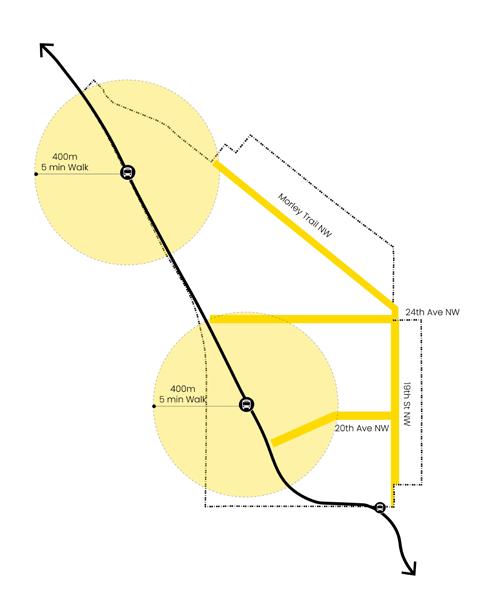
The community of Banff Trail was established in 1951. Named for the route that connects Calgary to the mountain town of Banff, this community is a well-established and wellloved neighbourhood with significant potential for positive growth. While primarily a residential community, Banff Trail is home to a large motel village in the south of the community, as well as pockets of commercial activity along Morley Trail and 20th avenue. Bordered by Crowchild Trail to the west, the Trans-Canada Highway to the south, with two LRT stations and several bus routes, this neighbourhood is well-connected to the downtown core and broader city of Calgary.
5-9
Banff Trail Community
Women
RENTER
Project Methodology Project Initiation & Kick-off
Final Design
Concept Development
Site Analysis Site Visit with BTCA
Community Workshop
Open House
Phase 1
Phase 2
Phase 3
Phase 4
Data Collection, examination of local policy context, project understanding, and walkabout with the Banff Trail community members.
In-depth policy review, demographic, environmental, infrastructure, built form, and zoning analysis. Presentation of research in a community workshop with Banff Trail residents.
Development of conceptual design concepts, vision, and guiding principles for Banff Trail. Development of 3D physical model of site.
Presentation of detailed design concepts and recommendations to Banff Trail community at Open House. Final report developed, including feedback from community Open House.
Site Analysis & Engagement Summary
Constraints Opportunities
What We Heard “Areas around schools are usually quite dangerous due to congestion.”
“I take bus 65 to Banff Trail School.”
“While 19th is considered a cycle route, it is challenging.”
Pedestrian Safety & Intersections “Walking along and crossing Morley Trail is difficult. “
“Biking towards the university is very awkward and unsafe.”
“Not many amenities are missing, feels well served by surrounding communities.”
Pedestrian Safety
Disconnection with Motel Village Environmental Concerns
Pedestrian Infrastructure
Age-friendly community
Missing Sidewalks & Unpleasant Walking Experience
Snow & Traffic along 24th Ave & 19th St
Mobility Programming & Activation
Bus stop Infrastructure
Underutilized Assets
Open Spaces Park Connectivity
Land Use & Built Form
Winter City Considerations
Traffic & Snow
Entry/Exit Points & Community Edges
Laneway Housing & Secondary Suites
Parks & Programming open spaces Lack of Co-Working Spaces
Housing Diversity & Quality
Affordable Housing for Students
Inactive Edges
Lack of coworking spaces & coffee shops
Condition & Affordability of houses for students
Challenges
Quality of Sidewalks
Connecting green spaces & creating green streets
Wider Sidewalks & Better Bike Paths
Sidewalk Conditions
Dangerous Intersections
Well connected to main LRT & BRT routes Connectivity with Motel Village & Commercial Nodes
Parks & Programming
Guiding Principles Our Vision Banff Trail is a vibrant community where connectivity, diversity, & sustainability flourish, fostering intergenerational harmony & a strong sense of identity.
Intergenerational Approaches
Sustainability & Resiliency
Connectivity & Mobility
Safety & Wellbeing
Diversity & Vibrancy
Community Identity