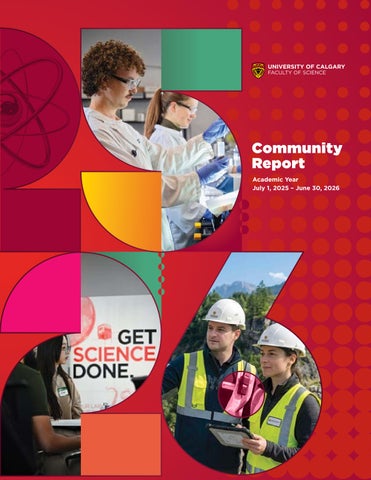
Community Report Academic Year July 1, 2025 – June 30, 2026
2
3
DR. KRISTIN BAETZ, PhD Dean, Faculty of Science
4
04 Message From the Dean. Some years are defined by discovery. Others are defined by momentum. For the Faculty of Science, the last year has been defined by both. Across our faculty, we have advanced our bold Get Science Done strategy. We introduced new multidisciplinary programs in geoscience and energy science, celebrated the successful launch of Calgary’s first student-built satellite, FrontierSat, and saw Faculty of Science research recognized by the 2025 Nobel Prize in Chemistry. We also continued building the partnerships that will shape the future of science in Alberta. We know that science does not thrive in a silo, and neither do we. We have worked closely with industry partners, employers, alumni, students and community members to better understand the challenges and opportunities facing our province. That collaboration has reinforced our belief that success comes from working together. Our goal is simple: to serve Alberta by responding to emerging opportunities and equipping our students for long-term success. That is why we continue to evolve our programs, partnerships and approaches to teaching and learning. Conversations with industry through initiatives such as our Future Ready Science Forum have helped inform this work, while new investments in research — including the launch of Canada’s first Centre for Biofilm Research — are strengthening our capacity to address complex challenges and create impact. When science is connected, it becomes a force for change. It transforms lives today while building a stronger Alberta and Canada for tomorrow. From our vision for a dynamic Science District to the discoveries, partnerships and student successes highlighted throughout this report, the future of science at the University of Calgary is bright. We invite you to join us in shaping what comes next. Dr. Kristin Baetz, PhD Dean, Faculty of Science 5
06 Get Science Done. Ambition and Good Timing. Strategic Plan 2024–2030 Excellence doesn’t happen by accident. It takes intention, good timing and — as every scientist knows — experimentation. Since launching the bold Get Science Done strategy in 2024, the Faculty of Science has been turning vision into action. Over the past year, faculty, staff, students and partners have brought the strategy to life through new collaborations and innovative learning opportunities. Together, these initiatives are strengthening Calgary’s leadership in scientific discovery and impact. Get Science Done is built around four strategic imperatives:
1. Radical Research Collaboration Create the space, culture and partnerships needed to enable new approaches to research and discovery.
2. Activating Science Education Deliver inspiring, career-focused educational experiences that prepare graduates to drive Alberta’s and Canada’s economies.
3. Destination Science District Build a national profile that positions Calgary as a leading destination for students, researchers and partners.
4. A Thriving Culture Reduce barriers and foster an environment where people can contribute fully and energetically to getting science done. 6
7
08 Talent First: Excellence in Science Training.
8
The Faculty puts science talent first, for Calgary, Alberta and beyond. Behind every successful startup, scale-up and global company are talented people trained in science and mathematics. Science powers innovation, drives economic growth and helps solve the complex challenges facing our communities, industries and planet. As our world evolves, science must evolve with it. The future belongs to science that is collaborative, entrepreneurial and focused on turning discovery into impact. At a time when demand for highly skilled talent continues to grow, Canada has an opportunity to strengthen its innovation capacity by investing in people. The Faculty of Science is helping close that gap by preparing the next generation of scientists, entrepreneurs and problem-solvers. In 2025–26, the Faculty of Science was home to more than 7,200 undergrad and graduate students. The emerging Science District will create capacity for at least 2,000 additional students, while expanding experiential learning opportunities and enhancing graduates’ readiness for the workforce. Through strategic growth and strong partnerships, we are building the talent pipeline that will drive innovation and prosperity for decades to come.
Science Claims Three UCalgary Teaching Awards. The Faculty of Science received three honours through the University of Calgary’s 2025 Teaching Awards program, which has recognized teaching excellence since 2014. Award recipients included Dr. Nicole Sandblom for Educational Leadership, ENSC 401 instructors Dr. Dan Shugar and Dr. Eve Robinson for Team Teaching, and Dr. Ariane Cantin for Inclusive Excellence. 9
10 Growing Our Programs. Amplifying multidisciplinary skill sets. Expanding pathways in geoscience The Faculty launched a new Geoscience degree in fall 2026 that combines geology and geophysics into a single program. Developed in partnership with APEGA, the curriculum creates more opportunities for students to customize their studies, participate in field schools and gain real-world experience. Graduates leave with professional certification eligibility, practical training and the interdisciplinary perspective needed to address complex challenges in energy, resources and the environment.
Building a talent pipeline for energy The Energy Science program brings together technical, environmental and policy perspectives to prepare graduates for the future of energy. Students explore energy generation, transmission and storage across conventional and renewable systems while gaining insight into policy, regulation and communications. Launched in 2025, the program combines industry-connected capstone projects and hands-on learning opportunities to help students develop the interdisciplinary skills needed to address complex energy challenges. With new seats supported through Alberta’s Targeted Enrolment Expansion initiative, UCalgary is expanding capacity to meet growing student interest and Alberta’s need for skilled energy professionals.
Advancing transdisciplinary graduate education Launched in fall 2025, the Faculty introduced new graduate programs in transdisciplinary research, including a Master of Transdisciplinary Research, a PhD in Transdisciplinary Research and a Graduate Certificate in Transdisciplinary Studies. Designed to prepare students to tackle society’s most complex challenges, the programs unite expertise from across disciplines and connect research with community and industry partners. Graduates gain the collaborative, cross-sector perspective needed to develop innovative solutions to issues ranging from climate challenges and health to emerging technologies and sustainable communities.
10
11
12 Building Our Reputation. Shaping the Future of Science Through Multidisciplinary Talent. As we build a dynamic Science District, we’re investing in researchers who break down traditional boundaries. Their work is accelerating discovery and tackling challenges from new angles.
Dr. Johnathan Burchill
Dr. Adriana Guatame
Dr. Johnathan Burchill is helping strengthen UCalgary’s presence in Canada’s space sector through research that bridges space science, technology development and student training. His work played a key role in the successful launch of FrontierSat, Calgary’s first student-built satellite, which carries a plasma imager designed to study upper-atmospheric phenomena. Through partnerships with students and industry, Burchill is helping build the next generation of space science and aerospace expertise.
Cross-appointed between the Department of Earth, Energy and Environment and the School of Public Policy, Dr. Adriana Guatame is improving the sustainability of critical mineral extraction. Her research explores how valuable minerals that are often discarded during mining can be recovered more efficiently, reducing waste and supporting the energy transition. By combining geoscience, policy, industry collaboration and community engagement, she is helping shape more sustainable resource-development practices.
Dr. Erin Nicholls
Dr. Chima Justin Ezekiel
Dr. Erin Nicholls connects hydrology, climate science and public engagement to better understand water security in a changing climate. Through her work with the United Nations University Hub at UCalgary, she studies how mountain water systems are changing while also helping translate scientific knowledge into practical solutions. Her research highlights the importance of including diverse community perspectives in addressing global water challenges.
Cross-appointed in Earth, Energy and Environment and the School of Public Policy, Dr. Chima Justin Ezekiel combines technical research and policy expertise to advance low-carbon energy solutions. His research focuses on carbon capture and storage, hydrogen and geothermal energy, helping improve how energy technologies are developed, deployed and adopted.
Transdisciplinary Space Science and Aerospace Technology
Water Security, Climate Change and Community Impact
12
Sustainable Critical Minerals and Public Policy
Clean Energy Systems and Policies
Dr. Johnathan Burchill
Dr. Chima Justin Ezekiel
Dr. Adriana Guatame
Dr. Erin Nicholls
13
14 Science in the Media.
3
1
Each day, a Faculty of Science researcher makes the news, with media coverage ranging from local radio and television morning shows to The Globe and Mail, New York Times, Discover Magazine and National Geographic.
1. 2. 3. 4. 5. 6. 7. 8.
14
Dr. Daniel Oblak, Associate Professor, Physics and Astronomy Dr. Jo-Anne Brown, Professor, Physics & Astronomy Dr. Pouria Ramazi, Associate Professor, Biological Sciences, and Mathematics and Statistics Dr. Daniel Shugar, Associate Professor, Earth, Energy, and Environment Dr. Emma Spanswick, Associate Professor, Physics & Astronomy Dr. Darla Zelenitsky, Associate Professor, Earth, Energy & Environment Dr. Farhad Maleki, Assistant Professor, Computer Science Dr. Marcus Samuel, Professor, Biological Sciences
2 4
5
Top 2025-26 News Stories Featuring Our Faculty: How AI can help protect bees from dangerous parasites The Conversation Dr. Farhad Maleki, Assistant Professor, Computer Science, and Dr. Farnaz Sheikhi, Postdoctoral Associate in Computer Vision
Agriculture researchers discover breakthrough in fight against pod shattering Western Producer Dr. Marcus Samuel, Professor, Biological Sciences Teleportation is no longer just science fiction — at the quantum level National Geographic Dr. Daniel Oblak, Associate Professor, Physics & Astronomy
After decades of mystery, scientists have finally mapped the Milky Way’s magnetic field MSN Dr. Jo-Anne Brown, Professor, Physics & Astronomy
UCalgary researcher finds way to predict whirling disease with almost no data CTV Calgary Dr. Pouria Ramazi, Associate Professor, Biological Sciences, and Mathematics and Statistics
University of Calgary researchers find northern sensor array also has military value The Canadian Press Dr. Emma Spanswick, Associate Professor, Physics & Astronomy
Ride a jet ski through a re-creation of an Alaska mega-tsunami with the help of Science CNN Dr. Daniel Shugar, Associate Professor, Earth, Energy, and Environment
Top 9 Dinosaur Discoveries of 2025 — From the Oldest Ankylosaur to Mongolia’s Dragon Prince Discover Magazine Dr. Darla Zelenitsky, Associate Professor, Earth, Energy, and Environment
6
7
8
15
16
16 Building a Science District. The science theatres and labs have created tens of thousands of success stories. As influential as they are classic, it’s time to modernization. The Faculty of Science is in a bold new era of expansion and revitalization. More science graduates and more interdisciplinary science research are crucial to a prosperous innovation economy for Calgary and Alberta. The Government of Alberta’s investment in a new building and the transformation of existing spaces was a significant vote of confidence in the future of science. Since that announcement, the university has continued to raise funds from donors and supporters who share the vision for a dynamic Science District. Together, this funding is accelerating the anticipated $450-million revitalization of the northeast corner of campus and helping create a hub for talent, discovery and innovation. The envisioned Science District will come to life with: Multidisciplinary Research with Global Impact This building is made unique by research neighbourhoods that bring together experts from across faculties and industries to tackle urgent challenges in areas where UCalgary is a recognized leader, including energy solutions, space science, health innovation and precision agriculture. 2,000 New Student Seats Learning and lab spaces that address the critical need to expand capacity, better meeting both the high volume of qualified applicants and demand for skilled graduates. Student Success Centre High-quality coaches and coordinators that support students as they acquire hands-on skills, take part in internships and co-ops, and develop workplace-ready experience, including personal and professional well-being. Industry Incubator Space Dedicated space that enables collaboration between students, researchers, startups and industry at the intersection of science, technology and business.
17
18 Building Together: Fundraising. A Community that Cares About Science In 2025–26, community partners made significant investments in the Faculty of Science, including record support during the university’s Giving Day. These contributions are accelerating groundbreaking research, expanding opportunities for students and supporting initiatives such as Girls Can Excel in Math, student experiential learning opportunities and innovative research projects that strengthen science’s impact in our communities and beyond.
A New Generation of Giving University of Calgary alumnus Shawn Freeman is investing in the next generation of innovators through the creation of a new student award in the Faculty of Science. A computer science graduate and successful technology entrepreneur, Freeman established the award to help students pursue their goals and make the most of their university experience. His support reflects the entrepreneurial spirit that defines UCalgary and demonstrates how alumni can create lasting impact at any stage of their careers. “When I was a student, I began exploring entrepreneurial ideas that eventually led to founding my first company. Having support and recognition during that vulnerable early stage would have been transformative. This scholarship is designed to support students who are already building something — whether it’s a tech startup, a consulting practice, or any venture that demonstrates entrepreneurial thinking and action.” Shawn Freeman 18
19
20 Research Excellence. Science is one of the largest faculties at the University of Calgary.
Ranked Canada’s youngest top five research university.
20
At the heart of the faculty’s future is a commitment to scientific excellence. In the 2025-26 academic year, the faculty’s nucleus of research and discovery was driven by:
262 faculty members 69 visiting and adjunct professors 123 postdoctoral scholars 310 PhD students 370 thesis-based MSc students 369 research associates and technicians
$65.9M in research funding from governments, business and industry 179 research funding sources $8.3M funding for quantum research $3.5M funding for agricultural research $10.8M funding for health and healthcare research $24M funding for thesis-based graduate students
~488 academic papers published by faculty members
21
22 Partnering for Impact. Scalable Carbon Capture Acknowledged by Nobel Committee Professor George Shimizu’s entrepreneurial journey demonstrates the successful translation of academic research into climate solutions. As a leading researcher in metal-organic frameworks (MOFs), he developed CALF-20, an advanced material capable of selectively capturing carbon dioxide from industrial gas streams. CALF-20 was later highlighted by the Nobel Committee as a benchmark example of industrial-scale carbon capture using MOFs. Recognizing its commercial potential, Shimizu helped move the technology from the laboratory to the marketplace through industry partnerships and the co-founding of Existent Sorbents. As the company’s Chief Technology Officer, he is now advancing the commercialization of CALF-20 and other nextgeneration sorbent technologies.
Global Partnerships in Paleontology International collaboration is central to Professor Darla Zelenitsky’s work, uniting scientists worldwide to reveal new chapters in dinosaur evolution. Most recently, she and then University of Calgary PhD candidate Jared Voris led an international team that identified Khankhuuluu, a newly recognized dinosaur species and the closest-known ancestor of the iconic tyrannosaurs. The discovery fills a critical gap in understanding how tyrannosaurs evolved from medium-sized predators into the apex carnivores that later dominated prehistoric ecosystems. Through global research partnerships, Zelenitsky continues to advance knowledge of dinosaur evolution while strengthening UCalgary’s international reputation in paleontological research. 22
Planetary Science Through Global Collaboration
Accelerating Research Impact with the Parex Innovation Fellowships
Professor Benjamin Tutolo is helping answer one of science’s biggest questions: was Mars ever capable of supporting life? As a participating scientist on NASA’s Curiosity Rover mission, Tutolo led groundbreaking research that identified significant carbon deposits in Gale Crater, providing the strongest evidence yet of an ancient carbon cycle on Mars. Published in Science in 2025, the discovery helps explain how the Red Planet once maintained conditions capable of supporting liquid water and advances our understanding of Mars’ climate history and habitability.
The 2026–27 Parex Resources Innovation Fellowships recognized six University of Calgary researchers whose work is advancing innovative solutions to real-world challenges. Supported through a $3.24-million endowment established by alumnus Wayne Foo and Parex Resources Inc., the fellowships provide funding and dedicated time for researchers to accelerate innovation, commercialization and community impact.
National Investments Support Research Leadership Dr. Casey Hubert secured funding from two major sources to support innovative research. Through Genome Canada’s Genomic Applications Partnership Program (GAPP), Hubert is collaborating with Triple Point Resources to de-risk underground energy storage in Atlantic Canada as part of a broader $20 million federal investment supporting industryacademic partnerships nationwide. In addition, Hubert and his collaborators received $4 million from the Canada Foundation for Innovation (CFI) Innovation Fund to expand the University of Calgary’s wastewater monitoring program, enhancing its ability to provide real-time public health insights and support evidencebased decision-making.
This year’s fellows are advancing projects in fields ranging from assisted reproductive technologies and skin infection treatments to machine-learning tools that support firefighters’ mental health and multilingual communication apps for health-care settings.
Launching Canada’s First Centre for Biofilm Research The University of Calgary launched the Canadian Centre for Biofilm Research (CCBR), the first facility of its kind in Canada, supported by a $5.8-million award from the Canada Foundation for Innovation. Led by researcher Dr. Joe Harrison, the centre brings together experts across disciplines to advance understanding of biofilms and develop new approaches to combating antibiotic-resistant infections. The CCBR will strengthen research capacity and drive innovations with significant health and economic impacts.
“I had a number of people, during my time as an undergraduate here, who took the opportunity to influence my development. Professors who went beyond what would normally be available in an undergraduate environment. This is an opportunity to give back to some of the professors at the university who extend the same kind of considerations to their students. This hopefully will assist not just the professors and their continued development, but also help provide graduate students with a foundation to build upon.” Wayne Foo
Advancing Geospatial Innovation Professor Faramarz Samavati is working with Mitacs, industry partners and Calgary-based startup BigGeo to advance a groundbreaking 3D Digital Earth System that enables more accurate and efficient analysis of geospatial data. The technology addresses limitations of traditional flat-map systems and supports applications in environmental monitoring, infrastructure planning, and location-based decision-making. Through more than $1 million in Mitacs-supported research and commercialization efforts, the partnership has helped move the technology from the laboratory to practical use, earning Samavati the Mitacs Innovation Award for Outstanding Research Leadership. 23
24 Industry Collaboration.
24
Future Ready Science Forum
Advancing Energy Innovation
Preparing students for tomorrow’s opportunities starts with listening. In spring 2026, the Faculty of Science hosted the Future Ready Science Forum, convening three cohorts of industry leaders, economic development experts, public policy professionals and entrepreneurs to share insights on the future of work, emerging skills and workforce needs. The conversations are informing our undergraduate strategy and curriculum planning, helping ensure our programs remain relevant, responsive and aligned with the needs of employers, students and communities.
For more than half a century, the Faculty of Science has partnered with Alberta Sulphur Research Ltd. (ASRL), a unique industry-academic consortium connecting researchers with leaders across the global energy sector. Supported by companies involved in the production and use of elemental sulphur, ASRL advances applied research while fostering collaboration between industry and academia.
Connecting Mathematical Excellence Through the Pacific Institute for the Mathematical Sciences (PIMS), Faculty of Science researchers collaborate with a network of leading mathematical scientists across Western Canada and the Pacific Northwest. PIMS supports research partnerships, postdoctoral fellowships and scientific events that advance mathematical discovery, strengthen research capacity and provide valuable training opportunities for the next generation of mathematical scientists.
25
26 Student Success and Experience. Curiosity, Leadership and Impact. Radical Research Collaboration
Experiential Learning in Action
Students from Physics & Astronomy and Engineering joined forces through CalgaryToSpace to help launch Canada’s first student-built satellite. The project provided an unparalleled hands-on learning experience while demonstrating the power of interdisciplinary teamwork and innovation.
After completing his BSc in 2024, Matthew McConnell continued his academic journey as a PhD student in physics and astronomy while gaining valuable experience with the Canadian Space Agency. Through a Transformative Talent Internship, he contributed to Canada’s growing space sector, showing how experiential learning opportunities can launch students toward extraordinary careers.
Entrepreneurship Meets Discovery
Science in the Community
Computer science student Rumeza Fatima combined entrepreneurship with community impact through The Archive, a nonprofit microgrant platform that helps people pursue meaningful projects and experiences. By making funding more accessible, she is empowering others to create positive change in their communities.
Nikki Kim and Priya Tiwari turned their learning experience into a practical solution for community accessibility. After participating in AI Research School 2025, the pair developed an accessible transit application designed to help users navigate transportation more effectively, demonstrating the potential of artificial intelligence to improve everyday experiences.
A Thriving Culture
By the Numbers:
Recipient of the 2026 President’s Award for Excellence in Student Leadership, Douye Igoniderigha has been a powerful advocate for equity and opportunity at UCalgary. Through co-founding the Black Science Student Network and helping establish the $350,000 Black Brilliance Bursary, he expanded access to mentorship, research experiences and financial support for underrepresented students.
The Faculty of Science is attracting students from all parts of the province and Canada, preparing them for Alberta’s innovative workforce and globally competitive careers. The 2025-26 trainees were registered in programs with increasing emphasis on computer science and multidisciplinary skills. • • • • •
6,600 BSc students 20 undergrad programs 694 thesis-based graduate students 129 MSc students in professional programs 3 professional graduate programs: 1. Quantum Computing 2. Data Science and Analytics 3. Information Security and Privacy
26
Empowering Big Dreams: The Kennedy Scholars Program The Kennedy Scholars program enables Faculty of Science students to pursue ambitious goals at the intersection of technology and entrepreneurship. 1
In 2025, computer science students Tamjeed Ekram and Braden Baumann received Kennedy Scholarships worth a combined $200,000, providing financial support, experiential learning opportunities and access to entrepreneurial programs across campus. Through internships, mentorship and connections, the scholarship enables students to transform their passions into real-world ventures. For Ekram, whose interests lie in fintech and entrepreneurship, the award is providing opportunities to explore new ideas, build valuable skills and expand their professional network. For Baumann, an aspiring video game developer who has already published and sold games, it is helping further develop their talents while contributing to Calgary’s growing innovation ecosystem.
2
The Kennedy Scholars program is among North America’s most prestigious scholarship programs, established through a landmark $2.3-million gift from Alberta business leader Paul Kennedy in 2022. 3
From Classroom to Career: The Power of Co-op Preparing students for success beyond graduation requires strong partnerships between academia and industry. TELUS has been an invaluable partner in creating experiential learning opportunities for Faculty of Science students, offering pathways for them to develop in-demand skills, gain practical experience, and launch impactful careers in technology and innovation.
4
550+ Registered co-op employers
1. 2. 3. 4. 5.
5
Aarti Chandiramani, Meagan Davies and Pierre Dawe Matthew McConnell Rumeza Fatima Douye Igoniderigha Nikki Kim and Priya Tiwari
27
28 Indigenous Pathways. Dr. Myrle Ballard, an Anishinaabe scientist from Lake St. Martin First Nation, Canada Research Chair Tier II and Associate Professor in the Department of Earth, Energy and Environment, is advancing Indigenous-led approaches to environmental stewardship. Her research examines the impacts of flooding and emergency response in her traditional homelands, demonstrating how Indigenous knowledge can strengthen water governance, climate resilience and community well-being. Through her Three-Eyed Seeing framework, Ballard weaves together Indigenous Science, Western Science and relationships with the natural world to promote more inclusive approaches to protecting water and ecosystems. A recognized leader in sustainability, she serves in prominent national and international roles, including contributions to United Nations climate and environmental initiatives. Dr. Deborah McGregor, Canada Excellence Research Chair in Indigenous Ways of Climate and Water Sustainability for Planetary Health and Well-being, is advancing Indigenous-led approaches to some of today’s environmental challenges. An internationally recognized scholar in Indigenous environmental justice, she examines issues related to climate change, water security, environmental governance and planetary well-being. Through close partnerships with Indigenous communities, McGregor co-develops knowledge and strategies grounded in local priorities and Indigenous ways of knowing. Her work strengthens Indigenous leadership in sustainability and reconciliation while fostering more equitable approaches to climate resilience, environmental stewardship and the protection of ecosystems for future generations. 28
Dr. Myrle Ballard, Associate Professor, Department of Earth, Energy and Environment
Three-Eyed Seeing Framework
29
30 Science in the Community. Cultivating Science Conversations Communicating science has never been easy — and is becoming even more important, especially for a faculty that is rapidly re‑engaging the community on the frontlines of science. That’s why the faculty created a Science‑Communication Hub: public‑facing spaces and initiatives designed to help build the capacity and culture to build bridges, make research approachable and lift trust in science. The hub supports exposure to science in accessible ways.
Building Community Connections
“We’re creating opportunities for students to connect with alumni who have built careers across a wide range of industries and experiences. Our goal is to help students broaden their horizons, understand the opportunities ahead and build relationships that continue long after graduation.” Owen McGoldrick, Council Chair
In 2025-26, the Faculty of Science hosted five major public lectures and engagement events including the Louise and Richard Guy Lecture Series, EARTHx and the Darwin Lecture. Collectively, they welcomed renowned experts to share leading research with the community. These events explored topics ranging from quantum computing and dinosaur science to Martian geology, evolution and the search for life beyond Earth. By opening doors to world-leading research, these events fuel lifelong learning and reinforce the university’s role as a hub for community engagement.
Science Alumni Advisory Council Creates Pathways for Future Graduates. The Science Alumni Advisory Council serves as a vital bridge between industry, the Faculty of Science, its alumni and current students. Comprised of graduates from diverse disciplines, industries and career stages, the council brings valuable insight from the professional world back to the faculty, helping inform discussions around emerging trends, workforce needs and student 30
success. Building on the positive response to its inaugural event in 2025, the council will host the Science Alumni Advisory Council Panel and Networking Event on October 14, 2026. Featuring alumni from across the faculty, the event will help students explore the many possibilities a science degree can unlock while fostering meaningful connections that extend beyond graduation.
Reaching for the Stars
By the Numbers:
Over the past year, the Faculty of Science hosted two exciting public events featuring Canadian astronauts. Found in Space welcomed University of Calgary alumnus Dr. Robert Thirsk, while a second event featured Canadian Space Agency astronaut Joshua Kutryk, who is set to begin a six-month mission aboard the International Space Station as early as fall 2026. Free and open to the community, these events brought together faculty, students, alumni and the public to share in the joy and inspiration of science and space exploration.
~100 Outreach events 14,200+ Social media followers 14,500+ Students, faculty and community members involved in events in person and online 925+ News stories
Dr. Kristin Baetz, PhD
Dr. Robert Thirsk
Dr. Emma Spanswick
Dean, Faculty of Science
Astronaut, Alumnus & Former Chancellor
Associate Professor, Physics & Astronomy
31
1. 2. 3. 4.
1 2
3
32
4
Bamfield Marine Science Centre Rothney Astrophysical Observatory Newell Country Field Research Station Barrier Lake Field Station
32 Unique Spaces, Extraordinary Discovery. Through partnerships with leading organizations, we give students and researchers access to specialized facilities and resources that make innovative, world-class research possible.
Rothney Astrophysical Observatory
Newell Country Field Research Station
For more than 50 years, the observatory has inspired students through hands-on astrophysics experiences and public programs. Now it also plays a key role in Calgary’s growing space sector, serving as the mission control for CalgaryToSpace’s student-built FrontierSat satellite mission and supporting the next generation of space innovators.
Located near Brooks, Alberta, is a globally unique facility advancing carbon capture, utilization and storage research. Through partnerships with industry, government and academia, it provides University of Calgary students and researchers with hands-on opportunities to explore innovative technologies that support emissions reduction, energy transition and climate solutions.
Bamfield Marine Science Centre
Barrier Lake Field Station
For decades, this facility has provided worldclass marine research and training opportunities on the west coast of British Columbia. Led by a partnership of five western Canadian universities, the centre offers immersive, year-round field learning that connects students and researchers with ocean science, biodiversity, climate change and coastal ecosystems.
For 60 years, the Field Station has been a hub for field-based research, education and environmental discovery in the Canadian Rockies. The station supports research on ecosystems, water, wildlife and climate, while a new Indigenous Interdisciplinary Land-based Research Space is expanding opportunities for land-based learning, cultural knowledge sharing and community-driven research.
Kluane Lake Research Station Since 1961, the facility has supported Arctic and northern research, hosting researchers from around the world, including UCalgary Physics and Astronomy department head Dr. Emma Spanswick. Her work at the station focuses on space weather and the near-Earth space environment, using advanced ground-based sensors to study auroras, atmospheric conditions and their impacts on communications and navigation systems.
33
34
34 Partner With Science. Your daily life, your community, your company and your future are all enriched by science. There has never been a better time to get involved with science. Attend an event, partner with us, share an idea or support our work through a donation — every contribution helps expand our impact and strengthen the future of our communities. Sign up for email notices about public talks and events
Follow us on social media LinkedIn: UCALGARY FACULTY OF SCIENCE Facebook: UCALGARYSCIENCE Instagram: UCALGARYSCIENCE X: UCALGARYSCIENCE Or, reach out for a conversation about anything in the world (of science)! Faculty of Science University of Calgary 540 Biological Sciences Building 2500 University Drive NW Calgary, AB, Canada T2N 1N4 Email: science@ucalgary.ca Phone: (403) 220‑5516
35