How safe is our data? UBC instructors and experts discuss concerns, vulnerabilities and solutions
By Juan Pablo Sastoque Vega News Editor
It’s May 8, 2026, and Dr. Elizabeth ‘Biz’ Nijdam sits in her ninth-floor office in Buchanan Tower. The assistant professor is surrounded by colourful books and board games she uses as materials for her courses in the department of Central, Eastern and Northern European studies. A recurrent online Faculty of Arts meeting is playing in the background, and is discussing AI and teaching.
About a week prior, in a Salt Lake City office park, edtech developer Instructure detected unauthorized activity in its signature product: Canvas. The company was quick to identify the threat and remove it from the platform, but on the same afternoon that Nijdam listened to her colleagues debate the opportunities and challenges of AI, a new breach was detected. In a few hours, a criminal network known as ShinyHunters would take responsibility for an attack that compromised the personal data of 275 million Canvas users from nearly 9,000 universities worldwide, bringing the platform down for several days. The group provided a May 12 deadline for institutions to negotiate a settlement before leaking the breached information.
Nijdam turned to her screen and noticed the Canvas page she was working on was unresponsive. “I tried a few more times, and I was like, well, Canvas is down,” she told The Ubyssey The roundtable was about to conclude when Nijdam was told there was an “emerging situation” that required a pause in discussion — it was the Canvas breach.
Administrators and department heads rushed to repeatedly communicate the urgency of the matter. As UBC reviewed the security of the platform, Canvas remained unavailable until May 15, marking a major disruption as summer classes got underway. It’s been more than a month since access was restored, but while some instructors rushed to shift to alternative platforms, and students remained confused about how to access final grades and summer classes, others saw a larger story developing — a story that connects concerns of instructors across B.C. with tech giants south of the border and hacker groups originating in Europe.
Continued on page 4.
Here’s what Canada’s AI strategy could mean for students
As youth unemployment sits around 13 per cent, and anxieties over regulation dominate public discourse, the federal government released its strategy for artificial intelligence — for some, it leaves much to be desired.
Move Fast, Break
Things: The risks of age verification outweigh the benefits
T he U byssey
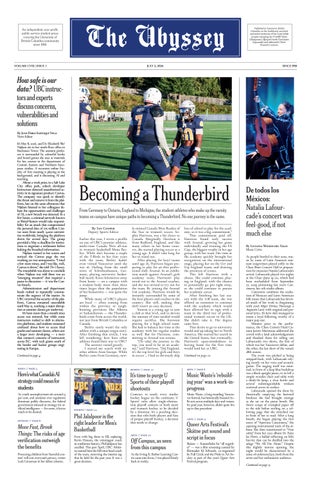
Becoming a Thunderbird
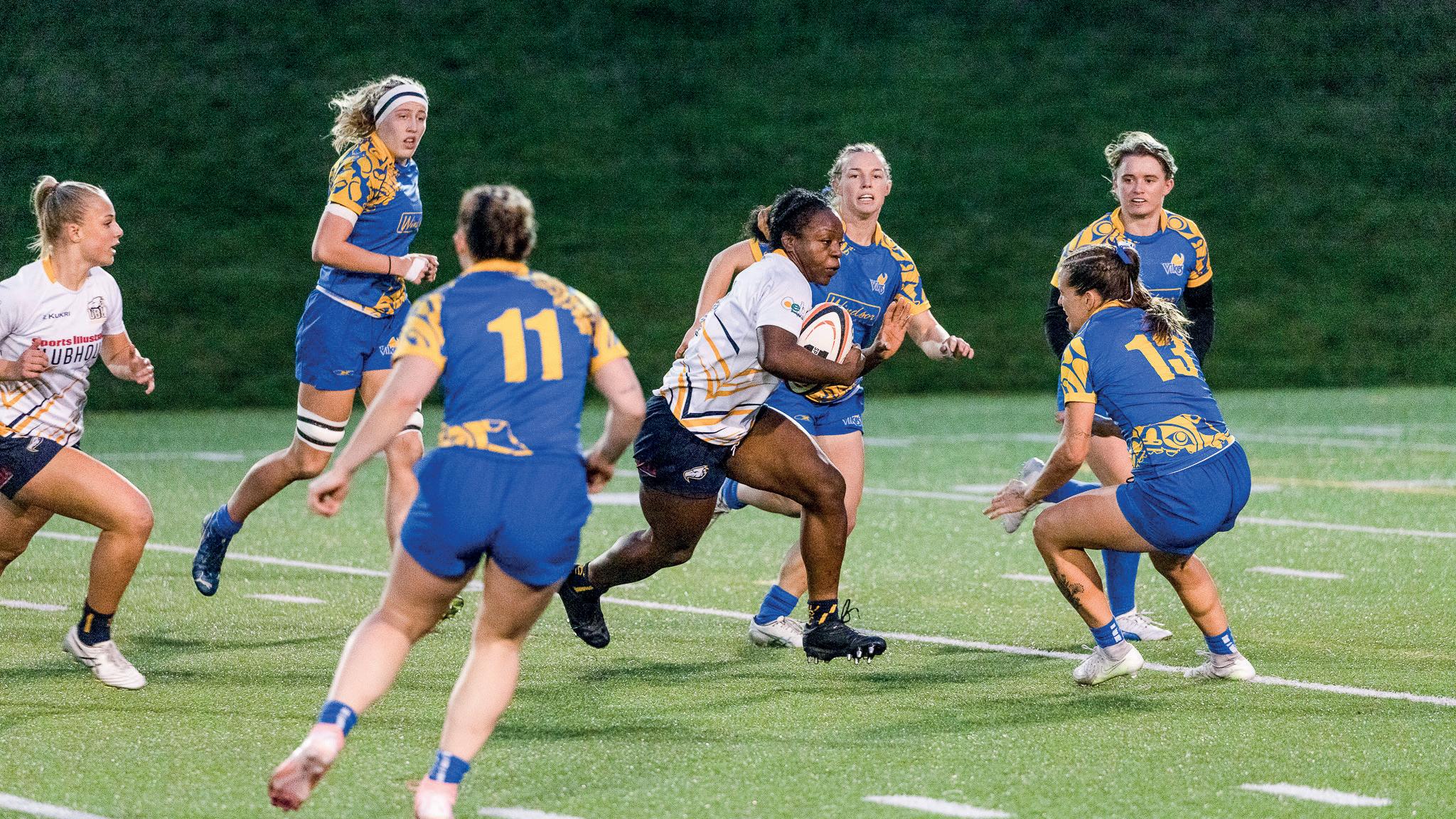
From Germany to Ontario, England to Michigan, the student-athletes who make up the varsity teams on campus have unique paths to becoming a Thunderbird. No one journey is the same.
By I an Cooper Deputy Sports Editor
Earlier this year, I wrote a profile on one of UBC’s premier athletes, multi-time Canada West all-star in women’s basketball Mona Berlitz. While she’s become a staple of the T-Birds in her four years with the team, Berlitz hadn’t even visited Vancouver until she was 16. Hailing from the small town of Schrobenhausen, Germany, playing university basketball nearly 8,000 kilometres away from home — on a campus with a student body more than three times larger than the population of her hometown — was quite the jump.
While many of UBC’s players are local — often coming from within the province or neighbouring provinces like Alberta or Saskatchewan — the Thunderbirds come from across the world, not just from British Columbia or Canada.
Berlitz surely wasn’t the only athlete with a unique origin story. After finishing that article, I was left wondering: how have other athletes found their way to UBC?
The answers varied greatly. I started my search with another athlete from Europe. While Berlitz came from Germany, new-
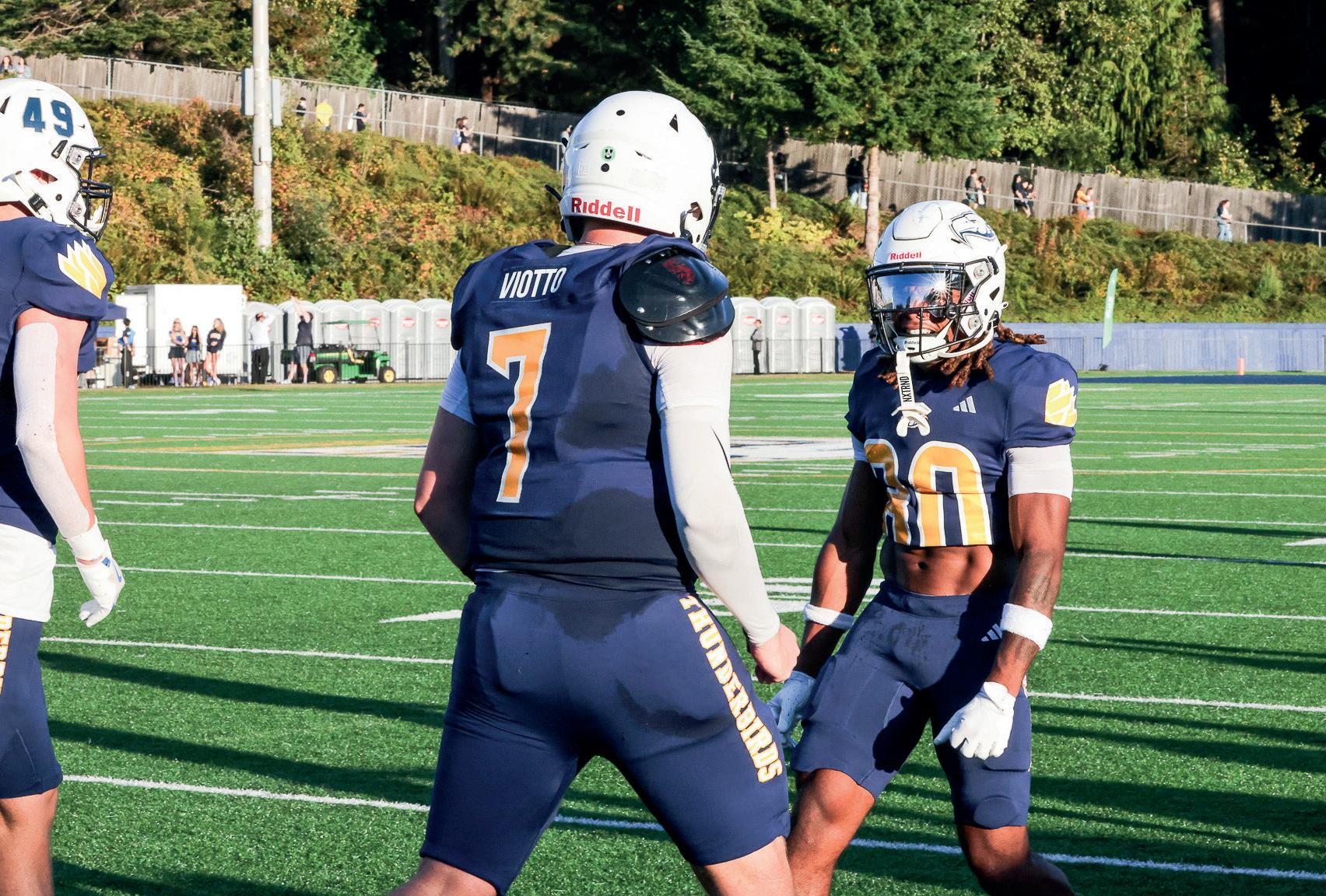
Phil Jalalpoor is the right leader for Men’s Basketball
Even with big shoes to fill, replacing Kevin Hanson, the winningest coach in conference history, Phil Jalalpoor has excelled. This past April, UBC Athletics named him the full-time head coach of the team, removing the interim tag that he held for the past year. It was a great decision.
ly-minted Canada West Rookie of the Year in women’s soccer, Sophie Harrison, was a bit closer to Canada. Marginally. Harrison is from Bedford, England, and like many others in her home country, she started playing soccer at a young age. It didn’t take long for her to stand out.
After playing for boys’ teams until age 16, Harrison began preparing to play for an elite professional club: Arsenal. In an exhibition match against Arsenal’s girls academy team, Harrison’s play stood out to the Arsenal coaches, and she was invited to try out for the team. By joining the Arsenal U16 academy, Harrison would be instantly surrounded by some of the best players and coaches in the country. But still, making that shift wasn’t an easy decision.
Sixteen is a young age to join a club at that level, and to devote the amount of time needed would require sacrifice. She forewent playing for a high school team. She had to balance her time at the academy with her regular studies as well. But for Harrison, committing to Arsenal was serious.
“[To take] the journey to the top, you need to be in an academy,” said Harrison. “[In] England, it’s the top level for girls and boys in soccer … I had to obviously skip
It’s time to purge U Sports of their playoff shootouts
Contrary to nearly every similar hockey league on the continent, U Sports’ rules allow single-elimination playoff contests in both men’s and women’s hockey to be decided by a shootout. It’s a puzzling decision that robs both players and fans of proper playoff hockey, a decision that needs to change.
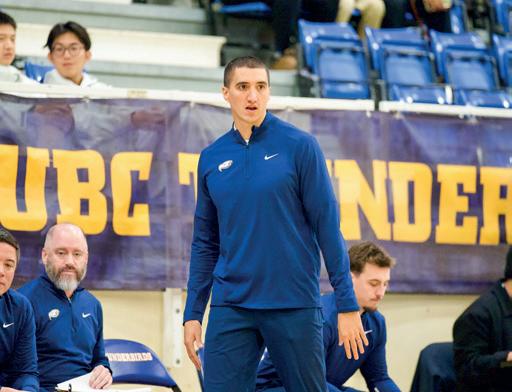
Off Campus, as seen from this campus
As the Irving K.
Learning Centre came into focus, I was placed firmly back in reality.
lots of school to play for the academy, so it was a big commitment.”
That commitment paid off. Harrison found early success with Arsenal, growing her game individually and winning the FA Cup, the biggest trophy in her age group, with her team. Her time at the academy quickly brought her recognition on the international stage, placing her on the U17 and U19 England teams and drawing the attention of scouts.
This left Harrison with a choice. She could continue playing in England, with the chance to potentially go pro right away, or she could continue to pursue her academic career.
After finishing her last season with the U18 team, she was offered an extension to continue with the academy which would have allowed her to sign with a team in the third tier of professional women’s soccer in the UK. She didn’t take it. Her degree came first.
That desire to go to university would end up taking her to North America. She started her search in the United States, but eventually, Harrison’s open-mindedness to leaving home for the first time would land her at UBC.
Continued on page 10.
Music Waste’s ‘rebuilding year’ was a work-inprogress
Music Waste, a long-standing Vancouver festival, has historically boasted 70–80 acts across multiple days and venues. Its 32nd year, however, didn’t quite live up to that precedent.
Queer Arts Festival’s Skátne put sound and script in focus
De todos los Méxicos:
Natalia Lafourcade’s concert was feel-good, if not much else
By Luciana Wilson del Valle Music Critic
As people bustled to their seats, music by some of Latin America’s eminent songwriters played softly in the Chan Shun Concert Hall in preparation for musician Natalia Lafourcade’s arrival. Lafourcade played two nights at the Chan (June 19–20, which had been rescheduled from September 27, 2025) promoting last year’s Cancionera, her 11th studio album.
Cancionera combines the exaltation of Mexican and Latin American folk music that Lafourcade has devoted much of her work to (beginning with 2012’s Mujer Divina: Homenaje a Augustín Lara) with original and personal lyrics. It’s how she’s managed to retain a loyal following worthy of a major pop star.
Minutes prior to the performance, the Chan Centre’s Head Curator Jarrett Martineau addressed the crowd with a land acknowledgement and thanked them for selling out Lafourcade’s two shows, the first of which was her Vancouver debut, and the other, the last show of the venue’s 28th season.
The event was pitched as being stripped-back, with Lafourcade relying mostly on her voice and acoustic guitar. The staging itself was minimal; in front of a deep blue backdrop was a black upright piano, to its left a simple wooden chair and table with a dimly-lit lamp, a clear bottle and several indistinguishable trinkets scattered across its surface.
Skátne — Kanien’kehá for “all together” — was a film screening
by
Lafourcade opened the show by theatrically emptying the battered briefcase she had brought onstage as she sat on the piano bench. She threw scraps of crumpled paper off to the side before settling on a yellowing page that she stretched out in front of her to read. After a long breath, she began playing the first notes of “Apertura Cancionera,” the opening instrumental track of the album. She then transitioned to “Vine solita” from her 2022 album De Todas las Flores, a ballad reflecting on life’s brevity that can be distilled into the adage “We All Die Alone.” Despite this slightly morose opening, the night would be characterized by a sense of unfettered joy, both from the artist and her enthusiastic audience.
Continued on page 15.
Barber
Protecting children from ‘harmful content’ will cost everyone’s privacy, writes Leah Grossman in her debut column.
curated
filmmaker KJ Edwards, co-organized by Full Circle and the Pride in Art Society as part of this year’s Queer Arts Festival program.
Across 1- Lure; 6- Chuck; 10- Youth org.; 13Musical drama; 14- URL starter; 15Fly high; 16- Museum piece; 17- Rub the wrong way; 18- One of two equal parts; 19- Swarm; 20- Macaroon flavoring; 22- Sailor; 24- Deadly fly; 28Scan again; 31- Fighting; 32- Check recipient; 34- U-turn from SSW; 36Permits; 37- Drunkard; 38- Large sea wave; 41- A really big shoe?; 42- Preowned; 44- Theater sign; 45- Tied; 47Curved letters; 49- Hose; 51- Sell directly to the consumer; 53- Ford flops; 56- Toll-free turnpike; 59- Weak, as an excuse; 61- Overhang; 64- Like ___ of bricks; 65- Male voice; 66Dentist's request; 67- Confident; 68Grenoble's river; 69- This is what eyes do; 70- Stadium level; 71- Beasts of burden;
Introducing our newsroom blog, Margins
Over the past year, we’ve been making a lot of changes to the way The Ubyssey works. We’ve invested much more time into sharpening our craft, and recently, our newsroom has been talking about the distance between us and our community.
Here’s the problem as we perceive it: we journalists don’t understand how our audiences function, and most of our audiences don’t understand how journalism works. It’s becoming more and more apparent to us that some aren’t even sure what a journalist is.
We need to do all we can to change that. Rather than running away from a word that means so much to us, we’re running toward journalism. It holds so much promise on the other side of an information ecosystem wrecked by artificial intelligence, bots, unreliable Instagram carousels and influencers in a causal relationship with accuracy.
We’re doubling down on journalism. At the same time, however, what we do know about audiences leaves us to conclude we need to do better than the journalism of the past.
You deserve deeper, more detailed, more timely reporting. You want stories with informed views from somewhere rather than from nowhere. And you need to know who we are and why you should trust us.
We’re working toward a better journalism — a more democratically-engaged, community-centred, systems-oriented one — and we want to use this new vertical, Margins , in our report to show you how we’re doing it.
Each week, a member of our team will be using this space to explain certain reporting choices or address changes in The Ubyssey’s general practices — all the parts of our journalism that may not be easily understood from just reading one of our stories.
A career in journalism is not the most lucrative path, to say the least. Each person at The Ubyssey chooses to be here because they value high-quality reporting and they recognize the influence their work has on UBC and its surrounding communities — and they have fun while doing it. Our reporters have plenty to tell you about
how they spent hours sifting through meeting minutes to find the final piece of a puzzle or how they managed to communicate with a source who was initially reluctant to speak to a journalist. Sometimes the most fascinating part of a story is how we got the story in the first place.
In addition to breaking down our reporting, we’re also giving you a glimpse of what exists beyond the bylines; we have talented people overseeing facets of The Ubyssey you might not have even stopped to think about, like the colour of our nameplate or where we place a photo on a print page. Every decision is intentional. Margins will tell you why.
The Ubyssey , in its current state, is practically unrecognizable compared to what it was when we first started reporting here four years ago. It’s possible the Senior Masthead of four years from now will say the same thing. Margins is as much for our newsroom as it is for our readers. It’s a record of what worked, what didn’t, where we still need to grow and how we’ve changed to better serve you. U
ACROSS
João Pedro Valino Senior Editoral Designer, Digital digital@ubyssey.ca
Sophie Clark Audio Producer audio@ubyssey.ca
Quyen Schroeder Senior Systems Developer Deacon Sowerby Senior Systems Developer webmaster@ubyssey.ca
in Vancouver,
Down
1- Civil wrong; 2- Fencing blades; 3- Donnybrook; 4- First in rank; 5- Tic ___ Dough; 6- Seat occupied by a sovereign; 7- Ear-related; 8- WWII battle site; 9- Used up; 10- Feathery wrap; 11- Actor Mineo; 12Comics bark; 15- "Fiddler on the Roof" setting; 20- Fondle; 21- NATO member; 23- Convene; 25- Twixt's partner; 26- Satisfied; 27- Celtic language; 29- Bother; 30- Kind of fingerprint; 32- Sheriff's band; 33This is only ___; 35- Exemplify; 37- Plaintiff; 39- Coffee server; 40- Charged particles; 43- Destroy hearing; 46- Serving no function; 48- Title for Elton; 50- Less fatty; 52- Minimum; 54- Bowling alley divisions; 55- Campfire treat; 57- Toiletries case; 58- Sported; 60- "___ Tu": 1974 hit; 61- Dawn deity; 62- Primate with a short tail or no tail; 63- Neckline shape; 65- Acapulco aunt;
DOWN
1- Civil wrong; 2- Fencing blades; 3- Donnybrook; 4- First in rank; 5Tic ___ Dough; 6- Seat occupied by a sovereign; 7- Ear-related; 8- WWII battle site; 9- Used up; 10- Feathery wrap; 11- Actor Mineo; 12- Comics bark; 15- “Fiddler on the Roof” setting; 20- Fondle; 21- NATO member; 23- Convene; 25- Twixt’s partner; 26- Satisfied; 27- Celtic language; 29Bother; 30- Kind of fingerprint; 32- Sheriff’s band; 33- This is only ___; 35- Exemplify; 37- Plaintiff; 39- Coffee server; 40- Charged particles; 43Destroy hearing; 46- Serving no function; 48- Title for Elton; 50- Less fatty; 52- Minimum; 54- Bowling alley divisions; 55- Campfire treat; 57Toiletries case; 58- Sported; 60- “___ Tu”: 1974 hit; 61- Dawn deity; 62Primate with a short tail or no tail; 63- Neckline shape; 65- Acapulco aunt
1- Lure; 6- Chuck; 10- Youth org.; 13- Musical drama; 14- URL starter; 15- Fly high; 16- Museum piece; 17- Rub the wrong way; 18- One of two equal parts; 19- Swarm; 20- Macaroon flavoring; 22- Sailor; 24- Deadly fly; 28- Scan again; 31- Fighting; 32Check recipient; 34- U-turn from SSW; 36- Permits; 37- Drunkard; 38- Large sea wave; 41- A really big shoe?; 42- Preowned; 44- Theater sign; 45- Tied; 47- Curved letters; 49- Hose; 51- Sell directly to the consumer; 53- Ford flops; 56- Toll-free turnpike; 59- Weak, as an excuse; 61- Overhang; 64Like ___ of bricks; 65- Male voice; 66- Dentist’s request; 67- Confident; 68- Grenoble’s river; 69- This is what eyes do; 70- Stadium level; 71- Beasts of burden
Here’s what Canada’s AI strategy could mean for students
By Simon Jian Governance Reporter
The federal government launched a new five-year national artificial intelligence (AI) strategy last Thursday, promising to bring AI training to every Canadian post-secondary student and dramatically expand the country’s use of the technology.
The strategy, titled AI for All , is the federal government’s most significant move to date to expand Canadians’ use of artificial intelligence. The government says it wants to increase AI adoption among Canadian businesses from roughly 12 per cent now to 60 per cent by 2034 and create 250,000 AI-related jobs by 2031.
Central to the strategy is a National AI Literacy Initiative that the government says will reach one million entry-level post-secondary students and train more than 3,000 educators with AI learning kits. According to the federal government, AI for All is intended to ensure that Canadians become “informed participants” in an AI-enabled society rather than passive users of the technology. Training programs will focus not only on using AI tools, but also on identifying misinformation, bias, privacy risks and unsafe uses of AI.
The government also committed to providing access to “trusted AI agents for every post-secondary student,” regardless of their field of study.
Dr. Heidi Tworek, direc-
tor of the UBC Centre for the Study of Democratic Institutions, works on AI policy and regulation and has served on the Department of Canadian Heritage’s expert advisory group on online safety. She told The Ubyssey that the strategy’s framing of trust toward AI as something students must develop — rather than something that AI companies must earn — raises questions the government has not answered.
“It’s important for students themselves to have the opportunity to define meaningful trust,” Tworek wrote. She also questioned whether the government has a strategy to hold AI companies accountable for doing so. “Rather than implying Canadians need to learn to trust AI, what about strategies to make AI trustworthy?”
Tworek also said AI for All does not adequately address regulation. “The strategy gives us comparatively few insights into the government’s plans for AI regulation and safeguards … There are many potential (and currently occurring) harms beyond erroneous results, including mass production of non-consensual intimate images.” Other dangers include privacy risks and misinformation. Tworek wrote that addressing these harms requires “urgent thought before we rush headlong into adopting AI en masse.”
The statement accompanying the release of AI for All includes a brief discussion of regulation. It says to “build
As youth alcohol consumption reaches a 20-year low, consumers and businesses on campus adapt
By Harleen Randhawa Health Reporter
Youth alcohol consumption in British Columbia has steadily declined over the past two decades, according to a provincial health officer report published last month.
Per the report, only 38 per cent of youth aged 12-19 have tried alcohol beyond a few sips, down from 58 per cent in 2003. Moreover, among youth who tried alcohol, the proportion who reported drinking before age 15 declined from 80 per cent in 2003 to 66 per cent in 2023. While alcohol consumption rates briefly increased during the COVID-19 pandemic, they have steadily declined in the post-pandemic years.
The trend is likely driven by cultural trends that result in youth starting to drink later and growing interest in alcohol-free lifestyles, the report says. It’s also affecting business — including ones on campus. According to the AMS’s Q3 financial report, several AMS businesses fell short of their projected contributions, with former VP Finance Gagan Parmar citing declining alcohol sales at both the Pit and the Gallery as a contributing factor.
“The people that do come [to these establishments] are also drinking less,” Parmar told The Ubyssey earlier this year.
Dr. Zach Walsh, a professor of psychology at UBC Okana-
trust,” the government will “modernize legislative frameworks” that reduce the risks of AI and strengthen protections, namely against deepfakes and surveillance pricing. The strategy itself echoes this by claiming “Canada will update the laws and standards” that protect privacy rights, children’s online activity and vulnerable groups from online violence, which will include providing Canadians with legal tools to combat such harms and hold those responsible accountable.
However, there are no specific policies or plans mentioned throughout the strategy beyond the acknowledgment of a need for robust safeguards. No significant legislation has been tabled regarding AI regulation since the 2022 Artificial Intelligence and Data Act (AIDA) failed to pass before former Prime Minister Justin Trudeau resigned and prorogued parliament in 2025.
AI for All also includes plans to build a public AI supercomputer, expand sovereign cloud and computing infrastructure and launch an AI Missions Program with a flagship health care component.
For young Canadians, the strategy promises up to 90,000 new AI-related jobs and work placements: 45,000 through the Student Work Placement Program and Canada Summer Jobs, 10,000 through the Mitacs ADOPT and AI+X program, and 35,000 through other initiatives.
The job commitments
come as Canada’s youth unemployment rate sits at 13.4 per cent, higher than the pre-pandemic average of 10.8 per cent. High youth unemployment comes amid broader concerns that AI is displacing entry-level white-collar roles which recent university graduates have historically relied on. A study conducted by researchers at Stanford’s Digital Economy Lab in late 2025 found a 16 per cent decline in early-career employment across the most AI-exposed occupations in the United States since late 2022.
The federal government’s announcement also comes as universities across Canada continue to adapt to the rapid growth of generative AI tools. Over the past several years, institutions and instructors have revised academic integrity policies and experimented with new approaches to teaching and assessment as AI use has become increasingly common in classrooms.
At UBC, starting September, syllabi will have a statement on how generative AI can be used in the classroom.
The Senate has also introduced a new “Artificial Intelligence” subject code, under which five AI-focused courses will be offered. While education falls under provincial jurisdiction, AI for All signals that the federal government sees AI literacy as increasingly important to Canada’s workforce and economic development goals. Questions about regulation, trust and accountability of AI, however, are likely to remain central as AI for All moves to implementation. U
gan and director of the Therapeutic, Recreational & Problematic Substance Use Lab, said the trend aligns with what many researchers have observed.
According to Walsh, there is unlikely to be a single explanation for the decline. “I think people are becoming increasingly aware of some of the negative health consequences of alcohol use,” he said. The provincial report states that alcohol remains a leading cause of preventable death in BC. In 2023, six per cent of all deaths in the province were attributable to alcohol use. The report also found that alcohol increases the risk of at least seven types of cancer.
“Culturally, there’s a shift where people are recognizing that this … default of everyone getting together for drinks or assuming that people are going to drink alcohol in social gatherings is on the decline,” said Walsh. He also noted that non-alcoholic beverages have become increasingly common in social settings and that alcohol is no longer assumed to be present at every gathering.
While the report emphasizes that no level of alcohol consumption is entirely risk-free and emphasizes a “less is best” approach, Walsh said reductions in alcohol use can have benefits that go beyond physical health. “It’s definitely a public health win.”
Walsh added that changing patterns of substance use may
also play a role in declining alcohol consumption. Since cannabis was legalized in Canada in 2018, researchers have increasingly examined whether greater access to cannabis may influence the use of other substances. In 2024, 27 per cent of Canadian youth aged 16-19 reported using cannabis in the past 30 days. As cannabis has become more accessible in Canada, some young adults may be more prone to use cannabis instead of alcohol in certain social settings.
“I think we can’t ignore the potential role of cannabis as a substitute,” Walsh said.
While he emphasized that both substances carry risks, Walsh argued that cannabis generally poses fewer acute risks than alcohol — namely lower likelihood of violence, accidents and organ damage. Walsh said cannabis legal-
ization provides an opportunity to study how a more evidence-based approach to drug regulation affects substance use patterns. However, he emphasized that substance use trends should not be viewed in isolation, since changes in one may influence the other. “If we don’t also look at how it’s potentially impacting the use of alcohol, we miss out on some of the potential health benefits,” he said.
The provincial report notes that any reduction in alcohol consumption lowers the risk of alcohol-related harms. For campus businesses that have historically relied on alcohol sales, however, changing student habits may present new challenges.
The AMS has observed alcohol revenue decreasing over the past three years, with the Pit experiencing annual declines ranging from 7 to 24 per cent.
In response, AMS businesses have adjusted their offerings rather than focusing solely on increasing alcohol consumption. At the Gallery, management has introduced new cocktail options, added cider on tap and regularly rotates its beer selection. The AMS has also expanded its non-alcoholic offerings and promoted mocktails in response to growing demand.
“We are adapting to the broader trend of lower alcohol consumption while continuing to offer students and guests a diverse and engaging range of options,” wrote AMS President Dylan Evans in a statement to The Ubyssey He also discussed the long-standing idea of starting an AMS Microbrewery. “At this stage, we would have to do some deeper analysis to see what a possible business model would be,
to determine if it makes sense to pursue or not,” wrote Evans. He added the decline in consumption would be a factor in pursuing the project.
Evans also said the AMS’s focus is on increasing participation in events and activities rather than encouraging greater individual alcohol consumption. To support this approach, the AMS recently applied for a permit that would allow activities such as karaoke and dance events at the Gallery on a permanent basis, which it hopes will attract more visitors and increase overall food and beverage sales. As campus businesses continue adapting to shifting consumer preferences, the trend suggests that alcohol may no longer play the same role in student life that it once did. U
GUNTAS KAUR / THE UBYSSEY
“We are adapting to the broader trend of lower alcohol consumption while continuing to offer students and guests a diverse and engaging range of options,” wrote AMS President Dylan Evans. ALEAH KIPPAN / THE UBYSSEY
How safe is our data? UBC instructors and experts discuss concerns, vulnerabilities and solutions
By Juan Pablo Sastoque Vega News Editor
As continued from page 1.
A letter to the privacy commissioner
Amid the Canvas calamity, a Thompson Rivers University professor decided to take action. Brenna Clarke Gray, an expert in educational technologies, crafted an open letter to the Office of the Information and Privacy Commissioner. The letter was signed by dozens of British Columbian academics, including some from UBC.
The OIPC is an independent provincial authority that regulates privacy protection in both private and public organizations, among other things. It researches the privacy implications of new technologies and policy, and can conduct investigations and audits into public bodies’ compliance with the Freedom of Information and Protection of Privacy Act.
The signatories to Gray’s letter want the OIPC to use that power. “As concerned educators and citizens, we are writing to request a compliance audit of the data handling by Canvas as it relates to data from within the province of British Columbia and of the risk assessment process by institutions, including University of British Columbia and Simon Fraser University, that led to the decision to opt for a cloud-based solution while BC-based solutions are available and in use at other institutions,” the letter states. The letter also comes at a time of nationwide anxiety fuelled by the Trump administration’s threats to Canadian sovereignty and tech billionaires’ growing power to shape society.
The letter goes on to argue that the audit would help British Columbians understand if risk assessment processes are impacting universities’ pursuit of U.S.-based cloud platforms. Clarke Gray said in an email tied to the letter’s release that educators’ concerns over the dependence of B.C. institutions on U.S.-based platforms is compounded by the prospect of deeper integration with AI tools. The signatories are also asking for a review of the risk assessment processes used in the selection of cloudbased educational platforms, more transparency on cybersecurity and privacy standards, and clarification on how B.C. privacy laws are protecting sensitive educational communications.
Out of over 50 educators that signed the letter, seven are UBC professors — including Ben Britton, who is also a senator representing the Faculty of Applied Science. Britton told The Ubyssey the letter is a way for a group of interested educators to share concerns with their delegates and ask for help in the process of getting a “better solution at the end of it.”
Nijdam was unaware of the letter and thus hadn’t signed it, but she still had thoughts on how the incident played out. “I think it does warrant further investigation. We do need to seriously understand the consequences of some of these actions in light of increasingly vulnerable digital spaces and bad actors.”
Nijdam also said protecting historically marginalized communities’ data supports students who have chosen
Canada as a refuge from persecution in countries like the United States. “Information is power around the world and ensuring that our own students are protected from … bad actors … should be a priority for not just UBC, but Canadian institutions.”
Costly trade-offs
For Britton, Canvas delivers practicality. “My interest in teaching students is not about how I upload my files or how I email my students, all of those things I don’t want to think about. I want a system that is seamless,” he said. “Canada doesn’t have [a] Silicon Valley creating lots of these tools or the centralization of resources” that could serve as an alternative LMS.
But Britton says the risks of relying on such technology are clear. “There is risk that data is no longer held within things that UBC trusts,” he said. He thinks UBC is incredibly fortunate the attack took place during the summer session when fewer classes were running — implying the attack could have had a more acute effect if it had taken place during exam season or other busy educational periods. With the size of UBC and the value of its data making the institution “such a shiny prize” for hackers, the university has a vested interest in protecting community members’ data, Britton said.
The questions we have to ask ourselves, Britton said, are “who can read that data, what were the expectations on that data when it was created and what … UBC’s duty of care is with regards to us using these
large systems and deploying them at scale to support 55,000 students.”
Finally, Britton said that the Canvas breach exemplified universities’ reliance on a “monolith” LMS in which over 9,000 institutions share a risk regarding data management.
During the attack, Nijdam worried about faculty members who would have trouble navigating the shift to alternative LMS tools and how this might impact enrolment numbers. Similar to Britton, she does not think the Canvas attack sparked debate over shifting to Canadian tools — it merely fuelled an ongoing conversation.
She said UBC has pivoted in recent years to prefer that Canadian data be stored on Canadian servers, but this has not been the case for Canvas. For instance, Nijdam said that the Social Sciences and Humanities Research Council — a federal agency that funds post-secondary research — has been encouraging instructors to use their funding on Canadian services.
Should we worry?
The Ubyssey contacted experts on cybersecurity and privacy law to assess the validity of instructors’ concerns. They expanded on issues of data residency, data in-transit and data sovereignty — three concepts that are key to understanding the ongoing debate over data management. Nguyen Phong, a computer science professor who works on cybersecurity, said many of the concerns are valid. “It didn’t come from nowhere, because cybersecurity incidents
happen on a daily basis,” he said.
Phong said the Canvas breach is perhaps the largest case that targeted an “academic setting.”
He explained that the attack exposed vulnerabilities related to how data is being managed and that the leaked information could have included anything from student IDs and transcripts to sensitive conversations between instructors and students. “Sometimes students say ‘I have family problems or I have mental issues’ [over Canvas]. Those are things that shouldn’t be out there in the public.”
UBC says “the information in Canvas is stored and backed up in secure data centres run by Amazon Web Services (AWS) in Quebec. It is not stored outside Canada at any time.” During the interview with Phong, he ran a quick diagnosis into the frontend of Canvas and said it was directing him to an IP address in Pennsylvania. “So that is the front end of the website. When you type canvas.ubc.ca you’re being routed to a Philadelphia server.”
The Ubyssey ran tests similar to what Phong ran and got IP addresses in the United States — both were AWS servers. Phong clarified that according to this, the data is not stored in the U.S., but that he is certain it passed through Philadelphia.
The Ubyssey also interviewed a law professor working at the intersection of law and technology (who asked not to be named — and didn’t specify why and didn’t respond to our followup correspondence about it). According to
them, data residency refers to where the information is being stored, while data sovereignty is related to the specific legal bodies that have exclusive jurisdiction over data even after it has transited to and from where it is stored.
Phong told The Ubyssey that despite the data being stored in Quebec when it is being accessed, it can transit through places like Philadelphia, making it especially vulnerable to cyberattacks in the process. “If the credential to get into that frontend is stolen, they can still get through that, and then from there, get into the server in Quebec.” That risk would not be mitigated if data were to transit only through Canada, but the legal jurisdiction over what happens if the data is compromised would remain with Canadian courts.
The law professor explained that data can be resident in Canada but beholden to a U.S. institution that has operations in Canada. As a result, the U.S. has some legal authority over it. Complete data sovereignty would mean maximizing data residency for the entire chain of transmission to guarantee that Canadian courts and regulators have exclusive or near-exclusive jurisdiction over it.
If the data is in-transit abroad, as Phong’s test seemed to show, concerns over who has legal jurisdiction to pursue criminal actors who access the data illegally are valid, according to the legal expert. They told The Ubyssey that because Canada lacks the infrastructure to support widespread domestic data residency, there’s no all-encompassing,
significant legal obligation to do so. Canada doesn’t have any homegrown alternatives to the tech giants in the U.S., and stricter data privacy laws might also constrain innovation.
Britton said his concerns are not restricted to data being more vulnerable in transit and Canada having no legal authority over it. He’s also worried about the U.S. CLOUD Act, which allows American authorities to compel American companies to disclose what information they have about non-Americans, even when it’s stored outside the U.S. The legal expert added that concerns about the CLOUD Act can be compounded by the weaker data privacy culture compared to that of Canada or the European Union.
They said the language of the CLOUD Act is especially concerning for some people. “It talks about [how], if you’re a tech service provider, then you may have to disclose the benefits within your possession, custody or control. And theoretically, something could be in your control even if it’s offshore, and so it has what you call extraterritorial reach.” They explained the legal tests that determine a company’s possession of data are not concerned with residency. “They ask, ‘Do you have the capacity to manipulate, dispose, access’ — those kinds of things. A modern technology company would certainly be found under the law to control data, even if it was offshore, if they could quickly access it, and if they had exclusive authority to access it … That’s the risk, because the legal question is about who has operational
SKYE SHEN / THE UBYSSEY
control.”
The legal scholar finally added that some companies might appear Canadian but may only have a Canadian subsidiary and actually be operated by a U.S. company, which would make them subject to the CLOUD Act without some people knowing.
The legal scholar called the letter sent by Clarke Gray “very modest” in terms of its demands. They added that what the professors are asking for is “exactly the role that the privacy commissioner ought to be taking” and explained that because Canada does not have “muscular privacy regulators, commissioners play a role of naming and shaming” to raise public awareness and spark legislation.
They said the outcome of the letter could be an investigation by the OIPC, followed by a report that could lead to legislation. “That’s been the historic role of these privacy commissioners. It’s been doing that work of … investigating and amplifying.”
The road ahead Clarke Gray’s letter is not the only effort to increase data sovereignty at Canadian universities. Multiple interviewees brought up the prospect of moving to local servers or increasing data encryption and some instructors said they have already moved to alternative tools.
The days during the attack were filled with stress and chaos for some as administrative work increased to provide learning tool alternatives to Canvas in a short period of time. Others saw it as an opportunity to assess UBC’s dependency on Canvas.
Nijdam said figuring out how to support her students when the Canvas attack happened required extensive screen time and caused migraines for her. For Annie Prud’homme-Généreux, a sessional instructor in the faculty of science, the administrative burden of transitioning between systems right before the start of the summer term was not so pressing, thanks to collaboration between faculty. “It has been a lot more work, like a ton more work, but it’s not been that stressful for me in the sense that we’re all in this together,” she said. “We’ve been working together, helping each other out through this.”
Working through the Canvas attack, Prud’homme-Généreux said “it’s actually been a very positive experience.” Nijdam also praised collaboration, saying her faculty set up Piazza threads so instructors could “learn alongside emerging information and also share tips with fellow faculty members.” Britton sees the breach as an opportunity to explore the decentralization of learning tools. “Some discussions are percolating [around] ‘Is this the best place to do it’, ‘Are there ways of backing up data tools’ …. The sort of things we haven’t thought about that we should have thought about,” he said.
One of the potential solutions would be an LMS completely owned and operated by UBC or a Canadian entity — which Britton called “the gold standard,” but said is unlikely for various reasons. According to him, UBC’s size might give it greater bargaining power in making something happen, but it would take time. He also recognized that student familiarity, ease of access and budget constraints must all be taken into account. “Yes, we could. The real question is, do we want to, and what’s the cost of that,” he said.
Before transitioning to Canvas last year, the University of Alberta used to have a locally hosted and operated LMS through an open-source software called Moodle, which they had to move away from
because the support needed to keep up the system exceeded resources, there were limited features to support modern learning and the system experienced frequent outages. (For reference, U of A has just under 40,000 students, compared to UBC’s over 70,000, and a consolidated budget of around $2.1 billion for 2026/27, compared to UBC’s $4.2 billion.) Phong agrees that for “a full-
“It talks about [how], if you’re a tech service provider, then you may have to disclose the benefits within your possession, custody or control, and theoretically, something could be in your control, even if it’s offshore, and so it has what you call extraterritorial reach.”
- A privacy law expert from a leading Canadian university on the U.S. CLOUD Act
scale university” like ours, it would make sense to have the IT department run a dedicated system. It would not reduce the risk of cyerbattacks, but would increase the control the university has over data management, he said. “I think having the system run in B.C. and the data in B.C. is critical, because at the end of the day, an attack like this is beyond the control of UBC — but if you have everything run locally and managed by UBC, then we have full control,” said Phong.
Another way to protect sensitive information is to bolster encryption. UBC’s Chief Information Officer recommends Tier 3 or 3+ encryption as best practice for IT infrastructure — which are file-level or transparent database engine encryption and application-level database encryption, respectively. File-level encryption allows individual folders to be encrypted independently — these two are UBC’s highest levels of encryption to mitigate unauthorized access risks. Phong said we need more data encryption, and explained that even if data resides in a foreign jurisdiction and is accessed illegally, encryption ensures it is not accessible to bad actors if the key is held by UBC.
Decentralization and moving away from a Canvas-centric approach are other potential solutions. Prud’homme-Généreux said she was not going to move back to Canvas for the summer semester even after the platform was back up. “To me, that changes nothing, because as you know, the summer terms are so fast that at this point, I’ve established all the alternative systems. I’m just gonna stick with them for now,” she said.
She said her switch to Microsoft Teams gave her better results in terms of communication with students than Canvas used to do. She said she used to get a few emails after classes, but after setting up Teams for direct communication, students are reaching out more frequently and more informally. “It’s facilitated communication between me and the students, and I’m planning to keep that tool,” she said. Nijdam turned to UBC Blogs — a learning platform managed and locally hosted by UBCIT that runs on WordPress, an open-source publishing platform — to re -
imagine the execution of her class outside of Canvas. She said she also used Gradescope for assignments and Piazza for discussion — the two are tools UBC instructors already used before the attack.
Britton said he was not directly impacted since he is not teaching over the summer, but stated that listening to his colleagues on the best alternative tools moving forward will be important for him. He added that building redundancy between platforms to ensure seamless transition in case of a technical difficulty would be beneficial.
When questioned on the potential of opening UBC data to more “points of attack” by increasing the platforms used through decentralization, he said there’s a balance between points of attack and operational capacity to continue business as usual. “[It’s] about not [putting] all of your eggs in one basket, to use that old analog, but effectively to spread a little bit of that risk, and for instance a little bit more decentralization.”
A never-ending story
It’s been over a month since digital chaos erupted while Nijdam met online with her colleagues to discuss AI. Canvas is backup and running, and a sense of normalcy has returned as students settle into the summer term.
Instructure reached an agreement with ShinyHunters on May 11. The company never announced that a ransom was paid, but it is most likely the case. Instructure claimed they received confirmation of data destruction from ShinyHunters.
“In my network security [class], the very first thing that I teach my students is never pay … because you can never trust that it is the last version of the data that they have,” said Phong, as he explained there is a non-zero chance that the stolen data is still being held by the group or has been sold illegally and can surface any time.
Britton said he still harbours mixed feelings about Canvas’s safety. However, “I don’t know what the alternative looks like. Do I want to have a large email list with my students? Probably not, because that has other risks with regards to disclosure of information that we shouldn’t be using. There was a nice disconnect that Canvas operated in,” he said.
The legal expert The Ubyssey contacted said the attack “was primarily about creating inconvenience” to extract a ransom, and stealing the data itself wasn’t the main goal of ShinyHunters. They also said that tougher legislation — like requiring data residency and legal frameworks to maximize data sovereignty — could come with other problems. “If we flip the switch tomorrow and said, ‘we will only allow companies to operate if the data is fully resident in Canada and under [the] … sovereign … and exclusive authority of Canadian courts, we would be undoing a lot of the modern economy, because we haven’t yet built up that domestic capacity.”
Phong said the long-term effects of the attack might not be revealed yet. “Maybe not tomorrow, but years from now,” the data stolen, including transcripts or communication between students and instructors, could resurface and be used to harm students who go on to become public figures. Transcripts with low grades, he said, could hurt alumni in the future. People would have forgotten about the attack and would be unaware of where the data came from — but the reputational damage would be done.
“That would not come in a few months. That would come in 20 years, 30 years from now.” U
UBC to open food prescription program in September
By Stephen Kosar Deputy News Editor
UBC is opening a new food prescription program in September, thanks to a $3.5 million gift from RBC. The program is meant to address food insecurity on campus and is one of three initiatives supported by RBC’s largest-ever donation to a post-secondary institution.
Announced on May 29, the program will operate out of UBC’s recently-opened Gateway Health Building, the new home of UBC’s integrated student health services.
“Alongside physical and mental health screening, students may now be asked about their food security,” a statement from the university read. “If a risk is identified, clinicians will create a personalized food prescription and connect students directly to the campus food supports.”
“We know that a student who is hungry cannot focus, cannot engage and cannot perform to their potential,” said Noorjean Hassam, UBC’s associate vice-president, student health and wellbeing.
Hassam said the program will be transformative by including nutritional health in the support UBC gives students.
The donation comes as one in four Canadians report living in food-insecure households. According to Food Banks Canada, nearly 2.2 million Canadians visited a food bank in a month last year.
Students at UBC are feeling the pressure too. Forty-six per cent of students reported worrying about affording groceries in the 12 months prior to May 2025, according to last year’s AMS Academic Experience Survey. Graduate and international students were more likely to face food insecurity than undergraduate and domestic students.
In the 2024-25 school year, the AMS-run food bank recorded 27,329 interactions, representing an eight per cent increase in interactions from the previous year, and 18 times the number of interactions just five years ago.
With increasing financial pressure on students, student union executives have pushed for greater food security funding for years. In last year’s
AMS executive goals, the VP external and VP academic & university affairs committed to lobbying UBC and the provincial government for funding to support food security, including for student union foodbanks across the province.
In September, the AMS and the Students’ Union Okanagan (SUO) both asked the Board of Governors to increase funding for similar initiatives. The board seemingly agreed, and in March, committed $1.2 million towards food security initiatives in the university’s budget — consistent with the student unions’ requests and up from $800,000 the year prior. The Ubyssey reached out to Agora Café, Roots on the Roof and Sprouts — food security organizations on campus — for comment, but received no response.
RBC’s gift also supports an agriculture practicum to train future farmers and the BC Food Web, an online resource that “translates complex agricultural research into plain-language resources that farmers and industry can act on directly.” U
Two community fridges located in the tunnel between the Nest, the LIFE building and the Recreation North Centre. | ALEAH KIPPAN / THE UBYSSEY
Move Fast, Break Things: The risks of age verification outweigh the benefits
Leah Grossman (she/they) writes Move Fast, Break Things , a column about how technology and the politics surrounding it affect our lives. They are a third-year student studying Astronomy. Her email is l.grossman@ ubyssey.ca.
By LEAH GROSSMAN Technology Columnist
Age verification is quickly spreading around the world — and the internet. The U.K. Online Safety Act 2023 requires platforms to verify users’ ages in order to prohibit children from accessing adult or harmful content. Australia’s Online Safety Amendment (Social Media Minimum Age) Act requires social media companies to “take reasonable steps” to block children from having accounts on their platforms. Many US states have similar bills in various stages of the legislative process, some of which have already passed and some of which are currently being challenged in courts. Here in Canada, the Liberal party recently adopted official policy positions supporting age verification for social media and AI tools. Some companies, such as Roblox and Discord, have announced that they will be rolling out age verification globally. These regulations ostensibly protect children. In reality, they strip people of anonymity, give governments more power to censor speech, further push already commonplace invasions of personal privacy and open the door to massive data breaches.
Anonymity enables people to post dissenting political opinions and empowers whistleblowers to expose corruption and misconduct while limiting the risk of repercussions. It allows marginalized and oppressed communities, like transgender people and undocumented immigrants, to access resources and community without fear of persecution. It protects social media users from blackmail and identity
theft.
Age verification threatens this. A transgender person in Tennessee, where the state just passed a bill requiring clinics to provide detailed reports on all gender-affirming care to the government, living through the rampant transphobia taking place across the federal government and the majority of Republican-controlled states, likely will not feel comfortable uploading a government-issued ID to connect with other transgender people online. An anonymous whistleblower reporting on government misconduct will not want their identity linked to their online presence.
Age verification also creates a powerful opportunity for government censorship.
The U.K. Online Safety Act, for example, focuses mainly on “content harmful to children.”
The Act includes many cases of this, including content that is pornographic, “encourages, promotes or provides instructions for an act of deliberate self-injury” or “incites hatred against people [ …] of a particular race, religion, sex or sexual orientation.” While these restrictions could make sense in the case of a well-meaning government — I’m not advocating for homophobia — it is too easy to see how they could be abused by bad-faith actors.
The Trump administration has described gender-affirming care for transgender minors, which is often reversible, as “chemical and surgical mutilation” that “maim[s] and steriliz[es]” children. A transphobic government in the U.K., pushing these same beliefs, could easily argue that information intended to help children and their families explore their identity falls under promoting deliberate self-injury. (The current U.K. government under Prime Minister Keir Starmer, while not using as outrageously transphobic language, has banned puberty blockers — a common and safe form of gender-affirming care for minors — indefinitely.)
Similarly, certain people could argue that a movement like Black Lives Matter incites hatred against white people. By
this argument, resources promoting racial equality could be restricted under the Act.
The security implications of age verification are perhaps the simplest. The most common methods include uploading a scan of a government ID or using AI to analyze a facial scan. Many companies performing the verification promise that the data is stored for a limited period of time, only long enough to perform the required function. In October 2025, Discord reported an incident where photos of approximately 70,000 users’ government-issued IDs were stolen. These users, suspected of being too young to use Discord under their terms of service, had uploaded their IDs to prove their ages. Discord claims this was a breach of 5CA, a third-party company that Discord used as part of their customer service. 5CA denies this. Regardless of who is at fault, the breach is a damning example of how collecting this type of information en masse creates an enticing target for hackers. And this is only 70,000 people; as age verification grows more common, the amount of data being collected will grow rapidly.
There are ways to perform less invasive age verification, to an extent. For example, a user can be verified by confirming if they have a credit card on file — credit cards typically require you to be the age of majority — or analyzing their history, such as how long they have had an account. Apple uses both methods as part of their age verification procedures in the U.K. and Singapore. Certain types of age verification, such as those using facial biometric data, can also be done on-device, which means the data is never sent to a company’s servers, making it more difficult for hackers to steal the data. These methods also help to address anonymity, since they don’t rely on verifying a user’s identity, but they don’t address the censorship issues.
But many companies simply don’t have a vested interest in using methods like these.
loading an identity document to a third-party partner, which they said would be “deleted quickly — in most cases, immediately after age confirmation.” They said more methods would be coming in the future, including continual improvement on a model that would run in the background and attempt to automatically determine a user’s age group. Discord emphasized that they would only receive a user’s age, not their identity or any other information.
Remember, this was around four months after they announced that approximately 70,000 users’ government-issued IDs were stolen as part of Discord’s existing age verification procedures. While Discord no longer works with 5CA, they did not announce what companies they would be working with.
ille-Dechêne in the prior parliament in late 2021, and made it through two readings and committee in the House before parliament was prorogued due to former Prime Minister Justin Trudeau’s resignation.
The government has also shown willingness to consider other forms of age verification. Prime Minister Mark Carney said in early March that a social media ban for children “merits an open and considered debate in Canada.” And at the Liberal Party’s national convention in April, just days before three byelections handed the Liberals a majority government, party members voted in favour of two policy resolutions focused on age verification.
Unless privacy and security are part of a company’s brand, as they are for Apple, why would a company do more than the bare minimum of outsourcing the work to a third party?
This essay is part of Move Fast, Break Things , our technology column. It is written by staff columnist Leah Grossman, who is trained as an opinion journalist.
When Leah writes about consumer technology, the internet and the politics that inform our digital lives, she isn’t impartial. They write with an eye toward how Canada’s reliance on American technology affects us all. Her American perspective informs how she covers technology regulation and Big Tech’s successes and failures.
Opinion essays are intentionally subjective and make no claims to impartiality. Otherwise, they are required to uphold the same ethical standxwards and undergo the same factchecking process as the rest of The Ubyssey’s report.
The views expressed in Move Fast, Break Things are Leah’s and don’t represent the views of The Ubyssey as a whole.
That is exactly what Discord did. On Feb. 9, Discord announced that all new and existing users would have a new “teen-appropriate experience” and could verify their age to have full access to the platform. Users who did not verify their age would not be able to view sensitive content, access age-restricted chat rooms or speak in certain types of public voice channels, among other minor changes. The initial two methods of verification, Discord announced, were an on-device facial scan and up -
The user base reacted quickly — with backlash. Discord responded on Feb. 24 announcing that they would be delaying the rollout until the second half of 2026 (outside of jurisdictions with existing legal requirements), with significant changes. Every partner they work with will be documented on their website along with that partner’s practices, and every partner offering facial verification must perform it on-device. More verification options will be added, including credit card verification. Additionally, there will be a dedicated spoiler channel option that does not include adult content, so gated channels for sensitive topics such as politics will be able to continue to exist without requiring age verification. They also announced that before the program launches, they will publish a detailed blog post explaining the technical details of their age estimation.
These are certainly improvements. Better documentation, more options, less privacy-invasive methods and less of a need for age verification are all good things! That said, they aren’t enough. If the automated age estimation doesn’t verify you, then you still need to provide your identity or a facial scan if you want to access the restricted content. You still need to trust that the scan is happening on-device and that the data is being treated with care. Yes, that was already true with your messages, but now it’s also true with your driver’s licence, your passport or a 3D scan of your face. And perhaps most damning of all, these changes were only implemented after immense backlash.
As people get more used to age verification, the backlash will decrease, and even the same amount of backlash will have less of an impact on vastly more powerful companies like Google, Meta, and other Big Tech companies. Discord’s withdrawal is perhaps the bestcase scenario for users, and I don’t think the industry will tend toward the best-case scenario. In fact, the most powerful tech companies, the ones that I’m most wary of, are the ones that I think are least likely to even consider what’s best for users. Again, why would they?
Canada does not currently have any age verification laws in place. However, at least one bill is under consideration at the federal level: S-209, introduced by Hon. Sen. Julie Miville-Dechêne in May 2025, would effectively require commercial distributors of pornographic content to implement age verification. This bill has passed the Senate, but has only just entered the House of Commons. A nearly identical bill was introduced by Miv-
The first of these, citing Australia’s legislation, would require social media platforms to set a minimum age of 16 for a user to have an account. It would also establish a regulatory framework for social media platforms to enforce other, less problematic safety standards (such as removing artificial images of non-consenting people). The second policy resolution would require an age restriction, again set at 16, for access to generative AI chatbots and “other potentially harmful forms of AI interaction.”
These resolutions are non-binding and party policy is not a part of the legislative process. However, these are now official Liberal positions, and it would not surprise me if the government adopts legislation based on these policies — especially now that it has a majority in the House of Commons.
Yet, there is recognition that age verification is not necessarily the solution. A few days later, Culture Minister Marc Miller said banning children from social media “could be an important layer” but that it’s not “the answer to everything.” After all, online harms “don’t end as soon as you turn 15 or 16 or 17.” However, the government still plans to introduce an online harms bill, and I suspect age verification will be a part of that. This legislation is, in one form or another, coming to Canada. In fact, Premier Wab Kinew announced last week that Manitoba will ban youth from using social media and AI chatbots, the first such ban announced by a government in Canada, though the details are not yet known.
I will leave you with this. Do you trust the platforms you use to approach age verification with care? Do you trust governments to use their legislative powers with the absolute best of intentions? Do you trust every company performing age verification to delete your data, in a timely manner, without sharing it with governments and law enforcement and without building a biometric database? Do you trust everyone involved to treat your face and your government IDs with the utmost security so they don’t fall into the wrong hands?
If, like me, you answered no, then hopefully you agree there are too many issues with age verification. Even if you believe age verification protects children (and I’m not sure it does), it’s not worth exposing ourselves to the self-serving motives of governments and corporations. Even the most well-meaning, pro-free speech government can be replaced by an oppressive one. Even a well-intentioned age verification company might mess up and get hacked. I hope you weren’t planning to keep your ID private. U
SKYE SHEN / THE UBYSSEY
Point of Inquiry: Finally, the courtesy of open debate
Quyen Schroeder (they/ she) writes Point of Inquiry a column covering student politics and the AMS. They also serve as The Ubyssey’s opinion editor. Her email is q.schroeder@ubyssey.ca.
By QUYEN SCHROEDER AMS Columnist
A month after taking office, the latest crop of AMS executives held their first Council meeting. It was an embarrassing showing. The proposals they brought forward were challenged, amended and delayed at the behest of the non-executive councillors.
We’re still early into the terms of both this executive and this council, but this portends a shift in AMS governance power.
In recent years, executives have commanded Council. Even when facing councillor opposition, executives have garnered the votes required for their priorities.
This spring, Council nearly fired former VP AUA Zarifa Nawar. This would have made her the second executive to be removed from office, following Drédyn Fontana’s removal the previous year. Councillors told The Ubyssey that Council had initially intended to remove Nawar for violating her fiduciary duty to the AMS. At least, they did until then-President Riley Huntley intervened, cautioning that the potential reputational harms risked jeopardizing the union’s three planned fee increase referenda. Council ultimately decided not to fire Nawar. (Regardless, she resigned before the end of her term, alleging racism and sexism within the AMS.)
Years earlier, in 2023, the AMS brought forward an amendment to increase the health and dental fee. The increase was initially designed to include coverage for gender-affirming healthcare and was developed in consultation with the Trans Coalition. At the last minute, the executive
backtracked and separated the $8 that would fund gender-affirming healthcare into its own referendum. There were fears that a $60.50 combined fee increase might fail to pass; a $52.50 referendum — by their logic — would be more likely. The executives couldn’t bring themselves to risk the healthcare of “normal” students; they preferred alienating trans students and framing us as not normal. Many councillors vocally opposed this change, but after an in camera session — which lasted over an hour — ultimately fell in line with the executive.
The tide began to turn during the previous administration as the typical publicly-unified executive front fractured amid office in-fighting. Council took on a more active role. This February, food security groups like Sprouts pushed a referendum to give themselves a say in how UBC’s food security funding is distributed. It failed to gather enough signatures to be included on the March AMS ballot. Rather than accepting this, Councillor Bryan Buraga brought forward a motion to create the Food Security Initiatives Ad Hoc Committee anyways. The motion initially faced opposition (including from two executives — Nawar and VP Student Life Kevin Heieis) before being referred to committee.
Not to be deterred, during a break in the meeting, Buraga sprung into action. Directly in front of me, the terms of the committee were renegotiated. Concessions in the committee’s composition were made and once council returned to session, the motion was reconsidered and passed unanimously.
(A number of councillors abstained, including Nawar. The dynamic duo of ex-VPs AUA Nawar and Fontana are now our representatives on the Board of Governors — the university body that grants the Food Security Initiative funding.)
Introducing a motion without going through a committee was a level of initiative I had not seen before in the AMS. Same with the legiti-
mate negotiation and politics that were required to collect votes on the motion. Admittedly, some of this may have happened behind closed doors in years past, but this was a far cry from the passivity of council during meetings I had grown used to.
The story of a more active council willing and able to take on the executive continued in May’s AMS council meeting.
On the campaign trail, AMS President Dylan Evans promised a governance review, aimed at addressing what he considers irresponsible and hasty code changes and governance practices. In his spring interview with The Ubyssey ’s ad hoc editorial board, he told us about the breakneck pace of code changes. There were so many, according to Evans, that councillors were unable to “follow a lot of the changes.”
To me, this is more a dereliction of duty from councillors than a fix-worthy governance failure.
However, he has a point: the AMS needs governance changes. These past years have been exceptionally bad for executive turnover and AMS culture. Evans champions the myopic view that this is entirely a structural issue — which I think ignores the persistent cultural problems of recent years. Yet, the AMS’s structures undeniably contribute, and to that end, I think this year’s executive team has begun to meaningfully address them.
This year, the executive team presented their goals to council as a group — rather than as individual executives. This is a good step. I hope it keeps our executive focused, off each other’s toes and accountable for helping each other.
The proposed governance review, however, is closer to an executive power grab than meaningful change. I am not inherently opposed to a governance review. I agree with Evans that the structure of the AMS played a role in recent years’ turmoil (though we disagree on the extent).
But the proposed committee’s structure would allow
the executive to seize control over a full revision to the society’s code and policies. Evans’ proposed committee would include two executives, the President, two councillors and a single student at large, for a total of six voting members.
Evans insisted that the President would only vote in the case of a tie — which is to say, the President would get to vote every time their vote would actually make a difference — giving the executive team an effective three votes on the committee. The executive would outnumber councillors on the committee and would have a crucial 3–2 majority when appointing the student-at-large.
The executive would have further measures to ensure dominance of the review. Most notably, guests would not be allowed at the meeting, except at the sole discretion of the president, potentially veiling proceedings from the press (hello!) and students-at-large.
This was not an appropriate procedure for this review. Intentional or not, it’s a clear play for executive power.
Council rejected these terms. Councillor Josh Bradbury — who served as speaker of council last year — pushed a motion to amend the committee’s terms, replacing one of the executive seats with a councillor. Multiple members of the executive — including Evans, VP Administration William Sparks and VP External Alex Zheng — opposed this motion. Evans’ justification? “Executives are very interested in being a part of this.”
Regardless, when the matter went to a vote, only eight voted against it (presumably, the five executives and three other councillors). For being one of the main goals of the executive team, it garnered exceptionally little support from the rest of Council.
I chalk this up to two main reasons.
The first is that the executives provided exceptionally poor justification for the composition of the committee. Though during and after the meeting Evans praised the quality of the discussion, I didn’t think the executives’
their decisions. They weren’t able to this time; they should next time. The second reason is that not all of Council is content with passivity — Bradbury’s intervention showed that. I hope this year will be marked by substantive council discussion. Council should not just be a bygone approval of the executives’ agenda. Certainly, an unnecessarily obstinate council is also bad; I don’t believe an aggressive and adversarial council–executive relationship serves anyone. But Council should host substantive discussion when considering important matters. Yes, between councillors and executives but also among councillors.
This requires that councillors engage in parliamentary procedure. Not everyone needs to be neck-deep in Robert’s Rules of Order. However, a base level of competency is required to fulfill the duties of office.
Councillors cannot be afraid to speak against an executive’s motion or to question an update. Likewise, they must have the competencies to — when necessary — oppose the executive with an appropriate amendment or counter-motion.
arguments were the source of that quality. Repeating that the president can only vote in a tie is not persuasive. Neither is saying that other executives are “very interested” in sitting on the committee and “having a voice.” Even the seemingly cogent points — executives bringing relevant on-the-job experience and wanting a nimble committee — fall flat when considering that two of the six members of the Bradbury-proposed committee would still be executives.
This essay is part of Point of Inquiry , our AMS column. It is written by staff columnist Quyen Schroeder, a trained opinion journalist who also serves as The Ubyssey’s opinion editor.
Quyen isn’t impartial when they report on the AMS. With years of council attendance as context, she imagines a better future for our student union — one with meaningful advocacy and productive student engagement. When they go to council meetings, attend AMS protests and interview executives, they make it clear they are reporting as an opinion journalist.
The views expressed in Point of Inquiry are Quyen’s and do not represent the views of The Ubyssey as a whole. Opinion essays, though not impartial, are still subject to the same editing process and fact-checking standards as everything else in The Ubyssey’s report.
Our executives should be able to coherently justify their decisions. When I write Point of Inquiry, I don’t trip and accidentally produce opinion journalism. I make intentional editorial decisions and am accountable for justifying them if asked by you, dear reader. Our representatives should be held to the same standard: they must be able to justify
Crucially, this must expand beyond Graduate Student Society representatives like Bradbury and Buraga. We are still early in this council’s term — it’s no surprise that new councillors are still developing these competencies. However, every councillor must strive for this level of engagement. It’s that commitment that produces the deliberation that makes Council a valuable institution and allows councillors to serve their constituents.
If our representatives can lock in at Council, the rest of us have to contribute too. Last year in Point of Inquiry’s inaugural essay, I wrote “we are responsible for pushing our union where we want it to go, and our union should be receptive.” Over the past year we’ve seen the start of that healthy reception; this year, we must nurture that seedling of healthy governance culture. This year’s executives don’t seem like ones to rock the boat — at least on their own.
Conveniently, executives are accountable to Council; conveniently, Council is on its way to being comfortable challenging our executives.
For us, that means we need to tell our councillors what is important to us — and not just when told to by an incendiary Instagram infographic. While it’s clear that students in the School of Music are justifiably concerned about reduced access to rehearsals in the Chan Centre, it’s less clear what, say, dentistry students want from the AMS.
AMS executives have told us for decades that what we want is an exam database. Are we satisfied being told what we want? Is our highest aspiration truly … a list of PDFs? I don’t think so. We can dream bigger. And our councillors can help make it happen. U
Do you have an original perspective that’s relevant to our community?
Pitch us an op-ed! You don’t have to be an experienced writer: the opinion editor will help you structure your argument and put your ideas to paper.
SKYE SHEN / THE UBYSSEY
Music Waste’s ‘rebuilding year’ was a work-inprogress
By Claire Donnan Arts & Culture Editor
The WISE Hall, an unassuming brown structure in a quiet area of East Van, was the new home of this year’s iteration of a long-standing independent music festival.
In the past, it has typically boasted 70–80 acts across multiple days and venues. The 32nd year of Music Waste, however, looked quite different. It was more modest, with six local acts sharing one stage this past Sunday, on June 7.
Julia McDougall, one of the event organizers, said it was a rebuilding year for the festival.
“This year is a little bit different because we lost so many people, and because, as a result … a lot of funding things didn’t happen. We decided collectively with everybody who’s new and some old people [who] were with the festival, that it made more sense to take this year to restructure and to fundraise,” said McDougall. That meant the bill was smaller, the bands were quite different from one another and the venue was singular. While none of those were problems on their own, the bill suffered from very little crossover between fanbases.
GØØ, a self-described grungegaze band, started the night off at 6:45 p.m. with screamy lyrics and heavy distortion. GØØ was a last-minute, morning-of addition to the bill, after another artist had to pull out.
GØØ was received by a small but hearty crowd, with one or two people immediately beginning to mosh. Their music was fun (this reporter is quite the fan of early 2000s metal and grunge), but that’s not to say it didn’t feel slightly out of place to be headbanging while the sun was still out.
Patrick Farrugia was up next. As the solo artist explained, he was labelled bedroom pop, though that wasn’t his exact genre.
“I feel like … ‘psychedelic pop’ is a bit more describing my stuff,” said Farrugia. “There’s influences from all over the world, really … I love music from everywhere, so it kind of all feeds into the stuff that I make and stuff I play.”
Farrugia was the only artist The Ubyssey spoke to who had performed at Music Waste before. His music jumped from genre to genre, with light, vocal-heavy bedroom pop one minute and distorted feedbacked guitar riffs the next. Each song ended with a peppy “Thank you!”
Every artist who got up to
perform mentioned how important the local music scene is and encouraged attendees to donate to the festival. As McDougall explained, they had been impacted by a variety of factors, including cuts to arts funding and venue closures.
“We’re in a pretty tumultuous time, so I hope we can kind of start working together collectively to push back on things like budget cuts and venue cuts,” said McDougall.
By the time Lonely Crowd came on, a group of their friends and family was ready to cheer and dance. The four-piece band mostly met through their programs at Capilano University, getting together to make music about a year ago.
Frontwoman Stefania Vero described their music as “heavy shoegaze,” and their dreamy, distorted ’90s sound was evident in clanging drums and grimy guitar licks. The band, being relatively new, was thrilled to perform at a festival as well-known as Music Waste. They cited several other bucket list items they were looking forward to crossing off.
“Definitely recording, just in general, we would love to get our stuff out there,” said Vero. Guitarist Hudson Golden and drummer Nate Holyome were both interested in filming some music videos, mostly because of their backgrounds as film students.
Next came Doom Loops, with their upbeat sound and energetic stage presence. They told the audience this was the third show they’d played this week, in celebration of their newest single, and shouted out the one person in the crowd who’d attended all three.
Guitarist and vocalist Natalia Beltran said their band’s music comes from a desire to perform and share. “It’s really hard to get people together to do anything, so if you have the agreement of a few people that have talent to come together and jam and make something new, and then do shows, that’s … such a gift,” Beltran said.
Music Waste was much smaller this year. The crowd maxed out at around 30 people, at a show that was quietly advertised on a new, unverified Instagram account. But McDougall said she hopes this year’s smaller event can set the festival up for years to come.
“Hopefully we can just get it back to being a really sick weekend festival, where people can gather in different venues that maybe [they] don’t always go [to].” U
ALEAH KIPPAN / THE UBYSSEY
By the time Lonely Crowd came on, a group of their friends and family was ready to cheer and dance. The four-piece band mostly met through their programs at Capilano University, getting together to make music about a year ago. | ALEAH KIPPAN / THE UBYSSEY
Queer Arts Festival's Skátne put sound and script in focus
By Elena Massing Editor-in-Chief
I had never truly seen the inside of The Birdhouse before. I considered myself a pretty frequent attendee — earlier this month, I dropped in for an all-Filipino lineup of drag performers — but the details of the space itself had never really registered in my mind. Usually, I’m too focused on squeezing through a sold-out crowd to strategically position myself by the nearest fan, fishing for earplugs in my purse or
dodging a queen strutting down the middle of the room, doing her best to part a sea of people waving $5 bills in her face.
I saw the venue in a different light on June 18 at Skátne. The DIY-ness of the warehouse was more evident in the daytime: the industrial ceilings, the worn concrete floors, the clusters of mirrorballs hung up with chains. The space had a handmade charm to it.
Skátne — Kanien’kéha for “all together” — was a film screening curated by filmmaker KJ Edwards, co-organized by Full Circle and the Pride in Art Society as part of this year’s Queer Arts Festival program. It featured five short films and music videos by queer Indigenous artists.
The venue wasn’t equipped to showcase the films to their full visual potential, as the projector caused everything to appear a bit murky. But The Birdhouse was the right place to present these works. The queer community hub, which has recently ran afoul with the City of Vancouver amid its crackdown on DIY venues, captured the themes that emerged throughout the films — of displacement, chosen family, belonging — much more effectively than a theatre might have.
The event opened with
ODMK’s “Four Spirits Walk As One,” a sub-five-minute, Chaplin-esque silent film portraying a first date between a pair of Two-Spirit people. It didn’t take itself too seriously — their picnic supplies were identifiable via comically large labels, and most of the dialogue (or phrases scrawled on tiny signs, rather) was pretty cheesy. But there’s value in reclaiming even the silliest of cinematic forms by reimagining them with characters who would’ve never made their way into the mainstream media of the time. Shot on 8mm film and edited on an iPhone 7+, it was not the most polished piece of the night, but its simplicity was charming. Also on the shorter side, “Taha, Ua” reflected on Indigenous communities from across the Pacific Ocean. It drew on director Ngaire Lyden-Elleray’s mixed Pasifika background and the challenges of finding ‘home’ after being displaced. Lyden-Elleray’s early creative projects existed in the realm of poetry and prose. “Taha, Ua” — “one, two” in Tongan — was an opportunity for her to exercise those skills while overlapping them with other artistic mediums like dance, performed by Annelie Wells and Nenaa’ikiizhikok Kinew Erdrich.
“You only know from the curve of your nose, the hunch of your back, the dips of your eyes, and stories pried from an orphan’s hands,” she recites in the film, as we observe the subtle movements of a person’s bare back, the sandy shores of the Pacific Ocean, a dancer in vibrant regalia travelling in slow motion through void-like darkness. “Holiness, wholeness, was never an option for you. You were never even given a chance.”
Lyden-Elleray didn’t grow up speaking Tongan, so permanently capturing the initial steps of learning their language was a challenge to reckon with, they said. But even if the language isn’t entirely perfect, they see their storytelling as reclaiming their family’s narrative from the museums, archives and academic institutions that allow settlers to dominate conversations on Indigenous histories.
Rylan Friday’s “TERROR/ FORMING” followed, an intriguing take on horror as a vehicle for anti-colonial commentary. The film was born out of “dating white men, a 30mg edible and the American Dream,” Friday joked at a Q&A following the screening.
Friday started his career in radio, which shows in his attention to sonic detail; “TERROR/FORMING” begins in near-complete darkness, revealing only the faintest outline of our main characters’ back profiles and the interior of a car.
I find my attention drawn to the rumble of car tires against a gritty, unpaved road, and to the couple bicker-
ing, still oblivious to what they might encounter. It’s a classic horror film opening, signalling a story sure to face a doomed end. We learn that the couple, Darren and Parker, are headed to Parker’s late kokum’s — grandmother in Cree — cabin.
On the way there, they come across a deer carcass hanging from a tree. They choose to write it off as a cougar attack, but both of them know that’s not true. Although Parker tries to warn his white partner of the supernatural occurrences they might face in the area, Darren refuses to take him seriously until it’s too late; it’s a clear allegory for the challenges they seem to be facing in their relationship, specifically when it comes to talking about Parker’s indigeneity. Friday’s relatives went through Saskatchewan’s residential school system, he said, and both sides of his family have always been deeply spiritual — this intersection of trauma and hauntings is nothing new to him. The film is a 20-minute-long continuous shot, which Friday partly attributes to a desire to break away from settler storytelling conventions. A feature-length adaptation is currently in the works.
“Find My Way Back” by Samuel Gaskin and Kee’ahn was the only music video of the night. Through over-thetop makeup and special effects straight out of a science fiction movie, it reminds listeners that their ancestors are present in one way or another — and that it’s always possible to find one’s way back to their roots.
“ÁHKUIN” by Sámi artist Radio-JusSunná was a sharp pivot away from the grandness of Gaskin’s piece, but was by far the most visually stunning work of the night. The film is an “ode to grandmothers” shot in Gáregasnjárga (or Karigasniemi, in Finnish), a village in Finland’s Lapland region.
Radio-JusSunná intersperses cuts of old tape interviews with beautiful spoken word and joik, a form of traditional Sámi song, to depict the daily lives of multiple generations of Sámi women. The film contrasts the neutral landscapes that have remained constants of the region with the bright colours of the younger generation of women: a barren tree strung with colourful ribbons, a vibrant flamingo pool float moving down the river, a music box against rocky ground, plastic lawn chairs in serene white snow. We see how the daily lives and routines of these women have changed over time, but that they still have more in common than they might’ve thought. Perhaps I have a stubborn tendency to stick to what I know, because in every film I watch, the dialogue stands out, for better or for worse. I left the venue pleased with the quality of writing observed in most of these works.
Radio-JusSunná and Lyden-Elleray did a lot with very little; mundane daily routines and everyday anxieties were conveyed through few, skillfully-chosen words, offering novel perspectives on a topic as common as reconnecting with one’s heritage. While “TERROR/FORMING” leaned on Gen Z internet humour a bit too much for my liking, I can’t deny that Friday does know how to draw you into a story. A poorly-crafted script can’t be saved by even the most perfect of visuals, but these films didn’t disappoint. U
Two Two-Spirit people on a lawn, in black-and-white COURTESY QUEER ARTS FESTIVAL
Lyden-Elleray’s early creative projects existed in the realm of poetry and prose. “Taha, Ua” — “one, two” in Tongan — was an opportunity for her to exercise those skills while overlapping them with other artistic mediums like dance. | COURTESY QUEER ARTS FESTIVAL Rylan
Off Campus, as seen from this campus
By Selina Hay Film Critic
UBC is undeniably one of the most scenic campuses in Canada. As the summer months approach, this picturesque setting is often borrowed by the motion picture industry, being transformed into fictional campuses for films like Fifty Shades of Grey and She’s the Man
I, alongside most of the population, turn to film and TV for one very specific purpose: to escape. I’ve always loved film’s ability to send you into a new universe far away from the mundanity of daily life.
No genre executes this with such overwhelming success as romance. With sugary-sweet storylines and upbeat pop bangers, there’s simply no way to prevent oneself from giving in to the joy of a classic love story. But as I pressed play on the newest steamy hockey romance to grace the small screen, I found myself entering a state opposite of escapism. As the Irving K. Barber Learning Centre (IKB) came into focus, I was placed firmly back in reality, transported to the night I was kicked out of the library and had to finish my paper on the outside steps.
Off Campus, which premiered this May, is Prime Video’s latest hockey romance series. Season one of the show reached 36 million viewers globally in its first 12 days, beating Prime’s mega-success, The Summer I Turned Pretty
Based on Elle Kennedy’s best-selling book series of the same name, Off Campus follows music major Hannah Wells (Ella Bright) as she stumbles into a romance with star hockey player Garrett Graham (Belmont Cameli). What begins as a simple deal to secure Garrett an A in his philosophy class, and Hannah her dream boy Justin (Josh Heuston), results in a dreamy romance that is sure to make even the coldest of hearts blush.
The premise is simple, the vibe is fun and the actors are swoon-worthy. Studio executives knew Off Campus would be a huge hit — so sure that Amazon didn’t even wait
until its premiere to greenlight season two, having already renewed the series back in February.
However, I should give a fair warning to all current and former UBC students out there. The show heavily features our campus, and I could barely resist mentioning all the locations I knew firsthand when I watched the beginning of the series with my younger sister. I must admit, seeing a picturesque romance play out in the exact spot you experienced your first-ever heartbreak isn’t the easiest watch, but if you enjoy seeing your life (if everyone was a lot hotter and school didn’t take up 90 per cent of your time) reflected on screen, this is the show for you. Be sure to mark your Off Campus location bingo card with such hits as the Chan Centre, the Doug Mitchell Thunderbird Sports Centre, IKB, and everyone’s favourite, Main Mall.
Fans of the show are already invested in the next couple of the series – Hannah’s best friend and theatre major Allie Hayes (Mika Abdalla) and heartthrob defenceman Dean Di Laurentis (Stephen Kalyn). Sparks first fly between Allie and Dean after an encounter at a Halloween party, but with Allie still committed to her long-term boyfriend, Dean is pushed to the side and bacwk to a gaggle of eager “puck bunnies.” Things heat up later in the series, however, as events are unveiled and boyfriends are dumped.
With two picturesque couples firmly cemented, Off Campus has established itself as the summer binge for romance lovers. The show is an easy watch, all things considered. Longtime romance viewers know exactly how this fake boyfriend trope ends, and the show knows they know. By featuring classic genre staples, such as the beloved one-bed trope, series creator Louisa Levy draws the audience into a safe trance of predictability. Even the characters in the show seem tuned in to the fact that Hannah and Garrett’s love is an unstoppable force, with Allie admitting
they’re “stupid right for each other” in the last episode. This is a perfect version of reality, where frat parties don’t need industrial-level fans to prevent people from overheating, and the men can, for the most part, successfully communicate their feelings.
This is where the show, for all its tropes, surprised me. It doesn’t shy away from some difficult conversations. Topics like sexual violence, abuse and strained familial relationships were discussed, though mostly via allusions rather than direct depiction. I found this approach successful, as it gave the topics the attention they deserved while still allowing the characters to fully bounce back into carefree party mode a few scenes later. The choice to address certain challenging aspects of hockey culture, such as the promotion of aggression and violence on the ice, was also handled with care.
Seeing men take active accountability for their actions, prioritize healthy communication and acknowledge consent as an absolute non-negotiable felt poignant and intentional. This emphasis on vulnerability, especially in the male characters, was an aspect of the show that many women could appreciate; it shifted the story from a fun, lighthearted college flick to a show I feel confident recommending.
As much as I do love a corny romance, I was less familiar with the genre than I care to admit. So, to obtain only the most thorough stamp of approval, I went to my 17-year-old sister. While discussing some of the scenes together, my sister mentioned how many of the girls around her expressed a desire to embrace the positive qualities of the characters — Allie’s ambition, Hannah’s bravery, Garrett’s vulnerability. While I still, perhaps cynically, know it shouldn’t require 14 turns to get from the fountain to the Chan Centre, I can’t help but smile knowing this cast of compassionate and joyful characters got to share the same setting as me and my own cast of kooky co-stars. U
De todos los Méxicos: Natalia Lafourcade’s concert was feel-good, if not much else
By Luciana Wilson del Valle Music Critic
As continued from page 1.
Following a renditio n of “Pajarito colibrí”— also from De Todas las Flores — Lafourcade moved away from the piano and towards her guitar. She mostly stayed at the little table, occasionally walking across the stage to sing to her “friend, la cancion.” La cancion is a sitting figure that appears in much of the promotional material for the tour, a bodyless character made up of a bright red, flowing blouse and trousers, with a bouquet of dried flowers in place of a head and a painted mask fastened where a knee would be. Lafourcade used this stage dressing as a personification of “song” itself, representing the legacy of past songwriters. While initially visually striking, the device felt half-baked and somewhat underutilized — after she leaned towards “her” for a brief serenade, it seemed as though the physical embodiment of the theme tying the album together was mostly forgotten.
Over the last decade, Lafourcade has come to personify a feelgood, almost treacly nationalism that was on full display Saturday night. Sporting a modified charro outfit, she wore her hair in a tight braided style, with red ribbon woven into the longer braid running down her back, a hallmark of Mexican folk dancing traditions. That feeling of a broad yet deeply resonant identification with Mexico — its people, its music and its humour — lived in the crowd as
well. Audience members waved and hung the tri-colour from the balcony, donned dresses, shirts and belts displaying colourful bordados, unleashed full-throated gritos and cheered every time Lafourcade took a sip of her mezcal.
She prefaced some songs with a brief explanation or anecdote in English, expressing her gratitude and surprise at her tour having made it all the way to Canada. She spoke on how she associates this country fondly with the time she spent in Ottawa in her early twenties, when she was still questioning the validity of a music career. However, the majority of her spoken interludes and interactions with the audience were carried out in Spanish, in an unmistakable Mexican vernacular. Though she was grateful to everyone in attendance, the familiarity with which she spoke in her native tongue made clear that long-time fans were her main addressees.
The final few songs were among her best-known (including “En el 2000” and “Tú Sí Sabes Quererme”), though it hardly felt like a reward for our attention. Throughout her performance, Lafourcade imbued her songs with her trademark and infectious vivacity. Expressions softened and bodies swayed as the crowd sang along to the night’s encore, “Hasta la Raíz,” an ode to her homeland and formative experiences, which has taken on the status of an anthem for many.
Just before the show started, Alfredo Zitarossa’s “La Canción del Cantor” drifted across the concert hall. This was likely intended
as another homage to a giant of Latin American popular music, Lafourcade honouring her predecessors in ways big and small. Instead, I was reminded of a friction between aspects of her work and the less-than-gauzy background of some of the most important contributions to this category of popular music.
Other examples include the work of Mercedes Sosa against the backdrop of the Argentine “Dirty War,” Caetano Veloso’s music during the 1964–85 military dictatorship in Brazil and the existence of the Nueva canción (“New song”) movement. These were artists who made use of, and expanded upon, the existing musical vocabulary of their respective regions, while remaining critical of increasingly limiting national narratives. Lafourcade’s context is different: the Mexican state in the 21st century cannot be described as a dictatorship, but there is plenty of turmoil to draw upon — like femicide, and more recently, ICE’s escalating deportations and arrests of Mexican-Americans, among other groups. This is not to say that all Latin American music needs an explicitly (or creatively disguised) political outlook, but among some of its most resonant songwriters, the influence is unmistakable.
Lafourcade is a talented musician and an enigmatic performer — and stubbornly impossible to dislike. She has shown herself to be a brilliant chronicler of all that there is to celebrate about Mexico. In my opinion, celebration can be a potent balm, if an insufficient remedy. U
Over the last decade, Lafourcade has come to personify a feel-good, almost treacly nationalism that was on full display Saturday night.
| COURTESY JAN GATES
ALEAH KIPPAN / THE UBYSSEY
The Vancouver Heritage Fair brings the past to life on UBC campus
By Zoé Stojanovic Theatre Critic
UBC’s Neville Scarfe Building was brimming with excitement on May 28, filled with a crowd of chattering, energetic children. They weren’t there for a scintillating summer course, but rather to display their projects in the 2026 Vancouver Heritage Fair, representing Grade 4–8 students from elementary schools across the city.
Revived by the Faculty of Education’s Dr. Lindsay Gibson and Vancouver Heritage Foundation (VHF) Community Manager Jessica Quan, this year’s fair featured 60 projects selected from over 500 student participants across seven schools.
For Gibson, a professor and researcher in the department of curriculum and pedagogy, the fair’s alignment with inquiry pedagogy was part of what drove his interest in revisiting the project after learning of its discontinuation. Through the fair, students get to “do history on a regular basis,” he explained.
“We regularly accept the fact that … to learn science, you need to do science; to learn math, you need to do math; and yet in history, we want [students] to learn … but we don’t ever get them [to do] any history. We get them [to learn] other people’s conclusions.”
Across three rooms in the Neville Scarfe Building, the students’ poster boards indicated the eclectic range of interests and issues that occupy the minds of preteens. Structured around specific historical events, figures or themes, the Heritage Fair projects showcased key Canadian moments and peo-
ple. The projects went far beyond the typical written boards and oral presentations, with animations, stop-motion videos, models, paintings, poems, Lego builds, pamphlets, zines, comics and a paper insulin syringe taller than some of the participants.
Participant Sam Suto became a live uniformed artifact for his project on Kaye Kaminishi, Elliot McCallum dressed up as a French “haut commandant” from the War of 1812 and Jasmine Kaur Sodhi — the winner of the 2025 Heritage Fair National Showcase — recreated murals from Hogan’s Alley.
The fair’s blend of individual passion and curriculum structure was evident, as students anchored their thinking in primary sources — often stylized to match their poster, such as printed newspaper archives — and inquiry questions, the main starting point for their research process.
For Gibson, the process showcased how these young students “took on difficult subjects, framing really good questions, looking at varying types of evidence and sources, constructing, understanding and designing an exhibit that they wanted to display to other people.”
BC Heritage Fair Vancouver Regional Coordinator Daniel Li said while teachers provide structure and criteria, “students provide the creative energy for each project,” and decide “the direction it takes, what research gets included [and] how to interpret sources and provide critical thought.”
This was an opportunity for students to deepen the specific points of the curriculum they connected with, Gibson said. This
included characters from military and political life, such as Lester B. Pearson and Igor Gouzenko; from sports, such as Christine Sinclair and Wayne Gretzky; from music, like Joni Mitchell; and from science, through Frederick Banting and Maud Menten.
Injustice was a consistent theme throughout the fair. Li said many of the projects documented under-represented voices and marginalized communities, allowing students to “understand what has to be done in order to redress past and present injustice, and for a greater recognition of the stories that are often left out of the national conversation.”
Many projects explored migrant and Indigenous histories of Canada and Vancouver. Some looked at the Canadian Pacific Railway’s treatment of Chinese workers, the Chinese Head Tax or Chinatown’s unofficial mayor, Yip Sang. They also inquired into racism, sexism and colonialism. One studied the internment of Japanese Canadians during the Second World War. Another studied Chloe Cooley, and in their presentation, displayed a pamphlet for a hypothetical contemporary protest in her honour.
Grade 6 student Reyva Thakore did a chilling project on the Starlight Tours — referring to a practice by Saskatoon police of picking up and abandoning Indigenous persons (mostly Indigenous men) outside the city, leaving them to freeze, from the ‘90s to early 2000s. Thakore engaged with historical traumas and demonstrated a mature understanding of how history is actively mobilized in the present.
Feeding UBC with the Sikh Student Association’s langars
By Jack Paransky Food Critic
It’s 6:55 p.m. on a Tuesday in early summer. The chill of the air complements the ephemeral echoes of past midterms and finals. In this dormant state, a blue tent near the Abdul Ladha Science Student Centre with the words “Love All, Feed All” printed on it is quickly erected by six people, all with smiles on their faces. A line of twenty-or-so have already appeared for a free meal, and the UBC Sikh Students’ Association is happy to feed them.
The UBC Sikh Students’ Association (SSA) was founded in 1985 to create a space for the university’s Sikh population. Sikhi is the fourth largest religion in Canada and the second most followed religion in B.C., and the SSA creates a space for Sikh students to meet each other and give back to the community in a religiously fulfilling way.
One main belief of Sikhi is that everyone should be fed. Based on the teachings of Guru Nanak, one of the original leaders of the faith, Sikhs created langars. These vegetarian communal meals are typically served in Gurdwaras – Sikh places of worship and community – every day, 24/7. Free meals are given out by volunteers to anyone coming into a Gurdwara hungry.
These meals are not restricted to Sikhs. Everyone is welcome when langar is served. Jashan Chacal, a sixth-year engineering student and a prominent SSA member and organizer, told me Sikhs look at langar as the great equalizer. He said, “it’s just a constant reminder to yourself that no matter who you are, a CEO or just a labour worker, in the end, you’re all coming down to eat food.”
Chacal told me about Guru Nanak, who founded Sikhi in the 14th century. “A king wanted to meet him and ask for some spiritual advice. [He] said, ‘if you want
to have some food with me, you’ll have to come down and sit on the ground and eat from the same utensils that a peasant eats from’. And so 500 years ago, he’s talking about equality and making sure that kings and peasants are the same. They’re all human in the end, and that’s what we believe.”
Every year, the SSA puts on their Langar Day. One day a year in late March, in the belly of the Nest, students are invited and encouraged to get a free hot meal provided by the volunteering club members. It’s a big event, with students lining up in battalions to receive this food.
Chacal told me they make a thousand free meals for Langar Day to give out to students each year.
This alone is no small feat, but Chacal wanted to expand. In August of 2023, while working in the AMS, he thought he could make large-scale langars a weekly thing. With the help of Guru Nanak’s Free Kitchen, he helped start the Vand Shako project, serving langars outside the Nest every Tuesday starting at 7 p.m. and continuing until they run out.
Over the course of three years, they have served over 26,000 meals to anyone at UBC who wants them.
Students and the surrounding community seem very eager for affordable food. If you were to visit the Vand Shako project during the school year, a 10-minute delay could cost you dinner. A hundred students line up before 7 p.m. from Abdul Ladha to the Nest entrance to receive one of the 200 available meals.
Food insecurity is a problem at UBC. One report by the AMS noted that the Food Bank represented about 70 per cent of all of their service interactions. Statistics Canada’s most recent Canadian Income Survey reported that nearly 10 million Canadians live in food-insecure households.
The SSA wants to expand the
“I really wanted to do this for my Heritage Fair [project], because you need to raise more awareness about Starlight Tours … not enough people know about it,” Thakore explained.
Neelu Childress, another Grade 6 student, presented on fe-
scope of the Vand Shako project. They recently acquired a food truck and over $25,000 in funding from various clubs and the AMS to produce more langars. According to Chacal, they have the money and resources to expand their operation from 200 meals once a week to 500 meals two or three times a week, which would put them at over five times their current weekly output.
The food is also excellent. As a branded “food critic,” I can say that the SSA serves quality cooking. They served a wonderfully-spiced red dish with rice and peas. It had a slight backheat that filled me with nostalgia and simple joy. It was hearty, wonderful, and even if you forgot to eat it for 10 minutes, it was still good enough to keep you warm in the light chill of the evening.
The SSA puts their religious obligations and traditions into wonderful practice. Their devotion to public good is unwavering, clear and joyful. Chacal told me that during the year, they have almost too many volunteers for the Vand Shako project. Hearing about their love for club outreach, student participation and desire to create a model of food for all was spectacular.
The road forward with the food truck should be celebrated. In one week, they will be able to outpace their yearly event. It’s evident that they’re ready to hit the ground running.
After 20 minutes, the SSA runs out of food. The sun sets a little more. Fifteen or so people quietly eat their dinner on the wooden benches outside the Nest, making light and lovely conversation with each other. As quickly as it was put up, the blue tent is taken down, the serving gloves are tossed and the serving containers are packed up. In an instant, there is no tent, just six volunteers with smiles on their faces. U
male representation in Canadian politics, using stop-motion animation, dolls and graphs detailing female representation across municipal, provincial and federal elections. She proposed her own amendment of Bill C-23, 444 (an amendment to the Fair Elections Act) and pre-
sented a petition for her interviewers to sign. “You need to have the past to understand what’s going on right now [and] to prepare for the future, because I want to live in a world where women aren’t held back because of their gender,” Childress said. U
ALEAH KIPPAN / THE UBYSSEY
Organizers Jessica Quan, Lindsay Gibson and Daniel Li, from left to right. GUNTAS KAUR / THE UBYSSEY
GUNTAS KAUR / THE UBYSSEY
It’s time to purge U Sports of their playoff shootouts
By Caleb Peterson Sports Editor
This article is a commentary, which is driven by an author’s perspective on the sport they cover as a beat reporter. In a commentary, writers are expected to take a position on an event or topic relevant to the sport they cover, and suggest a course of action.
Caleb Peterson writes commentary articles about university sport administration from his position overseeing The Ubyssey’s coverage of varsity sports on campus as Sports Editor.
Last March, UBC Women’s Hockey strode into nationals on an all-time heater. After finishing the regular season with the best record in both team and conference history, they decimated their opponents in the Canada West playoffs, outscoring the Trinity Western Spartans and Manitoba Bisons by a combined score of 13–2 across four games, sweeping both series.
They entered the U Sports Women’s Hockey Championship as the clear No. 1 seed and the favourite to win their first national title in program history. Then, in their first game against the Montreal Carabins, that dream came to a crashing halt.
After an intense battle in regulation, during which the T-Birds erased an early two-goal Montreal lead, the game went to overtime tied at three. Then, after 10 minutes of extra play, both teams’ seasons came down to a shootout.
The first two rounds were dead even. Then, Montreal’s Jade Picard beat UBC goalie Elise Hugens. The T-Birds’ Cassidy Rhodes was stopped. Game over.
Montreal went on to win the national championship, defeating Concordia 5–2 in the gold medal game. For UBC, however, the loss marked more than the end of a promising season. After being eliminated, the team left with some of the best players in their history — including the T-Birds’ all-time leading scorer, Grace Elliott — having played their final meaningful game in blue and gold. The stakes for those final moments couldn’t have been any higher.
The way they were decided was a sham.
When I learned this was how the T-Birds’ season ended, I was shocked. I’ve been watching hockey for as long as I can remember, but I couldn’t recall a game of that magnitude ever resorting to a shootout.
For the uninitiated, the shootout is essentially a glorified skills competition, designed to end
games quickly. Once a game has gone too far into overtime without a deciding goal, the shootout takes away the five-on-five action that defines hockey to pit an individual skater against an individual goaltender. The two teams alternate shots, going back-and-forth until one team scores and the other doesn’t. It’s a crude tool, effective only at efficiently deciding a winner. It doesn’t belong anywhere near the playoffs.
To understand why this is a bad idea, the best place to turn to is the shootout’s origin — at least on professional hockey’s biggest stage. While the shootout had existed on the international scene for some time before 2005, it had been nowhere to be seen in the NHL. For decades, the NHL had decided regular-season games that went past five minutes of overtime by simply … not deciding them. Any game that was tied after overtime remained that way, going into the record books as a draw. While perhaps unsatisfying for the casual fan, it was simple and workable.
That was, until the turn of the century. As the league entered the new millennium, it faced two major problems. For one, scoring was down. After the heights of the 1980s, when games averaged more than eight total goals throughout the decade, those numbers plummeted. In the early 2000s, scoring was down to about half those numbers, a five-goal-per-game pace that lessened the game’s excitement and a stretch boring enough to have its own name: the “Dead Puck Era.”
Their second problem was even more pressing. Leading up to the 2004-05 season, the NHL was embroiled in a labour dispute with its players. As they neared the start of play, they still hadn’t come to terms. The conflict extended past the theoretical start of the season in 2004 and eventually into 2005, and the league had to make the call to cancel the entire season. To this day, it remains the only major North American professional sports league to cancel an entire season because of a lockout.
While the two sides would come to an agreement in time for the 2005-06 season, the NHL had lost some goodwill with their fans. To bring them back, they’d have to do more than just show up. They needed to inject life back into the sport.
The 2005-06 campaign introduced sweeping rule changes meant to increase scoring — including reducing goalie equipment and allowing greater freedom in moving the puck up the ice — but the most drastic would come after the typical conclusion of a game.
The NHL had killed the tie.
In a New York Times article published about a month before the lockout ended, now-famous hockey correspondent Rick West-
head detailed a league in panic, throwing countless potential rule changes at the wall, many of which Westhead deemed “doubtful that the NHL will adopt.” However, one proposal stood out above the rest — the shootout.
Hockey Hall of Famer and then-Boston Bruins President Harry Sinden dismissed the change as “cosmetic,” comparing it unfavourably to other sports by saying: “You don’t have a home-run-hitting contest in the 10th inning, and you don’t have 3-point shooting to decide an N.B.A. game.”
Edmonton Oilers General Manager Kevin Lowe, part of the rules committee that introduced the shootout, acknowledged the move to eliminate ties “largely [came] from an American influ-
with stakes. For a regular season game, going into the shootout is a concession that teams are willing to make, because while it’s not quite the same as actually playing out the game to the conclusion, it’s just one of 82 games. They all matter, but more in totality than individually. The shootout can’t really kill a team, and a loss doesn’t define a season.
But in the playoffs, every game is vital. The four-round gauntlet to decide the Stanley Cup is meant to determine the best professional hockey team in the league — and as much as they may try, shootouts are not hockey.
By removing 10 of the 12 players from the ice, a shootout turns a team game about coordination, positioning and formation into an
In the last 20 years of the U Sports Women’s Championship, there have been 15 games decided by shootout, with four of those coming in the last three seasons. While that may not feel like a large number, for a tournament of only 11 games, it’s not insignificant, especially considering that the tournament is single-elimination. If you lose once, you’re out.
No other major hockey league in North America operates like this in the playoffs. I’ve checked.
After going through the playoff overtime rules for the NHL, PWHL, AHL, ECHL, NCAA, WHL, OHL, QMJHL and the general Hockey Canada rule book that defines most minor hockey play north of the border, I couldn’t find another setup like the one U
time period,” with play continuing “until a goal is scored.” While U Sports only keeps public records of their playing regulations back two seasons, there’s evidence of this rule being in place for essentially the entirety of their history, with numerous multi-overtime playoff games as far back as 1974-75.
Why the discrepancy between the two sports? As far as I can tell, there was no obvious reason to allow the men’s teams to play on, while the women’s teams were hurried out of the arena in a shootout. It’s a little insulting to the women’s teams. As has been shown in the NHL — and copied by essentially every other organized league — shootouts work best when the stakes are low, and the outcomes matter less. Whether it was their
ence” — a nod to the diversion from the traditional game that Canada had defined itself by.
But it was New York Islanders General Manager Mike Milbury who put it most succinctly.
“The fans want it, and it’s the least we can do after spitting at them the past 12 months,” he said.
So, the shootout was born, largely as a concession. A white flag waved in a desperate attempt to draw fans back into a sport on life support. Now, more than 20 years later, it survives. While it’s common to hear players and coaches grumble about the gimmicky, constructed nature of the shootout’s setup — lacking resemblance to the actual game that was played for 65 minutes prior — they’ve mostly come to terms with the bargain they made.
The fans get a winner in every game. The players get to show off their individual skills by demonstrating dekes they’d rarely get away with in real action. It may have gone against what hockey was supposed to look like, but it was a necessary evil.
But only for the regular season.
When the shootout was introduced to the NHL, they didn’t have the playoffs in mind. They already had a solution for playoff games that needed extra time. They ordained that, if a playoff game remained tied after 60 minutes, the action would just … continue as it had before.
In the playoffs, overtime could go as long as it needed to. The rules wouldn’t change. The periods would stay at 20 minutes, and the teams would stay at five skaters per side. The only stop to the fun would be if a team scored, granting us fans the ecstasy of a game-winning, walk-off goal. Since the 194748 season, NHL playoff hockey has operated this way, defined by its stubborn persistence, sometimes stretching deep into the night before a winner emerges.
To arbitrarily cut that short for a shootout would cause a riot within the league — and it all has to do
individual sport. It flattens the numerous intersecting variables that a hockey game provides into an overly simple equation — skater against goalie. It exists solely as a mechanism to erase ties, which haven’t been in the playoffs for nearly 80 years. As Sinden essentially put it 20 years ago, it’s a gimmick. But when things actually matter, gimmicks don’t work.
So, as they have for as long as I’ve been alive, the NHL plays on in the playoffs. I’ve had the joy of watching games that extended into three, even four overtime periods — such as the 2023 matchup between Florida and Carolina that ended with Matthew Tkachuk’s goal with 13 seconds left in the fourth overtime. The bizarre, surreal experience of watching a game that couldn’t seem to end is one of my all-time favourite hockey memories, a beautiful, near-six-hour experience.
U Sports wouldn’t even give its women’s teams more than 10 minutes.
At the U Sports Women’s Hockey Championship — the national tournament to decide the best team in Canada — the overtime rules are starkly different from what you might expect, if, like me, you grew up watching the NHL.
Instead of continuous five-onfive, 20-minute overtime periods, U Sports women’s hockey playoff games allow only 10 minutes of extra time, with one overtime period played at four skaters a side. Then, they rush to a shootout. While they make an exception for the gold medal game, which plays continuous five-on-five until a winning goal, all other elimination games are decided this way.
Sports employs. In all eight rule books, they define a clear separation: shootouts are for the regular season, and continuous overtime is for the playoffs.
Most embarrassingly for U Sports, even the leagues they oversee don’t seem to be on the same page about how to administer overtime. Canada West, Ontario University Athletics (OUA), Atlantic University Sport (AUS) and Réseau du sport étudiant du Québec (RSEQ) — U Sports’ four major conferences — all break from their governing body when administering their conferences’ playoffs. None of them use shootouts. All four opt for continuous five-onfive overtime periods (with the exception of the RSEQ, which is continuous four-on-four) until one team scores.
It’s a strange island to be on — but it gets weirder. Up until this most recent season, U Sports wasn’t even consistent within itself. While the women’s game has always operated with shootouts in the national tournament, the same rules weren’t applied equally to the men’s game.
In the August 2024 edition of U Sports’ rule book for men’s hockey, it states that after a game finishes in a tie, the teams will play on in a “20-minute sudden victory over-
intention or not, by not applying these shootout regulations equally across both sports, there’s an unspoken prioritization of one over the other.
To U Sports’ credit, in their recent edition of the playing regulations for this latest season, inequality has been mostly paved over, with the playoff overtime rules now being fundamentally similar. But they took it in the wrong direction.
Instead of applying the rules from the men’s game to the women’s side — eliminating the playoff shootout once and for all — U Sports instead introduced playoff shootouts to men’s hockey. Having the chance to level the playing field and allow the women’s teams to compete under the same conditions as essentially every other hockey team on the continent, they opted to artificially shorten the men’s game, introducing new problems rather than solving their current one. Now, all U Sports hockey teams can sit on the bench and watch as a single player determines an entire team’s fate. Great. They didn’t even properly balance things out between the two rule books. While they are more similar than they were before, with both now having play-
off shootouts, the men still have a longer runway to get to that point than the women’s teams do. Where U Sports allows only 10 minutes of overtime for women’s teams, the men get 25; with one full 20-minute, five-on-five period, followed by a five-minute period of threeon-three, before eventually succumbing to a shootout. It’s a flawed solution that doesn’t fix anything.
Through all of this, one question remains. If the shootout is a near-universally despised way to end any hockey game of consequence, why is U Sports one of, if not the only, hockey league in North America to use them in the playoffs? I have a theory.
Eagle-eyed hockey fans might have noticed a glaring omission in this conversation around shootouts. While, as noted, playoff shootouts are essentially unheard of in North America, there’s one organization that has held onto them for more than 30 years — the International Ice Hockey Federation (IIHF).
If you don’t know what the IIHF is, just think of it as hockey’s version of FIFA. It governs the sport’s international competition, including the World Championships, the World Juniors, and most notably, the Olympics. As part of that responsibility, the IIHF also gets to set the rules for how the international version of hockey is played — and while it mostly tracks with the NHL and other professional leagues, there are some key differences. Like how they handle shootouts.
The IIHF loves shootouts.
While the history I detailed earlier outlines how the shootout became part of the hockey fan’s everyday life through its introduction to the NHL, it wasn’t its true breakout moment. That would be 13 years earlier, at the 1992 Winter Olympics in Albertville, France.
While this surely wasn’t the first time a shootout had ever decided a hockey game (in 1992, the Times claimed that the only other Olympic shootout was in 1988 during a game between France and Norway for 11th place), it was the first time the IIHF had properly enshrined it in their rules — including elimination games. In the quarterfinal matchup between Canada and Germany, a game that gave us the tournament’s first shootout after ending overtime tied 3–3, the policy became consequential. Canada scored three times. Germany scored twice. Canada advanced.
Neither side was really satisfied with how those events played out. Ludec Bukac, Germany’s coach, suggested the teams should have just flipped a coin, because to him, “[it’s] the same thing.” Eric Lindros, who scored the winning goal in the shootout for Canada, was equally unenthused, claiming it was a “stupid way to end a terrific game.”
Still, the IIHF doubled down. Since 1992, shootouts have been the norm at any IIHF competition — even in the gold medal game. If nothing else, it’s produced some memorable moments, such as Peter Forsberg’s eponymous move that won Sweden the gold medal in 1994 or TJ Oshie’s repeated shootout heroics for the United States in 2014 — but there’s a reason that the most iconic Olympic moment of the century came in overtime.
Recently, even as the stalwarts of keeping shootouts in play no matter the stakes, the IIHF has been forced to correct course. In 2019, after numerous World Championship games between 2017 and 2019 were decided by shootout, the organization was forced to concede that this arrangement wasn’t ideal. Going forward, they would decide all gold medal games without a shootout, playing three-on-three overtime for 20-minute periods until a goal was scored. It may not seem like much of a concession — but the IIHF moving away from shootouts in any capacity is noteworthy.
But why were they so determined to stick to shootouts? Why were they in such a rush to get these games — which are often arguably the most important hockey games of the year — over with? It all comes down to scheduling and capacity.
In an interview with The Athletic after the 2026 Olympics, IIHF President Luc Tardif explained their reasoning behind only taking a
half-measure towards full five-onfive overtime.
“It’s the best rules to fit in a tight schedule,” Tardif said. “We have to figure out 30 games in 11 days for men, and for the women, 28 games in 13 days. 58 [games] altogether in 16 days. [It’s a] huge challenge.”
Venue space is limited. Schedules are inflexible. They simply can’t afford for games to go past their scheduled end date, so they artificially cap how long they can go. It costs the product, but for them, there’s no other choice.
I bet U Sports thinks the same way. For the women’s tournament, they squeeze all 11 games into four days (eight games for the men’s tournament) — playing two games on Thursday, two games on Friday, four on Saturday and three on Sunday. Because these are all hosted at one university, and therefore, one venue, any delay in one game pushes back everything else. That’s likely why they institute playoff shootouts at nationals, while their constituent conferences don’t.
While it’s impossible to be certain, I believe I can point to one specific moment as the catalyst for U Sports’ embrace of playoff shootouts, particularly on the men’s side of the bracket. In the 2024-25 quarterfinals, the TMU Bold took the Mount Royal Cougars to quintuple overtime, where they would win 5–4 — the longest game in U Sports history at a whopping 143 minutes in play time. A game that started at 1 p.m. didn’t end until 7:48 p.m. This had a costly domino effect, pushing back the game for the host Ottawa Gee-Gees to 9:16 p.m., where they would eventually also go to overtime, ending the night at 12:24 a.m.
My guess is that U Sports took one look at this chaos and said: never again. The overtime rules were changed the following season.
But to extrapolate from this one scenario would be quite short-sighted. For starters, the odds of another game even going to a fifth overtime any time soon are low. Even with nearly 100 years of history and significantly more playoff games than U Sports, the NHL has only had five games go that long. There were also other factors at play that lengthened the game, such as a Zamboni malfunction that delayed the start of the second period. I understand why this chain of events might have scared U Sports away from keeping up playoff overtime, but whatever scheduling nightmares you may or may not have to figure out after a game goes late — it’s not worth sacrificing the on-ice product.
Every team that reaches the U Sports championship — on both the men’s and women’s side — is full of talented, driven athletes who have put their bodies on the line and sacrificed for a year to get to this point. A national championship is the ultimate prize of university sport. It means everything to them. It’s insulting to hastily wrap up the most important games of these players’ lives. It’s insulting to, in many cases, have them sit on the bench for a skills competition, depriving them of the chance to pay off all the work it took to get there, all because of an overbooked venue. It’s ludicrous.
Venue space and scheduling are valid issues, but the integrity of the game should not be the first thing sacrificed to fix it — there are other options. They could spread out the games over five days instead of four. They could distribute the quarterfinal games back to home-team venues, and host only the final four teams at a neutral site. They could further spread out start times to give more wiggle room for potential overtime. In the women’s bracket, they could even kill the pointless consolation bracket where teams fight for fifth place, an exercise that currently comprises three games. Cutting three full games should buy more than enough time for full overtimes.
Or, considering that they had got along just fine with continuous overtime until last year, U Sports could simply do what it did successfully for men’s hockey for the past 50 years: play exactly the same, but without playoff shootouts. It’s not too late to go back.
But this time, don’t forget to include the women’s teams. U
Seattle Torrent select Grace Elliott in fourth round of PWHL draft
By Luiza Teixeira Women’s Hockey Reporter
For the second consecutive year, a Thunderbird is headed to the PWHL. Grace Elliott, UBC’s power forward and alltime leading scorer, was drafted by the Seattle Torrent this Wednesday, June 17. The draft, held in Detroit, saw the backto-back Canada West Player of the Year selected in the fourth round, with the 38th overall pick.
This makes Elliott only the fourth player to be drafted directly from U Sports into the PWHL, following Audrey-Anne Veillette (Montreal) in 2023, Emmy Fecteau (Concordia) in 2024 and Elliott’s teammate, Chanreet Bassi, in 2025. Elliott is the second-highest drafted U Sports player ever, coming seven picks after Fecteau, who was drafted at No. 31.
Of the 42 U Sports players eligible for the draft, Elliott was one of only two selected, with Emilie Lavoie of Concordia being picked after Elliott and becoming the fifth U Sports player ever selected with the final pick of the draft.
There’s a reason why Elliott has made it this far. Her game is driven by her physicality. Now the tallest player in the PWHL, Elliott is known for using all of her six-foot-two frame to chase after pucks and create opportunities for herself and her teammates to score.
And score she did. In her last regular season playing for the Thunderbirds, she was the top goal-scorer in the conference and the country, tallying up 42 points in 35 games last year. She finished with 88 goals and 155 points in her T-Birds career, both program records.
Those aren’t the only alltime marks she’s shattered. She’s also shown her star potential by breaking the Canada West record for game-winning goals in a season, which had been set by none other than Canadian hockey icon and Hockey Hall of Fame inductee Hayley Wickenheiser, 15 years ago. Elliott scored 12, far surpassing the seven scored by the four-time Olympic champion.
The White Rock native is only the fourth Thunderbird to join the PWHL, after Bassi was drafted in 2025 and defender Rylind MacKinnon made the Toronto Sceptres’ roster out of training camp in 2024. Current T-Bird Ilona Markova was also selected in the PWHL draft, but she joined UBC after being taken by the Boston Fleet. While MacKinnon has
stuck around through last season, Bassi was released by the Vancouver Goldeneyes after training camp. Based on her play, Elliott has a great chance of making it onto a team’s final roster.
Given her production, coming into the 2026 PWHL Draft, there was no surprise when the forward’s name was called on the stage. The only question left was where she would go — a question answered by her new team, the Seattle Torrent, who are heading into their second season in the league.
Elliott joins a team that is in a period of transition. Leading up to the 2026 PWHL Draft, the Seattle Torrent suffered important losses for their roster, mostly due to the league’s expansion to four new cities: Las Vegas, Hamilton, San Jose and Detroit. Key players such as Hilary Knight, Hannah Bilka and Corinne Schroeder were signed to expansion teams — the first two are going to the Motor City and the latter signed with San Jose. The roster isn’t the only part of the team in flux. After posting the league’s worst record, the Torrent’s previous coach, Steve O’Rourke, was let go, and assistant coach Christine Bumstead was hired as the new leader for the team.
Despite key changes in the roster, Seattle was still able to protect six players of their choosing in the expansion process. Among those choices were forward Alex Carpenter, forward Julia Gosling, defender Anna Wilgren, and goaltender Hannah Murphy. Defenders Aneta Tejralová and Emily Brown, and forward Theresa Schafzahl also signed two-year contracts with the team.
Adding on the selection of Minnesota phenom Abbey Murphy with the No. 2 pick in Wednesday’s draft, there’s hope that this offseason has made Seattle’s roster a mix of promising young talents and more experienced athletes.
Heading into training camp, Elliott has a tough path ahead of her. The first step will be to secure a roster spot, and while there are more openings on the team thanks to expansion, nothing is a given. Adapting to a completely new team and a new league will require hard work and determination, but if there is anything Grace Elliott has proven time and time again, it is that she is driven to win. U
SIDNEY SHAW / THE UBYSSEY
Phil Jalalpoor is the right leader for Men’s Basketball
By Ian Cooper Deputy Sports Editor
Since 2000, Kevin Hanson had been the face of UBC men’s basketball. In his 25-year tenure, he became one of the all-time winningest basketball coaches in U Sports history. He had the most victories ever in Canada West, winning the conference six times. He was the national coach of the year twice and the conference coach of the year six times. That made his departure before the 2025-26 season all the more surprising.
“Honestly, it was very shocking. It kind of came out of nowhere,” said Tobi Akinkunmi, a recent grad and former team captain. “It was a pretty sad day when [Hanson] left.” According to Akinkunmi, the team was provided with little information about the decision. All they were told was that Hanson would not be returning and that former UBC player and assistant coach Phil Jalalpoor would be serving as his interim replacement.
Since Jalalpoor was a member of the prior year’s coaching staff, there was at least a certain level of comfort in a familiar face for the team members who were returning. Despite that, it was still a massive change for everyone on the team. As for Jalalpoor, he was faced with the biggest opportunity of his career so far.
In addition to being in a completely new role as a firsttime head coach, Jalalpoor was also handed a completely new roster. Having lost, in his estimation, 70 per cent of last year’s scoring to a mixture of graduation and transfers, Jalalpoor and his squad were always going to be fighting an uphill battle.
to do what he does best: compete. Instead of stressing about his job security, Jalalpoor committed himself fully to his team and began strengthening his relationships with his players.
“It doesn’t really matter what role I have, I give 100 per cent.”
Coming into the season, expectations were high. UBC’s basketball program is historically very successful — thanks, in large part, to Hanson — and they were coming off a solid year in 2024-25 as a conference finalist, finishing sixth in the country after playing in the U Sports Final 8. The Thunderbirds’ conference record in 2025 was 15–5, one of the better marks in Canada. Now, the team was heading into 2026 with a new coach and massive roster turnover. A step back would be expected. In 2026, Jalalpoor’s team finished conference play with a 15–5 record. The same record as the year prior. The playoff success was also the same. They made it back to the conference final. They made it back to the Final 8 and went toe-to-toe in their first match against the OUA champs, the TMU Bold. Despite everything, Jalalpoor had upheld the standard of success Hanson had established.
no longer a gamble. He had proven himself. By the end of his first year, Jalalpoor had made it impossible for the university to give the job to anyone else.
How exactly did Jalalpoor find such quick success with such a new team? How were they able to nearly match their offensive output in every category from the year prior?
“We’re trying to play as fast as possible ... the ball should never die,” said Akinkunmi.
Jalalpoor employs a modern style of basketball that can be referred to as “space and pace.” The idea is simple: by playing fast and having a high-intensity defence, you force turnovers — and the benefits cascade from there.
As he battled the odds on court, behind the scenes, Jalalpoor was also competing just as hard for his job. As an interim coach, your position with the team is never certain. It’s an inherently temporary measure, appointing somebody to the role because it cannot sit empty. Unlike full-time head coaches who can rely on their long-term contracts for job security, as an interim coach, there’s always an inflection point on the horizon where the team will either commit to you — or move on.
As Kavie Toor — UBC’s managing director of Athletics & Recreation — explained, when they face a quick turnaround to find a new head coach, UBC will appoint an interim for less than a year. After this, the athletics department does an extensive search to make sure they are “leaving no stone unturned.” For Toor and UBC Athletics, this meant taking over 150 applications.
“[It was] an extremely qualified candidate pool from across Canada [with] several U.S. … and even European applicants [as well],” said Toor.
Jalalpoor, true to his nature, seemed unfazed by this added pressure. Instead, he saw this period of time as a chance for him
After the conclusion of the 2025-26 season, UBC Athletics removed his interim tag and named him the new, full-time head coach of the men’s basketball team. Now, Jalalpoor is locked in at least for the next five years. He’s earned it. It wasn’t a given. Even at the highest levels of college basketball, replacing a head coach can produce, at best, spurious results.
Consider the Big-10 conference in the NCAA. The Big-10 had four teams appoint new head coaches last season. Two of them finished well below .500 (Maryland and Minnesota), while the other two finished with winning records, with one team advancing all the way to the Elite Eight (Iowa). It was essentially a coin flip.
The level of experience coming in didn’t seem to matter either. Buzz Williams, the head coach at Maryland, has taken three different schools to the NCAA tournament, multiple times each. He finished his first year at Maryland with an abysmal record. Regardless of the coach’s calibre, when a school hires a new leader, they are taking a chance.
When Jalalpoor was named interim head coach, it’s unlikely anyone knew what was going to happen. While he had been a presence in the program as an assistant and player, he had never held this level of responsibility.
UBC Athletics had taken a gamble or an educated guess at best.
Now, after this year, the decision to promote Jalalpoor was
By forcing more turnovers, you get more possessions, which means more shots. If you get more shots up, you’ll score more points, and if you can do that, you’ll likely win lots of games. This fast-paced system also meant Jalalpoor was reaching deeper into his bench, often playing ten players in a game to keep everyone fresh. With more shots being taken, more players were given an opportunity to score.
As mentioned, Jalalpoor and the team lost a substantial amount of scoring coming into this season and he was forced to problem-solve. His system was the answer. It allowed young players to emerge as new stars and veteran players to improve drastically.
In 2024, Nylan Roberts averaged just three points a game. This past season, he averaged over 12. Meanwhile, Nikola Guzina, who had already established himself as a top player in the conference, improved in every major statistical category and began expanding his range beyond the three-point arc for the first time in his career.
Yet, implementing something like this isn’t easy. For a system of such high intensity to succeed, it requires an incredible level of buy-in from the players. Coach Jalalpoor was able to get this out of his squad by investing back into his players and working with them to maximize their potential. That level of investment is easily identifiable in the way Jalalpoor carries himself on the sidelines.
At the final buzzer of the Canada West semifinal, when UBC took down Winnipeg in an
overtime classic
didn’t just celebrate. He hugged his assistant coaches and players before immediately turning back to jaw at some rowdy Winnipeg fans who had been chirping at him all game. His passion is intense but his camaraderie and love of his team is unmistakable.
“Collective basketball, that’s always what I termed my philosophy,” said Jalalpoor.
According to Toor, Jalalpoor’s priorities for his players are clear: they should develop as a leader, student and individual first, and the results on the basketball court will follow. By prioritizing the relationships he establishes with the people around him, the culture he’s built isn’t just healthy, but conducive to winning basketball games.
Jalalpoor’s collective mindset is reflected in the box score. This past season, three of his players averaged double-digit scoring, and a fourth came within a few points of reaching the same mark. Instead of having just one star player, UBC played as a team and the buy-in to the system from Jalalpoor’s players was obvious. It was not uncommon to see all five T-Birds touch the ball at least once on any given possession — no one was hogging the ball.
“I think [Hanson] was a very results-oriented coach … if you’re not doing the best, he won’t really play you,” said Akinkunmi. “But with Phil, I feel like he’s more of a process-oriented coach. He’s seen you put in all the work … and he has almost complete trust in you to play w sithin your role.”
Jalalpoor has such a high level of trust in his players because of his focus on development. The leaps many players made this year on the court were sizable, and for players like Akinkunmi, it was clear that Jalalpoor’s emphasis on development made an impact.
“The general consensus between all of our guys was that it was an amazing change having Phil, just in the way he connected us.”
Akinkunmi is an incredibly versatile player, and his role varied greatly throughout his time at UBC. Earlier in his career, Akinkunmi had been a ball-dominant offensive player before slowly transitioning to the
team’s defensive anchor and primary rebounder. Under Jalalpoor, Akinkunmi was asked to do a bit of everything. His threepoint attempt numbers took a huge leap, but Akinkunmi remained one of the team’s most important and versatile onball defenders.
Most importantly for Akinkunmi this year, however, was how his coach helped him develop mentally. Akinkunmi plays with an intensity and passion that cannot be taught. As a leader on the team, his energy is contagious. But over the years, Akinkunmi had frequently struggled with getting frustrated over aspects of the game he could not control.
This past season, however, Akinkunmi felt he was able to stay level-headed on a consistent basis.
“Phil coached me a lot on [being able to] stay even-keeled the entire time,” he said. “It was a very big improvement from what I was before.”
The confidence that Jalalpoor had managed to instill in all of his players this year was something that Akinkunmi had never seen before — at any point in his basketball career. As it is with the competitive nature of sport, frustration will inevitably arise, whether about playing time or a player’s usage. However, Jalalpoor would frequently check in on players to make sure that his group remained tightly knit and confident in their abilities and roles.
As for Jalalpoor, his development as a leader and coach also shone through the year. Both Toor and Akinkunmi praised his flexibility and adaptability to challenges as the season progressed. He faced a steep learning curve, and while he was understandably a bit stressed at the start of the season, he leaned on those around him and poured himself into his work.
“He’s not set in his ways. He’s curious to learn, to grow, to pick other people’s brains,” said Toor. “I think, collectively, that’s why he’s so good at what he does.”
With constant roster turnover, continuity in university sports is hard to find — but in his first year, Jalalpoor achieved it. It’s Jalalpoor’s qualities as a passionate, curious leader that make him so well-suited for this role.
Having a coach dedicated to fostering a strong team culture is both a breath of fresh air and a necessity. Kevin Hanson spent 25 years building his legacy at UBC. Now, Phil Jalalpoor is hoping to build his own, one relationship at a time. U
— Jalalpoor
Becoming a Thunderbird
By Ian Cooper Deputy Sports Editor
As continued from page 1.
After getting in contact with coach Jesse Symons, who had expressed interest in her, a potential move to British Columbia came on Harrison’s radar. While she could have signed with any number of potential schools, there were a few factors that sealed the deal for her to become a Thunderbird.
“[First,] the success of the program … I knew I was going to be playing with great players,” she said.
“[Also,] I’m a big outdoorsy hiker. I love the outdoors, so obviously the location of BC [was] perfect for me. Then, obviously the academics along with that.”
On the field, Harrison was a quick study. She immediately slid into the top back line in the country, acting as a key part of a defence that didn’t allow a single goal in the regular season. That production led Harrison to win the conference’s Rookie of the Year award, continuing a streak of three-straight Thunderbirds defenders who have earned that nod.
For Harrison, it’s all about building upon that success while adjusting to a new country. And while there was some initial trepidation around the move, the shift to Canada has not been much of an issue, thanks in large part to the welcoming nature of the team.
“I was definitely apprehensive, because it’s a new country. I’ve never been away from home for this long,” said Harrison.
“When I arrived, obviously I was nervous … [but] everyone was so welcoming, and it didn’t take long for me to fit into the group and be myself. I think that really helped early on.”
Harrison’s foundation in her sport was constructed by one of the most famous soccer academies in the world. For T-Birds quarterback Drew Viotto, however, the development could not have been more different.
Viotto’s first season with Thunderbirds football mirrored the journey that brought him to UBC. Like much of his career, the year began with uncertainty. He was forced to split reps through the first few games and got benched at multiple points in the season. However, by its conclusion, Viotto had established himself as a premier starting quarterback in Canada West.
After growing up in Ontario, Viotto moved to the United States, playing high school football in Michigan. It was there that he received his first NCAA D-I offer for football in the ninth grade. The offers only continued to grow, and being largely recruited by American universities, Viotto wrapped up his high school career with ten Division I offers.
Eventually, Viotto made his choice and started his college career at the University of Minnesota but his time with the Golden Gophers didn’t last long. After his first year, he left Minnesota, transferring to Eastern Michigan University after the coach that had initially recruited him left to coach at Rutgers.
“Things just didn’t really work out with me in the program,” said Viotto. “I didn’t feel like I was going to get a fair chance to play, and I decided it was best for me and my future to transfer.”
While having to leave Minnesota was unexpected, the move to Eastern Michigan was intentional. Having been recruited by them out of high school and knowing that the same coaching staff was present, Viotto felt the school would be a good fit. Unfortunately after only a year, things at Eastern Michigan did not go according to plan either.
“They brought in multiple quarterbacks, and it just didn’t work out.”
Viotto sat out the entire year. Even though the lack of playing time was frustrating, it left him with an array of options moving forward. Having preserved all years of his college eligibility, Viotto was now looking for stability. Instead of continuing to bounce around the NCAA, he decided to return to Canada.
Viotto had previously contact-
in two of his final four games and helping the T-Birds clinch a playoff spot, Viotto established himself as one of the most deadly quarterbacks in the conference.
Now, Viotto is looking forward to his remaining three years as a Thunderbird.
“I feel like we’ve got a good group, and we’re going to be very successful,” he said. “I’m not planning on rushing out of UBC at all. I want to finish my degree, and I plan on using all three years.”
While both Viotto and Harrison earned their spots as some of UBC’s most promising young players through a lifelong commitment to their respective sports, Women’s Rugby’s third-year hooker, Kiki Idowu, has taken the opposite route. Idowu is a member of the UBC women’s rugby team, has played on the Canadian Women’s Rugby National team, and continues to represent Canada as a wrestler, recently competing at the Pan-Am games. She also takes a full course load. For Idowu, one challenge has
also picked up wrestling, a sport she continues to compete and win championships in to this day. While many elite athletes decide early on to commit to one sport, for Idowu, the challen sge of playing multiple sports keeps her in the game.
“Both wrestling and rugby are combat sports, both involve some crazy amounts of athleticism, and crazy amounts of dedication,” she said. “To be a wrestler, you have to be crazy fit, crazy strong, and also crazy skilled. All those assets make me a better rugby player.”
Idowu’s ambition is perhaps best demonstrated in how she arrived at UBC. Instead of being contacted by recruiters, Idowu took matters into her own hands. While she could have attended a rugby program closer to home in Ontario, she was looking for a fresh start. At the time, UBC women’s rugby didn’t recruit as much from Eastern Canada. After Idowu, that changed.
“I essentially reached out to Dean, because he didn’t necessarily
the company she has surrounding her as a member of the team. She’s been teammates with Olympians like Sara Kaljuvee, Charity Williams, Piper Logan, Florence Symonds and Shalaya Valenzuela during her time at UBC — and some of her idols have become her mentors.
“When I first started playing rugby, obviously I looked up to quite a few people who were on that Olympic team, and then it turns out that they’re my teammates,” she said. “The ones that really bought into the program … raised the level of play and competition.”
Now, for Idowu, it’s all about continued improvement and achieving her goals. She hopes to one day represent Canada at the Olympics in rugby or wrestling and is currently on track to graduate in four years. She also hopes to one day work in medicine and sees no reason why she can’t do it all.
“I know that I am someone who, if I want to [do something], I’ll get it. I’ll do med school and play rugby
ed UBC’s recruiting coordinator, Shomari Williams, while he was being recruited out of high school, and he reached back out to Williams in the off-season last year. After speaking to Williams and head coach Blake Nill to determine if the team needed a quarterback — which they did — he was sold.
“I decided to commit without even visiting,” he said. “I did some research and knew it was beautiful, and [when] I came out here in early July, I was very happy with my decision.”
After finally touching the field for the first time in his university career, starting out hot with an upset win against the Manitoba Bisons, Viotto quickly found himself back on the bench. In a 51–14 shellacking by the Saskatchewan Huskies, he was replaced by fifthyear quarterback Derek Engel, with whom he would split time on the field for the next two games.
However, by season’s end, Viotto had earned the starting role he had been chasing his whole career. Throwing over 400 yards
never been enough.
Even from the beginning, she was juggling multiple sports. After arriving in Canada at four years old, her parents got her athletic journey started by having her play hockey.
“My parents were like ‘the most Canadian thing you can do is play hockey,’ so they put me in hockey,” said Idowu. “That was followed by gymnastics and track. Honestly, every single sport that exists, I probably have played.”
Idowu’s openness to trying new sports is also what eventually led her to rugby. In middle school, while playing for the flag football team, she was introduced to rugby by her coach, who had played the sport himself. After showing Idowu some of his highlights from his playing days, he encouraged her to join a team once she reached high school.
“As soon as I got into high school, luckily, there was a team. I joined, and honestly, I haven’t looked back.” Around the same time, Idowu
look at Ontario athletes that much until my year … I think I might have been part of the reason why he started looking out east just a bit more,” she said.
And, as always for Idowu, she was steadfast in her decision to commit to UBC despite having her pick of the litter. Schools from Ontario, including Queens and Guelph, were interested in recruiting her, but they didn’t feel right. Even schools from outside of the country came calling, with three Ivy Leagues reaching out to Idowu. But after visiting UBC in September of 2022, she had made up her mind.
“I kind of knew that this was the school for me. I didn’t apply to any other school, it was just UBC.” Since arriving at UBC in 2023, Idowu and the women’s rugby program have achieved tremendous success, capturing back-to-back U Sports National Championships, with their most recent victory coming on home turf last season. It’s been a rewarding experience for Idowu, especially considering
it comes to youth development programs for athletes. It’s not uncommon for kids to move away from home for extended periods of time and stay with billet families in order to play for different clubs. While it’s a lot to sacrifice, it’s a necessary stepping-stone for young Canadian players to eventually get the opportunity to play in the NHL. The intensity and grind of the system is unparalleled. Recruiting begins at a young age, and players must choose early on to commit to hockey, essentially as a career path. For Thorpe, his story was no different.
After playing Bantam in his hometown when he was 13 years old, he already had his first agent. He was being actively recruited. The same year, he moved a twohour drive away to Winnipeg’s Rink Hockey Academy to pursue hockey.
“It’s crazy how young you are when you’re going through all that and having to make those big decisions,” he said. “Looking back, you realize how young and naive you [were].” That move paid off though, and the next level of junior — the CHL — came calling. In 2017, Thorpe was drafted to the Victoria Royals of the WHL, and while it was a big step toward the pros, Victoria was a lot further away from Brandon. He was forced to make a choice: would he move cross-country to pursue his dream?
Luckily for Thorpe, however, soon after the draft, he was traded to his home team, the Brandon Wheat Kings. This provided him with the opportunity to pursue the WHL without having to move provinces at just 16. He would stay with the Wheat Kings for three years before being traded back to British Columbia and spending his final two years in the WHL with the Vancouver Giants.
Thorpe’s stint in Vancouver ultimately paid off academically as well, as it exposed him to UBC at a time when he was fielding countless offers from other top university programs. UBC head coach Sven Butenschon reached out to him after attending a Giants game, and while he had plenty of options to choose from, it was the T-Birds who eventually sealed the deal for Thorpe. That decision didn’t come easily, however.
“You go from being drafted, and that’s your team, to … being recruited, and you have all these options,” he said. “You just try and figure out what the best situation is for you … you’ve just got to trust your gut.”
In the end, Thorpe found a home with the men’s hockey team. He’s coming off a breakout season with the ‘Birds, scoring 38 points in only 31 games, the second-highest on the team. While next year will be a transition year for Men’s Hockey, with many graduating seniors leaving the team, for Thorpe, the connections he’s made with his teammates will last far beyond graduation.
Looking back on his long journey to campus, when asked what advice he would have imparted on himself in the early days of his recruiting process, the answer was clear.
at the same time … the goal hasn’t really changed much.”
While Idowu has found success playing multiple sports, for men’s hockey forward Ty Thorpe, hockey has always been the answer. Long before arriving at Doug Mitchell Thunderbird Sports Centre, Thorpe spent years navigating the complicated world of junior hockey in Canada. Thorpe developed a passion for hockey early in his childhood — much like many Canadian children — and first began playing at just four years old in his hometown of Brandon, Manitoba. Following in the footsteps of his older brother, Thorpe fell in love with the game, playing outdoors in his home’s backyard rink.
“From pretty early on, I was pretty sure [hockey] was what I wanted to do when I was older,” he said.
In order to take that step, Thorpe would have to find his way in junior hockey. To those who are unfamiliar, the junior hockey circuit is particularly intense when
“The biggest thing is just to lean on your friends and your family and those close to you when you need guidance. Enjoy it, even when it is not going your way, because you’re going to miss it,” he said. There is no “correct” path to representing UBC. Some athletes arrive in Vancouver fresh out of secondary school without ever looking back, while others need time in other places before settling down. All of the athletes I interviewed faced challenges on their road to becoming a Thunderbird. There’s always uncertainty. There’s always branching paths and what-could-have-beens. In the end, however, it doesn’t seem to be the individual steps in the journey that matter, but the determination it requires to take them.
“If you follow your dreams, you stay true to yourself, you’ll find success, [even if] you don’t necessarily know what that looks like,” said Thorpe. “There’s going to be hard decisions. I think you just need to make them, and then commit to them.” U
NAVYA CHADHA / THE UBYSSEY
ZOE WAGNER / THE UBYSSEY
By Caleb Peterson Sports Editor
The ongoing 2026 FIFA World Cup is the biggest sporting event in the world right now. While we don’t have the overall numbers yet since the tournament is ongoing, it’s already breaking viewership records in multiple countries, and if the last World Cup is any indication, it’ll end up reaching more than half of the world’s population.
From the perspective of someone in sports media, it’s all-encompassing. There are thousands upon thousands of words spoken about the tournament on TV, written across newspapers and online publications, or argued about on sports talk radio. The World Cup gets people talking, and along with them, sportswriters.
But when sports media across the globe is in conversation about one event, should The Ubyssey’s Sports section join that chorus?
It’s a question that only I, as the publication’s sports editor, can answer — and making that determination is one of the most important parts of my job.
Being the head of a section at The Ubyssey, as I am, entails quite a few responsibilities. As the name implies, we edit the work of our staff reporters. We work with our writers to improve their writing, both through feedback on articles and through training in meetings. We do reporting. We coordinate photo, graphic and video material for our articles with our Visuals departments. But above all of those responsibilities, in my mind, is our work in editorial curation.
At the end of the day, as an editor, I, alongside our deputy editors in Sports, Ian Cooper and Sofia Campanholo, decide what stories the section runs. While our reporters pitch stories, it’s up to us three to work with those writers to refocus and reorient those pitches, while cutting down on ideas that don’t fit the section’s identity and promoting those that do. It’s thinking about the section in totality. Where do we want it to go?
While our editor-in-chief and managing editor take the reins in setting the direction for our publication as a whole, section editors and deputy editors are entirely responsible for the content within a section. It’s up to us to present an organized report for our area of coverage — and for something as broad as “sports,” that isn’t easy.
Within just our section at The Ubyssey, during the last few years, we’ve covered varsity sport, recreation, sport clubs, kinesiology research, alumni activity, general athletic phenomena, sightseeing and more. Each of those sub-sections could easily fill hundreds of stories, if not more. But those groupings don’t encompass all sports news. How do we narrow it all down? How do we decide what is worth writing about and what isn’t?
Why The Ubyssey is covering the World Cup
One of our most prominent delimiters in previous years was our adherence to our hyperlocal mandate. In essence, because we are an on-campus newspaper, our coverage should be limited to what’s on-campus. While we can occasionally stray past Point Grey and into coverage of professional sports like the PWHL or NSL, this would only come if there was a direct link to campus, such as a Thunderbird alumni in the league. When we covered the Grey Cup in 2024, it was less because the game was in Vancouver, and more because UBC had two alumni playing in the game.
That required “UBC connection” defined our borders, and from there, section editors operated as they saw fit. Then, last year, we started to move those limits.
In our strategic report, published in October 2025, one of our 29 goals for the upcoming year was to have our report “expand beyond the hyperlocal, somehow.” Instead of drawing a strict line by having stories require some link back to UBC, we shifted to “creating a report that brings stories back to campus from the wider world.”. That barrier had been removed. So, as sports editor, how did I heed that call?
With much trepidation.
I’ve always been hesitant to push beyond campus for stories in the Sports section, and much of my reasoning comes from my understanding of what journalism is for. I think the best terminology to describe my issue comes from New York University associate professor of journalism, Jay Rosen. In a 2013 article written for the Columbia Journalism Review, Rosen addresses journalism’s purpose by coining a term: awayness.
Essentially, to Rosen, journalism is useful when it can communicate information about the goings-on in a certain area of interest to an intended audience who wasn’t there to either see it first-hand, or learn about it through someone else who was there. It becomes important “when human settlement, daily economy, and political organization grow beyond the scale of the self-informing populace,” to say to others: “‘I’m there, you’re not, let me tell you about it.’”
This justification works well for most of our on-campus coverage. While any student on campus could theoretically go to a Thunderbirds game at any point, the likelihood that they’ll attend every single game they want to is very low. That is where we can come in, to address the “awayness” problem. We went to the game and spoke to the players and coaches while you were studying, and here’s what happened. On its face, that approach works. By keeping to our hyper-local coverage, we would be bringing novel coverage to our readers.
Yet, if we were to decide to cover something much larger in
From our newsroom blog, Margins
scope, such as the Super Bowl, or, say, the World Cup, then that same value isn’t there. While obviously not everyone is going to every single World Cup match, anyone who is interested in a game will be watching it on TV — to the tune of millions upon millions of people. If one of our readers is interested in following Canada throughout the tournament, they can just turn on TSN and watch the game. Even if they don’t watch the game, however, we still aren’t addressing an awayness problem — specifically because of how many other outlets are covering the same event.
For something as big as the World Cup, every sports media publication that even tangentially covers soccer will likely be writing an article for every single game. If more established organizations like The Athletic, TSN, Sportsnet, Sports Illustrated and so, so many more all have coverage out for games — likely before we do — then why would anyone have reason to read our writing at The Ubyssey?
The answer to that question lies in a move we made to re-format the Sports section last year.
In previous iterations of The Ubyssey, to report for Sports, or any other section, all you had to do was respond to a pitch email: a message that came out in a massive list, sent to anyone on campus who clicked a link to sign up. Essentially, anybody could write for us, even without experience or expertise. As our strategic report detailed, the quality of our journalism suffered immensely because of it.
This was especially potent in Sports. Because new writers could jump on covering a sport whenever they wanted — typically with little to no prior knowledge — most game coverage ended up looking the same: bland, 250-500 word ‘recaps’ that provided little information or insight beyond what could be drawn from the box score. While we were technically addressing the awayness problem for our readers, we weren’t doing it in a very interesting way. We were giving them the bare minimum, something they could still theoretically find elsewhere — like on the Thunderbirds official team website — before we had even published our article.
So, to address these issues, we did two things. First, we established beats. No longer could inexperienced, untrained writers come in to cover sports for our section. Instead, each varsity team on campus had their own dedicated, experienced reporter who would stick with the same group throughout the year. Second, in a move enabled by the establishment of beats, we moved away from verbatim ‘what happened’ recapitulations of game action and towards reporting that
instead prioritized why something happened, and more importantly, why it mattered.
That kind of reporting can only be done from a place of expertise. You can’t begin to analyze anything if you don’t know what you’re looking at. That’s where beats came in. By sticking with a team all season, that expertise developed over time in each of our reporters, through watching every single game of a team’s season, speaking to team personnel after and between every match, and researching and writing about the team all year. Through more analytical reporting and persistence on a beat, our reporters became voices worth listening to.
We were still addressing the awayness problem — but now, it wasn’t the only thing bringing value to our reporting. It now also included the experience and knowledge of the people writing it. It provided a voice that readers could trust, and hopefully, a perspective they wanted to hear.
This is the approach we’re bringing to the World Cup.
As a university newspaper, we cannot cover global sports events — especially one of this scale — without any thought. I think there’s often an instinct to cover an event just because it’s large and popular. Of course we’ll cover the World Cup, everyone’s talking about it. Of course we’ll cover the Super Bowl, everyone’s watching it. But that’s not the point. For something like the World Cup, the question isn’t a broad ‘is this newsworthy enough to talk about’ — because the answer is obviously yes. The question is instead: why us?
Why would a reader come to us for World Cup coverage, as opposed to any other publication? If we regurgitate 500-word recaps of game proceedings that everyone already knows, we’re not adding any value to the media landscape for readers. There’s nothing novel. There’s nothing insightful. There’s no purpose. Why us? Who knows.
However, if we come into this World Cup anchoring the expertise of our reporters, then we have an answer.
Why us? Because you’ve been reading our varsity soccer coverage and want to hear from the same voices that have been providing analysis for the T-Birds all year. Because you want to hear our writers’ unique perspective on the game, through their voice as a storyteller. Because you’re interested in their insights. Because you want to hear from a voice you trust. That’s what we’re centring here. That’s why our coverage — in a sea of it — is worth reading. To accomplish this, we’ve established two ‘break-away beats’ to cover the tournament. In essence,
two members of our team will ‘break away’ from their typical coverage for a month to take on World Cup responsibilities in a specific area. These beats are inherently temporary because of the limited duration of the event, but they still ensure the voices you’re hearing are consistent and come from a place of knowledge on the subject they’re reporting on.
Our two beats for this tournament are our Canada Soccer Reporter, Maia Cesario, and our Vancouver Soccer Reporter, Sofia Campanholo. In Maia’s coverage, she’ll be following Canada’s Men’s National Team throughout the tournament, providing analysis and insight into the team’s performance for all three group stage games, and any additional knockout round games. Sofia’s coverage, on the other hand, will be focused on all the games played in Vancouver — grounding the beat in the games played on our city’s home turf, with a particular focus on match and fan culture.
Both Maia and Sofia have extensive experience writing about soccer for The Ubyssey. Maia was our Women’s Soccer Reporter last year, and will retain that role heading into next year. She was there throughout all of UBC’s historic undefeated regular season, giving readers a view into how the team developed over the year. While Sofia is our Women’s Volleyball Reporter, she’s been writing about soccer with The Ubyssey for nearly two years, mostly covering the men’s team, including last year, where she covered multiple games on their run to nationals.
When you see analyses of World Cup games on our website, they’re not impulsively done because a reporter was interested in the game and parachuted into the topic — they’ve been planned months in advance and are written by knowledgeable voices with analytical insights that add to the reader experience.
Expanding beyond campus is something we’ll continue to push the boundaries of, testing out what works and what doesn’t. But it’s not something to be done just because we feel like it.
It’ll be something that’s been vetted, thought through and curated. If we cover something, we’ll have a consistent reason to do so. Because, if readers can’t trust us to make good decisions on what to cover, then why would they trust the reporting itself? Sometimes, a story fails in its mere existence before it’s failed by the writing.
It’s my job to ensure that never happens in The Ubyssey’s Sports section. That starts with a question, the same one that sparked our conversations around the World Cup. Why us? U