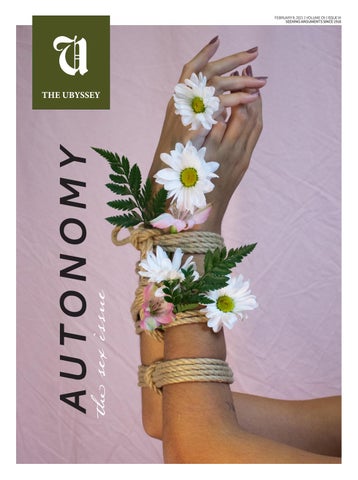
U
the sex issue
AUTONOMY
THE UBYSSEY
FEBRUARY 9, 2021 | VOLUME CII | ISSUE IX SEEKING ARGUMENTS SINCE 1918
U
THE UBYSSEY
content warning: this issue contains descriptions of sexual assault, self harm, interpersonal violence, eating disorders, physical abuse and other content that may be disturbing to some readers.
FEBRUARY 9, 2021 | VOLUME CII | ISSUE IX
EDITORIAL
BUSINESS
Coordinating Editor Pawan Minhas coordinating@ubyssey.ca
Business Manager Douglas Baird business@ubyssey.ca
Visuals Editor Lua Presidio visuals@ubyssey.ca
Account Manager Forest Scarrwener adam@ubyssey.ca
News Editors Charlotte Alden and Andrew Ha news@ubyssey.ca
Web Developer Keegan Landrigan k.landrigan@ubyssey.ca
Culture Editor Danni Olusanya culture@ubyssey.ca Sports + Rec Editor Diana Hong sports@ubyssey.ca Video Producer Josh McKenna video@ubyssey.ca Opinion + Blog Editor Sam Smart opinion@ubyssey.ca Science Editor Myla White science@ubyssey.ca
Web Developer Samuel Lin s.lin@ubyssey.ca President Rees Pillizzi president1@ubyssey.ca Social Media Coordinator Luiza Schroeder social@ubyssey.ca CONTACT
Editorial Office: NEST 2208 604.283.2023 Business Office:
Photos Coordinator Jasmine Foong photos@ubyssey.ca
NEST 2209 604.283.202 The Nest 6133 University Boulevard Vancouver, BC V6T 1Z1
Features Editor Bailey Martens features@ubyssey.ca
Website: ubyssey.ca Twitter: @ubyssey Instagram: @ubyssey
STAFF Sarah Zhao, Charul Maheshka, Paloma Green, Safa Ghaffar, Mahin-EAlam, Tianne Jensen-DesJardins, Maya Rodrigo-Abdi, Danisa Rambing, Sydney Cristall, Silvana Martinez, Sophia Russo, Joey He, Hannah D’Souza, Vik Sangar, Jackson Dagger, Winnie Ha, Tina Yong, Shanai Tanwar, Owen Gibbs, Maheep Chawla, Kaila Johnson, Nathan Bawaan, Elif Kayali, Hannah Dam, Iman Janmohamed, Peyton Murphy, Lalaine Alindogan, Melissa Li, Ella Lewis-Vaas, Tony Jiang, Polina Petlitsyna, Alan Phuong LAND ACKNOWLEDGEMENT We would like to acknowledge that this paper and the land on which we study and work is the traditional, occupied, unceded territory of the Coast Salish peoples, including the territories of the xʷməθkwəy̓ əm (Musqueam), Skwxwú7mesh (Squamish), Stó:lō and səl̓ ilwətaɁɬ/Selilwitulh (Tsleil-Waututh) Nations.
LEGAL The Ubyssey is the official student newspaper of the University of British Columbia. It is published every Tuesday by The Ubyssey Publications Society. We are an autonomous, democratically run student organization and all students are encouraged to participate. Editorials are chosen and written by the Ubyssey staff. They are the expressed opinion of the staff, and do not necessarily reflect the views of The Ubyssey Publications Society or the University of British Columbia. All editorial content appearing in The Ubyssey is the property of The Ubyssey Publications Society. Stories, opinions, photographs and artwork contained herein cannot be reproduced without the expressed, written permission of The Ubyssey Publications Society. The Ubyssey is a founding member of Canadian University Press (CUP) and adheres to CUP’s guiding principles.
The Ubyssey accepts opinion articles on any topic related to the University of British Columbia (UBC) and/or topics relevant to students attending UBC. Submissions must be written by UBC students, professors, alumni, or those in a suitable position (as determined by the opinions editor) to speak on UBC-related matters. Submissions must not contain racism, sexism, homophobia, transphobia, harassment or discrimination. Authors and/or submissions will not be precluded from publication based solely on association with particular ideologies or subject matter that some may find objectionable. Approval for publication is, however, dependent on the quality of the argument and The Ubyssey editorial board’s judgment of appropriate content. Submissions may be sent by email to opinion@ubyssey. ca. Please include your student number or other proof of identification. Anonymous submissions will be accepted on extremely rare occasions. Requests for anonymity will be granted upon agreement from four fifths of the editorial board. Full opinions policy may be found at ubyssey.ca/ submit-an-opinion. It is agreed by all persons placing display or classified advertising that if the Ubyssey Publications Society fails to publish an advertisement or if an error in the ad occurs the liability of the UPS will not be greater than the price paid for the ad. The UPS shall not be responsible for slight changes or typographical errors that do not lessen the value or the impact of the ads.
the sex issue
LET TER FROM THE EDITORS
G
oing into this, our idea of autonomy was mostly tied to freedom. We were hoping to explore what it meant for us to have freedom and control over our own bodies, not just in terms of our own personal relationships with our bodies, but also in relation to others. But over the last year, that definition has been put into question. In a time where we can no longer hug, touch or even stand less than six feet away from one another, what does autonomy look like in the context of the greater good? Autonomy is respecting your body along with others’. It’s understanding and communicating boundaries. It’s giving yourself space to be fluid or change your mind, to change the end goal. But finding autonomy also means redefining your body’s worth against society’s definitions. It means finding beauty in hardship, controlling your own narrative. And it can also mean inviting others into that. It might be easy to think that autonomy is simply doing what you want with your body, but we have learnt that it is much more than that. Autonomy can go wrong when trust is broken — it comes with responsibility and choices. When exercising your autonomy can be a life-or-death situation, how do you evaluate that risk while finding human connection? While we don’t know what autonomy means for you, or what it will mean in the future, we hope that this issue helps you find new ways to grapple with it for yourself. Thank you to the models and photographers that made this issue possible.
BAILEY MARTENS, DANNI OLUSANYA & SAM SMART
illustrations by maya rodrigo-abdi
TUESDAY, FEBRUARY 9, 2021
DANCE FOR ME shanai tanwar
roar up and down the pole as though your legs were jaws opening erupting up with roars onto crowds of triumphant scavenging hyenas eager to relish any part of you an arm, a waist, a freckle any angle into which they can their foreign inject geometry roar for the parts of you that go unsold like the eyes that could set a forest ablaze
S U RVI VA L G U I D E FOR THE 2 1 S T- C E N T U R Y ‘ S L U T ’
shanai tanwar
I T H O U G H T I WA S R E A D Y
tianne jensen-desjardins
Stained jeans lying limp on the corner of the bed. Left sock thrown somewhere behind the door. Right one resting in front of the closet after briefly being airborne. Star Wars shirt resting on the bedside table. Livewire boy ready, safety coating removed. Leggings neatly folded by the foot of the bed. Socks gently placed beside the door. Old team t-shirt still used as a buffer between eyes and skin. Lights-off girl uncertain, vulnerable and exposed. Whispered questions and rearranging. Nervous laughter and playful kisses. Underwear sliding down, down, down. Can I? I think so. Intruder digits with high spirits entering into the body searching for spots to excavate pleasure. Finding only tense insecurity instead. I thought you said you were ready. I thought I was.
i dip my feet and paint my nails in your ocean of misogyny ‘slut’ for when i feel like going out ‘whore’ for walking in the streets ‘bossy’ when i take charge and show you who the man really is i glance out into your ocean and see a man reflected in me maybe this is what it has always been me, not looking at me but me, looking at me through eyes your eyes that could bring a mountain rumbling down with only a word i cap my nail enamel now and dry off my feet to walk again on plates which slowly shift out of your reach don’t worry, i’ll send the lava mottling down for when you try to climb again so bring your best boots, dear climber because the meteorologists predict a tsunami ahead
3
4
TUESDAY, FEBRUARY 9, 2021
D AT I N G W I T H A DISABILIT Y IS HARD.
BUT DISABLED UBC STUDENTS EMBRACE THEIR BODIES
O
ne sixty-eight. My heart was racing when the paramedics took me to the emergency room early December. One by one, triage nurses and doctors came to take my pulse, a small but firm woman began tugging at my clothes and I explained my medical history to the attending. “Oh... okay,” I said as she silently stripped me. Before long I was sitting there in my underwear calmly telling my life story in front of five men. “Let’s give you some space,” the attending finally said before closing the curtain as the nurse stuck EKG stickers on my chest and down my legs. She slipped me into a gown. I never felt uncomfortable, only slightly annoyed that the height of my 2020 love life was a midnight ER trip. What the visibly uncomfortable men couldn’t have known is that my body has never been my own. In every medical circle, it is in the gaze of others who pinch my skin, take notes and analyze every aspect of my body. It is always up for debate but I have never felt a part of the conversation, just the centre of it. I was 12 the first time someone suggested I donate my body to science. They said it could be useful. I decided around the same age that the only logical response to living in this body was to accept that nobody would ever love me. I was neutral toward my body — seeing it as only a vessel to keep me alive with no aspect of pleasure or desire. I couldn’t see how anyone could love me if I could only be apathetic at best toward my limbs. Frankly, I wasn’t sure I would live long enough to grow up and get a white picket fence and a family. I now know that disabled people do not have marriage equality, that the low marriage statistic is a reflection of disabled people being unable to marry as a result of losing benefits and thus being unable to afford to stay alive. But as I saw my friends get into serious relationships, I longed for someone to be by my side. I thought I would need to convince people to love me since my body wouldn’t win them over. I became their best friend and then they got really pretty girlfriends. They were kind and looked like sunshine. I didn’t blame them for dating the boys I really, really liked, but it made me feel worthless to know that I was never enough for them.
bailey martens For Hannah Facknitz, a second-year history master’s student, it’s the soft-spoken ableism that is harder to swallow than the constant wave of blatant ‘What is wrong with you?’ messages. Facknitz developed lupus, an autoimmune disorder that affects her heart, lungs, brain, kidneys and joints, but has been in remission for five years. Today, she is most impacted by accompanying diagnoses of fibromyalgia, chronic fatigue syndrome and unpleasant side effects to her medication. She also has complex-PTSD and OCD. In 2014, she was 23 the first time she realized that people may not like her because she is disabled. She was talking to a guy on OkCupid that she really liked. He was attractive and they were getting along great. While she was disabled, she looked rather able-bodied and had not yet explored what it means to be disabled on a social level, since she passed for able-bodied rather easily. But she had just found out she couldn’t have biological children. “I really thought about myself in terms of lack and loss. And I had also found out that I can’t have children, which was a really big emotional blow,” she said. They kept talking and all seemed well, until a few days later, he told her that having children was important to him so he didn’t think it would work between the two of them. She thought it was a kind and respectful way to let her know and appreciated that he didn’t want to lead her on. “But I was devastated and furious. I was so upset, I was so angry,” she said. Though she felt the conversation was not “blatant ableism,” that moment marked a change in her approach to dating. “It was like … ‘Oh my God, my life is different now and my romantic life is going to change’ … and not in the way that I had predicted.” She understands that self-awareness in recognizing one’s priorities, or more so limitations, is important but hopes that people don’t go further to wrestle with this internalized ableism. One of the first interactions people have with Facknitz is asking her to explain her diagnosis, step by step. She would much rather they just search it up. “That is almost always followed by an ‘Oh, I’m so sorry.’
“And it’s not an ‘I’m so sorry for making you perform this labour of explaining a basic illness to me, the basics of your disability to me.’ It’s ‘I’m so sorry that you’re disabled and are sick.’” She said it is a test of patience to put up with the constant cycle of invasive and ableist remarks. “I think ableism is pervasive and I just need to put up with this little bit of ableism until I find someone I actually like, and then I can educate them and make them stop doing these things. But then I will have an interaction with someone who doesn’t do any of those things, and I’m like, ‘Oh I don’t actually have to put up with this.’” Facknitz wants her potential suitors to know she loves watching Studio Ghibli movies, knitting, crocheting and used to be an artist, instead of explaining the fundamentals of how her body works. “It is kind of exhausting and not something able-bodied people have to do,” she said. But often, they never make it to the crocheting stage. Facknitz doesn’t allow herself to get excited about a match until the diagnosis conversation has been had. With COVID-19, it may be a natural lead into disclosure. Even though Facknitz does have disability justice noted as important on their online dating profile, it doesn’t make it any easier to have that conversation. “So many people are still asking to get coffee. First of all, what is wrong with you? There is a pandemic and Dr. Bonnie Henry told us to go home. No, I am not getting coffee with you. “Second, I always feel like I have to justify it when I’m high risk. I can’t meet you until I’m vaccinated.” That’s when the conversation turns to asking why she is high risk. It is a constant circle. Though the disappointment has been normalized, it’s still hard for Facknitz. “If I am in a long-term relationship, and heteronormativity tells us we should be in [a] monogamous relationship for the rest of our lives, your partner is going to become disabled at some point. You’re going to become disabled at some point. So, actually being a good partner to a disabled person is sort of the bare minimum for a healthy relationship.” A 2019 Dr. Phil episode titled “I
TUESDAY, FEBRUARY 9, 2021 Swiped Right on My Quadriplegic Boyfriend” sparked outrage after Phil told an inter-abled couple their issues were because the disabled man was a burden on his partner. “You’re a young, single, attractive female. Out of all the people that you can choose, why choose someone in a wheelchair?” said Phil. “We make each other happy,” Harley said in justifying her interest in Bailey, a C5/C6 quadriplegic. Phil told them, “100 out of 100 relationships that involve caregiving fail.” He later polled the audience and asked how many of them would swipe right on someone in a wheelchair. Fifty-eight per cent said they never would and only 29 per cent said they would swipe right on someone who required full-time caregiving. This episode sparked outrage among the disabled community. Some couples spoke to the lack of resources for adequate caregiving like in Harley and Bailey’s case, how caregiving is as normal as dish duty in their relationships and how disabled people are deserving of and experience love daily. This birthed the viral hashtag #100OutOf100 where inter-abled couples shared their love stories. Facknitz said this anger keeps her safe and able to maintain the progress she has made in loving her body. “It’s like having a slipcover on the sofa. If you spill something on the slipcover, you can rip it off quickly and it doesn’t stain the sofa underneath,” she said. “My anger protects me in a lot of ways because it’s my reaction that tells me about the wrongness in the world. [It] allows me to not allow it to dig its roots into me and make home there ... There are more important things that I want to have make a home in my body and my mind and my heart. “I also feel really sorry for those people because they’re going to be disabled one day and the fact that they can’t love a disabled person now means that they likely won’t be able to love themselves when they become disabled. That’s such a tragedy.” Leah Cook thrives having a neurodivergent partner. The first-year land and food systems student is also neurodivergent and struggles to understand social cues. This makes forging a relationship even more challenging as there is virtually no positive representation of Queer disabled couples in media for Cook to look toward. Cook met her partner in Grade 9. They were good friends for a few years before realizing that there may be more to their relationship and made things official this past summer. “It definitely has been really nice to have somebody that always [has] my back and that understands how my brain works, especially during COVID. A lot of my other support networks have disappeared,” she said. Cook grew up with messages from her family that her panic attacks or sensory meltdowns would impede her adult life. They would tell her she needed to grow out of them to be happy and successful in life, specifically with regard to school and relationships. “I ended up having a panic attack in front of my partner. They didn’t shy away
or [were] weird or anything, they just hugged me and asked how they could help me through this. That was a pretty big moment for me to [realize] I can be myself and be in a relationship.” Both Facknitz and Cook stressed that their disabilities are an integral part of who they are and far from a bad thing. Because of this, it’s important to them that their disability is not treated like an aside, but rather an intrinsic part of who they are. “It should be part of the relationship as well. Not ‘I love you and you also happen to have such and such.’ No, I love all of you,” said Cook. Maybe loving a body we have spent a lifetime being told isn’t worthy of love is the ultimate destination, not a significant other. “Self-acceptance and self-celebration is not a permanent thing. It’s something you have to choose every day,” said Facknitz. For Facknitz, that also means only wearing fancy underwear as a constant reminder of her worth. Perhaps it’s alright that I might not have anyone to walk down the aisle to. Perhaps I have all the love I could ever need in friends who love me fiercely. Perhaps it’s alright to desire a partner while knowing I will live a full and meaningful life, regardless. Facknitz wishes she knew that at 23. “I had to build community first. I had to remember that I was whole first. And then I could say [that] I do deserve this kind of happiness because I already have these other kinds of happiness,” she said. “I think of a romantic relationship as a beautiful extra that I want in my life and I want for myself, but it’s not my daily sustenance.” U
5
6
TUESDAY, FEBRUARY 9, 2021
“S
o… where are you really from?” Dating apps have taken the world by storm, and telling your friends your Hinge date is coming over is a pretty normal romantic announcement as of late. I, too, despite my best efforts, have succumbed to the dangerous wormhole that is online dating. I made my very first Tinder account as a senior in high school to see what all the fuss was about. But as a result of being thoroughly disappointed with my prospects in Edmonton, I quickly deactivated my account. Also, I saw too many guys from school. That was weird. Upon arriving at university in a new city, I decided to give these notorious apps another go. I was hearing success stories from mutual friends and acquaintances, and a small part of me wondered if I could be the next gal to find her beau on the internet. This was not true. As I pondered over swiping left or right, I had to push aside that small voice in my head meekly offering a pestering question: “But do you think he’d like brown girls?” Most women of colour will tell you how every time they start getting that gross feeling in their stomach, one of the first things that pops into our minds is the question: “But what if they don’t like (insert ethnicity)?” In my opinion, it doesn’t matter if the person of interest is of your race or not. Preference is very prevalent in all ethnicities. Dating as a brown woman is very different from dating as a non-brown woman. For one, I had to make sure none of my relatives could ever discover my presence on these apps. I can block them on Instagram, but Tinder, Bumble? Not so much. Now let’s talk about Hinge. More specifically, let’s talk about Hinge’s handy little ethnic preference feature. That’s right, people. You can now be exclusively exposed to the ethnicities of your choice. Brilliant. So, let’s unpack that. First: let’s talk about their range of ethnic selections! We’ve got the classic options: “White/Caucasian,” “Black/African descent,” “Hispanic/Latino,” and just to throw you in a tizzy, “American Indian.” Yep. You read that right. Going beyond the fact that we minorities have been casually placed into these quaint little categories and pushing aside the creeping thoughts of a diabolical Pocahontas fantasy, it’s just… archaic and racist. I understand, I have a brown mom. I know that oftentimes, bringing home a nonbrown person isn’t going to go well. I understand that sometimes it’s just easier to limit yourself to a race or ethnicity your parents would approve of. I get that particular reasoning behind wanting to use this feature. But when I first saw this feature, the only thing I could think of was how perfect an opportunity this was for weirdos on the internet to live out their ethnic fetishizations. One of my most-received lines on dating apps is the age-old question, “So… where are you really from?” While I think of myself as
DATING APPS AS A BROWN WOMAN NAVIGATING ‘RACIAL PREFERENCES’ farzeen ather
being very obviously South Asian, guys on the internet love to play the racial ambiguity game. They have their hopes up that I might be something wild and exotic until I shut them down by telling them that I’m just an immigrant from Pakistan, before I feel their interest slowly fading away. Cultural preferences are abundant and valid. I know my mom would find it easier to navigate a relationship with my in-laws if they were from a similar social and cultural group. It’s just a fact. But let’s put aside our parents for a second and talk about what ‘racial preferences’ really are. Personally, I’ve been told many times by an exasperated teenage boy that “brown girls just aren’t my type.” Now, let’s explore that sentiment. What about me is not their type, I wonder? Here are some things that come to mind: “Maybe it’s my food? Does he not like the smell of curry? Maybe it’s my family. Is it because of my nose? Is my nose too big? Oh… what if it’s my skin? What if he doesn’t like the colour of my skin?” Do you see the issue here? It always seems to boil down to our very features. What makes us us. What makes us human. And that’s why “just having a preference” can sometimes be really dehumanizing. Here’s a preference: I prefer girls who are more athletic. Fair. Here’s what a “racial preference” sounds like: No, I’m not racist. I just don’t want to date women with certain ethnic features and/or racial backgrounds. Let’s reluctantly push that seemingly superficial statement aside and try to delve deeper. The question inevitably arises: why? And it almost always boils down to internalized racism or colourism of some sort. Colourism is a phenomenon wherein certain skin shades are preferred or discriminated against, simply for their colour. For instance, in brown communities, potential spouses have been historically measured on how light they are, because lighter is always “better.” I know it’s fucked up. Believe me, the years of being told to scrub my face with Fair & Lovely whitening cream can attest to that. And that’s the crux of the issue here. If more people asked why they just ‘prefer’ certain ethnicities or races over others, perhaps they would gain some insight on how their ‘preference’ might be a product of intrinsic bias. And as a woman of colour in a diverse and globalized society, that’s kind of disheartening. The fact that you prefer to date within certain groups of people isn’t really the issue here. The issue is, why? U
design by mahin-e-alam
TUESDAY, FEBRUARY 9, 2021
ASK TO UNMASK
CONSEN T AN D BOU N DARI ES ON COV I D T I N D ER tova gaster
I
’ve been intermittently on Tinder over the course of the pandemic. I’m not proud of it. But as I have swiped (mostly left) through dozens of fish-holding straight men: it has become clear that I’m not exactly alone. We’re all bored, thirsty and lonely. Aimless virtual flirting is, for some, better than none at all. There is an almost formulaic process to matching. After a few awkward and planned opening lines, the quarantine Tinder chat stumbles along: “Do we meet in person?” “Who else have you been seeing?” “What are we willing to risk to get some?” Consent and boundaries can already be tense to navigate with strangers. When those strangers potentially carry the coronavirus, those boundaries around physical autonomy extend beyond standards of sexual consent and into a newer, greyer area. Consent still describes whether you feel comfortable taking your clothes off around someone, or with them undressing around you. But does autonomy now include your right to remain masked? Your right to only be in a private room with people who value your security enough to keep their mouths wrapped? A couple of months ago I matched with a guy on Tinder. He assured me over Snapchat that both he and his roommate had COVID-19 less than three months ago, that both of them had tested positive for antibodies and even so, had been physical distancing. He asked me whether I would be down to meet up in person. After all of the ghosting and small talk, that directness and the promise of relative safety from COVID-19 was refreshing. And so, I agreed. He was kind of cute and from all the ways you can catch a vibe online, seemed normal. I went to his apartment on a Friday night. I had met people from dating apps before, but always in public before going to their place and never during a pandemic. Beyond the anticipation and the normal, often justified worries about meeting someone new, I wasn’t sure if I remembered how to hold maskless eye contact with a stranger. What do you do with your mouth again? He lived in a minimally furnished condo in a nice building near the university. It smelled like cigarettes mixed with Amazon packaging and bachelor pad. He, a short Indian guy with a sharp haircut and intense eyes, met me outside and we hugged. He was the first stranger I’d touched in months — hugging him felt discomfiting, even slightly anxiety inducing but it wasn’t bad. His roommate, red eyed and apparently surprised to see me, was rolling a blunt when I showed up. To make small talk, I asked him what it had been like having COVID-19. He was confused. As I turned to face my match he (guiltily) grinned and said, “Oh yeah, I lied about that.” He assured me he did really have COVID-19 three months ago, but his roommate, who I was in a
room with unmasked, had not. They evidently had not been distancing either. The pile of cigarette butts and roaches on the balcony was the work of at least seven undergrad tech bros, passing their spit around. I inhaled with hesitation, suddenly and futilely conscious of all the particles in the air between us. While my risk may have been relatively low, my paranoia wasn’t for myself. I live with family, whom I didn’t want to and have no right to endanger. I’ll pause here and say that this anecdote does not end in trauma or sexual assault. But it does fall into a quarantine-specific hookup dilemma. Transparency during a COVID date is an ambiguous area under the umbrella of consent — an expanding one as we reckon with a culture that deprioritizes the autonomy of marginalized individuals so consistently and insidiously that it often isn’t clear whether and to what extent boundaries are being violated. Under normal circumstances, as long as I’m being safe, who I sleep with shouldn’t be anyone’s business but mine. But if my personal choice to expose myself to some horny dude’s dishonesty could inadvertently transmit the coronavirus to people I care about, that exclusive agency over sexual autonomy fades. What’s bodily autonomy when every choice impacts an expansive web of connections and dependence? Right now, the boundaries we assert, or fail to assert, around our own bodies can have extreme impacts not only on our own safety but on the health of everyone else. And while he wasn’t doing anything to keep me there, with some combination of inertia and awkwardness and possibly ‘girl conditioning,’ I sat stiffly on the brown leather couch while his pinky finger crept towards mine. We never touched but we sat awkwardly watching Twin Peaks for an hour before I made an exit. I’m fine but I feel fortunate the situation didn’t go wrong in the ways it probably could have. COVID-19 cases are still accumulating worldwide and even so, we cannot be wholly reliant on those with antibodies to stop the rate of transmission. Even in normal conditions, infringements on agency and consent harm people all the time. Marginalized identities — Queer and trans communities, BIPOC, women, disabled people — are already more vulnerable to social norms that approach our boundaries as permeable, breakable or just invisible. According to a 2019 study on undergraduate students at Vancouver Island University, 84.3 per cent of respondents had experienced some form of digitally focused sexual harassment, which includes behaviours such as receiving unsolicited nudes, sexuality-based harassment online or having their sexually explicit images circulated without their consent. For people made especially vulnerable by physical comorbidites and/or by societal oppression, COVID-19 must influence our social scripts around online dating and casual sex.
But how do we set boundaries and recognize what constitutes a violation of those boundaries, when our whole understanding of autonomy, personal risk and collective risk has shifted rapidly? To meet someone for a hookup, we don’t just need to trust that they will respect our autonomy by not touching us without asking. We need to be able to trust that they’re being upfront about all the other people they may be touching. Everyone is grappling with some uncertainty about social interactions, whether that’s COVID-19, Tinder chats or the etiquette of the Zoom private message. For an informal vibe check, I asked a WhatsApp group about their Tinder experiences. “It’s the incessant cycle of ghosting and getting ghosted,” said a first-year science student. “The small talk phase makes it hard to actually find any meaningful connection.” The cycle of uncertainty and thirstiness rattles through infinite loops. “It gets so boring to just talk to strangers without there being that glimpse of ‘I might meet them and we might really hit it off,’” said UBC first-year Hirari Soto. “The ego boost eventually wears off and the dating app just becomes another app to go on when you’re bored.” There is a palpable tension when the conversation leads to a dead end. On top of the existing stressors of quarantine life, the exhaustion of feeling out these boundaries can make typing out a response feel futile. As a meta conversation starter, I also asked some Tinder matches about how they were feeling about the app. “A big difference [on quarantine Tinder] is people’s lack of intent in general,” said Quinn, a 22-yearold software engineer whose bio says he likes social psychology, anime, learning violin, and you ;). “I feel like conversations die a lot more easily than before. Both parties will seem interested but then just sudden silence.” Romantically, platonically, in the streets, on our phones: On all levels, social norms adapt. This moment requires recentring the existing dialogues of sex and consent around genuine respect for others’ boundaries. It also requires knowing and intentionally communicating our own. Pandemic or not, those are healthy practices to cultivate. I pulled way back on Tinder-ing after that one meetup; cases where I live in Seattle abruptly spiked after the holidays, and if meeting someone in person ever felt worth the risk, after December it definitely did not. This is the final stretch before, hopefully, a healthier and more open summer. It’s February, still too cold and damp to comfortably sit in the grass on a Friday evening with a friend or date. Once spring comes, how different will our conversations look? Once we can touch each other again, I wonder whether and for how long guilt and inhibition will linger. U
7
8
TUESDAY, FEBRUARY 9, 2021 content warning: this article mentions sexual assault and the use of GHB
N O P R I VAT E J E T S O R U N L I M I T ED B A N K ACCOUNTS. BEING A SUGAR BABY IS N OT W H AT YO U T H I N K . paloma green
E
ighteen-year-old Michelle Lee was nervous about her first sugar date. She had just moved out from her parents house and was learning to navigate the world on her own. Arriving at her sugar daddy's house, she told herself she would be okay despite the safety risks. She had been thinking about doing this for months. “‘It’s basically like Tinder,’” she told herself on the way to the date. “Meeting someone online is not uncommon.” She reminded herself that people always worry about safety when meeting a stranger from the internet. She wasn’t worried because of the age gap, although she knew her parents would be. She was only concerned with meeting a stranger. Once Lee talked to the guy for a while, she stopped being nervous. He seemed harmless so she started to relax. Now 19, the second-year art student looks back on her first arrangement with no regrets. Lee continued to see him for a few months. She worked through Seeking Arrangements, a sugar baby site, commonly referred to as Seeking. A sugar baby is someone, typically a young person, who goes on dates in exchange for money, gifts, mentorship or travel. Wealthy sugar daddies hire sugar babies for these dates. Lee’s age range on Seeking went up to 60. These arrangements are typically referred to as sugar dating or sugaring. “I always heard stories from friends or a YouTuber that I like would make storytimes about [sugaring] and it was always interesting to me, and I want[ed] to see what it was about,” she said. Lee created her Seeking Arrangements account in 2019 during her last year of high school but didn’t start actively using it until her first year at UBC. She waited until university so that she didn’t have to tell her parents about being a sugar baby as she did not want to sneak around. “I'm not gonna tell [my parents], but if they find out, it is what it is,” said Lee. When first
getting into sugaring she was more worried about her parents finding out. But now it seems normal to her. Lee is far from the only UBC student to give it a try. According to Seeking Arrangements, 71 UBC students used the app in 2020. This places the school 17th out of all Canadian schools for users. Lee is open about being a sugar baby with her closest friends, but she is aware of the societal stigma of being a sugar baby and doesn’t want people to look down on her. “I think a lot of people are against [sugaring] because they think it's on the verge of [sex work] probably. You could argue that to some extent but even [sex work] should be normalized. There's nothing wrong with that either,” said Lee. Lee is currently taking a break from Seeking Arrangements because she’s in a relationship. “The person I’m currently with, he definitely thought [sugaring] was the worst thing anyone could do,” she said. When he told Lee that no self-respecting woman should be a sugar baby, she just nodded along with him. She just didn’t want the conflict. She thought there was no point in arguing with him. “What I realize from talking to [him] is that it's pretty much impossible if you already think that way, you can't really change the way they feel … Just giving my one perspective to them is not going to change their worldview about doing [this type of work], which is unfortunate,” said Lee. Lee thinks his views are old-fashioned and reflective of older generations’ views on sugaring. She thinks that if you’re okay with Tinder, you should be okay with Seeking Arrangements. She said if she viewed the relationship as long-term she would have been more bothered by his comments. Lee doesn’t think she could be with someone who isn’t acccepting for the for the long-haul.
“You shouldn't differentiate [between Tinder and Seeking] just because one is more stigmatized than the other. They’re really the same thing,” said Lee.
BILLS TO PAY But the stakes can feel higher in sugar daddy situations because of the financial impact. Ella, whose name has been changed to protect her identity, told Kwantlen Polytechnic’s The Runner she started selling her nudes to a man for $100 a photo. He had contacted her via Bandcamp, an online site where Ella’s band sells their music. Over time she became uncomfortable so she stopped, although he kept asking. One of Ella’s friends was struggling to pay for groceries so she decided to see if she could sell him another photo, he offered her $30. She turned him down. Ella hasn’t participated in any sugar dating since. While Lee isn’t currently active on Seeking Arrangements, her less experienced friends still come to her for advice. Lee tells her friends never to give out their bank information and avoid PayPal or any online transferring services. Lee only accepted cash because even an e-Transfer exposes their email address which could reveal their true identity — Lee warns against using a real name. Although she’s aware of the safety concerns of sugaring and risks of scamming, she's actually never had a bad experience or been scammed. Lee often checks sugar daddies’ verification on Seeking Arrangements where daddies can verify both their social media accounts and bank accounts. Verifying their bank accounts lets babies know they aren’t ‘Splenda daddies.’ “A Splenda daddy is someone who poses as a guy who is successful financially, in a position of power and seniority. He’s not, unfortunately, and he’s kind of a time-waster.” Jasmine, a Vancouver-based sugar baby whose name has been changed, told The Runner. “For every five or six guys you meet,
TUESDAY, FEBRUARY 9, 2021
there’s probably one actual real sugar daddy that comes out of it,” said Jasmine. According to Seeking Arrangements, the current average monthly allowance for babies is $2,400 per month, which is $28,800 a year. That means most sugar babies make less than minimum wage. Seeking Arrangements boasts that this comes among other benefits like luxury gifts, travelling and mentorship but Lee says arrangements like that are rare. She doesn’t know anyone with one. “That's most people's ideal [for sugaring], living that luxury life for free, but it's really a lot less than that,” said Lee. Seeking Arrangements claims that sugar daddies can help students manage their finances while elevating their lifestyle above that of a typical university student although many babies don't solely rely on sugaring for their income. Liz, a student at Simon Fraser University whose name has been changed, told The Runner that she had a part-time job and parental support when she started to sugar. There are many different types of arrangements, some are pay-per-month some are pay-per-date. Lee prefers pay-per-date arrangements as pay-per-month is too much commitment for her. She averages $400–500 per date depending on the type of date. Lee claims that she has a higher rate because she is open to having sex. Her friends who don’t sleep with sugar daddies average $100–200 per date. Violet, a 23-year-old sugar baby at Kwantlen who spoke to The Runner using a pseudonym, usually charges her 10–15 rotating sugar daddies $500–700 depending on the length and expectation of the date. Violet loves being a sugar baby but her experience hasn’t always been positive. “Once I took GHB and woke up and my date wasn’t there. I’ve been threatened,” said Violet. GHB, a common date-rape drug, is a colourless and odourless substance that may cause a tranquilized effect or amnesia. “A lot of sugar babies get into it and can’t do it without the help of a substance … It’s when reality sets in and you look up and there’s some fat hairy dude there, it can make you question your worth, but for me it never really does. I think it’s making me appreciate other people’s bodies,” said Violet. Lee thinks when people start out, they’re less open to having sex on sugar dates but as it becomes normal they get more comfortable with it. But Lee personally was always open to having sex while sugaring as she just views them as normal dates. “On a normal date with someone online most of the time you’re eventually, probably,
going to sleep with them. It's really not that different except this time you’re profiting off of what you’re doing anyway. In that sense, it is very empowering,” said Lee.
PANDEMIC SHIFT The last time Lee was active on the site — a few months ago before the current public health restrictions — things were business as usual. Lee said she was mostly seeing her regulars during the pandemic, although the guys that were messaging her still seemed open to meet and were unconcerned with the pandemic despite public health advice. “I don’t think the pandemic really affected anything in my experience, [such as] how many people were reaching out, or what their arrangement type was which was pretty surprising,” said Lee. Although the pandemic didn’t affect Lee’s Seeking Arrangements experience, there is a noticeable drop in the number of active sugar baby accounts at UBC. In 2019, UBC was ranked seventh by Seeking Arrangements for Canadian universities with the most sugar babies, with 359 members from UBC. At the end of 2020, there were only 71 members. While Seeking Arrangements boasts that the majority of its sugar babies are students, there seems to be an overall drop in student usage throughout Canada. Between 2019 and 2020 the University of Toronto dropped from 1170 to 257. At York University, 836 to 141. Despite this drop, the site still reports a 3 per cent increase in student membership worldwide, however, last year saw a 44 per cent increase in university users. Seeking Arrangements incentivizes student engagement. If someone signs up with a .edu email, they will recieve an upgraded account. Tia, a sugar baby who also attends UBC, told Vancouver Is Awesome that giving Seeking Arrangements a student email can get you verified as a student which can help get better matches. The drop in sugar babies may be due to the pandemic. Potential sugar babies may not know how to navigate their priorities with the public health crisis, so they don’t want to waste their time, said Taylor B. Jones, author of The Sugar Daddy Formula. This may cause sugar babies to take a step back. “During this time, one might think [sugaring] would be difficult. But actually, in reality, it’s not because we have something that we didn’t have before, which is time. And that allows someone to nurture relationships, and it actually puts [sugar babies] in a better position,” said Jones. While one may think they’ve lost the perks
“THAT’S MOST PEOPLE’S IDEAL
[FOR SUGARING], LIVING THAT LUXURY LIFE FOR FREE, BUT IT’S REALLY A LOT LESS THAN THAT.” — MICHELLE LEE
of being a sugar baby such as nice clothes and expensive dinners, according to Jones, you can still get a sugar daddy to buy you a nice outfit for virtual dates and order in Uber eats. “This is actually the perfect time to go all in to nurture relationships and build these connections. It’s actually a goldmine for the 71 [UBC sugar babies who] know how to leverage the dating site to their advantage,” she said. Lee is surprised the numbers have dropped as she feels sugaring has become increasingly normalized through apps such as TikTok. Although she does understand why some may have dropped off due to not wanting to risk meeting people in the current health crisis and some students moving back home, others may feel similar to Lee. During the pandemic, housing has become an increased concern for some students with residence closures. Sugar daddies can help provide some financial support along with mentorship, wrote Seeking Arrangements in a press release. “[Sugaring] was such easy money and I don’t think there’s any other type of job that you can do at this age that’ll bring you that type of income with almost no effort. It was just a life hack really. So, yeah, I do miss [it]. I think anyone would miss that opportunity to get that much income,” said Lee. She definitely believes she will return to sugaring. “At the end of the day, men are going to objectify you regardless so why not make a profit out of it,” asked Lee. U
9
10
TUESDAY, FEBRUARY 9, 2021 content warning: this article contains subject matter regarding eating disorders, body dysmorphia, self harm, physical abuse and interpartner violence that may be disturbing to some readers
HOLDING S PA C E H OW LO C A L A RT I S T S TRANSFORM TRAUMA INTO ART
bailey martens
T
aylor Menzies knew she could not stay — in Indonesia or in a body that reminded her of the weight of her trauma. She had moved overseas after chasing a career as a yoga instructor. There, she quickly found herself in a relationship and was offered a tattoo apprenticeship after locals spotted her talent while she got a tattoo and spoke of her love for the art form. Menzies has always used art as an escape from the tough aspects of her life. But she couldn’t afford a tattoo machine or the necessary supplies so she sat on the opportunity. As her relationship turned abusive, she found herself ashamed to tell her friends and family. So, she drew. Art had helped her cope with childhood abuse, an abusive relationship and an eating disorder. Menzies realized her art could be an outlet for others too. “As a teen I had a lot of self-esteem issues and body dysmorphia. I had a hard time looking at my body without seeing a child who was abused. When I started getting tattoos, I gained a lot of confidence and started looking at my body [as] something beautiful,” Menzies wrote in an email to The Ubyssey. When the relationship ended, she found herself wanting to do more to help others who were in similar situations and felt like yoga was not enough. “I was thinking to myself, ‘What if people are in the same position as me, they're not telling anyone, they're not bringing it up and they're just hating themselves for it,’” she said. She moved to East Vancouver in January 2019 where she has worked as a tattoo apprentice ever since. But this past week, her independent work took off after an overwhelming response to a TikTok about her life and work. Within the day, Menzies was booked solid for the next three months. “It definitely can be a lot, especially going through all my emails, story after story after story on people's stories and [the] trauma they're holding onto … it’s amazing to me that I'm holding a space for people to feel comfortable enough to open up to me and share their story. “And come to me not only for a tattoo that’s gonna help them love themselves but also help them get over everything,” she said. “They’re allowing me to put something on their body forever.” She told The Ubyssey that she was shocked that people were willing to drive from out of town to get a tattoo from her. She quit her day job to focus on her art and is hoping to start a non-profit in the future. In addition, she is in the process of releasing a line of crewnecks and shirts with her designs on them for those who may not be able to afford a tattoo. “I want to help people work through different eating disorders, mental health battles and everything like that, and use it in a way to make people feel beautiful in their body.” According to VAWNet, a branch of the National Resource Centre on Domestic Violence, tattoos can help survivors reclaim their body after trauma. It can help them change or revive their self image. While research is limited, there is evidence to support the therapeutic value of tattoos for survivors. A thesis by Ana-Elisa Armstrong de Almeida at The University of Victoria suggests that tattoos provide an outlet for painful emotional healing through painful body modifications on top of the ob-
TUESDAY, FEBRUARY 9, 2021
vious change in artistic expression the tattoo provides. Candice Falcon, a restorative tattoo artist, frequently interacts with people who believe they need a big scar or life-altering reason to get a cover-up tattoo. They often feel unworthy of specific tattoos because they haven’t gone through large enough traumas. She wants the public to know there is no reason too small to desire a cover-up or scar camouflaging tattoo. She stressed that nobody needs a restorative tattoo but it is there if they want one. Aubrey Wolf, a Vancouver-based tattoo artist currently working out of Ottawa, sees the magic in giving people the chance to enthusiastically embrace and consent to a major change in their body. “A lot of people, especially people who experienced marginalization and oppression because their bodies are not the standard of what’s expected and acceptable in society, have had a lot of non-consensual and very disempowering, disappointing experiences projected onto their bodies,” they said. Before becoming a tattoo artist in 2013, after nudges from friends and family, Wolf sought out scar cover-up tattoos for themselves. “I know firsthand how suddenly your life could change. Years of harassment and people being invasive about your body just suddenly ends with a tattoo,” they said. It took about a year of tattooing before they started helping others cover up their tattoos. Clients would mention how they wanted a certain tattoo but were worried because of scars. They said those conversations catapulted them into the work they now do. Today, Wolf specializes in camouflaging scars, creating 3D areolas and purely artistic pieces. Wolf is able to create a 3D nipple for those who have scars, are without nipples, or those who are unhappy with theirs by customizing the shape, colour and size of their new areola. Furthermore, they also offer scar cover up and camouflaging for burn survivors and those with skin discolouration or self harm scars. A camouflage works by matching a client’s scar to their natural skin tone. A cover-up places an artistic tattoo over a scarred area. According
to Wolf’s website, this may be right for someone who feels distress from seeing the scars and wants to minimize their visibility, those who want a physical reminder of something positive instead of a potentially traumatic reminder from the scars or those who wish to honour their scars. “It feels like I don’t do the work anymore because of COVID. But when we're not in a pandemic, I touched people. The core community that I [am] tied to is often genderqueer, trans people and disabled bodies and often the intersections of both,” said Wolf. They said their work impacts people regardless of the tattoo’s scale. The experience meant a lot for those who received cover-up work on scars or post-medical journeys, or as part of gender-affirmation journeys. But it was equally important for those who received smaller pieces to be a part of a larger transformation even if they don’t elicit the same type of response. They said there is often a feeling of relief and self-becoming from their clients. But that moment often happens before the piece is completed. “The moment the scars begin to really fade under the work that’s happening, some people cry. Some people are just amazed that their mouth drops open, they look at themselves from all kinds of different angles and feel like a glamour[ous thing] has happened to them,” they said. “This is a seemingly indelible visible feature that was bringing them all kinds of attention and experiences that they weren’t comfortable with which they’re free from now.” Seeing people walk in freedom, the way Wolf has, is what means the most. “The best thing [is] when people share with me later on that it changed the way that they moved around in their body ... They began to dress differently, they stopped covering up this part of their body, they began to feel more confident. That’s when I really feel like something has happened.” U — With files from Jackson Dagger and Winnie Ha
11
12
TUESDAY, FEBRUARY 9, 2021
LOVE IN A (I N S TA G R A M) BOT TLE winnie ha
M
y post-secondary life didn’t go the way I planned. While most people my age are probably in their second year and have moved out, I am still in my first year at UBC. I still live with my parents in my suburban hometown in California. As a result, my experience with online dating has been pretty unconventional. When I was in high school, I had some idea of how I wanted my years in university to play out: I would attend university (in the Great Lakes region), participate in campus life, make new friends and meet the person who would become my best friend turned true love. The romantic fantasy that I dreamed up when I was 16 would go along these lines: We would meet in one of our freshman courses, preferably a subject that I am good at — United States History, maybe? — and become fast friends. He would be a member of the school’s gymnastics team and really love animals (maybe with the hope of becoming a veterinarian someday). In the final months of my senior year of high school, I didn’t feel like I had any control. It felt like everybody else was making my decisions for me — my family didn’t allow me to apply to UBC right out of high school. I was lucky enough that my courses and credits allowed me to transfer to a school in Canada in the fall of 2020. Although years had passed, my romantic fantasy remained largely the same — except, since there are no collegiate men’s gymnastics teams in Canada, he’d play centre on the school’s hockey team. In November 2019, I decided I wanted to meet more people, preferably my age and from Vancouver. I didn’t really know what I wanted but if something went somewhere, I wouldn’t complain. After reading some articles on the best dating apps for students — I didn’t want to download Tinder because of the hookup culture surrounding it — I created an OkCupid account. While I found the act of swiping addicting, it didn’t go anywhere. I stayed away from actual dating apps for the next six months, preferring to meet new people on Instagram instead. I followed and messaged some hockey players — they
rarely replied, of course, though most who did were quite polite, but not interested. For the most part, everything felt very one sided and conversation usually died out within 10 to 12 messages — it didn’t seem like these guys wanted to get to know me. At the time, I wondered if I was ‘pretty enough’ to be the kind of girl that hockey players date. As time went on, I realized that my standing in life — the fact that I lived at home and didn’t attend a major university — already placed me at a disadvantage in this arena. On top of that, I’ve always been rather dorky. In real life, I read and write a lot. On my Instagram feed, I write long, thoughtful passages as captions. I post very random things on my story, sometimes with funny captions. But in late May, I thought I finally met the one. He was incredibly passionate about hockey but on top of that, he was one of the kindest people I had ever met. We also had our culture in common. However, that day, conversation would die out because we were both busy, lived too far apart (he was in Vancouver and I was in California), and I was too short (he wanted somebody who was 5’10” while I’m just under 4’11”) — all factors I didn’t feel like I had control over. After being quarantined for two months and done with the rejections that came with meeting potential love interests online in this way, I decided to download Hinge in June. Just like my previous experience, swiping was addictive and whenever I logged on I would reach the maximum amount of swipes. That swipe limit actually made me raise my standards on the app, but I didn’t really have much to base a swipe on, so it was mostly just on appearance. I deleted the app from my phone before the end of summer. In July, I founded UBC Matchmaker in an effort to add a more human component to modern online dating. Instead of swiping left or right on a dating app, students could follow the account on Instagram, then fill out a Google Form detailing their interests, self-described appearance and what they were looking for. With no pictures involved, matches would be made primarily based on personality. The entire program ended up flopping
TUESDAY, FEBRUARY 9, 2021
“HE MENTIONED THAT HE WAS SPECIFICALLY LOOKING FOR ASIAN GIRLS, BECAUSE HE WAS ‘DONE’ WITH WHITE GIRLS AS ASIAN GIRLS WERE SUPPOSEDLY SWEET AND WHOLESOME.”
as so much of what people wanted seemed to be based on appearance. More than once after making a match, one party (most often, it was a man) replied, “I don’t date brown/Asian girls” or “I would prefer a tall girl with long, blonde hair.” I had no intention of using the services for myself, but I did ask my friend to find me a match and not once, but twice, guys rejected me on the basis that I am of Chinese descent. I think that’s when I realized my race was a hindrance in the dating world. I’d considered that it might be a factor, but always rejected it. I thought that people would at least make an effort to get to know me, especially if our personalities seemed to match. But all they saw was a short, not-skinny girl of Chinese descent. And that felt like a huge slap in the face. I’m very much Asian American — emphasis on the American — and I’ve had a complicated relationship with that element of my identity. As a kid, I completely rejected it because it meant going to Chinese school on Saturdays and doing extra homework on Sundays and Friday evenings while other kids my age got to do fun things, like play Wii. Although my experience with UBC Matchmaker absolutely sucked, I eventually laughed it off and moved on. However, my first experiences of trying to meet guys at UBC has stuck with me. I continued to run the account with help from friends, but I felt like I was pretty much done with my own romantic pursuits. And then in August, on my personal Instagram account, I met a guy from my hometown. At the time, he was away at his university in Arizona, so all of our interactions were online. For the first time, a guy who I would rank among the top 10 most physically attractive guys in the world actually thought I was hot and kind of cool. But when I told him about my then-recent experiences, he mentioned that he was specifically
looking for Asian girls, because he was ‘done’ with white girls as Asian girls were supposedly sweet and wholesome. I laughed it off — it’s not like what he said was particularly insulting — and besides, he was kind and caring. If my race was a big turn off for other guys, was it wrong for me to want to be with a guy who saw my race and its connotations as a positive? I fell. Hard. But barely two weeks after we had started talking and after he was done quarantining, he told me to forget about him because he didn’t see it going anywhere. To me, it came out of nowhere, and I was hurt and sad — which I unfortunately allowed to affect my grades. By December, I was ready to meet new people again. With encouragement from my friends, I downloaded Bumble. Unlike previous apps, Bumble did not allow me to adjust my location while on a free plan. Again, it all felt very superficial. Almost everything was based completely on appearance which led me to reflect on how superficial I had been. In the words of one of my friends, “Winnie, not chasing after hockey players is the largest character development we’ve seen in this chat.” In another case, I thought I found something special. We stayed up until 9 a.m. talking and laughing one night. He felt real and I genuinely wanted to meet him when it was safe to do so. But once again, I was un-added. After another rejection, I found myself, for the first time in almost a year, crushing on nobody. But in late January, my best friend and I were joking around on a Discord call, and he suggested I hit up random seemingly single collegiate gymnasts. In reality, the chances of me ever seeing these people in real life unintentionally was pretty slim. But the next morning, I received a new follow request: Trevor, gymnast at a major university in the Great Lakes region, animal sciences major. U
13
14
TUESDAY, FEBRUARY 9, 2021
unsolicited advice A S E X U A L ( H E A LT H) FA N TA S Y sophia russo
T
he most compelling thought about autonomy that I was exposed to in my undergrad was during a conversation about chlamydia. My third-year microbiology professor made the following provocative argument: if everyone did an STI screening, received appropriate treatment and abstained from sex for one week, we would functionally eradicate certain STIs. Though not a perfect argument, it stuck with me. The biggest problem with my professor’s proposal is autonomy, specifically your refusal to acknowledge your own. Advocating for condom use and STI-test transparency are two simple ways to embrace your bodily autonomy alongside some consensual fun. Since many STIs don’t show symptoms, it’s recommended you get tested with each new partner and even add an STI screening to your health routine. Let me challenge a common misconception: these practices are not offensive. You aren’t being mean or bitchy or stuck up to demand that someone share their STI results or “wrap it up.” Your body is yours and protecting it is a fundamental sexual right that you are owed. There is no shame in contracting an STI, just as there is no shame in being exposed to pink eye or strep throat. But to refuse consistent screening and condom use is to disregard your sexual partner’s autonomy. Though the eradication of bacterial STIs may remain a sexual (health) fantasy, empowering students to prioritize their autonomy and sexual health promotes a culture that can be sexy, safe and responsible. U
ORGASMS AREN’T NECESSARY FOR GOOD SEX lindsey palmer and nafeesa alibhai
T
here are those who can orgasm in their sleep (hello, wet dreams). But there are also those who literally cannot orgasm ever, whether that’s because of their physiology, medications or trauma. Those who can’t orgasm aren’t doomed to have bad sex, because good sex truly doesn’t require one. You don’t need an orgasm to have good sex, and the pressure to make one happen can make sex bad. Case in point: faking an orgasm. It’s not fun for anyone — the faker has to become aware of their orgasm sound (no, thank you) and their unwitting partner won’t get any better at pleasing their partners. For many, sex is about intimacy, and imposing a finish line can take away from enjoying the moment and spending time with your partners, maybe even shorten a good session. Good sex can be about appreciating and discovering your partners’ bodies, making them feel comfortable and loved in their own skin. This kind of sex can be revolutionary for people whose skin colours or bodies aren’t accepted (and often feared and hated) in our society that idealizes white, skinny and abled bodies. And for the cishet men reading this and asking, what about blue balls? How often has your partner had to be satisfied with your pleasure, but not their own? Focusing exclusively on your partners and not yourself from time to time can be extremely rewarding. It’s a chance to hone your skills, let them know you care about their pleasure and selflessly show them how you feel. If that isn’t your jam: let us introduce you to masturbation (and even that can be good without an orgasm). U
LEARNING MORE ABOUT YO URSELF MAKES SEX BET TER sam smart
L
ove languages. Attachment styles. Kinks. These concepts and so many more have probably come up for you throughout your adult life. Maybe you took some interest, or maybe you scrolled past because they felt like some wacky concept that won’t enrich your life. But trust me, it will enrich your relationships when you understand yourself better. Better understanding how you express and experience love, how you bond with others and what exactly gets you off will give you a better idea of your own needs. That understanding can give any partners you may have a better idea of how to best communicate with you and how to make sure you feel good. And better yet, knowing these things about yourself will probably make you feel much more sure about your needs and wants in relationships. While you’re at it, ask your partners about their own communication and attachment styles, as well as kinks. Do online tests together! Talk about your results! Gaining an understanding of the similarities and differences between you and any partners will ensure you can satisfy each other and communicate better. U
TUESDAY, FEBRUARY 9, 2021
THE DECL A SSIFIED T I N D ER S U RVI VA L G U I D E FOR WOMEN OF COLOUR ONLINE danni olusanya
S
o you’ve exhausted all of your other options. Your Instagram DMs are barren, your Snapchat messages unopened and all the places that you might have a meet cute with a potential partner are closed due to the fact that we are living in the middle of a deadly pandemic. I’m sorry to say that it might be time to throw your hat back in the ring, and by the ring, I mean the bastion of disappointment that is dating apps in 2021. Yes, I know that going on Tinder, Bumble and OkCupid is the literal embodiment of opening your fridge trying to find a gourmet meal, but instead finding a half-eaten sandwich and maybe a slab of questionable, potentially mouldy cheese, but I believe in you. More importantly, I’m here to help you.
SWIPER, NO SWIPING! Dating apps are simultaneously terrible and incred-
ibly addicting. There is a power that comes with swiping left through potential partners. You don’t like their hiking photo (swipe left), or their pre-COVID picture at Celebrities (swipe left) or their walls are looking bare (swipe left). But here are my personal red flags.
THE CURSED FISH PHOTO
I have no idea why people in this city keep taking photos with big fish. They are creepy, they are confusing and ultimately fishing seems like a very boring activity. If the fish photo is the first photo on their profile, it has moved past a hobby and has turned into a lifestyle. Think about all the time that you might have to spend sitting in the middle of a cold-ass boat in silence with this person while they try and fail to capture a fish. And if they do catch a fish, it’ll be you taking the photo.
THE GYM RAT
Sure, it’s great to like fitness, but a photo at the gym, hiking or swimming? Unless you want to spend the next year and a half going on jogging dates together, if more than 60 per cent of their photos are in activewear, swipe left and don’t look back.
THE SERVICE TRIP
In 2021, if your potential partner is advertising their service trip to India or ‘Africa,’ surrounded by small children, swipe left. Or be ready for multiple (neo-colonialist) conversations which inevitably harken back to their lifesaving trip where they single-handedly ‘built a school’ in a week and bothered African children for a new Facebook profile picture.
IT’S A MATCH! So now you’ve matched. You liked each other’s faces enough
that you both circumvented your natural intuitive response to swipe left and even gone as far as to start a conversation. I’m proud of you! Here are some nonos for your first conversation.
“NO, WHERE ARE YOU REALLY FROM?”
Of course, finding out about each other’s hometown is a foundational question, but when it moves from a superficial question into an “Actually are you really X” game show. Unmatch. Block. Delete.
“YOU’RE REALLY PRETTY FOR A …” / “YOU’RE ACTUALLY MY FIRST…”
This is like the previous example, but a lot worse. They’ve embraced you’re different, but you are more than a sum of body parts or a prize for bragging rights. “Thank u, Next.”
“I LOVE YOU, MY CHOCOLATE QUEEN”
You are not chocolate, you are not a spice, you are not a dragon. You are a human being and more than a fetish! Anyone who wants to call you an object as a term of endearment can ‘object’-ively show themselves out.
GIRL, OFFLINE! So you’ve decided to meet your match in person. That’s won-
derful. But it’s important to be safe. Especially due to the pandemic, it’s important that you set guidelines for your date. I would advise a video call before, where you can discuss ahead of time how you are both going to keep each other safe. This could include agreeing on a pre-date isolation period, a COVID test or even agreeing to stay masked during the entire date. Furthermore, it’s important to meet in a public location for your first meeting. Go for a walk and let a trusted friend or family member know where you’re going to be. If it would make you more comfortable, you can even share your location! Happy dating! U
15