Issue 19 | Autumn 2026
MAGAZINE
YOUR NATURE CONSERVATION STORIES
WINGS OF SURVIVAL Cycling From Alaska to Patagonia in the Shadow of Migratory Birds
IBIZA & FORMENTERA PRESERVATION The Ibiza the World Doesn’t See
XERCES SOCIETY FOR INVERTEBRATE CONSERVATION Protecting Invertebrates: Growing a More Welcoming Future
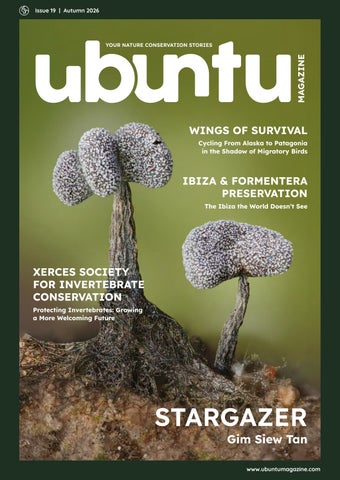
STARGAZER Gim Siew Tan
www.ubuntumagazine.com
Transform Your Perspective on Nature. Follow Ubuntu Magazine’s Social Channels! Cover photo credit: Gim Siew Tan
Photo credit: Daniil Malikov
JOIN US ONLINE
Instagram @ubuntu.magazine.official
Facebook @ubuntumagazineofficial
LinkedIn @ubuntu-magazine
Website www.ubuntumagazine.com
CONTENTS
06 08 18 34
INTRODUCTION Stacy Hsu, Illustrator
WINGS OF SURVIVAL Cycling From Alaska to Patagonia in the Shadow of Migratory Birds
IBIZA & FORMENTERA PRESERVATION The Ibiza the World Doesn’t See
ENDANGERED SPECIES The Fight to Save the Vancouver Island Marmot
42 46 58 68 80
18
BOOK REVIEW Nature’s Ghosts by Sophie Yeo
XERCES SOCIETY FOR INVERTEBRATE CONSERVATION Protecting Invertebrates: Growing a More Welcoming Future
STARGAZER Gim Siew Tan
DANIIL MALIKOV
Youth Conservation Champion
CIKANANGA WILDLIFE CENTER West Javan Wildlife & How to Protect It
INTERACTIVE TABLE OF CONTENTS: CLICK TO JUMP TO ARTICLES INSTANTLY!
90 92 102 108 46
INFOGRAPHIC
Beavers and their Ecosystems
ABIMAEL MUNDURUKU The Guardian’s Sacrifice
NEW TO NATURE
Thismia selangorensis
THE CLASH AT THE FOREST EDGE Fire, Forests, and the Fragile Balance Between People and Wildlife
INTRODUCTION My very first multi-day backpacking trip was in the summer of 2009 while I was an architecture student living in Eugene, Oregon. It was a grueling, hot summer day on Breitenbush Trail with little to no shade, and I had to work so hard on my breathing as I followed behind my dog, Roland, and told myself ‘one step at a time’. I’d never forget the moment we reached Jefferson Park, with Mt. Jefferson and its glaciers in view, alpine meadows and the fields of wildflowers in front of us, and the hum of the running creek. I experienced joy, wonder, relief, and gratitude all at the same time, and I felt so connected to the land I called home.
shimmering tide pool creatures in neon colors, or the joy of seeing marmots perched on a warm rock while hiking through the Pacific Crest Trail. This connection also had me examine my relationship with my birthplace, Taiwan, and what this tiny subtropical island in the western Pacific Ocean meant to me. I went back in 2024 and backpacked there for the first time, hiked through a rainforest full of tree ferns, and the towering hemlock forest 3,000 meters above sea level. As I work on illustrating native botanical and wildlife species of the island, I think about my Hokkien, Hakka and Indigenous ancestors and how the land nurtured generations.
My journey into becoming a wildlife illustrator and artist was a very winding one. Trained as an architect but graduating into the recession, I never practiced architecture; instead, I moved to Seattle and became a visual designer, and later on a UX designer. During this period, I also enrolled in a science illustration program at our local university, which set the foundation for the work I create today. During the day, I worked on solving complex design and user problems, and at home I would spend hours practicing botanical and wildlife illustrations, hoping to capture the awe and wonder I feel every time I am in the wilderness. A series of personal events that followed after COVID made me realize that life is short, and I had to live a more authentic life that’s aligned with my values, and I took a leap and became a full-time artist and illustrator in 2023.
As I continue to travel around the world and create more place-based illustrations, I have realized my role as a wildlife illustrator is to tell the stories of the interconnectedness of the various ecosystems on our planet. While the team of fabulous writers at Ubuntu Magazine works hard on bridging the gap between various conservation efforts happening around the world and the public, my job is telling the stories of various ecosystems in a visual and easy-to-understand way. Through words, photographs and illustrations, we can bring the feeling of awe, wonder, and connection that I feel every time I’m out in the wilderness to our readers. With connection, we can inspire engagement.
At the heart of my art and illustration practice is my connection to place. Living in the Pacific Northwest opened my eyes and my heart to the Cascade Mountains and Puget Sound. I started to create a series of works that tell the stories of the ecosystems surrounding the area. I wanted to share the near-religious moment I experienced when a pod of orcas swam by while I was on a bike trip, or the wonders I felt while sea kayaking near Vancouver Island and discovering a cove of
I am still chasing what I felt in Jefferson Park at 22, with a tired dog and a pack I had packed badly. It was not only beauty, but the sense of having walked into something that had been working perfectly well without human interference. That is what I am trying to draw as I work on this current issue.
- Stacy Hsu Illustrator
7
WINGS OF SURVIVAL CYCLING FROM ALASKA TO PATAGONIA IN THE SHADOW OF MIGRATORY BIRDS It’s January 2026, and a small group that includes two biologists, an ecologist, and a professional athlete is hiding at the edge of a beach on Chiloé Island, Chile. They’re watching a flock of Hudsonian whimbrels look for crabs and other tasty invertebrates in the mudflat. As the tide comes in, the birds draw nearer to the humans. After some patient hours, they’re very close, and a cannon net is shot out. Five birds are captured.
Written by Megan Abigail White
Photo credit: Aaron Hiebert-Prasad
THE AMERICAS
Photo credit: Jan van dem Kam
The team swiftly takes the whimbrels’ measurements, then fits each one with a tiny GPS tag. By the time they’re ready to release them, they feel a connection to these particular birds. Unfortunately, one of the whimbrels drops off the radar almost immediately after release. Did it shed its tracker somehow? Come March, the birds start their northward migration. A few days later, three of them show up in Baja California, Mexico. Hooray! But what of the fourth? Did a storm take it out? Jumping ahead to June, two of the tagged birds show up in southern Alaska. (The third whimbrel – named Alba – is still in Mexico, clearly enjoying herself too much to leave.) Later that month, the signal of one of the Alaska birds is lost. What happened? Soon after, the remaining Alaska bird – Whimbie – travels west to Hooper Bay, a known whimbrel breeding ground. In early July, he starts flying back to Mexico, which is sooner than expected.
10
On August 1st, shortly after Whimbie and friends began flying south, the ecologist and the athlete climb onto their expedition bikes in Prudhoe Bay and also head south. The cyclists are ostensibly chasing the flock, given their route follows the Pacific Americas Flyway, a path running the length of the Americas that is flown by various migratory species, including the Hudsonian whimbrel. By the time you read this, the cycling duo will likely be in southern California or Mexico. Their intention is to reach Tierra del Fuego at the tip of South America within nine months. En route, they will revisit that Chiloé beach. If they can arrive by mid-March, they hope to find Whimbie and Alba there. Join me in crossing fingers and toes that the reunion takes place.
THE AMERICAS MEET THE ECOLOGIST, THE ATHLETE, AND THEIR WINGS OF SURVIVAL INITIATIVE Dr. Timm Döbert is a German-Canadian global change ecologist who researches the human footprint on ecosystems and biodiversity. His studies and work have seen him live in a few countries, namely New Zealand, Thailand, Australia, and Malaysia. In 2018, a postdoctoral research position at the University of Alberta brought him to Canada. After many years in ecology, Timm came to the conclusion that his research and published papers won’t change the world in the ways he initially hoped. He now believes it’s absolutely critical that ecologists and other scientists engage in storytelling that helps the wider public to feel something about animals and nature. In his own words, humanity’s “emotional disconnect from the natural world is arguably the root cause of the accelerating climate, biodiversity, and extinction crises.”
Timm is also passionate about endurance sports. This is important, because it gave him something in common with Leanna, the athlete in this story, that was a good foundation for getting to know each other. Leanna Carriere grew up in Alberta and always loved athletics. As an adult, she became Canada’s first female decathlete. She has also worked as a personal trainer, participated in major endurance events like the Everest Base Camp Marathon, and runs a sports nutrition company, 7 Summits Snacks, with her sister. She has a nine-year-old daughter, Adelynn. Through Timm, Leanna developed a keen interest in ecology, so they are now both passionate about biodiversity protection and endurance sports. From this foundation, in 2021, they developed the idea for Wings of Survival, a bold initiative that promotes nature conservation through the headline-grabbing undertaking of two athletes ‘chasing’ birds along migratory corridors, or flyways. They hope this extreme endeavor will shine a bright light on the various threats facing migratory birds. Timm’s long-term vision for Wings of Survival is to travel three of the world’s avian corridors through unmotorized means. This mostly means cycling, but there’ll also be some sailing or rafting when necessary.
“TIMM’S LONG-TERM VISION FOR WINGS OF SURVIVAL IS TO TRAVEL THREE OF THE WORLD’S AVIAN CORRIDORS THROUGH UNMOTORIZED MEANS.” Photo credit: Todd Horne
11
THE AMERICAS The Pacific Americas Flyway is the project’s first expedition. By cycling roughly the same path used by Pacific shorebirds like the Hudsonian whimbrel, and chronicling the mental and physical toll it has on them as top athletes, Timm and Leanna hope more of us will feel an emotional connection with these birds and better appreciate all they endure during their mammoth migration. And when we feel a connection with a particular animal or ecosystem, we’re often motivated to take actions to protect them. THE MYSTERIES AND MAGNIFICENCE OF MIGRATORY BIRDS Migratory birds have always been a mystery to humans. Aristotle proposed the idea that some species transmute into something unknown in summer, then change back in winter. And for millennia, many believed certain birds hibernate in the mud at the bottom of rivers and lakes. Such speculations arose because the only thing folks knew for sure was that some species disappear for months each year.
While past theories like these can be amusing, it’s remarkable how little we know about migratory birds even to this day. There is still just so much to investigate. The Chiloé beach crew, led by Prof. Juan Navedo of the Austral Shorebird Alliance and Universidad Austral de Chile and Prof. Chris Guglielmo of the Centre for Animals on the Move at Western University, are using solar-powered GPS tags and the Motus Wildlife Tracking System to track Whimbie and Alba. Motus relies on radio telemetry; when a tagged bird flies near a collaborating research station, there’s a ping on the system. Leanna and Timm selected Hudsonian whimbrels for this leg of Wings of Survival as the species flies approximately the full length of the Pacific Americas Flyway and does, they believe, stick largely to the Pacific coastline. The cyclists can therefore pedal a fairly direct route and say they’re chasing the whimbrels – an important claim in creating an impactful narrative.
“ARISTOTLE PROPOSED THE IDEA THAT SOME SPECIES TRANSMUTE INTO SOMETHING UNKNOWN IN SUMMER, THEN CHANGE BACK IN WINTER.” Photo credit: Aaron Hiebert-Prasad
Photo credit: Timm Döbert
While some of the wetlands that Hudsonian whimbrels visit are known to us, like those already mentioned, there are still question marks attached to their exact migratory paths and other resting stops. So with Whimbie and Alba, we’re waiting and hoping for pings in new places that will tell us more about the species.
How is this even possible, you ask? “It’s a feat that seems to defy natural law,” says Timm. “We know they can put half of their brain to sleep, so they can rest by shutting off one hemisphere. [But] there’s a bit of magic to it that we just don’t understand.”
One thing we do already know is that Hudsonian whimbrels are endurance athletes par excellence. In fact, they, along with certain other migratory species, could be said to be the world’s greatest endurance athletes.
“WE KNOW THEY CAN PUT HALF OF THEIR BRAIN TO SLEEP, SO THEY CAN REST BY SHUTTING OFF ONE HEMISPHERE. [BUT] THERE’S A BIT OF MAGIC TO IT THAT WE JUST DON’T UNDERSTAND.”
Case in point, the whimbrels tagged on Chiloé Island in January reached Baja California, 9,000 kilometers away, in just five days. Incredible. Given they didn’t stop during that time, those three birds averaged 75 kilometers per hour … for 120 hours straight.
13
THE AMERICAS When whimbrels do land to rest, feed, and drink during migration, they generally hang around for a week or two. Soon after arriving, they drop brown gold, by which I mean they excrete guano rich in nutrients, seeds, and other material carried from the distant ecosystem last visited. In this way, they connect far-flung coastal wetlands, transferring matter between ecosystems and playing a distinctive ecological role at each stop.
primary raison d’etre of raising awareness for migratory birds. Their undertaking is extreme and unique, so they’ve sought out various types of partnerships to make the most of it.
The same is true of all migratory birds. Yet one in five migratory species is facing extinction. This is because they’re particularly vulnerable to pollution, habitat loss, and climate change. For example, if just one wetland in the network used by Hudsonian whimbrels during their arduous migration disappears, so too could they. LEANNA AND TIMM ARE CYCLING 30,000 KM ON A PLANT-BASED DIET So what does cycling from Alaska to Patagonia actually look like? An average day sees Timm and Leanna spend eight to nine hours in the saddle. Weather and terrain permitting, their goal is to cover 120 to 150 kilometers per day. (Of course, that won’t always happen, as in the first month alone they’ve had to deal with crazy mud, intense dust, torrential rain, and eight tire punctures.) The aim is to be off their bikes by 8 PM each evening. Then, in collaboration with the folks in their support vehicle, they must still pitch camp, make and eat dinner, and prepare for the next day’s ride.
One key partnership is with plant-based nutrition specialist TJ Waterfall and his colleagues across several research institutes. Leanna and Timm are collaborating with these scientists in investigating the resilience of endurance athletes operating on a plant-based diet. They have already published some data and findings on this from one of Timm and Leanna’s ‘proof of concept’ expeditions from 2024, when the two rode 4,300 kilometers across Canada in just 30 days.
It’s a grueling schedule. The two athletes are, however, including some important rest days in their itinerary. These are necessary not just for physical and mental recuperation, but also to give them time for various other tasks, including online updates, research, and in-person speaking events. Early on, Timm and Leanna realized that the Wings of Survival initiative offers meaningful scientific and advocacy opportunities beyond its
14
During this Canadian traverse, “We had to eat a great deal of food to sustain our energy levels,” says Leanna. “But we maintained our lean muscle mass. Our metabolisms were healthy. And we never became sick, even though we took no rest days.” Timm and Leanna continue to monitor their health metrics, which will doubtless prove invaluable in the furtherance of Waterfall and his team’s research.
Photo credits: Todd Horne
THE AMERICAS THE FINAL WORD GOES TO TEAMWORK Leanna and Timm have been working hard on the Wings of Survival initiative for five years. They’ve had to prepare themselves in various ways, like learning Spanish and undertaking various physical training trips, but a great deal of time has also been invested in establishing strategic collaborations. I’ve already discussed some of these, but there are quite a few more.
Seat of Your Pants, each week they’re providing free, 30-minute livestreams where they share their latest experiences and learnings. Leanna’s daughter and her class are among the many around the world tuning in to watch.
One invaluable partnership has been with award-winning Canadian film producer Justin Brunelle of Moving Artistry Productions. Justin has accompanied Leanna and Timm on various training expeditions over the years, and continues to film them now. We can therefore look forward to a high-quality feature-length documentary on Wings of Survival somewhere down the line.
Beyond this, Timm and Leanna are partnering with The Wildlife Society, making audio recordings of birdsong in the places they visit, and collaborating (through Birds Canada) with Conserva Aves, a Latin American initiative that aims to empower Indigenous and femaleled communities through sustainable birdrelated industries. Wings of Survival really is a multifaceted endeavor! Head to the website to learn more about their various partnerships. You’ll also find an interactive map there showcasing Leanna and Timm’s progress.
This documentary is critically important, given that education and awareness are at the heart of Wings of Survival. But that film will be for adults. And Timm and Leanna want to reach children too. So in partnership with Exploring by the
Beyond this, you can follow Wings of Survival on Instagram. And you could reach out to them if you’d like to propose a collaboration of your own, or even arrange an in-person meeting when they come to a flyway near you.
Photo credit: Timm Döbert
Finally, I asked Leanna and Timm what advice they have for anyone planning an environmental project, having secured support from so many individuals, academic institutions, advocacy organizations, and even major brands including Patagonia, Swarovski Optik, and Allianz. Timm recommends trying to identify skills gaps early on so you can look for complementary partners and save yourself some of the headaches they experienced. He also stresses the importance of having a strong team for going the distance, pun intended. That said, Timm adds, “There are a lot of people who want to make a difference but don’t know how to go about it. Not everyone needs to take on a project like Wings of Survival. Talk to your inner circle of family and friends about the issues that matter to you. And remember the power of storytelling.” When Timm and Leanna first met, he explained the environmental reasons behind his decision to eat a plant-based diet. Leanna realized this was a relatively easy way to reduce her own footprint, and decided to make the change. That means there is now one less person supporting environmentally damaging livestock farming because of a conversation. Talking to our inner circle is something we all can do. And you can think of yourself as part of a team if you do. Because each conversation makes us part of a bigger community of people working for change in ways both big and small.
Website www.wingsofsurvival.com Instagram @wingsofsurvival LinkedIn @Timm Dobert Photo credit: Leanna Carriere
Ibiza sea Photo credit: Jon Izeta
THE IBIZA THE WORLD DOESN’T SEE Beyond the Ibiza famous for its clubs, beaches and picture-perfect waters lies another island — one of wetlands, ancient farmland, underwater forests and species found nowhere else on Earth. For Inma Saranova, Executive Director of Ibiza & Formentera Preservation, protecting it begins with asking us to see these islands differently.
Written by Kamile Trakimaite
SPAIN
Ses Feixes
Just outside Ibiza Town, two versions of the island seem to exist at once. At Ses Feixes, reeds rise from the wetlands and birds call over centuries-old irrigation channels and small plots of farmland. But listen closely and, as Inma puts it, “you can hear birds and traffic at the same time.” This is the place she would take someone who wanted to understand why she does what she does. It is not the Ibiza most visitors come looking for. There are no white-sand beaches stretching toward turquoise water, no famous sunsets, and no nightlife that has made this small Mediterranean island one of the world’s most recognizable destinations. Instead, Ses Feixes holds something quieter: a landscape where wetlands, traditional farming, biodiversity and the island’s pagesa heritage meet the expanding edges of Ibiza Town. Its beauty, Inma says, “is not dramatic in the way visitors might expect, but it runs much deeper”. For centuries, people here learned how to live with scarcity, carefully managing water and land where neither was unlimited. Today, this fragile landscape sits between being partly preserved
20
Photo credit: Jordi Serapio
and partly neglected, as development continues to place pressure on the land around it. For Inma, Ses Feixes raises a much bigger question: what happens when land is valued primarily for what can be built on it, rather than for the ecosystems, history and communities it sustains?
“FOR INMA, SES FEIXES RAISES A MUCH BIGGER QUESTION: WHAT HAPPENS WHEN LAND IS VALUED PRIMARILY FOR WHAT CAN BE BUILT ON IT, RATHER THAN FOR THE ECOSYSTEMS, HISTORY AND COMMUNITIES IT SUSTAINS?”
Photo credits: Jon Izeta
SPAIN INMA SARANOVA’S JOURNEY INTO CONSERVATION Born in Soria and raised in Albacete, far from the coast, Inma came to Ibiza after her husband secured a public-sector position on the island. Until then, she had never even visited. And she does not tell the familiar story of arriving and immediately falling under its spell. “I’m not one of those spiritual types who say they arrived in Ibiza and instantly fell in love with the island,” she says. Instead, her relationship with Ibiza developed gradually — and largely through listening. A journalist by training, Inma spent seven years presenting the current-affairs program Más de Uno on Onda Cero Ibiza & Formentera. Radio took her beyond the Ibiza seen in holiday brochures. She traveled between municipalities, spoke with farmers, scientists, residents, public officials and community groups, and came to understand an island whose rhythm changes completely once the summer season ends.
Inma Saranova presents the IFP 2025 annual report
Behind the international image of Ibiza as a seemingly endless playground was a year-round community living with the consequences of enormous pressure on a very small island: scarce water resources, rising demand for housing and transport, changing landscapes and increasingly vulnerable ecosystems. “When you really get to know a place, its wounds stop being abstract and start to feel like your own,” Inma says. “Pressure on the land, the disappearance of a species or the loss of the countryside are no longer distant ‘issues’.” Eventually, the stories she had spent years hearing as a journalist began appearing in the data.
“EVENTUALLY, THE STORIES SHE HAD SPENT YEARS HEARING AS A JOURNALIST BEGAN APPEARING IN THE DATA.” Photo credit: Cintia Sarria
SPAIN Inma joined Ibiza & Formentera Preservation as technical coordinator of its Sustainability Observatory, where she analyzed indicators spanning tourism, population, water, energy, transport and land use. Viewed together, they revealed something important: many of the islands’ environmental problems were not separate problems at all. A surge in visitors does not only mean busier beaches. It increases demand for water, energy and transport and places additional pressure on wastewater systems. Development can fragment habitats and consume agricultural land, while the abandonment of farming means losing local food production, traditional knowledge and the landscapes it helped create. Climate change compounds those pressures through hotter temperatures, increasing water scarcity and warming seas.
“DEVELOPMENT CAN FRAGMENT HABITATS AND CONSUME AGRICULTURAL LAND, WHILE THE ABANDONMENT OF FARMING MEANS LOSING LOCAL FOOD PRODUCTION, TRADITIONAL KNOWLEDGE AND THE LANDSCAPES IT HELPED CREATE.” For Inma, understanding those connections changed her relationship with the problems she had once reported on. The more evidence she saw, the harder it became to remain simply an observer. “Neutrality does not mean being indifferent to the evidence,” she says. “You can remain rigorous while still taking a clear position in defense of the common good, biodiversity and environmental justice.”
Photo credit: Luana Failla
Ibiza & Formentera Preservation team Photo credit: Luciana Damiao
Posidonia study
In 2021, that journey took her to the role of Executive Director of Ibiza & Formentera Preservation — moving from telling the story of an island under pressure to helping shape what happens next.
There is another Ibiza that farms, fishes and works throughout winter. An Ibiza of Mediterranean forest and salt flats, ancient fig trees and drystone walls, family-run farms and small fishing communities.
THE ENVIRONMENTAL PRESSURES FACING IBIZA AND FORMENTERA Few places have been packaged for the outside world as successfully as Ibiza. Its beaches, nightlife and luxury tourism attract people from across the globe. Yet Inma tells us that this image obscures something fundamental.
And then beneath the crystal-blue water lies a whole other world again.
“Ibiza is not simply something to be consumed, nor is it a theme park designed for Instagram,” she says.
“IBIZA IS NOT SIMPLY SOMETHING TO BE CONSUMED, NOR IS IT A THEME PARK DESIGNED FOR INSTAGRAM.” 24
Between Ibiza and Formentera lies an extensive stretch of Posidonia oceanica seagrass meadows, which are protected as part of the Ibiza, Biodiversity and Culture UNESCO World Heritage Site. Found only in the Mediterranean, Posidonia oceanica forms underwater forests that provide spawning and nursery grounds for fish and shelter a remarkable variety of marine life, including seahorses, wrasses, damselfish, octopuses, cuttlefish and sea urchins. Many visitors may never knowingly see them. Yet the crystalline water they have traveled to experience is closely connected to what is happening below the surface. Posidonia’s long, dense leaves act almost like an underwater
Photo credits: Soledad Torres
buffer, slowing currents and wave energy so that suspended particles can settle rather than continually being stirred through the water. Its network of roots and rhizomes then traps this sediment and stabilizes the seabed — helping to create the exceptionally clear waters for which Ibiza and Formentera are known and protecting their beaches from erosion. However, “while enjoying their extraordinary beauty,” Inma says, “we may also be unknowingly helping to destroy the natural infrastructure that makes that beauty possible.” Anchors dragged through seagrass meadows can leave scars across a plant whose rhizomes may spread by only a few centimeters a year, meaning damage
caused in minutes can take decades to recover. Pollution and deteriorating water quality add further pressures, while warming seas pose an increasing threat. It is a contradiction at the heart of the islands: the very landscapes and ecosystems that draw millions of people to Ibiza and Formentera are also being strained by the pressure of that popularity. The clear water, wild coastlines and living landscapes visitors come to experience are not simply a backdrop to tourism — they are what make that tourism possible in the first place. “The Ibiza that is photographed least,” Saranova says, “is, in many ways, the very Ibiza that makes possible the one the world wants to visit.”
“ANCHORS DRAGGED THROUGH SEAGRASS MEADOWS CAN LEAVE SCARS ACROSS A PLANT WHOSE RHIZOMES MAY SPREAD BY ONLY A FEW CENTIMETERS A YEAR, MEANING DAMAGE CAUSED IN MINUTES CAN TAKE DECADES TO RECOVER.” 25
SPAIN ECOSYSTEM AND IDENTITY: PROTECTING THE IBIZA WALL LIZARD On land, one tiny animal has come to embody just how quickly an island ecosystem can be transformed. The Ibiza wall lizard, Podarcis pityusensis, is endemic to Ibiza, Formentera and the surrounding islets, meaning it is found nowhere else in the world. Across different island populations, the
Photo credits: Jordi Serapio
lizards have evolved striking variations in color, from vivid greens and blues to darker, almost black forms. For generations, they have been a familiar part of the landscape — basking on stone walls, darting through gardens and becoming woven into both the ecology and identity of the islands. But in some parts of Ibiza, they are beginning to disappear.
Horseshoe whip snake in trap
Snake trap
Photo credits: Jordi Serapio
One of the greatest threats comes from invasive snakes introduced to the island, largely through imported ornamental olive trees. Ibiza’s wall lizards evolved for thousands of years without these predators, leaving them poorly equipped to recognize or escape them. As the snakes spread, populations that were once abundant have declined sharply. In 2024, the Ibiza wall lizard was moved from Near Threatened to Endangered on the IUCN Red List. “It plays an important role in the islands’ ecosystems, but it is also part of our identity. It is woven into the everyday landscape, into many people’s childhood memories and into the way the islands see themselves. To lose it would mean standing by while an endemic species that was
here long before humans arrived on the islands disappears before our eyes,” Inma says. In 2023, Ibiza & Formentera Preservation launched Protegim ses Sargantanes, beginning with just 40 snake traps in the protected areas of Ses Feixes and Ses Salines. But it quickly became clear that a threat spreading across an island could not be tackled by one organization alone. Farmers, scientists, landowners, volunteers, public authorities and conservation groups became part of a growing network, extending trapping from protected natural areas into farmland across Ibiza. By 2025, the project had expanded to 350 traps, capturing 584 invasive snakes in that year alone and 1,172 between 2023 and 2025.
27
SPAIN Those figures reveal the scale of the threat, but they also tell another story: conservation here has become a collective effort. A farmer checking a trap on their land, a scientist monitoring populations and a volunteer reporting a snake sighting may each be doing something small, but together those actions create an island-wide line of defense for a species found nowhere else on Earth.
Photo credit: Luana Failla
For Inma, that is reason enough to keep fighting. “The network of farms, natural areas and people now involved also shows that there is still time to act if we combine control measures, research, prevention and public involvement. I do not believe we should give up while there is still a single wall lizard left in the islands.” SOW THE FUTURE: RESTORING LOCAL FARMING AND THE RURAL LANDSCAPE Protecting these islands means more than protecting what is wild. Sometimes, it also means keeping farmland alive. For centuries, agriculture has helped shape the landscapes of Ibiza and Formentera. Fig trees, almond and olive groves, terraces and drystone walls are not separate from nature here; they are part of a living mosaic created through generations of people working with the land. When that farming disappears, much more can disappear with it. Traditional knowledge is lost, local food production declines and landscapes that were once actively managed begin to change. Abandoned farmland can also increase the risk of wildfire, while greater dependence on imported food leaves the islands increasingly disconnected from what they can produce themselves.
“WHEN THAT FARMING DISAPPEARS, MUCH MORE CAN DISAPPEAR WITH IT. TRADITIONAL KNOWLEDGE IS LOST, LOCAL FOOD PRODUCTION DECLINES AND LANDSCAPES THAT WERE ONCE ACTIVELY MANAGED BEGIN TO CHANGE.” 28
SPAIN This is where Eivissa i Formentera Sembren Futur — Ibiza & Formentera Sow the Future — comes in. Through the project, Ibiza & Formentera Preservation supports farmers to plant fruit trees, including local varieties and species better adapted to the islands’ Mediterranean climate. Between 2024 and 2025, 1,350 trees were planted across Ibiza and Formentera, with another 1,000 planned for 2026. But behind each of those trees is something harder to measure: a farmer or family choosing to continue working the land despite an economic environment in which agriculture can struggle to compete. For Inma, that makes farming a conservation issue, but also a question of fairness. “We cannot expect a farmer, a family or a small business to bear the cost alone of protecting resources that benefit society as a whole,” she says. Preservation, then, is not about freezing Ibiza and Formentera in some idealized version of the past. It is about keeping the systems that sustain them — soil, food, biodiversity, traditional knowledge and the people who care for the land — alive into the future.
BETWEEN 2024 AND 2025, 1,350 TREES WERE PLANTED ACROSS IBIZA AND FORMENTERA, WITH ANOTHER 1,000 PLANNED FOR 2026. Butterfly garden Photo credit: Carmen Pi
SPAIN BALANCING CONSERVATION AND TOURISM The fact is that with Ibiza and Formentera, conservation really cannot be discussed without talking about tourism too. Tourism supports much of the islands’ economy, but on small islands the limits of growth are especially visible. Fresh water is scarce, land is finite, waste must be processed locally or transported elsewhere, and infrastructure designed for year-round communities must cope with huge seasonal increases in demand. At the same time, coastlines, marine habitats and other ecosystems can only absorb so much pressure before they begin to change.
“TOURISM SUPPORTS MUCH OF THE ISLANDS’ ECONOMY, BUT ON SMALL ISLANDS THE LIMITS OF GROWTH ARE ESPECIALLY VISIBLE.” For Inma, responsible tourism therefore has to go further than reducing its most visible environmental impacts. It means recognizing that the islands have an ecological capacity — and operating within it. Businesses need to measure and reduce their use of water, energy and materials. Public authorities need to regulate and enforce those limits. Visitors have a responsibility too. “Being on holiday does not suspend personal responsibility,” Inma says. The more difficult questions concern where those limits should be drawn. “How much pressure the islands can withstand, which activities are incompatible with their ecological capacity, and who needs to accept lower profits,” she says, are conversations that can no longer be avoided. “The aim is not to set tourism against conservation, but to make clear that without conservation, there will be no viable tourism either.”
30
Understanding where those limits lie requires evidence. Through its Sustainability Observatory, Ibiza & Formentera Preservation tracks environ mental, social and economic indicators across areas including tourism, population, water, energy, transport, waste and land use. Viewed together, the data helps reveal how pressure in one part of the system can ripple through many others. More visitors can mean greater water and energy consumption, more vehicles on the roads and more wastewater and waste to manage. Development can place additional pressure on land and housing, while damage to marine and terrestrial ecosystems threatens the very landscapes that draw people to the islands in the first place. That interconnectedness sits at the heart of Ibiza & Formentera Preservation’s approach. You cannot talk about beaches without considering what is happening beneath the sea. You cannot protect the rural landscape without supporting the people who farm it. And you cannot talk about the future of tourism without also talking about water, transport, housing, waste and biodiversity. Beach clean World Oceans Day 2026 Photo credit: Cintia Sarria
SPAIN Protecting an island means understanding that none of these systems exist in isolation, including the people who depend on them.
“PROTECTING AN ISLAND MEANS UNDERSTANDING THAT NONE OF THESE SYSTEMS EXIST IN ISOLATION, INCLUDING THE PEOPLE WHO DEPEND ON THEM.” THE FUTURE OF IBIZA AND FORMENTERA Working at the intersection of all these pressures can be exhausting. For Inma, one of the hardest parts of environmental leadership is the mismatch between the speed of ecological decline and the much slower pace of meaningful change. Months of progress can be undone by a single decision. Important projects sometimes have to be turned down because resources are finite. And a team working every day with environmental urgency can itself become overwhelmed by it.
Es Vedra
So she returns to what is tangible. Another snake trap installed. A piece of evidence entering public debate. A farmer planting a tree. A schoolchild learning how to study the sea. “What gives me hope is the number of people who keep caring, researching, farming, teaching and working together even when the results are not immediate,” she says. But Inma is careful not to confuse hope with optimism. “I do not believe in naive optimism. For me, hope is a discipline: looking at reality without softening it and deciding that, even so, it is still worth acting.” By 2030, she wants to see an Ibiza and Formentera where wellbeing is no longer measured by economic activity alone: cleaner seas and protected Posidonia meadows, secure wall lizard populations, productive farmland, less waste, and the use of water, energy and other resources kept within what the islands can sustain. It is an ambitious vision, but the alternative is difficult to ignore.
Photo credit: Jon Izeta
31
Because conservation here is about more than saving a lizard, restoring a meadow or planting another tree. It is about whether two islands loved by millions of people can continue to function as living places — with ecosystems, communities and limits of their own — rather than becoming something designed primarily to be consumed by those passing through. Back at Ses Feixes, that tension exists within a single landscape. Birds call from the reeds while traffic moves nearby; centuries-old irrigation channels remain beside a growing town. It is a place where nature, people and history are still intertwined — and where what happens next depends on what we decide is worth protecting. For Inma, that responsibility begins with recognizing that loving Ibiza and Formentera cannot simply mean enjoying what they give us. It also means asking what we are willing to give back. “To love a place means accepting that it has limits,” she says. And perhaps, after everything Inma has learned about these islands — first by listening to their people, then through the data, and now by working to protect them — the reason she continues is the simplest thing of all. “Because they are not a backdrop or a product. They are our shared home.”
Website www.ibizapreservation.org LinkedIn @Ibiza & Formentera Preservation Facebook @Ibiza & Formentera Preservation
32
Photo credit: Jon Izeta
34 credit: Frank Fichtmueller | Shutterstock Photo
CANADA
THE FIGHT TO SAVE
THE VANCOUVER ISLAND MARMOT
As one of Canada’s most critically endangered mammals, the Vancouver Island marmot exists nowhere else on Earth. Found exclusively in the high mountain meadows of Vancouver Island, these friendly “whistle pigs” spend roughly seven months of the year snoozing through winter hibernation. While they hit a dangerously low population in the early 2000s due to a range of threats, dedicated conservation efforts have been helping these social little creatures bounce back.
Written by Chelsea Whittingham
35
CANADA SPECIES The Vancouver Island marmot (Marmota vancouverensis) is a herbivorous rodent species that is part of the Sciuridae (squirrel) family endemic to Vancouver Island, British Columbia, on the west coast of Canada. The species is one of five endemic mammal species within Canada and is identifiable by its dark brown to nearly black fur with contrasting white patches and distinct skull structure. Within North America, the Vancouver Island marmot is closely related to the hoary marmot (Marmota caligata) and the Olympic marmot (Marmota olympus), both of which inhabit northwestern alpine environments. As social creatures, they form close-knit colonies and predominantly exhibit monogamous mating behavior, forming strong pair bonds that endure over many years. For centuries, Indigenous peoples across Vancouver Island held a deep connection with the marmot. Nations including the ’Namgis, Nuuchah-nulth, and Coast Salish undertook seasonal high-elevation hunts, relying on the animals for rich winter meat and dense fur pelts. Furthermore, in the ’Namgis First Nation territory near Schoen Lake, the place name Papikatan, which translates to “Place of Marmot”, highlights the species’ traditional importance. Indigenous oral histories and ecological knowledge reveal that these marmots were once far more abundant across high-elevation peaks. An interesting feature of these highly territorial creatures is that they use cheek scent glands to claim their space. As daytime animals, they spend their waking hours foraging, socialising, playing, basking on sunny rocks, and resting in underground burrows. Their hibernation length varies based on location and yearly weather. Still, wild Vancouver Island marmots typically sleep for around seven months, ranging from early autumn (late September or October) through mid-spring (late April or May). During their hibernation, colony members withdraw into a specialized deep burrow known as a hibernaculum, positioned beneath the frost line, and seal the entrance using a mixture of
36
soil, rocks, and plant matter. Once inside, their physiological processes slow dramatically as body temperature plummets, heart rates drop, and breathing reduces to only a few cycles per minute. To conserve warmth, the family engages in social thermoregulation by cuddling tightly together, positioning vulnerable pups between adults to minimize heat loss and boost the survival odds of the young throughout the winter. Furthermore, their tight-knit family units are anchored by an adult male, a couple of breeding females, and a lively crew of yearlings and pups. They remain a close family unit through “nose-tonose” greetings, routine grooming sessions, and playful behavior that strengthen group bonds. As of 2023, an estimated 303 Vancouver Island marmots were distributed among 33 colonies across the island. About half the wild marmots live in Nanaimo Lakes, while another half call the Strathcona and Mt. Washington area home. The tiny remaining 3% are tucked away in just two isolated spots on the Clayoquot Plateau. Both the Species at Risk Act and COSEWIC (Committee on the Status of Endangered Wildlife in Canada) list them as Endangered in Canada. At the same time, the International Union for Conservation of Nature (IUCN) classifies them as Critically Endangered, with the species population being significantly threatened.
QUICK FACTS Species: Vancouver Island marmot Scientific name: Marmota vancouverensis Range: Vancouver Island, Canada Habitat: Sub-alpine and alpine meadows Weight: 3-7 kilos Height: 65-70 centimeters Group size: 7-8 individuals IUCN Red List Status: Critically Endangered Current estimates: Around 300 individuals
CANADA
Photo credit: Adam Taylor / Marmot Recovery Foundation
HISTORICAL THREATS AND POPULATION DECLINE The Vancouver Island marmot faces severe threats, driven primarily by high rates of natural predation, compounded by habitat fragmentation from forestry clear-cutting and shifting snowpack conditions brought on by climate change, which continues to threaten its remaining colonies. Historically, the species’ high-elevation habitats offered geographic isolation from major carnivores that could threaten the species. However, widespread forestry throughout the mid-to-late 20th century altered these dynamics. High rates of logging in low-lying valleys boosted populations of black-tailed deer and elk, which in turn attracted larger carnivores, primarily cougars and wolves. These predators, alongside golden eagles, established foraging patterns that included marmot colonies. While the cleared land temporarily resembled natural subalpine meadows, it negatively impacted marmot populations by offering minimal thermal cover and heightening predation risk. Given that female marmots reproduce only every two years, high mortality rates among breeding adults rapidly decreased and destabilized population numbers. Climate change can also threaten the burrowing behaviour of the species as they depend on heavy snowpack to act as insulation, keeping soil temperatures stable and protecting them from
38
the cold. When winter snowfall is sparse or patchy, this insulating layer thins. Subzero temperatures penetrate deeper into the soil, forcing hibernating marmots to expend precious fat reserves to maintain their body heat. In severe cold spells, insufficient snow cover can lead to hypothermia and death, significantly raising winter mortality rates across remaining colonies. When a species declines sharply, the surviving population may pass through a genetic bottleneck that disrupts its normal breeding patterns. With so few individuals left, much of the population’s genetic diversity is lost, and close relatives are increasingly likely to reproduce with one another. This heavy inbreeding brings out hidden, harmful genetic traits that usually stay masked in bigger populations. The result can be devastating to species populations: lower fertility,
Photo credit: Michael Lester
higher infant mortality rates, physical birth defects, and weaker immune systems. A shallow gene pool limits the population’s ability to adapt, leaving them susceptible to disease outbreaks or environmental shifts. As a way to ward off threats such as predation, close-knit marmot units communicate with one another through a complex system of vocalizations. When danger strikes, the whole colony relies on a designated sentry whose highpitched, piercing alarm whistle echoes through the air, sending everyone scrambling for the nearest burrow. But their alarm is far more than just random noise; it is a clever early-warning radar system with distinct dialects. By tuning their calls to different frequencies, they give their neighbors an instant heads-up on exactly what kind of trouble is coming, using one distinct chirp
for aerial threats like a swooping golden eagle, and a completely different signal to warn that a ground predator, like a wolf or cougar, is prowling nearby. HABITAT AND ECOLOGY The species is widely distributed across the island. Studies on its bones highlight its habitat preference, with its current range spanning from the Jordan River in the far south of the island to the Forbidden Plateau further north. They can be found across subalpine meadows, steep slopes, coniferous forests, and artificial openplan manufactured road banks and meadows created by ski runs. They live exclusively in open mountain meadows, typically found on steep slopes between 1,000 and 1,400 meters above sea level.
39
CANADA As strict herbivores with a brief active window outside of their long hibernation, these marmots must fuel an extraordinary annual transformation, doubling their body weight before the onset of winter. Upon emerging from burrows in spring, they rely on hardy green shoots, sedges, roots, and lichen. By midsummer, as subalpine meadows erupt into bloom, their focus shifts to energydense flowering plants such as lupines, tiger lilies, peavines, and cow parsnips. Their diet enables them to secure the fat reserves needed to survive months of freezing slumber and allow for early spring breeding. CONSERVATION EFFORTS The Vancouver Island Marmot Recovery Foundation was founded in 1999 to ensure on-theground work to protect and conserve the species. For over two decades, their phenomenal work has been a foundation for conserving them and reducing their risk of extinction. The foundation brings together biologists, naturalists, and local communities on Vancouver Island to implement conservation strategies, monitor populations, and maintain habitat. Additionally, the foundation has partnered with the Calgary Zoo and Toronto Zoo to support their breeding programs. Field teams conduct supplemental spring feedings, monitor survival using radio telemetry and remote cameras, and manage predator pressures. Additionally, habitat restoration, such as clearing encroaching trees, helps preserve vital subalpine habitats. Together, these dedicated actions have stabilized the wild population to several hundred individuals. Currently, it is estimated that the species’ population is about 300 individuals. However, maintaining stable population levels will require persistent field monitoring, adaptive habitat management, and periodic population monitoring for years to come. The population took a devastating hit in the 1990s when habitat loss pushed numbers below 100 individuals. To save them from the brink, conservationists stepped in with a captive breeding-for-release program in 1997 to help rebuild their numbers. But getting these high-altitude rodents to thrive in captivity isn’t easy. Even amongst fertile pairs, only
40
CANADA about 53% managed to successfully raise and wean a litter of pups. Interestingly, studies show that female age and past mothering experience are the real keys to success, though the male’s age matters too. Long-term, successful pairs actually show lower stress hormones, suggesting that having the right companion might help cushion the pressure of captivity. These scientific insights helped conservationists refine captive pairing strategies to better support the recovery of this vulnerable species. THE FUTURE OF THE VANCOUVER ISLAND MARMOT The conservation of the critically endangered Vancouver Island marmot is an important conservation issue for the ecosystem of the island it inhabits. As an essential ecosystem engineer, this burrowing rodent plays an irreplaceable ecological role. Its recovery demonstrates that targeted conservation can pull a species back from the brink of extinction. Driven by captive breeding, habitat monitoring, and multi-agency collaboration, a population once reduced to fewer than 30 wild individuals has expanded into hundreds across multiple colonies. The ongoing conservation efforts of the Vancouver Island marmot are far more than a victory for a single endemic rodent. It proves that consideration for nature and human ingenuity can pull a species back from the brink of extinction, transforming what seemed like an inevitable loss into a story of ecological hope. Yet, as climate change alters habitats and natural pressures persist, the marmot’s future remains an active, daily campaign rather than a finished story. Ultimately, conserving this endemic marmot species means protecting the integrity of British Columbia’s fragile high-country wilderness. Their high-pitched alarm calls serve as a poignant reminder that when science and local communities come together, humans can repair nature and protect wildlife. The marmot’s survival stands as a testament that even at near extinction, wildness can be reclaimed and species can be protected despite the odds.
41
BOOK REVIEW
NATURE’S GHOSTS
BY SOPHIE YEO Winner of the 2024 Richard Jefferies Award and a Times Science Book of the Year, Sophie Yeo’s debut, Nature’s Ghosts, is a standout achievement from the accomplished writer and journalist. Blending investigative rigor with personable observation, Sophie takes the reader into deep ecological history to ask a question that challenges us to think more about the implications of wildlife restoration and rewilding: how can we restore our wild places if we have forgotten what they used to look like?
Written by Will Westwood
42
BOOK REVIEW At first, the author points out that discussions of rewilding and returning habitats to “ancestral” baselines too often skim over the hardest question to answer: which historical timeline are we talking about? Some say pre-industrialization, but humans had already profoundly shaped the world to their own needs long before the rise of machines. Maybe pre-agriculture? Yet the author presents convincing evidence that the hunter-gatherer peoples of the distant past were far from passive inhabitants of a prehistoric world. So the first fundamental question the author poses is: when, exactly, were humans ever truly wild?
No stranger to wildlife conservation and rewilding, Sophie Yeo is a wellestablished nature writer, journalist, and editor of Inkcap Journal. She has reported extensively on climate and the environment for publications including The Guardian and BBC Future.
At its core, the book explores humanity’s evolving place within the wild, and how we have shaped the land, how it has shaped us in turn, and what it could mean to return to some version of primeval ecological baseline. Almost immediately, the author dismantles the romantic idea of returning to an Eden-like state of nature. From the opening pages, she shows how deeply and permanently humans have imprinted on the land. Through the lens of historical ecology, the landscapes we often consider pristine turn out to be cultivated or at least curated. The seemingly pristine habitats have actually been shaped by deep-time climate shifts, lost megafauna, and millennia of human hands and ingenuity. Restoring what has been lost, she suggests, begins with understanding that the lost world was just as complex as the present.
“WHEN, EXACTLY, WERE HUMANS EVER TRULY WILD?” Deeper into the book, Yeo ventures into the forensic science of historical ecology to hunt for clues in the deep landscape. She shows how unassuming archives like mud cores drilled from ancient peat bogs, trapped pollen grains, and the preserved carapaces of extinct beetle species are actually loud evidence that dismantle our inherited assumptions of the past. Among these is the fabled European wildwood. Was Europe really one unbroken, impenetrable forest before the arrival of metal and the axe? The paleoecological evidence she presents suggests not. Drawing on new research and hypotheses, she reveals that we often fail to give our ancestors and ancient browsing herbivores enough credit for shaping their ancient ecosystems. It’s shifted the way I view my local forests and nature completely; instead of thinking in terms of human encroachment versus the wild, it’s clear to me now I’m as embedded in the place and history as the birds, grass and trees around me. Just as crucially, Yeo unpacks the psychological trap of “shifting baseline syndrome”, the tendency for each generation to accept the depleted nature
43
BOOK REVIEW they inherited as the natural baseline. Throughout Nature’s Ghosts, Sophie explores how excavating the deep past can answer key questions surrounding rewilding, species reintroductions, and lost trophic cascades. For instance, Europe’s forest-dwelling bison not being a forest dweller by choice. Instead, it has fallen back to the forest as a refuge, previously maintaining the open woodland mosaics before the arrival of human farms. In doing so, she cleanly demystifies the current conservation paradigm for the reader while offering a thoughtful, constructive challenge to its most rigid dogmas. It is a familiar cliché to describe books taking the readers on a journey, but Yeo genuinely invites us into her own, grounding her reporting in intimate, personal reflections from her years of research. Her tone is disarmingly warm and conversational, yet every chapter is anchored by rigorous scholarship and lively encounters with field experts. Ranging from paleoecologists deciphering microscopic pollen grains preserved in peat to an intriguing scientist making a surprisingly compelling case for shipping polar bears to Antarctica. Entertaining, endearing, and deeply convincing, Nature’s Ghosts unravels a complex subject step by step. But do not expect to be spoon-fed neat conclusions; as thoughtful and well-crafted as the book is, the questions it raises linger long past the closing of the pages.
legal frameworks for restoration may find the book seeks to be more of a thought-provoking critique than a rewilding manifesto. Nature’s Ghosts focuses primarily on Europe and the British Isles, peering deep into the fabled wildwoods of the landscapes’ deep past. Naturally, a single book cannot unpack the entire globe with such granular detail, but the author’s framework is so compelling that it inevitably leaves the reader eager for more. Readers may be left wanting to learn how these questions of memory, loss, and deep-time restoration might play out past the confines of the small continent off the far edge of Asia. For me, Nature’s Ghosts opened my eyes to how easily and readily I’ve jumped to conclusions about the natural world and how the bigger picture is altogether more complex, more interdependent than I could have imagined. Yet the author’s personable anecdotes and stories didn’t make me feel foolish for those assumptions; instead, it felt like we had learnt it together almost. The epilogue ends the book in the most appropriate, and beautiful way: with the birth of the new generation in the long, long line of humans that have shaped the world they are born into. The author reflects on her hopes that the future offers every high and low, thrill and fear to her daughter as it did to our Holocene ancestors.
Nature’s Ghosts is a must-read for anyone captured by questions of the wild and “original” state of nature. You will be challenged to consider a deeper and altogether more complex view of humanity’s place in nature, and how our shaping of it is fundamental to who we are. And for anyone experiencing anxieties about the future, Nature’s Ghosts is a poignant and refreshing look at the past and the present. The book excels at identifying the shifting baseline we consider “the past”, our collective historical ecological amnesia that removes species from their landscapes. It leans more heavily on conceptual reframing and narrative reflection than on the ground-level policy and governance tools. Readers looking for granular guides or
44
Website www.sophieyeo.com Instagram @sophiemyeo LinkedIn @Sophie Yeo
NOW STREAMING FOR FREE ON YOUTUBE!
HOW TO LIVE ON EARTH Presented by Benedict Cumberbatch, the film explores the ultimate hack for building a future in which nature thrives, and so do we. Full of surprise, ambition and hope, it’s told through the stories of extraordinary people around the world. A must-see documentary about what’s possible when we work with nature, not against it.
Watch it now on YouTube
Benedict Cumberbatch filming in the Natural History Museum, London, for How to Live on Earth Photo credit: Connor McDonnell
PROTECTING INVERTEBRATES:
GROWING A MORE WELCOMING FUTURE
Lacking the popularity of large charismatic species, thousands of invertebrates are declining in number and slipping into extinction, almost unnoticed. The Xerces Society for Invertebrate Conservation works relentlessly to bring invertebrates back into our fields, backyards, and gardens. Scott Black, executive director, takes us on a journey through the biggest group of animals on Earth, their vital role in our lives, and what Xerces and we can do to help them. Written by Giulia Frezzato
A prairie strip provides shelter for wildlife in the open landscape of Montana’s wheat fields Photo credit: Xerces Society / Jennifer Hopwood
USA On a cold autumn Sunday morning, wrapped in a sweater, a man steps out into his garden for a morning stroll. The plot looks a little wild compared to the neighbor’s pristine lawn – tidy, but also rather hollow at this time of year. A bit of a moonscape. On this side of the fence, the vibrancy of summer life, now resting until spring, is still palpable. The stems left uncut on the herbaceous beds have been covered in tiny ice crystals overnight, in the first frost of the year. In the dormant wildflower meadow, the cobwebs look like geometrical works of art. AN ECOLOGIST TO BE It all began on a plot of land still untouched by urban sprawl in a city in Nebraska, USA. Scott Black, now executive director at the Xerces Society for Invertebrate Conservation, spent several childhood summers in a small woodland near his family home. Unspoiled by the distractions of video games and cell phones, he spent his days off from school outdoors, exploring nature.
With a bedroom filled with terrariums teeming with insects and reptiles, he was an inquisitive child who was fascinated by animals. “My mom was a major reader and proponent of reading. I’d find these things and then I’d go to the library to try and find out more about them. I wondered why fireflies were flashing at night, why I was always seeing the same type of caterpillar on the same kind of plant and things like that.” “In first grade,” he continues, “I got in trouble because I carried a pocketful of baby snakes to school. I wanted to show the teacher and I was really excited about it. But they got warmer and warmer in my pocket, so when I took them out, they went all over the teacher’s desk. The teacher got really upset and walked out of the room, I had to catch all the snakes and the principal called my mom. She came in and said — This is what he does; he just loves these animals and he just wants to show everybody!”
Monarch butterfly caterpillar on milkweed, the essential food for monarch caterpillars Photo credit: Xerces Society / Candace Fallon
Monarch butterflies spread across the US during the breeding season. Xerces has been working to ensure there are both milkweeds for caterpillars and nectar plants to fuel the adults Photo credit: Xerces Society / Jennifer Hopwood
“A LOT OF THE WORK I’D DONE WAS ABOUT SALMON OR SPOTTED OWLS OR OTHER VERY IMPORTANT THINGS, BUT UNDERPINNING ALL THESE SPECIES THERE ARE TINY ANIMALS THAT, IF WE DON’T HAVE THEM, WE WON’T HAVE ANY OF THE BIGGER SPECIES.” Never thinking about conservation as a profession, Scott took different jobs in construction after high school, but kept finding himself reading about nature in his spare time. Five years later, he decided to try to turn his passion into a career, went to university and became an ecologist. He then worked for a large nonprofit before discovering Xerces. “I found out about this tiny organization that had been around for a while, but it hadn’t reached a
big enough audience yet. I thought it seemed like the time had come to start talking about all of the wildlife out there and not just the charismatic animals. A lot of the work I’d done was about salmon or spotted owls or other very important things, but underpinning all these species there are tiny animals that, if we don’t have them, we won’t have any of the bigger species.” Twentyfive years later, Scott’s love for ecology and conservation still comes through clearly as he inspires curiosity and enthusiasm for the society’s mission: protecting invertebrates. XERCES’ WORK Established in 1971 by Robert Michael Pyle, awardwinning lepidopterist and writer, the Xerces Society is based in Oregon, USA, and owes its name to an extinct California butterfly, the Xerces blue (Glaucopsyche xerces). Under Scott’s leadership, the organization has grown and continues to grow today. With staff located in 23 different states, Xerces is the premier invertebrate conservation charity in North America and a globally important nonprofit. “We now have over 100 people working with us. I am the executive director and have been for 25 years now, but I credit our success to somehow being able to find the most talented, dedicated people I’ve ever met to help me run the organization.”
49
USA Scott is keen for the charity to be part of every piece of the “conservation pipeline”, which makes Xerces’ projects extremely diverse. “We start with applied research and work with universities to understand animals and the best way to protect them. But we also use community science: tens of thousands of people go out and collect information on everything from bumblebees to fireflies and from butterflies to freshwater mussels.” The team then turns science into easy-tounderstand material for education, a huge part of the charity’s work. “Last year we reached, face to face, over 87,000 people through talks and workshops. We have 170 Xerces ambassadors who are incredible volunteers, who go out many
weekends a year to help educate about insects. But our outreach in education is always geared towards what’s going to be the next step. If we can get people excited about insects, then we are ready to give conservation assistance.” The charity provides step-by-step, practical information to anyone who wants to take action: from people who just have a garden to politicians, farmers and land managers. And not having a plot of land to manage is not a limitation: “You could live in an apartment and if you’re fortunate enough to be able to buy sustainable or organic food, changing what you eat can also help invertebrates. Or you can become a community scientist. Every single person can be engaged.”
USA Xerces also gets involved with conservation on the ground and habitat restoration, as well as policy and advocacy, from changing local and state laws to promoting protection of invertebrates at a federal level.
multiple trophic levels across ecosystems. As Scott puts it, “we would not be around without invertebrates, as they connect plants to the other animals through pollination, and are food for wildlife.”
GETTING EXCITED ABOUT INSECTS Seven thousand species of mammals sounds like nothing compared to the 1.4 million invertebrate species on Earth. Invertebrates are, broadly speaking, animals that do not have a backbone. Among other groups, they include arachnids (spiders), insects, mollusks, annelids and flatworms, and they constitute 97% of all known animal species. No vertebrates, including humans, could exist without invertebrates, as they occupy
Invertebrates, and insects in particular, are facing a global decline in diversity and abundance due to human activities. “Hundreds of studies show that whether you care about pollinators or aquatic invertebrates or whatever group you care about, those groups are declining. And that’s due to habitat loss and degradation, pesticide use, climate change, as well as a variety of other smaller things.” Millennia of evolution has taught us to fear little crawlers. “When a lot of people think about insects, they think of mosquitoes or cockroaches or flies, but 99% of insects are not pests and the vast majority are incredibly beneficial.” One of the most important messages the Xerces Society is trying to spread through education is that invertebrates are essential to life. As Scott explains, “One third of the food we eat comes from insects. If you like to eat fish, you can thank an insect because that’s what a lot of fish eat. Ninety-four per cent of songbirds need to feed invertebrates to their young. Grizzly bears (the largest bears in North America after polar bears) are obligated to insects. They eat salmon, one of their main food sources, and salmon would never make it back to the ocean without eating a lot of invertebrates. Berries are their other main food source, and those berries are pollinated by native bees — and bears are animals that weigh hundreds of pounds!”
51
USA SO WHAT CAN BE DONE? Xerces’s website is full of information for anyone who wants to take action. A key message the Xerces Society aims to deliver is that while not everyone can get involved in protecting Bengal tigers and pangolins, each one of us, without exception, can take a small action to help protect invertebrates. “The data is clear that we have a big impact on the planet, but the evidence is also clear that our decisions can either continue to harm wildlife, including invertebrates, or help them. Insects lend themselves to pretty much anyone being involved in conservation, whether you have a yard, or a farm, or manage a natural area, or just choose to buy from sustainable or organic sources. So the bad news is that things seem pretty bad; the good news is that we know what to do. We just need a lot more people to step up and do it.” POLLINATORS: A POPULAR STARTING POINT Even though the charity is focused broadly on invertebrate conservation, one of its key programs focuses on pollinating insects, as they resonate with people. It’s easy to understand their importance in nature and to associate them with something positive and beautiful, such as flowers.
“If you have a garden or even a small yard, you can do wonders for the small animals that live in your neighborhood,” Scott says. “Plant mostly native plants that flower throughout the seasons. Also, just like us, these animals need to eat, but also need places to live. Many bees dig holes in the ground where they lay their eggs, and about 30% of them may live in dead trees, so they appreciate a little messiness. If you want to make your yard beneficial for these animals, think about a nature walk: is it a perfectly manicured landscape?” He also points out that this doesn’t mean that one must have a totally messy yard. You can have some messiness around the edges while still maintaining some form of landscaping. Leaving some uncut grass and dead wood piles, and planting local flowering plants that provide blooms throughout the seasons, are key to providing food and shelter consistently. THE HABITAT KIT PROGRAM To help the public, farmers and gardeners get started supporting pollinating insects, the charity runs an interesting project. Xerces works with local nurseries to grow climate-adapted, pesticide-free, native pollinator-friendly plants. People can apply
After a decade of research and advocacy, in 2017, the rusty patched bumble bee was protected under the US Endangered Species Act Photo credit: Xerces Society / Rich Hatfield
USA
Xerces Habitat Kit program has given away more than half a million plants to nearly 2,500 projects Photo credit: Xerces Society / Angela Laws
to receive free “habitat kits” made up of these native flowering plants, which they then plant in their garden, farm, or school. Depending on the area one applies from, the combination of native plants and insects to support can change based on climate and geography. “We’d like to make this as broad as possible, and we’ve been growing as much as we can across the United States, but it takes staff, building a relationship with native plant nurseries that might grow in the area, and, of course, money.” But in spite of all these challenges, the project has grown. It all started in California in 2019, but it now involves eight states, with two more to be added next year. This project has supported 2,477 pollinator habitat projects with over 600,000 free pollinator plants. And for those who join, it seems to turn into a compelling home project that carries on well beyond the first round of planting: “People get excited and then often will go off and buy their own plants to add in and around these new habitats. So they get this one kit, but at the end of the day they might have a habitat that is five times the size!”
GIVING UP PESTICIDES Plant selection, mechanization, and the use of phytosanitary products, including pesticides, have helped fill our bellies at relatively low production costs for several decades. However, these products can unintentionally affect a range of other species and, in turn, the animals that depend on them. Growing plants in more sustainable ways requires a change in both practice and mindset. After over half a century of heavy reliance on chemical inputs, this is not always an easy shift to make, especially at the business level. This is why Xerces supports and provides assistance to farmers and land managers, but also gardeners and policymakers in reducing their reliance on pesticides. Particularly at the backyard scale, Scott stresses that “In urban and suburban landscapes, pesticides are not needed; they are almost exclusively used to make plants look blemish-free,” which, in light of the issues they cause, is hard to justify.
53
USA
54
NURTURED WILDERNESS Scott talks about his garden with the same passion as he talks about his work, and it provides a good example of a pesticide-free, intentionally wild area – without giving up a lawn for the kids to play on or a sitting area for enjoying the outdoors. “We moved into our house 10 years ago. We have a medium-sized backyard and a small front yard, and we’ve reclaimed most of it as habitat for insects. We also grow a lot of our food. We have apple trees and blueberries, and I grow tomatoes and basil and other things to feed me and my family. But I also provide a lot of flowers for all of the other animals.”
“It’s amazing,” he continues. “We now have the insects, but also we’ve got the seeds which attract the birds in the fall, and the insects attract dragonflies and birds that eat some of the insects… so you can build on that. Each year I’ve tried to document which animals I’ve seen in my yard – insects, birds, and any other animals – and I’ve gone from having about a dozen the first year to well over 100 different species now, just by adding a few plants.”
“When we moved in, it was all manicured grass. We still kept a little patch of lawn with a trampoline for the kids, but we gave up part of the garden to wildlife.”
“We’ve had a sign in our garden that says that it’s a pollinator habitat. I’ve had a lot of neighbors come by and start maybe not doing quite as much as we’ve done, but planting some pollinator
TELL OTHER PEOPLE WHAT YOU ARE DOING – AND ENJOY THE PROCESS A key takeaway here is that leading by example can help drive change.
Xerces staff organize community pickup days to distribute plants as part of the Habitat Kit program Photo credit: Xerces Society / Angela Laws
USA plants. One of them has given up on pesticides and another has become more thoughtful about their use. You can start by planting some plants first, and you get the beauty of that because of their flowers, then added beauty because of the butterflies and other things that come to your yard.” These kinds of conversations and signs can help open people’s minds to what is possible. In the USA, there are also homeowners associations with sometimes strict guidelines to follow, occasionally based on the aesthetics of how front yards were expected to look in the 1950s. “We have a big campaign to change this, as a lot of people would like to make pollinator habitats but they can’t because of these regulations.” This isn’t true only of private gardens, but also of larger properties. Scott brings up the example of a farm that Xerces collaborates with: “A few years
ago we started working with this wonderful man who’d been a farmer for a long time. We got a call a few years later and he said, ‘I think I’m going to take out the habitat, because one of the neighbors thought I might be ill, as I’m not maintaining the strips along the road — they were worried about me.’” The solution to that problem was also to put up a sign, showing that the changes were intentional and part of a conservation effort. The other, very overlooked point is remembering to slow down and enjoy the change. “Humans walk through life not exactly looking around and seeing what’s in their landscapes. Once you plant a patch of flowers, get a chair, take your favorite drink and actually watch the flowers. I’ve had many people say they had no idea of how many insects they had in their yard because they never took a minute to stop and look.”
Pollinator habitat growing on an urban farm in San Francisco, California. This farm received a habitat kit and is part of the National Nectar Network supporting bees and butterflies Photo credit: Xerces Society / Jessa Kay Cruz
55
REFLECTIONS Scott worries about staff and funding, but he still focuses on what can be done going forward. “There’s so much going on in the world, there’s so much noise. My biggest worry is that we need more people engaged. We can fix a lot if we step up. There are things that everybody can do to help these animals and help the entire ecosystem, which in turn helps us.” “I have the best job in the world because I get to focus on what I think is important and what I love, and I get to see the changes. Looking back, we’ve improved habitats on millions of acres. I feel fortunate to spend my life working in conservation, which I have a passion for and I love. It’s not a way of making a giant amount of money, but I love what I do and I always have.”
Invertebrate conservation is a vehicle for getting everyone engaged, and the work of the Xerces Society is very much focused on people. “Whether you’re a snail, a bee, a butterfly or a human, we all share the same world. What we do for these other animals is a vital sort of connection in helping humans. This world is not going to support us unless we support it.” So the central message we get from Scott Black is a question answered: Is one person’s action really going to make a difference? Yes. It makes a difference to take even a small action: buying sustainable food, giving up on pesticides, and planting a few native flowers. Yes, our backyards might become a little less tidy, but if we take some time to sit and enjoy the view, take a morning stroll with a cup of coffee, and just look around, we will be rewarded. Maybe it will be some icy cobwebs and a misty, dormant meadow in the cold months of the year, when nature is at rest. But when the blooming starts, the buzzing follows. And instead of growing a pristine but empty carpet, we nurture life.
56
Xerces combines science with conservation. Our staff conduct surveys for rare species, essential information that is the foundation for successful conservation Photo credit: Xerces Society / Candace Fallon
Website www.xerces.org Instagram @xercessociety Facebook @The Xerces Society LinkedIn @Xerces Society for Invertebrate Conservation Youtube @XercesSociety
STARGAZER
GIM SIEW TAN
Erionema aureum Photo credits: Gim Siew Tan
Instagram @mymyxos.my
Alwisia bombarda
Hemitrichia serpula
Hemitrichia calyculata
Instagram @mymyxos.my
“HIKING BROUGHT ME INTO THE FOREST. SLIME MOLDS TAUGHT ME TO SLOW DOWN AND LOOK CLOSER.” I’m Gim Siew Tan, a hiker and slime mold photographer from Kuala Lumpur, Malaysia. I’ve always enjoyed exploring forests and community parks, but discovering slime molds changed the way I see the natural world. These tiny organisms are easily overlooked, often hidden among decaying wood and fallen leaves. Yet through a macro lens, they reveal extraordinary shapes, delicate structures and unexpected colors. What began as simple curiosity soon became a fascination.
Craterium leucocephalum
My walks have since become little journeys of discovery, where even the smallest details can lead to something unexpected. Sometimes I return to the same spot over several days to observe a slime mold’s development. Hiking brings me closer to nature and keeps me active, while photographing slime molds has taught me patience and the pleasure of simply observing. I’ve come to enjoy the search as much as the discoveries themselves. I share my observations on iNaturalist to help document Malaysia’s slime mold diversity, where there is still so much to learn and discover. Through my photographs, I hope to inspire others to look more closely and appreciate the fascinating world of slime molds that so often goes unnoticed around us. - Gim Siew Tan
Instagram @mymyxos.my
Craterium roseum
Diachea leucopodia
Instagram @mymyxos.my
Physarum rigidum
Didymium leoninum and Physarina echinocephala
Physarum hongkongense and Didymium species
Photo credit: Daniil Malikov
YOUTH CONSERVATION CHAMPION
DANIIL MALIKOV On the banks of the Upa River in northern Central Russia, approximately 190 kilometers South of Moscow, lies the city of Tula. A town known for gingerbread, samovars, and its industrial production. For wildlife photographer and young conservationist Daniil Malikov, it’s the place where a passion for photography and nature was born. At sixteen years of age, Daniil has followed the rivers that flow through Tula into the forests of central Russia for the last four years. With just his camera in hand, sometimes in knee-deep snow, he would wait for hours to capture deer, wild boar, weasels, beavers, foxes and rare birds. His work has become noticed in Russia and abroad. He finished 2nd in the all-Russian competition of the Russian Geographical Society “The Most Beautiful Country Through the Eyes of Children”, and was a finalist in a number of international competitions including “The Golden Turtle”, “Science Around US”, and “Photography as an Image of the World”. This year, he is participating in the international competition, Nature Photographer of the Year, which takes place in the Netherlands. Wildlife photography has become Daniil’s passion, but his wider goal is to become a speaker for change. He runs a Telegram channel where he talks about Russia’s wildlife, collaborates with local media, and works hard to draw public attention to environmental issues. He’s growing an engaged community, teaching people why they shouldn’t feed the local swans, how to help a wounded animal, and organizing charity cleanup events in the nearby forests of Tula. In short, Daniil has set out on a mission: photography to preserve. We had the opportunity to speak with Daniil and learn more about the work he is doing, and how a teenager with a camera became a young, passionate conservationist.
Written by Marc Kranendonk
RUSSIA
THE DISCOVERY BEHIND THE LENS
WHAT IS YOUR EARLIEST MEMORY OF CONNECTING WITH THE LOCAL WILDLIFE AROUND YOUR HOME IN TULA? DID THAT START WITH PHOTOGRAPHY? I grew up in Tula, and although it is a city, nature never felt distant to me. Thanks to my parents, I spent a lot of time in the wild. Within the city, there were green spaces and parks nearby, while just outside the city limits lay a completely different world. As a child, I would spend long periods observing birds, insects, and other animals, simply trying to understand what was happening around me. Back then, I didn’t know the names of many species, let alone imagine that I would one day pursue wildlife photography, but it was the start of my interest. Photography would come later. At first, I simply wanted to preserve what I saw: a bird, a beautiful landscape, or a unique moment in nature. Gradually, I realized that the camera offered a way not only to capture these encounters but also to become more observant myself. To get a good shot, you have to spot the animal, understand its behavior, the lighting, and the surroundings, and then wait for the right moment. This is how photography gradually evolved for me from starting as a simple hobby into a way to study nature and spend time immersed in it. HOW DID LEARNING ABOUT THREATS TO LOCAL SPECIES IN TULA CHANGE THE WAY YOU LOOKED AT YOUR HOMETOWN’S LANDSCAPE? When I learned that swans, a creature I had always taken for granted as a familiar part of the landscape, were actually facing serious threats, my perception of the natural world around me shifted. What once seemed ordinary — rivers, fields, tree lines, and small ponds — changed in my eyes into a habitat for countless living beings whose very survival depends on the health of that environment.
70
Daniil Malikov
I began to observe my surroundings more closely, noticing the profound influence of human activity on nature and I realized that the disappearance of a species wasn’t happening somewhere far away, but in fact, right on our doorstep. This realization hits home particularly hard when you are familiar with a specific location and have seen the animals there with your own eyes. That was likely the moment I first understood that nature photography could be about more than just capturing beautiful images. Behind every animal in a photograph lies a story: its habitat, the threats it faces, and the actions humans can take to protect it. Now, when I look at places I know well, I no longer see merely beautiful scenery; I see a fragile ecosystem, easy to lose and difficult to restore.
RUSSIA
A white squirrel from the Belousov Central Park in Tula
THE WORK BEHIND WILDLIFE PHOTOGRAPHY
YOU STARTED WANDERING THE WILDERNESS IN RUSSIA FOUR YEARS AGO. HOW WAS YOUR FIRST EXPERIENCE GOING OUT INTO THE WILD AND WHEN DID YOU START BRINGING THE CAMERA ALONG? I began to take a keen interest in nature at the age of twelve, but I didn’t pick up a camera until I was fourteen. My first journey into the wild specifically as a wildlife photographer took place in July 2024.
Photo credit: Daniil Malikov
That summer, my family and I went for a weeklong getaway to the Tula region, to the banks of the Oka, our widest and most voluminous river in the area. For me, it was a real adventure: a whole week surrounded by nature near a great river, with a floodplain teeming with birds and animals, and a brand-new, modern camera in my hands. I spent a lot of time exploring the area, photographing wagtails and little ringed plovers on the sandy beaches, watching birds of prey in the sky, and trying to capture images of a large beaver family. Back then, I was still just learning the ropes and didn’t always get the shots I had envisioned, but those early outings gave me the feeling that I had found a pursuit I truly wanted to dedicate myself to.
71
RUSSIA
A moment of sisterly warmth between two female sika deer amid the snow in the Kaluga region
WHAT’S THE SECRET BEHIND WILDLIFE PHOTOGRAPHY? HOW DO YOU CAPTURE MOMENTS NATURALLY? To me, the secret to successful wildlife photography is this: you must become an invisible part of the landscape. It is not so much about camouflage as it is about behavior. In the city, we are accustomed to moving quickly, talking, making noise, and ignoring countless small details. In the forest, all of that instantly gives a person away. You might be perfectly hidden, but a single sudden movement or sound and an animal will spot you long before you can get the shot. For me, becoming an invisible part of the landscape means a shift in mindset: moving more slowly, listening more intently, and seeing myself
72
not as a human visiting the forest, but as part of the world around me. In a sense, you have to become a bit of a wild animal yourself. You learn to observe, to sense the space, and not to try to dominate it. That is precisely what countless shoots, successes, and mistakes have gradually taught me. I realized that for a wildlife photographer, learning to be truly inconspicuous is the key.
“IN A SENSE, YOU HAVE TO BECOME A BIT OF A WILD ANIMAL YOURSELF. YOU LEARN TO OBSERVE, TO SENSE THE SPACE, AND NOT TO TRY TO DOMINATE IT.”
RUSSIA
A family of sika deer
CAN YOU SHED LIGHT ON HOW MUCH PATIENCE PLAYS A ROLE IN THIS ACTIVITY? HAS THERE BEEN A PARTICULAR TIME IN THE FIELD WHERE IT WAS CHALLENGED MOST? Patience is arguably one of the most important qualities for a wildlife photographer. In this line of work, you often have to sit in ambush for hours, waiting for an animal to appear, all while maintaining your focus. You never know exactly when it might show up. You might spend hours waiting without taking a single shot, only to get a window of just a few seconds where you have to spot the animal, react, and capture the image. All of this requires a certain amount of willpower and endurance. But honestly, I believe patience is important beyond just photography. In life, it is one of the highest virtues, and perhaps one of the most forgotten ones.
Photo credits: Daniil Malikov
As for the most challenging field shoot I’ve ever done, that would likely be a winter project photographing deer in the Kaluga region. For one thing, it was an exceptionally snowy winter; snowdrifts reached waist-height in places, and were even deeper elsewhere. Moving through the forest was incredibly difficult. Secondly, the task itself was far from simple. We wanted to photograph the deer specifically in winter, outside of the rutting season. Finding them during this time is much harder than in the autumn. Before the main shoot, we made several scouting trips to look for animal trails and try to figure out where the animals might emerge into the open. Eventually, we had a rough idea of where to wait. All that remained was to position ourselves on the far side of a large forest clearing and wait.
73
RUSSIA On the first day, we managed to get a few good shots. But the weather soon took a sharp turn. The sun vanished under a blizzard and strong winds. Shooting in those conditions became much harder, and the waiting itself turned into a real ordeal. Fortunately, the weather improved before long, and a few days later, we were able to resume shooting. In the end, we succeeded in photographing wild boars, sika deer, and red deer. Yet perhaps the most significant outcome of that trip was not the individual shots themselves, but the very sensation of the winter forest. A vast, snowcovered landscape, virtually devoid of people. We spent a lot of time waiting, walking, enduring the cold, making mistakes, and waiting again, which is precisely why the moments when the animals finally appeared remain so vividly in our memories. This is likely one of the defining characteristics of wildlife photography: sometimes, the most prized shot begins with hours during which it seems as though nothing at all is happening. ARE THERE PARTICULAR MOMENTS YOU CAPTURED THAT YOU ARE MOST PROUD OF? It is probably impossible to say definitively which shoot I am most proud of. I cherish every excursion into nature because it is always a special time to observe animals and simply become inconspicuously part of the world around me. I cherish a very dear trip to photograph mute swans on the Nepryadva River in the Tula region in May 2026. During that time, I managed to capture a whole series of photographs that I hope will form the basis of a future photo project about the swans of the Nepryadva. YOU ARE CURRENTLY PARTICIPATING IN THE NATURE PHOTOGRAPHER OF THE YEAR COMPETITION IN THE NETHERLANDS. WHAT IMAGE OR MESSAGE DO YOU HOPE PEOPLE TAKE AWAY ABOUT RUSSIAN WILDLIFE AND NATURE? To be honest, I didn’t set out with the specific goal of telling the viewer something about Russian nature itself. I wanted to convey an emotion: that
74
unusual, almost human state of contemplation I saw in the deer. Hence why I came up with “Deer Dreams”. Ultimately, what I want to share is that, yes, the wild has beautiful landscapes and you can capture animals with beautiful photographs, but
RUSSIA there is also more to it. Animals have their own personalities, emotions, and moments capable of making us pause and reflect. Yet I realize I would like international viewers to experience the wild nature of Russia through my photographs exactly as I envision it — alive, authentic, incredibly beautiful, and a little mysterious.
“ANIMALS HAVE THEIR OWN PERSONALITIES, EMOTIONS, AND MOMENTS CAPABLE OF MAKING US PAUSE AND REFLECT.”
“Deer Dreams” Taken in the Ryazan region in 2025, it depicts a sika deer resting its forehead against the trunk of a pine tree Photo credit: Daniil Malikov
RUSSIA
ACTIVISM AND COMMUNITY AWARENESS
YOU ARE NOW WORKING BEYOND WILDLIFE PHOTOGRAPHY, AND REALLY FOCUSING ON CONSERVATION AND EDUCATION ABOUT THE ENVIRONMENT IN GENERAL. WHAT HAS BEEN THE REACTION FROM LOCALS WHEN THEY SEE YOUR GROUP TAKING ACTION IN THESE NATURAL AREAS? I am currently trying to build several directions for my creative work that I intend to pursue. One of the most important to me is environmental education. On my social media channels, I not only showcase the beauty of the wild but also explain why preserving it is vital, the roles different species play in ecosystems, and just how amazingly rich and diverse the world around us is. I also run a similar feature for local media outlets in my hometown. I can see that this really resonates with people. Many of us simply don’t take the time to think about the nature right around us, or how fragile it can be. I want to gradually shift that mindset, but I don’t want to preach; I want to spark interest
and share beauty and personal stories. If seeing a photograph inspires someone to learn more about an animal, reflect on the health of a forest or river, or simply treat nature with greater care, then my work is already making a difference. HOW DO YOU USE YOUR VISUAL STORYTELLING TO EDUCATE PEOPLE ON PRACTICAL CONSERVATION TASKS, SUCH AS CORRECT WINTER FEEDING FOR SWANS OR REPORTING INJURED WILDLIFE? I try to talk about nature conservation not just in general terms, but also through specific situations people might encounter in their daily lives here in Tula. For instance, when I talk about swans in winter, I try to explain when they actually need help, what to feed them, and what should be avoided. When it comes to an injured wild animal, it is important to show that trying to help on one’s own isn’t always the right move; sometimes consulting a professional is far more important. I find that visual storytelling is particularly effective here. A good photograph grabs attention first, and through it, you can convey something important and practical. I want people who view my posts not just to think, “What a beautiful animal,” but also to understand how to behave when they encounter one and how they themselves can help nature.
An unexpected weasel encounter as a result of following unfamiliar tracks 76 credit: Daniil Malikov Photo
RUSSIA YOU HAVE DEEP CARE FOR NATURE AT A YOUNG AGE. DO YOU FEEL PEOPLE IN YOUR AGE GROUP UNDERSTAND YOUR PASSION AND DO YOU SEE YOURSELF SURROUNDED BY MORE LIKE-MINDED PEOPLE AS IT HAS GROWN? Yes, I suppose I do find a connection with my peers. Of course, everyone views my passion in their own way: some like my photographs, others are amazed by how much time I spend outdoors and how often I go on trips, while others relate to my love for animals and the natural world. I believe the main thing our generation brings to environmental activism is the ability to speak about nature in a modern, accessible language. Today, it is not enough simply to tell someone that a species is under threat; you have to engage them, evoke an emotional response, and show why the issue affects them personally.
“I BELIEVE THE MAIN THING OUR GENERATION BRINGS TO ENVIRONMENTAL ACTIVISM IS THE ABILITY TO SPEAK ABOUT NATURE IN A MODERN, ACCESSIBLE LANGUAGE.” Young people have tremendous opportunities thanks to social media, photography, video, and other modern formats. We can inform thousands of people about an issue in a matter of hours and rally like-minded individuals around it. I would like environmental activism to evolve from a mere fight against existing problems into a culture of caring for nature. And I believe my generation can play a major role in this. HAS THE ONLINE COMMUNITY HELPED BUILD CONNECTIONS WITH LIKE-MINDED PEOPLE OF SIMILAR AGE? The internet is a huge help when it comes to finding people who share the same interests.
When you first get into nature photography, it can feel like you’re pretty much alone in your hobby. But through online communities, you realize just how many people around the world are interested in nature and wildlife observation. It is especially gratifying that there are so many photographers among them. There is always someone to look up to, someone to learn from, and someone who helps you find new ways to grow. What’s more, I enjoy connecting not only with Russian photographers and naturalists but also with people from other countries. This kind of exchange allows me to view nature — and my own creative work — from a much broader perspective. YOU’VE BEEN RUNNING COMMUNITY CLEAN-UPS: WHAT HAS BEEN THE REACTION FROM LOCAL RESIDENTS WHEN THEY SEE A GROUP OF TEENAGERS TAKING ACTION IN THESE NATURAL AREAS? The reaction of local residents to our environmental work is not always uniform. Some support us, expressing gratitude and saying how glad they are to see young people who care about the state of the environment. Others, however, are dissatisfied, questioning why such work is being done by teenagers and volunteers rather than the local administration. For me, though, it is important that we are gradually finding common ground with city officials as well. Our small grassroots group has already established contact with the Tula parks administration, and together we are carrying out small-scale environmental projects focused on cleanup and site improvement. While these efforts are currently local in scope, I would like to expand this work further. I am now seriously considering establishing an informal community of young environmental activists in Tula to bring more volunteers together, systematize our initiatives, and organize more events. My goal is for this to evolve beyond just a few isolated actions into a genuine youth movement that truly cares about the nature of our city and region.
77
RUSSIA
OUTLOOK FOR THE FUTURE WHAT FRESH PERSPECTIVE DO YOU THINK YOUR GENERATION BRINGS TO ENVIRONMENTAL ACTIVISM AND HOW DO YOU SEE PHOTOGRAPHY PLAYING A ROLE IN FUTURE CONSERVATIONISM? Photography can achieve what even the most compelling statistics and scientific reports sometimes cannot: it can reveal the natural world to people and foster a sense of connection with it. For me, photography can showcase a beautiful animal or a stunning landscape. But, more importantly, it is an opportunity to tell a story,
Photo credit: Daniil Malikov
draw attention to an issue, and show people something they might otherwise never see with their own eyes. I aspire to create photographs that do more than evoke admiration. I want my images to inspire people to learn, reflect, and perhaps even change their attitude toward nature. ARE THERE ANY PROJECTS OR TRIPS THAT YOU HAVE PLANNED FOR THE FUTURE? I want to continue developing my social media platforms and use them to bring more and more people closer to nature and inspire them to take part in its conservation. I also plan to improve my wildlife photography skills and create several
RUSSIA personal photographic projects focused on the wildlife of the Tula region. I want to explore the natural world more deeply, discover new places and tell stories about the animals that live around us. Through my photographs and writing, I hope to show people how rich and beautiful local wildlife is, while drawing attention to the environmental challenges it faces. In the long term, I dream of travelling to remote parts of Russia and beyond, photographing wildlife in its natural habitat and creating projects that combine photography, storytelling and nature conservation.
I don’t know where my passion for wildlife photography will take me, but I know that nature and photography will always remain a part of my life. Wherever my path leads, I hope to keep discovering the natural world and sharing its beauty with others.
“I HOPE TO SHOW PEOPLE HOW RICH AND BEAUTIFUL LOCAL WILDLIFE IS, WHILE DRAWING ATTENTION TO THE ENVIRONMENTAL CHALLENGES IT FACES.”
WEST JAVAN WILDLIFE & HOW TO PROTECT IT:
CIKANANGA WILDLIFE CENTER
Photo credit: Cikananga Wildlife Center
Some fortunate, exotic areas of the world boast far more biodiversity than others. These hotspots are often found around the tropics, where unique, ideal conditions mean a wide variety of species can thrive. Coupled with speciation and, often, isolation, these locations can often contain a very high proportion of the world’s rarest and most interesting species. One such country is Indonesia, the tropical Asian archipelago, 14th largest country in the world and one of the most biodiverse places on Earth. The tropical climate mixed with the nature of so many isolated islands being relatively unpopulated by humans for such a long period of history has created a safe haven for thousands of wildly different animals, among which are some of the most unique in the world. These animals require concentrated conservation efforts due to their rarity and their susceptibility to climate change, as all tropical ecosystems are. A pioneer of these efforts is Cikananga Wildlife Center, one of the first Indonesian NGOs for wildlife rescue, which has helped lead the charge in sustainable conservancy in the country with diligent, nature-based solutions and careful integration of specialist knowledge.
Written by Nathan Turnbull
INDONESIA Cikananga Wildlife Centre (CWC), or Pusat Penyelamatan Satwa Cikananga (PPSC) was founded solely as a wildlife rescue facility on the 27th of August 2001, following the establishment of several Government-backed wildlife centers in the country as part of the solution to enforce the regulations on illegal wildlife trade and poaching. The cracking down on this black market trade meant that there needed to be spaces to facilitate the inevitable influx of wounded and mistreated animals, and government intervention was needed. For a while, the facility operated primarily through rehabilitation of animals that would then be reintroduced back to their natural habitats, as
Aerial views from Cikananga Animal Rescue Center Photo credit: Cikananga Wildlife Center
well as assisting law enforcement efforts to stop poaching and illegal wildlife trade through animal confiscations. In 2008, CWC expanded to include a breeding center with the long-term goal of breeding extremely rare, vulnerable endemic Indonesian species using genetic management software to preserve genetic diversity and avoid inbreeding. In 2020, there was a further expansion for a sustainable farming program, one that focuses on educating local communities on the benefits of regenerative agriculture, agroforestry, and environmentally-friendly farming practices.
INDONESIA
Photo credits: Cikananga Wildlife Center
In discussion with Bertie Ferns, CWC’s Strategic Director, it is clear that the center’s story is a complex one, full of trials and tribulations. When the site was first created, it was hugely beneficial to the local community as it quickly became a major economic boon, both as a job creator for the people, and as a way of bringing income into the village, which was severely underfunded and, as a result, suffered from underdeveloped infrastructure. CWC meant roads were paved and improved, electricity was brought to the village, and it helped the otherwise isolated communities diversify their income through consistent employment. In 2007, after the total withdrawal of the main donor of the CWC, funding had become sparse — the staff had to be economical and smart to stretch their budget and facilitate the influx of wildlife that the government sent to the center for rehabilitation. However, once the breeding center was established, the scientific benefits of keeping
in situ populations of critically endangered species became a huge boon — and far more attractive to potential funders. The breeding center was able to bring more stakeholders on board, which made for a far busier site, now full of breeding populations of Indonesia’s most critically endangered species. As the center developed, funding increased, more information and data became readily available to inform the breeding programs, and the site took on increasing numbers of specific species, prioritizing West Javan endemics. At present, the breeding center houses the following: Black-winged Myna (Acridotheres melanopterus), Rufous-fronted Laughingthrush (Garrulax rufifrons rufifrons and Garrulax rufifrons slamatensis), Javan Green Magpie (Cissa thalassina), Sumatran Laughingthrush (Garrulax bicolor), Javan Pied Starling (Gracupica jalla) and the Javan Warty Pig (Sus verrucosus).
83
INDONESIA Bertie himself joined the center almost eight years ago, following an academic background in zoology and conservation. Having worked at Jersey Zoo as a bird keeper and having been involved in songbird research in Malta and Sumatra during his time as a bird keeper and later during his Master’s degree, he initially applied for a role as a manager within the breeding center. Working at Jersey Zoo and spending time in Sumatra opened his eyes to the illegal bird trade and, now well aware of the issues associated with it, he had become an excellent fit for the role — which he held for six years. Now, as CWC’s Strategic Director, his responsibilities are centered around allocating project funds, sourcing funding, and working with key stakeholders to ensure the foundation remains safe, secure and effective in its long-term functioning. The logistics involved in such a site, one with so many hyper-specific and varied goals, remain a difficult responsibility to balance. For example, while the rehabilitation and eventual re-release of charismatic megafauna species like leopards can be hugely political and therefore difficult to manage, it can also mean extremely positive publicity and attention, which leads to faith and security from stakeholders. However, understanding Indonesian and West Javan ecosystems as they do, CWC also has a priority to attend to the needs of species that are less charismatic but more important to wider conservation in the area and far more critically endangered. The breeding center brings in the most funding by far, but the sustainable farming program is extremely important for the local area’s agricultural prosperity, despite being less attractive for fundraisers and stakeholders. While full-time staff are enough to keep the facility running, a large portion of the workload is taken on by interns and volunteers, so the site’s volunteer and intern scheme needs to be well-maintained, financially accessible, and attractive enough to encourage a constant turnover. Juggling all of these issues at once makes for a challenge, but both Bertie and CWC remain resilient in the face of adversity.
84
CWC’s constant efforts have not gone unnoticed. Now 25 years old, they were one of the first NGO wildlife centers in the country. In that time, many other centers have come and gone — unsustainable, underfunded and under appreciated. Through it all, CWC has created a reliable and robust reputation for itself, able to stay operating despite so many challenges. Known as a trailblazer and a prime example of success within the national field of wildlife protection and conservation, the center has benefitted in recent years from receiving increased funding and keeping stakeholders interested in investing, knowing that CWC can deliver.
Photo credit: Cikananga Wildlife Center
“THE BREEDING CENTER BRINGS IN THE MOST FUNDING BY FAR, BUT THE SUSTAINABLE FARMING PROGRAM IS EXTREMELY IMPORTANT FOR THE LOCAL AREA’S AGRICULTURAL PROSPERITY, DESPITE BEING LESS ATTRACTIVE FOR FUNDRAISERS AND STAKEHOLDERS.”
85
INDONESIA When thinking back on specific events that have remained memorable, Bertie talks about a case a few years ago where a leopard was sent to the site to be treated. After a lot of work, they managed to release the leopard back into the wild following treatment and rehabilitation, after fitting it with a tracking collar designed to fall off after six months to be collected again. During this time period, the data the collar collected could be looked at to measure the spatial dynamics of the individual (where it was going and why), its natural range, and ultimately, whether it would survive post-treatment. “With funding and equipment sometimes being hard to come by,” Bertie says, “it’s nice to be able to conduct a study where everything is done properly from beginning to end, following international guidelines to the letter, and [we] get to see how well an individual gets on after it’s left the center. It’s rare that we get to prove beyond all reasonable doubt that what we are doing is working and worthwhile — and to be able to prove that with such an attention-grabbing species is hugely beneficial for our work.”
“IT’S RARE THAT WE GET TO PROVE BEYOND ALL REASONABLE DOUBT THAT WHAT WE ARE DOING IS WORKING AND WORTHWHILE — AND TO BE ABLE TO PROVE THAT WITH SUCH AN ATTENTION-GRABBING SPECIES IS HUGELY BENEFICIAL FOR OUR WORK.” “Animals are brought to the center by law enforcement agencies, including Police, BKSDA and Quarantine. They are then given an initial health assessment to determine the extent of their issues, and are placed in quarantine so that behavioral assessments can be conducted. Individuals are housed in the main center and treated according to the issues they present and, once we think they’re ready, they are released back into the wild.”
86
Photo credits: Cikananga Wildlife Center
This process can sometimes take years. Bertie says, “The site would ideally function as a transit center with a far quicker turnaround than what we’re currently capable of, but with various limitations to consider, that’s just not the case. There’s a lot of bureaucracy involved in releasing an animal back into the wild, and sometimes complex health cases can take a very long time to treat.” Since the center opened in 2001, Bertie estimates that the site has treated around 4,800 individuals total, brought in from confiscations, surrenders, or rescues. This enormous number of animals is difficult to comprehend, and is a testament to the importance of the work that the center conducts. With many of these individuals endemic to
the West Javan area, the impact that CWC will have had on the region is profound. It helps that the full-time staff on site are well suited to the work, with the majority being native to the West Javan area. Those that are not, like Bertie, bring their own areas of expertise: his background in songbird research, for example, made him a prime candidate for the breeding center since it is so focused on endangered songbirds. The site has two full-time veterinarians, both trained to the highest standards and invaluable to the center’s animal treatment procedures. With up to 500 animals on site at any one time, they are kept extremely busy. Some people are more qualified to work in the center’s breeding section, some in the wildlife treatment section, and
87
INDONESIA others in the agricultural section, but each individual can operate across all areas if need be, and provide expert knowledge based on their own unique experiences. Some staff have been with the organization for decades, whereas others have been for only a few years. Bertie praises the flexibility of the organization as a whole: “We can sometimes be let down by the facilities that we have at our disposal, but the flexibility of our staff makes the whole operation work. Having all of our projects run side-by-side on the same site means people can move from one thing to another based on where the most hands are needed, and it’s definitely a benefit for us from a logistical perspective to work this way.” The organization shows no signs of diminishing their presence, either. Looking ahead, Bertie mentions “eco-tourism, improving merchandise and distribution, and expanding our volunteer program” as possible projects on the horizon, to ensure that they can continue their work as social, financial and environmental pressures increase. He cites wildlife rescue centers as massively important facets of conservation, and highlights that the animals they rescue and rehabilitate help keep populations of less-endangered species stable while also often saving the lives of individual animals that would be helpless without them. The daily jobs that are done at CWC present many challenges, and can only be facilitated by prolonged support. For that to be provided, people need to understand how important it is. Overall, though, he says that everybody can help with conservation. “Even small changes and contributions help an enormous amount, and doing something is better than doing nothing. Make a change that may seem insignificant, or get involved with a project that may seem tiny, and you’ll soon realize that everything adds up to make a whole.”
Website www.cikanangawildlifecenter.com Instagram @cikananga.foundation Facebook @Cikananga Wildlife Center
88
INDONESIA
“MAKE A CHANGE THAT MAY SEEM INSIGNIFICANT, OR GET INVOLVED WITH A PROJECT THAT MAY SEEM TINY, AND YOU’LL SOON REALIZE THAT EVERYTHING ADDS UP TO MAKE A WHOLE.”
Photo credit: Cikananga Wildlife Center
EURASIAN BEAVERS ECOSYSTEM ENGINEERS RESTORING NATURAL PROCESSES The Eurasian beaver (Castor fiber) was once widespread across Europe, but centuries of hunting for its fur, meat and castoreum drove the species to the brink of extinction. By the early 20th century, only a small number of isolated populations remained. Stronger legal protection, alongside targeted reintroductions and natural recolonization, has enabled a remarkable recovery in recent decades. Beavers are now returning to rivers and
wetlands across much of Europe, restoring ecological processes that had been absent from many landscapes for centuries. Rather than simply occupying habitats, beavers actively modify them. Through dam building, tree felling and the creation of ponds and channels, they alter hydrology, vegetation structure and nutrient dynamics — making them one of Europe’s most important ecosystem engineers.
INCREASING BIODIVERSITY Disturbance creates ecological heterogeneity Tree felling opens the canopy and lets more light reach the ground, while standing and fallen deadwood create new places for wildlife to shelter, feed and nest. The resulting patchwork of open water and wetlands creates opportunities for a range of species — from frogs, newts and dragonflies to fish, water voles and wetland birds such as kingfishers and grey herons. On land, the increased diversity of vegetation and deadwood can benefit woodpeckers, willow warblers, hedgehogs, shrews, snakes, bats and a variety of butterflies and other pollinating insects. Mammals such as otters and wild boars may also benefit from greater food availability.
BEAVER FACTS Tail slap
IMPROVING WATER QUALITY Beaver wetlands can act as natural nutrient and sediment sinks Slower water allows suspended sediments to settle, while wetland vegetation and microbial processes can retain or transform nutrients such as nitrogen and phosphorus. The effect varies with site conditions, but beaver-created wetlands can contribute to improved downstream water quality.
Beavers are not very vocal, sometimes growling or hissing, but they warn each other of danger by slapping their flattened tails on the surface of the water as they dive to escape.
Orange teeth Beavers have distinctive orange teeth due to iron in their enamel which makes their teeth strong enough to gnaw through wood.
BUILDING CLIMATE RESILIENCE Water retention can buffer ecosystems against environmental extremes Beaver-created wetlands maintain higher soil and surface-water moisture, providing refugia for wildlife during drought. By maintaining wetter vegetation and landscapes, they may also reduce the vulnerability of some areas to wildfire.
RESTORING WETLAND HABITAT Beaver activity increases habitat complexity Dams transform flowing water into a dynamic mosaic of ponds, wetlands, shallow channels and wet woodland. This creates a greater diversity of ecological niches, supporting amphibians, aquatic invertebrates, fish, birds, mammals and wetland plants.
REDUCING FLOODING & REGULATING WATER Beaver dams slow water and increase natural water storage
Rodent heavyweight
By slowing water flow, beaver dams can reduce the speed and magnitude of downstream flood peaks. The water stored in beaver wetlands can then be released gradually, helping to sustain streamflow and wetter conditions during dry periods, thereby increasing hydrological resilience across the catchment.
The Eurasian beaver is one of the world’s largest rodents, weighing up to around 30kg.
Strictly vegetarian Beavers do not eat fish! They feed entirely on plants, including tree bark and other vegetation on land and in the water (they LOVE aspen and willow!).
Born to swim..and dive! Beavers can swim at speeds of up to 8 kilometers per hour — more than double the speed of the average human. They can also hold their breath for up to 15 minutes underwater!
A SMALL MAMMAL WITH LANDSCAPE-SCALE EFFECTS By restoring natural processes rather than simply restoring a single habitat, beavers can generate cascading ecological effects. Their activities create a continually changing mosaic of aquatic, wetland and terrestrial habitats — demonstrating how the recovery of one keystone species can help restore ecosystem function and resilience. Written by Flavia Manieri
THE GUARDIAN’S SACRIFICE TORN BETWEEN TWO WORLDS, AN INDIGENOUS LEADER CONFRONTS THE GLOBAL APPETITE DESTROYING HIS HOME. INTERVIEW WITH ABIMAEL MUNDURUKU — COORDINATOR OF THE FOREST GUARDIANS OF THE MUNDURUKU INDIGENOUS TERRITORY OF TAKUARA. We sit on the edge of the Tapajós River, its waters unusually low — a visible scar left by the worst drought in recorded history. Faced with relentless exploitation and little official support, Indigenous communities in the Amazon are forming their own groups of Forest Guardians. This is the story of Abimael Munduruku, a guardian torn between his ancestral homeland and the modern world he must navigate to save it. It chronicles his community’s fight for survival, blending ancient wisdom with modern resistance.
Written by Antoine Van Aerde
92
Abimael Munduruku Photo credits: Collage by Antoine Van Aerde, with photos by Matthew Portman
BRAZIL The distance between us dissolves as Abimael Munduruku evokes his home. In his telling, we silently sit on the edge of the Tapajós River, captivated by its gentle ripples. The idyllic image, however, fractures as a deeper truth comes into focus... The waters are unusually low, a visible scar left by the worst drought in recorded history. Beyond the village of Takuara, the dense forest gives way to open sky where the BR-163 highway carves its path — a dusty symbol of a complex duality: on one side, connection, offering access to urban healthcare and opportunity; on the other, invasion — an aggression that erases a people’s birthright by the hands of illegal loggers and the infamous grileiros — professional land-grabbers who use fraud and violence to seize territory. This path of resistance is one Abimael never anticipated. As a child, he dreamed of becoming an archaeologist, fascinated by the artifacts in his surroundings. It’s early September, deep in the dry season. The air in Takuara carries the scent of smoke, dust, and the lingering aroma of roasted manioc. He stands on the riverbank, parched by such severe drought — yet his voice remains clear and composed. “I only came to grasp the magnitude of the invasion when I left my homeland to study in the city and understood the law.” That understanding transformed him. The childhood dream of unearthing the past was replaced by the urgent need to protect the present. Driven by a thirst for knowledge and the desire to combat injustices against his community, Abimael’s educational journey began in his village school. It was under the guidance of mentors like Maria Arlete, “Aunt Arlete,” that Abimael truly thrived. In a classroom that bridged generations, her mentorship was the force that overcame the school’s limited resources. The reality of his situation, however, was simple and stark. His village offered no education beyond the fourth grade. At the age of nine, Abimael was faced with a choice that would define his life: abandon his education, or abandon his home. The transition to urban Santarém came as a culture shock: “I noticed variations in posture, behavior, and communication styles — all I longed for was the start of holidays so I could return to my village.” This longing only strengthened his resolve. He would go on to enter the Federal University of Western Pará (UFOPA) — where he later founded the Indigenous Academic Directorate (DAIN). Abimael would pursue a path that led him from aspirations in pharmacy and forestry to his true calling in law, anthropology, and archeology.
94
The Tapajós River
The Tapajós Riverbed dried up in November 2024 — experiencing the worst drought in recorded history 95 Photo credits: Treesistance
BRAZIL A PARADISE UNDER SIEGE This journey from the village to the city was not just a personal one; it was a preparation for a battle. To truly understand the fight he was being forged for, one must first understand the world he was fighting for — a world of immense richness, now under immense threat from various fronts.
lush homeland, rich in natural wonders (spanning over 25,323 hectares), faces constant threats — endangering the lakes, the Igapó (a flooded forest) and rivers for extended periods of time. Adding to this, the mainland suffers as loggers dismantle woodlands, and illegal fishermen and poachers intrude upon the territory.
Nestled along the banks of the Tapajós River in the state of Pará, a battle rages within and around the Munduruku-Takuara territory. This
The region is undergoing significant transformations driven by extreme weather. Despite severe droughts later in the year, rising floodwaters are forcing families from their oncestable homes to relocate to drier regions — areas previously reserved for traditional food practices: cassava harvesting, salt production, and the processing of manioc flour. To date, seven families remain in the flooded area, forced to adjust to a “new reality”.
“ONE MOMENT, I WAS FREE TO PLAY AND FISH IN THE WATERS WITH A BOW AND ARROW; THE NEXT, THAT FREEDOM VANISHED.”
Primary Rainforest in TI Takuara Photo credit: Matthew Portman
Top: Rising floodwaters Bottom: Sloth seeking new refuge Photo credits: Treesistance
As explained by Abimael: “It began with a ‘few incidents’ on the outskirts of our homeland: Munduruku-Takuara. The BR-163: a new concrete highway flagging the border, would come to be a frequent crossing point, inviting trespassers deeper into the forest. Farmers slowly encroach on buffer zones, moving closer to our Indigenous territory as they acquire land from ‘small settlers.’ Trees tend to fall first, then clouds of pesticides contaminate water sources, followed by a wave of wildlife, seeking new refuge until non-indigenous poachers arrive at their doorstep. They litter the territory with snares and deadly pitfalls, transforming a shared backyard into a landscape of hidden dangers. Our children, who are used to playing freely, now have to watch their steps.” During a pause in our conversation, Abimael’s gaze softens, his focus shifting away into a place only he can see. “Without us,” he states, his voice dropping slightly, “this would have all turned into a savanna.”
Confronted by this relentless assault of water contamination, encroachment by poachers, loggers, agribusiness expansion, and more recently the extreme weather of a changing climate, the Munduruku face the urgent question of how to respond and defend their territory. The answer begins not with a plan, but with a stark realization: the official systems meant to “protect” them had failed.
97
BRAZIL
A talk with the elders
THE NAVEL OF RESISTANCE Agribusiness expansion near Indigenous lands in Brazil poses significant challenges. Therefore, in 1998, the Munduruku people pursued the demarcation of their territory by Brazilian authorities. Without full official recognition, “gates” remain wide open for a cascade of disasters: illegal property transactions, the violation of Indigenous rights, and the ruin of an ancient legacy and precious ecosystem preserved for centuries. Since the application for demarcation began in 1998, the process is still ongoing. In Brazil, demarcations may take over thirty years to complete — an administrative burden designed to exhaust Indigenous communities while advancing commercial interests. Ultimately, agribusiness profit prevails, leaving Indigenous people vulnerable in the face of frequent, often violent violations of their territories. When authorities do cooperate, fines imposed on offenders, including illegal fishing and logging, are ineffective. The bureaucratic
98
Photo credit: Treesistance
system is slow and does not properly enforce violations — meanwhile, they are filling their own public coffers when retributions do come in — as opposed to mending affected communities. Abimael insists, “These fees should be returned immediately to harmed livelihoods, repairing the damage caused.” This consistent failure of official channels is what compels indigenous groups across the Amazon to form their own protective patrols — often known in policy circles and grant applications by the formal English name Forest Guardians. To understand how one begins to resist such systemic failure, one must see that Abimael’s strength is not drawn from politics, but from a much deeper, ancestral source. He shares with me his spirituality and stories that have stood the test of time — the ancient wisdom of a people who inhabited Brazil long before European explorers set foot on the continent in 1500. The colonial encounter would ultimately shatter the “harmonic structures” with nature that had always guided the Munduruku way of life.
BRAZIL
The different generations of guardians
“Born with my navel buried underground, I have the presence of a greater cosmological force guiding me,” Abimael says, “I sense the Piracema season, identify the spawning of the Tracajá turtle, and know the arrival of fish within the territory. Even from afar, my connection to the land remains vibrant.”
“I SENSE THE PIRACEMA SEASON, IDENTIFY THE SPAWNING OF THE TRACAJÁ TURTLE, AND KNOW THE ARRIVAL OF FISH WITHIN THE TERRITORY. EVEN FROM AFAR, MY CONNECTION TO THE LAND REMAINS VIBRANT.” This community-led vision was brought to life through a partnership with the international NGO Treesistance. This support allowed for the formation of the Guardians of the Munduruku Takuara Territory. A close-knit collective of about fifty men and women in which youngsters aged
Photo credit: Matt Portman
12 to 27 stand side-by-side with their elders. Their mission is clear: to patrol the village area and territorial boundaries, protecting Munduruku lands from all intruders. This dedicated team, involving all genders and ages, stands united, tirelessly protecting their ancestral lands. Their methods are rooted in a deep understanding of the territory, supported by training in de-escalation, monitoring violations, and dismantling poachers’ traps. As the threats have mounted, so has their sophistication. “We now require a team expansion to effectively map surroundings, using GPS — along with skilled drone operators,” Abimael stresses, also highlighting the shift towards more advanced techniques. This evolution has led to specialized divisions tackling the territory’s needs with comprehensive solutions. For water protection, water guardians monitor the lakes, gathering data and filming activity to denounce environmental crimes to the Public Prosecutor’s Office. For community health, volunteers collaborate with the Indigenous Health Division, integrating traditional practices
99
BRAZIL
Water guards patrol
with modern techniques. This combined use of technology, tradition, and evidence-gathering enables them to file well-supported complaints, turning their vigilance into effective legal action. Abimael’s move to Santarém to lead the legal and political fight of the Munduruku was a strategic necessity, and one that catalyzed a remarkable evolution in leadership. The role he founded has since blossomed into a sustainable, collaborative system. Today, a dedicated team of coordinators leads specialized divisions, spanning forest management, technology, and vital water patrols. This resilience demonstrates more than a successful strategy; it proves the community’s profound capacity to adapt and grow. Yet, even a successful and sustainable local defense is not enough to win the war. Abimael knows the frontline is not just along the rivers of the Takuara territory; it extends across the ocean, leading directly to the choices made by global companies and consumers. THE SUPERMARKET FRONTLINE “Most consumers worldwide do not fathom the true nature of products hidden behind attractive labels,” Abimael clarifies, “it is essential that consumers and companies conduct their own research, as there’s no guarantee a product is free from unethical business.” When we look overseas, consumers hardly know how Indigenous land plays a role in balancing ecosystems and climate change — along corporations that still see Indigenous populations as obstacles rather than solutions to keep planet Earth alive. “Imagine having your fundamental human rights negotiated by outsiders — this is the ‘society’ we live in. At the heart of the Amazon, this village is more than a place of survival; it is a living vision of a world where rivers still flow and trees still stand. What may look like an untouched sea of green from above is, in fact, a frontline — where rights, traditions, and futures collide.
100
THE HIDDEN COST IN YOUR SHOPPING CART The fight for Indigenous lands in the Amazon is directly connected to a vast range of consumer products. The connection is often hidden, but the list of goods linked to illegal deforestation and mining in disputed territories includes: Food: Corn and soybeans Electronics: Devices containing conflict minerals like tin and tantalum Furniture: Pieces crafted from illegally logged timber Jewelry: Items forged with “blood gold”
Photo credit: Treesistance
BRAZIL This path of resistance is one Abimael never anticipated. As a child, he dreamed of becoming an archaeologist, fascinated by the artifacts in his surroundings. Today, physically separated from the Aldeia (village) and working from the city to protect his community, his resolve is forged by decades of seeing official systems fail his people. He is sustained by what he calls a greater cosmological force, born from his deep connection to the land. “I feel that if the government won’t do it for us, we must do it ourselves,” he affirms, a statement that has become the guardians’ core principle. This fierce defense is rooted in a profound connection to the land that outsiders struggle to comprehend. Abimael extends an invitation to understand their perspective: “The Munduruku remain steadfast in their identity, continuing to defend their territory. Go visit an Indigenous area, and you will come to understand why we cherish a standing tree, a flowing stream...” But while their fight is fueled by this internal love for their home, Abimael stresses that the battle cannot be won from within the forest alone. Though forced to be cautious in his own country, he makes it clear that the most critical support must come from outside the Amazon, directly challenging the industrial forces at their source. “We have reached a tipping point — where educating Westerners is vital,” he warns, specifically pointing to the role of responsible consumption in Europe and other parts of the world. “Blind Shopping at supermarkets puts lives at risk — one must acquire knowledge of where products come from and go to.” Wherever he goes, a sense of belonging with nature is treasured — an awareness he aspires to recognize in all people one day, so they will see and act differently. His ultimate goal transcends borders, a final plea for a systemic shift in perspective: “It is our vision to create a world that no longer works against nature, treating it with the same respect that ‘we,’ as Indigenous peoples, extend to it.”
101
Photo credit: Gim Siew Tan
NEW TO NATURE
THE STORY OF AN EXTRAORDINARY PLANT FOUND IN A MOST COMMON PLACE
THISMIA SELANGORENSIS Written by Maike Zelck
MALAYSIA DISCOVERY The stories of scientists discovering new species often involve venturing into some of the most remote and inhospitable spots in nature, from dense, impenetrable jungles to the dark, eerie depths of the sea. Thismia selangorensis was discovered in a rather unexpected place: at a picnic area, used for decades by visitors of the Hulu Langat Forest Reserve near Kuala Lumpur, Malaysia. The person who found it was photographer and naturalist Gim Siew Tan. In November 2023, Gim Siew went out for a photography excursion and spotted a tiny plant with an almost otherworldly design in a hole at the base of a tree, right next to a river that runs alongside the popular picnic and camping area. A new species in such a highly frequented and familiar spot was probably the last thing anyone would have expected to find. When scientists returned to systematically survey the area around the initial discovery spot, they found more individuals, but in total less than 20 in an area of 4 square kilometers. Two years later, a paper was published describing the new species, with Tan as the second author. A NEW SPECIES OF FAIRY LANTERN Selangorensis refers to the Malaysian state Selangor in which the species has been discovered, whereas Thismia is a rather unusual genus of flowering plants, also known as fairy lanterns, of which around 120 species in East Asia, South East Asia, New Guinea, Australia, New Zealand and the Americas are known. Many of those species are hard to find, and little is known about many of them. In Selangor itself, Thismia selangorensis is the third species, after Thismia alba and Thismia fumida, to be described. The oddity of the fairy lanterns is that they are plants without chlorophyll, meaning they cannot use photosynthesis to convert sunlight into usable energy. Instead, they are myco-heterotrophic parasites, stealing nutrients from fungi living in the soil. Consequently, they are mostly found in habitats where fungi thrive: moist, shaded soil in lowland forests, among watershed vegetation,
104
hidden within tree buttresses and tree hollows, surrounded and covered by leaf litter. The parasitically acquired nutrients are stored in swollen underground structures known as tubers. For most of their lives, these hidden structures are all that exists of the plant. Only when it flowers does it emerge from the soil, producing the strange, delicate blooms that give fairy lanterns their byname. Given the limited time period between October and February in which Thismia selangorensis blooms and thus becomes visible makes its discovery even more incredible.
QUICK FACTS Species: Thismia selangorensis Population: Fewer than 20 known individuals Habitat: Lowland forests among watershed vegetation Size: When flowering, up to 10 centimeters
“THE ODDITY OF THE FAIRY LANTERNS IS THAT THEY ARE PLANTS WITHOUT CHLOROPHYLL”
Photo credit: Gim Siew Tan
MALAYSIA What makes this find so special beyond the plant’s scarcity and restricted visibility, is its outlandish appearance. Fairy lanterns look like something out of a fantasy world, maybe something you see in the Avatar movies or read about in Alice in Wonderland. The flower is around 10 centimeters tall, with neutral coloring between a faint peach and pink due to the lack of chlorophyll. Its roots form a coral-like structure supporting a striped, cup-shaped flower. Above it sits an umbrellalike structure called mitre, from which three slim, antenna-like appendages extend. These mitral appendages place Thismia selangorensis within Geomitra, the smallest section of the genus Thismia, which currently comprises eight species, all of which are endemic to Southeast Asia. CONSERVATION STATUS AND THREATS Thismia selangorensis, along with other fairy lanterns, remain hidden underground, making it nearly impossible to find them. When they do flower, which can be unpredictable, a timed window opens in which they can be spotted by eye. However, they are small and their colors blend in with fallen leaves, making them still incredibly difficult to spot. They also face the threat of being trampled, and their riverside habitats are vulnerable to flooding. This is why it is not possible to be sure about the exact population size, though efforts are being made to find specimens outside of its currently known range. The area of occupancy is thus formally still estimated at 4 square kilometers, with a population of just 20 individuals. As the known population is tiny and endemic to a heavily frequented area, the plant has been classified as Critically Endangered under IUCN Red List criteria. Researchers advise careful management and monitoring of the discovery site, especially during tourist season, as well as efforts to raise awareness. These are crucial steps to close knowledge gaps and ensure we can protect this unique and extraordinary plant that was already on the brink of extinction upon discovery.
106
MALAYSIA SIGNIFICANCE OF THE DISCOVERY Thismia selangorensis may be one of the world’s rarest and most difficult to find plants. It could also have been one very busy tourist season or a period of heavy rains away from extinction. This story of an unlikely discovery in an unexpectedly common place makes one think of all the species that we lost before discovery. What beauty, weirdness and ingenuity of nature did we miss? On a positive note, there are around 374,000 plant species described, with 2,000-2,500 adding to that number every year and thousands awaiting being formally described in collections around the world. And in all this abundance, there is Thismia selangorensis, this small plant that looks so bizarre and like something you never saw before. How many surprises of biodiversity are still in store for us?
Thismia selangorensis can be our tiny reminder to be mindful of our surroundings, and of how awesome and worth protecting nature is!
Photo credits: Gim Siew Tan
THE CLASH AT THE FOREST EDGE FIRE, FORESTS, AND THE FRAGILE BALANCE BETWEEN PEOPLE AND WILDLIFE
Across the Himalayan foothills, the boundary between forest and village is rarely defined by fences or walls. Pine forests gradually give way to orchards and cultivated fields. Narrow footpaths weave through grazing lands, while small streams originating deep within the mountains flow quietly past farms and homes. For centuries, people and wildlife have shared these landscapes. Shepherds moved livestock along forest edges, farmers cultivated crops near woodland, and wild animals travelled along routes that crossed valleys and ridges. This coexistence was not always without conflict, but communities developed an understanding of wildlife behavior and learned to live with the animals around them. Today, however, that balance is becoming increasingly fragile.
Written by Farhan Nazir
Photo credit: Boudhayan Bardhan | Unsplash
INDIA The forest edge is transforming into an area where human livelihoods and wildlife survival intersect in new and sometimes dangerous ways. Encounters that were once occasional are becoming part of everyday life for some communities living close to forests, orchards, and agricultural fields. These experiences provide an important perspective on the changing relationship between people and wildlife. THE CHANGING FACE OF FOREST ECOSYSTEMS Forests are constantly evolving, with natural processes shaping forest landscapes over time.
Human activity has accelerated the pace and scale of environmental change in many regions. Roads cut through previously undisturbed forest areas. Expanding settlements extend further toward woodland. Agricultural fields replace natural vegetation in some areas, while tourism and other infrastructure reach remote mountain landscapes that were once difficult to access. These changes alter the structure of ecosystems, fragmenting habitats and dividing forests into smaller patches. Wildlife species that require
110
extensive territories may struggle to find adequate space, while movement routes can become disrupted. As habitats change, animals adjust their movements. Some species retreat deeper into remaining forest areas. Others begin exploring new territories that overlap with farms, orchards, villages, and homes. WHEN FIRE ENTERS THE FOREST Fire is part of a natural ecological process in many ecosystems, but severe or frequent fires can be devastating. And the changing climate and human activity can create conditions in which fires ignite more easily and spread rapidly.
When fire tears through a forest, the wildlife may flee well beyond their usual territories, potentially taking them much closer to human habitation. And once wildlife identifies human-dominated areas as potential sources of food, the wildlife may be more likely to return in the future, leading to repeated human-wildlife encounters. For communities, this can mean damaged crops, disturbed homes, threats to personal safety, and increased anxiety.
INDIA COMMUNITIES LIVING AT THE FOREST EDGE For people living near forests, daily life has always involved a degree of interaction with nature. Yet repeated wildlife encounters can change the relationship they have with the animals they share a territory with. Farmers have to weigh up how to protect their harvest, while also ensuring they don’t put themselves in harm’s way. Abdul Salam, a resident of Sumbal, northern India, described the impact of bear activity on his crops, particularly apples and maize. “When bears come into our fields and orchards, they can damage the crops we have worked hard to grow. Apples and maize are important for us, and losing part of the crop is difficult. At the same time, people are afraid because a bear is a powerful wild animal and we do not know how it may react.” Mohammad Shaban, a farmer from Shallabugh, also in the north of India, described the damage caused by wild boars to rice paddies and kitchen gardens. “Wild boars enter the rice paddies and kitchen gardens. We spend a lot of time and effort preparing the fields, so when animals destroy the crops, it affects the whole family. We understand that the animals are looking for food, but we also have to protect what we grow.”
“WE SPEND A LOT OF TIME AND EFFORT PREPARING THE FIELDS, SO WHEN ANIMALS DESTROY THE CROPS, IT AFFECTS THE WHOLE FAMILY. WE UNDERSTAND THAT THE ANIMALS ARE LOOKING FOR FOOD, BUT WE ALSO HAVE TO PROTECT WHAT WE GROW.”
Hafeeza, a resident of Babasaliha, northern India, highlights how encounters with monkeys around homes and orchards can put pressure on the communities who live alongside them. “The monkeys come very close to our houses. They can enter the house, take food and other things, and they also damage apples. People are afraid to get too close to them because they can sometimes attack when people try to chase them away. When children are around, this becomes an even bigger worry.” For villagers, protecting their families and property is the immediate priority. For conservationists, protecting wildlife and preventing harmful human– animal interactions is equally important. The challenge is finding solutions that recognize both needs. Photo credits: Farhan Nazir
111
INDIA There is also a psychological dimension to repeated encounters: parents may worry about children walking near forest edges. Farmers may become hesitant to work alone in fields. Families may feel less secure when wild animals begin appearing close to homes. While people experience fear and economic loss, wildlife is also responding to environmental pressures such as changes in habitat and food availability. And as the behavior becomes more common, the possibility of conflict grows. TOWARD SOLUTIONS AND COEXISTENCE Addressing this human-wildlife conflict requires integrated strategies involving communities, conservationists, forest authorities, researchers, and policymakers. For agricultural communities, practical measures may include improved crop protection, appropriate fencing, community-based monitoring, early-warning systems, and rapid communication when wildlife is detected near settlements. Awareness programs are equally important. Residents should have access to clear guidance on what to do when they encounter a wild animal. But solutions should begin with listening, and respecting the perspectives of the communities that live alongside wildlife. Farmers and villagers can identify recurring conflict locations, describe seasonal patterns, explain which crops are most affected, and share how encounters influence daily life. Scientific knowledge and local knowledge should therefore work together. The goal should not be to create a landscape without wildlife. Nor should communities be expected to bear the costs of conservation alone. It should be coexistence where both people and wildlife thrive.
“THE GOAL SHOULD NOT BE TO CREATE A LANDSCAPE WITHOUT WILDLIFE. NOR SHOULD COMMUNITIES BE EXPECTED TO BEAR THE COSTS OF CONSERVATION ALONE. IT SHOULD BE COEXISTENCE WHERE BOTH PEOPLE AND WILDLIFE THRIVE.” 112
Lookout tower
In conversation with the locals
Warning system
The challenge is not simply to prevent wildlife from entering human areas. It is to understand why animals are moving there, reduce the causes of conflict, protect community livelihoods and safety, and maintain the habitats that wildlife needs. Protecting forests, managing fire responsibly, maintaining wildlife movement corridors, supporting affected communities, improving awareness, and, most importantly, listening to local people are all part of this effort. The clash at the forest edge is ultimately a reminder that humans and wildlife share the same environment. The future of both depends on finding a balance where forests remain healthy, wildlife remains wild, and communities living beside them feel safe and supported. Photo credits: Farhan Nazir
113
Photo credit: Daniil Malikov Photo credit outside back cover: Gim Siew Tan
COLOFON DIRECTOR Manon Verijdt ART DIRECTOR Jacinta Breijer
CHIEF DIGITAL OFFICER Tobias van Krieken
GRAPHIC DESIGN Milagros Font Ekaterina Shakhova Jesse van de Valk
ILLUSTRATORS Stacy Hsu Milagros Font
EDITORS Manon Verijdt Michael Edmondstone
SOCIAL MEDIA Kamile Trakimaite Megan Abigail White
WRITERS Antoine van Aerde, Giulia Frezzato, Stacy Hsu, Marc Kranendonk Flavia Manieri, Farhan Nazir, Kamile Trakimaite, Nathan Turnbull Will Westwood, Megan Abigail White, Chelsea Whittingham, Maike Zelck
INTERVIEWEES Scott Hoffman Black, Leanna Carriere, Timm Döbert. Bertie Ferns Hafeeza, Daniil Malikov, Abimael Munduruku, Abdul Salam Inma Saranova, Mohammad Shaban, Gim Siew Tan
and thanks to all contributing photographers!
CONTACT DETAILS UBUNTU MAGAZINE hello@ubuntumagazine.com | advertising@ubuntumagazine.com www.ubuntumagazine.com
ISSUE 19 | AUTUMN 2026