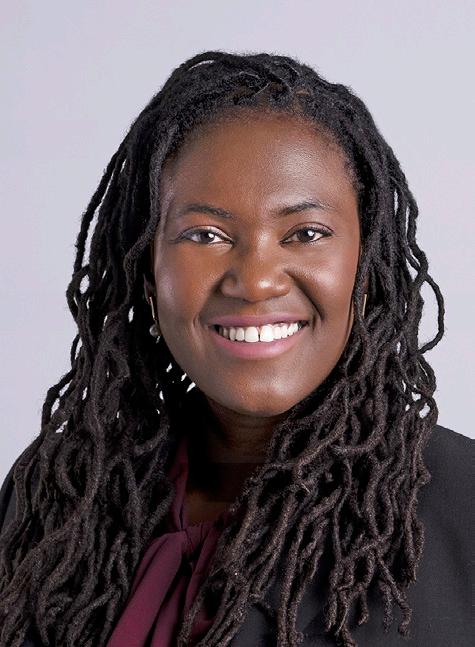
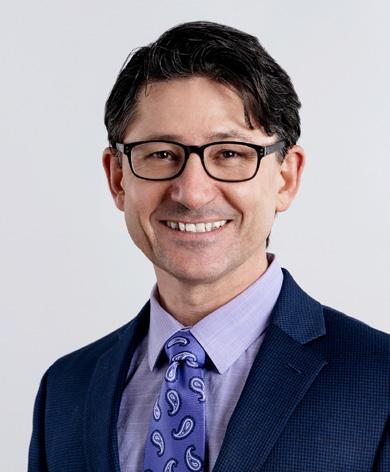
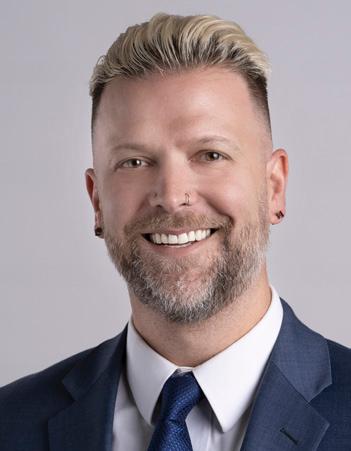
To share your ideas and stories, email us at gsenews@buffalo.edu
Follow @ubgse on social media
DEPARTMENTS
6 Book Stacks
Publications by GSE authors
20 Beyond the Game
PhD fellow Iman Lathan’s research reframes college athletics as a diasporic pathway, amplifying Black women athletes’ stories and systemic realities
22 Digital Divide 2.0
Paris Wicker calls for critical digital literacy to close the next digital divide
24 $1M Grant
Scott Sabella’s new grant powers GSE’s effort to train rehabilitation counselors, expanding support for New Yorkers with disabilities
26 Q&A
AI in the classroom: A conversation with Ian Mette on equity, ethics and AI in education
30 Student Perspective
Samantha Didrichsen transforms self-doubt into research and purpose
38 Gifts of Giving
Kathleen Cellura’s lifelong generosity is creating opportunities, supporting students and paying compassion forward
42 Class Notes
45 Soundtrack to Buffalo
A curated Spotify playlist welcomes new GSE students—using Buffalo’s music scene to build connection, celebrate and set the tone
47 In Memoriam
ED ARTIFACT
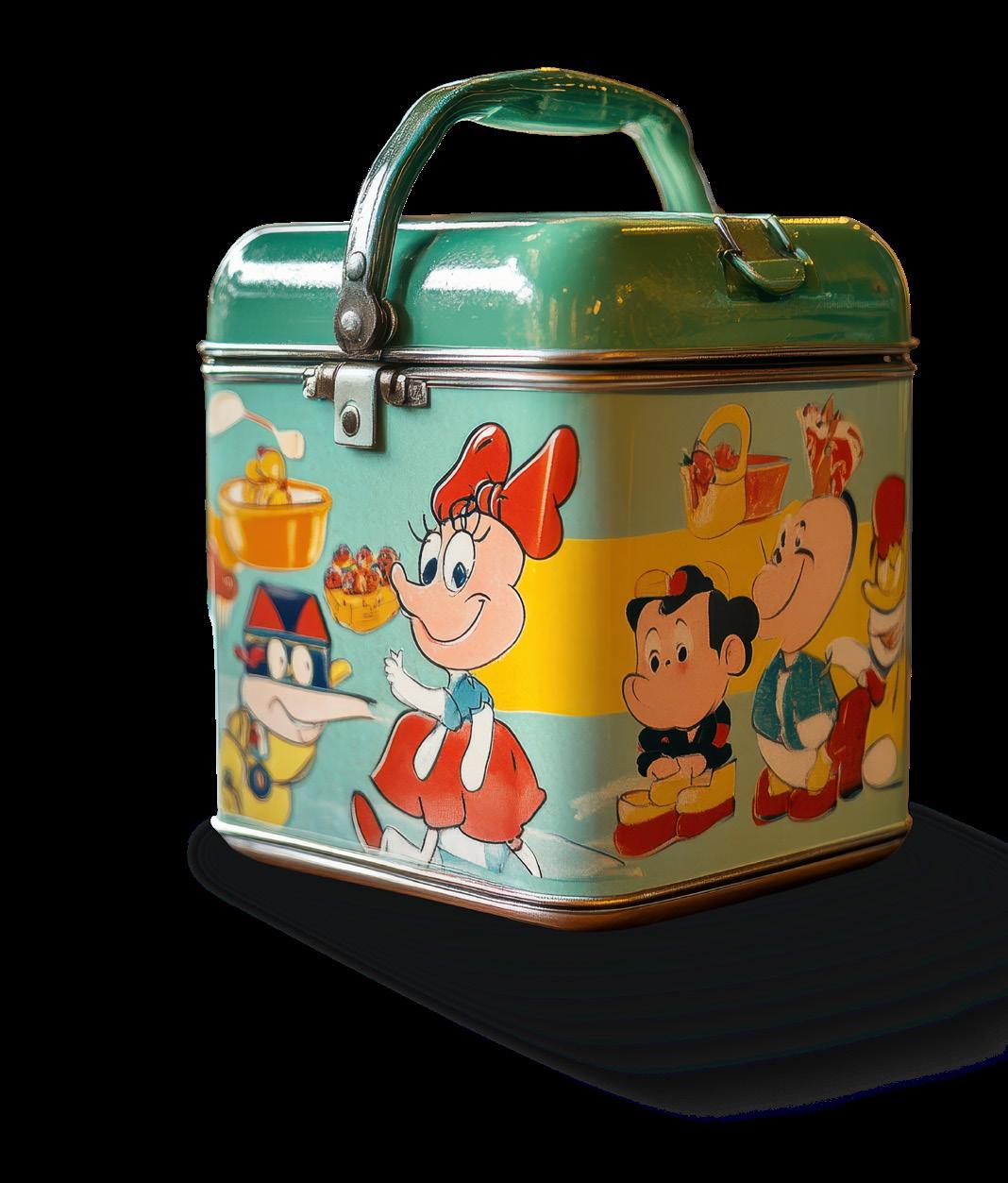
From Tin Pails to Pop Culture: THE INCREDIBLE JOURNEY OF THE LUNCHBOX
BY KARLY RAKHIMOVA
Who would have thought that a humble container could carry not just a sandwich, but a century of cultural change? The story of the lunchbox is one of inventions, identity and the daily ritual of gathering around a shared meal.
In the late 19th century, as industrialization surged, American workers needed durable containers to carry their midday meals. They repurposed biscuit and tobacco tins, while wealthier individuals used wooden boxes, symbolizing their status.
The lunchbox’s transformation began in 1935 when Geuder, Paeschke & Frey introduced the first licensed character lunchbox featuring Mickey Mouse. This tin box marked the fusion of functionality and popular culture.
The 1950s and 1960s witnessed a boom in characterthemed lunchboxes. Aladdin Industries’ 1950 Hopalong Cassidy lunchbox sold 600,000 units in its first year, turning lunchboxes into status symbols for schoolchildren.
Today, lunchboxes emphasize health, sustainability and style. Modern designs use BPA-free plastics and stainless steel, with compartments promoting balanced meals.
As an educational artifact, the lunchbox reveals not just what children eat, but how society views work, culture and identity. It is a small yet powerful lens through which we can explore the past and present of schooling.
It is a homecoming both literally and symbolically.
Dear Alumni and Friends,
It is with great pride that I welcome you to the Spring 2026 issue of Learn. This edition marks a meaningful moment in the life of the Graduate School of Education. It is a homecoming both literally and symbolically. With the completion of the $41 million renovation of Foster Hall, we return to a building that holds generations of memories, now reimagined to support the bold, inclusive and forward-looking work that defines GSE today.
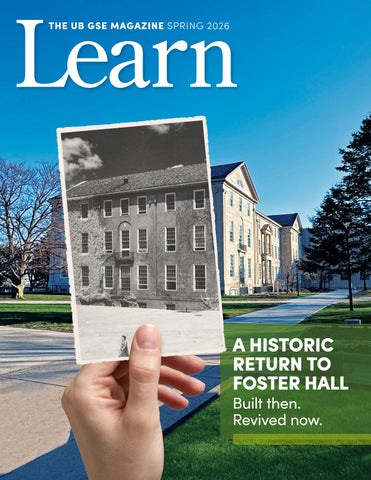
The theme of this issue, Homecoming, Reimagined, reflects the spirit you will find throughout these pages. Our cover story, historic return to Foster Hall: Built then. Revived now, explores how renewed learning spaces mirror GSE’s evolving mission, blending history, sustainability and community-centered design with reflections from faculty, staff and students on what returning home truly means.
You will also meet members of our community who are shaping education in creative and unexpected ways. Mental health counseling alumnus Dorian S. Withrow Jr. shares how he uses animation and storytelling to model emotional growth and expand conversations around mental health. Faculty research and leadership are highlighted through features on Scott Sabella’s U.S. Department of Education-funded grant, Paris Wicker’s timely op-ed on AI literacy, and practical guidance from Ian Mette on thoughtful, ethical uses of artificial intelligence in the classroom.
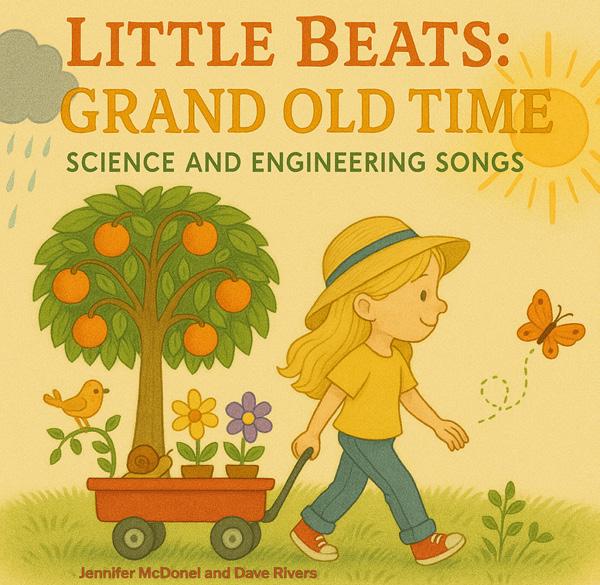
This issue also celebrates emerging scholars and students. From Reza Nahid Sahlan’s culturally grounded research on eating disorders and body image to Samantha Didrichsen’s personal reflection on her dissertation journey, these stories remind us that innovation often begins with curiosity, courage and lived experience. We also recognize alumni achievements such as Iman Lathan’s Spencer Dissertation Fellowship and Jennifer McDonel’s nationally recognized work blending music, STEM and early childhood education.
As you read these pages, my hope is that they remind you of GSE’s shared values and commitments. Thank you for being part of this journey.
Warm regards,
Suzanne Rosenblith
LAND ACKNOWLEDGMENT STATEMENT
A pledge to peaceably share and care for North America’s five Great Lakes
We would like to acknowledge the land on which the University at Buffalo operates, which is the territory of the Seneca Nation, a member of the Haudenosaunee/Six Nations Confederacy. This territory is covered by The Dish with One Spoon Treaty of Peace and Friendship, a pledge to peaceably share and care for the resources around the Great Lakes. It is also covered by the 1794 Treaty of Canandaigua, between the United States Government and the Six Nations Confederacy, which further affirmed Haudenosaunee land rights and sovereignty in the State of New York. Today, this region is still the home to the Haudenosaunee people, and we are grateful for the opportunity to live, work and share ideas in this territory.
“Great Lakes, No Clouds” Image of North America’s five Great Lakes courtesy of US NASA Earth Observatory.
GSE in the News
Headlines from stories that featured our faculty and students
EDUCATION WEEK quoted Christopher P. Brown, professor in the Department of Learning and Instruction, in an article titled “Child Care From Age 2: One City’s Plan to Improve Student Outcomes.”
and Instruction and associate director of the Center for Literacy and Reading Instruction, and Blythe Anderson, assistant professor in the Department of Learning and Instruction, in an article titled “Few Books Are Tailored for Older Struggling Readers. ‘It’s an Absolute Wasteland.’”
THE ARIZONA REPUBLIC quoted Samuel Abramovich, associate professor in the Department of Learning and Instruction, in an article titled “Cold plunges, running food trucks? Scottsdale AI school focuses on life skills.”
HUFFPOST quoted LaGarrett King, professor in the Department of Learning and Instruction and director of the Center for K-12 Black History and Racial Literacy Education, in an article titled “MAGA is Fuming Over the Black National Anthem at Super Bowl 2026 – and It Says A Lot.”
SPECTRUM NEWS 1 quoted Samuel Abramovich, associate professor in the Department of Learning and Instruction, in an article titled “N.Y. Schools Opting for Virtual Learning Instead of Snow Days.”
THE GUARDIAN quoted Tangela Montgomery, assistant professor in the Department of Counseling, School and Educational Psychology, in an article titled “‘We Have to Go Out and Touch People’: How Activism is Tackling the US Loneliness Epidemic.”
THE PRESS DEMOCRAT quoted Amanda Nickerson, SUNY Distinguished Professor in the Department of Counseling, School and Educational Psychology and director of the Alberti Center for Bullying Abuse Prevention, in an article titled “Sebastopol Parents Say School District Failed to Act on Bullying, Bias Complaints.”
EDUCATION WEEK published an opinion piece by Nick Kennedy, a learning and teaching in social contexts doctoral student, titled “My Step-by-Step Framework for Taking Flight Into Black History.”
BOOK STACKS
Books and chapters published by members of the UB GSE community
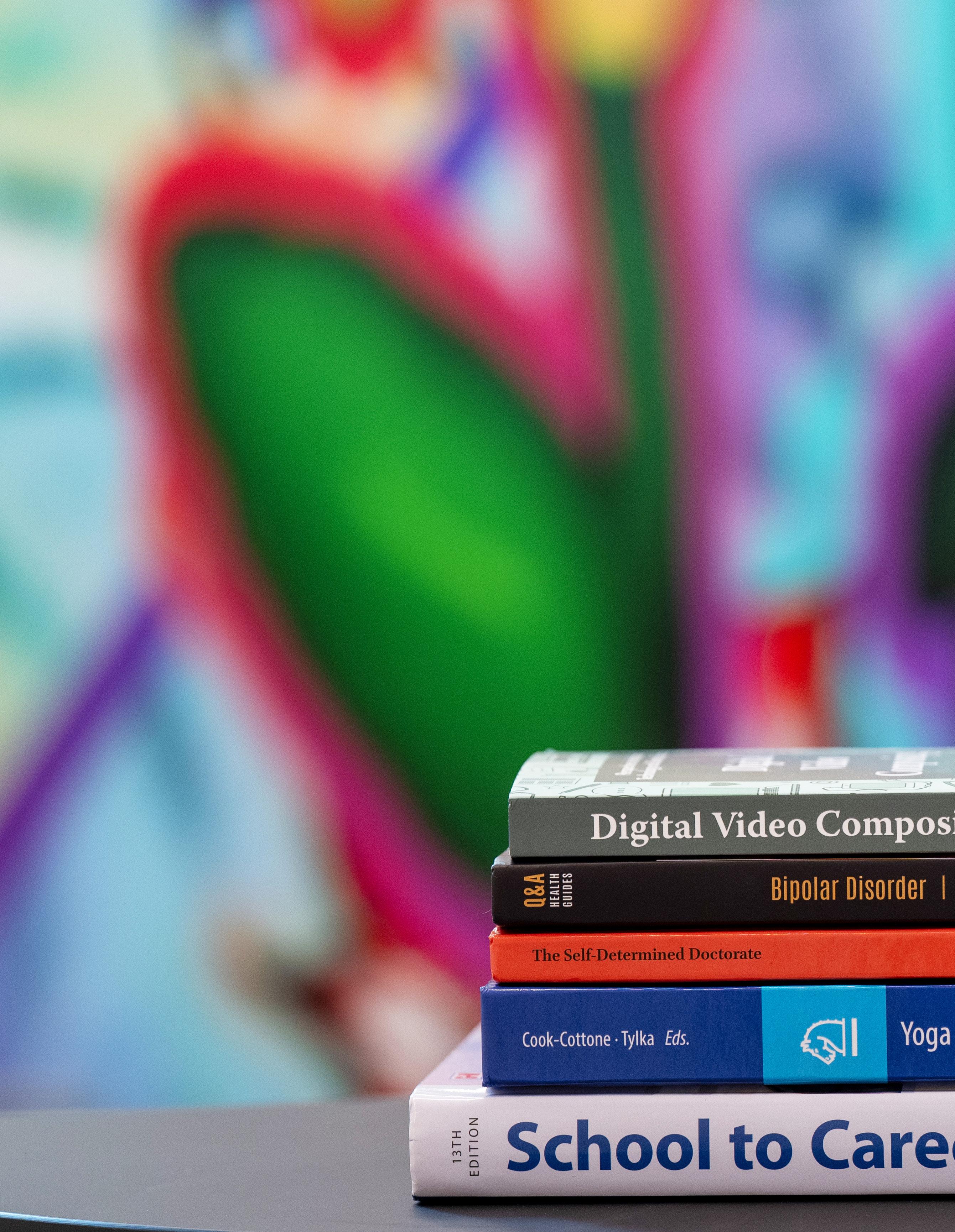
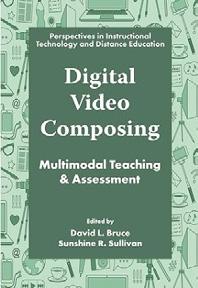
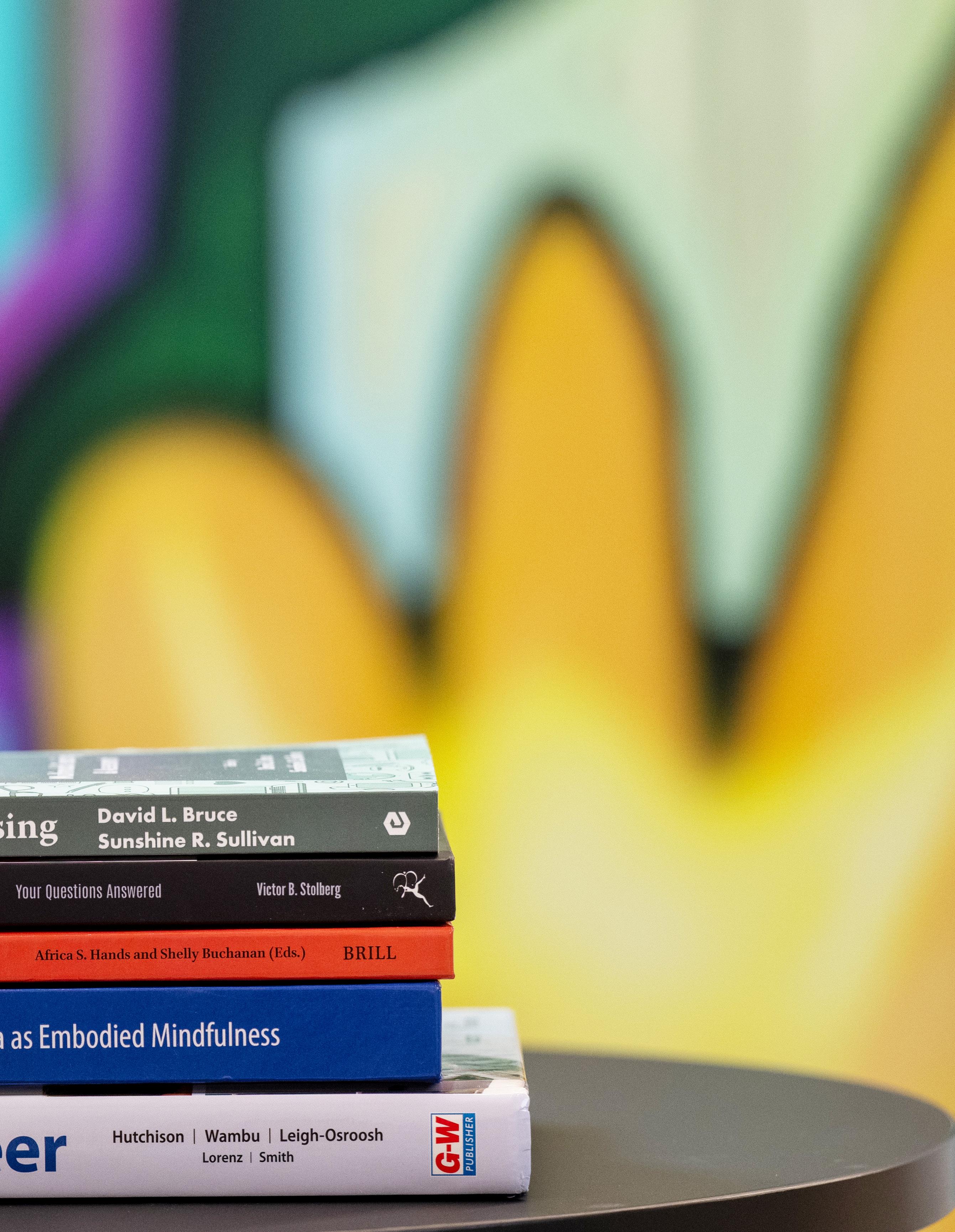
“Digital Video Composing: Multimodal Teaching & Assessment” was co-authored by David L. Bruce, PhD, associate professor in the Department of Learning and Instruction. It was published in December 2025 by Emerald Publishing.
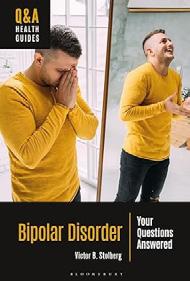
“Bipolar Disorder: Your Questions Answered” was released in January 2026 and authored by Victor B. Stolberg, EdM ’84. It was published by Bloomsbury Publishing.
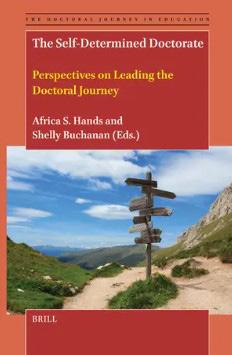
“The Self-Determined Doctorate: Perspectives on Leading the Doctoral Journey” was co-edited by Africa Hands, PhD, assistant professor in the Department of Information Science. It was published in October 2025 by Brill.
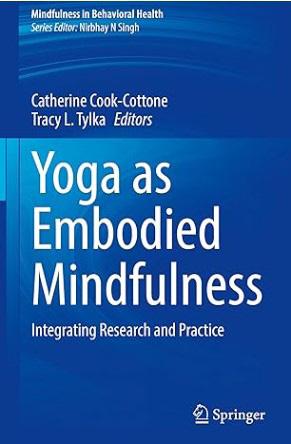
“Yoga as Embodied Mindfulness: Integrating Research and Practice” was co-edited by Catherine CookCottone, PhD, professor in the Department of Counseling, School and Educational Psychology. It was published in May 2025 by Springer.
The 13th edition of “School to Career” was co-authored by Katheryne T. Leigh-Osroosh, PhD, assistant professor in the Department of Counseling, School and Educational Psychology. It was published in 2025 by The GoodheartWillcox Company Inc.
(Photo/ Dylan Buyskes, Onion Studio)
Exploring the dynamics of interactive video searches and STEM learning
BY ANN WHITCHER GENTZKE
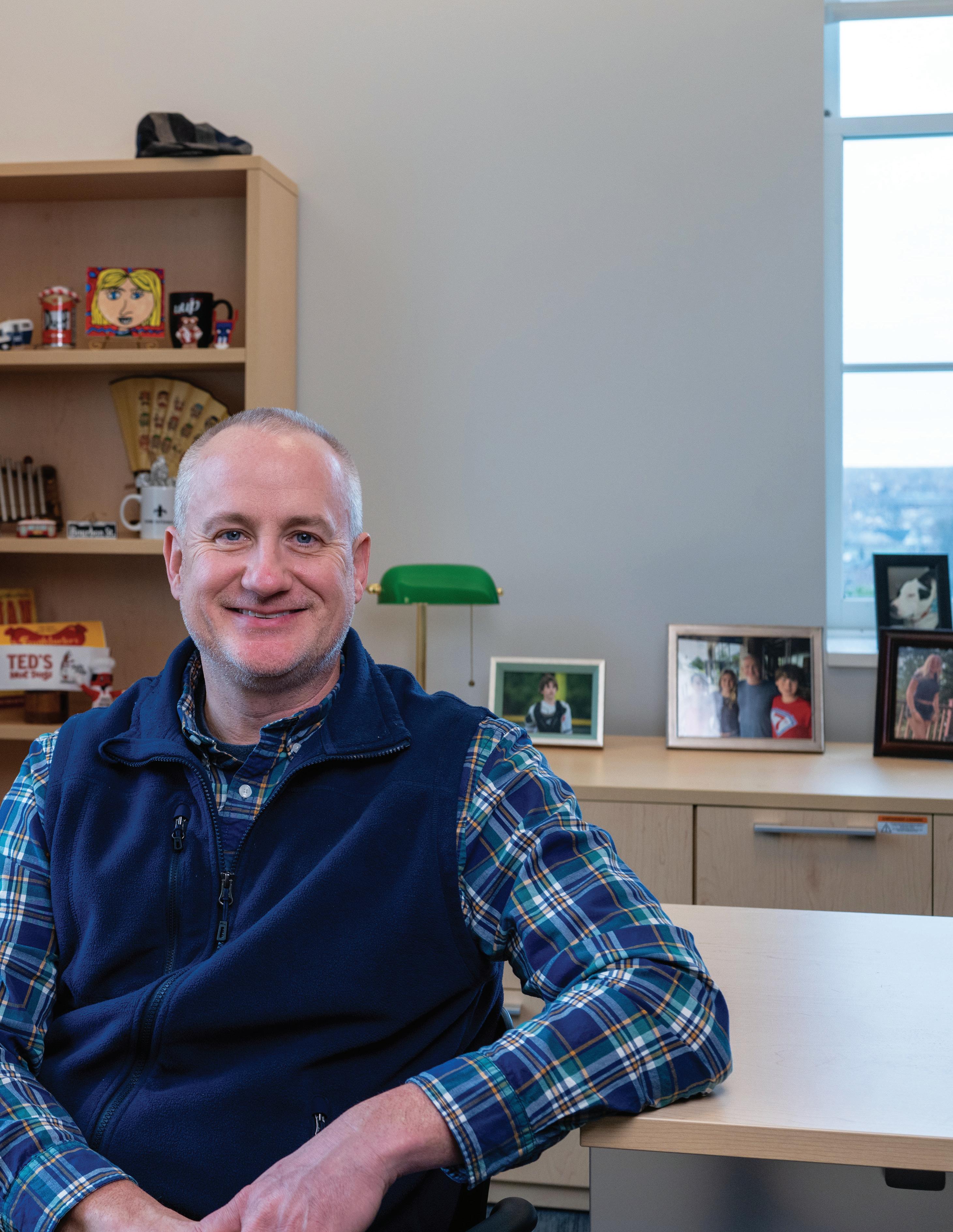
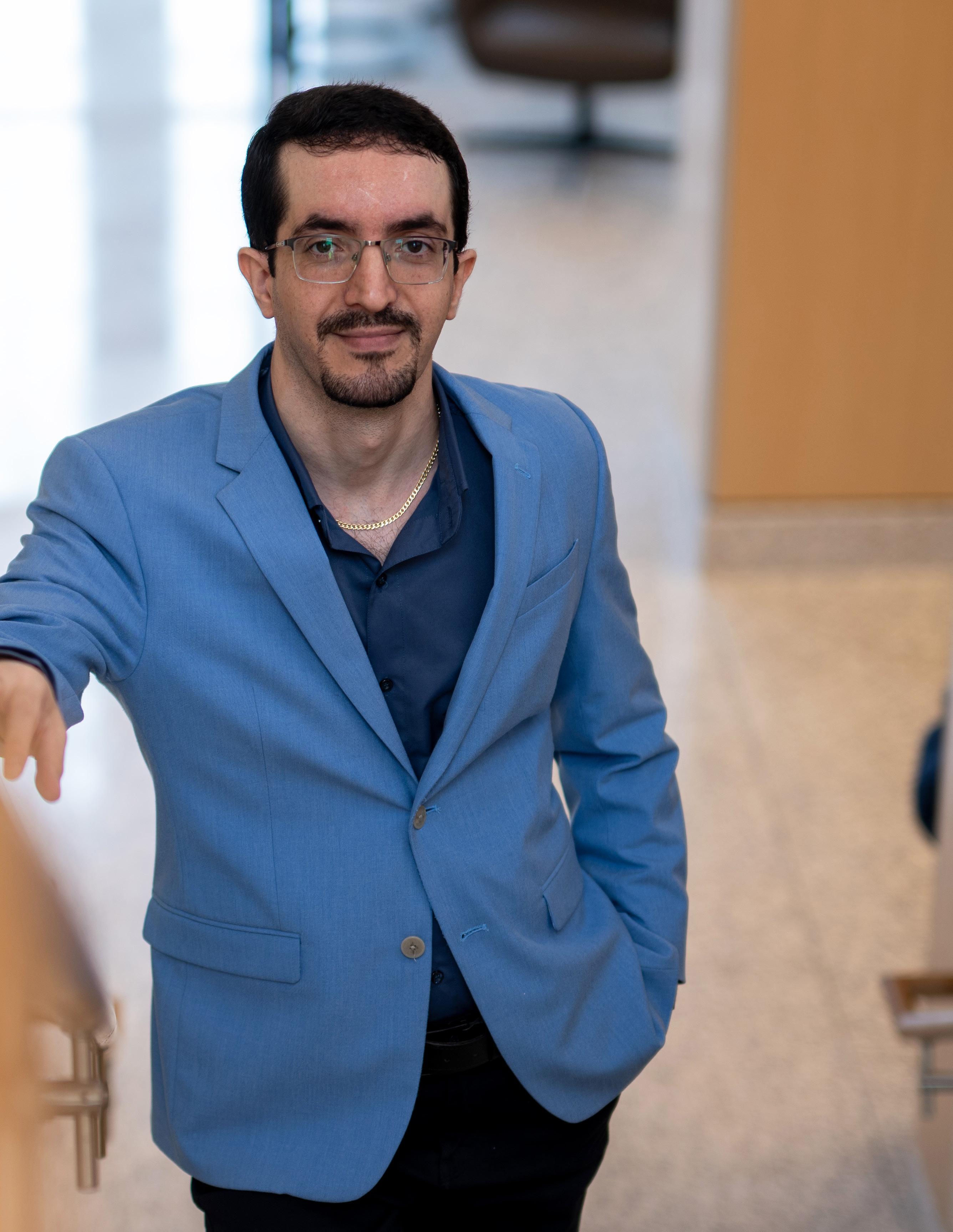
On this cold, bright day in mid-February, Dan Albertson, professor and chair of the Department of Information Science, is settling into his office in Foster Hall on the South Campus. He’s clearly pleased with the building’s abundant natural light, clean, modern design and its many practical spaces. “It fosters a lot of collaboration and seeing people—everything is very functional,” he said.
Albertson came to UB in 2016 as associate professor and was promoted to full professor three years later. Today, he mainly focuses his research on “interactive information retrieval,” focusing on digital video. He describes this intellectual inquiry as “how people go about searching and browsing for digital video content—all the effects in seeking, finding, selecting and using videos within their own contexts.”
Meanwhile, Albertson has explored an array of information technology topics, including STEM learning in informal spaces. In 2017, and later in 2019, he was co-PI on a “REALIS-D in School Libraries” grant from the Laura Bush 21st Century Librarian Program, Institute for Museum & Library Studies. “We were looking at how we can bring computer science and computational thinking into the informal learning spaces in K-12 rural schools, to try to enhance STEM learning through their school library,” he said.
A native of Indiana, Albertson earned his PhD, master’s and bachelor’s degrees at Indiana University. He has published widely in leading journals and taught a variety of courses both at UB and at the University of Alabama, where he was associate professor before coming to Buffalo. Each semester he teaches “The Information Cycle,” a core course for the department’s MS programs at UB. “I like teaching it,” he said. “I get to meet a lot of our new students that way.”
As his cheerful office décor demonstrates, Albertson is a dedicated family man. He and his wife Tara are parents to Lucy, a UB freshman in the School of Law BA program; Charlotte, a high school senior; and Mac, a ninth grader. As for hobbies, Albertson says he likes to barbecue and play softball and golf.
A ten-year Western New York resident, Albertson can easily articulate why GSE—now in its original home in Foster Hall— matters so much to the Buffalo community and vice versa. “That’s something that’s really stood out to me about Buffalo: Even though it’s a larger city and not a college town, the people here take such pride in UB. And there’s the identity of the university with Western New York. That’s a great thing.”
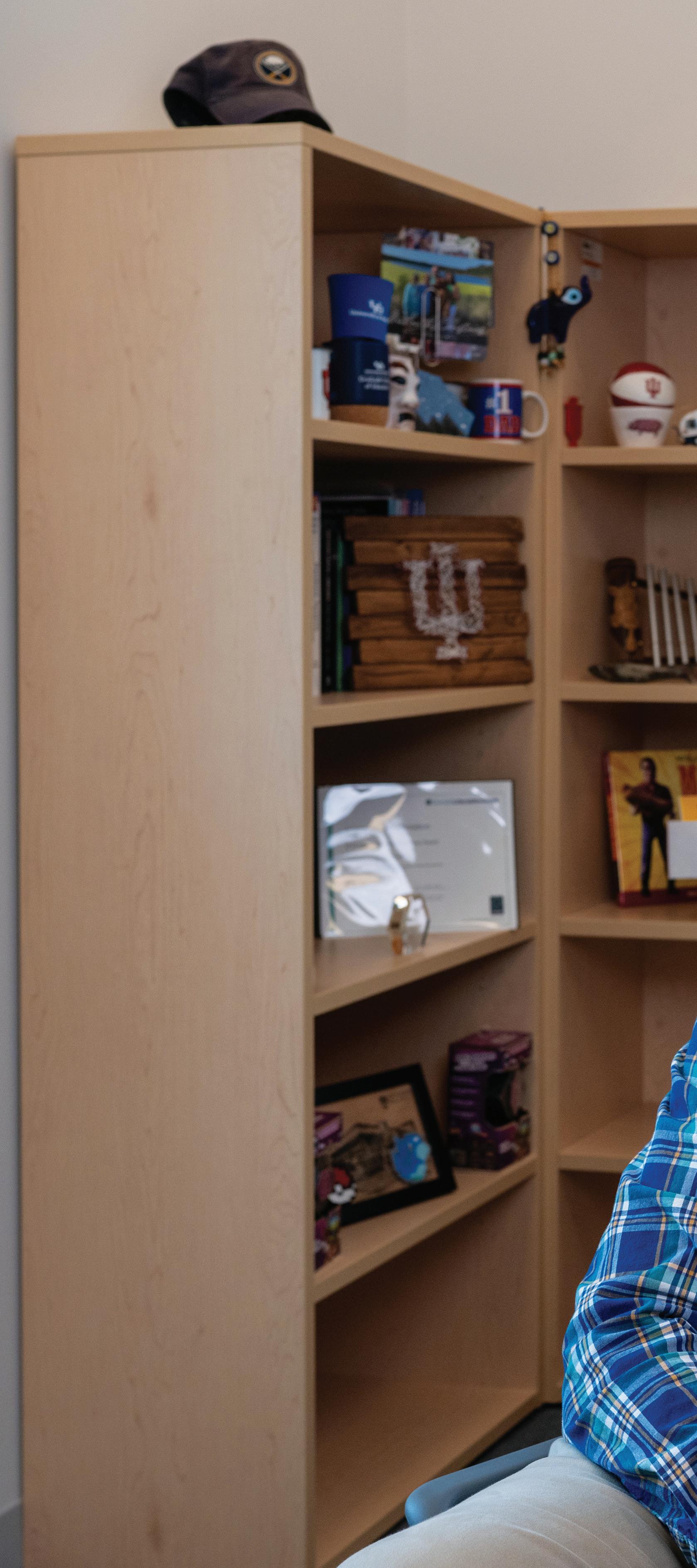
Sabres hat: After accepting the UB job, Albertson bought the hat and wore it one day in a Tuscaloosa coffee shop. “Someone who worked in my college, but I didn’t really know, waved, and said, ‘Are you a Sabres fan?’ I said, ‘I’m about to be.’ We sat down and talked—it turns out he got his PhD at UB. He introduced me to someone in Williamsville, who introduced me to the person who was selling our house. Without that hat on that day in that place, who knows where the Albertsons would’ve landed.”
National Championship: Albertson is a big Hoosiers fan. His son made this yarn logotype a few years ago for Father’s Day and it now marks Indiana University’s 2025 National Championship.
Merge Cube: This handheld holographic object was designed for augmented reality experiences and was part of the “REALIS-D in School Libraries” grant. “We bought a bunch of these for the libraries to put them in their library,” said Albertson.
(Photo/ Dylan Buyskes, Onion Studio)
Hot dog memorabilia: “Hot dogs are the best,” Albertson said. His display includes items from Ted’s along with a book on hot dog culture.
ALBERTSON’S RESEARCH AREAS
• Information Science
• Information Retrieval
• Human Computer Interaction
Foster Hall
After a $41 million transformation, the historic building reopens on South Campus—where memory meets momentum
BY DANIELLE LEGARE
Maria Runfola still remembers the moment she yawned in Foster Hall.
Now a professor emeritus in the Department of Learning and Instruction, Runfola first encountered the building as an undergraduate while completing her certification requirements at UB in the early 1970s. She sat among hundreds of students in a large, tiered lecture hall heated by steam radiators that often left the room uncomfortably warm. One afternoon, midway through Professor Richard Poole’s course on measurement and evaluation, he singled her out in front of the class for appearing disengaged.
“It was embarrassing,” she said. “All I really needed was some fresh air.”
Decades later, the memory stayed with her, in part because Poole’s course would go on to shape her career in music education, where measurement and evaluation became central to her work.
A return to familiar ground
Runfola was one of many UB students who passed through Foster Hall when education programs were based on the South Campus. Long before GSE relocated to Baldy Hall on the North Campus in 1973, Foster served as an academic home for what would become GSE.
Today, the school’s move back into the building marks a return to an earlier chapter in its history.
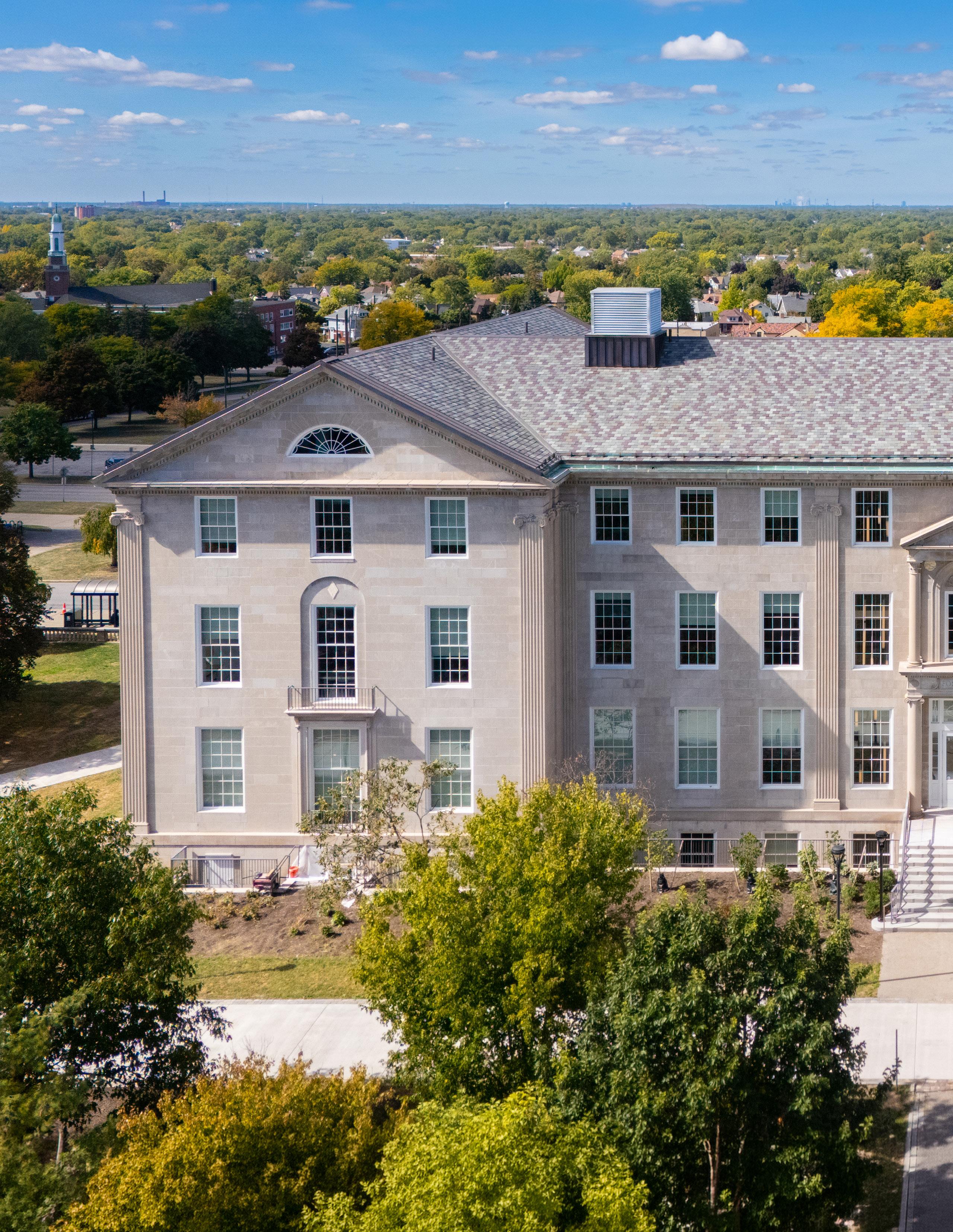
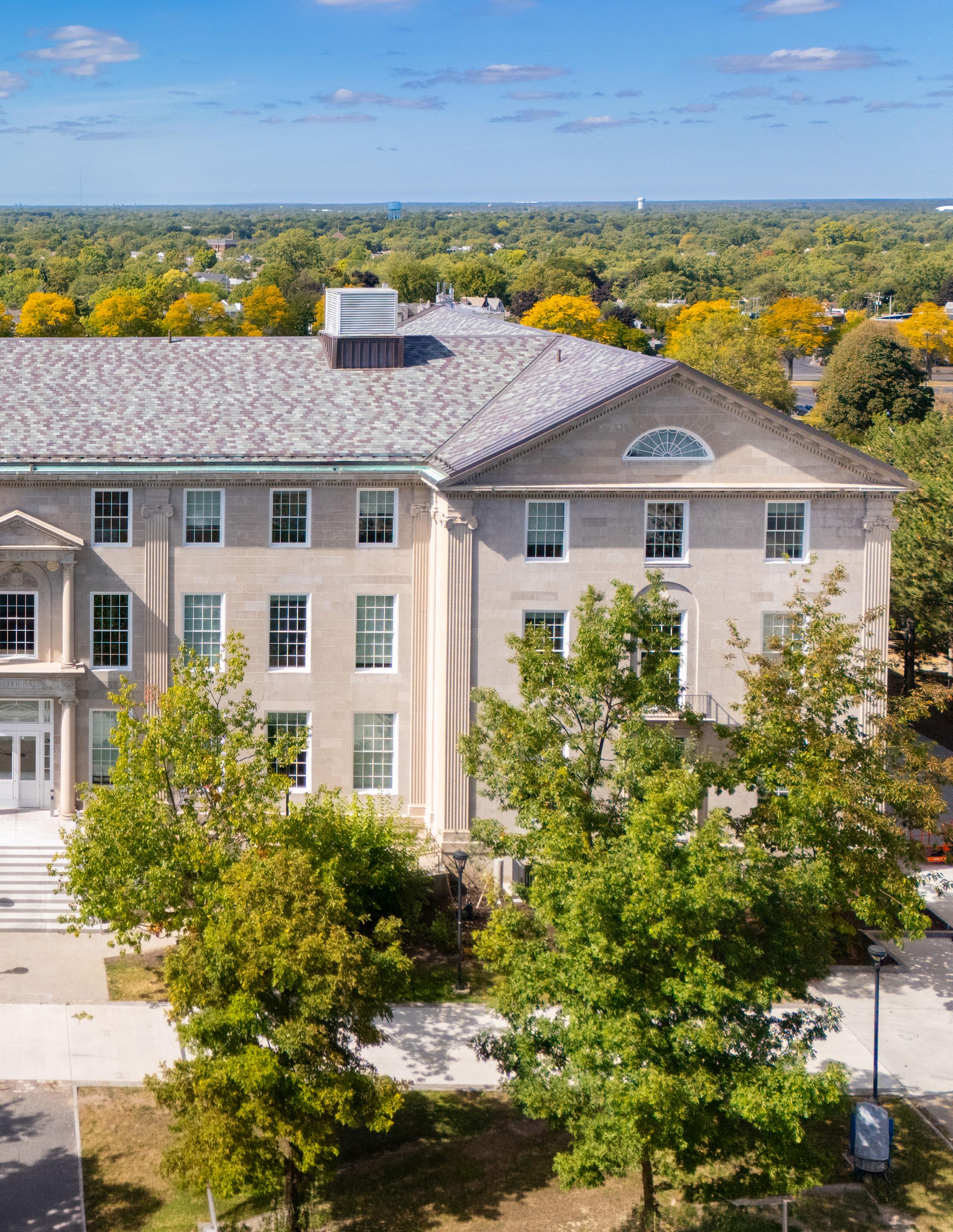
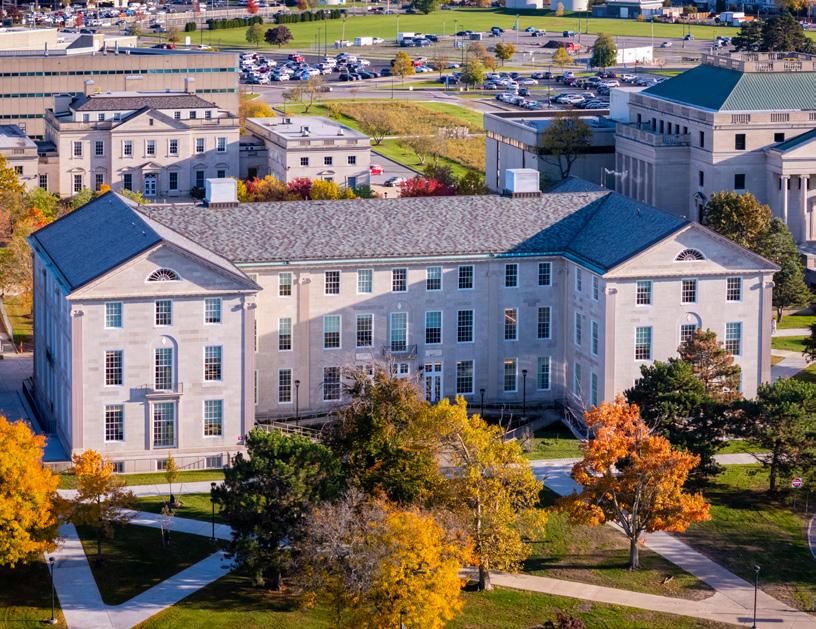
Completed in 1921, Foster Hall was the university’s first academic building on the South Campus along Main Street. Designed by McKim, Mead & White and funded by a $500,000 gift from philanthropist Orrin Elliott Foster, the building first housed the Department of Chemistry before later becoming home to education programs.
After GSE moved, the building continued to support UB’s academic mission, most recently serving the School of Dental Medicine.
“Foster Hall was where GSE first took shape— where future teachers, leaders and scholars began their journeys nearly a century ago,” said GSE Dean and Professor Suzanne Rosenblith.
A familiar face, restored for a different moment
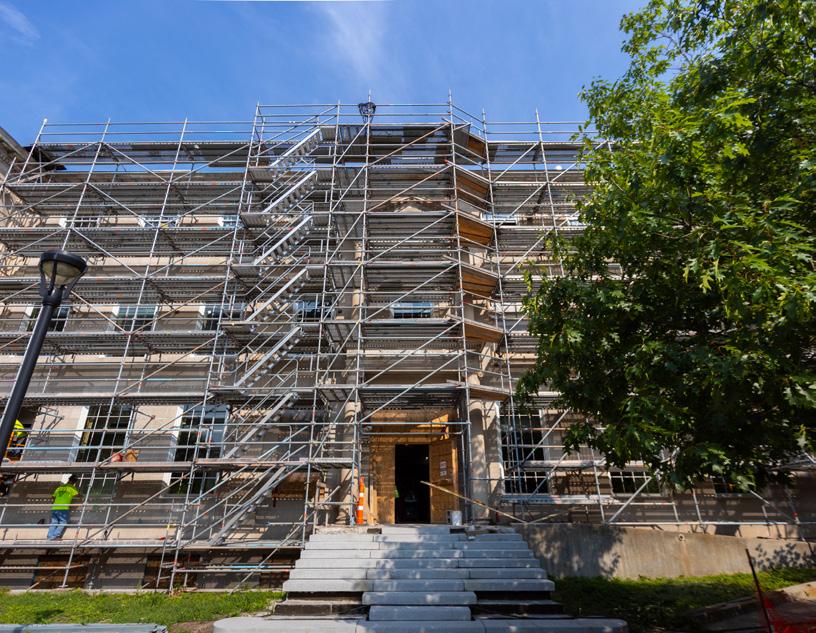
Now, after a three-year, $41 million renovation, Foster Hall still looks like Foster.
Set along Main Street in the City of Buffalo, the building remains a jewel on UB’s South Campus. The lines are the same. The presence is the same. And the building’s outward character remains intact, with one notable difference.
The Main Street entrance has been reopened as a true front door. During renovations in the early 1980s, that entrance had been closed off and repurposed as a loading dock—a practical decision at the time, which ultimately turned the building inward. In addition to recent exterior refinements,
PHOTO CAPTIONS
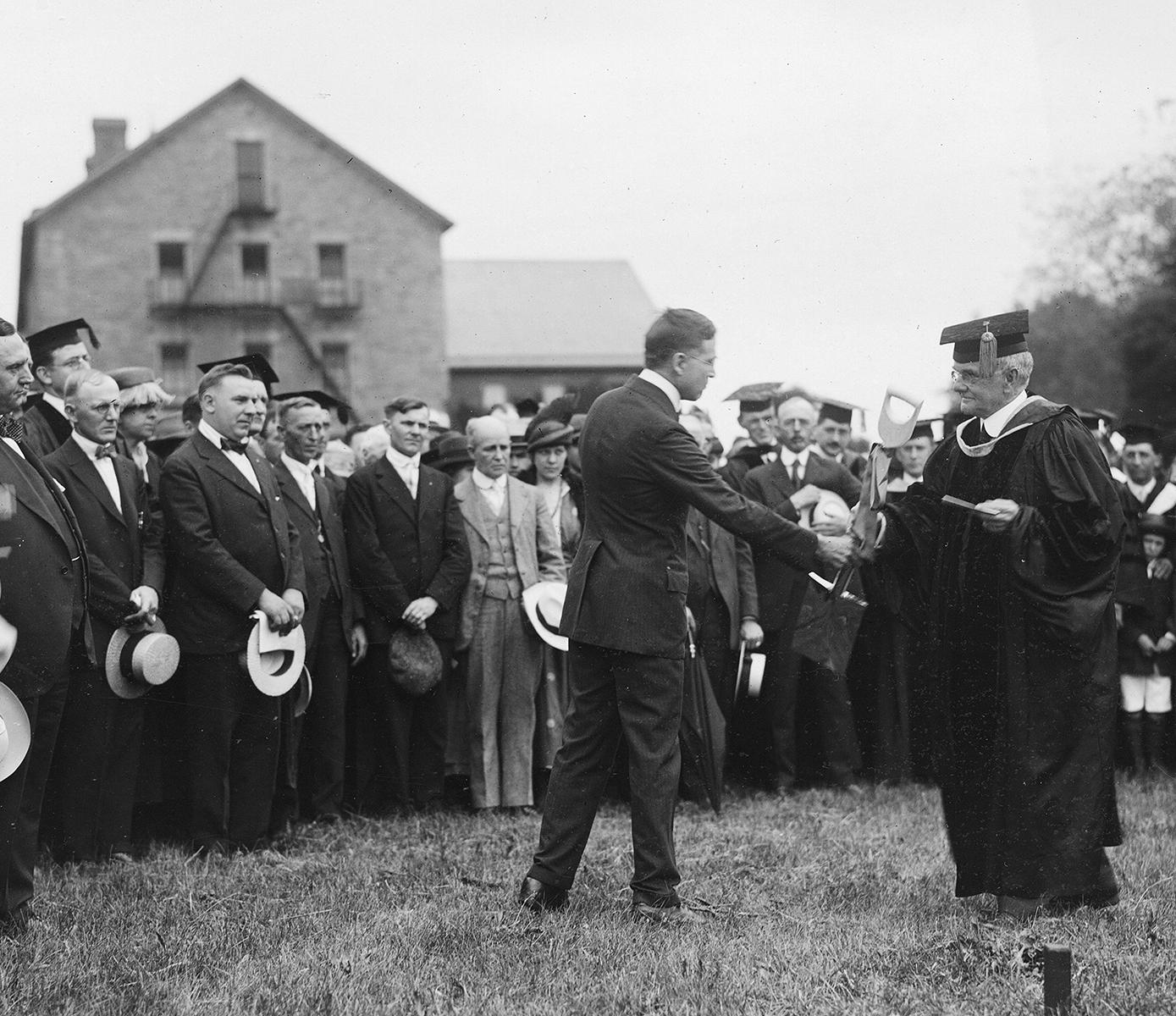
1. UB Chancellor Charles P. Norton broke ground for Foster Hall on June 11, 1920.
2.
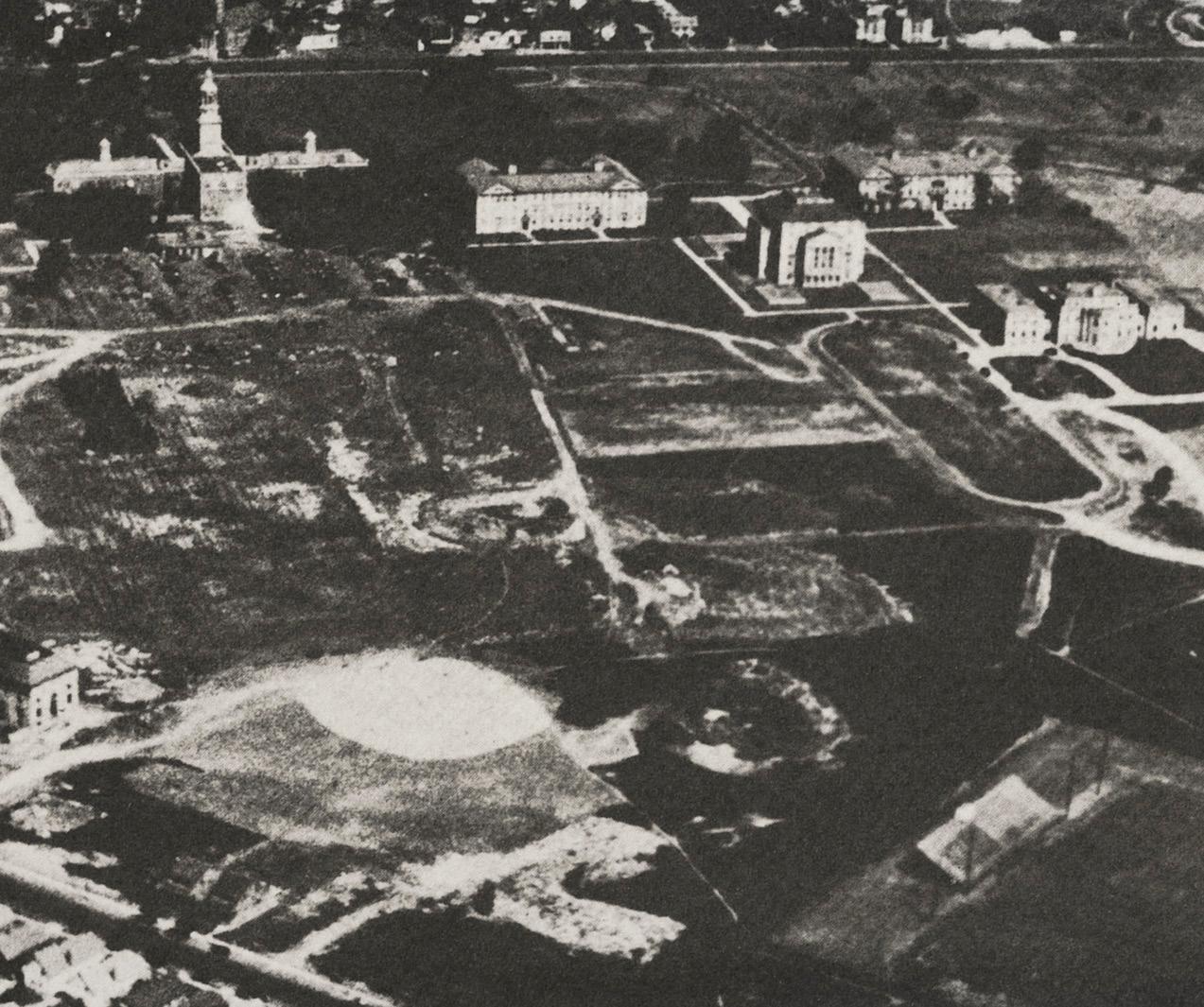
3. Aerial view of South Campus, circa 1934-37. Courtesy, University Archives.
4.
5.
a
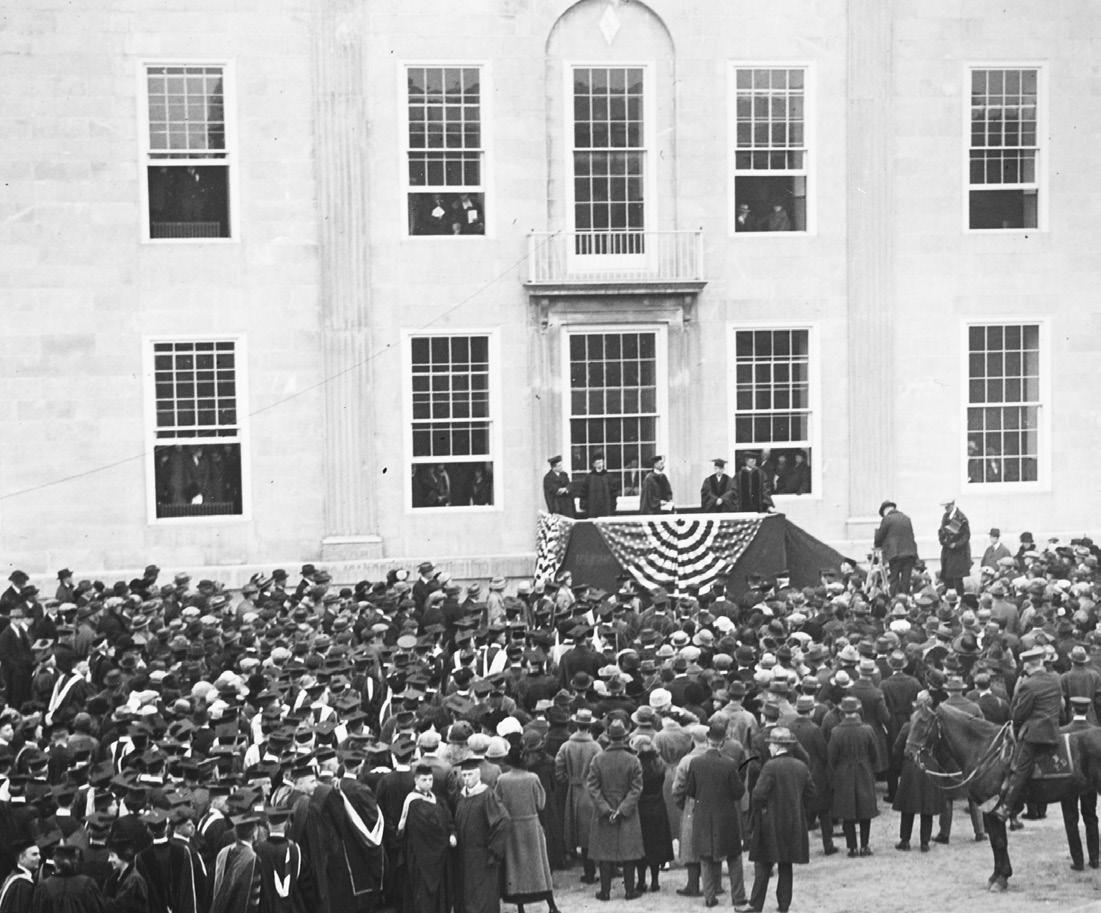
6. A crowd gathered for the inauguration of Samuel P. Capen and Foster Hall’s dedication in October 1922.
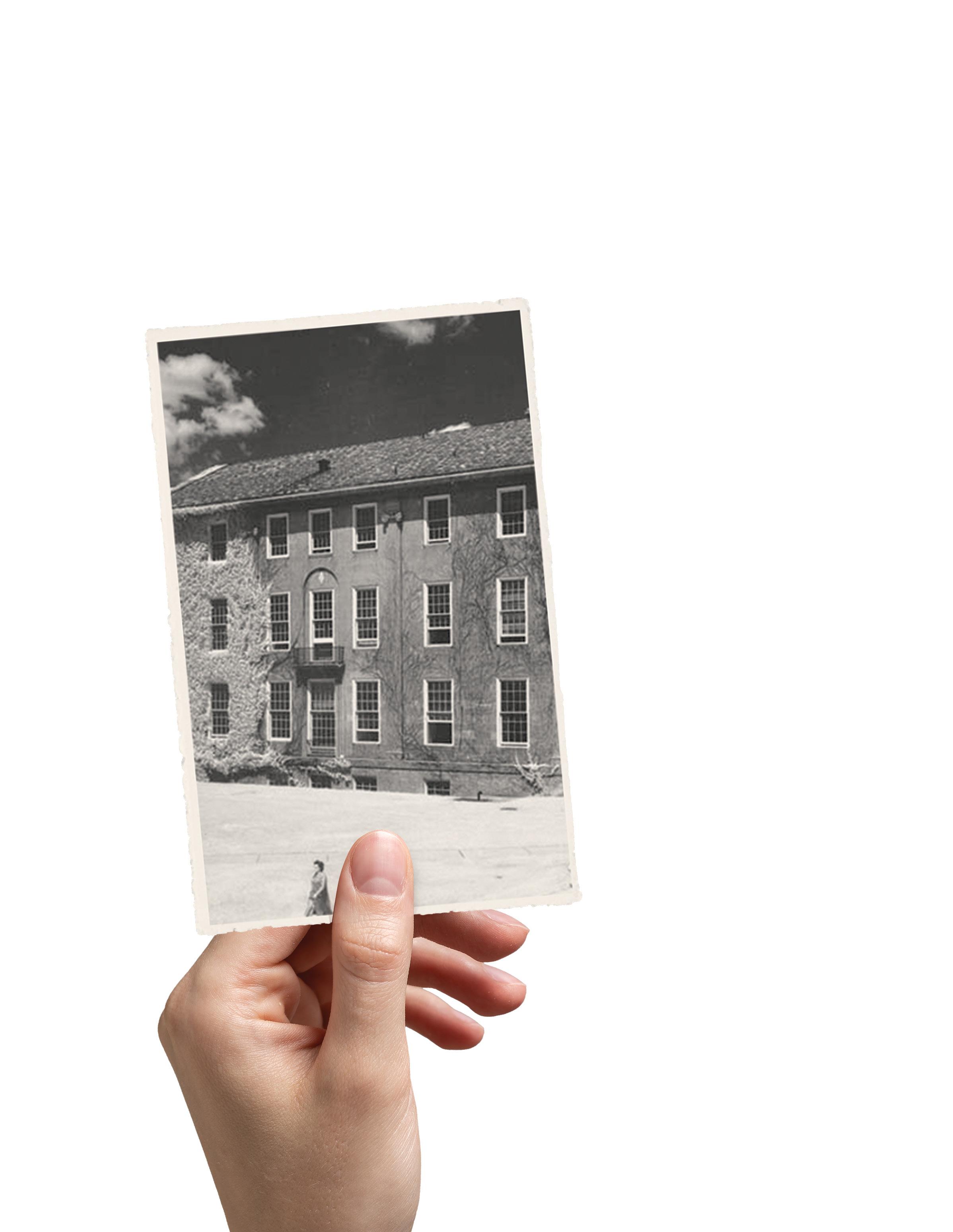
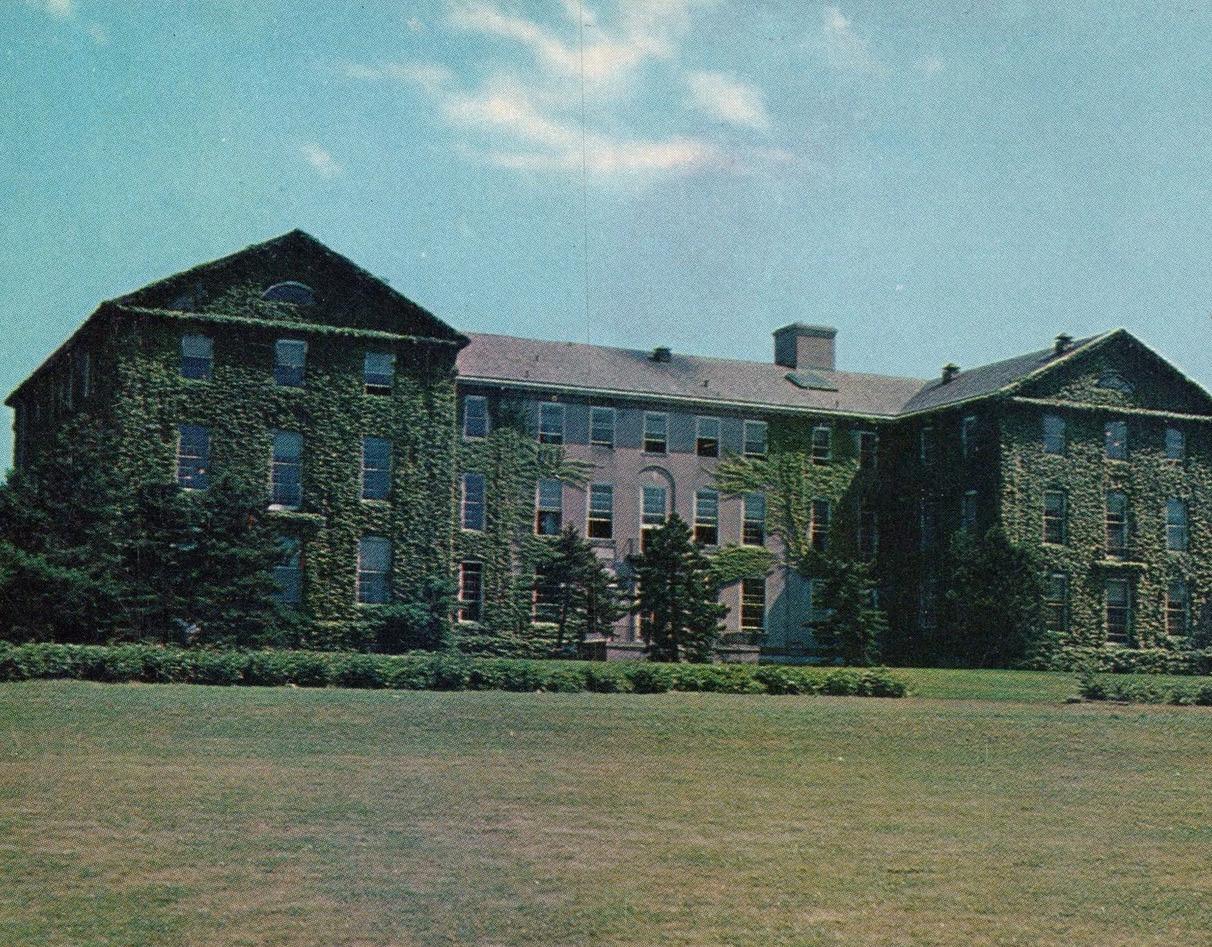
7. Vintage postcard of Foster Hall, circa 1950.
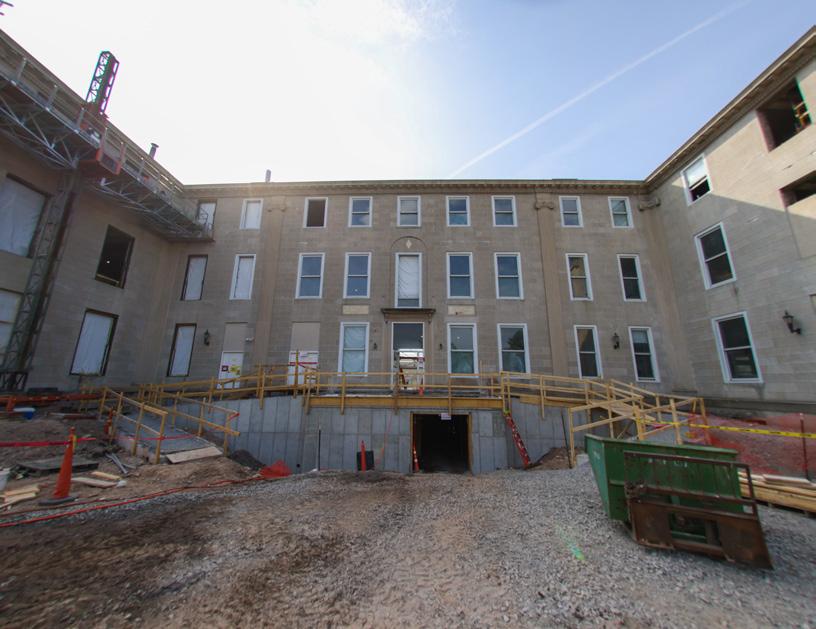
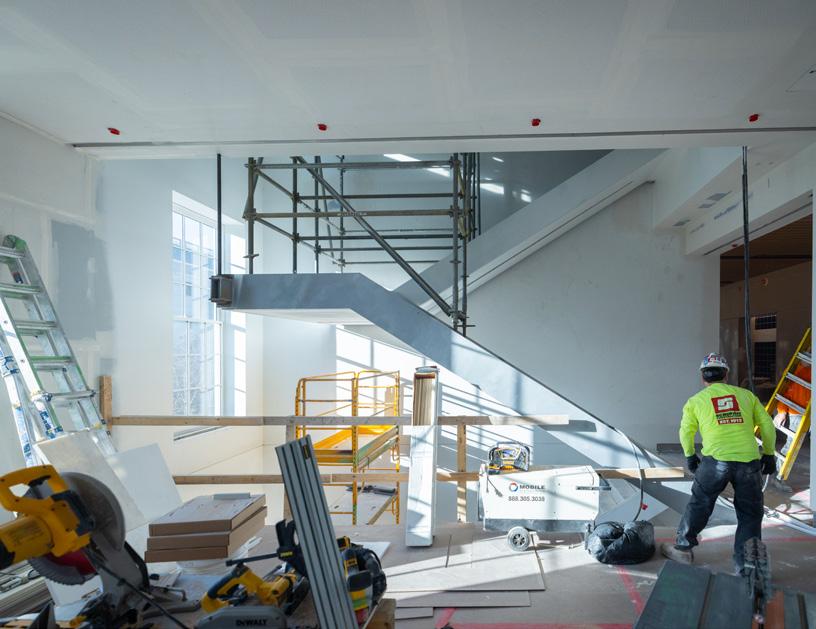
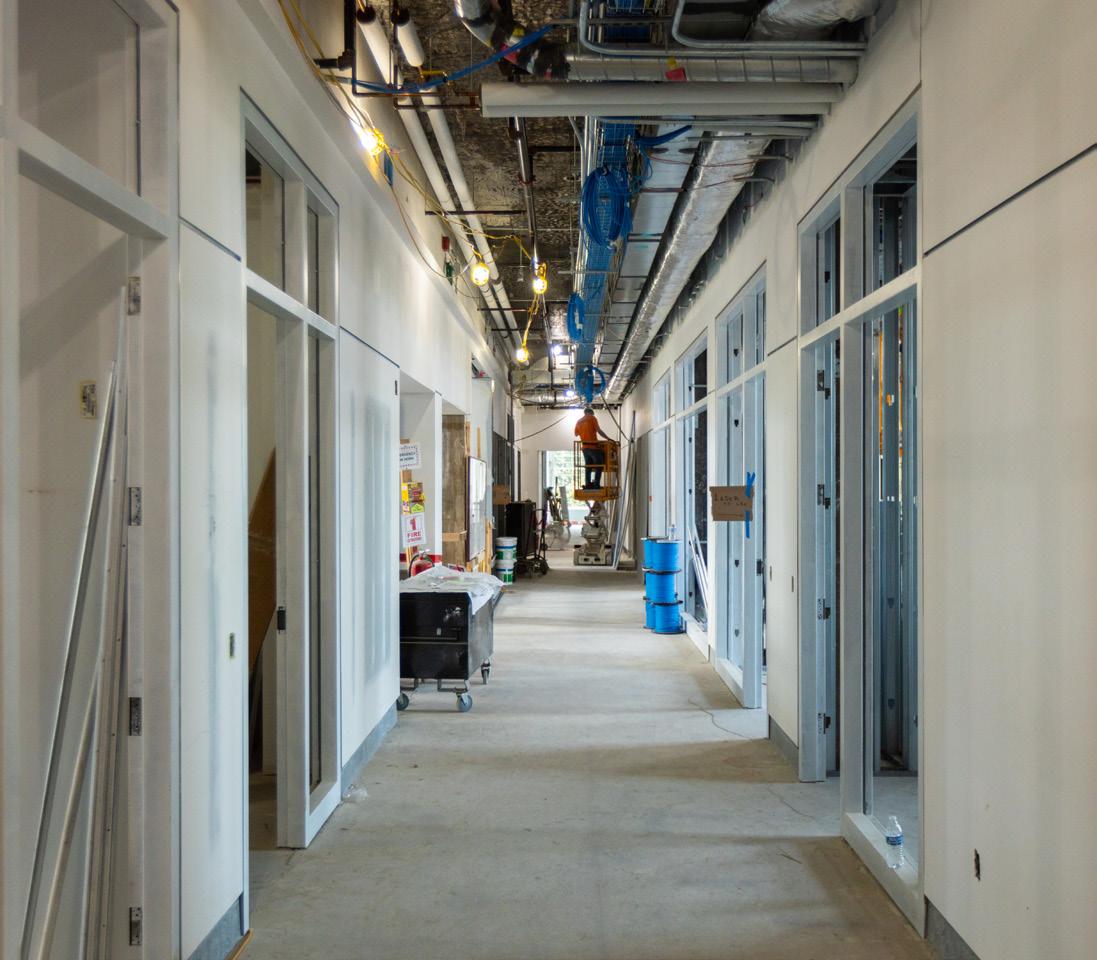
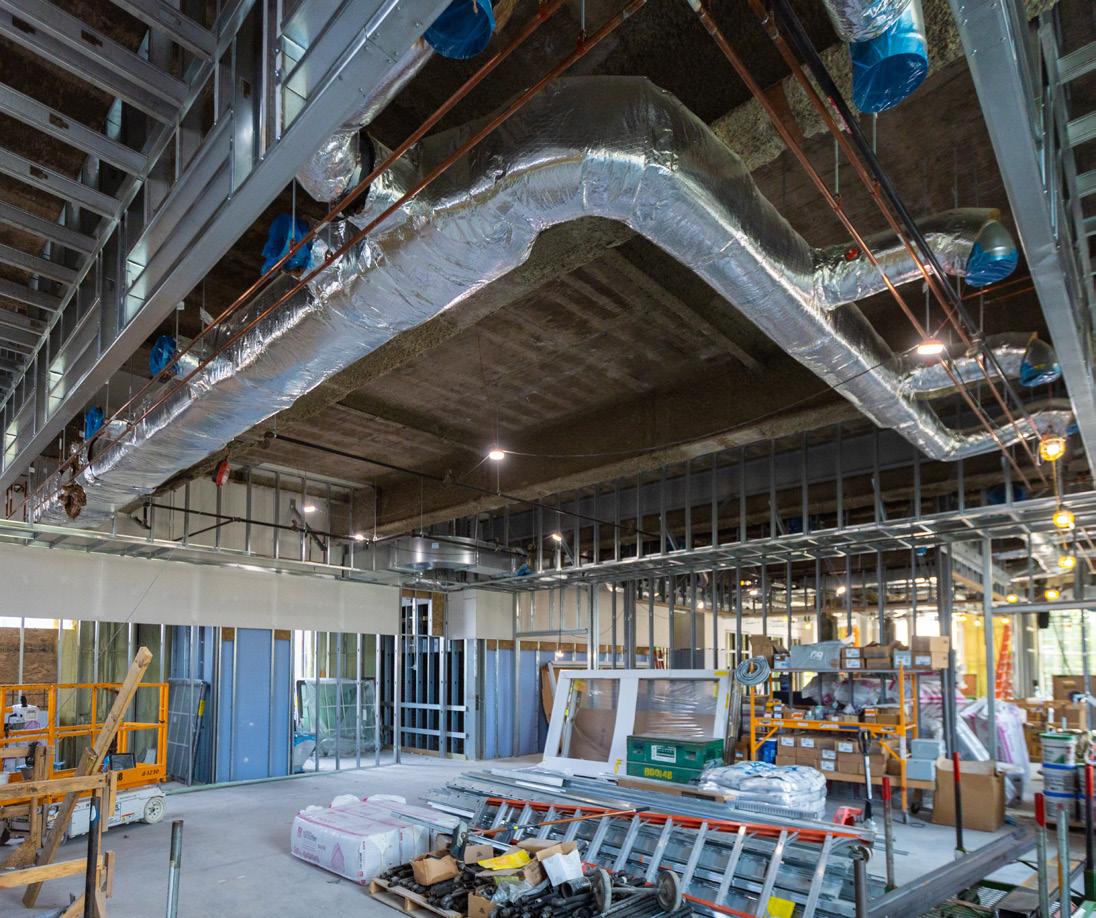
8. Construction underway at Foster Hall in June 2023.
9. Foster Hall in July 2024, as construction continued.
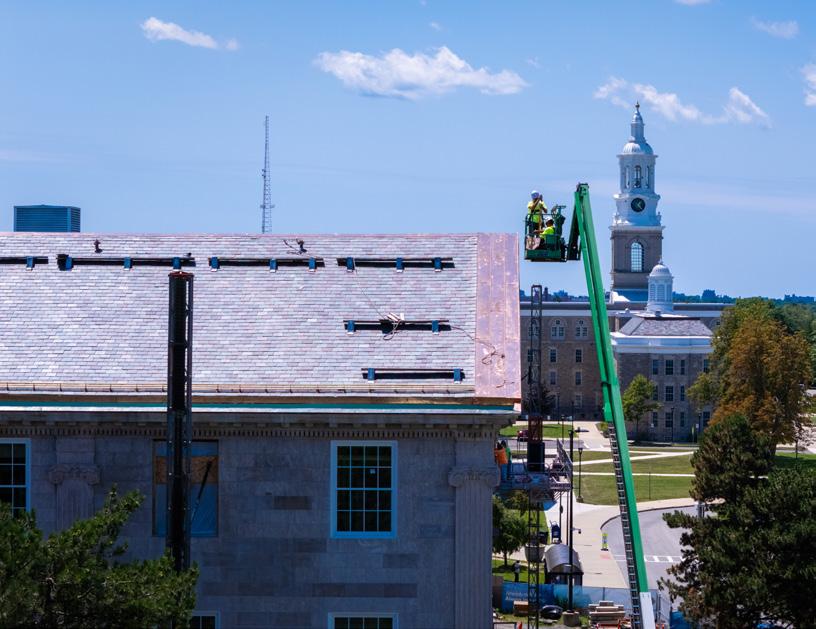
10. Foster Hall in late October 2025.
“Foster Hall was where GSE first took shape—where future teachers, leaders and scholars began their journeys nearly a century ago.”
-Suzanne Rosenblith, GSE Dean and Professor
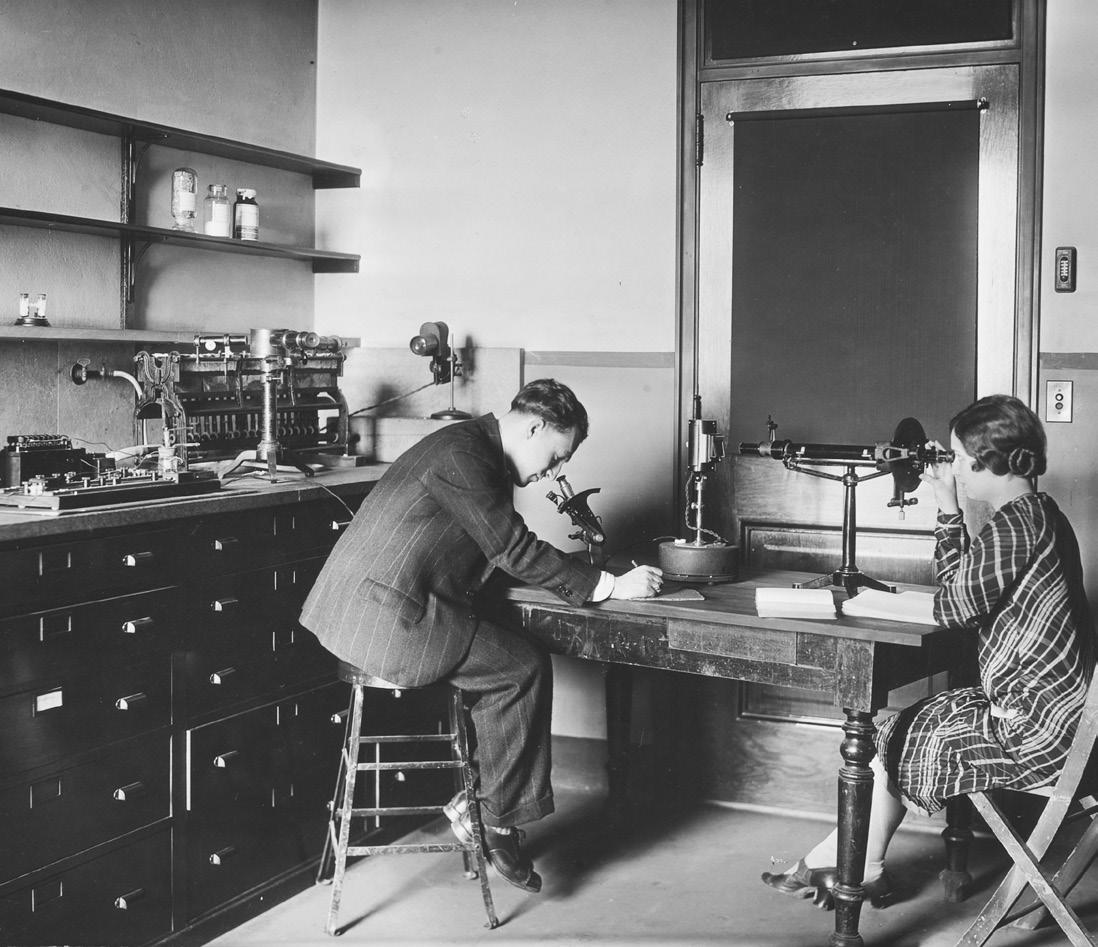
Two students studied in a Foster Hall lab in the 1920s. Courtesy, University Archives.
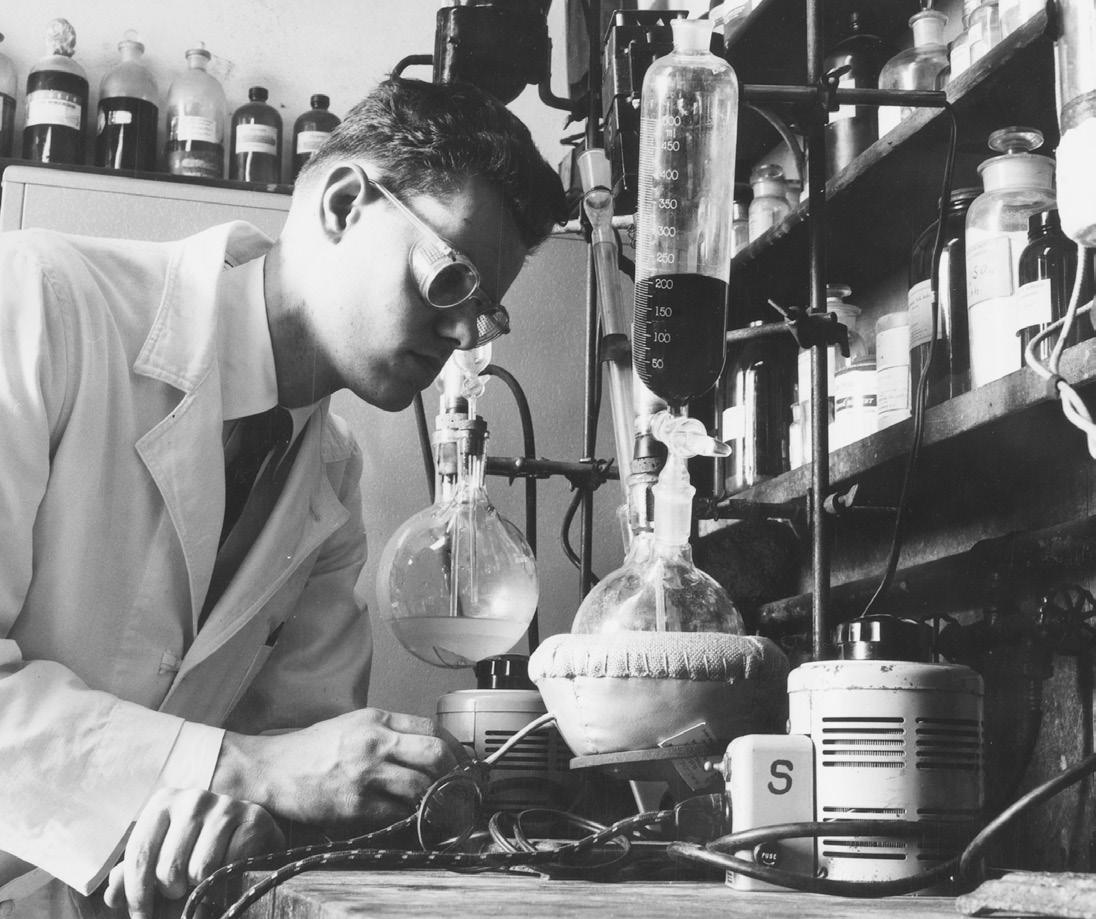
A student worked in a Foster Hall lab in 1950. Courtesy, University Archives.
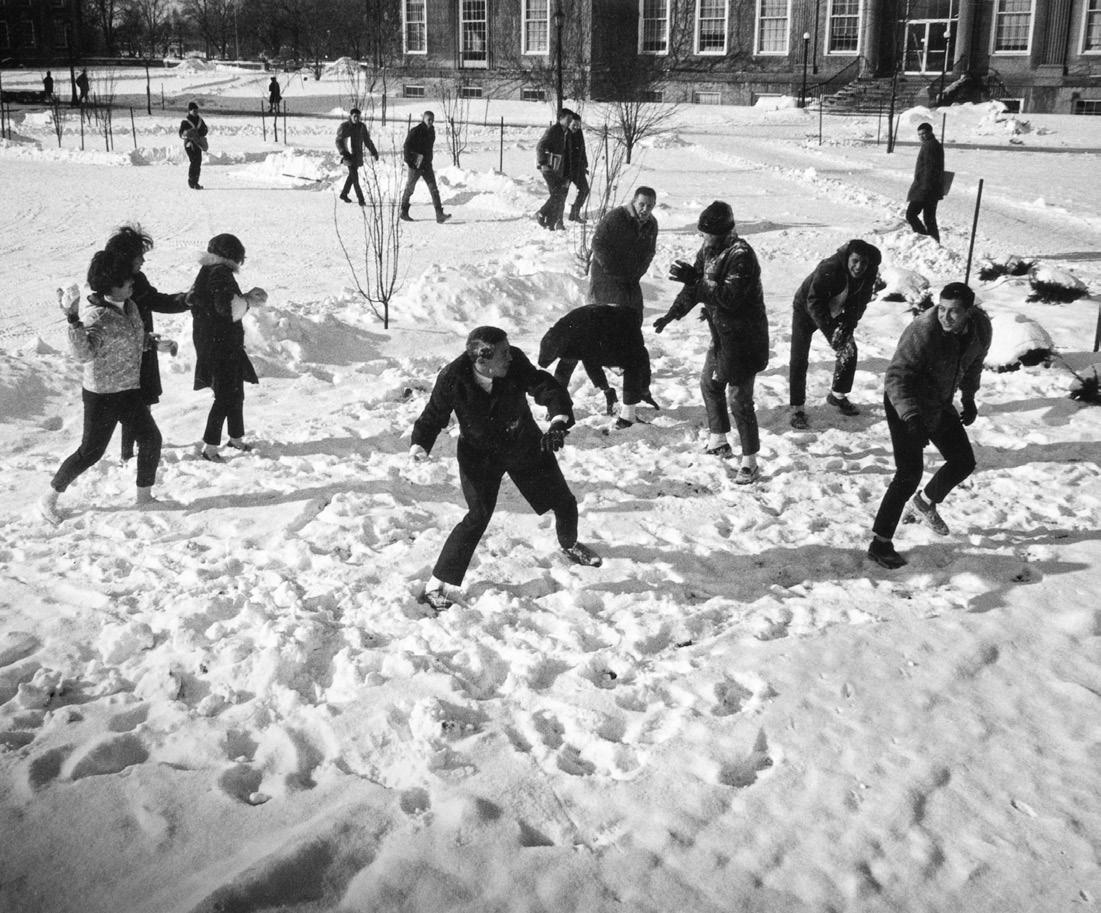
Students had
snowball fight in front of Foster in the 1960s. Courtesy, University Archives.
All in-progress and current photos of Foster Hall included in this story were taken by UB Photographers Doug Levere and Meredith Forrest Kulwicki.
11. Foster Hall in July 2024, as construction continued.
12. Interior construction in January 2023.
13. Continued construction progress in March 2025.
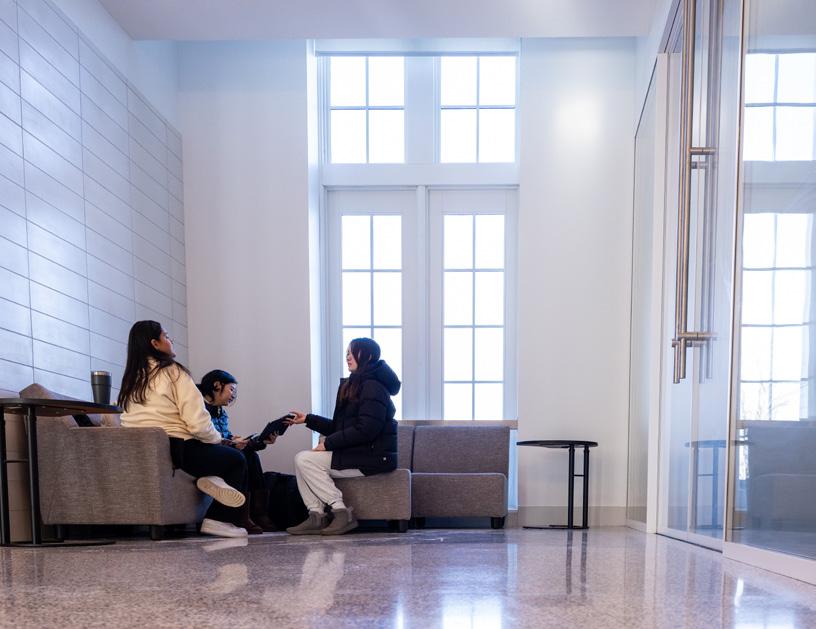
14. Between classes, students sit in the light-filled lounge on the first floor of Foster Hall in January 2026.
17. A Career Design Center consultant speaks with students in a Foster Hall classroom in January 2026.
“We wanted to have a welcoming front entry, flanked by what we call learning landscapes, which are lounges, because we want students to feel that this is their home.”
-Kelly Hayes McAlonie, architect and director of campus planning
Foster’s interior has been reshaped to support the rhythms of a contemporary academic community.
“We wanted it to be a welcoming space and to maximize natural light,” said Kelly Hayes McAlonie, architect and director of campus planning, who collaborated with Mitchell Giurgola, the project’s architectural consultant.
What Foster makes possible
For decades, Baldy Hall on UB’s North Campus was where GSE did its thinking and grew into the school it is today. There, the GSE community expanded its research portfolio and strengthened its partnerships with schools and communities.
Over time, however, GSE’s work became more collaborative, community-facing and interdisciplinary. The limits of the space became harder to ignore.
The school, its work and its people had changed. And its home needed to acknowledge that.
Faculty and staff began moving into Foster Hall in October 2025, with students and classes following in the spring semester.
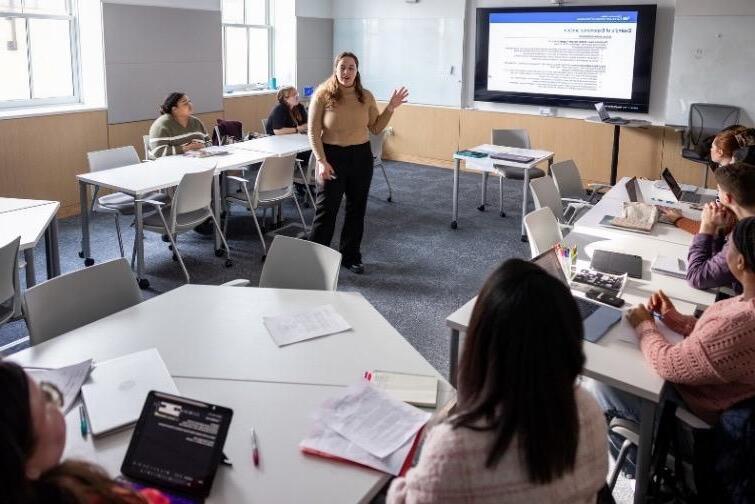
From the moment the GSE community arrived, it was clear that the building shaped how learning and connection happen throughout the day. Students, faculty, staff and community partners gather informally before class, pause midconversation on the staircase and spread out across lounges between meetings and study sessions.
“There’s definitely a little more of a buzz,” Rosenblith said. “Toward the end of the day, you see students milling about. It’s really fun to see the building full of activity.”
“This building reflects GSE’s pedagogy, which is small-group learning,” said Hayes McAlonie. “We wanted to have a welcoming front entry, flanked by what we call learning landscapes, which are lounges, because we want students to feel that this is their home.”
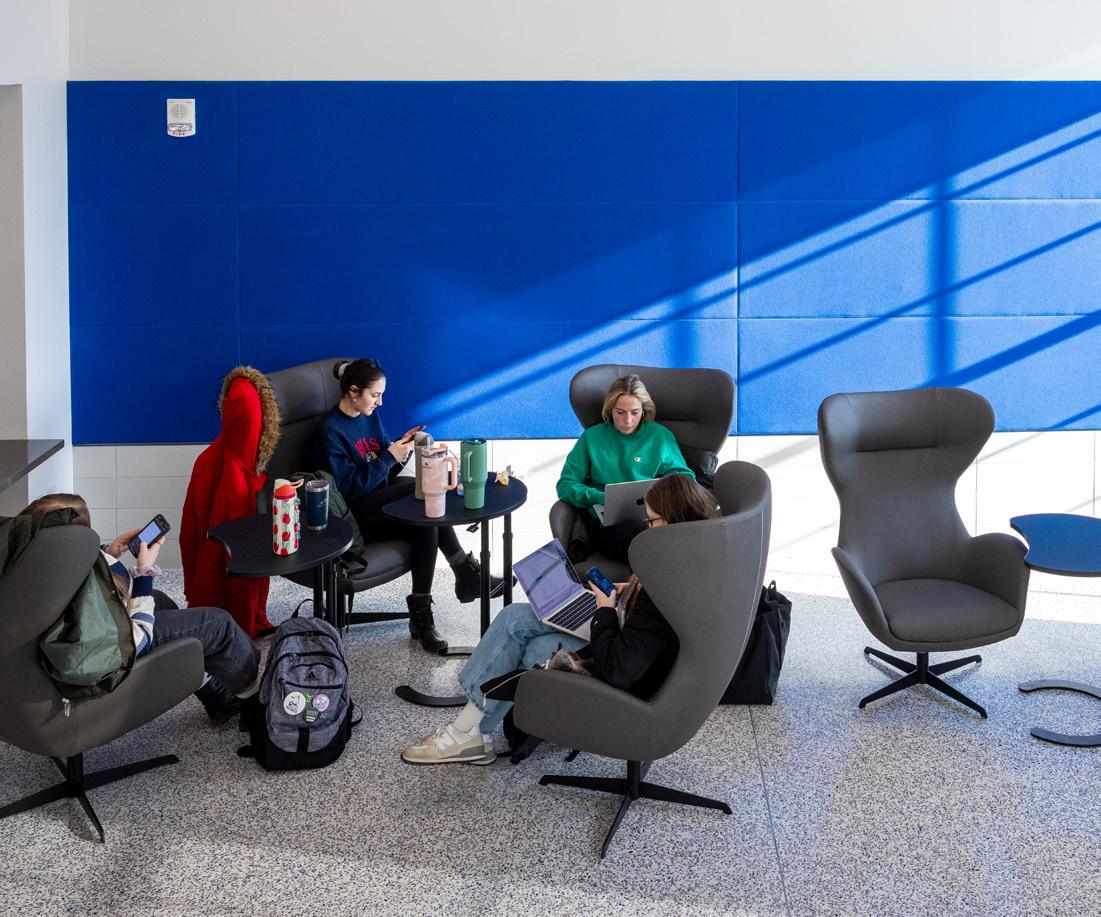
GSE PhD student Tukhbita Nawmi recalls exploring the building for the first time, looking for the perfect place to study or relax. “The yellow seats in the corner of the second floor got my attention. I really do like the cozy vibe of that corner, and it’s next to the window with the view of [the Hayes Hall clock]. I love it.”
Foster’s more formal spaces are designed for flexibility. Conference rooms transform easily into classrooms or meeting spaces, while larger gathering areas support school-wide events and lectures.
For students moving between classes, labs and study spaces each day, the impact of those design choices is easy to feel. “I love this building. It’s bright. I feel like we’ve leveled up as a space,” said GSE doctoral student Abigail Henry. “There are so many quiet places to work, and the classrooms are great places to be a student and teach.”
PHOTO CAPTIONS
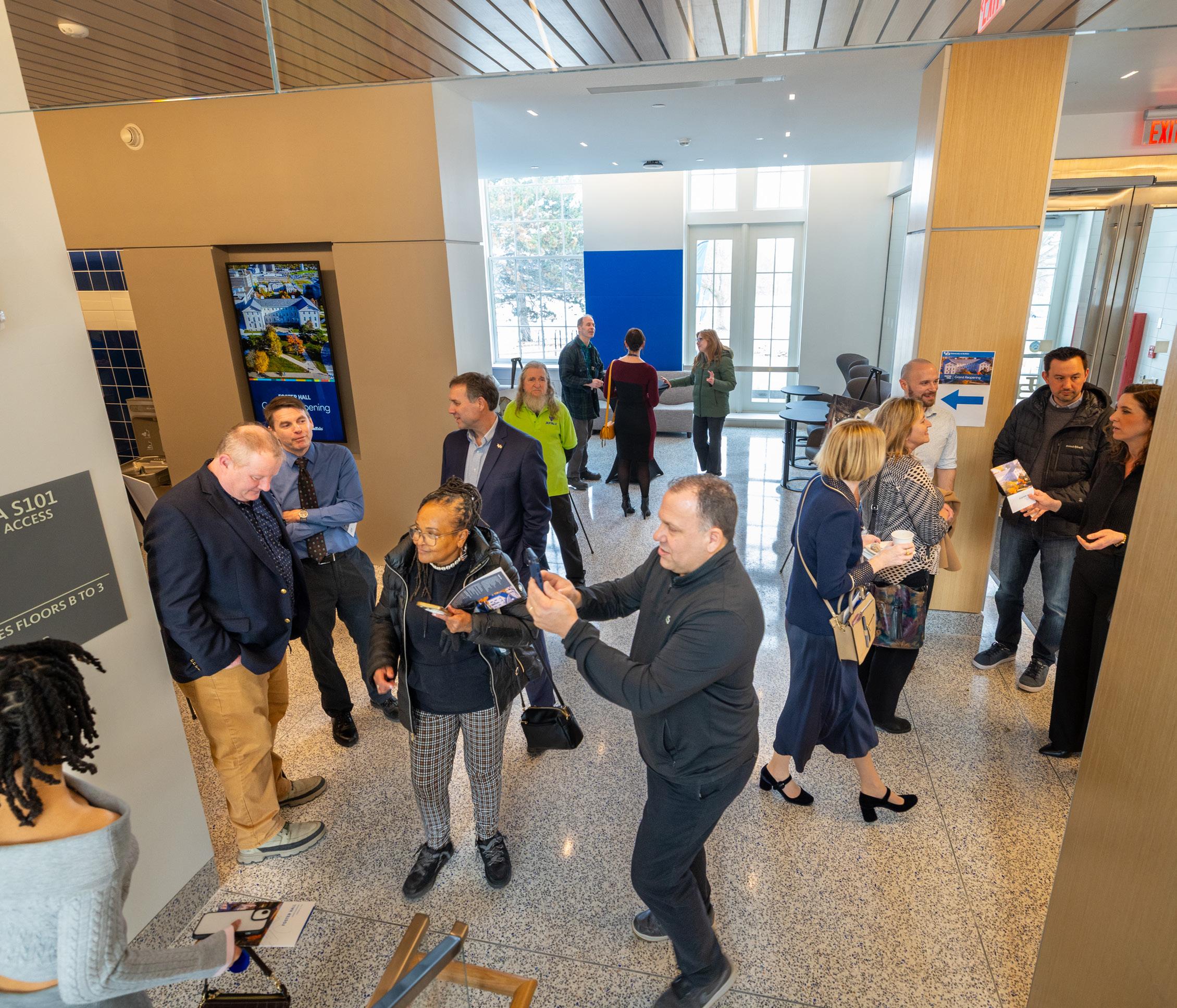
15. The GSE community gathers in Foster Hall’s front entry.
16. Students sit in a lounge area on the second floor of Foster Hall between classes in January 2026.
1921
Foster Hall opens on UB’s South Campus as the university’s first academic building along Main Street. Designed by McKim, Mead & White, the building is constructed with a $500,000 gift from philanthropist Orrin Elliott Foster.
1931
The School of Education is established. In its early decades, education programs are housed in Foster Hall, placing the school at the heart of UB’s city campus.
Mid-20th century
As UB grows, Foster Hall serves multiple academic units, including chemistry and education, adapting to the university’s evolving needs.
FOSTER HALL: GSE’S FIRST HOME
Infrastructure for learning
Technology is another key feature of this renovation. Foster was rebuilt with a modern infrastructure designed to support hybrid learning, research and collaboration. Wireless connectivity has been upgraded throughout the building, and classrooms are equipped with advanced audiovisual systems.
“Instead of implementing the current campus technology standard for classrooms and conference rooms, we were able to push that standard forward,” explained Mike Tinsmon, GSE’s director of IT.
Just as important as the technology itself is how it supports the broader student experience. The building offers prominent, visible spaces for GSE’s Alberti Center for Bullying Abuse Prevention, Center for K–12 Black History and Racial Literacy Education and Institute for Learning Sciences, among others.
“It means a great deal to us to have a dedicated space where students, faculty, staff and collaborators can gather to meet, exchange ideas and build community,” said Stephanie Fredrick, associate professor and associate director of GSE’s Alberti Center for Bullying Abuse Prevention.
“Our work is highly collaborative, and having a centralized location enables us to connect and work together effectively as a team.”
That same sense of connection extends to the research happening throughout the building.
“On many campuses, teaching, research and outreach take place in separate spaces,” explained Christopher Hoadley, professor of learning and instruction and director of UB’s Institute for Learning Sciences. “But you really want those activities rubbing up against each other as often as possible.”
In Foster Hall, the Institute’s Learning Sciences Lab now serves as a flexible space for research, teaching and community programming.
According to Rosenblith, the new facilities are already prompting conversations about expanding this programming, including youth-oriented initiatives such as summer camps that bring students and families onto campus.
Values made visible
From the outset, sustainability has been a central piece of the Foster Hall renovation.
The building has been integrated into the South Campus thermal-energy network, a cornerstone of UB’s Clean Energy Master Plan. The overhaul replaced aging infrastructure with a high-efficiency system designed to reduce emissions, while improving reliability and comfort inside the building. Foster is now considered a state-of-the-art facility with no scope 1 or 2 carbon emissions.
“Foster Hall is significant because it translates UB’s Clean Energy Master Plan from a roadmap into a real, occupied building,” said Tonga Pham, associate vice president for university facilities. “It demonstrates how campus-scale strategies can be implemented at the building level in a way that is scalable, durable and directly supports UB’s long-term decarbonization goals.”
That commitment was formally recognized in January 2026, when Foster Hall earned LEED Gold certification—UB’s tenth LEED Gold certified building.
“Foster Hall’s transformation from one of our oldest structures to a state-of-the-art net-zero carbon building is a testament to the commitment, value alignment and perseverance of University Facilities, the SUNY Construction Fund and the Graduate School of Education,” UB’s Chief Sustainability Officer Ryan McPherson said.
Behind the scenes, systems such as the building’s heat pump network, upgraded windows and long-lasting materials were selected to reduce environmental impact while maintaining stable, comfortable conditions across classrooms, offices and common areas.
20.
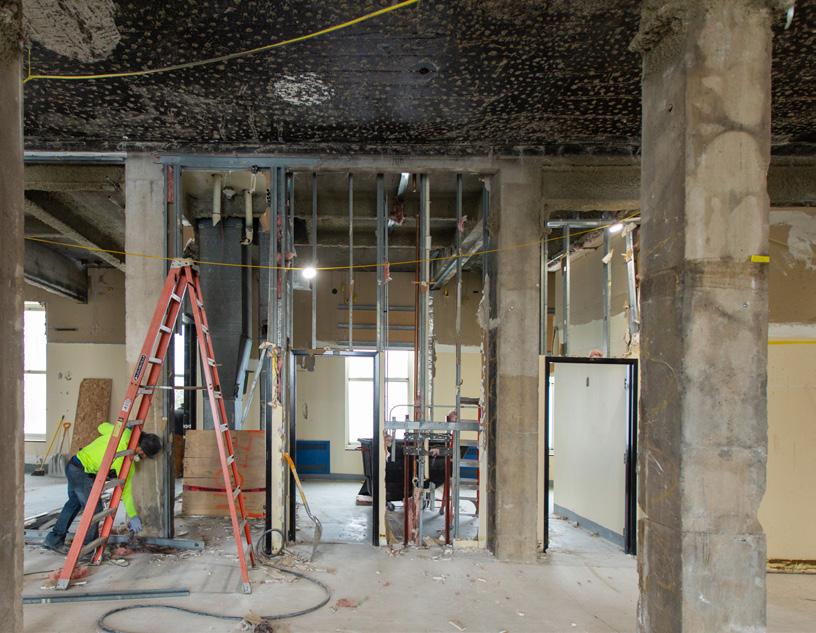
21. The building’s transformation in progress, with new infrastructure, framing and interior systems taking
“Foster Hall is significant because it translates UB’s Clean Energy Master Plan from a roadmap into a real, occupied building.”
-Tonga Pham, associate vice president for university facilities
1973
GSE moves from Foster Hall to Baldy Hall on the North Campus, reflecting expanded programs, faculty and research activity.
1973–2025
For more than 50 years, Baldy Hall serves as GSE’s academic home. Foster Hall continues to support UB’s mission, most recently housing classroom and research space for the School of Dental Medicine.
2025
Following a three-year, $41 million renovation, GSE returns to Foster Hall, now restored for a new era of teaching, research and community engagement.
PHOTO CAPTIONS
18. State-of-the-art wireless connectivity is installed in Foster Hall.
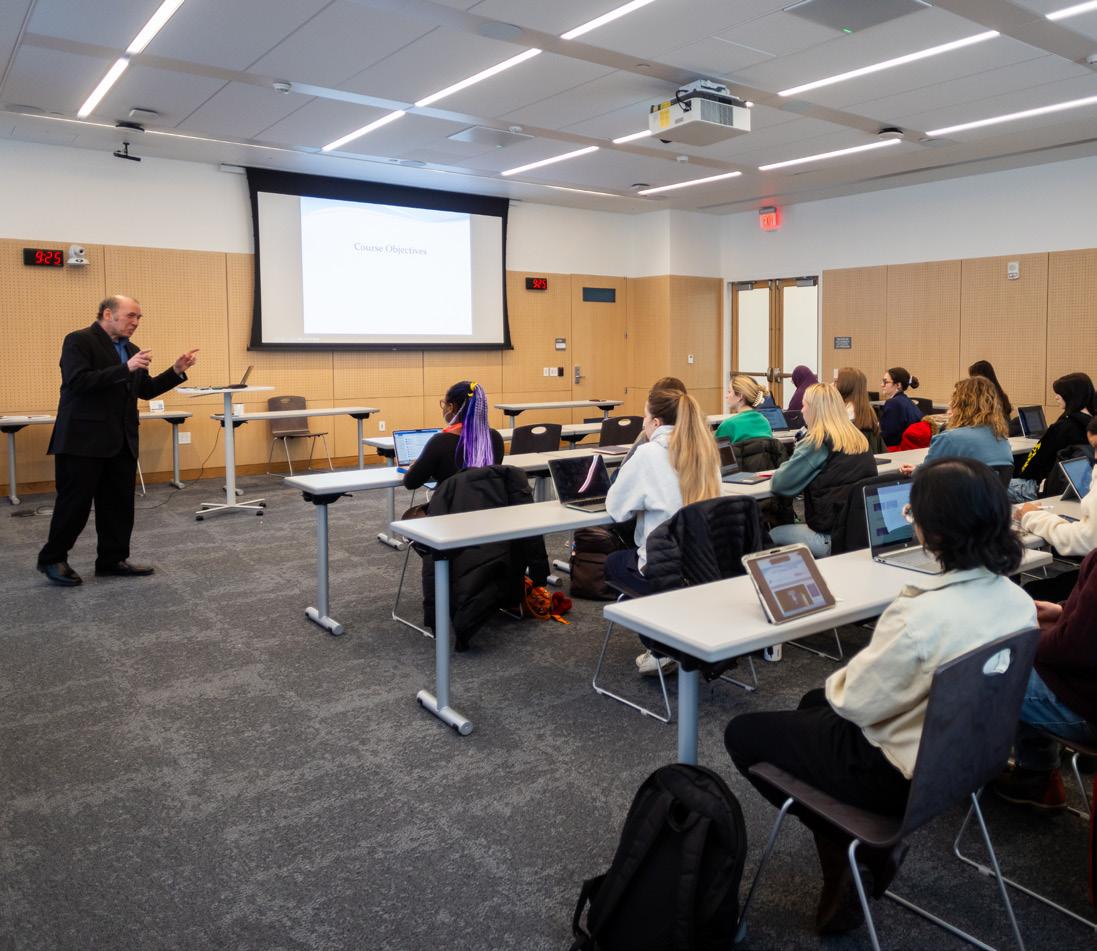
19. GSE Professor Myles Faith teaches a class in Foster Hall in January 2026.
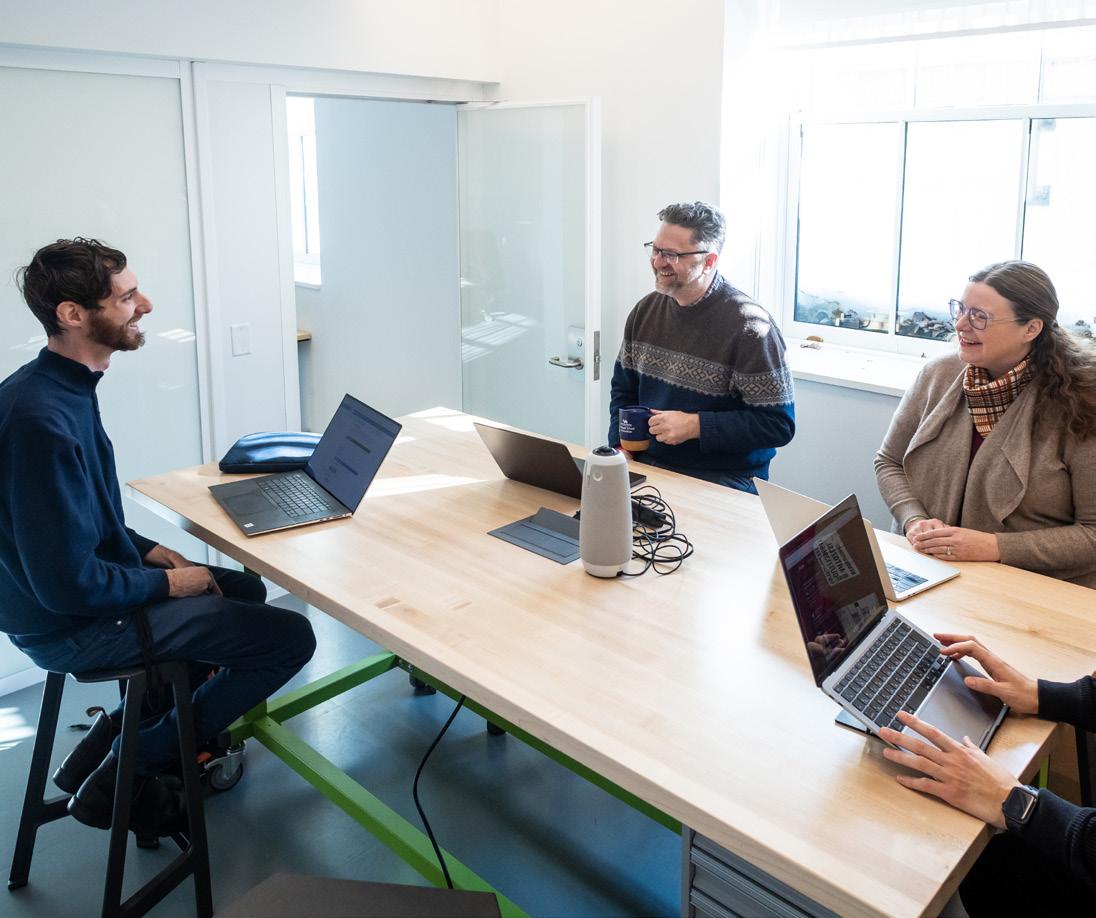
GSE Professor Christopher Hoadley meets with a small group in a ground-floor space in Foster Hall in January 2026.
shape.
The ‘city campus’ advantage
One of the greatest advantages of Foster Hall is its location. The building places GSE squarely within the city it serves. For a school whose work depends on partnership with K–12 schools, educators, families and community organizations, proximity is essential.
“With GSE’s public mission—serving and engaging with the community—it made sense that we are not tucked away in the middle of North Campus, but much more present within the community,” said Rosenblith. “We sit right at the nexus of Amherst and Buffalo, which makes this the right place to enact that mission.”
Being located on the South Campus along Main Street, with access to Metro Rail and NFTA bus routes, expands the notion of who can walk through GSE’s doors. Families, educators and community partners can more easily access programs and services in a space that is familiar and reachable. Meetings and events can take place in an area that feels open and accessible.
The alignment between location and mission reflects the university’s long-standing vision for the South Campus as a civic-facing academic environment that houses its professional schools, including GSE, the School of Architecture and Planning, and the School of Public Health and Health Professions.
That vision is the result of years of intentional planning and investment. “We’ve been methodically revitalizing the South Campus over time,” said Hayes McAlonie.
She explains that the revitalization has unfolded in phases—shaped in part by fluctuations in state funding—but guided by a long-term plan. Projects such as Hayes Hall, Crosby Hall and improvements to surrounding buildings have steadily advanced that vision, reinforcing the campus as a hub for UB’s professional schools and community-facing work.
In particular, Foster Hall was designed to welcome the community inside. As part of the renovation, the interior palette was intentionally kept neutral to support the integration of public art throughout the space.
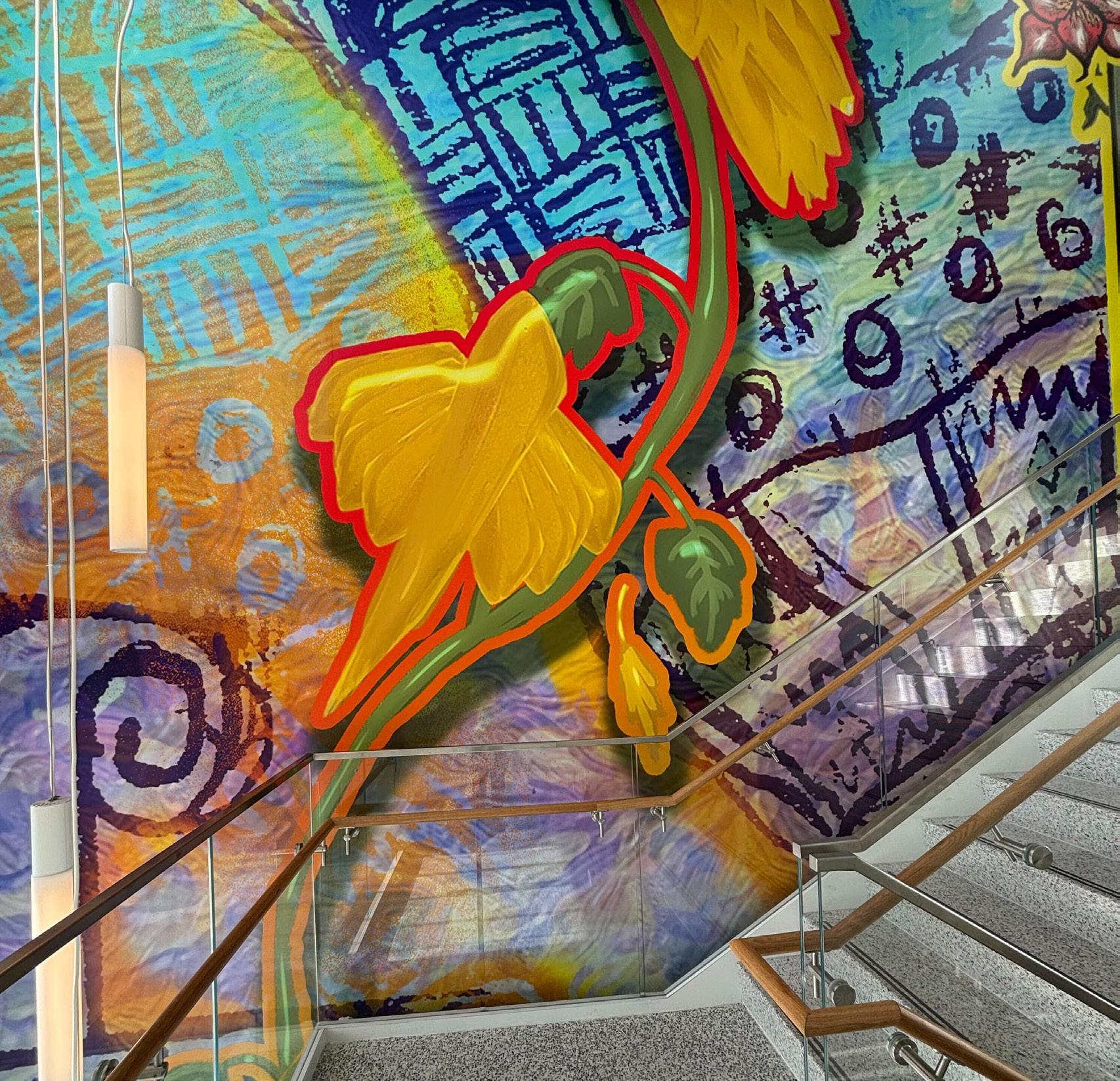
One early example of that approach now stretches across the building’s main stairwell.
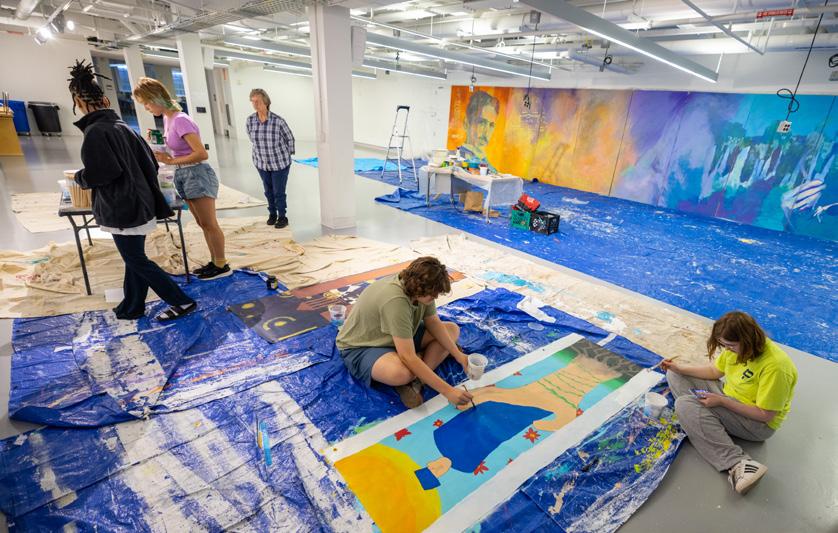
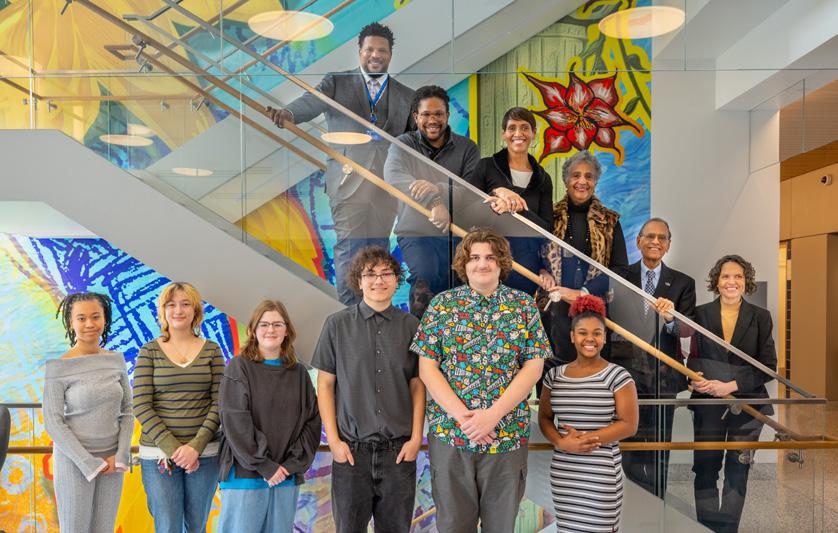
Throughout the summer of 2025, Buffalo Public Schools students worked alongside GSE faculty and local artists to create a mural for Foster Hall that reflects themes such as hope, inclusion, education and democracy.
Guided by local visual artist James J. Cooper III, BPS Director of Arts Michele Agosto and art teacher Jackie Hart, a team of student artists researched UB’s history and GSE’s mission before translating those ideas into a large-scale design. The students—paid through the city’s summer youth program—worked as art apprentices. They learned drawing, design and painting techniques, while
developing collaboration, communication and leadership skills.
The final mural weaves natural imagery, such as flowers and vines, and symbolizes the power of learning.
“Anytime we can create opportunities to break down barriers to higher education, that matters,” Rosenblith said. “If families come to campus to see their child’s artwork, that visit alone might help them feel that they—or their child—belong here.”
According to Cooper, GSE’s return to South Campus has made partnership more reciprocal.
“Access works both ways. On any given day, I can spend time with partners at local schools or community programs, and those same stakeholders can come to campus or use space in Foster Hall for meetings and activities,” he said. “Ideally, that type of traffic in and out of the building will foster connections that grow well beyond transactional collaboration.”
What Foster represents now
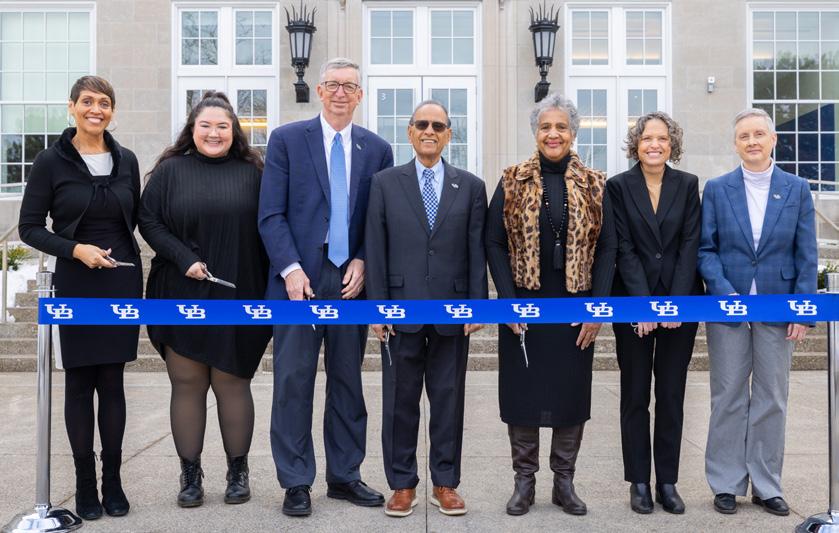
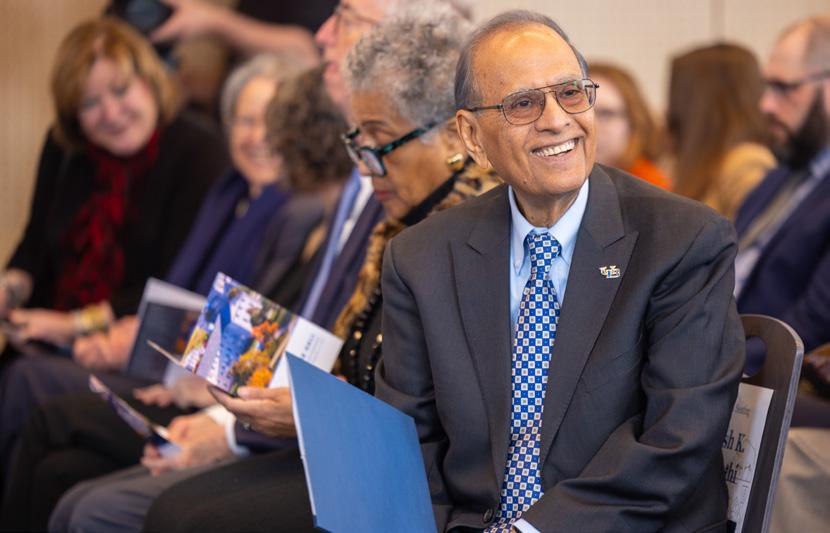
On Feb. 27, the UB community and its local partners gathered on the front steps of Foster Hall for a ribbon-cutting ceremony marking the building’s official reopening.
“The return of the Graduate School of Education to its original home in Foster Hall marks more than a relocation,” said UB President Satish K. Tripathi during his remarks. “It represents a bold step forward.”
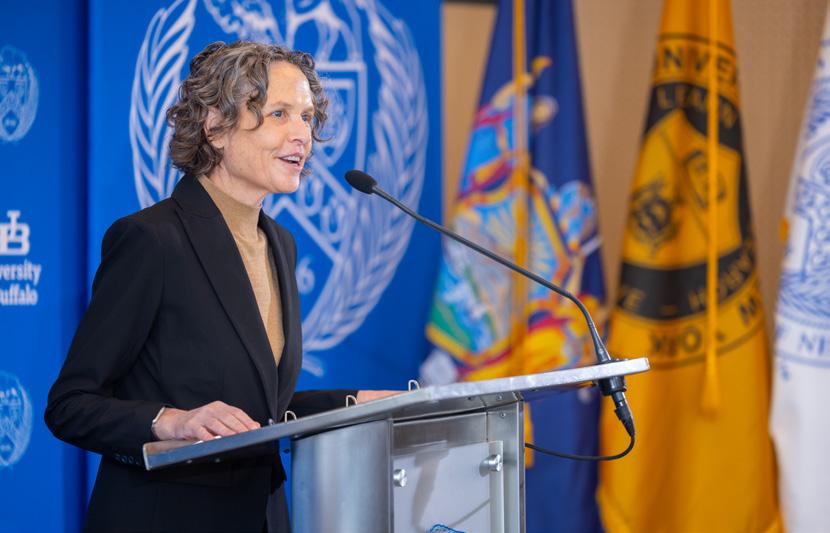
Rosenblith shared his sentiments: “Foster Hall once turned inward. Today, it faces Main Street again. It is open. It is connected. And it is ready,” she said at the ceremony. “It is ready to support the work that will happen in classrooms and labs, in tutoring sessions and community meetings, in conversations that challenge assumptions and in partnerships that strengthen schools and neighborhoods.
“This building does not define us. But it does reflect us,” she added. “It reflects a school rooted in history, committed to community and focused squarely on the future.”
That future will be shaped by the conversations, partnerships and research happening inside. The walls are historic. The work ahead is not.
Foster Hall was built for this.
22. BPS student artists’ 53-foot mural brings themes of hope, inclusion, education and democracy to Foster Hall’s main stairwell.
23. BPS students work with GSE community members to create a mural for Foster Hall in July 2025.
24. A ribbon-cutting ceremony marks the official reopening of Foster Hall. Pictured from left are BPS’s Michele Agosto, GSE doctoral student Sarah Hale, Provost A. Scott Weber, President Satish K. Tripathi, SUNY Trustee Eunice A. Lewin, GSE Dean Suzanne Rosenblith and Laura E. Hubbard, UB vice president for finance and administration.
25. BPS student artists stand in front of their mural in Foster Hall. Joining them on the stairs, from left, are Wil Green, GSE assistant dean of outreach and community engagement; local artist James Cooper III; Michele Agosto, BPS director of arts; SUNY Trustee Eunice A. Lewin; UB President Satish K. Tripathi; and GSE Dean Suzanne Rosenblith.
26. Tripathi joins the UB community to celebrate the reopening of Foster Hall.
27. GSE Dean Suzanne Rosenblith speaks at ribbon-cutting ceremony.
“Foster Hall once turned inward. Today, it faces Main Street again. It is open. It is connected. And it is ready.”
-Suzanne Rosenblith, GSE Dean and Professor
PHOTO CAPTIONS
Fellow’s research examines athletics in higher ed as secondary Black diaspora
Iman Lathan, a 2025 GSE graduate, recently received a prestigious National Academy of Education Spencer Dissertation Fellowship.
BY ALEXANDRA SACCONE
PHOTO: MEREDITH FORREST KULWICKI
Iman Lathan has some advice for anyone stressed about pursuing their PhD.
“You don’t need to know exactly what you’re researching right away. Take your time to explore and refine your interests,” said Lathan, an alumna of GSE’s educational culture, policy and society doctoral program.
“Drawing on Black feminist and queer diasporic frameworks, I aim to provide new insights into the dynamics of mobility and the institutional forces that both enable and constrain Black women athletes.” – Iman Lathan
Lathan is a former Division I basketball player with a passion for storytelling who was trying to focus her research on race, gender, sport and education. And with consistent encouragement from GSE faculty, Lathan has earned national recognition by becoming a 2025 National Academy of Education (NAEd) Spencer Dissertation Fellow.
“I’m very proud to see Iman gathering important recognition for her work, which is a missing piece in contemporary educational discourse on race, gender and collegiate athletics,” said Jinting Wu, associate professor of educational leadership and policy, and Lathan’s academic advisor. “Iman’s compassion, drive and originality in improving the education and life of Black female athletes and becoming a change-maker of marginalized communities are loud and clear in her spoken and written work.”
Lathan says the award would not have been possible without the encouragement of Lois Weis, retired SUNY Distinguished Professor of Educational Leadership and Policy, who consistently reminded her of her research’s strong potential for funding. “From that point forward, applying for funding became a clear goal of mine, something I envisioned for myself over and over again as part of my academic journey,” Lathan said. Her research examines the National Collegiate Athletic Association (NCAA), which she says shapes the Division I educational pathway as a secondary diasporic conduit for Black women’s basketball players— descendants of the Black Atlantic Diaspora— to predominantly white institutions. Using interviews, archival analysis and a content analysis of the NCAA’s Instagram account, her research explores how race, gender, sport and higher education intersect to influence athletes’ movement, visibility and opportunity.
“Drawing on Black feminist and queer diasporic frameworks, I aim to provide new insights into the dynamics of mobility and the institutional forces that both enable and constrain Black women athletes,” Lathan explained. “I am a storyteller at heart. My doctoral program allowed me the freedom and creativity to explore educational patterns to tell fuller stories about race, gender, sport and education, while also equipping me with the tools to critically examine how institutions shape people’s lives.”
The Spencer Dissertation Fellowship provided Lathan $27,500 to help cover living expenses, research costs and tuition while she completed her dissertation. She says the award’s value is not just the funding, but also the opportunity to attend two NAEd retreats and be paired with a faculty mentor, broadening her network of inspiring scholars beyond the strong support she already receives at UB.
“The award also expanded the scope of my research capabilities, allowing me to think bigger and pursue additional questions,” she said.
This research has become very personal to Lathan, who often calls it “me-search.”
“My work is deeply tied to making sense of my own athletic and educational trajectory,” she said. “As a former Division I basketball player, I finished my career with more questions than answers about the structures shaping my experience. My research began as a way to grapple with those questions. The faculty in GSE helped
Iman Lathan
(Photo/ Meredith Forrest Kulwicki, UB)
me sharpen my focus and encouraged me to look beyond my personal experience and consider the larger economic and institutional systems that shape it.”
The application criteria for the fellowship require that each fellow’s research has a strong impact on the field of education, something the NAEd says Lathan’s project exemplifies.
“Lathan’s work not only centers Black women’s voices in sport but also contributes to broader discourses on racial and gendered capitalism, representation and educational equity.”
– NAEd awardee profile
“Lathan’s work not only centers Black women’s voices in sport but also contributes to broader discourses on racial and gendered capitalism, representation and educational equity,” according to her awardee profile.
“Her research has implications for media practices, policy reform in college athletics and the support systems designed for student-athletes. She aims to continue this work in both academic and communityengaged spaces, using scholarship as a tool for liberation and systemic change.”
Lathan says the fellowship recognition was worth the year-long application process. While the process was intense, she says it was also rewarding because it pushed her to sharpen the way she communicates her research and its significance.
Lathan offers some advice for those beginning their research journeys. “Honor the work you’re doing but also maintain hobbies outside the academy to stay grounded, inspired and innovative. Don’t be afraid to push boundaries and be bold in your approach. Connect with someone who is further along in the journey than you,” she said.
Most importantly: “Get people’s eyes on your work and don’t get emotional with feedback. Let it fuel and sharpen you.”
GSE launches new learning sciences and educational technology EdM program
BY DANIELLE LEGARE
As technology continues to reshape how people learn in classrooms, workplaces and communities, GSE’s new EdM program in learning sciences and educational technology equips students to lead that change.
Designed for educators, designers and professionals across sectors, the program blends learning science, equity-centered design and hands-on experience with emerging technologies. The result is a flexible graduate degree that prepares students to improve learning wherever it happens.
“The learning sciences and educational technology (LSET) master’s program empowers students to become innovative leaders in technology-enhanced learning,” said Yunjeong Chang, associate professor in the Department of Learning and Instruction.
“Graduates develop the expertise to design, evaluate and lead impactful learning environments that transform education in schools, workplaces and communities. With two flexible tracks—a practice-oriented track and a research-focused track—the program enables students to personalize their pathway based on their interests, strengths and future career aspirations.”
Two paths, one shared goal
The practical track focuses on applied design and technology, offering training in instructional design, user experience, digital tools and policy. Students build a professional portfolio through applied projects, gaining skills they can apply immediately in classrooms, organizations or the educational technology industry.
Meanwhile, the research track is designed for those pursuing doctoral study or inquirydriven careers. Coursework strengthens students’ abilities to investigate how people learn, design equitable learning
environments and critically examine technology’s role in society.
Comprising 30 credits of coursework, the program emphasizes evidence-based design, learner-centered approaches and the meaningful use of technology. Students engage with foundational courses in learning theory, user experience, design-based research, and curriculum and instruction. The program culminates in a capstone project aligned with their professional or scholarly interests.
Preparing students to lead learning innovation
This new master’s degree arrives at an exciting moment for UB. The recently launched Institute for Learning Sciences— led by scholar Christopher Hoadley—brings together experts from anthropology to artificial intelligence to explore how people learn across homes, schools, workplaces and communities. Students in the EdM program benefit from this growing, interdisciplinary community focused on designing learning for equity, access and innovation.
Graduates will be prepared for diverse roles, including UX designer, instructional or learning experience designer, curriculum specialist, educational technology consultant and researcher. Whether working in schools, universities, nonprofits, cultural institutions or tech companies, alumni will be equipped to design and evaluate learning experiences that expand opportunity and improve outcomes for all learners.
Prospective students can explore the program’s curriculum on GSE’s website: ed.buffalo.edu.
Digital Divide 2.0:
A professor’s dilemma on addressing disparities in tech use, AI tools and digital learning readiness and refusal.
BY PARIS D. WICKER
Some of my students (and future education leaders) have no desire to learn or use generative AI, and this worries me for reasons that may not be receiving enough attention in the public discourse on AI usage.
As a university professor and someone who is cautiously engaging generative AI to support teaching, learning and research, I am fortunate to have access to, and take advantage of, a wide variety of AI tools, digital learning and training. Most recently, as a Lumen Circle AI teaching fellow, I spent a year exploring generative AI models and AI tools, and improving my prompt development. As someone committed to democratizing AI knowledge, I have begun to infuse opportunities for AI-assisted pedagogy into my class activities and assignments, only to find that some students are defiantly refusing to engage.
“I’m afraid of it.”
“Can I opt out of the AI activity?”
These are actual comments of recent graduate students when asked to incorporate AI into class activities and discussions. At first, their refusal surprised me. While I initially assumed this refusal stemmed from fear of the known and the unknown dangers of using AI, upon further reflection, I now see it as understandable and rooted in underdeveloped literacy about this technology, built on an unjust foundation of existing disparities.
While there is growing attention to how generative AI is shaping how students learn, socialize and cheat, I worry about what will happen to those without access or who refuse to engage at all. How will AI refusal change the current digital divide, which is often about equal access to technological devices?
To explore these questions, it helped to reframe refusal as a symptom, and not the problem. In my follow-up discussion with
students about their intent to refuse AI, they shared fears of false accusations or disciplinary action for AI use, or worried that they cannot afford the high prices for access to premium models. These are valid concerns. At a time when generative AI detection tools are at best minimally accurate, this raises the question of who will be punished along the way in the Gen AI revolution. Without equityminded AI implementation, bias in generative AI training and utilization may lead to unfair penalization of vulnerable student populations.
In an unjust system, the risks of AI may continue to outweigh the benefits, and students are well aware of this. I believe that as educators, we can encourage a critical AI adoption and reasoned AI resistance to minimize the digital divide. Furthermore, university students, especially graduate students, have the right to reach their own conclusions about AI. At the same time, it is much less effective to refuse from a place of ignorance; instead, it should come from a place of critical AI literacy that consistently places the social and ethical challenges of AI alongside any perceived opportunities.
Refusal and resistance should come from a place of deep knowledge and familiarity. In the rush to increase AI literacy and AI skill development, as educators, we must also make space for necessary dialogue on individual and collective attitudes on both the desire to use generative AI (and in what capacity) and the readiness and capacity for critical AI engagement, such as awareness of unequal disciplinary practices or inherent biases.
Like many new technologies that experience a variety of fast, medium and slow adoption, critical AI literacy-oriented activities can also make space for both the speed and the intensity of generative AI usage in higher education. In essence, we cannot effectively refuse that which we have not learned, and to allow students (and anyone else) to do so would not only further widen the digital divide beyond who has access to the right devices, of the haves and have-nots. It would also increase the divide between those who have the skills and knowledge to effectively engage, evaluate and critique generative AI (or the AI literate), and those who do not.
“The path to AI literacy must include acknowledgement of and engagement with the unjust and unequal conditions and consequences of AI usage.”
- Paris Wicker
At the same time, the path to AI literacy must include acknowledgement of and engagement with the unjust and unequal conditions and consequences of AI usage. From energy-sucking, water-guzzling AI cooling centers, to the expansion of AI premium services, some benefit from such a system while many others do not. A way forward is not through blanketed, uninformed refusal, but rather through empowered, informed agency that comes with an in-depth exploration and scrutiny of generative AI. At a time when misinformation and anti-intellectualism are on the rise, the 400-year-old adage from philosopher Francis Bacon still rings true today in this AI revolution: “knowledge itself is power.”
Paris Wicker is an assistant professor of educational leadership and policy. Her interdisciplinary research, informed by a decade of experience in higher education in student affairs and college admissions, contributes to scholarship exploring the conditions and consequences of success and well-being in higher education, especially for Black and Indigenous students, faculty and staff.
GSE researcher receives new grant to strengthen New York State’s rehabilitation counseling workforce
BY DANIELLE LEGARE
Responding to a growing statewide need, a Graduate School of Education researcher recently secured a $1 million grant from the U.S. Department of Education to support and train future rehabilitation counselors.
Scott Sabella
The award—Preparing Rehabilitation Counselors to Meet 21st Century Agency and Client Needs—will help address the significant demand for qualified counselors throughout New York State. More than 2.5 million New Yorkers have disabilities, and the U.S. Bureau of Labor Statistics projects a 23% increase in demand for vocational rehabilitation (VR) counselors over the next decade, far outpacing growth nationwide.
According to Scott Sabella, associate professor of counseling, school and educational psychology and principal investigator on the project, the funding represents an opportunity to make a meaningful statewide impact.
“We’re very thankful for this support,” Sabella said. “This grant allows us to prepare more counselors who are ready to meet the needs of individuals with disabilities and the
agencies that serve them.”
The project is supported by a team that includes coinvestigators Omayra Muñoz-Lorenzo and Rebecca Jacob, both clinical assistant professors of counseling, school and educational psychology, as well as senior project manager Tikana Truitt, a faculty member at Canisius University.
Meeting an urgent workforce need
Rehabilitation counselors work within a state–federal vocational rehabilitation system designed to help individuals with disabilities achieve employment, independence, community participation and long-term well-being. In New York State, these services are delivered through ACCES-VR—the Adult Career and Continuing Education Services Vocational Rehabilitation program— and the New York State Commission for the Blind.
“These agencies provide vocational rehabilitation services for people with the most significant disabilities,” Sabella said. “The transition from school to what comes next can be challenging, and vocational supports and early work experiences can help support success toward their independence goals.”
This emphasis on transition-aged youth was written into federal law through the Workforce Innovation and Opportunity Act of 2015 and continues to drive demand for well-prepared counselors. At the same time, VR agencies nationwide are experiencing staffing shortages and high turnover.
Sabella’s research focuses on recruitment and retention issues within the field.
“Personnel challenges affect a system that is already overwhelmed,” he said. “Supporting these agencies means supporting individuals with disabilities and our communities.”
A program positioned to lead
GSE’s rehabilitation counseling master’s program is uniquely equipped to meet statewide needs. It is one of only three Council for Accreditation of Counseling and Related Educational Programs (CACREP)-accredited programs in New York State and offers both on-campus and fully online options.
Sabella’s grant leverages existing program partnerships, including a long-standing collaboration with ACCESVR. Because of its coordinated training model, the rehabilitation counseling program can align ACCESVR’s traineeship program with students’ internship requirements, giving scholars valuable field experience while agencies gain support from emerging professionals.
In addition, the new grant provides tuition and fees for scholars pursuing master’s degrees in rehabilitation counseling, along with structured academic and professional support. Scholarship recipients commit to a service obligation, working for the state VR agency or one of its community partners after completing the program.
“With the new grant, we’ll do bimonthly check-ins with all scholars to provide academic support, scholarship-related support and career support,” Sabella said.
A career and project grounded in purpose
Sabella’s commitment to the field is rooted in years of direct service. He has worked with individuals with brain injuries and their families, adults with developmental and intellectual disabilities and clients receiving psychiatric care. Those experiences shaped his understanding of the critical role work and community participation play in well-being.
“I understood how socialization and finding purpose were so important,” he said. “Work is one of the ways we define ourselves. Vocational rehabilitation services reach beyond overcoming employment barriers; they promote community participation, empowerment and general wellbeing.”
Although the work can be challenging, Sabella believes it is also rewarding: “You see people when they’re in crisis, and sometimes at their most vulnerable,” he said. “But you also see advancement. You see lives changed.”
With this in mind, the project team is focused on strengthening the statewide rehabilitation workforce. From Sabella’s perspective, success will mean helping agencies address staffing shortages so they can expand their capacity to serve individuals with disabilities across New York.
“If we can help improve recruitment and retention, we can better support the individuals who rely on these services every day,” he said.
“Work is one of the ways we define ourselves. Vocational rehabilitation services reach beyond overcoming employment barriers; they promote
community participation, empowerment and general well-being.”
- Scott Sabella
Notice
The contents of this article were developed under grant H129B250031 from the U.S. Department of Education Rehabilitation Services Administration. The Department does not mandate or prescribe practices, models or other activities described or discussed in this document.
The contents of this article may contain examples of, adaptations of and links to resources created and maintained by another public or private organization. The Department does not control or guarantee the accuracy, relevance, timeliness or completeness of this outside information. The content of this article does not necessarily represent the policy of the Department. This publication is not intended to represent the views or policy of or be an endorsement of any views expressed, or materials provided by any Federal agency (EDGAR 75.620).
AI in the classroom: A conversation with Ian Mette on equity, ethics and AI in education
BY DANIELLE LEGARE
Artificial intelligence is reshaping conversations in schools, from the classroom to the principal’s office. While it offers new opportunities for analyzing data, supporting instruction and streamlining daily tasks, its limitations and risks require careful attention.
As schools navigate these changes, educators and communities alike are asking how to strike the right balance between innovation and responsibility.
As an expert in equity-oriented educational leadership, Ian Mette, associate professor of educational leadership and policy at GSE, offers guidance to help families, teachers and administrators use AI thoughtfully and responsibly.
Q: How can families help guide students’ critical thinking around AI?
AFor parents, guardians and community members, it is important to talk with students about responsible AI use and to be clear about expectations. This might include helping students understand that AI can be a starting point—a way to begin thinking about a solution to a problem or engaging with a prompt—but it does not replace critical thinking.
We want to make sure our children can engage critically with addressing the needs of humans within our communities. Families and community members can help students understand that humans, not AI, are needed to navigate our day-to-day world and work toward addressing societal inequities so every citizen can thrive.
Q: What role do clear guidelines play in how teachers use AI in the classroom?
AIt is important for teachers to set clear expectations for when AI can be used and when it is not appropriate. This includes designing a variety of activities that value
higher-order thinking, prioritize the student voice and encourage students to synthesize and create knowledge rather than simply repeat information.
This type of thinking has been at the center of debates within mathematics instruction for decades, specifically when calculators were introduced. There was concern that students wouldn’t be able to engage with mathematical concepts due to an overreliance on calculators. Most math teachers know that isn’t the case—calculators help students produce the beginning of an answer to a problem. However, how you interpret the answer you get from a calculator, and what it means when answering a problem, is of critical importance. The same is true with the use of AI.
Teachers should engage in helping students learn how to use AI ethically and in a way that helps them understand themselves and the world more fully.
Q: Why is a humancentered approach essential when educational leaders use AI?
AFor educational leaders using AI, we need to continue to doublecheck the data and results. While AI can jump-start a review of literature by suggesting potential authors, theories and sources, it is not exhaustive and often generates inaccurate or nonexistent
citations—something I have seen in classroom assignments and with submissions to journals by researchers.
Education researchers and practitioners should treat AI’s output as a launchpad, then confirm and expand their search through databases like Google Scholar to ensure a complete and accurate review.
Keeping AI human-centered across education is of importance because while AI can help inform responses to prompts—whether for class assignments, emails or policy decisions— it often misses nuance or misunderstands the question.
It is our ethical responsibility as educators to critically examine what AI generates and to apply our own thinking to make the response our own and from a human perspective.
Ian Mette, associate professor in the Department of Educational Leadership and Policy, focuses his research on access and equity in education, with particular attention to school leadership, educator preparation, curriculum and instruction, and issues of race, inequality and social justice.
Reading the warning signs: Inside Reza Nahid Sahlan’s research on eating disorders and suicide risk
BY DANIELLE LEGARE
When Reza Nahid Sahlan started graduate school in Iran, he thought he had a clear sense of where his studies were headed.
He explored borderline personality disorder, social phobia and bipolar disorder, reading widely, drafting proposals and continuing to look for a topic that felt like home.
But nothing quite clicked.
Then he came across a paper that changed his trajectory. The study explored body image among women who voluntarily chose to wear the hijab. The authors found that those women reported fewer body image concerns.
“I wondered: ‘What about my country?’” Sahlan said.
When he began studying Iranian women, he found the opposite pattern: heightened body image concerns and more eating disorder symptoms. That tension between cultural expectation, personal identity and mental health became the question he couldn’t put down.
Today, Sahlan is a doctoral student in GSE’s counseling psychology and school psychology PhD program, where he is building a research career at the intersection of eating disorders, body image and suicide risk.
Where eating disorders and suicide risk intersect
One of his latest publications (Sahlan et al., 2025), in the journal Suicide and LifeThreatening Behavior, uses a statistical approach called latent profile analysis to look at how different patterns of eating disorder symptoms combine with suicide-related risk factors such as feeling like a burden, feeling disconnected from others and feeling more
capable of acting on suicidal thoughts. Among 773 Iranian adults, Sahlan and his co-authors identified six distinct subgroups. The groups with both binge/purge-type symptoms and high levels of suicide risk factors had the greatest odds of suicide attempts.
For Sahlan, the takeaway is both practical and scientific.
“If someone comes to therapy with suicidal thoughts, clinicians also need to ask about eating disorder symptoms,” he explained. “When both are present together, the risk can be much higher.”
Building a global research network
Although much of his early work centered on Iranian populations, Sahlan has steadily expanded his lens. He is now collaborating with faculty and students in UB’s Department of Psychology on a longitudinal study of UB college students, tracking how specific risk factors over time might predict eating disorder symptoms. He has also co-authored cross-cultural studies involving LGBTQ+ populations from universities in the U.S. and other countries, with collaborators in Europe, North America and Asia.
That global network didn’t happen by accident.
“In terms of research, it’s important to expand our networks,” he said. “I’m open to collaboration. I’m eager to learn from many colleagues and many teams. When I began doing research, I started working with professors from Canada, the United States and Australia. We need feedback from lots of people.”
Sahlan’s CV reflects that philosophy. He has already reviewed hundreds of manuscripts for more than 50 journals and served as a guest associate editor and conference abstract reviewer.
Outside of his studies, Sahlan tries to carve out time for his hobbies. He listens to pop music while he writes, unwinds with movies and likes to walk around Buffalo and play volleyball when his schedule—and the weather—cooperate.
“Everything about Buffalo is good,” he said with a laugh. “Except maybe the winter. Last year was … cold.”
In the future, Sahlan hopes to become an assistant professor in the U.S., where he can establish his own lab focused on eating disorders.
“I’m so happy I chose this field,” he said. “There is still so much we don’t know, and I want to keep answering those questions.”
“When I began doing research, I started working with professors from Canada, the United States and Australia. We need feedback from lots of people.”
(Photo/ Dylan Buyskes, Onion Studio)
‘I’M OK (I PROMISE)’: Growing into Myself
BY SAMANTHA DIDRICHSEN
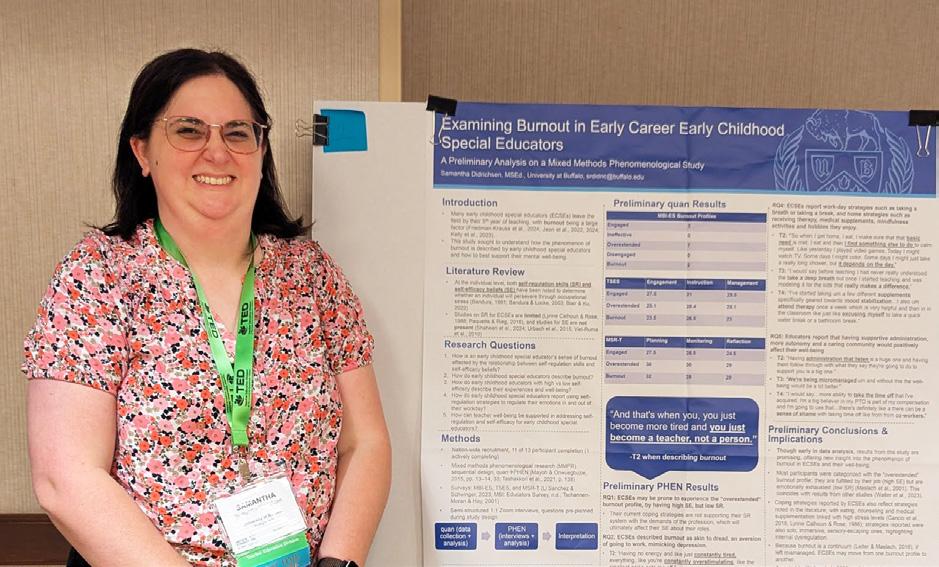
Born and raised on Long Island, I had wanted to be an early childhood educator since graduating from high school. Never in my dreams did I imagine that the girl with anxiety and a fear of public speaking would grow into a woman who could speak to an entire auditorium of adults on education research. And yet, here we are.
My husband and I came to Buffalo before my doctoral program was even on the horizon. I was an early childhood special educator serving young children with developmental delays and disabilities, and we had moved to Buffalo for a better quality of life. There came a point in my time working here when I realized that my teaching certificate was an incredible asset, not because of the specialization, but because there weren’t enough providers to serve all the children in the city and region. With classrooms and programs closing and children going without special education services, I decided to do what many people said I should have done years earlier: Apply to the CISL (curriculum, instruction and the science of learning) program at UB in 2021.
“It’s my hope that, with my PhD, I’ll help create a high-quality early childhood special education teacher preparation program here in Western New York to supplement the few existing programs.”
During my first semester, I experienced a crazy level of imposter syndrome. Was I seriously doing this? Who gave me the right? It went so far as to spontaneously buy My Chemical Romance tickets and have an emomidlife crisis.
But once that first big paper was on my plate, I went to work and knew I’d be fine. I maintained my confidence and kept working on one paper after another.
Before long, it came time for my dissertation of which I’m exceptionally proud. My doctoral study seeks to understand the phenomenon of burnout in early childhood special educators and how we can best
support their mental well-being. It’s here where I find I’ve come full circle! If anyone had known me in my first year of teaching, you wouldn’t have recognized me. From the toxic environment to the abusive tactics, the school I was in was destroying me. The funny part is that I didn’t even decide on that topic because of my experience! I was inspired by a research article on why student teachers choose to leave education upon graduation. It wasn’t until I started writing my literature review that I realized, “Wow, I’m writing about me!”
It’s my hope that, with my PhD, I’ll help create a high-quality early childhood special education teacher preparation program here in Western New York to supplement the few existing programs. I’m also incredibly excited to continue my work on burnout and teacher well-being. I’d love to work with preservice candidates in the future, using what I’ve learned from my research to help them succeed in their transition into the profession. I love the peers I’ve met in GSE and
wouldn’t be graduating this spring without them. Working on your PhD isn’t an easy task! It’s so important to be able to have people who can understand what you’re going through and give you much-needed support. I’m very lucky to have found my people here in GSE.
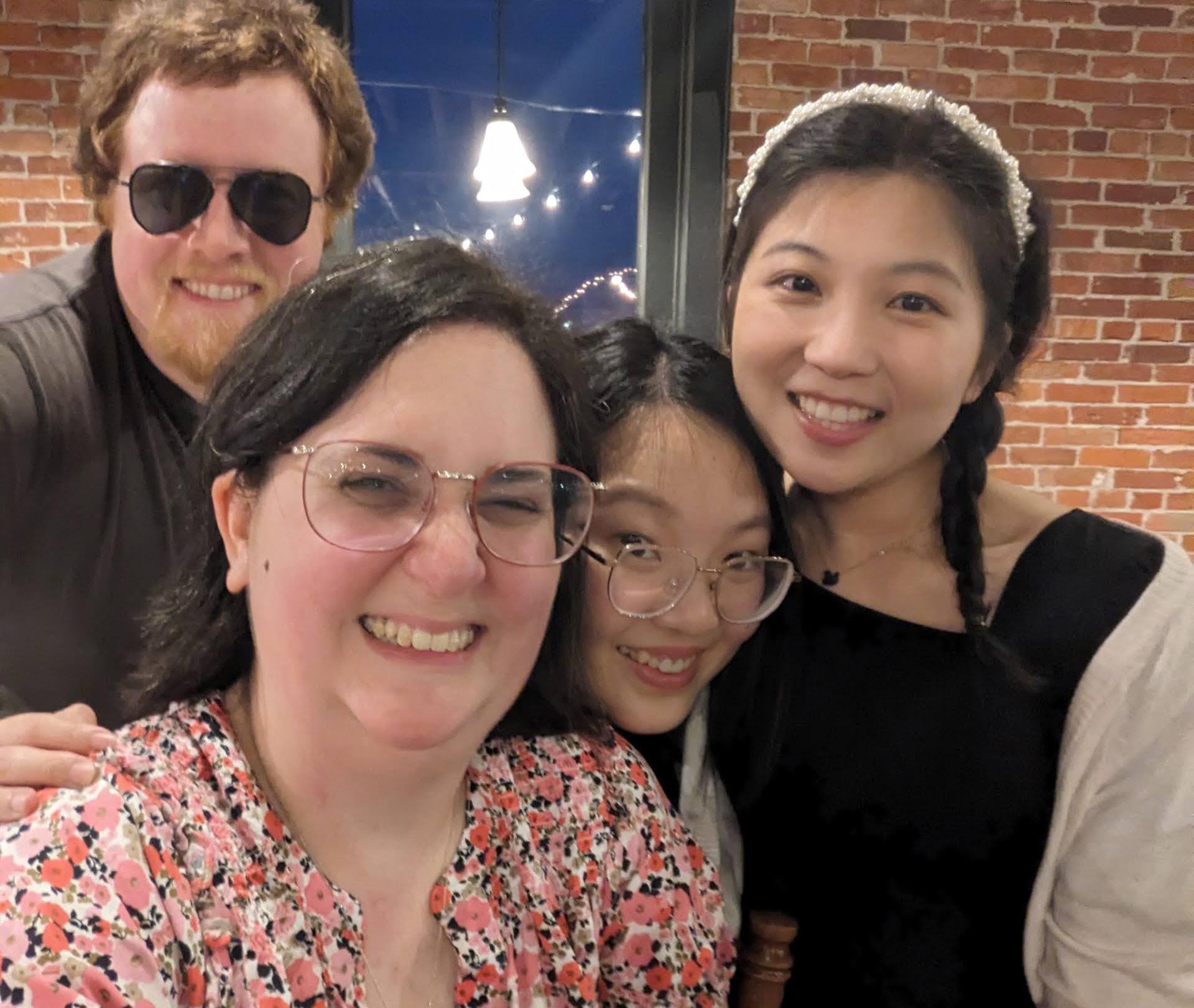
Samantha Didrichsen with her husband, Wes, and friends Grace and Joy at an end-of-year LAI gathering.
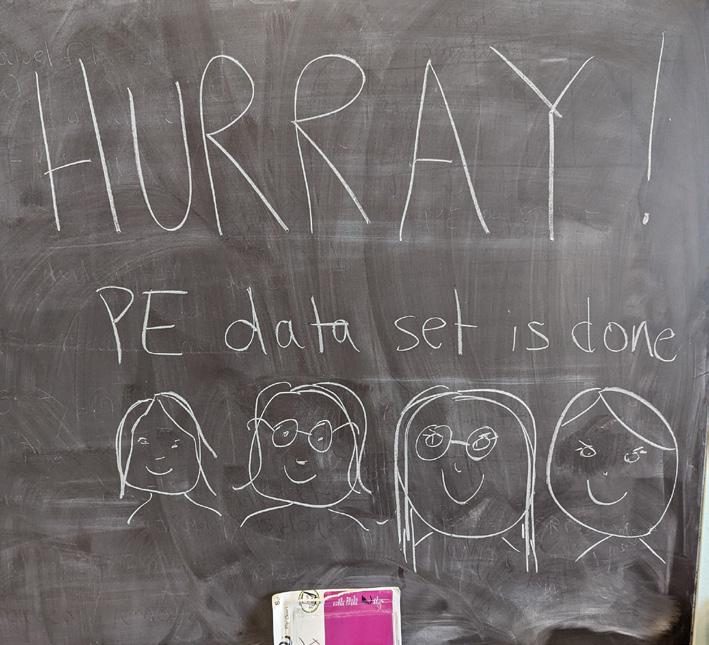
A chalkboard drawing celebrates a milestone in one of Didrichsen’s early childhood research projects.
TRAJECTORY
(Source Photo/ Blanc Photographie)
Creativity is King:
GSE counseling alum uses animation to transform pain into peace
BY NICOLE MEHLMAN-DAVIDOW
Dorian Withrow Jr., MS ’25, has found that the everyday conversations within his community spark his creativity. Whether it’s a 70-year-old taekwondo classmate or a group discussion at one of his workshops, Withrow has discovered that he learns the most from the ordinary. He then turns these moments into extraordinary work.
Two summers ago, Withrow wanted to expand his messaging to teens after writing multiple books. He consulted his agent and felt animation was the best medium to reach young people, but there was just one problem: “I don’t draw,” said Withrow with a laugh. “I can make a decent stick figure, and that’s about it.”
“I wanted to create something that schools just don’t teach, and parents may not have time to explain.” -Dorian Withrow Jr., MS ’25
A lack of artistic ability did not stop Withrow from thinking creatively. He had an idea and a strong foundation for a script based on his books, but he needed to delegate to others who could bring it all to life. That’s where Emperium Studios came in. “You have to find other people who are strong where you are weak,” explained Withrow. “A lot of the animated shows we see are created just for laughs or for a quick heartthrob moment. They’re not trying to teach anything. I wanted to create something that helps young people build inner resilience, character and discipline—teaching them what they truly need.”
Connecting with a professional studio meant Withrow’s stories could come to life, but it also came with challenges. “Sometimes you have a vision in your mind, but studios may not have the capacity or the mindset to carry it out. That’s part of the process—you have to step in, collaborate and figure out what’s actually doable,” said Withrow.
After over a year of collaboration, Withrow and his team produced “Thoughts
of Creativity King” and “Conversations You Need,” animated features that are based on Withrow’s books. Both features bring to life themes of emotional growth, self-discovery and the importance of connection. Each series is still being developed, but the trailers are now live.
Withrow aimed to incorporate emotional education into entertainment, a concept he believed was lacking in current animated shows. “I wanted to create something that schools just don’t teach, and parents may not have time to explain,” he said.
These animated series expand on Withrow’s books, which draw on his training in GSE’s mental health counseling program, as well as his everyday experiences and conversations with the people around him. “The program really sent me on my way to do what I am doing now,” said Withrow. “My latest book, ‘A Poetic Epiphany,’ pulls together everything I’ve learned—self-esteem, grief, multicultural perspectives, all of it. I make it my own by telling my stories and weaving in the concepts I learned in school. It keeps the human, relatable side intact. You’re not reading a science textbook, but you still get the message.”
Withrow has also been participating in taekwondo classes at Master Gorino’s Tae Kwon-Do in Amherst, New York. There, he learned to discipline his mind and meditate on key conversations he would have throughout his day. One discussion stuck out and helped create new ideas for his books and shows. “Our school does a great job of building community. At our annual banquet, I spoke with a classmate in his 70s who told me about his family’s tradition: Every Sunday, his kids and grandkids pile into his house for a chaotic, crazy meal. It’s messy, but it creates real unity,” said Withrow. “I kept thinking—
how do I take that conversation, capture its meaning on the page, and then transform it into an animated show?”
Growing his own personal brand means making business decisions, but this is an endeavor Withrow believes can help his community. “I want to be out doing workshops and reaching people where they are,” said Withrow. “I don’t want these lessons I have learned to be locked away from those that really need it, given the kind of gatekeeping that can happen in the mental health field. I want to reach people directly and creatively.”
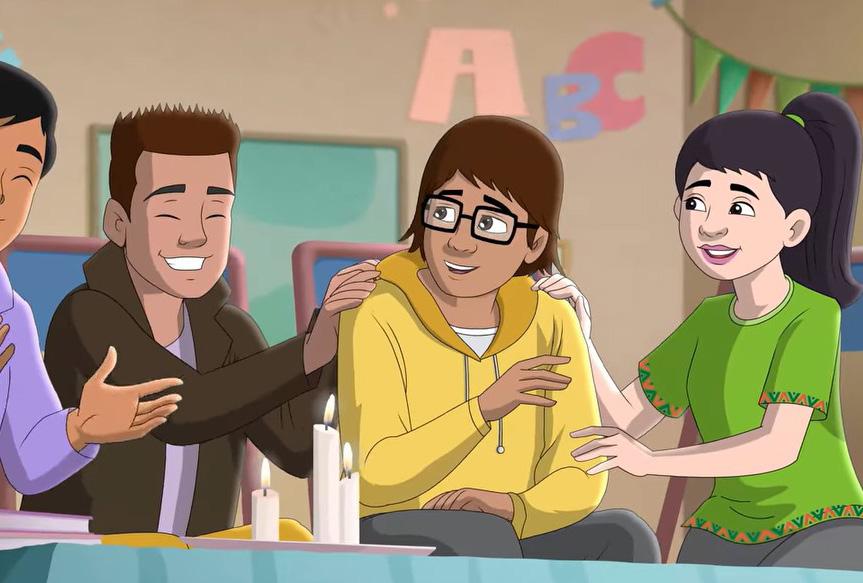
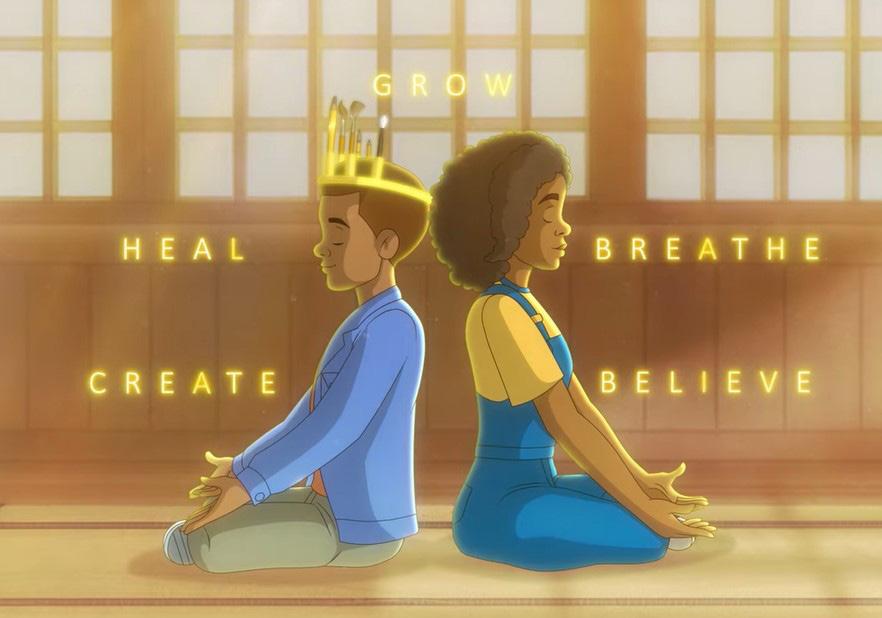
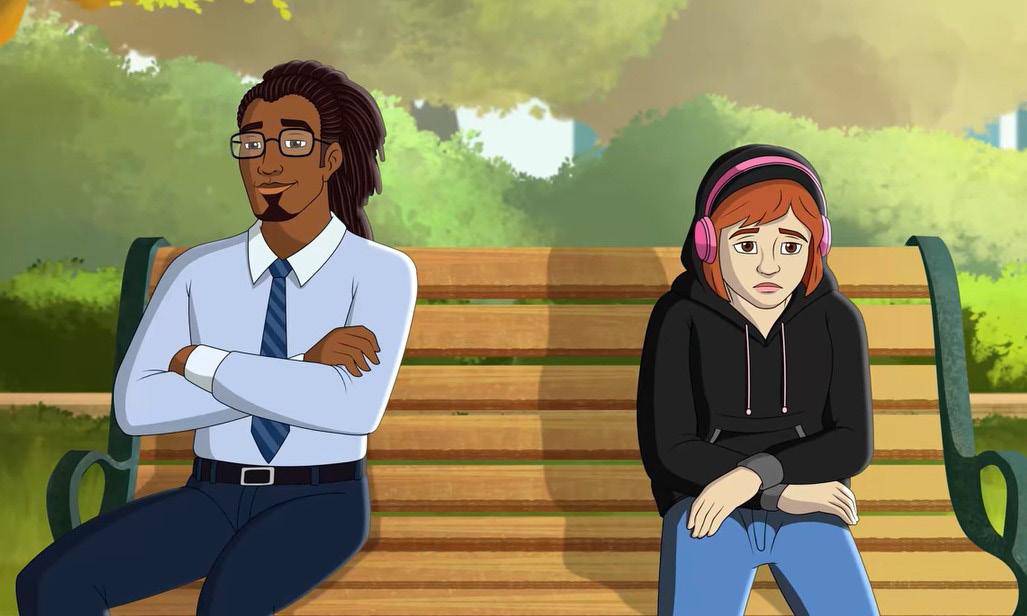
From quiet reflection to shared moments of understanding, “Thoughts of Creativity King” and “Conversations You Need” transform Withrow’s words into vivid animated storytelling. These are screenshots from the trailers of both animated features.
Event Recap
CELaRAI Quarterly Forum
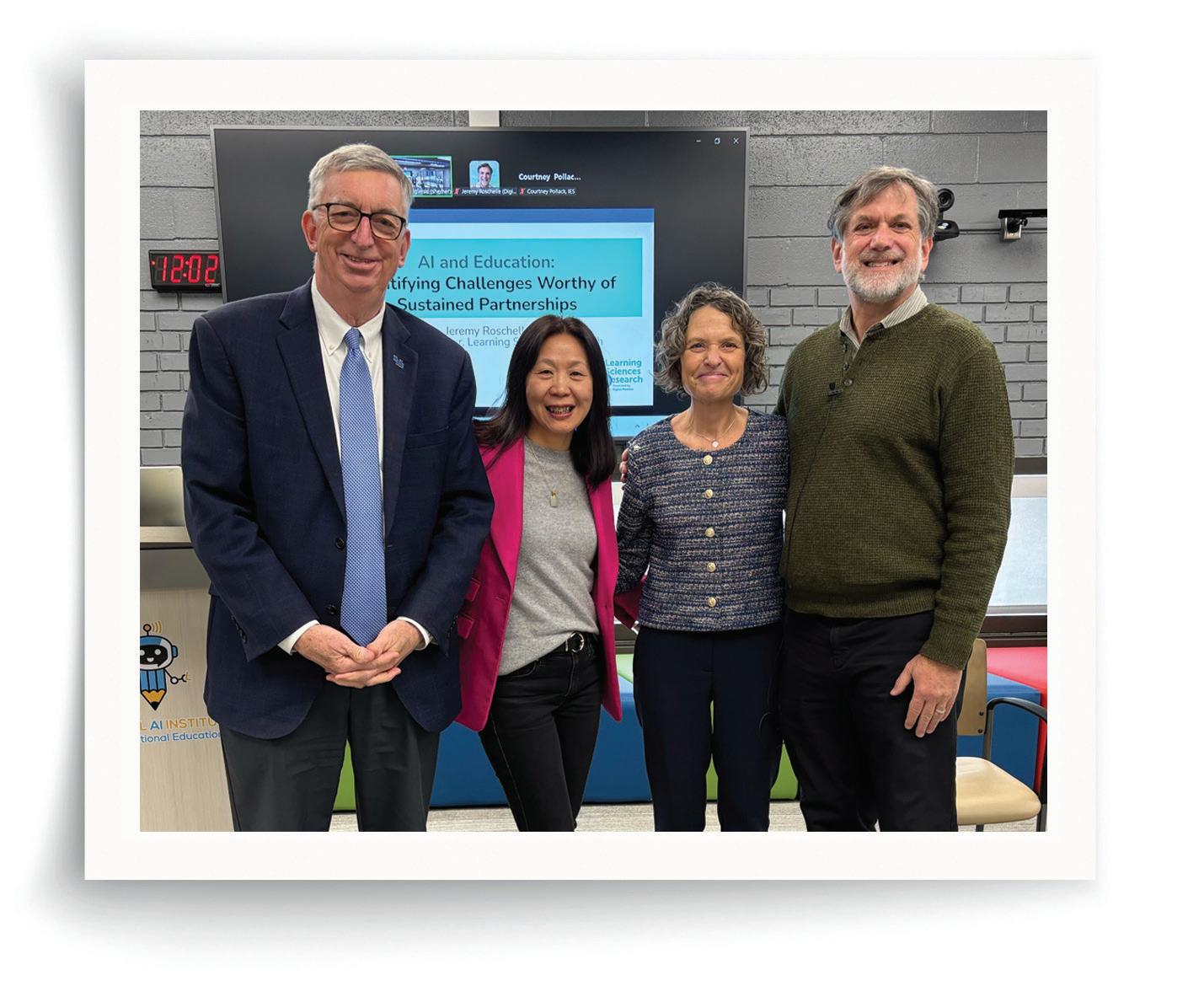
“AI and Education: Identifying Hard Challenges Worthy of Sustained Partnerships,” featuring Jeremy Roschelle, PhD, executive director of Learning
Institute for Learning Sciences Speaker Series
“Pioneering AI for Personalized Education: Designing Human-Centered Systems for Speech and Language Learning,” featuring Qingxiao Zheng, PhD, University at Buffalo | Dec. 4, 2025
“From Doctoral Research to Global Impact: Career Pathways in Human Rights and International Development,” featuring Catalina Crespo-Sancho, PhD, Ambassador of Costa Rica to the United States | April 28, 2026
Three
Minute
Thesis
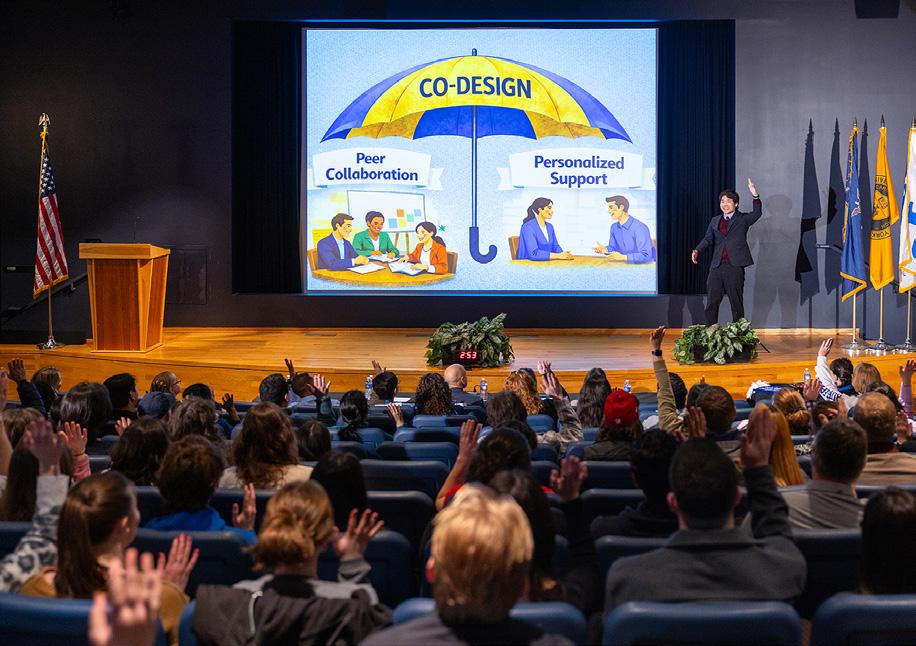
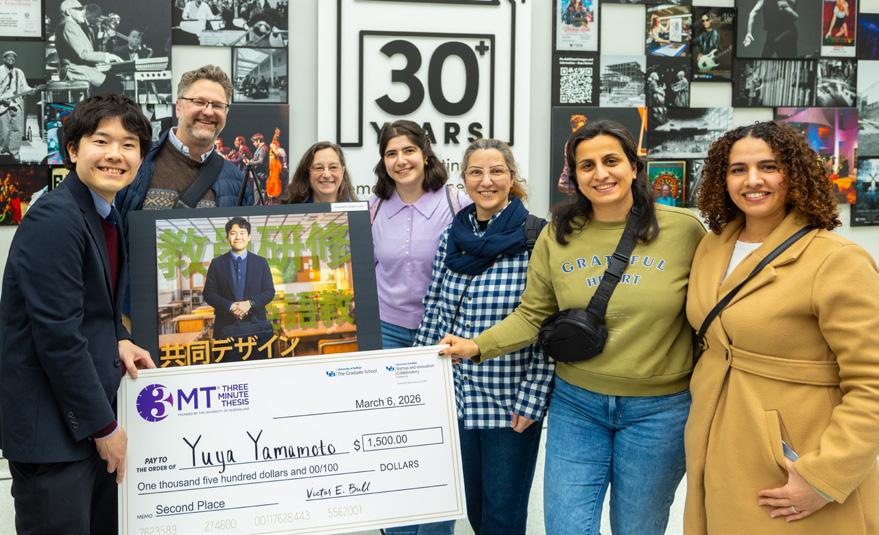
Yuya Yamamoto, a language education and multilingualism doctoral student, won second place for his thesis “Who Owns Teachers’ Learning? Reimagining Teacher Professional Growth Through Co-Design.” | March 6, 2026
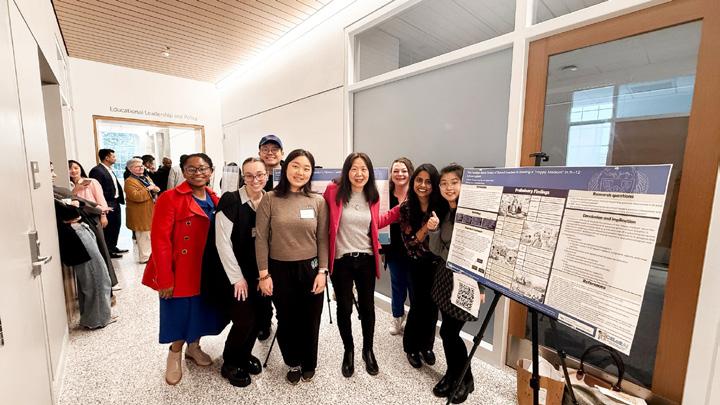
GSE Student Research Symposium
“Human-AI Collaboration & Agency” | March 31, 2026
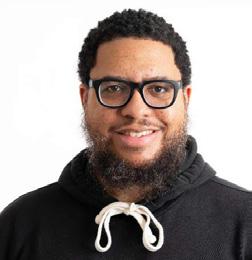
Black History Nerds Saturday School Professional Development Series
Learn more: ed.buffalo.edu/bh-nerds
“Expanding the So-Called NIL Deals of Historical Exemplars,” featuring Akil Parker, MEd, CEO of All This Math | Jan. 10, 2026
“But What Did Black Educators Already Teach Us about Reading Instruction? Exposing Paucity in the Science of Reading and Other Approaches,” featuring Tiffany Nyachae, PhD, Penn State University | March 14, 2026
“Honoring the Legacy: Creating the Blackprint 20,” featuring Abigail Henry, Schomburg Fellow and GSE doctoral student, and Ismael Jimenez, director of social studies curriculum at the School District of Philadelphia | Feb. 21, 2026
“Freedom for Me and also for Thee: The History and Significance of Binational Emancipation Day Commemorations,” featuring Natasha HenryDixon, PhD, York University | April 11, 2026
On the Move
FACULTY AWARDS
Stephanie Fredrick, associate director of the Alberti Center for Bullying Abuse Prevention, received the Shapiro Mid-Career Scholar Research Award from the Society for the Study of School Psychology for her project, “Extending the Evaluation of the Effects of a Digital Citizenship Program with 6th-Grade Students.”
Heidi Julien, professor of information science, received the 2025 Association for Information Science and Technology (ASIS&T) Award of Merit—the organization’s highest distinction—for her sustained and influential contributions to information science through scholarship, leadership and mentorship.
Namsook Kim, clinical associate professor in the Department of Educational Leadership and Policy, has been elected to the TESOL International Association’s Nominating Committee.
Katheryne LeighOsroosh, assistant professor in the school counseling program, received the Counselor Education Qualitative Interest Network (CEQUIN) Qualitative Researcher of the Year Award for her contributions to qualitative research in counselor education.
Stephen SantaRamirez, associate professor of higher education, was named to the third cohort of Diversity, Equity, Inclusion, and Social Justice Fellows at the State University of New York. He also received the 2025 Association for the Study of Higher Education Early Career Award and the 2026 Outstanding Advocate Award from the ACPA–College Student Educators International’s Coalitions & Networks.
STUDENT AWARDS
Elnaz Amini, a master’s student in the higher education and student affairs program, was named a 2025 Western New York Prosperity Fellow by the Prentice Family Foundation.
HONORS, AWARDS AND PROMOTIONS
Jane Bartley, a doctoral student in the Department of Information Science and full-time digital archivist at Virginia Military Institute, was named a 2025 ASIS&T New Leader.
Kayla Burt, a doctoral student in the Department of Information Science and data analyst at the Massachusetts Institute of Technology (MIT), was named an emerging scholar by the Association for Library and Information Science Education (ALISE).
Jahare Hudson, a PhD student in the counseling psychology and school psychology program, was named a 2025 Western New York Prosperity Fellow by the Prentice Family Foundation.
Lino Loja, a doctoral student in the educational psychology and quantitative methods program, received a second-place poster award at the SMART Youth Mental Health Summit. His poster was titled, “Do Community Schools Work for High-Needs Students? Evaluating Integrated Student Support Services and Outcomes for Equity.”
Hassan Mortada, a doctoral student in the Department of Information Science and manager of the NonLatin Script Unit at Yale University Library, was named a 2025 ASIS&T New Leader.
Red Murdock, a master’s student in the education studies program and linebacker for the UB Bulls, has been named to the 2025 Allstate AFCA Good Works Team. He also was selected by the Denver Broncos as “Mr. Irrelevant,” the final pick of the NFL Draft.
Yuya Yamamoto
earned second place in UB’s Tenth Annual Three Minute Thesis (3MT) Competition, held March 6, 2026, for “Who Owns Teachers’ Learning? Reimagining Teacher Professional Growth Through Co-Design.”
ALUMNI AWARDS
Laureen CantwellJurkovic, PhD ’24, was named as an emerging scholar by the Association for Library and Information Science Education (ALISE).
Catalina CrespoSancho, PhD ’09, was recognized by the UB Alumni Association Board for her distinguished humanitarian work and her leadership as a notable alumna.
STAFF AWARDS
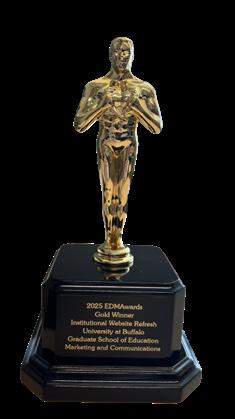
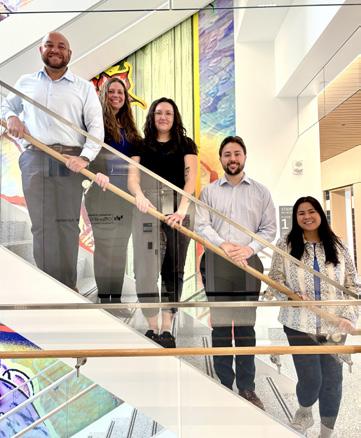
GSE’s marketing and communications team received a Gold Award in the 2025 Education Digital Marketing Awards for excellence in website redesign. The team also received a Web Excellence Award in the Education category with the Web Excellence Awards (WE-Awards). These recognitions highlight the work of Amber M. Winters, William J. Belz III, Danielle M. LeGare and Nicole MehlmanDavidow.
GSE’s Office of Admissions received the Association for Graduate Enrollment Management’s (NAGAP) Promotion of Excellence Award for their innovative “Hidden Curriculum of Graduate School Admissions” series. This award recognizes the work of Ryan Taughrin, Lynette DePonceau, Alaina Guzman, Daniel Krawiec, Duvi Kominiarek, Renad Aref and William Bogdan.
UB’s Graduate School of Education has been recognized among the nation’s best, securing the No. 47 spot in U.S. News & World Report’s Best Graduate Education Schools rankings. Among public universities, GSE rose to No. 37 and is the No. 1 education school among public universities in New York State, a testament to our ongoing commitment to innovation, research and student success.
#37
Photo/ Maggie Martinez, courtesy of Sarasota Scene Magazine
CONNECTED FROM THE HEART: A lifetime of giving forward
BY DANIELLE LEGARE
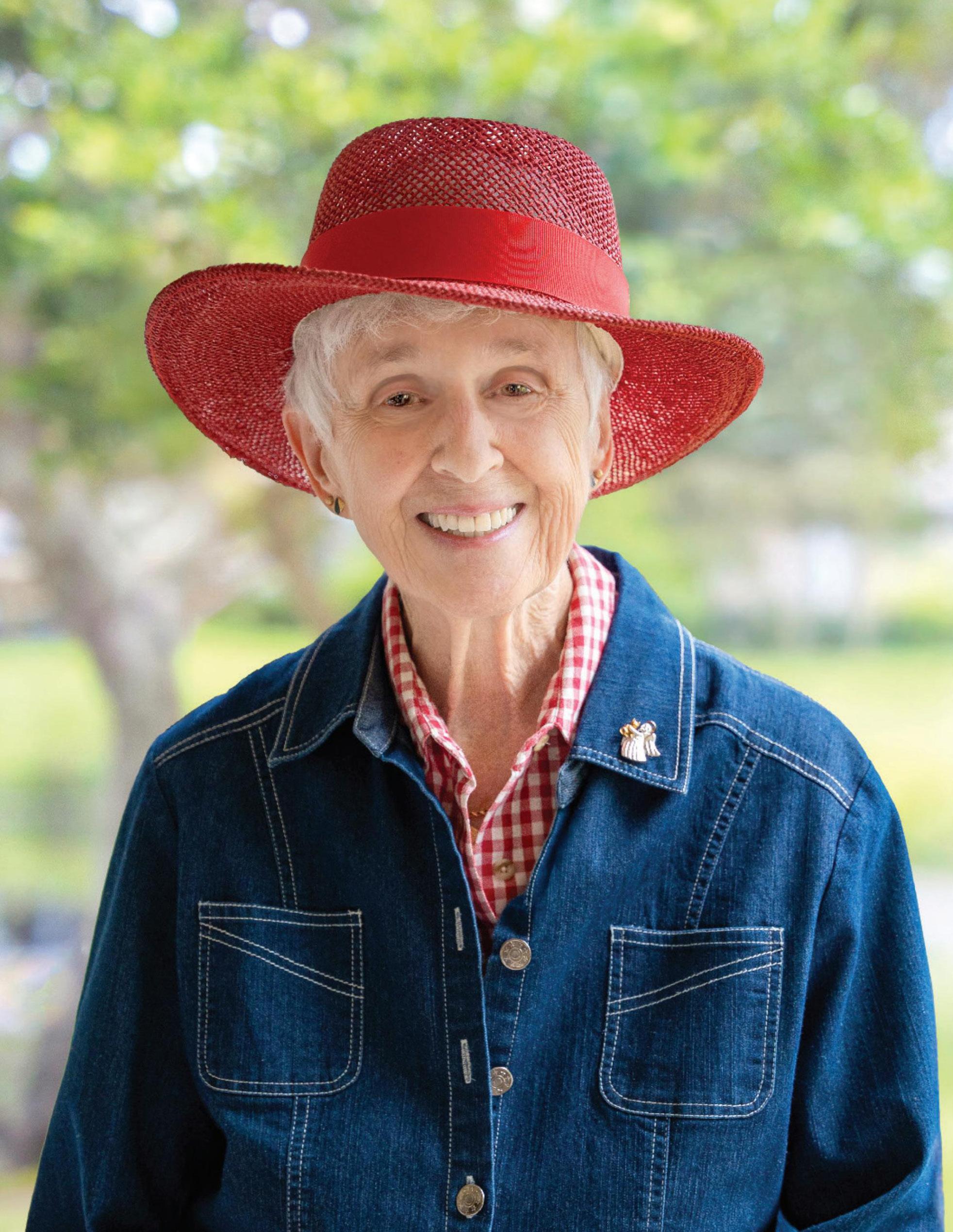
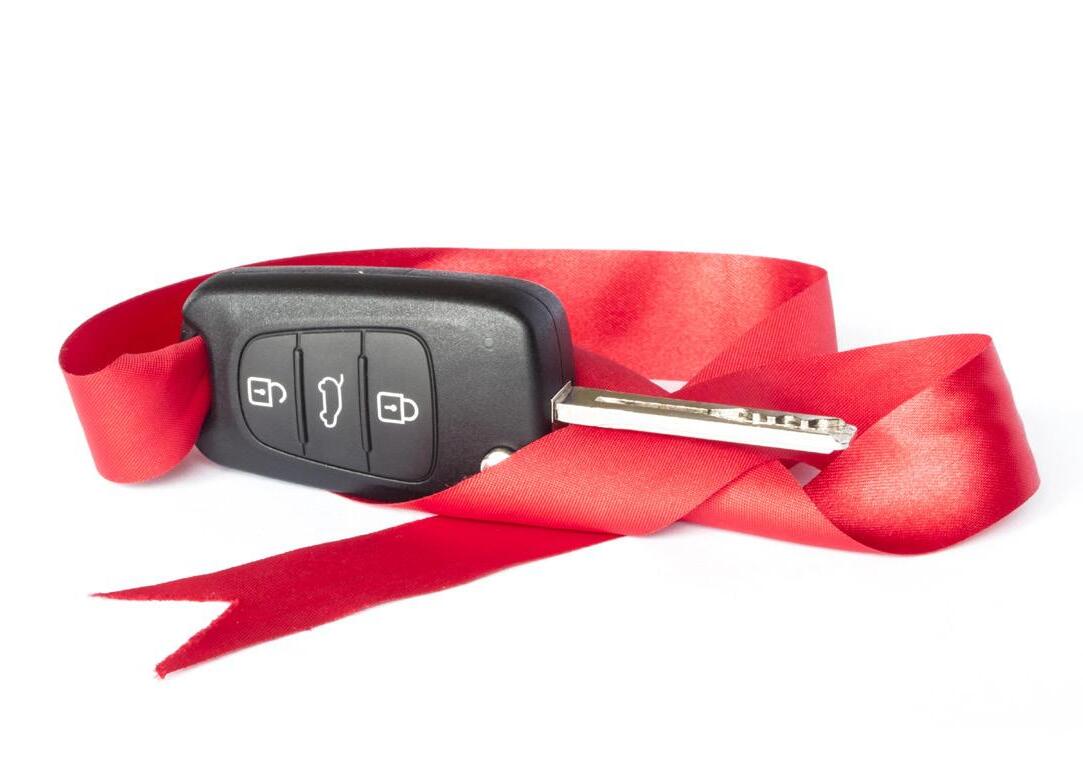
Kathleen “Kathi” Cellura, EdB ’59, often muses that her luxury car is a 2013 Toyota. But for the University at Buffalo alumna, the car’s value has little to do with driving it.
Instead, she has already planned for the car to be given to a mother with children through the Women’s Resource Center in Sarasota, Florida, to provide reliable transportation to work and help care for her family. This gift is a telling example of the thoughtfulness that has defined Cellura’s philanthropy for decades.
A life shaped by teaching
Cellura’s connection to UB began in the 1950s, when she arrived from Rochester, New York, determined to pursue her education. She initially set her sights on a career in medicine, but a perceptive professor encouraged her to consider a different path that aligned more with her strengths and sensitivity to others. The moment proved pivotal and ultimately guided her toward a career in education.
After completing her undergraduate studies at UB and graduate work at the University of Rochester, Cellura spent decades teaching in Western New York before relocating to Florida. Throughout her career, she became known not only for her work in the classroom but for the care she extended beyond it. She supported students, worked closely with parents and advocated for those who needed someone in their corner. She was recognized as “Teacher of the Year” twice, an honor made especially meaningful because it was driven by the parents of her students.
“To be a teacher is one of the most beautiful professions,” Cellura said. “You can take a child and change his or her life.”
At times, that impact comes not from instruction alone, but from presence, she explained. “Maybe you just have to be there for them, because nobody else is.”
That commitment to helping others has shaped Cellura’s approach to giving.
Giving with purpose
Over the years, she has supported a wide range of causes through the Kathleen F. Cellura Foundation at the Community Foundation of Sarasota County, and through partnerships in Sarasota South County, with a focus on education, community programs, conservation, animal welfare and opportunities for women and young people.
Her giving is intentional and has been built over time through personal discipline and careful planning. Early on, she made a habit of setting aside money she could have spent on herself—like buying a new suit—and investing it instead. These small decisions and sacrifices grew over time into something much larger.
Her belief: “What I spent is gone, what I kept is lost, but what I gave to charity will be mine forever.”
Cellura says that although she did not inherit money or come into sudden wealth, her passion for helping others has remained constant throughout her life.
At UB, that generosity is reflected in the Kathleen F. Cellura Scholarship Endowment Fund, which supports students in GSE’s
Department of Learning and Instruction, with preference given to women preparing to become teachers in STEM fields. The scholarship is a way to invest in future educators who will shape the lives of others, just as her own teachers once shaped hers.
“To be a teacher is one of the most beautiful professions. You can take a child and change his or her life.”
In addition to her philanthropic work, Cellura is also the author of “Forever Footprints,” a novel inspired by themes that have guided her life, including compassion, perseverance and the idea that even small acts of care can have a lasting effect on others.
Now in her late 80s, Cellura continues to think carefully about how her legacy will carry forward. “We have so much,” she said. “We need to share it.”
According to Cellura, her support of UB has always been about more than a donation.
“It’s from the heart, not writing a check.”
From ‘Ice Ice Baby’ to engineering: GSE alum’s ‘Little Beats’ brings STEM to preschoolers
BY DANIELLE LEGARE
A preschooler doesn’t need to know what “engineering design” means to practice it. Sometimes it starts with exploring classroom materials, sketching an idea, building a simple structure and then figuring out how to make it work even better the next time.
That hands-on, iterative approach is central to Jennifer McDonel’s work. A GSE alumna, McDonel, PhD ’13, was recently promoted to professor of music and associate dean of the College of Visual and Performing Arts at Radford University in Virginia. She is also the director of music education at Radford and the co-creator of “Little Beats,” a growing collection of children’s songs that intentionally connect early music development with STEM concepts.
McDonel’s newest children’s album, “Little Beats: Grand Old Time, Science and Engineering Songs,” was released July 29, 2025.
From theory to song
For McDonel, the “Little Beats” idea dates back to her time at UB, where she was fascinated by how young children learn before subjects become separate classes in schools.
“I realized young kids have a more holistic approach to learning,” she said. “Their learning is not really separated by subjects yet. Everything is learning by doing.”
At GSE, McDonel studied and worked as a graduate research assistant in early childhood music with Maria Runfola, emeritus professor of music education. She later served as a graduate assistant with former GSE faculty members Doug Clements and Julie Sarama in an early mathematics lab. Those experiences helped her identify parallels between what Clements and Sarama describe as “learning trajectories” in mathematics and what music learning theory calls “music learning sequences.”
“That’s why I decided to do my dissertation work on potential connections between early childhood music learning and early childhood mathematics learning,” McDonel said.
In 2022, those connections moved from theory into practice. McDonel began writing children’s songs that integrate music with STEM learning, in partnership with Zero to Three, a national nonprofit focused on early development.
“I was looking for vocabulary, concepts and actions on objects that young children do, and
then I wrote the songs around that content and vocabulary,” she explained.
The “Little Beats” project now includes multiple albums, including “Little Beats: Counting, Shapes, and Sets,” released in 2023, in addition to “Little Beats: Grand Old Time, Science and Engineering Songs.”
McDonel and Dave Rivers, her husband and collaborator, are also developing a third set of songs tied to early literacy concepts for children as young as 18 months.
Designed for children … and grown-ups
Even as the content maps to math, science, engineering or literacy, McDonel emphasizes that the music itself is carefully designed for young children’s musical growth. She aims to build what she calls “listening vocabulary,” helping children develop the aural foundations needed for singing later on.
“When we provide a rich musical environment with many styles, genres and tonalities, we’re helping build children’s brains for music. I’m not just creating what’s
most common—major tonality and duple meter, which dominate popular music—but a wider range of tonalities and meters that children can simply hear and experience in a fun, active way,” she said. “And if children are ready to use their singing voice, the songs are written in ranges that fit a young child’s initial singing voice.”
Just as important, she wants the music to feel human, active and genuinely enjoyable for families.
“We want parents to want to listen to this,” McDonel said. “So, we add what we call little musical ‘Easter eggs.’ In one of the songs, we use a melodic pattern inspired by ‘Ice Ice Baby.’ We change it slightly, put it in a different tonality and write a completely new melody over it. The funny part is that the song is actually about ice melting, so it becomes a playful wink for adults who catch the reference.”
As McDonel progresses on her musical journey, she has advice for students who hope to blend creativity, research and education:
“Work hard, be open to possibilities and follow paths just to see where they go.”
McDonel with Dave Rivers, her husband and collaborator.
Class Notes
1960s
Norbert Baschnagel, EdM ’68, celebrated his 50th wedding anniversary with his wife, Beverly, in March 2026. He also authored the book “How to Build a Sport or Life Dynasty” (2021).
Victoria Stearns, BA, BFA ’65, MLS ’68, published her third book, “Classical Music: A Listener’s Guide,” in 2025. The book offers an accessible introduction to classical music and provides readers with pathways for exploring additional works.
1970s
Anne Deming, MEd ’74, PhD ’77, currently thriving in her 80s, recently published “A History of Bear Lake,” second edition, in 2025, her third book about Bear Lake, New York. She has also revived her hypnotherapy practice and has provided sessions for more than 300 residents in her community.
Salvatore Illuzzi, BA ’68, EdM ’72, PhD ’75, received recognition from the U.S. House of Representatives upon his retirement, including a flag flown over the U.S. Capitol in honor of 34 years of service as a school district superintendent in Pennsylvania and New Jersey.
1980s
Victor Stolberg, MA ’81, MAH ’83, EdM ’84, recently published “Bipolar Disorder: Your Questions Answered” (2026) and “ADHD Medications: History, Science, and Issues” (2024). His recent articles include “Stroke as a Lifestyle Disease: A Review” (2024), “Issues Between Addiction and Gender” (2024), and “Biomarkers for High Metabolic Burden in Neurologic Disease” (2024). He also has an article in press titled “Epigenetics of Neural Networks in Neurocognitive Conditions: A Review.”
1990s
Kevin McKelvey, EdM ’95, served for 22 years as the resident director of UB’s undergraduate program at the Singapore Institute of Management. He retired at the end of March 2026.
Roxana Reichman, PhD ’96, in 2023 was appointed vice president and dean of the Graduate School of Education at Gordon Academic College in Israel, where she oversees five graduate programs and is leading the launch of an online English-language master’s program in educational administration and leadership beginning in fall 2026.
Michele Pava, BA ’94, MLS ’99, recently moderated a panel discussion following a screening of the documentary film “The Librarians” that addressed censorship and book banning in the United States.
2000s
David Caban, PhD ’01, served as principal of the Herman Badillo Bilingual Academy (HBBA) for 22 years. In 2024, the auditorium at HBBA was named in his honor. He is currently a consultant with the National SAM Innovation Project, focusing on effective time management for principals.
Dianne McCarthy, EdM ’90, EdD ’01, published “Young Children and Mathematics: Teaching and Learning” (Innovative Ink Publishing, a division of Kendall Hunt, 2026).
Cynthia Tysick, BS ’99, MLS ’01, published a book, “Digital Literacy in the Age of Big Tech” (Routledge, 2025).
Casey Jakubowski, Adv. Cert. ’04, published a seventh book, “Settling Conflict in Rural New York: Case Studies of Education Reform,” which examines post–World War II community building through centralized education policy and the role of local communities and bureaucracy.
Marvel Ross-Jones, EdM ’05, EdD ’06, enrolled in a combined master’s/doctoral program in ministry through the Antioch School of Church Planting and Leadership Development in Ames, Iowa.
2010s
JJ Brice, EdM ’10, celebrated 10 years at Binghamton University and currently serves as director of student affairs for the School of Pharmacy and Pharmaceutical Science. Rick Jetter, BA ’96, PhD ’10, is ranked 16th in the top 30 Global Gurus in Education. He is highlighted in various prominent educational journals, including Educational Leadership and Principal Magazine.
Dominique Vola Ambinintsoa, EdM ’11, is a lecturer and learning advisor at Kanda University of International Studies in Chiba, Japan. She also edited a special journal issue in the Studies in Self-Access Learning (SiSAL) Journal.
Laura Dawidowicz, BS ’10, EdM ’13, was recently promoted to senior director of client relations at the Community Foundation for Greater Buffalo.
Nichole Hawkins, BA ’11, MS ’13, has served since 2023 with the Louisiana Department of Health, providing psychological services to diverse and underserved communities, including assessment, evidence-based psychotherapy and expert testimony within the Louisiana judicial system.
Xiaoshuo Gao, EdM ’16, started a new role in October 2025 as a co-op advisor at the University of Waterloo in Waterloo, Ontario.
Kristen Braunscheidel, EdM ’17, received the UB School of Public Health and Health Professions’ Outstanding Staff Award for the 2024-25 academic year. She also welcomed her second son, Quinn Brendan, on July 31.
Tommy Buttaccio, MA ’16, MS ’17, got married on Sept. 29, 2024, at the Buffalo and Erie County Botanical Gardens and purchased a home in South Buffalo the following year. He recently joined Lockwood Library at UB as a user services supervisor, where he mentors student employees and supports public services. He is currently writing a paper on emotions and library workers, and has presented on local history at museums in New York City.
Lorenda Chisolm, EdD ’17, has been appointed superintendent of schools for the Greenburgh Central School District in Westchester County. Her tenure began on July 1, 2025.
Zach Basler, MLS ’18, has been appointed the first-year/ second-year student success librarian and assistant librarian at the University of South Alabama.
2020s
Ayse Cobanoglu, PhD ’21, now serves as associate dean in the School of Education at Bogazici University in Istanbul. She previously served as principal investigator on a HeisingSimons Foundation grant supporting a national research-topolicy convening, and as guest editor for a special issue on early childhood workforce well-being in Early Childhood Research Quarterly.
Daniel Kelly, BA ’05, MA ’07, EdM ’09, PhD ’21, published two books in philosophy: “Kant in Context: The Historical Primacy of the Transcendental Dialectic” (2024) and “Kant and the Path of German Idealism: Competing Accounts of Cognition” (2025).
Christopher Spence, EdM ’13, PhD ’21, serves as superintendent of schools for the Utica City School District in Utica, New York. Under his leadership, the district was named to Forbes’ Top 100 Employers in New York State and received a Champions of Change Award from the New York State School Boards Association for its extended learning initiatives.
Linda Stricker, EdM ’21, completed her first year at Methodist Theological School in Ohio in pursuit of a career in ministry.
William Bohen, EdD ’17, EdM ’22, completed a twoyear term as president of the Graduate School of Education Alumni Association, supporting expanded alumni outreach and networking initiatives. He continues to serve on the executive committee as immediate past president.
Devon Cozad, MS ’22, co-authored the chapter “Faculty Perceptions of AI: A Case Study in Higher Education” in “Meaningful Work in a Post-Covid Age: The Impact of New Technologies,” published in November 2025 by Emerald Publishing.
Laureen Cantwell-Jurkovic, PhD ’24, won the 2025 Eugene Garfield Doctoral Dissertation Award from the Association for Library and Information Science Education. She also started a new job as a humanities and multidisciplinary librarian at Vassar College in Poughkeepsie, New York.
Mitch Kase, EdD ’24, has been appointed executive director of the Center for Excellence in Learning, Teaching, and Assessment at Hofstra University.
Kristen Smigielski, MM ’17, PhD ’25, Adv. Cert. ’25, was named a 2026 Women in AI Fellow through the InnovateEDU EdSAFE AI Alliance. She serves as research project manager for the Center for Early Literacy and Responsible AI at UB and was recently appointed grants specialist in the GSE Office of Research.
Dima Abass, EdM ’23, EdD ’26, recently completed a doctorate in learning and instruction at GSE, marking the culmination of a decade of academic and professional engagement across student affairs, academic support and institutional research.
The GSE bride who broke TikTok
BY DANIELLE LEGARE
Around GSE, Eduvijez “Duvi” Kominiarek is known for helping students find their path. Online, the assistant director of recruitment became known for something else entirely: the bride who turned a chaotic wedding day into viral comedy.
IntheTikTok that catapulted her into the spotlight, Duvi walks viewers through “everything that went wrong on our wedding day”—a montage of mishaps that seemed almost too absurd to be real.
Photographers delayed by nearly two hours? Check.
A rushed photo schedule that forced a first look with her dad in a hotel hallway? Check.
A hotel attempting to charge a hefty extra fee for photos, even after she booked two suites? Also check.
But the real plot twist came when she and her husband-to-be, Ryan, pulled up to their venue to find a massive Trunk-or-Treat event occupying the entire parking lot. Guests circled for spots, fire trucks honked through their patio ceremony and some family members missed the vows altogether.
And, at the afterparty, both newlyweds came down with the flu.
Still, as Duvi declared, they “had the best day ever.”
TikTok audiences were entertained and charmed. Hilton Hotels even chimed in with, “After all that, you two ‘suitehearts’ definitely deserve a getaway.” They gifted the couple a honeymoon in Portugal.
Soon after, even People magazine featured their story.
And through it all, Duvi brought the same positivity, humor and resilience that she brings to GSE every day.
Welcoming new GSE students through music
BY NICOLE MEHLMAN-DAVIDOW
You may not realize how musically inclined the city of Buffalo is, especially compared to the more internationally known New York City. However, GSE’s admissions staff could see that artistic talent runs deep within the Queen City.
After brainstorming ways to connect with accepted GSE students, Ryan Taughrin, assistant dean for enrollment management, and Danielle LeGare, director of content, realized that their shared love of music and passion for promoting Buffalo’s music scene could be a great way to draw students to the
“Music is part of what makes this area so culturally rich, so we were really excited to share music that had Buffalo or UB connections with our newly accepted students.”
area. “Ryan and I are both music lovers from Buffalo, so it just clicked for us to create a collaborative ‘Welcome to Buffalo’ playlist on Spotify,” said LeGare. “Music is part of what makes this area so culturally rich, so we were really excited to share music that had Buffalo or UB connections with our newly accepted students.”
The Spotify playlist “Welcome to Buffalo” is a constantly evolving list of songs and musicians that have ties to the region. Artists like Passion Pit, the Goo Goo Dolls and Ani DiFranco are from Western New York, while there are also songs like “The Erie Canal” by Bruce Springsteen that have references to the area.
A link to the playlist is sent to accepted students as part of a sequence of messages designed to make becoming a GSE student a positive experience.
“Over time, this has just turned into a staple to share with our incoming
students, especially because so many students are fully online learners, and others are coming from outside of the area,” said Taughrin.
LeGare emphasized that the playlist is meant to celebrate a key achievement for accepted students and help them get to know Buffalo better: “Going to grad school is a significant accomplishment, and this playlist is one more way to embrace our community, savor the moment, have a little fun and celebrate.”
According to Taughrin, the playlist is open for members of the GSE community to add arearelated music and artists. “I’d love to have new students, as they learn about the playlist, add a song or two as they learn about music from the area.”
Retirement Reflection
BY RAECHELE L. POPE
After more than 40 years in higher education, including 25 years at UB, I step away from my faculty role with deep gratitude for the Graduate School of Education and for the people who made it an intellectual, professional and personal home.
My academic journey took me through Indiana University of Pennsylvania, Illinois State University, UMass Amherst, the University of Iowa and Columbia University, before leading me to UB—where I found a community that shaped not only my work, but also how I came to understand teaching, learning and leadership.
Immediately following my master’s degree,
“I learned far more than I taught. I was sustained by mentorship, challenged by thoughtful disagreement, and continually reminded that this work matters.”
my career in higher education began in student affairs, working in residence halls, student development, diversity leadership and academic advising. Those early years grounded me in the relational, often invisible labor of supporting students as whole people.
Although much of my career unfolded as a faculty member, it feels especially fitting that I concluded my final seven years at UB by returning to administration, serving as senior associate dean for faculty and student affairs and as chief diversity officer for GSE. This role allowed me to bring my career full circle; the opportunity to serve the dean, students, faculty and staff in that capacity was, without question, the most deeply satisfying work of my professional life.
Across GSE, I was fortunate to work alongside colleagues and students whose commitments to scholarship, equity and the public good were evident in both large and quiet ways. Within the student affairs and higher education program, and in collaboration with faculty and students across the school, classrooms became spaces of inquiry and connection. Advising conversations often became moments of clarity, courage and growth. Again and again, students reminded me that education is relational at its core, and that the most meaningful learning happens when we listen carefully to one another and take one another seriously.
As I reflect on these years, I do so with appreciation for what I was able to contribute, humility about the moments when I missed the mark, and deep respect for the generosity, trust, patience and grace extended to me by colleagues and students alike. I learned far more than I taught. I was sustained by mentorship, challenged by thoughtful disagreement, and continually reminded that this work matters—not because it is easy, but because it is consequential.
In retirement, I will remain connected to the field through my work on the Student Affairs NOW podcast and by continuing to support doctoral students as they complete their dissertations and programs. While my role has changed, my belief in the transformative power of education—and in the people who carry this work forward with integrity and care—has not.
It has been a true honor to be part of the Graduate School of Education. I leave with gratitude for the past, confidence in the future and enduring appreciation for a community that made this work both meaningful and joyful—and with the quiet satisfaction of knowing that my alarm clock and I are finally parting ways.
IN MEMORIAM
Howard R. Kight, associate professor emeritus
Howard R. Kight, associate professor emeritus in GSE’s Department of Counseling, School and Educational Psychology, died May 1, 2025. He was 92.
A native of Charleston, West Virginia, Kight earned his bachelor’s degree from Wesleyan College before completing master’s and doctoral degrees in child psychology at Indiana University. He joined the UB faculty in the early 1960s, building a career that bridged psychological measurement, learning theory and the everyday realities of schooling.
1930s
Jane Keefe, BEd ’35 | 11/21/2025
1950s
Carmelo Palano, BEd ’50 | 1/12/2026
Siiri Puust, BEd ’59 | 12/18/2025
1960s
Donald Szen, EdM ’64 | 12/11/2025
James Neenan, EdM ’67 | 2/19/2026
His research explored achievement motivation, test anxiety and how students experience and interpret school environments. One of his early publications, co-authored in the Journal of Educational Measurement, examined the factor structure of test and general anxiety among university students, contributing to a growing body of scholarship on how assessment conditions shape student performance.
Kight was also engaged in the Northeastern Educational Research Association (NERA), where he served in multiple leadership roles over several decades, including program co-chair and member of the board of directors.
Later in his career, Kight co-authored a comprehensive study of in-school suspension programs across New York State. The work documented how districts implemented disciplinary policies while maintaining academic instruction and student supervision—an effort that reflected his long-standing interest in the intersection of learning, behavior and school systems.
He is remembered by those who knew him for his gentle nature and quick-witted sense of humor.
“Howard was always willing to assist doctoral students and serve on their committees, helping with the statistical part of their study,” said former GSE colleague and professor emeritus Al Pautler. “He was always very helpful to them, as well as to me, as their major advisor. I always appreciated that about Howard.
“He was also always up for a good game of ping-pong and was well known as a good ping-pong player,” Pautler remembered. “He was a good tennis player, too, and an all-around good person.”
Martin Oper, EdM ’67 | 12/30/2025
Dennis Pulisi, EdM ’68 | 11/10/2025
Elizabeth Clark, EdM ’69 | 11/5/2025
1970s
Dr. John Hanssel, EdD ’70 | 1/12/2026
Daniel Selkirk, EdM ’71 | 2/20/2026
Lottie Fortune, EdM ’72 | 1/16/2026
Wayne Triano, EdM ’72 | 12/19/2025
Thomas Centofanti, EdM ’73 | 11/17/2025
Dr. Frank Calzi, EdD ’74 | 11/3/2025
Carolyn Darch, EdM ’74 | 11/22/2025
Lucy Folga, EdM ’75 | 2/9/2026
Cheryl Williams, EdM ’75 | 11/3/2025
Lawrence Naukam, MLS ’76 | 2/18/2026
Remembering recently deceased members of our cherished GSE community
Judith Speller, MLS ’76 | 2/19/2026
Bruce Radka, EdM ’77 | 11/3/2025
Eugenie Rebres, MLS ’78 | 2/18/2026
1980s
Dr. Peter Roswell, EdD ’80 | 1/27/2026
Dr. Juanita Hunter, EdD ’83 | 11/22/2025
Leon Shkolnik, MLS ’88 | 1/7/2026
D. William Nordstrom, MLS ’89 | 11/19/2025
Dr. Mary Sharrow, PhD ’89 | 1/7/2026
1990s
Dr. Kay Johnson-Gentile, PhD ’90 | 12/1/2025
Dr. Valerie Cooley, EdD ’93 | 2/19/2026
Colleen O’Connor, EdM ’95 | 11/5/2025
James Gerland, Sr., MLS ’98 | 1/6/2026
2010s
Douglas Conway, MLS ’09 | 2/19/2026
300 Hayes Road
Buffalo, NY 14214
Buffalo, NY
Permit #311
Search for and follow @UBGSE to catch up on the latest university and school news and information.
Naomi Thompson, assistant professor in the Department of Learning and Instruction, leads a class on informal STEAM education. The students used special thread to sew battery-powered lights into fabric.