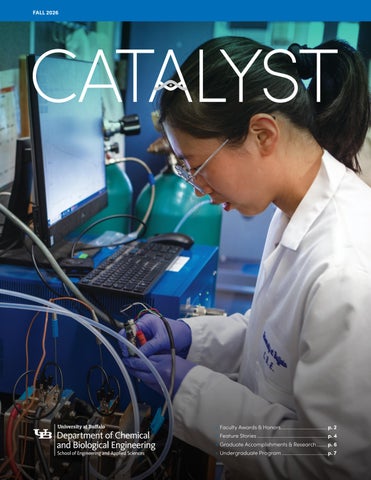
FALL 2026
» Faculty Awards & Honors........................................ p. 2 » Feature Stories............................................................ p. 4 » Graduate Accomplishments & Research.......... p. 6 » Undergraduate Program....................................... p. 7
CHAIR'S WELCOME
Dear CBE Community, It’s been another exciting year for UB CBE! Our early-career faculty continue to accelerate their research and education programs, and it was a banner year for faculty and student awards. In what follows, you will learn about awards from the American Institute of Chemical Engineers (AIChE), American Chemical Society (ACS), State University of New York (SUNY), University at Buffalo (UB), and the UB School of Engineering and Applied Sciences (SEAS). It is wonderful to see colleagues recognized for their seminal contributions to our community and students acknowledged for their potential. We are very excited about the launch of a minor program in nuclear engineering. The first class, CE 370, was delivered in spring 2026 and we expect the first cohort of graduates this spring. We are eager to engage students in this subject as it becomes increasingly relevant in efforts to meet energy demands. It is a challenging time for higher education in the United States. CBE is navigating these challenges while remaining committed to our mission. The ingenuity and dedication of our faculty and staff are shining bright as we adapt to the new landscape. Best regards,
Jeff Errington
Professor and Chair
SRIRAM NEELAMEGHAM was named SUNY Distinguished Professor for his pioneering research in the field of systems glycobiology.
ASHLEE FORD VERSYPT Professor, was awarded a $2.1 million National Institutes of Health (NIH) grant.
KAIHANG SHI, Assistant Professor, received an NSF (National Science Foundation) CAREER Award.
PASCHALIS ALEXANDRIDIS UB Distinguished Professor, received the SUNY Chancellor's Award for Excellence in Faculty Service, and Best Paper Award, Recycling journal (2026).
HAIQING LIN, Professor, received the Jacob F. Schoellkopf Medal from the Western New York Section of the American Chemical Society and a UB SEAS Graduate Mentor of the Year award. MARK SWIHART, SUNY Distinguished Professor, received the Geoffrey Marshall Mentoring Award from the Northeastern Association of Graduate Schools, and another from UB’s Graduate School, the Excellence in Graduate Student Mentoring Award.
2 | University at Buffalo Department of Chemical and Biological Engineering
JEFFREY ERRINGTON, Professor, was elected an AIChE Fellow for his distinguished career in molecular simulation and thermodynamics and was also elected VicePresident of CACHE (Computer Aids for Chemical Engineering). MARINA TSIANOU, Professor, was elected an AIChE Fellow for her research advances in interfacial phenomena and soft materials, and her outstanding leadership as Chair/ Director of the AIChE Separations Division and Chair of the AIChE Interfacial Phenomena Area. RUDIYANTO GUNAWAN was promoted to Professor and received a new NIH R01 grant, along with the UB SEAS Senior Teacher of the Year Award.
VIVIANA MONJE, Assistant Professor, was awarded a NSF Designing Materials to Revolutionize and Engineer our Future (DMREF) grant to create bio-inspired membranes. STELIOS ANDREADIS recently published a paper in Nature Communications and received a new NIH R01 grant.
CHONG CHENG, Professor, received the SUNY Chancellor’s Award for Excellence in Scholarship and Creative Activities, and also received UB’s Exceptional Scholar Award for Sustained Achievement. TAMARA KOFKE, Associate Professor of Teaching, received the Chancellor’s Award for Excellence in Teaching.
Goyal Receives National and International Recognition for Scientific and Technological Impacts AMIT GOYAL, SUNY Distinguished Professor and a member of the National Academy of Engineering, was elected as a Foreign Fellow of the National Academy of Science, India in November 2015. He was also elected to the European Academy of Engineering in the 2026 cohort of 147 Fellows including 21 Nobel Laureates. In April 2026, he received an Award for Lifetime Industrial Contributions to the field of Applied High-Temperature Superconductor Technology from the worldwide superconductivity community. Recently, a research technology led by Goyal was awarded two prestigious R&D 100 Awards. Widely recognized as the “Oscars of Innovation,” the R&D 100 Awards are presented annually by R&D World Magazine, recognizing the 100 most innovative technologies developed from industry, academia and government-sponsored research during the past year. In December 2025, Goyal was recognized for Lifetime Research and Innovation contributions, impact and accomplishments from the national (congressional), state and local (county/town) levels. A U.S. Congressional Record was entered by U.S. Congressman Representative Timothy M. Kennedy in the 119th U.S. House of Representatives celebrating his lifetime achievements, contributions and impact. He noted: "Dr. Goyal's leadership exemplifies the transformative power of science, innovation and technology in addressing the real world challenges our state and the nation face. Dr. Goyal has left an indelible mark on our nation and world, and we thank him for his tireless efforts." In February 2026, he was appointed Associate Editor-in-Chief of the National Academy of Engineering (NAE)’s flagship publication The Bridge and was also appointed to the NAE Editorial Board. In 2026, Goyal hosted NAE Webinars on major global contemporary topics in engineering including AI Driven Data Centers, Advanced Biomanufacturing for Medicines and the Materials Genome Initiative (MGI).
Catalyst Fall 2026 | 3
CBE.BUFFALO.EDU
F A C U LT Y A C H I E V E M E N T S
CBE.BUFFALO.EDU
F E AT U R E S T O R I E S
$2.1 Million NIH Grant Fuels Research Into Tissue Remodeling, Regeneration and Drug Treatment ASHLEE FORD VERSYPT has received a $2.1 million grant renewal from the National Institutes of Health to study how diseases interfere with the complex balance between the growth and break-up of tissues occurring in normal healthy conditions. The Maximizing Investigators’ Research Award (MIRA) R35 funding mechanism within the National Institute of General Medicine Sciences funds the investigator’s overall research program
rather than funding a single project. This grant covers her lab’s efforts to develop computational models for multiscale tissue damage and pharmacological treatments. They also are developing a suite of machine learning approaches to optimize drug delivery and to calibrate models to modern data types for cell migration, bulk and single-cell transcriptomics, and spatial biology. They apply these techniques to investigate processes that are present across a multitude of conditions, approaching them from cellular and tissue levels up to the scale of the whole body. The team studies tissue remodeling and damage in various human, animal, and engineered tissue microenvironments. The long-term goals are to better predict how to promote regeneration across different tissue systems in the body and optimize treatments. This will enable better treatment and reduce the impact of those conditions on patients. Ford Versypt's lab studies tissue remodeling where tissue degradation and tissue formation are delicately balanced. The balance can be tipped by chemical factors towards diseases or restored towards healthy homeostasis.
Engineering a More Circular Future: Tools for Sustainable Systems
Assistant Professor AURORA MUNGUÍALÓPEZ leads the Sustainable Systems Engineering Lab, where her group develops computational tools that guide the design of sustainable products and technologies. Using process systems engineering methods such as mathematical modeling, optimization, techno-economic analysis, and life cycle assessment, her lab works to advance sustainable supply chains and waste management systems. Munguía-López co-authored a paper in Current Opinion in Chemical Engineering discussing how artificial intelligence
4 | University at Buffalo Department of Chemical and Biological Engineering
and machine learning can inform process and policy design in circular economy systems. Her expertise was also featured in Business Insider in an article highlighting novel AI-driven systems that optimize material sorting in recovery facilities. In addition, she and her PhD student, Abdulganiyu Ajalogun, recently co-authored "Assessing the Environmental Benefits of Textile Waste Valorization via Methanolysis," published in Waste Management, which analyzes different methanolysis pathways to valorize textile waste into monomers and quantifies the environmental benefits of these pathways.
New Membrane Sets Record for Separating Hydrogen from CO2 Haiqing Lin and Kaihang Shi's Groups Turn an Unexpected Finding Into a New Benchmark for Industrial Gas Separation Engineers designing gas-separation membranes usually add chemical groups that attract the target gas. A recent study in Science Advances, led by professors HAIQING LIN and KAIHANG SHI, shows this approach can backfire. Lin's group studied crosslinked polyamines, a polymer built to attract carbon dioxide. Instead of speeding CO2 through the membrane, the polymer slowed it down. "It's very counterintuitive, and it challenges traditional thinking in gas separation science," says Lin, the corresponding author. The team turned this weakness into a strength. Because the membrane blocked CO2 so well, they tested it for separating hydrogen from CO2, two gases often found together in industrial byproducts. The membrane achieved a record selectivity of 1,800, meaning hydrogen passes through 1,800 times more easily than CO2. "Before this work, the best selectivity rates were around 100," says first author Leiqing Hu, a former postdoctoral researcher in Lin's group
CO2-philic membrane retards the CO2 transport
who is now an assistant professor at Zhejiang University. "So this really sets a new benchmark in terms of performance." The membrane can be made into industrial thin-film composites, self-heals, and remains stable under extreme conditions. Assistant professor Kaihang Shi, a co-author, points to the bigger picture. "Industrial chemical separations presently require a tremendous amount of energy, up to 15% of global energy consumption," Shi says. "That's why membranes like this, due to their energy efficiency and absence of chemical wastes, are critically important to reducing carbon emissions and supporting cleaner industrial processes." CBE students Asha Jyothi Gottipalli, Gengyi Zhang, Thien Tran and Narjes Esmaeili also contributed.
Stem Cell-Derived Salivary Gland Organoids Show Promise for Regenerative Medicine A recent Nature Communications study led by Laura Sherwood from the Andreadis laboratory developed a method to generate salivary gland progenitor cells from human pluripotent stem cells by mimicking key steps of normal gland development. In a three-dimensional hydrogel, these cells self-organized into salivary gland organoids, or “mini-organs,” with features of normal gland structure and function. When transplanted into injured salivary glands in mice, the human organoids integrated into the tissue and developed into the three major salivary gland cell types: acinar cells that produce saliva, ductal cells that transport it, and contractile myoepithelial cells that help expel it. These findings demonstrate the regenerative potential of the stem cell-derived organoids. Beyond regenerative medicine,
the organoids could provide a valuable platform for studying disease and testing new therapies aimed at restoring salivary gland function in patients receiving radiation treatment for head and neck cancer or suffering from autoimmune diseases such as Sjögren’s, and may help accelerate translation of laboratory discoveries into clinical treatments.
Salivary gland organoid (mini organ)
Catalyst Fall 2026 | 5
CBE.BUFFALO.EDU
F E AT U R E S T O R I E S
CBE.BUFFALO.EDU
G R A D U AT E S T U D E N T A C C O M P L I S H M E N T S & R E S E A R C H
JADA MOWATT (Haiqing Lin lab) received an AAUW (American Association of University Women) Dissertation Fellowship of $25,000.
ABDULGANIYU AJALOGUN (Aurora del Carmen Munguía-López lab) published his first first-author paper, “Assessing the environmental benefits of textile waste valorization via methanolysis” in the journal Waste Management. NARJES ESMAEILI (Haiqing Lin lab), received the 2026 AIChE Separation Division Dibakar Bhattacharyya Graduate Student Research Award for her work with membrane-based separations. FATHY ATTIA (Haiqing Lin lab) received the Outstanding Student Presentation Award from the ACS (American Chemical Society) Symposium of Hybrid Functional Materials of Polymers and Inorganic Nanoparticles (Colloid Division). SHIKHA SOLANKI (Marina Tsianou and Paschalis Alexandridis labs) was selected as the Student Poster Winner at the 2026 Society of Plastics Engineers (SPE) Annual Technical Conference (ANTEC®). PHAM YEN NHI TRAN (Aurora del Carmen Munguía-López lab) presented her work, “An optimization framework for critical mineral and material recovery from electronic waste in the United States,” in the 4th Annual LatinXinChE Virtual Symposium 2026. JIAHENG MO (Haiqing Lin lab) was awarded best poster presentation at the ICOM (International Congress on Membranes and Membrane Processes) and also received a 2026 NAMS Elias Klein Founders’ Travel Supplement for 2026.
6 | University at Buffalo Department of Chemical and Biological Engineering
Annual Ruckenstein Memorial Lecture On Friday, April 17, 2026, UB CBE hosted Carol K. Hall, Worley H. Clark Jr. Distinguished University Professor in Engineering in the Chemical and Biomolecular Engineering Department at North Carolina State University, who presented the annual Eli Ruckenstein Memorial Lecture, and spoke on “Computational Design of Peptides as Detectors, Sensors and Drugs.” The Ruckenstein Lecture, held each spring, honors the late Eli Ruckenstein, a prolific researcher who made contributions in almost every subfield of chemical engineering. Each year, the series brings a distinguished scholar in chemical or biological engineering to our campus to speak about research activities in their laboratory, trends in the field, and larger problems in society that chemical engineers can address.
CBE Senior MATTHEW BABLIN has received the prestigious Goldwater Scholarship. Bablin joined the Sustainable Systems Engineering Lab, led by AURORA DEL CARMEN MUNGUÍA-LÓPEZ, in February 2025. Since then, he has participated in two URCAfunded projects and has received several awards, including the AIChE Environmental Division Undergraduate Student Paper Award, and the UB Enrichment Award.
UB CBE Launches New Nuclear Engineering Minor The Chemical and Biological Engineering Department at the University at Buffalo's School of Engineering and Applied Sciences is launching a new undergraduate minor in nuclear engineering, designed to provide students across engineering and science with a strong foundation in applied nuclear science and engineering, including nuclear reactions, radioactivity, radiation, reactor design, hazards and safety, and applications in energy, medicine, and materials. The initiative for this new minor grew from a combination of student advocacy, faculty engagement, and discussions with industry partners, including the New York Power Authority, New York State Energy Research and Development Authority, and Adsorption Applications, among others. The minor responds to growing global and regional demand for nuclear expertise, and reflects strong student interest, representing the first nuclear engineering credential among SUNY university centers, positioning UB as a leader in this area. The program is supported by Professors Jeffrey Errington, David Kofke, Mark Swihart, and Thomas Thundat.
NICHOLAS REILLY, a recent chemical engineering alumnus, received the National Science Foundation Graduate Research Fellowship (NSF GRFP) award earlier this spring. His project aims to generate economically viable CO2-derived fuels like natural gas. He also received the 2026 SUNY Chancellor's Award for Student Excellence. AMELIA KELLY, a recent alumnus, received the 2026 SUNY Chancellor’s Award for Student Excellence for her continued dedication to the highest academic ideals for the University at Buffalo. CBE senior KYRA HO-SHING, working from the Haiqing Lin lab, received an NSF ICOM Travel Award. She has been working with PhD student Farhang Pazanialenjareghi to develop polymeric nanofilm nanocomposite (NFN) membranes comprising metal-organic frameworks (MOFs) for gas separation applications.
Catalyst Fall 2026 | 7
CBE.BUFFALO.EDU
U N D E R G R A D U AT E S T U D E N T A C C O M P L I S H M E N T S & R E S E A R C H
Nonprofit Org. U.S. Postage PAID Buffalo, NY Permit No. 311
308 Furnas Hall Buffalo, NY 14260-4200
1
3
2
5
4
6
7
8
Components 1
A
2 3
Innovative Technology Earns UB Club Spot in ChemE Cube Competition
1ft
3
2
Plexiglass Sheet Sorbent Column Components Air Filter 6 t-slot 7 Air Pump 1 aluminum 5
1
5
4
6
7
8
4
B
9
A
12
2
8
C
5
4
B
1ft
D
8 7
C
5
F
1
Connect with us CBE.BUFFALO.EDU/ALUMNI
facebook.com/UBCBE @ubcbe11 linkedin.com/groups/4334724/
8 | University at Buffalo Department of Chemical and Biological Engineering
2
4
10 11 12
t-slot Buck-Boost corner Converter connector 14tubing Gauge wire 1/8ID Plexiglass Sorbent Sheet Fitting Sorbent
C
Column Pressure B Air Relief Filter valve
7
Air Pump
8 9
Buck-Boost Converter 14 Gauge wire
10
Sorbent
11
Fitting
12
Pressure Relief valve
D
C
E
3 D
1ft
7 11
F
1
9
B
A
10
D
E
11
6
1ft
E
8
6
10
12
3
ChemE Cube is an annual competition where teams of undergraduate students design, build and demonstrate a functioning plant to produce a chemistry defined in the competition’s annual problem statement. This year, teams must create a modular direct-air capture mini-plant that will capture as much carbon dioxide (CO2) as possible during the run time. Teams are encouraged to find a balance between high flow rates, cost, power usage and cube weight to achieve the maximum amount of points. The teams also must design the mini-plant so it can fit inside a cube that is 1 foot in length, width and height. Sixty teams competed in the virtual qualifying round, and fewer than half advanced as finalists to the in-person portion of the competition.
2 3
5
1
1ft 9
A
4
2 1
t-slot aluminum t-slot corner connector 1/8ID tubing
2
Senior students on the UB CBE ChemE 1 Cubeft team L-R: Ashlyn Schwagler, Eva Passalacqua, Ahren Hammer, Gavin Otty, Sean Torres 3
3
5
4
4
F
6 6
7
8
E
F
5
6
7
8