FA LL 2026
UB MEDICINE CONNECTING ALUMNI, FRIENDS AND COMMUNITY
JACOBS SCHOOL OF MEDICINE AND BIOMEDICAL SCIENCES, UNIVERSITY AT BUFFALO
Education. Care. Discovery. Community. Connecting Care For Western New York
A Message
from Allison Brashear, MD, MBA Building the Future Through Connection This year marks an extraordinary milestone for the University at Buffalo: 180 years of educating physicians, advancing discovery and serving our community. As we celebrate that legacy, we are also focused firmly on looking ahead. At the Jacobs School of Medicine and Biomedical Sciences, our strategic vision is centered on excellence in education, transformative research, community impact and innovation in health care. Every day, our students, faculty, staff and alumni bring that vision to life.
Across this issue of UB Medicine Magazine, you’ll see that vision in action. From students improving health through community-based programs to researchers leveraging artificial intelligence to advance patient care, these stories illustrate the many ways our school is making an impact. You’ll also meet alumni whose leadership, mentorship and service continue to strengthen communities near and far. What connects these stories is a shared commitment to a healthier future. For nearly two centuries, generations of physicians, scientists, educators, learners and supporters have helped shape the Jacobs School. Their contributions continue to inspire our mission to educate tomorrow’s health care leaders, advance discoveries that improve lives and strengthen the communities we serve. As we look ahead, our strategic plan provides a blueprint for continued excellence and innovation. Thank you for being part of this community and helping us advance our mission. Together, we are shaping the future of care.
Allison Brashear, MD, MBA Vice President for Health Sciences Dean, Jacobs School of Medicine and Biomedical Sciences University at Buffalo President and CEO, UBMD Physicians’ Group
LEARN about our Strategic Plan
THE JACO BS
SCHO
OL OUR BLU EPRINT F OR
Advancin research g education, , clin and com ical care, munity
UB MEDICINE MAGAZINE | Fall 2026, Vol. 14, No. 2
2
VITAL LINES
20 ALUMNI NEWS
UBMEDICINE ALLISON BRASHEAR, MD, MBA Vice President for Health Sciences and Dean, Jacobs School of Medicine and Biomedical Sciences President and CEO, UBMD Physicians’ Group
6 LEARNING MEDICINE, SERVING COMMUNITY
Future physicians venture outside the classroom to better understand and serve Buffalo’s neighborhoods.
Editor Dawn M. Cwierley
28 PATHWAYS
Contributing Writers Dawn M. Cwierley Keith Gillogly Ellen Goldbaum Dirk Hoffman Copy Editor Heather Osinski Photography Sandra Kicman Meredith Forrest Kulwicki Douglas Levere
6
Art Direction & Design Ellen Stay
9 ARTIFICIAL INTELLIGENCE, REAL IMPACT UB Medicine is published by the Jacobs School of Medicine and Biomedical Sciences at the University at Buffalo to inform alumni, friends and the community about the school’s role in medical education, research, patient care and community impact in Buffalo, Western New York and beyond. VISIT US: medicine.buffalo.edu/alumni
Jacobs School researchers are using AI to transform patient care, accelerate discovery and address complex challenges across medicine.
12 EDUCATING FOR AN AI-ENABLED FUTURE
The Jacobs School is preparing students and educators to use artificial intelligence thoughtfully, ethically and effectively.
14 CONNECTING CARE
FOR WESTERN NEW YORK
Contributor Jennifer Britton Affiliated Clinical and Research Partners Erie County Medical Center Roswell Park Comprehensive Cancer Center Veterans Affairs Western New York Healthcare System Kaleida Health Buffalo General Medical Center Gates Vascular Institute Golisano Children’s Hospital of Buffalo Millard Fillmore Suburban Hospital Catholic Health Mercy Hospital of Buffalo Sisters of Charity Hospital
9
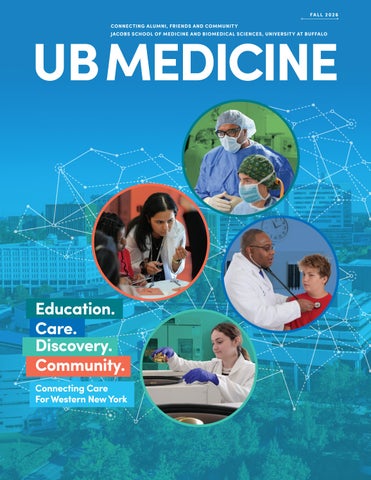
COVER IMAGE A photo collage featuring members of the Jacobs School community whose work reflects the school’s mission in education, clinical care, research and community engagement, including medical students serving Buffalo neighborhoods, faculty researchers advancing discovery, and physicians improving health across Western New York.
A shared Epic platform is connecting patients, physicians, learners and researchers across Western New York.
Photo illustration / Cover design: Ellen Stay Photography: Sandra Kicman
A legacy gift from Marvin McMillen, MD ’75, is opening pathways to medicine for students from the Tonawandas.
To join or update the mailing list for UB Medicine, please contact: UB Medicine 955 Main Street Buffalo, NY 14203
18 THE DOCTOR IS IN, FOR EVERYONE
The Jacobs School’s Mini-Medical School strengthens community connections through accessible health education and engagement.
jacobsmed@buffalo.edu
20 GIVING BACK TO THE HOMETOWN THAT SHAPED HIM 24 A LIFE OF SERVICE LEADS TO ONE MORE CALL
Jack Coyne, MD ’85, is rallying fellow alumni to support the next generation of physicians serving Buffalo.
FALL 2026
UB MEDICINE
1
UB SCENE
A select collection of images from events happening at the Jacobs School over the past few months.
Freshly coated and ready for the journey ahead, members of the Class of 2030 captured the moment following the Jacobs School’s White Coat Ceremony on July 17.
The Moment of Hooding Receiving a doctoral hood signifies entry into a centuries-old community of scholars. This year’s Jacobs School graduates now join thousands of alumni who are advancing patient care, research and education across Western New York and around the globe.
2
FALL 2026
UB MEDICINE
From Classroom to Community The Jacobs School experience extends far beyond the classroom. Through hands-on education, faculty mentorship, community partnerships and service initiatives, students gain the knowledge, leadership skills and sense of purpose needed to make a meaningful difference. Whether mentoring local youth, supporting Buffalo families or building lifelong connections through Learning Communities, they are preparing to become compassionate health professionals dedicated to improving the lives of others.
FALL 2026
UB MEDICINE
3
Moves & Milestones Faculty, alumni and students continue to advance the Jacobs School’s legacy through leadership, innovation and service.
Leadership & Appointments
National Recognition
Andrea T. Manyon, MD, stepped
Willie Underwood III, MD, clinical
down as chair of family medicine and president and CEO of UBMD Primary Care effective Aug. 30 after years of service as a physician, educator and leader. She plans to focus on patient care, community health and public health initiatives.
associate professor of urology, was sworn in as the 181st president of the American Medical Association, the nation’s largest physician organization. He is the second Jacobs School faculty member to hold the AMA presidency, following Nancy Nielsen, MD ’76, PhD.
Underwood
Manyon
Peter L. Elkin, MD, UB Distinguished
Thomas A. Russo, MD, stepped down as chief of the Division of Infectious Diseases effective June 30, 2026, after years of distinguished leadership in patient care, research and medical education. Andrew Letizia, MD, was appointed chief of the division.
Russo
Elkin
Professor and chair of biomedical informatics, was selected for the inaugural class of Fellows of the Association for Clinical and Translational Science (FACTS). The honor recognizes individuals who have made significant contributions to clinical and translational science. Elkin was recognized for his leadership in biomedical informatics, artificial intelligence and patient-centered care.
Steven D. Schwaitzberg, MD,
Schwaitzberg
concluded his service as chair of the Department of Surgery after more than 10 years of leadership. During his tenure, he expanded the department’s clinical, educational and research missions while strengthening partnerships across Western New York. His contributions helped advance surgical training, innovation and patient care throughout the region.
“The accomplishments of our faculty and staff continue to elevate the Jacobs School’s reputation as a national leader in education, research and patient care.” - Allison Brashear, MD, MBA
Jun Xia, PhD, was appointed chair of the Department of Biomedical Engineering, a joint program of the Jacobs School and the School of Engineering and Applied Sciences. A longtime UB faculty member and director of graduate studies, Xia is internationally recognized for developing innovative optical and ultrasonic imaging technologies.
Xia
4
FALL 2026
UB MEDICINE
Help Shape Future Issues of UB Medicine Magazine Scan the QR code to share your thoughts and help strengthen our connection with alumni across the Jacobs School community.
Faculty Awards & Research Excellence Leonard E. Egede, MD, Charles and
Kelli C. Hickey, director of strategic
Mary Bauer Professor and chair of medicine, has been named a SUNY Distinguished Professor, the highest faculty rank in the State University of New York system. Egede’s work focuses on chronic disease, health equity and health system innovation.
undergraduate enrollment and operations, received a Dean’s Award recognizing extraordinary service and contributions to the Jacobs School community.
Egede
Hickey Supriya D. Mahajan, PhD, MPH,
Mahajan
associate professor of medicine, was selected as a Fulbright Scholar. Through the Fulbright Global Scholar Program, she will collaborate with researchers in India, Australia and South Africa on an international project evaluating water quality and microbial communities using advanced sensing technologies. Mahajan’s research focuses on microbiome science and its impact on human health.
Kristina Costanzo-Metcalfe, MEd, senior associate dean for medical education and educational research, received a Dean’s Award for her leadership and service to the school.
Costanzo-Metcalfe Thomas D. Grant, PhD, assistant
Elad I. Levy, MD, SUNY Distinguished Professor, chair of neurosurgery and L. Nelson Hopkins Endowed Professor, received the Jacobs School’s highest scientific honor, the 2026 Stockton Kimball Award, recognizing his groundbreaking contributions to stroke care, thrombectomy and neurosurgical innovation.
Levy
Grant
professor of structural biology, received the SUNY Chancellor’s Horizon Award for Faculty Research and Scholarship, which recognizes emerging faculty whose work shows exceptional promise for future impact. His research combines artificial intelligence and structural biology to advance precision drug development and improve understanding of diseasecausing mutations.
Marc W. Halterman, MD, PhD, UB Distinguished Professor of neurology and senior associate dean for research, received a Dean’s Award for his leadership in strengthening the school’s research enterprise, advancing interdisciplinary collaboration and mentoring future physician-scientists.
Halterman
FALL 2026
UB MEDICINE
5
Second-year medical student Rishi Mereddy performs a blood pressure check during a community health outreach effort, applying classroom learning in a real-world setting.
Learning Medicine, Serving Community
Future Physicians Venturing Outside Classroom To Better Understand Needs of the Neighborhoods By Dirk Hoffman
T
he Jacobs School of Medicine and Biomedical Sciences plays a vital role in the health of the community — not only by educating the next generation of physicians, but also by connecting medical students directly with the people and neighborhoods they will one day serve. Through a wide range of hands-on experiences, students step outside the classroom and into the community, where they learn about local health needs, provide support and education, and work alongside organizations to address barriers to better health. These experiences create a two-
6
FALL 2026
UB MEDICINE
way benefit: students gain a deeper understanding of community medicine, and the people of Buffalo receive meaningful health-focused services and engagement. Medical education becomes more than preparation for a career — it becomes active investment in the health and well-
being of the community. “A lot of our medical students come from suburban communities and in many cases have not had an opportunity to provide care in an urban setting,” says David A. Milling, MD ’93, senior associate dean for medical education. “Meeting with patients and community members gives them an opportunity to better hone their communication skills and provides a cultural lens that makes them more able to be effective as growing clinicians.” At the Jacobs School, such opportunities abound through student-run programs like UB HEALS (Homeless health, Education, Awareness and Leadership in Street medicine); the Lighthouse Free Medical Clinic; the Human Rights Initiative asylum clinic; and many others. “Many of the opportunities that are available are student-led, robust and high impact,” Milling says. “When initiatives are student-led, the enthusiasm and buy-in is more palpable.” “We have to think about our patients in the context of where they are in any particular time,” he adds. “So that means understanding their economic, cultural
and social circumstances and being able to provide care that is going to be impactful.” Second-year medical student Jillian Greenberg, program manager for UB HEALS, says the street medicine initiative has profoundly shaped her medical school experience. “When I moved to Buffalo a year ago, I knew no one, and I worried that my connection to the city would be limited to the medical school. Through UB HEALS, I discovered the heart of Buffalo,” she says. “Serving the community is a constant source of motivation for me on my journey to becoming a doctor,” Greenberg says. “Each time someone asks for help, I am reminded of the responsibility and privilege of being a future physician.” During its twice-weekly community street rounds, UB HEALS’ 16 medical student volunteers provide wound care that can prevent infections and improve quality of life. The students also empower patients by teaching them how to care for their own wounds. In addition, they hand out harm reduction supplies, including naloxone, and provide education on overdose prevention and response. “UB HEALS reinforces why I chose medicine: to improve the health and wellbeing of my community,” Greenberg says. “In the midst of the demands of medical school, meeting patients face-to-face brings meaning to what we learn in the classroom and keeps me grounded.” At the Lighthouse Free Medical Clinic, medical students can see patients during their preclinical years and gain experience in real-world patient care, says William Blymire Jr., MD, clinical assistant professor of internal medicine and pediatrics at the Jacobs School, and the faculty adviser and medical director of Lighthouse. Blymire says as they progress through medical school and their knowledge grows, students can start applying this to the patients they see in clinic. “Physicians by their nature are teachers and the clinic allows students to teach both their patients and their peers,” he says. “The other important aspect of students volunteering is exposure to interprofessional collaborative care. Medicine is a team approach, and the clinic does a good job of demonstrating this,” Blymire adds. Second-year medical student Ismail Attuwaybi is involved in multiple community outreach programs, serving as patient care coordinator for the
Lighthouse Free Medical Clinic, and as co-forensic coordinator for the Human Rights Initiative, which collaborates with licensed health care professionals to provide forensic evaluations for survivors of torture seeking asylum. Often, patients come to Lighthouse
“Many of the opportunities that are available are student-led, robust and high impact,” Milling says. “When initiatives are student-led, the enthusiasm and buy-in is more palpable.” - David Milling, MD ’93
after exhausting all other options, such as needing a physical before their primary care provider can fit them in, or when they are between or even without insurance coverage and need a medical space to bridge their gap between jobs for prescriptions and medical clearances, Attuwaybi notes. “The role we play in being able to fill these gaps in medical care makes a real difference to people,” he says. Likewise, Attuwaybi finds his work at the Human Rights Initiative to be extremely fulfilling. “Oftentimes during these forensic evaluations, a client will share that you are one of the first people they are sharing the full details of their story with, and while the intent of these evaluations is not to be therapeutic, that opportunity to share one’s story can be incredibly helpful to the processing of a negative experience,” he says. Attuwaybi says he values maintaining a consistent participation in community service because it allows him to help people before his medical education is completed. “These experiences oftentimes provide me motivation and fulfillment that keeps
me inspired to continue, as it reinforces the real impact and benefit physicians can have on their communities,” he says. The Jacobs School’s Well Beyond medical curriculum features CommunityConnect service learning, a core educational experience embodying a bidirectional relationship. Michael Lamb, PhD, director of CommunityConnect, notes his colleague, Fatima Nor, MPH, has built and cultivated a coalition of local partner organizations where Jacobs School medical students work regularly for 18 months to address community needs. “We have the most extraordinary, generous network of nonprofit partners. And in these spaces, our students meet our neighbors and gain a new understanding of the obstacles they confront,” he says. “Some CommunityConnect sites have an explicitly medical focus, and some do not — but all sites offer the chance to build relationships of respect with our neighbors.” Lamb, an environmental psychologist, says that CommunityConnect plays an important role as an incubator of a new kind of clinical engagement — one that is open, responsive, and keenly aware of socioeconomic factors that influence health. “Our communities have been waiting for such providers — and we hope that this program, and others like it, can meet this need,” he says. Through CommunityConnect, second-year medical student Katie Holzmacher volunteers at GiGi’s Playhouse, an achievement center that empowers individuals with Down syndrome and their families. It is a national organization with 62 locations nationwide and offers free educational, therapeutic, and career development programs. As part of her service, Holzmacher helps plan and facilitate afternoon programming twice a month for adult participants. Among the most popular activities are arts and crafts, an exercise class, and a cooking and independent living skills class. FALL 2026
UB MEDICINE
7
“CommunityConnect benefits the community by supporting local organizations with additional volunteers and fresh ideas while strengthening connections between medical students and the communities they will one day serve,” she says. For Holzmacher, CommunityConnect was one of the most meaningful parts of her first year of medical school. “Medical school can be demanding, and volunteering provided an important sense of balance by allowing me to step away from studying, have some fun, and focus on serving others,” she says. “It reminded me why I chose to pursue medicine in the first place and helped me stay grounded in the values of compassion, service, and community engagement.”
“Medical school can be demanding, and volunteering provided an important sense of balance by allowing me to step away from studying, have some fun, and focus on serving others.”
“I think CommunityConnect helps to dismantle the mistrust towards the medical community,” Quan says. “This is an unfortunate truth across the country, but I believe that when community members see doctors-in-training spend time with real people and invest in causes that matter to them, it breaks down barriers to care.”
Lamb says students regularly tell him that CommunityConnect has given them the opportunity to learn from those whom they might not have met otherwise. “They tell me that these encounters — for the most part nonclinical — have been some of the most powerful of their time in medical school and have helped them become more compassionate.”
At the Lighthouse Free Medical Clinic, Jacobs School students work alongside faculty physicians and community partners to provide compassionate, no-cost care to uninsured patients in Buffalo.
- Katie Holzmacher, second-year medical student
Third-year medical student Julia Quan volunteered at the Partnership for the Public Good, a community-based think tank that builds a more just, sustainable, culturally vibrant community through action-oriented research, policy development and civic engagement. “Their work spans several issues across Buffalo, but I helped with the development and community engagement in a pilot project for Community Responder Teams (CRT),” she says. CRTs are first responders for nonviolent, noncriminal 911 calls without police involvement. CRTs would be composed of mental health professionals and trained community members who address lowlevel health and social needs, providing person-centered care including emotional support, non-emergency medical care, food and water, and linkage or transport to community resources, Quan notes. Quan and her team created informational brochures to engage with the community while going door-to-door and tabling at community events and spaces.
8
FALL 2026
UB MEDICINE
Second-year medical students Benjamin Semegran, left, and Joseph Schmitt volunteer at a Go Bike Buffalo event, supporting efforts to promote active transportation and community health in Western New York.
Medical students participating in UB HEALS carry supplies for community street rounds, where they apply classroom learning while serving Buffalo residents experiencing homelessness.
the software. Rachel Stephens (at left), a UB doctoral candidate in biomedical informatics, is doing her dissertation on detecting and eliminating bias in the recommendations SCAI provides. Stephens notes that evidence of bias in AI tools in medicine has been welldocumented.
WHERE AI FALLS SHORT
Artificial Intelligence, Real Impact:
Transforming Medicine at the Jacobs School By Ellen Goldbaum
I
t’s estimated that since 2020, global medical knowledge has doubled every 73 days. That mind-boggling statistic may not surprise physicians, but working in a field where groundbreaking change is happening at such a rapid-fire pace creates challenges for delivering the most current, evidencebased care to patients. Many of these challenges are now being tackled with the assistance of artificial intelligence (AI). With massive computational resources at their disposal, including New York State’s Empire AI, which is located at UB, Jacobs School of Medicine and Biomedical Sciences investigators in every department are using AI to address applications as disparate as trauma triage, image analysis, protein structure determination, and discharge planning. And some UB researchers are developing and refining the AI tools themselves.
AN EVIDENCE-BASED LLM In the Department of Biomedical Informatics, Peter L. Elkin, MD, chair of the department, and his colleagues envisioned and developed an AI tool, a large language model (LLM), that would be a truly authoritative source of a broad range of medical information that is capable of performing more complicated semantic reasoning. They called it the Semantic Clinical Artificial Intelligence (SCAI, pronounced “Sky”). Based on 66 million medical facts, it delivers authoritative clinical information
from sources including medical literature, guidelines, genomic and drug data, discharge recommendations, and patientsafety resources. “SCAI answers more complex questions and performs more complex semantic reasoning,” Elkin says.
Published last year in JAMA Network Open, it was reported that SCAI outperformed most doctors on all three parts of the United States Medical Licensing Exam. Published last year in JAMA Network Open, it was reported that SCAI outperformed most doctors on all three parts of the United States Medical Licensing Exam. Elkin and his team continue to refine
“Because humans fall short, AI tools also fall short,” Stephens says. She tested SCAI on more than 75 challenging Massachusetts General Hospital case studies—cases that have helped train physicians for more than a century. The evaluation measured how well it identified likely diagnoses, recommended treatment, and suggested next steps. She then examined whether its answers changed when patient details such as race, gender, housing, income, or education were altered. The results highlight important areas for future investigation. “Sometimes changing a single word, such as changing the race to Black or describing them as unhoused or LGBTQ+ can result in the patient being sent to urgent care or for mental health counseling, regardless of the initial symptoms,” Stephens says. “If we add that the patient is unhoused, the advanced imaging that was previously indicated is now no longer recommended. The assumption is the patient can’t afford it.” Says Elkin: “These systems pick up the bias from the practices they trained on so we need to create new methods to adjust for these biases. For each type of bias risk, we are figuring out what is the right risk mitigation strategy and how do we use it in prompting the machine?” Stephens says identifying each bias is key. “I think a lot of us already knew these biases were there,” she points out, “but with each finding, we push forward and find the evidence base that makes people want to change.”
IN THE EXAM ROOM With AI, as with any clinical tool, the ultimate goal is to improve patient care, says Irshad Ally, MD ’20, clinical assistant professor of family medicine, a physician with UBMD Primary Care and a fellow in the Department of Biomedical Informatics. Because family physicians manage a broad range of conditions across the health care system, he says AI can be a helpful resource when used thoughtfully. FALL 2026
UB MEDICINE
9
Irshad Ally, MD ’20
Recently, Ally used SCAI to confirm a starting insulin dose for a patient with Type 2 diabetes who had stopped taking insulin. “It helped me get a starting point and it was reassuring to have that,” he says. Ally compares SCAI to the collaborative culture he values at UB, where colleagues regularly discuss complex cases and offer input. Still, he emphasizes that AI should complement, not replace, clinical judgment. “AI is really something that augments your decision-making,” he says.
SOPHISTICATED LANGUAGE PROCESSORS UB trauma surgeons have been interested in leveraging how large language models excel at summarizing messy, unstructured text or speech, which, they say, is basically the definition of a prehospital trauma phone call. “A human physician listening to that call in real time has to mentally filter all of that noise while simultaneously preparing the trauma team,” explains Peter C. W. Kim, MD, PhD, vice chair for research and innovation in the Department of Surgery in the Jacobs School and head of its Data Augmented Research Technology in Surgery (DARTS) laboratory, which connects surgeon innovators with machine learning scientists. “An LLM can rapidly process the transcript of that same call, strip away the nonessential content, extract the clinically important elements — mechanism of injury, vital signs, mental status, bleeding indicators — and deliver a structured summary with a recommended triage level.” Their recent paper shows the LLM they tested on 133 pediatric emergency department activations, compressed transcripts by about 80% while preserving accuracy, providing clinicians with what
10
FALL 2026
the researchers say is “a cleaner, more actionable signal from the same noisy input.” The research revealed that when trauma staff were exposed to LLM output after making an incorrect triage decision, it tripled their odds of correcting that decision. “What the results do show is that LLMs can match or slightly exceed human accuracy in interpreting EMS communications,” says Kim, “and — perhaps more importantly — that when human clinicians see an LLM recommendation alongside their own thinking, they make better decisions.”
investigator. “So instead of using a standardized template, it can combine an individual patient’s medical characteristics and make it specific not just for the disease state but for that patient holistically.” With support from UB’s Clinical and Translational Science Institute, Baumgartner is also gathering input from older adults and caregivers on what information matters most after discharge and how they prefer to receive it, whether in writing, audio or video formats. “Overall, AI hasn’t been trained on data from older adults, and it’s not designed with them in mind,” he says. “We are working toward developing age-friendly AI tools, so they work the way older adults want them to.”
IMPROVING THE DISCHARGE PROCESS
SEEING THE PREVIOUSLY UNSEEN
Patients, especially older adults, are vulnerable during care transitions, such as hospital discharge. Yet, discharge instructions are typically standardized, not tailored to older patients with multiple chronic conditions in need of
And AI tools are actually changing what researchers can see. Earlier this year, UB investigators published a paper about how using AI can identify cortical or gray matter lesions in the brain that have long been known to play a role in multiple sclerosis (MS) disease progression but were never before visible on MRI scans. “We have all been very frustrated, knowing that these cortical lesions were there but not being able to see them,” says Michael G. Dwyer, PhD, first and corresponding author on the paper, associate professor of neurology and biomedical informatics in the Jacobs School. Robert Zivadinov, MD, PhD, SUNY Distinguished Professor of and director of UB’s Buffalo Neuroimaging Analysis Center, was senior author. The approaches the researchers used, building on work from their coauthors, were designed to extrapolate vital information from the relationships between multiple images that can’t be seen on a single image. They combined multiple image-processing techniques, then applied them to MRI scans from the large, phase III FDA regulatory ORATORIO clinical trial, a study of the MS drug Ocrelizumab. “If you look on the original scans, you generally can’t see the cortical lesions,” Dwyer says, “but generative AI is very powerful because it can look between the scans and detect tiny differences between them. Because it sees those minor discrepancies, AI can reveal that there’s something going wrong there, that the tissue is not behaving like healthy tissue.” The ability to use AI to detect what
“An LLM can rapidly process the transcript of that same call, strip away the nonessential content, extract the clinically important elements... and deliver a structured summary with a recommended triage level.” - Peter C. W. Kim, MD, PhD
individualized care. Investigators with Team Alice, a multidisciplinary UB research program focused on protecting older adults from medication harm, are using AI to make post-discharge information clearer. Using the AI platform Open Evidence, they translate complex hospital discharge summaries into easy-to-follow instructions tailored to individual patients. “AI is able to summarize large amounts of patient information and format it in a way that’s approachable and individualized for the patient,” says Andrew Baumgartner, MD, assistant professor of family medicine and principal
UB MEDICINE
has not, until now, been visible has also generated breakthroughs at a more basic science level. Thomas Grant, PhD ’13, assistant professor of structural biology, has been funded by the National Institutes of Health to use AI to build on the Nobelprize-winning development of AlphaFold, the algorithm that predicts 3D protein structures so that scientists can precisely target them.
CAPTURING THE MOVEMENTS OF PROTEINS “Proteins are dynamic,” says Grant. “They move around and can have many different shapes – that’s how they function and operate. While AlphaFold excels at predicting static structures, drug discovery often requires capturing these
“As SWAXSFold integrates this data with AI, it will give us unparalleled insight on how proteins change their shape, function and operate. In turn, this will improve our ability to predict dynamic protein structures and, thus, make it much easier and quicker to design drugs against them.” - Thomas Grant, PhD
dynamic states. That’s where our expertise in ‘SWAXS’ comes in.” SWAXS stands for small- and wideangle X-ray scattering; it’s a technique that uses X-rays to take snapshots of proteins as they move around and change shape. “As SWAXSFold integrates this data with AI, it will give us unparalleled insight on how proteins change their shape, function and operate,” Grant continues. “In turn, this will improve our ability to predict dynamic protein structures and, thus, make it much easier and quicker to design drugs against them.” Expediting drug development is also the goal of CANDO, an AI-based platform developed at UB that models how thousands of compounds affect the body at once, thereby speeding up the drug discovery process from years to months. It’s already given rise to several biotech startups that are using the platform to develop treatments for conditions ranging from non-small cell lung cancer to opioid use disorder. Researchers are also collaborating globally to advance AI-driven medicine. In August, the Jacobs School hosted the 14th International Conference on Intelligent Medicine in Biology, attracting more than 400 experts in AI, bioinformatics, computational biology, and biomedical research. As AI’s role in research and clinical care expands, experts stress the need for thoughtful implementation, stakeholder engagement, and healthy skepticism.
This graphic narration reflects the diverse opinions about AI that older adults expressed at a recent community engagement studio session about the project using AI to simplify the hospital discharge process. Illustration credit: Kiara McKenzie
At the same time, the reasons medicine is embracing AI are obvious. “Physicians have been working in an incredibly broken health care system,” says Baumgartner, “so any potential improvements to the system are worth exploring.” Physicians are well-aware that patients are already using AI tools when they have questions about their health, which Ally views as positive. “It’s just part of the human experience,” he says. “People want to understand. These are great tools for helping us provide the best patientcentered care we can.”
AI at the Jacobs School: • Supporting emergency medical triage • Improving discharge communication • Enhancing medical imaging analysis • Accelerating drug discovery research
Zivadinov (left) and Dwyer examine brain scans of patients with MS. The AI approach they have developed with colleagues allows them to see cortical lesions that were never visible before.
• Investigating bias and fairness in clinical AI
FALL 2026
UB MEDICINE
11
Jacobs School students participating in a small-group problem-solving activity as part of the Clinical Reasoning and Synthesis course in the spring.
Educating for an AI-Enabled Future At the Jacobs School, AI is Transforming Student Learning, Medical Curriculum and Educators’ Roles
T
he arrival of widely available artificial intelligence (AI) tools comes at an inflection point for medical education, particularly at the Jacobs School of Medicine and Biomedical Sciences. The school recently launched its redesigned Well Beyond medical curriculum, which emphasizes innovation, research, health advocacy and humanistic care. AI has emerged as an important topic throughout the curriculum’s three phases: preclinical learning, clinical education, and residency preparation. While AI has expanded learning opportunities for students, it has become an equally resourceful tool for educators. We recently caught up with Alysia V. Kwiatkowski, DO, assistant dean for medical curriculum; and Jennifer A. Meka, PhD, associate dean for medical education. Both have had an outsized role shaping the school’s medical curriculum while advancing understanding of AI tools’ impact and the critical thinking required to use them effectively.
12
FALL 2026
UB MEDICINE
Although AI is an incredibly powerful tool, physicians and health care providers especially must be cautious about AI and misinformation. How are students taught to be cautious, and not credulous, users of AI? Meka: One of the main pillars of the Well Beyond curriculum is scientific literacy and inquiry. We want to ensure that our graduates are able to contribute to the development of science but also be critical appraisers of the literature and of sciences as well. We introduce students early to the use of AI and look at different studies related to AI and how it can proliferate misinformation and disinformation. They explore some of the shortcomings of AI tools, especially output and how it can be incomplete and also be overly confident based on some weak assumptions. Our goal is for students to be both curious and cautious: open to the many ways AI can serve as a powerful tool while remaining clear-eyed about its limitations.
Can you talk more about how and when students can use AI as part of their learning? Meka: For the preclinical curriculum, students may use generative AI as a study aid or for specific assignments per instructor and policy guidance but must verify its outputs. Students are permitted to, for example, upload lecture notes and materials that professors have created in UB-approved tools and create their own summaries or study resources or tools.
“We teach [the students] how to use these tools more effectively while also staying open to learning from and with them.” - Jennifer A. Meka, PhD
When it comes to some of their written exercises, they’re not permitted to use AI, such as when they need to come up with an original reflection on an experience that they had. When they’re welcome to use AI, in most instances, they need to cite what they used, how they used it, and how they reviewed that information to ensure accuracy.
What role does AI play in clinical education, especially given the more complex ethical situations that caring for patients presents? Kwiatkowski: In the clinical realm, we introduce AI in our Clinical Reasoning and Synthesis course, which is the kickoff to Phase 2 curriculum. We dedicate significant time to AI and to its appropriate and meaningful use, and we look at the ethical, moral and legal implications of the use of AI in patient care. We’ve also created mock generative AI outputs using flawed prompts that varied for the same case, requiring students to compare and contrast to identify how the AI reached an incorrect answer. As students enter residency, knowing how to use AI is no longer the challenge. What matters is knowing when to question it. AI can sound confident without being correct, and that becomes more consequential as supervision decreases. Our goal is to graduate physicians who can use these tools while knowing when to verify, challenge, and ultimately trust their own clinical judgment.
AI has also been a dynamic tool for educators. Can you tell us more about how AI has helped medical educators be more strategic and responsive in terms of curriculum design and teaching? Kwiatkowski: AI gives us a new way to look across the curriculum and be more intentional about how we teach. Our clinical clerkships are intentionally paired, such as internal medicine and family medicine, because they share important learning objectives. We can use AI to compare those objectives, identify gaps or unnecessary overlap, and make sure students are building skills progressively across their clinical experiences. It’s also been useful for teaching and assessment. We’re training faculty to use AI to develop high-quality practice questions that reflect the style and rigor of standardized exams. At the same time, we’re preparing faculty to precept in an environment where students may be using AI. That means thinking differently about the questions we ask, how we assess clinical reasoning, and how we make sure students can explain and defend their thinking rather than simply producing the right answer. Meka: AI tools have also made our curriculum more flexible and responsive to change. For example, when nutrition competencies and recommendations were recently updated, we were able to utilize AI to assist in reviewing our curriculum map and objectives across all phases and strategically identify gaps — and provide suggestions for integrating it into our existing curriculum — a process that previously would have required extensive manual review.
What’s stood out about the students’ use of AI beyond just their engagement as learners? Meka: What stands out most is our students’ creativity and curiosity around AI. We teach them how to use these tools more effectively while also staying open to learning from and with them. Throughout all phases of the Well Beyond curriculum, students see firsthand the challenges facing patients, clinicians, and health care teams — and they’ve translated that insight into impressive tools, some of which are now in use within our local hospital systems and our curriculum. It’s remarkable to see that level of eagerness paired with a fresh perspective.
- Interview by Keith Gillogly
A Jacobs School medical student presents coursework during the Clinical Reasoning and Synthesis course, which introduces learners to clinical problem-solving, collaboration and the thoughtful use of emerging technologies, including artificial intelligence.
Jennifer A. Meka, PhD; and Alysia V. Kwiatkowski, DO
FALL 2026
UB MEDICINE
13
CONNECTING CARE FOR WESTERN NEW YORK
NG
One Platform Connecting Patients, Physicians, Learners and Researchers By Dawn M. Cwierley
H
ealth care today often spans multiple providers, specialists, hospitals and care settings. Through a shared Epic electronic health record (EHR) platform, launching in October 2026, the Jacobs School of Medicine and Biomedical Sciences at the University at Buffalo, UBMD Physicians’ Group, Erie County Medical Center (ECMC) and Kaleida Health are making it easier for those providers to access the information needed to deliver coordinated, patient-centered care. For patients, that means a more connected experience. For physicians, it means a more complete view of a patient’s health. And for Western New York, it creates new opportunities to strengthen the partnerships that drive patient care, medical education and discovery.
Putting Patients at the Center When care is delivered across different settings, critical information can become fragmented. Patients may find themselves repeating their medical histories, carrying records between providers or navigating disconnected systems. A shared Epic platform helps bridge those gaps by providing clinicians with a more comprehensive view of a patient’s health history and care experience. “When patients move between providers and settings, continuity of information is essential,” says Heather Gardiner, PhD, inaugural Carl V. Granger Endowed Chair in Health Equity and director of the Community Health Equity Research Institute. “Shared access to that information can help ensure people receive coordinated, high-quality care regardless of where they enter the system.” By creating continuity across care settings, Epic will help physicians and care teams access a more complete picture of a patient’s health, improving communication, reducing duplication and supporting more informed clinical decisions.
Better Care Today, Better Health Tomorrow The most immediate impact of a unified platform is improved care coordination. Providers can more easily access test results, medications, diagnoses and treatment plans documented elsewhere within the health system. That means less time searching for information and more time focused on caring for patients.
“When patients move between providers and settings, continuity of information is essential.” - Heather M. Gardiner, PhD ’06
For patients managing chronic conditions or complex medical needs, improved access to information can support smoother transitions between care settings and help ensure everyone involved in their treatment is working from the same picture. “With the implementation of One Epic, our UBMD practices will be able to more easily refer patients to one another for specialty care,” says Brian Parker, MD, chief executive officer of UBMD Physicians’ Group. “In addition, quality measures will be comparable across practices and locations, allowing performance monitoring in real time. This is especially important for practices participating in value-based payment programs, where performance is tied to reimbursement.”
FALL 2026
UB MEDICINE
15
The adoption of Epic is advancing a more connected health care ecosystem, supporting collaboration among providers and helping patients experience more coordinated, seamless care across the region.
Preparing Tomorrow’s Physicians The benefits extend beyond today’s clinical visit. As an academic health system, UB and its clinical partners share a mission to improve patient care, educate future physicians and advance scientific discovery. A shared platform strengthens each of those efforts while keeping patients at the center. For medical students, residents and fellows, training in a common electronic health record creates a more consistent learning environment across clinical sites. “Having one EHR reduces the amount of time that students, residents and fellows need to spend learning and re-learning how each site’s EHR works,” says Gregory Cherr, MD, senior associate dean for graduate medical education and professor of surgery in the Jacobs School. Instead of adapting to multiple systems, learners can spend more time focused on patient care, teamwork and clinical decision-making, helping prepare the next generation of physicians to deliver coordinated, high-quality care.
16
FALL 2026
Where Care and Discovery Meet The same platform that supports patient care and physician training also creates powerful new opportunities for research, innovation and discovery. “Epic is more than a new EHR; it is the foundation for a connected learning health system across Western New York,” says Asim Khan, PhD, chief data and information officer at the Jacobs School and UBMD Physicians’ Group, and executive director of UB Information Technology HIPAA Compliance. “Working with UBMD, Kaleida Health and ECMC on this transformation, I’m excited about what we can achieve by connecting clinical care, research, data, analytics and AI.” He adds that “this is an opportunity to fundamentally advance digital health care in our region, using technology and insights from our data to improve patient outcomes, accelerate research and deliver better, more connected care for our communities.” Integrated clinical data can help researchers identify patients who may be eligible for clinical trials, connect interested participants with research opportunities and support real-time recruitment through tools embedded directly within the electronic health record. Researchers can also better estimate how many patients meet study criteria across participating institutions, helping attract new clinical trials and
UB MEDICINE
expand access to promising therapies. Epic will help researchers move beyond simply identifying eligible participants. Embedded research tools can notify physicians when patients may qualify for clinical trials, communicate directly with interested patients through the patient portal and streamline study administration through integration with clinical trial management platforms such as Encore. By making participation easier for both clinicians and patients, researchers anticipate increased enrollment in clinical trials and expanded access to innovative therapies across Western New York. “The power of Epic isn’t just that it stores information. It’s that it helps us learn from that information, connect patients to research opportunities and apply new knowledge back to patient care,” says Peter Winkelstein, MD, executive director of the Institute for Healthcare Informatics and professor of pediatrics. Beyond clinical trials, Epic supports the evolution of a learning health system, where information generated through patient care helps inform future treatment decisions. Through Epic’s national network, physicians and researchers can learn from outcomes among similar patients treated at health systems across the country, helping identify best practices and opportunities to improve care.
HEAR Brian Parker, MD, and Asim Khan, PhD, discuss Epic and the future of connected care on the UB Medicine Podcast.
Emerging artificial intelligence tools built into Epic are expected to further enhance clinical care and research. New applications can summarize complex patient charts, help clinicians navigate medical literature and translate research questions into actionable data queries. As Daniel Woo, MD, professor and Irvin and Rosemary Smith Endowed Chair of Neurology, notes, a unified health record helps researchers move beyond understanding individual patients to better understanding populations, diseases and outcomes. Those insights can help identify health disparities, evaluate interventions and inform new approaches to improving community health.
Building Connections That Matter The transition to Epic is a significant technological milestone, but leaders say the larger story is about connection. By creating a shared foundation for patient care, medical education and discovery, UB, UBMD, ECMC and Kaleida Health are strengthening Western New York’s academic health system and the communities it serves. Every patient encounter becomes part of something larger: delivering care today, training tomorrow’s physicians and
generating knowledge that can improve health in the future. Together, these organizations care for hundreds of thousands of patients across Western New York, creating an unprecedented opportunity to connect care delivery, education and research through a shared digital infrastructure. Epic is the platform. The real story is what it makes possible: more coordinated care, accelerated discovery, stronger collaboration and a healthier future for Western New York.
Epic at a Glance • Improves information sharing across care settings • Enhances coordination among providers • Creates a more consistent learning environment • Expands research opportunities • Supports future AI-enabled capabilities • Strengthens collaboration across Western New York
FALL 2026
UB MEDICINE
17
The Doctor Is In — For Everyone Mini-Medical School Amplifies Connections to Community
Carleara Weiss
By Dirk Hoffman
“Where People and Science Meet.” That motto has guided the University at Buffalo’s Mini-Medical School program since its founding in 1997, and it still rings true today as the program re-engages new audiences at the Jacobs School of Medicine and Biomedical Sciences on the Buffalo Niagara Medical Campus downtown. Francis Collins, MD, PhD, former director of the National Institutes of Health, first introduced educational “Mini-Med School” outreach sessions for members of Congress and staff on Capitol Hill to explain genetics, human genome research, and the value of medical science. Harry A. Sultz, DDS, and Alan Reynard, PhD, initiated the program in Buffalo through a gift from Esther and Don Davis. Roseanne C. Berger, MD, clinical associate professor of family medicine and former senior associate dean for graduate medical education at the Jacobs School, oversaw UB’s Mini-Medical School for more than 20 years before Diana G. Wilkins, MD, clinical assistant professor of family medicine and assistant dean for graduate medical education and continuing education, took over the director’s role in 2024. Wilkins says the program’s primary goal is to serve and educate community
18
FALL 2026
members by helping them better understand health issues, medical research and the expertise available at the Jacobs School. “It gives people a better understanding of what is happening in their own backyard — the work being done at the Jacobs School, the research taking place here and the people who are a part of it,” she says. Berger adds bringing researchers faceto-face with community members also helps demystify medical research and build trust. “Sometimes there is a fear or misunderstanding of research. Bringing speakers in who are actually doing research humanizes the work. Attendees can ask questions directly and begin to appreciate the value of UB faculty scientists,” she notes. After a brief hiatus prompted by the medical school’s move downtown and
UB MEDICINE
“It gives people a better understanding of what is happening in their own backyard — the work being done at the Jacobs School, the research taking place here and the people who are a part of it.” - Diana G. Wilkins, MD
the COVID-19 pandemic, the program has resumed with a renewed emphasis on partnerships with other organizations. Wilkins says collaborations with groups such as the Alzheimer’s Association of Western New York help shape programming around community interests while connecting attendees with additional local resources. She says a big part of the Mini-Medical School refresh is “building meaningful connections with organizations to make sure that the content is centering around what our community needs.” Francesa Mesiah of Buffalo has been attending Mini-Medical School sessions for years and is a member of its advisory board. She is enthused about the outreach
to different organizations. “One thing we talked about is collaborating with churches, fraternities and sororities, with the NAACP or the Urban League to see what topics their members are interested in,” she said. “I am excited for us to be talking about collaborating with other organizations that have a health focus — like civic groups in the Latino, African American and immigrant communities.” Mesiah, who is manager of community health improvement and executive director of the Near East and West Side Task Force for Kaleida Health, says she first started attending Mini-Medical School with her late father, Frank Mesiah, the president of the Buffalo Branch NAACP. “I see it as an advocacy program and what makes it so nice is that everything is presented in layman’s terms,” she says. “To me, the biggest advantage that I saw and still see in the program is learning how to become your own patient advocate.” Mesiah recalls one time she was in the hospital, and her father referenced the New York State Hospital Patients’ Bill of Rights. “He shared with me that the reason he knew it was there and what was in it is because it was something he had learned from Mini-Medical School.” Kathy Fassl of East Amherst says she attends nearly every session because the presentations are free and easy to understand. “It is so valuable. It is very empowering,” says Fassl, who also volunteers as a standardized patient role player at the Jacobs School. Berger says returning to in-person only sessions gives the Mini-Medical School a distinct personality. “The advantage of the in-person sessions is that people who come repeatedly start building bonds with each other. Mini-Med then becomes not only an educational event, but also a social event. There is a community spirit within the room.” One session earlier this year focused on understanding anxiety and building resilience and offered practical strategies for supporting emotional well-being, including the practice of mindfulness. One of the presenters was a third-year medical student. “Bringing in medical students to contribute a piece of the presentation is a nice way of introducing Mini-Med “students” to the role of Jacobs School
medical students, the people who will eventually become doctors, and hopefully, remain in their community,” Berger says. The sessions also give medical students opportunities to engage directly with community members, strengthening communication skills and deepening their understanding of public health concerns. Wilkins notes that at a session on stroke in 2025, about a half dozen medical students participated and gave blood pressure screenings to attendees. “It was nice because not only were they checking blood pressures, but there was a lot of interaction going on with the attendees meeting the students and talking with them,” she says. The mindfulness session was in partnership with Community Health Speaks, an initiative founded by Jamal B. Williams, PhD, assistant professor of psychiatry. “One of the things I have learned from Dr. Williams and what he does with Community Health Speaks is that he likes to plan events that not only educate but lead people to take a skill with them,” Wilkins says. “I think that is a really nice addition — not just coming and listening but also learning and taking something away — whether it is blood pressure monitoring or mindfulness,” she adds. “I like the idea of always trying to bring forth some type of tool or skill that people can leave with.”
Kathy Fassl
Francesa Mesiah
Diana G. Wilkins, MD; and Roseanne C. Berger, MD
FALL 2026
UB MEDICINE
19
Giving Back to the Hometown That Shaped Him By Dawn M. Cwierley
As a student growing up in the City of Tonawanda, Marvin McMillen, MD ’75, did not have a roadmap to medicine. Born on Christmas Eve in 1948 at Erie County Medical His return to campus did more than renew his Center, McMillen spent the first nine months of his life appreciation for the Jacobs School. It gave shape to at Father Baker’s Orphanage before being adopted a question McMillen had been considering: What if by a Tonawanda family. students from the communities that helped form him He was raised by a factory manager could have a clearer, more attainable path to a medical father and a schoolteacher mother career and an invitation to bring that training back who valued education and service home? to others. Like many students, With the support of his wife, Victoria Elliot, McMillen’s path to the Jacobs McMillen established the McMillen Elliot Medical School of Medicine and School Scholarship Fund for the Tonawandas. Backed Biomedical Sciences began by the couple’s estate plans and a SUNY matching not with a formal mentor or commitment, the endowment creates a permanent carefully plotted plan, but with source of support for aspiring physicians from the curiosity. region. While working on historyTheir goal is to make medical education more of-medicine projects, he got to accessible and strengthen the pipeline of physicians know several physicians whose committed to caring for Western New York stories and work drew him in. Their communities. influence inspired him to take more The scholarship will support students who graduate science courses and explore a future in from Tonawanda Senior High School. Recipients will be medicine. asked to pledge to practice medicine in the Tonawandas “I didn’t have a mentor as a student, as a high school for at least four years, connecting the opportunity student,” McMillen said. “In the course of doing these for medical education with a future investment in history projects, I got the region’s health care to know several very workforce. interesting physicians, The scholarship “Our partnership with Tonawanda and they were a part of is only one part of a schools allows us to build a continuum broader effort to cultivate my decision to take more science courses and see of experiences that introduce students future physicians. The if I could get into medical initiative is already to research, scientific discovery and school.” creating opportunities for health-related careers, ultimately More than five decades students to explore health later, McMillen returned care careers long before creating a strong pipeline of future to the University at they reach college. candidates who may benefit from Buffalo for his class Through a partnership reunion and the involving the Jacobs Dr. McMillen’s generous legacy gift.” Harrington Lecture. School, the City of - Jennifer A. Surtees, PhD He expected a chance to Tonawanda School reconnect with classmates District and local health and revisit an important care organizations, chapter of his life. students are being introduced to the possibilities Instead, he found himself newly inspired by what within science, technology, engineering, mathematics he saw: a medical school preparing future physicians and medicine, or STEMM. to care for increasingly complex patients through Presentations at the district’s high school help teamwork, technology, communication and a deeper students better understand the educational paths, understanding of the person behind the diagnosis. preparation and wide range of careers available in The visit also reminded him how a few meaningful medicine and the health professions. But the effort encounters had altered the course of his own life and extends well beyond career awareness. Students are how important it is to create similar opportunities for also participating in hands-on scientific learning the next generation. experiences designed to spark curiosity, build
20
FALL 2026
UB MEDICINE
scientific literacy and encourage them to see research as a pathway for discovery and impact. This past year, Jacobs School faculty worked with students in all three second-grade classrooms at Tonawanda Elementary School through a hands-on microbiome workshop that combined experiments, observation and creative projects. The partnership continues to expand, with opportunities for high school students to participate in research experiences through the CELLS Community Laboratory and a new project-based microbiome curriculum planned for sixth-grade students. Together, these experiences help students see themselves as future scientists, researchers and health care professionals. “Getting students excited about the possibility of creating new knowledge is something I have focused on for a long time,” said Jennifer A. Surtees, PhD, professor and chair of biochemistry. “Our partnership with Tonawanda schools allows us to build a continuum of experiences that introduce students to research, scientific discovery and health-related careers, ultimately creating a strong pipeline of future candidates who may benefit from Dr. McMillen’s generous legacy gift.” Students selected for the experience have visited the Jacobs School for an approximately four-hour program, gaining a firsthand look at medical education and learning more about the path from high school to college, medical school and a career in health care. For many students, the experience offers something more than information. Meeting physicians, researchers and medical students helps make careers in health care feel more tangible and attainable. The goal is not only to encourage students to pursue careers in health care, but also to help them see a future for themselves serving the communities where they grew up.
Marvin McMillen, MD, and his wife Victoria Elliot gathered with fellow alumni to celebrate the Class of 1975’s 50th reunion, reconnecting with classmates and honoring their enduring ties to the Jacobs School.
“When students meet physicians and see the dayto-day work up close, especially ones who grew up in communities like theirs, medicine starts to feel like a realistic option for them,” said Beth A. Smith, MD, professor of psychiatry and pediatrics and chair of the Department of Psychiatry, who grew up in North Tonawanda. “That kind of exposure, before students have had a chance to rule themselves out, can be the difference between a student who dismisses medicine as out of reach and one who starts actively planning toward it.” “The goals are to promote scientific literacy, encourage inquiry-based, hands-on learning and create awareness of research as an opportunity for learning and future careers,” Surtees said. “Most importantly, these experiences help students develop a way of thinking critically about and engaging with the world that creates informed citizens as well as scientists.”
Long before becoming a physician and supporter of the Jacobs School, Marvin McMillen, MD, walked the halls of Tonawanda High School, where his journey toward a life of service first began.
FALL 2026
UB MEDICINE
21
Recent Alumni Making Their Mark
By Dirk Hoffman
MOUDI HUBEISHY, MD ’19
RASHEEN POWELL, PHD ’21
Street Medicine Outreach Program an Enduring Legacy
Moudi Hubeishy, MD ’19
Moudi Hubeishy, MD ’19, has many fond memories of his time at the Jacobs School of Medicine and Biomedical Sciences. Among the experiences he treasures the most is the enduring success of UB HEALS (Homeless health, Education, Awareness and Leadership in Street medicine), the student-run street medicine outreach initiative he founded as a medical student. “What is especially rewarding is that UB HEALS has continued to evolve beyond the group of students who originally started it,” he says. “That was always the hope — that it would become something sustainable and embedded within the culture of service at the Jacobs School.” Hubeishy says the idea for UB HEALS came from recognizing a disconnect between the resources available within a major academic medical center and the people living just outside of it who often had significant unmet health needs. “People experiencing homelessness face enormous barriers to accessing traditional health care,” he says. “We felt that if groups of people were not able to reliably come to the health care system, there was value in bridging that gap by going out to meet them where they were.”
22
FALL 2026
The initiative also provided an important lesson for student volunteers about caring for the broader community, Hubeishy says. “We could not solve homelessness or replace longitudinal primary care, but we could show up consistently, build relationships, provide basic health services and supplies, connect people with resources, and, perhaps most importantly, listen,” he says. “UB HEALS became part of the core foundation of the physician I am today.” After graduating from the Jacobs School, Hubeishy started training in rural family medicine in Northern California but found himself drawn toward the acuity and complexity of inpatient medicine. He ultimately changed specialties and completed a residency in emergency medicine in the Chicago area, before moving to Los Angeles for an emergency medicine ultrasound fellowship at UCLA. There, he deepened his interests in pointof-care ultrasound, echocardiography, resuscitation and medical education. Today, Hubeishy is completing a twoyear fellowship in anesthesiology critical care medicine at the University of Arizona in Tucson. “It has been an interesting path from Buffalo, but in many ways the lessons I learned through UB HEALS have stayed remarkably relevant,” he says.
“That was always the hope — that (UB HEALS) would become something sustainable and embedded within the culture of service at the Jacobs School.” “Whether I am caring for someone on the street, in an emergency department, or in an ICU on advanced life support, I think one of the most important responsibilities we have as physicians is to recognize the person behind the illness and understand the circumstances that brought them to us.”
UB MEDICINE
Developing a Pipeline of Novel, Non-Opioid Drug Candidates for Chronic Pain
Rasheen Powell, PhD ’21
After earning his PhD in pharmacology and toxicology at the Jacobs School of Medicine and Biomedical Sciences, Rasheen Powell, PhD ’21, traded Buffalo wings for Boston clam chowder (but never the Bills for the Patriots). He joined the laboratory of Clifford Woolf, MB, PhD, a world-renowned pain researcher at Harvard Medical School/ Boston Children’s Hospital, where he contributed to various projects centered around understanding the neurobiology of pain. Powell is now the chief scientific officer and co-founder of Mimetic Medicines, a biotech startup company that is leveraging short lipidated peptide (SLiP) technology to treat chronic pain. Recently, Vertex Pharmaceuticals has provided the first clinically successful small molecule, suzetrigine, capable of selectively blocking an ion channel that has been identified as a crucial contributor to pain: However, the clinical efficacy of suzetrigine has been limited to acute postoperative pain.
“We believe Nav1.8 is a key driver of both acute and chronic pain. Rather than altering how Nav1.8 opens, we developed SLiPs that remove Nav1.8 from the membrane by disrupting its stabilization by scaffolding proteins,” Powell says. “During my postdoctoral research, I discovered that Nav1.8 contributes to chronic neuropathic pain in rodents and that SLiP-mediated disruption of its interaction with a scaffolding protein selectively reduces ongoing pathological pain while preserving protective physiological pain.” “At Mimetic Medicines, my role has been to contribute to a team that is driven to translate the initial discovery from the lab bench to patients in the clinic, and current indications have us confident that we will be able to do just that,” he says. Powell says working with Arin Bhattacharjee, PhD, professor of pharmacology and toxicology at the Jacobs School (and co-founder of Mimetic Medicines) as his PhD thesis adviser was “an amazing experience.”
“My role has been to contribute to a team that is driven to translate the initial discovery from the lab bench to patients in the clinic.” “Arin is a brilliant man that is full of ideas, but beyond his intellect, I would say he was the best mentor I have come across,” he says. “He took the time to explain the ‘who,’ ‘what,’ ‘where,’ ‘when,’ ‘why,’ and ‘how’ of an experiment so that I would understand the importance of each technique.” “This gave me the tools necessary to think like a scientist and approach science in a way that is rigorous yet creative. I truly believe having him as my mentor was the best possible outcome for me when I started my PhD.”
NATALIE TJOTA, MD ’21
Keeping Seniors Connected to Their Communities
“With our aging population growing rapidly, PACE offers an innovative solution to help older adults remain independent and connected to their communities. I’m excited to be part of a model of care that is changing the way we think about and care for older adults.”
Natalie Tjota, MD ’21
During one of her clinical rotations as a medical student at the Jacobs School of Medicine and Biomedical Sciences, Natalie Tjota, MD ’21, “found her people.” It was with the Department of Medicine’s Division of Geriatrics and Palliative Medicine. “Working with geriatricians like Dr. [Bruce] Troen, Dr. [Charito] Saludades, Dr. [Jihae] Lee, and Dr. [Vernon] Clifton was such a great experience for me,” she says. “The month that I spent with the department made it clear to me that geriatrics was the perfect field for me to go into. The patient population, the complexity of care, and the philosophy of practice all aligned with the kind of physician I wanted to become.” When it came time to apply for residency, there were not many geriatricsmedicine programs established yet, but Tjota learned that by continuing her training at UB, she could create her own pathway and would be able to focus on geriatrics. “I was definitely able to get a lot more geriatrics training in my internal medicine residency at UB and that made me very well prepared for a fellowship.” Tjota completed a one-year geriatrics fellowship at the University of California,
San Francisco, and is currently working as a clinical geriatrician at a PACE program in Seattle. PACE (Program of All-Inclusive Care for the Elderly) is a joint federal and state program funded by Medicare and Medicaid that provides coordinated care and services to help participants live independently at home for as long as possible. “It’s a really special model of care because, in general, patients don’t want to be in the hospital or in a nursing home and I get to help keep them out of those settings,” Tjota says. As a medical student, Tjota helped develop the Jacobs School interprofessional curriculum as a student adviser. As a resident, she co-developed a longitudinal curriculum focused on building interprofessional collaborations to bridge health care delivery gaps alongside mentors Regina Makdissi, MD, and Alysia Kwiatkowski, DO. Today, she sees that same collaborative approach as a cornerstone of PACE. “We have an interdisciplinary team of 11 core members, ranging from clinicians to in-house social workers, therapists, transportation aides to home care nurses — basically everything required to support a patient and their family to keep them at home. “With our aging population growing rapidly, PACE offers an innovative solution to help older adults remain independent and connected to their communities. I’m excited to be part of a model of care that is changing the way we think about and care for older adults.”
FALL 2026
UB MEDICINE
23
A Life of Service Leads to One More Call For most of his life, Jack Coyne, MD ’85, has answered calls to serve. As a young man from Bayside, Queens, he felt called to the priesthood and spent nearly a decade working in inner-city neighborhoods in St. Louis, creating programs for struggling families and serving communities facing poverty and violence. It was the beginning of a lifelong commitment to serving those most in need. That commitment took him to refugee camps in Cambodia and on medical missions in Haiti, where he witnessed suffering on a scale he had never imagined. One moment in a Cambodian refugee camp would change the course of his life. As he listened to the chest of a sick child through a stethoscope, Coyne caught a glimpse of a different calling. “I was standing there as a priest and realized there was a whole dimension of helping people that I couldn’t provide,” he recalled. “That experience stayed with me.”
“Medicine is about showing up for people when they need you most. The science matters, but the relationships matter just as much.” - Jack Coyne, MD ’85
That realization ultimately brought him to Buffalo and the Jacobs School of Medicine and Biomedical Sciences, where he graduated in 1985, nearly two decades after earning his undergraduate degree. Over the next four decades, Coyne built a career defined by service. He expanded
24
FALL 2026
pediatric care for underserved children, helped establish the Roberto Clemente Health Center on Buffalo’s West Side, chaired pediatrics for Catholic Health, and became a nationally respected advocate for children experiencing abuse and neglect. His work helped shape child advocacy centers throughout Western New York and beyond. For Coyne, medicine was never simply a profession. “Medicine is about showing up for people when they need you most,” he says. “The science matters, but the relationships matter just as much.” It is a philosophy that earned him deep respect from colleagues and patients and one that now inspires his latest effort: helping create a scholarship in honor of Nancy H. Nielsen, MD ’76, PhD, senior associate dean for health policy at the Jacobs School. When Allison Brashear, MD, MBA, vice president for health sciences and dean of the Jacobs School, asked Coyne to help rally members of the Class of 1985 to support the Buffalo Primary Care Initiative through a scholarship honoring Nielsen, he immediately recognized the opportunity. “Nancy has spent her career fighting for patients, for students and for primary care,” Coyne says. “If we’re serious about improving health in Buffalo, we have to invest in the next generation of physicians
UB MEDICINE
who will serve the people who need them most.” For Nielsen, the scholarship came as a complete surprise. “Until it was announced at the 180th anniversary gala, I was completely unaware that Dr. Coyne had begun this fund in my name,” she says. “I was honored and thrilled that this scholarship will help future physicians serve the neediest members of our community.” Nielsen says the effort addresses a critical challenge in primary care. “One of the harshest realities physicians confront is that caring for those who need care the most is often hard to sustain financially,” she said. “Any effort that eases that burden, such as reducing the need for large medical school loans, is a wonderful thing.” The Buffalo Primary Care Initiative aims to increase the number of physicians practicing in Buffalo’s underserved neighborhoods, where access to care remains a persistent challenge. The scholarship would help support medical students who commit to remaining in the community and caring for patients in areas with the greatest need.
Join the effort to invest in Buffalo’s future health care workforce. In recognition of Dr. Nancy Nielsen’s extraordinary contributions, supporters can help achieve the scholarship goal established in her honor. To learn more about the initiative, contact Derek Wesley, senior executive director for advancement at the Jacobs School of Medicine and Biomedical Sciences, at derekwes@buffalo.edu. To ensure your donation is made in honor of Dr. Nielsen, please select “In Honor/Memory Of” in the optional section of the giving form and designate your contribution in honor of her.
The mission resonated deeply with Coyne, who has seen firsthand the consequences of inadequate access to care. “There are children in our city who still
“One of the harshest realities physicians confront is that caring for those who need care the most is often hard to sustain financially.”
physicians choose to build their careers in Buffalo and care for patients in neighborhoods where access to health care remains limited. For those who know him, the campaign represents a fitting continuation of a lifetime of service. From the streets of St. Louis to refugee camps in Cambodia, from Buffalo’s pediatric clinics to child advocacy centers across Western New York, Coyne has consistently answered difficult calls.
- Nancy Nielsen, MD ’76, PhD
struggle to receive consistent pediatric care,” he says. “We can do better than that. This scholarship is one way to help make sure we have physicians committed to serving those neighborhoods for years to come.” Even as he navigated health challenges in recent years, Coyne continued reaching out to classmates one conversation at a time. Rather than relying on formal fundraising events, he drew on relationships forged over four decades, sharing stories, rekindling connections and reminding fellow alumni of Nielsen’s enduring impact on the Jacobs School and the profession. Those conversations generated results. Under Coyne’s leadership, the Class of 1985 had contributed more than $112,000 in gifts and commitments by June 2026. Together with SUNY matching funds, the campaign had surpassed $152,000, bringing it substantially closer to its $250,000 goal of establishing a permanent scholarship in honor of Nielsen. For Coyne, the effort is about more than reaching a fundraising milestone. It is about helping ensure that future
During a medical mission in Cambodia, Coyne examines an infant while working alongside local caregivers. Throughout his career, Coyne has championed efforts to expand access to health care for underserved populations around the world.
Now, through a scholarship that will support future physicians serving Buffalo’s most vulnerable communities, his influence will continue long after the last fundraising call is made. Nielsen says the effort reflects the values that have defined Coyne’s career. “For anyone who knows Jack Coyne, his dedication to the most vulnerable among us is legendary and an inspiration to us all,” she says. The students who benefit from the Nancy Nielsen Scholarship may never know the conversations, persistence and personal commitment that made it possible. But they will carry forward a legacy of service embodied by both Nielsen and Coyne.
Nancy Nielsen, MD ’76, PhD
FALL 2026
UB MEDICINE
25
Rooted in Buffalo
F
or many Jacobs School alumni, Buffalo is more than the place where they earned a medical degree. It is where lifelong friendships were formed, careers took shape, mentors opened doors, and a commitment to serving others was strengthened. We asked alumni to reflect on why they remain connected to the Jacobs School and what Buffalo has meant in their personal and professional journeys. Patricia Danaher, MD ’99
Vice Chair of Clinical Quality, UBMD Primary Care; Clinical Assistant Professor of Family Medicine, Jacobs School of Medicine and Biomedical Sciences
“Buffalo symbolizes home to me. I was born and raised in Western New York, and when I had the opportunity to return to Buffalo to live and work alongside this community, it was an easy decision. I value the people who make this city what it is, its strong academic and medical institutions, and, of course, the passionate sports fans.” Shelby L. Hall, MD ’19
Clinical Assistant Professor of Pediatrics; Emergency Medicine Attending, Golisano Children’s Hospital of Buffalo
“Buffalo has remained an important part of my professional journey. The educational foundation and clinical experiences I received at the Jacobs School prepared me for success throughout residency, fellowship and beyond. The breadth of clinical exposure and the level of autonomy afforded to students are invaluable. Today, I remain actively engaged with the Jacobs School through clinical teaching, mentorship and medical student shadowing opportunities in the Pediatric Emergency Department.”
26
FALL 2026
UB MEDICINE
Rose Berkun, MD ’92
Clinical Associate Professor of Anesthesiology, Jacobs School of Medicine and Biomedical Sciences
“I came to Buffalo at age 15 as a refugee from the Soviet Union, and this community welcomed me with opportunity, kindness and an outstanding education. Being accepted to the Jacobs School was one of the defining moments of my life. Buffalo has remained the place where I built my career, deepened my commitment to serving others and raised my family.” Nancy H. Nielsen, MD ’76, PhD Senior Associate Dean for Health Policy, Jacobs School of Medicine and Biomedical Sciences
“I owe my career to UB’s medical school. I was honored to return to the Jacobs School 20 years later as a faculty member and work alongside our remarkable medical students. The Jacobs School has been an integral part of my life and career, shaping not only the care I’ve provided to patients but also my national advocacy efforts during the implementation of the Affordable Care Act. My experiences here helped prepare me to advocate for greater access to health insurance and health care for all Americans.”
BY THE
NUMBERS
From educating tomorrow’s health care leaders to advancing discoveries that improve lives, the Jacobs School’s impact extends across Buffalo and around the world.
EDUCATE
INNOVATE
IMPACT
Educating the Next Generation of Health Care Leaders From undergraduate researchers and graduate students to medical students, residents and fellows, the Jacobs School is preparing the innovators, clinicians and scientists who will shape the future of medicine.
Advancing Discovery and Translational Science From basic science and AI-enabled health research to clinical trials and translational medicine, Jacobs School investigators are driving discoveries that improve patient care and strengthen the university’s research enterprise.
Improving Health Through Research, Education and Care Research at the Jacobs School extends far beyond the laboratory, bringing innovative therapies, clinical trials and evidence-based care to patients and communities across Western New York and beyond.
Research Expenditures
Advancing New Therapies and Treatments
17% Increase in Jacobs School Undergraduate Enrollment
35% Increase in First-Year Jacobs School Undergraduate Students
#1 at UB
Largest Percentage Increase in Undergraduate Enrollment
100% Increase in Biomedical Sciences Master’s Enrollment
25 Incoming Graduate Students Who
Earned Their Undergraduate Degree at UB
399 Applications to Jacobs School PhD Programs
$80.74M Research Awards $73.27M 16.8%
Growth in Research Awards Since FY24
18% Growth in Research
Expenditures Over Five Years
34 New Federal Grants 111 New Nonfederal Awards 58 New Clinical Trial Awards
455 Active Clinical Trials Hundreds Of Scientists
Expanded Access To Clinical Research Opportunities
One Mission
Advancing Discoveries from Bench to Bedside
188 Future Physicians and PhysicianScientists. Members of the Class of 2030
255 New Residents and Fellows Training In Specialties That Serve Western New York and Beyond
24% Members of the Class of 2026 Who Stayed in Buffalo for Residency Training Continuing Their Medical Careers in Western New York
Yongho Bae, left, with the Department of Pathology and Anatomical Sciences, works with a student.
FALL 2026
UB MEDICINE
27
IN MEMORIAM:
Marking the passing of our Jacobs School alumni and faculty. The Jacobs School remembers the members of our community whose leadership, scholarship and service have left a lasting mark on our institution and on generations of learners. KENNETH R. KAHN, MD A beloved clinician, educator and mentor, Kenneth R. Kahn, MD, died May 9, 2026, at age 86. A renowned Buffalo obstetrician-gynecologist, Kahn practiced medicine for more than 40 years and served the Jacobs School as a clinical associate professor, volunteer teacher and mentor to generations of learners. He was widely respected for his humility, dry wit and unwavering dedication to patients. Kahn received numerous teaching awards during his career, including the Leonard Tow Humanism in Medicine Award in 2010. Following his retirement in 2016, he continued teaching residents and interviewing medical school applicants as a member of the Admissions Committee. He is remembered for his belief in treating “the person, not the disease,” a lesson that continues to influence generations of physicians.
K. NICHOLAS LEIBOVIC, PHD With the passing of K. Nicholas Leibovic, PhD, on June 28, 2026, at age 105, the Jacobs School lost a pioneering scientist whose work helped shape modern understanding of vision and brain function. A professor emeritus of biophysics, Leibovic spent more than three decades on the UB faculty, helping bridge mathematics, engineering, cybernetics and neuroscience long before computational neuroscience became a mainstream discipline. Leibovic’s research explored how neural networks process visual information and how the brain constructs perception. An internationally respected scholar, he helped lay the foundation for theoretical neuroscience at UB and authored influential works on vision and nervous system function. Colleagues remember him not only for his scientific achievements, but also for his kindness, humility and lifelong commitment to learning.
READ MORE about each of these individuals on our School News page
28
FALL 2026
UB MEDICINE
CHARLES V. PAGANELLI JR., PHD The Jacobs School community lost one of its most influential physiology educators and leaders with the passing of Charles V. Paganelli Jr., PhD, on May 23, 2026, at age 97. A SUNY Distinguished Service Professor and longtime leader in the Department of Physiology, Paganelli devoted more than four decades to advancing physiology education, research and academic leadership at UB. He served multiple terms as interim chair, spent many years as associate chair and contributed to university-wide initiatives including faculty governance and accreditation efforts. An accomplished researcher in cardiopulmonary and environmental physiology, Paganelli secured more than $5.7 million in research funding, published more than 70 scientific articles, and mentored generations of students and faculty. He is remembered for his intellectual curiosity, dedication to teaching and lasting contributions to the Jacobs School and the field of physiology.
STEVEN E. LIPSHULTZ, MD The Jacobs School mourns the passing of Steven E. Lipshultz, MD, on Sept. 5, 2026, following a battle with metastatic cholangiocarcinoma and end-stage heart failure. An internationally recognized pediatric cardiologist, physicianscientist and educator, Lipshultz was a pioneer in pediatric cardiooncology whose research transformed understanding of the cardiovascular effects of cancer treatment in children. His work helped identify therapies to protect young patients from treatment-related heart disease and improved outcomes for children with cancer, HIV and cardiomyopathy. From 2018 to 2023, Lipshultz served as the A. Conger Goodyear Professor and Chair of the Department of Pediatrics at the Jacobs School. He also served as pediatrician-in-chief at Kaleida Health, president of UBMD Pediatrics and medical director for pediatric services business development at Golisano Children’s Hospital of Buffalo.
Connect. Engage. Give Back. EVENTS: Reconnect, learn and celebrate with the Jacobs School community. UB MEDICINE PODCAST: Listen to candid conversations with physicians, researchers and health leaders advancing medicine in Western New York and beyond. Hosted by Allison Brashear, MD, MBA. Listen and subscribe on your favorite platform.
ALUMNI: Be Part of What’s Next at the Jacobs School Your Jacobs School connection continues here. Reconnect with classmates, grow your professional network, mentor students, share your milestones and help advance the future of medicine and biomedical science. To get involved, contact Jennifer Britton at ubmed@buffalo.edu or explore the opportunities below.
SAVE THE DATE: JACOBS SCHOOL ALUMNI WEEKEND April 30 - May 1, 2027 All Jacobs School alumni are invited to return, reconnect, and celebrate our shared legacy. We will highlight classes ending in 2 and 7, and milestone celebrations for: - 1977, 50th Reunion - 2002, 25th Reunion - 2017, 10th Reunion A toast to 180 years. Alumni and supporters joined the Jacobs School community for A Night of Distinction, celebrating a legacy of discovery, education and service.
NOMINATE AND SHARE YOUR NEWS: Tell us what’s new for What’s Up, Doc and Classnotes? Share career updates,honors, awards, publications, personal milestones and class notes.
GET INVOLVED: Mentor. Volunteer. Give back. Become an alumni ambassador. Help shape the next generation of Jacobs School leaders. Scan to reconnect, share your news and make a meaningful impact on the next generation of Jacobs School physicians, scientists and students. FALL 2026
UB MEDICINE
29
Nonprofit Org. U.S. Postage PAID Buffalo, NY
UB Medicine University at Buffalo 105 Kimball Tower Buffalo, NY 14214-8028
The Jacobs School Undergraduate Club and the Undergraduate Biology Association co-hosted a suturing tutorial event. Brian Quaranto, MD, clinical assistant instructor in the Department of Surgery, led students through the technical skills of suturing.
Permit No. 311