A student-run advertising & strategic media agency launched in 2017
Named Associated Collegiate Press Best of Show for Advertising Media Kit
To join the staff, contact mhinfo@uark edu
An award-winning student-run newspaper Named the Best All-Around Student Newspaper by the Society of Professional Journalists in 2022
To join the staff, contact traveler@uark.edu.
The yearbook of the University of Arkansas for over 100 years A 6-time Pacemaker Award Winner, named Yearbook of the Year
To join the staff contact: yearbook@uark edu
An award-winning literary magazine Named Best Magazine by the Society of Professional Journalists for seven years in a row
To join the staff, contact hillmag@uark.edu.
Welcome back to Hill,
You would think as a returning editor I would have this thing figured out right off the bat. I was really looking forward to calling this year’s theme Progression or Regression. I was set on it since the end of the last semester, but it held too much academic jargon. Challenges seemed like a way to wrap everything up at once, but that one was too broad and too basic. That’s when Professor Schulte shared the title “Things Fall Apart” by Chinua Achebe.
Achebe’s work brings in the connections of the tragic downfall of the Okonkwo whose fate and weakness led to the destruction of his culture. That forces outside ourselves determine our fate, even when that fate leads to negative outcomes. Although I’ve never read the novel myself, the title really fits well with the stories we’ve collected for this semester’s issue.
The stories selected revolve around different challenges, such as addiction, tornado damage, and, homelessness, and the fate people expect as a result. In the issue, we are bringing in ways some people have been able overcome those challenges, seek help, but how those challenges persist to fall into their expected fate. As things fall apart, the ways in which we carry on despite the trouble that’s been caused.
When things felt like they could fall apart for this issue, I had several people by my side to pick things back up. I’d like to thank my new editorial staff for taking a leap of faith and applying without prior experience with Hill Magazine: Lainey Richardson and Lindsey West. Both have given me immense encouragement and taught me to stand my ground more when it comes to my position. I’d like to thank Erika Fredricks for bringing the edition to life with art that encapsulates each story, poem and work of fiction precisely. I’d like to thank Professor Schulte for continuing to advise our outlet despite the crazy busy schedule that is being the chair of the journalism school.
We hope you enjoy Hill: Things Fall Apart.
Thank you,
Victoria Hernandez Editor-in-chief
Victoria Hernandez Editor-in-Chief
Lainey Richardson
Assistant Editor
Lindsey West
Online Content Editor
Erika Fredricks
Graphic Designer
Bret Schulte
Faculty Advisor
Robyn Starling Ledbetter
Director of Student Media
Hill Magazine is published by Student Media Division of Student Affairs at the University of Arkanasas, 203 Kimpel Hall, Fayetteville, AR 72701. P: 479-575-3408
All content decisions are made by the student staff of Hill. Views and opnions expressed herein are not necessarily those of the University of Arkansas faculty, staff or administation.
Contents c 2023
All rights reserved.
Victoria Hernandez
Lainey Richardson Assistant Editor
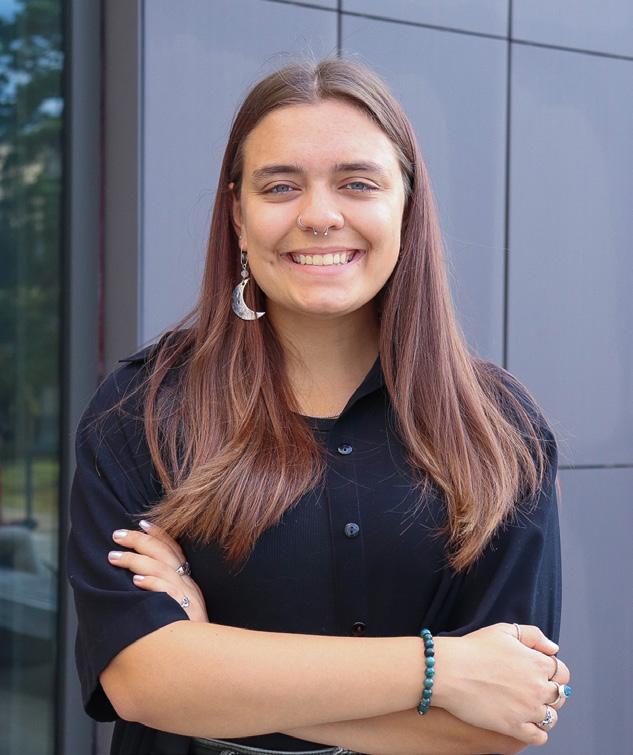
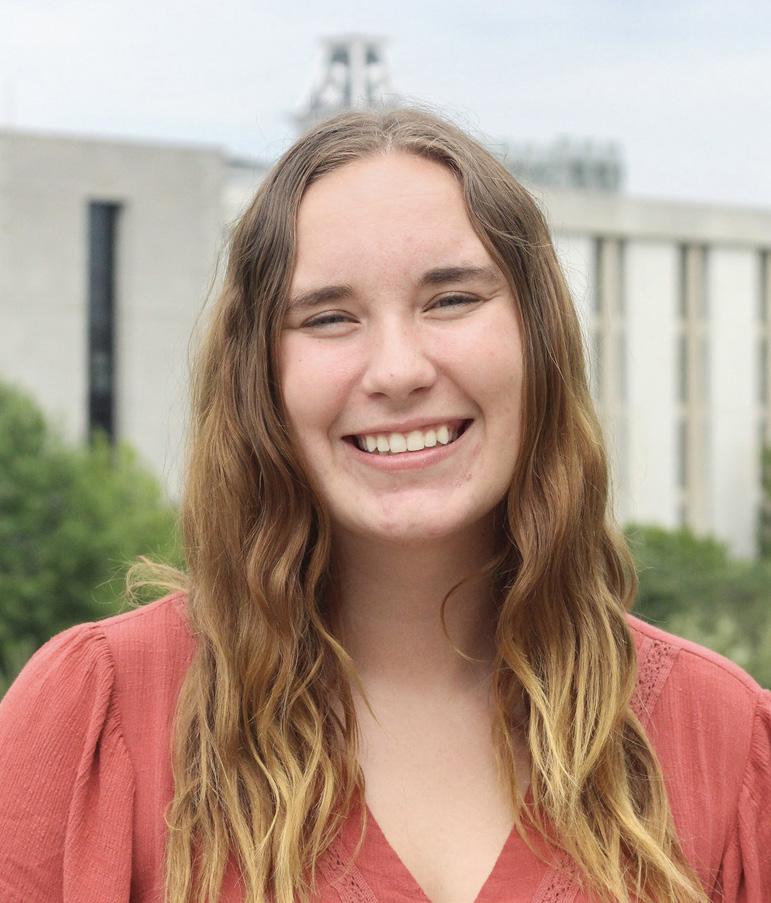
Victoria Hernandez is a senior English and journalism major with minors in history and gender studies from Flower Mound, Texas. She loves winter weather, coffee, and music. Hernandez will be staying in Fayetteville after graduation to earn a masters in Journalism.
Katherine Taylor
Editor-in-chief Writer
Katherine Taylor is from Little Rock and a 2023 journalism graduate. She plans to attend law school in the Fall of 2024. She also has a cat named Mr. Marvin Beans who is both her greatest joy and worst enemy.
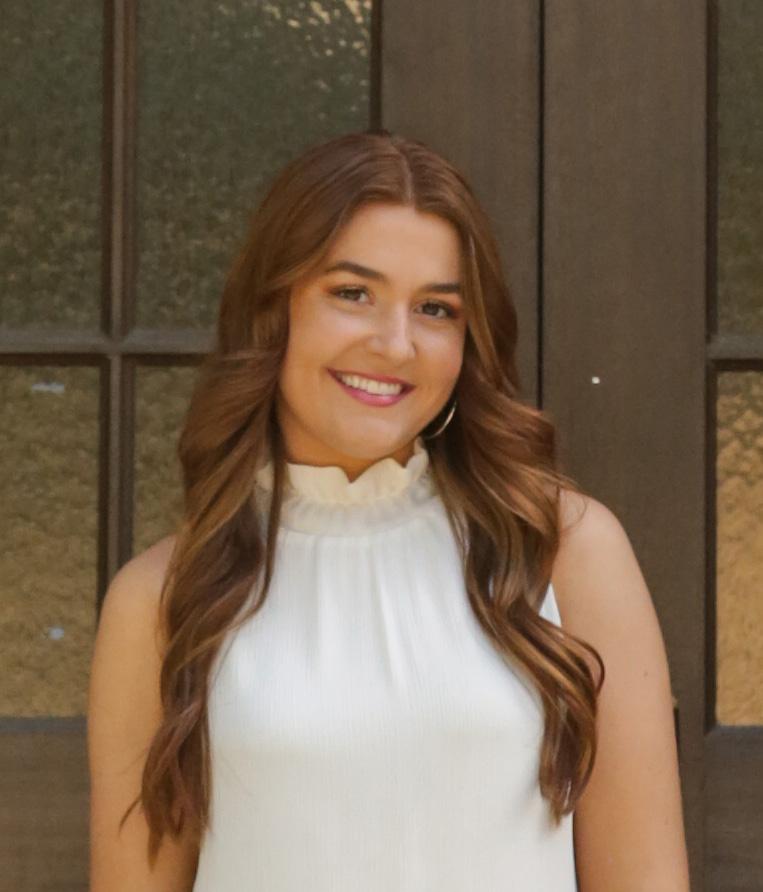
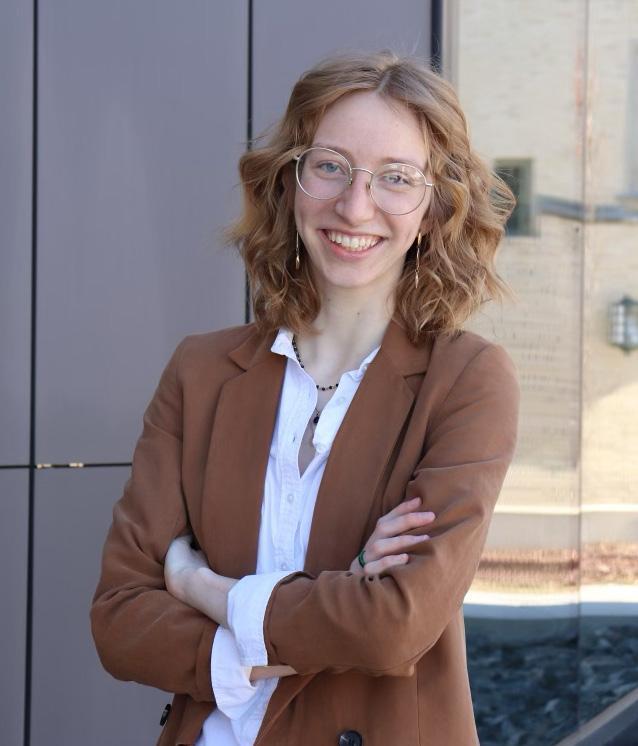
Lainey Richardson is a junior majoring in Advertising and Public Relations with a minor in journalism. She is from Dallas, Texas and loves reading, cooking, and friends and family. Fun fact that even when traveling, Northwest Arkansas continues to be one of her favorite places ever.
Alyssa
Riley Writer
Alyssa Riley, from Graham, Texas, is a first-semester graduate student earning her master’s degree in News Narrative Journalism. She now writes for Walton Insights, and in the future wants to be a magazine lifestyle writer/editor.
Lindsey West
Online
Content Editor
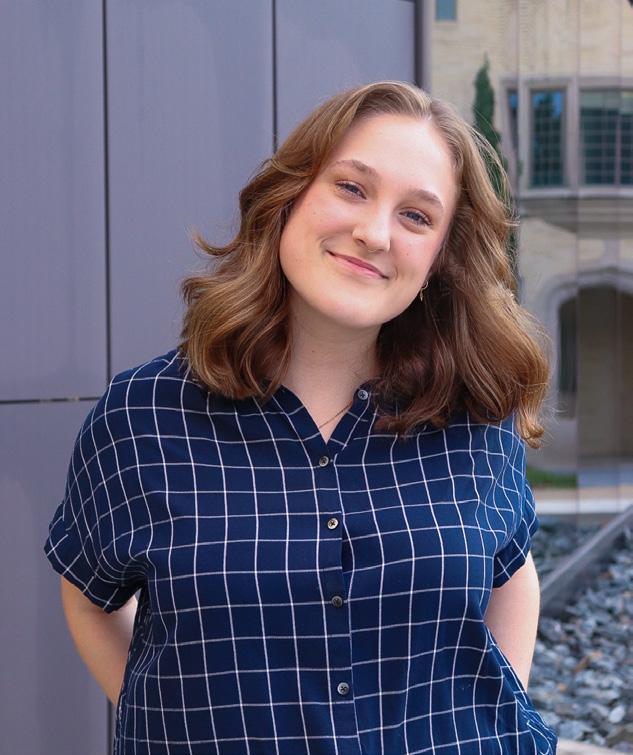
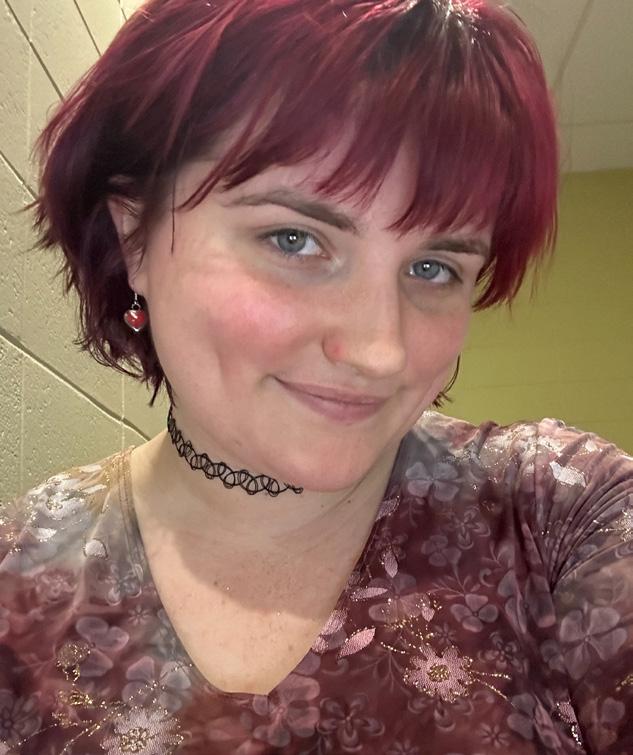
Lindsey West is a junior Advertising and Public Relations major with minors in marketing in journalism from Houston, Texas. In her free time, she loves to bake, read new books, and watch movies. After graduating, Lindsey hopes to move somewhere colder so that she can wear a sweater everyday without sweating.
Trevor Spencer
Writer/Photographer
Trevor Spencer is from Jackson, Tennessee. He graduated in 2022 with a BA in Criminology and a minor in Journalism. Now, he’s in his second year of getting my Masters in Journalism. Outside of school, he enjoys playing tennis and practicing the guitar.
Erika
Fredricks Graphic Designer
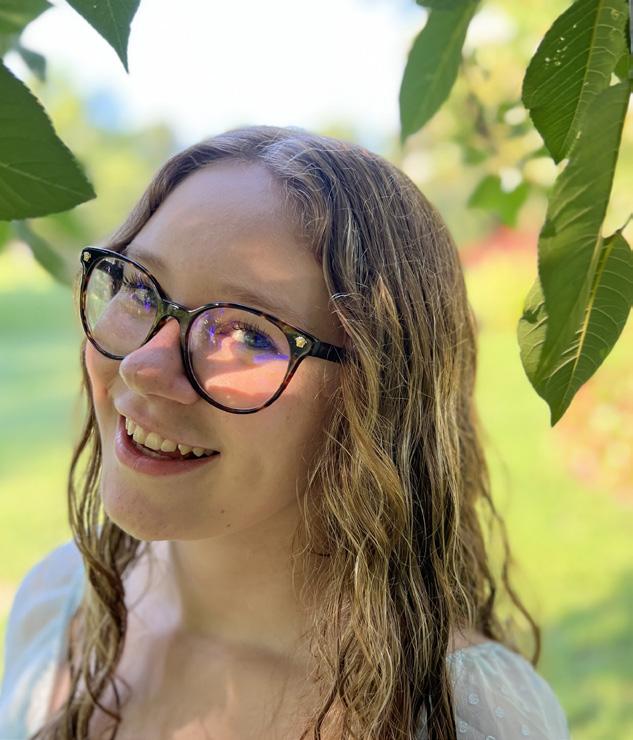
Erika Fredricks is a junior Graphic Design major with a minor in art history from Cabot, Arkansas. Alongside her work in design, Erika enjoys expressing herself through sewing and baking as well as hitting the trails. In the future she hopes to pursue design work for non-profit agencies.
Eli Stokes
Erica Wilson
Writer/Photographer Writer Photographer
Eli Stokes is a senior studying Journalism and Political Science from Little Rock. Eli hopes to work in the outdoor industry combining it with his love of photography and writing. If he’s not rock climbing in Arkansas, you can probably find him at Puritan Coffee and Beer procrastinating all of his deadlines.
Erica Wilson graduated spring 2023 with degrees in English/ journalism and music education. Originally from Denton, Texas, she now works for the New Braunfels Herald-Zeitung as an education and nonprofit reporter.
Sarah Wittenburg
Sarah Wittenburg is a senior from Conway studying physics and minoring in math, journalism, and art history. With seven years of professional experience, she has tried many genres of photography, and photographed subjects across the country.
Arden Malloy
Arden Malloy is a creative writing major born and raised in Fayetteville. She is currently on the staff of the undergraduate literary magazine, The Diamond Line. She is a senior, planning to graduate in the spring. She loves eating candy corn pumpkins and logging movies on Letterboxd.
Maggie Meyer
Jackson Cook
Tyler Thompson Poet Poet Wrtiter
Maggie Meyer is a freshman from El Dorado majoring in Secondary Education. A fun fact about Maggie is that she was a starter on her kindergarten basketball team.
Jackson Cook is a senior from Little Rock studying English and History. Jackson’s writing often explores mundane Southern life through an absurdist lens, and his one-act play “Graveyard Picnic” was selected as a winner of the New South Young Playwrights Festival.
Artist
Tyler Thompson is a first year pursuing a degree in English. He is working on writing a novel and hopes to get it published one day. He is from Oklahoma where he is currently living while taking online classes and running his Instagram page Thompson Art Design.
Alyssa Riley
Katherine Taylor
Erica Wilson
Trevor Spencer
Bottled in by
Topics of abuse, addiction and suicide in this story may be triggering for some readers
by Alyssa Riley
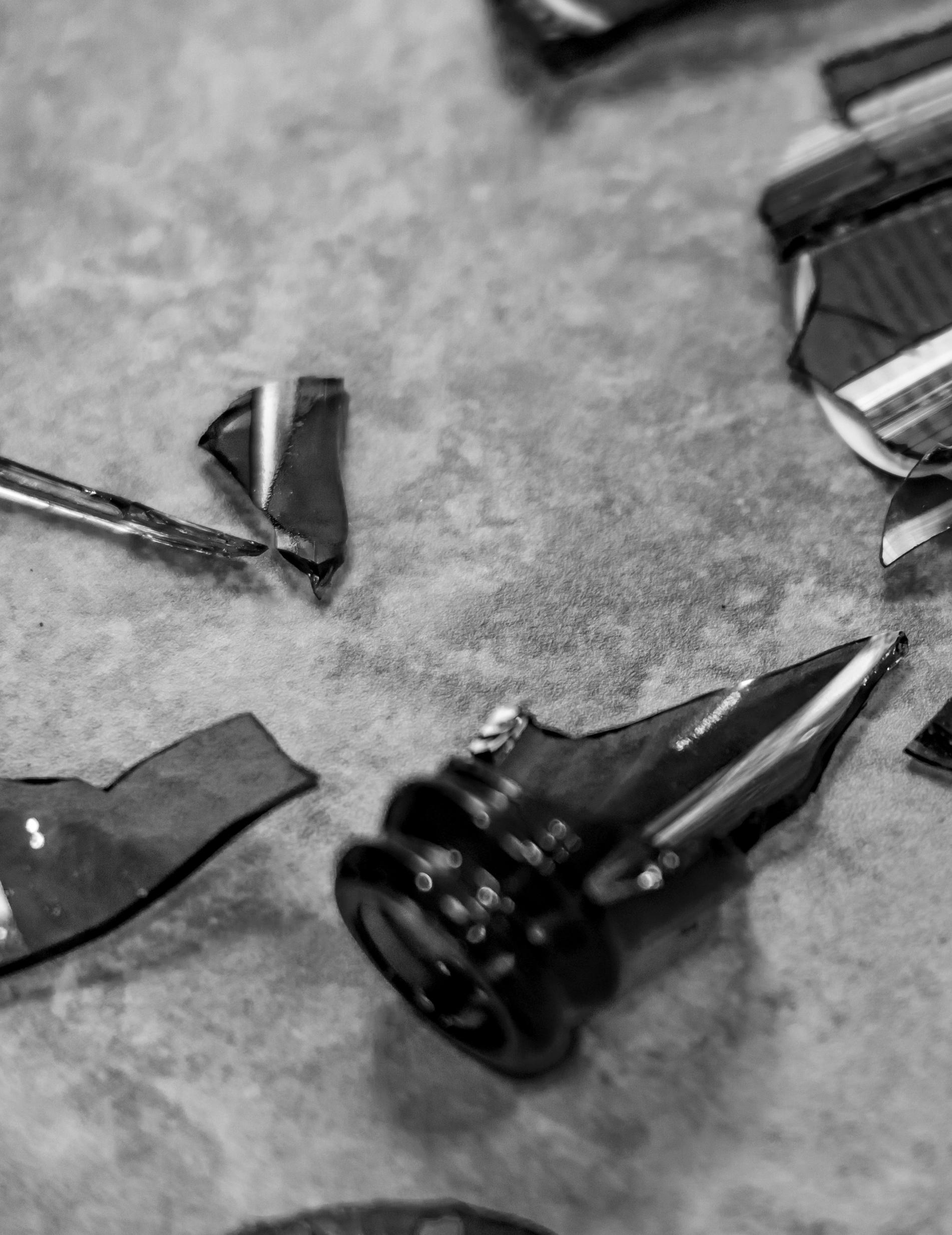
Photo Illustration by Sarah Wittenburg.
Fate
My roommate Eloise has hair the color of an out-of-control forest fire, one that destroys everything in its path, ringlets drifting upward. She is short and stout, but what she lacks in height, she makes up for with her loud choice of dress and her booming voice, often coming out in an excited, boisterous laugh. You can regularly find her in a thrifted get-up, made up of every article and accessory manageable; something you wouldn’t be able to find on the market, that is wholly her own. At 21, she can choose freely what she wears and how, exactly, she wears it. And choose she does, because, for a while, all she felt was trapped, for this freedom wasn’t always a presence in her life.
She lived her childhood and teenage years in Bass, Arkansas, a town so minuscule and isolated that you wouldn’t notice if you drove straight through its center. The home she grew up in, which her parents, Edena and David, built themselves, resembles a storybook picture.
The cabin, blooming in a field of shaded trees, floats on a bed of flowers, bushes, and vines. Up the 13 wooden steps and onto the front porch that extends the length of the house that built her, a church pew takes up residence where the sunset can be viewed perfectly on a warm, summer night; the cicadas and mosquitoes filling the night air with earthly clicks and buzzes. Here, David could often be found perched with a bottle in his hand and some pills in his pocket, drinking and popping himself silly into the night. In a few hours, Edena would be waking up, sliding into her starch scrubs, and heading to Cox Medical Center in Branson, dropping Eloise off at the Mount Judy school on her way.
“One time my dad mixed pills and alcohol and the ambulance came; he got really upset that we called it,” Eloise said. “I was in 8th grade.”
The only regulars of her childhood besides her parents were more adults, and like David, who struggled with addiction for the entirety of Eloise’s life, most of them were addicts themselves; alcohol, meth, or otherwise.
Education became her salvation, her escape from the loneliness and drunkenness of the only town she’d ever known. She was seen as a good girl, an outlier in a community that was destined to pump her full of its vices and imprison her with the addictions that made wreckage out of her father. But this she was not oblivious to; she knew the dangers of not having a ticket out, a way to save herself.
So, Eloise studied hard. She made the plans and packed her bags to head to the University of Arkansas to study political science; she thought she had finally escaped her generational fate. However, life rarely works out according to plan, and hers was no exception.
During the fall of 2021, the height of the COVID-19 pandemic, she was taking online classes for her political science degree and living with her then-boyfriend, Jonah Houston, when she started to notice her own dad-like, unhealthy behavior of drinking, drugs, and fighting. With these addictions quickly consuming her life, telling herself to not become like her father wasn’t enough; it was like he had hitched a ride in her mind, concocting every reason why she should pick up the bottle and never put it down.
Her control began unraveling, as she was undiagnosed and, thus, unmedicated in several areas and in an incompatible, open relationship in which sex was her only means of intimacy. She felt that she possessed a certain invincibility, that consequences didn’t pertain to her, so life quickly became a game and for a while, it worked in her favor.
Before long, she dropped out of college, feeling like she had failed at the only goal she had ever known. “School was really easy for me,” but the adjustment was huge, she said of balancing homework, relationships, and the new freedom to party whenever she pleased. “I was not prepared for it. That brought about a lot of shame and “What the fuck do I do now,” being 20 and lost.”
She describes herself now as an inheritor of a predisposition, selfish with her addictions – alcohol, cocaine, and marijuana –and the “Fucking cliché of losing your mind and going crazy when you move out,” but also making moves that her father never attempted; regularly attending recovery meetings.
Is Talking About It Adequate Enough?
Childhood is usually for sweet cups of lemonade from scrappy, home-crafted stands when thirst arises, but not for Eloise. She was 12 years old when her uncle Justin passed her the cheap bottle of “dizzy water” and she took her first swig of the repugnant liquid. She didn’t know how the vodka
would taste, but she had been smelling it on her father’s breath for as long as she could remember. If he could drink it, so could she. And drink it she did. It wasn’t long before she was “pretty blackout” and immediately knew it was a problem, but it didn’t create a drinking problem, not until she was out in the world and on her own, at least.
“Substance abuse runs very bad and is in almost every vein of my father’s family,” she said. “He still drinks to this day; he’s never gone to AA meetings or therapy or any of that shit.”
According to a 2016 National Survey on Drug Use and Health study, 3.8 million out of 21 million people ages 12 and older sought and received substance abuse treatment. However, only 2.2 million people, just over 10 percent, accessed such treatment through facilities that specialize in rehabilitation.
The problem isn’t the stunted numbers of people with addictions seeking help but the availability of impactful help, especially ringing true for Arkansans. American Addiction Centers lists eight states that offer state-funded programs, and Arkansas isn’t one of them. Because of Arkansas’ unavailability of state-funded recovery services, those struggling with substance abuse – who want to recover – must turn to non-profit organizations like Alcoholics Anonymous, or in Eloise’s case, SMART Recovery of NWA.
SMART Recovery, an international organization, aims to help people cope with and move past addictive behaviors through cognitive behavioral therapy. “SMART works for anything. Meth, food, sex, gambling, alcohol, etc.,” said Luke, 31, a SMART meeting facilitator who prefers not to share his last name. “However, in our meetings it’s drugs and alcohol that make up most of the participants’ addictive behaviors.” After dropping out, Eloise’s drinking became worse, so she
“I was not prepared for it. That brought about a lot of shame and “What the fuck do I do now,” being 20 and lost.”
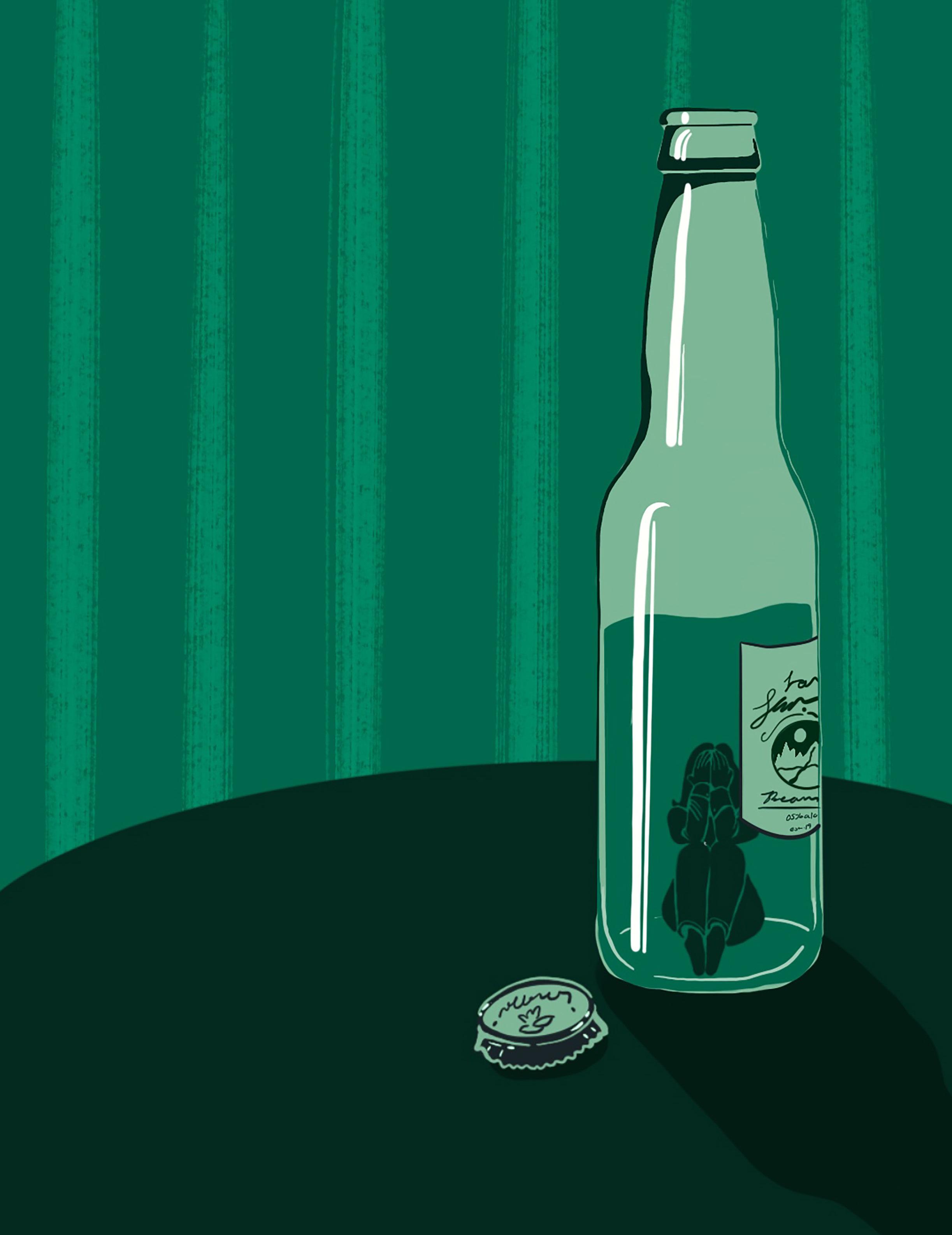
Illustration by Erika Fredricks.
turned to cocaine to feel better, or even different, but this addiction switch created a boomerang effect. Realizing she couldn’t use cocaine forever, she would pick the bottle back up, until memories of her father’s addiction would materialize.
“You’re not a pleasant person to be around, you act like a fiend which is very annoying, unsettling, and sad; I think anyone who is an addict knows,” she told me after returning home inebriated one night, shattering glass from who-knowswhat on our front porch and falling onto the kitchen floor. To this day, her mud-caked boots from that night remain under the carport where she had drunkenly kicked them off.
About five years ago, when Raymond Roe started the meetings, they were originally held at the Rogers Police Department and, later, at the Center for Non-Profits. Now, after luckily receiving a free meeting space from Bentonville’s Keypoint Church, SMART has its own facility, Rogers Dream Center, where meetings are held daily, whether online or in person.
Despite Keypoint’s generosity, SMART receives no state funding, relying heavily on word-of- mouth and out-of-pocket donations to continue providing free help to those with no other option. “Having money would be useful. We could probably buy more materials to give people,” Luke said. “… Probably could spend some money marketing it so more people know about it.”
“I think better dissemination of information about resources available for recovery would help a lot,” said Megan, a regular attendee of SMART meetings. “I went through multiple therapists and not once did any of them point me in the direction of SMART. For some, it was just because they
didn’t know it even existed.”
Attending meetings on Tuesdays and Thursdays, Eloise believes the meetings are “Such a good thing,” but that she doesn’t gain much from hearing about others’ sobriety. Even therapy – she is on her 12th therapist – isn’t adequate in aiding her recovery the way that she needs.
“They’re just people, they don’t have the answers,” she said. “But I’m going to these meetings and people talk about how they’ve been sober for years, but I don’t want to be sober for years and not have alcohol for years. Why can others do it and I can’t?”
For Eloise and others like her struggling with substance abuse, affordable help at the age of 21 can be hard to find, so she leads herself with a short-term plan – to stay sober for as long as she can. However, she doesn’t have a long-term plan to beat her addictions with an iron fist. “I don’t want to hurt the people I love, because I’ve been on the receiving end of someone you love picking addiction over you and it hurts so much,” she said.
Like Father, Like Daughter
Home life was never good growing up, Eloise told me, remembering how her father raised her, “If that’s what you can call it.” Her parents were always fighting, so weekly fits of verbal abuse, and some physical were consistently endured by Eloise as only a child.
“I hated my dad for a long time, but despite everything, they both [her parents] try hard to be good people; I think they both had very traumatizing childhoods, themselves,” Eloise said. “And I’m 50% him.” Everyone on her father’s side of the family suffers from either alcohol or drug addictions.
According to the SAGE Encyclopedia of Abnormal and Clinical Psychology, Substance Use Disorder, SUD, affects nearly one in five adults in the United States, as well as their families.
Even for Megan, who attends SMART once a week, her grandmother and grandfather had addictive behaviors with alcohol, although her family didn’t typically discuss it when she was growing up. “I’m not sure how much either case actually contributed to my issues,” she told me. “I now think that drinking was a compulsion I developed, and I didn’t have the tools to break my compulsion.”
Organizations like the National Association for Children of Alcoholics identified the negative effects SUDs have on children, including a heightened risk of developing SUD, mental health disorders, attention deficit, conduct disorders, and borderline personality disorder in females. Risks even reach adopted children, despite their adoptive parents not having SUD.
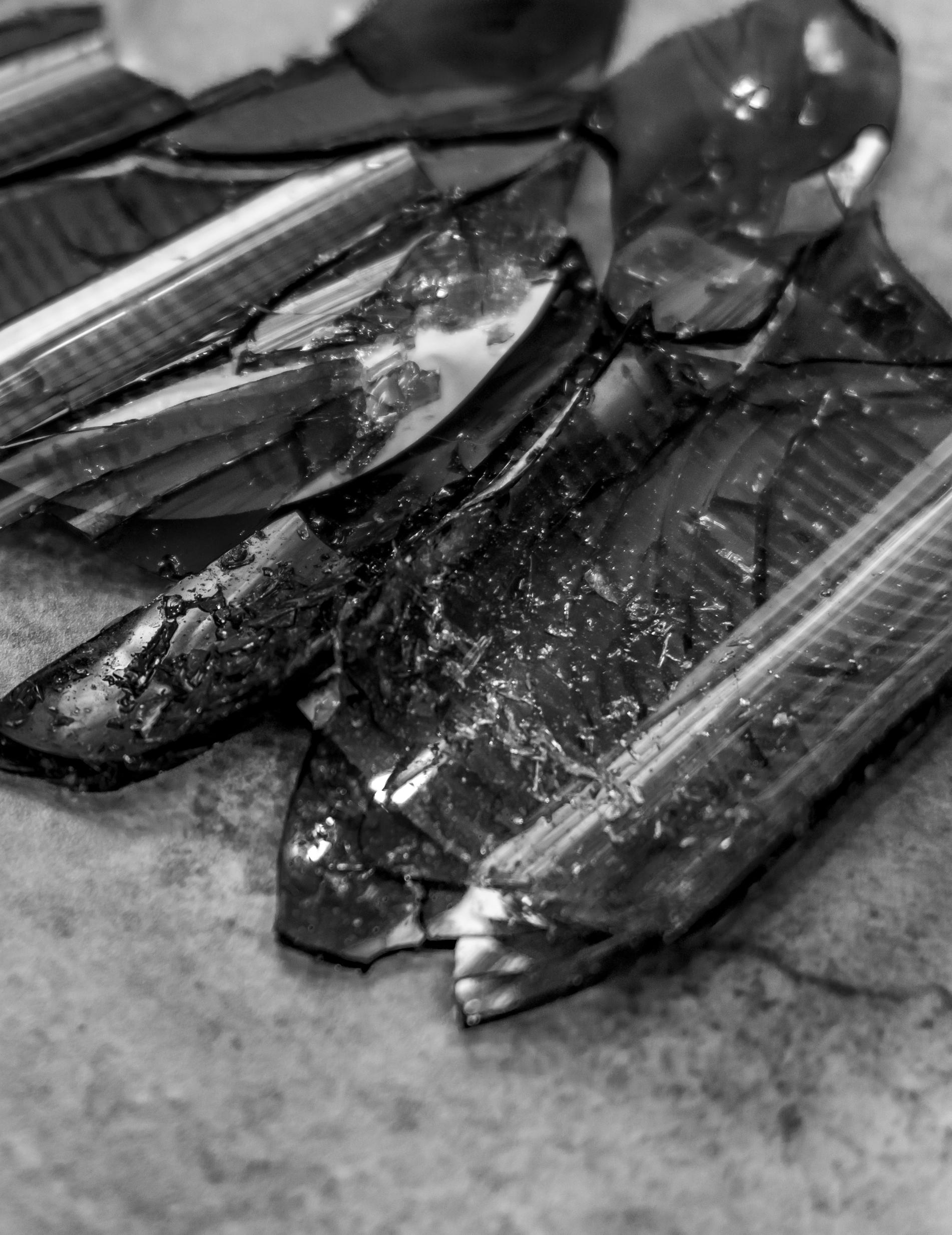
Photo Illustration by Sarah Wittenburg.
“Risk is, therefore, genetically and environmentally transmitted to children as approximately 50% of children raised by a biological parent with SUD will develop a SUD, which is at least 4 times higher than for children raised by parents without SUD,” the SAGE journal said.
The National Association for Children of Addiction, NACoA, which spearheaded Voice for the Children, an outreach program advocating for the needs and circumstances of atrisk children, has made SUD intervention their top priority as the prevalence rate nears 20 percent with a transgenerational continuity.
Eloise feels the impact of SUD daily. “For some people, it doesn’t seem to be a question or a temptation, but for me, that’s my inclination,” she said. “I just wish I could think about it differently. Why can’t I just drink and be normal when so much of society seems able to?”
According to the Addictions and Recovery Organization, children of addicts are eight times more likely to develop SUD. Additionally, if at least one family member is an alcoholic, children are at a greater risk of developing addictions to opioids, cocaine, or marijuana – especially important for women from alcoholic families.
“My mom is a saint and she doesn’t deserve for her only child to be an addict,” Eloise told me.
“I loved [cocaine] enough to not want to stop and I knew what that meant, death or being absolutely broke; that’s not what I want to be, and that’s not what childhood me wants to be.”
A Look Inside
The rectangular room’s faux trees, green paper-link garlands, and a semi-circle of chairs facing the whiteboard give the semblance of a classroom, where each occupant is ready to listen and learn, but mostly every face is aged with decades of life and addiction struggles.
The whiteboard showcases five sections for the SMART meeting attendees to ponder; definitions of stress, myth vs. reality, what in your life causes stress, how you cope with stress, and managing stress. Luke opens up the discussion, and one by one, 11 people begin spouting out what brings them stress and how they handle it.
Family, relationships, seeing a bottle on the shelf; the answers
go on. Then, with resolve, outlets for working through stress are called, including breathwork, shopping, creating, meditating, yelling, cigarettes, and metal music – a crowd favorite. Despite a serious and personal topic, the room is vibrant with joking and shared laughter, giving the notion that everyone can resonate with each other. However, the word “addict,” whether of drugs, alcohol, or otherwise, is never spoken.
Frankly, Luke said, they don’t focus on what their “things” are; “It is all about moving forward and finding ways to build a better life.” This, he can say with discernment, for his position as facilitator didn’t come without a history of addiction and, to the benefit of the 11 attendees on April 16, recovery.
As a teenager, Luke started showing signs of Bipolar Disorder; his dependency on alcohol and various non-prescribed pharmaceuticals as a means to cope had dangerously developed by his early 20s.
“After being arrested a couple of times, I decided to stop doing everything except the alcohol,” he said. “Over the years, my drinking became worse as I coped with the bipolar and previous trauma. It got to the point where I decided I was going to seek help one last time, and if it didn’t work, I was going to kill myself.”
At 27, he started a new job – his current career, which he prefers not to disclose – becoming the one thing he had succeeded at. With life looking up, he began attending therapy and was professionally diagnosed and medicated for
Photo Illustration by Sarah Wittenburg.
Illustration by Erika Fredricks.
Bipolar type 1 – defined by the National Institutes of Health as manic episodes lasting at least seven days or severe manic symptoms that demand immediate medical care.
When his therapist recommended SMART, he decided to take a real swing at putting down the bottle for good. In February 2020, three days into being sober, Luke walked into his first meeting and continued to do so several days a week for the first year and a half of his recovery journey.
“Therapy, medication for my mental illness, taking care of my physical health, self-reflection, attending SMART meetings, countless hours of working the SMART and other tools on my own, and a ton of motivation totally changed my life,” he said.
Six months into attending, he was asked to become SMART certified to facilitate meetings. After declining to focus on his happiness, something that was so elusive in his life, he realized that facilitating could be the very solution for his selfimprovement.
“As a participant, it was a key part of me changing my life and finding freedom from my addictive behaviors,” Luke said. “Facilitating for me started as a way to continue growing in my recovery, as it holds me accountable to come up with content to share each week. The guy at the time that was running the Sunday meeting decided he needed to step back [June 2021]. I’ve been doing it ever since.”
An Opportunity for Change
With Arkansas’ drastic unavailability of state-funded recovery resources, the announcement of new federal grants for allhours mental health and substance abuse care on October 19th could not have come sooner.
According to a Northwest Arkansas Democrat-Gazette article, the government is focusing on providing 24/7 support for crisis care to Americans, which has only been available to some depending on income and ZIP code; “That’s going to start to change,” said Health and Human Services Xavier Becerra.
Dating back to 2014, the Excellence in Mental Health and Addiction Treatment Act was born by Senators Debbie Stabenow and Roy Blunt. “Mental illness and substance use disorders do not discriminate – they affect our parents,
children, CEOs, students, teachers, veterans and other community leaders,” said Senator Stabenow. “For too long, our country has funded health care above the neck differently than health care below the neck. We are finally transforming the way we deliver high-quality services in our communities and the results are clear.”
By 2024, ten states will be selected to receive the new federal grants, and ten more will be selected every other year until all 50 have been provided for.
Effective May 22, 2023, “AR ConnectNow will move from grant funding to its long-term, sustainable, fee-for-service financial model,” said Victoria Spradley, outreach coordinator at AR ConnectNow, a psychiatric research institute. As has been their philosophy since the model’s inception, patients seeking behavioral health care will be seen regardless of their ability to pay.
“I’m not sure where I would have turned if SMART hadn’t been an option,” Megan said. The best-case scenario was that she would’ve moved home to live with her mom, and the worst-case scenario isn’t something she likes thinking about. “But it’s hard to say because SMART was so pivotal to my recovery that I can’t image how I would have succeeded without it.”
While SMART has successfully benefited Luke and Megan and will continue to do so, Eloise and others like her who require a bit more than discussion to overcome addictions can soon receive affordable, and possibly free, substance abuse care with ConnectNow and, hopefully, other state funding options. According to Spradley, the UAMS Center for Addiction Services and Treatment will soon begin providing alcohol abuse treatment.
“It’s amazing to see people’s progression; it’s a community of people supporting each other through something incredibly difficult,” Luke said. “…Unfortunately, it is not typically a straight line to recovery. Rarely is it one thing that gets people to turn it around. I love SMART Recovery, but it is only one tool.”
Arkansas has greatly lacked affordable recovery services, but the future shows promise as this potential solution has been set in motion, and, hopefully, more Arkansans than ever before can embark on casting their addictions out for good.
“You get to a point where you start really liking it and you’re going to spend your next paycheck on it,” Eloise said about cocaine. “And it just became this whirlwind of everything I loved – making me emotionally obsolete, cold and unbothered. It doesn’t make you a good person, I was doing stuff I wasn’t proud of. I’ve relapsed a lot, but I’m five months now; that’s the farthest I’ve ever gone since I started using.”
No Aderall, No Answers
Drug Shortage causes Students to
by Katherine Taylor
Emma Ferguson’s spot on the worn green couch might as well have been spring-loaded. In the midst of a passionate monologue that included topics like the essentials of rabbit care, Lizzo being a “bad bitch,” voting patterns of suburban white women, and the best method for making a beaded lampshade, she popped up and walked into the kitchen several times, simply to open and close the fridge without taking anything out.
This is a regular occurrence with Ferguson, 21. Catch her in a conversation that excites her and just watch; chances are she’ll leap from her seat, subconsciously driven to her feet by sheer passion, then realize she didn’t actually have any reason to stand up so now she has to create one: move a charger from one outlet to another, fill a cup that wasn’t empty, check the fridge, pet the cat.
Being restless and talkative are commonly-known traits associated with ADHD, parts of Ferguson’s personality I’ve become very familiar with as her roommate. These are the things that anyone who meets her sees right away.
But these are only a few strands of the tangled web ADHD has woven around Ferguson’s life. When she has access to Adderall, her symptoms are manageable; when she’s unmedicated, they become overwhelming.
The Food and Drug Administration (FDA) announced a shortage of amphetamine and dextroamphetamine salts [the generic name for Adderall] in October 2022, with little explanation as to why. Almost a year later, it has yet to be resolved, an abundance of red tape blocking the path to any potential solutions. The shortage has created a myriad of both psychological and logistical problems for people across the country who rely on the medication in their daily lives.
For Ferguson, the “fun” side of her ADHD takes a backseat when she can’t get her prescription filled. She forgets things: where she put her car keys, meetings, homework assignments, commitments she’s made. Focus becomes elusive. Things get disorganized, jumbled up and confused, a frustrating barrier
Struggle
to success for a high-achieving student. True irritation creeps in and spills out as she fights the feeling that she isn’t in complete control of herself anymore. Having her medication doesn’t just make it easier for Ferguson to focus. It makes it possible for her to function.
“When I don’t have my Adderall, it’s 75/25 if I brush my teeth and put on deodorant,” Ferguson said. “I have a hard time doing routine tasks. My impulse control goes out the window, so I drink a lot more and I binge eat. I don’t show up for obligations that I normally would never miss.”
Despite the enormous impact of the shortage, to those affected, it seems like very little is being done to find a solution. A potential explanation is that Adderall is a highly controlled substance. It’s classified as a Schedule II drug by the Drug Enforcement Administration (DEA), meaning it has a “high potential for abuse, with use potentially leading to severe psychological or physical dependence.” This is the same designation awarded to drugs like hydrocodone, fentanyl, and opium.
Despite the addiction risks, Adderall prescriptions are not rare. According to the Centers for Disease Control and Prevention (CDC), prescription fills amongst people aged 2544 increased by roughly 10% from 2020 to 2021. From 2006 to 2016, amphetamine use [including Adderall and drugs like it] more than doubled. Data collected by Trilliant Health shows that Adderall prescriptions for people aged 22-44 is outpacing actual ADHD diagnoses amongst the same group. Because millions of people are prescribed the drug, strict regulations are set to curb attempts to sell or use it illegally. This is a fair concern; while estimates vary, data collected by the National Institutes of Health showed that roughly 1 in 10 college students used Adderall without a prescription in 2019. An Ohio State study from the previous year had that number at almost 16%. As a “study drug,” many students turn to it during exam season, hoping to increase focus, stay awake longer, and improve performance on tests.
But for Ferguson and others like her—people who are prescribed Adderall for intense and sometimes debilitating
symptoms—there is little comfort to be found in the idea that someone else might not be able to get it. She just wants her meds.
“I don’t love taking Adderall,” she said. “It makes me kind of irritable. But without it, I feel like a little kid because the people around me have to corral me. When I got to college freshman year, I went to my doctor hysterically crying because I thought I’d gotten stupid, when I really just needed a prescription. I can’t do things at the capacity I’m capable of without it.”
For those who are seeking an explanation for the shortage, there isn’t much out there. The drug industry higherups—manufacturers, distributors, the FDA, the DEA—are providing very few satisfactory answers about what is causing this problem or when it will end. Some politicians and legislative committees have called for answers, but the pharmaceutical supply chain does not seem to have much to say. It seems that Big Pharma and all its subsidiaries are shrugging a collective shoulder on this issue.
According to the American Society of Health System Pharmacists, seven of 11 listed manufacturers have provided no explanation for the shortage, or refused to disclose how much of the drug they have available. Of the four remaining on that list, two have discontinued the product, and two are prioritizing existing customers.
Right now, many with ADHD are simply trying to ride the shortage out, doing their best to navigate a myriad of bureaucratic and logistical issues to get their medication. Through a combination of phone calls, pharmacy cooperation, psychiatrist assistance, and sheer luck, some people have found a path to getting their prescription filled. Callie Barnett, 22, is a student at the University of Arkansas studying abroad in Rome last spring. For her, going abroad has made it easier to take her medication consistently. She was able to request a full four months’ supply before she left, though it wasn’t easy to acquire.
Callie Barnett studied abroad in Rome in the spring at the University of Arkansas’s Rome Center. She was unable to get Adderall there and had to take enough with her for the entire semester.
“Before January, I was already having trouble getting my normal prescription, but for four months[’ worth] I had to travel five hours away to my hometown to get enough,” Barnett said in an email from Rome. “I have friends who didn’t have that luxury.”
Were Barnett without her medication, though, things could get dark quickly. As part of her diagnosis, she deals with racing thoughts, inability to focus, and suicidal ideation.
“When I don’t have my meds it is almost impossible to get out of bed,” she said. “My thoughts race and all I can think about is everything I need to be doing, but it feels like I can’t. It sends me into a depressive spiral that makes it extremely difficult for me to get up and join the world.”
Dealing with such serious symptoms means that people who are left without their medication are forced to try and solve the problem on their own. Ferguson, who is prescribed the generic versions of both extended release and instant release Adderall, is supposed to get a month’s worth of both every time her prescription is filled. Recently, though, that hasn’t been the case—especially for the extended release, which she relies on the most.
“Twice now it’s been 20,” she said. “One time I got ten of each type. I’m on this fucked schedule where I don’t have them at the same time. It’s been about six months that I haven’t gotten my two prescriptions on the same day.”
In order to carefully control the amount of Adderall and other Schedule II drugs on the market, the DEA sets specific quotas at the beginning of every year. Manufacturers are only allowed to produce based on those quotas. Thus, production
is limited by estimates derived from data collected in previous years, rather than as a response to actual demand. Producers can’t simply make more to match prescription needs—and individual recipients are saddled with the consequences.
“When they run out of Adderall, it’s all on me to call my doctor and have her call in more,” Ferguson said. “And I have to call the pharmacy to see if they have it so she can send the script over. I can only have three pharmacies on file, so if none of them have it, I just can’t get my meds. Plus I have to wait until I’ve run out of whatever they gave me initially before I can get the rest of the month filled. You expect me to do all that without my Adderall?”
Because of the strict regulations on the drug, any potential solutions that could be executed lower down the food chain are out of the question. Pharmacists can’t substitute similar drugs; insurance companies have their own rules about what they cover. Once, a pharmacy had Adderall on hand, but Ferguson is only insured for the generic version, not the name brand. She would have to pay $300 if she wanted it.
“That’s unacceptable,” Ferguson said. “I should not be paying the same amount for a medicine I’m prescribed as I would to get it on the black market.”
Without consistent access to her medication, Ferguson and others like her have had to learn to cope. Because the extended release pills have been harder for her to get, she has been relying on taking multiple instant releases in a day. When she runs out of her measly ration of those, she asks friends who have a prescription to loan her some until she can get hers filled and repay them. More often than not, though, she simply goes without. And the inconsistency has serious side effects.
“When I stop taking my meds suddenly, I can’t even get to class,” Ferguson said. “It’s difficult to slow my mind down enough to focus on one thought, so things slip through the cracks.
“It’s hard to maintain relationships. Due dates become really impossible because my procrastination gets worse. It’s not that I’m intentionally being a shit student or coworker or whatever it is, I just don’t have the capacity to do things in a timely manner.”
No timeline. No answers. No solutions. No meds. The Adderall shortage is affecting people diagnosed with ADHD across the country, and there is little that individuals are able to do to solve the problem. Without the medication, performing the tasks necessary to get more becomes increasingly difficult, and daily life becomes a struggle. ***
Photo by Sarah Wittenburg. Illustration by Erika Fredricks
Happy Little Girls
by Maggie Meyer
Happy little girls
Ride bikes with their dad
Play tug of war with their cat
Imagine they live in fairy land
Build sand castles
And then somewhere between the ages of “I hate my mom” and “I hate myself”
Another little girl tells them those things aren’t fun anymore
They wait years to find joy again only to wake up one morning to the realization that the next place they are support arms of a man Girls will talk to girls about nearly anything
But never will they open up about the soul crushing cycle that is searching for ecstasy in simple things again only to be told by every judgmental woman around them that it’s time to grow up
So May we May you
Raise the future daughters to Laugh
repeat
And never introduce the disconsolate notion
That happiness is ever to be lost Or taken away from us
And that if it is
It is never again to be found in someone else
May we raise the future daughters in front of a mirror
Pointing at ourselves and then them
With smiles on our faces
With no one else in the room, just the legacy that is happy little girls flowing between the two of us
Between all of us
Like Scenes from a Battlefield
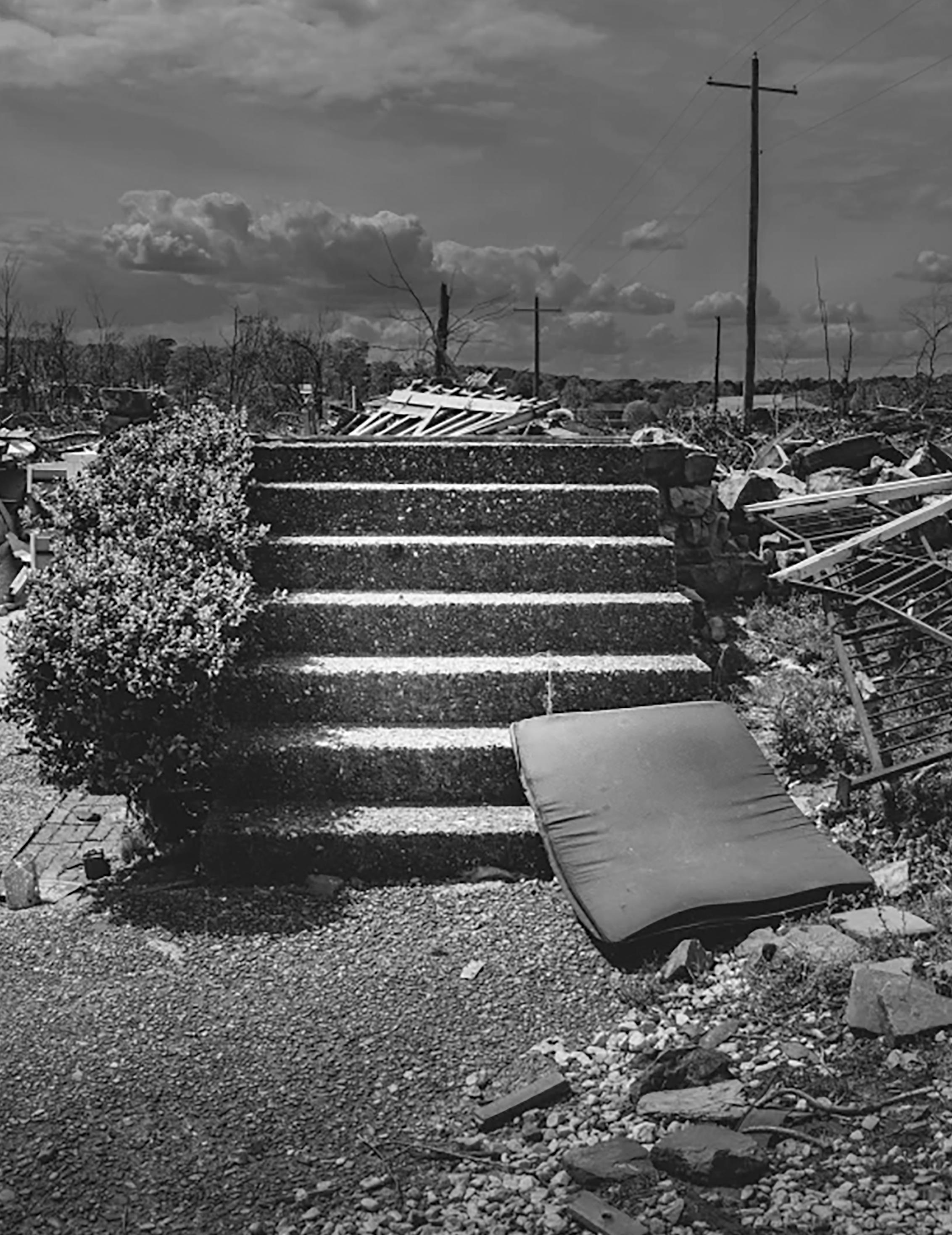
The aftermath of the tornado that ripped through Arkansas’ capital
by Eli Stokes
I sat in the back of a BMW sedan as we slowly drove through a neighborhood, with my camera at the ready. I had heard of the damage and watched dozens of videos, both in the aftermath of the tornado and in preparation for this story. I knew my hometown had been ripped apart, and I knew the neighborhoods not even 15 minutes away from my childhood home, the home where my parents still live, had been decimated. But I hadn’t seen much of it with my own eyes.
The first time that I drove through Walnut Valley, one of the neighborhoods that got destroyed, I immediately compared it to a war zone. Most houses had their roofs ripped off, and some had been completely leveled. I watched volunteers scurry throughout the neighborhood, trying to slowly remedy the destruction, even if it was a seemingly impossible task.
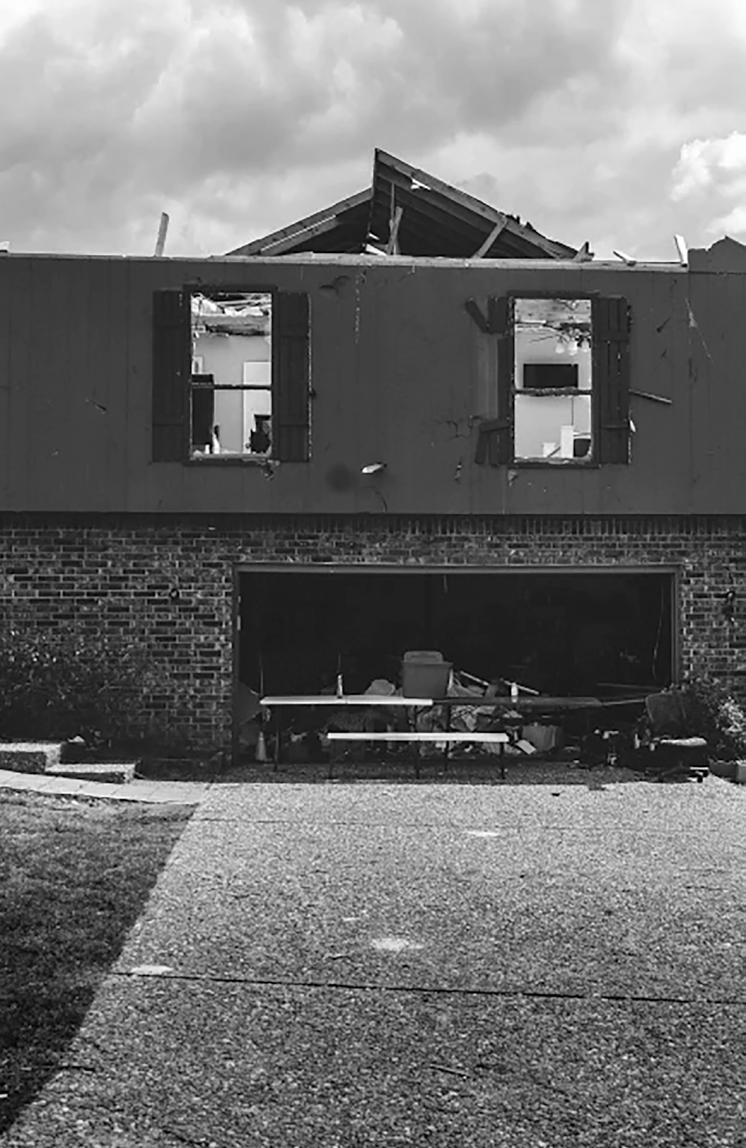
On March 31, an EF3 tornado ripped through Little Rock, Ark. killing five and injuring dozens. According to The National Weather Service the tornado had wind speeds of 165 mph and traveled over 20 miles. The twister damaged over 2,600 buildings, blowing out windows in some and mincing others. The tornado was part of a larger storm system that affected seven states, all of which experienced large tornadoes similar to the one that touched down in Little Rock.
Meteorologists use the Enhanced Fujita Scale [EF Scale] to measure the severity of tornadoes based on their wind speed. According to the National Oceanic and Atmospheric Administration (NOAA) an EF3 tornado is classified as severe, and an EF4 devastating. The wind speed of the tornado that ripped through Little Rock was 1 mph under being classified as an EF4.
I was following a woman named Layla Hadidi on my journey through the city. Hadidi is a private flight attendant that lives in Huntington Beach, Cali. She’s a Little Rock native, and her father owns a rug store on the west side of town. While she was on a flight that Friday, she got a text
from her brother that her dad’s shop had been damaged by a tornado. She did not believe him at first.
“I thought he was kidding, honestly,” she said. “Things like this, it’s like they always happen to someone else far away, not at home.”
While it was still standing and had a roof, the front windows were shattered and debris cluttered the floor. When I arrived at the shop, her father and some of their family and staff were working to clear debris off of the ground.
Despite the damage to her father’s store, she was not back in Little Rock to help him. In the week between the tornado and Hadidi’s arrival, she had raised $5,250 via Instagram. Donations from friends, family, and her small following poured in. Her goal was to distribute the money in five separate payments of just over $1000 by directly handing out cash to residents in the affected areas.
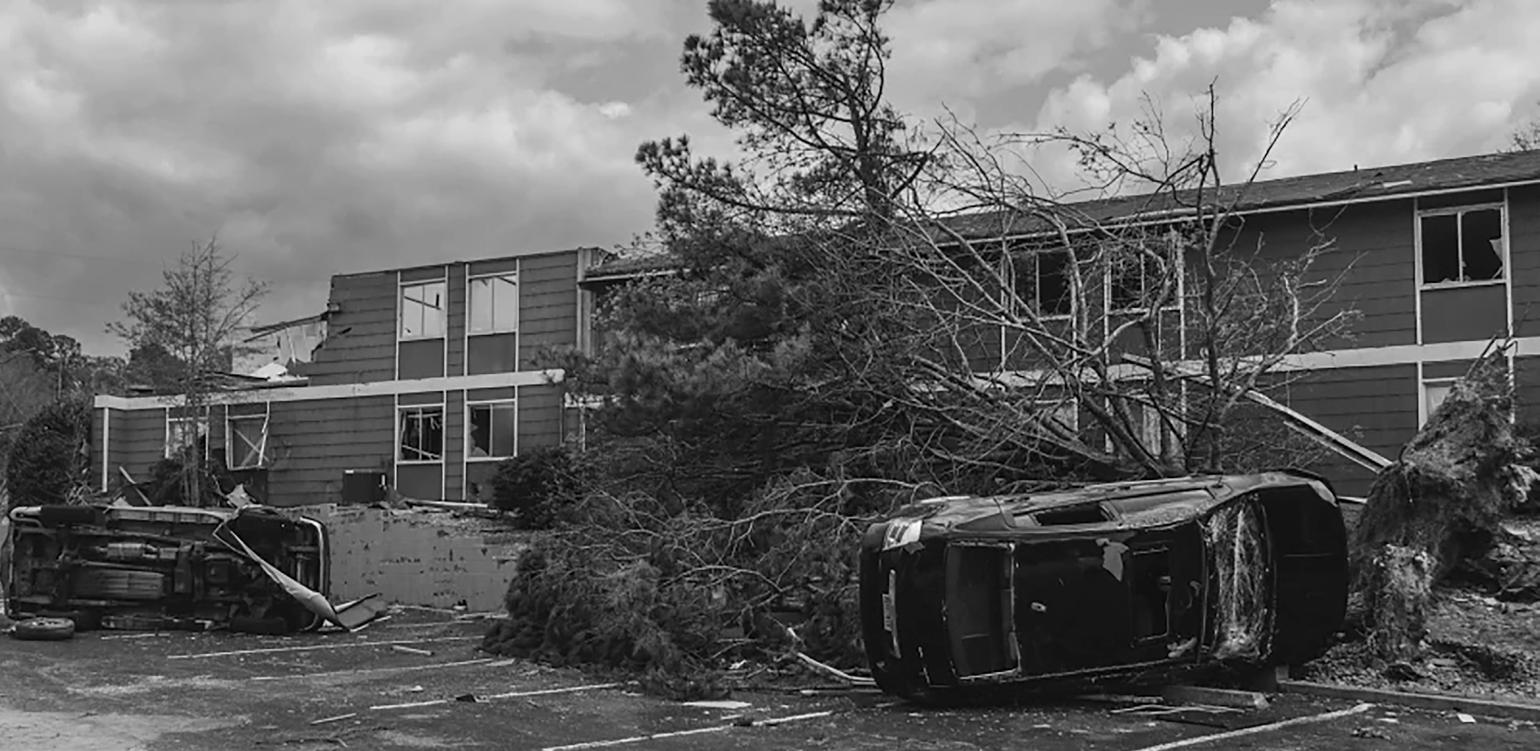
We drove down a two-lane road surrounded by trees and suburbia. All of them were seemingly untouched, completely unaffected by the severe weather event that happened not even a mile down the road. But as we drove over a hill, the damage became visible. Trees had been ripped out of the ground, cars had been turned on their side, and the apartment complex we turned into was missing its roof.
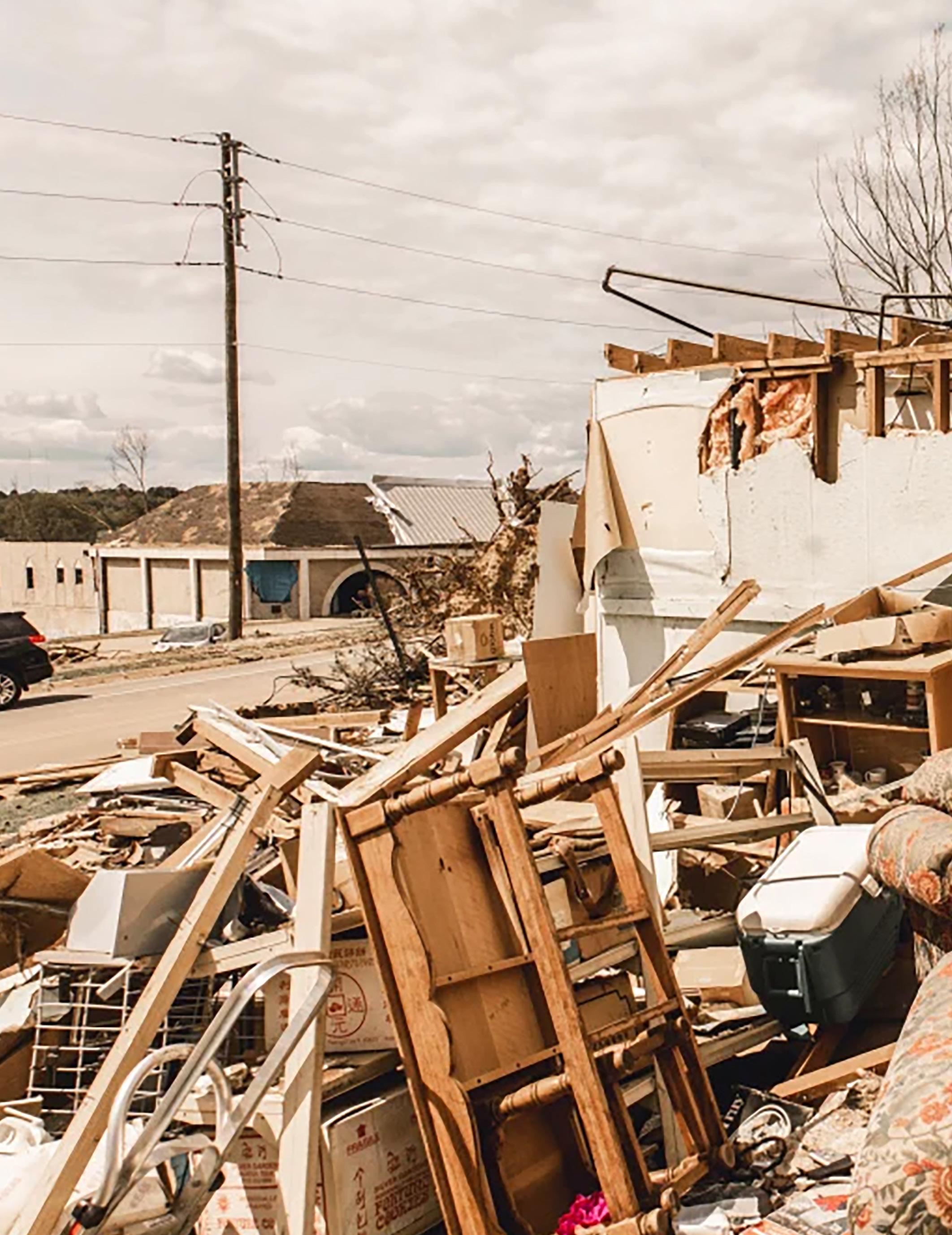
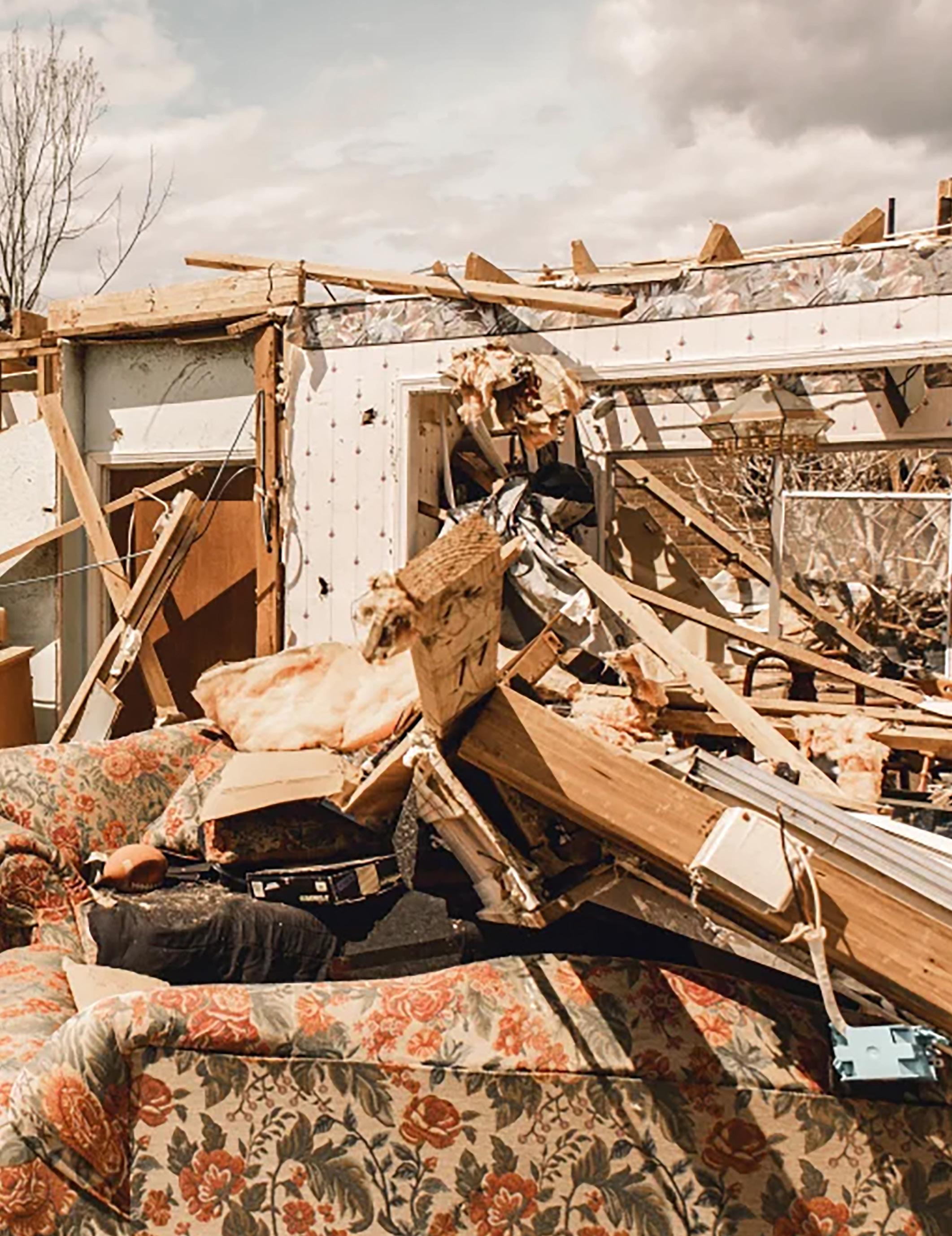
The first neighborhood we visited was adjacent to the apartment complex off Reservoir Road. Massive trees had been uprooted and still lay on top of people’s houses. Books, toys, and family photos were still strewn out on the ground around hundreds of houses. Roofs had been ripped off of homes and walls had been torn down, providing a window into people’s lives. But they were not there. As Layla searched for a resident, the only people that were in the destroyed neighborhood were volunteers and city workers.
Since there were no residents to give the money to, we left to try our luck in another neighborhood.
Dr. Timothy Eichler is an atmospheric scientist for the
National Oceanic and Atmospheric Administration’s [NOAA] Climate Prediction Center. He explained that Arkansas resides in what is known as Dixie Alley, which is the southern sibling of Tornado Alley in the Great Plains. The tornadoes that plague the South are often part of storm systems that mix with the moist, tropic air from the Gulf of Mexico. As a result, tornadoes in the South are often accompanied, or even shrouded, by rain. This makes them harder to see than the tornadoes formed by the dry air in the plains.
Another trait that differentiates tornadoes in the South from the ones in the plains is how they jump. In the plains, the ground is primarily flat. But in the rolling hills of the South, strong winds are disturbed by the rough terrain and the tornadoes can lift off the ground. The tornado that hit Little Rock did just that on several occasions during its time on the ground.
Hadidi and I followed one of the jumps, moving from one neighborhood that was completely destroyed to the next. The two were separated by neighborhoods that were completely unharmed, graciously left alone by the wind.
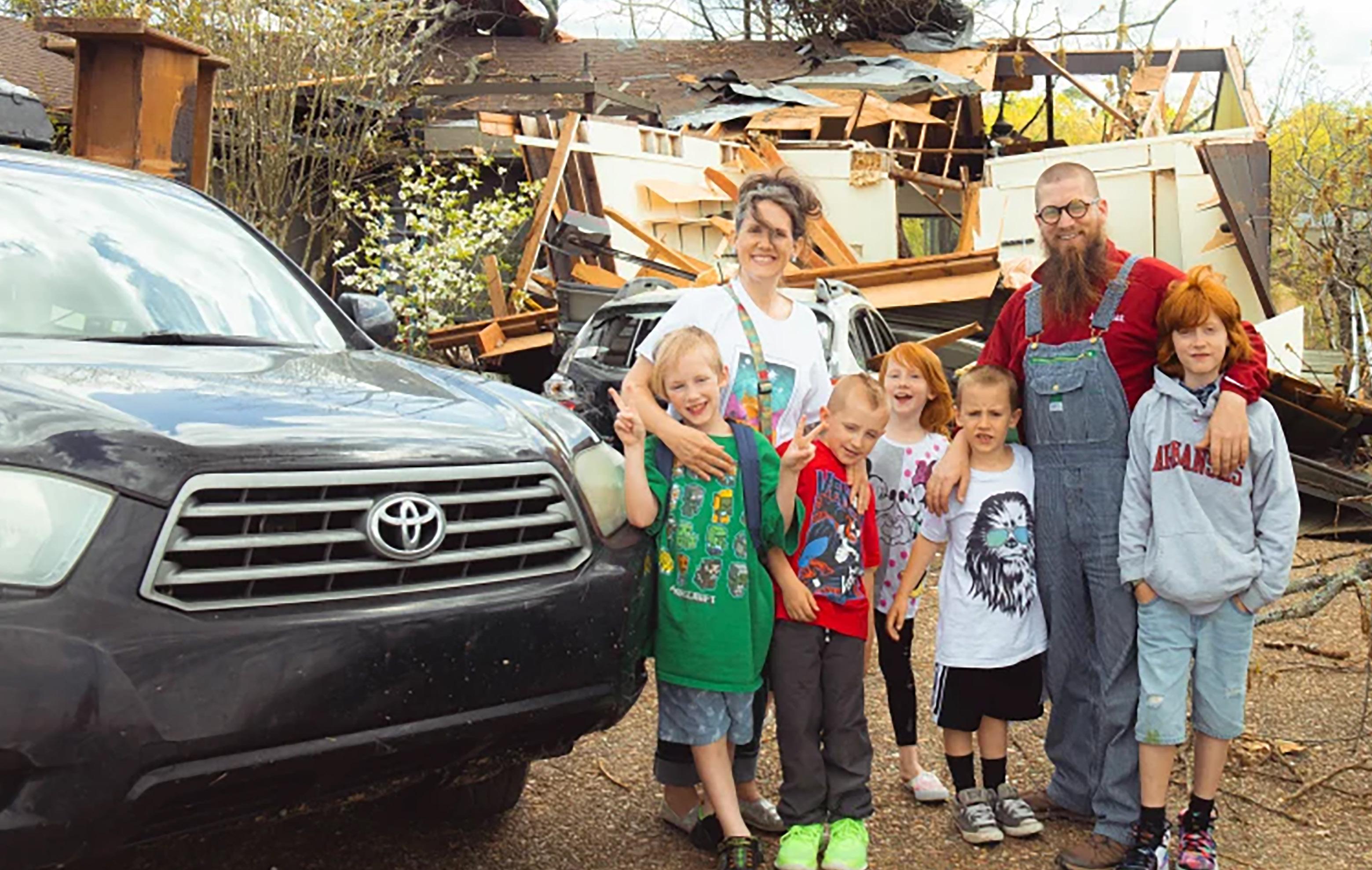
Emily and Jeff Hood moved their family into Walnut Valley two years ago. The house is a five minute walk to the neighborhood park and pool, which makes it an ideal location for them and their five young children. They hoped to build a life in this neighborhood.
As the storm approached and the tornado warning sirens blared, Jeff raced to pick up their children from school and his wife from work. They planned to weather the storm together in their home. As the wind and noise roared outside of their car, they realized they needed to seek refuge in a nearby fire station, which later temporarily closed for damage itself.
After the storm they were forced to walk home because of the trees that were covering the road. They arrived to their home completely destroyed.
“We don’t really know what’s next,” Emily Hood said. “If we could rebuild we would love to, even if the neighborhood is never going to be the same.”
The Hood family’s house is being covered by insurance, and they currently have a bright green convertible Mustang for a rental car and are living in a hotel. They were one of the first people that Hadidi gave money to.
The Hood family in front of what remains of their home. Photo by Eli Stokes.
When I arrived in Little Rock, it had been nine days since the tornado had happened. The first neighborhood we visited was adjacent to the apartment complex where I saw the damage with my own eyes for the first time. While the trees had been moved off of roads by workers, the neighborhoods were still ravaged. Massive trees had been uprooted and still lay on top of people’s houses. Roofs had been ripped off of homes and walls had been torn down, providing a window into people’s lives. But they were not there. The only people that were in the destroyed neighborhood were volunteers and city workers.
The volunteers were working with Samaritan’s Purse, a Christian organization that provides relief across the world after war, natural disasters, or any of the other afflictions that people face. Hadidi and I spoke to some of the volunteers that were at the site of the disaster to help clean up the debris. The group of five or so volunteers in this neighborhood had poured in from Tennessee, Ohio, Kentucky, and Oregon. Some planned to stay for only a few days, others for weeks.
Walnut Valley was even worse than Reservoir. It was the same kind of destruction, just more of it. From the hill above, it used to be impossible to see more than a couple of streets because of the trees that surrounded it. Now those trees were lying across houses, yards, or cut up into piles, and you could see every bit of the now destroyed neighborhood. Many of the houses had been completely destroyed, and the ones that were still standing were missing walls–many of them no longer safe to enter. The homes that still stood had walls ripped down, exposing the possessions and memories of their inhabitants to the outside elements.
There were children’s toys, books, televisions, DVD’s, dishware, and any other household item you could think of scattered on the street, in people’s yards, and littering the floors of the destroyed homes.
The remains of the house that Hadidi’s friends lived in. Photo by Eli Stokes. 27
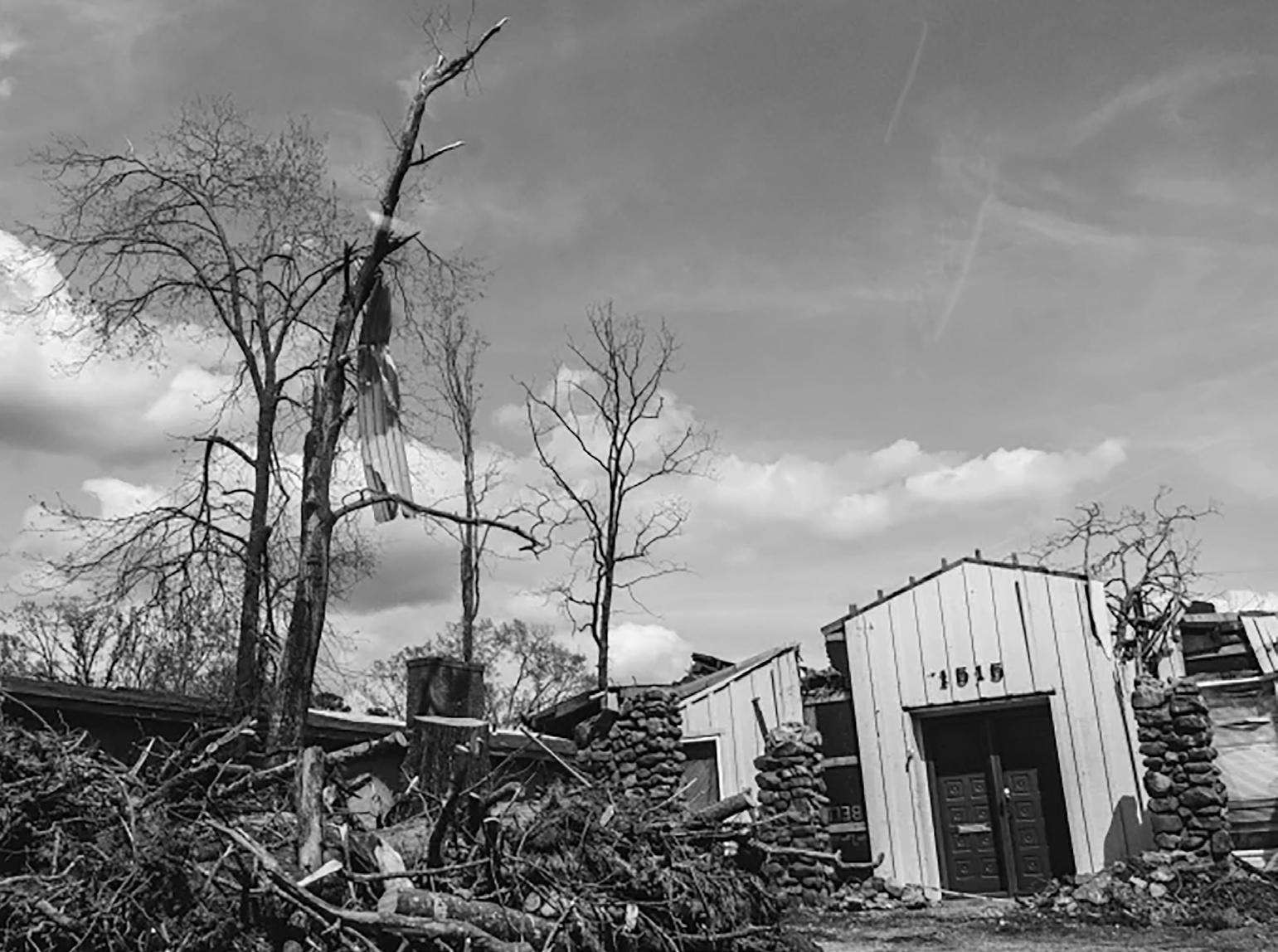
condemed and deemed unsafe to enter. [4] The sign outside of the fire station that the Hoods took shelter at that reads “We shall Retern!” [5] Flipped cars and uprooted trees lay in front of a destroyed apartment complex
Stokes.
Hadidi had a strong personal connection to the area. City employees and relief workers had set up shop in the pool Hadidi worked as a lifeguard at in high school. Across the street from that was the home of one of her childhood friends, which had been completely destroyed.
Those old friends of Hadidi’s were cooking lunch when the tornado came through. They heard what sounded like a train rumbling down tracks, which is the distinct sound tornadoes make. Before they could even process what had happened they were buried under rubble, unable to even hear each other scream for help or to see if their friends were still alive. Eventually, all three of them dug their way out, somehow emerging with nothing but small scratches. However, every tornado cloud has a silver lining, and theirs was the rice that they had been cooking. They ate it amidst the wreckage of what used to be their home.
A few blocks down from the Hood’s house was a collection of volunteers, some from Samaritan’s Purse, some from local churches, and some who lived in the neighborhood or nearby and wanted to lend a helping hand. Volunteers were moving debris, cutting fallen trees apart, and handing out water. According to one of the volunteers, one woman who lived in the neighborhood and had her house destroyed had been picking through the rubble of her own home in an effort to find summer clothes to hand to the volunteers to ward off the heat.
Down the road, an elderly couple who live in the neighborhood, who requested not to be named, declined the money that Hadidi offered, even after admitting to needing it. Despite some of their roof being gone and trees toppled over in their yard, they insisted one of their neighbors needed the money more than they did. When she offered to just give them a part of the original sum, they still refused it.
“I couldn’t even walk back [to the house] because the trees were all over,” the wife said. “Not little trees and brush, but big, old-growth trees were lying in the roads.”
The woman, who appeared to be in her late sixties, described climbing over and crawling under trees on the way back to her home.
The last neighborhood we visited was the same as all of the others. While the majority of homes in this neighborhood weren’t completely destroyed, many were missing roofs or walls. There, we met a few men who were aged between their teenage years and their 40s. They were splitting wood from a fallen tree in a backyard.
The homeowner, Ryan Scott, said that his back wall and roof were ripped off of the house by the tornado. His insurance had already covered the damage and the wall had been fixed.
“We [him and his wife] have some survivor’s guilt, honestly,”
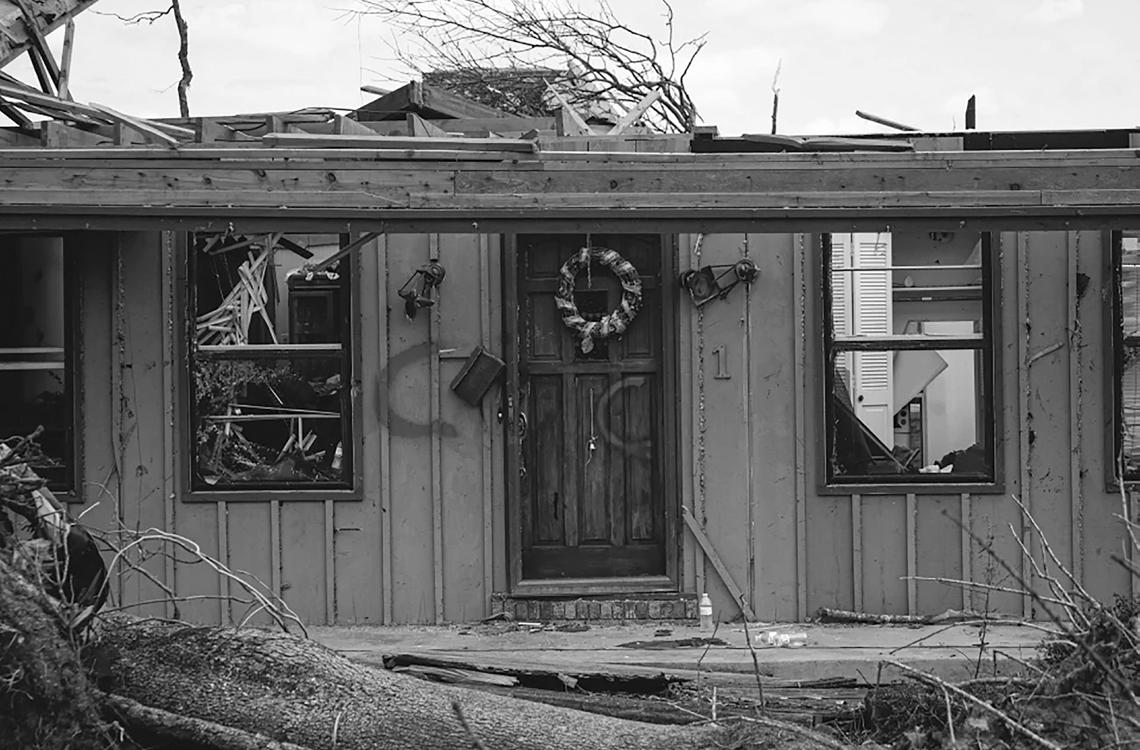
[1] The tornado ruins of Little Rock. [2] The remains of a house in a neighborhood off of Reservoir Rd. [3] Dozens of homes iike this one were marked with a spray painted “C”, which meant they had been
at our first stop. Photos by Eli
Scott said. “You’re in the same boat as them but it’s quite a bit different,” he said, gesturing to the house across the street that had been completely destroyed.
“We all have losses, but we have different levels of loss. You want to feel loss but you look across the street and see something totally different.”
On the day that I was with her, Hadidi only handed out one of the five envelopes of cash. She found some connections that did lead to people that needed the money later in the week. While literally handing out free money was harder than she expected, she did eventually get every dollar she raised into the hands of a few people who needed it.
The city of Little Rock has a long road of recovery ahead. FEMA has already donated over $4 million according to KARK.com, and almost 6,000 people had already applied for assistance on April 13. Mayor Frank Scott Jr. conducted bi-weekly press conferences following the natural disaster. On April 14 he announced that $341,000 had been donated
to the city through the Little Rock Cares Emergency Relief Fund, an initiative started by the city. The Red Cross, the Arkansas Department of Human Services, and the Arkansas Division of Emergency Management are all working together to provide temporary housing to the over 500 people that were displaced by the storm.
The state’s capitol resembles London during World War II. The splotches of destruction are something like the patches of destruction that were produced by German bombing runs. But just like the citizens of Britain during the war, the residents of Little Rock stand strong and continue to help each other.
After almost six months of recovery, the city is still early in the recovery process. Mayor Frank Scott Jr. said in a press conference in May that the overall recovery may take up to two years. Despite this, the city remains hopeful. The city raised $400,000 to help those impacted and Heart of Arkansas United Way has been put in charge of distributing those funds to those who need it most. According to an article published by THV 11, the organization hopes to provide relief and funding to citizens of Little Rock by the end of the year. ***
Crying in the Cafeteria
Fiction by Jackson Cook
Neither one of them can really be described as social or particularly charming. Their lunches, typically two cobb salads decorated with slightly funky sliced eggs, primarily exist to satisfy that uncomfortable stretch of time between morning classes and another afternoon spent in the library.
But, during one of these casual lunches, she asks him, “I see less caterpillars these days. Have you noticed that? Do you think anything is happening with that?”
The guy awkwardly laughs before answering, “I don’t think so- I mean probably not. You may just be spending less time playing in lawns.”
At that moment, he really sees her for the first time: when all of those quiet memories begin to swell up. The kind of memories that someone accumulates from millions of moments across years, weeks, hours, and minutes. The kind of memories that she could never even begin to describe to someone else because the words hadn’t been invented yet. The kind of memories that slowly build up and simmer before finally boiling over in, what is cruelly and characteristically, an extremely public place like a lunchroom. He saw that she wasn’t tremendously sad or happy; instead, she just momentarily lost her control on that wall you put up between two people who only really share cobb salads with each other. That wall of safety you put up to protect yourself from being perceived as excitable, depressed, stupid, or excessively emotional and because nobody wants to be seen crying over caterpillars.
LGBTQ+ Censorship Community Crushed by
Restricting LGBTQ+ literature goes beyond book banning
by Erica Wilson
One side of the room clapped and cheered at the Craighead County Jonesboro Public Library Board meeting following the announcement that the annual June Pride display would no longer be in the children’s section. But Rosemary Heyl’s 12-year old, a transgender boy, turned to Heyl’s husband and said “Daddy, I need to go to the bathroom.” He locked himself in a stall and started crying, as the feeling of people cheering his exclusion weighed on him. The Heyl family has always loved visiting the library, making it something of a Father’s Day Tradition. Walking into the children’s section a few years ago, her LGBTQ+ kid saw the Pride display and felt validated, but then witnessed the controversy surrounding its presence. It was a crushing weight. Heyl’s husband spoke at the next board meeting, calling people out by saying “You say you’re protecting children, but who’s protecting my child? How was excluding them in their best interest?” Not a single person could give him an answer, Heyl said.
Trends in library programming censorship efforts have paralleled nationwide book-banning attempts and targeted legislation toward librarians, many of which have been left feeling demoralized and undervalued. Groups such as the Freedom to Read Foundation and the National Coalition Against Censorship have rallied around librarians. Christine Emeran, NCAC’s youth free expression program director, said she thinks the show of support and a provision of resources is essential to avoid librarians feeling isolated and self-censoring.
Jonesboro Public Library Director Vanessa Adams said librarians still organize an annual Pride display in both the teen and adult sections. Controversy over library programming began before Adams started her position, when programmers experienced backlash over hosting a transgender author in 2019, Adams said. It was part of the library’s annual author event in which schools would typically attend as a field trip, but did not that year due to the rise in safety concerns, according to a Facebook statement that clarified no one was required to attend and the author was there to discuss her book.
And amid 2021 backlash surrounding the Pride display and children’s books with LGBTQ+ themes, the library lost both its director and assistant director, the latter of which cited threats to her well-being in her resignation letter. Adams stepped into the director role on Valentine’s Day in 2022. “I stepped into a mess here,” she laughs. Since she started, she had only seen two book reconsideration requests as of mid-April, but book-banning efforts have been rapidly increasing across the nation. The American Library Association reported 1, 269 demands to censor library books and resources nationwide in 2022, nearly doubling the 729 challenges reported in 2021. Books targeted for censorship tallied 2, 571, a 38% increase from the previous year. The vast majority of those titles included LGBTQ+ or BIPOC content.
The shelfs of books within the library. Photo by Sarah Wittenburg.
The Children’s Library. Photo by Sarah Wittenburg.
“The idea that information is scary or should be hidden away, it never stops with the books,” Heyl said. “The idea that LGBTQ literature is too inappropriate for a child to have in their hands just, it’s a very quick jump to LGBTQ+ people are too dangerous to be around kids, and that just leads to people getting hurt.”
Adams, who grew up in Jonesboro, recalls how some of her peers expressed feelings to her like, ‘When I was in high school, I wasn’t sure if I was gay or not and fortunately the Jonesboro Public Library had some books about it that I could read.’
“That’s why I think there should be something on the shelf for everyone,” Adams said.
“I do believe you need a balanced collection, but I do believe there should be something on the shelf for everyone so that they can see themselves in the literature.”
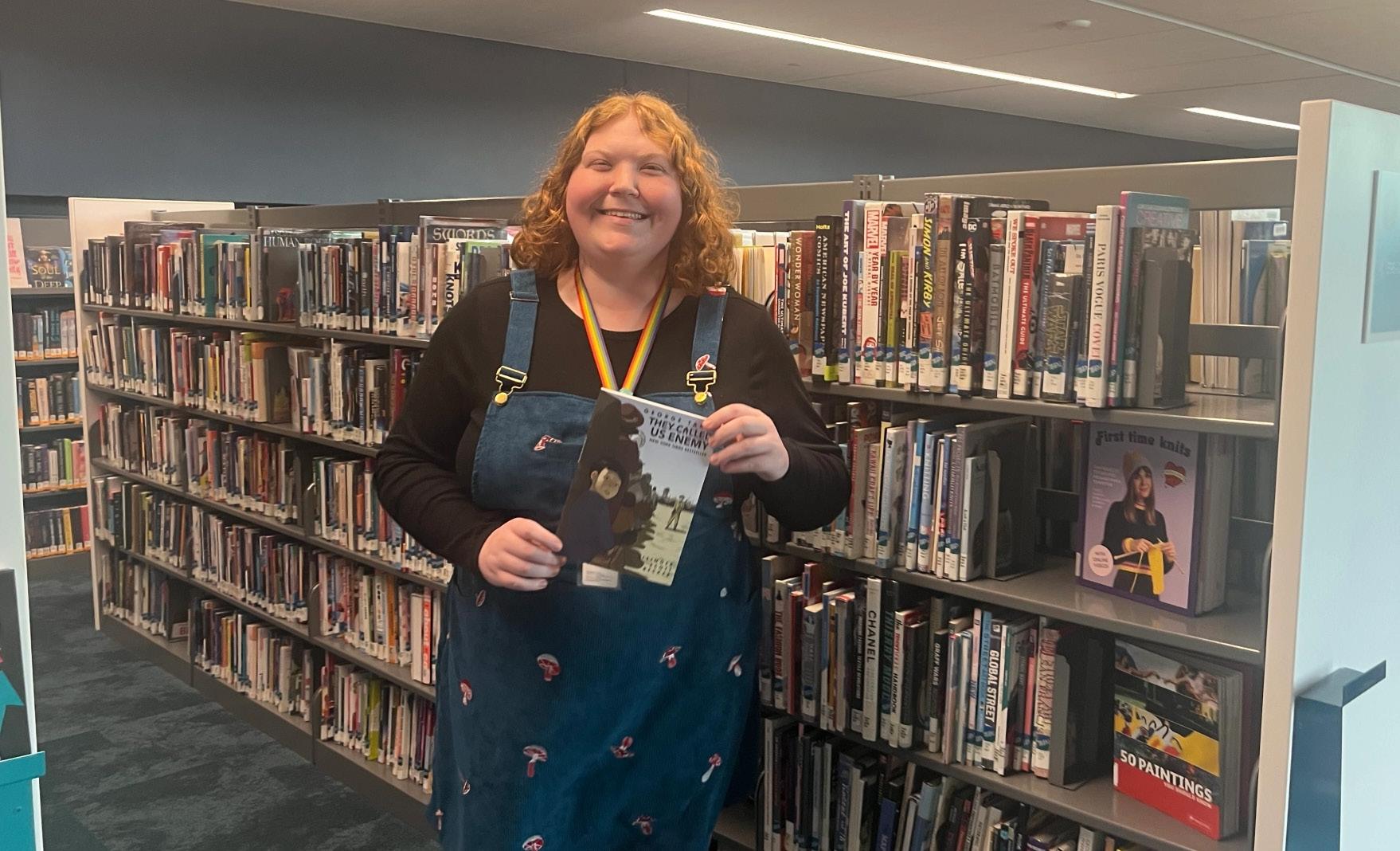
Emily Walker, who previously worked as the Fayetteville Public Library’s assistant youth and teen librarian for just over 3 years, strived to make the space as inclusive, comfortable and encouraging as possible for anyone who walked through the doors. As a queer librarian, Walker said pointing kids toward representation in books was especially important to her. It was not until college that she read a book that included specific representation that she identified with, and it is essential to her that kids have the ability to read happy, positive stories that they can resonate with. She co-ran a teen book club and recalled a time when one of the teens and their parents approached her. They thanked Walker for helping them feel so supported, citing that the book club was helping them feel safe and comfortable with their identity. Each June, Walker hosted Pride bingo that teens could fill out, with spaces such as “read a fantasy book with a queer character” or “read a book with a trans main character.”
She found it so rewarding to provide an avenue for creating excitement among kids about simply feeling seen, she said. However, her programming efforts did not come without pushback. In August of last year, Walker worked to hold a Back to School Bash at the library geared for transgender and queer teens. The event had to be shut down because the hosts were receiving hundreds, if not thousands, of threatening phone calls and emails, she said.
Adams recalls a Blacklight party hosted at the Jonesboro library in which people took to social media to make comments such as “I wouldn’t take my child and let them be in the dark with those librarians.” People referred to the librarians as pedophiles and groomers. The slandering language was utterly and completely demoralizing for the staff, Adams said.
The entrance of Fayetteville Public Library. Photo by Sarah Wittenburg.
With librarians now fearing for their safety or their jobs, targeted legislation is simply adding fuel to the fire. Senate Bill 81, now titled Act372, would hold librarians criminally liable who are found to have provided “obscene materials” to minors. Both Adams and the Fayetteville Public Library’s director Willow Fitzgibbon share the same sentiment: Their libraries do not harbor any obscene material. Publishers take the definition of obscenity, marked by being offensive to moral principles, into consideration, and Adams pointed specifically to the Miller’s test, which has three parts. It includes whether the average person would find that the work appeals to prurient interest, depicts or describes sexual or excretory functions in a patently offensive way, and whether the work lacks artistic, political or scientific value. Adams says that for the library to get in trouble for having obscene materials being obscene on their shelves, the term would have to be redefined in the Senate and the House.
As of right now when someone challenges a book at the Jonesboro Public Library, they are given a reconsideration request form. It states that library officials will not consider the challenge if the person has not read the book in its entirety, asks for specific objection examples and recommendations for books to replace it. A committee of library staff has to read the entire book and then meet to decide whether to remove it or move it to another section. With Act372, the power of the final decision would not rest with the library board, but with elected officials if someone were to contest the board’s decision. A similar process is in place at the library in Fayetteville, and the city’s library staff
have never had to move a book to a different collection or remove it entirely as a result of challenges.
“Now, it’s been taken out of [the committee’s] hands and put into the hands of the city council, which are elected officials and I don’t think elected officials need to be deciding what’s on our shelves, because it’s political then,” Adams said. “It infuriates me, every librarian in Arkansas, we’re all mad.”
Fitzgibbon thinks that any time material is removed from the library or people lose access to material, there is potential damage for members of the community.
“Just because the material isn’t for somebody doesn’t mean it’s not going to be of value or have important information for somebody else,” Fitzgibbon said. “We really do believe in the First Amendment right, that people should have the access to explore ideas and information, and part of [it] involves having ideas out there that you don’t agree with, but it’s just important to be able to provide access to different ways people think and different perspectives.”
Walker said librarians share the sentiment that their job hinges on whether or not they can make inclusive book recommendations to kids without fearing they could be putting themselves in jeopardy.
“It’s a fear of all of us, my coworkers and myself, that we’re not going to be able to help these kids that need it and want it and we’re being criminalized for what?” Walker said.
“Reading from every perspective is so important because even if you don’t quite know someone’s point of view, if you read
Former librarian Emily Walker stands among the book section at the Fayetteville Public Library. She holds the Mauy book selection for her teen bookclub, where she strives to make members feel comfortable and included. Photo by Erica Wilson.
from their point of view you’re going to be more empathetic and understand where they’re coming from. It just broadens your horizons.”
Overall, Emeran thinks society should place more trust in librarians.
“They do have credentials, they are trained [to select materials],” Emeran said. “There should be more respect to their practice and to their professional judgment.”
The library is more than just a repository for knowledge, Heyl said. It is a community hub, one that’s welcoming and inclusive environment should be preserved. At the Jonesboro library, community members gather for karate or yoga classes, research their family tree in the genealogy department, attend arts and craft fairs or summer concerts, and can gather materials for their garden in the seed library. It’s a safe place for people to go, one where people are not expected to spend any money, Heyl said.
“[It’s important for librarians to know] that they know they have people in their corner, and they know that they have more people than the very vocal handful of people in our community that have decided to absolutely run them into the mud, it’s shameful what these people have done to these librarians,” Heyl said.
With many librarians feeling like they have come under fire for programming and book selection efforts, Emeran encourages community members to show their support by becoming active in their communities, whether it be through attending school board elections, budget meetings or writing letters in support of challenged books. One of the best ways to combat censorship is to call it out, and the First Amendment holds firm that no particular viewpoint or belief is allowed to dictate what students can learn and read.
“I think that as community members, our presence is essential to defeat, you know, their opponents who are usually single individuals with particular views and to show that there’s a wider support for what librarians do,” Emeran said. ***
A stack of books. Photo by Sarah Wittenburg.
The Missing and the Murdered
Illustration by
Tyler Thompson
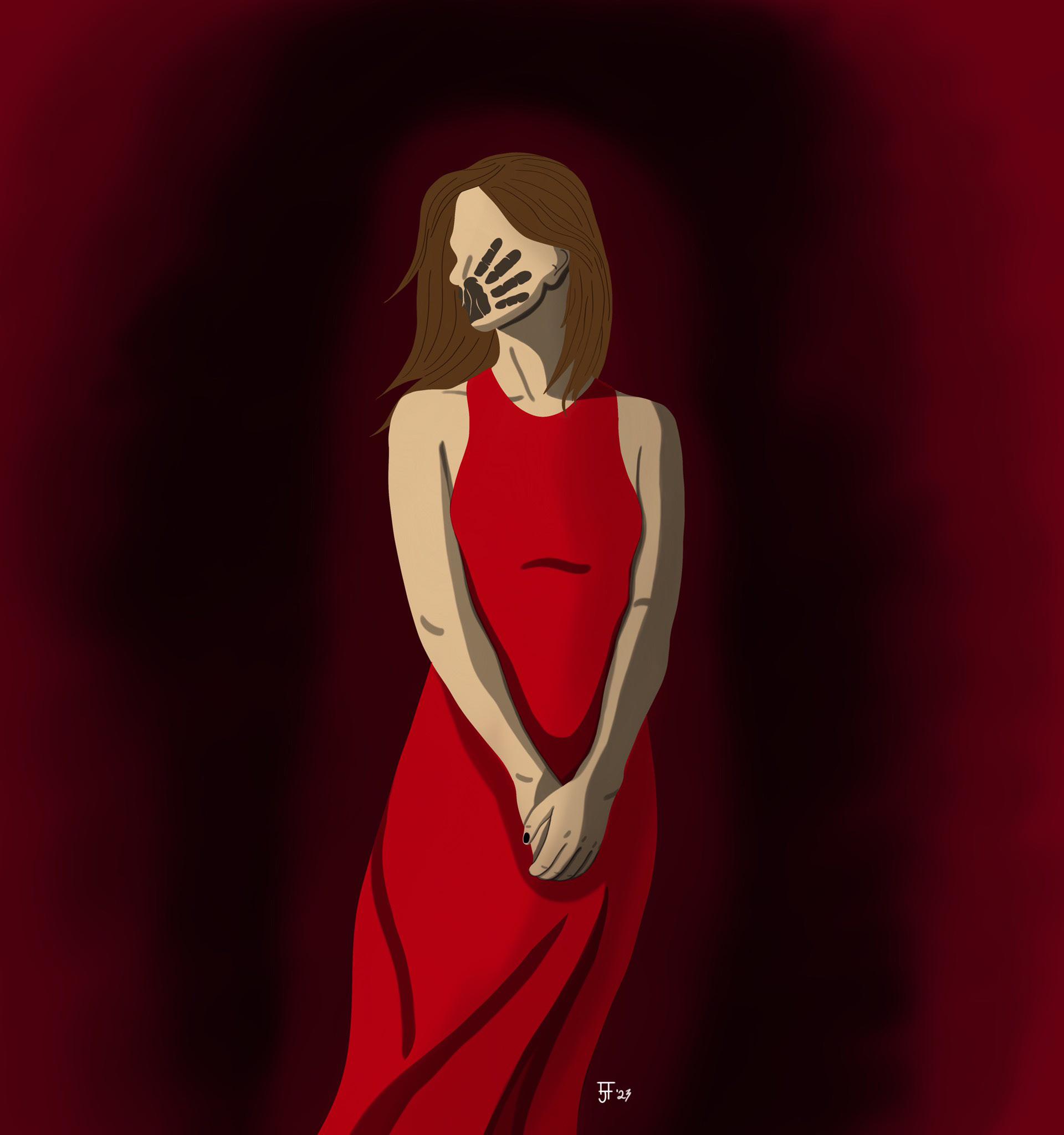
This piece of artwork is titled “The Missing and the Murdered.” I drew it digitally using my iPad and digital art is what I mainly focus on doing now. Art has always been a passion of mine and one way I use it is to help raise awareness for missing and murdered Indigenous people. Being Native American, these tragedies weigh heavy on my heart and soul. Color usage plays heavily in Native American culture and I implement that in this piece. I use red to represent the missing and the black handprint to represent the murdered along with the blend of both in the background. I didn’t draw in a face because I want her identity to be anyone because the missing and murdered can be anyone you know or hold close to your heart.
A Pastor Provides Showers; That Doesn’t Make it a Baptism.
by Trevor Spencer
Friday afternoon, Bradley Clyne walks the smooth concrete trail that runs alongside Walker Park. Runners and bikers swerve past him as their minds focus on finishing the next mile of the path. This trail is the Razorback Regional Greenway. It provides a good way for residents to enjoy some exercise in nature around Fayetteville before returning to their couch. Clyne, however, is not walking as some form of escape or recreation. He is not focused on finishing the next mile. Because, he does not, like many runners, avoid the reality that sits just outside the concrete path.
Uncovered by the barren trees, anyone during Fayetteville’s winter can plainly see clusters of tents that sit beside the creeks and under the bridges that the Greenway passes. For almost a mile along this stretch of trail near Walker Park, these camps are communities of some of the approximately 200 residents of Washington Country with nowhere to go, according to NWA Continuum of Care.
For many of those that are lying in these tents just beyond Walker Park, they have no couch to go back to like those passing them, no home with a bed, or a shower, a kitchen, or air conditioning. But, every week, they will see Clyne’s familiar face. “To them, I’m B.C.…They’re family.” And, they know why he’s here walking, waving, and looking right at them.
Leading to The Trail
Clyne leads a non-profit organization and ministry called Every Soul Matters, which distributes food, clothing, and other needs in homeless outreach.
Another reason for Clyne’s patient, gentle, and intentional outreach with this group in society is empathy. Clyne and his family used to live in a van, as he was homeless for the late 70’s and early 80’s.
In 1977, at 20, he moved near Estes, Colorado, which is the base of Rocky Mountain National Park, to help his dad run
a Girl Scout camp called Meadow Mountain Ranch. This sort of venture was not new for Clyne. For the seven previous years, Clyne grew up in a remote town called Big Moose in New York that sat in the middle of the Adirondack Mountains. His mom and dad ran the Little Fox Hotel there. Even then, his parents’ business controlled much of his life, in what he called an abusive upbringing.
In this, Clyne had a lot of responsibilities, such as chopping firewood, helping out at the hotel bar or restaurant, and getting his brother ready for school every morning. His parents would have been up until 2 or 3 a.m. tending the bar. The strenuous atmosphere led to long sessions of escape in the wilderness reading and playing in the lush forest of northern New York. Eventually, Clyne was dissatisfied with the pay given by his parents, and he went to work at another restaurant close by. This demanding childhood led to a growing independent spirit. In 1977, this spirit took off. Clyne helped at the ranch for only a few months, and then his friends met him in Colorado to leave the ranch and hitchhike the West.
He traveled from Colorado to Arizona and Arizona to Washington. Taken up by the desired independence from his childhood combined with the similar free spirit of the 70’s, he and his friends would sell their plasma for $15 dollars a week to eat cheap hamburgers and buy fresh Mexican pot.
This lifestyle of travel and homelessness would keep up into his mid-20’s and 30’s. Starting in 1981, Clyne, his wife Angela, and eventually his two children would move back and forth between Pensacola, Florida and Northwest Arkansas for much of the 80’s. They initially moved to Northwest Arkansas because they liked the weed they had smoked from Madison County. Soon after arriving, they would begin to homestead, living off the land, and growing their own crops. In the winter, they would move to Pensacola, but after years of instability in a home and
Courtesy of Every Soul Matters.
job, they became homeless. Clyne and his family began to live out of their van in Florida. This instability would not change until 1998.
He and his wife Angela were tired of being consumed by the substances. One day, they were watching television when a message came on called “Walk in Love.” They didn’t have a remote for the TV, so they couldn’t change the channel. The show played on. It spoke of freedom and a life of selflessness. Clyne described this program as a pivotal moment of life change for he and his wife.
They threw out their drugs and their drinks, they started attending a small Assembly of God church in Witter and then in Huntsville, and they joined ministry work. In this, they received a lot of help from the churches to grow in sober living, in parenthood, and, now, as ministry workers.
Clyne was ordained as a minister in 2014 with Worldwide Missionary Evangelism. Soon after, in 2015, he started Every Soul Matters as a disaster relief foundation. But, after a lack of funding, Clyne shifted the focus of his organization to the homeless.
“I had a revelation that hurt my heart,” said Clyne.
“Why am I going so far when there are those that need help right here?”
Clyne stopped focusing on the big tragedies to find the small ones, the ones he says we all pass on the street corners.
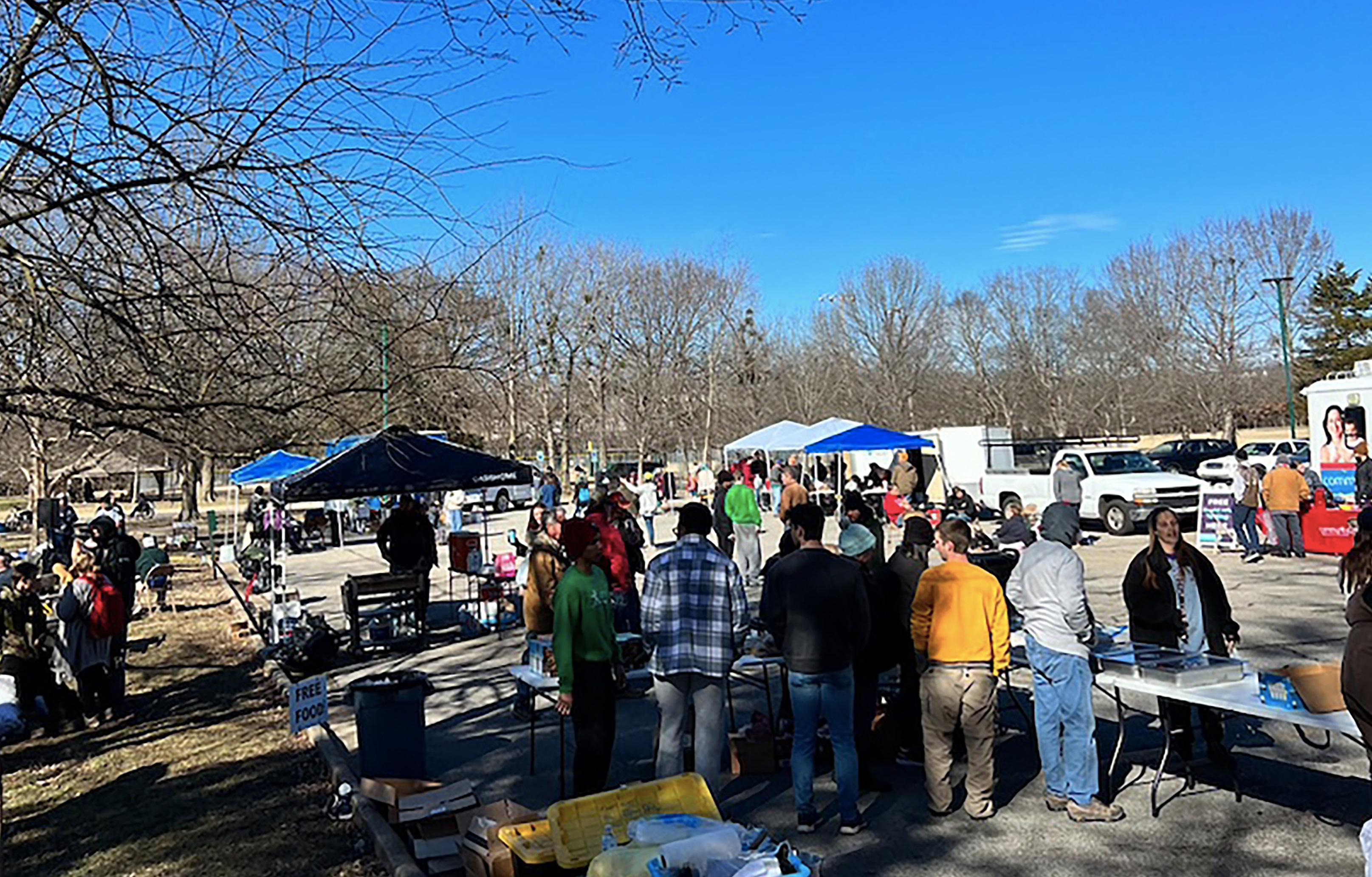
Clyne spends a lot of time on this trail to connect with those in need. For this Friday, he walks the trail to share the news: On one Saturday of each month, Every Soul Matters hosts an event in Walker Park. This event is designed to meet
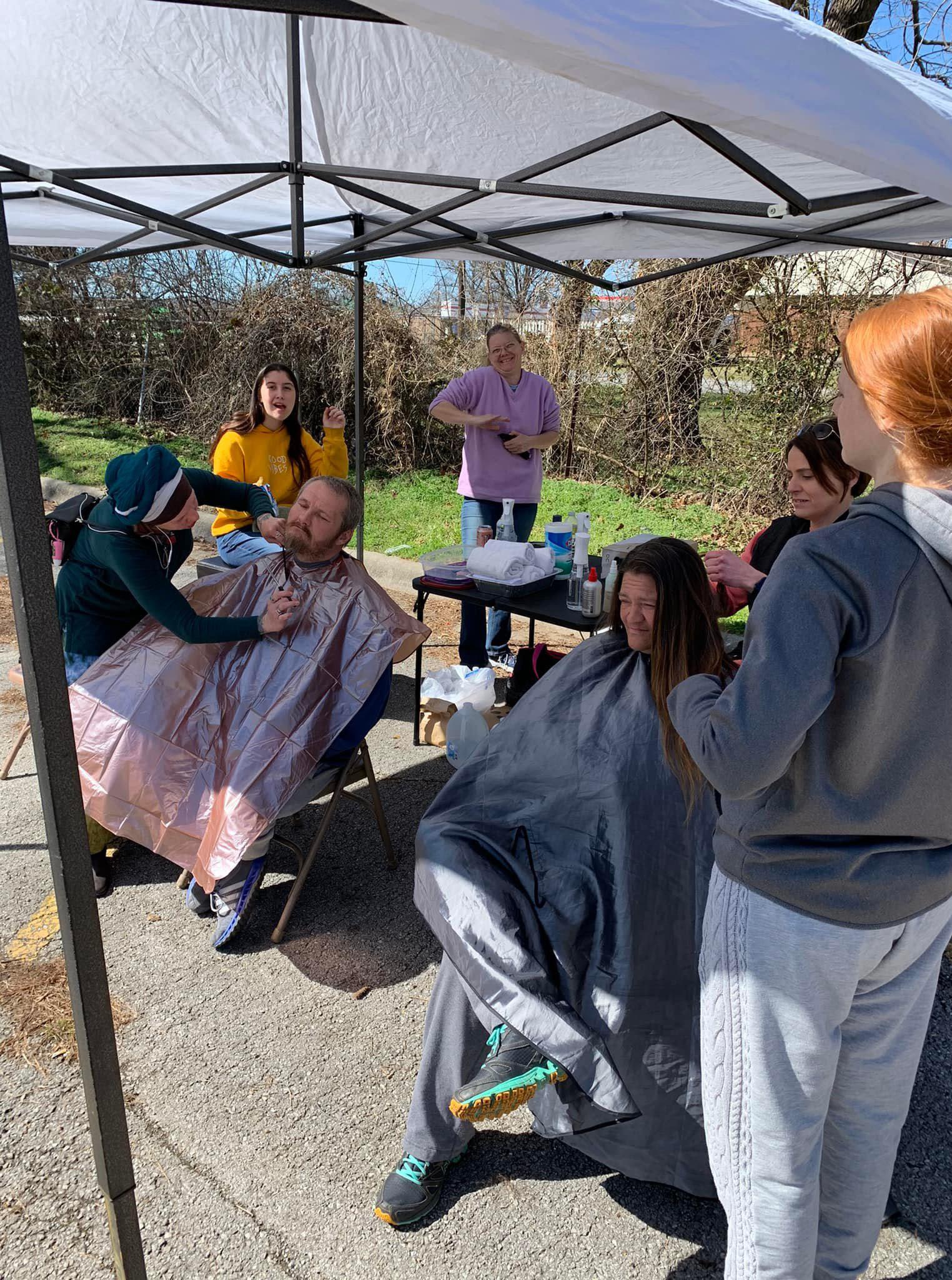
many of their basic needs: medical attention, showers, food, clothing, haircuts, supplies, and friendship.
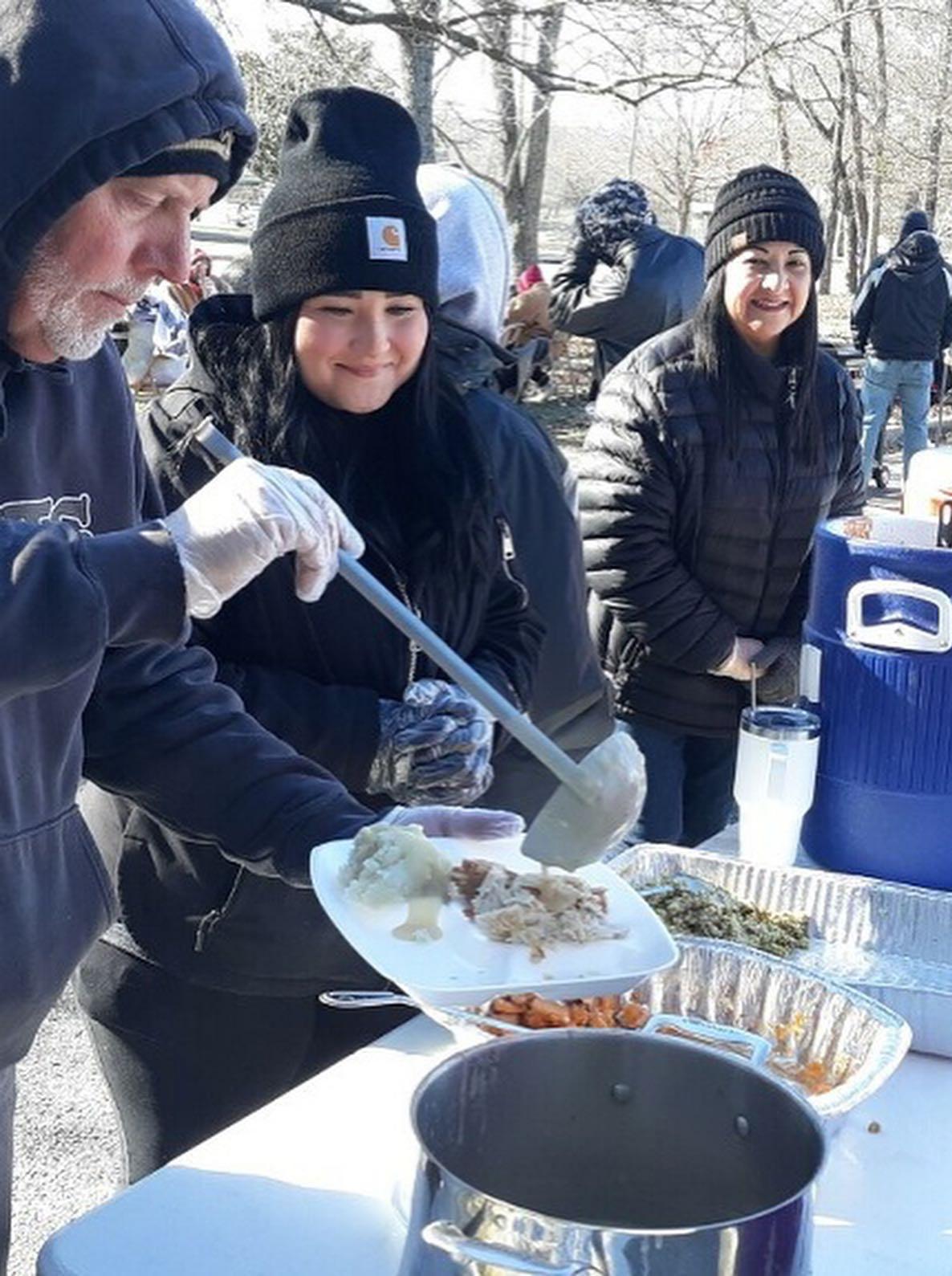
“A family reunion’ is the best way I can put it,” said Clyne. “You have these ten tables set up with all these chairs, sixty or seventy people eating at once. We have a lady playing worship music. We have a PA system where we’re directing them to the medical clinic and everything. People will give lifechanging stories, on the microphone. It’s a family reunion.”
Clyne is passionate about meeting all their needs, especially friendship. He described our general attitude toward the homeless and disenfranchised to be “looking past them.” But, in Clyne’s holistic approach to helping the homeless, these Saturdays go beyond passing out food and T-shirts. This event is not merely a handout. The help he does for others is more than the number of care packages and meals he hands out in a given month.
“We’re giving them a friendship,” Clyne said. “We’re talking to them. And not only that, but we’re listening to them. They want someone to listen to their story. They want to be listened to and to be seen as people.”
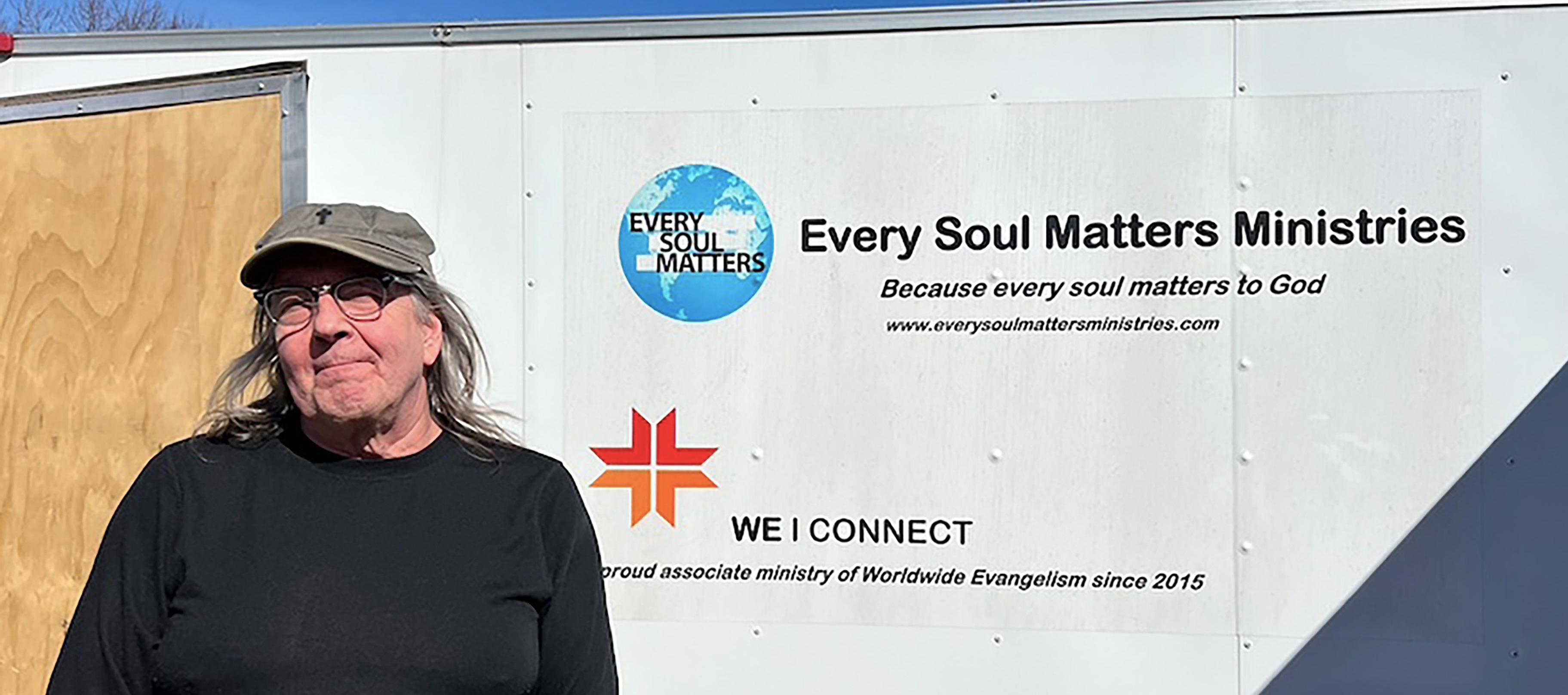
Pastor Clyne poses in front of his clothing distribution van. Photo by Trevor Spencer.
The Van
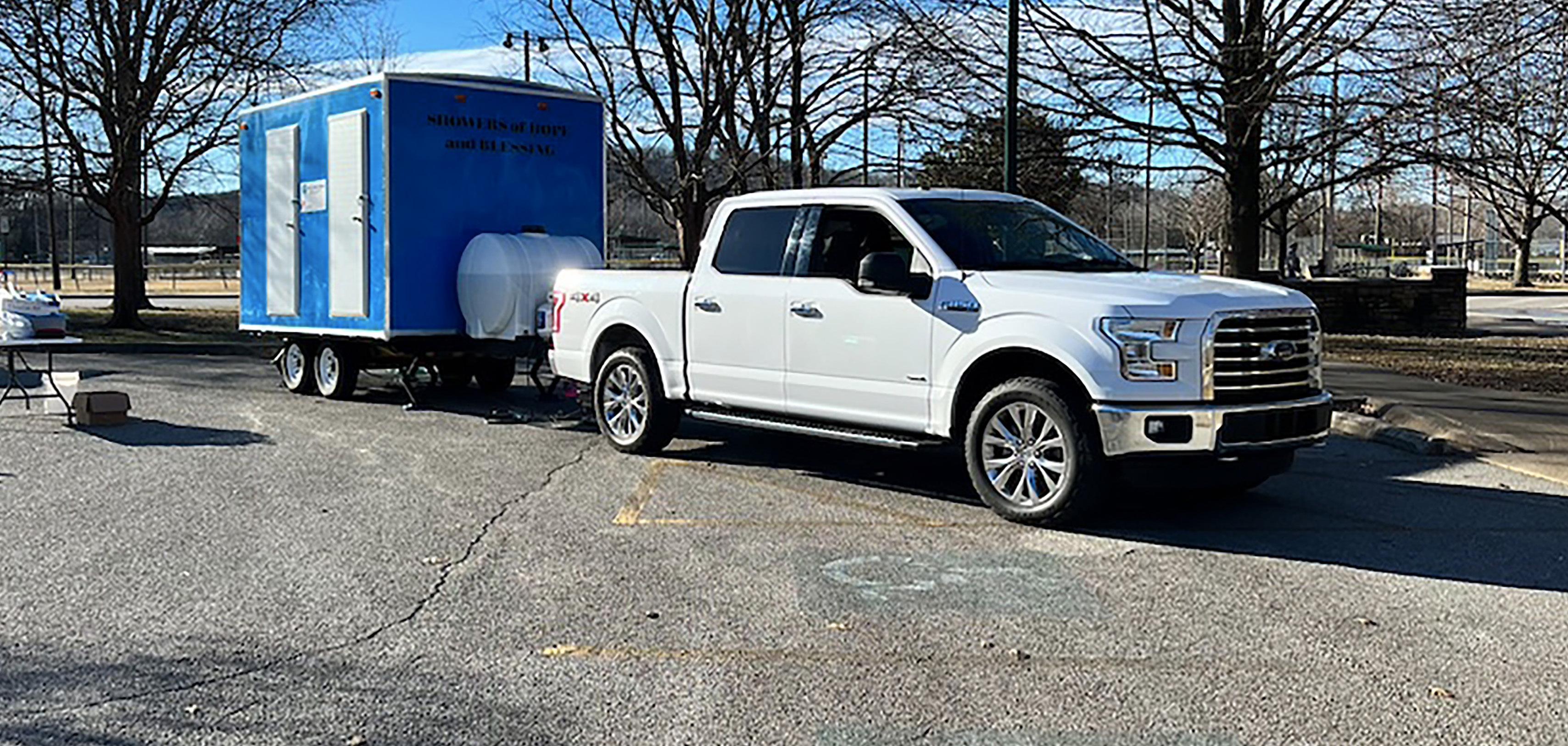
Early Saturday, Clyne wakes up at around 5:00 am in a hurry. He makes his way outside in the dark and cold to fill up the tanks for the large blue shower van. “On these Saturdays, I don’t stop at all.” The rest of the rapid morning preparation is coordinating. Clyne directs volunteers to their stations. He checks on the clothing distribution van, the grilling tent, the coffee dispensers, the tables, the music, the mobile medical unit, and, this newest edition, his mobile shower van.
Just before 9 a.m., Clyne gathers the nearly twenty volunteers in a circle. For a moment, all the moving and talking, cooking and organizing stops. All eyes look to Clyne at the head of the circle. He guides the group to act as one cohesive heart and mind in order to serve others. A single theme unites the volunteers: patient love, or long suffering. In this theme, Clyne prays for the day’s event to be one of kindness, hope, endurance, and patience for all those attending.
Just as Saturday’s event is kicking off, Clyne sends volunteers
to walk the trail and invite the displaced for a final time. As one of the volunteers, I joined another named Larry Holliman. And, we started to make the same walk Clyne often does. Holliman first discovered Clyne’s ministry through other volunteers from his church, and he’s been helping every month for almost a year.
“This is what Jesus does,” Holliman told me as we made the walk. “He meets people where they’re at. He went out into their space and communities and cared for them.”
Put simply, Larry says that Pastor Bradley sees a need and he fills it. Larry and I see two women sitting under a park pavilion shaking from the 26-degree weather. Larry invites them to join us and offers them coffee. One woman shakes her head softly back and forth, denying both offerings. The other gladly accepts some coffee, as she quickly picks up her head and smiles wide to Larry. They didn’t join us in the “family reunion.” But, one thing that Pastor Bradley said continually to me was, “We’re not here to force anything. We are just trying to love as Jesus did.”
One reason for Clyne’s patient, gentle, and intentional outreach is sympathy. “They just can’t help it,” said Clyne, as he described their issues with substance abuse and lifestyle. Holliman explains that many of these individuals that Clyne cares for have mental issues, recently deceased family members, or have just given up on life. Another volunteer from Saturday, Karen Rodgers, said, “He [Clyne] has challenged us to look at these homeless as people, because they are, and because we must learn how to deal with people that have different challenges.” In other words, Clyne understands that these people have specific issues that can’t all be handled in the same manner. That’s why Clyne’s sympathy and compassion move in ways beyond a monthly event.
Clyne goes to Walker Park and the Greenway every week. He brings snacks and a message of hope to the homeless there. Specifically, he says he’s often there to pick up anyone suffering from substance abuse issues in order to get them the help they want.
Clyne meets people in whatever need they have. One
“This is what Jesus does,” Holliman told me as we made the walk. “He meets people where they’re at. He went out into their space and communities and cared for them.”
Clyne as a continual friend in many seasons of his recent life. Randles traveled to Fayetteville from Arizona in 2021, and He lived out of his van here for a couple of years until he moved in with family in nearby West Fork. During his homelessness in Fayetteville, he would attend Celebrate Recovery meetings in Walker Park held by Clyne. These meetings were for breaking habits of addiction or dealing with a hurt from one’s past. “Pastor Bradley exudes outgoing love that has a strength behind it,” said Randles.
While Randles would not go into detail on why he was at the meetings, he did explain it was a great help to him. Unfortunately, Randles went to jail soon after in 2022. But, he explains, Clyne was there after his sentence, keeping his van secure for Randles to pick up. Clyne even sent a tow truck to him soon after his release from prison. It picked up the stalled car he was in to take him to his parole meeting. Randles now works as a musician, playing at many of Clyne’s outreach programs.
As a close friend and participant of Clyne’s outreach, Randles says that Clyne is not afraid to go into the “dark side of Walker Park” to get people the care they need. “Clyne’s help and heart go beyond a once-a-month event. If given the opportunity, he would be out all the time helping people.”
The early February ice storm in Fayetteville was one of those opportunities. Clyne bought hotel rooms for some of the homeless in danger of freezing to death. “We don’t need nice lights and theater seating to care for people,” Clyne said.
Instead of a building they can come to, Pastor Clyne’s approach is to meet them in their space. “His approach is eye-opening, because it’s different,” said Holliman. “Anyone can sign a check to help, but when you’re in the trenches with
is just different.” This event shows this willingness to meet them in their space, as it takes place yards away from their camps.
Larry and I walk back as it begins. People emerge from the groves and camps near the trail and join us in our walk toward the echoing piano, the rising grill smoke, and Clyne’s big blue shower van.
The Crash
As the park event begins, people from all walks of life emerge in the center of this concrete slab on 13th and Block. The mobile medical unit pulls up to complete the carousel of care that surrounds them. Rotating in the center, there are women, men, families in need, pets, young loners, and elderly, all tired and cold. At the day’s peak of activity, there are close to eighty homeless individuals. Completing the circle around them, the volunteers walk around each station. Those serving are returning volunteers, nurses, gospel singers, cooks, hairdressers, and organizers. Lines form at each station of the circle. The longest line forms in front of the clothing distribution van, where people wait patiently for an extra layer in the 30-degree weather.
Clyne goes from one point of the circle to the next, guiding people to their needs. He answers any question, points in the necessary direction, and hugs the many familiar faces. “It’s hugs all day long…I don’t know how many I give…almost to all of them. It doesn’t even matter who they are or what they smell like.”
At a stop, he pushes his long white hair out of his face
Clyne’s truck and shower van sit in the corner of the parking lot in Walker Park. It reads “Showers of Hope and Blessing,” photo by Trevor Spencer.
and around the back of his hat, and he leans in close to those needing assistance. Then, he suddenly departs and bursts off in one direction to check that all needs are being met elsewhere. Randles says of Clyne, “He makes time for everybody. He is the busiest f—ing guy in the world. But, he does it with such grace. It shows the love he has for everyone.”
In one particular instance of this busy, graceful routine, Clyne showcases this heart. A volunteer group from Teen Challenge Adventure Ranch huddles around him. This ranch is a home to boys who have gotten in trouble with the law and/or their families. One of the kids is under the impression they are not going to get to wash the dogs that the homeless brought. Clyne is upset. Clyne is not going to let this promise of service and kindness be unfulfilled for the giver or the receiver. Motioning several of the teens with him, he darts in the direction of the shower trailer to set up the process.
When I join Clyne later during lunch, he stares at me before motioning his eyes around the scene overtly, getting me to do the same. He explains to me the powerful picture in front of us. Many of the anxious faces arriving at the park, the ones
that live in camps near the creek, cold and tired, are now eating, smiling, hugging, laughing, and singing. Arms are filled with friends, food, clothing, or a washed dog.
But, Clyne also described this event as draining. The excitement and service of Saturday turns into a depression on Sunday. One volunteer, Richard, and Clyne’s wife Angela spoke of this as a crash that hits them in the hours after the event ends. This crash, as all three describe, is a realization of the life the homeless go back to and the life the volunteers go back to in their homes. Clyne says, “It’s unfair…I know that while I am sitting on my couch, someone else is lying on the pavement.”
Sunday is a reminder that not every day of ministry is like Saturday’s event. “Not every day is going to be puppies and rainbows,” said Holliman. But, Clyne’s service and long suffering for them extends past Saturday’s exciting, impactful event. Clyne prepares for the next week, where he distributes clothes and food to them, where he sees them in their hardship. “If we continue to love, we can show them that hope is there and change is possible.” ***
On February 18, 2023, Every Soul Matter’s Event Begins, photo by Trevor Spencer.
Fenced
by Arden Alloy
My mother always told me that I was wild in my youth, that I was never afraid to act out at a moment’s notice.
When I was a baby, I rammed myself into the living room coffee table, My head swung violently until it slammed into the dark wood. I cracked open like a blood orange—a wound so grand I earned dozens of silver stitches for my work.
That’s the reason why we had to built that wooden fence all around the backyard, Mother says.
Now, I stare at the damp wooden fence in the morning, thinking about the white scar between my hairline and left eyebrow, and wonder where I lost my damn nerve.