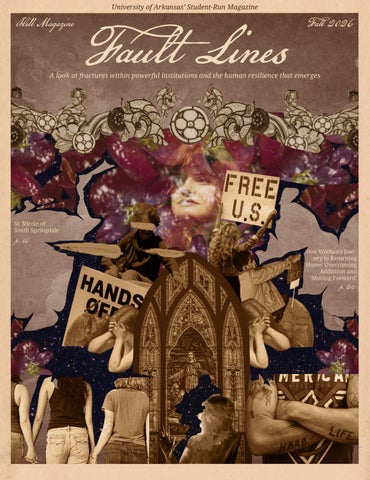
Fault Lines University of Arkansas’ Student-Run Magazine
Hill Magazine
Fall 2026
A look at fractures within powerful institutions and the human resilience that emerges
St. Nicole of South Springdale
p. 16 One Woman’s Journey to Returning Home: Overcoming Addiction and ‘Moving Forward’
p. 24
Hill Editors
2
ANNABEL SIMMONS
DESTINY MBUTHIA
MAEVE STERLING
ANGIE RAMIREZ
GARRISON BRISTER
MIA OVALLE
Editor-in-Chief
Visuals Editor
Social Media Editor
Assistant Editor
Design Editor
Web Content Editor
Letter from the Editor-in-Chief Fault lines, cracks in the Earth’s crust, often remain hidden until the ground begins to shift. Until stress builds up within the rock and causes the ground to shift. The ground beneath us feels permanent—dependable. But, when the earth moves, weaknesses are exposed. What once seemed solid reveals its fractures. The foundations of society are not so different; beneath the promises of our institutions lie the realities of those they fail. Through religion, the criminal legal system, healthcare and immigration enforcement, the following stories collectively relay how institutions have failed and harmed people while eroding public trust in distinct ways. They reveal a gap between the ideals that these structures ‘aim’ to uphold, such as freedom, redemption, faith, safety, opportunity, and the lived realities of many people in the United States. In the years since the 2024 presidential election, this divide has only deepened, compelling me to bring these stories together in Fault Lines. Though, this issue is not intended to be bleak. Paradoxically, these institutional fractures also reveal the utter strength of the human spirit. Resilience. There is an enduring capacity for human adaptation and connection in the midst of precarity. Individuals and communities continue to find ways to survive and belong outside of these traditional structures. I want to thank my wonderful editorial staff, contributors and Professor Bret Schulte for working alongside me on this issue. I also owe a very special thanks to photographer Jason Fricke, who may have taken over half of the photos in this issue, for his dedication to Hill Magazine. Finally, thank you to Aly Hubbard, the immensely talented artist who transformed my vague vision into this issue’s cover. Let these stories challenge you to look more closely at the structures that shape our lives and the role each of us plays in determining what comes next. All the best,
Annabel Simmons Editor-in-Chief
3
Writers & Photographers JASON FRICKE photographer
MADELYN GRAY photographer
KEELIN FISHER writer
ALLIE
TRIESCHMANN writer
NOAH KEISER photographer
Hill Magazine is published by Student Media Division of Student Affairs at the University of Arkansas, 203 Kimpel Hall, Fayetteville, AR 72701. P: 479-575-3408 All content decisions are made by the student staff of Hill. Views and opinions expressed herein are not necessarily those of University of Arkansas faculty, staff, or administration. Contents ©2026 All rights reserved.
4
Not pictured: Aaron Klahr, writer Madelyn Dibee, writer
Table of Contents Fault Lines 1...................................................................................................................Cover by Aly Hubbard ‘Who Does Jesus Love?’: Inside America’s Changing Relationship With Christianity By Keelin Fisher.............................................................................................................................................................6
Truth and Deception A Poem by Siena Lamb ................................................................................................................................................14
St. Nicole of South Springdale By Allie Trieschmann...................................................................................................................................................16
One Woman’s Journey to Returning Home: Overcoming Addiction and ‘Moving Forward’ By Keelin Fisher............................................................................................................................................................24
In Castillo San Felipe del Morrow A Poem by Anatole Hurta............................................................................................................................................32
Feeling Thread Along by Sun into Stars A Poem by Anatole Hurta............................................................................................................................................33
Taken Hostage by ‘the Game’: Forced Criminality and a Trafficking Survivor’s Struggle to Clear Her Record By Aaron Klahr............................................................................................................................................................34
Just Listen A Poem by Caroline Riley.............................................................................................................................................43
The Weight of Caring: A Look Into the Arkansas Dementia Crisis
By Madelyn Dibbee.......................................................................................................................................................45
Aspire to be in Awe A Poem by Siena Lamb.................................................................................................................................................49
Violence, Death, and Ruination; Is This the End? Artwork by Josephine Neukirch...................................................................................................................................50
5
‘Who Does Jesus Love?’: Inside America’s Changing Relationship With Christianity By Keelin Fisher Photos by Madelyn Gray
6
R
ick O’Kelley was sprawled across a wooden church pew when the world was supposed to end.
His mother stood nearby to do the talking, speaking for his father, saying he could not be friends with the girl because she was Catholic.
He was 8 or 9 years old, still small enough to stretch out along the wooden pew, his head resting against the hard varnish. Outside the 81 Freewill Baptist Church in Rudy, Arkansas, everything was business as usual. It was the early 1960s. Other residents were on their way home from work, and children were outside playing until the street lights came on, signaling it was time to go inside for dinner. But inside the house of worship, the faithful intently waited.
“Where is God to protect me?” he thought again.
His mother had rushed him and his brothers there after hearing a radio broadcast warning that Jesus Christ would return that very day. Their minister had also dreamed that a comet was a sign of the Second Coming, or Jesus’ return. So, members at 81 Freewill Baptist Church—which still operates today—drove to the sanctuary and sat along with others and waited. O’Kelley, who typically fell asleep by 9 p.m., drifted off. He was woken up close to midnight, only to find out it was time to go home. Nothing had happened. The earth was still spinning. No end of the world. No Second Coming. Another eight years or so passed. At 16, just weeks away from his seventeenth birthday, O’Kelley arrived home to find his parents enraged. He had befriended a Catholic girl who had just moved to town and did not yet know anyone. It was a solely platonic relationship, but that did not matter to his parents. They were concerned that she was Catholic, reflecting the deep doctrinal and theological differences between Free Will Baptists and other denominations. His father’s belt came off before any questions were asked. Soon after, the teenager found himself cornered in his room as the belt swung toward him. “Where is God to protect me?” he remembers thinking.
O’Kelley grabbed the belt with both hands, yanked it away and ran out of the house. “Where was God to protect me?” he asked once more. He ran to a nearby creek where the Boy Scouts often met, found a bench to spend the night on in the cold air and still made it to school the next day. “I’d been raised in church to be a friendly guy, to try to be nice to all people — and now they’re telling me I can’t be friends with this girl,” said O’Kelley, now a 74-year-old retired homicide investigator and former chief investigator for the Washington County Sheriff’s Office. O’Kelley’s experience provides insight into the American religious life experienced by some of today’s growing number of non-believers, where people raised in deeply rooted Christian traditions sometimes question their faith later in life, struggle with it or eventually leave—or move to churches that better match their beliefs—after years of internal doubt and pressure. In Rudy, O’Kelley was raised in the Free Will Baptist Church. But the name is ironic, he said, because he had no free will, though he acknowledges the title actually refers to the belief that sin exists because individuals have the freedom to choose it. His great-grandfather had been a minister in the denomination. His grandfather was a deacon. His father would eventually become one, too. That cycle stopped at O’Kelley. For most of his childhood, he questioned the existence of a higher power, reflecting a broader national shift. According to a 2026 Gallup analysis, 42% of men ages 18 to 29 said religion was “very important” to them between 2024 and 2025, up from 28% between 2022 and 2023. Young men
7
now surpass young women on the importance they place on religion, reversing a long-standing gender gap. But many Americans, like O’Kelley, are walking away from the Church. Professor Lynda Coon, an associate professor of history at the University of Arkansas with 40 years of experience as a historian who focuses on religion and cultural history, said the decline reflects something she has been watching build for years. Rather than abandoning spirituality altogether, she said, many young people are simply no longer willing to conform to one institutional structure. She points to the rise of Christian nationalism as another driving force pushing people away. The movement, which asserts that the U.S. was founded by and for Christians, has been building for decades. “People think this happened overnight, but it’s been building since the 1970s,” she said, referencing movements tied to dominionism, or the belief that God intends Christians to gain influence within civil institutions so that biblical principles can guide and govern the nation. She also added that the gradual blurring of church and state is a key part of that story. “We’re sort of the heirs to that situation right now,” she said.
8
For O’Kelley, the pressure to accept Christ and receive salvation, or the Christian belief that a person is forgiven of sin and granted eternal life through faith in Jesus, began at age 12. That is also the age at which Free Will Baptists believe Jesus was in the temple speaking with the elders, O’Kelley said. Every Sunday during altar calls, the older women of the congregation—the great-aunts, the grandmothers, always the elders—would reinforce that expectation. The women would move through the pews during the invitation and lay hands on the 12 and 13-year-olds and push them toward the front. O’Kelley’s friends gave in one by one. “Just go up there and get it over with and they’ll get off your back,” his buddies told him. He watched them get baptized and then go right back to practicing the same behaviors as before. But O’Kelley never went up to the altar because he said it was dishonest. People in the church were not permitted to ask questions. “I saw all kinds of cases growing up where I thought, ‘If this stuff is real, why is this happening?’” he said. “But we weren’t allowed to talk about it. Every time you’d ask a question, it was blasphemy.” The moment the world was supposed to end, along with the beating at 16, were pivotal points that confirmed his
skepticism of the church. He never believed, he said. When his parents passed away in 2006 and 2009, he stopped pretending entirely. Today, when people ask him if he is a Christian, he says no—although he used to say yes to avoid being questioned. He does not practice any other religion, nor does he label himself as atheist or agnostic. To him, any religion is just “organized crime that is protected by our government.” Religion is made up, he said, because he has yet to see evidence. What he does see, and what has been a driving force of his denial, are things that make him ask where that higher power was to protect him and others. His first homicide victim was a 22-year-old Catholic woman who was murdered by a 16-year-old boy for the $12 and change in her purse. His last homicide case was a 35-yearold Protestant mother who was killed by her 15-year-old daughter, who attended church with her.
“Where was God to protect these women?” he asked. In 2008, he experienced a brain aneurysm while working as a computer programmer. He made it to his car and called 911. At that point, he was at peace with the possibility that he might die, as he did not believe in any kind of afterlife and felt certain he would return to the same state he was in before he was born. What did concern him was the thought of a young Fayetteville detective searching his pockets the same way he had done in the deaths he investigated.
sified in her family by her father, a closeted gay man, and her mother’s resulting guilt. Every time something surfaced about her father, her mother would blame herself, saying it was her fault for not being a good wife, pushing her to the extremes of her faith. At age 5, Post witnessed what was described as an exorcism. Her first one. She watched the people around her, unsure of how she was expected to respond when the pastor approached. After about 30 seconds of chanting, she began imitating the sounds. She then fell to the ground as others did during what was described as being “slain in the Spirit.” She then pulled up a blanket and slept through the rest of the service, but her mother later referred to that day as a miracle and talked about it for years. Post stopped attending church when she was 15. As an adult, she tried to reconnect with her faith during a difficult period in her life. Her infant son had been physically abused by her ex-husband, and the baby had black eyes and other injuries that a 5-month-old could not have inflicted on himself. But later, people in the church told her the abuse stemmed from demons that only appeared because her ex-husband had tattoos and piercings. Her mother called her crying and distraught, saying that the tattoo on Post’s body had also played a role. “That’s not how the child got four black eyes,” Post thought.
Today, he believes the existence of a higher power is something churches cannot answer. For some, that inconsistency leads them to step away. Danielle Post, a 48-year-old photographer and artist, described a similar experience of unraveling in a different church. She grew up in a fundamentalist non-denominational church in Oklahoma whose rules she found hypocritical and hard to make sense of, even as a young kid. She was not allowed to watch “The Smurfs,” as she was told it was satanic. But her mother took her to “Smurfs on Ice.” She also could not have a unicorn toy but was taken to see “Legend,” the 1985 Ridley Scott film in which Tim Curry plays the Devil, because it portrayed him as the villain. She could not, however, watch “E.T.” nor could she listen to Boy George. But the Beatles were fine because they were from her mother’s era. Her mother converted from Catholicism and left the denomination because she questioned the Bible and was told it was not up to her to read it, because the men would explain it. She then landed in the fundamentalist world during the Satanic Panic, or a moral panic in North America, driven by fears that widespread satanic cults were ritually abusing children. Post believes that fear was inten-
9
She left again, this time permanently. “I felt free,” she said. “A lot of the things within church—it’s very fearbased. Even though they try to make it seem like you have nothing to fear, it’s always, ‘If you don’t do right, you’re going to Hell.’ And I no longer had that fear.”
Her mother, she added, has struggled with her family’s path away from faith, once questioning how she ended up with two “unbelieving” children, with Post describing herself as “punk rock” and her brother, who also left the church, as a “staunch atheist.”
Post now raises three children without religion and said her daughter goes out of her way to stand up for people who she believes are being treated unjustly. All her kids stand up for what they consider just, she said.
That kind of generational break is increasingly common in American religious life, and scholars have pointed to a broader pattern often described as “the great dechurching.”
Despite this, someone told her a few years ago that she must not have morals because she was not a Christian. “I don’t know about you, but I love other people for who they are,” she responded. “I respect other people, unless they give me a reason not to. I try to live my life in kindness and acceptance of others.”
A 2024 NPR discussion of the phenomenon reveals that about 40 million Americans have left churches and other religious institutions in the past 25 years, with religious sexual abuse scandals among the factors contributing to some departures. While the Catholic Church has been the center of that scrutiny, a 2025 Pew Research study reports that 62% of U.S. Catholics say clergy sex abuse remains an ongoing problem, although 68% believe it is equally as common among other religious leaders. However, many of the reasons cited in the NPR discussion are more mundane, reflecting broader cultural and social shifts in how people engage with Christianity today, such as changes in work, family life and mobility. Religiosity is increasing among at least one demographic: young, white conservative men. Grahm Burks, a 23-year-old University of Arkansas alum, said his level of engagement with faith is roughly seven out of ten. He goes to church most Sundays and considers himself a traditional, conservative Christian, although he said he knows why people often avoid the label. He grew up Methodist. In his northern Louisiana high school, a pastor was reassigned after someone said something about a gay person and feelings were hurt, he said. When he got to Fayetteville, he started playing guitar at U of A Wesley College Ministry on campus. Then, leadership changed again, and he decided he was done rebuilding from scratch. “It’s a bunch of petty squabbles,” he said. “I’m tired
10
of dealing with it.” He now goes to St. Joseph’s with a Catholic friend, though he is not Catholic himself. Regardless, he, like many others, longs for a stable environment to practice his faith. Over time, Burks thinks Christianity has become a right-leaning identity, while rejecting it became a left-leaning one. He said President Donald Trump is a significant factor in Christian nationalism in the U.S., but not necessarily a cause, adding that he thinks Trump is “a symptom of the whole culture war problem.” Coon, the professor and expert on the topic, said she sees younger generations reshaping religion through what she calls “DIY religion,” or do-it-yourself spirituality. She said her Generation Z students increasingly draw from multiple traditions and approaches rather than conforming to institutional structures. “They’re not conforming to a particular institutional structure of religion,” she said. She noted that moments of church-state blending are not new historically but tend to reappear in different forms. When that happens, she said, religious communities often debate the proper relationship between faith and political authority, especially in democratic systems like the United States. What college student Burks described as a “new counterculture,” built around what he calls being “racist, homophobic, conservative” and “hypernationalistic,” has taken hold particularly among young white men, he said, with figures like far-right commentator and live streamer Nick Fuentes rising rapidly in influence. On the other side, people are looking at the association and deciding they want no part in it, but he does not think the people leaving are necessarily losing their faith. “Because people don’t want to associate with these hypernationalists,” he said, “I think they’re just leaving the church.” He does not think there is anything morally wrong with the concept of progressive Christianity, although he said he does not think people should be “so free
and wild about [their] theology and about [Christian] principles.” “I’m not quite on the side of those principles,” he said of progressive Christianity, “but I think they have the right idea that we need to try and be a lot more accepting and not fall to the side of that extreme hypernational Christian side of the faith.” Vanessa Ryerse, the 52-year-old co-pastor and co-founder of Vintage Fellowship, a small progressive church in Springdale that meets once a month, was raised in the fundamentalist denomination called the General Association of Regular Baptists, where members were not allowed to associate with Southern Baptists because Southern Baptists were considered too liberal, according to her religion at the time. Ryerse spent years inside that system by attending a Christian school, Bible college and ministry before shifting her mindset. She specifically recalls a Good Friday service she attended while living in Michigan, where she was asked to leave the service because her infant child was coughing, even though her other two children under age 5 were still seated in the room. That moment was when she decided to leave the denomination entirely, creating her congregation with her husband roughly six months after that incident. That response is an example of what Coon calls “recalibration” of Christianity, arguing that religious systems often shift rather than collapse. During those periods, new forms of Christianity emerge that respond to political and economic change instead of replacing a belief entirely. With that, Coon added that history shows recurring movements that call for a return to what she described as Christianity’s “apostolic roots,” emphasizing service, humility and reduced focus on institutional power. She said these cycles often appear when religion becomes closely tied to wealth or political authority, which prompts internal reform movements. Now she leads her congregation the way she believes Christ intended. About 20 years after the Good Friday service that prompted Ryerse and her husband to leave, she greeted her congregation members at
11
Vintage Fellowship church in Springdale on a recent Sunday, which happened to be Easter. The door in the Springdale church unlatched into an open floor plan, the room filled with families — men gathered on couches talking, women clustered together in easy conversation. Many members were tatted up with piercings and colored hair. In the kitchen area, there was a turquoise fridge filled with food and drinks for all guests. “It’s about that time,” one man on the couches said, prompting the group to stand up and move toward the other area, where there were five tables topped with coloring sheets, Play-Doh, and Crayons. As Ryerse’s husband began the service, 68-yearold Lois Fess sat alone at a table, sketching on a blank sheet of paper with Crayons. Her hair was cropped to about an inch on top, while the rest fell well past her collarbone. She wore a long white dress splashed with purple, green and pink, paired with brown moccasins. As a child raised in the Southern Baptist church in Colorado, Fess believed she was part of a more progressive congregation because her mother took her to a church that allowed dancing, which was something many Baptists still considered sinful. When she looked up from her paper, she asked, “Do you like my deconstructed basket?” She had drawn six small blobs scattered throughout the paper, all of different colors. In the corner, she had used the green Crayon to cluster straight
12
scribbles together, the kind of thing someone does with a pen to test if it works. Nearby, a semicircle was layered with crossing lines. On the opposite side, an arc of tight, curly marks took a crescent shape. At the bottom, a tiny and simple outline of a bunny anchored the page. “It’s an Easter basket and it’s deconstructed,” Fess added. “We were talking deconstruction, so I just deconstructed the basket.” She paused, then softly sighed. “Yeah, and the fact that—I actually don’t know that I can explain it now,” she said, as the basket related to deconstruction. Before the service, Fess had reflected more directly on what the idea of deconstruction meant to her. “Most people are somehow injured from their previous upbringing in churches, some more than others,” she said. “I would say me less, but I’ve heard about folks just totally isolated from the world just because of how strict their upbringing was.” Deconstruction in a religious context is the process of reexamining long-held beliefs, which surfaced earlier in Ryerse’s service as she discussed her evolving view of Easter. Her husband dropped a raw egg on the wood floor to suggest that faith is fragile, because it requires care and can easily be lost. Ryerse later led the service and discussed that modern Christianity often frames Easter as a story of power and victory, while its first witnesses experienced something quieter. Toward the end of the service, Ryerse went up to the small stage, where there was a cluster of grape-fla
vored Capri Sun and a bowl of Goldfish crackers. She began handing them out, echoing the traditional communion ritual. Ryerse had grown up going to Ms. Julianne’s Sunday school in the church basement, where the woman never once took a break and never missed a week. She would ask the children, “Who does Jesus love?” and when a child answered “Me,” she gave them a Goldfish. Years later on Easter Sunday, Ryerse would do the same thing but with everyone in the service, including adults. Her service focused on openness, where she invited people to be comfortable and to engage faith in a less rigid way. She pointed to Jesus’ ministry as rooted in ordinary people and mutual relationship, not status or authority, and pushed back against ideas that faith requires strict self-denial to achieve worthiness. For Fess and many others, deconstruction was tied to rethinking what she had been taught, and some had chosen to walk away from it completely. Taken together, the shifts in the traditional church have contributed to a steady movement away from it—although not always as outright rejection, but sometimes as disengagement or rethinking. At the front of the room, the bowl of Goldfish sat where communion might have been. Some people came forward. Others stayed seated. No one told anyone else to go up just to get the pressure off their backs, and no mother was asked to leave because her child was crying. “There are a lot of us that are trying to address that,” she said, referring to the exclusion and rigidity that has driven so many people away from the church. “That movement may be hard to find, it might be hard to understand that there are a group of people working to combat that. But it does exist.” After decades of navigating spaces that she felt had little room for her, she built one open to all. Ryerse said that the arrangement of the church and the focus on individuality and acceptance are a direct reaction to the church she stepped away from. “People need to know what that feels like,” Ryerse said. “If you come from an environment where you’ve not experienced that before, you need somebody to show you what that looks like. That’s healing.”
13
Truth and Deception A Poem by Siena Lamb
The hypocrites have hardened you, haven’t they? It is not the sword deemed dangerous but the hands that hold it. The salt has corroded, not preserved. They see it burning the flesh, not healing. What is meant to carry you has been used to curse you, What was meant to be soft has been shattered, I am sorry you have been pierced by the shards of a broken reflection, Deceived by a distorted image. It is not by the mouth of the Creator you are criticized, But rather the cynics’ sins that seek to slander you. Their portrayal pollutes the Truth, The Truth that does not condemn nor reduce you to shame, But indeed upholds you, And calls you by name.
14
Photo by Noah Keiser
15
St. Nicole of South Springdale By Allie Trieschmann
16
I
t was eight degrees on the night that Nicole Mozzoni met the little girl with tears frozen to her face.
“Anna” and her three children were huddled together on the floor of a small trailer in Springdale, Arkansas. She has chosen to remain anonymous to not draw unnecessary attention to her immigrant family.
his second term. The Department of Homeland Security has reported the deportation of more than 675,000, and approximately 2.2 million self-deportations since Trump’s reinstatement.
Mozzoni rapidly sent a message in a group chat.
In a town like Springdale, where Hispanic and Latino individuals make up 42.1% of the population, making them the largest demographic group, the fear of deportation and family separation is extremely real.
Within twenty-four hours, Anna and her family had a couch, a mattress and a new place to live.
When Mozzoni arrived in Rogers, she said she was completely uninvolved politically.
Moments like this have become routine for Mozzoni.
“I didn’t know the difference between a Republican and a Democrat when I got here,” Mozzoni said.
In the last six months, Mozzoni has raised almost $40,000 for families in need and helped secure passports for over 50 immigrant children, including Anna’s. Mozzoni helps parents gather important documents, pay application fees, complete forms and coordinate transportation to passport offices. For families living in fear of deportation, obtaining passports for their children is essential and urgent. Without the required documentation, native born children are unable to accompany their parents if they are deported. Since President Donald Trump’s return to office in 2025, Immigration and Customs Enforcement’s presence across the country has increased drastically, in accordance with Trump’s promise to crack down on immigration during
It wasn’t until her youngest child returned from school one day with a “Vote for Kerry” sign taped to her scooter that Mozzoni became politically involved. “She said, ‘I learned in school about the difference between John Kerry and George Bush, yeah, and he can’t be President, and you aren’t even voting. You’re not even registered to vote, so I have to get someone to take that vote in your place, because voting is patriotic, and we learned that in school,’” Mozzoni said. The next day, Mozzoni and her husband registered to vote and fulfilled their daughter’s wish of securing votes for candidate John Kerry. She said that was the beginning of her realization that she owed it to her children to become more politically aware. But registering to vote was only the beginning. As Mozzoni circled the Jones Elementary cafeteria in 2016, one of her many daily duties as assistant librarian, she was waved over by one of her students. It was shortly after Trump was first elected as president. “Mrs. Mozzoni, do you have any extra suitcases that my mom can have?” one of Mozzoni’s young students inquired as he ate his lunch. Mozzoni assumed that the student’s mother was in search of suitcases for a do-it-yourself project and excitedly asked the student what she planned to create with them. “I need them because Trump is going to deport all of us to Mexico,” he told her. At that moment, Mozzoni realized how scared families in her predominantly Hispanic community were. She knew that there was more she could do to help. Jones Elementary, where Mozzoni worked for 16 years, has a Hispanic/Latino population of 58.4%, which is 10% higher than the Hispanic/Latino population of Springdale Public School System as a whole.
Photo Illustration by Jason Fricke
17
Photo Illustration by Jason Fricke
Throughout her time as an education professional, Mozzoni was viewed as a safe place for many of her students. She refused instructions to not speak Spanish to her students, something that the school system claimed would prevent them from learning En glish. “They’re just sitting there, and they’re hearing garble,” Mozzoni said. “They don’t know English. This might be their second day in America, or the first day that the family realized they could get schooling for free. And so, just a simple recognition of, ‘Hola, ¿cómo esNicole Mozzoni, tás?’, they smile, and all of that Photo courtesy worry goes away.” of Nicole Mozzoni But it wasn’t until Mozzoni completed her tenure at Jones Elementary that she understood the impact of her kindness. In August 2025, Mozzoni received call after call from the parents of previous students who feared that ICE would enter school buildings. It was then that Mozzoni knew she needed to find a
18
way to connect these families with the resources and information they needed. Since then, Mozzoni’s phone has seldom remained silent. Informed by a vast network of online friends and advocates, Mozzoni spends much of her days sorting through the seemingly endless notifications of requests for assistance from people in her community: an unpaid water bill, a teenager’s birthday cake, a pair of shoes, a ride to the grocery store, the list goes on. As quickly as her fingers can type, Mozzoni then relays the requests to a smaller, more private group of thoroughly vetted women who are willing and able to fulfill these needs, either through the use of Mozzoni’s community fund, or their own resources. On an unusually sunny day in February, I arrived at the gravel driveway of Mozzoni’s farmhouse. At first, I was unsure of whether I had the correct address, but when I spotted her GOBIRDZ license plate, I was immediately reassured. One of the first things I learned about Mozzoni is that her love for the Philadelphia Eagles is almost as expansive as her love for the surrounding community. I meet Mozzoni in the driveway and before I can formally introduce myself, she tells me to hop in her car. We drive to a small house nearby. Outside, we meet Eron, one of Mozzoni’s trusted contacts, and Tania, who volunteered to act as a translator during our meeting with Anna. The last names of Eron and Tania are not included due to safety
concerns. Although Mozzoni’s Spanish far supersedes my own, she wants there to be no mistakes in how Anna’s story is relayed to me.
deported in 2023, and has recently cut off all contact with Anna, refusing to participate in her efforts to secure passports for her children.
A “Home Sweet Home” doormat precedes the front door. The house is old but charming. Anna sits brushing her daughter’s hair. The large bay windows are adorned with beautifully embroidered green and white curtains. Small lime green crocs and even smaller pink ones are scattered on the floor. A TV is balanced across two plastic storage bins, a broken A/C sits in the kitchen window and a makeshift t-shirt mop stands propped in the corner.
Anna told us about a friend who was pulled over and deported back to El Salvador, and how she fears that the same thing could happen to her before she has a plan in place for her children.
Now, as we enter the home of the single, immigrant mother that Mozzoni has formed a trusted relationship with over the last month, that same little girl that had tears frozen to her face just weeks ago, jumps into Mozzoni’s arms, and she swings her around the room before greeting Anna with a hug. Anna asks if we’d like water or juice, but regrettably informs us that she has not been purchasing Coca-Cola, as it is a guilty pleasure she hopes to quit. Eron and Mozzoni spoke through Tania and reassured Anna that they would help her in any way they could. Anna, like many, feared that she could be deported at any time. In January 2026, Mozzoni was able to help finance passports for Anna and her oldest son, but her two youngest still need passports. Mozzoni knows that she can’t stop deportation. She knows that the fate of these families does not lie in her hands, but she also knows that if she can help families prepare for what may come, they are much more likely to remain unseparated.
With mass deportation efforts being carried out across the country, many immigrant parents are fearful that if they are deported, their native-born children will be left without options. The children of deported parents are often placed in the foster care system or sent to live with relatives nearby, but for many, family members share a similar immigration status and face the same risks.
Anna said that she wonders if it would be safer to self-deport. But she told us that she is scared of the unknown and what would come next for her family. She said that she worries about the children’s stability, feeling that each time they move, the children—particularly the older ones—struggle. Mozzoni told Tania to reassure Anna that the choice is entirely her own. “I want her to know that it’s her decision,” Mozzoni said. “There is no pressure to stay because we got this house for her. This house has been here for at least fifty years, and it will be here for a hundred more. She needs to know this is her decision.” As Eron and Mozzoni coordinate plans for Anna to visit the passport office next week, Anna’s three-year-old daughter sits in the adjoining room, wearing a pink t-shirt featuring several Disney princesses, flipping through a Minnie Mouse picture book. Eron told Anna that she would be back on Monday to take her to the passport office. It’s safer that way, since passengers are not required to provide identification if the driver is pulled over. Eron became connected with Mozzoni through a Facebook group, but very quickly became one of Mozzoni’s most trusted allies. Eron and her husband moved from Seattle to Northwest Arkansas a month before the pandemic in 2020, and after years of hoping to take in foster children, Eron received a call from a colleague who works as an immigration lawyer. He told Eron about two teenage boys whose mother had recently been deported and would soon need housing.
Even if the family is deported together, Anna’s contact with her children is not guaranteed. In El Salvador, local law requires that minors obtain written consent from both parents to travel. Unfortunately, the children’s father was Photo from U.S. Immigration and Customs Enforcement
19
Living on her husband’s salary, who is an employee at the University of Arkansas, and her own inconsistent income as a non-profit employee, Eron knew she needed additional support to provide for the boys. She began making t-shirts that read, “No Human is Illegal” and invited people on her personal Facebook page to purchase them for whatever amount they wished to contribute. In early December, Eron learned that a friend of her oldest boy was preparing to sleep in his car following a deteriorating housing situation. She immediately insisted that he move in with her family. Eron said that since witnessing the hardships that can come to families affected by deportation, she has felt a need to become more involved as an advocate, and that her work with Mozzoni has helped her feel empowered as a foster mom. “We are not rich people by any means,” Eron said. “But if we can be that for them, if we can be soft for them, if we can show them any amount of love and kindness, and just show them that’s not how it’s supposed to be. Like, genuinely, what you have experienced is not right. It’s not okay. And I think that’s also why I have been trying so much to participate in what I can. Because I look at them [the boys] every morning when I wake up and I’m like, ‘How can I look in their faces and [at] what they’re experiencing and not be doing anything I can to make this better?” Before we left Anna to get ready for work, Mozzoni asked if she had a designated power of attorney should something happen s u d d e n l y, as these things often do.
Photo Illustration by Jason Fricke
20
Anna told her she has no one to designate, and Mozzoni asked if she would consider her, assuring her that her children would be well taken care of. Anna agreed, and the conversation shifted to a more light-hearted debate about who has the best pupusas (the national dish of El Salvador) nearby. They exchanged recommendations but the winner was clear in Anna’s eyes: her mother’s pupusas are incontestable. Just before we departed, Mozzoni recalled that Anna’s oldest son would turn sixteen soon, and she asked if there was anything in particular he wanted. Anna told her that his only request that year was that she cook dinner and that his birthday cake features a photo of their family on the front of it. Mozzoni understands that her work walks a very thin line between being perceived as a “White savior” or a friend of the community. She recalled years ago, when a friend was unable to pay a traffic ticket. Mozzoni knew she couldn’t pay the ticket because as soon as she did, she would no longer be a friend, but a benefactor. Mozzoni began to spread the word that her friend made great tamales, and within the week, enough tamales were sold to pay off her ticket. “[These things] are not mine and they’re not my money, so I can go in and just be more of a conduit, and a friend and an honest person that shows up once in a while.” Mozzoni said. “I’ll put money in if a need is close, but I feel like the fund has kind of grown in itself.” Mozzoni’s fund is filtered entirely through her personal Venmo, which remains untouched until she is connected to a need. The women who make-up Mozzoni’s trusted congregation of online warriors look to her to understand how they can best
serve those in need as discreetly and swiftly as possible. Rather than hundreds of individuals sharing needs directly in the chat, people come to Mozzoni with their needs, and she shares them with the group. Mozzoni’s work functions almost entirely online, but that doesn’t mean it doesn’t carry real risks. Just a week before we met, Mozzoni told me that she, along with nine other moderators of the “ICEWatch” Facebook Page, was doxxed. Even after learning that the group’s founder, Mia Magdalena’s home address had been posted online, Mozzoni said she didn’t feel any hesitation about her online presence. Aside from an invasion of privacy, Mozzoni and her fellow moderators have not been directly targeted because of the leak. Mozzoni carries a responsibility to protect the community that she has built. Each person who enters her sacred group chat is thoroughly vetted and informed that the work they are doing is not for themselves. Mozzoni makes it known that any supplies or funds should be dropped off, and that there should be no contact between the group members and those receiving aid.
That was the second call Mozzoni had received that day. Just that morning, a former student of hers was taken into ICE custody after appearing for an immigration hearing in Little Rock and was already being transferred to an Alabama detention center. As I sat with Mozzoni in the realization that she is powerless, she wasn’t downtrodden; she was angry. “Can you imagine you’re just in Rogers, and you get a call that you have to be in Little Rock.” Mozzoni asked, “You go to Little Rock, and now everything you’ve known- every video game you’ve owned, every pair of Nike Airs is at your house, and now you didn’t even get to say goodbye to your cousins or your neighborhood?” Mozzoni sighed deeply. She can no longer protect the students who once sought refuge in her library. Then, her phone lit up again. Another family. Another need. Mozzoni sat up straight and began typing.
“I feel like no contact keeps everyone’s dignity, and that, to me, is what it’s all about,” Mozzoni said. “Someone says, ‘I can show you the receipt, and I can show you that I didn’t work.’ No, no, if you were asking me, and you tell me what you need, you’re getting it, and I don’t need to know.” Mozzoni said it’s not her job to determine who deserves aid. It’s only her job to provide it. As I spent more time in South Springdale, it became clear that Mozzoni has a true bond with the people of the community. To her, these aren’t random individuals: they’re the families of the countless students whose lives she touched over the years. Mozzoni received a call from a close friend who said that her nephew was detained by ICE in Little Rock. That was the first time I had seen Mozzoni rattled. Once someone is detained, she knows there’s nothing she can do. Mozzoni scrolled through her contact list for anyone she knew who might give her more information on where he was being held or whether he had been transferred.
21
Photos by Jason Fricke
22
23
One Woman’s Journey to Returning Home: Overcoming Addiction and ‘Moving Forward’ By Keelin Fisher Photos by Jason Fricke
24
Residential housing units at Returning Home, a non-profit transitional living and reentry program for men in Huntsville, Arkansas.
25
B
renda Stringfellow sat at the front of a classroom at Returning Home, leading a weekly leadership class where men work through accountability, decision-making and the practical steps of rebuilding life after incarceration. Ten men leaned forward, their attention fixed on her next words. A whiteboard on wheels leaned against the wall, filled with handwritten prompts and responses. One part read, “What are we doing today? Moving forward!” Since 2024, Stringfellow, 37, has served as the director of operations at Returning Home, a non-profit transitional living and reentry program for men in Huntsville, Arkansas, where she works daily to ensure post-incarceration recovery is not just words on a whiteboard. Through structured housing, life-skills courses and mentorship, she supports the participants as they rebuild their lives in a state where 46% of those released from prison return within three years.
for the men in the program, as approximately 90% of them have a history of substance abuse, Stringfellow said. That percentage reflects a larger issue. According to the Prison Policy Initiative, the U.S. criminal legal system punishes substance use far more often than it provides treatment. Notably, roughly 41-49% of those arrested or incarcerated have a substance use disorder, compared to 8% of the general population. As a group, Stringfellow prompted the men in the classroom to discuss the definition of triumph. “To encourage, to rally, to find inner strength, to be hardened,” one of the men read aloud.
Unresolved fines, fees and warrants, paired with limited reentry services, make it harder to secure housing, find work and stay on track — all of which raise the risk of returning to prison, according to the Council of State Governments Justice Center. The parole process itself often fails to account for job continuity, while statewide shortages in housing, behavioral healthcare, substance use treatment and workforce training compound the problem further. Stringfellow leads the class as someone who once lived through what the men are living through in that room — recovery from substance addiction. At that time in her life, she built her own routines and accountability, which is exactly what she now weaves into the program for them.The need for that structure is especially important
26
Brenda Stringfellow serves as the director of operations at Returning Home.
“That’s huge,” Stringfellow said in reference to the text, as the men’s eyes looked steadily at her, waiting for the next words she would utter. “When people talk about our stories as addicts, those are the words that they use — ‘They prevailed over addiction. They triumphed after incarceration,’” Stringfellow said. Seated near the front, 55-year-old Jonathan McDowell murmured a quiet “Mmm” in agreement. “That’s y’all,” Stringfellow said, followed by a pause. “That’s us!” Through its Community Alternative Program (CAP), the program aims to reduce recidivism by offering housing, addiction recovery support and life skills for roughly 30 men transitioning from incarceration. Entry into the 120-day program is referral-based, requiring a submission from a probation officer, attorney or public defender before a man can be considered. Before Stringfellow ran the program, she had walked a similar path to those in the facility. She grew up splitting time between separated parents — one in Orlando and the other in Westfork — in households where addiction was a constant. Both of her parents were, in her words, “functioning alcoholics,” and substance abuse was present in both households. When Stringfellow did not have community support or healthy relationships, school stopped mattering, and she was eventually kicked out for truancy. After smoking marijuana for the first time with a group that she described as “the wrong types of people,” she turned to opioids at 19 while in Orlando. What followed was a decade of substance abuse, petty possession and disorderly conduct. Eventually, she was convicted of residential burglary, receipt of a firearm and violating probation. Soon after, she landed in prison. Forty days after her first release in 2017, she relapsed. It was only when her own support system advocated for her
to return for treatment that the horizon of her life started to brighten. This was exactly what she needed.
“Rebuilding my life, learning how to give and receive love, was one of the hardest pieces,” she said. “It was something I had to learn that was taught to me in a very unhealthy way growing up.” That second jail stint, roughly 30 days, was the first time anyone had offered her treatment instead of punishment, she said. When she was released, she cut ties with everyone she had known before prison and threw herself into what she called “ultra accountability.” She enrolled in Goodwill’s Traditional Employment Opportunity program, which places formerly incarcerated individuals in temporary jobs while providing job training and mentorship. Because of a firearm charge on her record, she could not work inside a Goodwill store. However, by chance, the program placed her as a receptionist at Returning Home, which had just launched a reentry hub for released prisoners. She has since been sober for nearly a decade and has never left Returning Home. In 2021, she became director of the CAP program. Today, she is also a wife, mother, homeowner and the person standing at the front of the room, giving back what was once given to her. The facility sits tucked away on a country road in Huntsville, where two-lane roads wind through open land and cows graze along the roadside as cars pass. The brick building is enclosed by tall trees, their scent carrying the quiet coolness of a forest. Inside, the setting is cozy and modest. The walls in the house are plain, sometimes decorated with words of encourage-
27
ment, and natural light fills the rooms. Surrounding the table during the leadership class are plastic chairs filled with men who traded one kind of life for the chance at another. One of those individuals is 40-year-old Cody Scott, who arrived at the program in 2023 and went through the 120-day program. When it ended, the staff reviewed his case and gave him the option to stay for work. He volunteered doing case work for six months before being hired full time as the facility’s caseworker and manager, where his office shares a wall with Stringfellow’s. He carries a caseload of 14 men, helping them sort through legal obligations, court dates and fines — the same work Stringfellow once did for him. “I had never been sober in my adult life,” he said of his past. He said he found his way back to his daughter, now 14, whose life he had not been a part of for nearly a decade, adding that Stringfellow was one of the first people who made him feel like this was possible. “She’s got a way with bringing out the best in someone, and that kind of support was something I was not used to having,” Scott said about Stringfellow. “I was used to doing everything on my own.” The residence’s community pantry stocked with cereal boxes hints at one of the small rituals the men had come to value — breakfast on Fridays, a time to sit together and debrief the week. At the end of every week following 50 hours of work and case management, the men go back to the facility to pay down their fines and share a meal. Stringfellow said that,
on average, they enter the facility with $6,000 in fines each, and Friday is the day they make their way to the bank to pay some of it off. That same day, a volunteer typically comes in to make biscuits and gravy, but that person never arrived that particular morning. So, Stringfellow drove down the street to the local donut shop and came back with enough for everyone. She laughed while telling the story, adding that there was something slightly humorous about watching men with face tattoos eat Valentine’s Day-themed donuts with heart designs. Some of them probably would not care if they skipped breakfast altogether, she said. But some of them would. For her, it has never just been about the food. “It’s a big piece of fellowship, it’s a big piece of our community,” she said. “You find out so much over a meal.” She has noticed that during family meals around holidays the men open up in ways that they rarely do day to day. “That’s when they talk the most, really. That is when they are more transparent.” That, she said, is why breakfast matters to her and why she went out of her way to get the donuts that morning upon realizing the volunteer cook did not show. Beyond the building, a pool surrounded by a gate sat, still and waiting. Once a month on a Saturday, the facility holds a family day, which includes three hours of meals, games and a bouncy house. It is one of the few times the men are allowed visitors on site, and for fathers, it is a chance to let their families see how far they have come.
Residents of Returning Home.
28
On a nearby bench, a resident sat smoking a cigarette, his face buried in his phone. No one called him back inside. Stringfellow pointed out that quitting smoking does not need to be a focus right now, especially given everything they have walked away from. Whenever they feel they need one, they can have one. What does get monitored is substance use. The men are regularly and randomly tested as part of the program’s structure, with a minimum of one test per week and several over the weekend. Stringfellow added that although none of the residents have fought a drug test, scheduling
is always difficult. And when they go on pass, a time when a resident is authorized to leave the supervised facility for a designated amount of time to engage in community activities, they are immediately tested upon their return. Back inside on the kitchen counter, the box of donuts sat beside the bulletin board where that week’s results were posted. For Stringfellow, the tests carry personal weight. “When I was finally able to pass drug tests, it was a very proud moment for me,” she said. She remembered avoiding her probation officer and the courts during active addiction, knowing the result would be a disappointment. Now, watching the men in the program apply for jobs and fight
to see their children — doing it because they know they can pass — is one of the more rewarding parts of the work, she said. During the week, those same men clock in at places like Tyson and Butterball, which partner with the facility to help provide the men a work foundation. Through this, they build routines and paychecks one shift at a time, learning what it means to show up. “Man, I gotta get up. On time. I gotta set an alarm,” McDowell said during the class, as he reflected on the transition
into routine that many of the men described about their early days in the program. Another individual who has learned to ease back into work is 56-year-old Christopher Benko, though everyone at the facility calls him by his last name. He speaks slowly and deliberately, with a faded tattoo on his right hand and a warmth that makes him easy to talk to. He arrived at Returning Home with a broken femur still healing, the clothes on his back and a severe drinking habit, sleeping on the streets. As Benko described it, he was going downhill until he waved the white flag at his probation officer and asked about pro-
29
grams that could set him on the right path. Since arriving at Returning Home, he has found employment at Butterball, opened a checking and savings account, recently got his license back and bought a car. His fines are paid, and he is almost off probation. He continues to add money to his savings with the intention of purchasing a house, although he said he is “still new to the house-buying thing.” The National Low Income Housing Coalition states that a conviction record, layered on top of a national shortage of 7.3 million affordable rental units, leaves many formerly incarcerated people with nowhere stable to land upon release. Without stable housing, the path to recidivism is short. Benko knows this reality. But through his own hard work and mentorship from leaders like Stringfellow, he is working toward a place to call his own. “I still to this day am just like, I don’t know how I got to where I am at,” he said, “but I know I am in a great place.” In the facility’s TV room, hooks lined the wall with positive character awards, a form of peer recognition the men give each other to acknowledge integrity in action. They do this publicly during every house meeting on Monday. Sometimes the awards follow a write-up, nodding at the way someone handled a sanction. Other times, it is celebrating the day someone got their driver’s license back. As Stringfellow invests in the men and recognizes their accomplishments, she also works on her own self-improvement. For a year and a half, she has been enrolled in the Christian Leaders Institute, an online program that seeks to empower individuals with Biblical knowledge and leadership skills. The same way she pushes the men to keep growing is the same way she approaches her own growth. “I think it’s really important to always invest in how to be better at what you’re passionate about,” she said. She also learns from the men themselves. Working in her position, she said, has made her a better leader. She has grown to learn how to support others, handle difficult situations and hold boundaries. “It’s definitely a learning experience every day,” she said. “I 100% know that I experienced those things to be better equipped to help my guys — not to tell them what to do, but just to come from a level of empathy of, ‘Hey, this is what worked for me, and this may not be best for you, but I’m gonna grind this out with you and we are gonna figure it out,’” she said. Stringfellow said she ended up working with men largely by chance, but she has come to believe that men sometimes resonate with female figures better. She said she does not cast herself as a mother figure to these men, but she recognizes the weight of being a consistent female presence in their lives.
30
When working with the men in the program, she leads with honesty. “Your kids weren’t enough for you to be sober before, they’re not enough now,” she tells them. “It’s got to be about you and a bigger purpose in life.” For Stringfellow, that conviction is the foundation of everything Returning Home offers: structure, accountability, a community that does not give up on them and a path toward finding that purpose. Every week, she conducts a leadership class intertwined with verse-mapping, which is a structured, in-depth Bible study method that analyzes a single verse by diving into its historical context, keyword meanings, alternate translations and cross-references. While the organization identifies as a ministry, participants are not required to be Christian to enroll, and all faith-based activities are voluntary. The same Friday that she picked up heart-decorated donuts, the class centered on the story of David and Goliath, one of the most well-known stories in the Bible that highlights the underdog. David is a young shepherd boy who defeats a giant warrior against all odds and would later become king. Goliath is described as a giant soldier standing around nine feet tall, clad in heavy armor and carrying a massive spear. The text indicates that Goliath was so intimidating that the opposing army would not face him, until David, carrying only a sling and a few stones, stepped forward. “Sometimes we wait for better tools, and David didn’t wait for better tools,” Stringfellow said. Upon reading the verse where David released the stone from the slingshot, Stringfellow asked the men what their Goliath was, encouraging conversation about their recovery journey and how their story relates to David’s triumph over what stood against him. Several men pointed out multiple incarcerations, substance abuse, as well as relationships and choices they described as “poor.” At a separate time, Stringfellow mentioned how she spent her early years socializing through drinking and substance abuse. Together, the group acknowledged that hardships such as those in their past are only some of the challenges they will face throughout their lives. For the men, including Stringfellow, the work happening around that rectangle of tables is not just spiritual. According to research by Brian and Melissa Grim, faith may be one of the most effective tools they have toward ongoing triumph in recovery. But Stringfellow is careful NOT to frame it that way. Rather than relying on faith passively, she said it is something that should walk alongside the work. Saying “God’s got this” only goes so far, she believes, without the actions to match it.
The men, whose faces were still but nodded in agreement, were the same ones who teased each other between moments of reflection, the kind of ribbing that only exists between people who trust one another. Benko, in particular, seemed to be a recurring subject, with his name prompting easy laughter around the room. He was quick to laugh along. Throughout his time at the facility, he said he has watched other men leave permanently without saying a word, whatever their reason may be. But he said he would never go out that way. When his time comes to graduate from the program, he plans to move somewhere close and keep returning for visits. “Fines paid, everything good,” Benko said, grinning as he talked about his recovery. For men in the facility like him, triumph is a busy kitchen on a Friday morning and the
unfamiliar feeling that this time, they have a community worth staying for.
“She’s my sister,” he said of Stringfellow, “and they’re my brothers.” The tight-knit community Benko described — the one worth staying for — is the same one Stringfellow once rebuilt herself following years of addiction. As she continues showing up for the men in the program, even if that means driving down the street at dawn and coming back with a box of Valentine’s Day-designed donuts so they can have their morning ritual, she does not let the weight of her past hold her back. After all, that same history is what gives her credibility in rooms that matter most to her. “My past is really what skyrocketed me into the position I’m in now,” she said. “It’s done nothing but helped me today.”
31
In Castillo San Felipe del Morrow A Poem by Anatole Hurta
I’m fighting. I feel death seeping my soles and life infecting my veins I want to scream at the Carribean as it kisses the Atlantic. Not fair! Push n pull they chant harmonies, swirls instead of cheap dial tones. Vistantes: ‘keep off the walls’ like they know I want to jump. To hold my breath and fly like the crows. To stare below yet tip toe across kite tails. Too bad I dread the fall. That I’m content pecking for scraps, only to forget the way back to myself. Salty air splintering dreams that can’t bear reminding me I’m sick of the sea, of showering together, but mostly of fighting a war with no victor. 32
Feeling Thread Along by Sun into Stars A Poem by Anatole Hurta Feeling thread along by sun into stars where each bead burrows between vertebrae. Tapeworms crave blood too. To drink the Spring. Iron swelling atop lips, sour, cracking, humming mockingbird cries. Please! Beguile me! Please whistle that tune. The one that made me forget I am hungry. Please. Feed me love, lunacy, I don’t care what. Just make it sweet. I can’t take salt. Let my wounds fester, spew pus. Crawl down beside me, just this once, let’s string bracelets together. Photos by Noah Keiser
33
Taken Hostage by ‘the Game’: Forced Criminality and a Trafficking Survivor’s Struggle to Clear Her Record By Aaron Klahr
Human trafficking is commonly referred to as “the game” — a game where the victim plays but never wins. For Arkansas native Kachia Phillips, this game followed her into the criminal justice system, where the crimes she was forced to commit became convictions that followed her long after her exploitation ended. In Arkansas, the absence of a legal remedy may mean there is no attorney who can give her the relief she needs. In a legal system where the victim plays but never wins either, what do we call it?
Photo by Noah Keiser
34
I
s this all that I’m going to be? Kachia wondered.
By the end of 2014, Kachia was barely participating on sex calls anymore. “I was really tired,” she explained. “I was robbing them” and providing nothing in return. She remembers the day she came to a grim conclusion—It was Thursday, Jan. 22, 2015: “I’m going to die not being anything, and nobody is missing me.” The next day, she awoke convinced that something was going to happen, something that might bring to an end two decades of sex work, drug trafficking and methamphetamine addiction. “In my spirit I could feel it,” she said. Kachia left her brother-in-law’s house for the store with a friend. As they exited the store, two Fayetteville detectives, enjoying breakfast at a nearby restaurant, spotted her. Before Kachia made it back to the house, a patrol car pulled them over. Weeks earlier, Kachia had sold meth to undercover officers. Now, she was under arrest on two felony counts of delivery of methamphetamine. One of the detectives told her the prosecution could make it go away. They wanted Kachia to wear a wire on some people. “I said, ‘Nah, I think I’m just gonna go to jail.’” Jan. 23, 2015 Kachia was booked into Washington County jail, where she spent several nights. A chaplain visited her and handed her a Bible. “I want you to read the red letters in this Bible,” she told her, “because this is a love letter for you.” “So, I opened the Bible to John 8, and verses 32 and 36 just jumped out at me,” Kachia said. “‘You will know the truth, and the truth will set you free, and he who the son sets free, is free indeed.’” Kachia served a nine-month sentence inside the Northwest Arkansas Department of Community Corrections. In October 2015, Kachia was released. Her arrests were not separate from her trafficking; they resulted from it. *** “Forced criminality,” occurs when a trafficker manipulates or coerces an individual—often when they’re young and vulnerable—into illegal activities for the trafficker’s benefit. Victims may be forced to cultivate, transport, sell or use illicit drugs; commit theft or identity fraud, participate in violence; or to engage in criminalized forms of sex work. Instead of committing the offense themselves, traffickers use the person they exploit to carry it out—and to serve the
punishment. The crime is part of the trafficker’s control. Six in 10 trafficking survivors reported being arrested, detained, or cited by law enforcement. Of those encounters, 81% occurred during the respondents’ trafficking experiences, and 71% resulted in criminal records. For Kachia, recognition of her exploitation came years after her cases had closed. When she finally said it out loud— I’m a victim of human trafficking—the words landed in a system not yet built for such a claim. She wasn’t simply an offender or simply a victim. Rather, she was operating in a justice system that had already decided which side of her story mattered—that she was a criminal. Arkansas has a trafficking-specific process for sealing a conviction, but there’s no trafficking-specific legislation for vacating convictions resulting from forced criminality. Now an advocate for sex trafficking victims, Kachia herself remains convicted by the state of Arkansas for crimes she was coerced into committing. Without hope that the criminal justice system will change, she is helping other victims live with the same fate. *** On a summer night in 1992, Kachia and her friend couldn’t afford the cover charge at a University of Arkansas fraternity party. Her friend knew a man who would pay Kachia $100 if she would “go over there” and let him “do what he has to do.” A people pleaser with low self-esteem, Kachia didn’t want to disappoint one of her few friends. “When we got there, I was scared to death, but I went anyway,” she says quietly as if telling a secret. “I went and did it, and this whole wave of shame came over me.” That man was the father of two boys who Kachia attended high school with. Embarrassed, she dropped out at 17 and enrolled in night school in Springdale to earn her GED. Until her parents divorced when she was 14, Kachia says she grew up in a “strong Christian home.” After her father left, Kachia and her younger sister “fluctuated to the people that accepted us for who we were,” and “paid us attention.” At 18, Kachia entered an abusive relationship and had her first child. She was one of the many girlfriends he was seeing. Around the same time, Kachia’s younger sister, Anna, became involved with a man twenty years older than her. He smoked crack and marijuana with her, drank with her and bought red heels and halter tops, dressing Anna in the clothes he wanted her to wear. “He wasn’t a mean person,” Kachia recalls. He was charismatic. “He knew how to talk to people.”
35
At 18, Anna married him and reluctantly moved to Minneapolis for him.
problem he attributes to high caseloads and limited training.
Kachia says it was his opportunity to “break her in.”
“It’s not only prosecutors, investigators, and defense attorneys that don’t recognize a victim as a victim,” says Metcalf. Victims tend to think, “I did all this. I deserve the punishment.”
Months later, she called Kachia. Her husband was abusing her and working her day and night at his escort service, Southern Beauties. Kachia went to Minneapolis intending to bring her sister home. Instead, she stayed. “By the time I got up there, everything was kosher, and they were getting along.” Her sister lived in her husband’s Annadale condo, drove his nice cars, and was regularly taken on shopping trips. “As a young girl,” Kachia says, “the world taught me that your value lied in the money you made, in the material things you had.” After a year in Minneapolis, Southern Beauties relocated to Fayetteville in 1998. They could be found in the yellow pages. At first, Kachia organized calls for her sister, but $25 per booking wasn’t enough. More comfortable in her hometown, Kachia began escorting too. Working as an independent contractor, Kachia was legally responsible for what happened with clients. “The money was far more attractive,” she recalls. “There wasn’t a day we rested.” To match pace with the lucrative hustle, Kachia was kept awake “for days at a time” and slept eight hours maybe “one day out of the month.” Kachia frequently awoke with a meth pipe already in her mouth. “We didn’t think it was trafficking; we just thought we were getting money.” *** Kevin Metcalf has seen human trafficking from both sides of the criminal justice system. After more than a decade as a felony prosecutor for the Washington County Prosecutor’s Office, Metcalf directed the Oklahoma Attorney General’s Human Trafficking Response Unit. After working counterterrorism in the early 2000s, Metcalf attended law school in his late forties and led a prosecutorial career focusing on technology used in crimes like human trafficking because “no one was doing it.” “Forced criminality is not only misunderstood, but not understood well at all,” he observes. Now, the Arkansan attorney advises Kachia and her clients on cases. Kachia once had a public defender who told her, “I guess you gotta do what you gotta do,” after she revealed herself as a working escort struggling with drug addiction. Metcalf worries that too many criminal justice professionals touch only on the basics of labor and sex trafficking, a
36
While Kachia’s actions may have started voluntarily, consent can be withdrawn, he explains. It was in 1998 through another childhood friend that Kachia began escorting at Dial-a-Date, based in Fayetteville. In the summer of ‘99, her other childhood best friend, Lynn, recruited Kachia to work for her pimp in New York. Kachia’s trafficker would pick up “the work” and bring it back to the hotel. For the rest of the day, Kachia and her best friend were expected to memorize the personal information associated with the stolen identities. For six months, Kachia wasn’t allowed to leave the hotel she lived in. She’d be placed in front of a blue poster board and photographed with her hands at her sides and an unassuming expression. Her photo was forged onto a fake identification card with someone else’s information. Kachia was then forced to open instant-credit accounts at electronic, jewelry and retail stores across New York, New Jersey, Delaware and Maryland. Her pimp told Kachia what to purchase. She’d then take the goods to 42nd Street and 10th Avenue, where the fenced products were sold to Iranian and Pakistani stores for a fraction of the price. Yet Kachia never saw any of the profits. On Kachia’s first job, she was arrested in Columbia, Maryland, after opening a credit account at Target with fraudulently altered government ID. To ensure Kachia wouldn’t snitch, her trafficker left her in jail for a month before bailing her out. After her release, he told Kachia that her friend Lynn had run away. Really, she was relocated to another hotel to ensure operations continued smoothly. Wanting to return home, Kachia convinced her traffickers to move the operation to Arkansas. Later that year, the operation was raided in Pine Bluff. Kachia was arrested on felony charges for forgery and theft by deception. *** She insisted that she acted alone. She spent 90 days in prison, and everyone else went home. Her growing criminal record made alternative employment difficult, and she joined the nearly three-quarters of self-identified trafficking survivors who reported losing or being denied employment due to their record.
Kachia found work at restaurants and fast-food locations. But her best friend constantly reminded her that she’s a felon and would never find the kind of employment that sustains her desired lifestyle. “It’s like boiling a frog,” Metcalf explains with his hands. He puts the frog into cold water and gradually turns up the heat. By the time the frog realizes what is happening, it’s thinking, “Oh shit, I’m in hot water. I can’t get out.” Afraid she couldn’t survive financially, Kachia returned to the game. While working for Dial-a-Date, a client raped her at knifepoint. Meth-crazed and angry, Kachia returned without money; her best friend accused Kachia of stealing from the company. Later, she had Kachia kidnapped. Kachia promised God she’d quit the game if she made it out alive.
*** Since January 2024, Kachia has been the program director at Hub of Hope, a survivor-led nonprofit in Northwest Arkansas. She’s one of two employees. “We’re not a program,” she staunchly declares. Instead, they “work therapeutically.” Hub of Hope breaks traditional social work codes. They don’t close their doors to survivors with a criminal record or close their books on someone who returns to their trafficker. They’re a community-funded non-profit that doesn’t bill payments or insurance. Clinical programs have their place, but basic needs, friendship and trust provide a launch pad for victims to begin their restoration journey, explains Kachia.
Unlike other forms of victimization, trafficking is built on sustained control. That control doesn’t end when a surviThat was a lie. vor leaves a trafficker. It follows them into recovery. For many survivors, entering a formal program can feel re*** strictive. Kachia says she was “programmed out,” by the “It takes seven to eight positive interactions with law en- end of her incarceration and rehabilitation. forcement for them to exit their cases,” Sgt. Matthew Foster explained unhurriedly. Inside Arkansas State headquarters in Little Rock, Foster works from a collection of modest offices that offer little indication of the work conducted inside. Children’s toys lay scattered across the floor as the only suggestion of anything personal.
Photo Illustration by Noah Keiser and Jason Fricke
Foster is Arkansas’ statewide human trafficking coordinator and one of three individuals at the state police solely dedicated to trafficking cases. A part-time employee from the Attorney General’s Office helps too. Foster says one of the largest misconceptions about adult trafficking victims is that they can simply choose to leave. At 21, Kachia had a daughter and entered another abusive relationship. Unable to love and protect her children, Kachia gave them to her mother. Her mother was furious. “How dare you choose that life over your children,’ Kachia recalls. Still, Kachia didn’t view herself as someone who needed to escape. She was “too loyal.” Kachia visited her children, but with black eyes and broken ribs. Eventually, her mother told her not to come over anymore. They tried to visit on Kachia’s birthdays, but she never showed up. Kachia lived around the corner. Advocacy therapy, not mental health or behavior modification, is critical, stresses Foster.
37
Photo Illustration by Noah Keiser and Jason Fricke
Traditional service models, particularly those for domestic violence and sexual assault survivors, are often program-based. Curfews, bag searches and program milestones woven with constant legal and social service systems create a climate of control for survivors. Arkansas has at least 44 advocacy centers or facilities for juveniles that address human trafficking in some way. Adults have 13. Hub of Hope is one of two locations in Arkansas that strictly focuses on adult victim services. Once a juvenile is identified as a victim, they automatically enter the welfare system. The Department of Human Services assumes guardianship of that juvenile and ensures their path forward. The existing system receives more robust federal and state funds, says Foster. Therefore, more access to victim services. All advocates interviewed say funding was the largest barrier to victim services.
*** It’s eight a.m. and painfully apparent that Kachia has downed more than one cup of coffee as she navigates the east side of Rogers. Behind her oversized, softly squared glasses, her almond-shaped eyes offer the clearest window into her morning joy. “Are you ready for this” she laughs. Her dark brown hair pulls neatly into a claw clip, leaving her full face unobstructed. Her plump lips stretch outward, fighting against her cosmetic restraint as she laughs. As she explains what the day will look like, the radio plays beside her.
I’m alive, it’s a ride Where I go, Lord, I know It’s gonna be alright.
Forced criminality doesn’t only start in adults. Half of child victims report serving time during exploitation.
She pulls into True Self Recovery, a treatment center specializing in substance abuse and mental health services.
Rescue and treatment are required for juvenile victims; for adults, it’s a choice.
Striding across the asphalt with her head down, as if admiring her brightly colored Nikes, she clutches her laptop and HDMI cord against her chest as she approaches the building.
But once a child turns 18, it appears that support decreases at the exact moment autonomy increases.
38
“WHAT IT DO, WHAT IT DO.”
The voice, pounding the morning air, comes from a woman balancing on a concrete railing near the back entrance. She’s no older than 30. Kachia replies with a cheery good morning of her own before continuing inside. She enters a small classroom, and the energy follows her through the door. The room feels less like a therapeutic institution than an adult day care as the 20 or so individuals stampede into the room. As the clients settle, notebooks, pens, Jolly Ranchers and Uncrustables pile onto the tables. Kachia opens her laptop and connects the HDMI cord to the television. Turning to confront their rambunctious energy, she sits cross-legged in front of the room. Unbothered, Kachia readies herself to share her experience inside the world’s fastest-growing criminal industry. “Human trafficking is a hidden issue,” she begins. *** The Arkansas Human Trafficking Task Force assists all 75 counties, a mostly rural expanse that Sgt. Foster says challenges local agencies to verify victims, deliver services and mount investigations. According to last year’s data from the National Human Trafficking Hotline, 106 potential trafficking victims were identified in 63 reported cases. Forty-seven involved sex trafficking, and twelve involved labor trafficking.
As part of her outreach, Kachia teaches monthly trafficking seminars at Benton County Detention Center. From 2022 through 2025, the Arkansas Human Trafficking Council documented 266 trafficking-related arrests. Arrests nearly tripled from 2022 to 2024, and an additional 82 arrests were documented in partial-year 2025 data. The increase may suggest traffickers are becoming more visible to law enforcement, but not necessarily victims. Metcalf says victims may hesitate to come forward because they know the legal process is demanding, and reliving their traumatic experiences in court proves that retreating is safer than coming forward. “Bad things happen to victims who come forward,” he says. *** After receiving her Bible in jail, Kachia raised her hands in the dark of her cell and told God she was done. She would sit there until He saved her. A couple of days later, her friend Mary visited jail. Kachia remembers Mary saying she had been sent by God to get her out of jail. Twenty minutes after giving Mary a random bondsman’s
Photo Illustration by Jason Fricke
Yet Foster sees labor trafficking as Arkansas’ largest trafficking area. He argues these numbers “reflect underreporting rather than absence of exploitation.” In 22 years, not once did Kachia hear the term human trafficking. “I heard about being in the game,” but never human trafficking, she says. “It was not a word.” A 2022 cross-state analysis found that 89% of correctional and anti-trafficking leaders agreed that people in their state’s correctional facilities had experienced human trafficking. Yet only half of the correctional leaders agreed that identifying incarcerated victims was an important part of their occupation. Sixteen percent of correctional leaders reported strategies to identify and respond to trafficking and 27% reported human trafficking training for corrections staff. “The Department of Corrections was all about alcohol and drug rehab,” Kachia states. “Never in my life have I even heard somebody say human trafficking within the prison system on both sides.”
39
number posted on the jail-cell wall, Kachia was released without paying bond. That evening, Mary took her to a women’s deliverance retreat at a Hispanic Pentecostal church. “God had a sense of humor,” Kachia jokes. “I don’t know Spanish.” The group laid their hands in prayer on Kachia until she collapsed onto the floor, throwing up blood and bile. At its end, she had lost her voice. Regaining composure, Kachia watched a bald eagle fly past a window and God said, “It’s finished.” *** “Who has authority over you?” Kachia asks. “Drug Court,” one woman sheepishly responds. The women around her erupt in laughter. Encouraging messages like “Never give up” and “Faith can move mountains” decorate the clay-colored walls of the classroom located inside Washington County Drug Court. The all-women group is quieter than the bunch Kachia spoke to at True Self Recovery. Their eyes remain fixed on her as she talks, nodding along or smiling at anecdotes before she finishes them. They seem to know the punchline before the joke ends. Some take notes and others hold coffee cups. Some hold themselves. One woman says she was fourteen when she started giving men massages in a bra and underwear. She is nearly 40 now. Another says she was used for sex in exchange for drugs. Another says she was forced to cash bad checks. She is still paying fines. A woman in the back adds that she was a people pleaser. Men would provide her with things she needed in exchange for sex. One bought her food. Another put gas in her car. Another occasionally provided her with a place to stay.
She remembers lying in a broken-down camper, praying to God that she didn’t want to continue living that way. “When I got arrested,” she says, “it was the very day that saved my life.” Kachia looks around the room with a knowing smile. “If we all did the complete opposite of what we were doing, we would all be okay,” she says. The obviousness of the truth brings a chuckle, and the room laughs with her. *** In 2017, Kachia completed the Washington County Drug Court. She returns every month to speak on human trafficking. After completing the program and following a recommendation from a specialty court judge, her record was sealed. One count of theft by deception. One count of forgery. Two counts of delivery of methamphetamine. The record was sealed, but the convictions remained. Rightly so, Kachia believes this isn’t justice. “Forced criminality is a thing,” she says. “Back when I got charged, it wasn’t a thing.” Until 2010, no state had a law allowing trafficking survivors to vacate convictions resulting from their exploitation. Today, most states have some form of criminal-record relief specifically for trafficking survivors. Arkansas has a trafficking-specific process for sealing qualifying convictions under the Comprehensive Criminal Record Sealing Act of 2013. Under the current law, survivors who were minors when the offense occurred can seek to have qualifying convictions sealed regardless of the offense. Survivors who were 18 or older must have been convicted of prostitution “as a result of the petitioners’ having been a victim of human trafficking at the time of the offense.” Convicted as an adult, Kachia does not qualify for trafficking-specific sealing. Arkansas sealed her record under its broader sealing laws, not trafficking-specific statutes. Under this process, the conviction remains cuffed to the idea that Kachia committed a crime on her own conscience. Kachia says that a trafficking-specific remedy would place the focus on the exploitation that produced the criminal record rather than the rehabilitation that followed it. Ideally, Arkansas legislators would expand the statute to include all offenses related to forced criminality.
Photo by Aaron Klahr 40
Maryland law gives Kachia another option. She is working with attorneys there to seek relief for the identity fraud
conviction stemming from her 1999 arrest in Columbia, Maryland. She interviewed and completed a human trafficking assessment as part of the process. Maryland trafficking survivors convicted of 26 qualifying offenses “may file a motion to vacate the judgment if the person’s participation in the offense was a direct result of being a victim of human trafficking.” Kachia’s identity fraud case in Maryland is pending, but her drug and theft-by-deception convictions occurred in Arkansas, where no vacatur laws exist. Metcalf says the passage of time can make that connection harder to establish. Evidence that may have documented force, fraud or coercion may no longer exist years or decades later. Kachia doesn’t have much traditional evidence of her own. Her alias was listed by Southern Beauties and Dial-a-Date, and her services were marketed on Backpage, a site notorious for its adult services section. Kachia is one of thousands of individuals who filed a claim against the platform after the DOJ proved the Craigslist competitor was knowingly facilitating prostitution and sex trafficking. Kachia doesn’t have phone or text logs, since those types of communications were controlled by her trafficker. However, Maryland law doesn’t require any specific documentation. As the Maryland Volunteer Lawyers Service notes, the law is inclusive of survivors who do not possess traditional evidence. Rather, their stories are their evidence. Kachia has already begun helping other survivors navigate the criminal justice system. She’s helped her clients identify and document forced criminality, and in some cases, she’s convinced prosecutors to drop charges. But getting the state to acknowledge what happens to a survivor after a conviction is tougher. In 2020, Kachia applied for a full gubernatorial pardon. It was rejected. She wants her five felony convictions vacated. Under Arkansas’ current legal framework, there is no trafficking-specific statutory process for an attorney to ask a court to vacate a conviction because it resulted from forced criminality. An attorney could explore other forms of post-conviction relief, but none provides the trafficking-specific remedy Kachia seeks. Metcalf doesn’t understand why there aren’t broader trafficking-specific criminal relief laws in Arkansas. He chalks up the legal hesitation to “ego” and an “us-versus-them mentality” that he considers danger-
ous for law enforcement and the prosecution. For Kachia, distinction is more than legal terminology. She spent years being treated as a criminal before she understood herself as a trafficking victim. Now she wants Arkansas to recognize the connection between the exploitation and the crimes that followed it. Her story raises a question that reaches beyond her own case: What does justice mean for survivors when recognition comes too late to change the sentence, but not too late to change our understanding of what happened? *** “When does it turn from trafficking to someone’s choice?” Back at True Self Recovery, a middle-aged man, sporting an “In Arkansas, made in California” hoodie, speaks out. “Their body, their choice.” “I’ve never met a person who’s okay with it,” responds Kachia. He presses. Was it the drugs? The person? The money? “All three,” Kachia explains. Then, more firmly, “I was a kid.” Unconvinced, he interrupts, “But at the end of the day how can someone be sold unless they don’t put themselves up for sale?” “It is a choice at the end of the day,” he follows up. Kachia has heard some versions of the argument before. She understands why people struggle to reconcile choices with trafficking. It took her more than two decades to understand that the decisions she made were shaped by force, fraud, and coercion. “If I didn’t understand that I was being trafficked,” she questions, how is somebody who’s never been affected by it supposed to know?
“It can happen to anybody.”
Kachia Phillips, Photo by Jason Fricke
41
Any woman on the street will tell you, if asked, a story of how they were beaten, bested, bruised. They will tell you of the weight they carry each and every day because of it. It starts in broad daylight, no man possessing shame. I was with my mother the first time it happened to me. Every woman’s story is different, though, I suppose. A man in a truck pulled up beside us, friendly smile at the ready, calling out to us. “You two pretty things need a ride?” He hid the gluttony in his grin from me, but my mother saw through his grime. “Keep your head down Caroline, just keep walking. Just ignore him.” I was nine years old. When I got older I understood, but something bothered me. Just keep walking, just don’t make eye contact. Like it was so common, so routine, killing a little girl’s innocence. Mothers every day guard their daughters in hopes the lampost stays lit on the corner and the wolves don’t get to her first. My heart breaks for those mothers. They know what is coming, know the cruelty of the world, but can provide nearly no protection. Men on the other hand, those foul creatures of the night, they claim ownership of everything they touch. Everything they wish to touch. They have the protection of the almighty government, freedom to stalk their prey with no qualms in their big, thick heads. God, it’s disgusting. It’s not built for us here. They claim righteousness, said you asked for it, said you wanted it— Said they just couldn’t help themselves. “Mom, why is it always our fault?” They’ll crush you, if you’re not careful. Pulverize you into utter nothingness. Use you up until you have no more. They’ll steal your virtue, say you have no more value. Says who? Well Big Mr. President says grab ‘em by the pussy. Such rush to the x-rated, and he’s their big man in the sky. Good Lord we need to yell louder. Maybe someday through all the other noise, we can finally zero in on raising better boys. 42
Just Listen A Poem by Caroline Riley
Photos by Destiny Mbuthia
43
The Weight of Caring: A Look Into the Arkansas Dementia Crisis By Madelyn Dibee Photos by Jason Fricke
Zinnias grown in the courtyard at Clear Creek Memory Care in Fayetteville, AR, which serves individuals with dementia-related memory loss.
44
W
hen Laura Icenogle was asked what Arkansas does well in supporting dementia caregivers, she laughed.
It was a full, loud belly laugh that took up her entire breath, the kind that would undoubtedly be contagious in almost any other setting. But the reality behind it wasn’t funny. It was the exhausted sound of a woman who spent nearly a decade watching systems fall short and being the only person left to hold the pieces together. Her situation is a common standard for families in Arkansas. Here, when people struggle with dementia, the support systems are often too thin to matter, leaving families to wing it through a mess of financial and logistical hurdles that never seem to end, resulting in caregivers paying the price in the form of their mental health. Right now, over 60,000 Arkansans are living with the disease, a higher share of the senior population than the national average, according to the Arkansas Alzheimer’s Association. In a state that is largely rural and already struggling with high rates of chronic health issues, the need for help is simply moving faster than the resources can keep up. By 2015, Icenogle’s, 51, life had already begun to revolve around her father. He was a veteran living in Prairie Grove, dealing with a tricky combination of dementia, Parkinson’s and mental health challenges. As his condition progressed, it became clear he could no longer manage alone. As an only child, the responsibility settled entirely on her. It forced a life-altering pivot that most people never have to consider. She walked away from a career on Wall Street, abandoning the high-speed, high-stakes logic of the finance world for the slow, more illogical world of memory loss. The transition was jarring. In New York, her world was defined by logic: problems were identified, analyzed and solved with data and quick, decisive action. There was a sense of agency and a clear path to a result. But in Prairie Grove, her world would become defined by the navigation of a system that no one could make sense of. She was faced with a father whose health was getting progressively worse, and a disease that didn’t care about a “return on investment” or a logical progression. She became a full-time caregiver overnight, learning to navigate an entirely different world. Dementia is rarely a steady decline; it is a series of unpredictable ups and downs. While the clinical timeline for dementia progression usually spans from eight to twelve years, according to the Alzheimer’s Society, that path is rarely predictable. For many, it starts with small lapses you can almost ignore: a forgotten name, a lost set of keys or a repeated story that feels like a simple quirk of aging. But eventually, it hits a point where the smaller things create a bigger crisis, and 24-hour supervision becomes the only way to keep a loved one safe. A guide of support available through dementia progression at the Schmieding Center for Senior Health and Edu-
cation. The Schmieding Center is a space in Springdale that gives support and resources for those caring for loved ones with dementia. For Icenogle, dealing with the Veteran’s Affairs added an additional layer of frustration to her father’s decline. He relied on the VA for his medical treatment, but Icenogle said the system’s rigid disability ratings often failed to reflect the treatment a person actually needs. Though her father was battling a multitude of medical conditions, that made caring for him more difficult, the VA placed him at a rating that limited the help Icenogle would receive with his care. “They have the services there,” she said. “But if you don’t meet that rating, you can’t access them.” Even with the Veterans Health Care System of the Ozarks near Fayetteville, the physical proximity didn’t bridge the divide. These ratings determine whether professional help arrives, or a family is left in isolation. She found herself fighting a system that prioritized codes over the man in front of her. “I was pulling teeth and nails to get someone to give him a shower once a week,” she said. For a while, the crisis remained within Arkansas. Then, in 2019, that changed. Her mother, who was living in Franklin Township, New Jersey, with Icenogle’s stepfather, started to develop early signs of cognitive decline. Her moment of clarity regarding her mother’s state came without warning during an accidental pocket dial. On the line, Icenogle could hear her stepfather trying to guide her mother into a wheelchair. He repeated the same instruction again and again, while her mother, who was battling Parkinson’s, struggled to follow. The confusion played out in real time over the phone: the sound of two people drowning in a room a thousand miles away. “That was the moment,” Icenogle said. “There was no pretending anymore.” After that, the geography of her life shifted. Roughly 1,300 miles separate Prairie Grove from Franklin Township, and Icenogle and her husband began moving between the two in response to whatever demanded their attention most at the time. She had to coordinate care from wherever she was not. Appointments were scheduled and confirmed remotely and information didn’t always transfer cleanly between providers. She found herself repeating the same details to different nurses and clarifying instructions that had been lost between conversations. She was constantly on edge regarding her father’s care, as she was the only family he had to lean on.
45
Photo board of residents, inside of Clear Creek Memory Care. That kind of sustained pressure, often referred to as shadow work, is the invisible labor of caregiving. For people like Icenogle, it can look like hours spent on hold with insurance companies, late nights preparing for what the day ahead will hold and constant, never-ending anxiety that comes with waiting for the next phone call. According to the Alzheimer’s Association, nearly 60% of caregivers report high levels of emotional stress, with more than one-third describing that stress as severe. Over time, the strain can turn physical. The CDC found that long-term caregivers face increased risks for heart disease, weakened immune responses and chronic exhaustion, especially when support is limited. For Icenogle, the breaking point of that system became clear during a trip to New Jersey. While she was there caring for her mother, the VA called and told her that she needed to pick her father up from the emergency room back in Arkansas. “I kept telling them I’m not there,” she said. “There is nobody else.” After endless back and forth, the hospital eventually found him a ride, but they made it very clear that it was a temporary solution to Icenogle’s predicament. Her dad needed someone there permanently. Finding additional help for her dad was draining. She struggled to get access to transportation services, pain medication, palliative care and any form of in-home help. Managing one parent was consuming but managing two, separated by half the country, was unsustainable. As both
46
parents declined, Icenogle eventually brought her mother and stepfather to Arkansas. She consolidated their care into one place, not because it was easier, but because it was the only way to keep doing it at all. What she was navigating is part of a massive, growing national problem. More than seven million Americans aged 65 and older are living with Alzheimer’s, the most common form of dementia, and this number is projected to nearly double by 2050, according to the Alzheimer’s Association. The number of caregivers to address this problem, however, is not growing anywhere near the same pace. But in Arkansas, the systems meant to support that growth are visibly strained, specifically in the workforce. According to Indeed, home health aides in the state earn about $14.09 per hour on average, which is 20% below the national average. It is work that is physically demanding and emotionally heavy, and without better compensation, fewer workers are staying in those roles. In Northwest Arkansas, these shortages are already creating bottlenecks. At the Schmieding Center for Senior Health and Education, a program in Springdale that provides training and support to dementia caregivers, social worker Lauren Gale said that families can sometimes wait up to six months just for a dementia evaluation through the Washington Regional Senior Health Clinic. Those delays are tied to a shortage of physicians trained in geriatrics, a field that has not kept pace with the aging population. Because Medicare and Medicaid reimbursement rates for geriatric care tend to be lower than other specialties, it is less financially attractive for new doctors.
Those delays narrow the window for early intervention, leaving caregivers to interpret symptoms and make life-altering decisions on their own without a clear roadmap. The financial cost makes resources unattainable for many as well. After Icenogle’s mother was diagnosed, the family hired a live-in aide, but within a year, the cost approached $100,000. “It just disappears,” Icenogle said. “You don’t realize how fast until it’s gone.” For many, this represents a cruel reality of handling Medicaid, where families must drain every cent of a lifetime’s worth of savings, just to qualify for state help. It is a system that punishes those who save and leaves them with nothing to pass on. Medicare does not cover long-term in-home care, leaving gaps that are filled either by life savings or unpaid labor. According to AARP, in Arkansas, labor is provided by roughly 178,000 family members who have become a makeshift workforce. They pour an estimated 257 million hours into unpaid care every year. If that labor were paid, the bill would rack up to $4.6 billion annually. New federal efforts like the GUIDE Model are supposed to bridge these gaps, but for most families, that support is still a future possibility. This leaves local support centers, like the Schmieding Center, to pick up the slack. Schmieding Center social worker Jay Vogler runs what he has called a Memory Café. It is a space with activities and socialization, giving both the patient and the caregiver a rare chance to just feel normal for an hour. The center also hosts essentrics sessions: gentle full-body workouts that are meant to improve both physical and mental well-being. That specific rhythm helps cut through the confusion for the participants while giving caregivers a few hours of much-needed breathing room: the time to go to the grocery store without checking a clock every thirty seconds, the time to get a haircut or simply the time to sit in a parked car in total silence and relaxation. Even with those wins, the gaping holes in support are hard to ignore. In NWA, the most apparent issue, according to Gale, is the lack of reliable daytime care. While caregivers in larger cities can often rely on adult day centers that are covered by Medicaid, the last adult day center in the region closed during the COVID-19 pandemic. Outside of the Schmieding Center, options are slim. There are additional respite services in the area, but locations are limited and not plentiful. Even within the Schmieding Center, capacity is at a breaking point. Adherence to certain guidelines gives them a limit to how many people are allowed within the space at a time. That limit is often far lower than the need. “I send out a weekly registration to 25 participants, and it’s full within the first 20 minutes,” Gale said. “Jay and I see
caregivers just plummet themselves because they’re trying so hard.” This labor triggers a secondary crisis: a mental health emergency among the caregivers themselves. According to the Arkansas Alzheimer’s Association, 30% of caregivers have reported being diagnosed with depression. Without consistent access to professional respite, caregivers often experience prolonged trauma, watching a loved one’s personality vanish while their own social connections and mental stability erode. In Arkansas, where professional help is scarce in comparison to the need, this burnout often leads to higher rates of mental health struggles among unpaid family members who feel they have no off switch. This is a large reason why many support groups have been created for family caregivers for loved ones with dementia in NWA. At Clear Creek Memory Care in Fayetteville, peer support takes place on the first Monday of each month in a side room right by the entrance. In March of 2026, Eleanor Dalmut, 76, arrived early to the Monday meeting. She is a petite woman with peppery hair pulled to the nape of her neck, but her presence fills the room. She spent seven years caring for her husband, Frank, before he passed away in January 2025. She continues to return to the meetings to serve as a source of support for those going through what she once went through herself. “When my husband passed away… I continued to come because I felt like I had something to offer for the people coming up behind me,” she said. The room is small, and the circle of chairs is misshapen to make room for everyone who needs to be there. There are two tables taking up space in the room: one is filled with hot pizza for attendees to snack on during the meeting, and the other has a vase with two bright green hydrangeas, bringing lightness to a meeting focused on such serious matters. The air is thick with love, heartache and compassion, only other caregivers understand. The conversation flows easily between practical questions, like how to get a loved one to become more involved, and more difficult ones, like the unspoken reality of end-of-life decisions. There is no judgment here, only a collective understanding of what it means to love
47
someone who is slowly disappearing in front of your eyes. Dalmut remains a steady presence in the center of it all. With kind eyes and a quiet, reassuring presence, she becomes someone others turn toward for guidance. It is a kind of support that is difficult to replace. It was something Icenogle did not have access to consistently throughout her time caring for her parents. Her caregiving journey ended in 2024. Both of her parents died within months of each other, and she was there for both, holding each of them in her arms as they passed on.
But for the caregiver, the crisis doesn’t necessarily end at the funeral. After a decade of hyper-vigilance and of making someone else’s health the center of your life, the silence that follows can be deafening. What she experienced is becoming the new reality for Arkansas. The state is aging, the number of residents with dementia is rising and the systems meant to support them are falling behind. While many of these systems are creat-
Photo Illustration by Jason Fricke 48
ing issues at a national level, specific state support is lacking as well. Arkansas is struggling to provide plentiful and affordable respite programs, consistent support systems and fairly paid caregivers. Unless the state’s support systems expand, more families will be left to like Icenogle once was: giving everything up to support their loved ones through their decline until there is little left of themselves to give.
Photo by Noah Keiser
Aspire to be in Awe A Poem by Siena Lamb
There must be a reason for it, Why we reckon the rainbow in reverence, even if only a reflection. Why we crave color whilst creating, crayons carved down to a stump. Why we find fascination in the fireflies even as they fear and fly away, we still hold out our palms with hopes they’ll find rest on our finger. How we may race to see the sunrise, or the sunset, bracing our tired bones to be still, to see the daily fire spread across the sky. How we pick plants to lay beside our bed, next to our head as if their vines will reach into our dreams and bloom sweet things. There must be a reason for it all, the way we aspire to be awed, to bask in beauty, to sprint for the sun. Maybe it is a rebellion, or a resilience. Maybe it is a comfort, to greet goodness like an old friend. Maybe it is a homecoming, a return to what we are made of. Whatever it is, I hope we do not lose it; that if it must be placed in a pocket, it does not escape when we wash it. 49
Violence, Death, and Ruination; Is This the End?
Artwork by Josephine Neukirch
50
SKIP THE DINING HALL
Let us invest in your future. Apply for an Army ROTC Scholarship and we’ll cover up to your full tuition. We’ll also teach you lifelong leadership skills that translate to a range of exciting Army careers. For more information about the University of Arkansas Army ROTC Program, call Oscar Rayford at (479) 599-9313 or (479) 575-5853.
For more information on how to pay for college, visit https://armyrotc.uark.edu.
©2024 U.S. ARMY. PAID FOR BY THE U.S. ARMY.
2985 N College Ave.
51