FALL 2026
EDUCATING OUR FUTURE...NOW
Another COE Alum Wins Teacher of the Year Training Indigenous Teachers Luis Moll & Funds of Knowledge Live On
EDUCATION.ARIZONA.EDU
100
+
YEARS OF EDUCATING OUR FUTURE 14
CONTENTS 04
FROM THE DEAN
THE HOUSE OF LEARNING
05
NEWS
NEW SIGN UNVEILING
06
INSPIRE LISA SCOTT, AZ TEACHER OF THE YEAR
08
LEAD COE GRADS CHANGING THE WORLD
10
06
LEGACY KATHY & JERRY SHORT: WHY WE GIVE
12
GUIDE
INDIGENOUS TEACHER EDUCATION PROGRAM
INQUIRE
14 16
LUIS MOLL & FUNDS OF KNOWLEDGE
ELEVATE
DR. RENAE MAYES, SMITH ENDOWED CHAIR
17 18
12
INVEST PAUL LINDSEY & KATHY ALEXANDER
TEACH
ALUM COLIN GROGAN’S WINDING PATH
ON THE COVER
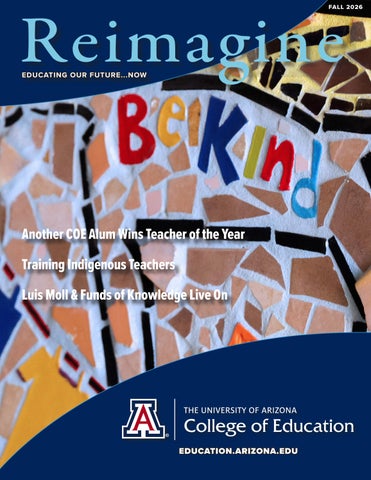
The Ben’s Bells Kindness mural at the College of Education was installed in 2012 and was based on a student’s design. Ben’s Bells was founded by Jeannette Maré, an alum of COE and now a professor at the University of Arizona.
ABOUT REIMAGINE MAGAZINE
14
Reimagine is the biannual magazine of the College of Education. Questions? Email: rwittman@arizona.edu
EDUCATION.ARIZONA.EDU | 3
DEAN’S DESK The House of Learning O
n Sept. 4, a new sign was unveiled outside our building, with new words added in the Mohave language. They were chosen by the Colorado River Indian Tribes (CRIT). The meaning of the words is simple but profound: “House of Learning.” Before the unveiling, our faculty and staff wrapped the new sign in a quilt they and members of CRIT had made by hand, square by square. That is our College of Education: many hands, one house…with learning as our top priority! In our first issue of Reimagine, I wrote that education in Southern Arizona is never abstract. This fall, it has faces. It is a first-generation student who started college online during a pandemic, recovered from a difficult first year with the help of our TRIO Teacher Prep program and is now headed to Harvard Graduate School of Education. It is a single mother teaching second grade in Nogales while finishing her degree, sometimes from a hospital room. It is an Iraq war veteran who earned her degree and is now pursuing a master’s in counseling. It is the world’s top adaptive golfer, preparing to build the next generation of adaptive athletics programs. It is, for the second consecutive year, an alumna of our college earning the title of Arizona Teacher of the Year by the Arizona Educational Foundation! These are our students. These are our alums. Our programs are reaching further, too. Forbes Advisor ranked Leadership & Learning Innovation #4 among online leadership degrees in the nation. New stackable certificates in Data Literacy empower working educators and leaders to use data to improve their learning environments. A new certificate in International Education Studies & Practice prepares students to bring global perspectives to local schools. And our 4 | EDUCATION.ARIZONA.EDU
credit-bearing program partnership with Blue Chip Leadership Experience was named a national finalist by Examples of Excelencia for success with student retention, especially among Latino students. Our faculty continue to lead their fields. In the months since our last issue, they have been named Association for the Study of Higher Education Fellows, inducted into the Society for the Study of School Psychology, honored by the American Educational Research Association, the American Counseling Association and the American Alliance of Museums, and selected for the inaugural cohort of University of Arizona AI Fellows and as a Provost Fellow for Academic Success to forward engagement with our communities to create opportunity. Their books are earning national awards. Their research meets communities where they are, from school safety to Indigenous education to youth-led inquiry. This issue also honors the enduring legacy of a scholar whose ideas helped shape who we are as a college. Luis Moll’s Funds of Knowledge framework taught educators everywhere to value the wisdom students carry with them from home. It’s a fitting reminder that the best learning begins by recognizing what our students and families already know. Even our youngest learners are leaving their mark. A middle school Reading Ambassador in our Worlds of Words program suggested the title for an author’s upcoming novel, and Simon & Schuster said yes. Afar arrives on shelves in February. In our “House of Learning,” the learning is never finished. Every student we prepare, every partnership we build and every family we welcome adds another square to the quilt. If you have been looking for your place in it, there is room for you. Mentor a student. Support a scholarship. Share our story. We teach, lead, guide, inquire…and together, we inspire!
NEWS The Latest News from the College of Education Leadership & Learning Innovation ranked #4 in Online Leadership Degrees Forbes Advisor has ranked the College of Ed’s Leadership & Learning Innovation in the top four online leadership degrees nationwide. Forbes named it the best program for aspiring educational leaders and highlighted its tracks in community education and leadership for equity, access and success in education, as well as its flexible internships for working professionals.
Faculty & Staff Achievements COE Faculty Book Explores Youth-Led Research
COE faculty members Ashley D. Domínguez and Julio Cammarota have co-edited a new book, Revolutionizing Education, Revitalized: Creative Resistance Through Youth Participatory Action Research. Arriving more than 15 years after the fieldshaping original Revolutionizing Education, the new volume gathers YPAR scholars, practitioners and youth leaders to explore arts-based approaches to research and activism spanning literacy, music, theater and environmental justice.
Dr. Desiree Vega
Congratulations to Dr. Desiree Vega on her induction into the Society for the Study of School Psychology (SSSP), one of the field’s most respected organizations dedicated to advancing research and scholarship in school psychology.
Austin Ross
Congratulations to Austin Ross, selected for the inaugural cohort of UA AI Fellows, a partnership between the Office of Research and Partnerships, the Office of Responsible AI and the Arizona Institute for Artificial Intelligence and Society.
COE Dean Regina Deil-Amen with members of CRIT at the Sept. 4 sign unveiling
CRIT, College of Ed Celebrate Sign Unveiling The U of A honored the Colorado River Indian Tribes (CRIT) on September 4 with the unveiling of four new monument signs featuring the four languages represented by CRIT: Chemehuevi, Navajo, Hopi and Mohave. CRIT Chairwoman Amelia Flores joined members of the Tribal Council and university leaders for the celebration. As part of the Native American Language Campus Sign Initiative, the September 2026 ceremonies added bilingual signage to campus buildings representing the four distinct CRIT tribes. During the College of Education unveiling ceremony, the sign was covered with a custom quilt created by CRIT members and some College of Ed faculty and staff. The College of Education’s sign features the Mohave language. It says: “The house of learning.”
Drs. Leslie Gonzales and Nolan Cabrera Congratulations also to Dr. Leslie Gonzales and Dr. Nolan Cabrera, named to the latest cohort of ASHE Fellows, a signature honor in higher education studies. Dr. Gonzales currently serves as ASHE’s president-elect and will begin her term as president following this year’s conference.
EDUCATION.ARIZONA.EDU | 5
INSPIRE
COE Alum Lisa Scott Wins AZ Teacher of the Year For the second year in a row, a College of Education (COE) alum has won the Arizona Educational Foundation’s (AEF) Arizona Teacher of the Year award.
L
isa Scott, who teaches 8th grade social studies and science at Esmond Station K-8 in the Vail School District, is now Arizona’s candidate for National Teacher of the Year. Scott’s school superintendent nominated her last spring, kicking off a long and intense process that included eight narrative essays, a two-minute video and letters of recommendation. Once the candidate pool was narrowed to 10, candidates
6 | EDUCATION.ARIZONA.EDU
had in-person interviews with a 20-member panel in Phoenix. “It’s a lot of work, and it is an intense process,” Scott said. But the process itself helped her reflect on why she teaches. “It made me a better teacher.” Scott didn’t always see herself teaching. As a University of Arizona freshman, she planned to become an orthopedic surgeon. A classmate told her she’d make a good teacher and the idea stuck. She declared elementary education by her second semester and graduated in 2004. She began her career teaching First Grade in the
Vail School District but switched to teaching middle school after finding it was her true calling. This year marks her 21st year teaching. Scott describes her teaching philosophy as one of inclusivity where each student has a voice. She instills in her students curiosity and problem-solving skills that transcend the classroom. The AEF Teacher of the Year award is the highest honor for public school educators in Arizona. It recognizes the dedication and impact teachers have on students and their communities. The winner and finalists go on to complete a year of service. For Scott, the AEF Teacher of the Year award carries weight beyond the recognition of excellence. During winter break in 2022, Scott developed severe sepsis, an infection that led to the amputation of both hands and feet. She returned to her classroom as a quadruple amputee, continuing to teach the same inquiry-based science curriculum she’d built her career on. Her return drew attention well beyond Vail, including an interview with KJZZ and recognition from local leaders. She credits her success as a teacher to her COE training, particularly the semester-long practicum and student teaching placement, which prepared her well for the classroom. She sees newer teachers, especially those from alternate certification routes, struggle because they lack this formative experience. Scott’s AEF Teacher of the Year win marks the second year in a row that Arizona’s Teacher of the Year has been a COE grad. Last year, COE alum Tiffani Jaseph, a K-5 special education teacher at Copper View Elementary in the Sahuarita School District, took home the honor. Scott is now reworking her application for the national competition. Finalists will be announced in the Spring. “Teachers are phenomenal, and they’re working their tails off to help our students succeed,” she said. “It’s a heavy crown to wear, but I’m excited to represent that.” •
Top: Lisa Scott with her family at the AEF Teacher of the Year ceremony; Middle: Arizona Gov. Katie Hobbs and Lisa Scott; Bottom: Esmond Station K-8 shows its pride for Lisa Scott.
LEAD More Than Teaching
Alums changing the world in and outside the classroom
Dr. Alexis Dotson
Coordinator, Player & Family Support, Washington Commanders Alexis Dotson is the Coordinator of Player and Family Support for the Washington Commanders, but her path there started on a softball diamond, not a football field. A student athlete recruited to play softball at the University of Arizona, Dotson planned to become a nurse until a bad chemistry grade sent her looking elsewhere. A teammate introduced her to the College of Education’s (COE) Leadership & Learning Innovation major, which combined education and child development. Dotson enrolled and later completed an internship at a children’s clinic. After graduation, she taught reading intervention at Laguna Elementary, but struggled with the abrupt end of her athletic career. “I felt like I didn’t know who I was,” she said. That led her back to COE for a master’s in school counseling, where mentors reconnected her to athletics, this time through player development. A presentation to COE’s dean led to an unexpected question: had she considered a doctorate? Dotson enrolled at Howard University, volunteered with its football program, and built connections that landed her a Commanders internship in 2022. She’s been with the team ever since, working to make sure players are supported as whole people, not just athletes.
Brenna Yunkherr
Owner, Desert Drifter Coffee Brenna Yunkherr didn’t plan to run a company. She wanted to teach kindergarten, and, after earning her degree from COE in 2023, she landed a kindergarten teaching job at a Title I school in the Marana Unified School District. She filled her classroom with supplies and manipulatives, often paying for them herself, because she wanted to give her students the stability she remembered needing at that age. Nearly three years in, a family health crisis changed things. Her husband, Eddy, was running their small coffee business largely on his own while she managed a teacher’s long hours. Something had to give. Yunkherr made the decision to leave teaching, but it was very hard. She then took on marketing and branding for the business, areas she’d never studied. She found herself relying on skills she’d learned at COE. “I didn’t know how to talk to other professionals [before COE],” she said. “There’s so much I took away from COE.” She added that teaching and running a business are similar, saying, “Teachers often work off the clock.” She sees the same demands in Desert Drifter and credits teaching with preparing her. She hasn’t ruled out a return to the classroom, but for now, she’s using her COE training to run her family’s small business. 8 | EDUCATION.ARIZONA.EDU
Dr. Stephanie Choi
Assistant Professor & Award-winning Poet Stephanie Choi didn’t plan on becoming a professor, or a poet, for that matter. She just kept following what interested her, and it eventually led to a tenure-track job at Oklahoma State University, where she teaches creative writing and poetry.
Choi graduated from the University of Arizona College of Education in 2017 with a COE Leadership & Learning Innovation degree paired with English. She’d been drawn to environmental and community work, interning with the Environmental Education Exchange while taking classes on educational disparities and inequities. What stuck with her most, though, was the degree’s experiential learning model. “It’s not something that a lot of degrees have,” she said. After college, she took a public service fellowship in Cleveland before deciding she wanted to commit herself to writing. She returned to school for an MFA at the University of Utah, graduating in 2023. Things moved quickly from there: her debut poetry collection, The Lengest Neoi, was selected for the 2023 Iowa Poetry Prize and named one of Poets & Writers’ Debut Poets of 2024. Now in her third year at OSU, Choi is working on her second book while teaching two classes a semester. She’s also begun researching her third project, a book about poet Ai Ogawa.
Dr. Alison Zagona
Associate Professor & Special Education Advocate Dr. Alison Zagona earned all three of her degrees at the University of Arizona, a path that took her from undergraduate special education major to Associate Professor at the University of Kansas (KU). Her bachelor’s degree built a foundation in instructional strategies and classroom management. Her master’s narrowed her focus to students with complex support needs, including kids with multiple disabilities and deaf-blindness. That training carried directly into five years teaching special education in the Vail School District, where she grew passionate about including students with the most significant support needs in general education classrooms. That classroom experience shaped her Ph.D. research on literacy instruction for students with complex support needs, work she found was thin in the existing research. “There’s a need to build the literature,” she said, describing her dissertation as a launching point for a broader research agenda. At KU, Zagona coordinates the low-incidence disabilities master’s program, teaching future special educators the same inclusive, high-expectation approach she absorbed at COE. She credits her Ph.D. years with teaching her how to teach, write grants and conduct research, skills she now passes on directly to her own students. “It’s exciting to bring those things that I learned in my earlier degree to my teaching,” she said. EDUCATION.ARIZONA.EDU | 9
Background photo: Inside the Worlds of Words center. Left: Two photos of a handpainted mural by a local artist that recognizes those who have donated to WOW.
LEGACY Why We Give
From Crisis to Commitment:
Kathy & Jerry Short Create a Legacy
T
here is nothing like impending doom to prompt one to evaluate their life. Such was the case for Kathy and Jerry Short.
In 2018, the couple traveled to Hawaii to celebrate their 44th wedding anniversary. At 8 am on their first morning at Turtle Bay Resort, their cell phones blasted an emergency alert: a ballistic missile was inbound. Seek shelter immediately. This is not a drill. What followed were 38 minutes of terror as the couple huddled with other frantic hotel guests in the hotel’s basement cafeteria. Many believed it could be an attack by North Korea. Finally, officials gave the allclear, stating that the alert was given in error and life could resume as usual. That evening, still shaken, Kathy and Jerry went to dinner and began asking each other a question that would reshape the rest of their lives: if the missile had been real, where would their money have gone? The honest answer, they realized, was that it likely would have been divided among family, with no connection to the causes and institutions they cared about most. “It wouldn’t have made a legacy of any kind,” Jerry recalled. That night the Shorts made three decisions that continue to guide their philanthropy today. The first decision was to focus their giving on the handful of organizations that most closely aligned with their values, choosing depth over breadth. “Once you start giving to so many places, it’s so diluted down that it doesn’t make a difference,” Jerry said. At the top of their giving list was the University of Arizona College of Education, where Kathy is a Regents professor and directs Worlds of Words (WOW), a center focused entirely on global children’s literature. Under her stewardship, WOW has earned multiple awards and today holds the distinction of being the largest collection of youth literature in the United States and the second largest in the world. The Shorts support the center through ongoing giving
as well as an estate gift. “The mission is one that is clearly very important to us and we wanted to put our money toward the center,” Kathy said. The Shorts, who each were raised Jerry & Kathy Short in the Mennonite Church, also give to the Shalom Mennonite Fellowship as well as the Mennonite college where they earned their undergraduate degrees. Their second decision was to give substantially now, while they can see the results. In 2018, they established the Founders Endowed Chair for Global Children’s and Adolescent Literature with $1 million in appreciated stock given over three years. The third decision was to think beyond their lifetimes. The Shorts have committed the majority of their estate, roughly two-thirds of their net worth, to the College of Education and Worlds of Words, with additional plans for a scholar’s endowment and a visiting scholar’s endowment to sustain the center’s programming and staffing long after they are gone. Having watched too many worthwhile university initiatives quietly disappear once their founders retired or funding dried up, the Shorts wanted to build something that could keep growing. “It feels good to see the impact of our giving over the last few years,” Jerry said, “and to know that Worlds of Words is in a better position to continue well after we are no longer here.” What began as a terrifying 38 minutes in a hotel basement has become an enduring commitment to create a legacy. • EDUCATION.ARIZONA.EDU | 11
GUIDE INDIGENOUS TEACHER
EDUCATION PROGRAM
A Decade of Rooting Education in Indigenous Knowledge, Culture & Community
T
en years ago, a statistic set the University of Arizona’s College of Education (COE) in motion: only about 2% of the state’s teachers are Indigenous, even though Indigenous children constitute 4% of Arizona students. The Indigenous Teacher Education Program (ITEP) was created in 2016 to close that gap. ITEP prepares K-8 teachers, but its ambition goes beyond certification. It develops critical and culturally sustaining educators who strengthen the knowledge systems their students already carry. Drs. Valerie Shirley (Diné) and Jeremy Garcia (Hopi/ Tewa), ITEP’s co-directors, trace its purpose to a harder history and to a goal: reconceptualizing teaching and learning for Indigenous communities. For generations, schools serving Indigenous students were designed to separate children from their languages, stories and relationships to the land. “That was an intentional and systemic way of teaching for the purpose of assimilation,” Shirley said. ITEP was built to reverse that trajectory. Indigenous Knowledge Holders serve alongside faculty as coteachers and mentors, and coursework and fieldwork center Indigenous kinship, educational sovereignty and the resurgence of Indigenous knowledge systems. “What’s so different about Indigenous knowledge systems is that our knowledge goes back to our stories of origin, relations to land and ceremonial knowledge,” Garcia said. Over 10 years, more than 50 Knowledge Holders and scholars have helped shape how ITEP prepares teachers. Marie Salt, a Diné Knowledge Holder, said she values working with ITEP candidates because “teachers are healers, leaders, artists and philosophers who will lead the next generation of Indigenous youth.” ITEP also hosts the Indigenous Pedagogies Speaker Series (IPSS), which brings in speakers whose
12 | EDUCATION.ARIZONA.EDU
work informs the teaching of Indigenous histories, knowledges and values from pre-K through eighth grade. Past sessions have given teachers of Native students space to consider how curriculum grounded in Native histories, philosophies and contexts can build critical consciousness in Indigenous youth, the kind that moves them to advocate for and sustain their communities. Funded by the U.S. Department of Education, the Arizona Department of Education and the university’s Arizona Native Scholars grant, ITEP covers students’ tuition and fees and provides a living stipend, dependent support, travel and book stipends, technology and NES teacher certification costs. For Jadan Sixkiller, a Navajo student from Tuba City, ITEP arrived just in time. She started at the university in veterinary science and struggled. “My first few years, I was not doing very well,” she said. “I was on the verge of making my way back home.” An academic advisor pointed her to ITEP. Her GPA barely met the minimum, but she applied anyway. Today Sixkiller is student teaching third grade at Johnson Elementary in Tucson Unified School District, mentored by an ITEP graduate, and she finishes this fall. The program provided funding, a laptop, books
and regular check-ins from staff. It also gave her something harder to put a price on. “My biggest takeaway from ITEP is just, in a way, family,” she said. “It’s a fireplace. We all come together, we are able to share our space together, create a space as one.” When she has her own classroom, Sixkiller plans to bring in Indigenous stories and language, the way her mentor weaves Pascua Yaqui stories and trilingual morning introductions into the school day. Her advice to other Indigenous students is direct. “Just apply,” she said. “If you don’t meet the requirements, just work your way up to meet those requirements.” ITEP has graduated more than five dozen teachers representing six of Arizona’s 22 federally recognized tribal nations, and it is working to expand its reach.
L-to-R: Isabel Obregon (Pascua Yaqui), Alicita Trujillo (Diné), Kailee Adson (Diné) and Jesse Manygoats (Diné) at May 2023 graduation
Many paraprofessionals in tribal schools can’t step away from their jobs or their cultural responsibilities to enroll full time. Alongside an accelerated distance pathway, ITEP is working with the Department of Teaching, Learning and Sociocultural Studies to create more routes to certification. Looking ahead, Shirley and Garcia frame the future around sustainability and growth, including relationships with all 22 Arizona tribal nations. ITEP faculty have also joined international conversations on Indigenous teacher education, meeting with Sámi, First Nations peoples and the National Autonomous University of Mexico to advance Indigenous education globally.
ITEP Gathering with Knowledge Holders, Around the Fireplace Teachings at the base of San Francisco Peaks in Flagstaff, Ariz.
Ten years in, a program born from a 2% statistic has become a working model of what happens when Indigenous communities define good teaching. • ITEP student Jadan Sixkiller
INQUIRE What Was Already There
Funds of Knowledge & Luis Moll
L
uis C. Moll and his collaborators taught a generation of educators to look for the learning that happens at kitchen tables, in workshops and across the border. The College of Education (COE) plans to carry that work forward. For a long time, when a teacher called a student’s family, it was on school business: a report card to deliver, a problem to discuss. The school had something to tell the family. Then a group of University of Arizona researchers and Tucson teachers started calling for a different reason. They came to listen. What they found inside were households full of expertise. Parents who could frame a roof, repair an engine or manage irrigation for a crop. Relatives who knew which home remedies eased a fever. And children who absorbed all of it, not from textbooks, but by watching, helping and belonging. None of that knowledge showed up on a report card. The researchers set out to change that, and in doing so they reshaped how educators around the world think about the students in front of them.
Borderland beginnings The concept started with two cultural anthropologists, Carlos Vélez-Ibáñez and James Greenberg, who were studying Mexican families living along the U.S.Mexico border. Families moved north for political and economic reasons, among many others, said Judy Marquez Kiyama, a professor in the College of Education who has taught and researched the Funds of Knowledge framework for years. Those families rarely went it alone. They formed clusters of relatives and neighbors who helped one another navigate unfamiliar schools, jobs and government systems. Vélez-Ibáñez and Greenberg borrowed a term from anthropologist Eric Wolf’s research on household economies and called those 14 | EDUCATION.ARIZONA.EDU
L-to-R: Dr. Luis Moll, Dr. Iliana Reyes and Moises Esteban-Guitart
shared resources “funds of knowledge.” The name sounds financial, but Kiyama said the exchange was anything but. “Those funds were cultural in nature, not economic in nature,” she said. “They weren’t being shared because they expected something in return. It was more like community care.” That knowledge moved through ordinary life: daily routines, religious practices, family traditions and work done on both sides of the border. “In doing so, children were learning,” Kiyama said, “and communities were surviving.”
From the household to the classroom Luis Moll and cultural anthropologist Norma González saw what that insight could mean for schools. Together with Cathy Amanti, then a K-12 teacher, and other Tucson educators, they turned an anthropological concept into a framework teachers could put to work. In a 1992 article, Moll and his colleagues defined funds of knowledge as “historically accumulated and culturally developed bodies of knowledge and skills essential for household or individual functioning and well-being.” Kiyama put the question the team was asking more bluntly. “These families, these kids, are already coming with sources of cultural knowledge,” she said. “Why are we treating them as not having information
spread well beyond Tucson’s elementary classrooms. Marta Civil, a UA mathematics professor who worked closely with Moll and González, applied it to math education. Kiyama and Cecilia Rios-Aguilar, one of Moll’s former students and a professor and leader at UCLA’s School of Education and Information Studies, brought it into higher education, building on the strengths of first-generation, immigrant and lowincome students. Iliana Reyes, associate dean and professor in the Department of Teaching, Learning and Sociocultural Studies (TLS), helped bring it into teacher preparation. When COE revamped its Early Childhood Education program, Moll and González, along with a diverse group of colleagues, helped shape CREATE: Communities as Resources in Early Childhood Teacher Education.
Dr. Luis Moll at the Worlds of Words center
and knowledge? Essentially, it’s up to the educators to understand what that knowledge is and build upon it.” So teachers became researchers. Working alongside Moll and González, they visited the homes of Mexican American families in Tucson and documented what they learned: labor histories, immigration histories, language practices and daily routines. Then they built curriculum around it. Rather than replacing required content, the approach built on what students and families already knew. Teachers invited parents and relatives into the classroom to demonstrate their expertise, which Kiyama said did two things at once. “That validated the knowledge in front of the kids,” Kiyama said, “but also showed that knowledge is held in these community and family settings, not just in formal classrooms.” The team collected these examples in the 2005 book “Funds of Knowledge: Theorizing Practices in Households, Communities, and Classrooms,” edited by González, Moll and Amanti. Among educators it’s known simply as the Yellow Book. Moll is often credited, sometimes entirely. Kiyama is quick to widen that circle. “It wasn’t just Luis,” she said. “Norma González was also behind all of that.”
A concept that travelled Over the next three decades, funds of knowledge
“Luis was instrumental in helping us imagine how Funds of Knowledge could become central to preparing future teachers,” Reyes said. Through direct work with families, preservice teachers “learned to recognize bilingualism, home language practices and families’ cultural and experiential knowledge as powerful resources for teaching and learning.” The idea crossed oceans, too. Educators in Australia and the United Kingdom adapted it for their schools. Spanish scholar Moises Esteban-Guitart and Moll extended it into “funds of identity,” and an international network of researchers continues to test, stretch and question the concept.
Carrying the legacy forward After Moll’s passing in 2024, colleagues and scholars from around the world gathered in Tucson for a memorial of academic panels and a journal issue on his work. For Kiyama and many others, Moll’s influence was personal. “He really has been a mentor, a bridge, a foundation for all of us,” she said. COE intends to continue this foundation. With an initial financial commitment from Dean Regina Deil-Amen, COE will launch a fundraising initiative to establish the Luis C. Moll Legacy Fund. Through philanthropic support, COE hopes to create opportunities to celebrate his contributions and carry his influence forward. COE plans to record oral histories with Moll’s former students and collaborators and map the reach of his work. It’s a tribute to a scholar whose life’s work reminded us that knowledge lives in families and communities. • EDUCATION.ARIZONA.EDU | 15
ELEVATE Rooted in Joy Dr. Renae D. Mayes, Smith Endowed Chair
F
or more than a quarter century, the Lester L. and Roberta D. Smith Chair in Prevention and Education has worked from a simple premise: children thrive when the adults around them build schools that protect them. Today that mission is in the hands of Dr. Renae Mayes, professor of school counseling at the University of Arizona College of Education (COE), whose research on Black joy and homeplace brings a strengths-based lens to the question of what makes a school a safe and supportive place to learn. The Smith Chair was created to carry research into schools and classrooms, improving children’s lives and reducing the risk of alcohol, tobacco and other drug use and violence by changing school climate. Under Kris Bosworth, who held the chair from 1998 to 2023, the work shifted its focus from individual students to the adults who shape the school environment. The resulting Protective Schools Model reached 193 schools in 42 Arizona districts, supported by $31 million in grants. Mayes builds on that foundation from a new angle. Her research explores how school counselors can engage in practices to cultivate joy in youth of color and create a space where students’ humanity is recognized and valued. “I’m really focused on cultivating Black joy and homeplace across all aspects of my work,” Mayes said. “I look specifically at P-12 schools and communities for Black youth as I aim to uncover strengths they possess in navigating schools and communities that promote their mental health and wellness and promote their success.” That emphasis on strengths echoes one of the chair’s founding insights. Bosworth’s early research found that student-focused interventions worked best in schools with strong relationships and asset-oriented policies. Mayes’ work offers a counternarrative to deficit perspectives about youth of color and families,
16 | EDUCATION.ARIZONA.EDU
and her model of recognizing each student’s full humanity can inform support for all students facing challenges to their wellness. Her record extends the chair’s commitment to research, practice and training. Mayes is principal investigator of the Black Youth Mental Health Initiative, a $1.05 million grant from the U.S. Department of Health and Human Services Office of Minority Health. She has authored more than 60 peerreviewed articles and has spent more than a decade preparing school counselors, first as director of the school counseling program at Ball State University. She joined the University of Arizona in 2020. Mayes provides free counseling to local students and families through Talk It Out, an initiative born of a partnership between the COE School Counseling Program and the Tucson Unified School District (TUSD) Family Resource Centers. Her work has drawn national notice. This year Mayes received the American Counseling Association’s (ACA) S. Kent Butler Transformative Impact Award, which honors counseling professionals for advancing equity, inclusion and access, and was celebrated at the 2026 ACA Conference & Expo. In 2024, she was named an Emerging Scholar by Diverse Issues in Higher Education. For Mayes, the work begins close to home. “I’ve always been driven and inspired by my community,” she said. “There is so much strength, knowledge, nurturing and vivacity that exists in our culture, and I always want to find a way to support, protect and cultivate even more.” •
INVEST Education Dedication Kathy Alexander & Paul Lindsey
F
or nearly two decades, Paul Lindsey and Kathy Alexander have quietly shaped the College of Education’s (COE) ability to support both its students and the Tucson community. This drive comes from a passion to create good teachers. “We need a lot more teachers, especially good ones,” Lindsey said. “And the College of Education turns out really great teachers.” About fifteen years ago, Lindsey created what became his signature program: internships for education students who, after completing their student teaching, discovered the classroom wasn’t quite the right fit. Rather than let those students feel stuck, Lindsey built a bridge into the nonprofit world, placing seniors and graduate students at nonprofit organizations throughout Tucson. Interns receive $1,000 per semester as undergraduates or $2,000 as graduate students, for up to two semesters, and many placements have led directly to jobs. Lindsey likens it to a “resettlement program” of sorts. “We’ve done dozens and dozens of internships over the years,” he added. COE Dean Regina Deil-Amen said Lindsey has been instrumental to the College’s success. “I’m extremely grateful for Paul Lindsey’s commitment and support. He is a true and enduring friend of our college,” she said.
of Phoenix, she led the institution’s operations across Arizona during the early days of online higher education. She holds a master’s degree in sociology from the University of Arizona and a second master’s in management from the University of Phoenix. Beyond the College of Education, the couple remains active around Tucson, including Arizona Public Media, where Lindsey previously served as board chair of the Community Advisory Board, and Tucson Village Farm’s advisory board. Reflecting on their commitment to the College of Education, Lindsey said, “Our involvement has been pretty deep for a long, long time and I don’t see it ending anytime soon.” •
Lindsey was awarded an honorary Doctor of Humane Letters in May 2013 for his commitment to education, the College and the University of Arizona. Alexander brings her own deep ties to education. A retired vice president and director at the University EDUCATION.ARIZONA.EDU | 17
TEACH A Winding Pat Colin Grogan’s Journey to the Classroom
F
or second-grade teacher Colin Grogan, the road to his own classroom at Laguna Elementary in the Flowing Wells Unified School District wasn’t a straight line. “I kind of took a nontraditional path through the U of A,” he said. After switching from nursing to education, Grogan left the university for two years. He took a paraprofessional job at a Tucson charter school and became its first-grade aide when the pandemic hit. “That was kind of the push I needed to get back into school,” he said. “I was like, oh, I want my own classroom.” The job also drew him to the younger grades. “I like the foundations,” he said. “I could be a formative memory for these kids.” After two years at Pima Community College, Grogan returned to the College of Education and completed the professional program in 2024. He credits site coordinator Trina Zimmerman and Dr. Erin Turner for connecting him with the Center for Recruitment and Retention of Mathematics Teachers (CRR), where he tutored students in math as an AmeriCorps member. He kept attending CRR trainings after graduation, and after his first year of teaching, the center made him a teacher leader, a role that usually requires two years of experience. He now leads workshops for other teachers and was named Teacher of the Year in the Early Career category at Math Educators Appreciation Day. Teaching on his own took adjustment. “I got there and I went, oh, I’m the only one in the room,” he said. He credits the COE program with preparing him to adapt a scripted curriculum: “Taking what’s given to me and
18 | EDUCATION.ARIZONA.EDU
COE Dean Regina Deil-Amen and Colin Grogan at the Math Educators Appreciation Day. Grogan was named Teacher of the Year in the Early Career category.
scaffolding or differentiating, that was a strong suit of the program.” He met Laguna’s principal while volunteering at a United Way Day of Caring event, and the two reconnected at a career fair. Now he tells new hires what to expect in a small district: “The amount of support you get will be overwhelming.”
alongside math.
This fall Grogan started a master’s degree in the Teaching, Learning and Sociocultural Studies program, focusing on language and literacy
His advice to education students: “There’s only so much you can learn in two years and one semester of student teaching,” he said. “Any little opportunity you have, take it. Build your community.” •