CATALYST The
CHEMISTRY AND BIOCHEMISTRY ALUMNI MAGAZINE FALL 2025
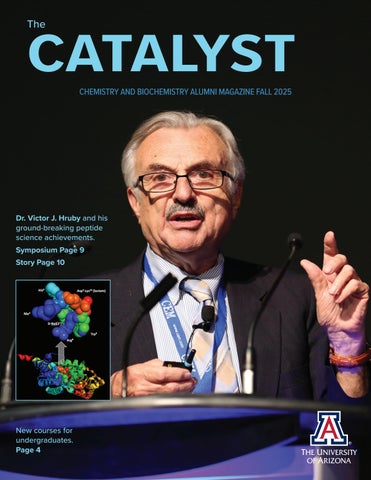
Dr. Victor J. Hruby and his ground-breaking peptide science achievements. Symposium Page 9 Story Page 10
New courses for undergraduates. Page 4
DEAR CBC COMMUNITY
A
s we turn the page on another remarkable year, it is a pleasure to reconnect through this edition of the Catalyst. This year, we continued to witness significant and impactful achievements by our students, staff and faculty. In this Catalyst, we are excited to share a range of stories that highlight some of these accomplishments, which are a true testament to the dedication, creativity, and resilience of our students, faculty, staff, and alumni.
Our faculty continue to excel and be recognized for their outstanding research and teaching. Dr. Tori Hidalgo’s Gerald S. Swanson Award, Dr. Jon Njardarson’s distinction as University Distinguished Professor, and Dr. Andrei Sanov’s COS Distinguished Achievement award are highly deserved. Promotions and new faculty additions continue to strengthen our academic community and broaden the horizon for discovery. We celebrate with our colleagues who have transitioned into retirement and are grateful for their ongoing contributions to CBC. We also pause to remember cherished colleagues and friends whose contributions live on in CBC.
Our cover story honors the legacy of Dr. Victor J. Hruby, whose pioneering research and visionary leadership in peptide science continue to inspire. The in-depth feature showcases not only his prodigious scientific career but also his enduring influence on national and global scientific communities. We are also excited to use this opportunity to announce the endowment of the Victor and Patricia Hruby Endowed Chair in Peptide Science, to continue this legacy in perpetuity.
The expertise and devotion of our staff remain a cornerstone of the CBC community and success. We welcome new staff members Jim Fulford, Riley McCarty, Jasmine Eyssallenne-Cook and Dr. Pho Bui, and recognize staff milestone achievements and awards, including Olivia Mendoza who received the College of Science Distinguished Academic Advising award.
Our strong spirit of innovation and academic excellence paved the way for many milestones this year. The unveiling of new courses, including expanded offerings in Organic Chemistry, Clinical Chemistry, and Forensics, reflects our ongoing commitment to meeting the needs of our future scientists. We also spotlight collaborations with alumni and community partners, linking classroom learning to real-world impact. Our students have shown remarkable drive, creativity and distinction, earning competitive awards and fellowships, establishing peer mentorship programs, and distinguishing themselves in research. Several extraordinary accomplishments of our undergraduate and graduate students are highlighted in this issue, as well as the expanded online version.
This year’s “CBC by the Numbers” offers a snapshot of our community’s impact, while “2025 in Pictures” and alumni and student updates showcase the wide-ranging adventures and achievements of CBC graduates—from innovative entrepreneurs and leaders in health and space operations, to educators and trailblazers in science and technology worldwide. As you explore this issue, know that your ongoing support, whether through sharing news, mentoring, or philanthropy, fuels our shared mission to inspire, educate, and advance scientific knowledge. We look forward to an even more exciting year ahead and continuing to connect with our CBC family and community. With best wishes,
Generous alumni contributions have made possible several new scholarships and endowments at both the graduate and undergraduate level, enabling us to continue to support Craig Aspinwall Department Head our students as they pursue their careers in the molecular sciences. These include the Dr. Harry W. Edwards Chemistry Memorial Scholarship, Dr. Curtis L. Schilling, Jr. Graduate Scholarship, Dr. Richard and Susan Glass Memorial Scholarship, Dr. Todd W. Rockway Early Career Excellence Award and the Anne Shotton and Patrick M. Hefferan Scholarship. These are vital resources that enable students to pursue excellence in their academic endeavors. (L to R) Dr. Oliver Monti, Dr. Marie-Pierre Hasne, Nancy Louks, Dr. Dominic McGrath, Dr. Craig Aspinwall, Dr. Brooke Beam Massani, Dr. Dee Belle-Oudry, and Lisa M. Arrotta
2
THE CATALYST | CBC ALUMNI MAGAZINE
The
CATALYST
Editor-in-Chief/Contributing Editor & Photographer: Olivia A. Mendoza
TABLE OF CONTENTS
Associate Editor-in-Chief: Lisa M. Arrotta Creative Editor: Lisa Stage Senior Editors: Stephanie Boysen, Dr. Brooke Beam Massani Editors: Aanzala Haque, Olivia Culbert Proofreaders: Regina Brandt, Jasmine Eyssallenne-Cook, Peggy Humbert, Laura Lustro, Heidi Sweet Contributors: Lisa M. Arrotta, Dr. Craig Aspinwall, Dr. Dee Belle-Oudry, Jenna Courey, Dr. Marielle Wälti, Dr. Wendy Ingram, Dr. John Jewett, Sam LaMotte, Dr. Dennis Lichentenberger, John Maciulla, Cindy Neal, Dr. William Montfort, Dr. Jeanne Pemberton, Dr. Tomi K. Sawyer, and Dr. Tarjani Thaker Cover Photo: Lars Sahl, 2017 APS Symposium, Whistler, BC
What’s New in Academics . . . . . . . . . . . . . . . . . . . . . . . . . . . . . . . . . . . . 4 Organic Chemistry for Majors . . . . . . . . . . . . . . . . . . . . . . . . . . . . . . . . . 4 Careers in Forensics . . . . . . . . . . . . . . . . . . . . . . . . . . . . . . . . . . . . . . . . . 4 New Clinical Analysis Course Bridges Chemistry and Healthcare . . 5 Undergraduate Student Successes . . . . . . . . . . . . . . . . . . . . . . . . . . . . 6 Graduate Student Successes . . . . . . . . . . . . . . . . . . . . . . . . . . . . . . . . . 7
7
Thank you to the CBC community for all the support and inspiration that helped make the CBC Alumni Magazine happen. We respectfully acknowledge the University of Arizona is on the land and territories of Indigenous peoples. Today, Arizona is home to 22 federally recognized tribes, with Tucson being home to the O’odham and the Yaqui. The university strives to build sustainable relationships with sovereign Native Nations and Indigenous communities through education offerings, partnerships, and community service.
Find Alumni News and more in the online magazine
cbc.arizona.edu/alumni/ catalyst Scan with your device to visit the site
2025 Research Symposium . . . . . . . . . . . . . . . . . . . . . . . . . . . . . . . . . . 8 New Scholarships . . . . . . . . . . . . . . . . . . . . . . . . . . . . . . . . . . . . . . . . . . . 8 Alumni Spotlights . . . . . . . . . . . . . . . . . . . . . . . . . . . . . . . . . . . . . . . . . . . 9 Victor J. Hruby Symposium . . . . . . . . . . . . . . . . . . . . . . . . . . . . . . . . . . . 9 Dr. Victor J. Hruby: A Prodigious Life of Adventure, Odyssey & Legacy . . . . . . . . . . . . . . . . . . . . . . . . . . . . . . . . . . . . . . . . . 10
10
Powering the Cell . . . . . . . . . . . . . . . . . . . . . . . . . . . . . . . . . . . . . . . . . . . 12 Examining HSP . . . . . . . . . . . . . . . . . . . . . . . . . . . . . . . . . . . . . . . . . . . . 12 Dr. Thomas Gianetti named Donna B. Cosulich Faculty Fellow . . . 13 Faculty Awards & Promotion . . . . . . . . . . . . . . . . . . . . . . . . . . . . . . . . . 14
Chemistry and Biochemistry at The University of Arizona on: Facebook | Twitter | LinkedIn | Instagram | YouTube
New Faculty . . . . . . . . . . . . . . . . . . . . . . . . . . . . . . . . . . . . . . . . . . . . . . . 14 Staff Retirement . . . . . . . . . . . . . . . . . . . . . . . . . . . . . . . . . . . . . . . . . . . . 15 New Staff & Staff Awards . . . . . . . . . . . . . . . . . . . . . . . . . . . . . . . . . . . . 16 Student Awards . . . . . . . . . . . . . . . . . . . . . . . . . . . . . . . . . . . . . . . . . . . . 17 Faculty Retirements . . . . . . . . . . . . . . . . . . . . . . . . . . . . . . . . . . . . . . . . 18 In Memoriam . . . . . . . . . . . . . . . . . . . . . . . . . . . . . . . . . . . . . . . . . . . . . . 19 CBC by the Numbers . . . . . . . . . . . . . . . . . . . . . . . . . . . . . . . . . . . . . . . 20
WHAT’S NEW IN CBC ACADEMICS By Dr. Dee Belle-Oudry
I
t’s an exciting time for our undergraduate programs as we are launching several new courses this year. In addition to the new foundational chemistry courses central to our revamped degree plans, we are rolling out some options that will appeal to students across disciplines. Introduction to Clinical Analysis (CHEM 365) focuses on chemical measurements in the clinical realm and their impact on health care. Various facets of clinical chemistry are explored including preparation of complex samples, types of instrumentation used, and how these measurements are used to diagnose and treat disease. Scientific Fundamentals of Forensic Science (CHEM 328) explores the forensic science realm with a particular emphasis on the scientific practices and procedures involving crime scene evidence evaluation.
CAREERS IN FORENSICS ELEANORE LEICHTENBERG
I
recently accepted a position with the Toxicology Unit of the Tucson Police Department Crime Laboratory. I earned my Chemistry BS degree at the University of Arizona in 2015, and I conducted research under Prof. Dennis Lichtenberger. While I was involved with the U of A Chemistry Club, we had a tour of the new TPD Crime Lab on Miracle Mile. I had been heavily interested in forensic science for some time but taking that tour solidified my interest in the field. After I earned my degree, and taking a few other jobs, I found employment in Albuquerque, New Mexico at the New Mexico Department of Health Scientific Laboratory Forensic Toxicology Bureau where I gained real-world experience in a nation-
ORGANIC CHEMISTRY FOR MAJORS By Dr. John Jewett
T
his story began many years ago while teaching the first semester of honors organic chemistry. A student came after class to ask a question. I informed them, “we’ll see this topic next semester,” to which they responded, “I love this class, but my major only requires one semester, and I can’t fit a second one.” From this interaction, the seeds were sown, awaiting germination to develop into a one-semester course in organic chemistry. A few years later, a key goal of my sabbatical was to envision a one-semester organic chemistry class from the ground up. This task involved identifying key topics and then working backward build the curriculum, using a blank notebook
4
to craft the course. The most important realization was that if I taught a carbonyl-centric view of organic chemistry, the students would be exposed to most core topics. Originally, I planned to write a textbook, but teaching during the pandemic taught me the power of videos. By observing my children consume media, I learned that short videos were the key. The next few times I taught organic chemistry I created topic-based, modular preclass videos, knowing that I could eventually
reorder them. My current CHEM 246 course has 37 required pre-class videos, and 16 “bonus” videos for organophiles. During the past two years, I served as a program director for the National Science Foundation (NSF) in “the nation’s chemistry department.” This role gave me a broader perspective of
THE CATALYST | CBC ALUMNI MAGAZINE
ally accredited forensics laboratory. I held many positions in this lab including working in the Breath Alcohol section where we maintained over 200 of the state’s Intoxilyzer 8000s and provided monthly trainings to certify law enforcement officers in the use of the instrument, acting as Quality Assurance Coordinator for the Toxicology Bureau to ensure and monitor compliance of the lab against accreditation standards, and as a Blood Alcohol/Drug Screening section supervisor. After almost 7 years in New Mexico, I moved back home to serve the community I grew up in. I spend most of my time outside of work camping and traveling.
Laboratory Technician, an entry level position, where I was mostly making reagents and performing instrument checks, but not analyzing evidence. In 2001, I was promoted to a Forensic Scientist, in the Seized Drug section, analyzing suspected controlled substances. In 2003, I was selected to the ATF’s National Firearms Examiners Academy in Maryland, where I trained to be a firearms examiner. As a firearms examiner, I would analyze firearms evidence to try and determine if a bullet or cartridge case was fired from a particular firearm. In addition to firearms analysis, I also performed toolmark analysis, where we attempt to identify if a tool had been used in a crime.
JOHN MACIULLA
In 2012, I was promoted to a Supervising Forensic Scientist, and supervised the Seized Drug, Firearms, and Latent Print sections at our laboratory. Throughout my career, I have supervised all the forensic disciplines at the laboratory, including DNA and Toxicology. In 2015, I was promoted to Laboratory Manager, where I am today. I oversee the operations of the entire Laboratory here in Tucson. I continue to maintain my proficiency in firearms analysis and manage to work on a case now and then.
I was lucky enough to find a career using my degree that has kept me in Tucson, allowing me to continue to attend U of A sporting events. I began my career in forensics at the Arizona DPS Southern Regional Crime Laboratory, in Tucson, in 1998. I started as a
I am married, with one son, who will be graduating from NAU with a BioMed degree in May and is currently applying to the U of A veterinary program.
I
am a Tucson native and have been a lifelong Wildcat. My father graduated from the U of A, and I followed in his footsteps graduating from the U of A with a bachelor’s degree in chemistry (2000).
cutting edge of chemistry and acted as a palate cleanser from my old teaching processes, providing the opportunity to teach new course, to a new generation of students, in a new way. I am indebted to colleagues, both in CBC and at the NSF, for questioning and challenging my thinking, plans, and goals. A special thanks to Dr. Hamish Christie, who created an amazing new majors’ lab to go along with the course. We chat frequently to synchronize learning outcomes. “Will they learn organic chemistry?” Yes and no. Students will learn the tools that allow them to navigate the beautiful landscape that is organic chemistry. They will not see all of it, nor would they in two semester sequences. The field is too large and constantly expanding. The goal is to provide students a foundation that will allow for growth, inquiry, and blooming into whatever kind of scientist they choose ... ideally chemists and biochemists.
NEW CLINICAL ANALYSIS COURSE BRIDGES CHEMISTRY AND HEALTHCARE
A
new undergraduate course in clinical analysis CHEM 365—Intro to Clinical Analysis will be introduced in Spring 2026. The course integrates analytical chemistry, biochemistry, and medical diagnostics to bridge the gap between foundational chemistry and modern healthcare practice, preparing students for careers at the intersection of science and medicine. Students will gain a working knowledge of instruments commonly used in clinical labs—spectrophotometers, chromatographs, and automated analyzers—while developing essential understanding of sample handling, data interpretation, and quality control. Through case studies, they learn to identify disease
DEPARTMENT OF CHEMISTRY AND BIOCHEMISTRY | FALL 2025
markers, validate analytical results, and understand the correlations between chemical data and physiological conditions. This curriculum innovation addresses both student demand for applied, career-relevant education and a national need for qualified laboratory professionals. As healthcare evolves with advancing diagnostic technologies and precision medicine, professionals with strong grounding in clinical chemistry principles are increasingly vital to hospitals, research centers, and public health institutions. Students also develop expertise that is directly transferable to careers in clinical diagnostics, biotechnology, pharmaceutical research, and medical technology.
5
UNDERGRADUATE STUDENT SUCCESSES NATALIE RAWLINGS 2025 Astronaut Scholar and Goldwater Scholar
Natalie Rawlings is a senior pursuing a dual degree in Molecular and Cellular Biology and Biochemistry. Natalie fell in love with science and research at an early age when her parents bought her a simple 400x Smithsonian microscope. Her interest in science became more directed when her grandmother was diagnosed with an aggressive form of Amyotrophic Lateral Sclerosis (ALS) and died only months later. Losing her grandmother to a rare disease with so much left to be discovered about it filled her with a desire to understand and solve complex problems involving human health. Always wanting to understand the fundamental workings of the world, Natalie joined the lab of Dr. Andrew Capaldi during her first semester at the University of Arizona to study just that—the molecular basis of disease at a cellular level. In the Capaldi Lab, she studies a fundamental metabolic pathway that governs cell growth and proliferation, which may hold the key to understanding aging, cancer, and many other complex diseases. This summer, she took the knowledge she gained about cellular metabolism to St. Jude Children’s Research Hospital. There, she studied how anti-cancer molecules directly target a pediatric bone cancer known as Ewing sarcoma. Outside of research, Natalie loves being a leader and mentoring others. In her junior year, she founded the Undergraduate Journal Club, where she hosts weekly meetings to discuss interesting scientific publications with other undergraduates. She hopes the club will get more undergraduates excited about research and science. Natalie also has entrepreneurial interests and has led the renovation of a room in the College of Medicine Tucson, which she calls the “Room for Wellbeing.” This room is an innovative approach to student wellness that integrates VR technology, massage chairs, and biophilic design to enhance student wellbeing. Rawlings hopes to pursue an MD/PhD following graduation and hopes to continue investigating the molecular basis of disease to provide more treatment options for those suffering from rare, complex conditions. She specifically aims to contribute to mechanistic discoveries in the context of autoimmune diseases and rare cancers. Natalie is incredibly grateful for the support of many phenomenal mentors at the University of Arizona and for the immense support from the Goldwater Foundation and the Astronaut Scholarship Foundation to pursue a career in research.
6
CALEB KONECEK
Caleb Konecek, a senior in the Department of Chemistry and Biochemistry, is pursuing degrees in biochemistry, molecular & cellular biology, and Spanish with minors in classics and professional & technical writing. Throughout his undergraduate studies, Caleb has distinguished himself as a researcher and a scholar, evident by his receiving the Thermo Fisher Scientific Antibody Scholarship Award, the Excellence Award in Biochemistry, the Royal Society of Chemistry’s Certificate of Undergraduate Excellence, and Dr. Thomas M & Candace C Grogan Scholar. As a MARC program trainee conducting research in the Charest Lab, Caleb investigates the molecular pathways responsible for chemotaxis, a complex biological process with implications in cancer. He has attended numerous university and national research conferences, even receiving an award for his poster presentation at ABRCMS 2024. His passion for the environment emerged from his leadership roles in the Students for Sustainability club and the Epsilon Eta environmental fraternity, where he led teams of students in the development of sustainable service projects across Tucson. Following graduation, Caleb plans to pursue a Master of Science in biotechnology at the University of Galway in Ireland, after which he intends to intern with MicroGen Biotech, a company based in Ireland, to gain hands-on experience in the field of bioremediation. With this degree and training, Caleb plans to return to the United States to pursue a career with the Department of Energy where he will lead the development of novel techniques in environmental restoration.
THE CATALYST | CBC ALUMNI MAGAZINE
GRADUATE STUDENT SUCCESSES
CHEMISTRY AND BIOCHEMISTRY GRADUATE STUDENT COUNCIL By Jenna Courey
The CBC GSC serves as the representative body for graduate students, working closely with departmental leadership to advocate for student needs. Through various initiatives, the Council fosters an inclusive environment, encourages academic success, and promotes a strong sense of community within the department. The CBC GSC advises the department on issues affecting graduate student success, retention, programming, support, and other critical matters. The Council hosts monthly graduate student coffee hours to build community and provide a safe space for students to share concerns with CBC GSC members. They also organize an annual town hall to amplify the collective voice of the student body.
Last year, the CBC GSC began developing a peer mentor program to support 1st and 2nd year students. The 2025-26 academic year will mark the first full year of this initiative. Project Mentor is designed to cultivate a robust network among CBC graduate students. The program helps early-career students navigate coursework and the transition to candidacy, encourages communication and networking across all years of graduate students, and establishes a strong system of support for every student. In collaboration with department leadership, the CBC GSC also created two small scholarships to recognize mentors who demonstrate exceptional commitment to mentorship.
(L to R) Emma Kempton, Sivaraj Velusamy, Jenna Courey, Aidan McMahon, Katherine Gold, Vinu Wijeratne, and Waleed Yual
SAM LAMOTTE, OUTSTANDING GRADUATE PEER MENTOR! By Sam LaMotte
I’m an analytical/physical chemistry major in the Monti Lab. After I get my doctorate, I’m planning on going into industry or maybe a government research facility where I can take advantage of the skills I’ve gained throughout my PhD. I think it is incredibly valuable to have people available to talk to who recently went through the same things. So, CBC putting together a program to help connect new graduate students with more experienced graduate students, such as myself, is great and I’m just happy to help and give advice where I can.
DEPARTMENT OF CHEMISTRY AND BIOCHEMISTRY | FALL 2025
7
2025 RESEARCH SYMPOSIUM CBC congratulates all the winners of the 12th Annual CBC Research Awards Symposium held on Friday, August 15, 2025! The winners are: • David F. O’Brien Fellowship – Abigail Page • Carl S. Marvel Fellowship – Katherine Gold • Howard P. Klein Early Career Excellence in Research – Debolina Sarkar • CBC Early Career Excellence in Research – Hayden Leatherwood
NEW SCHOLARSHIPS ANNE SHOTTON AND PATRICK M. HEFFERAN SCHOLARSHIP A generous gift from Ms. Anne Shotton in loving memory of her late husband, Mr. Patrick M. Hefferan. Born in Seattle and raised in Phoenix, Mr. Hefferan graduated from the University of Arizona in 1970 with a B.S. in Chemistry. He served as a U.S. Army Officer from 1970 to 1972, earning the Bronze Star in Viet Nam. He retired in 2014 after working for more than 40 years in the technology industry in Texas, New Jersey, Minnesota, and North Carolina. He passed away in 2015. The inaugural recipients are (L) Jennifer Dominy and (R) Abena OduroGyaminah.
(L to R) Abigail Page, Hieu Pham, and Aleksey Lanin
(L to R) Katherine Gold, Rajat Ravi, Christopher Marshall, and Ramandeep Kaur
THE DR. CURTIS L. SCHILLING, JR. GRADUATE SCHOLARSHIP ENDOWMENT
(L to R) Debolina Sarkar, Raushan Anjum, and Evelyn Cheng
(L to R) John Federice, Hayden Leatherwood, Sydney Cordova, and Yasaman Fazeli
2025 White Coat Ceremony for new CBC graduate students
Dr. Curtis L. Schilling, Jr. earned a BS and MA in Chemistry from Syracuse University and a PhD in Chemistry from The University of Arizona. After a postdoctoral position at the University of Iowa, he worked for 34 years at Union Carbide. Dr. Schilling was a recognized authority on hydrosilation chemistry and filed over 30 patents. He was also active in numerous community organizations, as well as the American Chemical Society and Alpha Chi Sigma. The inaugural recipient for 202526 is Ramandeep Kaur.
8
THE CATALYST | CBC ALUMNI MAGAZINE
ALUMNI SPOTLIGHTS WENDY INGRAM
Co-founder of Dragonfly Mental Health
A
s a freshman, I joined Matthew Cordes’ lab in Biochemistry and Molecular Biophysics (BMB) and fell in love with research. In 2008, I graduated as the College of Science Outstanding Senior with a BS/MS in BMB and a BS in Psychology. While an undergrad, I met my best friend, Emily Dykstra, and my now husband, Christopher Bauer (m. 2018), both of whom were PhD students at the time. I went to UC Berkeley for my PhD in Molecular and Cell Biology, but in 2013, a spate of suicides in my department prompted a parallel path to my research on behavioral neuroimmunology—one of advocating for academic mental health. Following my postdoc in psychiatric epidemiology at Johns Hopkins in the Department of Mental Health, I began my current role as CEO of a global nonprofit in 2020. I co-founded Dragonfly Mental Health (dragonflymentalhealth.org), which has delivered 400+ educational programs to over 65,000 academics in 42 countries. We envision a world where academics take care of their minds like elite athletes take care of their bodies and this year the International Society for Bipolar Disorder recognized us for our global impact with the Mogens Schou Award for Public Service & Advocacy.
TOMI K. SAWYER
Founder & Chief Drug Hunter, Maestro Therapeutics; Founder & President, Peptide Drug Hunting Consortium
A
s a graduate student, I joined the Victor Hruby lab in the fall of 1976 (Department of Chemistry in those days). I did both biology and chemistry research (this included mentorship by Mac Hadley in the Department of Biology). My personal favorite part of the science was drug design. I was fortunate to have made two peptides (NDP-MSH and a macrocyclic analog Ac-cyclo[Cys4,10]a-MSH) which were the first superagonists of the melanocortin-1-receptor (MC1R). My career skyrocketed from my graduate studies and Victor Hruby will always be my scientific father and friend. My scientific odyssey has been an awesome one, and next year (2026) I will have been a drug hunter for 50 years! My wife (Constance) and I have two sons, Thomas and Jonathon, and they each have PhDs in science (in fact, Jonathon received his PhD with Victor Hruby in 2022). Both are now entrepreneurial drug hunters working with me at Maestro Therapeutics! Over the years, I have been a designer and synthetic chemist engaged in multiple drugs that have advanced into the clinic. Three are marketed medicines and more are on the way through biotech partners of Maestro Therapeutics. I’m credited with nearly 700 publications, patents and presentations highlighting breakthrough drug modalities (peptide, peptidomimetic, small molecule, and natural product) for receptors, proteases, protein-protein interactions, and other intriguing targets underlying complex diseases.
Dr. Tomi K. Sawyer will co-host the
VICTOR J. HRUBY SYMPOSIUM May 21-22, 2026 University of Arizona
More info about the Symposium:
victorhruby.com
DEPARTMENT OF CHEMISTRY AND BIOCHEMISTRY | FALL 2025
9
VICTOR J. HRUBY
A PRODIGIOUS LIFE OF ADVENTURE, ODYSSEY & LEGACY Dr. Hruby’s remarkable career, his enduring service to the University of Arizona and the Department of Chemistry and Biochemistry are highlighted in this story written by one of his earliest PhD students, Dr. Tomi K. Sawyer
FRIEND, COLLEAGUE, MENTOR & SCIENTIST For all of us, including his beloved family as well as enumerable friends and colleagues of Dr. Victor J. Hruby, this article is aimed to celebrate an extraordinary professor and scientist who hailed from Valley City, North Dakota, and through his passion of education as a teacher, mentor and researcher, rose to be one of the greatest peptide scientists for over fifty years. His achievements in peptide design, chemistry, biophysics, biochemistry, and pharmacology enabled translational research and drug development with a worldwide impact. How proud all of us are to have been a part of Victor’s journey and witness his great achievements.
A VIGNETTE OF BEING ONE OF VICTOR’S STUDENTS In 1976, I started my graduate studies in Chemistry at the University of Arizona with hope of doing neuropeptide research with Dr. Hruby. After finishing my coursework and preliminary written/oral exams, I was ready to start, and instead of doing chemistry, Victor asked me to work with Dr. Mac Hadley to establish some new biological assays to be used for testing a–melanocyte-stimulating hormone (a–MSH) analogs. Unfortunately, I struggled and despite very significant effort to finally succeed, it was Victor’s uncompromising faith and confidence in me that kept me going. This was Victor’s gift to all his graduate students and postdoctoral researchers. His enthusiasm, passion, and joy were for not only science, but for his team and collaborators. As a student, it was a good day to see Victor “on a roll” with something good happening in the lab or news from one of his collaborators. All of us who worked with Victor were witness to his perpetual youth and high energy, and this also melded into his iconic persona.
ADVENTURE, ODYSSEY & LEGACY OF A RENOWN MULTIDISCIPLINARY POLYMATH To know Dr. Hruby was to know his entire personal history (from childhood and what he learned in school to virtually every major event in his life, including family, education, science, humanity, symposia, publishing, and, of course, the University
10
of Arizona, and his many faculty friends and colleagues) as he loved to share his life with all of us. I’m not sure if there was a single adventure that dominated over others, because both sharing science and inspiring people were as important to Victor as his latest “peptide breakthrough”. Nevertheless, one adventure signifying the first of his major achievements was that of the discovery of [Nle4, D-Phe7] a–MSH (NDP–MSH), a peptide superagonist at the melancortin-1 receptor (MC1R). After years of further preclinical research at the University of Arizona, it (Afamelanotide) was ultimately developed and marketed (Scenesse®) by Clinuvel upon recent FDA-approval (2019) for therapeutic use in the treatment of specific pigmentary diseases. In a 1980 publication in the Proceedings of the National Academy of Sciences (USA), NDP-a–MSH brought a worldwide spotlight on both Victor and me as well as Mac Hadley as a breakthrough in peptide drug discovery. Soon after NDP–MSH, another superagonist, cyclo[Cys4,11] a–MSH, became the second breakthrough in peptide drug discovery for Victor, Mac and me. Again, years later, cyclo[Cys4,11]a–MSH provided the template for which Rhythm Pharma developed a modified fragment analog, Setmelanotide (Imcivree®), that was also recently FDA-approved (2020) and marketed for therapeutic use in the treatment of rare genetically related obesity diseases. Victor’s odyssey in the design and discovery of novel peptide analogs included opioid peptides (including the d–receptor agonist DPDPE, but also many agonist/antagonist peptides modulating the m– and k–opioid receptors) as well as oxytocin, vasopressin, cholecystokinin, substance P, glucagon, and glucagon-like peptide-1. His scientific reputation for the use of conformational constraints via macrocyclization and unique amino acids to design novel peptides with highly specific pharmacological properties was highly acknowledged worldwide. Victor’s legacy reflects more than fifty years (1970s-2020s) of a mind-boggling summation of >1000 scientific publications/ patents, hundreds of symposium lectures/seminars, and a long list of awards/honors (e.g., Guggenheim Fellowship, American Peptide Society Merrifield Award, Senior Humbolt Fellowship, ACS Arthur C. Cope Scholar Award, ACS Ralph F. Hirschmann Award, Jacob Javits Neuroscience Award, NIH MERIT Award,
THE CATALYST | CBC ALUMNI MAGAZINE
Photo courtesy of Arizona Daily Star
MSH Project Team: (L to R) Chris Heward, Mac Hadley, Dr. Victor J. Hruby, Dr. Tomi K. Sawyer (1981)
NDP-MSH (Scenesse®) and recent X-ray structure of SHU9119 complexed with MC4R.
Sommer Award, Goodman Scientific Excellence Mentorship Award, ACS Medicinal Chemistry Hall of Fame, Meinhofer Award, University of Arizona Regents Professor, University of Arizona Innovator of the Year–Science, and the University of Arizona College of Science Innovation Award). He is acclaimed as one of the most celebrated members of the American Peptide Society, which he co-founded (1990) and was its first president. His legacy at the University of Ari-
zona includes his teaching, mentoring and scientific research, and he was honored many times to his last academic position as Regents Professor Emeritus. One time back in the early years, Victor mentioned to me that we (i.e., all who were mentored by him) were part of the legacy of his scientific family roots which included two Nobel Laureates and he was very proud to share this gift with us to inspire and see us aspire to do good work.
The scientific family legacy of Victor J. Hruby traces back to his postdoctoral mentor, Vincent DuVigneaud (awarded the Nobel Prize in Chemistry, 1955), a renowned mentor of DuVigneaud, Max Bergmann, and Bergmann’s mentor, Emil Fischer (awarded the Nobel Prize in Chemistry, 1902).
CONCLUDING REMARKS AND A SPECIAL TRIBUTE TO VICTOR J. HRUBY On behalf of all of us who have been part of Victor’s life, this is a story of the adventure, odyssey and legacy of Dr. Victor J. Hruby written from the perspective of a student who shared fifty years of knowing him as a mentor, a scientific father, a friend and one who admired the great person that he was. Through the years, Victor and I remained very close. He attended my wedding and we (my wife and two sons) took many vacations in Arizona that included visits with Victor and his wife Pat. And just a few years before Victor retired, another Sawyer showed up to be a part of the last chapter of this story. My youngest son, Jonathon, would also receive his PhD (2022) doing research with the Hruby team and co-authoring several of
DEPARTMENT OF CHEMISTRY AND BIOCHEMISTRY | FALL 2025
Victor’s last publications, including a focus on both MC4R-targeted macrocyclic agonists and novel ultra-short GLP-1 agonists for drug discovery focused on next-generation obesity therapeutics. Indeed, and so many other graduate students and postdoctoral scholars share this great legacy because of a gifted man, Victor J. Hruby, who chose to establish his career one day in 1968 at the University of Arizona. Yes, and how very lucky we all were because of this as we also share in giving a special tribute to a remarkable human being—Victor J. Hruby. The Victor J. & Patricia Hruby Endowed Chair in Peptide Science
11
POWERING THE CELL
INVESTIGATING HOW ATYPICAL KINASES PROTECT MITOCHONDRIAL FUNCTION By Dr. Tarjani Thaker
E
very cell in the body relies on a tightly regulated network of proteins and enzymes that produce energy and maintain health. When sources of energy are disrupted for extended periods, stress-inducing molecules accumulate inside cells, resulting in significant consequences for health. The Thaker Lab investigates how a unique group of proteins, known as atypical kinases, maintains cellular stability by regulating processes at the intersection of energy metabolism and cell signaling, enabling cells to respond to and recover from stress. Our current research focuses on a specific subset of kinases from the ABC1 family, which reside within the mitochondria, the cell’s main energy-producing factory. Two members of this family, ADCK3 and ADCK4, play essential roles in producing Coenzyme Q10 (CoQ10), a lipid-like molecule that fuels cellular respiration and protects cells from stress. When these kinases are disrupted, CoQ10 levels drop, leading to energy loss, cell damage, and ultimately, organ dysfunction, as seen in kidney disorders, cardiovascular disease, and certain cancers. To understand how this occurs, our team combines biochemical reconstitution, high-resolution structural methods, and systems-level omics approaches to investigate how ABC1
EXAMINING HSP By Dr. Marielle Wälti
P
roteins must fold into precise three-dimensional structures to function, yet the process is highly complex and error-prone. Misfolded or aggregated proteins can be toxic, particularly in neurons, leading to neurodegenerative diseases such as Alzheimer’s, Parkinson’s, and Huntington’s Disease. Molecular chaperones are central to maintaining proteostasis by assisting in folding, preventing aggregation, and managing misfolded proteins under stress. Among them, Hsp60 and its co-chaperone Hsp10 play essential roles in ensuring correct protein folding and preventing aggregation, particularly within
12
Mature human kidney podocyte cell expressing ADCK4 on mitochondria, stained for nuclei (blue), ADCK4 (green), and cytoskeleton (red).
kinase activity and its network of protein and lipid interactions maintain mitochondrial and metabolic health. We are particularly interested in how kinase crosstalk coordinates metabolism across different cellular compartments and how disease-associated mutations disrupt this regulation. By uncovering these mechanisms, we aim to identify new strategies for restoring cellular energy balance and developing treatments for diseases associated with mitochondrial dysfunction and CoQ10 deficiency.
Top (L to R): Tariq Islam, Cadence Regan, Tochukwu Eze, Paige Sandoval, Thomas Chen, Hugo Chavez Bottom (L to R): Madison DeJesus, Tarjani Thaker, Alicia Krusee, and Mariella Gunther
mitochondria—organelles often compromised in neurodegenerative disorders. In contrast to the extensively characterized bacterial Hsp60 (GroEL), mammalian Hsp60 adopts multiple conformations (monomeric, heptameric, and tetradecameric) and displays distinct biochemical properties. Despite its importance, little is known about the molecular mechanisms by which Hsp60 maintains protein homeostasis and prevents protein aggregation. In the Wälti Lab, we investigate the molecular mechanisms underlying Hsp60/Hsp10 function. We combine a variety of biochemical assays with structural biology techniques, including NMR spectroscopy and cryo-electron microscopy (cryo-EM), to study and visualize different forms of the Hsp60/ Hsp10 complex. Cryo-EM reveals chaperone conformational dynamics, while NMR spectroscopy probes interactions with substrates and co-chaperones. Using human Hsp60 together with key substrates—such as malate dehydrogenase, superoxide dismutase, the Alzheimer’s peptide Aβ, and Huntington
THE CATALYST | CBC ALUMNI MAGAZINE
DR. THOMAS GIANETTI NAMED DONNA B. COSULICH FACULTY FELLOW By Dr. Thomas Gianetti
R
ed light is more than a symbol of energy, it’s the driving force behind Dr. Thomas Gianetti’s pioneering research in organic photochemistry. The Gianetti Lab designs new carbocation-based photocatalysts that absorb low-energy red light to promote challenging chemical transformations under mild, metal-free conditions. These organic dyes open new possibilities for sustainable synthesis by replacing rare metal catalysts with tunable, earth-abundant molecular systems. Beyond catalysis, the same molecular platforms are being adapted for energy storage applications, where their redox stability properties enable innovative organic redox flow battery designs.
Building on this research foundation, Dr. Gianetti founded CarbeniumTec, a University of Arizona spinout company dedicated to advancing organic flow battery technologies. Its subsidiary, Flow6 Energy LLC, focuses on developing semi-solid symmetric battery systems that merge molecular catalysis principles with electrochemical stability, offering a pathway toward low-cost, safe, and recyclable long-duration energy storage solutions.
peptides—we aim to address fundamental questions regarding the functioning of Hsp60/10, ATP-induced conformational changes, substrate-binding motifs, and the precise role of Hsp10 in the chaperone cycle.
active role than previously thought— rather than acting merely as a passive co-chaperone, it directly regulates protein homeostasis and may have a crucial function in the cytosol and mitochondria.
His work has already led to several high-impact publications, invention disclosures, and patents, underscoring the translational reach of Gianetti’s science. As the 2025 Donna B. Cosulich Faculty Fellow, he continues to bridge molecular design and practical innovation. “We aim to transform how molecules capture and store energy,” Gianetti says. “Whether it’s through light-driven chemistry or next-generation batteries, our goal is to make sustainable technologies both powerful and practical.”
Dr. Thomas Gianetti
Using low-energy red light to promote chemical transformations with new photocatalysts
One of our most exciting recent discoveries is that Hsp10 plays a much more Top (L to R): Firdousi Parvez, Rithika Parthasarathy, Hriday Sutradhar, Wyatt Hendricks, Leo Parra, Luke Illes, Dr. Marielle Wälti, Ayobami Tosin Adegbenro, Muhammed Shafeek O.H. Bottom (L to R): Soleil Robinson, Ryan Taylor Riha, Sydney Call, Abigail Page, and Sanjana Shahreen
DEPARTMENT OF CHEMISTRY AND BIOCHEMISTRY | FALL 2025
13
FACULTY AWARDS & PROMOTIONS AWARDS
PROMOTIONS
Dr. Tori Hidalgo
Dr. Katrina Miranda
Gerald J. Swanson Award for Teaching Excellence, 2025
Full Professor
Dr. Jon Njardarson
Dr. Vanessa Huxter
University Distinguished Professor Award
Associate Professor with Tenure
Dr. Jeffrey Pyun College of Science, Honoree of the Rieke Prize, 2025
Dr. Michael Taylor Associate Professor with Tenure
Dr. Thomas Tomasiak Associate Professor with Tenure
NEW FACULTY Zhifei Yan
Assistant Professor In August 2025, Zhifei Yan started his independent research group at the University of Arizona. His group focuses on addressing material challenges in large-scale electrification technologies, including renewable energy storage, sustainable chemical production, and critical element separations. His
14
work focuses on the fundamental understanding of ion-coupled electron transfer kinetics at interfaces and within confined environments. The group operates at the intersection of materials science, physical and analytical chemistry, and electrochemical engineering.
Read more about our new faculty in the Online Catalyst
cbc.arizona.edu/alumni/catalyst
THE CATALYST | CBC ALUMNI MAGAZINE
STAFF RETIREMENT Dr. Andrei Sanov 2025 College of Science Distinguished Achievement in Science Education Award The COS Distinguished Achievement in Science Education accolade celebrates Professor Sanov’s decades-long commitment to innovative teaching and mentorship, marking a career dedicated to bridging mathematics, physics, and chemistry to inspire students at every level. Dr. Sanov joined Arizona in 1999 and built an internationally recognized research program in photoelectron imaging spectroscopy—work that deeply informs his approach to teaching. Sanov’s philosophy rejects silos: “No area of science exists in a vacuum,” he asserts, framing chemistry education as “an application of mathematics to the molecular universe.” In collaboration with colleagues, he has pioneered several groundbreaking courses over the span of his career. Partnering with Professor Oliver Monti, he launched the graduate course in Mathematical Methods for Chemists (CHEM 581) and its undergraduate counterpart, Mathematical Physics for Chemistry (CHEM 380). Together with Regents Professor Steven Schwartz, he co-created a new quantitative general chemistry lecture series (CHEM 141-142). The original classroom modality of this course was adapted for online delivery just before COVID-19, aiding thousands of students during remote learning. The new general chemistry curriculum eventually evolved into Majors General Chemistry (CHEM181-182), where UA students majoring in Chemistry, Biochemistry, and Engineering consistently outperform national averages on standardized ACS exams. Most recently, Sanov redesigned the undergraduate course in Quantum Mechanics and Spectroscopy (CHEM 480A: Physical Chemistry II), using a “Chemistry: The Coupling Science” approach born from joint research with Professor Laura Van Dorn. Students vividly praise his impact: “Dr. Sanov is one of the best professors I’ve had here at the U of A,” shares one. “Everything seems so easy when he explains it... this was the best class at the UA that I’ve ever been in,” adds another. Sanov is now involved in the design of the Quantum Universe track in the revamped Chemistry BS curriculum, continuing to ignite scientific curiosity in the next generation.
DEPARTMENT OF CHEMISTRY AND BIOCHEMISTRY | FALL 2025
Cindy Neal
Assistant Director, MARC Program In 1999, I was given an incredible opportunity to be part of a nation-wide program dedicated to training and preparing undergraduate STEM students to go to graduate school in pursuit of a PhD in some area of biomedical research. The University of Arizona Maximizing Access to Research Careers (MARC) program has successfully impacted hundreds of students to matriculate into many amazing PhD programs across the United States. I am so grateful to Dr. Marc Tischler for taking a chance on me, guiding me and teaching me how to best make a difference in students’ lives. I have learned so much from the students who have crossed my path. They have inspired me, motivated me to be a better version of myself and to try harder to help even more students navigate their paths. I have loved the many relationships that were created by this opportunity on campus with the staff, students and faculty involved in UROC, ASEMS, UBRP, USIP and many more. It’s funny that for many years I felt I would never reach retirement. It always seemed so far away – until it wasn’t! All of a sudden, I had hit a milestone that said I was eligible to retire. Where did the time go??? Although the actual milestone date had come and gone, I felt I still wasn’t ready to let go and wanted to keep going for a few more years. Then … earlier this year, the program I’d been part of for almost 26 years found itself terminated. At that point, it felt like the decision was made for me and would be a “natural” break. I truly appreciate Dr. Katrina Miranda for her continued support especially when the road got rough for the MARC Program. With the decision made, I could then focus on what the next chapter would look like. My husband and I moved to Texas to be closer to our grown children and grandchildren. We’re now able to attend all the fun things the grandkids have invited us to – grandparents’ day at school, baseball games, softball games and dance recitals. Another major part of retiring was the plan to travel. There are many places on my bucket list and now I just need to move through those. I’m so grateful for the career that I had and the many people who were integral parts of it. My goal was always to make some small difference in the lives of people who wanted my help and to leave things better than when I got there. I surely hope I did.
15
NEW STAFF & STAFF AWARDS Read more about our new staff in the Online Catalyst
cbc.arizona.edu/alumni/catalyst
Pho Bui
Research Scientist, Aspinwall Lab
Jasmine EyssallenneCook
Undergraduate Academic Advisor
Jim Fulford
Grant & Contract Administrator
Riley McCarty Administrative Support Assistant
Nancy Louks
Olivia A. Mendoza
2025 College of Science Excellence Award
2025 College of Science Distinguished Academic Advising Award
Nancy was presented with this award and honored at the CoSSAC Staff Awards Luncheon on April 16, 2025
CBC congratulates Olivia A. Mendoza on receiving the College of Science Distinguished Academic Advisor Award for 2025. This award is given to an advisor in the college who demonstrates outstanding, extensive, and continuous involvement in undergraduate advising.
Nancy has been instrumental in providing clear and solid data to the department head and the leadership team, which has enabled us to navigate significant changes, plan strategically, and pivot as necessary to continue advancing our mission. The transparency in the business office under her leadership is refreshing. Nancy has remained a steadfast and reliable presence. She consistently builds bridges within our team and across units in our department, making time for what truly matters as we all work together toward a common goal. Her positivity is infectious—she is always quick with a smile and acknowledges the hard work, effort, and cooperation of those around her. Her positive attitude and dedication to teamwork have made a lasting impact.
Carleen De Armon College of Science Staff Advisory Council Star Award Academic Advisor Carleen De Armon was nominated by Dr. Dee Belle-Oudry, Olivia Mendoza and Robin Rarick: “Carleen is not satisfied with simply fulfilling her job duties. She constantly seeks new challenges and takes the initiative to enhance her own knowledge and improve our program. She has a positive look for all people, and she truly cares for students; she is a sounding board and a trouble shooter.”
16
Olivia’s academic journey began at Salpointe Catholic HS (Tucson, AZ). Upon graduation, she attended Pima Community College, then transferred to Northern Arizona University, earning a BS in Consumer Studies and Marketing. Her path led her to 13 years of experience in the retail industry; Olivia realized her true passion was teaching and decided to pursue a career in higher education. This led her to complete an MS in Consumer Studies and a minor in Marketing in 1994, at the U of A. It was during this time that she discovered she valued being part of the university environment. Olivia had the privilege of working across various departments at the U of A. Her journey ultimately led her to the Department of Chemistry & Biochemistry (CBC), where she found her true calling. In her role as academic advisor, Olivia has been fortunate to create opportunities that enhance the experiences of the CBC students, faculty, staff, and alumni. Through her work, she aimed to bring vision to life, merging strategy with action. Olivia’s approach to advising was to mentor with empathy. She is honored to contribute to the growth of the department’s vibrant, caring community and grateful for the support and connections found along the way.
THE CATALYST | CBC ALUMNI MAGAZINE
STUDENT AWARDS GALILEO CIRCLE SCHOLARS Graduate Students Jenna Courey John Federice Katherine Gold
Michael Cusanovich Scholar
Aleksey Lanin Abigail Page Hieu Pham Rajat Ravi
Undergraduate Students Gavin Arnold Branham Jeffrey Carpenter Luke Fasse Sara Franco-Duque Fiona Hodkinson Scholar
Marc Garcia Elizabeth Ghartey Andrea Hernández Isaac Kailat Ronald Palmenberg Delaney Petruzelli Natalie Rawlings Erin Schuette
Michael Cusanovich Scholar
UNDERGRADUATE AWARDS Chemistry & Biochemistry Outstanding Senior Fall 2024 Truc Le - Biochem
Chemistry & Biochemistry & the College of Science Outstanding Senior Ika Lin Chemistry Outstanding Senior Tyler Martinez Chemistry & Biochemistry Excellence in Research Jaden Todd-Nelson Chemistry Excellence in Research Kai Walsh Biochemistry Outstanding Junior Gavin Arnold Chemistry Outstanding Junior Luke Fasse Biochemistry Outstanding Soph Adrian De La Peña Biochemistry Outstanding Freshman Laura Serikova
CBC Outstanding Senior Thesis 1st Place: Jake Shaw 2nd Place: Jaden Todd-Nelson 3rd Place: Sean J. Chen ACS Hach Scholars Alice Miranda Aubrey Sommer ACS Undergraduate Award in Analytical Chemistry Tyler Martinez ACS Undergraduate Award in Physical Chemistry Leah Harroun ACS Undergraduate Award in Organic Chemistry Joseph J. Jung ACS Undergraduate Award in Inorganic Chemistry Jake Shaw Charles Y. F. Hoyt Scholars Gavin Arnold Natalie Rawlings Excellence Award in Biochemistry Isaac Kailat Caleb Konecek Michaela Ryan Dr. Harry W. Edwards Chemistry Memorial Scholar Jorge Ruiz Michael A. Wells Undergraduate Research in Biological Sciences Scholars Marc Garcia Jaden Todd-Nelson Kathryn K. & James D. Steele Scholar Daniel Aranda Anne Shotton & Patrick M. Hefferan Memorial Scholars Jennifer Dominy Abena Oduro-Gyaminah Patrick M. Hefferan Memorial Scholar Soleil Robinson Dr. Thomas M. and Candace C. Grogan Scholars Clara Donovan Caleb Konecek Anahi Macias Audrey Winkle Arizona Society for Coatings Technology Scholars Isaac Kailat Alice Miranda
DEPARTMENT OF CHEMISTRY AND BIOCHEMISTRY | FALL 2025
Royal Society of Chemistry Certificate of Undergraduate Excellence Recipients Luke Fasse Caleb Konecek CBC Outstanding Senior Ambassador Megan Hahn CBC Outstanding Peer Mentors Janelle Amegatse Dorie Chen Andrew Zoretic Ronald Gonzalez Wildcat Spirit Awardees Ryenne Belt Sam Ellis Madison Grams Melvin Misraim Lopez Ronald Palmenberg Natalie Rawlings Michaela Ryan Jake Shaw Kai Walsh
GRADUATE AWARDS Outstanding Graduate Students Outstanding Scholarship Jake Molineux Outstanding Service Katherine Gold Outstanding Teaching Jeffrey R. Groch Graduate Student Peer Mentoring Award Sam LaMotte
Dr. Wayne Cody Scholar in Medicinial Biological Chemistry Jeff Jheng Dr. Curtis L. Schilling, Jr. Graduate Scholar Ramandeep Kaur Howard P. Klein Early Career Excellence in Graduate Research Abigail Page 24-25 Debolina Sarkar 25-26 CBC Early Career Excellence in Graduate Research Zachary Bachler 24-25 Hayden Leatherwood 25-26 Herbert E. Carter Awardee Zachary Bachler Lela E. Booher Memorial Scholar Jenna Courey John Hostetter Scholars Oluwaseun Fapohunda 24-25 Abigail Page 25-26
SPECIAL RECOGNITION
2025 Molecular & Cellular Biology Excellence in Research Bryce Wilson 2025 Churchill Scholar Bryce Wilson 2024 Astronaut Scholar Bryce Wilson 2024-25 Barry Goldwater Scholar Natalie Rawlings
Carl S. Marvel Scholars Jake Molineux 24-25 Samantha Rokey 24-25 Katherine Gold 25-26
CBC Undergraduate Poster Fair
David O’Brien Graduate Fellow Christopher Marshall 24-25 Abigail Page 25-26
Biological Sciences Advanced 1st: Erin Schuette 2nd: Natalie Rawlings
Victor P. Thalacker Chemistry Graduate Fellows Lindsey Holmen 24-25 Christopher Marshall 24-25 Hayden Leatherwood 25-26
Biological Sciences Emerging 1st: Forrest Zepezauer 2nd: Elizabeth Ghartey
Kathryn K. & James D. Steele Scholars Katherine Gold 24-25 Sydney Cordova 25-26 Jenna Courey 25-26
Senior Thesis 1st: Natalie Sheridan Sanchez 2nd: Douglas Swango
Physical Sciences Advanced 1st: Jacob Narr 2nd: Trin Šutalo Physical Sciences Emerging 1st: Natasha Graham 2nd: Delaney Petruzelli
17
FACULTY RETIREMENTS Professor Dennis Lichtenberger My career at the University of Arizona I was incredibly fortunate to have been hired by the UA Chemistry department (purely by happenstance John Enemark had attended my PhD defense at the University of Wisconsin two years prior). I have enjoyed teaching at Arizona for 49 years, missing only a single class (due to COVID). Especially rewarding was initiating a research-focused course in computational chemistry in my first year and keeping it state-of-theart through the years. I’ve been fortunate in many research explorations and discoveries. Examples include: • Developing an instrument with unprecedented precision for measuring electron energies of neutral molecules. This instrument opened the door to numerous discoveries and rewarding collaborations in cutting-edge areas of inorganic, organometallic, and materials chemistry. • Predicting and later proving a highly stable molecule with a quadruple bond and the lowest ionization energy – strongest reducing power—of any neutral molecule (reported by Science and selected for ACS Chemistry Highlights). • Discovering an iron-sulfur-based electrocatalyst that rivals the efficiency of platinum in producing clean and sustainable hydrogen fuel from neutral water. Midway through my career at Arizona, I accepted the position of Department Head. I was fortunate that this period saw rapid growth in the department’s undergraduate enrollment and graduate program that enabled the hiring of many excellent faculty and expanding the staff and facilities. Along with this growth, one of my principal accomplishments was securing construction of the Chemical Sciences building. My greatest fortune has been sharing the excitement of science and discovery with many wonderful students – over 150 undergraduate students, 50 graduate students, and 27 postdoctoral researchers. I’ve also benefitted immensely from my colleagues, the friendly and dedicated staff, and other outstanding professors in research collaborations (over 75 faculty collaborators in total). As a “retired” Emeritus Professor, I look forward to continuing my professional work and collaborations, and exploring new scientific areas.
18
Professor William Montfort Looking back after years of looking forward is a challenge (lab motto: “How’s it goin’? Any data?”). But looking back brings a smile, especially for the more than 100 delightful scientists who somehow agreed to join my laboratory. They arrived from across the United States and around the world – Europe, Asia, South America, Canada and Mexico. Become a scientist, meet the world. I joined the University of Arizona for its breadth and the chance to understand how life emerges from simple molecules. While I still don’t know the answer, I’ve gained ground on the question with the help of scientists spanning Mathematics to Cancer Biology. Together, we published over 100 manuscripts. What could be more fun? Other fond memories include those of our truly enjoyable faculty and staff. The students of the Biological Chemistry Program, which I led for over 20 years. The remarkable students I taught in the classroom. The chance to Co-Led Clinical and Translational Oncology in the cancer center. I gained far more than I gave. What an experience. What’s next? I still have science to pursue, many things to learn, and new places to explore with friends, family, and my partner for life, Martha.
Regents Professor Jeanne Pemberton Hired right out of graduate school as an Assistant Professor in 1981, I have spent my entire career at the University of Arizona. Boy, was I young! I was the first woman hired to the tenure track faculty in the Department of Chemistry and was the only woman faculty member in the Department until we hired Professor Ann Walker in 1990. I arrived at Arizona with the belief that an academician should strive to excel in all facets of the job including research, education and service, and I structured my career to try to attain that ideal to the best of my abilities. Any success I have had in research has been the result of the hard work, dedication, and brilliance of my students; they were the “closed-toe shoes in the lab” who wrestled my crazy research ideas to the mat and turned them into tangible reality - for their risk taking and vision, I am forever grateful! I could not have asked for
THE CATALYST | CBC ALUMNI MAGAZINE
IN MEMORIAM Dr. Hans Bohnert 1944–2025
Our friend and colleague Hans Bohnert passed away in May of this past year. Hans joined the University of Arizona Department of Biochemistry as Associate Professor in 1983. He established a robust program in desert plant biology, biochemistry, and stress survival. He was promoted to Full Professor in 1989.
Dr. Dennis H. Evans 1939–2024
Our former faculty colleague, Dr. Dennis H. Evans, passed away on March 26, 2024. Dennis was a Professor of Chemistry at Arizona from 2004-2009. He was born in Grinnell, Iowa on March 28, 1939 and began his schooling in a one-room schoolhouse. Dennis attended Ottawa College in Kansas, where he was Homecoming King, an All-American football player, and an ordained Baptist minister. After earning his chemistry degree, he pursued a PhD at Harvard under James Lingane, sparking his lifelong passion for electrochemistry. Internationally renowned for meticulous experimentation and insightful analysis, Dennis was truly an electrochemist’s electrochemist. Beyond his brilliance, he was humble, generous, and deeply loved by students and colleagues for his calm, helpful nature. Dennis is survived by his wife of 37 years, more out of a career. I wish I could say that this was my grand plan from the beginning, but I am amazed in hindsight by my good fortune! Yes, it was a lot of hard work, but yes, it was also immensely fun and constantly stimulating and rewarding. Overall, it has been one heck of a wild ride!! Retirement? Really?? Not really a word that has ever been front-and-center in my vocabulary! For the foreseeable future, my “retirement” is in name only, as I will spend the next few years finishing out my last graduate and undergraduate student researchers and wrapping up our current exciting research. As time permits, I plan to play more golf and hike, travel to see the places still on my bucket list, and to spend more time with friends and family. But, I will never lose my passion for the basic scientific discovery process (so much science to do, so little time ….), and when I finally do shutter my own lab, I hope to continue my engagement in research in the labs of my junior colleagues.
DEPARTMENT OF CHEMISTRY AND BIOCHEMISTRY | FALL 2025
Mary Wirth, a brother, two sons, John and Andrew, and their families, and a rich extended family. He will be missed—it was indeed our true honor and good fortune to have him as a colleague at Arizona!
Dr. Richard S. Glass 1943–2025
Our friend and colleague, Professor Richard S. Glass passed away in January 2025. Dr. Glass was an extraordinary scholar, mentor, and friend whose impact spanned six decades Dr. Glass graduated from Bronx High School of Science, earned a BA from NYU, and completed his PhD at Harvard before joining University of Arizona in 1970. During his career, Dr. Glass was elected as a Fellow of the American Association for the Advancement of Science, authored over 350 publications and held 16 US patents, while mentoring dozens of graduate students and postdoctoral fellows who themselves went on to highly distinguished careers. Professor Glass pioneered organosulfur chemistry, bridging organic synthesis, materials science, and energy research. His groundbreaking contributions included sulfur-based polymers and inverse vulcanization for energy storage and sustainable plastics; bioinspired catalysis developing iron–sulfur hydrogenase mimics; and advances in redox chemistry and stereochemistry. His innovations influenced global research and industrial applications. Beyond his profession, Dr. Glass was known for his kindness, humor, and love of travel, cultures, languages, fine food, wine, and collecting. He cherished time with his family. His passing came days after his beloved wife Susan died—his partner of 54 years. Dr. Glass’s legacy lives on in scientific literature, in those he mentored, and in the hearts of family, friends, and colleagues. His contributions will inspire generations to come. The Richard and Susan Glass Memorial Scholarship Endowment was established by his family through the University of Arizona Foundation to support graduate students pursuing a PhD in the Department of Chemistry and Biochemistry Contributions can be made online:
Read more in the Online Catalyst:
cbc.arizona.edu/alumni/catalyst
19
STUDENTS
Photo credit: Olivia Mendoza
CBC BY THE NUMBERS
50K Student Credit hours taught in 2025
FACULTY
44 Tenure-track & Teaching Faculty
TECH TRANSFER
126 Graduate Students 320 Biochemistry Undergrads 162 Chemistry Undergrads 679 Biochemistry Minors 71 Chemistry Undergrad Minors
2 Galileo Circle Fellows 4 Regents Professors 3 Endowed Chairs and Faculty Fellowships 3 University Distinguished Professors
36 US patents filed 14 invention disclosures 7 licenses and options executed
1 Startup launched 8 US patents issued
Back (L to R): Kristine Porter, Cadence Regan, Linnea Thim, Chase Valentine. Front (L to R): Alice Miranda, Lauren Graham, Coltrin Sparks, and Samuelson Harmouche
Photo credit: Olivia Mendoza
Thank you for helping us support scholarships for our brilliant students, conduct outreach in the community, and for all your support for the Department of Chemistry & Biochemistry. When you choose to help, CBC flourishes. We ask for your continued support to ensure that we have the resources to help create bright futures for our students and the world that they influence. We are immensely grateful to all our alumni and friends who have made contributions by following one of the options below:
BY MAIL
Make your check out to: University of Arizona Foundation and add “Chemistry & Biochemistry General Fund” or the fund of your choice in the Memo line Mail to: University of Arizona Foundation PO Box 210109, Tucson AZ 85721-0109
ONLINE
give.uafoundation.org/science-chem-biochem
Back (L to R): Michaela Ryan, Delaney Petruzelli, Anahi Macias, Amanda Nguyen. Front (L to R): Ivanna Zuniga, Alicia Krusee, Olivia Dobra, and Joelle Smith
Scan this QR code to be directed to the donation webpage
NEW FACULTY & STAFF Zhifei Yan
Assistant Professor Zhifei Yan started his academic journey in Wuhan, China. He received his BE and MS degrees in Material Chemistry and Engineering from the China University of Geosciences in 2013 and 2015, respectively, where he investigated the dynamics of organic molecules in layered silicates using calorimetry and molecular dynamics simulations. Zhifei earned his PhD in Chemistry from the University of Pennsylvania in May 2021 under the supervision of Dr. Thomas E. Mallouk. His doctoral research focused on managing ion transport in photoelectrochemical systems. He discovered effective catalyst materials for the water dissociation reaction in bipolar membranes (BPMs), addressing the asymmetric pH requirements of water electrolyzers and fuel cells. In June 2021, Zhifei joined Professor Daniel G. Nocera’s laboratory at Harvard University as a postdoctoral fellow. Using transient infrared spectroscopy, he studied the proton-coupled electron transfer pathways and kinetics of carbonate oxidation, which is a long-standing challenge in rechargeable metal-air batteries and CO₂ electrolyzers. In August 2025, Zhifei started his independent research group at the University of Arizona. His group focuses on addressing material challenges in large-scale electrification technologies, including renewable energy storage, sustainable chemical production, and critical element separations. Their work focuses on the fundamental understanding of ion-coupled electron transfer kinetics at interfaces and within confined environments. The group operates at the intersection of materials science, physical and analytical chemistry, and electrochemical engineering.
Jasmine Eyssallenne-Cook Undergraduate Academic Advisor
My name is Jasmine Eyssallenne-Cook and I am the new undergraduate academic advisor for CBC. I graduated from the University of Arizona in December of 2024 with a Bachelor of Science in Biological Anthropology and a Bachelor of Arts in Spanish, with minors in EEB and Philosophy. During my undergraduate years at the U of A, I spent my time working in academic and student support, and resource and community engagement roles such as interning at the A Center, precept-
DEPARTMENT OF CHEMISTRY AND BIOCHEMISTRY | FALL 2025
ing for the philosophy department, and working at the VETS Center. I have a strong passion for the sciences, especially, a keen interest in life sciences, and research in primatology and environmental conservation. On my free time I love spending time with my rottweiler, Cooper Pupp, painting, hiking, traveling, practicing yoga, and going to concerts and plays. As a military brat, I moved a lot and got to experience living in different countries and meeting people form all over the world. Being adaptive to change and immersing myself in a multitude of backgrounds, values and experiences ultimately led me down a path of being able to empathize, support, and build community among differences, and coming to the U of A helped me find my role in and passion for academia, research, and student support. Down the line, I hope to assist others towards their own goals and success stories as an Academic Advisor.
Jim Fulford
Grant & Contract Administrator My father was in the US ARMY. My father is from West Virginia, and my mother is from Thailand. I traveled to Europe and Asia when I was little. I grew up in Sierra Vista, AZ. I enjoy playing basketball with my son, I have a pet White-Winged Dove, and I’m a die-hard Raiders fan. I graduated with a BS from the university’s Eller College. I served as an Accountant in the College of Medicine for six years, and as a Budget Analyst in the College of Pharmacy for 5 years. I also worked as an Accountant for five years with University Medical Center prior to joining UA. I have solid experience managing grants and contracts. I enjoy reconciling accounts, finding discrepancies, and fixing them. The best way for me to manage awards is by getting to know my faculty members. Please don’t hesitate, my door is always open.
Riley McCarty
Administrative Support Assistant My name is Riley McCarty, and I’m excited to join the CBC as the new Administrative Support Assistant. I will be working closely with the Graduate Advisor and the CBC Front Office. I come from a background of Special Education and IT Support. I graduated from the University of Arizona in 2021 with a Bachelor cont. page 23
21
IN MEMORIAM Hans Bohnert 1944–2025
Our friend and colleague Hans Bohnert passed away in May of this past year. Hans was born and educated in Heidelberg, achieving his PhD at the University of Heidelberg in 1972, where he focused on mitochondrial DNA in plant development. Following postdoctoral studies, Habilitation and studies as an EMBL Fellow, Hans joined the University of Arizona Department of Biochemistry as Associate Professor, in 1983. He established a robust program in desert plant biology, biochemistry, and stress survival. He was promoted to Full Professor in 1989. Hans developed a large, joyful, collaborative, unruly, and outgoing group of plant biologists and biochemists on the fifth floor of Biological Sciences West. He was an excellent colleague and generous with his time, readily available with insightful suggestions and advice, often with a unique twist outside of mainstream thinking. He published extensively with Richard Jensen while in Tucson, who added analytical rigor to many of Han’s outlandish ideas. Their 1992 PNAS and 1993 Science publications are good examples, describing a transgenic tobacco plant engineered to produce mannitol, leading to protection against salt stress. Other studies involved critical plant complexes RuBisCO and PEP carboxylase, and protein import into chloroplasts. Hans left Tucson in 2001 to direct the Center for Comparative and Functional Genomics at the University of Illinois in Champagne-Urbana (UIUC), where he continued to collaborate, publish, and develop young scientists. Hans was a prolific publisher with over 350 publications and 40,000 citations, and was elected a Pioneer Member of the American Society for Plant Biology (read more). Hans retired in 2011 and returned to Tucson and desert life. He is survived by his wife, Regina, their two sons, and four grandchildren, as well as his brother, Dieter. He was a joy to know and is greatly missed.
Dennis H. Evans 1939–2024
Our former faculty colleague, Dr. Dennis H. Evans, passed away on March 26, 2024. Dennis was a Professor of Chemistry at the University of Arizona from 2004-2009. He was born in Grinnell, Iowa on March 28, 1939 and began his
22
schooling in a one-room schoolhouse in rural Iowa. Dennis attended Ottawa College (now Ottawa University) in Ottawa, Kansas, where he was, quite remarkably, Homecoming King, an All-American football player, and where he became an ordained Baptist minister. After receiving his degree in chemistry, Dennis continued his education at Harvard University, receiving his PhD in 1964 for his Dissertation entitled “Studies in Chronopotentiometry” under the direction of James Lingane, one of the most prominent analytical chemists of the time. This was the start of Dennis’ lifelong love and passion for the study of electrochemistry. Dennis was an electrochemist’s electrochemist! He was internationally renowned for his electrochemical prowess based on decades of careful experimentation and deep and insightful analysis of complex electrochemical processes. Much of his work focused on the redox chemistry of organic and organometallic systems, especially those involving nuanced electron transfer-linked structural and configurational rearrangements, and electron and coupled proton-electron transfer mechanisms by these complex redox-active molecules. His work resulted in almost 240 scientific publications with more than 11,400 citations. For his seminal contributions to electrochemistry, Dennis was awarded the American Chemical Society Award in Electrochemistry, the Manuel Bazier Award in Organic Electrochemistry from The Electrochemical Society, and the Riley Award in Electrochemistry from the Society of Electroanalytical Chemistry, and he was elected a Fellow of The Electrochemical Society. As an additional indicator of the high esteem in which his science was held, Dennis served as an Associate Editor for the Physical and Analytical Electrochemistry section of the flagship journal of The Electrochemical Society, Journal of the Electrochemical Society. Dennis started his independent academic career in the Department of Chemistry at the University of Wisconsin-Madison where he rose through the ranks to eventually become the Meloche-Bascom Professor of Chemistry before moving to the University of Delaware in 1986 with his also-chemist wife, Professor Mary Wirth. In what can only be described as an outstanding dual hire, we were able to hire both Dennis and Mary as analytical chemistry faculty members here at Arizona in 2004. During his relatively brief stint here, Dennis’ career continued to flourish with the establishment of several strong and highly productive collaborations with Professors Richard Glass and Dennis Lichtenberger. Of Dennis’ contributions to these efforts, Professor Lichtenberger recounts: “I was aware of the respect Dennis Evans was receiving in his early years at the University of Wisconsin when I was a graduate student there, but I didn’t fully appreciate what a
THE CATALYST ONLINE | CBC ALUMNI MAGAZINE
wonderful person he was until the fortunate crossing of our paths again at Arizona. In the early stages of our collaboration with Professor Glass, Dennis was invaluable in the discovery of a highly efficient electrocatalyst for hydrogen production. Dennis would carefully and patiently explain the subtleties of electrochemistry to me (a gas-phase spectroscopist and computational chemist up to that point) and our group. I remember he was always congenial in sharing his time and expertise with anyone and always with a friendly smile that I still see. I am tremendously thankful for Dennis springboarding my continuing work in electrocatalysis. I am also very thankful for knowing Dennis as a model for professional and personal interactions and as a model for how to live in general.” Dennis was a genuinely kind and thoughtful, humble and generous person, and he was loved by his students and colleagues alike. Always willing to offer a helping hand, his calm and steady demeanor left a lasting impression on those who had the pleasure of working with him. Dennis is survived by his wife of 37 years, Mary Wirth, a brother, two sons John and Andrew and their families, and a rich extended family. He will be missed - it was indeed our true honor and good fortune to have him as a colleague at Arizona!
Professor Richard S. Glass 1943–2025
The Department of Chemistry and Biochemistry is saddened by the passing of Professor Richard S. Glass, an extraordinary scholar, mentor, and friend whose impact on science and education spanned more than six decades. Born in New York City in 1943, Richard Glass graduated from the Bronx High School of Science, earned his B.A. in Chemistry from New York University in 1963, and completed his Ph.D. in Organic Chemistry at Harvard University in 1967 under Nobel Laureate E.J. Corey. After a brief tenure at Hoffmann– La Roche and Stanford University, he joined the University of Arizona in 1970, where he served with distinction for 55 years, since 2018 as Professor Emeritus. He was elected a Fellow of the American Association for the Advancement of Science in 1984 and authored more than 350 publications and 16 U.S. patents. Professor Glass was a pioneer in organosulfur chemistry. In addition to his independent scientific advances, he shared his expertise and elevated the works of many local, national, and international collaborators. Through these efforts he maintained countless relationships as a dedicated mentor and steadfast friend. Groundbreaking contributions were made in several areas, including but not limited to: • Sulfur-based polymers and inverse vulcanization – transforming elemental sulfur, a petroleum byproduct, into advanced materials for energy storage, infrared optics, and sustainable plastics.
DEPARTMENT OF CHEMISTRY AND BIOCHEMISTRY | FALL 2025
• Bioinspired catalysis—developing iron–sulfur hydrogenase mimics to advance the hydrogen economy and renewable energy technologies. • Electrochemistry and molecular design – elucidating fundamental principles of redox chemistry and stereochemistry. His work bridged organic synthesis, materials science, and energy science, influencing both fundamental science and applied technologies. Richard Glass was as dedicated to his students as he was to his research. He mentored dozens of graduate students and postdoctoral fellows, many of whom have gone on to distinguished careers. His graduate-level courses in physical organic chemistry were highly regarded, and he received the Faculty of Science Career Teaching Award in 1990. Students and colleagues remember him for his clarity, rigor, and generosity of spirit. Beyond his profession, Richard was known for his kindness, humility, and sense of humor and clever remarks. He loved traveling and immersing himself in other cultures and languages, fine food and wine, and collecting stamps and coins. Above all, he cherished time with his family. His passing came just days after the death of his beloved wife, Susan, his partner of 54 years—a testament to their deep bond. Professor Glass’s legacy lives on in the scientific literature, in the careers of those he mentored, and in the hearts of his family, friends, and colleagues. His contributions to science and humanity will continue to inspire generations to come. The Richard and Susan Glass Memorial Scholarship Endowment has been established by his family through the University of Arizona Foundation to support graduate students pursing a PhD in the Department of Chemistry and Biochemistry. Contributions can be made online. Additionally, you may share memories of Professor Glass or his impact.
NEW STAFF
Riley McCarty, contd. of Arts in Psychology with a minor in Business Administration. Working in Special Education taught me the value of patience, empathy, and adaptability. I learned how to communicate effectively across a wide range of abilities, advocate for individual needs, and collaborate closely with families and multidisciplinary teams to support student success. In IT Support, I learned strong technical and problem-solving skills that allowed me to best tailor support for each student. Outside of work, my full-time job is entertaining my cat, Funyun. Also, I tend to spend my free time listening to music, hiking, traveling, and playing video games. I’m really looking forward to supporting the CBC and helping things run smoothly behind the scenes.
23
RETIREES Professor Dennis Lichtenberger My career at the University of Arizona has been marked by good fortune in many respects. First, I was incredibly fortunate to have been hired by the UA Chemistry department (purely by happenstance John Enemark had attended my PhD defense at the University of Wisconsin two years prior). Since joining the University of Arizona, I have had the great satisfaction and fun of teaching for 49 years, missing only a single class (due to COVID). One of my most rewarding accomplishments has been initiating and continually modernizing the research-focused, state-of-the-art course in computational chemistry and molecular modeling—an area that has advanced tremendously since the course’s inception in 1977. Throughout my research career, I’ve been especially privileged to experience the joy of exploration and the thrill of discovery. Examples include: • Developing an instrument with unprecedented precision for measuring electron energies of neutral molecules. This advancement opened the door to numerous discoveries and rewarding collaborations in cutting-edge areas of inorganic, organometallic, and materials chemistry. • Measuring the photoelectron spectrum of C60 (buckminsterfullerene) shortly after its discovery. At the time, our published paper was the fourth most cited across all scientific disciplines. • Predicting and later proving a highly stable molecule with a quadruple bond and the lowest ionization energy – strongest reducing power – of any neutral molecule. This achievement was published by Science and selected for ACS Chemistry Highlights. • Discovering and continuing to develop an iron-sulfurbased electrocatalyst that rivals the efficiency of platinum in producing clean and sustainable hydrogen fuel from neutral water. Midway through my career at Arizona, I accepted the position of Department Head. I was fortunate that this period saw rapid growth in the department’s undergraduate enrollment, faculty, graduate program, staff, and facilities. Along with this growth, one of my principal goals was to secure funding and initiate the construction of the Chemical Sciences building. While I planned to achieve this goal in four years and return full-time
24
to my love of teaching and research, it ultimately required eight years due to frequent turnover in the University administration. My greatest fortune has been the opportunity to share the excitement of science and discovery with many wonderful and highly talented students – over 150 undergraduate students, 50 graduate students, and 27 postdoctoral researchers. I’m grateful that I had grant funds to support these students throughout their time with me. I’ve also benefitted immensely from my colleagues, the friendly and dedicated staff, and other outstanding professors in research collaborations (over 75 in total). I attribute all of my successes and recognitions to these people. As a “retired” Emeritus Professor, I plan to finish a substantial backlog of nearly completed manuscripts and continue my research and collaborations. I look forward to exploring new scientific areas and contributing to their development.
Dr. William Montfort Looking back after years of looking forward is a challenge (lab motto: “How’s it goin’? Any data?”). But looking back brings a smile, especially for the more than 100 delightful scientists who somehow agreed to join my laboratory. They arrived from across the United States and around the world—Europe, Asia, South America, Canada and Mexico. Become a scientist, meet the world. I joined the University of Arizona for its breadth and the chance to understand how life emerges from simple molecules. While I still don’t know the answer, I’ve gained ground on the question with the help of scientists spanning Mathematics to Cancer Biology. Together, we published over 100 manuscripts. What could be more fun? Other fond memories include those of our truly enjoyable faculty and staff. The students of the Biological Chemistry Program, which I led for over 20 years. The remarkable students I taught in the classroom. The chance to co-lead Clinical and Translational Oncology in the cancer center. I gained far more than I gave. What an experience. What’s next? I still have science to pursue, many things to learn, and new places to explore with friends, family, and my partner for life, Martha.
THE CATALYST ONLINE | CBC ALUMNI MAGAZINE
Jeanne E. Pemberton Career in Brief Hired right out of graduate school as an Assistant Professor in 1981, I have spent my entire 44-year career at the University of Arizona. Boy, was I young! In fact, when I started, I was younger than quite a few of the graduate students in chemistry at the time, which was, at times, a very weird dynamic. And speaking of Diversity, Equity and Inclusion, I was the first woman hired to the tenure track faculty in the Department of Chemistry. In fact, I was the only woman faculty member in the Department until we hired Professor Ann Walker in 1990; that intervening period was not without its challenges but was made immeasurably more bearable by the continued support and encouragement of faculty colleagues Mike Burke, John Enemark, and Dennis Lichtenberger, who always had my back. As it turned out, I was the first woman to rise all the way through the tenure track ranks to Full Professor (1992), eventually becoming a Regents Professor (2005). I was honored to hold the John and Helen Schaefer Professorship in Chemistry from 2001-2023 and the Homer and Emily Weed Endowed Chair in Chemistry & Biochemistry from 2023-2025. I arrived at Arizona with the belief that an academician should strive to excel in all facets of the job including research, education and service, and I structured my career to try to attain that ideal to the very best of my abilities. My research program in chemical measurement science, broadly defined, flourished here at Arizona in large part due to the excellent state-of-theart instrumentation facilities that the Department developed and sustained, along with their outstanding professional staff. Through a collaboration with Professor Raina Maier in the Department of Environmental Science, we also developed an interest in sugar-based materials, the range of which we have expanded greatly for various functional purposes. Our efforts have led to multiple patents and the co-founding with Professor Maier of a small company, GlycoSurf, which is now located in Salt Lake City and led by a former undergraduate researcher in my group, Dr. Chett Boxley. Any success I have had in research has been the result of the hard work, dedication, and brilliance of my students; they were the “closed-toe shoes in the lab” who were willing to wrestle with some of my crazy research ideas and turn them into tangible reality - for this risk taking and vision on their parts, I am forever grateful! I have mentored 45 Ph.D. students and numerous master’s students, postdoctoral researchers, visiting scientists, and undergraduate students in research. Our research was continuously federally funded for 42 straight years, largely by the National Science Foundation and the Department of Energy. Here at Arizona, our research was enriched by collaboration with faculty colleagues Steve Schwartz, Raina Maier, Robin Polt, Neal Armstrong, Vicki
DEPARTMENT OF CHEMISTRY AND BIOCHEMISTRY | FALL 2025
Wysocki, and Erin Ratcliff. Quite satisfyingly, our work has been recognized with multiple national awards and other kudos. In addition, I am honored to have been elected as a Fellow of the American Association for the Advancement of Science, a Fellow of the American Chemical Society, and a Senior Member of the National Academy of Inventors. I have tried to give back to the profession through extensive professional service. Notable among these contributions, I have served as an Executive Editor of the ACS journal Analytical Chemistry since 2019 having previously served as Associate Editor from 2008-2019. Additionally, I was co-Editor of Annual Review of Analytical Chemistry. I do hope that these activities, along with my service on scientific advisory boards and committees, editorial advisory boards, and review boards and committees too numerous to cite for the National Science Foundation, Department of Energy, National Research Council, American Chemical Society, College Board, IUPAC, the European Research Council, and various scientific journals and academic departments, have left the profession better off, even if only by a little. Through these activities, I have accumulated over four million air miles, and I have been fortunate to visit and interact with other professionals in many corners of the world (usually at someone else’s expense!), which has been personally quite broadening. I could not have asked for much more out of a career, and I wish I could say that this was my grand plan from the beginning …. Ha - it wasn’t, and for that reason, I am truly amazed in hindsight by my very good fortune! Yes, it was a lot of hard work, but yes, it was also immensely fun and constantly stimulating and rewarding. Overall, it has been one heck of a wild ride!! Retirement? Really?? Not really a word that has ever been front-and-center in my vocabulary! For the foreseeable future, my “retirement” is in name only, as I will spend the next few years finishing out my last graduate and undergraduate student researchers and wrapping up our current exciting research. As time permits, I plan to play more golf and hike, travel to see the places still on my bucket list, and to spend more time with friends and family. But, I will never lose my passion for the basic scientific discovery process (so much science to do, so little time ….), and when I finally do shutter my own lab, I hope to continue my engagement in research in the labs of my junior colleagues.
25
ALUMNI UPDATES 1970s David Oswald
David Oswald
Chemistry BS, 1978 (Research Mentor: Krishna Vemulapalli) Retired
1980s Dan Villalanti
Chemistry PhD, 1980 (Research Mentors: Mike Burke, Bonner Denton, George Wilson) Currently the Founder and Chemist at Triton Analytics Corp. founded 1991. Contract Hydrocarbon Analysis Laboratory specializing in GC and MassSpec. As an ASTM chair (along with fellow UA Chemists Tom Smith and Burt Lamoureux) the American Society of Testing and Materials International will be presenting a lifetime Award of Appreciation to Professor M. Bonner Denton at the winter ASTM Committee D02 on Petroleum Products, Liquid Fuels, and Lubricants in Houston, TX. Dr. Denton has graduated many ASTM D02 Chairman/Members and has made significant contribution to Analytical Chemistry in the areas of Automation, Optimization, Optical and Mass Spectroscopy and Array Detectors. ASTM sets the specifications for gasoline, jet and diesel fuels. Carl Villalanti
Donna Wiedemann
Our son Carl Villalanti was LT USN EA-19G Growler pilot and is currently a SWA pilot.
1984 Donna Wiedemann
Chemistry BS, 1984 (Research Mentor: Quintus Fernando) I am currently working at Procter and Gamble in the Family Care Organization where we are leaders in functional papermaking for Bounty, Charmin and Puffs. I am retiring in November 2025 after a 34-year career at the Procter and Gamble company. Career highlights include 9 publications, 9 patents, invented the first formulation for Tide Cold Water, the preservative system used in wipes, among other inventions. I have been a ACS member since college; Chair of the local Cincinnati Section in 2019. I have participated in public outreach for National Chemistry Week and led the Cincinnati Section Earth Day/Week activities for more than 25 years. Teruna Siahaan
1986 Teruna Siahaan
Chemistry PhD, 1986 (Research Mentor: Robert B. Bates) I have been a Professor at the University of Kansas (KU) since August 1991. I enjoy teaching and doing research at KU to train PharmD and Ph.D. students as well as postdocs. My group is doing research on how to improve delivery of drugs to the brain for brain diseases (i.e., Alzheimer’s, Multiple Sclerosis, and brain tumor. We also work on controlling immune response in autoimmune diseases (i.e., rheumatoid arthritis, and multiple sclerosis) by targeting immune cells.
26
THE CATALYST ONLINE | CBC ALUMNI MAGAZINE
1987 David J. Mangelsdorf
Chemistry PhD, 1987 (Research Mentor: Neal Armstrong) Dr. David J. Mangelsdorf received his BS in Biology and Chemistry from Northern Arizona University in Flagstaff (1981) and his PhD in Biochemistry from the University of Arizona in Tucson (1987). He did his postdoctoral studies at The Salk Institute for Biological Studies. Since 1993, he has been at UT Southwestern, where he currently is Professor and Chair of the Department of Pharmacology and an Investigator of the Howard Hughes Medical Institute. He holds the Raymond and Ellen Willie Distinguished Chair in Molecular Neuropharmacology, in Honor of Harold B. Crasilneck, PhD and the Alfred G. Gilman Distinguished Chair in Pharmacology, and he is a member of the National Academy of Sciences. Dr. Mangelsdorf runs a joint laboratory with Dr. Steven Kliewer, and together their research team is focused on nuclear receptor regulation of metabolism. Their early work identifying the ligands and physiologic functions of a number of orphan nuclear receptors led them to discover two new signaling pathways mediated by the endocrine factors FGF19 and FGF21, which govern nutrient metabolism during feeding and fasting. Together, this work has uncovered potential therapeutic targets for diseases such as cholestasis, type 2 diabetes, and obesity. The Mangelsdorf/Kliewer lab also discovered the existence of a nuclear receptor pathway in parasitic nematodes, and has shown that pharmacophores that target this pathway may represent a new class of anthelmintic agents.
David Mangelsdorf
Ellen Yezierski
1989 Ellen Yezierski (Roth)
Chemistry Education BS 1989 Currently Professor of Chemistry, Miami University, Oxford, OH I was recently named the winner of the 2026 ACS Award Achievement in Research for the Teaching and Learning of Chemistry. Here’s the link to the C&EN announcement: https://cen.acs.org/people/awards/ACS-announces-2026-national-award/103/ web/2025/08 Here’s a link to a story that my university did https://miamioh.edu/news/ yezierski-awarded-highest-recognition-for-a-researcher-in-her-field.html
1990s
Qiang Qiang
1992 Qiang Qiang
Biochemistry PhD, 1992 (Research Mentor: Elizabeth Vierling) I am currently a professor at ASU. Elected as a Senior Member of the National Academy of Inventors in 2025.
1994
Woncheol Jung
Woncheol Jung
Chemistry PhD, 1994 (Research Mentor: Richard S. Glass) Currently, CEO of a startup. After 25 years of service at Samsung Electronics R&D Center, I have established a small startup focused on semiconductor-related development.
DEPARTMENT OF CHEMISTRY AND BIOCHEMISTRY | FALL 2025
27
Michael Ruane
Michael Ruane
Chemistry BS, 1994 (Research Mentor: Dr. Robert Bates) Currently, Professor, Texas Lutheran University. I was promoted to Full Professor. Published the Organic Chemistry app for iOS and Android which offers a full year of organic chemistry help. Lawrence Williams
1996 Lawrence Williams Gwen Gross
Chemistry PhD, 1996 (Research Mentor: Gene Mash) Currently Professor and Chair of Chemistry and Chemical Biology at Rutgers, The State University of New Jersey
1998 Gwen Gross (Lanphere)
Chemistry BS 1998 I am currently working as the Chief Chemist for The Boeing Co. in Seattle, WA with primary focus being on polymeric materials including primary structural carbon fiber composites.
Danny DJ Morales
I was recently promoted to Senior Technical Fellow (STF) within the Composites Materials and Chemical Technology space. STF’s within Boeing are part of the company’s executive leadership.
2000s Danny DJ Morales
Biochemistry BA 2000 Currently a Space Operations Officer with U.S. Space Force. Danny Graduated in May 2025 with an MPH at NAU. Joined the US Space Force on 22 September 2025. Awaiting first grandchild in late October!
Jonnie Shackman
Jonnie Shackman
Chemistry BS, Biochemistry BS, 2000 (Research Mentor: Bonner Denton) Currently Scientific Director in Chemical Process Development at Bristol Myers Squibb. Recently elected Councilor of the ACS Division of Analytical Chemistry. Jennifer Corrigan, Justin Wong, and Fiona, Owen and Isobel
2005 Justin Wong
Biochemistry BS, Molecular & Cellular Biology BS, 2005 (Research Mentor: Elizabeth Vierling) Justin Wong graduated in 2005 with a BS in Biochemistry and Molecular and Cellular Biology then attended medical school at the University of Arizona. He then completed Orthopedic Surgery Residency at Thomas Jefferson University as well as subspecialty fellowships in Shoulder and Hand surgery. After meeting Jennifer Corrigan (Biochemistry 2006, Pharmacy 2010) during undergraduate, they married in 2015. After many years in Philadelphia, they moved to Phoenix where they are raising three wonderful kids: Owen (8), Fiona (5) and Isobel (1).
2006 Steven Angersbach Steven Angersbach
28
Chemistry BS 2006 Currently at Innovative Research, Inc., promoted to Vice President.
THE CATALYST ONLINE | CBC ALUMNI MAGAZINE
2007 Joseph Carroll
Biochemistry & Molecular Biological Physics BS, Molecular & Cellular Biology BS, 2007 (Research Mentor: Elizabeth Vierling); Medicine MD 2012 Dr. Joseph Carroll is a board-certified trauma surgeon at Hennepin County Medical Center with a deep commitment to caring for the acutely injured. He earned his undergraduate degree in Biochemistry and Molecular Biophysics from the University of Arizona in 2007, where he was recognized as a Galileo Scholar. He went on to receive his medical degree from the University of Arizona in 2012. Dr. Carroll completed his General Surgery residency at Grand Rapids Medical Education Partners in 2017, followed by advanced fellowship training in trauma and acute care surgery at the University of Nevada, Las Vegas, which he completed in 2019. Throughout his career, Dr. Carroll has received numerous teaching awards and authored multiple peer-reviewed publications. His clinical interests include trauma resuscitation, surgical critical care, and medical education. He lives in Minneapolis with his wife, Dr. Jennifer Carroll, a breast surgical oncologist, and their two children, Luke (7) and Maggie (5).
Jennifer Carroll and Joseph Carroll with Maggie and Luke
Alan Wang
Biochemistry & Molecular Biophysics BS, Mathematics BS, 2007 (Research Mentor: Andrew Hausrath) I graduated in 2007 with a BS in Biochemistry and Molecular Biophysics, as well as a double major in Mathematics. After graduation, I went to work at the San Francisco Veterans Administration Hospital for 1 year as part of fulfilling government duty from receiving a National Security Education Program scholarship. I matriculated into the University of Arizona College of Medicine - Phoenix’s second class in 2008 and met my wife. We got married and both went to residency training in Philadelphia where I was a neurology resident physician at Thomas Jefferson University Hospital. I served as chief resident last year and moved to Miami for my fellowship subspecialty training in epilepsy. We moved home to Arizona in 2018 where I started as a neurologist at Banner University Medical Center - Phoenix, the teaching hospital for my medical school. I became the Associate Program Director for the residency program in 2019, the Clerkship Director for the medical school in 2020, and ultimately the Program Director for the residency in 2022. It has been quite the journey so far and an honor to care for people. I am humbled that I was just notified about being selected as the Medical Provider Honoree for the Epilepsy Foundation of Arizona.
Alan Wang and familiy
Along the way, my wife and I became parents to two beautiful children: Axel, who is 3, and Azelle, who is 10 months, and we have a 14-year-old Yorkie! To think that all this began in 2003 in Tucson is hard to believe and I feel very lucky to have all the support from the wonderful staff at University of Arizona’s Chemistry & Biochemistry Department. Alan was recently recognized as Epileptologist of the year by the Epilepsy Foundation of Arizona.
DEPARTMENT OF CHEMISTRY AND BIOCHEMISTRY | FALL 2025
29
2008 Angela Folley (Peiffer)
Biochemistry BS, 2008 (Research Mentor: Jess Martinez) Currently coaching cheerleading, substitute teaching, and volunteering in my kids’ school. Pictures are of me helping to teach my daughter’s 5th Grade Chemistry Day. My station made Bouncy balls and we discussed polymers.
Ellene Mashalidis Angela Folley
Biochemistry Molecular Biophysics BS, 2008 (Research Mentor: Tsu-Shuen Tsao) I graduated summa cum laude from the University of Arizona in 2008 with an undergraduate degree in Biochemistry and Molecular Biophysics with High Honors. I am Principal Scientist and Lab Head in Structural Biology at Pfizer, Inc. I live in Connecticut with my husband Peter, and we recently welcomed our son, Andrew.
2009 Brian Bode
Ellene Mashalidis with husband Peter and son Andrew
Brian Bode
Biochemistry BS, Molecular Biophysics BS, Linguistics BA, 2009 (Research Mentor: Elena Plante) After graduation from the U of A in 2009, I took two gap years to continue travelling around the world, exploring new corners of the planet. In 2011, I moved to Hungary to pursue a Doctor of Medicine degree at the University of Szeged, graduating summa cum laude in 2017. With my MD in hand, I moved yet again, to Inverness, Scotland where I started working in the British medical system, initially rotating through a wide range of specialties, finally settling in Emergency Medicine, where I have found my true passion in medicine. There’s never a dull moment, and I never get bored at work! I was given the opportunity to move to the Isle of Man (a small island in the Irish Sea best known for our death-defying motorcycle races, the TT Road Races!). I’ve been here on the Isle of Man for the last three years, currently working as a Specialty Doctor in Emergency Medicine. It’s a relatively small district general hospital, but for the two weeks during the TT Races, our Island comes alive, and we get to deal with the real bread and butter of Emergency Medicine. We see a lot of trauma as the racers barrel down our country roads at 200+ mph, sometimes not staying on two wheels! In addition to working in the Emergency Department during the races, I do a lot of pre-hospital work at the trackside, providing initial care and stabilization (and intubation!) to injured racers if they come off somewhere along the 37-mile course! I continue my journey to visit every country on the planet. My current country count is 124 countries visited. I prefer the off-the-beaten-track destinations, with my personal favorites of Pakistan, Iran, Iraq and Namibia. Generally, the worse the reputation of the country on the international scene, the more I’ll like it! Covid put a temporary halt on my travelling journey, starting with getting stranded in Monrovia, Liberia when the world shut down in 2020, but I’m so happy the world is open again and I can continue to explore. In 2022, I fulfilled another one of my dreams and earned my Private Pilots License. I was so fortunate to be able to learn to fly in the beauty of the Scottish Highlands and continue to get up in the skies as often as I can. As I constantly have itchy feet and can’t stay put for too long, I’m planning on moving again next year, this time to New Zealand to continue working in Emergency Medi-
30
THE CATALYST ONLINE | CBC ALUMNI MAGAZINE
cine. After having been in Europe for the past 15 years, it’ll be nice to have a change of scenery and be able to deeper explore another corner of the earth. Life is never boring, and that’s the way I prefer it!
Justin Crotty
Chemistry PhD, 2009 (Research Mentor: William Montfort) Justin Crotty is a partner with Saul Ewing, a full-service national law firm. Justin graduated with a Chemistry PhD in 2009, in 2012 graduated with his JD from George Washington University Law School. Prior to law school, Justin earned both a bachelor’s degree and doctorate in chemistry and, as a graduate fellow, lectured on topics at the interface of biology, mathematics and physics. His interest in the path from laboratory to commercial product stems from a fellowship in a university technology transfer office, where he evaluated technologies for their potential commercial value. His work there also involved researching prior art to determine the feasibility of patenting technologies.
Justin Crotty with Jillian and Meredith
Justin is also knowledgeable about organic chemistry, drug development, computational chemistry, crystallography, and nuclear magnetic resonance (NMR) spectroscopy. He has advised clients on patent issues relating to pharmaceutical formulations, synthetic processes and crystalline forms (polymorphs). While in law school, Justin developed his litigation skills as a law clerk in Litigation Support for the U.S. Justice Department’s Environmental Crimes Section. His work there included issues relating to sentencing, appeals, restitution, perjury and the Clean Water Act. Justin was named to The Best Lawyers in America: Ones to Watch list, Intellectual Property Law, 2023 to present. All the rest of his time is spent with his children, (Meredith, 3; and Jillian, 5 months).
Aaron Vannucci
Chemistry PhD, 2009 (Research Mentor: Dennis Lichtenberger) I am currently Associate Professor in the Department of Chemistry and Biochemistry at the University of South Carolina.
Aaron Vannucci
2010s Brittani Craft (Hertfelder)
Biochemistry and Molecular Biophysics BS, 2010 (Research Mentor: Kate Dixon) After graduating, I was hired with Abbott as a Microbiologist within AN (Abbott Nutrition) Since then, I have held roles within Quality Engineering, Operations, and Division Quality within AN. Following AN, I transitioned to Abbott Medical Devices as a Project Manager within the EU MDR and Global Biocompatibility organizations over the past 6 years. I will be celebrating my 15th Anniversary with Abbott this year and am incredibly grateful for opportunity to serve customers through various business unit applications. I married my husband in 2016, and we have recently celebrated our sons first birthday! We enjoy serving in our church at Crossroads in California and will be soaking up all of the fun fall activities this year.
DEPARTMENT OF CHEMISTRY AND BIOCHEMISTRY | FALL 2025
Brittani Craft with husband Abbott and with son
31
Michael Anthony Ortega Jr.
Biochemistry & Molecular Biophysics BS, Molecular & Cellular Biology BS, Physiology BS, 2010 (Research Mentor: Hans Vanetten) Since graduating, I received a Doctor of Pharmacy from the Skaggs School of Pharmacy and Pharmaceutical Sciences. My wife and fellow alum, Robin Ortega (Mosteller) Mathematics Education BS, 2009, and I have a daughter (age 9) and son (age 5). We currently reside in Greeley, Colorado where I am managing a pharmacy at King Soopers, while my wife is a high school math teacher. By providing excellent patient care, I was nominated for and awarded SingleCare’s Best of the Best Pharmacy Award for Education in 2022. Michael Anthony Ortega, Jr. and Robin Ortega, with children
Joseph Boyd
My parents and I attend every football and basketball game when Arizona visit CU. My children are growing into ardent Wildcats. I look forward to introducing them to college gamedays in the very near future. BEAR DOWN!
2011 Joseph Boyd
Biochemistry and Molecular & Cellular Biology PhD, 2011 (Research Mentor: Carol Dieckmann) I graduated in 2011 with PhD in Biochemistry and Molecular & Cellular Biology. After graduation I spent a few months in my advisor’s Carol Dieckmann’s lab finishing up my last publication on the genetics of new light-sensing genes in algae, I moved to San Diego where I started a post-doc in Circadian Rhythms in the laboratory of Susan Golden at the University of California San Diego in La Jolla. During my 5 years at UCSD, I studied the internal clock of cyanobacteria and gained experience with many novel molecular techniques. I had always wanted to transition to a career in the life science industry, however, so I persistently pursued job leads for several years. Finally in 2016 I was hired as a Research Scientist at MilliporeSigma in Temecula, California. My current research focuses on characterizing patient-derived organoids (mini-tissues or tumors that can be grown in the lab) for a wide range of research applications including drug testing and personalized medicine. October 2025 marks 9 years with the company. I am truly thankful to have my dream job and be able to contribute to a very exciting field! Outside of work, I continued playing violin with a Baroque music ensemble at UCSD and at church, where I was ordained as a deacon in 2018. I met my wife Wenyan in 2015, we married in 2017, in La Jolla. At our wedding it was wonderful to have so many special people from all our lives come together, including many friends from Tucson. We settled in north San Diego County, where we planted fruit trees and started raising chickens. We were able to take some memorable trips, first a national park road trip with my friends I met in Tucson, then to China in 2018 to travel with Wenyan’s extended family, and to the UK (my mother’s birthplace) in 2019. After 7 years just by ourselves, we almost gave up hope for having a child, but our miracle baby Josiah was born in April 2024. We are expecting our second child in March 2026!
Kristina Orosz
Chemistry PhD, 2011 (Research Mentor: Scott Saavedra) Congratulations to Kristina Orosz, CHEM PhD (Saavedra Group) who won the POSA World Championship in November 2024 in the Women’s 40+ Competitive Pole Sport category. She is now preparing to go to Budapest in December to defend her title. Kristina currently is a R & D Scientist at Roche Tissue Diagnostics. Kristina Orosz
32
THE CATALYST ONLINE | CBC ALUMNI MAGAZINE
Dio Placencia
Chemistry PhD, 2011 (Research Mentor: Armstrong, Neal) This year’s keynote speaker is Diogenes (Dio) Placencia, PhD (2011). Dio obtained his doctoral degree (Analytical concentration) under the guidance of Professor Neal Armstrong (CBC/Optical Sciences), where he studied surfaces/interfaces of optoelectronic devices. He’s currently dual-hatted as Research Scientist at the Naval Research Laboratory (Washington, DC) and RDT&E Portfolio Manager at the U.S. Southern Command (Doral, FL), where he leads research into nanomaterials and operationally-relevant science & technology initiatives, respectively. Dio’s career as a scientist within the Federal Government spans from basic research to operational roles, with overseas tours serving within Department of State missions. Dio’s a lover of all-things nature, avid backpacker, strong proponent of Public Service, and mentor to many promising young scientists.
Dio Placencia
Daniel A. Sanchez
Chemistry BS 2011 After graduating from the University of Arizona with a bachelor’s degree in chemistry in 2011, I began my career in microscopy and process engineering. I spent 3 years at Hitachi and five years at Intel, where I was honored to receive two division recognition awards. I’ve recently started a new role at SemiAnalysis, where I’ll be helping start up a laboratory in Portland, Oregon focused on semiconductor reverse engineering. I’m incredibly grateful to the University of Arizona for providing me with the strong foundation that helped me get to where I am today.
Huong Truong
Daniel Sanchez and family
Chemistry BS, Biochemistry BA, Latin American Studies, 2011 (Research Mentor: Zhiping Zheng), Medicine MD 2015 I graduated from CBC in the spring of 2011, then went to medical school at the University of Arizona. After completing medical school in 2015, I became an integrated resident in vascular surgery at Robert Wood Johnson Medical School - Rutgers University. Since completion of this program in 2020 I’ve been an Assistant Professor of Vascular Surgery at Robert Wood Johnson Medical School - Rutgers University. During my work at Rutgers Robert Wood Johnson, I have found fulfillment and gratification in both teaching medical students and residents as well as my clinical work with my connection to vascular patients. I have been involved in promotion of women in vascular surgery through development of lectures, social dinners and conferences. In continuation of my mentorship at the medical school, I hope to pursue a limb salvage program at Rutgers University. My stay at the University of Arizona Chemistry and Biochemistry Department will forever be etched in my mind. The department, professors and staff helped guide me not only to medical school, but helped me develop critical thinking, adaptability and problem-solving skills that I habitually use in my medical practice today. I am forever grateful to be a Wildcat.
Huong Truong
Amanda Roca and family
Amanda Roca (Davis)
Biochemistry & Molecular Biological Physics BS, 2011 (Research Mentor: John Enemark) I currently work at Arizona State University as the lab manager for our teaching program downtown where I oversee the undergraduate science lab classrooms. In January 2026, I begin as an Assistant Professor of Instruction at Northwestern University in the Molecular Biosciences Department. Attached photo is of my husband (also a U of A alum and our two daughters)
DEPARTMENT OF CHEMISTRY AND BIOCHEMISTRY | FALL 2025
33
Adele Zhou
Adele Zhou
Biochemistry & Molecular Biophysics, Molecular & Cellular Biology, 2011(Research Mentor: Ramin Yadegari) Adele graduated from the University of Arizona with degrees in Biochemistry and Molecular Biophysics, and Molecular Cellular Biology. She received a doctorate in Genetics and Development from Cornell University and then completed a 2-year industry postdoctoral program in medical writing at AstraZeneca. Following her postdoc, she worked on early phase oncology drug programs at the AstraZeneca’s office in the DC/MD/VA area before relocating to Colorado with her partner and dog. Now, she works remotely as a Principal Medical Writer for Takeda. Her current focus is on Phase 2/3 clinical trials and regulatory submissions of drugs in the gastrointestinal and inflammation therapeutic area.
2012 Ersilia Anghel
Biochemistry & Molecular Biophysics BS, Art History BA, 2012 (Research Mentor: Ronald Heimark); Medicine MD 2017 As a graduate in biochemistry and art history in 2012 I am proud to be a Wildcat for life! I work as a facial plastic surgeon near Portland, OR where I live with my husband and young daughter. My practice is a mix of aging face surgery (facelift, eyelid surgery) and skin cancer reconstruction of the face. I attended U of A for medical school after my undergraduate degree and the OHSU for my residency in Plastic Surgery. The research I did at U of A in wound healing propelled me into my career as a plastic surgeon. Life is good and one of my favorite things to do in the wintertime is visit Tucson to see family and old friends from college. Ersilia Anghel
2013 Syna Daudfar
Syna Daudfar
Biochemistry & Molecular Biophysics BS, 2013(Research Mentor: Frank Porreca) I graduated in 2013 with biochemistry and molecular biophysics major. I’m an emergency physician now at a trauma center in Mesa, AZ.
Jonathan Ferng
Biochemistry BS 2013; Physiological Sciences MS 2015; (Research Mentors: Carol Barnes & Sara Burke) MBA 2017; Medicine MD 2021 Dr. Jonathan Ferng discovered his passion for medicine and mentorship at the University of Arizona, where he earned his Bachelor of Science in Biochemistry in 2013. As a Science Ambassador and undergraduate researcher, he enjoyed connecting with prospective students and exploring the university’s diverse research opportunities. Jonathan Ferng
During his master’s degree in physiology, Jonathan found joy in teaching as a head graduate teaching assistant and received the Outstanding TA Award for his dedication to mentoring students. He later earned an MBA, where he strengthened his leadership and teamwork skills through consulting projects and participation in regional and international case competitions. He went on to earn his MD from the University of Arizona College of Medicine – Tucson in 2021, where he was active in student government and community service and received multiple awards for compassion and leadership. After completing his Internal Medicine residency, where he was named Outstanding Resident of the Year in 2024, Jonathan joined Tucson Medical Center as a full-time hospitalist. Outside of medicine, he enjoys meditation, spending time with loved ones, and volunteering with Shen Yun Performing Arts, which promotes traditional Chinese culture.
34
THE CATALYST ONLINE | CBC ALUMNI MAGAZINE
He credits the supportive U of A community and its collaborative spirit as lasting influences on his career and life in Tucson.
Dominic Sacchetti
Chemistry BS, 2013 (Research Mentor: Stephen Kukolich) I am a Research Associate working with Caris Life Sciences in Phoenix to develop high throughput, automated whole exome and whole transcriptome sequencing assays using liquid biopsies to inform treatment decisions in patients with cancer. I am contributing author of a recently published article in Nature “Validation of an AI-enabled exome/transcriptome liquid biopsy platform for early detection, MRD, disease monitoring, and therapy selection for solid tumors”
Dominic Sacchetti
Carly Schnoebelen
Carly Schnoebelen
Biochemistry BS, 2013 (Research Mentor: John Pollard) Currently Assistant Professor of Chemistry at Pierce College I recently started a new job as an assistant professor of chemistry at Pierce College in Washington state
Aishan Shi
Biochemistry BS, Molecular & Cellular Biology BS, English BA, 2013(Research Mentor: Matthew Cordes); Business Administration MBA 2016; Medicine MD 2019 I am currently an Infectious Disease Physician/Clinical Assistant Professor at Banner University Medical Center - Phoenix
Aishan Shi
Luis Torres Figueroa
Chemistry MA, 2013 (Research Mentor: Oliver Monti) Currently I work for Western Emulsions, Inc., based in Tucson, as a Quality Manager. I recently celebrated my 10-year anniversary with Western Emulsions. As a Quality Manager since 2022, I oversee the quality program across five locations in the western United States. In 2025, I completed the Leadership Education in Asphalt Preservation program, an immersive, 12-month program for professionals in the asphalt emulsion industry. As part of this program, I traveled to various facilities and jobsites across the U.S. and Canada and attended multiple industry conferences. Additionally, my first industry collaboration with academia was published in 2024.
Luis Torres Figueroa
2014 Eric Figueroa
Biochemistry BS, Molecular & Cellular Biology BS, 2014 (Research Mentor: Qin Chen) I graduated from the University of Arizona in 2014 with dual Bachelor of Science degrees in Biochemistry and Molecular and Cellular Biology. There, I developed a passion for laboratory research exploring fundamental questions of human health and disease. In Dr. Qin Chen’s laboratory, my Biochemistry thesis research investigated sex differences in heart disease by characterizing how progesterone provides cytoprotection in cardiomyocytes through upregulation of glucocorticoid-induced leucine zipper (GILZ). This experience inspired me to pursue a Ph.D. in Pharmacology at Vanderbilt University, where my thesis focused on developing small-molecule inhibitors for channels implicated in strokes and diabetes.
Eric Figueroa
I am currently a postdoctoral fellow in David Julius’ laboratory at the University of California, San Francisco, investigating the cellular and molecular basis of female gut pain using organoids and mouse models. In the coming years, I hope to lead an independent research program focused on how the gut senses its environment and signals pain. My research continues the journey that began at the U of A, driven by a commitment to advancing our understanding of human health and disease.
DEPARTMENT OF CHEMISTRY AND BIOCHEMISTRY | FALL 2025
35
Sho Taniguchi
Sho Taniguchi
Biochemistry BS, Molecular & Cellular Biology BS, 2014(Research Mentor: Tsu-Shuen Tsao); Public Health MS (Epidemiology) 2016 After graduating from the University of Arizona in 2014, I pursued my Master of Public Health with a concentration in Epidemiology at the University of Arizona Mel and Enid Zuckerman College of Public Health in 2016. During my graduate studies, I had the opportunity to experience community health dentistry at El Rio Community Health Center. There, my passion in dentistry started.
Guadalupe Davila and family Elizabeth Nguyen
After working at a non-profit up in Phoenix, Arizona for a year, I moved to Boston, Massachusetts to attend Tufts University School of Dental Medicine, where I graduated in 2021 with my Doctor of Dentistry in Medicine (DMD). Afterwards, I completed a one-year Advanced Education in General Dentistry (AEGD) residency through the New York University Langone residency program. Currently, I work as a staff dentist at a community health center in the greater Boston area, while working as a faculty through the NYU Langone residency program and Harvard University School of Dental Medicine.
2015 Guadalupe Davila
Biochemistry BS, 2015 (Research Mentor: Vahe Bandarian); Medicine MD 2021 I am currently working at Mariposa community health center this January as a primary care provider, pediatrician. I had my second baby boy in April. I love being a boy mom.
Elizabeth Nguyen
Chemistry BS 2015 I worked at a scientific staffing agency, moved to doing inorganic QC at a refinery, and then came back to research for cancer at Fred Hutch and Seagan. I am now working at Pfizer as a scientist making ADCs. I just adopted a senior dog (I like rehabilitating old dogs) and her name is Miley. I also do pottery on the side.
2016 Chris Chan Varuni Livera
Chris Chan
Biochemistry BS, Neuroscience & Cognitive Science BS, Molecular & Cellular Biology BS 2016 (Research Mentor: Victor Hruby) Chris recently became an uncle to both a niece and a nephew. His wife was also recently accepted into a highly regarded fellowship in clinical neurophysiology at UCLA, marking an exciting final step as they look ahead to where they will settle down. Professionally, Chris continues to broaden his expertise through research in neuromodulation and by supporting neurosurgical cases treating brain tumors, epilepsy, and movement disorders. At home, he stays busy with his two cats, Kamo and Moya, and enjoys the occasional trip to the Bay Area to catch up with Khoi Nguyen a fellow Wildcat.
Varuni Livera
Chemistry PhD 2016, (Research Mentor: Zhiping Zheng) When I began my PhD in Chemistry at the University of Arizona, I never imagined my journey would take me deep into the heart of the semiconductor industry. The research rigor, problem-solving mindset, and resilience I built in Tucson laid the foundation for everything I do today.
36
THE CATALYST ONLINE | CBC ALUMNI MAGAZINE
At Intel, I serve as an Engineering Manager in Logic Technology Development (LTD), where I have the privilege of leading two engineering teams driving process innovation across Intel’s most advanced technology nodes. Together, we tackle some of the most complex challenges in semiconductor manufacturing—from boosting wafer output and eliminating bottlenecks to developing cutting-edge isotropic etch processes and transferring technologies seamlessly across global sites. Along the way, I’ve been honored with 18 departmental awards for manufacturing excellence, cost reduction, and process development. One of my proudest recognitions was receiving Intel’s Critical Talent Retention Grant—a CEO-level award given to fewer than 1% of engineers—for my strategic impact and leadership. Looking back, my time at the University of Arizona was more than just academic; it was where I learned to lead, to teach, and to persist. Those lessons continue to shape my career, and I am grateful to represent Wildcat excellence on a global stage.
2017 Jordan Barrows
Biochemistry BS, 2017 (Research Mentor: Daniela Zarnescu) Currently Postdoctoral research in the Lind Lab at Umeå University
Jordan Barrows
Pearce Haldeman
Biochemistry BS, 2017 (Research Mentor: Pascale Charest) I am currently an Orthopedic Surgery Resident at the University of California San Diego.
Matt Stagg
Biochemistry BS, Molecular & Cellular Biology BS, 2017 (Research Mentor: John Jewett) My name is Matt, and I currently live in Washington, DC, and am working as an Internal Medicine resident with MedStar-Georgetown University’s program. I live with my fiancée, Lavannya Atri, who also works in the same position and program, so we find ourselves busy with work often but enjoy exploring the city, travel, and go to shows and concerts when we can find the time.
Pearce Haldeman
While at the U of A, I was a walk-on football player, specifically a linebacker. I played in special teams and was far from the best athlete, but I kept my grades up and practiced hard, so I ended up being lucky enough to serve as a team captain for a few games. I also enjoyed time as a member of the Kappa Sigma fraternity, and we set up several events, fundraisers, and socials over the few years (and I now serve as part of the Alumni Committee for the chapter to stay connected). I am applying for a hospitalist position next year after finishing residency, and Lav is applying for primary care positions in several areas. We’re not sure where we will end up, but we’re considering moving near our parents who are centered in my home Matt Stagg and fiancée Lavannya Atri state, Georgia. We are getting married next month in November 2025, which we are incredibly excited about! And we hope to find the time (finally) to get our own pets after pushing it back for years in medical school and now residency.
2018 Tyler Rafferty
Biochemistry BS; Molecular & Cellular Biology BS, 2018 (Research Mentor: Ronald Lynch) My name is Tyler Rafferty, and I graduated from the University of Arizona in 2018 with a dual major in Biochemistry and Molecular & Cellular Biology. Following graduation, I attended medical school at Wayne State University School of Medicine in Detroit, Michigan. I completed my internal medicine residency at Temple University Hospital in Philadelphia, Pennsylvania where I am now a pulmonary and critical care fellow. Out-
DEPARTMENT OF CHEMISTRY AND BIOCHEMISTRY | FALL 2025
Tyler Raffery
37
side of work, I married the love of my life (who I met at UofA) in the fall of 2023 in Italy and we have a cockapoo named Cannoli. We are hoping to continue to expand our family in the coming years. Marisela Rodriguez
Marisela Rodriguez
Biochemistry BA, 2018 (Research Mentor: Jason X-J Yuan), Clinical Translational Science MS 2020, Clinical Translational Science PhD 2025 Hi, I’m Marisela Rodriguez. My story with the University of Arizona continued after a Bachelor of Arts in Biochemistry in 2018 up until 2025. Encouraged to participate in research by our Chemistry & Biochemistry Department, I found the laboratory of Dr. Jason X-J Yuan as an undergraduate where I spent countless hours immersed in pulmonary hypertension research. I grew up in a small western town northwest of Phoenix and had never been exposed to research. I moved to Tucson for the first time away from my family, thinking I would one day be going to medical school. Although as time progressed biomedical research had sparked a deep interest in me. Upon conclusion of my undergraduate studies, I pursued a Master of Science in Clinical Translational Sciences with a commitment to translational impact. I remained in the laboratory of Dr. Yuan and realized that continuity gave me a depth of insight and perspective into critical thinking that began to mold a passion and purpose for research. I loved everything about it- the discussions, framing hypotheses, troubleshooting and storytelling for all I could find. A pivotal moment came when I was awarded a minority graduate student supplement grant, and I moved with the lab to the University of California San Diego whilst remaining a student of U of A. For me it was a leap—geographically, professionally, and personally. In San Diego, I navigated the challenges of the 2020 pandemic while simultaneously working in the biotech industry, applying my skills in real-world therapeutic-translational settings, working with a company that holds focus on protein degradation in cancer and inflammatory diseases. Despite the chaos, I graduated with my Master’s degree in October of 2020. Recognition followed: I was honored as Best WAESO Scholar and celebrated at the 70th National Science Foundation Celebration. But I wasn’t done. I returned to Tucson to pursue a PhD in Clinical Translational Sciences, bringing with me not just experience, but a renewed sense of purpose- I no longer held the idea of medical school. In 2022, I was married and officially admitted into the PhD program. That year, I was awarded an Environmental Toxicology of Human Disease T32 Award from the department of Pharmacology and Toxicology directed by Dr. Nathan Cherrington, which supported my research and affirmed in me the value of the work I was contributing to- I was motivated by it. Suddenly, I packed up again—this time heading to the Herbert Wertheim UF Scripps Institute in Jupiter, Florida. There I continued my PhD research in the laboratory of Dr. Joe G.N. Garcia and watched my mentor form and be the founding director of the Center for Inflammation Science and Systems Medicine. Fueled more than ever, I was solving a mechanism of secretion for an enzyme involved in NAD+ synthesis intracellularly and then categorized as an inflammatory biomarker extracellularly. I was awarded the prestigious F31 grant from the National Institute on Aging and the NIH, a milestone that underscored the translational relevance of my work and has become life changing. In March 2025, I defended my PhD project with a passion for nutrition, awareness of inflammatory triggers, and the exploration of biological components within the longevity space. This August, I officially earned my doctorate. A moment of triumph, reflection, and deep gratitude. Today, I’ve moved back across the country once more, closer to family and the beach, in San Diego, California. This journey has been anything but ordinary and I
38
THE CATALYST ONLINE | CBC ALUMNI MAGAZINE
have many to thank who have supported me along the way. And it all started when CBC encouraged us into research.
2019
Alyssa Ellsworth
Alyssa Ellsworth
Chemistry MA, 2019 (Research Mentor: Douglas Loy) Employed at the University of Arizona! As of June 2025. I will be getting married in October 2025! I worked at Dugway Proving Grounds for Army Test and Evaluation Command (ATEC) prior to moving back to Tucson.
Leah Vanprooyen
Biochemistry BA, Molecular and Cellular Biology BS 2019 I graduated in 2019 with a BA in biochemistry and a BS in molecular and cellular biology, and. Initially after college I went to work for a blood sample testing laboratory called Creative Testing Solutions. I worked in the SDS department, (supplemental donor screening), testing for antigens and antibodies in donor blood samples. However, I left that job for a better career at CND Life Sciences, where I preformed immunoflourescent staining of skin biopsy samples to check for phosphorylated alpha synuclein. CND Life Sciences was an amazing lab to work for, as the testing we preformed helped doctors distinguish between Parkinson’s disease, Lewy body dementia, REM sleep disorders, and certain autonosomic immune disorders. It is the first and only test available using a minimally invasive biopsy to check for these diseases. In addition to working for CND Life Sciences, some other major events in my life include marrying my college boyfriend Tyler Lebhart, and us having our first child together, (our son Oliver), in September of 2022. As well as in 2024 we made a big decision to move to Georgia for my husband’s career, and I put my career on hold to become a stay-at-home mom to our son. Now that we have learned we are expecting our second child, I most likely won’t return to the work force for a bit. But I am happy being a mother to our little boy and can’t imagine our life without him.
Leah Vanprooyen with husband Tyler Lebhart and sone Oliver Marcos “Gomez” Ambriz
2020s Marcos “Gomez” Ambriz
Biochemistry BA, Anatomy and Physiology BS, 2020 (Research Mentor: Douglas Keen) I am happy to share that I am a 4th-year medical student in Pennsylvania, applying to general surgery residency in 2027. I am currently living in Boston, MA, where I am doing health policy/outcomes research at Beth Israel Deaconess Medical’s Smith Center for Outcomes Research.
Keelee McCleary Petersen
Keelee McCleary-Petersen
Chemistry BS, 2020 (Research Mentor: Jeffrey Pyun) Keelee graduated with a BS in Chemistry from the University of Arizona in May of 2020. Afterwards she went to graduate school at the University of Illinois Urbana-Champaign where she earned her PhD in Chemistry in May of 2025. In June of 2025, Keelee started a new position as a Research Scientist at AV Inc. where she works as a contractor at the Air Force Research Laboratory in Dayton Ohio.
Madeline Morrow
Madeline Morrow
Biochemistry BS, 2020 (Research Mentor: John Jewett) I’m currently in my second year of the direct-entry MSN program at Boston College I will be graduating with my master’s degree this May from Boston College! Afterwards, I’m looking to stay in the Boston area and work at one of the hospitals here, hopefully in pediatrics.
DEPARTMENT OF CHEMISTRY AND BIOCHEMISTRY | FALL 2025
39
2021
Alyssa Peterson and Ari
Alyssa Peterson
Biochemistry BA; Religious Studies BA, 2021 (Research Mentor: Roger Miesfeld) Alyssa Peterson graduated in May of 2021 and received the Robert Logan Nugent Outstanding Senior Award upon graduation. After graduating, she took a year and a half off of school and backpacked around Central and South America and the Middle-East. In October 2022, she started a PhD at the University of Queensland in Australia, where she met a wonderful Aussie man named Ari in the lab next door. While in her PhD, she did a six-month lab placement in the Netherlands and has also revived the prestigious American-Australian Association Fellowship. Alyssa and Ari live happily in Brisbane and if you’re in town make sure to come and say hi!
James Rozelle
James Rozelle
Biochemistry BS, 2021 (Research Mentor: Mark Beilstein) I am finishing my 4th and final year as a medical student at UofA College of Medicine - Tucson. Now in the process of interviewing for residency training in internal medicine.
Isabelle Simpson (Harrison)
Chemistry BS, 2021 I am currently a test engineer with Raytheon, and working on a master’s degree in Chemistry from the University of Ohio.
Isabelle Simpson
I had fraternal twins this year! A boy and a girl named Theodore and Charlotte. On my birthday!
2022 Dorien Haney
Biochemistry BS, 2022 (Research Mentor: Dennis Lichtenberger) I graduated from the University of Arizona with a Bachelor of Science in Biochemistry in 2022. I furthered my education directly after graduating with a Master of Science in Business Analytics from Arizona State University in 2023. Since then, I have been working in the Defense and Aerospace sector. I worked at Raytheon (Tucson) for two years as an Engineering Team Lead in Hypersonics. I was recently promoted from Team Lead to Senior Project Engineer at Collins Aerospace (Raytheon’s sister company) in August. The company relocated me to Connecticut, and it is absolutely gorgeous, but nothing will ever beat those Arizona sunsets.
Dorien Haney Matheo Herrera
Being a first-generation college student is never easy. I went down a completely unknown path that no one in my family had faced before. Looking back, I am very proud of the person I have become. I am grateful to the University of Arizona for being my first home away from home and providing me with a place to grow. Go Wildcats!!
Matheo Herrera
Biochemistry BS, Molecular & Cellular Biology BS, 2022 (Research Mentor: May Khanna) Since graduating from the University of Arizona, I began my career in biotechnology working on the development of protein antigens for vaccine candidates as well as protein carriers. I am now based in San Carlos, California, where I have transitioned into a new role focusing on using click chemistry to conjugate proteins to polysaccharides, advancing next-generation vaccine development strategies. Outside of work, I’m excited to share a personal milestone — I became engaged on August 15, 2025. It’s been a wonderful season of both professional and personal growth, and I’m grateful to carry forward the foundation built during my time in CBC.
40
THE CATALYST ONLINE | CBC ALUMNI MAGAZINE
Alexander Marciniak
Chemistry PhD, 2022 (Research Mentor: Robin Polt) Currently: Scientist 2 and Analytical Technical Lead at Amyris, Inc. in Emeryville, CA. I was promoted from Scientist 1 to Scientist 2 in November 2024 at Amyris for taking on the role of the Analytical Technical Lead of an international priority A project that entered production this year. I also just purchased my first house and am now a proud CA homeowner in the Bay Area.
2023
Alexander Marciniak
Carissa Bond
Chemistry BS, 2023 Carissa graduated in Fall 2023 with her BS in Chemistry. She worked in radiation control and regulatory compliance at the University and recently accepted a position as an analytical chemistry research technologist at Los Alamos National Laboratory (LANL), where her work supports integrated engineering, radiography, and diagnostics experiments at LANL firing sites. Outside of work, Carissa is excited to learn how to ski and snowboard this winter.
Carissa Bond
2024 Neel Ahmed
Biochemistry BS, Molecular & Cellular Biology BS, 2024 (Research Mentor: Nancy Horton) I recently completed my Bachelor of Science in Biochemistry and Molecular & Cellular Biology and am now entering my second year as a PhD student in Dr. Haining Zhu’s lab at the University of Arizona. My research focuses on identifying small molecules that promote readthrough of nonsense mutations in the progranulin (PGRN) gene as a potential therapeutic strategy for frontotemporal dementia (FTD). I recently had the honor of presenting my research at the International Research Conference on Neurodegenerative Diseases 2025 in Florida, where my poster was recognized with the Young Investigator Award. This conference brought together leading scientists from around the world who studied neurodegenerative diseases, and it was an incredible opportunity to share my work. It felt rewarding to see my work recognized and it gave me even more motivation to keep pushing forward in my research.
Neel Ahmed
Truc Le
Biochemistry BS, Pharmaceutical Sciences BS, 2024 (Research Mentor: Scott Boitano) Truc Le graduated with Honors in Biochemistry and Pharmaceutical Sciences. At the UA, she was a CBC ambassador, peer mentor, and TA for chemistry, which deepened her passion for helping others in their academic journey. Her research experience at the UA was in a drug discovery/physiology laboratory (Boitano lab) where she evaluated new antagonists to the G protein-coupled receptor, protease-activated receptor-2 (PAR2), and their ability to moderate asthma in animal models. Truc is now attending PharmD program the UC San Diego Skaggs School of Pharmacy and Pharmaceutical Sciences, where she continues to pursue her passion for patient care and research. She aims to integrate clinical practice with research to advance therapeutic strategies and promote more personalized treatment approaches. Truc was selected as the CBC Outstanding Senior for Fall 2024. Truc Le
DEPARTMENT OF CHEMISTRY AND BIOCHEMISTRY | FALL 2025
41
Sean Chen
MAY 2025 GRADUATES Sean Chen
Biochemistry BS, 2025 (Research Mentor: Michael Brown) Sean spent almost three years in the lab of Professor Michael Brown working on rhodopsin, and the biophysical mechanisms of its activation. Specifically, the effects of water, lipids, and soft matter in general regarding the stabilization of certain forms of the protein. Before this, he spent brief periods of time in the labs of Professor Steven Schwartz and Professor Sadhana Ravishankar, working on computational chemistry and microbiology respectively. He hopes to combine these interests at Caltech where he will be pursuing a PhD in chemical engineering under the mentorship of Professor Sujit Datta, working on the effects of soft matter on bacterial proliferation and motility. When he’s not in the lab, you can find him lifting weights, trying new restaurants, or theory crafting in his recent most favorite game.
Samuel Ellis
Biochemistry BS, 2025 (Research Mentor: Michael Taylor) The Department of Chemistry and Biochemistry has provided a sense of home for me on campus over the past three years. I joined the department at the end of my freshman year, switching into the biochemistry program. After meeting students, faculty, and staff in the department, I knew this was a community I wanted to be part of. I reached out and got involved through the CBC Ambassadors and Peer Mentor Program. Through CBC Ambassadors, I’ve been able to show prospective students the ins and outs of our department and what it looks like to be a Wildcat studying biochemistry or chemistry. Through the Peer Mentor Program, I’ve made invaluable connections supporting first-year students as they adjust to college—but my mentees have also supported me when I’ve struggled.
Samuel Ellis
That mutual support speaks to the heart of this department, which thrives on students lifting each other up. CBC has created collaborative environments inside and outside the classroom, bringing the whole community together: faculty, staff, undergraduate students, and graduate students. At CBC ice cream socials, I’ve enjoyed an ice cream sandwich while chatting with PhD candidates nearing the end of their programs. These conversations with more experienced students have significantly informed my decisions about what I want to do after graduation. This community has given me so much during my time here, and I’m grateful I’ve been able to give even a fraction of that back. Felicia Escalante
Felicia Escalante
Biochemistry BS, 2025 (Research Mentor: Luciano Matias Matzkin) I worked in the Matzkin lab for about 2 years while at the UofA. I am taking a gap year before applying to dental school.
Jacob Fredman
Biochemistry BS, 2025 (Research Mentor: Robin Polt) I greatly enjoyed my time here at UA and I found that being a Biochemistry major opened many opportunities for me. I am currently in my first year of Medical School at Dartmouth Geisel School of Medicine in New Hampshire.
Moorea Gailloux Jacob Fredman
42
Biochemistry BS, 2025 (Research Mentor: Melanie Hingle) I am thrilled to share that I will be attending Kansas City University College of Osteopathic Medicine to pursue my lifelong dream of becoming a physician! In my time spent at the UA as a CBC student, I have grown tremendously as a learner and got the opportunity to be a class preceptor under the mentorship of Dr. Sacoman—a wonderful experience spent welcoming the incoming freshman class. Meeting my best biochemistry friends early on in my courses made the challenging classes much
THE CATALYST ONLINE | CBC ALUMNI MAGAZINE
Moorea Gailloux
more enjoyable and I love the conversations we shared, fostering so much growth! I joined the Food and Resources Expanded to Support Health and Type 2 Diabetes (FRESH-T2D) research lab two years ago under the invaluable mentorship of Dr. Melanie Hingle, Ph.D., striving for clinical exposure and lab experience which would challenge me to expand my interdisciplinary lens. I conducted my honors thesis on “Clinical Impacts of Food is Medicine (FIM) on Hemoglobin A1c for Patients with Type 2 Diabetes”. Today, I am honored to be a contributing member to research aimed at increasing the collaboration between patients and their healthcare system through a study addressing health disparities.
Madison Grams
Biochemistry BS, 2025 (Research Mentor: Elisa Tomat) I graduated with my major in Biochemistry and double minors in Spanish and Marketing. Being a CBC peer mentor and ambassador has been such a fun and rewarding experience. I’ve made great connections—not just with my mentee, but also with fellow peer mentors who’ve become wonderful friends. It’s been meaningful to share my college experiences and help welcome the next generation of chemistry and biochemistry students. My current goal is to go into industry doing stem cell research for liver reproduction. I have learned a lot through CBC, not just as an academic student but also in life that I can put whatever the future holds. I am excited to see what is next!
Madison Grams
Megan Hahn
Megan Hahn
Chemistry BS, Biochemistry BS, 2025 (Research Mentor: Jeffrey Pyun) Megan Hahn was a CBC ambassador since her sophomore year and has participated in numerous events and met with many visiting students in her time. She graduated with her Bachelor of Science in chemistry and biochemistry, which gave her insight into both sides of the department and helped in her ambassador role. She is continuing to her work in Dr. Pyun’s research lab and plans on attending graduate school for a PhD in polymer/materials chemistry.
JosiAnna Hewitt
JosiAnna Hewitt
Chemistry BS, 2025 (Research Mentor: Marielle Wälti Hegetschweiler) Throughout my undergraduate career I had the opportunity to participate in research in the Wälti Lab during my senior year. I also worked as a chemistry content tutor for THINK TANK on campus for three years. My goal now is to work in industry before applying for graduate school
Daisy Kirshbaum
Chemistry BS, 2025 I hope to continue my education and research experience in chemistry in the near future, wherever and whatever it is I am beyond excited for what is to come!
Daisy Kirshbaum
Ika Lin
Biochemistry BS, 2025 (Research Mentor: John Jewett) Ika Lin graduated Summa Cum Laude with a Bachelor of Science in Biochemistry and minors in Spanish and Chemistry. On campus, Lin still volunteers as an Emergency Medical Technician and Field Training Officer for University of Arizona Emergency Medical Services. While a student she served on the Five Star Faculty Award Committee and as Director of Medical Outreach for Flying Samaritans - a student club that organizes monthly medical and dental clinics in Agua Prieta, Mexico. Lin is committed to expanding access to STEM education and has worked as a general chemistry preceptor, CBC ambassador, peer mentor, and THINKTANK tutor. Driven by her interests in public health and biomedical research, Lin interned at the Public Health Research Institute of India in Mysore, Karnataka investigating miRNA expression in cervical cancer. Since 2023, Lin has worked in the lab of Dr. John Jewett to develop synthetic routes for fluorogenic aryl diazonium ion probes. Her contributions have led to several award-winning posters, oral presentations, and an Honors thesis. Seeking to apply
DEPARTMENT OF CHEMISTRY AND BIOCHEMISTRY | FALL 2025
Ika Lin
43
her basic science training to address health disparities, Lin spent last summer at the Johns Hopkins Bloomberg School of Public Health exploring chronic kidney disease of Unknown Etiology in Nepali migrant workers. Lin has received the National Collegiate Emergency Medical Services Foundation CPR Save Recognition, National Merit Scholarship, Galileo Circle Scholarship, Vivien Thomas Scholars Initiative Fellowship, Maximizing Access to Research Careers Training Award, and Highest Academic Distinction. Lin’s goal is to pursue a Master of Public Health and envisions a career advancing health equity. Ika was selected as the CBC Outstanding Senior, along with the College of Science Outstanding Senior.
Tyler Martinez
Tyler Martinez
Melvin Misraim Lopez
Chemistry BS, 2025 (Research Mentors: Michael Marty, Katrina Miranda) Tyler Martinez graduated Magna Cum Laude with a Bachelor of Science in Chemistry through the College of Science and the W.A. Franke Honors College this past spring. He has developed a passion for analytical chemistry through his undergraduate research and coursework. With the Marty Lab, he conducts mass spectrometry research to study membrane protein-lipid interactions. His senior thesis further answers his passion for analytical chemistry, as he is reviewing xanthophyll quantification methods to propose a way to monitor pigmentation in egg-laying hens. As a former Arizona Future Farmers of America State Treasurer and national poultry science awardee, Tyler now leads the UA Poultry Evaluation event for high-school students. He is a MARC Scholar, lead Organic Chemistry preceptor, and former THINK TANK tutor. Tyler says, “I’ve found mentors, lifelong friends, and the confidence to pursue big ideas at U of A.” This fall, he will begin his Chemistry PhD at UCLA, aiming to advance research using mass spectrometry. His goal is to foster supportive learning environments and conduct analytical chemistry research as a university professor. Tyler was selected as the Chemistry Outstanding Senior
Melvin Misraim Lopez
Sebastian Pimentel
Biochemistry BS, 2025(Research Mentor: Matthew Cordes) I graduated as a first-generation student at the University of Arizona, and being part of this academic community has opened the door for opportunities I never imagined. One of the goals I had in mind when coming to the University was to challenge myself to pursue a career in medicine. I found that picking a degree in Biochemistry was the correct decision, not only was it challenging, it created my desire for knowledge and a passion to continue using the valuable scientific skills I’ve gained. The Chemistry and Biochemistry department is an incredible community because everyone around you is always willing to listen and help you pursue your goals. I’m grateful to my professors, advisors, and peers who helped me along this academic journey. I would especially like to thank Dr. Cordes, my professor and research mentor, whose patience and guidance introduced me to the world of research. The community that supported me throughout this academic journey has provided me with knowledge, values, and relationships that I will carry with me into my professional career and all areas of life.
Sebastian Pimentel
Biochemistry BA, 2025 I am currently in the GEMM Core research lab where I work with CRISPR-Cas9 technology on mouse models. I earned the opportunity to be part of the FRONTERA Summer internship where I was involved in health sciences research and medicine in underserved communities. In my gap year I am getting ready for my medical school application, volunteering as a biology tutor in San Miguel High School. As well as working in the emergency department and getting prepared for my MCAT. I am also continuing to serve my community by volunteering in free medical care institutions in
44
THE CATALYST ONLINE | CBC ALUMNI MAGAZINE
Tucson and border towns. As a U of A CBC student I had a wonderful time, I really enjoyed my major and the many opportunities it gave me. My instructors were amazing (shoutout to Dr. S!!!) and I felt extremely ready when going into my research lab. I was terrified when I became a biochemistry major because I was unsure if it was going to be for me, it only took one day in class for me to realize I was in the right path!
Imani Ralph
Imani Ralph
Biochemistry BS, 2025 (Photo) (Research Mentor: M. Leandro Heien) Hello Wildcats! My name is Imani Ralph, and I am a Biochemistry B.S. alumnus of the University of Arizona. After graduation, I received an offer to work as a postbac research fellow in Maryland. My lab is focused on studying medications that can potentially treat different substance use disorders, with multiple techniques. While I partake in research, I continue to work toward my long-term career goals in medicine. With my goal of becoming a pediatrician, I plan to apply to medical school within the next year. I intend to take two gap years, so I can prepare for the MCAT and obtain more clinical/research exposure before my next academic venture. As I pursue my journey, I am fortunate for the formative and impactful experiences I was involved in at the University of Arizona.
Jake Shaw
Biochemistry BS, 2025 (Research Mentor: Elisa Tomat) I continued my research in the laboratory of Dr. Elisa Tomat the summer after graduation. And now I am in my first year of a Ph.D. program in Biochemistry and Biophysics at Brandeis University in Boston.
Jake Shaw Samantha Thomas
Samantha Thomas
Biochemistry BS, 2025 (Research Mentor: Andreia Chignalia) After graduation I am taking a gap year and continuing my work in the Chignalia lab studying Protein Expression of Sepsis Induced Lung Edema in Syndecan-1 Knockout Mice. During this year I also plan to study for the LSAT in preparation for law school. I would like to pursue a career in patent law for pharmaceuticals or biotechnology. The CBC department was the backbone to my college experience. With the multitude of opportunities to get involved with the department and the kindness I felt from the staff and students, I credit this department with truly shaping my college experience.
Maddie Tibayan
Maddie Tibayan
Chemistry BS, 2025 (Research Mentor: Jeanne Pemberton) After gaining experience in Dr. Pemberton’s Analytical Lab, I am now pursuing a PhD in Atmospheric and Analytical Chemistry at UC San Diego. I remain actively involved in science diplomacy initiatives led by Dr. Vafai at the University of Arizona, and I am excited to continue advancing my education and research.
Camille Tinerella
Chemistry and Environmental Science BS, 2025 My four years at the University of Arizona have been transformative. I am excited to continue my journey of learning and growth. During my time at the UofA, I have had the opportunity to be involved in plant ecological research in the VIP group titled “Desert Laboratory on Tumamoc Hill - The Future of Life in the Desert”, as well as interning with the UArizona NASA Space Grant Internship Program studying dioxin and other carcinogenic chemical compounds in soils around Arizona. After graduation, I will attend the University of Massachusetts Boston pursuing a PhD in Green Chemistry, where I will study sustainable energy sciences and electrochemistry.
DEPARTMENT OF CHEMISTRY AND BIOCHEMISTRY | FALL 2025
Camille Tinerella
45
Jaden Todd-Nelson
Jaden Todd-Nelson
Biochemistry BS, Molecular& Cellular Biology, 2025 (Research Mentor: Anita Koshy) My name is Jaden Todd-Nelson, and I graduated with majors in Biochemistry and Molecular and Cellular Biology in May of 2025. During my time at the UofA, I have had the privilege of working in the lab of Dr. Anita Koshy through the Department of Immunobiology. Our lab studies the unique relationship between the common parasite Toxoplasma gondii and the mammalian central nervous system. That is, we’re interested in the tools used by this parasite to chronically infect the brains of up to one in three people worldwide! I am deeply grateful for the guidance and mentorship I received during my time in the Koshy Lab, particularly from Dr. Anita Koshy and Dr. Arun Sambamurthy. After graduation, I am looking forward to returning to my home in Northern California to attend medical school. Bear Down! Selected as the CBC Biochemistry Excellence in Research Award. Makaela Valencia Haley Vanhoft
Makaela Valencia
Biochemistry BS 2025 (Research Mentor: Paul Carini) I worked here at the Uof A in the Carini lab for three years. I plan on working at a biomedical company t hat focuses on cancer research or infectious diseases.
Haley Vanhof
Christian Viramontez
Biochemistry BS, Minor in Entrepreneurship and Innovation, 2025 (Research Mentor: Marielle Wälti Hegetschweiler) During my time here at The University of Arizona in the Chemistry and Biochemistry department, I have met so many great peers and mentors who I am extremely grateful for! My biochemistry friends made along the way helped keep me sane and will always be cherished as one of the best parts of this experience. My time in the Walti Lab also helped establish my wet lab skills, scientific writing, and presentation skills with the help of my amazing mentors there. In the coming fall, I will be attending Arizona State University to pursue my Masters in Biochemistry (Bear Down forever).
Christian Viramontes
Biochemistry BA, 2025 I plan on finding a job as a scientist someday after graduation. I’ve had a great time being a CBC undergraduate student. I wouldn’t want it any other way.
Kai Walsh
Chemistry BS, 2025 (Research Mentor: Dominic McGrath) I will be attending the University of Maryland-College Park for my PhD in synthetic chemistry. I spent my time at the University of Arizona doing organic chemistry research for the McGrath group. We focused on developing organic molecules that can act as single molecular wires. Selected as the Chemistry Excellence in Research.
Kai Walsh
Ashley Wellik
Chemistry BS, 2025 (Research Mentor: Jon Njardarson) I am so thankful for my experiences at UofA and the incredible people I have met. I especially enjoyed my time conducting undergraduate research in the Professor Njardarson Group, being a preceptor for Dr. Amy Graham and being an ambassador for CBC! Next year, I will be pursuing my PhD in Organic Chemistry at Indiana University Bloomington.
Ashley Wellik
46
THE CATALYST ONLINE | CBC ALUMNI MAGAZINE
STUDENT ADVENTURES IN RESEARCH Alice Miranda
Summer study in Emilia-Romagna, Italy This summer, I had the opportunity to study abroad in Modena, located in the Emilia-Romagna region of northern Italy. The program focused on Italian language and culture, and it allowed me to experience daily life in a part of Italy known for its history, art, and incredible food. Every morning began with a cappuccino, rich espresso topped with warm, velvety milk, often paired with gnocco fritto, a local specialty made of airy fried dough served with prosciutto or cheese. Meals quickly became one of the best parts of my time there. I tried piadina al prosciutto cotto, pizza margherita, creamy tiramisu, and of course, pistachio gelato that I am convinced tastes better in Italy than anywhere else. Evenings often included an aperitivo like a bright orange spritz, enjoyed outdoors in the warm summer air. As part of our coursework, we explored the cultural and artistic heritage of the region. We visited Villa dei Capolavori, home to the Magnani-Rocca Foundation near Parma, which houses an impressive collection of Italian art surrounded by green parkland. We also traveled to the nearby towns of Langhirano and Torrechiara, where we walked through Cobblestone Streets, admired historic architecture, and toured the medieval Castello di Torrechiara that overlooks the countryside. Toward the end of the trip, we spent time along the Riviera, relaxing on the beach and swimming in the calm blue waters of the Adriatic Sea. It was the perfect way to appreciate another side of Italian life, one centered on rest and togetherness. Studying in Emilia-Romagna taught me that learning happens everywhere, not just in the classroom. It was an experience that deepened my appreciation for culture, food, and history, and reminded me how meaningful it can be to slow down and fully take in the world around you.
Ronald Palmenber
Summer Study in Leipzig Germany During the past summer, I attended the Summer Study in Leipzig program. I had fun experiencing German learning through casual, everyday experiences while also practicing in a classroom setting. I forged strong friendships through the tandem partner program; strong enough to convince me to extend my stay beyond the end of the class. The most fun I had was traveling to and exploring new cities to see all of what Germany has to offer. My main motivation to study in Leipzig was to see how school in Germany compares to the US to see if I would be interested in pursuing my PhD for Biochemistry in Germany. Potsdam is one of my favorite cities that I travelled to. The massive Prussia palaces in the city are beyond any architecture I could see in the US. The best museum experience was taking a guided tour around a former Stasi prison in East Berlin. The tour guide had actually been incarcerated there for protesting, a fact I found particularly powerful while looking around the former prison.
DEPARTMENT OF CHEMISTRY AND BIOCHEMISTRY | FALL 2025
47
As a biochemist, I was excited to show my new friends some of my passions at a science night hosted by the University of Leipzig. Leipzig is so full of parks that we could walk right outside our classroom to work on school assignments while also enjoying nature!
Natalie Rawlings
St. Jude Children’s Research Hospital This summer, I was a Pediatric Oncology Education (POE) Student at St. Jude Children’s Research Hospital. The POE program is an 11-week long research internship that offers students the ability to perform translational research of their interest, shadow physicians, scientists, and St. Jude Faculty and attend daily lectures on recent advances in pediatric cancer research. I performed research in the Leggas Lab, which focuses on characterizing Ewing sarcoma, a solid tumor cancer of the bone, along with optimizing and testing small molecule inhibitors that target the unique genome of Ewing sarcoma. My work focused on characterizing the differences in metabolic activity between Ewing sarcoma and similar aggressive cancers using metabolomics. I identified unique metabolites specific to certain Ewing sarcoma cell lines as well as metabolites directly related to drug treatments administered to the cancer cells. Another focus of my work was exploring the potential synergistic or additive effects of combination therapies that target the fusion oncoprotein that is the primary driver of Ewing sarcoma. It was such a privilege to have access to so much cutting-edge technology that is specifically tailored to curing pediatric cancers as well as being able to experience the epitome of translational research¬—patients receive care in the same building that research is done! This experience has opened my eyes to the insidious challenges of pediatric cancer as well as the phenomenal work being done on all fronts to overcome these challenges.
Arizona Centre of Drug Discovery and Development Summit
(L to R) Fahmida Alam, Jenna Courey, and Abigail Page
Poster Session Winners On Oct 14th, 2025, the Arizona Centre of Drug Discovery and Development Summit was held in Scottsdale, AZ. Faculty and students from the University of Arizona and Arizona State University attended to present their research. Three CBC graduate students won best poster awards at the poster session: • Fahmida Alam, (Professor Gregory Thatcher’s Group) • Jenna Courey (Professor Gregory Thatcher’s Group) • Abigail Page (Dr. Marielle Walti’s Group).
The 2025 Biophysical Society (BPS) Annual Meeting
Zachary Bachler, Maya Arruda, Sean Chen, Evelyn Chen, Tiffany Luu, Swathi Menon and Lauren Thaller At the 2025 BPS Annual Meeting, Zachary Bachler, Sean Chen and Swathi Menon gave oral presentations on their research. This conference greatly expanded their abilities to communicate science as well as gave them the opportunity to network with several Principal Investigators and meet with their teams. The BPS published the students’ abstracts, so they are published authors now! Also joining them was Steven Fried, CBC Alum, class of 2020. Back (L to R): Steven Fried, Dr. Michael Brown, Zachary Bachler, Lauren Thaller, Sean Chen Front (L to R): Maya Arruda and Evelyn Cheng
48
Lindsey Holmen
Attending the 2025 American Chemical Society (ACS) Conference What an incredible experience attending my first American Chemical Society (ACS) conference at ACS Spring 2025 in San Diego! It was an amazing opportunity to present my research on magnetic polymer nanocomposites and engage with scientists leading the way in polymer chemistry and materials science.
THE CATALYST ONLINE | CBC ALUMNI MAGAZINE
Presenting my talk, “Self-assembly of well-defined magnetic polymer composites via surface-initiated atom transfer radical polymerization”, in the Polymeric Materials: Science and Engineering Division was both exciting and rewarding. I loved sharing how controlled polymerization strategies can precisely tune nanoparticle interactions to enhance magneto-optical properties—and the discussions and connections that followed made it even better! Attending the ACS conference for the first time was truly inspiring. Seeing the breadth of cutting-edge research, exchanging ideas with fellow scientists, and experiencing the energy of such a large and collaborative community reinforces why I love this field. There’s nothing quite like being surrounded by people who are just as passionate about chemistry and innovation! I have left this conference with new ideas, fresh perspectives, and a deeper appreciation for the incredible work being done in this field. And I am looking forward to continuing these conversations and collaborations. .
Luke Fasse
Attending the 2025 American Chemical Society (ACS) Conference I earned the privilege to attend the American Chemical Society Spring 2025 Meeting in San Diego, CA. On my first day, I listened to oral presentation sessions on organic chemistry topics, my favorite being the asymmetric synthesis session with speakers from pharmaceutical companies. Their talks showcased how they streamlined the synthesis of various drugs and drug candidates. The field of enzymatic catalysis is very interesting, and I am grateful I got the opportunity to listen to researchers in the top of this field. The rest of the weekend was spent presenting my research at the undergraduate poster sessions and meeting with fellow chemists who all had the same passion.
(L to R) Jake Molineux, Lindsey Holmen, Lily North, and Arthur Gibson
Philip Shaw
Presenting at the 2025 BioPhest This semester I had the honor of presenting at BioPhest, a conference hosted by the ASU Center for Biological Physics. I initially applied to present a poster to share my research on biophysical simulation with applications to drug discovery However, A week before the event, I received an unexpected invitation to upgrade from a poster to a 20-minute oral presentation. I jumped at the opportunity to practice my skill of conveying my research on a bigger platform to an audience of experts from across Arizona and California. While attending presentations and poster sessions, I learned more about computational models of thermodynamics and biomacromolecules. I was particularly struck by the high level of accuracy some projects achieved through molecular dynamic simulations, including solvent conditions and membrane lipid composition. Through this experience, I was able to gain exposure to techniques that I was previously unfamiliar with and that could be applied to my current and future research.
DEPARTMENT OF CHEMISTRY AND BIOCHEMISTRY | FALL 2025
49
2025 IN PICTURES CBC GRADUATE RECRUITMENT RESEARCH POSTER FAIR
Waleed Yual, Savannah Stull, and Pabasara Ediriweera
Potential student, Dimithree Kahanda, Kavya Sooriyaarachchi, and Phani Nekkalapudi
Fahrin Jahan Suchana, Seth Larger, Thomas Chen, and Md Shamiul Rasel
Sara Hashemi and Dr. Zhifei Yan
Ramses Hyde, Jake Molineux, and Shafagh Khoshsorour Anikur Raman and Phani Nekkalapudi
Shafagh Khoshsorour, Negar Moradi, Sam Durfee, and Lindsey Holmen
Vishal Agarwal, Bimal Raut, Hieu Pham, Sanwayee Biswas, Thy Tran, and Dylan Weaver
Leah Harroun, Velusamy Sivaraj, Anikur Rahman, and Sam LaMotte
Waleed Yual, Pho Bui, and Dr. John Jewett
CBC ICE CREAM SOCIALS
50
THE CATALYST ONLINE | CBC ALUMNI MAGAZINE
CBC UNDERGRADUATE RESEARCH AND SENIOR THESIS POSTER FAIR
Ika Lin, Ethan McNew, and Natalie Rawlings
Erin Schuette (First Place, Biological Science Advanced and Viewer’s Choice)
Kai Walsh (Viewer’s Choice) Luke Fasse (Viewer’s Choice)
Sean Chen and Dr. Michael Brown
Ginelle Maldonado and family
Maddie Tibayan (Viewer’s Choice Thesis & Honorable Mention), Benjamin Augustine, and Imani Ralph
Natalie Sanchez (First Place Outstanding Thesis)
DEPARTMENT OF CHEMISTRY AND BIOCHEMISTRY | FALL 2025
Andrea Hernandez and Dr. Marie-Pierre Hasne
Wyatt Hendricks (Viewer’s Choice) and Dr. Tara Archuleta
51
CBC CONVOCATION AND AWARDS CEREMONY May 2025
Graduate Student Galileo Circle Scholars: Hieu Pham, Abigail Page, Jenna Courey, and John Federice (not available: Katherine Gold, Aleksey Lanin, and Rajat Ravi)
Jacob Fredman, Dr. Robin Polt, Gabby Miranda, and Troy Smith
Dr. Diogenes Placencia, Convocation Keynote Olivia Mendoza and Ika Lin
Graduate Outstanding Students: Jeffrey Groch (Teaching), Katherine Gold (Service) and Jake Molineux (Scholarship)
52
Ika Lin (COS & CBC Outstanding Senior) and Tyler Martinez (Chemistry Outstanding Senior)
Undergraduate Galileo Circle Scholars: Elizabeth Ghartey, Gavin Arnold, Branham Jeffrey Carpenter, Marc Garcia Andrea Hernandez, Natalie Rawlings, Delaney Petruzelli, and Erin Schutte (not available: Luke Fasse, Sara Franco-Duque, Isaac Kailat, and Ronald Palmenberg)
THE CATALYST ONLINE | CBC ALUMNI MAGAZINE
CBC AT THE COLLEGE OF SCIENCE NEW STUDENT WELCOME
Chemistry Club: Delia Riley, Leo Russo, and Laura Serikova
Dr. Katrina Miranda, Dr. Deirdre (Dee) Belle-Oudry, and Jasmine Eyssallenne-Cook CBC Ambassadors: Adrian De la Peña, Ava Erickson, and Abena Oduro-Gyaminah
Back: Chase Valentine, Adrian De la Peña, Yanely Hurtado, Melanie Perez Front: Erin Schutte
New CBC Students
Back: Jasmine Eyssallenne-Cook, Ed Autz, Riley McCarty, Akshay Menghani, and Yvonne Lara Front: Melanie Perez, Linnea Thim, Stephanie Boysen, Olivia Mendoza, Laura Serikova, and Laura Lustro
Kylie Ernst presenting her research to new students
DEPARTMENT OF CHEMISTRY AND BIOCHEMISTRY | FALL 2025
53
CBC OUTREACH CHEMISTRY CLUB SHOW
Alyssa Wood demonstrating
UNIVERSITY HIGH SCHOOL CAREER FAIR
PAWS AT THE FESTIVAL OF BOOKS
CBC Ambassadors, at: Megan Hahn, Ronald Palmenberg, and Michaela Ryan
Back: Waleed Yual, Lindsey Holmen, Katie Martin Front: Michael Lazar, Andrea Hamilton, and Candace Outten
SPOOKTACULAR
PAWS at the Spooktacular at the Flandrau Planetarium, Emma Kempton demonstrating
Emma Kempton, Lexi Evans, Jessica Sager, and Candace Outten
Joy Ikenyirimba, Annika Silverberg, Daveena Biswas, Tapasyatanu Dash, and Emerson Joubert
COTTONWOOD ELEMENTARY SCHOOL VISIT
Abena Oduro-Gyaminah and Paul Lee demonstrating
Dr. Brooke Beam Massani demonstrating
Charlie Amling showcases glassblowing
Cottonwood Elementary visitors
54
CBC escorts Cottonwood Elementary to lab tours
THE CATALYST ONLINE | CBC ALUMNI MAGAZINE
CHALLENGER MIDDLE SCHOOL VISITS CBC
2025 WHITE COAT CEREMONY
Benjamin Akonor, Pabasara Ediriweera, Luis de Oliveira, Kay Do, and Joseph Jung 2025 CBC SALSA CHALLENGE WINNERS
BCB JOURNAL CLUB
Back: Olivia Mendoza, Aubrey Sommer, Mariposa Cox Front: Maniza Muni, Amy Graham, Evelyn Cheng, Yanely Hurtado, and Adrian De la Peña
Sydney Call, Luke Illes, Leo Parra, and Sara Hashemi
MEET YOUR MAJOR FAIR
Tochukwu Eze and Alyss Humphrey
FALL ACS PICNIC
Delaney Petruzelli, Michaela Ryan, Jasmine Eyssallenne-Cook, and Ronald Palmenberg CBC STAFF VOLUNTEERS AT CAMPUS PANTRY
COLLEGE OF SCIENCE SAC STAFF AWARDS LUNCHEON
Nicole Barber, Yvonne Lara, Jennifer Garcia, and Valerie McClure
Lisa Arrotta, Heidi Sweet, Nancy Louks, Jasmine Eyssallenne-Cook, Carleen De Armon, Laura Lustro, and Olivia Mendoza
DEPARTMENT OF CHEMISTRY AND BIOCHEMISTRY | FALL 2025
55
CBC AMBASSADORS
Congratulations to the 2024-2025 Graduating Ambassadors CONGRATULATIONS TO THE 2024-25 GRADUATING AMBASSADORS!
56
THE CATALYST ONLINE | CBC ALUMNI MAGAZINE
THE END
DEPARTMENT OF CHEMISTRY AND BIOCHEMISTRY | FALL 2025
57