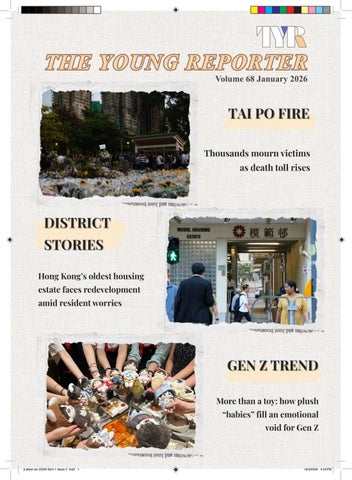
THE YOUNG REPORTER
Volume 68 January 2026
(Latest ver.)2526 Sem 1 Issue 2 .indd 1
18/3/2026 4:43 PM
LETTER FROM THE EDITOR In this issue, we highlight stories from our community. From exploring the boundary stones in the Central and Western District to investigating estate redevelopment in the Eastern District, our team set out to capture the changes shaping our city. We also delved into Gen Z trends, such as performative masculinity, the popularity of
Editor-in-chief Elaine Lai
Deputy Editors Jim Au Yeung Tricia Li Trista Kurniawan Vinci Ao
Video Editors
plush toys, and morning raves to reflect the
Gigi Ho
evolving interests of our generation.
Art Directors
Most importantly, we reported on the deadly Tai Po fire in November 2025. Covering this tragedy challenged us as student journalists to respond quickly and sensitively, from gathering spot news updates to producing in-depth features. It was a demanding period with tight assignment deadlines and I am grateful to everyone who contributed to the special coverage. Although the event was tragic, I believe this is the essence of journalism: reporting on what truly matters to society. I hope this issue inspires you to stay informed, engaged, and empathetic as members of our community. Sincerely, Elaine Lai Editor-in-chief
hkbutyr hkbutyr hkbutyr The Young Reporter
Edith Mao Natasha Ng
Social Media Editors Yoyo Chan
Advisors
Mimi Lau Robin Ewing
Publisher Zhong Bu
Printer
Win Fung Production Limited
Printer Address
Flat F, 12/F, Block 3, Golden Dragon Ind. Centre, 172-180 Tai Lin Pai Road, Kwai Chung, N. T., Hong Kong
Editors
Alishiba Matloob Anson Luk Canny Lau Carmen Cao Connie Wong Edith Mao Elaine Lai Gigi Ho Haicen Yang Hannah Wang Jim Au Yeung Maggie Yeung Nancy Wang Nansen Chen Natasha Ng Oscar Ma Tricia Li Trista Kurniawan Vinci Ao Yoyo Chan Yutong Liu Zoe Hwang Zoey Zhang
Reporters
Anny Chau Audrey Fu Betty Lan Bono Leung Darcy Ye Henry Li Henry Siu Howard Chen Jamie Yam Jennifer Yu Kate Chan Laura Lou Luna Lau Phoenix Li Quincy Qin Richard Chen Sean Cheng Shirley Zhou Sofina Zheng Stephen Feng Suri Yang
tyr.jour.hkbu.edu.hk tyrmagazine@gmail.com
(Latest ver.)2526 Sem 1 Issue 2 .indd 2
18/3/2026 4:43 PM
Contents Hong Kong’s oldest housing estate residents concern plans for redevelopment Colonial boundary stones remnants of Hong Kong history More than a toy: how plush “babies” fill an emotional void for Gen Z Performative male: Gen Z new solution to attract females? No more club and wine: the rise of morning rave in Australia Hong Kong debates bamboo scaffolding after deadly Tai Po fire At least 13 dead in Tai Po level five fire
Kwong Fuk relief stations overflow with supplies amid Tai Po fire response Thousands mourn Tai Po fire victims continue as death toll rises At least 65 dead, over 70 injured as blaze continues at Wang Fuk Court Brief return to the last standing block after Tai Po fire
1
(Latest ver.)2526 Sem 1 Issue 2 .indd 3
18/3/2026 4:43 PM
Stories of Hong Kong districts
(Latest ver.)2526 Sem 1 Issue 2 .indd 4
18/3/2026 4:43 PM
Eastern
Residents raise concerns as Hong Kong’s oldest housing estate remains under plans for redevelopment Reported by: Henry Siu Tsz-hang, Jamie Yam Long-hei Edited by: Trista Vania Kurniawan
T
hree years after Chan Sau-mei moved into her flat, the concrete wall started flaking off. Now, 20 years later, the entire building is full of exposed rebars, dust and concrete splatters.
“It’s like a sandy beach at home everyday. It is an endless nightmare cleaning up all the mess at my house,” Chan, 52, said, adding that there is a new renovation project nearly every eight months. Chan lives in the Model Housing Estate, Hong Kong’s oldest existing public housing estate, sandwiched between Quarry Bay and North Point on Hong Kong Island.
Model Housing Estate is the oldest existing public housing estate in Hong Kong that remains under plans for redevelopment. (Henry Siu Tsz-hang, The Young Reporter)
(Latest ver.)2526 Sem 1 Issue 2 .indd 5
3
18/3/2026 4:43 PM
Five of the estate’s six blocks were built in 1954, with one, a redevelopment of the original, built in 1979. Chan’s block is one of the originals built with five to six stories and no lift. Announced in the 2025 Policy Address in September, Lee announced that redevelopment plans for some of Hong Kong’s oldest estates will be announced.
There is an obvious height difference between the 20-floored Block C and the 6-floored Block B at Model Housing Estate. (Henry Siu Tsz-hang, The Young Reporter)
The Housing Authority is conducting a study on the redevelopment of Model Housing Estate, and will announce its preliminary findings in 2026-27, while redeveloping plans for Ma Tau Wai Estate and Sai Wan Estate by the end of this year. Chan said she is happy to finally hear about redevelopment plans.
“I love living here. We have a very close relationship with our neighbours, and doing groceries and commuting around the estate is also convenient. I think this place is a golden location, but the only flaw is it’s old and is worn to a skeleton,” Chan said. With no lift in the five older blocks, Chan said she is lucky to live on the ground floor, as it is very inconvenient to climb five or six storeys every day to their unit, especially for older residents. Even if there are lifts, they sometimes cause inconvenience, said Huang Yang-hong, 52, Chan’s neighbour who has lived in newer Block C for over 15 years. Huang’s block has two lifts: one for odd-numbered floors and another for even-numbered floors. “The lifts might be too old. One of the two would be out of service every 10 days. Elderly residents would just not go out and stay at home or wait at the lobby, not going home,” Huang said. But Huang said water seeping into her flat is the most pressing problem. Last year, she moved from the first floor to the 17th floor because of severe water leaking. Residents Huang Yang-hong (left) and Chan Sau-mei hope the “More than 10 flats of my old neighbours moved out of the estate Model Housing Estate redevelopment plan will be announced as because of water seepage,” she said. soon as possible. (Henry Siu Tsz-hang, The Young Reporter) 4
(Latest ver.)2526 Sem 1 Issue 2 .indd 6
18/3/2026 4:43 PM
She said that renovators told her they could not fix the problem, as it should have been done when the estate was first built. Both Chan and Huang hope the redevelopment plan will be introduced soon to improve residents’ living quality. “My biggest hope is that after reconstruction, we can move back and live here again,” Chan said. In an email to The Young Reporter, the Housing Department said it has consistently assessed the estate’s actual circumstances in line with four principles: the buildings’ structural conditions, the cost-effectiveness of repair works, the availability of suitable rehousing resources nearby and the redevelopment’s build-back potential, when deciding whether to redevelop public rental housing. Eastern District Councillor Cheng Chishing admits Model Housing Estate has serious maintenance issues, including ceilings flaking and water seepage. Cheng added that many units have been reclaimed for repairs, temporarily relocating residents, but that only those with mobility issues, such as leg problems or difficulty climbing stairs, applied for relocation. “Most residents here are reluctant to move out,” Cheng said.
Eastern District Councillor Cheng Chi-shing, whose office is located at the estate, does not see many residents enquiring about the estate’s redevelopment. (Jamie Yam Long-hei, The Young Reporter)
According to the Housing Authority, it would provide relocations for residents affected by estate clearance, allowing them to select new public rental flats through a priority-based self-selection scheme determined by household size, ballot and special consideration for the elderly or disabled. Cheng suggested demolishing one of the low-rise blocks first and constructing a taller building on the same site to accommodate residents from the remaining four blocks. Residents expect that the redevelopment may utilise high-rise space to provide more flats, as well as improve basic facilities, such as installing lifts. He said the redevelopment will take at least a decade, and Block C will be the latest to be redeveloped as it is the youngest building in the estate. Tsui, who declined to give his full name and who lives on the third floor of Block C, said redeveloping Block C is a waste of money. 5
(Latest ver.)2526 Sem 1 Issue 2 .indd 7
18/3/2026 4:43 PM
Jin Jin Cha Chaan Teng opened on the estate’s Block C for over 40 years and built strong relationships with regular customers around the neighbourhood. (Henry Siu Tsz-hang, The Young Reporter) “I don’t think Block C must be redeveloped. It only needs minor work on the exterior. It is the newest building and the government is already spending money on renovating other flats,” he said. “If you’re going to rebuild, you should’ve done it sooner. Once demolition starts, everything we’ve just fixed will be torn down,” he added. Tsui said he is temporarily staying in government-provided accommodation while his home undergoes renovation. The owners of Jin Jin Cha Chaan Teng, a restaurant on the ground floor of Block C that has been running for over 40 years, said they don’t have plans to relocate or close unless they receive an official letter requiring it. “I think every business stall here, if they are asked to relocate, will have the same worry about losing their regular customers,” the owners said. They said the employees and residents are emotionally attached to the restaurant. “If people think of eating chicken and immediately think of Jin Jin, that’s already a huge sense of achievement for us,” they said. 6
(Latest ver.)2526 Sem 1 Issue 2 .indd 8
18/3/2026 4:43 PM
Central & Western
Colonial boundary stones remnants of Hong Kong history Reported by: Richard Chen Xiyun, Stephen Feng Zhenpeng, Henry Li Yinheng Edited by: Yang Haicen
A
long the shaded fitness path on Broadwood Road in Happy Valley, a weathered stone stands quietly by the trail. “City Boundary, 1903,” reads its surface, reminding pedestrians of the remnants of Hong Kong’s colonial past. “I’m not sure what they are, but they lie along my running route, so I always treat them as rest stops and jogging milestones,” said Solo Chan, 56, a hiking fan who walks along Broadwood Road daily.
The Broadwood Road boundary stone stands on the pedestrian path, while the rest of the stones are mostly hidden in the woods, away from people. (Henry Li Yinheng, The Young Reporter)
“Every time I meet a new one, I pause and search for the recreational spot recommended nearby, so that I can decide the next leg of my trip,” Chan added. “It has become a great pleasure of mine during the daily morning runs.” These stone monuments were erected in 1903 by the British colonial government to delineate its first developed administrative area on the north shore of Hong Kong Island, called the City of Victoria, according to the Development Bureau. The stones are crafted from hard granite, with a square columnar body and a pointed pyramidal top. They were originally designed to be approximately 1.3 meters high, but current records indicate that some stones are between 98 centimetres and 1 metre in height. The boundary is still legally defined in the Interpretation and General Clauses Ordinance, and include what Chinese residents commonly refer to as the “Four Circuits and Nine Yeuks,” the colonial-era predecessor of today’s Central and Western District and Wan Chai District, according to official records from the Lands Department.
(Latest ver.)2526 Sem 1 Issue 2 .indd 9
7
18/3/2026 4:43 PM
Although the city’s boundaries have since expanded and no longer carry significance in city planning, they offer tangible links to the history of Hong Kong’s urban development, the Development Bureau added. British colonial rule in the city ended in 1997. Now, the stones are landmarks for hikers and tourists.
Solo Chan, 56, a business service staff member at the Jockey Club, leads TYR reporters towards the second boundary stone on Bowen Road. (Richard Chen Xiyun, The Young Reporter)
“People look for boundary stones within their districts and have their unique ways of checking in,” Chan said. “I will take photos of boundary stones and post them online for the record.”
Time has not only eroded the surface of the boundary stones, but has even altered the original positions of some stones. The stone in Kennedy Town was moved from its original location to the temporary recreation ground on Sai Ning Street in 1978, losing its significance as a boundary marker. Nine existing boundary stones have been located and recorded on the Land Department’s map, stretching from Happy Valley in the east to Kennedy Town in the west. The boundary stone originally located on Magazine Gap Road was recorded as lost in June 2007, the only stone that has been lost. The most recent three boundary stones were discovered in 2021 in the hillside regions, where Mounts Davis, Lung Fu Shan, and Rosary Hill each account for one, according to the Lands Department.
According to a statement given by the Antiquities and Monument Office to the Legislative Council in Oct. 2007, the government said the boundary stones will be protected.
An official from the Development Bureau told TYR the government has established a dedicated office for the study, inspection and documentation of boundary stones with potential heritage value. And work that might affect the boundary stones must first be run by the Antiquities and Monuments Office. The Office has also listed the boundary stones under “government historic sites,” according to the Lands Department’s website. Mandy Wang, 50, on Bowen Road to see the stone marking the old eastern boundary, said it was her first time seeing a boundary stone in real life. 8
(Latest ver.)2526 Sem 1 Issue 2 .indd 10
18/3/2026 4:43 PM
“Following the video to the boundary stone gives me a sense of satisfaction, like ‘Wow, I finally found it,” Wang said. “Instead of leaving stones for us to search for ourselves, the government should enhance the publicity, so that we would deliberately go and take a look,” said Wang. In addition to boundary stones, there are many historical sites from the British colonial era in the city today. “Beyond looking for boundary stones, people will also check in when encountering unusual street names, such as streets with T-shaped street signs, and share their interesting findings online,” Chan added. The 1881 Heritage building, formerly the Marine Police Headquarters, is a shopping mall and hotel in Tsim Sha Tsui. The former Central Police Station and Victoria Prison in Tai Kwun have been converted into museums and house numerous restaurants, bars and retail shops. Several artillery fortifications on Hong Kong Island have been preserved for public sightseeing and education. Zhang Junyi, a scholar from the Chinese Academy of Social Sciences researching Hong Kong history, said the 156-year British colonial history has left a profound impact on Hong Kong society.
Using a travel guide on YouTube, Mandy Wang, 50 (left), a retired resident living in Kowloon, came to Bowen Road to look for the boundary stone. (Henry Li Yinheng, The Young Reporter)
Initially called Queenstown, it was renamed Victoria City in honour of Queen Victoria. “Though the names changed over time, the colonial memories were inherited, carried by cultural relics like the boundary stones,” Zhang said. “These relics should be preserved and protected as much as possible,” Zhang said. Though the government currently has no plans to develop the boundary stones as a tourist attraction, the Lands Department has published a thematic webpage entitled “City of Victoria Boundary Stones” to provide information about the boundary stones to the public, according to officials from the Antiquities and Monuments Office. Wang said that few of her peers know the history behind the boundary stones. She is worried that the younger generation will know even less or even completely forget. “History should be made known to the public. No matter who occupied this place previously, this history should not be easily forgotten,” Wang said. 9
(Latest ver.)2526 Sem 1 Issue 2 .indd 11
18/3/2026 4:43 PM
Hong Kong Gen Z
(Latest ver.)2526 Sem 1 Issue 2 .indd 12
18/3/2026 4:43 PM
Kidult
More than a toy: how plush “babies” fill an emotional void for Gen Z Reported by: Darcy Ye Enyi, Sofina Zheng Xinyi Edited by: Liu Yutong
Y
in Yunjie, a 24-year-old financial accountant, not only owns plush toys, but also raised them. She talked to it, celebrated its birthday with a cake and worried about it like a parent.
Her “baby” is a cotton doll modeled after her idol, Liu Yaowen from the leading popular boy group in mainland China, Teens in Times, also known as TNT. “When I leave for work, I say goodbye. When I come home, I hug him first,” she said. “If I don’t come back at night, I’m afraid he’ll be scared sleeping alone and feel lonely.” “It truly became an indispensable part of my life,” she added.
A variety of uniquely styled Liu Yaowen plush dolls have gathered together with their owners joining to celebrate his 19th birthday. (Sofina Zheng Xinyi, The Young Reporter)
Yin represents a growing Gen Z trend of “cyber parenting,” where plush toys like Labubu, Chiikawa, and Jellycat are raised as emotional companions rather than mere collectibles or decorations. This shift is emerging alongside the rapidly expanding plush toy market, which is projected to grow at a compound annual growth rate of 8.1% from 2025 to 2032, led by the Asia-Pacific region at 9.6%, according to Persistence Market Research. In addition, Gen Z builds identities and communities around their plush “babies”.
These toys provide comfort and a sense of stable connection, filling a gap left by fragmented real-world relationships, according to Wong Ho-chun, 29, assistant professor of sociology and social policy department at Lingnan University.
(Latest ver.)2526 Sem 1 Issue 2 .indd 13
11
18/3/2026 4:43 PM
While millennials and Gen X might cherish stuffed animals for comfort or decoration, Gen Z engages in “cyber parenting,” said Wong. “The contemporary world is fragmented and high-pressure, demanding constant multitasking and production,” Wong said. “But dolls are always there to be with them and ‘listen’ to their thoughts as the outside world changes quickly.” Wong Ho-chun, 29, an assistant professor of sociology and social policy department at Lingnan University said the trend of purchasing plush toys as companions has become increasingly popular since the pandemic. (Darcy Ye Enyi, The Young Reporter)
“In this context, plush toys fill a void, serving as both an emotional comfort and a compensation for diminished social interaction,” Wong added.
Yin said she imagined her plush toys could think. “He is my spiritual refuge,” she said. “When I’m sad, I hug him. When I’m happy, I share my joy with him. “He really is my little companion who never misses a moment with me,” she added. Charlotte Zhang, a 20-year-old student majoring in statistics at Beijing Normal-Hong Kong Baptist University in Zhuhai, also treats her two plush dolls, modeled after her idols Yan Haoxiang and Song Yaxuan in TNT, as her babies. When human companionship is unavailable or temporarily unreliable, plush toys can serve as a cost-effective and relatively steady alternative, providing her a certain degree of companionship.
Charlotte Zhang studies with her two “babies” and said their smiling faces are all she needs which is incredibly healing, and never fails to make her smile.(Sofina Zheng Xinyi, The Young Reporter)
“While I have good friends, our work and study schedules rarely align, making it difficult to meet up regularly,” she said. “In those moments, being with my dolls makes me feel more at ease and accompanied.” Gen Z’s passion for plush toys has fueled the toy market with their strong spending power. 12
(Latest ver.)2526 Sem 1 Issue 2 .indd 14
18/3/2026 4:43 PM
According to a report by World Data lab, Nielsen and GfK in 2024, the global Gen Z will be the largest, wealthiest and highest-spending generation in history, their consumer spending power is projected to reach US$12 trillion (HK$93.36 trillion) by 2030. Pop Mart, a key player in the designer toy market, has seen explosive growth, reporting a revenue of 13.04 billion yuan, in 2024, marking a 106.9% year-on-year increase, according to its 2024 annual report. The brand crafts highly stylized collections and uses blind-box packaging to create what Wong calls “controllable uncertainty.” “You don’t know what is inside, but you know the possibilities,” Wong said. “That excitement attracts Gen Z.” According to the Pop Mart official online store, the odds of pulling a hidden variant vary by box size. In a 12‑blind‑box set is 1/144, while in a 6‑blind‑box set, it is 1/72. Mo Junkai, a 21-year-old student majoring in Entrepreneurship and Innovation at BNBU, He witnessed the latest and hottest plush toy craze, including the Labubu frenzy. When Labubu suddenly became popular, he found stores sold out across major cities in mainland China and online. “This little character is pretty cute, both mischievous and adorable,” he said.
As a leading figure in mainland China’s trendy toy culture, Pop Mart opened its first Hong Kong store in Tsim Sha Tsui in 2021. (Darcy Ye Enyi, The Young Reporter)
(Latest ver.)2526 Sem 1 Issue 2 .indd 15
13
18/3/2026 4:43 PM
He eventually bought several via a scalper on Douyin livestream at prices up to 359 yuan each, far above the official 99 yuan. “I liked it so much, I didn’t think too much and just bought a few,” Mo said. According to the 2025 Gen Z emotional consumption report jointly released by Soul App and the Shanghai Youth Research Center, nearly 60% of young consumers currently prioritize purchasing for emotional value or personal interests, marking a 16.2% increase from 2024.
Gen Z who love buying cotton dolls and treating them like their own children have formed a doll-centric social circle, connecting from online communities to offline gatherings. (Sofina Zheng Xinyi, The Young Reporter)
In 2019, Pop Mart has collaborated with Tencent Smart Retail to conduct in-depth analyses of consumers’ preferences and purchase behaviour, keeping a pulse on market trends. Pop Mart releases around 200 new products annually, tailoring offerings to user preferences and cultivating scarcity for high-demand items, according to the report from Tencent Smart Retail. Since opening its first Hong Kong store in Tsim Sha Tsui in 2021, Pop Mart has expanded to over 10 locations in the city. As of now, Pop Mart has a total of 451 offline stores, including 424 in Mainland China and 27 in Hong Kong, Macau, and Taiwan. Arena Zhang, 21, a student at Guangdong University of Foreign Studies majoring in International Trade, spends 20,000 to 30,000 yuan annually at Pop Mart. “These IPs often feature unique, artist-designed figures that resonate widely,” Arena said. “Like Labubu, I bought a whole box of the 3.0 version. Now I have 20 figures in different colors at home.” Pop Mart’s numerous IPs are collaborating with well-known brands across various industries to create best-selling products that are popular among young consumers, according to the Pop Mart’s official website. Arena has never pulled a hidden variant. Charlotte, however, once paid a 3,000 yuan premium for a hidden blind box item. “I used money earned from helping someone get concert tickets to buy that limited-edition collectible,” she said. ”And it’s already worth 3,400 yuan now, I can sell it anytime.” 14
(Latest ver.)2526 Sem 1 Issue 2 .indd 16
18/3/2026 4:43 PM
Beyond consumption, Gen Z has built vibrant, doll-centric communities, which is known as “baby circle ”. Shi Shuyu, 21, another TNT fan, is part of a WeChat “baby circle” where members discuss doll care, outfits and daily updates. “We have our own unique ways of communication,” she said. “We call each other ‘the doll’s mom,’ create characters and stories, and share photos with fans.” Some “moms” even run social media accounts for their dolls, posting about outings, outfits and care tips. Yin shares her doll’s daily outfit and vlogs of birthday celebrations and outgoing activities on RedNote. “From choosing clothes and styling hair to taking photos, every step of the process was healing for me,” Yin said.“The compliments from fans on his cute outfits also give me a real sense of accomplishment.” The obsession for plush toys has also led Yin and Zhang to make more like-minded friends. “Our regularly offline gathering makes me feel warm and happy,” she said.
Yin shared her daily life raising her “son” on RedNote.
“We usually gather during holidays, or sometimes after attending a TNT concert and then go to a nearby restaurant to have dinner together,” Zhang said. “While we’re eating, we talk about things related to the concert, such as their styling and makeup, choreography, or the latest merchandise.” “I believe the power of idols is that they bring people together,” she added. Wong said this as a reconfiguration of social connection. “Social media blocks out many of our daily life identities. In those groups, you are equal, just a fan of Labubu. It takes away other identities like social class or gender,” he said. “It helps build a more inclusive environment and eventually bridges people across different bubbles.”
15
(Latest ver.)2526 Sem 1 Issue 2 .indd 17
18/3/2026 4:43 PM
Fashion
Performative Male: Gen Z new solution to attract females? Reported by: Stephen Feng Zhenpeng, Henry Li Yinheng Edited by: Elaine Lai Uen-ling, Tricia Li Sin-tung
Video description: “Performative male”, a western Gen Z pop trend begins to enter Asia. Young people have unique attitudes and views towards performative male in Hong Kong. TYR spoke to Gen Zers and psychological expert to know more about what behind the new trend.
Scan the QR code to watch the video
16
(Latest ver.)2526 Sem 1 Issue 2 .indd 18
18/3/2026 4:43 PM
Culture
No more clubs and wine: the rise of morning rave in Australia Reported by: Anny Chau Wing-yau Edited by: Trista Vania Kurniawan, Elaine Lai Uen-ling
Video description: Young Australians are leading a new trend all over social media, focusing on alcohol-free socialising and personal wellness. Instead of bars and clubs, people in Brisbane, Sydney, and Melbourne are flocking to cafes and bakeries hosting 8 am morning raves to kick off the day feeling fresh and energised. Scan the QR code to watch the video
17
(Latest ver.)2526 Sem 1 Issue 2 .indd 19
18/3/2026 4:43 PM
Tai Po Fire
(Latest ver.)2526 Sem 1 Issue 2 .indd 20
18/3/2026 4:44 PM
Tai Po Fire (Day 1)
At least 13 dead in Tai Po level-five fire Reported by: Gigi Ho Wing-chi Edited by: Vinci Ao Wei-ying Video description: As of 8:30pm on Nov. 26, a No.5 alarm fire erupted at Wang Fu Court in Tai Po, leaving at least 13 dead, including one firefighter, officials said.As of 6pm, there are at least five injuries, including three that were critically injured. One person was in serious condition, and one was in stable condition. Scan the QR code to watch the video
19
(Latest ver.)2526 Sem 1 Issue 2 .indd 21
18/3/2026 4:44 PM
Tai Po Fire (Day 2)
At least 65 dead, over 70 injured as blaze continues at Wang Fuk Court Reported by: Sean Cheng Tsz-sen, Elaine Lai Uen-ling Edited by: Vinci Ao Wei-ying, Nansen Chen Yik-nam
Video description: As of 8pm on Nov. 27, over 60 people were killed in the blazing fire at Wang Fuk Court, Tai Po. 10 firefighters were injured in an effort to put out the fire.
Scan the QR code to watch the video
20
(Latest ver.)2526 Sem 1 Issue 2 .indd 22
18/3/2026 4:44 PM
Tai Po Fire (Day 3)
Kwong Fuk relief stations overflow with supplies amid Tai Po fire response Reported by: Jennifer Yu Yan-pui Edited by: Henry Siu Tsz-hang, Vinci Ao Wei-ying
A
s of Nov. 28, supply stations at Kwong Fuk Estate brimmed with essentials at noon as volunteers urged donors to hold off, confirming sufficient stocks for residents displaced by the Tai Po blaze.
The stations offered various supplies, including solid meals, drinks, first aid medicine, adhesive bandages, masks, paper underwear, and shampoo. A group of secondary school students from the nearby Wong Shiu Chi Secondary School, in uniforms, handed out snacks and fruit at the station.
Excessive toilet paper rolls are stacked up at Kwong Fuk relief stations for people in need to get supplies. (Jennifer Yu Yan-pui, The Young Reporter) 21
(Latest ver.)2526 Sem 1 Issue 2 .indd 23
18/3/2026 4:44 PM
Dozens of boxes of water are available at Kwong Fuk relief station. (Jennifer Yu Yan-pui, The Young Reporter)
Volunteering students from nearby Wong Shiu Chi Secondary School give out snacks and drinks at Kwong Fuk relief station. (Jennifer Yu Yan-pui, The Young Reporter)
One student told the reporter that they offered displaced residents freshly cooked vegetarian lunchboxes and hot tea provided by local restaurants in the neighborhood . “Prescription grains and blankets for pets can be obtained. We want to deliver them to people in need as soon as possible,” said Tracy Wong, 30, a volunteer at a pet supplies booth on site. The pet supplies booth called on the public to stop sending more cat and dog food as it had sufficient resources collected. Other booths worked on sorting clothes, separating heavy winter garments from lighter clothes on the ground. Additional services at the stations included blood pressure checks and counseling sessions to comfort residents.
Volunteers sorting out warm clothing for people in need at Kwong Fuk relief station. (Jennifer Yu Yanpui, The Young Reporter)
Volunteers handing out hand warmers for the elderly at Kwong Fuk relief station. (Jennifer Yu Yan-pui, The Young Reporter)
22
(Latest ver.)2526 Sem 1 Issue 2 .indd 24
18/3/2026 4:44 PM
Tai Po Fire (Day 6)
Thousands mourn Tai Po fire victims as death toll rises Reported by: Gigi Ho Wing-chi, Vinci Ao Wei-ying Edited by: Henry Siu Tsz-hang
A
s of Dec. 1, thousands gathered at the nearby Kwong Fuk Sitting-out Area in Tai Po on Monday to lay flowers in remembrance of the fire victims.
Bouquets, condolence cards and soft toys filled the lawn as citizens paid their respects to the victims of the deadly fire. Mourners penned blessings and messages on memos, which were posted at a pavilion near Wang Fuk Court. A similar display of memo wall appeared along a pedestrian tunnel leading to Kwong Fuk Sitting-out Area, but was later voluntarily removed after police cautioned against the practice.
Bouquets of white and yellow flowers fill the memorial area near Wang Fuk Court, where residents leave handwritten messages mourning the Tai Po fire victims. (Vinci Ao Wei-ying, The Young Reporter)
23
(Latest ver.)2526 Sem 1 Issue 2 .indd 25
18/3/2026 4:44 PM
A Civil Aid Service officer arranges bouquets laid by the public near Wang Fuk Court, as mourning continues for the Tai Po fire victims. (Gigi Ho Wing-chi, The Young Reporter)
Residents gather in silent prayer near Wang Fuk Court to mourn the victims of the Tai Po fire.(Gigi Ho Wing-chi, The Young Re-
24
(Latest ver.)2526 Sem 1 Issue 2 .indd 26
18/3/2026 4:44 PM
A funeral flower wreath bearing the words “Pain — From Hongkongers” places at the memorial site. (Vinci Ao Wei-ying, The Young Reporter)
Hong Kongers place flowers to mourn the victims of the Tai Po fire. (Vinci Ao Wei-ying, The Young Reporter)
Mourners line up at the Kwong Fuk Sitting-out Area to pay their respects. (Vinci Ao Wei-ying, The Young Reporter)
Hundreds of handwritten notes cover the pillars of a pavilion near Wang Fuk Court. (Vinci Ao Wei-ying, The Young Reporter)
25 (Latest ver.)2526 Sem 1 Issue 2 .indd 27
18/3/2026 4:44 PM
Hong Kongers fill a tunnel wall with penned messages of support and condolence for victims of the Tai Po fire. (Gigi Ho Wing-chi, The Young Reporter)
Hong Kongers fill a tunnel wall with penned messages of support and condolence for victims of the Tai Po fire. (Vinci Ao Wei-ying, The Young Reporter)
26
(Latest ver.)2526 Sem 1 Issue 2 .indd 28
18/3/2026 4:44 PM
Tai Po Fire (Day 8 & 9)
Brief Return to the Last Standing Block after Tai Po Fire Reported by: Quincy Qin Ziyang Edited by: Zoey Zhang Yipng, Nansen Chen Yik-nam Video description: Residents of Wang Chi House, the only building that wasn’t affected by the Tai Po fire, were allowed to return to their homes for 90 minutes to pick up personal belongings on Dec. 3 and 4. The 44-hour Tai Po blaze had claimed 159 lives by Thursday.
Scan the QR code to watch the video
27
(Latest ver.)2526 Sem 1 Issue 2 .indd 29
18/3/2026 4:44 PM
Tai Po Fire
Hong Kong debates bamboo scaffolding after deadly Tai Po fire Reported by: Laura Lou Zhengzheng, Suri Yang Shuyi Edited by: Elaine Lai Uen-ling
A
t 2:51 pm on Nov. 26, a fire broke out in the lower level of one of the eight blocks in Wang Fuk Court, a residential complex in the Tai Po neighborhood of Hong Kong’s New Territories — home to more than 4,600 residents. By 7:30 pm, seven of the eight buildings were on fire, giant flames turning the sky red and billowing clouds of black smoke thickening the air. Firefighters battled the fire for nearly two days, finally putting it out on Friday morning. As of Dec. 1, at least 151 people are dead, and 79 are injured. This is the deadliest fire in Hong Kong since 1962. The estate had been undergoing extensive renovations since the summer of 2024, and all of the 31-storey buildings were covered in traditional bamboo scaffolding wrapped in the ubiquitous green or grey mesh seen on construction sites all over the city. As the buildings burned, in videos that spread across social media, the sound of bamboo cracking could be clearly heard. But when the flames Bamboo scaffolding is visible as one of the Wang Fuk Court blocks burns in Taipo. (Gigi Ho Wing-chi, The Young Reporter)
were finally put out, much of the blackened bamboo scaffolding was still standing.
The use of bamboo scaffolding in construction, from small-scale work to skyscrapers, has been a visible part of Hong Kong’s cityscape for nearly two centuries. But the Wang Fuk Court fire, on the heels of smaller fires at building construction sites in recent months, has stirred controversy over whether the bamboo had anything to do with the fire and if it should be replaced with steel for safety reasons. Kristof Crolla, associate head at the University of Hong Kong’s department of architecture, said bamboo is unique. 28
(Latest ver.)2526 Sem 1 Issue 2 .indd 30
18/3/2026 4:44 PM
“It’s kind of nature’s optimal engineered material to use as a construction system in a way that none of our modern materials behave,” he said. Following an on-site investigation and evidence collection by the police, Secretary for Security Chris Tang Ping-keung said on Dec. 1 that seven samples of scaffolding mesh found at the scene failed to meet flame-retardant testing standards. He said the non-compliant mesh, combined with the foam insulation used to protect windows, contributed to the rapid spread of the fire. Though bamboo is not mentioned in the government investigative report, the Development Bureau met with the industry last week to discuss the replacement of bamboo with metal for scaffolding, according to a government press release. After the fire was mostly under control, many mesh had burned away, but some bamboo scaffolding remained its original structure. (Elaine Lai Uen-ling, The Young Reporter)
But experts say bamboo scaffolding is cheap, safe, fire-resistant and a cultural heritage Hong Kong should preserve.
Mainland China switched from bamboo to steel for scaffolding materials in the 1960s. It has the world’s largest steel industry, and is one of the main exporters of scaffolding, shipping 72 million tons in October 2025, according to the World Steel Association. Used to steel, some Chinese netizens have commented on posts about Hong Kong’s use of bamboo as backward. On Xiaohongshu, an image claiming bamboo is more heat-resistant than metal spread widely, with many scoffing at the claim. Andy Ong, 26, co-founder and director of Super Bamboo, a technology company that uses fire-roasted bamboo to develop new materials, said that their fire- On Nov. 30, the fourth day after the fire, the mesh covering the bamboo scaffolding at Nga Lan House in Prince Edward started to test findings on bamboo over the years show that it is heat-resistant. be dismantled. (Suri Yang Shuyi, The Young Reporter) 29
(Latest ver.)2526 Sem 1 Issue 2 .indd 31
18/3/2026 4:44 PM
He showed TYR that when a biomass material like bamboo burns, it forms a stable char layer that acts as a heat shield, protecting the interior. “Since bamboo is relatively dense and has a thicker wall than many other biomass materials, it also has a slower charring rate,” he said. “Steel holds heat and collapses suddenly, but bamboo burns predictably and slowly, giving escape time,” he added. According to data research done by TYR, there have been at least ten construction site fires this year. The largest was October’s No.3 fire at the Chinachem Tower in Central with four hurt.
the construction of bamboo scaffolding, dry bamboo is In typically preferred, which exhibits a yellow color. (Laura Lou Zhengzheng, The Young Reporter)
“The fires are unusual. I’ve never heard of bamboo scaffolds burning in 15 years in Hong Kong,” Crolla said.
In March this year, the Development Bureau issued a directive requiring that no less than 50% of all new government public works building contracts must switch to metal scaffoldings, mimicking mainland China. The government said that although bamboo scaffolding is more flexible in use, it is not as effective as steel for fireproofing. Kwok Chi-tak, 72, spokesman of the Hong Kong Institution of Engineers, said the Buildings Department and Labour Department in Hong Kong have clear guidelines and codes on the materials, structure and construction safety of bamboo scaffolding. “As long as industry practitioners follow the guidelines, the safety of materials and structure can basically be guaranteed,” Kwok said. According to the Census and Statistics Department, this city currently has around 1,600 building sites under construction. 30
(Latest ver.)2526 Sem 1 Issue 2 .indd 32
In Hong Kong, two types of bamboo are used in most scaffolding, including Kao Jue (pole bamboo) and Mao Jue (hair bamboo). (Suri Yang Shuyi, The Young Reporter)
18/3/2026 4:44 PM
There are 2,810 people with bamboo scaffolding certificates who meet the registration requirements under the Construction Workers Registration Ordinance in government registration data. Crolla said bamboo scaffolding has been used since the 1800s, when the small port city needed cheap and quick ways to build. After World War II, Hong Kong grew rapidly, with factories and buildings springing up. Kwok said bamboo became the best choice for its safety, construction speed, and low cost. Hong Kong’s terrain is varied and complex, with some residential buildings built on mountain slopes and some built beside the coast. “Bamboo is nimble and adapts to Hong Kong’s varied sites, like hills or water, better than steel, which is heavier and less flexible,” Crolla said. In Hong Kong, the bamboo used for scaffolding primarily comes from Zhaoqing in Guangdong, Guangxi, and Vietnam. According to the Bamboo Trellis Design and Construction Guide published by the Buildings Department, all bamboo used for scaffolding must be at least three years old and undergo at least three months of air-drying.
The scaffolding surrounding the entire Wing Shun Building in Tai Kok Tsui is entirely bamboo. (Laura Lou Zhengzheng, The Young Reporter)
(Latest ver.)2526 Sem 1 Issue 2 .indd 33
31
18/3/2026 4:44 PM
Lightweight bamboo is built into suspended working platforms in front of residential windows, commonly known as “flying scaffolds”. (Suri Yang Shuyi, The Young Reporter) Last year, seven typhoons hit Hong Kong, with heavy rain and strong winds. “In typhoons, bamboo scaffolding may collapse but remains hanging on the building and can be pulled back up, whereas steel would crash harder,” Crolla added. It’s Hong Kong’s older buildings that often need scaffolding for repair work. Statistics from the Development Bureau in 2023 show that the number of old buildings in Hong Kong aged 50 years or above has increased from 4,500 to 9,600 in the past decade. It is projected to reach 22,900 by 2042. For external building maintenance, the industry most commonly uses suspended bamboo scaffolding. This structure can cover only a specific section of a building without reaching the ground. Although metal scaffolds have been introduced and used alongside bamboo, workers still rely on bamboo to build flying platforms for repairing windows or pipes. “Metal is too heavy for that,” Kwok said. Crolla said bamboo scaffolding can be built for all types of buildings with various geometries and on different terrains, offering great flexibility that steel scaffolding cannot achieve to the same degree. “It has been performing exceptionally well in its area of expertise, so I don’t understand why people are trying to change it,” he said. 32
(Latest ver.)2526 Sem 1 Issue 2 .indd 34
18/3/2026 4:44 PM
Past Issues
(Latest ver.)2526 Sem 1 Issue 2 .indd 35
18/3/2026 4:44 PM
(Latest ver.)2526 Sem 1 Issue 2 .indd 36
18/3/2026 4:44 PM