THE YOUNG REPORTER Volume 67 November 2025
Stories of Hong Kong districts Kwun Tong
Evicted hawkers fight for survival
Southern
Aberdeen’s challenges amid fishing culture
Sham Tseng
The story of Hong Kong’s roasted goose restaurant
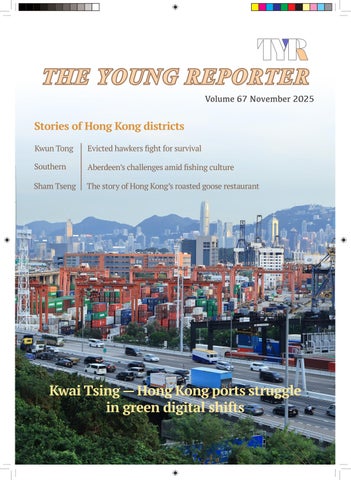
Kwai Tsing — Hong Kong ports struggle in green digital shifts
LETTER FROM THE EDITOR Chief Executive John Lee has emphasised the importance of “telling the world the good stories of Hong Kong.” This made me reflect on a question: What does it truly mean to tell the good stories of Hong Kong? Hong Kong, once divided into Hong Kong Island, Kowloon, and the New Territories by the Brit-
Editor-in-chief Elaine Lai
Mimi Lau Robin Ewing
Alishiba Matloob Anson Luk Canny Lau Carmen Cao Connie Wong Edith Mao Elaine Lai Gigi Ho Haicen Yang Hannah Wnag Jim Au Yeung Maggie Yeung Nancy Wang Nansen Chen Natasha Ng Tricia Li Trista Kurniawan Vinci Ao Yoyo Chan Yutong Liu Zoe Hwang Zoey Zhang
Publisher
Reporters
Deputy Editors Jim Au Yeung Tricia Li Trista Kurniawan Vinci Ao
Video Editors
ish, now comprises 18 vibrant districts. These are
Gigi Ho
the places where 7.5 million residents live, work,
Art Directors
and dream. In this copy, we present a selection of their stories in the magazine. We have also created an interactive Hong Kong map on our website, showcasing all stories, district by district. I invite you to explore and discover the true Hong Kong. I am grateful to our editorial board and advisors for their support and guidance. Producing 18 stories, often with just one reporter per district, was a challenge, but seeing the finished stories filled with the effort of our team, brings me great joy. Sincerely, Elaine Lai Editor-in-chief
hkbutyr hkbutyr hkbutyr The Young Reporter tyr.jour.hkbu.edu.hk tyrmagazine@gmail.com
Editors
Edith Mao Natasha Ng
Social Media Editors Yoyo Chan
Advisors
Zhong Bu
Printer
Win Fung Production Limited
Printer Address
Flat F, 12/F, Block 3, Golden Dragon Ind. Centre, 172-180 Tai Lin Pai Road, Kwai Chung, N. T., Hong Kong
Anny Chau Audrey Fu Betty Lan Bono Leung Darcy Ye Henry Li Henry Siu Howard Chen Jamie Yam Jennifer Yu Kate Chan Laura Lou Luna Lau Phoenix Li Quincy Qin Richard Chen Sean Cheng Shirley Zhou Sofina Zheng Stephen Feng Suri Yang
Contents Aberdeen faces challenges amid its deep-rooted fishing culture Nepalese community seeks to call Hong Kong home From street to stall: How Kwun Tong’s evicted hawkers fight for survival Reviving Yim Tin Tsai heritage: Arts festival rekindles traditional values at Sai Kung Running together: how a running club in Tai Po is bringing the community closer Hong Kong’s port battles to stay afloat amid green and digital shift Shatin hostel scramble under policy of expanding non-local student enrolment Australia sees a 20-year dip in Hong Kong students’ enrolment as preferences shift Sham Tseng — The story of Hong Kong’s roasted goose restaurant Lung Kwu Tan: the village paying for Hong Kong’s zero landfill vision Local green institutions call for environmental conservation
1
• Fishing vessels moor beside the Aberdeen Promenade on Oct. 22.
Southern
Aberdeen faces challenges amid its deep-rooted fishing culture Reported by: Howard Chen Ziyu, Oscar Ma Tsz-chiu Edited by: Oscar Ma Tsz-chiu
E
very typhoon, the two Aberdeen Typhoon Shelters are filled with fishing vessels seeking refuge from strong winds. On the southwest coast of Hong Kong Island, across from the small island of Ap Lei Chau, Aberdeen Harbour is a natural shelter for boats. When Super Typhoon Ragasa struck Hong Kong and prompted the Observatory to hoist the highest level T10 signal in September, the two shelters were full. “Ragasa left a trail of destruction in Hong Kong, but it didn’t affect Aberdeen much,” said Lee Choiwah, 68, the former president of the Hong Kong Chamber of Seafood Merchants, who owns a seafood store in Aberdeen Wholesale Fish Market.
Boats, vessels and yachts moor inside the Aberdeen West Typhoon Shelter on Oct. 22. Because of its geographic location, this naturally protected harbour made Aberdeen the most important fishing village in Hong Kong before the 1970s, with more than 50,000 residents active here, according to the Fishermen Museum. They were known as “boat dwellers” and many of them worked as fishermen. 3
“Aberdeen is an important spot for seafood trading,” said Lee. “At its peak, 80% of seafood products in Hong Kong were traded here.” Boat dwellers in Aberdeen operated grocery stores and restaurants on boats, forming a community on the water. This includes Jumbo Floating Restaurant, the most well-known seafood restaurant on boats in Aberdeen, which operated for 44 years before it was closed during the pandemic and subsequently sank in the South China Sea in 2022. Lee, from a family of boat dwellers, spent his childhood living on a boat. “It was exciting when I could just jump off and swim with other Areas around Aberdeen have one of the highest numkids after finishing my homework,” said Lee. He bers of fisheries production in Hong Kong. (Map by added that sometimes he and his friends casualLands Department) ly fished together between the moored boats. The 1961 Hong Kong Census recorded the highest number of boat dwellers since the end of World War II. Over 138,000 people, or 4.4% of the total population, were living on the water in places such as Aberdeen, Tai Po and Sai Kung. But starting in 1964, with the emergence of mechanised fishing, the younger generations of boat dwellers began to work in the growing manufacturing industry, according to the Hong Kong Chronicles Institute. Boat dwellers started moving ashore, including Lee and his family. In 2021, the Census found only 1,125 boat dwellers remained. The entire local fishing industry is facing a similar fate. According to the Agriculture, Fisheries and Conservation Department, the volume of fish caught dropped from about 170,000 tonnes in 2011 to 92,000 tonnes in 2024, a decrease of 46% in 13 years.
Lee Choi-wah, owner of Fei Por Seafood, inherited the wholesale store from his parents and has managed the store for over 50 years.
Lee said the government used to provide subsidies and low-rate loans for fishermen to upgrade their vessels and equipment. However, such practices led to overfishing and damaged the marine ecosystem, resulting in lost harvests. 4
In 2013, Hong Kong banned trawling, a destructive fishing method, which impacted many small-scale local fishermen who relied on nets for fishing. “The local seafood industry is shrinking,” said Lee. “Many of the local fishermen sold their vessels to those from mainland China in recent years.” Ling Man-sum, the current president of Hong Kong Chamber of Seafood Merchants, told Data retrieved from the Agriculture, Fisheries and ConTYR in an email interview that the mainservation Department. land-bound consumption habits by locals have dealt an additional blow to the seafood industry. “Our major challenge is to adapt to the changing market,” said Ling. “Consumer behaviours are shifting and the industry feels like ‘battling the boss’ every day.” “The mainlanders have larger fishing fleets, so locals can hardly compete with them,” said Lo Wingchun, 34, a descendant of a fishing family. He added that his father quit fishing seven years ago. “I couldn’t help but cry when my father decided to sell his boat. The boat is priceless to me as it represents happiness and the beautiful memories I had,” he said. Lo said many of the older fishermen, including his father, have found it hard to switch careers.
Fishermen pass their catch to a colleague on shore for sale at the Aberdeen Promenade on Sept. 29.
The Hong Kong Fishing Culture Association has got involved to help these older fishermen and preserve local fishing culture. They invited Lo and his father to be tutors of the Recreational Fisheries Green Angling Promotion Program, a public education scheme.
Under the programme, Lo and his father brought participants out to sea and taught them fishing skills, as well as about fishermen’s daily lives and their folklore. “Participants were actually curious about our culture and asked many questions,” said Lo.
5
The tutors also explain how they avoid capturing pregnant and juvenile fish to maintain the breeding chain. “It is good to promote the sense of protecting the sea by using fishermen’s experiences,” said Lo. “If the program can be further expanded, it will be a message for other fishermen not to feel discouraged despite all the setbacks,” he said. In the meantime, Lo criticised the government’s insufficient support for the local fishing industry. “They require a complete proposal if the fishermen want to apply for a special financial aid, which is impossible for the old ones to handle as they lack the writing skills,” said Lo. “Does the government really understand the fishermen’s situation?”
Lo Wing-chun, a tutor for the Hong Kong Fishing Culture Association, teaches the skill of attaching fishhooks.
When Lo and his parents were still living on a boat, relatives who had moved to land remained tied to the sea in their hearts. They celebrated the Lunar New Year on the family’s boat every year.
“Whenever it was the new year, all the family members came back to the sea from land,” he said. “The boat became a place for us to stay close.” However, Lo said many descendants of fishermen have already shifted their focus of life elsewhere. “I believe we, as fishermen’s heirs, should make greater efforts for our industry,” said Lo. “My hope is to lead all of them in preserving our culture together.”
A fisherman unloads goods from his boat onto the Aberdeen Wholesale Fish Market on Sept. 29.
6
Yau Tsim Mong
Nepalese community seeks to call Hong Kong home Reported by: Darcy Ye Enyi Edited by: Carmen Cao Jiawen
E
very afternoon, a diverse crowd sits in the dimly lit bar at The Nest, a Nepalese restaurant in Jordan, savouring its happy hour buy-one-get-one-free drink special and listening to jazz music.
“My guests are saying that this place is very cozy and relaxing,” said Pradeep Kandangwa, 55, the owner of The Nest. “They keep coming here once they come.” Jordan, referred to as “Little Nepal,” is dotted with restaurants like the Nest and specialty shops selling Nepalese food and daily necessities. It’s part of the Yau Tsim Mong District, which has the highest concentration of ethnic minority residents among Hong Kong’s 18 districts, approximately 8.6% of the city’s total ethnic minority population, according to the 2021 census. The largest portion of these are Nepalese.
The Nest Restaurant and Bar at the corner of Wai Ching Street in Jordan draws a steady stream of customers as soon as it opens each day.
Many, like Kandangwa, work in the catering and hospitality industry, which employs the largest proportion of ethnic minorities in Hong Kong, according to a 2023 study from Lingnan University and Hong Kong Baptist University. But experts say that ethnic minorities in the city are pushed into service industry or construction jobs because of a lack of Chinese language skills. For some, especially those who were born in Hong Kong, this can lead to an identity crisis. Kandangwa said he first worked in construction when he arrived in Hong Kong from Nepal 25 years ago before opening his restaurant in 2016. “Nepalese who don’t speak Chinese and even English still make a living in places like restaurants, salons and hotels,” said Kandangwa. “Finding work in Hong Kong’s local community isn’t easy for non-Chinese individuals. We may meet the qualifications, but the issue is language, our Chinese isn’t fluent enough.” 7
“While I can manage basic communication, read and write some words, it’s insufficient to secure a job at a local company, so I decided to start my own business,” he added. “The Nepalese community faces language barriers because of a lack of Chinese language education for ethnic minorities in Hong Kong,” said Jeffrey Andrews, 40, Hong Kong’s first ethnic minority registered social worker based at NGO Christian Action’s Centre for Refugees in Chungking Mansions. To address this, learning materials for the Chinese Proficiency Test, tailored for non-Chinese speaking students, will be extended to the junior secondary level in the next school year, according to the 2025 Policy Address,
Pradeep Kandangwa (Right), the owner of The Nest Restaurant and Bar with his friend from Australia (Left).
“The government must first change the framework of Chinese as a Second Language to become more comprehensive, meaning that minority language learning should be taught by qualified teachers starting from kindergarten,” he said. “The best approach is to start when they’re young, otherwise they’ll always be playing catch-up later on,” he added. Ram Lee Rai, 65, the owner of the Gurkha Store in Jordan who came to Hong Kong from Nepal in 1996, said he put his daughter into a local school so that she would learn Cantonese. “Although my daughter was very reluctant at first, she now feels quite comfortable and at ease speaking Cantonese,” Rai said. He came to Hong Kong to run the small family store passed down from his father, who was already living in Hong Kong. Rai conducts business and chats with his customers in Nepalese. Rai, who doesn’t speak Cantonese, said only by understanding the local language can one integrate more easily into the community and access more opportunities. Jeffery Andrews, 40, Senior Manager (Right) and Chandni Puri, 33, Senior Officer (Left), pose in the Diversity Hub by Christian Action in Chungking Mansions on Oct. 3, a firstof-its-kind community space in Hong Kong. 8
His daughter Ninam Rai, 26, who was born in Hong Kong, works as a teaching assistant and said people are surprised by her Cantonese skills.
“I don’t know whether to introduce myself as Nepalese or Hong Konger, but I hope one day I can naturally tell others I’m a Hong Konger,” she said. “Nepal is my homeland, but I feel depressed by the recent protest there,” she said, referring to the waves of recent street protests in Nepal sparked by rising unemployment and frustrations over government corruption and economic hardship. “I am also grateful to be in Hong Kong, because this is my home.”
Ram Lee Rai, 65, took over the Gurkha Store in Jordan from his father 29 years ago to cater to local Nepalese.
Chandni Puri, 33, also a Nepalese social worker at Christian Action, said many young Nepalese people she works with in Hong Kong experience an identity crisis. “They want to call themselves Hongkongers but can’t speak Cantonese, still conversing in Nepali because it’s their first language,” Puri said. “After graduating from secondary school, they generally face a harsh reality check about where exactly they belong,why they’re stuck in Hong Kong, and should they return to Nepal?”
Display cases showcase artifacts that represent the diverse communities living in Hong Kong at the Diversity Hub by Christian Action.
9
Nepalese clothing store on the second floor of the Bowring commercial centre to meet the needs of the local community. “This is the peak of the identity crisis,” she added. Eliza Rai, 21, who received help from Christian Action and resides in Yau Tsim Mong, said many Nepalese youth in Hong Kong find greater opportunities for personal and professional growth here than in Nepal, leading them to prefer staying in Hong Kong. An increasing number of Nepalese residents are choosing to remain in Hong Kong, its population rose from 3.7% to 4.8% over the past decade, according to the 2021 census. Andrews said that Christian Action now provides professional employment training and development programs for Nepalese and other ethnic minority youth to help prevent limited career prospects. Andrews also called for a societal shift. He said that despite the government investing substantial funds annually, with policies and budgets in place, many non-ethnic Chinese still cannot speak Cantonese today. “We’ve been here for a century but the language issue still exists,” Andrews said. “If the right resources are allocated to the right places, the government, society and private sector all have much to do. As an NGO, we also bear the responsibility to drive this forward,” “Through these efforts, hope for the Nepalese community in Yau Tsim Mong can gradually emerge, encouraging more ethnic minorities to choose to stay in Hong Kong,” he added.
10
Kwun Tong
From street to stall: How Kwun Tong’s evicted hawkers fight for survival Reported by: Luna Lau Ka-yan Edited by: Tricia Li Sin-tung
B
eneath Kwun Tong’s gentrified Yue Man Square lies a descending escalator that leads one to a ghost market. Despite bright lighting and air conditioning, the Yue Man Hawker Bazaar is drawing only a handful of visitors each day to the basement, selling household supplies. Off-seasoned pyjamas and bath towels are seen hanging on store fronts where shop owners idled by, barely making any sales. This is a stark contrast to the former street vendors who used to huddle up in the heart of Kwun Tong’s hustle and bustle while making a living to sustain their families. Since 2021, more than 100 stalls have been relocated to the Yue Man Hawker Bazaar, which was designed to support hawkers’ livelihood.
Owners station before their stores, while playing with their phones. But they complained that its hidden basement location and a surging popularity with online sales have made their businesses unviable. Despite the revival efforts, its once-vibrant and organic market vibe was killed in the process. Fung Kwong-wai, 88, is a stall owner in Kwun Tong who has been selling mostly pyjamas for all ages for over 50 years.
Fung Kwong-wai, 88, owner of Ka Sun Department Store, usually sits diagonally across from his shop, facing the aisle and sometimes dozes off.
“I can only make a hundred dollars a day. It is not enough, as even lunch now costs at least HK$40,” said Fung. 11
Lau Sze-ying, 80, owner of Sun Wah Printing, thinks there should be some publicity measures to make more people willing to come. Many hawkers, like Fung, face a similar situation at Yue Man Hawker Bazaar. “No one comes here except for some neighbours occasionally,” said Janet Chan, 50, another old stall owner who sells daily items including combs, hair ties and pouches at the bazaar. Lau Sze-ying, 80, has been an owner who sells Chinese New Year couplets and red pockets for over 50 years. “Half of the day goes by, and only two to three people out of every 10 people who take the escalators down may buy things here. Most of the people who come are usually not to buy, rather, to use the toilet here,” said Lau.
Next to the Kwun Tong minibus terminal, this sunken plaza usually serves as a passway that people walk straight over.
In 2021, over a hundred licensed fixed-pitch hawkers at the Tong Yan Street Interim Hawker Bazaar were relocated to Yue Man Hawker Bazaar, which was opened under the redevelopment programme led by the Urban Renewal Authority.
The redevelopment goes under Yue Man Square’s renewal plan, which provides more innovative and smart facilities to enhance residents’ quality of life. Hawker Bazaar now serves as a permanent market for vendors stationed at the former temporary small town on Mut Wah Street and Hip Wo Street, with no rental fee for the first five years, said the owner Chan. 12
Fung recalls his old life on the street. “In the past, I set up stalls on the street with my wife. It is undeniable that the work was very hard as we were exposed to the wind and rain, but we made a lot of money from the coming and going of people,” said Fung. The move in 2021, part of a government redevelopment program, which once promised a more upscale operation, however, has sent their business to a desperate deep-end.
Fung Kwong-wai, 88, owner of Ka Sun Department Store, has been a member of the Hawkers’ Union for around 50 years.
“The location is too hidden, and I have no customers,” he added. Markets help build strong connections between neighbourhoods in Hong Kong. From the delicious food at Temple Street Night Market to the casual clothes and shoes at Ladies’ Market, they showcase the city’s unique street culture. But for other markets like this one, moving from selling on the street to inside a building has become inevitable. Lau Chi-pang, a member of the Legislative Council, has taught Chinese history and Hong Kong history at Lingnan University for over 20 years.
Lau Chi-pang, a member of the Legislative Council, said that it is a natural transformation in today’s business conditions. “A more modernised environment, with fixed stalls and better lighting, can provide a higher quality of sales,” he said.
He said it is not the hawkers’ fault that their businesses are struggling, but the changing consumption behaviour, particularly the rise of online shopping. “Taobao’s products can be delivered to people’s doorsteps and are a lot cheaper. It is so convenient that fewer people want to shop outside, especially at hawker markets,” said the owner Chan. “Customers’ habits have changed due to the overall environment. No matter how much the government promotes hawker markets, it will not help a lot because it cannot change the current situation,” said Lau, the legislator. 13
“All physical stores need to find their own ways to fit the current market,” he added. Some organisations are trying to help. From last December to this March, the local non-profit creative Good Lab ran Market for Good, an entrepreneurship program that brought about 20 young vendors into the Bazaar, aiming to establish stronger community connections and bring more customers “But I feel like the area of Market For Good and where the old vendors are set up are completely two different worlds,” said Audrey Chan, 25, co-founder of Brake Corner, one of the new stores in the initiative.
Kowie Chan, 52, founder of Guidetor, suggests organising more unique and grand events, such as elderly catwalking, to draw more attention to the sunken market.
“I feel so helpless as this project cannot help the old stall owners at all,” she added. “People passing by don’t bother to look at the older shops, let alone buy anything from them.” Kowie Chan, 52, founder of Guidetor, is aware of the current decline of the city’s market development as she has participated in many booth events around Hong Kong, including the “Market For Good.” “There is no promotion at all, people do not know about the great products here,” she said. She said that holding workshops is also a good way to attract more new customers, especially children. “This market no longer has the bustling atmosphere that the street market once had,” said Ng Oi-ling, 87, a stall owner who has sold stationery in Kwun Tong for over 50 years.
Ng Oi-ling, 87, owner of Hoi Kee Stationery, always gives notebooks and pens to her customers as gifts, wishing them to achieve well.
“I have been running my stall for fifty years, and I have never seen it as miserable as it is now. Even if the government is trying to help us, I do not see any sign of recovery,” said the owner Lau.
“To keep the market going, we need to find ways so that we can keep maintaining a warm and welcoming environment, and the sense of intimacy that once existed in the hearts of Kwun Tong residents can be preserved,” said Ng. 14
Sai Kung
Reviving Yim Tin Tsai heritage: Arts festival rekindles traditional values at Sai Kung Reported by: Jennifer Yu Yan-pui Edited by: Yoyo Chan Wing-yiu
W
ith just a short ferry ride away from Sai Kung pier, visitors get to hop onto a small island rich in diverse culture as it seeks to rekindle heritage with a grassroots arts festival despite government funding having dried up. This community-powered event emerged after the government’s three-year “Sai Kung Hoi Arts Festival” pilot programme ended this year. This has prompted local villagers of Yim Tin Tsai to initiate a self-financed arts festival in the hope that they could pass on the heritage by drawing continuous attention to their homeland of 300 years.
The Yim Tin Tsai Arts Festival is launched on Oct. 7,11, and 12 along the village area on the island.
According to the Tourism Commission, the recently concluded Sai Kung Hoi Arts Festival was an expanded version of the earlier Yim Tin Tsai Arts Festival, which began in 2019. The project was estimated to have cost HK$47 million, and brought in at least 230,000 visitors over the years.
These festivals integrated local arts, cultural heritage and natural scenery to promote Yim Tin Tsai as a green tourism spot. Wong Chi-cho, former commissioner for Tourism, said in a government statement that the project introduced Yim Tin Tsai as the ‘back garden of Hong Kong’, showcasing its unique blend of Chinese Hakka culture, Western Catholic tradition, and rich ecology. Actress Emma Chan Chung-yan, 28, is a ninth-generation Yim Tin Tsai villager and is driving this new grassroots art festival. “It’s a beautiful place grown alongside Hong Kong with nine generations of locals, it deserves to be preserved,” Chan said. 15
• The artistic journey begins on the ferry, where passengers listen to the daily stories of old villagers.
Chan said she was driven by a vision to see the island once again immersed in performances as she worried that her hometown could be otherwise forgotten. “As an artist, hosting this arts festival feels like I can combine my passion and my mission,” Chan said. “Our festival uses ‘hope’ as the main theme, which expresses villagers’ wishes for cultural preservation and local artists’ hopes for the development of diverse art forms,” she added.
Emma Chan Chung-yan, 28, said she recognises her identity as one of the ninth-generation villagers and neglects her roots in Hong Kong.
One such form is environmental theatre, where performances are woven into the island’s historic sites, integrating actors seamlessly into the landscape. Upon arriving at Yim Tin Tsai, visitors are greeted by a striking performance where artist Yip Sze-yu dances on the beach with tree branches from the island, expressing the theme of reconnecting with one’s homeland and a theme that echoes Chan’s own return. Chan said she used to visit Yim Tin Tsai only twice a year, believing revitalisation was a responsibility for senior villagers. Having never lived on the island, she felt disconnected from her ancestral home. “My uncle, who passed away a few years ago, was passionate about promoting the island. He often invited young villagers to return and volunteer as tour guides but I always In an old house, drama artists perform a story related to Yim Tin Tsai’s past and present.
turned him down,” said Chan. “His passing made me realise that some things truly can’t wait, it’s time for me to carry on his mission,” she added.
While preparing for the events, Chan often interacted with the villagers, and now she’s remembered on the island as a descendant devoted to preserving its legacy through an art festival. Chan added that she has gained much support from villagers, who hope to see youthful energy brought to the island by the emergence of the Arts Festival. She said she felt a greater sense of cohesion when communicating with them about her ideas. 17
“The core values of conservation in Yim Tin Tsai are ecological preservation, cultural heritage, and the religious, ” said Shek Kwo-fung, the project manager of Salt and Light Preservation Centre. “The art festival is an innovative method for conservation, but it is vital to demonstrate these values, which are the common goal agreed by villagers,” Shek added. Old conservation measures are still ongoing, such as guided tours, while young villagers seek new directions in art. “Traditional ways of conservation relied on education and publicity. But with modern arts, the audience can be the recipient of conservation messages and co-create those messages through artwork,” said Professor Chan Zong-cheng, principal investigator of Yim Tin Tsai conservation.
Shek Kwo-fung, project manager of Salt and Light Preservation Centre, said the island accommodated around 1,000 visitors each day during the previous festival, bringing renewed popularity to Yim Tin Tsai.
Visitors watch performances located on bridges, old piers, and places across Yim Tin Tsai. The drama traces the island’s history from the decline of its salt-making industry and villagers’ departure by 1980. Villagers returned from abroad gathered, and restored the once-abandoned place twenty years later. The show carries a message that an island’s former glory hasn’t vanished, it has simply found a new way to exist and be remembered.
Chan said the art festival is the key initiative of Yim Tin Tsai, it drew government attention and prompted infrastructure upgrades, such as the construction of a new pier.
As Hong Kong’s last remaining salt field, which still produces salt locally, the cultural legacy salt has become a wellspring of artistic inspiration. Artist Tso Quan-yau’s movement performance evoked the loss of original space due to land reclamation, as the identity of a dead sea animal. She utilised the local specialty of Yim Tin Tsai salt throughout her performance, and expressed the emotions of grief and anger when her home disappeared. Currently, all performers are volunteers, and their shows are mostly free to the public.
Wincy Lau, an audience of a silent physical drama performed at saltpans, says the show moves her deeply as it depicts the sentiments of villagers across three generations.
Chan said the outdoor art festivals are nothing new abroad in foreign countries, yet they hardly exist in Hong Kong. Artists hope to motivate the government to organise art events. 18
One iconic scene features Tso lying on a pile of salt, then spinning to scatter the salt around.
The elderly sing songs in the Hakka language.
Chan said that community-based events can accommodate small-scale performances and offer opportunities to all kinds of artists, regardless of their levels of experience, which is a benefit for artists. On the other hand, government-funded ones can construct art installations that require large budgets, which is something villagers cannot afford. “Previous festivals covered expenditures for flight tickets, island-hopping, and performance support. This time, events are shortened and simplified, with a budget under HK$200,000,” Chan added. Chan said they didn’t want their art festival to be a one-off event. Without financial support, she explained, she would have to save up on her own to keep it going, and with limited savings and time, it might not be feasible to hold it every year. “We hope that besides remembering the art festival, people also remember the features and uniqueness of Yim Tin Tsai,” Chan said. “This is my way of promoting Yim Tin Tsai and continuing the development of this small island,” she added.
Fabrics coloured using salt harvested from the The organising team holds a promotional parade, island and crafted through natural techniques, ‘salt and they find their own ways to publicise. wash,’ are hung around the village.
19
Tai Po
Running together: how a running club in Tai Po is bringing the community closer Reported by: Kate Chan Hiu-ying Edited by: Elaine Lai Uen-ling
N
g Po-ki, the 34-year-old star with boy band Error, was not performing at Tai Po Sports Ground on a recent Tuesday evening. Dressed in a blue T-shirt bearing “Tai Po Running Club”, Ng was seen warming up with a crowd of more than 60 runners in the club that he founded. Hands clapping, runners changed their stretching poses from left to right. After the warm-up session, the pacers divided people by skill level, tightening their shoelaces before the run. From urban pavement to sports tracks, the area soon resonates with the sound of determined footsteps as runners begin their run. “I am here to support these people on their running journeys, whether it’s for health or personal best,” said Ng who founded the club in 2023 with former TV journalist, Lau Chun-kong, following a local TV sports reality show that documented celebrities training for a marathon.
Runners stretch their limbs together after the practice session.
Amid Hong Kong’s growing fitness enthusiasm, the running club is more than a place to sweat, it is a hub for social bonds. It has helped transform Tai Po, a district framed by valleys and rivers, into a vibrant destination for both seasoned athletes and casual joggers.
Ng Po-ki, 34, originally sought to find more running partners in the district to train with for the marathon and eventually form a club. 20
Tai Po, a suburban district in northeastern Hong Kong overlooking the Tolo Harbour with a growing population of 300,000, has been highly favoured by runners and cyclists along its treelined coastal walkways.
Ng recalled the club’s beginning with only a dozen participants. “When more people join the running, some members come up with different plans and set the levels of intensity based on each individual’s ability. Some groups stay in the sports grounds, some have street running,” Ng said. The club now holds free running sessions every Tuesday evening and Sunday morning. Welcoming all fitness levels, it has drawn over 21,000 members to its Facebook group.
Tai Po Waterfront Park is a popular spot for residents to enjoy exercise along its coastal path.
“I want to motivate and encourage locals to run more,” said Ng. “We do not have a specific aim, we are just running for pure enjoyment.” The number of participants in recreation and sport activities has nearly doubled in the past two years, according to Leisure and Cultural Services Department’s data. This surge shows a growing exercise trend in the city. Suki Lau Yun-kei, a 35-year-old flight attendant who lived in Tai Po since she was born, said anyone who joins the club would find it very enjoyable and welcoming.
The running club now attracts more than 60 runners to its regular Tuesday practice sessions. 21
“Running and training are very demanding, but when I have so many friends supporting me along the way, it makes me feel much happier,” Lau said. As an enthusiastic runner who has been part of the club for more than a year, Lau not only joins the regular running, but also represents the club in competitions, including a 4.5km mountain racing competition at Tai Mo Shan in June. Suki Lau Yun-kei, 35, a flight attendant (right) enjoys this “I remember when my teammates and I club more than the previous one she joined in Kwai Fong. were in the mountain racing competition, many members came to cheer for us and provide resources. I feel like a big family here,” she said. This running club is not exclusive to Tai Po residents. Tong Ka-shing, 19, a student trail runner who lives in Kowloon and spends half an hour travelling to Tai Po every Tuesday, just to run with the groups. “Everyone here has different ages and abilities, but we are all very passionate about pursuing our goals, like we really want to represent our team in various competitions,” said Tong. Tong said the environment in Tai Po also enriched his running experience. “The overall environment at Tai Po Sports Ground is very comfortable because there are only a few buildings surrounding. Compared to Kowloon where it is crowded, I feel like it’s harder to breathe when running,” said Tong.
Runners gather after the practice session to capture memories.
Anson Cheng Fu-on, 44, who moved to Tai Po from Kwun Tong four years ago, said he appreciated the accessibility.
“In Kwun Tong, running along the waterfront is difficult because it’s so crowded. But Tai Po offers a more convenient experience where I can simply head downstairs to enjoy a run, whether it is to the waterfront park, the sports ground, or even to Tai Mei Tuk,” Cheng said. 22
Wong Wai-tung, a district councillor in Tai Po, said as demand for exercise among residents continues to grow, more venues and support are needed. “There were some fragmented jogging paths where the surfaces are rocky. As some sections are managed by different departments, these problems may be left for a long time and not be fixed,” said Wong. To enhance residents’ running experiences in the long term, Wong said building water fountains, benches, and stretching facilities could encourage locals to engage in more sports activities.
Anson Cheng Fu-on, 44, stretches against the fence after the evening run with the club.
As a Tai Po’s newcomer, Cheng is still exploring this district with his running shoes. “When I first moved to Tai Po, I was surprised by how polite the community is,” Cheng said. “Everyone thanks the minibus driver when getting off, and neighbours greet each other warmly, which is something I seldom experienced in Kwun Tong.” Living in Tai Po for more than 30 years, Ng, the running club’s founder, said the close bonds in the neighbourhood have made the district a special place in his heart. “When I was a kid, I played sports with neighbours together, and I could feel lots of love. This kind of warmth and connection is something the online world cannot offer,” he said.
The uneven and bumpy surface along the route to the waterfront park can make jogging more difficult.
“If you’re feeling down, exercise and go running with others, because real connections are formed when people interact in person.”
23
Kwai Tsing
Hong Kong’s port battles to stay afloat amid green and digital shift Reported by: Qin Ziyang Quincy Edited by: Ng Natasha Goa-sheng
T
he Kwai Tsing Container Terminal was once the world’s busiest port and a symbol of Hong Kong’s economic boom. In 2023, for the first time in history, it fell off the list of the top 10, marking the end of a five-decade maritime dominance. Shipping data provider Alphaliner ranked Hong Kong in 11th place that year. In 2024, it fell again to the 13th. According to Lloyd’s List, in the top 10 global freight ports in 2024, mainland Chinese ports account for 7 of the largest ports, with Shanghai topping the list. In 2023, its throughput reached 49 million standard containers, 34 million more than Hong Kong’s. “Initially, Hong Kong’s container throughput has fallen mainly because manufacturing has shifted away from China, reducing goods routed through Hong Kong,” said Henry Ko Hok-han, professor at the School of Business of City University of Hong Kong. “Then, mainland ports like Shanghai and Ningbo have become more technologically advanced and handle more cargo directly, and rising operating costs have weakened Hong Kong’s competitiveness,” he added.
According to data from the Hong Kong Maritime and Port Development Board, Hong Kong’s container terminal throughput has been in a declining trend since 2017.
The government has introduced new policies to enhance port competitiveness, including connecting the port to shipping lines in the mainland and promising to push its green transformation and digital technologies, said Chief Executive John Lee Ka-chiu in the 2025 Policy Address. 24
“The mainland government subsidises its ports, which has created unfair competition for Hong Kong,” said Ryan Chan, Secretary General of the Hong Kong Container Terminal Operators Association. “The relocation of manufacturing industries from Hong Kong to cities in the Greater Bay Area and the competition from other ports in the GBA, like Shenzhen and Nansha, are the key factors in the transit port of cargo shifting from Hong Kong to mainland ports,” said Chan. “Mainland ports are being supported by advancing the sharing of railway and port facilities, integrated operations, and automated upgrades,” said Ko. To address this, Hong Kong’s port is advancing cooperation with mainland ports to develop a “single window” system to simplify trade processes and enhance customs clearance efficiency. The government is developing a “going green” plan for the port that includes switching to green fuels, such as sustainable methanol, ecologic ammonia and hydrogen and building a green methanol supply chain. “Green shipping, which aims at minimising the environmental impact of maritime operations, is an irresistible global trend, and Hong Kong can participate, but it cannot rely solely on this. We need to find other ways to promote port develop-
The relocation of different industries is also one of the reasons affecting Hong Kong ports’ status in the world, said Henry Ko Hok-han, professor at City University of Hong Kong’s School of Business.
ment,” Ko said. “Since its establishment, Hong Kong’s ports have mostly done transit services for the import and export of goods,” said Ko. “So I think Hong Kong’s ports still need to continue developing transit services as their most important business in the future.” A new smart port system, set to launch in 2026, will provide electronic services such as checking the location of cargo at any time and integrating data from sea, land and air transportation. “The port will implement an electronic release order and electronic booking confirmation note to transform the workflow of import and export cargo to paperless,” said Chan.
25
While the port has added digital technologies such as remote-controlled cranes and remote container inspections, it has yet to go fully automated, a move experts say will make it more competitive. “Hong Kong’s port is currently moving towards full automation,” said Ko. “However, I believe that the future will also see a development towards multimodal transport, as international trade will increasingly move towards cross-border e-commerce.” The transformation is not without its challenges. “Rising infrastructure costs, intensifying international competition, environmental challenges and uncertainties in the global trade environment continue to test the development of Hong Kong’s ports,” Ko said. Paul Harris, chair professor of global and environmental studies at the Education University of Hong Kong, said Hong Kong has not made much progress in terms of environmental protection and sustainable development. “The real question ought to be why the government is so institutionally resistant to taking these things very seriously,” Harris added.
According to the Transport and Logistics Bureau, as a key transhipment hub within Asia, Hong Kong’s competitive advantages lie in its status as a free port, fast customs clearance, high efficiency and strong international connectivity. 26
Sha Tin
Shatin hostel scramble under policy of expanding non-local student enrolment Reported by: Betty Lan Xinbei Edited by: Liu Yutong
J
oey Li’s dream of studying in Hong Kong is confined to a 10-square-meter room barely larger than a parking space.
The 21-year-old undergraduate from Guangdong, who majors in Integrated Communication Management at Hong Kong Baptist University’s College of International Education, paid HK$4,000 monthly for this partitioned corner in a shared 30-square-meter apartment. She shares this apartment at a cost of HK$15,500 a month with two other roommates, each of whom has a private bedroom.
Joey Li, 21, lives in a living room in a 30-square-meter apartment in City One Shatin.
The sacrifice is a loss of privacy, where she is constantly accompanied by the noises of roommates cooking or using the bathroom. “It makes me feel bad, but I have no choice,” Li said. To save more money, she mainly cooks at her residence and resorts to McDonald’s and frozen food. Li is one of nearly 89,000 non-local students studying in Hong Kong, a number set to grow dramatically as the government pushes its “Study in Hong Kong” brand. Non-local student quotas have been doubled by 40% and are set to hit 50% next academic year. However, the city’s eight top universities are only offering about 42,000 dormitory places. This severe shortage forces the majority of non-local students into the private rental market, where soaring demand squeezes prices in university-adjacent districts like Shatin. 27
• Citizens exercising and cycling or running near the Sha Tin, Shing Mun River.
According to the University Grants Committee, all full-time UGC-funded undergraduate students are only eligible for one year of on-campus housing during their studies at universities. Starting from the second year, both non-local and local students must apply for on-campus accommodation, with allocation subject to a screening process. The school considers factors such as commuting time, academic performance, and participation in student activities when assessing applications, according to the official websites of HKBU, CUHK and HSU. For postgraduate students, on-campus housing is not guaranteed, especially when the number of applicants exceeds available places. At institutions like CUHK, housing priority for non-local postgraduates is determined by lottery, while for local students, it is based on commute distance. Shatin is a popular rental destination for non-local university students as it is only one MTR stop away from CUHK and HSU, and two stops away from HKBU, with lots of shopping malls and supermarkets. Rachel He, 21, an HKBU student majoring in Innovative Healthcare, chose to live in ShatinPark, a private residential area, because of its convenience. “There is a beautiful view of Shing Mun River. And I can go for running exercises by the river with my friends,” she said.
City One Shatin, the largest private residential estate in the area, is directly above Shatin MTR Station and is just two MTR stops away from Hong Kong Baptist University and one stop away from the Chinese University of Hong Kong.
Terence Chong Tai-leung, an economics professor at the Chinese University of Hong Kong, said Shatin rental prices will keep climbing in the next five years, influenced by the “Study in Hong Kong brand” and US-China Trade 2.0. “The instability of US visas under the US-China Trade 2.0 is redirecting more international talent to Hong Kong,” Chong said. “This influx is keeping demand for rental properties in Hong Kong rising, which will continue to push up housing prices.” According to the data released by 28Hse, a Hong Kong real estate website, the rent in Sha Tin shows a sharp rise during the rental season this summer, climbing from HK$15,129 in July to HK$16,434 in August amid trading volume surges. 29
“As a result of climbing rental prices, non-local students who are facing greater financial pressure are forced to rent off-campus, even choosing more distant suburban areas such as Fanling or commuting between Hong Kong and Shenzhen,” Chong added. Due to high rents, some students opt to commute from Shenzhen to Hong Kong. Adjani Luo, 26, a postgraduate student studying Chinese at the Hang Seng University of Hong Kong who also missed out on campus dormitories, opted for a 1.5-hour commute between Hong Kong and Shenzhen, attending classes four days a week, living in Melin, Futian district.
Parkwood provides 122 rooms of different types for CUHK students.
“My monthly rent is 3000 yuan, which is about 5000 yuan lower than the price of a single room in Sha Tin I looked at before,” she said. “Living in Shenzhen also reduces food costs, with dish quality generally matching their price.” Faced with this widespread pressure, the government has streamlined the application process in relation to planning to encourage the market to convert hotels and other commercial buildings into student hostels, according to the 2024 policy address. Universities around Shatin are collaborating with real estate developers to open more off-campus housing, providing students with more options and freeing them from the burden of high rents and long commutes. For example, CUHK introduced their first university-endorsed off-campus accommodation, Parkwood in 2024. Developed and managed by Henderson Land, it offers double, triple and quadruple rooms with prices from HK$5,335 to $5,950 per month per bed.
The four-person rooms in Parkwood where JaelliBean Shao lives have a shared kitchen.
CUHK admitted 18,438 undergraduate students and 4,650 graduate students in 2024, offering 8,342 on-campus dormitories for undergraduate students and 1,462 on-campus dormitories for postgraduate students. 30
JaelliBean Shao, 23, a master student at CUHK, couldn’t get a place at an on-campus dormitory because of limited quotas and chose to pay HK$5000 per month for a four-person room in Parkwood. CUHK collaborates with Henderson Land Development on a residential project.
Parkwood Public Area, a space for students to hold dormitory activities.
“The price at Parkwood is not much cheaper than renting an off-campus apartment,” Shao said, adding that he had considered a double room at Hilton Plaza, another private estate in Sha Tin, for just HK$1,000 more.
The location also presents a challenge. Shao said his commute involves a seven-minute walk to Tai Wo MTR Station, followed by a train ride and a transfer to a university shuttle bus, taking approximately 30 minutes in total. “It is not particularly close to the university,” he added. Yet, Shao said the benefits of living in Parkwood are that it brings students together and holds regular dormitory activities. “The dormitory held a mooncake-making event during the Mid-Autumn Festival this year. Although I didn’t participate, when I passed by, I felt the homely atmosphere of reunion and joy and tasted some delicious mooncakes,” he said.
The new on-campus housing at HKBU, Village Care, offers 2-person rooms in a 4-person unit at an annual rent of HK$22,515.3 for local returning students and HK$28,218.1 for non-local returning students, according to the official website.
In 2025, HKBU introduced a new on-campus dormitory, namely - The Village Care- providing 1,700 dormitory places. It also launched a Local & Non-local pairing scheme that greatly increased the probability of non-local students obtaining on-campus accommodation. A spokesman from the HKBU Student Accommodation Section said 30 to 40% of the VC residents are local students. The spokesman said their website also provides information on off-campus housing and students can contact the housing agency directly for details. 31
Hong said the government should now focus on how to transform more vacant commercial and industrial spaces into dormitories to address the current shortage in the Q&A session of the guided tour event of the Legislative Council in Hong Kong. “If students have difficulty in funding or communicating with an agency, we may offer help to them,” the spokesman added. “And we are seeking further collaboration with off-campus housing providers to obtain suitable off-campus housing for our students.” However, these measures aimed at alleviating the pressure on non-local students have sparked new dissatisfaction within the local community. Legislative Council member Wendy Hong Wen said in a Q&A session of the guided tour event of the Legislative Council. “Some universities give higher priority to non-local students when allocating publicly funded dormitories, which is unfair to local students,” she added. “In fact, against the backdrop of the housing crisis in Hong Kong, many local students come from extremely crowded families and also long for a place to improve their living environment,” Hong said. “When I was studying at the University of Hong Kong, I also lived in a subdivided unit near the school, and I deeply understand the difficulties faced by students.” She admitted that the government’s Northern Metropolitan Area University City plan is too far away to alleviate the shortage of college student dormitories, and called for the immediate conversion of more vacant commercial buildings into dormitories. However, despite this, Shao’s voice may represent the true wishes of most students. “I still want to live in the on-campus dormitories, where I can participate in the unique cultural activities of different colleges and feel a stronger sense of community belonging.” 32
Australia
Australia sees 20-year dip in Hong Kong students’ enrolment as preferences shift Reported by: Henry Siu Tsz-hang, Anny Chau Wing-yau Edited by: Kurniawan, Trista Vania
T
he number of Hong Kong students studying in Australia has dropped to a 20-year low, according to government data, signalling a shift in study abroad preferences among Hong Kong students.
Data from Australia’s Department of Home Affairs reveals a stark decline: only 1,766 student visas were issued to Hongkongers in the 2024-2025 period – less than a quarter of the total from two decades ago. The trend is part of a broader downturn in new enrolments from key markets. Mainland Chinese students newly enrolled at Australian universities in the same period also fell by 2.4% to 41,442, contributing to a 17% year-on-year national drop in new international students reported in August 2025, according to Australia’s Department of Education. Despite this, the total number of international students studying in Australia remained unchanged. This could be a result of an influx of students arriving from countries like Bangladesh, Nepal, and Sri Lanka, and the continued presence of returning students. Hongkongers have long favoured Australia for its high-ranking universities, friendly immigration policies, and minimal time difference from home. However, observers have noted a combination of factors that are diverting Hong Kong students elsewhere.
Migration agent Willy Kwong poses for a photo at his office during the interview.
Willy Kwong, a Hong Kong-based migration agent, said the drop is partly due to the expansion of tertiary education opportunities in Hong Kong, which has reduced the need for students to study abroad. 33
Australia has been known among Hong Kong students as a popular backdoor into competitive fields. Health-science majors such as physiotherapy, veterinary studies and environmental studies have been particularly popular as admission is often more accessible compared to Hong Kong. Kristy Lau, a Melbourne-based education consultant, said many secondary students were drawn to Australian universities as a more accessible alternative to highly competitive local programmes in Hong Kong. “The acceptance rates of these [health-science related] majors at Australian universities are relatively low, and there are way more institutes providing spots, so it’s just a little bit easier to get into compared to Hong Kong,” she said. For popular majors at the Hong Kong Polytechnic University, like physiotherapy, the intake requires a DSE score of 33.5 out of 35 from the five best subjects, while Australian universities such as The University of Queensland require only a DSE score of 25 and an IELTS score of 7.
Education consultant Kristy Lau says Hong Kong students choose to study in Australian cities like Melbourne and Sydney for their favourable living conditions.
But now, tertiary education opportunities in Hong Kong are expanding. Kwong said programmes like occupational therapy are now offered in Tung Wah College. The cost of living of studying abroad is also a concern for Hong Kong students. In Australia, the annual living cost for undergraduate students can range from AU$26,800 (HK$135,071) to AU$82,700 (HK$416,806), according to IDP, a global education company. “It’s not easy for parents to commit to a three-year investment,” Kwong said. The decline of Hongkongers studying overseas not only happened in Australia, but also in the United Kingdom and the United States. In 2024, only 7.8% of Hong Kong secondary school graduates opted to study abroad. Of these, 647 chose the UK, and 67 chose the US, marking a significant drop from 2012, when 1,081 students went to the UK and 551 to the US. Mainland China is now the top choice for undergraduate studies outside Hong Kong, according to a 2024 survey by Hong Kong’s Education Bureau, partly due to lower living costs and tuition fees. Kwong added that with more tertiary education options emerging in Hong Kong and a struggling economy limiting purchasing power, fewer Hongkongers are choosing to immigrate overseas. 34
Another reason behind the decline may be the new immigration policies in Australia in 2025, which include a set cap of 270,000 incoming international students and a 25% increase in student visa application fees to AU$2,000 (HK$10,080). Previously, many Hongkongers were attracted by the migration opportunities Australia offers. In 2020, Australia introduced a specific Hong Kong visa stream, with easier pathways to permanent residency. Hongkongers can apply for permanent residency after residing in Australia for around three to four years, depending on the eligible temporary work visa or graduate visa that they hold. Hong Kong students can also receive an additional five years of work permit after completing their studies.
The graph shows a declining number of Hong Kong secondary six graduates pursuing their studies in Australia.
Now, Hong Kong students are worried that the uncertainty shrouding the stream might lead to closure.
Queenie Siu, a PhD student from the Australian National University researching Hong Kong student migration, said the current stream has no “set end date”. “Many fear that they may have missed the optimal window to pursue this migration route,” said Siu. “Concerns persist that, upon completing their degrees, they may face limited options for securing permanent residency in Australia.” She added that many students choose majors on Australia’s skills migration list of highly-demanded occupations, such as nursing, dentistry, or occupational therapy. “They are strategically selecting their programme because if the Hong Kong Stream were to close in the future, they would still have the option to apply for the skilled migration program as an alternative, given that the occupations in this list are in high demand in Australia,” Siu said. Rosie Chan, 23, previously studied hotel management in Australia but has now opted to study nursing for an easier path to citizenship. She said Australia has a better work-life balance because the patient load is not as high as in Hong Kong.
35
“You probably only get a maximum of five patients for a nurse if you are working in a private hospital,” she said. Tom Siu, 31, a massage therapist from Hong Kong, is also planning to study a master’s degree in psychology in Australia for migration. “Hong Kong is no longer a livable place for me due to its changing political environment. It’s not too late for me to complete a master’s degree there,” he said, adding that he will pursue his career for a residence in Australia and might not return to Hong Kong in the future. One of Australia’s cities, Melbourne, ranks as the 4th most livable city in the world, while Hong Kong ranks as the 44th, according to the Global Liveability Index 2025. He said he completed his bachelor’s degree overseas, as he dislikes Hong Kong’s ‘spoonfeeding’ education growing up locally. “The atmosphere of studying in Hong Kong versus overseas universities is incomparable,” he said. Despite the decline of the Hong Kong students, Australia would still be attractive if it maintains a decent worldwide ranking, according to Queenie Siu.
The University of Queensland has 20 subjects ranked in the global top 50, including Environmental Science (15th) and Pharmacy & Pharmacology (28th), according to the 2025 QS World University Rankings by Subjects.
“As long as Australia’s universities are still having institutionalised support, such as providing placement for students to get local working experience, Australia is still going to be an attractive place for Hong Kong students,” she added. Siu believes that Australia is still a more favourable destination for Hong Kong students among the UK, the US and Canada, in terms of safety, political environment and the closest time zone. “Within these four countries, Australia is also regarded as an embracing multicultural country itself.”
36
• Six Australian universities ranked in the top 50 worldwide from the QS World University Ranking 2026.
Tsuen Wan
Sham Tseng — The story of Hong Kong’s roasted goose restaurant Reported by: Gigi Ho Wing-chi Edited by: Anson Luk Chun-hei
Video description: Yue Kee restaurant, known for its roasted goose, is one of the oldest roast goose restaurants in Sham Tseng. Along with Chan Kee, both restaurants operating since the 1950s.
Scan the QR code to watch the video!
38
Tuen Mun
Lung Kwu Tan: the village paying for Hong Kong’s zero landfill vision Reported by: Zoey Zhang Yiping Edited by: Connie Wong Hong-ni Video description: Life at Lung Kwu Tan village, located at the west end of Tuen Mun, is disrupted by the construction of IPARK 2, an emerging waste-to-energy incinerator. Villagers worry about even more garbage trucks driving through Lung Kwu Tan Rd, the only road connecting the residential area with the outside world. Scan the QR code to watch the video!
39
Yuen Long
Local green institutions call for environmental conservation after super typhoon hit in Yuen Long Reported by: Sean Cheng Tsz-sen, Vinci Ao Wei-ying Edited by: Vinci Ao Wei-ying Video description: Super typhoon Ragasa has toppled trees and caused flooding in many areas. Local green institutions, Hong Kong Timberbank and sunflower farm Shun Sam Yuen are calling for more environmental awareness as they deal with the aftermath.
Scan the QR code to watch the video!
40
Past Issues