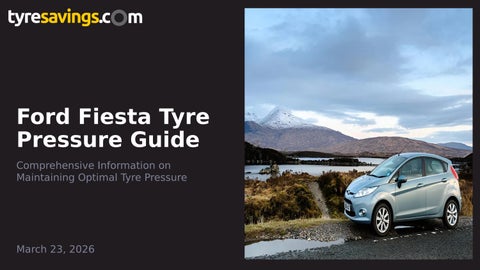

Ford Fiesta Tyre Pressure Guide
Comprehensive Information on Maintaining Optimal Tyre Pressure
March 23, 2026

Agenda
• Importance of Tyre Pressure
• Recommended Tyre Pressures
• How to Check Tyre Pressure
• Handling Low Pressure
• Handling High Pressure
• TPMS Overview
• Resetting TPMS Light
Importance of Correct Tyre Pressure



Enhanced Safety Improved Vehicle Performance
Correct tyre pressure reduces the risk of blowouts and accidents by ensuring optimal contact with the road surface, improving braking and handling.
Properly inflated tyres contribute to better fuel efficiency, smoother rides, and consistent tyre wear, enhancing overall driving experience.

Longer Tyre Lifespan
Maintaining the recommended pressure prevents uneven tyre wear and damage, helping your tyres last longer and saving replacement costs.
Recommended Tyre Pressures for Ford Fiesta
Automatic Transmission Pressures
For automatic Ford Fiesta models, tyre pressures range from 26 to 42 PSI based on tyre size and season type, with higher pressures recommended for full load conditions.
02 03 04 05
Manual Transmission Pressures
Manual transmission models have similar pressure ranges, typically between 26 and 41 PSI, adjusted for tyre size, season, and load, slightly lower on front tyres for winter types.
Pressure by Tyre Size
Seasonal Variations
Common tyre sizes include 195/60R15, 195/55R16, 205/45R17, and 205/40R18, each with specific front and rear pressure recommendations reflecting load and performance needs.
Winter tyres generally require slightly lower front tyre pressures compared to summer tyres, helping with grip and safety in cold conditions.
Load Conditions
Impact
Normal load pressures are lower, while full load pressures increase by up to 10 PSI to ensure tyre stability and vehicle safety when carrying heavier loads.
How to Check Tyre Pressure
Wait for Cold Tyres Remove Dust Cap & Place Gauge
Ensure your tyres are cold before checking pressure, as warm tyres increase pressure readings and give inaccurate results.
Take off the tyre valve dust cap and firmly press the tyre pressure gauge onto the valve to get a proper reading without air escaping.
Read & Adjust Pressure
Check the pressure reading on the gauge. Inflate or deflate the tyre as needed using a pump or by releasing air to reach the recommended PSI.
Check Spare Tyre
Don’t forget to check your spare tyre’s pressure regularly, as it naturally loses air over time and is crucial in emergencies.
• Tyres cooled down to ambient temperature
• Accurate baseline pressure readings
• Valve dust cap removed
• Tyre pressure gauge correctly positioned
• Pressure reading taken
• Tyre pressure adjusted to recommended level
• Spare tyre pressure checked
• Spare tyre ready for emergency use
Handling Low and High Tyre Pressure
If Tyre Pressure is Too Low
• Inspect the tyre for punctures or damage to determine if it is flat or leaking air.
• Use a nearby air pump station, commonly available at petrol stations, to inflate tyres to the recommended pressure.
• Regularly check the pressure using built-in gauges at air pumps to ensure accurate inflation.
• Always replace the valve cap after inflating to prevent dirt and moisture entry.
If Tyre Pressure is Too High
• Release excess air by pressing the valve pin in the tyre valve to reduce overinflation.
• Recheck the pressure gauge frequently during air release to avoid underinflation.
• Repeat the process until tyre pressure matches the recommended PSI for your Ford Fiesta.
• Leverage the car’s TPMS sensor to monitor tyre pressure and avoid overinflation risks.
What is TPMS?
TPMS stands for Tyre Pressure Monitoring System, designed to track the air pressure inside tyres and alert drivers when pressure falls outside safe limits, helping prevent accidents and tyre damage.
Types of TPMS
There are two main types: Direct TPMS uses pressure sensors inside each tyre to provide real-time pressure data; Indirect TPMS estimates tyre pressure by analyzing wheel speed sensors linked to the antilock brake system (ABS).
TPMS continuously monitors tyre pressure and displays alerts on the dashboard, allowing drivers to maintain optimal tyre pressure, improve safety, enhance tyre lifespan, and boost fuel efficiency.
Resetting the Tyre Pressure Warning Light
Reset on Central Screen Reset on Dashboard Screen
Drive to Recalibrate
Turn ignition on. Press Menu, go to Vehicle Settings, select Tyre Monitoring, hold OK until 'Tyre Monitor Reset' appears, then press OK to reset.
Use the jog wheel to access Settings, select Information, then Tyre Pressure. Choose reset and confirm with OK. Return to the main menu.
Drive the car at speeds above 20 MPH for a few minutes to allow the TPMS to recalibrate and show correct tyre pressure.
• Ignition on
• Menu > Vehicle Settings
• Select Tyre Monitoring
• Hold OK for reset
• Press OK to confirm
• Navigate to Settings
• Select Information
• Select Tyre Pressure
• Choose reset
• Confirm with OK
• Return to menu
• Drive over 20 MPH
• Allow TPMS recalibration
• Check tyre pressure display