tylers & bricklayers final
11/4/05
12:46 PM
Page 1
&
Tylers Bricklayers The Newsletter of the Worshipful Company of Tylers and Bricklayers
Report of the Master July 2005 Sandy Angus
ere we are at the height of summer
H
to Graham Bateman and Tim Llewellyn who
Company and a good Company website.
and already three quarters of my
have put a huge amount of work into making
I am confident about the latter two and
term as Master is over.
them such a success. We are going to have to
less so about the first given that the
I don’t think I ever fully understood how
consider how they are held in the future amidst
profitability of certain major companies has
much time a Master should devote to the affairs
the other industry awards which exist
dropped off a little bit during the last 12 months.
of the Company and also in representing the
throughout the country. Higher profile and
However, we will see what can be achieved if
Company at other City and Livery
largely to bolster our ability to
functions. With a heavy business
become more active and respected
and travel burden within the
on the craft side. With most of our
Montgomery business it has not
new intake of late coming from
been possible to attend as many
within the industry, I do believe that
lunches and dinners as I would have
might be achieved. It was a great pity
liked. The Clerk has been a tower of
that the Garden Party on Thursday 7
strength in running the business and
July in Manchester Square had to be
taking up the slack whenever I have
cancelled because of the events in
been away throughout my year and I
London. I hope that we will get a
know how lucky we are to have him.
good turnout for the September
Nevertheless, I believe I have man-
Court & Livery Dinner at Stationers
aged to attend the formal and very
Hall.
grand City functions with several
I am enormously grateful to my
trips to the Mansion House and
two previous Masters who have
Guildhall.
been hugely supportive and always
Even in the very hot
weather of the last week of June, I
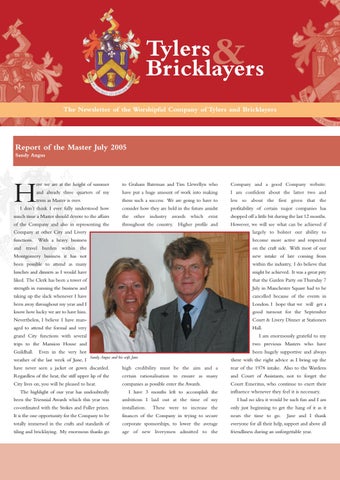
Sandy Angus and his wife Jane
there with the right advice as I bring up the
have never seen a jacket or gown discarded.
high credibility must be the aim and a
rear of the 1978 intake. Also to the Wardens
Regardless of the heat, the stiff upper lip of the
certain rationalisation to ensure as many
and Court of Assistants, not to forget the
City lives on, you will be pleased to hear.
companies as possible enter the Awards.
Court Emeritus, who continue to exert their influence whenever they feel it is necessary.
The highlight of our year has undoubtedly
I have 3 months left to accomplish the
been the Triennial Awards which this year was
ambitions I laid out at the time of my
co-ordinated with the Stokes and Fuller prizes.
installation.
It is the one opportunity for the Company to be
finances of the Company in trying to secure
nears the time to go.
totally immersed in the crafts and standards of
corporate sponsorships, to lower the average
everyone for all their help, support and above all
tiling and bricklaying. My enormous thanks go
age of new liverymen admitted to the
friendliness during an unforgettable year.
These were to increase the
I had no idea it would be such fun and I am only just beginning to get the hang of it as it Jane and I thank
tylers & bricklayers final
11/4/05
12:46 PM
Page 2
2005 Company Triennial Awards A report by Past Master Graham Bateman, Chairman of the Craft Committee
very 3 years in March our Company invites applications from the construction industry and our members to submit new and renovation building projects within the M25, for assessment and consideration for our prestigious bricklaying and tiling awards. The awards require a high degree of skill, not only by the craftsman but also by the vision from the architect to enhance the appearance of the building.To win the award we require every aspect and detail to be expertly completed and the same attention given throughout the project. The 2005 Triennial team was under the chairmanship of Liveryman Tim Llewellyn and consisted of Tim Walker, Andrew Stroud
E
and Graham Bateman as secretary. The applications were all initially inspected by teams of assessors from the construction members of the Livery and each led by the Chairman to ensure the continuity of assessment standards. The final assessment expert team was chaired by the eminent Architect, Richard Dixon together with the Triennial Chairman and experts from the three crafts. The Awards ceremony was presented by our Master, Sandy Angus at Painters Hall, Little Trinity, London on the afternoon of the 21st June 2005. All prize winning recipients received a framed certificate and in addition, the Architects and Foremen Craftsmen were awarded an engraved Company silver medal.
The winning projects are shown in the table below. Currently the representative trade crafts associations from our sectors of the construction industry are promoting their particular skills by organising annual U.K. regional competitions to identify the best workmanship and design to raise standards and encourage recruitment. The Tylers’ & Bricklayers’ Company has been approached to consider the possibility of future Triennial awards being used to select from their annual regional winners, to find the best national contract in each of our crafts to receive a premiere U.K. award. There will be much to consider and discuss!
2005 Triennial Awards Winners Bricklaying Project
The new Haberdashers Hall,West Smithfield, London.
Architects
Hopkins Architects.
Main Contractors
Holloway,White Allam Ltd.
Specialist Contractors
Swift Brickwork.
Foreman Bricklayer
Clive Day.
Ceramic Tiling Project
Borough London Underground Station, London SE1.
Architects
Ruddle Wilkinson.
Main Contractors
YJL infrastructure.
Specialist Contractors
W B Simpson & Sons.
Foreman Tiler
John Anderson.
Special Award in the ancient skill of brickwork tuck pointing Project
20/32 Baker Street, London.W1
Architects
Quinlan Francis Terry.
Main Contractors
Skanska Contractors UK Ltd.
Specialist Contractors
Bishop Development Ltd.
Foreman Bricklayer
Keith Beckwith.
tylers & bricklayers final
11/4/05
12:46 PM
Getting a Mayoral Life Liveryman Robert Piper
Page 3
"Sechselauten" (Six–bells) In Zurich Past Master John Martin very April Zurich comes to a standstill as the local Guilds celebrate their festival of "Six-bells". The schools close for the day, the trams stop for a while, and even the "gnomes" of Zurich have a bank holiday. Last year, I was privileged to join their celebrations as a guest of a Swiss friend. Our day started mid-morning as we gathered for drinks before lunch at their Guildhall.The meal lasted for about three hours as the Master and others gave their speeches. The Master delivered his annual report and ranged with great humour over many topics. His speech (by tradition) was three quarters of an hour long, and others also made planned contributions. The Master is appointed for a five-year stretch, and may do a second or even third term (unlike our own company with its annual rotation and "buggin’s turn"). During the meal, the teenage sons of the members act as wine waiters, giving them an introduction to the Guild. There are now 25 Guilds in the City. Instead of the "great twelve" they have the "great eleven" – Guilds which were established by 1336, with another 14 established after 1866. Unlike most of our own companies, the Guilds still wear their historic livery. Some costumes were of Robin Hood style, in green and brown, others had elements of armour and others were of knickerbockers and hose. As a visitor, I had to wear a cape and tricorn hat which the company provided for the day. At about 3 o’clock all the guild members assembled with bands, and carriages, and horsemen for a procession around the city.This is now a tourist attraction. My wife joined other ladies of our party on road-side seats to watch.The tradition is for the spectators to come armed with many bunches of flowers which are given to those
E
hen I retired my three daughters were worried about me getting under their mother's feet all day and instructed me to "Get a life". I had always been interested in local issues and therefore retiring on 30 April I joined the local town council on 1 May. Like everywhere else volunteers are welcomed with open arms and after serving an apprenticeship looking after the common, rugby pitches and the cemetery I was elected Mayor. Sevenoaks is one of the happiest towns in the country, partly because of the strength of its volunteer sector. It is my job to thank, on behalf of the residents, those volunteers who give up their time to work with Age Concern, Citizens Advice etc. Therefore I go to many AGMs - these are very important to the volunteers involved . There are also many visits to local schools. In the last week I have been to a talented version of Joseph put on by a primary school, been to a blind school's talent evening, visited a new school dealing with children with Aspergers Syndrome and met those local teenagers who visit old folks and run clubs for kids from single parent homes. At the same time there are visits to the local Playhouse Theatre to see Julian Lloyd Webber, garden parties with the High Sheriff of Kent and banquets at Penshurst Place. But the highlight has to be opening the Festival Fair in Sevenoaks High Street on the hottest day of the year, dressed in my finery. My face was as red as the gown I was wearing. Extraordinarily diverse and very different from going to the City every day! Yes, I think I have "Got a Life"!
W
in the procession.As we walked I was delighted to receive several bunches – and several kisses – from those I knew (and from some I didn’t!). The procession made its way to open ground beside the lake. A "snowman" of faggots had been built and at precisely six o’clock (when the six bells ring out from the clock) it was set alight.The stack of wood contained fireworks – which exploded and enlivened the bonfire. The climax comes when the head of the "snowman" is blown off by a charge of TNT. If this happens soon after the fire is lit (perhaps 10 minutes) it will be a good summer; if the head is slow to fall the summer will be poor. Next, we returned to the Hall for a two course dinner. Then at about 9 pm, whilst the Master and Wardens and oldest infirm members remained in their Halls, all the liverymen marched through the city, each with its own band and banner and flaming torches to call, in turn, at three rival companies. On arrival, we were welcomed with refreshment and thereafter there was an exchange of ‘abuse’ (with much humour) between the host and visitors. "Why do you bother coming here and disturbing my quiet evening?" "Why do you offer us this third rate wine? Can’t you afford something decent? Have you fallen on such hard times?" "Be off with you and return to that hovel you call a Guildhall". As midnight approached we were growing hungry, so returned to our own Hall for a hot sausage or two before breaking up. My friend and I and some others took our leave, whilst younger members all congregated at one of the Halls for what can best be described as fun and drinking games. What a day! – a three course lunch, a two course dinner and a one course supper; a mixture of a Lord Mayor’s Show and Bonfire Night; bouquets and kisses! And all the Swiss were back at their desks by seven next morning.
&
Tylers Bricklayers
tylers & bricklayers final
11/4/05
12:46 PM
Page 4
My Thyme Zoe Parris
O
n a warm day in May this year we
We continued on, passing oak temples, the two
with wild seed and covered in colour and
met
Coach
Princes’ holly inspired tree house, and tons of
drifts of bright blue camassia, butterflies and
Station at 10.15 am, complete
behind Victoria
old roots looking as if they had been dropped by
bees. That is until the Hebridean sheep arrive
with photo identification. Had they introduced
a giant but all carefully placed to form a
at the end of the summer to graze, and of
ID cards overnight? – no, the Master’s wife
Stumpery gushing with greenery, a wood
course to fertilize. Across the meadow is the
had warned us they were needed at our
nymph statue, terracotta and slate pots, an
Tulip Walk, either side of which are beautiful
destination. Piling on to a coach we set off for
extraordinary wall of sculpted pieces and gifts of
swathes of purple and scarlet tulips. As they
the 2005 Ladies Event.
stone and then on through a national collection
do not flower again, 10,000 bulbs are planted
of beech trees to a pale pink door.
each year for this spectacular show.
At 12 noon, as we bowled along the M4 motorway Jane, the Master’s wife
Inside this pink door is the one acre of
At the front of the house, the Aberdeen
produced bottles of wine, sandwiches and
walled vegetable garden, surrounded by the
Angus are grazing,Tetbury church can be seen
gorgeously stuffed pitta bread. At Tetbury, in
most beautiful 12 foot high old brick wall.
across the park, and lime trees line the long
Gloucestershire, we met up with the rest of
Being good Tylers’ and Bricklayers’ ladies we
drive. At the side of the house we pass the first
our party.
gardens to be created by the Prince,
At exactly the designated hour of
and find ourselves on the rear terrace,
1.30 pm we arrived at some impressive
at the other end of the thyme walk.
gates and were met by police who
Here is a lovely pool full of stones
checked all our identifications as well
with a fountain surrounded by beds
as the luggage compartment of the
filled with plants. We can see back
coach! A large sign identified that we
along the thyme walk to the fountain
were in a "Genetically Modified Free
where our walk started, the bronze
Area". We were in fact at Highgrove
statue and the dovecote. Here there is
House.
a raised azalea bed, a box bed, each
We were met by a guide, and so
plant a present for the Prince’s 50th
started the tour of His Royal
Birthday; he loves box.
Highness The Prince of Wales’ pride
We walk on past the swimming
and joy – his garden, started some 20
pool and along a meandering path took much interest in this, covered as it is by
through the glorious cottage garden passing a
We looked toward the House itself, a
roses and fruit trees and under planted with
seat, a present to the Prince and Princess of
surprisingly small lovely late eighteenth
herbaceous borders. The diagonal paths are
Wales on their wedding, and a circular bench
century house, along the thyme walk, with a
lined with box, arches of apples, arbours of
around a Sorbus tree, a present for the Prince’s
fountain in front of us and a dovecote behind,
roses and wisteria. In the middle of the garden
40th Birthday. All gifts whether statues,
hornbeam trees either side of the walk, all
is a fountain with a pond full of koi carp
pots, benches etc. are found a home in his
surrounded by eccentrically and architecturally
surrounded with crab apple trees above and
magnificent garden.
cut yew hedges and bushes.
herbs under foot.
years ago.
We turn a corner and alas our tour is
In the Woodland Garden, where once
Leaving, we crossed a Ha-Ha into the
complete. Tea, with a Duchy biscuit, is served
brambles, nettles and ivy covered the ground,
Arboretum and then passed through the
in the newly built Orchard Room, both very
now giant gunneras, ferns, mosses, giant
Spring Walk at the end of which is a beautiful
welcome before a visit to the Shop! Before the
hogweed, hollies, euphorbia and hellebores
bronze sculpture of four girls. Then there was
shop, however, are the plants. How can you
grow along meandering paths. The Prince has a
the Sanctuary, built to commemorate the
resist a plant raised at Highgrove? Hence, my
great love of hostas, which were everywhere
Millennium as a thanksgiving to God and the
thyme, that provides a beautiful and constant
growing to enormous sizes, with hardly an eaten
garden; a private place for contemplation.
reminder of a lovely day.
leaf. No slug or snail dare nestle here, they
The Arboretum leads into the Autumn walk
The day was quite extraordinarily wonderful
are all collected up and taken out! Don’t dare
towards the Wild Flower Meadow, said to be
and interesting and everyone who went
mention a slug pellet! It was explained that the
Highgrove’s crowning glory.
would want me to record their thanks to
whole garden is run completely organically with
Ancient oaks and chestnuts are dotted
manure from the farm and ‘the compost heap’.
around a vast open stretch of grassland, sown
the Master’s wife, Jane Angus, for her magnificent organisation.
tylers & bricklayers final
11/4/05
12:46 PM
Page 5
The Renter Warden Tom Hoffmann, LLB, FCA,
he current Renter Warden is Tom Hoffman. He is a law graduate of the University of Exeter, and a Fellow of the Institute of Chartered Accountants in England & Wales. His career has been in investment banking and international banking, as a corporate finance manager at Williams & Glyn’s Bank and at Hill Samuel & Co, as a director of the Capital Markets Division of Lloyds Bank International, as deputy managing director of Fuji International Finance, and for his last 13 years as UK General Manager of Banco Espirito Santo. In 2003 he retired to become more active in public life. Elected to the Court of Common Council in 2002 as a Common Councilman for Vintry Ward, he is currently a member of the City Lands & Bridge House Estates Committee, Planning & Transportation Committee, Libraries, Archives & Guildhall Art Gallery Committee, and the Livery Committee, having previously served on the Community Services Committee and the Markets Committee. Tom is a Committee Member (and
T
former Chairman) of the Vintry & Dowgate Wards’ Club, and Hon. Treasurer (and former Chairman) of the Cordwainer Ward Club. Outside the Corporation of London he is also significantly involved in the fields of education and music. He is a Member of the Council of Exeter University and Chairman of the Audit Committee, a Governor of Birkbeck College, London University and Member of the Finance Committee, Chairman of the Board of Governors of the City of London School for Girls, a Governor of Christ’s Hospital and Member of the Finance Committee, a Governor of the Guildhall School of Music & Drama, Chairman of the Advisory Board of The Sixteen Choir & Orchestra, Chairman of the Advisory Board of the London Festival Orchestra, and a Director of the City Arts Trust. In 2004 Tom was elected a Governor of King’s College Hospital, London, and in 2005 was appointed a Lay Member of the Research & Development Committee at King’s. He is also a Member of the Court of the Corporation of the Sons of the Clergy and a Trustee of the Friends of the Clergy Corporation.
Tom became a liveryman of the Tylers’ & Bricklayers’ Company in 1979, and since that date has immersed himself in guild history. His collection of books on the guilds numbers over 1,000. and, for the past 25 years, he has been compiling a Bibliography on the Guilds of England, Scotland, Ireland and Wales. He has published Papers on the guilds outside London, notably on the Butchers, the Drapers, the Tallow Chandlers, and the Vintners, and in 2004 he was elected a Member of the Guildhall Historical Association. Within the Tylers’ & Bricklayers’ Company Tom is a longstanding member of the Wine Committee, and in 2000 was appointed Chairman of a Financial Strategic Review Committee. One of many recommendations resulting from that review was the establishment of Finance Committee of which Tom is a member. He is a Fellow of the Royal Society of Arts, the Royal Commonwealth Society, and the Royal Society for Asian Affairs, and is a Member of the City Livery Club, and Leander Club. He and his wife Verena live in Biddenden in Kent, and they have a married son.
Frederick John Briggs (1923-2004) Joined the Company in 1954 Master of the Company 1982-83
J
ohn was a man for all seasons. He loved his country; he loved people and had the knack of being able to bring out the best in them – he could see their strengths and their weaknesses and accept them both. An unpretentious man with a strong sense of fun and humour; a generous host and in his wide range of activities he always had great energy and enthusiasm. In business John was an entrepreneur and an innovator. His business life was in companies both numerous and diverse. In these his integrity, drive and enthusiasm prevailed. He became a legend in the field of packaging and marketing, holding senior posts of a professional, commercial and institutional
nature both at home and overseas. During the war John served in the Royal Air Force as a pilot in 225 Squadron Army CoOperation 1942-1946. After going up through Italy into Southern France the war ended and he was transferred to Kenya as C.O. of the Met. Flight based in Nairobi, Kenya with detachments all over East Africa. He thoroughly enjoyed his time there, with his own Spitfire, wildlife to see and a really good social life. John loved sport, especially playing cricket and was a member of the M.C.C. and Middlesex Cricket Club. He would not let you forget the time he caught out Dennis Compton. Football was a keen interest and being present at England’s
World Cup win in 1966 was a highlight for him. Subsequently for some years he was a Director of Reading Football Club. John’s family were a source of great pride and pleasure to him including his sons, daughter-in-law and grandchildren. His wife Margaret, to whom he was married for 55 years, has most generously donated John’s Past-Master’s medal to the Company to add to the collection we are building to keep alive the names of those who have served the Company so well. This medal was previously worn by Margaret’s father, Major Percy Libbis Smout M.C. who was Master of Tylers & Bricklayers 1944-1945. The family connection with Tylers & Bricklayers is being carried on by John’s son Norman who is a Liveryman.
&
Tylers Bricklayers
tylers & bricklayers final
11/4/05
12:47 PM
Page 6
Some Reflections from the Organ Loft on playing at Livery Company Services or A Short History of Musical Deceptions! Richard Townend
I n July 2005, Richard Townend, Organist at our Church, St. Margaret Lothbury, was made an Honorary Freeman of our Company. This was in recognition of his musical contribution to our Installation and Carol Services at the Church. Here he reflects on his experiences playing for the many Livery companies that use St Margaret Lothbury. n the course of a year I have the great pleasure of playing over twenty Livery services at St Margaret Lothbury and other city churches. It provides me with much enjoyment and quite a few funny stories! I remember on one occasion being asked at the very last moment to hasten to a city church to play for a colleague who had inadvertently been double booked. On arrival I found all the choir music had been entrusted to the Rector (who had not arrived) and the final voluntary was to be Mullet’s Carillon Sortie - a well known nineteenth century French piece written for a large four manual organ with a grand pedal tune for Trombone. I, however, was confronted with a very small one manual, no pedal, six stop Snetzler chamber organ from the eighteenth century, beautifully restored but quite inadequate for the Master’s choice of Sortie! What to do? Five minutes before the service the Rector appeared with a plastic carrier bag containing all the music including the much requested organ voluntary. The solution was rehearsed during the inspiring sermon - the choir would sing the big pedal tune while I made an impression of the manual parts. Mullet might well have been surprised, or even offended, by the result but the performance was met with applause and a few days later a letter of great appreciation from the Master. On another occasion a Master telephoned to arrange a meeting to choose the music for his Installation service and enquired whether we might sing a piece by his father who had been a military musician and thus been required to compose many pièce d’occasion. Of course I agreed but imagine my horror when he arrived at St Margaret with two enormous old suitcases full of his father’s compositions so large they could not be brought up the spiral staircase but had to be pulled on a rope over the edge of the organ gallery. The result was a
splendid service in which every piece - organ voluntaries, hymn tunes, anthems - had been composed by the famous father (although some had had to be reworked silently to make them performable). The Master was delighted, the choir was amazed and the congregation
I
(knowing not a single hymn tune) silent. But a more recent Master trumped even that by writing the anthem himself. This proved quite a challenge for he had had little musical training and the resulting manuscript was really, shall we say, perplexing! A lot of silent reworking had to take place to provide a performance which went down very successfully. At the following dinner the Master was overjoyed with his masterpiece - receiving many compliments on his skill as a composer - and, happily, seemed quite unaware of how his anthem had been restored. Some Masters have provided us with the opportunity for a little light musical jokery. In your own Company I remember when a Dove was Master being unable to resist performing for the anthem Mendelssohn's famous "O for the wings of a Dove", and when a Fuller was Master the outgoing voluntary was a French style toccata with, for the big pedal tune, "Drink, drink...." from the Student Prince, and when a certain Mr Peck was Clerk one voluntary was a similar toccata on the tune Polly put the kettle on. These pieces appear in
the service papers as "Toccata Francesca" by a curious, little known composer, Fin de Ville. The choir always look forward to these musical bonbons and were well amused on one occasion when a Master ascended to the organ gallery and asked if he could buy a copy of the Toccata he had so much enjoyed! Seeing no music copy on the organ desk he asked if I had played it by heart. "Oh yes", I replied, "so very necessary with such a difficult piece!" One Master was a keen singer and suggested that he might sing a solo at the Company carol service. His clerk was not so enthusiastic but a solution was easily found. We performed We three kings of orient are with the Master taking the part of Casphar, the luckless clerk that of Melchior and a junior Freeman that of Balthazar. The result was a splendid success but the following Master, quite unaccountably, refused my offer that he should continue the tradition. Some Masters defer the choice of music to their wives. Thus on one superbly comic occasion, when the Lady had decided that all the music for the Installation service should be the same as they had had at their wedding many years before, the Master walked in to "Here comes the bride" and out to "The Arrival of the Queen of Sheba". Which all goes to prove the point that there is never a dull moment in a Livery service for the organist or the choir! Richard Townend with the assistance of Monsieur Fin de Ville.
The Worshipful Company of Tylers’ and Bricklayers’ Newsletter is sponsored by The Kier Group
tylers & bricklayers final
11/4/05
12:47 PM
Page 7
Aid mission to Ukraine Andrew Stroud
n July 2004, Liveryman Andrew Stroud was one of thirty members of Holy Trinity – parish church of Claygate in Surrey who took part in a pioneering ‘working holiday’ mission to severely deprived agricultural communities in Transcarpathian Ukraine. Its purpose was to enable church members to undertake, on a short-term basis, the sort of aid and outreach mission to needy parts of the world increasingly carried out by their children - or grandchildren! The nine-day mission involved providing a range of medical and dental services, a ‘summer school’ for children and support to the ministers of the local churches in their outreach work. For the 2005 mission, in which Andrew again took part, numbers had grown to 36. "The three villages we stayed in are in a region (now bordered by Hungary, Romania and the Carpathian Mountains) which was successively part of Hungary, Czechoslovakia, Nazi Germany and Russia until Ukraine’s independence in 1991." explained Andrew, "It suffered appallingly during WW II and today struggles to survive on subsistence agriculture and with virtually no employment." "Most villagers own chickens, a pig and a cow and a few a horse to pull farm equipment – tractors are very rare. On their small plots they grow fruit and vegetables for sale and their own consumption; their homes are generally basic, with water from a well and a primitive outside lavatory. Many are desperately poor because of ill-health, injury, bereavement or alcoholism. Some homes have television and a very few a dilapidated car, but this is a peasant
I
economy. There is mains natural gas, but the cost of connection - at least six months’ income – is well beyond the means of all but a handful." "Yet, despite their straitened circumstances," Andrew said, "more residents of the three villages extended invitations for us to stay in their homes than the total number of UK team members plus a further thirty from Hungary and Ukraine - mainly medical- and teaching- students who joined us as interpreters." The villagers have little access to doctors
and cannot afford medicines.This year’s expanded medical team saw well over 450 patients and dispensed over 250 prescriptions (and made provision for continued supply of medication, where needed) and many pairs of spectacles. Initially last year, there were hardly any patients for dental work. But, when word spread that, unlike their Ukrainian counterparts, the English dentists used anaesthetics, their popularity soared. They extracted 233 teeth from 186 patients and one woman was so pleased with having four teeth removed that she returned the next day to have another four out! This year, the dentists were also able to carry out fillings thanks to equipment donated by a UK Primary Care Trust (just a part of the 1.2 tonnes of supplies which went out in advance by road!). The six-day long summer school attracted an enthusiastic daily
attendance of over 170 children aged from 7 to 17 for English, crafts, bible-study and sports. Six new lavatories and septic tank, a wash-room and shower - all served by newly-installed running water - funded by donations from Claygate church members, were completed in the school buildings just before our arrival this year. Replacing two indescribable ‘earth closets’, they are a permanent legacy of the link between the English and Ukrainian villages. Outreach activities included home visits to the old and infirm, film shows, social evenings (complete with English tea and fruitcake!) and a coach outing to the Carpathian foothills for villagers, many of whom had never been more than a few kilometres from their homes. "Our first two working holidays have achieved far more than simply giving the villagers a week of medical, educational and spiritual support." Andrew observes, "It has made them aware that there are people in distant, wealthy England who actually think and care about them. We, in turn, were humbled by the selfless hospitality of our hosts and those whom we visited in the very poorest homes and by the gifts which they showered on us when we left. Though materially impoverished, they demonstrated a richness of spirit which we from the materialistic ‘western world’ can only envy. If fellow members of the Livery ever have a similar opportunity, I urge them to take it – if only to see their own lives in a better perspective."
&
Tylers Bricklayers
tylers & bricklayers final
11/4/05
12:47 PM
Page 8
The retirement of a master Past Master John Martin
E
Finance It may not be widely known that in the Tylers and Bricklayers, the Master is personally responsible for any overspend in his budget for functions. Total receipts for functions in his year must fully cover the cost of all the events. If the Master wants some extra touch to heighten his dinner and it is not covered by the ticket price, then he pays for it himself. For example, in my own year I decided to have a Piper in Highland Dress to welcome guests at the door and
lead us into dinner.This was an embellishment that I was pleased to provide. Only after his year has ended will an outgoing Master know the final balance and whether a cheque is due from him. (He does not receive any refund if income has exceeded the costs! Any surplus is to the benefit of the Company). Archive The Company requires every Master to compile an archive of his year. Usually two copies are made – one he retains and the other passes via The Clerk to Guildhall Library which, in theory at least, has records detailing the life of the Company over many centuries. The Master is well advised to keep two copies of every menu, programme and significant photograph for this collection. In this task, the Master is ably assisted by the Company’s honorary Archivist, Liveryman David Cole-Adams who knows what is required, advises on the script and, at the end of the exercise, can arrange for loose pages to be bound in covers bearing the Company’s name and crest. Deputy Master The Company’s Standing Orders wisely make provision for the business of the Company to continue if the Master is unwell or prevented for some other reason from leading the Court or some other function by calling upon either of the two immediate past masters to take the chair. Happily during the last two years the Masters who followed me have survived the pressures of office and I have not been called upon to deputise for them. Only in the event of the death of an incumbent Master does an election take place, which may either promote someone below the Chair, or make the appointment from the ranks of those who have already served as Master.
A Gift to the Company Although it is not mandatory, many Masters choose to make a gift to the Company to mark their year of Office. In this way the Company has a worthy collection of silver such as rose bowls, loving cups, goblets and plate which are used for its banquets during the year. Others may make a donation to one or other of the Company’s Charities so that others may benefit. Such gifts have enriched the funds that pay for the craft awards to apprentices and others in our industries and continue to provide support to scholars at the Guildhall School of Music and Drama and some of the City’s schools. In my own case, I identified that the Company gave no special support to the St Paul’s Cathedral school. The school educates boy choristers who sing at the cathedral, and also non-singing boys and girls. Accordingly, my wife and I have donated a capital sum to the General Charity which is being used partly to provide five prizes annually and also a silver cup engraved with the Company’s name and crest.These will be given for "school citizenship" at the speech day every summer. I am most grateful to Past Master Nicolas Carter who is the Chairman of our Charities’ Committee for his help in setting this up. Future Involvement on the Court Our Charter states that the Court shall be a minimum of eighteen but makes no statement about its maximum size.Two years ago, the Court decided to limit the number to a maximum of 21 (plus the Father of the Company).Typically there would be ten members below the Chair and ten Past Masters. All of us therefore who have relinquished Office can look forward to a decade of future service on the Court before moving to the honourable ranks of the Court Assistants Emeritus.
Recently welcomed Freemen and Members elected to the Livery Company Freeman
Liveryman
Background
Natasha Mary NICHOLSON
10.12.04
Michael Stuart DRIVER
10.12.04
Partner at Charlick Nicholson Architects
Joseph William Norman PETTY
07.07.05
Raymond James HORWOOD
07.07.05
Peter Michael PANTLIN
17.03.05
Stephen John TROTT
07.09.05
Wendy Jane TROTT
07.09.05
Director at Hanson Building Products Ltd/Accountant
Keith SHANKLAND
07.09.05
Operations Director Hanson Building Products
Director of the Brick Development Association 22.09.05
Retired Partner and Solicitor
07.07.05
Partner at Public Relations Firm
Chief Executive of NFRC/retired Air Commodore Contracts Manager Charles Church Developments
Clive MATHEWS
22.09.05
Michael Peter CAWSTON
07.07.05
Chairman/CEO Taylor Maxwell Holdings Ltd
Melvyn NEWELL
07.09.05
Quantity Surveyor - Own Practice
Richard TOWNEND
07.07.05
Musical Director - Lothbury Singers
Craig Richard MANNING
22.09.05
Works Manager - Hanson Building Products
22.09.05
Civilian Property Officer/City of London Police
&
Tylers Bricklayers
Designed & produced by D.A. Marketing & Communications Ltd 020 7608 1155
very October at the Installation Court the incumbent Master hands his Chain of Office to his successor (the Upper Warden) and receives in return a Past Master’s Badge. At that moment life changes.The new Past Master leaves the top table and sits in the body of the Court. The spotlight (rightly) swings from him to the New Master; he will no longer wear a gown; he will no longer receive guests but himself be received; no longer will his health be toasted but for the next two years he will be one of the two Deputy Masters who will be called upon to run the Company if the Master is unwell. So how does a Past Master fill his time? The Upper Warden has asked me to write about my own experience almost two years ago. On returning home after the installation of the new Master, my thank-you letters are soon written and posted.And then I noticed that my post shrank to a dribble, the telephone rarely rang and my fax machine became redundant. It was as though a bereavement had occurred. But all immediate Past Masters have two duties which they must undertake. One is the accounts for his year and the other is to complete his archive