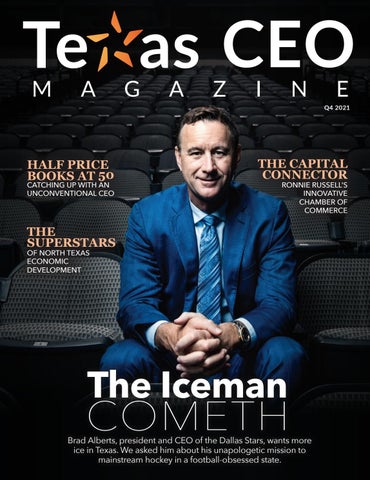
Q4 2021
HALF PRICE BOOKS AT 50
CATCHING UP WITH AN UNCONVENTIONAL CEO
THE CAPITAL CONNECTOR
RONNIE RUSSELL’S INNOVATIVE CHAMBER OF COMMERCE
THE SUPERSTARS OF NORTH TEXAS ECONOMIC DEVELOPMENT
The Iceman
COMETH
Brad Alberts, president and CEO of the Dallas Stars, wants more ice in Texas. We asked him about his unapologetic mission to mainstream hockey in a football-obsessed state.
RESILIENCE
is
REWARDING
OUR POLICYHOLDERS STAYED FOCUSED ON SAFETY AND EARNED $330 MILLION IN DIVIDENDS.
Employers faced unprecedented challenges in 2020. The obstacles were steep, but you adapted, stayed strong and stayed committed to keeping your workers safe. And we were proud to reward that commitment with a $330 million dividend payout this year. It’s our way of helping your business — and Texas — keep moving confidently into a brighter tomorrow. For more on how our dividend program is changing the way workers’ comp works for you, go to texasmutual.com/rewarding.
Dividends are based on performance, are not guaranteed and must comply with Texas Department of Insurance regulations. © 2 021 Texas Mutual Insurance Company
Let’s grow your strategy your cash flow your earnings your reach something together.
Bringing more to banking. www.texascapitalbank.com Texas Capital Bank Member FDIC NASDAQ ®:TCBI
FEATURES
8 HALF PRICE
Q4 2021 Publisher Donna Bragg
BOOKS AT 50
Editor Aaron Hierholzer
A Conversation with Sharon Anderson Wright, CEO of Half Price Books
Operations Tamara Trammell VP of Sales Whitney Bilyeu Graphic Design Michele Rodriguez Contributors
16 THE CAPITAL
CONNECTOR
40 COLLABORATIVE
A Conversation with Ronnie Russell, CEO of the Innovation Black Chamber of Commerce
62 STOP BEING SURPRISED!
A Conversation with Scott Harper, CEO of Dialexa
84 THE STRUCTURED CHAOS OF TEKREVOL A Conversation with Ryan Shirzadi, Partner and Cofounder of Tekrevol 4
Texas CEO Magazine Q4 2021
To subscribe to the print or digital edition of Texas CEO Magazine, please visit our website: www.texasceomagazine.com and click subscribe. POSTMASTER Please send address changes to: The American CEO, LLC dba Texas CEO Magazine 8012 Bee Caves Road Austin, TX 78746 © 2021 The American CEO, LLC dba Texas CEO Magazine. All rights reserved. The Content in this issue may not be reproduced, distributed, or otherwise used without the prior written consent of the American CEO, LLC. The various contributors own their respective Content that is published in this magazine.
COMPETITORS
Meet the Women Fostering the Explosive Growth of North Texas
Wade H. Allen Gordon Daugherty Charles Denyer Jason Dorsey James F. O’Gara Jan Ryan Alicia Thrasher Joel Trammell Justin Yancy
The beliefs, content, comments, opinions, statements and viewpoints (collectively, the “Content”) published in this issue are those of the respective contributors and we do not necessarily agree, endorse, support or verify such Content. The Content presented in this issue is for informational purposes only and is not advice of any kind. Your use of the Content is at your own risk. The Content is provided on an “AS IS” basis, without any warranties of any kind, either express or implied. Neither The American CEO, LLC nor any person associated with us makes any warranty or representation with respect to the completeness, reliability, quality, or accuracy of the Content. Without limiting the foregoing, The American CEO, LLC does not represent or warrant that the Content will be accurate, reliable, error-free, that errors will be corrected, or that the Content will otherwise meet your needs or expectations. The American CEO, LLC disclaims all warranties of any kind, whether express or implied, statutory or otherwise, including but not limited to any warranties of merchantability, non-infringement and fitness for particular purpose. The foregoing does not affect any warranties which cannot be excluded or limited under applicable law.
INSIDE 7
LETTER FROM THE CEO + PUBLISHER Donna Bragg
15
NEW BUSINESS BOOKS YOU DON’T WANT TO MISS THIS WINTER
21
THE ICEMAN COMETH
HOW THE DALLAS STARS’ BRAD ALBERTS IS MAKING HOCKEY BIG BUSINESS IN BLAZING-HOT TEXAS Donna Bragg
26
RETURNING TO THE OFFICE:
BLIND SPOTS AND EPIPHANIES Jan Ryan
32
THINGS ARE GOING GREAT? TIME FOR A CRISIS. Gordon Daugherty
36
THE ECONOMIC CASE FOR DREAMERS Justin Yancy
56
THE RISING GEN Z WORKFORCE EXPECTS YOU TO HAVE A SOCIAL CAUSE. IS IT WORTH THE EFFORT? Jason Dorsey
70
HIRING EXECUTIVES IN A HOT TALENT MARKET Wade H. Allen
73
A TEXAS CEO’S GUIDE TO PRIVACY & SECURITY BEST PRACTICES FOR THE REMOTE WORKFORCE
32
Charles Denyer
80
HOW TO HAVE THE DIFFICULT CONVERSATIONS MOST LEADERS HATE Alicia Thrasher
90
AN INNOVATIVE APPROACH TO SHARING REAL CUSTOMER SUCCESS STORIES
James F. O’Gara
94
NOW IS THE TIME TO WRITE YOUR 1-PAGE STRATEGIC PLAN
73
Joel Trammell
36 TexasCEOMagazine.com
5
For data-driven critical thinkers who are fed up with the opinion and bias of today’s news media. Get unvarnished, concise facts and knowledge about current events.
Subscribe Today www.citable.com
Use coupon code 21TEXASCEO to receive 50% off your subscription order.
We are reengineering the news.
Photo by Meredith Melody-Photography
Letter from the CEO + PUBLISHER In September, I had the distinct pleasure of joining my son for an incredible 10-course chef’s tasting menu at the award-winning Uchi in Dallas. It was a delicious way to celebrate his birthday and to cap off the end of an eventful week. That morning, I had met and interviewed Dallas Stars CEO Brad Alberts at the team’s headquarters and practice facility in Frisco. The day before, I was delighted to join the Women Presidents’ Organization for a meeting in downtown Austin. And the day before that, I had a late lunch in Westlake with two powerhouse Texas women whose fast friendships I hope to nurture. Such has been my life since joining the team at Texas CEO Magazine in June. I’ve been blessed to have reconnected with former friends from Humble High School and SMU, met or interviewed 26 CEOs and leaders (at last count), and been leadership certified by MGR360 at the beautiful Texas CEO Ranch in Smithville. I’ve learned a lot about publishing so far—about paper shortages, printing schedules, poly-bagging, bartering, the dangers of hasty communication and the art of negotiating deals, but those are just mechanics. What has really touched me are the lessons I’ve gained from the seemingly endless generosity of so many impressive Texas leaders who have been willing to share with me their hard-earned wisdom, advice, and connections. Almost every day, I am reminded of how much I love our big, bold state and her big, bold makers and doers. Looking back on my life, as many of us do during autumn, I see that I’ve been fascinated by the subject of leadership since I was a child. I just didn’t know that’s what it was at the time. My grandfather, Poppie, repeatedly shared his life mantras, which my entire family still can recite by heart. One of them was “When you need advice, go ask the person who is the very best at what it is you’re trying to do. Successful people are flattered when you ask them, and most of the time, they’ll help you.” How little I knew then how much I’d use that lesson now!
From the outside, good leadership seems simple. It’s the stuff I learned from Poppie as a kid. Look people in the eye, treat them well, have integrity, be able to communicate, surround yourself with supporters, and so on. But it’s more complex when you’re sitting in the CEO seat. How do others do it better? What can you learn from their experience to improve your leadership? In this last edition of 2021, we asked those who are the best at doing what they do. And guess what? They were more than happy to help! I hope you’ll gain insight from each leader who has shared his or her challenges, successes, paths, and methods in these pages. Brad Alberts talks about inclusion, patience, and the swagger required to sell ice in Texas. Several powerhouse economic developers (all of whom just happen to be women) discuss how they’re successfully selling North Texas to the rest of the world. Scott Harper, a fellow SMU grad and CEO of Dialexa, discusses the critical importance of good internal culture and of understanding the digital product landscape, especially as it relates to your competitors. The hippie-cool CEO of Half Price Books reveals a challenge she has never before discussed in public. And so much more. As always, we hope you are enlightened, entertained, and enriched by our efforts. Please share your feedback, and don’t hesitate to visit us at TexasCEOMagazine.com to sign up for our newsletter, get your print subscription, or check out our podcast. I’ll leave you with a fitting quote for this glorious Texas autumn: “When I die, I may not go to Heaven. I don’t know if they let cowboys in. If they don’t, just let me go to Texas, boys. ’Cause Texas is as close as I’ve been.” —Tanya Tucker Blessings, Donna Bragg
CEO & Publisher Texas CEO Magazine
Learn more about Donna and the rest of the team online at TexasCEOMagazine.com/about.
TexasCEOMagazine.com
7
8
Texas CEO Magazine Q4 2021
Feature
HALF PRICE BOOKS AT 50
Catching Up with Sharon Anderson Wright, the Unconventional CEO of Texas’ Legendary Bookstore Chain
The original Half Price Books store on Lovers Lane in Dallas, opened in 1972 TexasCEOMagazine.com
9
July 2022 will mark 50 years in business for Half Price Books, the Dallas-based seller of new and used media treasures. Since its origin as a collection of 2,000 books sold from a converted laundromat in North Dallas, the company has grown into 124 locations in nearly half the states in the nation. Half Price Books’ current CEO, Sharon Anderson Wright, has been at the helm since the mid-1990s, when she took over for her mother, Pat Anderson, who founded the company with her boyfriend, Ken Gjemre. But Wright has worked in the family business much longer than that—since she was 13, to be exact. After high school, Wright went straight to work at the company’s eighth store, in Richardson. She took great pride in setting the shop up herself. “My dog and I were the only employees,” she says, before reminiscing on the psychedelic mural she painted on the wall of the store. It depicted strains of music flowing from a castle and into the ear of a tree. If that sounds pretty free-spirited, you’re not far off. “My mom and her boyfriend were old hippies,” Wright says. “They started the company to keep books out of the landfill, to save trees, to spread literature.” The vision for Half Price Books was a departure from the stuffy, sophisticated vibe of some other bookstores, which seemed geared more toward the intelligentsia. “Ken and Pat wanted to create a casual experience,” Wright explains. “We’re everybody’s bookstore.” 10
Texas CEO Magazine Q4 2021
Casual is a great word for Half Price Books and for its unconventional CEO. The stores themselves, typically staffed by friendly, down-to-earth bibliophiles and music lovers, are neat but not too well organized, the perfect setup for serendipitous finds. Wright herself, meanwhile, shows few traits of your stereotypical corporate leader. She dislikes running meetings. She’d much rather go to dinner and talk in a more relaxed atmosphere. And she’s not the type to wax eloquent about leadership or spout inspirational business quotes. “I don’t really hang out with CEOs that much. Or if I do, they don’t really act like CEOs,” she notes. She is, as they say, a bit of a character. (Oh—and she runs an eco-friendly hardware store and cultivates milkweed in her spare time.) Wright recently spoke to me from her office in Half Price Books’ flagship store on Northwest Highway in Dallas. What follows is an edited version of our conversation, which ranged from Half Price Books’ transformative COVID experience to the ironic characteristic you might not guess about the CEO of Texas’ largest independent bookstore chain. —Donna Bragg
Feature How would you define the ethos of Half Price Books? What makes it special?
We’ve always wanted to do the right thing. From the beginning, we’ve supported the environment and literacy. We share our profits. We try to give the best benefits we can. We measure everything we do against our list of core values. We may not hit it all the time, but it’s what we strive for. If we seem to be going off on a crazy tangent, we look back at the core values and decide, “Is this really where we want to go?” Did you always want to be in the book business? I sort of fell into it. I started
shelving books here when I was 13. I always loved retail, though. I always loved playing store. I’m dyslexic, so I was a terrible reader. Books always scared me, so it’s ironic that I’m CEO of the largest independent bookstore chain in the country. But I love to read, love the smell, the feel, the art, the history of books, even if reading is a challenge. You’re the first person I’ve told that to in an interview. I’m playing junior psychologist here, but it sounds to me like you’re the type of woman who embraces a challenge. Always.
to start cultivating milkweed there several years ago to feed monarch caterpillars. We had a woman from the monarch conservancy come out there this year and harvest it. She said it was the best crop she’d ever seen. Have you ever suggested that your team read a particular book? No. No. They’re way smarter than me.
They keep telling me to read certain books. What is your vision for the future of the company? I’m very opportunistic. I’m
I’M DYSLEXIC, SO I WAS A TERRIBLE READER. BOOKS ALWAYS SCARED ME, SO IT’S IRONIC THAT I’M CEO OF THE LARGEST INDEPENDENT BOOKSTORE CHAIN IN THE COUNTRY.
If you challenge me, I’m going to do it. When you walk into a bookstore, what section do you go to first? Nostalgia and rare books. I don’t collect much now because my house is full. I don’t want to end up on Hoarders. It’s actually funny—on one of the episodes of Hoarders filmed in Chicago, you can see Half Price Books bags in the stacks of stuff! I don’t collect anymore unless it’s something really cool or really old. I like to save old things. Back in my own little store, I’d save the colored plates from books that were falling apart and mount them. Some of the trashiest, ugliest little books are the most valuable. I’m always looking for that rare first edition that looks like nothing at first. Do you have a favorite book or author? I think my favorite author is Barbara Kingsolver. I can get all the way through her books. One of hers that influenced my personal life was Flight Behavior. It’s about the monarch migration and how they’re all dying off. We have a pasture out in Sachse [northeast of Dallas], and that book inspired me
open for anything. I’m protective of the company like a mama bear. Right now, we’re spending some money on getting our technology up to speed. We’ve gotten to where we can do curbside shopping and ship to store. In the old days we didn’t have any idea what books we had in the stores. We’d just tell people they needed to come in and look, which was a brilliant strategy because they’d always buy something. Are these new changes due to COVID?
Many are. We learned so much through COVID. It was scary and tragic but also very exciting. We went down to a limited number of employees and shut every single store down on March 17, which is sad because Saint Patrick’s Day used to be one of our family’s favorite holidays. Then people just rallied. We turned the stores into distribution centers so that two people at a time could go in and fill online orders. People made homemade signs. Our team scrambled so that people could shop individual stores online and then pick up curbside. We learned to do things we never knew how to do before. We got a whole lot leaner and quicker. We cut way back on travel and advertising. Our expenses went down to pretty much nothing for a while. We turned it around, didn’t borrow any money, didn’t close any stores, so I think we’re doing okay. We just purchased a 97,000-square-foot warehouse in Carrollton to house our online sales. We’re very optimistic about that. We’re getting more books into our 124 buying stations than we’ll ever fit in the stores, so we’re working on HPB.com. We pieced the old website together as we went, so we’re looking to improve the shopping experience. TexasCEOMagazine.com
11
What is it like competing with big industry players like Amazon and Barnes & Noble? We try to make each of
our stores a destination, a place to hang out. Lots of people want to go out somewhere that’s not a bar or a shopping mall. They just want to browse, quietly peruse stuff, find funny, interesting things with friends. People still like physical media too—they just use physical and digital media for different things. When you want to sit down and read a book, it’s nicer to be able to turn a page than swipe a screen and have light glaring in your face. You don’t have to charge a book. You can take it places. Or as a friend of mine does, you can leave it on your seat so no one takes your chair. What was it like taking over leadership of the company from your mother? I had some cred
How would you say you differ from the typical CEO? I don’t
follow rules simply because they are rules. I follow all the legal rules of course, but I don’t think I act like a normal CEO. I’m very involved with the crew. I like hanging out with the people we work with. I don’t stand up in front of the team and do the Steve Jobs thing, walking Texas CEO Magazine Q4 2021
Who or what has been the biggest influence on your leadership style? My
WE TRY TO MAKE EACH OF OUR STORES A DESTINATION, A PLACE TO HANG OUT. LOTS OF PEOPLE WANT TO GO OUT SOMEWHERE THAT’S NOT A BAR OR A SHOPPING MALL.
because I started as a kid and had done everything from shelving to district store management. My mom was in failing health for several years, and it was just apparent that I was always there. Since the start, I’ve had people surrounding me who help me do better. There are several employees who have been here for 40, 45 years. They wanted the company to succeed and they wanted it to remain a family company. I still have several of those people beside me today. Kathy Doyle Thomas, our chief strategy officer, has been here forever. If I think of some crazy or impetuous idea, Kathy will make it happen. Jan Cornelius is our VP of operations, and he’s been here since the beginning. He’s always been a guide and mentor. He can read my face when I’m thinking something specific. There are several people here who aren’t afraid to tell me when I’m wrong. We have brought up a bunch of wonderful people as we go. We have brought in a few marketing and accounting people from outside, but most everybody else in the company has come up through the ranks.
12
around in a black turtleneck. I try to treat everybody equally, no matter where they are, what they’re doing, taking out the trash or running a company. I used to be real nervous about trying to impress people, but it occurred to me that pretty much everybody is the same, CEOs included, so I’m not dazzled that often.
mother was great. I’m doing it the same way she did. She was casual too. She worked with everybody. She was the type to say what came to her mind. Sometimes I had to straighten things out when she left the room. What are the advantages to being headquartered in Texas? Well, I will
say that I hope people don’t start boycotting us because of recent political events in Texas. But there’s a lot of industry moving to the Dallas area, a lot of smart people and money. My strategy was to buy everything that we would need in the future, so we own our main store and corporate offices, which house the Dallas distribution center. We own our central distribution center near Oak Cliff. And then we own our Woodshoppe, where we make all our own fixtures. If you own something, you can always turn it into an asset. We’re set here in Dallas. Dallas is also centrally located. It’s got a good airport. We run a remainder business as well [Texas Bookman], and we’re going to start hosting the Texas Remainder Expo—T-Rex we call it—in 2022 at our new warehouse. I went down that path because it’s right by the airport. People can get in easily from all over the world.
You mentioned you own your own woodshop and make your own fixtures. That’s pretty cool. We wanted our fixtures a
particular way. We use environmentally sensitive, waterbased stains and everything. We make picture frames and wooden crates so people can carry their books or albums. During the pandemic, the Woodshoppe got very creative. They’re making chess sets and beer holders and Kube—this wonderful baton-throwing game that became popular with a lot of our Midwestern employees. You’ve had other entrepreneurial ventures in your career, right? There was this wonderful little hardware store
Feature down the street that was struggling. My daughter and I liked the owner and I ended up buying it from her. I’ve always loved hardware. My dad was a hardware salesman. There’s not that many seven-year-olds with their own bench grinder, but I had one. We changed the name to Rooster Home and Hardware, and we sell live chickens, organic gardening supplies, local foods. People really discovered us during the pandemic. We won awards in D Magazine, Nextdoor, The Advocate. It’s fun running a newer venture. Pre-pandemic, Half Price Books got to be so well-oiled that I felt everybody was just humoring me. I’d do something in the store and I knew that people would just go in and fix whatever I messed up.
At the hardware store, it’s much more hands-on. I’m the main buyer of non-hardware items. I’ll be on my computer till two or three in the morning buying stuff online for it. I go over there on weekends and do displays. It’s very back to basics. I’m sitting there in the office talking to the one woman who handles accounts receivable, accounts payable, and HR for the hardware store, where we have people on two floors who do that at Half Price Books. Both of them are my babies. I just get to play more on the other one. The Half Price Books Mission Statement: “Be fair to our customers and our employees. Promote literacy. Be kind to the environment and remain financially viable so we may continue.”
Half Price Books’ flagship store in Dallas TexasCEOMagazine.com
13
Buckle up for growth.
“It is advisable to buckle up as some of the mountain roads require skillful maneuvering.”
CEO Peer Group Events Starting January 2022 Live Weekly Zoom Sessions In Denver / In Austin / On Demand Joel Trammell is on a mission to teach new and current CEOs what almost no one else is teaching: how to successfully perform the CEO job.
Check us out www.americanceo.com/texas
6
NEW BUSINESS BOOKS
YOU DON’T WANT TO MISS THIS WINTER
A great CEO never passes up a chance to learn. Here are six books coming out soon, each with lessons for how to think about innovation, growth, and personal success. Dain Dunston
Being Essential: 7 Questions for Leading with Radical SelfAwareness Disruption Books February 2022
Dain Dunston, a Wimberley-based executive coach and communications strategist, wants to help leaders understand who they are at their core. To that end, his new book encourages you to ask and answer seven essential questions that uncover who you really are—including the core purpose that guides you. Each chapter is backed with colorful examples from the worlds of neuroscience, philosophy, religion, and pop culture.
Anish Batlaw & Ram Charan
Talent: The Market Cap Multiplier Ideapress Publishing January 2022
Top CEO advisor Ram Charan has teamed up with Anish Batlaw, Operating Partner at General Atlantic, for this look at how six real leadership teams grew their companies through focus on talent. We all know—especially in this age of the so-called “Great Resignation”—that getting the right talent in place is fundamental to business success. Charan and Batlaw offer models from their work that show how and why CEOs should make talent acquisition and enablement a true priority.
Jeff Immelt
Hot Seat: What I Learned Leading a Great American Company Hodder & Stoughton February 2022
When Jeff Immelt took over leadership of General Electric, he was stepping into the shoes of one of the most iconic CEOs in US history: Jack Welch. Then, mere days into his tenure, the 9/11 attacks happened, plunging America into chaos and confusion. It was the first of many crises Immelt would lead GE through. Those crucibles form the backbone of Hot Seat, a memoir full of CEO lessons wrung from deeply challenging times. General Stanley McChrystal calls it “an extraordinary combination of insights and candor.”
Kim Hvidkjær
How to F*ck Up Your Startup: The Science Behind Why 90% of Companies Fail—and How You Can Avoid It Matt Holt February 2022
At 29, entrepreneur Kim Hvidkjær was a millionaire. At 31, he was nearly broke. He’s now rebuilt his wealth through a series of successful businesses, but along the way he learned a thing or two about failing—and how to avoid it. Every entrepreneur knows that nine out of ten startups fail, but with Hvidkjær’s advice—on pitfalls around business models, fundraising campaigns, product development, sales, and much more—you’ll be much more likely to be the one in ten that lives on.
Rebecca Stephens Making It Happen: Lessons from the Frontline of Strategy Execution Bloomsbury Business November 2021
Numerous studies over decades tell us the same thing: The majority of organizational change initiatives fail. In Making It Happen, Rebecca Stephens, a writer for the Financial Times and the first British woman to summit Mount Everest, seeks out the rare changemakers and execution-enablers to understand how to get meaningful things done. Uniquely, her focus is on the individual figures behind successful strategy execution, particularly those working in larger, inertia-ridden organizations like longestablished multinational companies, the United Nations, and England’s National Health Service.
Jeanine W. Turner
Being Present: Commanding Attention at Work (and at Home) by Managing Your Social Presence Georgetown University Press January 2022
Georgetown University professor Jeanine Turner wants your communication to come through in a world driven mad by digital distraction and nearconstant multitasking. Being Present offers a practical, well-researched look at “social presence,” our sense of being together in the moment, of hearing and understanding each other. Whether communicating to your executive team or your children, Turner’s guidance will help you pay more attention to the people around you—and hold their attention as well.
TexasCEOMagazine.com
15
THE CAPITAL A CONVERSATION WITH
RONNIE RUSSELL, CEO OF KILLEEN’S INNOVATION BLACK CHAMBER OF COMMERCE
16
Texas CEO Magazine Q4 2021
Feature
CONNECTOR Ronnie Russell has many goals. Near the top of his list is getting people to think more positively about the city of Killeen. Russell, a native of Fayetteville, North Carolina, served in the US Army for more than 15 years, most recently as a mortar platoon sergeant. Now he’s based in Killeen, near the nation’s second-largest Army base, Fort Hood. There, he’s working hard to empower the local Black business community and—as he puts it—“socially reengineer” perceptions of the city. “There are a lot of great things happening in the city of Killeen,” says Russell. “I feel like that’s overlooked a lot.” Right now, Russell’s primary tool for showing the opportunities of Killeen is the Innovation Black Chamber of Commerce, where he currently serves as CEO. He founded the chamber in February of 2020, with no inkling that a global pandemic would soon unfold. Yet nearly two years on, the chamber is going strong at almost 200 members. Russell had the idea for the Innovation Black Chamber of Commerce when he noticed that
Killeen fell right in the middle of two large Black chambers— in Austin and Dallas—but had no chamber representation of its own. This was despite its population being over 40 percent Black and being home to hundreds of Black entrepreneurs and Black-owned businesses. “I saw that there was a need, so I created the chamber to provide access to resources and capital, as well as to create a body of people who want to network with each other,” says Russell. The chamber is far from Russell’s first entrepreneurial endeavor. While he was stationed in South Korea in the early 2000s, he noticed that soldiers didn’t have much help figuring out how to get around the peninsula. When he revisited South Korea 15 years later on a rotation, he was surprised to find that the situation wasn’t much improved. So, working through all the proper military channels, he created an app called Penn Around that provided bus schedules and other resources for English-speaking soldiers. The app was a success, being downloaded by nearly a
third of all military personnel stationed in South Korea. After creating another app, Texas Corral, Russell was on to his next venture: the Texas Black Pages (texasblackpages.com). He now has over 17,000 businesses registered in that directory, allowing users to easily find Black-owned businesses in all 254 counties of Texas. Now, with the Innovation Black Chamber of Commerce as his primary project, Russell is focused on shining a positive light on Killeen and connecting Black entrepreneurs to vital resources—including, perhaps most importantly, capital. As Russell notes in the conversation that follows, connecting Black business owners with capital means more than just showing them how to find money. That’s important, of course, particularly given the systemic obstacles many Black entrepreneurs face in funding. But Russell is clear that intellectual and human capital are critical too—and that Black entrepreneurs often don’t have easy access to these either. It’s a gap his organization is working daily to bridge. TexasCEOMagazine.com
17
Khandiese Cooper, IBCC’s Membership Chair, who has helped the organization grow from zero to nearly 200 members in a little over 17 months
When an entrepreneur or business joins the Innovation Black Chamber of Commerce, what do they get from being part of the organization? What they gain is access to capital. A lot of times, people are looking for financial capital. We can help them with that for sure. But oftentimes we forget about the human capital and intellectual capital side. Once a business has access to
FORTY-ONE PERCENT OF BLACK-OWNED BUSINESSES IN THIS COUNTRY SHUT DOWN BECAUSE OF COVID. 18
Texas CEO Magazine Q4 2021
human and intellectual capital, the financial capital is often a byproduct. You have to start with a whole sustainable package that makes your business strong. All commerce starts with information and education. I could give you a lump of money, or I could personally teach you how to start a company, give you the necessary tools, help you maneuver and develop, show you how to acquire your first customers. If I give you all that intellectual capital first, you’re going to create commerce. We at the chamber also want to help people communicate and commune with other people who understand the nature of entrepreneurship and running a business. Many of our members started businesses to create a legacy for their family or to have complete control over their and their family’s future. People who have those similar motivations can help and support each other. What are some of the challenges that Blackowned businesses and Black entrepreneurs face in Texas? Access to capital—those things we were just talking about. That includes intellectual capital.
Feature
BEING RESILIENT IN UNIFORM HAS DEFINITELY TRANSLATED IN BEING RESILIENT OUT OF UNIFORM. Information is money. A lot of times, Black business owners aren’t in the rooms where that knowledge is gained, which can put us at a huge deficit. Why don’t we receive that same information as other ethnic groups? Sometimes it’s because we don’t put ourselves in those rooms. Other times, there are systemic, external factors that take place. Either way, the chamber is intent on getting business owners that information that’s going to help them create financial capital. How does the chamber engage with the military community and Fort Hood? Fostering the entrepreneurial spirit of veterans is huge with us. We also have a goal to see more businesses in Killeen get certified as veteran owned. Another thing we do is connect with the new soldiers when they come into Fort Hood every Thursday. I know what it’s like to be a soldier and not have a connection to the community outside the post. It can feel like a bubble, but we try to burst that bubble when we get the opportunity. There’s roughly 180 soldiers that come through in processing every Thursday. We meet with them along with 15 or so other organizations. Many of these soldiers are trying to figure out what the community offers them. We talk to them, let them know how we can be of service. They’ll come in married, they’ll come in single, they’ll come in divorced. They’ll come in confused. They’ll come in happy, they’ll come in sad. But there’s always a resource there for them no matter where they’re at. It’s like students coming down the hallway on the first day of school. We open our hearts and our eyes and our minds and our mouths in order to find out what they need. How did COVID affect the chamber’s work? I assume you saw a lot of people struggling. Right. Forty-one percent of Black-owned businesses in this country shut down because of COVID. But it also helped some businesses because it made them sit down and gain intellectual capital. It made people look at where their weaknesses were and how they could become stronger in those areas. It also taught people how to transition their business to meet new circumstances. So they weren’t
just pivoting—they were also transitioning from being an average business owner to a great business owner. A lot of the businesses that shut down didn’t have access to financial capital, but a lot of them also didn’t have the intellectual capital—they didn’t have the proper paperwork and accounting in place to get PPP [Paycheck Protection Program] loans or EIDL [Economic Injury Disaster Loans]. Again, in some cases that could be a self-inflicted wound. In other cases it could’ve been a systematic wound or a result of bias. COVID has been a blessing because I’m able to help more people from a virtual perspective. And now, I’m starting to be able to help more people from a physical perspective too. Killeen is growing along with the rest of Texas. Do you see all the growth as positive for the most part? I think it’s a very positive thing. Growth begets growth. When you have a community that’s growing, the people look at it and ask, “What is my role in this city as it grows?” They start thinking about how they can grow along with the area. It creates a feeling of positivity. It helps everyone rise. It also gives businesses a lot more access to human capital. You served in the US Army for over 15 years. Do you find that today you still use lessons learned in the military as a leader at the chamber and in the community? A whole lot of them. The Army gives you the tools, but it’s what you do with the tools that make it work. The army has seven values that I still utilize today: loyalty, duty, respect, selfless service, honor, integrity, and personal courage. When you break that down, it spells LDRSHIP. If you are utilizing those seven values, your leadership is going to be even better. People follow the person who has the willingness and the ability to go above and beyond. Being resilient in uniform has definitely translated to being resilient out of uniform. When you face challenges, even if you do go out of business, military training shows you that there are a lot of courses of action that you can still develop. Once you’re in the storm, you know how to weather it. You can picture what the outcome looks like and move forward. TexasCEOMagazine.com
19
I DON’T CARE HOW LONG YOU’VE BEEN IN BUSINESS, YOU WILL ALWAYS NEED A MENTOR. EVEN BILL GATES HAS A MENTOR. If you were talking to a young person who wanted to become an entrepreneur or CEO, what’s the numberone thing you’d tell them? To figure out what their why is. Not everybody has the same why. You’ve got people who want to start a business for the money, but if that’s your whole why, if you’re not solving a problem, then you might not succeed. So, focus on your why and never lose sight of it, because that’s going to be what keeps you grounded. If your why is strong, your vision is going to be strong and you’re going to make money. Have you had important mentors in your journey? Who are they? I’ve had plenty. I don’t care how long you’ve been in business, you will always need a mentor. Even Bill Gates has a mentor. My first mentors were my parents, and they still are. Along the way, in uniform, I had great platoon sergeants, a great sergeant major, and great lieutenant colonels who allowed me to be great and supported me through that journey.
Last question. Can you tell us about your team at the IBCC? We have a great team that’s committed to selfless service. The chamber is a service organization at the end of the day. My vice president, Ms. Secret Odom—she’s never been in the military, but she’s like a little drill sergeant. She makes sure things get done. Our events coordinator, Ms. Shirley LaTour, has owned the events and taken responsibility for them. The events really move the trains with sponsorships; they allow us to roll a lot further and faster. That’s just a couple examples of the people who give their time and efforts to the chamber. No one here looks at anything as, “Oh, that’s not my responsibility.” You’ve got to own it, even when you messed up. Each of us owns our areas of responsibility. Right now, we’re one of the most active organizations here in Killeen, so we feel we need to take ownership together as well, for our community. We want to display personal courage and integrity, because that will show what change looks like, in Killeen and beyond.
A group of businesswomen attending IBCC’s Velocity Series
20
Texas CEO Magazine Q4 2021
THE ICE MAN
COMETH
Brad Alberts, president and CEO of the Dallas Stars, is making ice hockey a viable business in blazing-hot Texas. And he’s intent on diversifying hockey’s fan base while he’s at it. Donna Bragg
WE’RE BURSTING AT THE SEAMS. WE BUILT EIGHT SHEETS OF ICE IN THIS CITY OVER THE LAST 20 YEARS.
When I recently sat down with Dallas Stars’ head honcho Brad Alberts, his long-running hockey franchise had just shared some big news. The previous day, the National Hockey League announced that the Stars would play in the 2021 Kraft Hockeyville game—an annual competition that takes place in a city hoping to prove its enthusiasm for the sport of ice hockey. It was a big win for the Stars on multiple fronts. First, it’s the kind of highly publicized event that Alberts loves, a vehicle for winning new fans of ice hockey in Texas. Second, this year’s winning host city was El Paso, so the game would take place less than a mile from the US–Mexico border. That’s very important for Alberts, who hopes to grow ice hockey participation in Spanish-speaking communities. “We’re trying to be Mexico’s team,” he says. “We’ve already told the NHL we ultimately want to play a regular-season game in Mexico City.” As winner of the contest to host the Kraft Hockeyville game, El Paso received $160,000 in rink upgrades and equipment. The Stars were victorious in their October 3 matchup with the Arizona Coyotes, and Alberts counts the game as a step toward the Stars’ long-term goals. 22
Texas CEO Magazine Q4 2021
As we spoke in Alberts’ office, which overlooks the Stars’ practice rink in the Comerica Center in Frisco, we were joined by a brand-new hire: 36-year-old former NHL goaltender Alvarez “Al” Montoya. Montoya is serving in the newly created position of Director of Community Outreach. He was the first Cuban American and Spanish speaker to ever play in the NHL. “I didn’t know if these doors would ever open for me,” says Montoya. “Hockey has been my life. It gave me so much, but for a long time I didn’t think I was going to ever be back in hockey, which would have been a shame. People need to see a Montoya in the office as much as they need to see a Montoya on the ice. And Brad gave me that opportunity. The Stars gave me that opportunity.” “That’s beautiful,” says Alberts. “I’m getting emotional now,” echoes Montoya. Alberts has tasked Montoya with mainstreaming ice hockey among underrepresented groups, particularly Hispanics, who make up over 40 percent of Dallas’ population. “If you look on the ice right now,” says Alberts, “we have Russians, Swedes, Finns, Czechs, Canadians. They’re just white, but they’re from all these different cultures. And so I think we
have an incredible diversity story to tell. What we’re trying to do here in Dallas is to make the sport more representative of the city. We don’t live in Helsinki. We live in Dallas.” Fifty-one-year-old Alberts knows and loves Dallas, crediting his move to the Big D 26 years ago as the greatest decision he’s ever made. “I met a woman and she was here, and she brought me to Dallas, and I got a job with the Stars as a 25-year-old kid. It was the greatest thing that ever happened, because it changed my complete trajectory and mentality.” Alberts grew up playing sports in Southern Wisconsin, where his father was a high school basketball coach. He always wanted to work in sports, but he thought he’d wind up coaching or being an athletic director. Instead, the eventual CEO started his career selling tickets for the Stars, making $12,000 a year with commission. “My wife and I laugh about it. But yeah, I’ve seen it all.” The Stars’ Dallas history begins in 1993, when the team relocated from the Twin Cities up north. Previously known as the Minnesota North Stars, the team kept the “Stars” moniker—it certainly fit in the Lone Star State. The team saw a wave of initial success in its new Texas home. “If you were around Dallas in those days, we were rock stars. We were the Beatles around here. We were bigger than the Cowboys in Dallas at that time. We were the best team in the NHL from ’98, ’99 and 2000. And so, I saw us at the peak, and then I’ve seen us at the bottom.” Alberts is referencing the team’s descent into bankruptcy and auction, which started after the 2008 recession hit thenowner Tom Hicks particularly hard. Seeing the writing on the wall, Alberts left in 2009 for a job as VP of Sponsorship and Sales with Legends Hospitality, then a new company created by Dallas Cowboys owner Jerry Jones and New York Yankees owner George Steinbrenner. When he was asked to come back to the Stars under new ownership in 2012, he met with CEO Jim Lites to look at the financials. “This place was bankrupt. It looked like it, it felt like it, and the numbers reflected it.” But Alberts wasn’t deterred. “I knew it was going to be incredibly difficult to dig out of the hole, and it was . . . but we did. We dug out of a monumental hole.” The Dallas Stars focused on improving facilities and winning games, but they also focused on winning lifetime fans, using the Dallas Stars Foundation to build ice rinks and participation in youth hockey leagues, particularly among girls and minorities. “Now, we need more ice in the city, to be honest. We’re bursting at the seams. We built eight sheets of ice in this city over the last 20 years. We run the sport. High school hockey went from a couple teams to 60 on our watch.” Alberts points me to a framed photo of a packed Cotton Bowl Stadium with an ice rink where you’d expect to see a football field. “I think that moment when we brought that hockey game to the Cotton Bowl, sold it out like we did—that really stamped that we were back.” “A coup?” I ask.
“Oh yeah,” he says. “Other than winning the [Stanley] Cup in ’99, that’s our greatest day in franchise history.” The photo depicts the sold-out Winter Classic, played on January 1, 2020, at the Cotton Bowl. The Classic is a game played outdoors each year since 2008 around New Year’s Day, and one of the NHL’s premier hockey traditions. It is normally hosted in a traditional hockey town. A cold hockey town. A town where outdoor ice rinks seem more . . . natural. But Alberts wanted it in Dallas. He first floated that dream when league officials were in town for the 2018 NHL draft. Not long after, when he had landed the deal, he says the NHL commissioner Gary Bettman gave him one directive. “‘Brad, don’t f--- it up.’ That was his exact quote,” says Alberts. “I’m like, ‘Thanks, Gary. I appreciate that.’ And you know what? I knew we wouldn’t. I had all the confidence in the world that this group would be able to execute and come with a great plan. I knew Dallas likes big stuff and big events.” He was right. Tickets to the Winter Classic sold out in three days, and they had to add seats. Thankfully, the weather also cooperated. By 9:00 a.m. before the game’s noon start, Alberts— then serving as the team’s executive vice president and chief revenue officer—says he walked down on the ice and about 30,000 people had already shown up. The Dallas Stars defeated the Nashville Predators 4–2 that day, in front of more than 85,000 fans, the first time either NHL team had played an outdoor game. Again, Alberts points to the picture on his wall. “That’s why I have it in here, because I get to look at that every day and go, ‘We made it. We did that.’ It’s a great picture.” We all know what happened shortly after that picture was snapped in January 2020. With Alberts and team hoping the success of the Winter Classic would translate into increased ticket sales, the worldwide COVID-19 pandemic dramatically scuttled the existing plan. Then, in July of 2020, as the pandemic raged, Alberts was promoted to president and CEO, his dream job, just not at the dream time. Furloughs and pay cuts followed. Games were played in audience-less bubbles, and his previous forte—ticket sales—meant little in a world without live spectators. “I don’t even worry about selling tickets right now. It’s like tenth on my priority list.” Alberts says patience has been his biggest pandemic leadership lesson. “Patience, patience, patience, with process and with people. Every CEO has had to deal with unprecedented stuff that no business school, no experience could ever have prepared us for. You have to be really flexible and nimble and patient.” Alberts describes his leadership style as collaborative, with a strong focus on culture, which he says is critical given the open layout of the Dallas Stars’ headquarters. “I like to say we live in one big room. So if you have a bad culture and you have bad apples in this room, you’re going to have problems. It’s not like you can escape. We’re on top of each other. And we’re in very emotional and intense situations. Games are emotional. There’s a lot of times when TexasCEOMagazine.com
23
you’ve got to pull back on the emotions. You can’t let your frustration with team performance turn into something that creates a bigger problem. We have people who cover us on a daily basis, so they’re looking for things.” Part of the emotion comes from the fact that victory on the rink translates to business success. “We need to win in order to make the business work. In hockey, winning takes on a much more important kind of role because financially, we’re really tied to team performance. You can make the argument that other sports aren’t as much. We are. So it puts that much more pressure on it, which means, again, you have to be that much more patient.” Being measured and patient with staff are leadership skills Alberts seeks to hone, but when it comes to team goals and vision, there’s no holding him back. “I want to do big things, and I’m a big thinker.” It takes big boots to sell ice to Texas, right in the backyard of giants like Mark Cuban and Jerry Jones. I asked if he was confident or maybe a little crazy. “You have to have big vision if you’re going to run companies. I mean, the Dallas Stars in Dallas, Texas, we compete against the biggest and the richest professional sports franchise in the world, and they happen to be right across the street. You cannot look small and act small in this city. This is a big-time city. We need to think big. We need to act big. We need to execute big. “In a football-crazed city and state, with the Cowboys across the street, it’s easy to just slide in and go, ‘Yeah, we’re just hockey. We’re going to accept our life.’ No, we are not,” he says with emphasis. “We’re going to be big, and we’re going to be big in our own way.” Despite competition from the Cowboys and Mavericks, Alberts cites the corporate market in Dallas as a significant benefit to the franchise. “The support that we get from the business community here is incredible. We’re a top 10 corporate sales market in the NHL. That has a lot to do with the fact that we’ve got really good people here, and we have for 20 years. But it’s also the market and the fact that Toyota’s around the corner. We don’t lose sight of that. That is a huge blessing that we know we have.” Alberts says Dallas also provides taxation and cost-ofliving benefits, which help attract NHL free agents. “Dallas is a great city. People like to live here. It’s big and there’s a lot to do. Also, the way we’ve run Texas, from a government perspective, over the last 20 years has been a significant benefit to us as well.” One windfall Alberts would like to see soon is the legalization of sports betting. He says he doesn’t want Texas to be the 50th state to that “game changing” party, because of the enormous competitive disadvantage for states without that increased revenue. “Our take is, Donna, everybody’s betting anyway. The state’s not capturing any of that revenue though. It’s going elsewhere. Everybody who wanted to bet last night on the Cowboys—that money went offshore. We’re like, ‘Guys, this is happening right in our state. Why don’t we capture it?’ We do have this pro-sports coalition. Everybody’s united in getting sports 24
Texas CEO Magazine Q4 2021
betting passed. I think there’s some mixed feelings on casino gaming, but that’s where the political winds are blowing.” Getting sports betting passed is high on Alberts’ list of future goals, in addition to the ones we’ve already discussed. And most of those goals, to again use one of his favorite words, are “big.” “We’ve got a 20-year-old arena, no different than a 20-yearold house. It needs renovation. We need to plot out the future. That’s a big strategic project. And then, probably the third big initiative is the changing nature of media and what’s going to happen in our next media negotiation. Things are dramatically changing, as you know, with how people view TV. It’s going to be good for the consumer. The issue and the question is, How’s it going to change the economics of pro sports? That has me a little concerned, a little nervous. So we’ve got to see that through. And I want to win the Stanley Cup again here bad, really bad.” Alberts speaks with great confidence when talking about both his and the Stars’ futures. “I don’t want to be cocky, but I want to have swagger. I want to be confident in who we are and what we’re trying to do. We’re not going to act like a minor league team in a big city. We have great respect for our neighbors and our partners. But we feel like we can stand right there toe to toe.” “Or boot to boot?” I suggest. “Or boot to boot.” At the end of the day, Alberts is grateful but aware of the pressure he’s under. “I’ve had a very blessed life. I’m very lucky and I know it. That’s why I feel very honored to be here in this position. There’s a lot of great weight that comes with it.” He finds himself echoing the directive from the NHL commissioner: “Don’t f--- it up, Brad. Don’t f--- it up.”
LIGHTNING ROUND:
BRAD ALBERTS
FAVORITE TEXAS PRODUCT? Barbecue. For sure.
MOST ADMIRED FELLOW CEO?
Joe DePinto of 7-Eleven is on our board and a friend. Lee Bird, CEO of At Home, is a friend and great mentor. Jim Lentz, who just retired from Toyota as well. And from a sports industry perspective, I have great admiration and respect for the Jones family and what they’ve done with the Cowboys.
LEADERSHIP MANTRA?
Don’t sweat the small stuff. And think big.
AFRAID OF ANYTHING? Health. I want to be healthy. I want my girls to be healthy. Especially now in the last year and half since health has been front and center. And I don’t like snakes.
FAVORITE HOBBY?
Golf. My stress relief. 100 percent.
EVER FAILED AT ANYTHING? My golf game’s not good enough.
EVER TRIED TO GET OUT AND PLAY HOCKEY?
I’m not crazy enough to try that. I can skate. I can do the old holiday skating on a rink.
LEADERSHIP: Where Did It Go? Ellen Wood
Look around you. Leadership is missing in action. It’s missing in our governing bodies across our cities, states, and country. It’s missing in our school boards, in our institutions of higher learning, in areas of our military, and absolutely in our political parties. Instead of stepping up to some very serious challenges, we are seeing many in positions of authority largely devolve into a blame game. Time after time, we see leaders trying to excuse their actions, often hiding behind “I was told to do it” defenses. The situation has been worsened by media outlets. Formerly valued as sources of legitimate, relatively unbiased news, many media outlets have gotten into the business of spinning events to fit a narrative, thus failing to hold leaders truly accountable. How did we get to this point? Historians will opine on that. It matters more what we do next. Too often we think it’s somebody else’s job to fix things. If ever there was a problem that wasn’t “someone else’s job,” it is moving this country toward a solid foundation of good decision making, led by servant leaders who are in it to do the right thing for their fellow citizens. As Americans, we need to advocate for qualified candidates who put their constituents first. We need to vote, in every single election. As business owners and executives, we need to step up now more than ever as leaders in our companies and our communities. Our employees are our constituents, and we can exert influence there immediately. How do we do that? 1. First and foremost, we must walk the talk of leadership. To do this we must instill, demonstrate, and advocate for the values that we believe in and that drive our companies to succeed. These values and standards are the bedrock upon which we make decisions. If you haven’t thoughtfully and collaboratively distilled your corporate values into words and ensured everyone on your team is living them—beginning with yourself—that is where you should start.
2. Through leadership, we must hold ourselves and our employees accountable to those standards we set. We must celebrate successes and remediate misses, refusing to overblow the former or make excuses for the latter. 3. We must embrace the principles of servant leadership—listening, empathizing, healing, selfawareness, persuasion, conceptualization, foresight, and stewardship—and weave them into the fabric of our interactions with the people around us. “Do unto others as you would have them do unto you” is ageless advice and a good benchmark to vet your decisions against. 4. We must stay educated on current city, state, and federal issues in as unbiased a way as possible. If no one is stepping up as a qualified candidate in races you are associated with, step up yourself or encourage qualified candidates to do so. 5. Finally, we must redefine what “politically correct” means. I encourage you to bring important community and national issues into conversation at work, in your community, and at home. Do it in a balanced way, with respect for the wide variety of opinions you will encounter. Advocate for voting—every time. Together we can make enormous changes. We have significant control over our corporate environments, and that is the place we can start, respectfully and with consideration for all positions, today. Will you engage and commit, or recommit, to strong, values-based leadership? Will you consider starting conversations on important local and national issues, and sharing your position authentically? We don’t have to convince everyone to engage, but we desperately need enough participation to create “herd immunity” to the current outbreak of terrible leadership and decision making we see today in so many institutions. No matter the size of your company or the reach of your platform, your actions as a leader can play a key part in moving our country in the right direction. Ellen Wood is the CEO of the financial consulting firm vcfo, founded in 1996 and headquartered in Austin. vcfo is celebrating its 25th year serving over 5,000 clients nationwide, providing an integrated suite of finance, HR, and recruiting support.
RETURNING TO THE OFFICE: BLIND SPOTS & EPIPHANIES WHY WOMEN’S VOICES ARE NEEDED AS WE ARCHITECT A RETURN TO THE WORKPLACE Jan Ryan
ALMOST 50 PERCENT MORE WOMEN THAN MEN WANT TO WORK FROM HOME FIVE DAYS A WEEK.
Among the wins and losses of the pandemic, one epiphany rings true: The office is not the only place where great work happens. For many women, and for longtime advocates of work flexibility, there is relief that employers now recognize it takes more than ping-pong, kegs, and snacks to keep employees happy. But as old structures give way to work-fromhome and hybrid approaches, it is becoming apparent that leadership blind spots are also surfacing. Could WFH policies put us in danger of losing hard-won gains for women’s progress in the workplace? And if so, who’s listening? Fact: Almost 50 percent more women than men want to work from home five days a week, according to a study of 30,000 college graduates with young children.1
ASK A WOMAN—NOT JUST IN A SURVEY, BUT HAVE HER WRITE THE SURVEY.
LAST YEAR, FORCED TO CARRY THE LION’S SHARE OF DOMESTIC AND CHILD-REARING RESPONSIBILITIES, WELL OVER TWO MILLION WOMEN LEFT THE WORKPLACE, AND ONE IN FOUR WOMEN CONSIDERED DOWNSHIFTING THEIR CAREERS OR LEAVING ALTOGETHER. A blind spot is by its very definition a space in one’s range of vision where something cannot be seen properly, even though it should be obvious. The majority of decision-making teams today in business are still made up of mostly white, able-bodied men. Despite gains in diversity these last few years, this majority is not likely to change near term. While I believe that most of today’s leaders are sincerely trying to do the right thing for their employees, in their ad nauseam surveying of team members the focus so far has been primarily on hours, days, and places of work. Less effort has been given to understanding longer-term outcomes, or how the perks and challenges of remote work may differ for men and women. New policies and playbooks are being published, but not enough women, and especially women of color, are at the table to help shape those policies for how tomorrow’s workplace should look. Could this be a blind spot in your own organization? It’s important for companies to get in front of this for four key reasons: 1. Stakes are high. Decisions about tomorrow’s workplaces can unintentionally put companies at risk for high churn rates, loss of key people, and low engagement. 2. Returning to status quo is not the goal. The time is ripe for innovation, for problem solving in ways that level the playing field. Workplace inequities
didn’t just go away when people started working at home. If anything, they’ve been amplified for most women. Do you want to actively rethink how to support families with two working parents, to align childcare and school systems to the parents’ actual needs? Ask a woman—not just in a survey, but have her write the survey. Want to be more intentional about bringing mentorship opportunities to team members who are underrepresented in your company? Examine the makeup of your team that is responsible for redefining post-pandemic policies. Are they digging deep enough for answers? Make no mistake, if we do not address current inequities as we begin to define hybrid environments, there will be unintended cultural outcomes that stunt the growth of our companies and economy for years to come. 3. We could be in danger of creating a whole new class of second-tier WFH workers. Will there be an unintended in-crowd and out-crowd that starts to emerge? Studies have shown that remote work makes it more difficult to get promoted (for both men and women).2 Since more women than men want to work from home fulltime, will this mean even more women will be passed over for promotions? What will it mean in terms of team assignments and advancement? The ability to make connections with senior management? Nicolas Bloom, a Stanford University economist, had this to say: “My fear is the
biggest cost in the long run is all the single men come in five days a week, and collegeeducated women with a six-year-old and an eight-year-old come in two days a week. Years down the road there’s a huge difference in promotion rates and you have a diversity crisis.”3 Will these workers be seen by leadership as the “least engaged,” as the CEO of WeWork, Sandeep Mathrani, made the mistake of saying publicly in a recent interview? Opportunities for mentorship, gaining visibility, and taking on new leadership assignments just got a whole lot more complex. Where is the roadmap needed to align in-office and remote teams, to safeguard risks to diversity? To reimagine traditional tracks for workplace advancement? 4. The final reason a woman’s perspective is critical in shaping new workplace policies is the disproportionate share of burdens they have already experienced during the pandemic. Their insights and ideas for change could not be more relevant. Last year, forced to carry the lion’s share of domestic and child-rearing responsibilities, well over two million women left the workplace, and one in four women considered downshifting their careers or leaving altogether.4 Senior-
level women experienced significantly more pressure than their male counterparts.5 Female entrepreneurs also had a disappointing year, as funding regressed overall for female founders to just 14.4 percent of total VC funding, down from 16.9 percent in 2019. (Meanwhile, funding for male teams enjoyed significant gains across the board, achieving record highs.)6 • • • In conclusion, there are serious headwinds that today’s business leaders must get in front of to not lose ground. A new normal for where and how we work is developing, but it’s not ultimately about days of the week or physical locations. In the end it’s about engagement, not structure. It’s about a mindset of innovation, about working differently and more effectively. It’s about pathways for advancement for all people groups, with all employees engaged in the success of the business and motivated to do their best work. We have a rare opportunity to invest in a more flexible and empathetic workplace that will retain the employees most 30
Texas CEO Magazine Q4 2021
impacted by today’s crises, but we must dig deeper for insights, and bring diverse voices together to build a cohesive strategy that represents everyone. Just as the pandemic brought about an acceleration of digital technology advancements, so could advancements toward an equitable workplace mark this era in history. It could become the fuel that drives our economy to new heights, and creates meaningful and lasting connections between workers and the companies to which they make a commitment. Jan Ryan is an entrepreneur and tech executive who has founded and sold multiple companies, both in public and private markets. She currently serves at the University of Texas as Executive Director of Entrepreneurship and Innovation, based in the College of Fine Arts, and serves as a CEO coach for executive teams facing issues of scale. Jan is industry-recognized for her expertise in building high-performance teams and the role women and creatives play in the future growth of our economy.
Jose Maria Barrero, Nicholas Bloom, and Steven J. Davis, “Why Working from Home Will Stick,” University of Chicago, Becker Friedman Institute for Economics Working Paper No. 2020-174, April 21, 2021.
1
Nicholas Bloom, “Don’t Let Employees Pick Their WFH Days,” Harvard Business Review, May 25, 2021.
2
Olivia Rockeman, “Americans Are Done with 5 Days a Week in the Office. Here’s What That Means for the Economy,” Bloomberg, June 1, 2021.
3
4 Victoria Masterson, “Why COVID-19 Could Force Millions of Women to Quit Work—and How to Support Them,” World Economic Forum, October 20, 2020. 5 McKinsey & Companyand LeanIn.Org, Women in the Workplace 2021: The State of Women in Corporate America. 6 All Raise Annual Report 2020, https://allraise.org/ assets/all-raise-annual-report-2020.pdf.
Grow Your Sales Across Generations CEOs face an urgent challenge: leading, marketing, and selling across generations coming out of the pandemic. Acclaimed speaker Jason Dorsey delivers the missing strategies and hidden insights CEOs and their teams need to grow sales now—virtually and in-person. Watch Jason’s keynote highlights: JasonDorsey.com
Jason Dorsey
• Speaker, Author, Texan • Over 1,000 standing ovations
• Seen on 60 Minutes and The Today Show
• Bestselling author of Zconomy: How Gen Z Will Change the Future of Business
Request speaking info or set up an intro call with Jason’s team: Info@JasonDorsey.com (512) 259-6877
JASON DORSEY
32
Texas CEO Magazine Q4 2021
STARTUP SUCCESS
THINGS ARE GOING GREAT?
TIME FOR A CRISIS. Gordon Daugherty
HOW TO USE A MOCK CRISIS TO MAINTAIN A WELL-OILED BUSINESS MACHINE
Business executives dream of the day when operations are smooth, employees are happy, and the company’s finances are in great shape. Those who achieve that trifecta should absolutely celebrate. But it’s amazing how success can cause numerous blind spots for managers and executives. The greater the success, the more severe the blind spots. As an advisor, I sometimes poke on those potential blind spots only to get a reaction like “Hey, we’re doing really well, what’s the problem?” Well, having no problems can be a big problem for multiple reasons. These oversights can backfire later if you’re not careful. That’s the focus of this edition of Startup Success.
SETTING THE STAGE
An executive can have blind spots in a variety of areas. Maybe it’s tools and processes that are currently used but won’t scale for much longer. Maybe it’s a new competitor that remains invisible to you for too long. But one of the executive’s most significant blind spots, and the focus of this article, relates to employees—more specifically, deadweight, underperforming employees, and the suboptimal programs or initiatives they might be working on.
We all aspire to build a high-performing team of A-players who work both hard and smart. But no matter how diligent we are at interviewing prospective employees, some B- and C-players are certain to slip through. This is especially the case when your company is doing really well, because you likely have an aggressive hiring plan and desperately need more bodies to keep the success going. Aggressive hiring plans can cause hiring managers to shortcut their due diligence and/or lower their bar. The other thing that can happen during a successful period is that your hard workers suddenly start working less hard. After all, things are going really well, so why put in that extra effort or point out things that are likely to break or not continue to scale? And if the overlooked issue isn’t the employees themselves, it could be what they are (or aren’t) focusing their effort on. We often grow our business by adding new products, targeting new customer segments, or expanding into new geographic markets. But as we add more and more of these things to our operations over time, we often forget to reevaluate the previous things we were doing to make sure they are still beneficial to our future goals and vision. TexasCEOMagazine.com
33
During stable, positive stretches of company performance, issues can quietly develop around any of these dynamics. If you don’t root them out early, your successful era can easily decline into mediocrity, or even business-threating underperformance.
TIME FOR A CRISIS!
As many of us learned in 2020, crises are a great opportunity to reassess priorities and get back to performance fundamentals. But rather than waiting for a new crisis to strike and having to make the hard decisions on the fly—who to lay off, what expenses to cut—you can go through the exercise of a mock crisis. I’m certain that the companies that had any sort of “in case of emergency, break glass” plan in early 2020 were more prepared for the actions they quickly took in order to keep their company alive during the real crisis. Going through a simulated crisis helps you develop such a plan, and even points to actions you can take right now. Pretend it’s September 16, 2008—the day after Lehman Brothers suddenly filed for bankruptcy and economic panic set in, triggering the beginning of the Great Recession. You don’t know what the next couple of years are going to be like, but you need to be prepared to reduce your costs in case it’s necessary for survival. Reacting too late could cause massive chaos and the potential death of the company. I don’t think the exact type of crisis scenario you use makes a huge difference. It should be something the executive team can relate to, which means that a massive asteroid colliding with Earth and causing the next Ice Age is certainly going too far. Gather the executive team and present a scenario that requires a 20 to 25 percent expense reduction. Ten percent isn’t enough for this exercise to show its value, and 35 percent or more isn’t really necessary to derive the benefits. Obviously, if your team has fewer than 10 employees, this exercise isn’t nearly as practical or worthwhile. But with 25 employees or more, you’ll be amazed at how insightful the exercise is.
REVELATIONS
When a real crisis happens, very painful actions are taken. Revenue-generating products might be eliminated, and beneficial programs and activities might be reduced or eliminated. Depending on the severity of the crisis, you may decide not to maintain a product line, geographic territory, program, or activity. Two of the first victims in this exercise are often marketing programs and travel. Your mock crisis will force you to reprioritize all these. Even though the circumstances aren’t real, you may find that the items toward the bottom of the list are candidates to eliminate or curtail regardless. 34
Texas CEO Magazine Q4 2021
A real crisis often involves layoffs as well. That means good employees are let go—in other words, employees who weren’t stealing from the company or otherwise doing damage. You’ll surely do everything possible to save your true A-players, even if it means redeploying them into other preserved roles, but solid B-players will also be affected. Meanwhile, your Cand D-players are the most likely candidates for dismissal. Going through the mock layoff will enable your managers and executives to see these otherwise-hidden B-, C-, and D-players before you have to start making decisions about who to lay off. Your managers will be forced to stack-rank their employees while assessing their expected contribution to the business for the duration of the crisis. Somebody has to be at the bottom of the list for each function. And some functions will be affected more than others. You may find that, even though things are good right now, they could be even better if you reform or dismiss some of the deadweight on your team. The greatest value of the mock crisis lies in the discussions and debates it sparks among the management team. And the more you treat the exercise like a real crisis, the better. I predict that you and your executive team will decide to take some actions following the mock crisis. In fact, I guarantee you will identify some employees that you need to talk to about their poor performance. But don’t be surprised if you also identify employees who need to be put on a performance improvement plan (PIP) with intentions to terminate if things don’t dramatically improve. I further predict that you will identify underperforming products or programs that need significant action. Dead branches exist on even the most lush and healthy of trees. You must trim those dead branches to maintain a vibrant, growing organization.
MAINTAINING A WELL-OILED MACHINE I sometimes say that “desperation reveals options that were always in front of you, but weren’t visible until you became desperate.” I recommend going through this mock crisis exercise starting when you have about 25 employees and every year or two after that. Just incorporate it into your management system. It sucks to build a well-oiled machine that’s generating big success only to have it start crumbling due to your inability to see through your blind spots. Gordon Daugherty is a seasoned business executive, entrepreneur, startup advisor, investor, and the best-selling author of Startup Success: Funding the Early Stages of Your Venture. A proud native Texan, Daugherty graduated from Baylor University. He has vast experience with early-stage fundraising from both sides of the table, making more than 200 investments and raising more than $80 million in growth and venture capital as a company executive, fund manager, board director, and active advisor.
ON SALE
NOW!
Available wherever books are sold online.
Funding the Early Stages of Your Venture.
If you’re new to the fundraising game, fear of the unknown might be keeping you awake at night. This book will help you navigate the fundraising journey while also helping make sense of the chaos and frustrations you will likely face during the process. The long list of valuable insights and genuine aha moments you’ll discover should dramatically improve your odds of fundraising success.
THE ECONOMIC CASE FOR DREAMERS Justin Yancy
Over the past 20 years I have worked with employers to make Texas the most competitive, business-friendly state in the country. As the president of the Texas Business Leadership Council, it has been my honor to collaborate with executives around the state on policies and practices that keep our economy growing. I’m happy to say, it’s been a very successful two decades for our state’s economy. Texas’ GDP is two and a half times the size it was in 2001,1 our population is at an all-time high, and so many people are relocating to enjoy what we’ve built here that we’re set to get two new representatives in the US Congress, while other states are losing representation. Of course, we still face many challenges. The COVID-19 pandemic has disrupted supply chains and forced many small businesses to shutter. Fluctuations in the oil and gas markets continue to have an oversized impact on our economy, as do changes to import/export protocols. Businesses of all sizes encounter serious and escalating issues with cybersecurity, climate events, and even finding employees. These concerns are all critically important. But there is one more issue to add to the list of what we must get right if we are to continue to prosper: immigration. I am working through both the Texas Business Leadership Council and the Texas Opportunity Coalition to advance bipartisan federal legislation 36
Texas CEO Magazine Q4 2021
that will allow Dreamers—young undocumented men and women brought to this country as children—to stay in the United States. That includes allowing the 213,000 Dreamers who call Texas home to continue to work, go to school, raise families, and support their communities here in our state. A federal DREAM Act—bipartisan versions of which have been introduced in the US House and Senate—would end years of uncertainty for Dreamers, many of whom know no other home than the United States. It would also end uncertainty for the employers who have already hired them, trained them, and invested in their growth, and who rely on their talent to see their businesses flourish. The reason that I, along with hundreds of Texas leaders representing businesses, chambers of commerce, and university systems, have chosen to show a united front on this issue is because it’s the smart and economically sound thing to do. Ninety-six percent of Dreamers are either working or enrolled in school.2 Dreamers are woven into every thread of our lives. Many are teachers, doctors, and nurses. They have been on the front lines over the past 18 months, putting their lives— and their families’ lives—on the line for their fellow Texans, sacrificing for a country that continues to let them live in limbo. The fact is, Dreamers are a substantial part of the economic
engine of our state. They are more likely than natives to start new businesses and hire other workers—nearly 8,500 Texas Dreamers are entrepreneurs. The economic data says it all. Every year, Dreamers in the Lone Star State contribute $6 billion in GDP to the Texas economy, wielding a spending power of more than $3 billion.3 That’s money that keeps businesses afloat, that keeps our housing market strong, that helps build our tax base. Speaking of taxes, Dreamers also pay hundreds of millions in both federal and state and local taxes, money that we use to support our roads, schools, and critical infrastructure. It makes no sense to spend resources educating someone and onboarding them only to ship that talent overseas because of something that wasn’t their fault to begin with. They should be given the opportunity to contribute to the state that invested in them, and the opportunity to adjust their status down the road. One only needs to look at the members of our Texas Opportunity Coalition to see that fixing DACA (Deferred Action for Childhood Arrivals) policy is a business issue that brings diverse Texans together. Our coalition partners come from different fields, from the public and private sector, from small and large enterprises. And they come from across the political spectrum. Wanting an immigration system that aligns with our economic
needs shouldn’t be a political football, or even a controversial issue. We are spending too much time talking about what an idealized immigration system could look like without dealing squarely with the reality of the situation in front of us. And when it comes to Dreamers, what we have is remarkable: hundreds of thousands of talented young people across the country who are committed to its future success. We don’t just owe it to Dreamers to give them a chance. We owe it to ourselves.
Justin Yancy is president of the Texas Business Leadership Council. You can reach him at yancy@txblc.org.
1 Federal Reserve Bank of St. Louis, “Gross Domestic Product: All Industry Total in Texas,” https://fred.stlouisfed.org/series/TXNGSP. 2 Tom K. Wong, Sanaa Abrar, Tom Jawetz, Ignacia Rodriguez Kmec, Patrick O’Shea, Greisa Martinez Rosas, and Philip E. Wolgin, “Amid Legal and Political Uncertainty, DACA Remains More Important Than Ever,” Center for American Progress, August 15, 2018. 3
Texas Opportunity Coalition, http://www.txopportunity.org/about.html.
TexasCEOMagazine.com
37
W H AT A R E Y O U R O R G A N
WORKPLACE SAFETY GUIDE:
OIL & GAS
When a geologist named Anthony Lucas discovered oil on a Southeast Texas hilltop more than a century ago, he had no idea he was witnessing the birth of the modern oil industry. Fast-forward to today, and oil remains a key component in our state’s economy. Thousands of hardworking Texans make their living in the oil and gas industry. Recent reports show that these employees were seven times more likely to die in a work-related accident than workers in other industries. Fortunately, safety efforts are having a positive effect, but it remains a high-risk profession that requires diligent safety measures. Here are several of the most common hazards in the oil and gas industry and controls to prevent them.
MOTOR VEHICLE ACCIDENTS HAZARD:
Of all the hazards oil and gas workers face, the most dangerous is something they consider secondnature: driving. Motor vehicle fatalities in the oil patch are eight times higher than in other industries.
CONTROLS:
• Wear your seatbelt all the time, and make sure passengers do the same. • Control your speed, especially when visibility is poor, you are hauling awkward loads or roads are slick or in poor condition. • Put away cell phones and other distractions. • Do not drive drowsy. If you feel yourself getting tired, ask a passenger to drive, or pull over to a safe place and rest.
BURNS HAZARD:
Flammable vapor and liquids, hazardous chemicals and hot work operations are common sources of burns in the oil industry.
CONTROLS:
• Implement and enforce a hazard communication program for handling chemicals. • Wear required personal protective equipment cutting, welding and handling chemicals. • Inspect tools, cords and plugs before use, and remove damaged items from service. • Follow lockout/tagout procedures.
STRUCK-BY, CAUGHT IN-BETWEEN INJURIES HAZARD:
Workers might be exposed to struck-by/caught-in/ caught-between from moving vehicles or equipment, falling equipment and high-pressure lines.
CONTROLS:
• Cover pipe-moving procedures during employee orientation. • Outfit elevated work and storage areas with toe boards to keep tools and supplies from falling. • Make sure tools and machines include necessary guards. • Inspect tools, cords and plugs before use, and remove damaged items from service.
I Z AT I O N ’ S S A F E T Y R I S K S ?
HYDROGEN SULFIDE GAS HAZARD:
Hydrogen sulfide (H2S) is a flammable, colorless gas that is toxic at extremely low concentrations. It is heavier than air, and may accumulate in low-lying areas. More commonly known as sour gas, H2S smells like “rotten eggs” at low concentrations and causes you to quickly lose your sense of smell.
CONTROLS:
• Understand and comply with OSHA’s permissible exposure limit for H2S: osha.gov/hydrogen-sulfide • Stay alert when working in conditions that increase the risk of H2S exposure, such as in manholes and other confined spaces, windless or low-lying areas, marshy landscapes, and hot weather that speeds up the rotting of manure and other organic materials. • Make sure a qualified person uses proper equipment, such as an electronic meter, to test for H2S before you enter the area. • H2S smells like rotten eggs at low concentrations. Don’t rely only on your nose, however, because you can lose your sense of smell the longer you are exposed to H2S. • Don’t smoke; H2S is flammable. • Wear your personal H2S monitor at all times. If it goes off, get upwind immediately. Workers often wear their monitor within 10 inches of their nose and mouth, but consult the manufacturer for proper placement. • Learn how to properly use and maintain your respiratory protection.
CARING FOR TEXAS FOR MORE THAN 25 YEARS
As the leader of the workers’ compensation market, Texas Mutual is committed to building a stronger, safer Texas. We offer workers’ compensation insurance that protects employers, their businesses, and their employees from the consequences of an on-the-job injury or illness. Don’t “go bare”—protect your employees and business with the company that does workers’ compensation bigger and better than anyone else. Whether you work in oil and gas, restaurants, construction, healthcare, auto repair, or any other industry, we’re here to help.
70,000+
businesses insured by Texas Mutual
8,962
agents across the state, ready to serve you
400
self-paced interactive safety courses available to policyholders and their employees
SPONSORED BY:
Downtown Las Colinas
40
Texas CEO Magazine Q4 2021
Feature
COLLABORATIVE
COMPETITORS Meet the Women Fostering the Explosive Growth of North Texas
These days, every week seems to bring news of a prominent company or CEO packing up and moving to Texas. Chief among corporategrowth hotspots is North Texas, anchored by the booming Dallas-Fort Worth metroplex. DFW has won an impressive string of Fortune 500 relocations in recent years, including CBRE Group, Jacobs, McKesson Corporation, CoreMark, and Charles Schwab. Most of those companies hail from California, a state that can’t seem to stop hemorrhaging headquarters. Currently, Texas is winning about half the companies that leave
in and day out, is a group tasked with growing wealth and opportunities in North Texas: the region’s economic development professionals. It turns out that North Texas is home to some of the top economic development teams in the country. Several of their programs are recognized nationally and even internationally. And—unique in a traditionally male-dominated industry—many of the top economic development leaders in the region are women. We recently spoke to four of these teams for an on-the-ground look at the region’s incredible growth.
CURRENTLY, TEXAS IS WINNING ABOUT HALF THE COMPANIES THAT LEAVE CALIFORNIA, WITH MOST ENDING UP IN DFW OR AUSTIN. the Golden State, with most ending up in DFW or Austin. This influx of new employers to DFW has undoubtedly helped its COVID-19 rebound. Today, North Texas’ unemployment rate is essentially back to its lows of March 2020, despite the summer’s delta variant spike. Clearly, North Texas is doing something right. But that economic flourishing isn’t happening on its own. Behind the scenes, working day
TexasCEOMagazine.com
41
42
Texas CEO Magazine Q4 2021
Feature
A GOOD ECONOMIC DEVELOPER HAS TO HAVE SOFT SKILLS TO FOSTER COLLABORATION. QUITE HONESTLY, WOMEN MAY HAVE AN EDGE THERE. NEVER A BORING DAY
The first thing the women of North Texas economic development will tell you is that they love the excitement and variation of their jobs. As economic developers, they function as liaisons between a complex group of stakeholders, including the corporations they hope to attract to or retain in their communities, public officials, the commercial real estate community, and citizens. The intense job of economic development is even more so right now, with a surge of new projects jumpstarted by the pandemic. “In my experience, this always happens after a recession,” says Misty Mayo, president and CEO of the Development Corporation of Abilene. “We’re all dealing with pent-up demand. We’re back to drinking from the firehose.” Their organizations may be in overdrive, though the women all told us that they’re glad to never be bored. Every project is a new challenge with fresh problems to troubleshoot. “I can’t imagine having been an accountant,” says Sally Bane, Plano’s Director of Economic Development. “As reliable and solid as that is, I don’t think I could handle the repetition.” “You often have to pinch yourself,” says Beth Bowman, president and CEO of the Greater IrvingLas Colinas Chamber of Commerce and the Irving Economic Development Partnership, “having the pleasure to be in the room with chief executive officers that are running our global economy. It’s really exciting. Our work is bringing jobs home to our local community so individuals can put food on the table, or have disposable income to support the local economy. It’s a real honor to be part of that.”
“FIRST AND FOREMOST, WE’RE IN IT FOR TEXAS”
In addition to thriving on the speed and community impact of their roles, economic developers tend to be a competitive lot: They fight fiercely to win projects, grow and diversify the tax base, and
build up their communities for the long term. But the women we spoke to are all very clear that they see their North Texas counterparts as collaborators first, rivals second. “First and foremost, we’re in it for Texas,” says Bowman, noting that her group actively works with the governor’s office and the Texas Economic Development Corporation. “We go up against our friends in the region often, so we have a mutual respect for each other. Obviously, our goal is to turn a prospect into a project and a project into a win, but when we go up against somewhere like Plano, we tell the team honestly, ‘You can’t make a bad choice.’ We have an authentic respect for each other.” Over in Plano, Bane agrees: “We all work very hard, collectively, to get people to pay attention to Texas as an option. And then we all work harder to get them to focus on North Texas. But when it comes down to subsequent consideration within North Texas, that’s when we get competitive. Not personally, just professionally.” Lexie Woodward, Manager of Economic Development in Mesquite, just east of Dallas, says, “We don’t view it as, Oh, Plano won that over us, but instead that Plano was the best fit for that business. If it’s a win for the general area, it’s a win for all of us.” It helps that much of the time, communities aren’t fully aware of who they’re competing with for a project, notes Kim Buttram, Director of Economic Development for Mesquite. “Companies keep that very confidential. We just try to be our best selves. And at the end of the day, the company makes the decision that works for them.” Much of an economic developer’s work, especially in the early stages of a project, does take place under NDAs put in place by the corporate partner. Even outside those agreements, they generally don’t speak much about projects before they are officially announced. Misty Mayo of Abilene notes that this is probably her team’s number-one challenge, something of an occupational hazard. “How do we promote what we’re doing without compromising the project? The community needs to
TexasCEOMagazine.com
43
hear about it, because they’re the ones who decide how our efforts are funded. People tend to say, Oh, they’re so secretive. But that’s not the case; we’re professional. Sharing details is just a matter of when, and when the time comes, we’re shouting the news from the rooftops.”
NO LONGER THE ONLY WOMEN IN THE ROOM
And what about the fact that there are so many women economic developers in the area? When we asked Bowman, she bristled goodnaturedly: “Why does the story have to be about women? Can’t it just be people who are successful in the field of economic development?” That’s truly the primary criteria of this article, but the fact remains that women are making big strides in a field usually full of men. “I’m often the only female in the room,” says Bowman. “Some would say, ‘Oh my gosh, is that intimidating? Is it lonely?’ I look at it as putting the most appropriate talent into that meeting to accomplish our goals. I encourage women in the industry to rise to the challenge. As women, we may be more prepared, we
44
Texas CEO Magazine Q4 2021
may be willing to listen a little bit more. Either way, we need more perspectives: women, men, people of different cultures, and sexual orientation. We need all those minds around the table in Irving-Las Colinas.” Kim Buttram of Mesquite has also found herself in many rooms of men, but it doesn’t bother her. “My mentors have been older men for the most part,” she says, laughing. She’s also seen the profile of the economic developer change in ways that have opened the door for more women. “In the 1980s and ’90s, a lot of economic developers were from the utility industry. But over the last couple of decades, the soft skills side of the profession has become more pronounced. Infrastructure isn’t the only thing now; it’s workforce. A good economic developer has to have soft skills to foster collaboration. Quite honestly, women may have an edge there.” Like her peers, Sally Bane of Plano doesn’t spend much time pondering the male-female breakdown of her profession. “I don’t really think a lot about gender differences,” Bane says. “In fact, I think that’s the most progressive thing you can do, to think about people’s value as individuals first.”
Feature
IRVING–LAS COLINAS:
HEADQUARTERS OF HEADQUARTERS As the epicenter of Dallas-Fort Worth, Irving-Las Colinas is a burgeoning sector of the metroplex. Economic development efforts here are led by the Greater Irving-Las Colinas Chamber of Commerce. Beth Bowman, the chamber’s president and CEO, happens to be a longtime mentee of Sally Bane in Plano (and an honoree on Texas CEO Magazine’s 2020 Exceptional Leaders list). When Bowman graduated from Baylor University, her goal was to be a sports agent. “I may have been in the wrong place at the wrong time,” she says with a small laugh. “Instead of representing athletes, now I get to represent a community and interact with different companies and entrepreneurs who are running our global economy.” Since starting with the chamber 17 years ago, Bowman and her team have worked alongside an impressive roster of companies, including Exxon-Mobil, Kimberly Clark, McKesson, Fluor, Louis Vuitton, Neighborly, Pioneer Natural Resources, Michaels, and Darling Ingredients.
A LOT OF COMMUNITIES CAN SAY THEY’RE BUSINESSFRIENDLY. NOT A LOT OF COMMUNITIES CAN SAY THAT THEY HAVE A SIX-DAY TURNAROUND ON PERMITS FOR REMODELS AND NEW CONSTRUCTION.
The chamber has worked hard to cement Irving-Las Colinas’ brand as the “Headquarters of Headquarters”—in other words, the place top companies want to be based. “We give companies a local address with global access,” says Bowman, who has a special gift for such turns of phrase. One of the prime draws of Irving and Las Colinas is the access to a diverse and highly educated workforce. The median age in the area is 32, and 52 languages are spoken in its schools. Another huge selling point is what the Greater Irving-Las Colinas Chamber team calls the “10-minute life.” Bowman attributes the term to Avocados From Mexico CEO Alvaro Luque, who leads his organization from Irving. Luque and others in the community appreciate the ability to access everything they need—home, office, school, kids’ activities, pet care, entertainment, the DallasFort Worth airport—in just a few minutes. Bowman’s colleague, Diana Velazquez, the chamber’s VP of Economic Development, points out that every resident of Irving-Las Colinas can enjoy the 10-minute life. A former banker who, like Bowman, stumbled into economic development without realizing it offered a real career path, Velazquez says, “It takes me four minutes to get to work, six on a bad day.” The thriving restaurant scene includes local culinary offerings from across the globe. “If you go along Belt Line Road, you can eat just about anything you want, from Mexican to Mongolian,” adds Velazquez. A third of DFW International Airport is technically within Irving, and the airport is connected to the heart of the community by six stops along the Dallas Area Rapid Transit (DART) train line. “That’s very alluring to CEOs who travel a lot,” says Bowman. She also points out that it’s just eight minutes to the corporate aviation options offered at Love Field. Velazquez notes that Irving-Las Colinas, like so many communities, touts itself as “business friendly,” but they make the term more tangible than most. “A lot of communities can say they’re business-friendly. Not a lot of communities can say that they have a six-day turnaround on permits for remodels and new construction. Time is money for our clients.”
TexasCEOMagazine.com
45
“There’s not another community that has been able to touch our speed to market,” adds Bowman. This sensitivity to the needs of partners is characteristic of the Greater Irving-Las Colinas Chamber. The team sees itself in the service business. They acknowledge that the process of selecting a new site is usually a vulnerable time for all the employees of a business—and their families. “We pull up the red tape and roll out the red carpet,” says Bowman. “We do anything we can to minimize the disruption they’re experiencing. We immediately connect CEOs with their peers here in Irving-Las Colinas so they can become part of the community. And not only the executives, but their partners and spouses and family members who are relocating with them.” The chamber is also proud of its status as a “five-star chamber.” That honor was earned from the U.S. Chamber of Commerce, which audits the operations, penetration, brand, governance, and more of local chambers and offers basic accreditation all the way up to its top honor: five stars. Irving-Las Colinas was one of the first accredited chambers back in the 1970s, and it was later the first to earn five-star status. That puts it among the top 1 percent of 7,000 chambers across the US. Far from Texas, the chamber’s reputation precedes it, to the point that site selectors and consultants often come to them first with projects. “People at the national level hear about Irving-Las Colinas and they’ll say, ‘Oh yeah, that’s that fivestar chamber,’” says Bowman. “We’ve really built unshakeable trust with our partners. People know they’re going to get the best service possible.” The Irving-Las Colinas team, like the others we spoke to, offers high-level service not because they want to attract any company. Rather, they are intent on building long-term partnerships that enrich the lives of residents. That includes retaining the companies that are already there. Bowman points to CHRISTUS Health as a good example. “When we met [CHRISTUS Health president and CEO] Ernie Sadau and his associates 12 years ago, we knew they would need additional space at some point. Sure enough, 10 years later, they came to us and said they were going to market to look for their future global headquarters.
46
Texas CEO Magazine Q4 2021
“We wanted them to stay at home in Irving,” says Bowman. “The deal had twists and turns, but at the end of the day, CHRISTUS realized they wanted to plant their roots here because of the quality-of-life amenities for their associates and the trust and continuity with local community stakeholders. It was really exciting to keep them home in Irving-Las Colinas.”
LIGHTNING ROUND: Beth Bowman
Favorite Texas product?
Anything by Kendra Scott. Not only does her jewelry add a bold pop of color that helps accent a professional outfit, but she’s also a standout example of a female executive who’s leading the way and helping shape the future of the Texas economy.
First job?
My first job was at a putt-putt golf course, where I learned Customer Service 101 skills.
Top leadership tip?
Every executive needs their own personal board of directors, a non-biased sounding board that provides guidance and helps foster your growth and success. My group, which ranges from corporate leaders to industry peers and close friends, holds me accountable to always being the best servant leader I can be.
LIGHTNING ROUND: Diana Velazquez
Favorite local restaurant?
Doña Lencha on Story Road in Irving. If you are looking for good authentic Mexican food, this place is a must! On Wednesdays, they have a Special of the Day called “La Tradición.” It is a variety of meats: fajitas, chorizo, pork chops, and shrimp served with rice and beans. It is delicious, and you will thank me later.
Your favorite part of your job?
Every day is different. It brings new opportunities.
Most important part of your morning routine? Sunscreen and my daily affirmations.
Feature
MESQUITE:
BRINGING AN INDUSTRIAL REVOLUTION TO THE RODEO CAPITAL OF TEXAS Kim Buttram’s favorite two words to describe Mesquite are accessible and frontier. As the city’s Director of Economic Development, accessible is Buttram’s preferred term to affordable. While many cities’ cost of living has skyrocketed, land and housing in Mesquite are still modestly priced, especially considering all the amenities Mesquite offers. Known as the Rodeo Capital of Texas, Mesquite is proud of its work-hard, play-hard image. And with over 10,000 new homes and 16 million square feet of industrial space in the pipeline, investors are taking note. Buttram’s team has overseen significant reinvestment in the city’s original town center, Downtown Mesquite, which is being reinvented as a place for public art, new restaurants, and local entrepreneurs. “We love big business, but we also want Mesquite to be known as a place where you can bring your business to life,” states Buttram. “Our new farmers market is becoming an incubator for brick-and-mortar ideas.” Accessible also refers to Mesquite’s status as a transportation hub. It is situated at the intersection of four major freeways—I-30, I-635, I-20, and US 80— giving employers easy access to the entire metroplex workforce. This advantage explains the longevity of some of Mesquite’s major employers, such as Orora Visual and Fritz Industries, each boasting over 50 years and multiple expansions in the city. Mesquite is the site of an executive airport, too, Mesquite Metro Airport, with over 150 hangars and more than 250 landings and takeoffs per day. Nearby is one of the nation’s busiest Union Pacific intermodals, facilitating the shipping of large freight containers. It’s a reminder of Mesquite’s past as a railroad town.
Buttram’s other word, frontier, alludes to the abundance of virgin land available for development in the area known as Trinity Pointe Mesquite. “Thanks to the tenacity of our city leaders, there’s a lot happening along I-20 in Dallas County and into adjacent Kaufman County,” says Buttram. “We have six million square feet of industrial development going up there, with surrounding prime retail sites, as well as thousands of homes in master-planned communities.” This overall spate of new commercial development began with Urban District 30, a nearly million-squarefoot industrial park built by Dallas-based Urban Logistics Realty. That project broke ground in early 2020 and is expected to generate over 500 jobs. “It’s helped up our game,” says Buttram. “The Class A development has attracted a manufacturing expansion and a well-known Internet retailer thus far.”
TexasCEOMagazine.com
47
48
Texas CEO Magazine Q4 2021
Feature
IT’S HELPED UP OUR GAME. THE CLASS A DEVELOPMENT HAS ATTRACTED A MANUFACTURING EXPANSION AND A WELL-KNOWN INTERNET RETAILER THUS FAR. Buttram, who was appointed director earlier this year, leads a busy six-person staff. They’re currently running fast—attracting investment, shepherding projects, working with partners to develop the local workforce, managing the convention and visitors bureau, and more. In addition to US companies making inquiries, they also see interest from foreign companies, especially from Asia. One of Buttram’s key employees is Economic Development Manager Lexie Woodward, who joined the Mesquite team in January. She previously served in the Peace Corps in Nicaragua, in AmeriCorps, and in economic development roles in Illinois, Arizona, and Texas. Buttram and Woodward’s strengths are uniquely suited to each other. Buttram, who worked her way up to director from an administrative assistant role at the Forney Economic Development Corporation, is a straight-shooting, high-energy visionary. By her own admission, she enjoys taking risks and pushing envelopes. That makes the more measured Woodward her perfect foil; she takes a more pragmatic approach and often takes the lead on frameworking projects and creating the checklists. “There are so many moving parts and a long list of steps, from dirt to ribbons, and Lexie keeps us on track,” Buttram said admiringly. Buttram and Woodward note that the structure of their organization is a little different from others in the area. Specifically, theirs is not a typical 4A/4B economic development corporation that allocates local sales tax for economic development projects; their 4B is instead a quality of life corporation that primarily supports the city’s 80-plus parks. “So, we have to be very creative with incentives,” says Buttram. Still, Mesquite offers plenty of advantages that help it land projects without sales-tax funding. One of those
is a distinctive appeal for companies that want to unify corporate and manufacturing headquarters in one place. Buttram points to a global furniture company, Elements International, as an example: “They put their warehouse distribution and their headquarters together here in Mesquite. You’ve got this headquarterlevel design, open space, lots of glass, cool names for all the meeting rooms. Then behind that, in the same building, they’ve got their warehouse distribution. “The fact that they can put all that under one roof and access a diverse workforce of corporate and warehouse talent—that’s one reason Mesquite is so attractive.”
LIGHTNING ROUND: Kim Buttram
Favorite Texas product?
Texas wine
Most admired Texas CEO? Herb Kelleher
Most important part of your morning routine?
Prayer and coffee
Best advice you ever got?
Remember that everyone has to put their pants on one leg at a time. —Dad
LIGHTNING ROUND: Lexie Woodward
Favorite Texas product? Leather
First job?
Some of my first jobs in high school were as a kennel tech at a vet, an ice cream slinger at BaskinRobbins, and a floor guard at a roller-skating rink.
Favorite part of your job?
Being a part of a local business’s and/or development’s success. And meeting and hearing the stories of successful and humble founders and CEOs.
Something most people don’t know about you? I used to be a speed skater—inline and ice.
TexasCEOMagazine.com
49
PLANO:
AN INTERNATIONAL DRAW
About 20 miles northwest of Mesquite is Plano, a city that serves as home base to a who’s who of major US companies, from Frito-Lay to FedEx Office, Cinemark Theaters to Toyota Motor North America. Plano’s Director of Economic Development is Sally Bane, now on her 25th year in the city. Bane started her career at an electric utility in Houston. “That job gave me a foundational understanding of how critical infrastructure is in the building of a community,” she says. From there, she went to do economic development for McKinney, and then it was on to the Dallas Regional Chamber for nine and a half years. “I came to understand the strengths of each of those communities, which today helps me position Plano as a contender for projects,” says Bane. “We’ve developed a program that has produced some pretty amazing results for this community. Though we’re a package deal. The people behind the scenes contribute as much as I do to landing these projects.” Asked what makes Plano a draw for businesses, Bane points immediately to the people. Location used to be the principal criteria for corporate site selection, she says, but that’s changed as the war for talent rages. Plano’s highly educated workforce gives it a clear edge, thanks largely to its excellent school district. “We have a business-friendly environment here, too,” says Bane. “That’s an overused term, but it’s nonetheless true for Plano. Our city council is very interested in working with business leaders.” She also points to Plano’s tax rate, which is lower than that of most communities in the metroplex. In the week we spoke with Bane, international interactions had been picking up. Some of these were pre-COVID deals that had cooled off but are now hot again. “Our relationships in other countries are beginning to reawaken,” she says. “We’re working with a lot of small and midsize businesses throughout Asia.” With 23 corporate relocations and expansions in 2020 alone, Plano is a huge economic development success story. But Bane keeps a keen eye on potential challenges.
50
Texas CEO Magazine Q4 2021
OUR RELATIONSHIPS IN OTHER COUNTRIES ARE BEGINNING TO REAWAKEN. WE’RE WORKING WITH A LOT OF SMALL AND MIDSIZE BUSINESSES THROUGHOUT ASIA.
Feature
One of those is a waning number of greenfield sites. “We’re down to 1,600 or 1,700 acres of truly undeveloped commercial property,” she notes. “That’s still a lot, but we have to be mindful to attract projects that give us the most value for what we have left.” Accordingly, some of Plano’s biggest opportunities are site redevelopments, or infill. Bane points to the 271 acres previously owned by JCPenney, which was redeveloped into the business and cultural district known as Legacy West. In addition to a staggering array of shopping and dining options, Legacy West houses Toyota’s North American headquarters, as well as regional headquarters for Liberty Mutual and JPMorgan Chase. “That’s an example of how to redevelop land already in use,” says Bane. “Our next big redevelopment is going to be the former EDS campus,” she notes, referring to the 98-acre campus originally built for Ross Perot’s Electronic Data Systems in the late 1980s. “That’s a lot of land, and a huge opportunity to reenvision and reinvent what that campus could be.” Whatever the case, Bane is clear that her team doesn’t seek out any old project for Plano. They’re picky about finding corporate partners who are an authentic match for the city. It’s a long-term relationship, more like a marriage than a quick fling. “We’re not on Tinder,” laughs Bane, before adding: “Don’t use that.”
LIGHTNING ROUND: Sally Bane
Favorite Texas product?
El Fenix hot sauce. We live on a daily basis terrified it’s going to disappear.
Favorite part of your job?
The challenge and excitement that each unique project presents.
Most important part of your morning routine?
At 5:45 a.m., reading business articles from multiple sources over a cup of coffee.
ABILENE:
SMALL CITY, BIG PROJECTS
Abilene, a city of 125,000 people a couple hours’ drive from the heart of DFW, is a bit of an outlier in North Texas. But it’s drawing a steady stream of its own corporate relocation and expansion projects. Misty Mayo, CEO of the Development Corporation of Abilene (DCOA), sees even more potential down the road. Two years ago, she was recruited to the DCOA from the Boerne Kendall County Economic Development Corporation, but before BKCEDC, she served as the San Antonio Executive Vice President at the Economic Development Foundation for nearly a decade. After calling San Antonio home for so many years, she initially told the recruiter she wasn’t interested, thinking she’d retire at BKCEDC. The more she thought about the endless potential of a place like Abilene, though, the more she was enticed. “Helping to build the future of Abilene is really what fuels my passion now. My kids are in elementary school and junior high, and when I meet their friends, I think about how I’m helping create jobs so that they’ll have a choice to call Abilene home one day.” Asked what makes Abilene special, Mayo points to many of the same factors that make the DFW metroplex appealing. There’s the convenient location, including quick trips to Dallas-Fort Worth and manageable flights anywhere in the country. There’s also the workforce, which benefits from three universities, a technical college, and a community college. Dyess Air Force Base, the city’s largest employer, is another asset to the community. But Abilene has a special charm all its own. It’s a change of pace from bustling DFW—feeling a bit more like a big small town. This was a winning formula for Great Lakes Cheese Company (GLC), the world’s largest cheese-packaging company, which became the biggest economic development project in Abilene’s history. The DCOA announced in May that GLC would break ground on a 280,000-square-foot manufacturing and distribution facility, expected to employ about 500 people in the Abilene area.
TexasCEOMagazine.com
51
WE’RE BUILDING REAL PRIDE OF PLACE HERE. “In 10 years, that’s a $1.3 billion impact on our community, both direct and indirect,” says Mayo. “That’s incredible.” And the projects keep coming. On the heels of the Great Lakes Cheese Company news, Primal Pet Group, maker of freeze-dried pet treats, announced a $31 million expansion in Abilene. Most recently, the city secured a last-mile operation with Amazon.com. “These three developments represent what’s to come in Abilene. We’re continuing to successfully recruit and retain businesses across the country and beyond,” says Mayo. “Our elected leaders and the community are able to reap the benefits of years of planning. We’re building real pride of place here.” The speed of the DCOA’s projects has also picked up. Years ago, the deals Mayo worked on took a minimum of 32 months. Now a project might take as few as 10 to 14 months. “We have to be a lot more agile in this profession than we were 10 years ago,” says Mayo. In fact, since she started in Abilene two years ago, Mayo has expanded business commitments to over $300 million in capital investment for the community. Mayo attributes the increased speed partially to the fact
52
Texas CEO Magazine Q4 2021
Feature
that companies, site selectors, and developers can now research Abilene entirely online. Gone are the days of weeklong visits and tours—now it’s Google Maps and the DCOA’s website. “Sometimes it’s like going on WebMD and thinking you’re a doctor,” says Mayo. “So we do our best to make sure our website is useful and accurate. A onestop shop for the information they need about Abilene.” Mayo ends our conversation by crediting Texas for its 4A/4B programs, which she believes have made Texas more competitive as a corporate home. In 1989, Texas first authorized 4A taxation, which allotted a small percentage of local sales taxes as a funding source for economic development corporations like the DCOA. (Abilene was the first city in Texas to opt for the program; currently, a half cent of every sales tax dollar goes toward economic development activity.) 4A funding is limited to creating or retaining primary jobs, particularly industrial and manufacturing roles. In 1991, 4B taxation was added, allowing economic development corporations to use their funding for broader community development projects. “Our budget is about $13 million a year,” says Mayo. “That enables us to work directly with companies and ensure we’re investing that money back into the community. Our job is to multiply $1 into many. I feel a special commitment to make sure the community reaps the benefits of that decision they made many years ago.”
LIGHTNING ROUND: Misty Mayo
Favorite Texas product?
Without a doubt, Absolutely Wild barbecue sauce. It’s made in Abilene and I loved it before I moved here. I moved to Abilene for a job and barbecue sauce!
Top leadership tip?
Lead with purpose and grace.
Your favorite part of your job?
Every day is something new and it’s so interesting and varied. I’m proud that I’ve put together such an amazing team, so the demand in the industry and constant need for creativity is exciting. This job keeps me coming in every day saying, “Now what? I want more!”
Something most people don’t know about you?
I was born in a helicopter when my parents were stationed in Germany. I grew up as an Army brat living in three countries and seven states, but I’m fortunate to have spent the majority of my life as a Texan.
TexasCEOMagazine.com
53
WHAT ABOUT FINANCIAL INCENTIVES? One of the most sensitive topics in economic development is that of offering companies financial incentives as they move into a community. These incentives can take the form of tax abatements, grants, fee waivers, and a whole host of other perks, depending on what’s offered by the specific economic development body. Across the board, the economic development leaders we spoke to told us that incentives are often misunderstood by the public—and that they aren’t as big a factor in most deals as people might think. Kim Buttram of Mesquite points out that incentives are rarely the primary factor in site selection. Far higher on corporate priority lists are items like location, access to talent, and quality of life. “Incentives matter most when the client gets down to similar options and one is offering more incentives than the other,” says Buttram. “That can change their decision if all the other factors are close.” “There’s a lot of misperceptions around how incentives are used,” says Beth Bowman in Irving-Las Colinas. “Incentives never make a bad deal good. They just allow a great deal to be greater.” She points to the fact that in Irving-Las Colinas there are minimum qualifications that all companies must meet and adhere to throughout the term of their agreements to receive financial incentives.
54
Texas CEO Magazine Q4 2021
Sally Bane says that Plano has passed 144 incentive agreements since 2006, so they’re definitely not averse to the concept. But an overemphasis on incentives is often a signal that a company might not be the best community partner. “The conversation about incentives is an important one, but it shouldn’t be the most important thing,” says Bane. “If that’s the highest priority for the company, they’re an unlikely fit for this community. Incentives by their nature are temporary. And that implies that a company’s occupancy in our community might be temporary as well. We’re looking for well-rounded corporate citizens who understand their impact on the community and want to be a part of the fabric of Plano.” Ultimately, all four North Texas development groups take a similar approach to incentives: They see them as useful tools, but they remain focused on the bigger picture. As stewards of the community’s resources, they are intent on turning any incentives into a tangible return for citizens.
ECONOMIC DEVELOPERS’ ADVICE FOR CEOS What does all this mean for you, the CEO? If you’re looking to expand your company’s presence or relocate to another part of Texas, here is some advice directly from these top economic developers.
Feature
MANY COMPANIES ARE WAITING FOR THE PERFECT TIME TO MAKE AN ANNOUNCEMENT. THEY DON’T WANT TO INTERRUPT WORK FLOW. THERE’S NOT A PERFECT TIME. BUT THERE IS ALWAYS THE RIGHT TIME. AND THAT TIME IS NOW. 1. Reach Out for Assistance Early and Often
“Start communicating with us at the onset of your project,” says Lexie Woodward of Mesquite. “Don’t wait until there’s an issue, such as having trouble getting a permit. We can have all sorts of informal conversations to help you achieve what you’re trying to achieve.” “Use us as a resource for the project,” echoes Beth Bowman of Irving-Las Colinas. “We can help you avoid mistakes we’ve seen in previous deals.” Misty Mayo of Abilene says, “I want to tell CEOs that economic developers are your greatest advocates. Our whole job is to help shepherd your deal—to get the timing right, to express the impacts effectively to elected officials. Your open and frequent communication helps us help you.” There may also be programs and resources available to you that you’re not aware of; engaging with chambers and economic development corporations directly is a great way to learn about them.
2. Don’t Wait for the “Perfect Time” to Relocate
Bowman encourages CEOs to stop kicking the can down the road on relocation decisions. She paraphrases what Brian Tyler, CEO of McKesson, said after the company moved its global headquarters to Irving-Las Colinas: “McKesson should’ve made this decision years ago.” “Many companies are waiting for the perfect time to make an announcement,” says Bowman. “They don’t want to interrupt work flow. There’s not a perfect time. But there is always the right time. And that time is now.”
3. Understand Your Goals for an Expansion or Relocation
In communicating with economic development teams, CEOs should be able to articulate what they are seeking from a move. What type of talent do you need? What’s your vision for the next 10 years of the company? And what types of alignment exist between your company culture and the communities you’re considering?
4. And Most Important: Get Engaged in the Community
All the women we spoke with encouraged corporate leaders to get involved with the communities they operate in. “If you engage where you’re physically located, the community is always going to be there for you,” says Bowman. Sally Bane of Plano emphasizes that “engagement” can mean things like philanthropic giving. But there are many ways to engage beyond that. She likes to tell the story of her team’s work with Toyota. After Toyota relocated its North American headquarters to Plano, the company gave back by sharing its unique production system—a forerunner of lean manufacturing—with the community. “Toyota applied their production system to assist the North Texas Food Bank in solving some of the pantry’s operational challenges,” says Bane. “It helped streamline their whole process with the goal of getting food in the hands of people experiencing food insecurity more efficiently and quicker. They worked with Children’s Health, too, on patient safety and quality of care. “That’s the kind of involvement that builds the fabric of a community—when a company takes what they’re really renowned for and shares it in open architecture with other people. “How perfect is that?”
TexasCEOMagazine.com
55
THE RISING GEN
EXPECTS YOU TO
Z WORKFORCE
HAVE A SOCIAL CAUSE. IS IT WORTH THE EFFORT? Jason Dorsey
In recent years, the expectation that CEOs and companies will support at least one key social cause has mounted—to the point that no reasonable CEO can ignore it. How did we get here? Back in the olden days, companies might show their social responsibility by making a one-off donation to a charity (maybe handing over a noveltysized check at halftime of a football game, for example). They’d make the gift, reap some good PR, and get back to work. As time passed, the bar was raised. In the mid-1990s, the concept of corporate social responsibility came to the fore. This new standard saw companies engaging in more sustained giving through foundations and charitable programs. Then in 2004, the term ESG entered the lexicon, referring to the environmental, social, and governance responsibilities of a corporation. The term was coined in a paper called “Who Cares Wins,” written in response to former UN Secretary-General Kofi Annan’s call to fifty top corporations to incorporate 58
Texas CEO Magazine Q4 2021
social responsibility into their investing activities. Within a decade, ESG had become a nonnegotiable concern for major corporations. Since 2015, Harvard Business Review’s annual ranking of CEOs has taken into account not only the firm’s financial performance but ESG factors as well. But now, the pressure has taken on an additional dimension. With the rise of a new generation—the diverse, extremely online, and highly socially aware Gen Z— expectations have again been raised.
GEN Z AND NEW EXPECTATIONS FOR EMPLOYERS
Gen Z, now up to age 25, are the fastestgrowing generation of consumers and the most influential group of trendsetters, and they are critically important for employers in almost all industries. They have come of age expecting—some might say requiring— companies and their CEOs to take much more tangible action in support of social
causes than ever before. The old oversizecheck method won’t work with Gen Z (many of them have never used a check in their lives!). And they don’t expect just lip service: They want transparency, candor, and measurable action in support of social causes. To them, business is about more than pure profit. This is not a fad but a generational shift that is poised to have a lasting impact. Gen Z, which we research extensively in our annual State of Gen Z® Study, cares deeply about causes ranging from protecting the environment to providing healthcare and housing for those in need. They not only vote with their wallet, driving almost all major consumer trends; they also represent a segment of the workforce that employers must attract and retain to stay competitive for the future.
IS IT WORTH THE EFFORT?
Putting time into social causes might sound like a lot of work, maybe even a
distraction from more important things. And, some may ask, do we really have to listen to the demands of these newbies? But when done right, the results of supporting a social cause have a whole cascade of positive effects. Many of the first movers who have embraced this approach are finding ROI in sales as well as in employee morale. On top of doing good in the world, you attract and keep loyal customers, employees, and advocates, particularly those in Gen Z—but also members of other generations who are following their younger peers’ lead. In addition, ESG funds and retail investors increasingly want to invest in companies whose leaders have a commitment to improving the world and delivering good returns.
CHOOSING A SOCIAL CAUSE
So, how do you go about getting involved in a social cause? Historically, the initial social cause a company undertook was reflective of its founder(s) and the causes they wanted to support. The rise of the corporate foundation broadened the diversity of the social causes companies supported. But when it comes to selecting a social cause today, it’s wise to look near the intersection of your industry, your consumers, and your employees. Listen particularly to the latter group. What topics are they impassioned about? Is the scope local, international, or somewhere in between? Is there a cluster of causes that would make sense to pursue simultaneously, helping everyone feel included? Once you have identified a cause or causes, the easiest path is to make a financial donation. That’s a good start, but action will go a lot further. This could range from offering paid time off for employees to volunteer their time and creativity, bringing in experts to discuss the social cause in-depth, supporting relevant legislation, or integrating the cause into operations—such as how you handle the
THE RESULTS OF SUPPORTING A SOCIAL CAUSE HAVE A WHOLE CASCADE OF POSITIVE EFFECTS. supply chain or wages. Some companies even make their social cause a core part of their business model, such as the “you buy one, we donate one” approach of TOMS, Bombas, Warby Parker, and many others.
PUBLICITY AND ITS PITFALLS
Determining how and when to message your efforts around a social cause is an important strategic decision. As you think through both internal and external communications, avoid “greenwashing.” You’re greenwashing if you loudly tout your righteous work when the actual efforts made are superficial or a façade. Greenwashing has long been an issue. Take National No-Print Day, created by Toshiba’s America Business Solutions division in 2012. The plan was that on NNPD, individuals and companies would be encouraged to refrain from printing as they reflected on the ills of deforestation and paper waste. A broad campaign was spun up in preparation for the big day, but soon critical voices began pointing out potential inconsistencies. Toshiba itself didn’t have the best record on paper sourcing, and the focus on paper distracted from the significant carbon impact of the company’s other product lines. Once the printing industry weighed in against the initiative, it was scrapped and never heard about again. That was 10 years ago. In the last 12 months alone, Gen Z and social media have already proven highly effective at surfacing greenwashing at a much faster and more
intense rate than ever before. Be sure your communications are accurate and backed with meaningful action. The plus side of this sensitivity to greenwashing is that when you do live up to your commitments, employees and other stakeholders will be especially excited to support you. The best approach to publicizing your efforts around a social cause is often to invite those involved to message it for you. If your employees are volunteering, highlight them and let them share what they are doing and why in their own words, posts, and videos—as long as they are comfortable sharing it. (You never want to pressure them to do so, obviously.) In addition to traditional forms of external communication, such as your website and social media profiles, don’t forget internal messaging as well, including company newsletters, Slack channels, and other messaging tools. When in doubt, let your actions and impact speak for themselves. ••• A whole host of stakeholders, from Gen Z to Boomers, from employees to customers to investors, are looking for CEOs to deliver on the company’s “second bottom line”—its social impact. Now is the time to start or enhance your efforts. Doing so is a double win: Not only will it strengthen your business, but you’ll be doing good for the world, too.
Jason Dorsey works with CEOs and leaders to solve generational challenges and drive growth. He is a global keynote speaker, researcher, and strategic advisor. Jason has served on public and private company boards, cofounded The Center for Generational Kinetics, and received over 1,000 standing ovations. He is the coauthor of the bestselling book Zconomy: How Gen Z Will Change the Future of Business—and What to Do About It. Learn more at JasonDorsey.com.
TexasCEOMagazine.com
59
This year, Texas CEO Magazine launched a new podcast: Scholar and CEO. Each month, veteran CEO Joel Trammell sits down with a leading voice from academia. Together, they discuss the latest research in an area of business or leadership—and examine how real-world CEOs can apply it for real-world results.
Brought to you by:
LISTEN on Apple Podcasts or Google Podcasts.
RECENTLY ON:
HOW COGNITIVE SCIENCE
CAN LEAD TO ORGANIZATIONAL SUCCESS DR. ART MARKMAN
When you subscribe to Texas CEO Magazine’s Scholar & CEO podcast, you’ll get access to in-depth conversations between veteran CEO Joel Trammell and some of Texas’ most fascinating academics and researchers. In his book Bring Your Brain to Work (Harvard Business Review Press), UT Austin professor Dr. Art Markman distills cognitive science and psychology into principles for success—in organizations and careers. As Markman likes to say, we all have a mind—but we don’t get an owner’s manual with it. In this episode of Scholar & CEO, Joel and Dr. Markman discuss how concepts from psychology apply in a very real way to executive leaders. How do we change habits? How do we overcome organizational inertia? How do we become “expert-generalists” who know how to integrate knowledge from many domains into useful solutions? Listen and find out! Dr. Art Markman is the Annabel Irion Worsham Centennial Professor of Psychology and Marketing at the University of Texas at Austin. He is also executive director of the IC2 Institute, a think-and-do tank that focuses on innovation and entrepreneurship.
Listen now—available wherever you get your podcasts! TexasCEOMagazine.com
61
STOP BEING SURPRISED!
Why are so many companies blindsided when digital natives disrupt their industry? If you ask Dialexa CEO Scott Harper, it doesn’t have to be that way.
Feature
In November of last year, Dialexa CEO Scott Harper was sipping coffee and reading the morning news when he came across a certain story—and couldn’t help but chuckle. The item breathlessly reported that Amazon.com had announced Amazon Pharmacy. This new offering would allow consumers to manage their prescriptions entirely online; Amazon Prime members would get fast, free shipping. On the heels of the press release, all the major pharmacy stocks were tanking. Wall Street and the broader market seemed totally shocked. But this was inevitable and obvious! Harper thought to himself. Why the hell is everyone so surprised? No one had much excuse for not seeing this coming. All the way back in 2018, Amazon bought up PillPack, a company that bundles all a person’s prescriptions in convenient daily packages and sends them straight to the doorstep. Bezos and crew couldn’t have telegraphed their intentions more clearly. Harper’s amusement that the market was once again confounded by disruption from a digital native is born of the work he does day in and day out. As cofounder and CEO of
Dialexa, he leads a team that aims to “make its clients into great technology companies,” ones that can write the future of their respective industries. That includes holding their own when gargantuan tech natives, the Amazons and Googles of the world, step in. “In most situations, the hardest part isn’t the technology, it’s capturing the market share and customers, which these traditional businesses already have. Owning the future of their industry is there for the taking. It’s a HUGE opportunity for them,” says Harper. Harper founded Dialexa with Mark Haidar in Dallas back in 2010, in that most fabled of startup locales: a home garage. Haidar and Harper had previously worked at the same enterprise software company, then quit on the same day. Eleven years on, their venture together employs 250 people and occupies an airy, loft-like office in Dallas’ downtown East Quarter neighborhood. Together, the Dialexa team works with clients, from startups to Fortune 500s, to innovate, design, and build technology products that capture market share and shape the future of industries. (Dialexa employees, under the Dialexa Labs umbrella, even
create their own tech products that are sometimes spun into their own companies.) As Harper explains in the following conversation, what makes Dialexa special is its intense product focus, as opposed to IT- or marketingled projects that often attempt and fail to deliver the value that product teams deliver. IT and marketing add tremendous value to businesses, but this isn’t what drives technological advantage for the digital natives. That comes squarely from their product teams, which perform a distinctly different function, take a different approach, offer a different value proposition, and require different talent and methods—none of it better or worse, just different. When a company adopts a product-centered approach, they can look ahead, seize these opportunities, and proactively create the future their customers want and need. “You can give your customers the best experience or someone else will. At the end of the day it’s that simple,” says Harper. Read on for Harper’s advice to CEOs who want to build a game-changing technology product, as well as his thoughts on culture building and his most admired fellow Texas CEO.
TexasCEOMagazine.com
63
Inside Dialexa’s Dallas office
Did you grow up thinking you wanted to start a tech company?
Not at all. Growing up in Fort Smith [Arkansas], you don’t see a lot of the technology industry. I was entrepreneurial though. I always had a scheme—maybe even a scam at some points—for making money, whether it was doing yard work, selling mechanical pencils, throwing parties. How did you get the idea to start Dialexa? As technology product guys, my cofounder Mark and I thought about a lot of different ideas for a company. While we decided which was the billion-dollar one, we did consulting work. That’s not an uncommon way for people to bootstrap product companies. 64
Texas CEO Magazine Q4 2021
Feature We started reaching out to people with the world’s worst sales pitch: “Hey, you guys need help building things. We’re really good at building things.” They were like, “What does that mean?” Fair question! Most assumed we were IT or marketing consultants, but we were product people. That was different, and it was the genesis of Dialexa. In technology, you’ve got three primary areas of technology: product, IT, and marketing. If you look at Amazon, for example, you’ve got the product teams—the designers, engineers, and product managers who build the ecommerce experience. Then you have the IT group, which handles things like ERP systems, CRMs, and other supporting systems. Then, marketing helps get the word out to customers. Those are distinctly different functions that each provide different value, and not everyone does them equally well. If you have your product team trying to deliver a large IT initiative, it’s like having your house framed by a house painter. And the same would go for using an IT team to build a product. This is far from a knock on anyone, it’s just that you can’t hot swap teams from different business units and wonder why the needle isn’t moving. Put the right team with the right approach on the right project—it’s a “right tool for the job” conversation. So we felt there was an opportunity to be a partner that uses the techniques and best practices from the digital-native product companies, the world we came from, to drive value for clients. Because tech companies are no longer an industry vertical. Every company is or will be a tech company, whether you’re building cars, selling commercial real estate, or running a pharmacy. Every industry is a technology industry. Within this new landscape, no company can compete by only looking at tech through an IT or a marketing lens. And really, it’s not about technology, it’s about providing what your customers want tomorrow, not what you gave them yesterday. We were honestly shocked when we won our first RFP from an enterprise client, partially because larger companies tended to struggle the most to wrap their heads around the need for product focus. We were seven or eight people at the time and up against companies like Accenture and Thoughtworks. Our pitch was all about product, whereas
the others pitched “software development” or “low-cost resources.” That really helped us win the confidence of the client by demonstrating our focus on delivering product excellence and real customer value, not on shipping code, screens and features to meet a spec. We are still proud of the engineering and design we delivered. That client then asked us, “Could you do this for some of our internal tools?” They felt it would give their people an edge in the market, help them do things better, faster, cheaper. We said, “Sure.” Internal customers are customers too. From there, we started really honing that message of product focus. We started seeing an appetite from certain buyers for it. Their other vendors may be great for traditional IT or marketing needs, but they also had product needs. In 2010, that was a really unique message. Now you’re seeing that Gartner will do a report on a product-centric approach. But most companies are still very early in that journey of achieving product excellence and even earlier in becoming a product organization.
EVERY INDUSTRY IS A TECHNOLOGY INDUSTRY. WITHIN THIS NEW LANDSCAPE, NO COMPANY CAN COMPETE BY ONLY LOOKING AT TECH THROUGH AN I.T. OR A MARKETING LENS.
What’s your advice for a CEO or company that wants to start on that journey? First, you must understand the need
for it. It can’t be something you’re doing because some consultant told you to or because everybody else is doing it. You need to know the business outcome you want, and you need a partner who focuses on outcomes versus delivering code or a set of requirements and moving on. Historically, technology was seen as a cost center, a box you had to check. Companies doing it right today realize that technology is a value driver, the primary way they are going to do business now and in the future. Technology is absolutely going to be a core differentiator—maybe the single biggest one—in every industry in the near-term and long-term future. Often, incentives aren’t set up for employees to capture the opportunities of technology. If you’re working at a Fortune 100 company with a demanding job and your results are measured by the quarter, are you going to put effort into a big transformational program that will take years to come to fruition? Probably not. Transformation only works when it is an organizational priority. TexasCEOMagazine.com
65
If you want to be a great technology company, there’s way more to it than hiring designers and engineers. If you don’t do it right, you can be easily outclassed by the digital natives, the next startup, or your competitors who found a way. Companies make excuses like “We don’t move that fast.” Or “We don’t have the budget for that” or “We can’t do that with our legacy systems.” The customer doesn’t care. Consumers don’t care why you can’t give them a better experience or better value than your competitor—it’s not their problem. In the pharmacy example, you might hear oldhat excuses like “We can’t ship prescriptions! What if you have questions about your drugs?” But that’s like the banks telling you, “Don’t you want to talk to your banker?” For most people, it’s a no 99 percent of the time. They just want to get their pills or their money as conveniently as possible. These traditional companies, the non-digital natives, now need to think and move fast to create the future of their industries. Somebody’s 66
Texas CEO Magazine Q4 2021
going to enter that space. Don’t be reactive; you look like you’re just aping somebody else. Own your industry instead of being reactive. The last thing I’d say is to remember, launch day is Day 0. A product adapts and evolves to drive value for the business. You don’t launch something and put it into maintenance mode and hope for results; we call that the “Field of Dreams” strategy. Real learning starts once a product is launched. That’s when you start getting real data, consumer feedback, market reactions, insights, etc. Writing code, designing screens, and shipping features is not the end goal—not even close. What’s the story behind the name Dialexa? My cofounder had the domain. It was derived from a Greek word that means “to choose.” It just stuck. No crazy branding story. It was unique and we liked it. I won’t try to church up the truth. Tell me about your leadership style. I don’t think I’ve
mastered the skills of a world-class CEO. I don’t know
Feature
that I ever will. It’s a process of continuous learning and evolution. As our company has grown, my job as CEO changes continuously. The role of a CEO in a two-person company versus a 250-person company is very different. Leading with purpose and values toward a defined North Star is important. It’s not just showing up to work for the sake of work. We just had our annual planning session, and that’s an area I’ve got to step up my game on—making sure everybody really understands our core purpose more than ever. If you can’t communicate that effectively, little else matters. I would say I am aggressive. I’m not necessarily a peacetime CEO. I’m not comfortable sitting in an executive office and just letting things happen. I also try to treat our people here as family. Anybody who’s worked at a company that treated their employees like a commodity knows that it leaves a feeling of emptiness. It’s difficult to make it through hard times when you have that dynamic. It seems clear that culture is important to your organization. Why was that a particular focus? Culture defines who
we are as a team. A lot of our efforts have been grassroots efforts from employees. We’ve just empowered people to try things—one of our core values is creative freedom. “Drinks with Dialexans” is a YouTube series we do. It’s casual, fun interviews with someone from the team so we get to know each other. That was grassroots. So was Waffle Friday. Not all the ideas work, which is totally fine. We like to have fun. We do drone races at the office. We’ve gone skydiving as a team. Learning and continuous improvement is a big part of the culture as well. We do a speaker series where we bring in people with outside perspectives on topics like leadership or diversity, equity, and inclusion.
too. Leadership is not something for a few people at the top of Dialexa. Anybody here can be a leader. What is it about Dallas and/or Texas that has been a benefit to you or your business? When we first started, that just
happened to be where we were. For our business, it’s good that Dallas has a lot of big businesses and a great business climate, which not a lot of states can say right now. Texas isn’t perfect, and they certainly can get in the way of certain things, just like everywhere. We don’t have the ocean or mountains. But it’s a big market and a great place to live. I can’t tell you how many people I know who have moved here recently from New York or San Francisco. Do you have a most admired fellow Texas CEO? Man,
there’s a lot of them. Elon Musk moving to Texas certainly added an interesting character. He’s really pushing the boundaries of things. What I respect is that he’s never complacent. He sees something that isn’t right and breaks that into first principles and challenges things. “Does it have to be that way? Should it be that way?” A lot of people would have been sitting on the beach a long time ago. Even if I don’t agree with everything he says, you feel like you get genuine answers from him. It’s not like he’s been coached by a PR person. I respect that he isn’t easily swayed or coerced into conformity.
How do you approach hiring? Cultural fit matters to us,
but it doesn’t mean everybody has to think and act like me. That would be terribly annoying for everybody. We want people who align with our values. We ask ourselves, “Is this somebody you want to be in the trenches with? Is it somebody you can count on?” Of course, we also look for skills, but I think one of the things that makes Dialexa successful is that we don’t look just for skills—we look for talent. Those are two different things. Where a person is today is their kinetic energy, but there’s also where they could be, their potential energy. We look for leadership talent TexasCEOMagazine.com
67
“I expect Texas to outperform the vast majority of other states in the country and to outpace the national average in terms of job and population growth” —Curtis Burchard,
Texas Capital Bank Head of Real Estate
To say Curtis Burchard is familiar with the cyclical nature of the real estate market would be an understatement. Burchard, Texas Capital Bank’s Head of Real Estate, has worked in the industry for more than 30 years—which means he is no stranger to the ups and downs that the market can bring. With his experience comes a deep understanding of the business, plus a keen eye for identifying and anticipating trends that help his team at Texas Capital Bank succeed. “Real estate generally is a use need,” he explains. “There’s no reason to build something unless someone is going to use it, and in banking—as well as in financing and investing in real estate—anticipating
needs and looking to the future helps identify opportunities to support those needs.” As a growing number of companies announce plans to relocate some or all of their business operations to Texas from other states, Burchard also sees opportunity for his team. Tesla’s recent announcement that it would move its headquarters to Austin, for example, will likely be a boon for the real estate market in the state. “If a new corporation is coming to town, there will be both job and population growth, driving a need for places to live, work, stay, shop, and store belongings—all things that drive the need for real estate,” Burchard says. “The opportunity within real estate is always market specific, and it still
is about location, location, location. The trend going forward will be the continued development of office, industrial, multifamily, retail, storage, and housing to meet the needs of corporate re-location, or existing company growth, and the jobs related to that.” Though his team operates on a national scale, Burchard sees Texas as a uniquely positioned market due to its business-friendly environment and recent job and population growth trends. With this will come demand for all real estate property types in markets Texas Capital Bank serves: multifamily, industrial, office, retail, self-storage, housing, and hospitality. “I expect Texas to outperform the vast majority of other states
Disclaimer: The views and opinions expressed in this article are those of the author and do not necessarily reflect the views and opinions of Texas Capital Bank.
in the country and to outpace the national average in terms of job and population growth,” Burchard says. “To me, that says there’s plenty of opportunity in Texas for commercial real estate development and growth across all asset classes.” One trend that no one saw coming—COVID-19 and the rippling effects that the pandemic brought to nearly every facet of life—has brought its own unique challenges and opportunities. As the workforce returns to an in-office environment and as other companies choose to offer hybrid or remote working flexibility, the impacts on real estate vary and run deep.
“Investors who believe that most employees will eventually return to the office might be able to buy commercial real estate at what they’d consider a discount,” Burchard says. “But among the folks who won’t return to an office and who are now working remotely, there’s a desire to have a little more space. So those horizontal, multifamily or build-to-rent investments are attractive to the institutional equity investor, too.” Despite what the future holds, Burchard is confident that his experienced team at Texas Capital Bank will be well positioned to meet clients’ needs within the real estate space. He says one thing about the team that drives
its success is the depth of their trusted client relationships. When further reflecting on the economic impact, distress, and disruption the pandemic had on our country, Burchard is reminded of the old industry adage: You make the best loans in the worst of times. “A core component of our strategy is to be financially resilient, which means being able to lend through the cycle when not everyone does or can—it comes from those relationships, years of experience, and our capital,” Burchard says. “In the middle of 2020 we made a conscious decision to continue lending to our clients—it’s proven to be good for our clients, our communities, and our firm.”
www.texascapitalbank.com
HIRING
EXECUTIVES IN A HOT TALENT MARKET
In booming Texas, recruiting a high-performing executive has a lot in common with buying a home. Wade H. Allen
70
Texas CEO Magazine Q4 2021
What do Texas’ talent market and housing market have in common? Right now, both are very hot—and the usual approach to acquiring an executive leader or a home won’t get you the results you want. Think about how you might have bought a house in the past. A real estate agent finds a lovely home in a good neighborhood that fits your requirements. You look at pictures, go see it in person, look at a few others, decide which you like, make an offer, and it’s yours. But that’s not the current reality. Today, homes often get offers before they go on the market or are sold within 24 to 48 hours of hitting the market. Bidding wars are prevalent, so your initial bid probably must be over the asking price, with counters expected. Finding talent today is eerily like buying a house. There’s an economic boom going on in Texas, so if you need executive-level talent, it’s time to learn how to navigate the market and secure an executive who fits the needs of your business. The top talent you want typically isn’t available long. Like buying a home, hiring a toptier executive requires that you: • Know what you are looking for • Understand the market value • Know your appeal • Act fast when you see what you want • Be willing to pay for what you need Let’s look at why each of those matters.
KNOW WHAT YOU’RE LOOKING FOR
Real estate agents often get vague input from buyers: We want a home that better fits our needs. With a little pushing, they get more detail: four bedrooms, three baths. And if that’s still all the agent has to go on, good luck getting what you actually want. Similarly, executive hires often start with something like: We need a chief marketing
officer. With a little pushing, the recruiter gets: They need to understand the tech industry. Same here; good luck on this search. That type of generic statement doesn’t tell a recruiter what specific type of CMO fits the needs of the business. Why are CEOs so often vague in describing what they want in an executive? The problem is, most CEOs are hiring outside their own expertise and experience. Whatever path they came up through, they may have had little exposure in certain areas of the business—such as marketing, which makes it hard to describe the ideal CMO. However, whatever your discipline, your career has undoubtedly required you to learn quickly and solve problems in areas you were previously unfamiliar with. That’s why you’re now CEO. Use your resources and key staff to determine the specific traits of an executive who is ideal for the position you’re hiring for. What are the baseline requirements? What are the desired attributes—the bonuses that would make the executive even more valuable? Once you’ve created a profile of your ideal hire, you can be explicit with your recruiter about what success—in this role, in your business, right now—looks like.
UNDERSTAND THE MARKET VALUE
You might assume that a $600,000 house you looked at last year is now going for $625,000 to 650,000. In reality, it might be closer to $750,000, because a Fortune 2000 company relocated its headquarters a couple of miles away and is moving 700 high-level people here. Salaries are changing just as fast as home prices. One company recently lost a well-paid, six-digit CTO to a Fortune 100 company that doubled the person’s salary. Houses and positions have “typical” price ranges, but their real worth is what someone will pay. If you’re hiring a CMO, you need to understand what a CMO can make today, and salary databases and surveys don’t convey the current market fluctuations. Today’s compensations are subject
to fundamental supply-and-demand economics. Think of the stock market with its spikes and valleys. Determine your budget and understand how it compares to what executive talent can command on the market. The amount may be more than you thought, but the best do cost more.
KNOW YOUR APPEAL
When the seller of a home chooses a buyer, there is more to the equation than the dollar value of the offer. A seller might consider what concessions are included, the timing of the offer, and even the personality and character of the buyers. Are they going to enjoy the home like the previous owner, or do they plan to tear it down? When hiring an executive, there’s a similar dynamic at play. Does the employer offer the intangibles the executive is looking for? And does the personality and character of the executive fit the culture of the organization? Everyone from millennials to seasoned veterans now want more than just a job and paycheck, such as a life outside of work. Ask yourself: What is desirable about your company and this position? It’s also important to examine cultural fit. Skills alone are not a sufficient reason to hire anyone. Ensuring the executive aligns with the values of the company and has the right chemistry will maximize ROI; a lousy fit can kill it.
ACT FAST WHEN YOU SEE WHAT YOU WANT
Making the final decision on a home buy can be challenging because we want to see other houses to ensure there’s nothing better out there. Meanwhile, the home that did meet all our requirements—and had lots of the additional bonuses—is gone, because we didn’t like that the game room had our alma mater’s archenemy’s colors. In home buying and hiring, time is of the essence, especially in a hot market. You should interview about three strong candidates who have all the required skills, possibly some of the desired skills, and who fit your culture. This must be TexasCEOMagazine.com
71
done in a tight window because if it drags out, you probably will lose. Let’s look closer at this point, because it’s critical in today’s market. If your hiring plan requires a week or two to schedule a phone interview, then another week or two to set up a personal interview, and then another week or two to make an offer, you will miss out. Great talent is not around that long. And besides, you will have displayed to the candidate that you can’t make decisions. In a market like the current one, opportunities seem to manifest themselves magically. A talented executive’s network, plus their own eyes and ears, will bring them plenty of opportunities. A timer starts once you contact a candidate; whether consciously or not, they will measure how long you take to move the process forward. You must narrow down that window and make getting to an offer a high priority for all involved. Identify any unneeded delays in your process and fix them. When you see what you want, make a decision and promptly make an offer. A swift, welllaid-out process with good communication makes people feel that you want them.
72
Texas CEO Magazine Q4 2021
BE WILLING TO PAY FOR WHAT YOU NEED
In a bygone time, you might have offered $25,000 less than asking on a home. That’s Negotiation 101, right? But that’s not today’s market. Nice-looking homes in good neighborhoods in most Texas cities typically don’t go for less than the asking price. I know of one house listed for $698,000 that went for over a million dollars. That’s because buyers determine the market price, and some are willing to pay more. The same holds very true in executive hiring. Your conception of a chief marketing officer’s compensation might have been accurate 12 to 18 months ago, but perhaps it’s $80,000 more today. Your budget may drive some of these decisions, but the fundamental question to ask is not “Can we afford this talent?” but “Can we afford not to have this talent?” Exceptional talent has options, and some of those options may pay more than you. It may be hard to ante up, but when you get the keys to your dream house, you know you made the right decision. Likewise, when you do your homework and hire
exceptional talent, you smile because you’ve secured the right talent—an executive who will drive real value in the business. ••• The market in most parts of Texas is hot, so get ready for a new approach to recruiting executive talent. It’s not a marathon; right now, it’s a sprint—and you are up against world-class sprinters. When you see what you want, make it happen. Remember: The right talent disappears fast, and you have to pay for what you get. If you’ve done your homework and hired well, the person will pay for themselves as they help take you to that next level and beyond! Wade H. Allen has been president and CEO at the executive placement firm Cendea for over 26 years. Since 1994, Cendea has provided senior-level executive search solutions for businesses that have high goals and require impact leaders who can take them to the next level. You can reach Cendea at TxCEOMagazine@Cendea.com.
A TEXAS CEO’S GUIDE TO
PRIVACY & SECURITY
BEST PRACTICES
FOR THE REMOTE WORKFORCE Charles Denyer
REMOTE WORK CAN OPEN YOUR ORGANIZATION TO POTENTIALLY CATASTROPHIC CYBERSECURITY BREACHES.
74
Texas CEO Magazine Q4 2021
Nearly two years from the onset of the COVID-19 pandemic, it’s likely that a portion of your employees are still working remotely some or all of the time. As CEOs lead these distributed teams, the first challenge that comes to mind is often the team’s productivity and cohesion. But there’s another key concern that no CEO should overlook: implementing robust privacy and security controls for their company’s—and clients’—data while employees are offsite. For all its benefits, remote work can open your organization to potentially catastrophic cybersecurity breaches. Fortunately, you can prevent the vast majority of these by ensuring you take the following five essential measures.
1. INVOKE MULTI-FACTOR AUTHENTICATION AT ALL TIMES Multi-factor authentication (MFA)—or its subset, two-factor authentication (2FA)—should, without question, be invoked when a user connects to the corporate network and any other critical systems. MFA requires two or more forms of credential before a person logs in to an account, which is an important safeguard. Cybercriminals have more than 15 billion stolen log-in credentials to choose from, so if they choose yours and are able to get in with just one credential, they have the ability to take over bank accounts, healthcare records, company secrets, and so much more.1 Setting up MFA or 2FA is a simple process that most IT personnel can quickly implement, so there’s no excuse for not having it. What was once a market with dozens of players is now down to two major providers, Duo and Okta. They’re similar in many regards, both offering industry-leading authentication credentialing and seamless integration with almost any IT platform, along with relatively straightforward deployment, implementation, and management. With so many external websites now accessed by employees, it’s nice to know that a great deal of them now offer some form of MFA, which helps users safeguard access to accounts if their password is
breached or stolen. Regaining access to such accounts once a password has been compromised can be difficult, as thieves will enable multi-factor options themselves and tie the account to a device they control!
2. KEEP A MINDFUL EYE ON FILE-SHARING SITES
From WeTransfer to Dropbox and far beyond, employees upload, download, and share valuable company data via thirdparty file-sharing and work-collaboration sites now more than ever. Sure, there are many upsides to these sites—ease of use, cost-effectiveness, adequate security—but there’s one big, thorny issue that’s not to like: access control. It’s time to get serious about developing comprehensive policies regarding which users have access to these platforms. Measures that must be stated in such a policy include the following: • List of all file-sharing/workcollaboration sites being used by the organization. • List of users who have privileged/ administrative rights and can establish accounts on such sites, along with clear responsibilities for creation, modification, and termination of other users. • List of current users who have access to such sites and their applicable roles and responsibilities. • And most important, a regular review of access rights and purging of users who should not have access for any number of obvious reasons (e.g., they have been terminated or their job responsibilities have changed).
3. WHO’S ZOOMIN’ WHO?
Video conferencing, whether with Zoom, GoToMeeting, Google Meet, or otherwise, is more common than ever. Unfortunately, so are the the attendant security and privacy issues: • Unauthorized access to private meetings, because authentication isn’t often required. • Data transmission that isn’t secure.
• Threat actors using the chat feature on these tools to spread malicious links and files. • Hackers potentially uploading videoconferencing credentials on the dark web, thus exposing a company’s sensitive and business-critical information. • Noncompliance with a laundry list of security and privacy regulations. A “threat actor” is industry lingo for any person or group that causes a cybersecurity incident. The solution? CEOs need to ensure that HR and IT work together in formulating best practices for video conferencing—a checklist that includes the following: • Enforcing meeting startup rights and attendee verification. • Not reusing meeting IDs. • Adding meeting passwords. • Providing privacy disclosures if meetings are being recorded. • Using caution when using meeting chat rooms. • Disabling unnecessary features. • Using encryption at all times possible to ensure meeting security.
4. CREATE A CLEAR REMOTE-WORK POLICY Surprisingly, many businesses don’t have a sound policy for remote work, but they need one now more than ever. CEOs should encourage HR and IT personnel to develop a well-written, enforceable, and comprehensive policy, which may include the following:
• Home Networks: Employees who telework often store, process, and transmit sensitive company information over their personal networks. As such, initiatives should be in place to secure the home network. It’s wise to use tools like WPA2-Enterprise certification programs to secure employees’ home WiFi connections, as well as encouraging them to turn off discoverability options. TexasCEOMagazine.com
75
• Malware Protection and Network Security Requirements: Anti-virus and anti-malware solutions used by employees who telework should be from an approved vendor, one that offers ongoing customer support pertaining to the installation and maintenance of the applicable software. • Backups and Business Continuity: While teleworking, employees should be required to save information to a shared network, thereby allowing IT personnel to back up the data. Employees should be forbidden from saving information on local equipment (desktops, laptops, etc.), as such devices could be easily destroyed during a disaster or lost in a variety of ways.
5. CREATE AWARENESS AMONG YOUR WORKFORCE A quality cybersecurity awareness training program can provide general, enterprise-wide knowledge along with subject matter relating to the specific compliance requirements or any other
necessary mandates. Ultimately, a sound security awareness program should implement the core components of awareness, training, and education. Awareness refers to keeping all employees knowledgeable and vigilant for security threats that affect the organization, especially when people are working from home. Training refers to a set of practical resources that show employees exactly what is expected of them as they work remotely. And lastly, education refers to continuing instruction on security issues and solutions. Cybersecurity threats are dynamic in nature—and your cybersecurity program should be too. ••• Remote work is now a permanent way of life for many businesses across the globe. Keeping sensitive data secure in this environment begins with a culture change in your organization. CEOs need to challenge their HR, IT, and legal departments to develop comprehensive, forward-thinking policies, procedures, and practices that
deal with these sensitive issues. The challenges will only grow from here on out. Charles Denyer is an Austin-based cybersecurity and national security expert who has worked with hundreds of US and international organizations. He is a founding member and senior partner in two consulting and compliance firms. He consults regularly with top political and business leaders throughout the world, including former vice presidents of the United States, White House chiefs of staff, secretaries of state, ambassadors, highranking intelligence officials, and CEOs. He is also an established author, with forthcoming biographies of three of America’s former vice presidents: Dick Cheney, Al Gore, and Dan Quayle. Last year, Denyer published Texas Titans, about the special friendship between President George H. W. Bush and Secretary James A. Baker III. In early 2022, Denyer will publish Blindsided, an in-depth examination of today’s growing challenges and cyberattacks, data breaches, terrorism, and social violence. To learn more, please visit charlesdenyer.com. Okta, “Why Multi-Factor Authentication (MFA) Is Important.”
1
Education is changing. Our data can help guide you. Find new opportunities in your district with our labor market data.
Program Review
Skill Gaps
Custom Reports
Align programs to your community’s needs.
Understand in-demand skills for your students.
Create reports that showcase the nuances of your region.
Let us guide you.
76
Texas CEO Magazine Q4 2021
Texas CEOs ON THE MOVE
Here are a few recent and forthcoming CEO moves in Texas—though this is far from all of them. Do you have a CEO announcement you’d like to have covered? Email us at info@texasceomagazine.com!
WHOLE FOODS MARKET Austin NEW CEO: Jason Buechel
PREVIOUS ROLE: Chief
operating officer at Whole Foods Market
TAKING OVER FROM: John Mackey, who has served as CEO since he cofounded the
company in 1980. Mackey personally chose Buechel to step up upon his own retirement.
TAKES EFFECT IN: September 2022
JASON BUECHEL
GARY KELLY (LEFT) CONGRATULATES ROBERT JORDAN
SOUTHWEST AIRLINES Dallas
NEW CEO: Robert Jordan
PREVIOUS ROLE: Executive vice
president of corporate services at Southwest
TAKING OVER FROM: Gary Kelly, the
airline’s current chairman and CEO, who says of his retirement, “I think now is really the perfect time.”
TAKES EFFECT IN: February 2022
JEFFREY BIRD
SEAN GAMBLE (LEFT) WITH MARK ZORADI
DRIL-QUIP Houston
CINEMARK Plano
NEW CEO: Jeffrey Bird
NEW CEO: Sean Gamble
PREVIOUS ROLE: Chief
operating officer at Dril-Quip. Bird was appointed to that role recently, in 2020, after spending several years as chief financial officer of Frank’s International, a maker of oil and gas tubes.
TAKING OVER FROM: Blake DeBerry,
who has spent 33 years at the oilfield services company.
TAKES EFFECT IN: January 2022
PREVIOUS ROLE: Chief
operating officer and chief financial officer at Cinemark
TAKING OVER FROM: Mark Zoradi,
who will remain on the board of directors at least through 2024. Zoradi spent six years as CEO at Cinemark and previously held executive roles at Disney.
TAKES EFFECT IN: January 2022
TexasCEOMagazine.com
77
SALLY BEAUTY Denton NEW CEO: Denise Paulonis PREVIOUS ROLE: Chief
financial officer at Sprouts Farmers Market, a role she took in early 2020 after several executive roles at The Michaels Companies. She is the first woman CEO at Sally Beauty since the company’s founding.
TAKING OVER FROM: Chris Brickman, who had held the role of
since 2015.
DENISE PAULONIS
CEO at Sally Beauty
TOOK EFFECT IN: October 2021
KEVIN M. SHEEHAN
MIMI CRUME STERLING
THE FAMILY PLACE Dallas
NEW CEO: Mimi Crume Sterling
PREVIOUS ROLE: Vice President of
Environmental Social Governance and Belonging at Neiman Marcus Group
TAKING OVER FROM: Paige Flink,
who has been at the family violence agency for 30 years. “I truly couldn’t be leaving The Family Place in better hands,” says Flink.
TOOK EFFECT IN: September 2021
ELIECER “ELI” VIAMONTES
DAVE & BUSTER’S Dallas
ENTERGY TEXAS
NEW INTERIM CEO: Kevin M. Sheehan
San Antonio
& Buster’s and a director since 2011. Sheehan previously served as CEO at Norwegian Cruise Line Holdings.
PREVIOUS ROLE: Vice president of
PREVIOUS ROLE: Board chair of
Dave
TAKING OVER FROM: Brian Jenkins,
who is retiring. The company has engaged Heidrick & Struggles in its search for Jenkins’ permanent replacement.
NEW CEO: Eliecer “Eli” Viamontes
utility distribution operations at Entergy
TAKING OVER FROM: Sallie Rainer,
who is retiring after nine years as CEO and 37 years total with Entergy.
TOOK EFFECT IN: November 2021
TOOK EFFECT IN: November 2021
HEALTH ALLIANCE FOR AUSTIN MUSICIANS Austin NEW CEO: Paul Scott
PREVIOUS ROLE: Vice president of
engagement at Vivent Health. Vivent was previously known as AIDS Services of Austin, and Scott was its CEO for a decade.
TAKING OVER FROM: Reenie Collins, who is retiring after seven years as CEO of
HAAM. The organization ensures that area musicians have access to affordable healthcare.
TOOK EFFECT IN: October 2021
PAUL SCOTT
78
Texas CEO Magazine Q4 2021
THRU PROJECT San Antonio NEW CEO: Courtney Laverty
PREVIOUS ROLE: Development director / annual giving manager at the Hemisfair
Conservancy
TAKING OVER FROM: Elaine Andries Hartle, a cofounder of
the nonprofit, which provides youth with help as they transition out of foster care.
TOOK EFFECT IN: October 2021
COURTNEY LAVERTY
STEVEN LEE BOLES, JR.
ROBERT “BOB” TRAUTMAN
HUNT MEMORIAL HOSPITAL DISTRICT
ST. LUKE’S HEALTH– BRAZOSPORT
Greenville
Lake Jackson
NEW CEO: Steven Lee Boles, Jr.
NEW CEO: Robert “Bob” Trautman
TAKING OVER FROM: Richard Carter,
executive officer at St. Joseph Hospital in Fort Wayne, Indiana
PREVIOUS ROLE: Chief
financial officer at Hunt Regional Healthcare who is retiring after 25 years at HMHD. “I am thrilled to know the future leadership of Hunt Regional is in stable, known hands,” he says of Boles.
PREVIOUS ROLE: Interim chief
TOOK EFFECT IN: August 2021
C. DESHA MCLEOD
HOSPICE AUSTIN Austin NEW CEO: C. DeSha McLeod PREVIOUS ROLE: Chief
executive officer at Community Hospice in Modesto, California. McLeod, who grew up in Mississippi, took this new role in part to be closer to her family in the South.
TAKING OVER FROM: Marjorie
Mulanax, who is retiring after 27 years of leading Hospice Austin as CEO.
TAKES EFFECT IN: January 2022
TOOK EFFECT IN: October 2021
ARLINGTON CONVENTION & VISITORS BUREAU
Arlington
NEW CEO: Brent DeRaad
PREVIOUS ROLE: President and chief
executive officer of Visit Tucson
TAKING OVER FROM: Ron Price, who left last May for Visit Phoenix in Arizona.
Following Price’s departure, the Arlington Convention & Visitors Bureau engaged SearchWide Global in its search for a new CEO.
BRENT DERAAD
TAKES EFFECT IN: December 2021
TexasCEOMagazine.com
79
HOW TO
DIFFICULT MOST
I HAD THAT CONVERSATION WEEKS AFTER I SHOULD’VE, BUT THAT WAS BETTER THAN NOT HAVING IT AT ALL.
HAVE THE
CONVERSATIONS LEADERS HATE Alicia Thrasher
It wasn’t my first difficult conversation as a manager, but it was one of the toughest. At the time, I was working as a consultant on a program for a large, household-name company. The team I led consisted of project managers who oversaw lots of data specialists and other technical types, all dispersed across the globe. Well, I started to hear a lot from one particular corner of this team. One of my PMs apparently had a pretty toxic management style—toxic even by the standards of a relatively aggressive corporate culture. One . . . then two . . . then three of her direct reports came to me about what they perceived as this manager’s very rude, cutting style. One by one, I listened to their complaints. They seemed at the end of their ropes, almost hopeless. And some of her behavior did sound beyond the pale. So I coached each of these employees on strategies for dealing with her, how to defuse situations and avoid her wrath. But I didn’t do the one simple thing I should have: talk to this person herself. Eventually, though, as the complaints continued to roll in, I realized I had no choice: I needed to have what sounded like an extremely difficult and awkward conversation. After weeks of dread and putting it off, I set up the meeting and broke it to her: “Your team is really upset. They feel that you are disrespectful and rude to them on a daily basis.” The mood of the conversation was quite a roller coaster. It started combative: She denied the behavior, wanted names of who said what about her. Then it moved to surprise. She’d been totally oblivious to how she was coming across. For her, a cutting style was just how you got things done. Finally, after I’d given her several specific examples (while guarding my sources), she began to see the issue. This story has a happy ending. After we’d talked through different ways she could hold her team accountable without demeaning them, things got a lot better. Not only were people happier working for her, but the team’s results improved too. Finally, she was able to influence people to do what needed to be done. And they finally respected her—because she respected them. 82
Texas CEO Magazine Q4 2021
WHY WE HATE DIFFICULT CONVERSATIONS I had that conversation weeks after I should’ve, but that was better than not having it at all. Crucially, I was the only person who could’ve had that talk with her. It wouldn’t have had the same effect from a direct report or even a peer—it had to be me. It was my responsibility as her manager. This is what so many managers miss when they wriggle out of the tough conversations that every manager must have:
• “I need you to be more punctual.” • “This presentation missed the mark.” • “The way you spoke to your colleagues earlier was unacceptable.” So often, initiating these talks feels like a confrontation. And most of us really, really dislike confrontation. But if we let our preferences dictate whether we have the difficult conversation or not, we do the employee a disservice. Here’s how Patrick Lencioni described in a previous issue of this magazine what happens when a leader refuses the responsibility of initiating difficult conversations: Avoiding or abdicating [the difficult conversation] is sometimes an act of selfishness that we’re disguising as an act of caring. In other words, when we say, “I don’t want that person to feel bad, so I’m not going to go talk to them about that,” what we’re really saying is, “I don’t want them to blame me for feeling bad. I don’t want to have to deal with them.” For most of us managers and leaders, difficult conversations are always going to be, well, difficult. But here are a few pointers I’ve picked up over many years of practice. I hope they help you embrace the discomfort and reap the much larger benefits of having these talks when they need to happen.
REMIND YOURSELF THAT YOU’RE DOING THIS FOR THE EMPLOYEE’S BENEFIT
As Lencioni reminds us, difficult conversations are for the employee’s benefit, not yours. And research shows that most employees actually want the negative feedback that you dread giving. Leadership development experts Jack Zenger and Joseph Folkman studied whether employees preferred receiving positive feedback or corrective feedback, and “a significantly larger number (57 percent) preferred corrective feedback; only 43 percent preferred praise/ recognition. Further, 72 percent said they thought they could improve their performance if their manager gave them more corrective feedback.” When it’s time for the next difficult conversation, enter with the mindset that you’re helping the employee—not needlessly castigating them—and that chances are, they will end up appreciating it.
DON’T PROCRASTINATE I put off the difficult conversation I described previously for weeks. That ultimately made it a lot harder to have. Each time you decide not to say something to the employee, you make it increasingly difficult to eventually have the conversation. When you observe something that needs to be addressed, take a deep breath, bite the bullet, and have the conversation now. The last thing you want is the employee to think “Why didn’t someone tell me earlier?”
FOCUS ON THE SPECIFIC, NOT THE GENERAL Your observational skills as a manager become very important in the lead-up to a crucial conversation. That’s because you want to offer them specific examples of the issue, while avoiding generalizing words like always and never. So, rather than saying, “You’re always late with your projects,” bring up the last two specific instances, and discuss why those projects were late. This will prevent the employee from feeling unfairly blindsided.
FOCUS ON THE FUTURE, NOT THE PAST Managers who are great at corrective feedback also tend to focus on future
corrective action rather than rehashing what the employee did wrong. After you’ve given a couple of specific examples of the issue, move quickly to a discussion of what the employee can do differently going forward. If you spend most of the conversation picking apart what the employee did wrong, they will feel helpless—what can they possibly do about their past actions now? Instead, give them a hopeful path forward by discussing a plan for the future.
NO SCAPEGOATING
As I mentioned above, when I confronted the woman with the rude management style, she immediately wanted to know who said what about her. It would’ve been easier on me to just tell her. It’s often tempting to scapegoat others when you’re giving negative feedback: “I don’t know why he’d say that, but let’s work on this to keep him happy,” and so forth. But that’s a cop-out the manager cannot afford. It only builds distrust within the team and lets all parties
operate in their own reality. As a manager, corrective feedback is best when it comes directly from your own observation; if you are delivering feedback secondhand, keep your sources confidential.
USE THIS MAGIC PHRASE IF THE CONVERSATION GOES SIDEWAYS
Finally, it’s just reality that sometimes a difficult conversation will devolve into a bad conversation. Maybe you said something you wish you hadn’t; maybe the employee gets emotional and defensive; maybe some kind of stalemate is reached. I’ve found that using this little phrase often jolts the conversation back to a better place: “Can we start over?” It both acknowledges the tension of the current conversation and offers a chance at a reset. In most cases, the employee will gladly accept and you’ll hopefully be able to get closer to the core issue at hand.
• • •
None of us became managers because we like criticizing people. Nevertheless, difficult conversations and corrective feedback are part of the job. And that means we’re not doing the job when we avoid them. However, if you build your ability to have these discussions at the right time, in the right way, and with the right mindset, they will pay off in the long run. Your team will respect you more, and your employees will get an all-too-rare chance at authentic development and growth. Alicia Thrasher is cofounder and CEO of MGR360. Before that, she brought her leadership, vision, and strategic oversight to many executive positions, including leading programs for eBay/PayPal, Google, and Anheuser-Busch. She is the coauthor with Joel Trammell of the upcoming book, The Manager’s Playbook: Make Exceptional People Management Your Competitive Advantage.
TexasCEOMagazine.com
83
Feature
THE STRUCTURED
CHAOS
When Tekrevol was founded seven years ago in Silicon Valley, it saw steady success in developing mobile apps for startups and small businesses. Over the years, it developed a set of standard operating procedures for a transparent, agile appdevelopment process. It also put a heavy focus on culture and on hiring people who shared the founders’ curiosity and willingness to experiment. And above all, it worked hard to make sure the apps it delivers actually do what clients expect, something that certainly isn’t a given in the industry. Then, in 2019, two shifts fundamentally altered Tekrevol’s trajectory—and saw the company begin to make real waves. The first was a headquarters move from Silicon Valley to (you guessed it) Texas. Tekrevol is
a global company, and it still maintains presence in California, with additional offices in New York, Dubai, Pakistan, and Ukraine. But from its new home base amid the growing tech scene of Houston, the company has seen accelerating growth even through the COVID era. The second shift was a pivot toward consulting work within large, enterprise companies. Today, the company still creates apps for startups, but it increasingly focuses on techenabled digital transformation within Fortune 1000 companies. When we spoke with Ryan Shirzadi, partner and cofounder at Tekrevol and an advisor for the University of Houston’s C. T. Bauer College of Business, he was enthusiastic about the deep competency his
team has built in these enterpriselevel consulting projects. The Tekrevol team is currently doing project work much like you would see the Big Four firms doing, but with a lively, digital-first spirit all its own. As Shirzadi—who cofounded Tekrevol with friends Abeer Raza, CMO, and, Asim Rais Siddiqui, CTO—explains in this interview, the company’s success is rooted in its ideology of “structured chaos.” The phrase describes not only a guiding sensibility of the company’s culture but also the team’s dual devotion to well-defined processes and constant experimentation. Shirzadi also told us about Houston’s growing status as a tech hub and the common mistakes companies make when choosing a development partner.
OF TEKREVOL TexasCEOMagazine.com
85
Feature You went to college in Texas, right? Right. I went to
Texas Tech for undergrad and then got a master’s in accounting and finance at UT’s business school. What drew you to Houston? Did you consider moving to a big tech hub? Well, Houston is a tech hub. People talk about
California and Austin so much, but Houston has really grown into a place where technology companies can grow and scale. I know a lot of founders here who are making waves globally. In fact, the Austin and California markets are a little saturated at this point, so moving Tekrevol to Houston from California was a strategic decision when we saw the tech ecosystem developing. Entering that ecosystem at the time we did, in 2019, was one of the best decisions we’ve made. Plus, I like being a part of Houston’s growth. I get to meet awesome people all the time who have crazy, awesome ideas. Can you tell us about Tekrevol’s growth and evolution over the past few years? It’s been a wild ride finding our little niche. We started in the app development space. Our core competency lay in helping startups and small to medium businesses build apps. Like most founders, we started Tekrevol because we saw an issue with the way things were being done. At that point, the main issue we were addressing was lack of transparency, communication, and trust in our industry. Imagine going in and saying, “I want an app that does this, this, and this.” Then you wait forever. Six months later, you get a product that’s not at all what you described. That happens a lot. Our app-development processes are designed to completely avoid that. We follow our standard operating procedures religiously and make sure our clients and ourselves are on the same page throughout the entire process. As we scaled, especially since 2019, we’ve moved into more consulting projects at the enterprise level, in addition to continuing app development. In that work, we’re looking at the client’s business processes and how we can optimize them in tech-enabled ways. How does the app development work relate to the consulting work? There are similarities and differences. On the app development side, clients generally have an idea of what they’re looking for. They come to us with their ideas, sometimes with examples of other apps they like. A lot of times it will be the typical “We want to create an Uber for X”—let’s say, coffee delivered to your door. We then
go in and figure out, “All right. How can we do that?” Today, we obviously feel very confident with those types of projects, and it’s something we love to help people with. I love the disruptive, crazy ideas these startups come up with. We helped with one of the first apps that did car delivery. That was unheard of at the time. With consulting work on the other hand, the enterprise client might not know exactly what they’re looking for. Instead, we go in and learn about their processes, then talk about how that can be transformed with digital solutions—making things way easier, way less expensive, way quicker. The end goal is saving time and money for the client. A lot of times, they might be doing, say, database management on a .NET server or something old-school like that. We can help them create a platform instead where they can view everything in one place. We also see where things can be automated. I don’t mean automation that will make people lose their jobs per se. It’s more processes that have so many needless redundancies and inefficiencies, like 10 people manually authorizing one transaction. Often companies have these processes in place and no one knows why they’re still doing it that way. In an oil and gas company, they might have vendors sitting around manually monitoring various items when they could instead set thresholds that automatically notify everybody when something needs attention. We can come up with cool solutions to streamline their processes. What common mistakes do you see CEOs making when they pick tech partners like Tekrevol? People sometimes
look first and foremost at price. That makes sense— they’re concerned with the bottom line. But that can cause them to just go with the cheapest option. A better way to make that decision is to look at the longterm value you get out of a solution. Obviously, value should outweigh investment, but choosing the cheapest partner won’t get you the most value in many cases. Other times, people get caught up in buzzwords like AI and want to dive into the deep end without understanding the business problem they’re trying to solve. That leads to implementing some big new tech solution that people just forget about. But you know how technology works—if you sit and wait, it will be outdated in a year. What makes Tekrevol different from other players in your space? One thing that makes us really special in this industry is that we’re all in-house employees. We don’t outsource any of our projects. When you hire a firm TexasCEOMagazine.com
87
like ours, you expect them to share your vision and enthusiasm. That doesn’t happen with a lot of companies. A lot of them manage projects with outsourced teams in other countries, and things get lost in translation. We definitely leverage a global workforce, but all of our employees are full-time. We refer to it as a hybrid solution—we have offshore operations, but not outsourced to other companies. I just set up an office in Ukraine for example, as they have some of the best UI/ UX design talent there. Our team over there is incredible. What is the culture like across Tekrevol? Is it the same in all the different offices in Ukraine, Dubai, California, Texas, or is it different? I love that you asked this question. We just
got nominated for the [Tech in Motion] Timmy Award for best tech culture, up there alongside companies like eBay. We have a very strong and standardized culture. The word standardized sounds boring—I mean more that it’s aligned. The same essential culture flows throughout all our locations, from Texas to Dubai to Pakistan to Ukraine. We focus heavily on that. Our core values set the tone for the culture: communication, individual collectivism, structured chaos. We really embrace experimentation within the structures we know work. We never want to be afraid to fail, to be a little chaotic. That’s how innovation happens. When we were building out the company culture, it was really difficult to define it and keep it consistent. It always comes down to the people, the vibes, the ability to gel with each other. We focused on making sure our workforce was full of people who are willing to learn, willing to fail, willing to try new things. In recruiting, we rarely say, “We need somebody who’s the best of the best at this technical skill.” Sure—we need highly skilled professionals. In some roles, education and experience play a role as well. But we also look at how they align with the things we value culturally. How will they collaborate with the rest of the team? Will they be willing to learn and try new things? Will they be able to hear what the client is asking for and exceed their expectations? Do you play a big hand in shaping that culture? I definitely play a role, being one of the owners, but I can’t say I’m the only one. My partners have played just as much of a role as me. We all want our company culture to be one where people aren’t afraid to come up with awesome ideas, even the out-there ones that could fail. 88
Texas CEO Magazine Q4 2021
Are people mostly still remote at Tekrevol? It always depends
on the local government’s recommendations, of course, but we do prefer for everybody to be in the office together. We’ve found that being around each other physically can help with collaboration toward a common goal. How do you handle communicating across all those different offices, with time zones and cultural differences?
Most of our team is well-traveled, so that helps with cultural understanding and openness. The consistent company culture helps too—everybody knows what we’re about. The whole company, except Texas, runs on Pacific Standard Time. Everybody is up at roughly the same time and asleep at same time. What’s the vision for Tekrevol in the next few years? We’d
like to continue our pivot toward consulting work. We’ve developed deep expertise in uncovering operational issues, creating solutions, and implementing those throughout the entire ecosystem of the company. Is there a difference in leadership style between you and your partners? Do you guys play off each other’s strengths?
Absolutely, man. Our partners are so diverse. There’s me over here with the crazy ideas, pushing for us to scale something that will separate us from the crowd. Then we have Asim on the polar opposite side, keeping things real, reasoning through each idea. And then there’s Abeer in the middle, keeping us balanced, making sure neither of us is pulling too hard on either side of the rope. As far as managing employees, we all bring a different flavor to it. It’s incredible how people react differently to our leadership styles. If you have just me in the room, it’s going to be a different discussion and set of ideas than if it’s just Abeer in the room. And that will be different from the conversation if it’s me and Asim in the room together. What’s your best tip for others who might be trying to get a startup off the ground? Really focus on the foundation of your company. If you get that foundation right, it will be a lot easier to start acquiring clients and generating revenue. Today, a huge part of that foundation is your online presence. How can you make your online presence more scalable? It might include SEO, app store optimization, digital marketing, videos, social media, and more. All these things require consistency. If you don’t have a foundation and you’re just putting out stuff randomly, you won’t acquire clients.
COMING IN JANUARY! “Joel Trammell and Alicia Thrasher have made the ultimate guide to navigating the dramatic shift to leading and making decisions on a new level. Whether you’re a new or seasoned manager, read this book and use it as a manual for better leadership!” —Marshall Goldsmith, New York Times #1 bestselling author of Triggers, Mojo, and What Got You Here Won’t Get You There
The Management Handbook
YOU NEVER GOT
In today’s chaotic, talent-starved landscape, exceptional bosses matter more than ever. Are the managers at your company attracting top-tier talent? Are they engaging and motivating their people? Are they delivering breakthrough results through their team? The Manager’s Playbook is a highly practical guide for ensuring managers at all levels are empowered with the tools, tactics, and mindset to lead their teams to success. Based on a combined 50 years of leadership experience, Joel Trammell and Alicia Thrasher have written the handbook you wish every one of your managers had read the day they became the boss.
PREORDER NOW:
mgr360.com/book
Want a copy for all the managers at your organization? Email us for a discount on bulk orders: hello@mgr360.com. “A must-read for any leader. Joel and Alicia have created a manual with fundamental tools that all managers can put to use right away. What a great resource!” —Matt Doherty, best-selling author, national champion, and executive coach
AN INNOVATIVE APPROACH
TO SHARING REAL CUSTOMER SUCCESS STORIES James F. O’Gara
Traditional case studies no longer cut it. Here’s what to use instead. While case studies continue to be high on
It’s Just Part of the Story
sales and marketing’s list, all indications
Think about it. Most case studies are one-dimensional. They speak
are that this communication vehicle delivers limited value in the buying process. Why? Traditional case studies, by their very nature, have limited application and activation in today’s omni-channel customer experience. They may be great as a download from your website, or a leave-behind in certain selling situations, but they do little to elevate the Voice of the Customer and storytelling in daily sales activities or throughout the buying process. This article includes a few insights as to why this is the case. 90
Texas CEO Magazine Q4 2021
to a single aspect of the company-customer relationship, and that is usually the financial impact. What about the rest of the story? What about a customer’s emotional connection with your brand? Or the relationships they have formed with executives and employees? The expert advice and knowledge you have delivered? And where’s the backstory? Where are all the other dimensions of this customer’s experience? A case study focuses on only one narrow chapter and leaves the rest of the story on the editing room floor.
The Format Inhibits Usability Case studies are usually contained within a one- or two-page document and are written in the typical challenge-solutionresult format. When was the last time an executive actually used a case study to tell a customer story? When was the last time a sales representative read a case study in a selling situation? The format restricts how the story can be told and limits the storytelling content, application, and usability.
The True Essence of Storytelling Is Missing Case studies are dry. Limited to marketing messages and canned quotes, they rarely achieve the purpose of true storytelling. That purpose is to paint a vivid, emotionally engaging picture that puts your audience in the middle of the story. The story should capture the imagination of the target audience and make them think, feel, and imagine: “That could be me.” “I want to feel that way.” “We need to experience that.” Case studies simply do not provide stakeholders with actionable storytelling source material and content they can use in real-world business situations. Case studies will not create an army of storytellers across your organization or elevate the Voice of the Customer throughout the buying process. There is a better way to share customer stories with your target audience. There is a more engaging and effective way to elevate
Forward-thinking companies are moving away from the oldschool case study format and creating powerful customer experience Storytelling Platforms. In contrast to a conventional, static case study,
vehicles and conversations.
a Storytelling Platform is a
It starts by acknowledging
that can be shared in every
that traditional case studies
customer-facing situation.
are not stories and that
It can be shared orally or
stakeholders need actionable
visually and customized to
the Voice of the Customer across a wide range of communication
storytelling content they can share in daily work activities, during the buying process, and throughout the customer experience. It starts with rethinking the way real customer stories are captured, developed, and delivered.
rich, dynamic set of content
the situation, and it dives deeper into the elements of story than a plain case study. Storytelling Platforms include content that can be easily infused into stories your team can share in everyday conversations and communication vehicles. These content elements include: TexasCEOMagazine.com
91
Complete Customer (Business) Profile
Storytelling Platforms include enough context on the customer to create a compelling story. They provide the storyteller with the facts they need to have a real-world conversation about the customer and the customer’s business. They can use these facts to deal with questions and comments from prospects, like: Tell me a little more about their business. How long have they been in business? Tell me about the executives at the company. What types of customers do they serve? Tell me more about what they do. Providing stakeholders with detailed profile information and context on the actual customer’s business is essential for them to feel confident telling real, authentic stories with prospective clients.
Detailed Character Profiles
When was the last time a case study included details about the characters involved in the story? They don’t. That’s a shame, because we all know characters make or break the story. How well we know, connect with, and understand the characters determines if we will care about the story . . . or not. That’s why every Storytelling Platform includes detailed profiles of each character involved in the story. This is content storytellers can share to ensure their audience can connect with the characters involved in the story personally and emotionally.
Complete Customer Relationship Profile Speaking of context, case studies usually only mention the customer’s company name and the products and services they purchased. What about other dimensions of the customer relationship that would make the story more rich, colorful, and meaningful? Things like how long they have been a customer, the executives your company works with every day, the different ways they use your products and services to create value for their business, etc. These are important elements of the story that provide the storyteller with the content they need to paint a complete picture of the company’s relationship with that customer.
Multidimensional Story Arcs The biggest difference between a Storytelling Platform and a case study is the way the content is developed and packaged. A platform is written to provide storytellers with an unlimited engine of useful content. Packaged in a way that provides maximum flexibility, it allows storytellers to share pieces, parts, and variations of the story in a variety of ways, both in written communications and in-person conversations. That is why a cornerstone of the Storytelling Platform is the Story Arc. A Story Arc captures the backdrop, supporting facts, and chronological events that took place in the customer experience. It breaks down the story into specific phases of that customer’s journey: Situation, Trigger, Quest, Surprise, Critical Decision, Climax, Reversal, and Resolution. This storytelling structure allows storytellers to share the end-to-end customer story, and yet pick and choose the dimension of the story that is most relevant to their specific situation. 92
Texas CEO Magazine Q4 2021
Each Story Arc is captured from multiple dimensions of the customer experience, providing the storyteller with ultimate control and flexibility to take the conversation in the direction his or her audience wants to go.
4 DIMENSIONS OF CUSTOMER EXPERIENCE STORIES Emotional Dimension This dimension of the story includes content that paints a picture of the emotional connections and relationships the customer has formed with your company. You want to tell real, true, and emotive stories about the connection the customer has formed with your company, team members, and brand. Financial Dimension The financial dimension shares the story that captures the meaningful and material results you have delivered for the customer. It also includes storytelling content, quotes, facts, and figures that bring the financial impact of your relationship to life. Relationship Dimension Part of telling customer stories is explaining the deep, meaningful relationships they have formed with specific individuals at your company—more specifically, how they feel about your executives and employees. This dimension of the story illustrates how individual team members have impacted your customer’s life, career, and business. Solution Dimension This dimension speaks to how your products, services, and solutions have helped the customer succeed personally and professionally. It highlights in detail how they used your solution to deliver business value, improve performance, and position their team for future success.
As you can see, there are significant differences between a case study and a Storytelling Platform. The main difference is that your employees can use a Storytelling Platform to elevate real customer stories in almost every customer-facing situation.
Think of it as a powerful engine that fuels endless storytelling opportunities across a wide range of communication channels and vehicles: > Selling conversations > Business development meetings > Executive presentations > Media and analyst pitches > Multichannel marketing programs > Content development campaigns > Event marketing materials > Internal communication programs > Employee engagement activities The days of static, one-size-fits-all case studies are behind us. The new way to package and share stories is multidimensional—more specifically, multidimensional Storytelling Platforms that every employee can use to activate compelling customer stories throughout the buyer journey. These are stories that will measurably improve customer engagement, sales closure rates, and revenue growth.
James F. O’Gara is the CEO and founder of StoryDimensions, a SaaS sales enablement company that helps B2B businesses capture, develop, and share real customer stories . . . at scale. O’Gara is also the author of 40+ Ways to Increase Organizational Clarity, Alignment and Performance.
TexasCEOMagazine.com
93
WALKING THE TIGHTROPE
NOW IS THE TIME
TO WRITE YOUR
1-PAGE
STRATEGIC PLAN A new year is coming fast. Why not begin it with one of the most powerful alignment tools at the CEO’s disposal? Joel Trammell
I SEE CEOS RUNNING AROUND TALKING ABOUT STRATEGY IN A WAY THAT IS COMPLETELY UNINTELLIGIBLE TO THEIR AVERAGE EMPLOYEE.
I was recently talking with a CEO who had apparently put a lot of time into his company’s strategic plan. Every time we got to a new topic, he would proudly tell me, “Oh, yes, that’s in our strategic plan.” After the third or fourth mention of the plan, I asked, “Can I see this thing?” The CEO was happy to oblige. Soon I was looking at an Excel spreadsheet with about 17 tabs and literally hundreds of entries. It was not the first time I have seen such a plan. Of all the mistakes companies make in strategic planning, one of the most fundamental is confusing a protracted task list for a usable company strategy. In these cases of overly long plans, the CEO might have a perfectly good strategy in their own head. In fact, the problem in most organizations is not a fundamentally bad strategy. The problem is that the CEO hasn’t communicated the strategy in a way that can be effectively implemented. The challenge for the CEO is how to present the strategy so that it impacts the frontline workers who are doing most of the actual work. Often, I see CEOs running around talking about strategy in a way that is completely unintelligible to their average employee. They often use confusing or jargon-filled language, mentally referring back to a very complex, long strategic plan.
THE 1-PAGE APPROACH TO STRATEGY
Strategy is probably the single most talkedabout area of business. Academics like Michael Porter and Roger Martin have made their careers writing and consulting on business strategy. Numerous consulting firms are happy to charge a hefty fee to prepare lengthy PowerPoints to capture all aspects of your strategy. But if we turn to the masters of strategy, we see that they consistently emphasize a few traits of a good plan, including the use of understandable language, clear conveyance of the leader’s intent, and—yes—brevity. For example, the Prussian general Helmuth von Moltke the Elder, one of the most famous strategists of all time and a significant influence on wise business leaders through today, insisted that his officers keep their orders precise, unambiguous, and short. “The rule was that they should never contain a single word by the omission of which their meaning would not be suddenly and completely affected,” writes the historian Arden Bucholz. In part through this discipline and clarity, von Moltke helped modernize military strategy—and became known as a tactical genius. I would like to share with you a deceptively simple tool for bringing a similar discipline and clarity to your company’s strategic plan. TexasCEOMagazine.com
95
We’re going to boil down your entire strategy into a 1-page strategic plan. This document will become a guide for every single member of your organization. Here’s everything you need to include.
1. Company Mission & Vision The mission and vision are important to put on the 1-page strategic plan because they represent the most fundamental purpose of the organization’s existence. They should go at the very top of the plan. Your mission statement describes your overall purpose as an organization: —What is our overarching intent? —What makes us different from everyone else?
96
Texas CEO Magazine Q4 2021
VALUES HELP EVERYONE UNDERSTAND THE TRADEOFFS EVERY ORGANIZATION MUST MAKE TO DIFFERENTIATE THEMSELVES AND BE SUCCESSFUL IN A COMPETITIVE MARKET. —What is the essence of what we’re trying to achieve? Tesla’s mission statement is “to accelerate the world’s transition to sustainable energy.” These eight words do an incredible amount of work for the company. They tie the people
who work at Tesla to a higher purpose—i.e., they are not just making cars. It also helps them attract employees who are part of the same “tribe” and highly motivated toward the mission. Having employees who have bought into your company’s mission is the only way to deliver exceptional performance.
Your vision statement describes how the world will look if you achieve your mission: —What role in the world do we want this organization to play? —How will people live differently if our organization is successful? Amazon says, “Our vision is to be earth’s most customer-centric company, where customers can find and discover anything they might want to buy online.” Those are powerful words that provide a clear direction for every Amazon employee.
2. Company Values Next come company values. Before you put your company values in the 1-page strategic plan, make sure they still accurately describe what you want to see reflected in the organization. Many companies choose values that are so generic and expected that they don’t differentiate you. Of course, everyone expects honesty, integrity, quality, etc. But none of these overly broad values are likely to cause anyone in your organization to act differently or help someone choose your organization over another. For example, some companies may value risk taking while other companies value consistency. Values help everyone understand the tradeoffs every organization must make to differentiate themselves and be successful in a competitive market.
3. Strategic Goals To complete the 1-page strategic plan, we need a set of 4–6 clearly defined goals looking out over a 2–3 year period. These objectives are the fundamental outputs of the strategy process. In writing them, you want to
HAVING EMPLOYEES THAT HAVE BOUGHT INTO YOUR COMPANY’S MISSION IS THE ONLY WAY TO DELIVER EXCEPTIONAL PERFORMANCE. answer this question: If we execute our strategy successfully, what tangible outcomes should we be able to attain in each functional area of the business? Start the goal-setting process with the two triangles of tension every CEO must manage: The first triangle describes the external tensions that exist between shareholders, customers, and employees. The second trial describes the internal tensions that exist between sales, marketing, and product. Using these six areas, simply ask the question: What is the most important thing we need to accomplish in each of these areas in the next two years? Agreeing on those goals with clear objective measurements for each provides a roadmap for the entire organization. Every six months you should then review those strategic objectives and update and extend them so that you always have strategic goals that are 2–3 years in the future.
PUTTING IT ALL TOGETHER
Once you have this material in one place, test its clarity and conciseness. Do a von Moltke check: Is your intent clear? Are there excessive words that don’t convey meaning? I like to put the mission and vision at the top of a PowerPoint slide, then place the core values on the left side and the 4–6 strategic objectives on the
right side. Your 1-page strategic plan now helps people see it all together in one view, an integrated whole. This is all most companies truly need to create a renewed sense of alignment—a fresh, companywide sense of “OK, this is what we’re all about and what we’re trying to get done.” Once you have made your plan, it’s time to get it in front of people. Make a blown-up laminated copy for conference rooms and employees’ desks. Make it the background of the company iPad. Place it at the very top of your communication and file-storage tools. And, above all, talk about it a lot. Yes, it’s just one page. And no, its contents are not mind-blowing. But there is more power in this one page than in all the tabs and cells of an overstuffed Excel sheet combined. Joel Trammell is a CEO and entrepreneur with more than 25 years of experience leading public and private companies. As a leading CEO educator, Joel regularly speaks at conferences and events nationwide. He has contributed to Entrepreneur, Forbes, Inc.com, and many other outlets, and owns Texas CEO Magazine. He is the author of two books, The CEO Tightrope and The Manager’s Playbook.
TexasCEOMagazine.com
97
EXECUTIVE EDUCATION
UNCONVENTIONAL THINKING. FRESH PERSPECTIVES. Register now for spring 2022 programs
Today’s business landscape requires fresh eyes, bold ideas. No matter your industry or career
EXECUTIVE EDUCATION PROGRAMS
EXECUTIVE EDUCATION PROGRAMS ADVANCED MANAGEMENT PROGRAM
stage, our world-class faculty will broaden your
LEADERSHIP
perspective and prepare you to meet your most
CORPORATE INNOVATION
pressing challenges in the new year.
FINANCE & ACCOUNTING
Early-bird registration available for select programs
98
Texas CEO Magazine Q4 2021
business.rice.edu/texasceo
In These Challenging Times, Come and Learn What it Takes to Fly Above the Turbulence and ACHIEVE ABSOLUTE ALTITUDE IN YOUR BUSINESS.
TURBULENCE.
A NEW, Innovative Mastermind Helping CEO’s and Executives Navigate Accelerated Growth to Reach Destination 2022 EARN YOUR WINGS @ CSUITEFLIGHTSCHOOL.com