
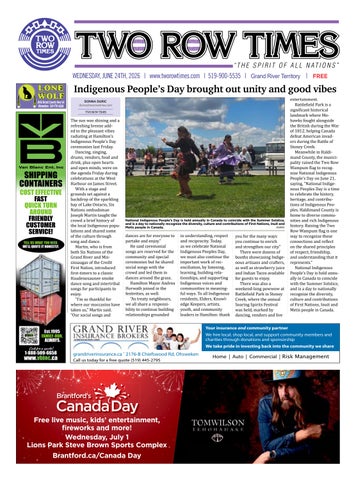
The sun was shining and a refreshing breeze added to the pleasant vibes radiating at Hamilton’s Indigenous People’s Day ceremonies last Friday.
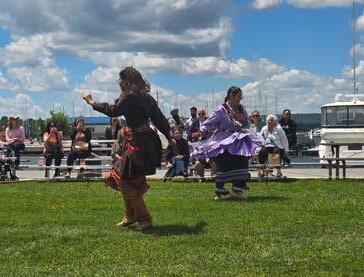
Dancing, singing, drums, vendors, food and drink, plus open hearts and open minds, were on the agenda Friday during celebrations at the West Harbour on James Street. With a stage and grounds set against a backdrop of the sparkling bay of Lake Ontario, Six Nations ombudsman Joseph Martin taught the crowd a brief history of the local Indigenous populations and shared some of the culture through song and dance.
Martin, who is from both Six Nations of the Grand River and Mississaugas of the Credit First Nation, introduced first-timers to a classic Haudenosaunee smoke dance song and intertribal songs for participants to enjoy.
“I’m so thankful for where our moccasins have taken us,” Martin said. “Our social songs and
dances are for everyone to partake and enjoy.”
He said ceremonial songs are reserved for the community and special ceremonies but he shared social songs with the crowd and led them in dances around the grass.
Hamilton Mayor Andrea Horwath joined in the festivities, as well.
“As treaty neighbours, we all share a responsibility to continue building relationships grounded
in understanding, respect and reciprocity. Today, as we celebrate National Indigenous Peoples Day, we must also continue the important work of reconciliation, by listening, learning, building relationships, and supporting Indigenous voices and communities in meaningful ways. To all Indigenous residents, Elders, Knowledge Keepers, artists, youth, and community leaders in Hamilton: thank



you for the many ways you continue to enrich and strengthen our city.”
There were dozens of booths showcasing Indigenous artisans and crafters, as well as strawberry juice and Indian Tacos available for guests to enjoy.
There was also a weekend-long powwow at Battlefield Park in Stoney Creek, where the annual Soaring Spirits Festival was held, marked by dancing, vendors and live
entertainment.
Battlefield Park is a significant historical landmark where Mohawks fought alongside the British during the War of 1812, helping Canada defeat American invaders during the Battle of Stoney Creek.
Meanwhile in Haldimand County, the municipality raised the Two Row Wampum flag to recognize National Indigenous People’s Day on June 21, saying, “National Indigenous Peoples Day is a time to celebrate the history, heritage, and contributions of Indigenous Peoples. Haldimand County is home to diverse communities and rich Indigenous history. Raising the Two Row Wampum flag is one way to recognize these connections and reflect on the shared principles of respect, friendship, and understanding that it represents.”
National Indigenous People’s Day is held annually in Canada to coincide with the Summer Solstice, and is a day to nationally recognize the diversity, culture and contributions of First Nations, Inuit and Metis people in Canada.











A recent police raid on a tobacco manufacturing facility on Six Nationsthe second in the past 12 months - has some local tobacco entrepreneurs concerned about what that could mean for the Six Nations tobacco industry itself.
One of those entrepreneurs, Nick “Nitro” Wyman, says “it’s a slippery slope, in my opinion.”
Six Nations Police, along with the Ontario Provincial Police Contraband Tobacco Enforcement Team, seized 40,000 kg in what they deemed contraband tobacco during the execution of a search warrant at a property near First Line and Seneca Road on June 11.
The warrant was part of a broader investigation
known as Project Track, which began in April of this year, to investigate tobacco manufacturing operations and their alleged connection to organized crime.
“(Police) began Project Track in April 2026 to support the Six Nations Police after a separate incident prompted a broader criminal investigation,” reads a press release from the Six Nations Police. “The investigation involved a tobacco manufacturing facility connected to a non-Indigenous criminal network. The profits generated from the illegal tobacco production were being channelled into the external criminal enterprise.”
The search warrant into the manufacturing facility on Six Nations also extended to a Hamilton residence and resulted in the arrest in several foreign nationals.


The investigation yielded the seizure of more than 40,000 kg of tobacco (fine cut tobacco cigarettes) and 300 kg of shisha tobacco with an estimated street value of more than $10 million.
Investigators also recovered a handgun, five cigarette manufacturing lines, three stolen vehicles, one truck, $25,000 in Canadian currency, cell phones and electronics, and packaging material and cigarette-making components.
Police said during the execution of the search warrants, 13 foreign nationals were investigated and two were arrested.
“Canada Borders Services Agency (CBSA) is engaged and actively participating in the investigation,” police said.
Andrew Besam Hadaddin, 34, and Mustafa Jaber, 45, both of Hamilton, were charged with several criminal code and excise act offences, including: -trafficking in contraband tobacco -possession of tobacco manufacturing equipment -manufacturing tobacco
products without a license -unlawful possession or sale of tobacco products.
Both of the accused were held in custody and released and are scheduled for a court hearing on July 23 in Brantford.
Wyman says although he agrees non-native criminals should not be involved in the tobacco trade on Six Nations, he’s concerned about the implications the two tobacco raids could have on the whole tobacco industry on Six Nations, which has been unregulated since its inception.
“What if they go after the wrong people? What if they came after me?”
Wyman, a Six Nations member and well-known entrepreneur, opened a tobacco facility a year and a half ago, with about 80 employees and 50 of them non-native.
“What happens if they see non native people in my field and decide I’m connected with some Triads?” he wonders. “I’m just worried what’s going to happen when the government tries to get too involved in our lives?”

The Law Society of Ontario hosted a program earlier this month, focused on “Reconciliation with Indigenous Peoples,” as part of the Equity Legal Education Series.
Watch the archived webcast: LSO.ca/EDI-CPD
Stay up to date on upcoming events: LSO.ca/news-events
He agreed in getting rid of organized crime and the nefarious element on Six Nations, but he’s also concerned about owners like him who are not involved in crime and are just practicing their sovereignty.
He agreed, “non-native entities invading our territory is getting out of hand,” but added, “I’m on the fence.”
Some of his employees are visible minorities, he said, but he tries to employ as many native people as he can.
Wyman also said the tobacco industry on Six Nations has become so saturated that many people are selling their products for dirt-cheap prices to stay competitive, resulting in owners like him having to be more creative to also sell their products.
He just hopes police “better be certain of what you’re doing. They treat us like it’s (the tobacco industry) illegal anyway. They make it hard for us to have this industry on Six Nations in the first place.”
He says he’s concerned, “we just opened the door for non-native law enforcement to go after everybody.”
Police cited concerns that the money made from the other enterprises was funnelled out of the community and into criminal activities.
Wyman donates large amounts of money and goods to the community every year through his business ventures.
He hands out hundreds of turkeys to community members every year and donated $100,000 to the Six Nations Fall Fair last year.
Wyman said he’s gotten a few calls from concerned tobacco entrepreneurs and business owners and said a local business association for tobacco entrepreneurs should get going to get control of the industry.
“If there’s bad elements out here, let’s expose them. There are lots of us that are trying to do the right thing. It does suck to have non-native people siphoning from our rights."









Applications for a contract position for Constable with the Six Nations Police are now being called for.
All applicants must fill out a standard application form available at the Six Nations Police Station.
CRITERIA for applicants are as follows:
Minimum Requirements to be considered for a career in First Nations Policing with the Six Nations Police Service, you must:
- Be 19 years of age or over and able to provide an official birth certificate or proof of age;
- Be physically and mentally able to perform the duties of the position having regard to your own safety and the safety of members of the public
- Have successfully completed at least 4 years of Secondary School education or its equivalent (official transcripts and diplomas will be required)
- Be of good moral character and habits, meaning that you are an individual other people would consider being trustworthy and having integrity, with no criminal record;
- certified by a physician to be fit for duty as a front line Six Nations Police Constable and able to pass physical tests which are required in the recruiting process
- Possess a valid driver’s license with no more than 6 accumulated demerit points, permitting you to drive an automobile in Ontario with full driving privileges
- Be able to pass a security clearance as well as background investigation, credit card and reference checks
If you have any criminal convictions under a Federal Statute you must obtain a pardon.
Special Requirements – for the Six Nations Police Service, in order to address the unique and at times urgent needs of the Six Nations of the Grand River Community and Haudenosaunee culture, additional requirements include:
- Extensive knowledge of the unique social dynamics of the Six Nations of the Grand River Territory
- A sound understanding of Haudenosaunee culture, customs, traditions and social political issues of the Six Nations of the Grand River
- Six Nations of the Grand River Band Membership/Citizenship and residency is considered a preferred asset and
- Membership or extensive working experience with any Indigenous Nation will also be considered an asset
Desirable Qualifications:
• Six Nations Band member preferred
Assets:
• Previous policing related experience
• Law and security courses, etc.
Closing Date: Applications must be received by 3:00 p.m June 25, 2026
The SNCDT accepts applications once a year from Six Nations organizations and organizations with Six Nations involvement requesting funding for their programs, projects and capital purchases.
DUE: June 30, 2026 at 4:30 p.m.
(No late applications will be accepted so prepare early)
The Six Nations Community Development Trust application for 2027 funding is open and can be downloaded from our website sncomtrust.com or please email for a copy to be sent directly to you.
Submissions must be sent electronically via email to coordinator@sncomtrust.ca. Please submit as one pdf file.
Please read through all the materials carefully to ensure you do not miss any information. The handbook is a great resource to help you answer each question.
If you have any questions or need assistance, please contact us at our office at 905-765-1236 or email coordinator@sncomtrust.ca
DONNA DURIC donna@tworowtimes.com
The Six Nations Fire & Emergency Services marked its 60th anniversary in June 2026 with community celebrations recognizing six decades of dedicated service. The milestone highlights the department’s role in
protecting residents and responding to emergencies across the territory.
Established in the 1960s, the department has grown to provide professional fire protection, emergency medical response and community safety programs. Throughout the anniversary period, events included recognition of long-serving members, such as captains and battalion chiefs cele-

brating significant career milestones in June.
Golden ticket promotions invited community members to participate by finding hidden tickets for special acknowledgements. Social media campaigns shared stories of service, equipment history and the evolution of emergency response capabilities tailored to the needs of Six Nations.
All Six Nations of the Grand River departments will be closed on Wednesday, July 1.
Regular office hours will resume Thursday, July 2.





Mondays, Wednesdays and Fridays
9:30 a.m. to 2:30 p.m.
(closed on holidays)
The Grand Erie Learning Alternatives Adult Education program can help you finish your diploma, or upgrade courses for college or university applications.
Location: Room 801, OSTTC, 16 Sunrise Crt., Ohsweken
Email: graham.gould@granderie.ca
Phone/Text: 289-257-7837
The Indigenous Education Team is offering support for summer secondary e-learning courses, including Reach Ahead credits.
Homework Help includes:
■ Supervision and structured daily support from a qualified teacher
■ Strengthening time management, selfadvocacy, and independent learning skills
■ Welcoming and culturally safe learning environment
■ Access to technology and internet
■ Daily snacks
Tuesdays and Thursdays (July 2 to 27)
9:30 a.m. to 2:30 p.m.
Location:





OSTTC, Room 802, 16 Sunrise Court, Ohsweken, ON









Each June 21, Canadians mark National Indigenous Peoples Day with statements from leaders, community events, and social media tributes honoring Indigenous histories, cultures, languages, and contributions.
Few dispute the value of this recognition. Yet a deeper question often goes unasked: Who exactly qualifies as “Indigenous Peoples” under Canadian law? And to what extent does Canadian discourse assume ownership or jurisdiction over distinct nations?
Over the past 150 years, terminology has shifted— from “Indian” to “Aboriginal” to “Indigenous.” These changes reflect evolving social norms, legal developments, and international influences. However, the underlying constitutional and legal framework has proven far more stable than the words used to describe it.
The Indian Act Era
For much of Canada’s history, the federal government relied on the term “Indian.” Enacted in 1876, the Indian Act created a comprehensive legal regime governing reserve lands, band governance, membership, education, and many aspects of daily life for Status Indians. Critics rightly describe the Act as paternalistic, concentrating power in Ottawa and constraining community autonomy. Yet it provided a clear, if rigid, legal category: individuals either held status or they did not. Despite repeated calls for reform, the
Indian Act remains in force today—nearly 150 years later—forming a foundational, if often criticized, pillar of federal-Indigenous relations.
The Constitutional Shift to “Aboriginal”
A pivotal change came in 1982 with the patriation of the Constitution. Section 35 of the Constitution Act, 1982 recognized and affirmed “existing aboriginal and treaty rights” and defined “aboriginal peoples of Canada” as including “the Indian, Inuit and Métis peoples of Canada.”
This is a domestic Canadian constitutional term—a specific legal category (“term of art”) created for Canada’s Constitution. It anchors rights tied to pre-contact societies that occupied what is now Canada. Courts have interpreted it to protect rights of groups with strong ancestral connections, even in limited cross-border cases like R. v. Desautel (2021), where Sinixt hunting rights were recognized despite the international border. However, it does not encompass unrelated Indigenous peoples globally.14
“Aboriginal” became the standard term in law, policy, academia, and public discourse for decades. Landmark court cases on land claims, resource rights, the duty to consult, and self-government unfolded under this framework.
The Rise of “Indigenous”
In recent years, “Indigenous” has largely supplanted “Aboriginal” in everyday and institutional use. This shift draws heavily from international contexts, especially the United Nations Declaration on the Rights of Indigenous Peoples (UNDRIP). Unlike “Aboriginal,”
which is rooted in Canadian constitutional law, “Indigenous” serves as a global umbrella term uniting diverse peoples across continents facing similar challenges.
National Aboriginal Day became National Indigenous Peoples Day. Governments, universities, museums, and corporations updated their language accordingly. Today, “Indigenous” is the predominant term in public life.
Can “Aboriginal” Be Rejected?
Because “Aboriginal peoples of Canada” is a constitutionally defined term, it cannot simply be rejected or unilaterally discarded in legal contexts where Section 35 rights are at issue. Individuals or groups may prefer “Indigenous” for cultural, political, or international reasons—and that preference is widely respected in social and institutional settings—but Canadian courts and governments continue to operate within the constitutional framework established in 1982. Changing everyday language does not amend the Constitution.
The Language of Possession: “Our” Indigenous Peoples
A related and increasingly noted tension concerns possessive language: politicians, media, and institutions frequently refer to “our First Nations,” “our Indigenous peoples,” or “our Native nations.” Some style guides for Indigenous writing explicitly advise against such phrasing, arguing it implies ownership—as if Canada “owns” these peoples—rather than acknowledging distinct nations with pre-existing sovereignty.12
Critics find this odd and potentially problematic. Canada is a sovereign state established through Confederation, treaties, and assertion of Crown sovereignty. Many Indigenous nations view themselves as sovereign peoples who entered into nation-to-nation relationships via treaties, not as subjects absorbed or owned by the Canadian state. The constitutional framework reconciles pre-existing Indigenous occupation and rights with Crown sovereignty, but it does not erase the underlying reality of distinct political communities.1
This rhetoric can feel like a de facto assumption of ownership: Canada speaking as if these nations are internal components rather than partners (or, in some views, separate nations sharing territory). Treaties and Section 35 recognize rights and title, yet ultimate sovereignty remains with the Crown in Canadian law. Whether this framing is “nefarious” is a matter of perspective—some see it as benign civic language common in many countries; others view it as a subtle continuation of colonial assumptions that subordinate Indigenous nationhood. The tension highlights an unresolved debate: Are Indigenous nations fully within Canada, or do they retain parallel sovereignty that Canada must continually negotiate?
Continuity Beneath the Changes
Here lies a common source of misunderstanding: many assume that evolving language signals a fundamental transformation in legal relationships. In practice, the core architecture has remained
remarkably consistent.
Section 35 was not rewritten, The Indian Act persists., Historic treaties retain their force., Reserve lands and band governance continue under federal jurisdiction., The Crown remains central to the constitutional order.
Language shapes perceptions, priorities, and respect. But words alone do not rewrite constitutions, repeal statutes, or renegotiate treaties. The shift from “Indian” to “Aboriginal” to “Indigenous” updated vocabulary more readily than it altered the substantive legal framework.
First Nations and the Limits of Categories
“First Nations” emerged in the late 20th century as a preferred political and cultural term, offering an alternative to the legislated label “Indian.” It is now widely used and respected. However, it is not a formal constitutional category on its own. Most First Nations communities continue to operate within the broader Canadian legal structure defined by treaties, legislation, court rulings, and Section 35.
This creates inherent tensions. Some communities prioritize self-government agreements, others emphasize nation-to-nation relations, and still others work for reform from within existing institutions. There is no monolithic “Indigenous perspective”— just as there is no single Indigenous nation. Diversity across hundreds of distinct communities, languages, and histories is a defining reality.
Nations Before—and Beyond—the Labels
One of the most profound insights is that
“nation” defies a single universal definition. The UN discusses self-determination and nationhood without imposing one rigid standard. Nations can be sovereign states with international recognition, or peoples bound by shared language, ancestry, territory, culture, laws, and collective memory—regardless of statehood.
Canadian law provides one lens: constitutional categories, treaty rights, and governance arrangements. Many Indigenous communities provide another: identities rooted in pre-Confederation (and pre-contact) histories. These are not always the same conversation.
Long before “Indian,” “Aboriginal,” or “Indigenous” entered official use, there were the Mohawk (Kanien’kehá:ka), Cree, Ojibwe, Mi’kmaq, Haida, Blackfoot, Dene, and dozens of other distinct peoples. These identities predate the Indian Act, the Constitution, and European arrival. Modern institutions may regulate or recognize relationships, but they did not create the peoples themselves.
Moving Beyond Labels
As Canadians observe National Indigenous Peoples Day, it is worth engaging both the evolving language and the enduring realities it seeks to describe—including the subtle assumptions embedded in possessive rhetoric. Terminology matters—it influences attitudes and policy. Yet beneath shifting labels lie ancient nations, living communities, and complex constitutional relationships that no single word (or possessive pronoun) can fully capture.



know the score.

By Jazz Fuller
Welcome back to another week of sports! We’ve been blessed with some great weather and great sports, let’s dive right into it!
In MLB baseball news, Toronto Bluejays star player Ernie Clement leads all AL players in All star voting with over 2.1 million votes. The 2026 MLB Allstar Game takes
place on Tuesday July 14th at citizens bank ball park, home of the Philadelphia Phillies. Bluejays first basemen Vladdy Jr. leads his position in votes with 1.5 million votes. The Bluejays are currently holding a record of 39 wins and 39 losses. They are currently 3rd place in their Al division and sitting in the final wild card playoff spot. The bluejays have games this week against the Houston Astros today with Trey Yesavage taking the mound for a 7:07pm game. The Bluejays will play a 4 game weekend series starting tomorrow against the visiting Texas Rangers. The Texas Rangers are currently 38-40. In World Cup Soccer
news, Canada is coming off of an impressive 6-0 victory over Qatar. Canada currently has one win and one draw, sitting in first place in their group standings. Canada will play Switzerland in their final game of the group stage. Switzerland is currently tied with Canada in points with 4, also with a win and a draw. This game will take place this upcoming Wednesday June 24th at 3pm in Vancouver at BC Place Stadium. There has been some records broken so far in this world cup with Argentina’s Lionel Messi breaking the all time world cup goals record with his two goals against Austria on monday afternoon. Messi now holds the all time world cup scoring

record with 18 goals, surpassing Portugal’s Christiano Ronaldo. Messi leads the “Golden Boot” (most goals in the world cup) challenge thus far through the tournament with 5 goals in just two games. Right behind him are France’s Kylian Mbappe with 4 goals and Norway’s Erling Haaland with 4 goals. Teams who remain undefeated in the tournament so far are Mexico, Canada, Switzerland, USA, Brazil, Morocco, Germany, Netherlands, Japan, Egypt, Spain, Uraguay, Cabo Verde, France, Norway, Argentina, Portugal and England.
In NBA basketball news, we have a blockbuster trade. Miami Heat land Giannis Antetokounmpo in a

6 player blockbuster trade that sends Giannis and Bobby Portis to Miami in exchange for Tyler Herro, Kelel Ware, Jaime Jaquez Jr, Kasparas Jakucionis, and three first round draft picks in this year’s upcoming NBA draft. The Boston Celtics were apparently finalists in the trade sweepstakes along with the Golden State Warriors.
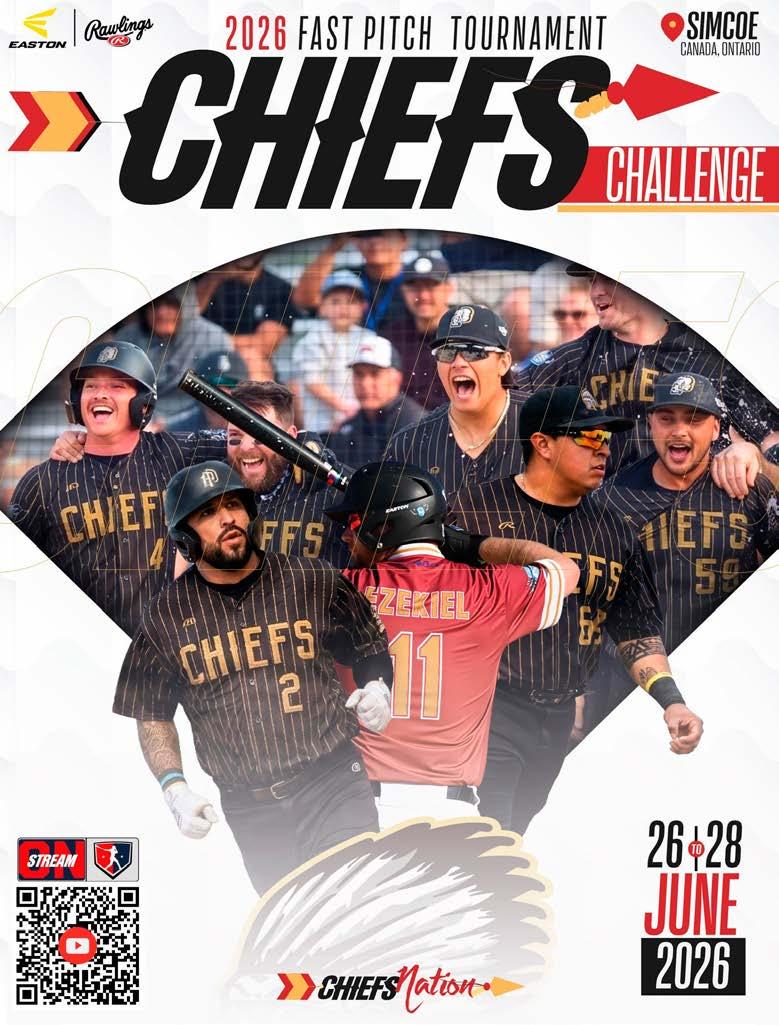
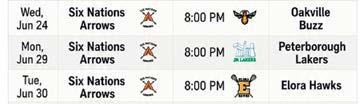
In local sports news, The Six Nations Chiefs remain perfect with a 7-0 following an 11-4 win over the Oakville Rock. They play at home next against the Cobourg Kodiaks on June 23rd. The Six Nations Arrows are currently 9-4 holding down second place in the league coming off of an 11-10 win over Brampton. Their next
game is scheduled for June 24th on the road against Oakville. The Six Nations Jr B rebels keep smashing wins, beating Owen Sound 10-3 on the road in their last game. The Rebels remain on top of league standings with an amazing 24-1 record. They play next at home against Owen Sound this upcoming June 26th at 8pm at the ILA in Six Nations. That is it for this week’s sports news. Stay tuned next week for upcoming sports news following the knock out stage of the world cup. As always, thanks for tuning in to read. We appreciate it, and we will see you all this upcoming Wednesday! Thank you for reading!

By Jace Koblun
Six Nations of the Grand River hosted Pride events in mid-June 2026 focused on fostering visibility, acceptance and inclusion for 2SLGBTQ+ community members.
Organizers, including Six Nations Health Services, co-ordinated activities designed to build community connections and provide safe spaces for celebration and dialogue.
One key gathering took
place on Saturday, June 13 at the Six Nations Community Hall on the 4th Line. The afternoon event from 12 p.m. to 5 p.m. featured drag performances, food trucks, art activities, a Pride scavenger hunt, vendors and community service booths. Attendees participated in educational and social programming aimed at promoting understanding and support within the territory.
Volunteers and organizers stressed the importance of these events in
a community context where traditional values intersect with contemporary needs for inclusion. Themes centred on creating environments where all members feel seen and respected, contributing to overall community wellbeing.
Pride Month activities aligned with broader National Indigenous Peoples Day observances, highlighting overlapping efforts to honour diversity and resilience.

The GREAT Job Board is brought to you by Service Canada. Only local positions are posted in the paper. For more positions in the surrounding area, visit our job board at www.greatsn.com! To apply for funding, book your intake appointment with an ETC by calling 519-445-2222 (Toll-Free long distance at 1-888 218-8230 or email us at info@greatsn.com.



June 28th – Christ Church
July 5th – St. John’s
July 12th – St. Lukes
July 26h – St. Peters
September (tbd) – St. Pauls
We especially remember our loved ones whose memory we treasure.
LONGBOAT: Shelley Ann (Bradley) July 27, 1962 - June 15, 2026

It is with profound sadness that we announce the passing of Shelley Ann Longboat (Bradley) of Hagersville, Ontario, on June 15, 2026, at the age of 63. Shelley was a loving mother, grandmother, great grandmother, sister, aunt, and friend whose kindness, warmth, and generous spirit touched the lives of many. She was known for her caring heart, her sense of humour, and her ability to make everyone feel welcome. She always had time to listen, offer support, and share a laugh with those she loved. Left to cherish her memory are her beloved son, Kyle (Shenice); her cherished grandson, Tyrell (Lexie); her precious great-granddaughter, Amryn; her sister Marcia, her only surviving sibling; and loving fur-momma to Salem and Max. Shelley is also lovingly remembered by her many nieces, nephews, extended
Shelley is predeceased by her parents, Don & Barb Bradley; her siblings Allan, Lorraine, Mac, Dawn, and Mark; and her brother-in-law, Chuck Johnson.
A proud member of Liuna, UA Local 67. Shelley was known for her hardworking nature, loyalty, and dedication. Above all else, she treasured her family and the time spent with those she loved. Her home and heart were always open, and the memories she created with family and friends will be cherished
The family would like to thank everyone for their love, support, and condolences during this difficult time and the care
A Celebration of Life will be held on Saturday June 20, 2026 from 11am - 5pm at the Hyde & Mott Chapel of R.H.B. Anderson Funeral Homes Ltd., 60 Main St. S., Hagersville, with eats and visiting to follow at the Six Nations Veterans



Requesting
Give temporarily
12. Excitedness
16. Armed Forces branch
17. Actor Harris
18. Middle Eastern capital
19. Air hostesses
24. Partner to “Pa”
25. Percussion instrument
26. Popular computers
27. Reduce light
28. Asian mountain range
29. Every one of two or more
30. Absence of difficulty
31. A public announcement of a proposed marriage
33. Whittles
34. Impact
38. Serviceman
39. A French river
40. Prehistoric people
43. Messenger ribonucleic acid
44. __ Clapton, musician
45. Ancient Greek sophist
49. Largest English dictionary (abbr.)
50. Singer Hansard
51. A way to disentangle
53. Atomic #93
54. Manifesting approval
56. Indigo bush
58. Former AL MVP Vaughn
59. Off-Broadway theater award
60. Fencers
63. Small Eurasian deer (pl.)
64. Relating to passerine birds
65. Arrange systematically
Of a main artery
5. Grew older
6. Not the leader
7. __ Lang (country singer)
8. A driver’s license is one
9. Nests of pheasants
10. Wildebeests
13. Equal to one quintillion bytes
14. Japanese three-stringed lute
15. Type of cat
20. It cools your home
21. The ancient Egyptian sun
god
22. Pouches
23. German trigraph
27. Form of Persian
29. Measurement unit
30. Body part
31. Bridge building degree
32. Indicates position
33. Political action committee
34. Snack food
35. Front part of a quadruped
36. Locate
37. Pitching statistic
38. __, myself and I
40. City in Utah
41. They play in the trenches
42. “Can’t Touch This” rapper __ Hammer
44. Type of tree
45. Performers
46. Slang for mistake
47. More open
48. Most slick
50. Needles
51. University of Dayton
52. Atomic #11
54. Large fish of the mackerel family
55. Not any
57. __ and behold
61. Popular sports highlight show (abbr.)
62. “The Great Lakes State”


ARIES – Mar 21/Apr 20
Aries, physical activity can boost your mood and clear your mind for some big decisions that are ahead this week. Tackle some larger projects.
TAURUS – Apr 21/May 21
Indulge in simple pleasures this week, Taurus. They will lead you to the happiness you deserve. You may discover a new favorite recipe or cozy nook to hang out.
GEMINI – May 22/Jun 21
Networking may feel less like a chore and more like a party this week, Gemini. A chance encounter could open a door to an excellent opportunity.
CANCER – Jun 22/Jul 22
Cancer, right now your home is filled with laughter and shared memories. It’s a great week to host a small gathering or a movie night with close friends to share all the good vibes.
LEO – Jul 23/Aug 23
Leo, today you are a beacon of light and a source of inspiration. Use your unique position as a leader to spread positivity and watch good fortune multiply.
VIRGO – Aug 24/Sept 22
Virgo, you are often a master of finding practical solutions to tricky problems both at work and at home. Your reliable nature is a great gift to those around you.
LIBRA – Sept 23/Oct 23
Libra, some diplomacy this week can help you navigate a complex situation with ease. Find moments for mindful meditation so you can create a calm atmosphere wherever you go.
SCORPIO – Oct 24/Nov 22
If you are brave enough to voice it, a secret wish just might come true, Scorpio. After some difficult days, you can use a bit of magic and mystery to change your perspective.
SAGITTARIUS – Nov 23/Dec 21
You’re definitely a glass-half-full kind of person, Sagittarius. This optimism will open doors to a new horizon. A sudden urge to learn something new leads to an opportunity.
CAPRICORN – Dec 22/Jan 20
Discipline will be rewarded with a measurable success that can feel very uplifting, Capricorn. Your hard work is finally getting the recognition it deserves.
AQUARIUS – Jan 21/Feb 18
Be your most authentic self this week and watch how it attracts those you want in your circle, Aquarius. A weird coincidence may lead to a funny situation.
PISCES – Feb 19/Mar 20
Pisces, calmer waters ahead allow you to reflect on yourself and recharge your emotional batteries. You may emerge at the end of the week centered and ready for anything. CLUES ACROSS 1. Nocturnal S. American rodent