First Nations Cable said about 20 homes on the reserve have now been fired up to the long-awaited high-speed fibre optic system.
“It’s pretty exciting times now,” said First Nations Cable President Jeff Thomas. “We’re just firing things up. We’re actually starting to put customers on. We’re starting to see all the benefits of all our hard work.”
The project is years in the making, with work
High-speed Internet fired up on Six Nations
beginning in 2022.
About 20 customers on Fourth Line were the first to connect, Thomas told Six Nations of the Grand River Elected Council last week.
Fiber optic cables pro-
vide high-speed Internet to private homes, making it suitable for streaming, gaming and reliable workfrom-home internet.
First Nations Cable (Six Nations Internet) has spent the past few years installing high-speed fiber-to-the-home (FTTH) infrastructure throughout the reserve to provide reliable, high-speed internet.
Thomas had been aiming for complete coverage to the reserve by late 2025 and then pushed it up to March 2026 but they still have a few fibres left to install on the reserve.
There are about 1,200
to 1,500 areas left to bury cables, he said.
The community has been asking him how to get hooked up to the high-speed system and he encourages people to visit their website at sninternet.com to get an Internet package.
First Nations Cable had to bury hundreds of kilometres of fibre throughout the reserve and had to approach homeowners individually for permission to install the fibres up to their homes.
Thomas received $11.4 million in government funding for the project.
First Nations Cable
has been serving the Six Nations of the Grand River since 1989 and has been licensed by the CRTC since 1992.
Now they’re just hooking up cables to homes, said Thomas.
By running fibre into every household on Six Nations, community members will finally have high-speed home Internet, he said.
The pandemic saw most of the community working and learning from home during lockdowns which presented challenges for residents with slow Internet ser-
vices trying to access live meetings virtually.
“If anything like that ever happens again, we’re prepared for it,” said Thomas.
“Recent times have shown us just how important Internet service is, not just for entertainment but as a crucial part of business and education,” said Thomas. “Over the years, we have continually invested in our infrastructure to improve service for our customers. We make strides in performance and reliability every day.”
EASTER & GOOD FRIDAY
All Six Nations of the Grand River departments will be closed on and Regular office hours will resume Tuesday, April 22 @ 8:30am. Friday, April 3 Monday, April 6, 2026.
Fiber optic cables provide high-speed Internet to private homes.
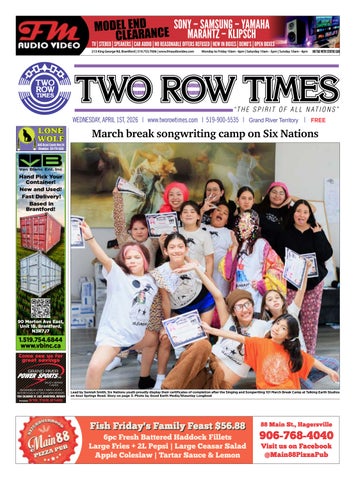
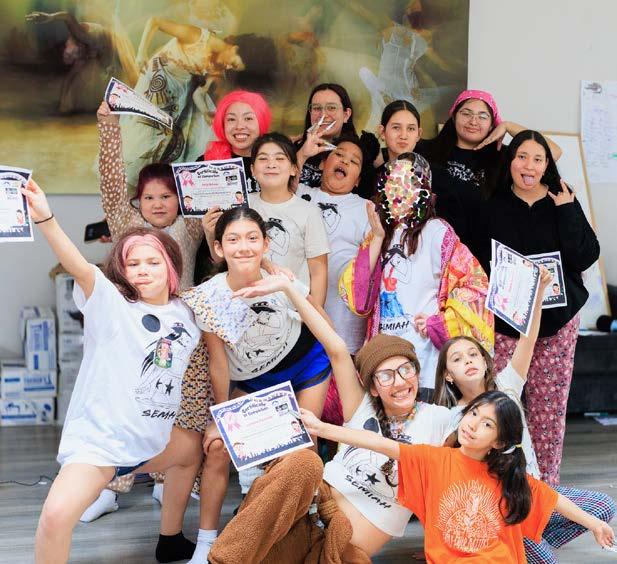
Six Nations youth explore songwriting at March Break camp
Six Nations youth spent their March Break discovering the power of music, performance and community at the Singing and Songwriting 101 Camp.
Semiah Inc., in partnership with Six Nations Child and Youth Health, hosted the free program March 16 to 20 for young people ages 9 to 14. The camp taught the basics of songwriting, music theory, singing, dance and performance all grounded in Haudenosaunee worldviews and values. Youth were mentored by Indigenous artists Se-
miah Smith (pop singer and songwriter), Maggie Powless (songwriter and pianist) and Donnika Stonefish (model and A&R representative).
The week took place at the newly renovated Talking Earth Studios, a peaceful space tucked back in the bush that now hosts arts and cultural events. Smith said creating the camp was personal.
“Lately I have been reflecting on what my role is in the community,” she explained. “I heard we need more support for the arts, so I wanted to step up and create a program that introduces youth to the arts and shows them it’s a real possibility for them.”
Smith, who continued her grandfather Steve Smith’s legacy of supporting Six Nations artists, deliberately chose the studio location because of its warm, home-like feel.
“I think it was the best decision to host it here because it is so peaceful back in the bush,” she said.
The camp blended modern pop music with traditional Haudenosaunee songs.
Youth learned not only technical skills but also how to be good community members and cultural ambassadors while problem-solving together. Smith wanted a space where kids could write about anything they
wanted and explore their identity without heavy themes.
“It was beautiful to witness their creativity uninhibited,” she said. “I also wanted to create a space where kids could create lasting relationships with each other.”
She added that she was impressed by the talent, dedication and kindness the youth showed. “I was so inspired, and we only got three snakes walking through the bush!”
The program was made possible through strong local partnerships. Smith thanked Six Nations Child and Youth Health for staff support and supervision, Six Nations Economic Development, Katie Montour,
Have an Eggs-cellent Easter!
and Townline Variety Gas & Groceries for sponsoring lunches and materials.
She also made a point of uplifting other Six Nations artists by using Indigenous craft supplies from Cornbread Dreamz Designs and photography from Good Earth Media.
Stonefish, who served as a camp counsellor, left feeling hopeful about the next generation.
“The future is bright for Six Nations artists,” she said.
By the end of the week
the youth had written original songs, performed for one another and built new friendships all while learning that the arts can be both a personal passion and a way to strengthen their community. The camp showed what happens when local artists step up, partners come together and young people are given the tools and space to create on their own terms.
What follows is a formal address from the posterity of the Mohawk Loyalists to His Majesty King Charles III. It is written not as a plea for recognition within Canada’s ordinary domestic framework, but as a reminder to the Crown of obligations long pledged and never extinguished. It sets out, in direct terms, what Mohawk Loyalist Posterity would say to the King if received in proper audience today.
TO HIS MAJESTY THE KING
To Charles III, By the Grace of God of the United Kingdom, Canada and His other Realms and Territories King, Head of the Commonwealth, Defender of the Faith:
May it please Your Majesty, We, the living posterity of the Mohawk Nation— who fought as loyal allies with Your Royal Ancestors in defence of the British Crown—address Your Majesty directly as covenant partners. We do so not as subjects petitioning within Canada’s domestic administration, but to remind the undivided Crown of its solemn and unextinguished word.
The relationship between our people and the British Crown is ancient and honourable. Our ancestors maintained this alliance through formal agreements sealed across generations. We are the descendants of the Four Mohawk Kings who travelled to Britain in 1710 to meet Queen Anne, and of Thayendanegea (Joseph Brant), who addressed King George III’s court as an equal. This alliance was formed and tested during
A Mohawk Loyalist Address to the Crown
the American Revolutionary War. Many of our people remained loyal to the Crown and suffered major losses as a result. Our ancestors gave not merely their military service but their homes, their villages, and their way of life in testimony to that loyalty.
In 1779, Governor Frederick Haldimand issued a solemn pledge specifically to “some of the Mohawks” from the villages of Canajoharie, Tikondarago (Fort Hunter), and Aughugo (Oquaga). Because of their loyalty to the King, their settlements had been destroyed by the rebels. Haldimand assured that those villages would be restored or that equivalent land would be provided at government expense. This pledge identified a specific group: the loyal Mohawk warriors and their families from those three villages. Their service had cost them their homes, and the Crown promised to make it right.
We, the living posterity of the Mohawk Nation, are the direct descendants of these named “some of the Mohawks. ” The Mohawk loyalist posterity are precisely the living heirs of this specially identified group from Canajoharie, Tikondarago, and Aughugo. The addition of “such others” of the Six Nations who later settled on that quarter does not cloud or dilute the original pledge made to this distinct body of loyalists.
This 1779 pledge was fulfilled and expanded in the Haldimand Proclamation of 1784, issued by the same Governor in the name of Your forebear King George III. The Proclamation states clearly:
“Whereas His Majesty having been pleased to direct that in consideration of the early attachment to his cause manifested by the
Mohawk Indians… to settle in that quarter to take possession of and settle upon the Banks of the… Grand River… allotting to them for that purpose six miles deep from each side of the river beginning at Lake Erie and extending in that proportion to the head of the said river, which them and their posterity are to enjoy for ever.”
This granted the Grand River tract to the loyal Mohawks and their posterity as acquired territory. The word forever was not rhetorical flourish — it was the deliberate language of a sovereign Crown binding itself and its successors in perpetuity.
In 1791, the British North American government confirmed the Haldimand Proclamation to uphold the honour of the Crown, where its faith was pledged to the Mohawks of the Grand River. This confirmation bound the Crown’s obligations to the specific loyalist posterity. Section 109 of the Constitution Act, 1867 states that all Lands, Mines, Minerals, and Royalties belonging to the several Provinces at the
Union “shall belong to the several Provinces… subject to any Trusts existing in respect thereof, and to any Interest other than that of the Province in the same. ” The Haldimand lands, set apart by imperial Crown pledge and confirmed in 1791, carry such a trust and interest in favour of the Mohawk loyalist posterity. Canada and the provinces remain constitutionally bound by these pre-existing conditions. They cannot unilaterally extinguish or override what the Crown pledged before Confederation.
Our ancestors explicitly rejected the 1793 Simcoe Patent—sometimes referred to as Treaty Number 4—a domestic colonial instrument that sought to reinterpret the Haldimand lands as territory held merely “under our protection” and subject to provincial oversight. Joseph Brant and the Grand River chiefs refused to allow it to alter our relationship from one of attachment to the Crown as loyal allies to one of subordination as wards or ordinary subjects. We stand
by that rejection today. Because the Haldimand pledge and Proclamation address this special and specific named people—the Mohawk loyalist posterity from the villages of Canajoharie, Tikondarago, and Aughugo—the general application of the Indian Act is defective when applied to these lands. The territory was acquired for the exclusive use and enjoyment of the Mohawk loyalist posterity. This status also prevents the unilateral imposition of provincial legislation within the sixmile tract.
Your late mother, Her Majesty Queen Elizabeth II, affirmed this relationship on two notable occasions. In 1984—exactly two years after the Canadian Charter of Rights and Freedoms came into force—during the bicentennial of the Haldimand Proclamation, she visited Her Majesty’s Royal Chapel of the Mohawks and presented royal gifts, including signing the historic Queen Anne Bible. Then, in 2010, she commemorated the 300-year anniversary of the royal family relationship with the Mohawks— marking the 1710 visit of the Four Mohawk Kings to Queen Anne—by personally presenting two peals of silver hand bells to the Chapels Royal of the Mohawks. Engraved with the words “The Silver Chain of Friendship 1710-2010,” these bells served as a tangible reminder of the long-standing alliance. Our relationship with the Crown long predates the Canadian Charter and Constitution Act, 1982, and stands apart from them. It is a pre-Confederation, pre-Charter covenant rooted in alliance, loyalty, and the Crown’s pledged faith. These royal acts were not ceremonial courtesies. They were acknowledgements by the reigning Sovereign of a
living and continuing relationship — and we receive them as such.
We make known to Your Majesty that, in the generations since Confederation, the direct diplomatic channel between our nations and Your Majesty’s person has been quietly severed. What was once a relationship of Crown-to-Nation has been funnelled through subordinate ministers, bureaucrats, and “consultation” processes that treat us as one more domestic interest group within the Crown-in-right-of-Canada. The Governor General, Lieutenant Governors, and federal departments now speak “on behalf” of the Crown, but they do not carry the personal honour of the monarch that our ancestors understood. Meanwhile, federal, provincial, municipal, corporate, and private actors have imposed controls, alienations, encumbrances, and conflicting claims upon the Grand River tract. These acts—carried out in the name of the Crown— are inconsistent with the pledge of 1779, the Proclamation of 1784, the 1791 confirmation, and the trust preserved under section 109 of the Constitution Act, 1867. They undermine the honour of the Crown, which requires that solemn undertakings be performed in substance and not merely acknowledged in form. We do not come to You seeking new treaties or numbered agreements that would reduce us to wards of the state. We come to remind You that the Haldimand lands remain ours by Your Royal word. Our jurisdiction upon them, our right to govern ourselves according to our own Great Law of Peace, and our direct relationship with the mon-
CONTINUED ON PAGE 12
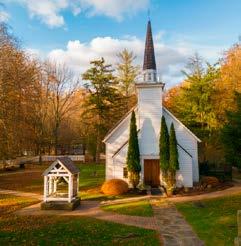
Her Majesty's Royal Chapel of the Mohawks was established before Canada was even a country. FILE
Automatically
Six Nations’ Joe Martin and Nikki Shawana, of Mississaugas of the Credit First Nation, were both featured in City of Hamilton highlight reels on social media as part of its broader effort
to honour Indigenous Languages Day 2026 on Mar. 31.
Each shared messages in their Indigenous languages, with Shawana speaking in Anishinaabemowin and Martin speaking in Mohawk.
Martin introduced himself in the language and provided a few examples of
Join the Norfolk General Hospital Board of Directors
Norfolk General Hospital is seeking community members to serve on its Board of Directors
Board members help guide the hospital’s strategic direction and support strong health care for our community.
Board members attend approximately nine meetings each year.
We encourage applications from people of all backgrounds. Experience in finance, clinical or legal fields is helpful but not required.
Our Board values diverse perspectives and skills to guide healthcare decisions effectively. We also encourage applications from Indigenous community members and newcomers to Norfolk.
Apply by April 15, 2026
For more information, contact Charlene Charles Coordinator of Board Affairs Norfolk General Hospital ccharles@ngh.on.ca
Scan the QR code to learn more and apply, or visit our website: www.ngh.on.ca
how to say hello and thank you in Mohawk.
“She:kon actually means ‘still’,” said Martin. “And when we greet each other, the long version is She:kon skennenko:ken? And it means, ‘is still the Great Peace With You?’ And it refers to our Peacemaker in the formation of our Confederacy. And I think that’s a really beautiful thing when we say hello.”
He said his language “means the world” to him.
“It connects me back to my ancestors, connects me back to my history…there’s like a spiritual connection for me, too. It’s kind of like how I communicate to the Creator. I’m just very thankful that our language is still alive. I hope that the youth and families can continue to pick it up, continue to try to learn the language and pass it on and that’s my best hope.”
Shawana introduced herself with her Indigenous name, saying, “Waasnodeeekwe Nindizhinikaaz,” which means, “Northern Lights Woman.”
She explained the meaning of the greeting “ngichinendam waabinaan” which means, “I am happy to see you.”
She said she grew up in Southern Ontario away from her community so her language is one of the ways she’s been able to learn
more about who she is as an Anishinaabe person and connect her to her culture. Indigenous peoples have historically spoken a wide variety of Indigenous languages. As a means of assimilating Indigenous peoples, restrictive colonial policies like the Indian Act put Indigenous languages at threat of endangerment and extinction. One of the largest impacts on Indigenous languages was the Residential School system in Canada.
Statistics Canada released data from the 2021 census that shows about 243,000 people reported being able to speak an
Indigenous language, which is a decline from the 2016 census when that figure was around 251,000.
While the number of people with an Indigenous mother tongue has been in decline, there has been growth in the number of Indigenous second language speakers.
In 2019, the federal Indigenous Languages Act was signed into law to support and promote the use of Indigenous languages.
The Office of the Commissioner of Indigenous Languages was established with a mandate to support the efforts of Indigenous peoples to reclaim, revital-
ize, maintain, and strengthen Indigenous languages.
Canada is home to more than 70 Indigenous languages.
The federal government issued a statement saying it acknowledged the harms colonialism did to Indigenous people, their culture, and language, which continue to be felt today.
“These colonial policies aimed to assimilate, have endangered many Indigenous languages and placed others at risk of being lost.”
Statistics show that since 2019, the share of students attending First Nations-administered schools who are taught at least one subject in a First Nations language has increased from 83 percent to 94 percent.
“Community-led efforts to strengthen language learning are also a component of breaking the cycle of violence and supporting healing. Language revitalization has a role to play in addressing the national crisis of missing and murdered Indigenous women, girls, Two-Spirit and gender-diverse people. Supporting these efforts remains central to our broader commitment to reconciliation and justice.
On this day, we highly encourage all Canadians to join us in celebrating the vibrancy and resilience of Indigenous languages.
arch are not extinguished by Canadian statutes or court rulings. They pre-date Confederation and sit outside its ordinary federal-provincial framework.
We therefore ask that the 1779 pledge, the 1784 Proclamation, and the 1791 confirmation be acknowledged as continuing and binding obligations of the Crown to the Mohawk loyalist posterity; that the Grand River tract be recognized as land set apart for their exclusive use and enjoyment; that conflicting claims be removed or reconciled with the original terms; that laws inconsistent with those obligations be reviewed and restrained; and that a direct channel of communication be restored between the Crown and our people.
May it please Your Majesty to receive our representatives in audience, as Your Royal Predecessors received ours, so that these matters may be addressed in proper
diplomatic form.
The covenant has not been broken on our side. We have preserved our identity and our law for more than two centuries.
The faith pledged to our people in 1779, affirmed in 1784, and confirmed in 1791 continues in full force, and stands as an obligation of the Crown recognized in law.
That faith now rests with the Crown in Your Majesty’s person, and the honour of the Crown remains engaged in its due performance.
We place these matters before Your Majesty in the confident expectation that the honour of the Crown will be upheld. All of which is respectfully submitted.
We remain, Your Majesty’s loyal allies and covenant partners, The Posterity of the Mohawk Loyalists Mohawk Nation of Grand River - Secretariat
Joe Martin took part in the City of Hamiltons effort to honour Indigenous Languages Day on March 31. FILE
DONNA DURIC donna@tworowtimes.com
8.5 billion for child and family
By 2RT Staff
The Canadian Human Rights Tribunal (CHRT) has approved a historic $8.5-billion agreement that gives Ontario First Nations full authority to design and run their own child and family services.
The Ontario final agreement, approved on March 30, is the first regional settlement in a fight that began with a 2006 complaint by the First Nations Caring Society (FNCS) against federal underfunding and discrimination. It replaces a one-size-fits-all system with programs rooted in First Nations laws, languages, cultures and traditions. The deal includes $258 million for housing infrastructure so children can stay safe in their own homes, plus funding for prevention services, post-majority care for youth aging out of programs, capital projects, and First Nations representative services that give communities a voice in every child-welfare decision.
National Chief Cindy Woodhouse Nepinak of the
Assembly of First Nations called it a significant step forward.
“This is a good day for First Nations children,” she said. “As First Nations, we have the inherent right to oversee the wellbeing of our children, families and communities. We know what they need to thrive.”
She lifted up Ontario Regional Chief Abram Benedict, Chiefs of Ontario, Grand Chief Alvin Fiddler of Nishnawbe Aski Nation and all Ontario First Nations for their decade-long advocacy at the tribunal. She thanked them for pushing band representative services province-wide and for First Nations-led research that ensures funding matches the realities of remote communities. National Chief Woodhouse Nepinak also praised the tribunal for its commitment to better outcomes and urged Canada to flow the funding quickly while continuing work on a national agreement for other regions.
Indigenous Services Minister Mandy Gull-Masty welcomed the decision as
a milestone made possible by First Nations Leadership.
“When First Nations lead, outcomes improve,” she stated. The agreement, she added, strengthens prevention-focused services, supports families, and lets communities build programs that reflect their own priorities. It moves away from crisis response toward a system where fewer children are taken into care and more families stay together, surrounded by love, culture and community.
Benedict described the moment as extraordinary.
“This agreement does not end in nine years,” he said. “It is the beginning of an opportunity for all of us together to continue to forge the way forward and reform this program that has done so much wrong to our people for so very long.”
He stressed that children could not wait for a broader national deal while the current system continued to harm them.
know the score.
By Jazz Fuller
Hey Everyone, welcome back to another week of spring sports talk! MLB Baseball is officially back! Opening weekend of baseball was great in Toronto as the Bluejays officially started off their season with a big 3 game sweep of the Cityless Athletics! The Bluejays won 3-2 in the home opener Friday night with pitcher Kevin Gausman throwing for 11 strikeouts. In game 2 Saturday the Bluejays battled back from a 6-2 deficit to get a thrilling extra inning 8-7 victory with newly acquired pitcher Dylan Cease throwing an incredible 12 strikeouts in just 5.1 innings of work. Sunday afternoon, the Jays pulled off the series sweep with a 5-2 win in a game where George Springer, Jesus Sanchez & Kazuma Okamoto all homered. After getting blitzed Monday night, the Bluejays are now 3-1, tied with the Yankees who are
Scoreboard Watchin' with Jazz Week 12
also 3-1 for a share of the AL East conference lead. 4 games into the season there are no teams left unbeaten. The jays finish off a three game stand against the Rockies tonight with Kyle Freeland taking the mound for the Colorado and Kevin Gausman getting his second start of the season for Toronto. Following this series, the Bluejays head to Chicago to face the White Sox for a 3 game stint with games tomorrow night, Saturday and Sunday. Scheduled times for each game are Thursday @4:10pm, Saturday @2:10pm & Sunday game start @2:10pm.
In College basketball news, Michigan took down Tennessee with a final score of 95-62. The Wolverines absolutely pisspumped the Volunteers by a staggering 33 points in a game that was never close. Michigan Wolverines star forward Yaxel Lendeborg led the team with 27 points, 7 rebounds and 4 assists. The UConn Huskies upset #1 overall ranked Duke BlueDevils with a last second steal and go ahead 3 pointer from damn near half court to get the upset win 73-72. This is the second year in a row where Duke blew a late lead of 10+ points to go on to lose the game.
Illinois man-handled the Iowa Hawkeyes 71-59. Arizona Wildcats had their way with the Purdue Boilermakers 79-64.
NCAA MARCH MADNESS
FINAL 4 matchup tables are set for two back to back games this upcoming Saturday April 4th. In the first of two games, Illinois is a slight -2.5 point favourite in their 6:09pm game against the UConn Huskies. In the second matchup of the night, Michigan is a slight -1.5 point favourite over the Arizona Wildcats in a beast vs beast game where both teams are ranked #1 in their starting brackets. It should be a great day of games this Saturday night, whoever wins the game between Michigan vs Arizona will be a heavy favourite to take down the college national championship game Monday night. Be sure to tune in to some great basketball this weekend!
In NHL hockey news, each team has roughly 7-9 remaining games to play to conclude their regular season schedules. Currently in the eastern conference, Tampa, Carolina & Buffalo are all tied for first place with 98 points. Buffalo has 8 regular season games left, Tampa and Carolina have 9. The Toronto Maple
Leafs currently have 77 points, 11 points out of the final playoff spot with just 7 regular season games remaining. If the NHL regular season were to end today NHL Stanley cup playoff matchups in both conferences would look like this:
EASTERN CONFERENCE
Tampa Bay Lightning vs Columbus Bluejackets
Buffalo Sabres vs Montreal Canadiens
Carolina Hurricanes vs Boston Bruins
Pittsburgh Penguins vs New York Islanders
WESTERN CONFERENCE
Colorado Avalanche vs Nashville Predators
Dallas Stars vs Minnesota Wild
Anaheim Mighty Ducks vs Utah Mammoth
Edmonton Oilers vs Vegas Golden Knights
In NLL lacrosse news, Week 18 is in the books, with just three weeks of regular play left.
Week 18
Results
Halifax took down Philadelphia 8-6
Georgia dog walked Ottawa 12-7
Rochester clapped
Oshawa 18-11
Buffalo narrowly defeated Saskatchewan 8-7
Las Vegas squeaked by Calgary 10-9
Philadelphia unloaded on Toronto 12-9
Week 19 Schedule
Las Vegas vs Colorado Friday @9pm
Rochester vs Halifax Saturday @6pm
San Diego vs Toronto Rock Saturday @7pm
Vancouver vs Buffalo Saturday @7pm
Oshawa vs Calgary Saturday @9pm
Regular Season Standings updated. Top 8 teams advance to playoffs:
#1 Vancouver Warriors 11 wins 4 losses (Clinched playoff spot)
Calgary Roughnecks, Oshawa FireWolves & Philadelphia Wings have been eliminated from playoff contention. Good luck to all teams in the hunt of postseason play!
If you are a local sporting league and would like your league news or scores reflected in this sporting page please don’t hesitate to contact me by email at JazzFuller@ Outlook.com as I would like to get local Six Nations sporting news out there for everyone to keep up to date with. Good luck to all baseball and lacrosse teams in the area. If you made your team, or even went out for a tryout or started a new sport for the first time, that is the first step! Playing sports is a great way to get your body active, learn team building skills and maybe even surprise yourself with how well you might be at picking up something up that you might’ve thought you wouldn’t even have liked to begin with. Weather its baseball, lacrosse, tennis, ball hockey, soccer, the weather is warming up. Get outside and get active! Spring is here & Summer is on its way!
SIX NATIONS COUNCIL
On Monday March 30th, 2026 at 12:24am, a member of the Brantford Police K9 Unit was conducting proactive patrol in the vicinity of a motel on Colborne Street, when the Officer observed two parties in the parking lot attempting to boost a vehicle that had been reported stolen from a neighbouring jurisdiction.
The parties were then arrested and processed by Brantford Police Uniform Patrol Officers.
Search incident to arrest and during the booking process revealed one of the parties to also be in possession 10.5 grams of suspected cocaine and 17.5 grams of suspected fentanyl. That party had been bound be two (2) separate Probation orders that were being contravened.
As a result of the investigation;
A 26 year old male from Brantford has been charged with;
-Possession of stolen property over $5,000.00, contrary to section 355(b) of the Criminal Code.
Police briefs
-Possession for the Purposes of Trafficking, to wit; cocaine, contrary to section 5(2) of the Controlled Drugs and Substances Act.
-Possession for the Purposes of Trafficking, to wit; fentanyl, contrary to section 5(2) of the Controlled Drugs and Substances Act.
-Breach Probation, contrary to section 733.1(1) of the Criminal Code.
-Breach Probation, contrary to section 733.1(1) of the Criminal Code.
The male was to be held in custody pending a bail hearing in relation to these charges.
A 39 year old female from Brantford has been charged with;
-Possession of stolen property over $5,000.00, contrary to section 355(b) of the Criminal Code.
The female was release and given a court date in relation to this charge.
Money laundering ring busted
The #WellingtonOPP Community Street Crime Unit (CSCU) has ar-
rested an individual in connection with a fraud and money laundering investigation, following the execution of a search warrant at a residence in Brampton.
In October 2025, a Puslinch victim reported losing approx. $500,000 in an investment scam.
After investigating further, police found further evidence of money laundering.
The search on March 27, 2026, resulted in the seizure of a large sum of Canadian currency, high end clothing and purses, several electronic devices and personal documents.
A 29-year-old from Brampton has been charged with:
• Laundering proceeds of crime
• Possession of proceeds of property obtained by crime over $5,000
• Fraud over $5,000
A well-deserved shout out goes out to the Wellington OPP CSCU and other supporting partners for their commitment to our communities.
OUR PURPOSE
The Justice Department offers support to victims and those accused of a crime in Brantford, Cayuga, Hamilton and Six Nations. We work toward providing community members with resources to heal from crime, social tragedy, and the consequences of their intergenerational trauma. They also provide alternatives to the mainstream justice system to refrain from further harm.
The Justice Department represents principles of restorative justice and rehabilitation similar to Gladue.
Gladue principles are utilized to address Indigenous overincarceration by looking at intergenerational and historic trauma faced by Indigenous communities like Six Nations. Justice programs and delivery of services to the community are guided by Haudenosaunee Legal Principles.
HOW WE SERVE THE COMMUNITY
SIX NATIONS JUSTICE DEPARTMENT
• Bail Verification program
• Restorative Justice program
•
•
• Restorative Justice (RJ): Provides diversion services to youth (12+) and adults who have come into conflict with the law (charged and pre-charged).
• Indigenous Victim’s Services (IVS): provides Indigenous victims of crime, tragic and traumatic circumstances, withimmediate supports. Indigenous Court Advocates provide court supports and referrals to other available services and programs. IVS provides assistance for those dealing with the following, but not limited to: house fires, sudden deaths, suicides, intimate parter violence, family violence, assaults, robberies, break and entering and car accidents.
• Bail Verification (BV): entails both a verification of the accused’s information before the court, and supervision as an alternative to custody while awaiting a court decision, or trial.
• Gladue Aftercare (GAW) Program: A client led program that assists offenders in fulfilling the recommendations of their Gladue Report and any release conditions.
Restorative Justice Program
• Gladue Aftercare program
• Indigenous Victims Services program
• Family and Criminal Law Information Clinic
• Community Standards/Bylaws program
• Native Inmate Liaison Officer (NILO)
GAW will provide community resources, can assist in the Gladue report process, and advocate for client’s best interest from a rehabilitative scope, to assist in healthy reintegration to the community.
• Family & Criminal LawInformation Clinic (FLIC/ CLIC): Offers an opportunity for a meeting with a lawyer, who can provide legal advice on Family and Criminal Law matters.
• Community Standards: Being updated to meet the community needs for present and future generations. Thisis being accomplished with community members input.
LOOKING FORWARD
Community Standards program is currently involved in developing laws for Six Nations in draft, for review by Council and SN community.
Note: priorities include: Child Welfare, Environment, Residency and creation of a court / tribunal on reserve and working on
enforcement component.
Restorative Justice program is running a pilot project with SN Elder to ensure RJ principles are delivered in a culturally appropriate manner.
Gladue Aftercare has multiple programs in development to assist meet the unique needs of the Six Nation Community.
Indigenous Victims Services program (IVS) will be expanding with additional IVS Advocates to meet the demand for services. The IVS program is also working towards operating as a 24/7 services.
Family Law & Criminal Law Information Clinic (FLIC/CLIC) is a growing program that we operate in collaboration with Legal Aid Ontario. Due to community demand,
FLIC/CLIC is planning to expand to offer two four hour clinics per week, instead of the current on per week.