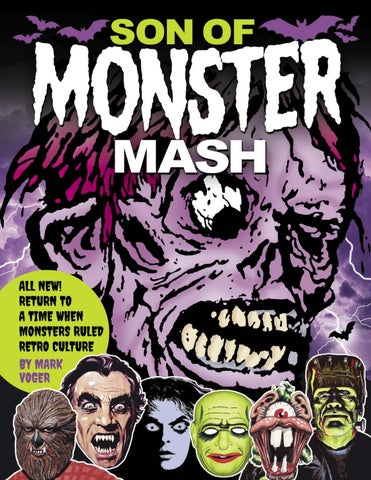
All new! All grue!
All characters & properties shown are TM & © their respective owners as indicated within. PRINTED IN CHINA
It’s the long-awaited sequel to “Monster Mash,” Mark Voger’s 2015 book which redefined Monster Kid fandom with a visually immersive style. This companion volume revisits the Fifties-Sixties period while examining its literary roots; the golden age of monster movies; the 3D and teenage monster trends; the Edgar Allan Poe films; and Hammer’s horrors. Featuring interviews with Ray Harryhausen, Roger Corman, Haruo Nakajima, Julie Adams, Hazel Court, Robert Quarry, Ingrid Pitt and many more. No monster fan should be without this treasure trove of terror!
TwoMorrows Publishing • Raleigh, North Carolina ISBN-13: 978-1-60549-136-3 $45.95 in the U.S.
INITIUM
THE GOLDEN AGE
PRINT MEDIA
Introduction 4 Timeline 8 Overview: Shock! & awe 10
Classic Universal monsters 22 Gloria Stuart 32 Competing creatures 34
Insidious ink 66 3-D Monsters, the magazine 71 Paperback horrors 72
IT’S ALIVE!
FIENDISH FIFTIES
COMICS
Mary Shelley’s ‘Frankenstein’ 12 Bram Stoker’s ‘Dracula’ 14 Silent screams 16 ‘The Cabinet of Dr. Caligari’ 18 ‘Nosferatu’ 19 ‘The Hunchback of Notre Dame’ (1923 version) 20 ‘The Phantom of the Opera’ (1925 version) 21
Trad vs. trendy 36 3D horrors 38 Ray Harryhausen 42 The ‘Creature’ trilogy 44 ‘Gojira’ 50 Haruo Nakajima 51 Teenage monsters 52 David Hedison 60 Norma Eberhardt 62
Gory 1950s comic books 74 1954 senate hearings 76 William M. Gaines 78 Jack Davis 80 Marvel monsters 81 Movie adaptations 82 Classics Illustrated 84 ‘Dark Shadows’ comics 90 Eerie Publications 92
Insets: “Shock!” © Screen Gems; “Cabinet of Dr. Caligari” © Decla-Film; “Mark of the Vampire” © MGM; “I Was a Teenage Werewolf” © AIP; Horror Monsters © Charlton; comic panel © Dell
2
COLLECTIBLES
BLOODY BRITS
The stuff of nightmares 94 6-foot Frankenstein posters 96 Monster mask madness 106 Terrorvision tie-ins 114 Generic monster swag 120
‘Curse of Frankenstein’ 164 ‘Horror of Dracula’ 165 Christopher Lee 166 Peter Cushing 170 Hazel Court 172
TELEVISION
EERIE EARLY SEVENTIES
Written & designed by: Mark Voger Publisher: John Morrow Proofreader: Eric Nolen-Weathington
Front cover: Shock Monster art by Keith Ward (1906-2000), redrafted and colored by Voger; werewolf © Dan Curtis Prod.; Count Yorga © American International Pictures; “Black Sunday” © Galatea-Jolly Film; Uncle Fester © Filmways TV Productions; “Ugly Stickers” © Topps Co.; 1960s Frankenstein poster © Honor House Products Frontispiece: “Masque of the Red Death” art by Reynold Brown © American International Pictures
Roland redux 128 Anthology monsters 132 Monster family sitcoms 134 Kiddie show monsters 138 Barnabas and Josette 144
The Last Gasp 174 Robert Quarry 176 ‘House of Dark Shadows’ 178 ‘Blacula’ 179 The erotic horror subgenre 180
SINISTER SIXTIES
AU REVOIR
Back cover: Franken-vampire art by Bill Alexander © Eerie Publications; Rondo Hatton © current copyright owner; “Beatles” cartoon © King Features; Lily Munster © Kayro-Vue Productions & TM Universal Studios; vampire art © Warren Publishing; Zacherle art © Crestview Records
For Wallace Stroby, crime novelist par excellence and, more to the point, onetime kid editor of Speaking of Monsters “Son of Monster Mash: Return to a Time When Monsters Ruled Retro Culture” © 2026 Mark Voger ISBN-13: 978-1-60549-136-3 First printing, October 2026 Printed in China
Modernity and monsters 148 The Poe cycle 152 Japanese kaiju 160 ‘Night of the Living Dead’ 162
Creative monster nerds 186 A Monster Soaky Christmas 187 Epilogue 188 Acknowledgments 190
All rights reserved under international copyright conventions. No part of this book may be reproduced in any form or by electronic or mechanical means, including information storage and retrieval systems, without permission in writing from Mark Voger, except by a reviewer who may quote brief passages in a review. Address inquiries to Mark Voger c/o: TwoMorrows Publishing. Photos credited to Kathy Voglesong © the estate of Kathy Voglesong
Published by: TwoMorrows Publishing 10407 Bedfordtown Drive Raleigh, North Carolina 27614
Insets: Mask © Ben Cooper; “The Beatles” © King Features Synd.; “Gamera” © Daiei; “Curse of Frankenstein” © Hammer; “House of Dark Shadows” © Dan Curtis Productions; Soaky © Colgate
3
INITIUM
INTRODUCTION
I wore eyeliner to school once, in 1970 when I was in the sixth grade. It gets worse. This was Catholic school. I was askin’ for it. To be specific, this was Holy Rosary School in the Diocese of Camden in the God-fearing town of Ashland, New Jersey, where the nuns smacked you with a ruler first and asked questions later. In my defense, I was obsessed with Barnabas Collins at the time. I lived for that half-hour after school when I could turn on “Dark Shadows” on Channel 6, and leave the real world behind. Whenever Barnabas opened his maw to bare his fangs, his eyes were rimmed in black. That was so cool to me. I dressed up as Barnabas for Halloween, so I’d already had a bit of practice. Sister Miriam Veronica spotted me from across the classroom. (Nuns have eyes like falcons.) She asked: “Mr. Voglesong, what is the matter with your eyes?” I whipped up a preposterous lie that I got bruised. “No you didn’t,” she said, now inches away. “You’re wearing eye makeup.” I don’t remember what happened next. I blanked it out. It must be a defense mechanism. I imagine there was taunting laughter and excruciating humiliation. I was probably pulled by my ear to Mother Marie Julia’s office for a proper lecture. But I don’t believe my parents were ever notified. My father would not have taken it well. That, I would have remembered. THERE’S ANOTHER MITIGATING circumstance. Holy Rosary School was crowded. The Baby Boom caught it off guard. We had two classes each of Grades 1 through 8. That’s 16 classes. But there were only 15 classrooms. So each year, one class — that’s half of one grade — was relegated to the basement of what everyone in the parish called the “Little Church,” a quaint old structure upon a small hill at the edge of a parking lot. (Digression: The Little Church was so small, it was only used for the sparsely attended 7 a.m. Sunday Mass. The other Masses — 9:30, 10:45 and 12 noon, a.k.a. the “red eye” — were held in the school’s allpurpose room. Wafers and wine were transmogrified into the body and blood of Jesus beneath basketball nets, amid BINGO signs. We now return to our narrative.) So my Barnabas obsession happened the same year my class reported to the dark, dank, ancient, mold-smellin’ basement of the Little Church. The other 15 classes had PA systems for announcements. Not us. And like I said, we were literally on a hill.
4
During recess, we wound up playing only with each other. The parking lot below would be a riot of raucous, joyous activity, while on the hill, we kept to ourselves. It was like some cruel social experiment. We were the friggin’ children of the corn. That isolation is another reason I think I went a little nutty in 1970. I began conflating Catholic doctrine with my daily dose of “Dark Shadows.” I started to believe I was fated to become a priest, but one who would mix a hint of the vampirism in with the holy stuff. (This was what the nuns called “blasphemy.”) Once ordained, I would sleep in a coffin and call my house of worship the “Church of the Living Corpse.” It made sense to my sixth-grade brain, since both Jesus and Barnabas died and were resurrected, and crucifixes figured in both milieus. Hoo, boy. Looking back, I needed help I never got. SO WHY WAS I IDENTIFYING WITH A Canadian actor from a daytime soap opera? What happened was, I loved monsters since I saw my first-ever monster face, which I reckon was on the box of an Aurora model kit in a department store called W.T. Grants (1906-76). Back then, getting a “monster fix” was a spotty proposition. But when I was in fifth grade, I started hearing people say, “There’s a show on TV that has a vampire.” I was 9 when I saw my first episode, and I can tell you the exact moment. Devoted “Dark Shadows” geeks will know this moment. It’s when, in 1795, Barnabas (Jonathan Frid) asks Ben Stokes (Thayer A nerd David) to tell him who the real dressed as witch is, sweet Victoria Winters (Alexandra Moltke) or beautiful Barnabas. but evil Angelique (Lara Parker). Family photo Ben can’t answer out loud because of a spell cast upon him by Angelique, so he writes it in the thick dust on an old cask. First he writes a V, and Barnabas says, “V for Victoria?” And then Ben Stokes crosses the V, prompting Barnabas to say, “A ... for Angelique.” Well, that just blew my mind. I didn’t know any of these characters yet, but I was like, “Wow!” (Important note: This was Episode 401, broadcast on Jan. 8, 1968, a Monday.) After that day, I never missed an episode, barring a 102-degree fever or some family trip.
TIMELINE
Monster media dates back to cave paintings and the Old Testament. Eons ago, creatures of folklore were feared. Over time, man came to identify with — and even revere — monster characters.
5/1897: The novel “Dracula” by Bram Stoker is published.
42nd millennium B.C.: A cave painting from the era is discovered on Sulawesi, an Indonesian island. It is thought to depict human-animal hybrids.
3rd millennium B.C.: The Leviathan, a sea serpent of folklore, is introduced. The fearsome creature is found in the Old Testament. 1818: The novel “Frankenstein” by Mary Wollstonecraft Shelley is published. 1836: The first “penny dreadfuls” (early horror fiction) are published in England.
1897: Théâtre du Grand-Guignol, a venue specializing in live horror shows, opens in Paris.
11/21/1931: “Frankenstein” starring Boris Karloff premieres.
12/24/1931: “Dr. Jekyll and Mr. Hyde,” for which Fredric March won a Best Actor Oscar, premieres.
3/4/1922: F. W. Murnau’s German horror film “Nosferatu” starring Max Schreck premieres.
2/12/1931: “Dracula” starring Bela Lugosi as the count premieres.
1/5/1886: The novella “Strange Case of Dr. Jekyll and Mr. Hyde” by Robert Louis Stevenson is published.
3/4/1943: “Frankenstein Meets the Wolf Man,” the first of four Universal “teamup” films, premieres.
10/26/1954: The Comic Book Code is adopted. It decrees: “All scenes of horror, excessive bloodshed, gory or gruesome crimes, depravity, lust, sadism, masochism shall not be permitted.”
6/15/1948: “Abbott and Costello Meet Frankenstein,” the final film in Universal’s classic series, premieres.
2/16/1920: Robert Weine’s German horror film “The Cabinet of Dr. Caligari” starring Conrad Veidt premieres.
12/22/1932: “The Mummy” starring Karloff premieres.
9/6/1925: “The Phantom of the Opera” starring Lon Chaney Sr. as Erik premieres.
1872: J. Sheridan Le Fanu’s vampire novel “Carmilla” is published.
12/9/1941: “The Wolf Man” starring Lon Chaney Jr. premieres.
10/27/1954: “Gojira” premieres in Japan. (In 1956, it will debut in the U.S. as “Godzilla, King of the Monsters.”) 4/10/1953: The 3D horror film “House of Wax” starring Vincent Price premieres. 4/27/1953: The Subcommittee on Juvenile Delinquency forms, and draws a parallel between horror comics and wayward youth.
4/2/1957: Hammer’s “The Curse of Frankenstein” starring Peter Cushing premieres.
2/12/1954: “Creature From the Black Lagoon,” also in 3D, premieres.
6/18/1957: “I Was a Teenage Werewolf” starring Michael Landon and Dawn Richard premieres.
4/29/1935: “Bride of Frankenstein” starring Karloff as the monster and Elsa Lanchester as his bride premieres. 7/12/1935: “Mad Love” starring Peter Lorre premieres. 5/11/1936: “Dracula’s Daughter” starring Gloria Holden as the countess premieres.
OVERVIEW: SHOCK! & AWE
SURELY BY NOW YOU’VE HEARD THE STORY OF HOW 52 movies altered the course of popular culture in 1957? It went like this: Early in the nifty Fifties, classic movie monsters (like Dracula, Frankenstein, werewolves, mummies, etc.) had given way to the militaristic sci-fi and giant bug movies that were so popular at the moment. Certainly, the horror genre still had juice where it counts: at the box office. It just took on different forms. In addition to all those bulbous aliens and radiated insects, there was the 3D trend (“House of Wax,” “Robot Monster”); animator Ray Harryhausen’s stop-motion behemoths (“The Beast From 20,000 Fathoms,” “20 Million Miles to Earth”); the “Creature From the Black Lagoon” trilogy; the Japanese import “Godzilla” (which opened the floodgates for Godzy’s pals Rodan, Mothra, Ghidorah, etc.); and American International Pictures’ drive-in monster flicks (“The Hideous Sun Demon,” “The Astounding She-Monster”). BUT THREE THINGS HAPPENED IN THE YEAR OF OUR Lord 1957 which spelled a comeback, nay a renaissance, for Gothic characters. Considering everything that was going on in the world — with the Cold War, the Red Scare and the Space Race — some good old-fashioned monsters were just what we Earthlings needed. 1957 saw the surprise hit “I Was a Teenage Werewolf” starring Michael Landon as a maladjusted high school punk who morphs into a werewolf with a pompadour — both monster and delinquent. “IWATW” was soon followed “The Curse of Frankenstein,” a British import starring Peter Cushing as a sociopathic Victor Frankenstein and Christopher Lee as his hideously scarred creation. “Curse of” kicked off a series of lavish, albeit gruesome, color reimaginings of classic monsters from England’s Hammer Films. The clincher was “Shock!,” Screen Gems’ TV package of 52 movies that ranged from iconic horror (“Dracula,” “The Mummy”) to mediocre suspense films (“The Spy Ring,” “Reported Missing”).
THE “SHOCK!” PRESSBOOK SENT TO PARTICIPATING TV stations was packed with improbable suggestions on ways to promote the movies. Cases in point: “A duet consisting of a monster and a pretty girl in a Charles Adams [sic] makeup tours the city in a horse-drawn hearse, banked with flowers” ... “A mummy ‘escapes’ from a museum, preferably one which has an Egyptian exhibit” . . . “The live news program on your station should interview a different monster every two or three days prior to the premiere” .. . “Arrange a tie-in with a major department store and plant a monster in the window — in an electric chair.” (OK, we’ll get right on those.) But “Shock!” proved to be an immediate ratings bonanza, taking everyone by surprise. “Shock!” has gone down as the big bang for the Monster Craze of that glorious, gorious Fifties-Sixties period. All Things Monster Craze soon followed. We’re talkin’ Famous Monsters of Filmland magazine (and its myriad imitators); the Aurora monster model kits; the #1 hit song “Monster Mash” by Bobby (Boris) Pickett; TV’s “The Addams Family”; TV’s “The Munsters”; Don Post, Topstone and Ben Cooper masks; the Frankenstein radio speaker; Marx’s walking Frankenstein toy; Fritos Mini-Monsters; Monster Candy Cigarettes; and Your Favorite Monster Craze Memory Here.
A pressbook for Screen Gem’s “Shock!” package of 52 films was sent to local TV stations. Left: Pressbook interior pages. © Screen Gems; © Universal Pictures
THE TEXT FURTHER STATES A “LIFE-AWAKENING word” must be placed in an amulet on the Golem’s chest, thus “he will be alive as long as he wears it.” The rabbi is apparently a sorcerer too; he conjures up a ring of fire, and gleans the magic word (“AEMAET”) from the spirit Astaroth, a spooky vision in its own right, in the cleverly staged creation scene. Odd traits for a rabbi, no? Some pundits have pointed to this, as well as the sexualized depiction of the rabbi’s daughter Miriam (Lyda Salmonova), as stereotypes indicative of German attitudes of the time. I should point out here that Wegener was not Jewish. Visually speaking, the third “Golem” film is a jewel of German Expressionism, with adroit cinematography (by Karl Freund), set design, lighting and costuming. Every frame is a work of art. With the exodus from Germany of filmmakers during the rise of Adolf Hitler, Expessionism had an effect on Hollywood. Expatriates included Freund, Conrad Veidt, Peter Lorre, Robert Siodmak and Curt Siodmak, all of whom worked in horror. One who stayed behind was Wegener. The artist whose “Golem” trilogy showed empathy for persecuted Jews (despite accusations of stereotyping) later acted in Nazi propaganda films. IN JOHN S. ROBERTSON’S 1920 VERSION OF “DR. Jekyll and Mr. Hyde,” John Barrymore was likely the first established mainstream movie star to play a horror character, which would make him a pioneer. During the silent era, the hard-drinking lothario of the Barrymore acting dynasty was considered the greatest stage Hamlet of his time. In “Jekyll and Hyde,” the “Great Profile” (as publicists called Barrymore) plays an eerie transformation sequence that set the tone for many to follow. Throwing his head back, he huffs and puffs, achieving most of the “transformation” into Hyde via his acting. Barrymore sports pointy extensions on his fingers like those later worn by Max Schreck and the Pale Man of “Pan’s Labyrinth.” ON THE SUBJECT OF LOST FILMS, TOD Browning’s “London After Midnight” (1927) starring Lon Chaney Sr. has been presumed lost since 1965, when the last known print was destroyed in an MGM film vault fire. That fire claimed another of Chaney’s horror films, “A Blind Bargain” (1922), in which he played an ape man with one wicked uni-brow. A surviving script tells us that “London After Midnight” is about a dogged detective (Chaney) who endeavors to sniff out a killer by posing as a vampire with the World’s Pointiest Teeth. Though hopes that a print of the film might turn up recede with each passing year, don’t count it out. For decades, no one thought they’d ever again see complete prints of Méliès’ “The House of the Devil,” Edison’s “Frankenstein,” Fritz Lang’s “Metropolis” (1922), the Spanish-language “Dracula” (1931), James Whale’s “The Old Dark House” (1932), or T. Hayes Hunter’s “The Ghoul” (1933). BEFORE “KING KONG” (1933), THERE WAS Harry O. Hoyt’s “The Lost World” (1925), the first feature-length film to blend live action and “stopmotion” animation to such a degree. Based on Sir Arthur Conan Doyle’s 1912 novel, the film is amazing enough when its dinosaurs trudge in their natural jungle habitat. But as a brontosaurus lumbers through then-contemporary London, the animation really seems ahead of its time. “The Lost World” animator Willis O’Brien later animated “King Kong.”
Lon Chaney in the lost “London After Midnight” (1927). © MGM
Paul Wegener in the third “Golem” film (1920). © Deutsche BioSkop
“The Lost World” (1925). © First National
7
Cesare (Conrad Veidt) slowly wakes from his long slumber in Robert Wiene’s masterpiece of Expressionism. © Decla-Film
‘The Cabinet of Dr. Caligari’(1920) “THERE ARE SPIRITS. THEY ARE ALL AROUND US.” So goes the opening line in Robert Wiene’s seminal horror film. In flashback, a fair in Holstenwall promises much entertainment. A peculiar, corpulent man (Werner Krauss) calls on the town clerk to obtain a permit for his fair attraction. He appears scholarly, if disheveled, in his top hat, long black coat, rounded glasses, and gnarled cane. “Wait!” the clerk repeatedly — and discourteously — bellows at the man, who does not take the insult lightly. On opening day, the fair hums with spinning rides, a bustling crowd, even a monkey-equipped organ grinder. The top-hatted man, who identifies himself as Dr. Caligari, is a born huckster: “Step right up! Presenting here for the first time, Cesare the somnambulist!” But we don’t get to see this Cesare just yet. Overnight, the town clerk is mysteriously stabbed to death with a long knife. AT THE FAIR THE FOLLOWING DAY, WE FINALLY see the partner in Caligari’s act. “He has slept for 23 years continuously, day and night,” Caligari tells the curious crowd. When Cesare (Conrad Veidt) awakens, it is a pivotal moment in Horror Movie History. Looking brittle and ill at ease, the being haltingly steps from his upright, coffin-like box. “Cesare knows every secret,” Caligari continues, inviting any audience member to inquire about her or his future. A young man named Alan (Hans Heinrich von Twardowski) pushes through the crowd and asks Cesare: “How long will I live?” The reply: “Til the break of dawn.” Meanwhile, Alan and his best friend Franzis (Friedrich Feher) are both hopelessly smitten with local beauty Jane (Lil Dagover). They make a pact: Jane will decide which suitor she prefers, but they will remain friends no matter what. Alas, the pact was unnecessary; Alan is stabbed to death that very night. If you haven’t guessed, Caligari uses Cesare to murder people. The next day, Caligari lures Jane behind his curtain. Cesare awakes, and his eyes meet hers. He is fascinated by Jane — the guy doesn’t get out much, after all — but she bolts the scene in terror. Caligari dispatches Cesare to kill Jane, but Cesare can’t complete the act on so lovely a creature (a theme repeated in subsequent monster movies). Instead, Cesare’s blank expression changes to one of perverted glee as he carries Jane off. She is rescued by locals, but we haven’t seen the last of Cesare or Caligari.
18
With her death-white face, raccoon eyes and shroud-like dress, Jane is a precursor of Morticia Addams, Maila Nurmi and Lily Munster. Cesare, neither dead nor alive, anticipates zombies, Frankenstein’s monster, Imhotep and any number of beings rudely awakened from another realm of existence. The surreal painted sets utilize forced perspectives. Buildings, streets, and landscaping are tilted, jagged, off-kilter, and impractical. Windows are glass-less. Furniture is the opposite of ergonomically sound. “Caligari” is the apex of German Expressionism.
Orlok (Max Schreck) feasts on Ellen (Greta Schröder). Below: Schreck’s startling Orlok-in-the-box trick. © Prana-Film
‘Nosferatu’(1922) YET ANOTHER INFLUENTIAL GERMAN Expressionist horror film was “Nosferatu” from F.W. Murnau. The plot will be familiar, as “Nosferatu” is an unauthorized adaptation of Bram Stoker’s “Dracula.” When Stoker’s widow Florence sued Prada-Film, character names and dialogue were altered. But “Nosferatu” has such an eerie vibe, not to mention a one-of-a-kind monster in the person of Max Schreck (1879-1936), that any redundancies are easily forgiven. THE WEDDED BLISS OF THOMAS (Gustav von Wangenheim) and Ellen (Greta Schröder) is interrupted when Thomas’ boss, Knock (Alexander Granach), offers him a sure-fire commission to sell a dilapidated house to a Transylvanian gentleman. Knock seems aware a trap is being set, as he warns Thomas he must pay “maybe a little blood” to secure the commission. Thomas travels to the castle of Count Orlok (Schreck), who provides a feast that includes, no joke, a glazed bundt cake. Orlok is soon feasting on Thomas, of course. Orlok arrives in Wisberg bringing rats and plague with him, and sets his googly eyes on Ellen. In reading about vampirism, Ellen is convinced that she alone can stop Orlok and the plague, though she must pay with her life to do so. A book decrees that an “innocent maiden maketh the vampire heed not the first crowing of the cock.”
Orlok will perish after the crack of dawn — if Ellen can offer her neck at just the right moment. At the turn of the 20th century, vampirism was an allegory for vermin and pestilence. The rats and plague in “Nosferatu” represent the fear and mistrust of uninvited visitors. CHANGING CHARACTER names didn’t protect “Nosferatu” from litigation, and Florence Stoker successfully sued. To avoid paying damages, Prana declared bankruptcy. In 1925, a German court ordered all copies be destroyed. Luckily for monster fans, some prints survived. Though undeniably a Dracula clone, Count Orlok is so distinct, he is thought of as a character in his own right. Two remakes bear this out. Werner Herzog’s 1979 redo starred Klaus Kinski. (Even though the film restored Stoker’s character names, Herzog was clearly paying homage to Murnau’s film specifically.) In 2024 came Robert Eggers’ remake starring Bill Skarsgård as Orlok. See also E. Elias Merhige’s “Shadow of the Vampire” (2000), which made Schreck, a real-life person, into a vampire played by Willem Dafoe. Neither fans, nor filmmakers, will allow this century-plus-old movie to rest in peace.
19
The first-ever werewolf movie has a touch of soap opera. In watching Stuart Walker’s “The Werewolf of London” (1935), we reach but one conclusion: If only botanist Wilfred Glendon (Henry Hull) had paid less attention to his precious flowers, and more attention to his neglected wife Lisa (Valerie Hobson), he never would have become a werewolf. In Tibet, Glendon locates the rare mariphasa lupin lumina, a plant that thrives in moonglow rather than sunshine. As he stoops to pluck the coveted bloom, he is attacked by a shadowy figure. Glendon stabs his attacker, but is injured in the struggle. Back in London, Glendon toils amid his in-home laboratory while a posh, well-attended “garden party” (decorated with his sometimes bizarre plants) rages elsewhere in his house. When he deigns to make an appearance at his own soiree, Glendon meets Dr. Yogami (Warner Oland), who identifies himself as the attacker in Tibet. Yogami further warns that both he and Glendon suffer from “lycanthrophobia.” Yep, they’re werewolves. Yogami, too, wants that plant, which he calls an “antidote” to lycanthrophobia. “The werewolf is neither man nor wolf, but a satanic creature with the worst qualities of both,” he says, adding: “The werewolf instinctively seeks to kill the thing it loves best.” Glendon begins to notice symptoms; his hands suddenly become hairy and claw-like. Meanwhile, Lisa has been growing closer to her childhood sweetheart Paul (Lester Matthews).
Henry Hull as the “Werewolf of London” (1935) anticipated Lon Chaney Jr. Above: “Frankenstein Meets the Wolf Man” (1943) was the preposterously titled, but nonetheless exciting, sequel to “The Wolf Man” (1941). © Universal Pictures
Jack P. Pierce’s superb makeup was not without its backstage drama. Reportedly, Hull went around Pierce to advocate for more subtle makeup, since a plot point has Lisa and Paul recognizing Glendon while he is in werewolf mode. Some transformation sequences utilize the “time lapse” method later seen in “The Wolf Man” (1941). “The Werewolf of London” never yielded a sequel, but paved the way for Universal’s Wolf Man series. GEORGE WAGGNER’S “THE WOLF MAN” is, irrefutably, a great monster movie. It’s just that there’s a bit of credibility-stretching along the way. Like about how everyone in the Welsh village of Llanwelly, which is generally populated by circa-1940s modern people (unlike, say, those superstitious peasants in the Carpathians), is ready to recite the Werewolf Poem at the drop of a hat: “Even a man who is pure at heart / and says his prayers by night / may become a wolf when the wolfbane blooms / and the autumn moon is bright.” Or how Lawrence Talbot (hulking, blustery Lon Chaney Jr.) looks like a highly unlikely candidate to be the son of Sir John Talbot (diminutive, soft-spoken Claude Rains). Or how Larry is supposedly a British subject returning after 18 years, when he comes off like a lifelong boorish American. If you can swallow all of that, suspending disbelief about a man who transforms into a snarling wolf is a cake walk. As the only surviving child of Sir John, Larry is heir to the ancestral estate. While testing a fancy telescope in the observatory atop Talbot Castle, Larry commits the sin that puts the whole werewolfery thing in motion: He peeps. Naughty Larry focuses the telescope on the bedroom window of a pretty young lady, Gwen Conliffe (Evelyn Ankers), who works in her father’s antique shop. Larry later presents himself as, not a guy trying to score a date, but a customer. On a whim, he buys a silver wolf’s-head cane. When Larry escorts Gwen and her friend Jenny (Fay Helm) to a Gypsy camp to have their fortunes told, Jenny is attacked by a “wolf” — the fortune teller Bela (Bela Lugosi) in werewolf form. While attempting to rescue Jenny, Larry is bitten by Bela, who he then kills with the silver-headed cane. And you know what happens to someone who gets bitten by a werewolf. UNEARTHED BY GRAVEROBBERS, LAWRENCE Talbot rises anew to discover that he is unkillable in Roy William Neil’s “Frankenstein Meets the Wolf Man” (1943). Yearning for the peace of death, Larry travels to Vasaria, last known base of the Frankensteins. There, he finds the monster (Lugosi) frozen in ice. A doctor (Patrick Knowles) agrees to help Larry, but like those before him, is seduced into reviving the monster to its full power. Also in the cast are Iona Massey as Elsa, daughter of the original Dr. Frankenstein; Lionel Atwill as the mayor of Vasaria; and Maria Ouspenskaya as Maleva the Gypsy woman (the fortune teller’s all-wise mama in “The Wolf Man”).
Lon Chaney Jr. played tortured lycanthrope Lawrence Talbot in five films. © Universal Pictures
MONSTERS IN 3D “The camera contains two lenses, the pupilary distance apart being the same as that of our own eyes. On the screen, to the naked eye, the photography appears to be out of focus, a red and green outline of each figure being plainly discernible. This was remedied by the red-and-green-lens glasses given out at the door, the instructions being that the red glass was for the left eye and the green for the right. ... By closing one eye, the pictures are seen only with breadth and height as is the ordinary picture. Opening the eye immediately gives them depth, and, instead of the foreshortened view of a room which we ordinarily get in motion pictures, we see the room exactly as we would were we to see it in real life.” NOPE, NOT A PROMO FOR ARCH Oboler’s jungle thriller “Bwana Devil” (1952), regarded as the first 3D feature film. This account appeared in a 1915 edition of the film journal Motography titled “Stereoscopic Pictures Shown.” It goes to show: There’s nothing new under the sun. By the Fifties, 3D was viewed (albeit, briefly) as a godsend for the movie industry, which was facing strong competition from that newfangled thing called television. From the earliest days of the fad, 3D found a kindred spirit in the horror and science fiction genres. Horror and sci-fi are big, melodramatic. 3D can do big and melodramatic. The formats seemed made for one another. The mack daddy of all 3D horror movies had appeal that wasn’t limited to horror geeks. Rather, it was a bonafide blockbuster that attracted scores of mainstream viewers: “House of Wax” (1953).
POSTERS FOR WARNER BROS.’ “HOUSE OF WAX” made a carefully worded claim: “First Feature Produced by a Major Studio in 3D!” In other words: Yeah, “Bwana Devil” got there first, but it wasn’t from a “major” studio. Subterfuge! In any case, Warners put the full might of its resources behind this widescreen, Technicolor, 3D spectacle. André de Toth’s “House of Wax” represents the moment when the film’s star, Vincent Price, ascended to the Horror Movie Throne following decades of dominance by old masters Bela Lugosi, Boris Karloff and Lon Chaney Jr. But this didn’t come out of the blue, exactly; Price had flirted with the genre for years. He previously played an ill-fated nobleman opposite Karloff in “Tower of London” (1939); the Invisible Man in “The Invisible Man Returns” (1940) and “Abbott and Costello Meet Frankenstein” (1948, a cameo); and a murderous medico in “Shock” (1946). But from “House of Wax” on, Price had a lasting, and profitable, hook. A STAR WAS BORN. BY 1953, PRICE had acquired a seasoned beauty in middle age, and looked quite becoming in period garb — a prerequisite for any horror movie star. He was the right man for the tricky job of holding together what could have gone down in flames (pun intended) as an expensive publicity stunt. Instead, “House of Wax” was No. 1 at the box office for five straight weeks, finishing as one of 1953’s top grossers (even if The New York Times called the film “as wild a display of noise and nonsense as has rattled a movie Horror’s new king: screen in Vincent Price in years”).
“House of Wax.” © Warner Bros.
39
Sculptor Henry Jarrod (Vincent Price) watches helplessly as his life’s work goes up in flames, in the hit 3D horror movie “House of Wax.” Inset: A suspiciously perfect likeness of missing good-time girl Cathy (Carolyn Jones). © Warner Bros. IN 1800s MANHATTAN, SCULPTOR HENRY JARROD (Price) co-owns a wax museum with businessman Matthew Burke (Roy Roberts). Burke burns the museum to the ground for the insurance money, leaving his partner for dead. Jarrod’s body is never found; Burke lives the high life off of the insurance payoff. Stalking the streets is a mysterious figure in a wide-brimmed black hat and cape with a disfigured face. But there’s no mystery to his identity, at least for the audience. We know it’s Jarrod, especially when he kills Burke and makes it look like suicide. One day, Jarrod materializes in a wheelchair with face intact, though his gloves cover gnarled hands rendered useless in the fire. Jarrod is launching a new wax museum, this one focusing on sensational murders rather than historical tableaux. “I’m going to give the people what they want: sensation, horror, shock,” he says in what could double as the new mission statement for Price’s career. Jarrod can no longer do the sculpting, which he leaves to two “pupils” who are more like henchmen. One of them, Igor, is played by Charles Buchinsky, later known as Charles Bronson. Bronson created a decidedly peculiar characterization. He could have had a career in horror if, you know, the whole international action superstar thing hadn’t worked out. See also Phyllis Kirk as Sue, the heroine who figures it all out (but no one will listen to her); Paul Perceni as the hero (and Jarrod’s fellow sculptor); and TV’s Morticia Addams, Carolyn Jones, as good-time girl Cathy who speaks in a Betty Boop voice. Somehow, when we see Jarrod’s sprawling new basement workshop with its gigantic vat of bubbling hot wax the color of Pepto-Bismol, we know he will end up belly-flopping into it. The 3D effects are plentiful and frequently gratuitous. Corpses and fainting ladies fall straight at the camera. Thrown objects fly toward the audience during fight scenes. A street “barker” in a top hat and tuxedo lures customers into the wax museum while demonstrating his paddle ball prowess.
40
In a meta moment, the barker (comedian Reggie Rymal in his only film appearance) looks directly at the camera and exclaims, “Ah, there’s someone with a bag of popcorn!” while skillfully winging the ball toward us. There’s also a stage performance by “can can” girls that culminates in, no lie, a 3D butt shot. It’s uncharacteristically bawdy. As Jarrod, Price brings a veneer of believability to bombastic dialogue, convincing the audience that he communicates with his wax creations and is in love outright with his Marie Antoinette (though he has yet to “find” the perfect Marie). Price somehow evokes sympathy, even as we clearly see that he is off his rocker. The irony of ironies is that director de Toth had but one eye. As Price once told an interviewer: “It’s one of the great Hollywood stories. When they wanted a director for (a 3D) film, they hired a man who couldn’t see 3D at all. André de Toth was a very good director, but he may not have been suited to direct a 3D movie. He’d go to the rushes and say, ‘Why is everybody so excited about this?’ It didn’t mean anything to him.” Bela Lugosi appeared at the Hollywood premiere wearing his Dracula cape and accompanied by a “gorilla” (Steve Calvert). Soon after, Lugosi expressed a desire to remake “Dracula” in color and 3D. There was zero chance of this happening, but it’s kinda sweet to know that Lugosi’s heart was still in the game. STUDIOS WERE JUMPING ON THE 3D BANDWAGON. In Universal’s “It Came From Outer Space” (1953), one memorable 3D effect has a spaceship come straight at the audience. Other such effects include the one-eyed alien creature emerging from a mine; tumbling rocks during an avalanche; the spaceship interior; and what has come to be called the “alien cam” — that is, weird optical shots from the alien’s point of view. Director Jack Arnold was just warming up; he’d soon direct two back-to-back 3D “Creature From the Black Lagoon” movies.
CREATURE FEATURE
Quick! Which Fifties movie monster is different from the rest? Is it the giant spider in “Tarantula” … the Metaluna mutant in “This Island Earth” … the veiny varmints in “Invasion of the Saucer Men” … or the Gill-Man in “Creature From the Black Lagoon”? You guessed correctly. The Creature emerged from his lagoon 10 or 20 years too late. He could have been a contemporary of Dracula, Frankenstein, et al. He was the right height, the right character design. There could have been a movie titled “The Wolf Man Meets the Creature.” (Plot: Larry Talbot lands in Florida in search of a cure for lycanthropy; he belly-flops into a lagoon during a full moon; and comes face-to-face with you-know-who.) Yep, the Creature swam alone among contemporary monsters in the 1950s. Don’t try to tell me Old Fish Breath fit in with the typical Fifties roster of gargantuan bugs and mottled spacemen. Still, Universal-International’s Gill-Man trilogy — “Creature From the Black Lagoon” (1954), “Revenge of the Creature” (1955) and “The Creature Walks Among Us” (1956) — are staunchly Fifties films. They have the requisite broad-shouldered hero on a scientific expedition; the independently minded damsel; and the older “authority figure” to explain, in concise pseudoscientific terms, how the monster came into existence. (Honestly, those Fifties horror/sci-fi hybrids can be tedious. The Creature’s edge? The supercool monster design, of course.) THERE WAS NO CREATURE NOVEL BY H.G. WELLS. So how did the Gill-Man come into existence? The Creature has a Hollywood-ready origin that could itself be a movie. Producer William Alland was once a member of Orson Welles’ Mercury Players. According to an essay by Tom Weaver in “Creature From the Black Lagoon: The Original Shooting Script” (1992), Alland met a “South American movie director” at a dinner party hosted by Welles. This director spoke of “a race of beings” living in the Amazon that were “human in shape (with) gills in lieu of ears, webbed hands and feet, and fish-like skin.” That’s some fish story. Alland wrote a memo based on the idea titled “The Sea Monster.” Through the often protracted process of script development, the memo evolved into “Creature From the Black Lagoon.” The final script was credited to Harry Essex and Arthur Ross, and the film was produced by Alland. The Creature movies are a little bit “King Kong,” a little bit “The Mummy,” and a harbinger of “Jaws.” Like “Kong,” “Creature” is about a group of scientists from (so-called) civilization who hear tell of a still-living fabled being, and mount an expedition in a far-flung locale to find it, and — as Robert Plant sang — bring it on home. Of course, everyone concerned would have been a lot happier, and the body count lower, if only these learned men had left well enough alone. In his resentment of the surface men’s intrusion, the Creature can be likened to Prince Namor of Marvel Comics fame. Though the three Creature movies have undeniable redundancies, they are generally distinct from one another. The first one is about finding the Creature. The second one is about dragging the Creature to “civilization.” The third one is about … the Creature getting a facelift and wearing pajamas?
44
Creature designer Milicent Patrick and friend. © Universal-International
THE CREATURE’S MILIEU SEEMED TO BE TAILORmade for the 3D process, considering the many underwater scenes and travelogue-worthy POV shots taken from boats in movement. The first two of the three Creature films were directed by Jack Arnold, and both were made in 3D. (Arnold was applying what he’d learned on Universal’s 3D hit “It Came From Outer Space.”) In “Creature From the Black Lagoon,” there’s a balletic sequence in which the heroine (played by Julie Adams), unaware of the Creature’s presence, goes for a swim while the curious Creature does the back-stroke beneath her. It’s a hallmark of the monster movie — and perfect for 3D. Other 3D effects to watch for: the Big Bang of the universe in the prelude; exploratory diving; a diver swimming straight at the camera; the Creature being set aflame; the hero (Richard Carlson from “It Came From Outer Space”) hunting the Creature with a speargun; and an unnerving sequence in which the Creature walks toward the camera from a medium shot to an extreme closeup, moments before abducting Adams and absconding into the lagoon. It’s a staple on the Classic Monster Movies clip reel. 3D effects in the followup “Revenge of the Creature” include a bird murder (a regrettable scene); tricks by Flippy the “educated” porpoise; John Agar frolicking with Lori Nelson; Clint Eastwood’s gravity defying pompadour (honest!); and the Creature rudely interrupting a jazz band playing in a seafood restaurant packed with tourists. (Perhaps he objected to the menu?)
HARUO NAKAJIMA WITH A RADIOACTIVE BLAST THAT MELTS TANKS, a scaly tail that derails trains, and an eardrum-piercing honk that evacuates cities, it’s no wonder Godzilla is called the “King of the Monsters.” Haruo Nakajima played Godzy in the original “Gojira” (1954) and 12 other films, including “King Kong vs. Godzilla” (1963), “Monster Zero” (1966) and “Son of Godzilla” (1967). I interviewed the Sakata native (1929-2017) in 2000 at the Chiller Theatre expo in New Jersey. Since Nakajima spoke no English, my questions were related by his traveling liaisons at the convention. I tape-recorded the interview, and his answers were later translated by Keiko Scardigno, then a lecturer for the Department of East Asian Languages and Cultures at Rutgers University in New Brunswick, NJ. Nothing seems to be lost in translation in the following interview excerpts.
Q: How did you create Godzilla’s movement? NAKAJIMA: When I got a scenario for the first time, there was no title. I had no idea what this film is about. Then a director, Mr. (Eiji) Tsuburaya, showed me a film, “King Kong” (1933), to help me to get some idea. But it didn’t help me a bit. What I did to create the movement was that I made frequent visits to Ueno Zoo to observe how large animals move. By keeping their movements in my mind, I created my movement by myself. Q: Did your artistic leeway increase with each successive film? NAKAJIMA: In the first film, I tried to throw myself into the character. I put my whole mind into it. From the second film, the director entirely left me to decide how to play a role, especially in fighting scenes. We have certain forms to do sword battle which we call “Tachimawari” in Japanese historical plays. In Godzilla films, we didn’t have to follow those rules. So, as you see in the fighting scenes with other monsters, I created my own movements. Q: The tone of “Gojira” is very bleak, especially compared to the more child-friendly films that followed. Were you told that there was a message behind the destruction of Tokyo in “Gojira”? NAKAJIMA: My focus was just on how to manage the huge body, about 30 meters in length, always looking down at this angle. I did not think anything else. I didn’t think it was destructive — just moving ahead.
Godzilla actor Nakajima in 2000. Photo by Kathy Voglesong
TEEN TERRORS
ONE NIGHT, THE TRAILER FOR “REBEL WITHOUT a Cause” (1955) came on. There was James Dean, his face scrunched into an expression of emotional anguish, bellowing at his parents, “You’re tearing me apart!” Dean looked like a human powder keg ready to blow. I thought: That’s just like Michael Landon in “I Was a Teenage Werewolf” (1957). Nicholas Ray’s “Rebel Without a Cause” was a big-studio Hollywood motion picture in CinemaScope and WarnerColor. Gene Fowler Jr.’s “I Was a Teenage Werewolf” was a nonwidescreen, black-and-white cheapie which nonetheless raked in a surprising $2 million at the box office. “Rebel” preceded “IWATW” by two years. The earlier film spawned many imitators. Landon’s earnest, intense performance in “IWATW” is as much about teen angst as, you know, fangs ’n’ fur. The two films have significant plot parallels. Both protagonists are high school outcasts with anger issues. Both are counseled by understanding cops (Edward Platt in “Rebel,” Barney Phillips in “IWATW”). Both have ineffectual father figures (Jim Backus in “Rebel,” Malcolm Atterby in “IWATW”). And, not for nuthin’, both protagonists rocked iconic outerwear. Dean wore that cool, red, nylon windbreaker which became “the” look of the mid 1950s. And Landon became the first werewolf in Horror Movie History to wear a letter jacket. THE SURPRISE HIT KICKED OFF THE teenage monster genre, as it altered the fortunes of the indie machine American International Pictures (AIP). Produced and co-written by Herman Cohen, “IWATW” provided future “Bonanza” star Landon his first starring role as Tony Rivers, a Rockdale High student who is obstinate, violent, but somehow likable. Maybe it’s his fantastic hair? Tony plays dirty during a fistfight, swinging a shovel and throwing dirt in his opponent’s eyes. So we, the viewers, are conflicted about this guy.
52
After tough-but-fair Detective Donovan (Phillips) breaks up the fight, he recommends that Tony see Dr. Alfred Bradford (Whit Bissell, an actor born to play roles like this). “He’s modern. He uses hypnosis,” Donovan says of Dr. Bradford. “No headshrinker for me, thank you,” Tony shoots back. “You keep the man in the white coat for the goofs.” Tony takes his sweetie Arlene (Yvonne Lime) to a Halloween party, where Vic (Ken Miller) — clearly the Jughead Jones of the gang — sings the Jerry Blaine-penned rocker “Eeny Meeny Miney Moe.” This being a Halloween party and all, the kids play goodnatured tricks on one another. When Vic plays one on Tony, he is repeatedly punched for his effort. This party is over.
EVEN TONY RECOGNIZES THAT THIS OUTBURST was the last straw, and he agrees to see Dr. Bradford. Says the doc with feverish glee to an assistant: “Through hypnosis, I’m going to regress this boy back, back into the primitive past that lurks within him. I’m going to transform him, and unleash the savage instincts that lie hidden within.” (Didn’t Lionel Atwill say the exact same thing in, like, 1943?) The doc has a beauty of a rationale for this view, related to 1950s paranoia wrought by the atomic bomb: “Mankind is on the verge of destroying itself. The only hope for the human race is to hurl it back into its primitive dawn, to start all over again.” The science is hazy, but whaddaya want? It’s a monster movie. Dr. Bradford then juices up Tony with unpronounceable chemicals and interviews him in his altered state, encouraging him to regress. As time passes, doctor and patient continue these treatments. (In the olden days, you had to get bitten to become a werewolf. By 1957, you just needed medication and therapy.) A mangled corpse is found in the woods. Ken Miller in 2002. Photo by Kathy Voglesong Werewolf movie fans know what that means.
121
Emoting with Richard Crane in “The Alligator People” (1959). © 20th Century-Fox
BEVERLY GARLAND SOMETIMES MAKING THE HORROR MOVIE is scarier than the movie itself. Genre superstar Beverly Garland (1926-2008) had, well, horror stories. Said the actress of making Curt Siodmak’s “Curucu, Beast of the Amazon” (1956): “We did that in Brazil, and there were no facilities. There were no trailers. There were no restrooms. You had to get in a truck and go to a fazenda — which was a coffee plantation — and use their facilities. Everybody had dysentery. “You couldn’t eat the lunch. The first time the lunch arrived was in a truck with two huge tins. One tin had tea and the other tin had rice. And they had tin plates, which they just wiped off with a cloth after everybody ate. So that was the last day I ate that. Flies were everywhere. The bugs were unbelievable. “We had a scene where the natives get us. We had this big village all made of Looking palm fronds. (Co-star) sharp in ’93. John Bromfield and Photo by Kathy I are in the middle Voglesong of this thing, and they throw lit spears into the village and it blows. It was so dry, it just went up in a second. It was a wall of fire. We’re standing in the middle of this blaze, and we were both frozen. I push John, and he runs. And then I stood there and I thought, ‘I’m going to die. I’m going to die here.’ And then I realized I can’t stay here. I’ve got to go. So I ran out of there. My eyebrows and my eyelashes and my hair were all singed.”
64
“THE ALLIGATOR PEOPLE” (1959) WASN’T much better. “We had one alligator head,” Garland recalled. “That’s all we had. Naturally, our star (Richard Crane) had to wear the alligator head. In one scene, I go to his laboratory out in the country and knock on his door. When I walked in, they wanted to have men walking by me in different stages of turning into alligators. “Well, it’s very hard to do that, because alligator heads are very large and they only had one alligator head. So they devised a cover for these men’s heads, so you wouldn’t be able to see the alligator heads in their different stages. To put a cover over an alligator head is not an easy thing to do, but they managed. I didn’t see what they had done. “So it’s the first day. It’s about 10 minutes before lunch. I knock on the door and come in, and there are all these men walking down the corridor in these things that look like white urinals on their heads! And I started to laugh so badly that we finally ended up shooting this scene after lunch. I could not stop laughing. It was the funniest thing I’ve ever seen. “When I saw the picture later, I discovered that they cut that scene out. I guess they, too, realized that these guys looked like white urinals walking down the corridors.”
PRINT MEDIA
INSIDIOUS INK
How to get a monster fix, pre-internet? The printed page. Good old Famous Monsters of Filmland magazine got the ball rolling with issue #1 in 1958, published by James Warren and edited by Forrest J Ackerman. What made FM a newsstand smash were magnificent color covers by such greats as Maurice Whitman, Basil Gogos, Vic Prezio, Ron Cobb, Albert Nuetzell, Russ Jones, Gray Morrow, Dan Adkins, Victor Livoti, Peter Green, et al. Often, a monster’s face filled the cover, making an indelible imprint on our psyches. Such as? Vincent Price in “House of Usher,” TV’s Zacherley, Lon Chaney Sr. in “London After Midnight,” Bernard Jukes as the stage Renfield (all by Gogos); Kharis and the Japanese giant Frankenstein (by Prezio); Mr. Hyde (by Whitman); and the “Horror Hotel” movie-poster ghoul (by Cobb). Besides their portraiture, the artists sometimes dreamed up scenes based on their subjects. That ceiling’s-eye view of the laboratory on Warren’s Monster World #7 is not in “Son of Frankenstein”; it was envisioned and executed by Morrow. The moody scene of torch-wielding cultist Lon Chaney Jr. from “Witchcraft” on FM #67 is likewise from the imagination of Prezio. OVER THE ENSUING DECADE, FM imitators proliferated. The first was Monster Parade, but you wouldn’t call it a competitor. The risqué model photo on the cover of Monster Parade #1 (1958) made it clear this magazine was aiming for — no pun intended — broad appeal. Issue #1’s pictorial titled “Come in to My Parlor” had sexy photos (but not nudes) of a young lady made up to resemble Luna or Vampira or Morticia, pretending to eat a shrunken head. Famous Monsters’ only serious editorial competition came from Calvin T. Beck’s Castle of Frankenstein and Paul Blaisdell’s Fantastic Monsters of the Films. There were also garbage-y magazines (Mad Monsters, Horror Monsters) that a kid would only buy if there were no copies of FM available.
ACTUAL JOURNALISM WAS BEING DONE IN CASTLE of Frankenstein, with probing interviews, on-set reports, thoughtful critiques, and the invaluable “Frankenstein TV Movieguide.” One illuminating interview exchange in COF sticks out in memory. Daniel Haller, the set designer on all but one of Roger Corman’s Poe cycle films, was the first-time director of the H.P. Lovecraft adaptation “Die, Monster, Die!” starring Boris Karloff. During the shoot in England, COF’s Michel Parry asked Haller: “All of the Poe films had a sensitive aesthete, played by Vincent Price, as a central character. This film doesn’t?” Replied Haller: “Those roles were ideal for Vincent, who is himself a similar person. Karloff has more attack, and I think this will show in this film. The Price character is part of the Poe films. I could have had a Poe subject but I didn’t want to. The Poe films belong to Roger. I wanted something of my own.” LANCER WENT ALL IN ON the Poe cycle with novelizations of “The Pit and the Pendulum,” “The Premature Burial,” “The Raven” and “Masque of the Red Death.” (Of course, you could simply read Poe’s original stories.) Besides Airmont’s series reprinting the classics (“Dracula,” “Frankenstein,” etc.), there was a “Creature From the Black Lagoon” novelization by John Russell Vearn (writing as “Vargo Statten”) from Dragon. Charles Addams’ morbid TV brood was novelized in Pyramid’s paperbacks “The Addams Family” and “The Addams Family Strikes Back.”
Magazines like Famous Monsters and Castle of Frankenstein filled the gap between movie viewings. Opposite: Cover details from Famous Monsters #28, #29, #40 and #41 (all uncredited except #40 by Ron Cobb). © Warren Publishing; © Gothic Castle Publishing Co.
67
WILLIAM M. GAINES
The horror comics publisher aimed to set the record straight.
He had even volunteered to testify. It didn’t save his publishing empire. (Something else did, namely Mad magazine.) Still, William M. Gaines — then publisher of Entertaining Comics, purveyors of gory, lurid, literate stories — got his point across, even if no one on the Senate subcommittee on juvenile delinquency listened: Comic books don’t ruin young minds. I spoke with Gaines in a telephone interview conducted in March 1992, three months before his death at age 70.
Q: So presumably, you’d assign a weirder thing to someone like Graham “Ghastly” Ingels . . .
Q: You did a lot reading as a lad. But did you follow your father’s career? Did you read the comic books that he published?
GAINES: Oh, many times (laughs). A lot of what we did was pretty nasty stuff. Somehow we knew that somebody would get us at the end of the road, but it was fun while it lasted.
GAINES: Oh, sure. They were free, so I read ’em (laughs). Q: Was it your idea to take over your father’s comic book business after his untimely death, or were you pushed into it? GAINES: I was pushed into it by my mother. I wanted to be a chemistry teacher. Q: Did you have a game plan going in? GAINES: None whatsoever. Q: Did you think you would fail? Were you at all worried about that? GAINES: I knew I would fail. Q: How long had you been operating as publisher at Educational Comics before you originated your first new “solo” title?
GAINES: Oh, Ingels got all the sloppy, gooey, yucky stuff. Orlando could go either way. Evans could go either way. Q: Before the public outcry over horror comics began to brew, did you and Al occasionally look at a script or artwork and chuckle sardonically to yourselves, “This is pretty nasty stuff?”
Q: Oh, you did have that feeling? GAINES: Oh, yeah. Well, the New York legislature kept passing bills against horror comics, and Gov. (Thomas E.) Dewey kept vetoing them. But we knew this couldn’t go on forever. And then finally, it (anti-horror sentiment) went national. Q: Do you have any guess as to why Dewey was so sympathetic? GAINES: He wasn’t exactly sympathetic. It’s just that he felt that this was a violation of freedom of speech. He was very adamant that no censorship laws should pass under his aegis. Q: The imitators that came out after your horror mags began to sell — did you feel they spoiled the fun? Did you read them? Were they gorier than what EC was doing?
GAINES: Well, Al Feldstein joined us William M. Gaines was (unwittingly) about 1948, and we started developing GAINES: We never read them. They instrumental in creating the CCA. titles. Let’s see, we had Gunfighter, Saddle couldn’t have got much gorier than we Justice. I kind of inherited War Against were. Except that our gore was mitigated by the fact that it had a Crime and Crime Patrol. We started Modern Love; Saddle good story to go with it. And theirs probably didn’t. But I didn’t Romances; A Moon, A Girl, Romance . . . really read them, no. Q: When you published your first horror comics, was there a Q: When you look at video of your younger self testifying before precedent to the types of stories you did? Horror movies didn’t the Senate Subcommittee on Juvenile Delinquency in 1954, can have stories like yours. What was your reference? The pulps? you remember how you felt at the time? GAINES: Well, the pulps I had read as a kid. But Al and I put GAINES: Scared out of my mind. those twist endings on them. We called them “O. Henry” endings. From the beginning, almost every story we wrote had a twist. Q: You came across as pretty confident in the footage I’ve seen. Sometimes it wasn’t a very good twist, but it was an attempt at a twist to surprise the reader. This was, I think, unique with EC. GAINES: That was at the beginning (laughs). That was when I made my statement. After that, they started pummeling me. In Q: You had your stable of artists, and each one had his particular addition to which, my (medication) dexedrine wore off. This gifts. How did you tailor your scripts to your artists? dexedrine keeps you hyper, but when it wears off, it leaves you like a limp rag. Halfway through the testimony, it wore off, and I GAINES: Oh, well, every day we’d know who we had to write a didn’t have any with me. I just was sitting there like a punchstory for. So depending on who we had to write it for, that’s the drunk fighter getting pummeled. kind of story we wrote.
78
SEQUENTIAL CINEMA It was a time when the stars of horror movies became ... comic book characters?
Consider Vincent Price. The horror icon headlined no less than six comic books during the Monster Craze, all adaptations of thencontemporary films in which he starred. Under its Movie Classics banner, Dell cranked out comics based on “Master of the World” (1961); “Tales of Terror” (1962) which also starred Peter Lorre and Basil Rathbone; “The Raven” (1963) which also starred Lorre and Boris Karloff; “Twice-Told Tales” (1963); “Masque of the Red Death” (1964); and “Tomb of Ligeia” (1965). Price’s fellow horror star Karloff made the four-color rounds too, with comics based on his movies “The Raven,” “Die, Monster, Die!” (1965) and “Mad Monster Party?” (1967), as well as the TV anthology “Thriller” (1960-62). Gold Key’s two Thriller issues yielded the spinoff Boris Karloff Tales of Mystery (1963-80). EC artist George Evans, who earlier drew Classics Illustrated’s “Hunchback of Notre Dame” adaptation, did the artwork for Dell’s “Tales of Terror” edition, though he could not recall the film’s title when we spoke in 1996. Said Evans: “Did you ever see the — what was the name of it? — it was all Edgar Allan Poe things. I don’t know what the title of the comic book was. But it involved ‘The Black Cat’ with Peter Lorre, and I did caricatures of the actual people in the picture.” Evans became animated when told the movie was titled “Tales of Terror.” “Yeah! So they did three of the stories, and I really enjoyed doing it. For the one that involved Peter Lorre, ‘The Black Cat,’ I did it all and I did it as sort of a caricature, you know, but sort of realistic, with Lorre staggering around, crab-like eyes all bulging. I had fun with that. I penciled it all. I did the first story with Vincent Price and a beautiful woman whose name eludes me. Debra Paget — right! They gave me a ton of stills, and I worked my butt off. But I loved doing it.” Dell also put out adaptations of older horror films. Some editorial liberties were taken, but the books were faithful in their character design. These included adaptations of “Dracula” (1962), “The Mummy” (1962) with art by Jack Sparling, “Creature From the Black Lagoon” (1962), “Frankenstein” (1963), and “The Wolf Man” (1963).
Above: A likeness of Vincent Price from Dell’s Twice-Told Tales (1963). Left: Peter Lorre from Dell’s Tales of Terror (1964). Opposite: Comics of movies new and old. © Dell Publishing; © United Artists; © American International Pictures; © Universal Pictures
Owing to the “Batmania” trend of the mid Sixties, Dell then made superheroes out of Dracula and Frankenstein, and introduced a secret agent in a comic titled Werewolf. All three lasted for three issues from 1966 to ’67. Though the books suffer from preposterous scripts and apparently rushed art, they are valued for their camp appeal. Of course, Dell’s descendant Gold Key put out a Dark Shadows comic (1969-76). If only GK had issued an adaptation of the spinoff movie House of Dark Shadows (1970). Wouldn’t you love to have seen artist Joe Certa’s take on “old” Barnabas?
83
IF IT’S CLASSIC LITERATURE, IT must be good for children. That seemed to be the loophole that justified four editions of Gilberton Company’s Classics Illustrated line that could be called monster media, and were published at a time when parents feared such dark content might give their kids nightmares. The four were Mary Shelley’s “Frankenstein” (with art by Robert Hayward Webb and Ann Brewster that was a touch on the gory side); Robert Louis Stevenson’s “Dr. Jekyll and Mr. Hyde” (art by Lou Cameron); H.G. Wells’ “The Invisible Man” (art by Norman Nodel); and Victor Hugo’s “The Hunchback of Notre Dame” (art by George Evans and Reed Crandall). It should be noted that CI’s earlier, cartoonier “Hunchback” edition was drawn by Allen Simon.
“The theaters always had big windows with the 8-by-10 glossies, which I ate up and devoured since I didn’t get to see the movie. So without a doubt, seeing the posters and the stills — that was a big part of it, the impression that it made.” As for Hugo’s book: “I did like the writing of it. I did a quick reading of the subject. Whenever I got these assignments (from Classics Illustrated), I really did dig back and refresh on a lot of it.”
EVANS COLLABORATED WITH HIS fellow EC artist Crandall on several issues of Gilberton’s Classics Illustrated line, including Hugo’s “Hunchback” and two Charles Dickens adaptations, “Oliver Twist” and “A Tale of Two Cities.” The only hitch: Crandall had relocated to George Evans drew horror Kansas, “which was out of the art market.” comics for EC and Warren, Continued Evans: “The way we worked it was plus Gilberton’s Hunchback. this: I would take the assignments. I got the THE “HUNCHBACK” ADAPTATION illustrated by Evans has a cinematic quality. I scripts. These were long stories. I would do the asked the artist if he was influenced by Lon Chaney’s or Charles entire breakdown. If it was 40, 50 pages, I’d lay out all the pages.” Laughton’s portrayal of Quasimodo, or by Hugo’s 1831 novel. (“Layouts,” a.k.a. “breakdowns,” is an early stage in comic “I guess the overall answer is all of the above,” said the book production wherein an artist adapts the script into panels on Pennsylvania native (1920-2001) in the 1996 interview. a page, usually in loose sketching with lightly applied pencil.) “I couldn’t afford to go to the movies, because I had all my Evans did all of the layouts of a given job, which were then growth by the time I was 12, and they were charging me adult lettered by Gilberton using the manual Leroy Lettering system. price to get in. So all I got to see of ‘The Hunchback of Notre “Then Reed and I would split it up,” Evans continued. “Based Dame’ when it made its first movie appearances with Charles on the layouts, I’d send him maybe 20 out of 40 pages. Reed Laughton (in 1939) were the posters out in front of the theater. would take it from there, and then send them back finished up. “But those posters had an effect on me. They stayed with me, “By then, I would have completed the other half of the job. because Laughton really made a great character out of it, didn’t Then I’d go over the entire thing and make a change here or a he? And (co-star) Maureen O’Hara was a beautiful woman. change there, if it was required to have it all match up.”
Left: Chilling scene from Classics Illustrated ’s Frankenstein. Above: CI ’s Hunchback of Notre Dame drawn by EC veterans George Evans and Reed Crandall. © Gilberton Co.
From above: Super Frankenstein lives in Frankenstein #2 (1966); the Gill-Man blows bubbles in Creature From the Black Lagoon (1962); Super Dracula looks super snazzy in Dracula #3 (1967); the Bandaged One speaks (huh?) in The Mummy (1962). Opposite: Kiddie indoctrination via cutesie, friendly monsters. © Dell Publishing; © Gold Key; © Universal Pictures; © Hal Seeger Productions; © Hanna-Barbera
89
From above: A Barnabas panel from Dark Shadows #6 (1970); Angelique from #15 (1972); the werewolf from #9 (1971). Art by Joe Certa. Opposite: All three characters on George Wilson’s monster mashup for the cover of issue #9. © Dan Curtis Productions
From left: Barnabas, the werewolf and Angelique from the “Dark Shadows” comic strip (1971). Art by Ken Bald. © Dan Cutris Productions
Eerie Publications kept the dripping entrails coming. Opposite: Lurid covers in garish colors — especially red. © Eerie Publications
SugaRY Shivers
Did monsters take part in a conspiracy whereby the Cigarette Industrial Complex indoctrinated gullible youngsters to become the Smokers of Tomorrow? From top: Monsters help sell Candy Cigarettes from the Phoenix Candy Co.; a Wolf Man “pin-up” (it wasn’t that big) from Phoenix; “Old Mold” and “Scent” cigarette parodies from the Four Star Candy Co. Characters © Universal Pictures; candy © Phoenix Candy Co. & © Four Star Candy Co.
98
Hey, kids, get your monster fix while you keep your pencils sharp. ABC Products — known for alphabet-themed toys meant to encourage reading — must’ve justified their monster pencil sharpeners as educational adjacent. Shown: Wolf Man and Frankenstein. Also sold were sharpeners in the likenesses of the Mummy and a skull. Characters © Universal Pictures; sharpeners © ABC Products
The enlarged details of Dracula (top) and Frankenstein (below) are from the Dracula Interlocking Picture Puzzle box art (above). Jaymar’s monster puzzle series was notable for decent artwork on the gruesome side. © Universal Pictures; © Jaymar Specialty Co.
The object of Hasbro’s Frankenstein Horror Target Game was to toss styrofoam balls closest to Frankie’s face; 25- to 100-point areas were deliniated with pins. The 1963 game came in two sizes. Was it the Cornhole of the Sixties? Not hardly. © Universal Pictures; © Hasbro 92
Topstone Vampire Girl and Mummy in “Ghost of Dragstrip Hollow” (1959). © American International Pictures; © Topstone Rubber Toys Co.
Isn’t that a Don Post Creature mask in a 1965 episode of “The Munsters?” “The Munsters” © Kay-Roe Vue Productions and ™ Universal Pictures
Topstone and Don Post masks sometimes found their way on film. Brooklyn busdriver Ralph Kramden (Jackie Gleason) and his pal, dimwitted sewer worker Ed Norton (Art Carney), wear Topstone’s Caveman mask to play a trick on fellow Raccoon Lodge members during a train ride on “The Honeymooners” (1956). At a costume party, the hot-rodding gang in “Ghost of Dragstrip Hollow” (1959) wear recognizable Topstone masks of the Mummy, the Vampire Girl, the Witch and the Caveman. I’d bet anything Uncle Gilbert wears a Don Post Creature mask and hands on “The Munsters.” For sure, Post’s Metaluna Mutant mask does double-duty as a random alien on “Lost in Space.” Post’s Tor Johnson mask is briefly worn by Mel Gibson in George Miller’s dystopian thriller “Mad Max” (1979). While Don Post did things by-the-book, making “official” masks based on Universal’s heavily guarded properties, Topstone was doing the dirty. Technically, Frankenstein (a novel published in 1818) was in the public domain, but not the Universal version. Topstone’s Frankie mask was clearly Universalian, with a flattop and neckbolts straight outta Jack Pierce’s makeup kit.
110
AS A KID, I PINED AWAY FOR THOSE DON POST masks, which were fascinating replicas of movie monsters but cost a fortune in 1960s kid money. I’d seen the ads in Famous Monsters for years, but I’ll never forget the first time I saw them “in person.” It was at Movieland Wax Museum in Buena Park, Calif., in 1972, the summer after I graduated eighth grade. The masks, all of them, were in Movieland’s gift shop (on high shelves, so as not to be molested by the lollipop-sticky fingers of tourists’ little brats). It was a revelation to see them for real. I later owned two of Post’s Tor Johnson masks (one was stolen, the other is in bad shape), but never one from that “first string” of monsters. I was, however, the proud owner of a Shock Monster mask from Topstone. At a gift shop in Detroit in 1970, I bought a skull mask (OK) and a devil mask (awful), and tried really, really hard to convince myself they were cool monster masks. I used the skull mask in my 1971 Super 8 opus “Fury of the Vampires” to show how vampires, once vanquished, turn into skeletons. Somehow, it looked a lot cooler when Christopher Lee did it in “Horror of Dracula.”
Ben Cooper and Collegeville masks, from top left: Grandpa Munster, the Creature From the Black Lagoon, the Wolf Man, Dracula (though he looks Phantom of the Opera-ish), two-faced Dr. Jekyll and Mr. Hyde, and Vampire Girl. Characters © Universal Pictures except Grandpa Munster © Kay-Roe Vue Productions and ™Universal Pictures; Jekyll and Hyde © public domain; and Vampire Girl © current copyright holder
111
OBJET D’ ADDAMS
From top: Gomez and Morticia puppets from Ideal; Addams sliding squares puzzle from Roalex; 1920s art of Jackie Coogan in his child star days; Addams jigsaw puzzle from Milton Bradley; Uncle Fester’s Mystery Light Bulb. “Addams Family” © Filmways TV Productions; puppets © Ideal; squares puzzle © the Roalex Company; Coogan art © current copyright holder; jigsaw puzzle © Milton Bradley; Fester light bulb © Poynter Products
102
Using a remote control, Marx’s handy Great Garloo (1961) went forward, backward, and could bend over and pick things up. © Marx & Co.
THE MONSTER BIKE BUDDY’S BOUNCING HEADS CAME IN three varieties: Frankenstein, Wolfman [sic] and Shrunken Head (the latter presumably for rabid aficionados of “The Four Skulls of Jonathan Drake”). “Easily mounted on your handlebar ... bobs along as you ride, causing gasps of surprise and horror,” claimed a 1965 Royal Advertising Corp. ad that also touted hot gum, sneezing powder and a “Get Smart” spy camera. © Universal Pictures; © Tico-Toys Inc.
TYPE ON THE BOX FOR Topper’s Motorized Monster Maker (1969) stressed: “This is a mold kit. It can only be used with a heating unit. Sold separately with other items.” Another warned that it made “ogre-monsters only. Accessory sets to make other monsters sold separately.” Got all that? Right: “Mad Monster Party” reject Dr. Shriek. © Topper Toys
TELEVISION
ROLAND REDUX THE MOST FAMOUS OF THE ORIGINAL 1957 WAVE of TV horror hosts was undoubtedly John Zacherle (1918-2016). The two-time Famous Monsters cover boy’s national profile was bolstered by a #6 hit record (“Dinner With Drac”) and a Don Post mask in his likeness — not to mention many decades of playing the “Cool Ghoul” (Zach’s nickname courtesy of Dick Clark). Though his best known persona was as the ghoulish “Zacherley” (the slightly different spelling is intentional) in New York, he was first known as Roland on WCAU-TV in Philadelphia. Beginning in Oct. 1957 with the debut of Screen Gems’ “Shock!” movie roster, Roland carved brains (actually cauliflower); fiddled with amoebas (actually gelatin); and conversed with unseen characters Gasport, Igor and My Dear (actually off-camera stagehands) for one year before being poached by WABC-TV in New York. He hadn’t portrayed Roland for many years when, in 2001, he appeared as the character at a parade in Ocean City, NJ (a coastal burg within the Philadelphia viewership area). To exploit this meta moment, I asked Zacherle if he would grant an interview “in character” as Roland. And so, for the first time in decades, the one and only original Roland spoke about life after television . . . and that Zacherley fella.
Q: Thanks for your time, Roland. Where have you been since your final show in 1958? ROLAND: Well, I left town in my hearse and went back to Transylvania, of course, and spent a few years there. I brought my wife (My Dear) along, of course. Igor came with us too; I just couldn’t bear to leave him behind. We all left town at the same time in the dead of night. Q: Have you changed much? ROLAND: Well, I don’t move as fast as I used to (laughs). I’m slower afoot. But I get around all right. Q: Have you heard about this guy Zacherley who looks like you? ROLAND: He’s a close relative. We both came out of the same background. Presbyterians gone mad! Yes, I’ve met him. On a dark night downtown at the Trinity Churchyard Burial Ground in Lower Manhattan. We met and we made peace with each other and decided to go our own ways. All is well. Q: You’ve told me that you landed the Roland gig after playing an undertaker on another WCAU show, a live western soap opera. ROLAND: That is correct. You know, it was a good-looking show. It wasn’t the greatest show in the world, but it was certainly on a par with the kind of westerns that Hollywood used to make. Those old “Hopalong Cassidy” black-and-white films didn’t have such great storylines, either. And it was very exciting to do it live.
128
Q: Was it a surprise when you were asked to host horror movies?
ROLAND: I didn’t know what they were talking about! Because I was never allowed to see horror movies when I was a kid. All those films that were made in the Thirties, I was totally unaware of. And they (WCAU) had no big ideas, either, except that I should dress like that undertaker character, with the black coat and the funny necktie and the neckpiece. They parted my hair in the middle and made my cheeks look dark and sunken. Q: Another Monster Craze milestone happened around the same time in Philly: Famous Monsters of Filmland magazine. ROLAND: When I was in Philadelphia at WCAU, a young fellow came to me named James Warren. He went on to become the publisher of Famous Monsters. The magazine started when those films came out on television. Simultaneously. So he saw the possibilities there. Warren lived in Philadelphia, so he was aware of the show I was doing. I don’t know what inspired As him — because there were other people doing what I was doing around the country Roland in 1958 — whether he realized that it (circa would spark a big interest to create the 1957) magazine. Warren and Forry (FM editor Forrest J Ackerman) pulled together the first issue in three days, which was great, because this was “strike while the iron’s hot.” They never planned to do a second issue. So because Mr. Warren was in Philadelphia and I was in Philadelphia, there was a big scene evolving there. Philadelphia didn’t have much to get excited about, apparently. Ha! Q: Not many of your 1957-58 TV broadcasts have survived. ROLAND: The trick was, the tapes were 2 inches wide. After they recorded and broadcast a show, they’d wipe it off and use the tapes over again, because the tapes were so expensive. But I was fortunate enough to get some kinescopes made. I wish I had more. Q: It’s wild that you’ve come back to life after all these years. ROLAND: Well, it’s still me, of course. Q: You’re breaking character, Zach . . . I mean, Roland. ROLAND: I am Roland and Roland is me — at least for the duration of this interview. Ha ha! I believe I’m due for another long rest, if you’ll kindly excuse me.
10 ALTOGETHER OOKY EPISODES Season 1, Episode 1 “The Addams Family Goes to School” (9/18/1964) directed by Arthur Hiller. Synopsis: Home schooling vs. public education! When a truant officer compliments the Addams homestead, Wednesday replies, “We like it. It’s so nice and gloomy.”
CAST: John Astin (Gomez), Carolyn Jones (Morticia), Jackie Coogan (Uncle Fester), Blossom Rock (Grandmama), Ted Cassidy (Lurch), Lisa Loring (Wednesday), Ken Weatherwax (Pugsley). Based on characters created by cartoonist Charles Addams. The episodes listed were directed by Sidney Lanfield unless otherwise noted.
Season 1, Episode 33
Season 2, Episode 18
“Lurch the Teen Idol” (5/14/1965) Synopsis: Mizzy Records (an in-reference to “Addams” theme composer Vic Mizzy) tapes Lurch grunting at his harpsichord and throwing in the odd “Go, go, baby!” The “song” becomes a hit, as Lurch’s new fans clamor for their idol at the doorstep.
“Fester Goes on a Diet” (1/14/1966) Synopsis: With his French lady pen-pal coming, Fester needs to lose weight. He tells his trainer (Jack LaLanne as himself) that he likes to eat “puree of aardvark” and “roast yak.” Replies LaLanne: “They say we are what we eat. And mister, you are!”
Season 2, Episode 2
Season 2, Episode 22
“Wednesday Leaves Home” (11/20/1964) Synopsis: Wednesday “runs away” after being disciplined for setting off Fester’s dynamite caps. Morticia frets Wednesday might “join the Brownies.” But really, she’s hiding under the bed in Pugsley’s room.
“Morticia’s Romance: Part I” (9/24/1965) Synopsis: In this flashback, sickly Gomez is strong-armed into wedding weird Ophelia Frump (Jones). Instead, he falls for her pigtailed sister Morticia. Margaret Hamilton, first to wear the green as the witch in “The Wizard of Oz,” debuts as Grandma Frump.
“Happy Birthday, Grandma Frump” (2/11/1966) Synopsis: An episode devoted to Hamilton in her third turn as Grandma Frump. Mistakenly believing she will be sent to an old folks home, Grandma Frump demonstrates her “pep” by jumping rope, doing cartwheels, and riding a pogo stick.
Season 1, Episode 20
Season 2, Episode 5
Season 2, Episode 27
“Cousin Itt Visits the Addams Family” (2/5/1965) Synopsis: The recurring character Cousin Itt (Felix Silla) debuts in this episode minus his trademark derby and specs. Itt does magic tricks and becomes a reluctant attraction at the local zoo.
“Gomez, the People’s Choice” (10/15/1965) Synopsis: When his tax bill is only $4.80, Gomez calls the mayor a “double-dealing scoundrel” and decides to run for the office. A reporter calls Gomez’s unorthodox campaign a “satire on dirty politics.”
“Lurch’s Little Helper” (3/18/1966) Synopsis: Afraid of overworking Lurch, Gomez builds a mechanical butler he calls Smiley (played by Robby the Robot from “Forbidden Planet”). Lurch takes offense until learning his new title: “head butler.”
Season 1, Episode 7 “Halloween, Addams Style” (10/30/1964) Synopsis: Two holdup artists (Don Rickles and Skip Homeier) hole up at the Addams place, where Halloween festivities include spider cookies, exploding punch, and a game of “Bob for the Crab” — a living crab.
Season 1, Episode 10
135
Even tiny tots could love monsters ... as long as they were in animated form. Toon terrors from top left: Goonda, wife of J. Evil Scientist; Milton the monster; Milton’s bony buddy Heebie; J. Evil’s son Junior; J. Evil himself; the Flintstones’ weird neighbor Weirdly Gruesome; his wife Creepella; the Creepy Coupe of “The Wacky Races.” “J. Evil Scientist,” “The Flintstones,” “The Wacky Races” © Hanna-Barbera Productions; “Milton the Monster” © Hal Seeger Productions
‘SCOOBY DOO’
Every Saturday, Scooby and those meddling kids Fred, Daphne, Velma and Shaggy met monsters galore. Problem was, these “monsters” were nearly always humans wearing masks. From top left: Dracula, a werewolf and Frankenstein (“A Gaggle of Galloping Ghosts”), a mummy (“ScoobyDoo and a Mummy Too”), Mr. Hyde (“Nowhere to Hyde”), a green ghost (“A Night of Fright is No Delight”) and a glowing alien (“Spooky Space Kook”). © Hanna-Barbera Productions
121
TV TERRORS Monster movie stars found work in Sixties television, and sometimes they weren’t cast as monsters. From top left: Peter Lorre plugs his latest movie, the Smell-O-Vision flick “Scent of Mystery,” on “What’s My Line” (1960); Vincent Price and Boris Karloff play father-and-son mad scientists on “The Red Skelton Show” (1968); John Carradine plays a shady magician on “The Beverly Hillbillies” (1966); Lon Chaney Jr. as a gangster is flanked by Micky Dolenz and Peter Tork on “The Monkees” (1965); Karloff absolutely murders Joey Dee and the Starliters’ #1 hit “Peppermint Twist” on the pop revue “Shindig!” (1965); Karloff wears hilarious drag as malevolent Mother Muffin on “The Girl From U.N.C.L.E.” (1966); Jonathan Frid, fangs and all, is the mystery guest on “What’s My Line” (1970). “What’s My Line,” “The Red Skelton Show” & “The Beverly Hillbillies” © CBS Television Network; “The Monkees” © Raybert Prod. Inc. ™Screen Gems Inc.; “The Girl From U.N.C.L.E.” © Metro Goldwyn Mayer; “Shindig!” © ABC Television
Owing to Corman’s restlessness, each Poe film was distinct. Recalled the director: “ ‘The Raven’ was a comedy; ‘Masque of the Red Death’ was a morality play; ‘Tomb of Ligeia’ was a romance. But all of them were done as horror films.” I spoke with the Detroit native (1926-2024) — whose films ran the gamut from “The Wasp Woman” to “The Intruder” to “The Wild Angels” — on six occasions between 1994 and 2012. Corman said he sought Price for “House of Usher” because he believed the actor and Poe’s character shared certain qualities. “Roderick Usher was a very refined, very intelligent, very sensitive man,” Corman said. “There are not many of that type in Hollywood. Vincent Price was the obvious choice. “And he was as wonderful a man as he was an actor. He got along well with other actors, I got along well with him, and I don’t know anybody who ever had a bad word to say about Vincent.” The director and his star were unknowingly creating a template for the series of Poe adaptations that would soon follow. “It was interesting and stimulating to bring his ideas and my ideas together,” Corman said. “I always felt Vincent’s performance in ‘House of Usher’ was one of the best of his career.” WHILE MAKING THE FOLLOWUP, “THE PIT AND the Pendulum,” Corman and his team really began to click. What drew Corman to that particular story for his sophomore effort? “I chose it primarily because of the visuals of the pit and pendulum,” he said. “I think it turned out well. You’re right when you say that it was coming together. All of the Poe films were a workin-progress. But on the second one, we all got it together — the writer, Dick Matheson; the cameraman, Floyd Crosby; the art director, Danny Haller; and the crew. We really put it together on that one. I was particularly pleased with the climax, in which John Kerr was trapped under the pendulum.” AIP clamoured for more Poe films, to Corman’s vexation. “Frankly — because we had done so many Poe pictures — we were trying to bury the formula,” he said. For the final two films in the cycle, the director traveled to England, which gave the films a new look and sensibility. “On the ones in England, we were able to take advantage of some sets that had been built for bigger films,” Corman said. “We rebuilt some standing flats that they had left over from either ‘Becket’ (1964) or ‘A Man for All Seasons’ (1966). We took those and were able to get a bigger look.” On the series’ final entry, Corman’s theory that the films should have a look of unreality (to suggest the subconscious) was jettisoned as a way of keeping things fresh. Said the director: “By ‘Tomb of Ligeia,’ I decided to throw out that theory and shoot the whole thing in the English countryside in broad daylight. That helped it to look quite different from the other films in the series, anyway.” Was there one film in the Poe cycle that encapsulated the series for Corman? “Usually, it’s ‘House of Usher,’ ” he said. “But sometimes it might be ‘The Pit and the Pendulum’ or ‘Masque of the Red Death.’ One of those three.” WITH THE POE FILMS, CORMAN WAS NO LONGER making movies at a breakneck pace. Then came “The Terror” (1963), for which he completed principle photography in two days. I asked the director if he was backsliding into old behavior. Said Corman: “What it amounted to was this: We had these sets left over from ‘The Raven,’ so I shot two days on the sets with Boris Karloff before he had to go back to England. I brought in a young, unknown actor who was a friend of mine, Jack Nicholson, and his wife at that time, Sandra Knight.
“I said to them, ‘You’re going to end up as the leads in this picture. I don’t have the rest of it written’ — because we put the whole thing together in a couple of days — ‘so just come in. We’ll play these two days with Boris, then I’ll write the rest of the picture, and we’ll come back and shoot the rest.’ ” But Corman didn’t direct those subsequent exteriors and scenes. “I couldn’t shoot the other sections because we were going non-union, and I was signed with all the unions and everything,” he said. “So my ace assistant at the time, Francis Coppola, shot a portion. Then he signed a contract with Warner Bros. And it just kept going from director to director. There was no big rush. “But it finally finished up with, I think, Jack Nicholson actually shooting the last day. He said to me, ‘Roger, every idiot in town has directed part of this picture. You might as well let me finish the thing up.’ I said, ‘OK, Jack.’ ”
“We were trying to bury the formula,” said Roger Corman, shown in 1994. Photo by Kathy Voglesong
Younger days
Katia (Steele) regards her father (Ivo Garrani) in “Black Sunday.” © Galatea-Jolly Film
BARBARA STEELE SHE WAS UP TO NO GOOD IN SCORES OF SIXTIES horror films. So when haunting beauty Barbara Steele got hers, you can bet the method of vengeance was commensurate. A British actress who became a superstar in Italy, Steele (born 1937 in Cheshire) lent her mysterious allure and huge eyes to such classics as “Black Sunday,” “The Pit and the Pendulum,” “The Horrible Dr. Hitchcock” and “The She Beast.” The following quotes are from a Q&A with Steele held in 1994 in New Jersey. n On “Black Sunday” (1960): “I was incredibly young when I made that film. I liked (director) Mario Bava. He was a great man, a civilized guy, and very tender.” n On her two “Black Sunday” characters, one good, one evil: “We all have a duality in us. I don’t think there’s a such thing as a totally benign person or a totally evil person.” n On working with Vincent Price in “The Pit and the Pendulum” (1961): “Haven’t we all loved Vincent Price? He was a 19th-century gentleman, incredibly elegant. A divine presence to work with. A great classical actor. Had he been in England, he’d be right up there with (Ralph) Richardson, (John) Gielgud and (Laurence) Olivier. Because he had this intelligence and presence. Nevertheless, we have him in another way, and that’s just as good.” n On Federico Fellini, who directed Steele in “8 1/2” (1963): “He was just like a great showman. He was very conspiratorial with everyone — incredibly democratic. Even the extras felt enormously significant. He had a huge, generous soul. He never belittled anyone. He had a witchy intuition with all of his actors, a wicked sense of humor. He was adored. He’s revered in Italy; 60,000 went to his funeral. I loved him.” n On multi-lingual sets: “I kind of like it, in a strange way. When we did ‘8 1/2,’ people were speaking four or five different languages. You just get fixated on faces.” n Why the overdubbing in Italian films? “Soundstages in Italy aren’t soundstages. They’re these great, shaking sets. You can hear every airplane fly, and every aria being sung! I can’t stand it not being my own voice. Our voices are half of our performances.”
158
n On “Castle of Blood” (1964): “Which one was that?” (After being told) “I had a nice, big lesbian scene in that one. A long scene; it seemed to go on for three days. (Director) Antonio Margheriti had a lot of anger, but a lot of energy. It was fun.” n On “The She Beast” (1966): “(Director) Michael Reeves was incredibly young, just 21 or something. Enormously gifted. He had a tragic end. I always sensed this melancholy in him.” (Reeves died at age 25 in 1969 of an accidental barbiturate overdose.) n On working with Elvis Presley in “Flaming Star” (1960): “I have very scarce memories of Elvis. I was only on the shoot for five days. He arrived every day with an entourage of five multicolored Cadillacs and women with beehive hairdos.” n On why Steele walked off the film: “They did my hair blond, which I wasn’t happy about. I had to speak in a Southern accent. I didn’t know what a Southern accent was. I had been in the United States for two weeks. I was supposed to have crossed the desert after my family was killed, and I looked like Doris Day! All crisp and clean. I rolled in the dirt and they freaked. They said, ‘We have no backup jeans! It won’t match!’ “I flew to New York, called them up and said, ‘I’m never coming back.’ They said, ‘You’ll never work in this town again.’ Then they sent emissaries with flowers. But I never went back.” n On shooting an episode of TV’s “I Spy” in Venice (1966): “I didn’t get along with either Mr. (Robert) Culp or Mr. (Bill) Cosby. I was well known in Italy. ‘I Spy’ hadn’t hit yet. I don’t know; it was a chilly encounter.” n On working with director David Cronenberg in “Shivers” (1975): “I love his work. He’s incredibly intense and focused. I was a monster in that one. I don’t think I behaved very well.” n On the Nineties TV revival of “Dark Shadows,” in which Steele played Dr. Julia Hoffman: “ ‘Dark Shadows’ was not fun for me. I was very shaky. I hadn’t acted in about 1,000 years, so I was vulnerable. When (‘Dark Shadows’ creator) Dan Curtis stopped directing the show, it was better for me. Freer.” n On the show’s star, Ben Cross: “Ben gave Barnabas fantastic depth and sorrow. I love his carved, weird face, like a gargoyle.”
CHRISTOPHER LEE
“In actual fact, I haven’t really made that many horror films.” This is what Christopher Lee, an eight-time movie Dracula, said during one of two Q&As held on a snowy weekend in New York City in January 1990. No one in the packed ballroom challenged Lee’s statement openly, even as we all recognized that it was delusional. But it raised the question: Did Lee hold the genre in disdain? Thankfully, no. Lee said that as a lad back home in England, he frequently attended the horror films of Boris Karloff and Bela Lugosi. “Oh yes, before the war” he said. “Don’t ask which one. “Before World War II, which I was in for five years and somehow survived, I went to see all of these pictures with Karloff and Lugosi. And wonderful they were. They were major pictures. The studios in those days had the top set designers, top cameramen, top directors, top stories. And I was scared by those pictures. Some of them were very frightening.”
LONDON NATIVE LEE (1922-2015) WAS THE LAST OF the Great Horror Movie Stars. (Who else was in his league? Jason? Freddy? The “Ring” girl?) Lee’s flagship role in the genre was Count Dracula, but he also played Frankenstein’s monster, the Mummy, a Mr. Hyde type, a Satanist, other vampires, even a 007 villain. Once Lee entered his “elder statesman” phase, he was sought after by such directors as Martin Scorsese, George Lucas, Peter Jackson, Tim Burton and Joe Dante. The actor won recurring roles in the “Star Wars,” “Lord of the Rings” and “Hobbit” franchises.
Uh-oh ... someone’s in trouble. © Hammer Films
TOILING IN HORROR, FANTASY AND SCI-FI HAS ITS dangers, considering all of the makeup, stunts and FX involved. Lee had some war stories. He spoke of the “Curse of Frankenstein” scene in which, as the monster, he is shot in his right eye by Dr. Frankenstein’s assistant Paul (Robert Urquhart). Lee, with a handful of stage blood, was supposed to cup his eye in “pain” as the “blood” flowed down. Problem was, much of the fake blood went directly into his eye. “When you see me in that scene, writhing in agony,” Lee said, “let me assure you that it wasn’t all acting.” However, Lee added, “I saved the take. Well, I didn’t want to go through that again.” Another such mishap occurred in “Dracula: A.D. 1972,” when Lee’s fingers “smoke” after touching a crucifix hanging from the neck of Stephanie Beacham. (To be frank, it is an intentionally suggestive scene.) “I was reaching my hand toward Stephanie Beacham,” he said, “which is not something that anyone would object to.” Alas, the effect went wrong, and Lee’s fingertips were singed. Lee also indicated a permanent knuckle scar he acquired from swordfighting with Errol Flynn on a British television episode in the 1950s. “It was after lunch,” he added.
EERIE EARLY SEVENTIES
IF YOU ENJOYED THIS PREVIEW, CLICK THE LINK BELOW TO ORDER THIS BOOK!
SON OF MONSTER MASH by MARK VOGER
ALL NEW! ALL GRUE! It’s the long-awaited sequel to author/designer MARK VOGER’S Rondo Award-winning book Monster Mash: The Creepy, Kooky Monster Craze in America 1957-1972, which redefined Monster Kid fandom with a visually immersive graphic approach. This companion book revisits the period, while examining the literary and cinematic roots of its fictional precedents (Mary Shelley’s Frankenstein, Bram Stoker’s Dracula); early silent films (Cabinet of Dr. Caligari, Nosferatu); the golden age of monster movies (with such stars as LON CHANEY SR., BELA LUGOSI, BORIS KARLOFF and CHANEY JR.); the 3-D and teenage monster movie trends; the Edgar Allan Poe adaptations and Hammer Studios releases of the period; the monsters of Sixties TV; the eye-popping toys, memorabilia and comics; and the aftermath of the influential Monster Craze. It features interviews with filmmakers such as RAY HARRYHAUSEN (20 Million Miles to Earth), ROGER CORMAN (The Pit and the Pendulum), and stars like GLORIA STUART (The Invisible Man), RICOU BROWNING (Creature From the Black Lagoon), HARUO NAKAJIMA (Godzilla), JONATHAN HAZE (Little Shop of Horrors), HAZEL COURT (Curse of Frankenstein), KATHRYN LEIGH SCOTT (House of Dark Shadows), ROBERT QUARRY (Count Yorga, Vampire) and many others. No monster fan should be without this treasure trove of terror! (192-page FULL-COLOR HARDCOVEr) $45.95 • (Digital Edition) $15.99 • ISBN: 978-1-60549-136-3 https://twomorrows.com/index.php?main_page=product_info&cPath=95_96&products_id=1902
Quarry as Yorga
Frid as Barnabas
THE LAST GASP THE SEVENTIES WAS THE DECADE IN WHICH THE horror film got more graphic, gruesome . . . and, yes, formulaic. But at the top of the decade, there was a final bow — a last gasp, if you will — for the Gothic Horror Movie Star. Five actors put modern spins on time-tested themes: Christopher Lee, Robert Quarry, Jonathan Frid, William Marshall and Vincent Price. Lee continued his reign as the screen’s No. 1 vampire in a veritable marathon: “Count Dracula” (1970), “Scars of Dracula” (1970), “Taste the Blood of Dracula” (1970), “Dracula A.D. 1972” (1972) and “The Satanic Rites of Dracula” (1973). All but the first were released by Hammer Films; “Count Dracula” was a West Germany/Italy/Spain/United Kingdom coproduction. These brought Lee’s film total as Dracula to eight. Quarry, too, blended the traditional with the contemporary in “Count Yorga Vampire” (1970) and “Return of Count Yorga” (1971). True, Quarry played yet another count in a cape, but with a Seventies attitude and a touch of the flamboyant.
174
1970 also saw the release of “House of Dark Shadows,” the first of two movies based on the hit Gothic soap opera “Dark Shadows.” Frid reprised Barnabas Collins for the big screen, but this was a different Barnabas than the one seen by kids running home after school to catch their favorite TV bloodsucker. Marshall studied at the Actors Studio and sang opera, all of which made him seem an unlikely monster movie star. But the early Seventies also saw the rise of the so-called “Blaxploitation” movie genre — supercool action flicks with Black protagonists in urban settings — and it wasn’t long before a hybrid subgenre reared its ugly head: the Blaxploitation horror film. One of the first, and best, was “Blacula” (1972) starring Marshall, who didn’t mind getting his hands dirty as a monster. “Blacula” and “Scream, Blacula, Scream” (1973) handily satisfied two genres with specific requirements . . . and picky fan bases. Crossover alert: Marshall understudied for Boris Karloff as Captain Hook in the 1950-51 Broadway production of “Peter Pan.”