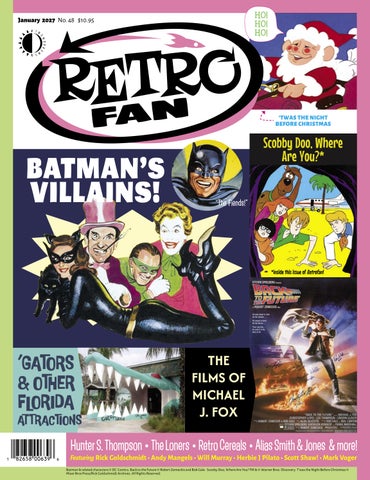
HO! HO! HO!
January 2027 No. 48 $10.95
’TWAS THE NIGHT BEFORE CHRISTMAS
BATMAN’S VILLAINS!
Scobby Doo, Where Are You?* “The Fiends!”
*inside this issue of Retrofan !
THE FILMS OF MICHAEL J. FOX Hunter S. Thompson • The Loners • Retro Cereals • Alias Smith & Jones & more!
Featuring Rick Goldschmidt • Andy Mangels • Will Murray • Herbie J Pilato • Scott Shaw! • Mark Voger Batman & related characters © DC Comics. Back to the Future © Robert Zemeckis and Bob Gale. Scooby Doo, Where Are You? TM & © Warner Bros. Discovery. T’was the Night Before Christmas © Miser Bros Press/Rick Goldschmidt Archives. All Rights Reserved.
3
61
The Crazy Cool Culture We Grew Up With ISSUE #48 ✽ January 2027
Columns and Special Features
45
3
17
Voger‘s Vault of Vintage Varieties Batman Villains
12
Batman Broadway Bad Guys Musical Malefactors
31
17
Retro Bat-Memories Ma Parker and Catwoman
35
12
70
53
19
23
Oddball World of Scott Shaw! Hunter S. Thompson
31
Retro Attractions Florida ’50s and ’60s Roadside Fun
Andy Mangelsʼ Retro Saturday Morning Scooby-Doo Part One Retro Cereals Saturday Morning Cereals with Sid Krofft
23
45
Retro Western Alias Smith and Jones Will Murrayʼs 20th Century Panopticon One Season TV Wonders: The Loners
Retro Christmas ’Twas The Night Before Christmas
19
35
Retro Movies The ’80s Movies of Michael J. Fox
61
70
53 Departments 2 Retrotorial
77
RetroFanmail RetroFan™ issue 48, January 2027 (ISSN 2576-7224) is published bi-monthly by TwoMorrows Publishing, 10407 Bedfordtown Drive, Raleigh, NC 27614, USA.Phone: (919) 449-0344. Periodicals postage paid at Raleigh, NC. POSTMASTER: Send address changes to RetroFan, c/o TwoMorrows, 10407 Bedfordtown Drive, Raleigh, NC 27614. Ed Catto, Editor-inChief. John Morrow, Publisher. Editorial Office: RetroFan, c/o Ed Catto, Editor, 304 N. Hoopes Ave., Auburn, NY 13021. Email: retroed@twomorrows.com. Six-issue subscriptions: $84 Economy US, $149 UK/EU, $128 other non-US, $29 Digital Only. Please send subscription orders and funds to TwoMorrows, NOT to the editorial office. Batman, Catwoman, and related characters © DC Comics, Warner Bros. Discovery. Batman © 20th Century Fox/Disney. ’Twas The Night Before Christmas originally produced by Rankin Bass, © Warner Bros. Discovery. Scooby-Doo © Warner Bros. Discovery. H.R. Pufnstuf © Sid & Marty Krofft Productions, Inc. Back to the Future © and TM Universal City Studios LLC and Amblin Entertainment. Alias Smith & Jones © Universal Television. Hunter S. Thompson © and TM The Gonzo Trust. Mermaid courtesy of Weeki Wachee Springs State Park and the State of Florida. All characters are © their respective companies. All material © their creators unless otherwise noted. All editorial matter © 2027 Ed Catto and TwoMorrows. Printed in China. FIRST PRINTING.
VOGER’S VAULT OF VINTAGE VARIETIES
HOLY HEAVIES! These TV Baddies Faced the DYNAMIC DUO in the Swingin’ Sixties
BY MARK VOGER What was the secret sauce of Batman, the 1966-68 action comedy that took the entertainment world by storm? The guest villains, of course. You never knew who might appear on the campy, candy-colored series starring Adam West as Batman and Burt Ward as Robin. Big names clamored for “guest villain” roles, from Tallulah Bankhead to Vincent Price to Zsa Zsa Gabor to Eli Wallach. Some villainous roles mirrored the actors who portrayed them. When Liberace played concert pianist Chandell—the name conjured “chandelier,” a favored onstage (ABOVE) Adam West and Burt Ward as Batman and Robin. (RIGHT) “When I was a kid, I remembered reading the Riddler and loving that character,” said Frank Gorshin, who played the Riddler in ten episodes of Batman. All images including Batman, Robin, and related characters © Warner Bros. unless otherwise mentioned. All courtesy of Mark Voger.
prop—he wooed Madge Blake as Aunt Harriet. Of course, Liberace’s 1950s fan base tended toward women of a certain age, like Harriet. There were three Mr. Freezes, two Riddlers, and two Catwomen. (One actress, Anne Baxter, played two villains.) Pity poor Frank Sinatra, who famously didn’t get to play Sky Masterson in Guys and Dolls ... or the Joker on Batman. Following are my interviews with Frank Gorshin (Riddler), Burgess Meredith (Penguin), Cesar Romero (Joker), and Malachi Throne (False Face), plus a profile of chanteuse Eartha Kitt (Catwoman). [Read Voger’s purr-fect profile of original Catwoman Julie Newmar in RetroFan #21. –RetroEd.] And so, as Robin used to say to Batman: “Turbines to speed!” FRANK GORSHIN “He’s dangerous,” West once said of Gorshin, the comic actor who clearly relished playing the Riddler, a criminal genius who seemed like he wanted to get caught. Why else would he spill all those clues? Gorshin imbued the green-clad Riddler with a manic, over-the-top RETROFAN
January 2027
3
Voger’s Vault of Vintage Varieties
(LEFT) A less form-fitting version of the Riddler’s costume. (BELOW) Gorshin as the Riddler wears period dress.
energy that seemed unrehearsed, and was positively spellbinding. His many years doing standup as an impressionist had a lot to do with it. As the Riddler in the first two episodes of Batman, Gorshin earned the distinction of being the show’s first guest villain. “I was on the first episode, yeah. I guess I was the pioneer,” Gorshin once told me. I spoke with the Pittsburgh native (1933-2005) in 1996, 1997, and 2001. “I kind of set the pace for the series. I received a nomination for an Emmy for that (in 1966), but I didn’t actually win the Emmy. But, yeah, I helped set the tone for it. “That was exciting. It was going to be a new, different thing—the comic book done with real-life characters. I loved it, loved being part of it. That was a big mark, a big changing point in my career. It was a catalyst. I’m talking about my nightclub situation. Up to that time, I was an opening act. Suddenly, I became a headliner because of the importance I took on from that exposure.” What did Gorshin use as inspiration for his interpretation of the character? Did he consult, for instance, the comic books? “No. I remembered the comic books,” the actor-comedian said. “When I was a kid, I remembered reading the Riddler and loving that character, even though he was synonymous with evil. But he had such a zest for life, such enthusiasm, even though what he was doing was wrong. But whatever he was doing, he did with a full commitment. It was a game for him. Life was just a game—outwitting the law and outwitting Batman. “I thought he was going to be a fun character to do. Here’s a guy who fancied himself as a genius, as someone who could do everything. You know, he would think of himself as a great actor, a great scientist, a great mathematician. 4
RETROFAN
January 2027
I thought it would give me that kind of scope. I thought I could end up doing Shakespeare, even, and things that the Riddler could do that nobody else could do as well, as far as he was concerned. I felt that I had a lot of levity in that role. “It’s too bad it lasted only three seasons. Because they would write it so that I would touch on Shakespeare. I would have a situation where I was raiding the vaults of the motion picture museum, and in raiding the vault, I assumed the roles of different people. This is one episode.” In his actual playing of the character, in his reading of the lines, Gorshin sometimes fluctuated between overthe-top hysteria and quiet menace. The approach kept viewers on edge. “Well, just the character himself was broad, you know? All the Batman characters were broad just by virtue of them showing up,” Gorshin said. “I think no matter what I would have done as an actor, it would all seem big. I think the clothes that I was wearing were already making a statement.” As for the Riddler’s trademark laugh: “It’s my own laugh. I found it when I started listening to my own laugh. I knew the laugh was going to be the key thing. If anything, it had to be honest. I didn’t want it to sound like a fabricated laugh. I’ve found that whenever something breaks me up—(Gorshin did a Riddler laugh here)—I get this high-pitched tone. And I felt, ‘That’s it! I’ve got to use that all the time.’ I laugh at people, sometimes patronizingly—(Gorshin did a ‘regular’ laugh)—I laugh like that. But when something really breaks me up, I get that highpitched sound.”
Voger’s Vault of Vintage Varieties
Burgess The outfit Gorshin wore as the Meredith was Riddler was unforgivingly form-fitperplexed ting. Did he have to lay off the pasta in that most fans order to squeeze into it? remembered “I love pasta. I always eat pasta. him as the But that’s not fattening. It’s what you Penguin, as put on that pasta that’s fattening,” opposed to Gorshin said. all of the “big “No, at the time, I was pretty things” he’d trim. I only weighed 155 pounds, as accomplished in opposed to now. Now, I’m between 175 the acting field. and 180. The costume was dictated by the comic book. That’s what the comic book was. If you look at those old comic books, he wore the same skin-tight outfit. The same one I wore, the same one Jim Carrey wore (in Batman Forever). West and Ward said they got pretty banged up while shooting Batman. Gorshin, too, had a stunt anecdote. “When I came down that slide in that first episode, I had a tough time doing that,” he recalled. “When I’d get down to the bottom of the slide, I always ended up on my can. That was embarrassing, to have everybody watching. But then after a few tries, I got it.” As the Riddler, sometimes Gorshin wore the mask, sometimes not. Gorshin said this was not designated in the scripts. “Well, the Riddler wasn’t worried about being recognized,” he explained. “But he would feel, from time to time, that the mask made him more attractive.” Ward has called West, with affection, the world’s greatest upstager. Did West upstage Gorshin? “No. It was Burt Ward who upstaged me,” Gorshin said with a laugh. “He’s the world’s greatest upstager.”
The actor said he never regretted being identified with the Riddler. “How could I resent it?” he said. “It was really an important part of my career. I like to think that people are aware that I do other things too. I can’t resent it, because it did a lot for me. Even now, I get kids who are 10, 11 years old who know me because they’ve seen me as the Riddler. So it’s kept me alive, so to speak, my career.” BURGESS MEREDITH “Best known as the Penguin.” The phrase was the bane of Meredith’s existence. And—as the actor probably feared—it turned up in obituaries that appeared following his death at age 89 in 1997. The twice-Oscar-nominated, Emmy-winning Meredith would have preferred us to remember him in Winterset (1936), Of For the first and only time, the Penguin (Burgess Meredith), the Joker (Cesar Romero), and the Riddler (Frank Gorshin) were teamed in the theatrical film Batman (1966).
RETROFAN
January 2027
5
The Joker and the Penguin, a.k.a. Caesar Romero and Burgess Meredith, in the 1966 cinematic Batman movie. © The Walt Disney Company. The Joker and Penguin characters are © and TM Warner Bros. Entertainment. Courtesy of IMDb.
1967. Alas, Sanders had to pull out of the show during its Boston tryout when his wife became ill, and he never made it BROADWAY ONEto Broadway. Vincent Price SHOTS (Egghead) made his entrance Several of the and egg-xit on Broadway guest villain actors the following year as the managed to get Barbara Nichols as Maid Marilyn, star of a flop called Darling themselves leading appeared in two Batman season of the Day, where he played roles in Broadway 2 episodes, “Shoot a Crooked an Edwardian painter who musicals either right Arrow” and “Walk the Straight fakes his own death to raise before or soon after and Narrow.” © Warner Bros. the price of his portraits. their Batman stints. Entertainment. Courtesy of IMDb. Earlier in the decade, Probably the most British thespian Maurice unlucky of these Evans, who, as the Puzzler, thespians was George Sanders, who was the first of three Mr. Freezes on the show. subbed for the Riddler in a hastily rewritten script, Sanders, who had a fine musical voice and performed in several British musicals, was cast as the leading character, Sheridan Whiteside, in a musical version of Kaufman and Hart’s The Man Who Came to Dinner called Sherry! back in George (Mr. Freeze) Sanders in Sherry! (a musical version of The Man Who Came to Dinner). © The estates of James Lipton and Laurence Rosenthal. Playbill © Playbill Incorporated.
(LEFT) Maurice Evans as the Puzzler and (ABOVE) as Reverand Brock in Tenderloin as featured on the cover of Playbill magazine. © Warner Bros. Entertainment. Tenderloin is © of Sheldon Harnick and the estates of Jerry Brock, Jerome Weidman, George Abbott, and Samuel Hopkins Adams. Playbill © Playbill Incorporated.
RETROFAN
January 2027
13
retrobroadway
sang (sort of) as a crusading Gilded Age minister in Bock and Harnick’s 1962 flop, Tenderloin, and Shelley Winters, the cunning Ma Parker, played a mother of a far more amusing clan in 1969’s Minnie’s Boys; she was Minnie Marx, the matriarch of the Marx Brothers. Alas, although Winters had some musical chops in her youth (she played Ado Annie on the road in the original Oklahoma! tour), her dominant personality somewhat overpowered an otherwise entertaining show about the legendary comedians. Perhaps the most, well, puzzling Batman/Broadway crossover occurred to Frank Gorshin. Gorshin was an astonishingly talented performer (as is well known, the only actor on Batman to receive an Emmy nomination) as well as a very high-strung fellow in real life. Following the 1959 success of Fiorello!, a musical about the life of Mayor La Guardia, ten years later producer Jack Warner underwrote a musical about an earlier New York City mayor, “Gentleman Jimmy” James J. Walker, a charming scoundrel who ran the city during the Roaring Twenties. Jimmy, as it would be called, was originally set to star Jack Cassidy, then at the height of his Broadway powers, but the role eventually went to Gorshin who, even better perhaps, was a dead ringer for Walker. Talented though Gorshin was (one can check out how good he was on a YouTube clip from The Ed Sullivan Show), playing the lead in a full-scale Broadway musical was physically and emotionally taxing for Gorshin—he had to handle two leading ladies and over a dozen songs written by a married team of Broadway tyros. According to actor Anita Gillette, who played Walker’s mistress, Gorshin would often find himself so exhausted—and so frustrated with his own performance—that he would frequently go straight to his dressing room when the show ended and absent himself from the company curtain call; bad behavior for a star performer. Riddle me this: when is an actor both a part of a show and not a part of a show? When he’s cast aside. Jimmy ran less than three months on Broadway in 1969. TONY TALENT A trio of Batman baddies found a far more hospitable home on the Broadway musical stage, getting to expand their talents in bonafide hits. Walter Slezak, who came from an impressive European opera background, won a Tony Award for Best Actor in a Musical in 1955 for his role in Fanny, a decent-size success, a decade before his time to shine as the Clock King. Lord Marmaduke Ffogg and Lady Penelope Peasoup—Rudy Vallée and Glynis Johns, respectively—each found themselves in massive hits. Former singing sensation Vallée resurrected an 14
RETROFAN
January 2027
Frank Gorshin Jimmy along with co-stars Anita Gillette and Julie Wilson. © Respective rights holders. Courtesy of Worthpoint.
enervated career by playing a dim-witted executive in the Tony-winning How to Succeed in Business Without Really Trying (both the stage and the film version) in 1962. Johns starred as a sophisticated but wistful actress in Stephen Sondheim’s 1973 A Little Night Music, for which she won a Tony as Best Actress in a Musical. Even better, she got to sing Sondheim’s legendary ballad “Send in the Clowns”—which surely makes her the only Special Guest Villainess to introduce a popular standard to the world. CATS—NOW AND FOREVER Given that Cats was, for many years, the longest-running musical in Broadway history, it’s not surprising that the Batman series’ two female felons would pad their way center stage to a musical spotlight. Eartha Kitt had already appeared on Broadway as a cat—Mehitabel—in the shortlived musical Shinbone Alley (book by Mel Brooks) and would rack up more than two dozen stage musical appearances (Broadway and on tour) during her career. She also had a hit recording of her version of the French standard, “C’est Si Bon.” Julie Newmar was practically a Broadway baby. Trained as a classical ballerina in Los Angeles, Newmar appeared in several Hollywood musicals while just out of her teens; she made her Broadway musical debut in 1955 in Cole Porter’s Silk Stockings at the age of 22. She used her dance background to anchor a ballet in Li’l Abner as the sex appeal magnet Stupefyin’ Jones the following season and then went on to win a 1958 Tony Award as Best Featured Actress for the toothless sex comedy, The Marriage-Go-Round (she repeated the role in the film version). Like many performers of her day, Newmar found receptive audiences in summer stock and touring productions, playing the leads in such musicals as Damn Yankees, Stop the World, and Irma La Douce. The fact that she never opened in a Broadway musical past her Catwoman prime is one of the New York stage’s greatest disappointments; there are so many Tony Award winner Walter Slezak as the Clock King. © Warner Bros. Entertainment. Courtesy of Wikicommons.
RETROCHRISTMAS
Father Mouse (voiced by George Gobel) reads a familiar book in bed. (BELOW LEFT) ’Twas the Night Before Christmas DVD box art. All images courtesy of and © Rick Goldschmidt Archives/Miser Bros. unless otherwise noted.
BY RICK GOLDSCHMIDT Arthur Rankin Jr. and Jules Bass were on a roll by 1974, as many of their previous Christmas specials were still airing on all three television networks. In 1974, they produced two television classics; The Year Without A Santa Claus in stop-motion Animagic and ’Twas The Night Before Christmas in traditional cel animation. As I shared in last year’s RetroFan article, fans would often ask me, “What was the special with the Miser Brothers?” They have also asked me; “What is the special with the mice?” This is another entry into the cel animated catalog and many ask, “Why?” As I mentioned before, if the Animagic studio was in full production with a special, in this case The Year Without A Santa Claus, ’Twas the Night had to be done in cel animation by another studio. Arthur Rankin Jr. explained, “I wanted the Christmas card look that only Paul Coker Jr. could achieve. His art was very animatable, which was important. I went to Paul most of the
time for character design. I was a big fan of Jack Davis too, but his art was more complex and hard to streamline down for animation.” ’Twas The Night Before Christmas had a beautiful look thanks to character designer Paul Coker Jr. (Mad magazine, Hallmark cards). His look for Santa Claus (voiced by my late friend Allen Swift) is drastically different than any other Rankin/Bass Production. When we appeared together at the North Dallas Comic book show, I asked Paul why Santa was so different; “Arthur always asked for a different look special to special, to keep things fresh. I never really worked with Jules Bass, as Arthur was an art director at ABC-TV and for Rankin/Bass. In the poem by Clement Clarke Moore, on which the Santa section of the special was based on, Clement described Santa as a right Jolly Old Elf, so I lowered the beard and made him look more elf like. His face mustache-less was definitely my version of an elf.” RETROFAN
January 2027
19
retroChristmas
Colorful cels and scenes Paul Coker Jr. and I from ’Twas The Night Before became very close friends Christmas featuring the over the years. I know always charming art of Arthur kept having Paul do Paul Coker Jr. character designs over the years, for many projects that never saw the light of day. I also had Paul do character designs for proposed projects. Paul was a saint, so when I look at a special like ’Twas The Night Before Christmas, it has Paul Coker written all over it. It is two-dimensional magic. His work defines the distinctive look of Rankin/Bass Productions. Arthur Rankin didn’t want his productions to look like Walt Disney Productions and Coker was definitely the answer. As much as I love the look of ’Twas The Night Before Christmas, it is really the music that defines it! My late friends Maury Laws and Jules Bass wrote a sensational score for this one! The standout song is “Even a Miracle Needs A Hand,” sung by Joel Grey as the clockmaker Joshua Trundle. Over the years, I got requests for the lyrics by parents who had handicapped children and for other situations that the lyrics fit. Maury Laws sent me Jules’ lyrics. The sheet music was never officially published for this one, which is strange. George Gobel, as Father Mouse, sings another gem, “Give Your Heart A Try.” It is another heartwarming, bouncy tune that only Maury Laws and Jules Bass could create. The main theme to the special is the song the town’s clock plays 20
RETROFAN
January 2027
for Santa, “Christmas Chimes Are Calling Santa,” another bouncy Laws/Bass carol. I am sure I am not the only one, but I give this special multiple viewings during the holidays just for the music. The soundtrack was issued on LP in stereo. It doesn’t single out the individual songs, because there are so few. It gives you the entire soundtrack of the special over two sides of the album on Disneyland records. I converted the soundtrack to CD and it is very, very popular. When I wrote my book, The Year Without A Santa Claus and ’Twas The Night Before Christmas 50th Anniversary Scrapbook
ANDY MANGELS’ RETRO SATURDAY MORNING
PART ONE
(ABOVE AND BACKGROUND) Scooby Doo, Where Are You? opening art. (LEFT) ScoobyDoo publicity Bumper cel. All Scooby-Doo and related images © Warner Bros. Discovery unless otherwise noted.
BY ANDY MANGELS Welcome back to “Andy Mangels’ Retro Saturday Morning,” your constant guide to the shows that thrilled us from yesteryear, exciting our imaginations and capturing our memories. Grab some milk and cereal, sit cross-legged leaning against the couch, and dig in to Retro Saturday Morning! This issue, we solve the mystery of who created one of the most popular animated shows ever, starring some meddling kids and their Great Dane. Ruh-Ro! Rooooo done it? Find out in the first part of our comprehensive multi-part guide to the history of Scooby-Doo! From September 1969 to today, one particular Great Dane has ruled Saturday mornings, courtesy of the team at Hanna-Barbera Productions and their successors. Scooby Doo, Where Are You! was the first incarnation of the franchise, with the ever-hungry Scooby-Doo and his human friends in the Mystery Machine—Shaggy Rogers, Fred Jones, Daphne Blake, and Velma Dinkley—foiling the plans of spooks, monsters, crooked real estate dealers, and others. And the villains all would have gotten away with their crimes if it weren’t for those meddling kids! But what led to the puppyhood of one of the most successful cartoon stars in history? Grab your favorite Scooby Snacks and let’s get into it! TOO MUCH MYSTERY New Yorker Joseph Barbera and New Mexico’s William Hanna had worked together for almost three decades as the Sixties came to an end.
They met working for legendary animator Rudolf Isling at his MGM animation department. Their first major collaboration was 1940’s Oscar-nominated theatrical short Puss Gets the Boot, a cat-and-mouse story that would birth the Tom and Jerry characters. They produced hundreds of cartoons for MGM until the company closed in 1957, after which they founded their own studio. H-B Enterprises produced the first original animation for television in 1957—NBC’s The Ruff and Reddy Show—and in later years, under the name Hanna-Barbera Productions, Inc. since 1959, they would produce such hits as The Flintstones, The Jetsons, The Yogi Bear Show and Jonny Quest, Space Ghost, and many more. Many of the shows were actually made for primetime viewing, but by the end of the 1960s, they and Filmation Associates were producing most of the material shown on Saturday mornings. CBS head of Daytime ProgramJoseph Barbera ming executive Fred Silverman was (LEFT) and in charge of the Saturday morning William Hanna, schedule there, and it was he who 1970s. brought on such hits for the network RETROFAN
January 2027
23
andy manGels’ retro saturday morning
as Hanna-Barbera’s Frankenstein Jr. and Space Ghost, and Filmation’s Superman, Aquaman, and Batman animated series. In 1968, he helped usher in the first major teen musical series, The Archie Show, also from Filmation. But even as Saturday morning was a burgeoning success story, so too was the backlash against it. Led by Peggy Charren, the brand-new Action for Television executive Fred Children’s Television (ACT) Silverman 1963. group was a grassroots quasi-religious/political group made up mostly of what is known today as “Karens.” They felt that cartoon shows were warping the minds of youth, that they were too violent, and that they had no redeeming social value. They assaulted members of the US Congress and the Federal Communications Commission (FCC) with letters and phone calls, convincing them that they were far larger and more important than their four founders and meager membership might show. The charge of violence led to the cancellation of “adventure/super” shows like Space Ghost and The Herculoids, and left Silverman with a schedule in need of new projects for debut in Fall 1969. Because The Archies had done so well, Silverman asked HannaBarbera to come up with their own teenage series, perhaps one that could involve music as well. He cited the popular teen sitcom The Many Love of Dobie Gillis (CBS 1959-63) as a possible inspiration, and he suggested that perhaps the teens could solve mysteries between band gigs, similar to the benign I Love A Mystery radio serials he had grown up with in the 1940s. That Carleton E. Morse series had three detectives who traveled the world, solving crimes. “I had always thought that kids in a haunted house would be a big hit, played for laughs, in animation,” Silverman said in the book William Hanna and Joseph Barbera: The Sultans of Saturday Morning. Joe Barbera worked hard to develop art for a pitch for the new show, which Silverman wanted to call House of Mystery. 24
RETROFAN
January 2027
In his autobiography, My Life In Toons, Barbera wrote, “I remember working like mad to get some artwork whipped up to show him, then running to get it to him before he left LA for New York. As usual, there was no time for a formal meeting, so I caught a ride with him to the airport, and he looked at the artwork on the way.” Silverman showed the art boards to CBS executives, including Chairman William S. Paley’s right-hand man, Frank Stanton. The boards reportedly showed teens involved in a chase in a spooky mine, a scene that would later be used in the fourth series episode “Mine Your Own Business.” The CBS execs reportedly recoiled from it in horror, and immediately rejected it as too frightening for children. According to Silverman, Stanton looked at him and said, “We can’t put that on the air.” THE GREAT REVISION OF 1968 “This presented a rather major problem,” wrote Barbera, “since Silverman had already made the show the centerpiece of Saturday morning, giving it the 10:30 slot and planning the rest of the [Fall 1969] schedule around it. Fred called us, said he was hopping a plane right away, and set up a meeting for six that evening.” There was little time to spare, and with mere days to make the series palatable, revisions were quickly underway. Joseph Ruby and Kenneth Spears, who had been sound editors at Hanna-Barbera before transitioning to writers in 1959, were onboard to flesh out the ideas. Artist/character designer Iwao Takamoto would provide almost all of the development artwork. And here’s where things get sticky, even with using the phrases “mere days” and “quickly underway.” Depending on which person is telling the story— Hanna, Barbera, Silverman, or Takamoto—the time-frame for the following changes was either within days, or within weeks. Even the paperwork seems to conflict as to timing, so we’ll present things as cleanly as possible. It seems clear The Mysterious Five —an early that the first Scooby gang prototype. title was House of Mystery, but that was softened to Mystery’s Five. One development document by Ruby and Spears for Mystery’s Five calls it a “working title,” and is
RETROCEREALS
BY AARON SULTAN What would Saturday morning television have been like without Sid and Marty Krofft in the late 1960s and throughout the 1970s? For a generation of kids, it is impossible to imagine. Sid Krofft, who passed away at the age of 96 on Friday, April 10, 2026, fundamentally revolutionized children’s entertainment (alongside his brother). First making waves by designing the iconic costumed characters for Hanna-Barbera’s The Banana Splits, the brothers soon branched out on their own. They completely transformed the approach to live-action kids’ TV with the psychedelic, larger-than-life world of H.R. Pufnstuf. Their production company went on to unleash a legendary string of hits that defined the era: The Bugaloos, Lidsville, Sigmund and the Sea Monsters, and the sci-fi adventure Land of the Lost. By the mid-1970s, The Krofft Supershow dominated the weekend block, while their signature, intricate puppetry featured on prime-time variety programs like The Brady Bunch Hour, Raquel Welch’s Really Raquel, Donny & Marie, and later, Richard Pryor’s Pryor’s Place. What many fans fondly remember, however, is that Sid’s vivid imagination influenced more than just the TV screen—it completely took over the Saturday morning cereal bowl. For millions of kids, breakfast wasn’t complete without hunting for the brilliant cereal premiums engineered straight from the minds of the Kroffts.
The Brave and the Bold: Author Aaron Sultan meets Sid Krofft at Galaxy Con in Raleigh, NC in 2024. RETROFAN
January 2027
31
RETROMOVIES
THE ’80s FILMS OF
MICHAEL J. FOX (LEFT) Michael J. Fox as Marty McFly in Back to the Future. Back to the Future is © Universal Pictures. Courtesy of IMDb.
BY DR. CHRISTOPHER IRVING Michael J. Fox acted in nine movies in the 1980s, the decade where he was the boy next door, and the cool older brother I wished I had. He was a heartthrob without being too pretty or hunky. He was an everyman and the star of the show. Michael J. Fox was the coolest. I should know. I was Family Ties—part of eight when Back to the Future NBC’s “Must See” Thurscame out and propelled him day night line-up for further into stardom, and had several seasons—was already been watching him as Michael J. Fox’s breakAlex P. Keaton on Family Ties. out and launchpad. That movie is a masterpiece: © Paramount Global. a timeless time travel film Originally produced by that doesn’t age. It’s a film the studio in association first set in the ’80s without with Ubu Productions. the techniques that made an Courtesy of IMDb. ’80s movie an ’80s movie. The intergenerational story is so
primal even teenagers in the 21st century find it relatable. It’s also the first movie I remember fully enjoying with my father when it came out in theaters. Back to the Future was the movie that spoke to both of us on our own respective level. For Fox, it was a breakthrough, but it also outshone his other movie roles to the point he never got cemented as the serious dramatic actor he truly was and, just maybe, always wanted to be. Michael J. Fox’s first film role was in the Disney movie Midnight Madness, a safe 1980 “teen” movie about five teams of teen movie archetypes going on an all-night contest in their different vehicles. It was touted in the preview as a risqué movie about college kids, or “The most fun you can legally have in the dark,” but the movie itself was anything but that. Fox plays Scott, the kid brother of the main character, Adam (David Naughton), who cuts up for attention.
RETROFAN
January 2027
35
retroMovies
(LEFT) A young Michael J. Fox in Midnight Madness was a flop that became a “so of the film through a long Disney’s Midnight Madness. © Disney. bad it’s good” cult movie. Siskel and Ebert even tracking shot. In the case (RIGHT) Class of ’84 was in theaters in of Doc Brown, the long deemed it the “dog of the week” and a PG-rated ’82. Confusing! © Shout! Factory. version of Animal House. It even has an astounding row of synchronized clocks cameo by Paul Reubens, a.k.a. Pee Wee Herman. give way to reveal framed 1982’s Class of ’84 is not a fun movie, a dystopic news clippings of the Brown exploitation movie about a high school gang and their mansion’s destruction and the estate’s sale, then pulls back attempts to break the new music teacher, Andrew (Perry to reveal photos of Ben Franklin and Thomas Edison over a King). Directed by Mark Lester (who also directed the messy bed, then across as a clock radio turns on with a car Arnold Schwarzenegger vehicle Commando), the story dealership’s October-themed commercial, a coffee maker was by future Fright Night and Child’s Play director Tom spills water onto a hotplate missing a pot, a timer cuts on Holland. the TV news where the anchor reports apparent missing It isn’t a fun movie, but it’s not meant to be. Holland’s plutonium, a toaster pops out burnt toast, a homemade story (co-written by Lester and John Saxton) does exactly robot arm brings a can of dog food to an opener and then what it sets out to accomplish: reveal the street punks, led dumps it on an ever-growing pile of dumped food in a dog by Peter Stegman (Timothy Van Patten), as so far beyond dish with the name EINSTEIN in bold red letters, and as it redemption that you cheer when Andrew is left with no drops the empty can in a wastebasket, the sneakered feet choice but to take the law into his own hands. Fox plays of Marty McFly walk into frame after opening the door. Arthur, one of Andrew’s star pupils, who the punks stab in The shot continues as he drops the key under the mat, the cafeteria; he sticks out as Arthur, as Fox plays him as comments on the likable and subdued—a nice kid who really tries to keep his mess, and pushes Is this Jo Polniaczek with Alex P. head down to survive. his skateboard Keaton? No, it’s Nancy McKeon as It was a bit part for Fox, and a departure from the genres to tap against a Beth Franklin and Michael J. Fox as he became most known for. Just a year later, Fox starred locker marked Jay-Jay Manners in High School, U.S.A. with plutonium. alongside other popular teen sitcom actors for the TV movie Originally produced by Hill-Mandelker High School U.S.A., playing the cool but cute boy-next-door This almost Films for NBC. who develops a crush on Nancy McKeon (from The Facts three-minute of Life) while palling around with Diff’rent Strokes’ Todd Bridges. I remember it from when it aired (I was six or seven), and simply couldn’t sit through it again at age 49. The screenwriter’s last experience with high schoolers may have been in the 1950s, because that sure as Shinola is what it felt like! There was one actor who stood out from the rest of the cast, for his dedication and absolute ownership in playing the school’s overall-wearing yokel. His name was Crispin Glover. He and Fox would team up very shortly to help make one of the greatest films of the 1980s. 1.21 GIGAWATTS! GREAT SCOTT! 1985’s Back to the Future has the greatest opening shot since Alfred Hitchcock’s Rear Window; both reveal the backstory 36
RETROFAN
January 2027
RETROWESTERN
ALIAS
SMITH AND
JONES BY HERBIE J PILATO In the history of television Westerns, Alias Smith and Jones stands out from the pack. The small-screen answer to the 1969 Paul Newman/ Robert Redford feature film Butch Cassidy and the Sundance Kid, Alias Smith and Jones combined a seriocomic premise and tone, entertaining stories, witty dialogue, groundbreaking cinematography, and likable performances. The one-hour series presented a new form of TV Western, which was generated by the 1970 ABC TV-movie The Young Country, produced by Universal Studios. Produced, written, and directed by Roy Huggins of Maverick, The Fugitive, Renegade, and Run For Your Life fame, The Young Country was a backdoor series pilot starring Walter Brennan and Joan Hackett. The film also starred Roger Davis and Pete Duel in dynamic roles that were not too distant from Hannibal Heyes, the same character they both eventually played on Alias Smith and Jones. But network TV was not yet ready for something as innovative as The Young Country, which, even then, was too contemporary in its presentation. According to Davis, “ABC wanted a more traditional Western starring Clint Walker,” which eventually materialized one year later, after Yuma, an Aaron Spelling production that also did not make it to series. With both Yuma and The Young Country out of the picture, Huggins switched gears
(TOP LEFT) Peter Duel as Hannibal Heyes (alias Joshua Smith). (TOP RIGHT) Ben Murphy as Jed “Kid” Curry (alias Thaddeus Jones). (LEFT) Smith and Jones in the saddle. © NBC Universal. Photos courtesy of IMDb.
to executive producer and episodic scribe for a similar Western concept that was ultimately rebooted by producer Glen A. Larson as
Alias Smith and Jones. Larson’s reconceived edition premiered January 5, 1971, on ABC as a 90-minute, mid-season replacement special just a few years before he would go on to oversee other popular shows, such as NBC’s McCloud and ABC’s Battlestar Galactica. Larson’s additional hit list includes NBC’s Quincy, M.E.; B.J. and the Bear; Knight Rider; and CBS’s original Magnum P.I. series starring Tom Selleck (who was an early consideration for Alias Smith and Jones). The show’s original cast featured Duel as Heyes, a.k.a. Joshua Smith, and Murphy as Jedediah “Kid” Curry, a.k.a. Thaddeus Jones, with Davis, formerly of Dark Shadows, and a successful voiceover artist, serving as narrator over the show’s opening credits. Had Huggins remained as core showrunner on the series, the producer would have retained the original Young Country Roy Huggins’ The Young Country debuted in 1970. ©NBC Universal. Courtesy of IMDb.
RETROFAN
January 2027
45
retrowestern
(RIGHT) Roy Huggins’ pairing of Davis and Duel. But as Davis Maverick, starring James noted, “Roy was no longer in control. Garner and Jack Kelly, This was Larson’s show now.” changed the game for Duel, under contract with Universal, TV Westerns. © Warner was already on board. As he told Los Bros. Entertainment. Angeles Times entertainment journalist Photo courtesy of IMDb. Cecil Smith in late December 1971, “I (BELOW) Alias Smith and was lucky. I had nearly three years Jones on the cover of the doing various things before they found April 4–10, 1970 St. Louis a series for me.” Post-Dispatch TV Magazine. Duel’s younger siblings, actor © NBC Universal. Courtesy Geoffrey Deuel (who died in 2024 at 81) of Worthpoint. and actress/singer Pamela Deuel, each retained the original spelling of their Smith and Jones countered Wild Wild family’s surname. As Geoffrey recalled, West’s off-beat sci-fi/Western take with Pete Duel had a “good working relaa more realistic base, style, and sophistionship” with Murphy. ticated look all its own. And the show’s Murphy, like Duel, was also engaging scripts percolated with a contracted with Universal and was unique banter between its leading subsequently called in to audition for characters that was ahead of its time. Smith and Jones. Upon his initial read of the script, Murphy immediately At its core, the series is an upbeat Old West tale focusing on two happytasted the flavor of Butch Cassidy and the go-sometimes-lucky bank and train Sundance Kid. robbers, who were former members of “I loved that movie,” he said. “And the Devil’s Hole Gang. I sensed that the ‘powers-that-be’ With a semi-Wild Bunch sensibility, saw me in the quiet Redford-like role and in another nod to Butch Cassidy and and that Peter was going to play the the Sundance Kid, the Newman/Redford Newman part. In working off that roles in that film were once part of premise, I looked at Peter, as we the Hole in the Wall Gang, while they rehearsed our scene, and he was just so eventually decided to go incognito as charming and naturally loquacious.” characters they named “Smith” and Subsequently, Murphy made the “Jones.” creative decision to temper his pace with a more reserved The TV Smith and Jones, meanwhile, never harmed or performance opposite Duel. “And all of that happened on killed anyone intentionally and were granted amnesty for a Friday,” he said. “By Sunday, I knew I got the part. From there, everyone was anxious to get going, and we just leaped their previous crimes. But they would have to cease their unlawful activity for one year, and not disclose to anyone right into it.” Once filming began, Murphy said he and Duel “never had the terms of their agreement. a discussion about acting or how we were going to play a They changed their names to Smith and Jones and certain scene. Ours was an effortless chemistry, a natural melded into the general law-abiding public, while still being progression. It was like one of those marriages that goes on, pursued by law officials and bounty hunters, oblivious to their amnesty deal. and neither party has to talk about it. We just did it.” According to Marion Veal, who owns and operates the LOVE AT FIRST SIGHT British-based website BenMurphyFans.com, Alias Smith An immediate hit, Alias Smith and Jones soared past the and Jones was “a good-hearted show with clean-cut boys. honeymoon stage and became one of TV’s top favorites for Your parents didn’t mind you watching it. Hannibal ABC, running for 50 episodes over three seasons, which Heyes and Kid Curry were equals who knew each other’s ended on January 13, 1973. Bearing little resemblance to the idiosyncrasies.” more traditional, dying-breed Westerns of the day, Alias Smith and Jones took a fresh approach to the genre and, in the ADDITIONAL LAYERS The appeal of the series also stemmed from the fact that process, reinvented it. Murphy likened his good-natured interplay with Duel and Heyes and Curry were not hardened killers in the mold of many classic Western antiheroes. Instead, they were Davis to that of Robert Conrad and Ross Martin’s cheerful interaction on The Wild Wild West (CBS, 1965–69). “I saw a lot approachable, funny, and deeply human. Viewers rooted of humor in that show, which I thought was a precursor to for them not because they broke the law, but because they Alias Smith and Jones.” were trying to escape their pasts and earn a second chance. 46
RETROFAN
January 2027
WILL MURRAY’S 20TH CENTURY PANOPTICON
The Outsider
Then Came Bronson
BY WILL MURRAY
1970s. No coincidence, since Rockford producer Roy Huggins created both characters. The Outsider started as an NBC Monday Night at the Movies During the latter 1960s, the television landscape World Premier Pilot first airing on November 21, 1967. changed. The counterculture revolution ushered in Roy Huggins wanted to cast Jack Lord as David Ross, a new kind of music and a different type of enterbut Lord declined. Huggins went with Darren McGavin, tainer. During this cultural sea change, producers who had been TV’s Mike Hammer back in the 1950s. tackled the themes of alienation and a yearning for Previously, McGavin had turned down the lead in many freedom—for something beyond the ordinary. A yearning just starting to percolate in the first wave of hit shows, among them I Dream of Jeannie, Hogan’s Heroes and Run For Your Life. A stage actor, he was seeking a niche baby boomers then coming of age. as a TV leading man. “I’m not making any pretensions about my reasons for THE OUTSIDER One such show was The Outsider, which took the form of being in this show,” he said at the time. “There’s obvian traditional detective series, except it was everything ously a shortage of good leading men in Hollywood and I want to show them that I can fit into that group. I’ve but traditional. got to make fans like David Ross as I play him, or all I’ll David Ross was a loner, an orphan who had served get out of this show is money.” prison time for a crime he did not technically commit McGavin played David Ross as a dogged and and who, upon being paroled, became a licensed private detective. world-weary stumbler through He was the opposite of most life—and the antithesis of Mike (LEFT) Darren McGavin as Mike TV detectives up to then. Not Hammer. Hammer Carl Kolchak David Ross, particularly handsome, not notably “Hammer is close to a The Outsider. © NBCUniversal. intelligent, nor was Ross especially ‘superman,’ a cold, hard Courtesy of Darrenmcgavin.net successful. He was an LA bottom individual without much (RIGHT) Michael Parks hits the road feeder just trying to survive. capacity for emotion,” the actor in Then Came Bronson. Then Came observed. “I enjoyed portraying In his essential personality, David Bronson © Metro-Goldwyn-Mayer him from the standpoint that Ross was a precursor to Jim Rockford, Studios Inc. Courtesy of Worthpoint. I could pull out all the stops. who would not come along until the RETROFAN
January 2027
53
Will Murray’s 20th Century Panopticon
Ross, however, is a different type. He’s a tough cookie, but just like being a loner, he is a man of emotion, aware of, and sensitive to, the decency inherit in the average man. Where Hammer was essentially a man of violence, Ross never resorts to it unless it becomes an absolute necessity.” That was McGavin speaking post-pilot. Unfortunately, the Outsider pilot telefilm was excessively violent. Guns blazed. People died. David Ross was often beaten to a pulp. The following year, Martin Luther King and Robert Kennedy were assassinated. The response was a backlash against television mayhem. “Because of all the concern about violence on TV these days,” McGavin revealed, “we’ve retained only as much—or as little— of my getting beat up as possible.” (ABOVE) Darren McGavin, Scapegoated, Roy as The Outsider, lands the Huggins was let go and a cover of TV Guide for the frantic retooling was initiweek of January 18th in ated. With almost half of the 1969. © NBCUniversal. TV episodes filmed, reshoots Guide is © NTVB Media / TV to remove violence were Guide Magazine. (RIGHT) ordered. Creator Roy Huggins “NBC was just scared to enjoyed a series of hits! death,” McGavin rememRoy Huggins by Paul Green bered. “Every script they was originally published by said, ‘No, you can’t! Do you MacFarland. (BELOW) And have to see the gun?’” Captain Pike is nowhere The opening credits under to be seen. McGavin with development for the weekly Susan Oliver from The Outsider series showed him Outsider “Land of the Fox” brandishing a revolver. It episode. © NBCUniversal. never aired. Ross’ prison Courtesy of IMDb. record served as an excuse for denying him a pistol permit. McGavin barged into the conference over a new introductory title sequence saying, “Show him getting up in the morning. Everybody does that, and the way it’s done says a lot for and about a man.” Consequently, the revamped opening depicted David Ross waking up, lifting the blinds to disclose that he was living in an apartment next to a freeway, 54
RETROFAN
January 2027
(ABOVE) Darren McGavin with Nita Talbot (RetroFan readers remember her from Hogan’s Heroes) in the Mike Hammer episode “Beautiful, Blue and Deadly.” Mike Hammer was originally produced by Revue Productions, now part of Universal Studios. Mike Hammer and associated characters are now owned by Skydance. Courtesy of IMDb.
then opening his refrigerator where he kept his desk telephone, and swigging a bottle of obviously sour milk. “So we shot it,” McGavin recalled, “and I got into a coat and went out the door—and we never went back to the apartment again!” The opening screamed loser. McGavin wanted it that way. “My David Ross is a loser, but so is most of the world today,” he explained. “Ross is a guy who’s been in jail. He’s not very successful. He doesn’t have much money. He loses fees. He fails to solve cases. He’s a loser, a loner.“ Storylines where Ross got into romantic relationships were also canned. “That,” McGavin insisted, “was cheap and chintzy. There isn’t much romance in his life. There isn’t much romance in anybody’s life. I’m talking about reality. Ross meets a few girls and has a fun relationship with one or two, but he’s not a lady’s guy. Most of us aren’t.” From his youth, Ross was a hard luck case. Placed in a school for boys, his circumstances started his alienation from society. A runaway at nine, he was caught and returned to the institution.
THE ODDBALL WORLD OF SCOTT SHAW!
“It’s Never Weird Enough For Me!” Hunter S. Thompson, Gonzo Journalist BY SCOTT SHAW! I was first exposed to “Gonzo” in one of Rolling Stone’s articles, “Fear and Loathing in Las Vegas,” by someone named Hunter S. Thompson. His effect on me, my friends, San Diego Comic-Con’s “Raoul Duke and His All-Human Orchestra,” and even an underground comix book I edited, Fear and Laughter, was massive. In college, if I couldn’t become a pro cartoonist, I took classes for journalism. Hunter S. Thompson’s writing had a huge effect on my sense of humor, especially his quote, “When the going gets weird, the weird turn pro.” Hunter Stockton Thompson (July 18, 1937–Feb. 20, 2005) was born in Louisville, Kentucky, the first of three sons. His parents were Virginia Davison Ray Thompson and Jack Robert Thompson. Virginia was the daughter of a Louisville businessman, who noticed the intelligence in Hunter. In 1934, she met Jack Thompson while she was working at the local library. Jack was a public insurance adjuster. Fifteen years older than Virginia, worldly Jack arrived in Louisville after the death of his first wife. There, in 1943, he made a down payment for a bungalow in the city’s Highlands. While Jack, a World War I veteran, quaffed local whiskey while listening to the radio as WWII began, Hunter’s lenient mom spent her time doting on their son. Considering that Louisville’s specialty was mainly tobacco and liquor to sell to the rest of America, it’s not surprising that Hunter grew up to often have both substances in him. HST’s first wife, Sandra Conklin, in 2004 for TV’s Biography: Hunter S. Thompson said, “Hunter came out of the womb different and somewhat angry. From talking to his
(ABOVE) Digitally altered image of Hunter S. Thompson in Las Vegas in 1971. Photo by Cashman Photo Enterprises, Inc. (INSET) Thompson, high school senior. Images courtesy of Wikipedia.
mother, he was always different. He always had that charisma.” Wiliam McKeen, the author of Outlaw Journalist: The Life and Times of Hunter S. Thompson, wrote “Even as a child, he worked a room. When Hunter was around, the chemistry changed; you felt his presence before you saw him. In that seen-andnot-heard generation, Hunter struck even grown-ups mute with his powerful personality.” In 1941, Hunter became a student at N. Bloom Elementary School. As expected, his wild sense of humor and troublemaking impressed many of his classmates. However, the RETROFAN
January 2027
61
the oddball world of scott shaw!
school’s staff saw Hunter as sheer trouble. He would bark questions, growl, and snarl at the educators. When his friends elected Hunter as the school’s head of its safety patrol, his principal referred to HST as “Little Hitler.” Thompson recalled, “I wasn’t sure what that meant, but I think it meant I had a natural sway over many students. And that I should probably be lobotomized for the good of society.” Hunter acted the same when he wasn’t at school. As the general of his war games at the city’s park, he left blood and bruises on the young “enemy.” After his friends went home, their parents considered Hunter to be a dangerous influence on their kids. “Hunter was a sweat to be around,” Hunter’s friend Neville Blakemore told William McKeen. “I got increasingly uneasy with being around him because I knew he would eventually think of something to do to me.” But Hunter continued to be a troublemaker, such as taunting other kids with a BB gun, pretending to bullwhip each other, and faking epileptic seizures to distract for their shoplifting. Surprisingly, Hunter and his pals also enjoyed reading together. “There’d be a lot of camaraderie and loud talk until we’d get to the steps of the library,” Gerald Tyrell told McKeen. “Then we’d get quiet, go in, and get a book, and sit down and read. We’d leave in about two hours and get noisy again. It wasn’t Thompson in 1957 as until much later that I realized sports editor of the it wasn’t the normal stuff for a Courier Commander, a gang of boys to do.” But sooner newsletter of the Eglin or later, it seemed inevitable Air Force Base in Florida. that Hunter would go too far. Courtesy of Wikipedia. One day, two FBI agents showed up at the front door of his parent’s home. They told them know that their nine-year-old son may have demolished a federal mailbox by getting his buddies to use ropes to pull the metal box in front of a bus. But they couldn’t prove it and Hunter and his pals refused to admit it. No one was arrested, which gave Hunter even more cockiness. Hunter took an interest in baseball after being moved to Bloom Elementary. He was known as a top player. But once he realized that one of his legs was shorter than the other, HST knew that he’d never be a pro. But he could write about sports. “To get by, you had to find the one thing you can do better than anybody else… at least this was so in my case,” wrote Hunter. “I figured that out early. It was writing. It was the rock in my sock. Easier than algebra. It was always work, but it was worthwhile work. I was fascinated early on by seeing my by-line in print. It was a rush. Still is.” 62
RETROFAN
January 2027
When one of his friends got his hands on a mimeograph, it wasn’t long before their neighborhood would have its own newspaper, named the Southern Star. Although his friend was the editor, Hunter wrote most of the articles. Their paper was noticed by the city’s Courier Journal, which led to HST’s first writing credit... at eleven years old! Louisville’s Athenaeum Literary Association, created in 1824, was at Male High School. For young writers, it often graduated their students into the Ivy League. Hunter’s goal was to join it, but he was too young and attended another school. But after Hunter continuously got beaten up for complaining about his school’s football team, he was switched to Male High. Hunter was much more comfortable there, as well as more wayward. Although his parents were concerned about his behavior, the family had a bigger problem with which to deal. After a third child was added to the family, Jack was placed in Louisville Veterans Hospital in 1952, which he never left. After Jack’s death, Virginia returned to become a librarian at a local public library because she now had to provide for her family. She also started drinking, which Hunter resented. His brother Jim told E. Jean Carroll in her biography, The Strange and Savage Life of Hunter S. Thompson, “Hunter had a real short fuse with all this stuff. He was intolerant and mean.” Ironically, Hunter was dating girls and figuring out how to get alcohol while underage. “I learned about jails a lot earlier than most people,” Hunter told High Times in 1971. “I was in and out of jails continually… for buying booze under age or for throwing 55 gallon oil drums through filling station windows. I learned about jails a lot earlier than most people.” Teenage HST and his pals were more like Marlon Brando’s gang in The Wild One, one of Hunter’s favorite films. After Hunter and his pals vandalized a gas station, the police arrested Hunter and took him away in handcuffs. Hunter still impressed other students at Male High with his writing for the Athenaeum Literary Association. It was like England’s Hellfire Club, with rites, ceremonies, underage drinking, and parties, gathered on Saturday nights to share their latest writings. “It was a rather extraordinary thing,” HST’s friend Porter Bibb told William McKeen, “for 45 testosterone-packed teenagers to sit there for three hours or more every Saturday night, reading the poems, the short stories, and the essays that they had written.” Hunter’s work appeared in Athenaeum’s yearbook, The Spectator. But that didn’t prevent him from going too far.
RETROATTRACTIONS
BY DON VAUGHAN The day started early. Up at 6 a.m., on the road by 6:30. Our destination: Six Gun Territory, a Western-themed amusement park in Ocala, Florida. An early departure was necessary because it was a 250-mile drive from our home in Lake Worth, a tiny beach-side tourist community just south of Palm Beach, to the center of the state. We traveled some of the way on the Florida Turnpike, which had been under construction since 1957, and the rest along old state and country roads. We drove past pastureland and orange groves that went on as far as the eye could see, through small towns that still had a whiff of the Civil War and what came after. The year was 1967 and I was nine years old. Florida was a very different place in the 1960s. It was still primarily an agricultural state back then, supplemented by tourist dollars. The orange tree was king, sugar cane its queen. Disney World was still just a gleam in Walt’s eye, and small towns outnumbered large cities. It was beautiful, lush, and green. This natural beauty made Florida a popular tourist destination, and tourism would eventually surpass agriculture as a major economic driver. The 1950s and 1960s, especially, saw a huge boom in tourist attractions of all kinds. Six Gun Territory was established in 1963, and would entertain visitors for two decades. It was just one of many such Spook Hill in Lake Wales, Florida, where cars roll uphill! Courtesy of Wiki commons. 70
RETROFAN
January 2027
Six Gun Territory in Ocala, Florida. Courtesy of Florida Division of Historical Resources.
attractions that competed for visitor dollars as the tourist industry flourished. Florida’s roadside attractions were eclectic, sometimes bizarre, and always entertaining. For the purposes of this article, I will divide them into three categories: amusement attractions, animal attractions, and natural attractions. AMUSEMENT ATTRACTIONS Six Gun Territory was the epitome of a ’60s-era Florida amusement park, and strived to give visitors a unique entertainment experience. Westerns were huge in popular culture when Six Gun Territory debuted, and the attraction capitalized on that popularity in a big way. Our visit started on the aerial Sky Ride, which took visitors from the entrance on Silver Springs Boulevard to the town itself, a detailed recreation of the Old West that included shootouts in the streets (complete with falling stuntmen), sexy can-can dancers, a train ride, and numerous Western-themed exhibits and activities. Sixty years after our family visit, I still vividly remember the gun smoke that filled the streets and the tinny piano music in the dance hall. We rode the train and other rides. It was a perfect day. Six Gun Territory met its match with the opening of Walt Disney World, compounded by a dramatic decline in public interest in Westerns. It struggled as Disney’s megapark siphoned tourists visiting the central part of the state, and shut down for good on January 1, 1984. Two years later, its buildings were leveled to make way for a shopping development. From Ocala, let’s travel south to Lake Wales and The Great Masterpiece, a mosaic depicting Leonardo da Vinci’s “Last Supper.” The mosaic was created by craftsmen with the
Puhl and Wagner Company, a well-known German glass company, between 1929 and 1930, and comprised 300,000 individual pieces across ten 500-pound panels that totaled 24 feet. The mosaic was delivered to the Pergamon Museum in Berlin upon completion, and during World War II was disassembled and hidden in a basement to protect it from Allied bombing. In 1950, the mosaic was brought to the United States, and in 1952 made its way to Lake Wales, where it came into possession by the Curtis family, who built the attraction as a showcase. When it debuted, the mosaic was behind a pull curtain and visitors sat on benches as they took in the stunning tableau. The attraction also featured replicas of da Vinci’s various inventions, a court of flags, an alligator pool (de rigueur at the time), and a train ride called the Phantom Express. Later additions included a re-creation of a Native American log fort, a deer feeding park, and a sky ride that gave visitors a panoramic view of the grounds. It doesn’t sound like much today, but in the 1950s and early ’60s, The Great Masterpiece was one of the most popular attractions in Central Florida. However, it, too, eventually became a victim of the Disney juggernaut and closed in 1978. The rides went to auction, and the mosaic was donated to Bob Jones University in Greenville, South Carolina in 1999. While we’re in Lake Wales, we must pay a visit to Spook Hill, an attraction like no other, mostly because it’s free! Spook Hill is located on 5th Street, near Spook Hill Elemen-
The unique sculptures of Coral Castle. Photo by Christina Rutz. Courtesy of Wikipedia.
tary School (whose mascot is Casper the Friendly Ghost), and is famous for its mystical properties. Put your car in neutral at the white line and watch in amazement as it seemingly rolls uphill! It’s a trick of the local terrain, though a regional “legend” tells a different story. Spook Hill was added to the IF YOU ENJOYED THIS PREVIEW, National Registry of Historic Places in 2019. CLICK THE ORDER THIS An equally bizarre amusement attraction LINK is theTO Coral ISSUE IN PRINT OR DIGITAL FORMAT! Castle, located in Homestead. Here, visitors are treated to massive sculptures carved from huge blocks of limestone, including a giant stone rocking chair, a crescent moon, a sundial, and a stone gate that reportedly weighs nine tons, yet can be moved with just a finger. The mystery man behind the Coral Castle was Latvian stonecutter Edward Leedskalnin, who carved the sculptures between 1923 and 1951 as a tribute to his teenage girlfriend, who dumped him the day before they were to wed. Leedskalnin mostly worked alone, and many bizarre theories arose as to how he was able to carve and move such large pieces of stone by himself. The truth? He was a skilled mason who understood how physics worked. It isRETROFAN believed he#48 carved TV Bat-Villains actor local interviews, Scooby Doo’s canine career, more than 1,000 tons of rock, mined from quarries, the films of MICHAEL J. FOX, Florida’s strangest attracover the course of the project. Leedskalnin died in 1951, yet tions, the Oddball World of HUNTER S. THOMPSON, RICK GOLDSCHMIDT with another TV Christmas Special memory, the Coral Castle lives on. and more top-notch retro-writing by HERBIE J PILATO, ANDY MANGELS, MARK WILL inspiraMURRAY, DON VAUGHN, Fun fact: Leedskalnin’s unrequited loveVOGER, was the and more! Edited by ED CATTO! tion for Billy Idol’s 1987 song “Sweet Sixteen.” (84-page FULL-COLOR magazine) $10.95 (Digital Edition)opened $4.99 In 1967, an amusement park called Pirates World in the Broward County town of Dania. Set on 100 acres, the park embraced its pirate theme with a variety of rides and activities, including a life-size pirate ship ride, complete https://twomorrows.com/index.php?main_page=product_info&cPath=98_152&products_id=1929
The Puhl and Wagner Company, a renowned glass company in Germany known for producing mosaics, recreated this mural of Da Vinci’s “Last Supper” in the 1490s. It was originally in Germany but shipped to Florida. Courtesy of Worthpoint. RETROFAN
January 2027
71