
“I’m


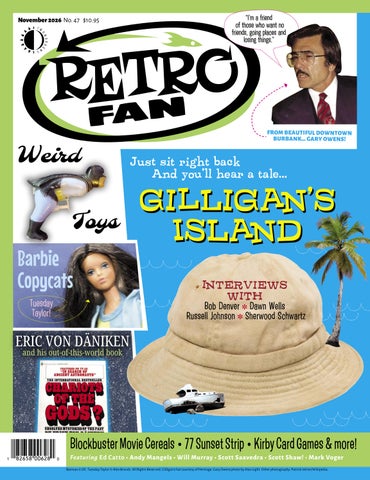
“I’m
BY SCOTT SHAW!
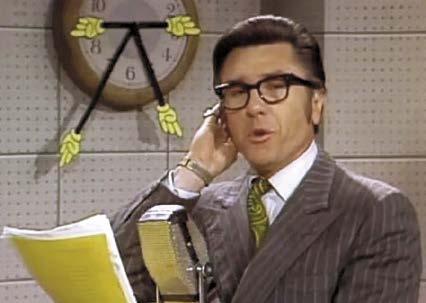
Like other kids who were interested in animation, I not only enjoyed cartoons, I also made sure to read their credits for studios, producers, writers, cartoonists, and voiceover artists. The first time I heard Gary Owens’ voice may have been with the title character on Kenneth Snyder’s Roger Ramjet TV series (1965–1969). Roger was a goofy, over-patriotic jet pilot/hero who depended on Proton Energy Pills which gave him “the strength of twenty atom bombs for a period of twenty seconds.” (Just try to put pills like that in a contemporary cartoon for kids!) Gary had been cast as Roger due to his then-current job as a hilarious and very popular deejay with Angelenos in the mid-1960s. That’s when I also may have first heard Gary whenever my parents drove around in LA on vacations. I never thought that I would eventually work with Gary, him becoming a good friend of mine and my entire family.
In fact, when our son Kirby was in kindergarten, one of his class assignments was to make an illustrated “alphabet book.” When we visited Kirby’s schoolroom for the PTA “Open House” night, his teacher showed us his alphabet book and flipped to the “G” page, illustrated by our son as a man in glasses holding one hand to his ear. She pointed to the scribbly drawing and said to us, “If this man is who I think it is, how in the world does your five-year-old son know about Gary Owens?”
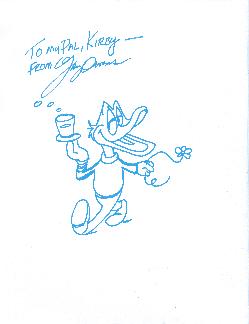
But let’s talk about the man who was behind the voice of beautiful downtown Burbank...
Gary Owens (May 10, 1934–February 12, 2015)—born as Gary Bernard Altman—was born in the sleepy town of Mitchell, South Dakota, best known for its Corn
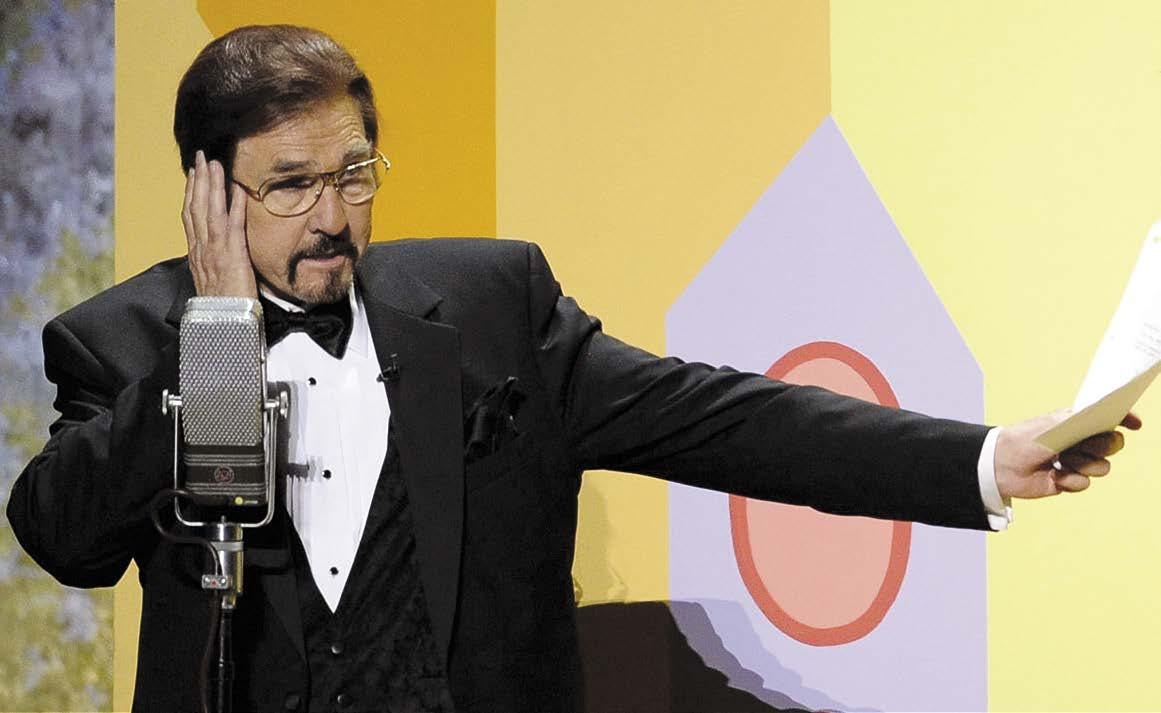
Gary was born with Type 1 diabetes, but he didn’t learn that fact until he was eight years old when his pediatrician diagnosed Gary with the deadly form of the disease. The doctor told his parents that it was likely that their son wouldn’t live past his teenage years. Fortunately, Gary lived a long, successful, and happy life.
Separated from urban society other than a new media called “radio,” it’s not surprising that Gary was fascinated with sound and storytelling. However, it wasn’t his first creative obsession.
“Well, I actually was a cartoonist,” said Gary. “As a child, growing up in South Dakota, I used to send in cartoons to Saga Magazine, Open Road For Boys, all of those kinds of publications.” At twelve years old, Gary impressingly won a cartooning contest that was judged by Charles Schulz, the creator of Peanuts. “I won the cartoon contest and won a scholarship to a cartoon company in Minneapolis, Minnesota, and Charles at that time was one of the judges for the cartoon competition. I sent in pictures of pirates and turtles and mongooses... mongeese, and won the contest. It was a $250 scholarship. It was a correspondence course. Then later on in San Francisco I became a friend of Charles because he was a member of the cartoon committee there. That was a big thrill for me too.
“I was a cartoonist up until I was about 17 years old. Then I basically continued radio and television at that time. But there’s not that much difference between being a cartoonist and someone who does weird things with TV and radio.”
experiences at the same time. I held down two full-time jobs and went to college full-time so I could develop a resume of material that I could later show to prospective employers.
“As a youth, I got my first radio gig at 18,” continued Gary. “At that time of my life, I was unsure what I wanted to do. I was floundering (I had four flounders in my school backpack and two in my pocket.) I was considering other careers, perhaps being an artist, also tinkering with a job as a fetlock wholesaler or a vocation in a local factory preserving and restoring underwear. I was torn.” Gary met and married Arleta Markell in 1952, when they were still in college.
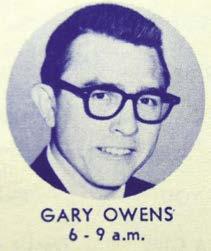
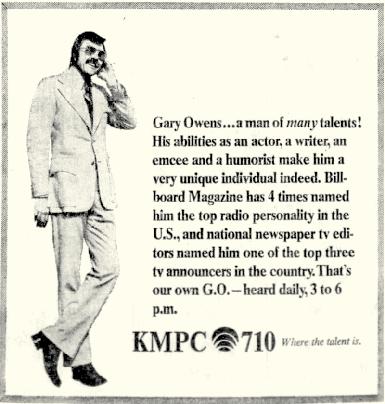
With self-training, Gary focused on radio, spending hours listening, examining, and memorizing the medium’s voices, mimicking their specialties, and concocting characters of his own. His exposure to the rhythms of radio—news bulletins, dramatic serials, and musical interludes—was much more than entertainment to young Gary. And soon, although still a teenager, he had already achieved his goal— using his voice as a paying job!
“After graduating from high school, I attended Dakota Wesleyan University in Mitchell, South Dakota, a small liberal arts college, not far from where I grew up,” wrote Gary. “Former presidential candidate George McGovern was my history teacher, and Joe Robbie, who later owned the Miami Dolphins, was my economics professor. It was a good school for one-on-one learning and was overall a worthwhile investment of my time and money. I worked my education around other jobs in related fields, so I could gain practical
Jokes aside, Gary’s professional broadcasting career in radio began in 1952 as a news reporter for Mitchell’s one and only radio station, KORN. His relentless practice based on his audio-heroes finally paid off, with a professional-but-unique approach by Gary when behind the mic. His bosses noticed his value, and two years later, Gary was promoted to the station’s news director, rare for a kid his age. But it wasn’t long before Gary’s goals widened.
When the station’s morning personality quit in the middle of his show, it was a boon for Gary. “He just left,” Owens recalls. “I took over being the on-air talent, but didn’t even know how to run a turntable. In those days, we had six turntables and two recorders. It was just a whole medley of goofy sounds, but I stuck it out. Within a month, I became Number One in Hooper (ratings).
“My definition of success has changed throughout the years because every time I reached a new plateau in my life, the definition took on a new meaning,”
Gary wrote. “When I was a high school student, success was getting a job as an announcer. A short time later, that job proved to be a major stepping-stone to more success. I went from a small market station to a bigger-market station, and so on. My idea of success changed with every new opportunity and kept changing every time I moved up or improved my current situation.”
In 1956, Gary left KORN for a newscaster job at KMA in Shenandoah, Iowa before moving on to a disc jockey job at KOIL, Omaha, Nebraska. Then he worked in Dallas, New Orleans, St. Louis, San Antonio, Houston, and at KIMN in Denver before relocating to California in 1959, working at KROY in Sacramento and KEWB in Oakland. By then, in studios, sound booths, and control rooms, he had taught himself the finer details of being a deejay—timing, modu-
BY WILL MURRAY
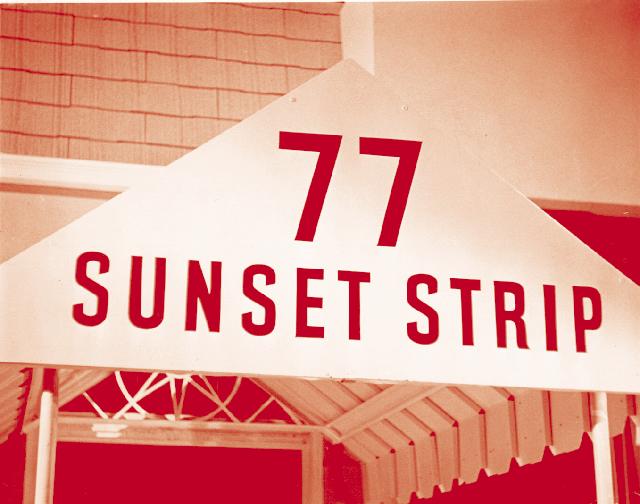
A long and circuitous road led writer Roy Huggins from first novel, The Double Take, to its reincarnation as one of the television’s early surprise successes, 77 Sunset Strip
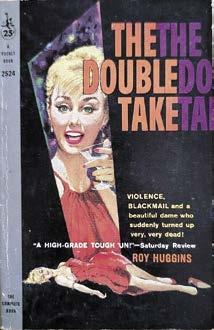
Huggins created Los Angeles private detective Stuart Bailey for his 1946 novel, The Double Take. It borrowed heavily from Raymond Chandler’s Farewell, My Lovely. Chandler read the book and considered suing for plagiarism, but ultimately decided against it.
Two years later, the novel was filmed as a half-forgotten film noir, I Love Trouble, starring Franchot Tone, from Huggins’ first script.
After writing three more Bailey stories, Huggins drifted into scriptwriting, even tually working for Warner Bros.’ new television division. There, he produced
(ABOVE ) Roy Huggins’ first novel, The Double Take, was published in 1946 and showcased P.I. Stu Bailey. The origin of 77 Sunset Strip can be traced back to this detective thriller. © Columbia Pictures. (RIGHT) Girl on the Run, another prototype of 77 Sunset Strip, was a television show with a theatrical release in Caribbean theaters. © Warner Bros. Entertainment. Courtesy of IMDb.
the first hour-long TV Western, Cheyenne, and created a follow-up hit with the anti-Western, Maverick.
After those successes, Huggins returned to his creative roots.
“I had managed to get ABC to see the wisdom of doing for the first time—on film—a one-hour private eye series,” he remembered. “I had sold them Maverick, I had sold him a different kind of one-hour series and then I thought why in the world don’t I come up with a one-hour private eye series, which is original. No one’s ever done
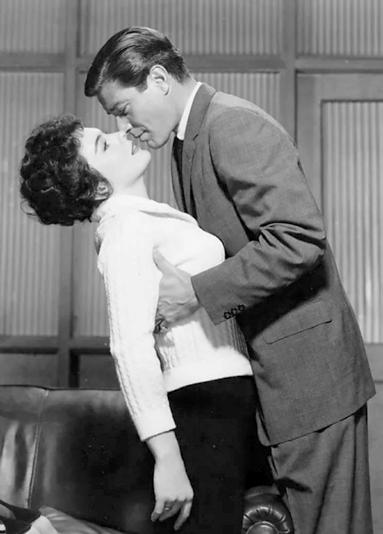
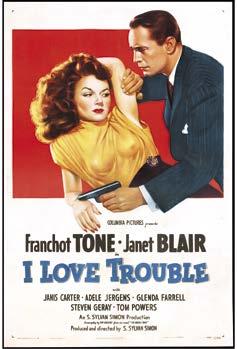
) I Love Trouble, the Film Noir adapted from Huggins’ book. Originally produced by Cornell Pictures and distributed by Columbia. © Sony Pictures. Courtesy of IMDb.
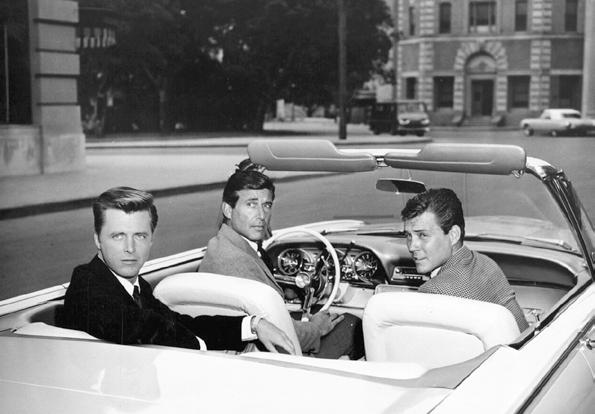
As a test run, he revived Stu Bailey for an episode of Warner Bros.’ weekly anthology show, . “Anything For Money,” starred Efrem Zimbalist Jr. as a for-hire troubleshooter. It was intended to be the pilot for a new show, but it was not picked up by ABC for its Fall 1957 schedule. The episode was based on Huggins’ 1952 Esquire story, “Death and the Skylark.” Zimbalist was cast due to his popular recurring character in
Maverick, Dandy Jim Buckley. Tab Hunter later claimed to have turned down the role.
Undeterred, Warner and Huggins tried again.
“Girl on the Run” was the second pilot. Based on an unpublished Huggins story, it established a new background for Stu Bailey. He had been with the Office of Strategic Services during World War II and held a PhD in Indo-European languages. World War II interrupted his academic career and after the war he decided he could not return to academia, so Bailey turned to private detecting. He worked alone and his low-rent office was not at 77 Sunset Strip. His job was to protect a young Burlesque girl who had witnessed a mob connected slaying.
Jack Warner asked Huggins to add 30 minutes to the hour-long teleplay. This was a ruse. Girl on the Run first aired for a single week in Caribbean theaters as a way to cheat Huggins out of ownership of the series. He was not pleased.
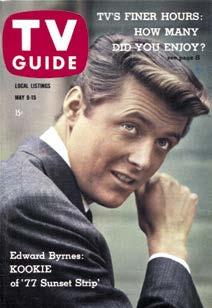
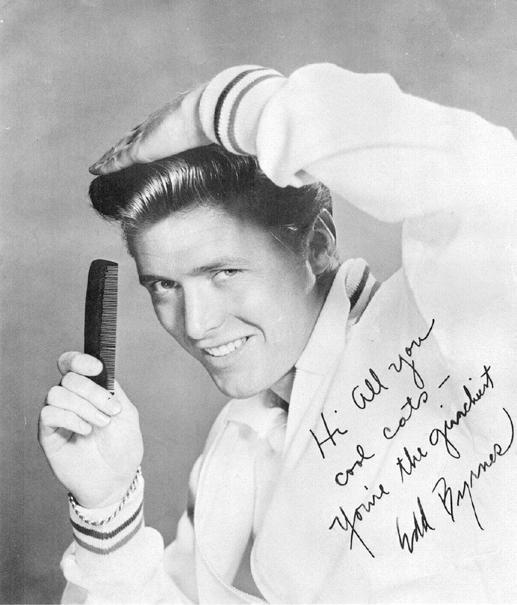
(RIGHT ) Edd “Kookie” Byrnes with his signature prop. © Warner Bros. Entertainment. Courtesy of Worthpoint.
A fateful side effect of the second pilot was the casting of young Edward Byrnes as a bop-talking homicidal stalker, Kenneth Smiley, nicknamed “Kookie.” In an effort to give his character a distinct touch, Byrnes brandished a deceptively ordinary prop.
“As part of the characterization,” he explained, “I had the kid fooling around with his hair, combing it, looking at it in mirrors.”
Roy Huggins recalled, “When the story was over, that kid was going to the gas chamber—he was irredeemable, unconscionable, immoral. Charles Manson with a comb.”
The comb proved to be career-altering. “When the movie was finished,” Byrnes recalled, “we went to its sneak preview in Pasadena, and we’re standing around in the lobby when the audience came out. A group of girls
recognized me as the kookie kid on the screen with all the hair, and they mobbed me for autographs. That’s all the producers had to see; the movie was changed right then and there to a continuing TV series—with me as a good guy, of course.”
Warner Bros. executive William T. Orr decided Byrnes had to become a cast member. But in a new role. With trademark comb and hip “daddy-o” lingo, of necessity. They planned to call him Rickie until someone decided the Kookie nickname was indispensable.
To avoid confusion, Efrem Zimbalist addressed viewers prior to the second episode:
“We previewed this show, and because Edd Byrnes was such a hit, we decided that Kookie and his comb had to be in our series. So this week, we’ll just forget that in the pilot he went off to prison to be executed.”
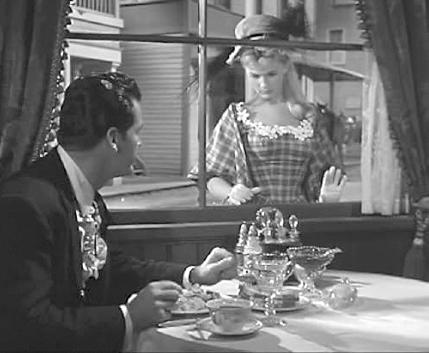
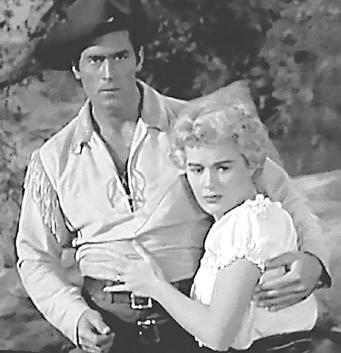
Huggins’ two successful Westerns, Cheyenne and Maverick. (LEFT ) Clint Walker and Diane Brewster from the episode “Mustang Trail,” and (RIGHT ) James
Entertainment. Courtesy of IMDb.
Recast as a parking valet at Dino’s Lodge, a famous Sunset Strip restaurant owned by singer Dean Martin, Kookie appeared in virtually every episode— parking Stu’s flashy Thunderbird convertible and often sharing the “word on the street” in what some dubbed “Kookie language.” But was basic beatnik slang. Having experienced problems with Cheyenne and Maverick, where the stars stormed off their shows in the middle of production, the Warner Bros. executives decided they would never again be held hostage by
permit an actor to undermine a successful show through a walk-off, justified or not.
Season two opened with the episode titled “Only Zeros Count” in which Stu, vacationing in Honolulu, encounters Hawaiian detective Tom Lopaka, played by Robert Conrad, and taxi driver Poncie Ponce, in the first crossover between Warner’s detective shows. It aired five days before their debut on Hawaiian Eye. Periodically over the next three seasons, one or more of the 77 Sunset Strip characters would crossover with those populating Hawaiian Eye 77 Sunset Strip scripts would also be rewritten and repurposed for these spinoff shows.
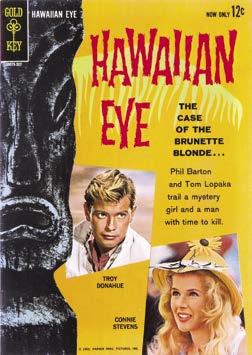
Hawaiian Eye #1 (Gold Key, July 1963). © Warner Bros. Entertainment.
After initially telling reporters that he was resisting pressure to cut a record album for Warner Records, saying, “I can’t sing,” Edd Byrnes finally gave in and performed a duet with Connie Stevens—Cricket of Hawaiian Eye— where they sang “Kookie, Kookie (Lend Me Your Comb).” Like 77 ’s finger-snapping theme song, it became a smash hit.
In 1960, Warner Records released an album of Roger Smith songs, Beach Romance. Unlike Byrnes, Smith was a talented singer. He was discovered by James Cagney singing calypso sings on Waikiki Beach back in 1954.
During the 1959–60 season, Warner Bros. discovered to their chagrin that their ensemble approach to episodic television was not bulletproof.
Richard Long, as Rex Randolph, jumped over from the cancelled Bourbon Street Beat for the third season. Although Long, as Randolph, only appeared on the one season, the actor did return as a guest star later in two other roles. © Warner Bros. Entertainment.
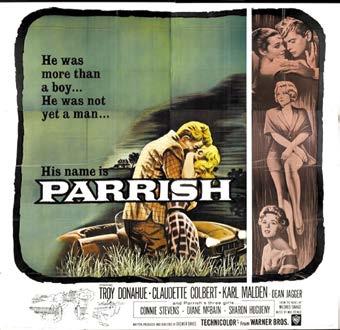
Edd Byrnes had been promised the lead role in a TV series that ultimately become a movie called Parrish, starring Troy Donahue. © Warner Bros. Entertainment.
First, a blood clot caused Roger Smith to miss the first half-dozen weeks of that season. Efrem Zimbalist simply read Smith’s lines in the scripts originally written for Jeff Spencer. While convalescing, Smith started scripting episodes, including the memorable “The Silent Caper,” which contained no dialogue.
Riding a tremendous crest of popularity among young female viewers, yet frustrated with his limited role, Edd Byrnes began demanding a larger role and payment commensurate with his popularity, complaining, “Every time I see my name in a column and they write Edd (Kookie) Byrnes, I resent it. I want to be known as an actor, not the character I play.”
Kookie was prominently featured in the second episode of season two, “The Kookie Caper.” But that wasn’t enough.
Warners would not budge. Consequently, Kookie split in mid-season. Ironically, his last episode was “The One That Got Away.”
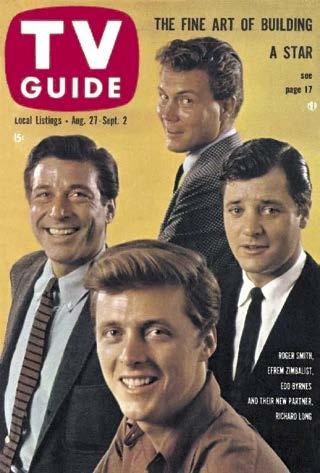
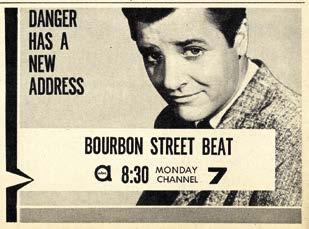
Richard Long in Bourbon Street Beat advertisement. © Warner Bros. Entertainment.
Troy Donahue replaced him for one episode as a long-haired, intellectual carhop, but the character of Star Bright did not return. There was only one Kookie.
During that interim, producers William T. Orr and Howie Horwitz tweaked the format. Implausibly, Suzanne and Louis took more active roles in investigations. In one two-parter, Stu Bailey is shot near the first episode’s conclusion, leaving Jeff Spencer to take over the following week.
Near the season’s end, after a 16-episode absence, Kookie resurfaced in “Sierra.” Byrnes received his raise, but paid a steep price. His promised Parrish TV series became a Troy Donohue movie instead.
“I returned to 77 Sunset Strip as a newer, cleaned-up version of Kookie,” Byrnes stated. “I figured that the character had grown older and couldn’t keep parking cars forever, so the jive talk
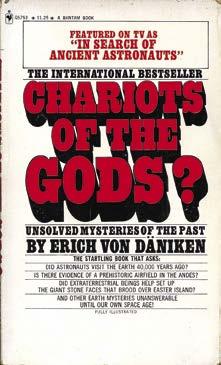
Erich von Däniken defied the scientific community and rode his Chariots of the Gods? for nearly sixty years
BY JOHN C. BRUENING
By the late 1960s, the ground-level view of the human condition was looking fairly grim.
An influential civil rights leader and a charismatic presidential candidate were both assassinated just a few weeks apart in the spring of 1968. The increasingly unpopular Vietnam War was escalating in Southeast Asia, and the political climate in the US was growing more volatile in response to the military conflict.
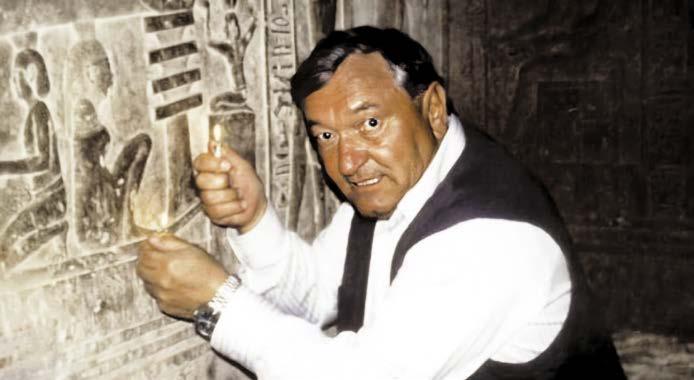
Amid the noise and confusion, seekers of the truth from all over the world got a hefty dose of cosmic insight from an unlikely source: a Swiss hotel manager named Erich von Däniken.
Von Däniken offered an elaborate explanation of humanity’s cosmic backstory in his 1968 book, Chariots of the Gods?
Many of us started looking to the cosmos for answers. In our living rooms, Star Trek was one of the most popular series on network television. On Broadway, a controversial musical called Hair celebrated the dawning of the astrological “Age of Aquarius.” At Cape Kennedy in Florida, we’d spent the entire decade pointing rockets at the heavens, with a plan to set foot on the moon before 1970.
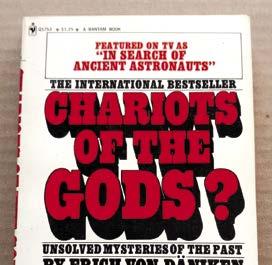
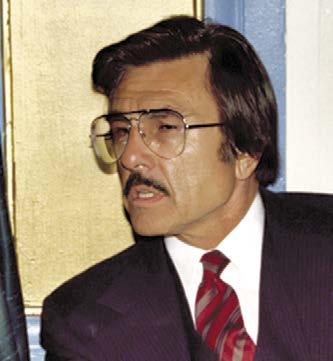
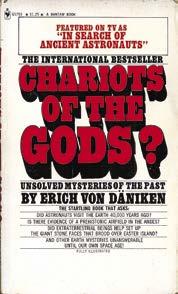
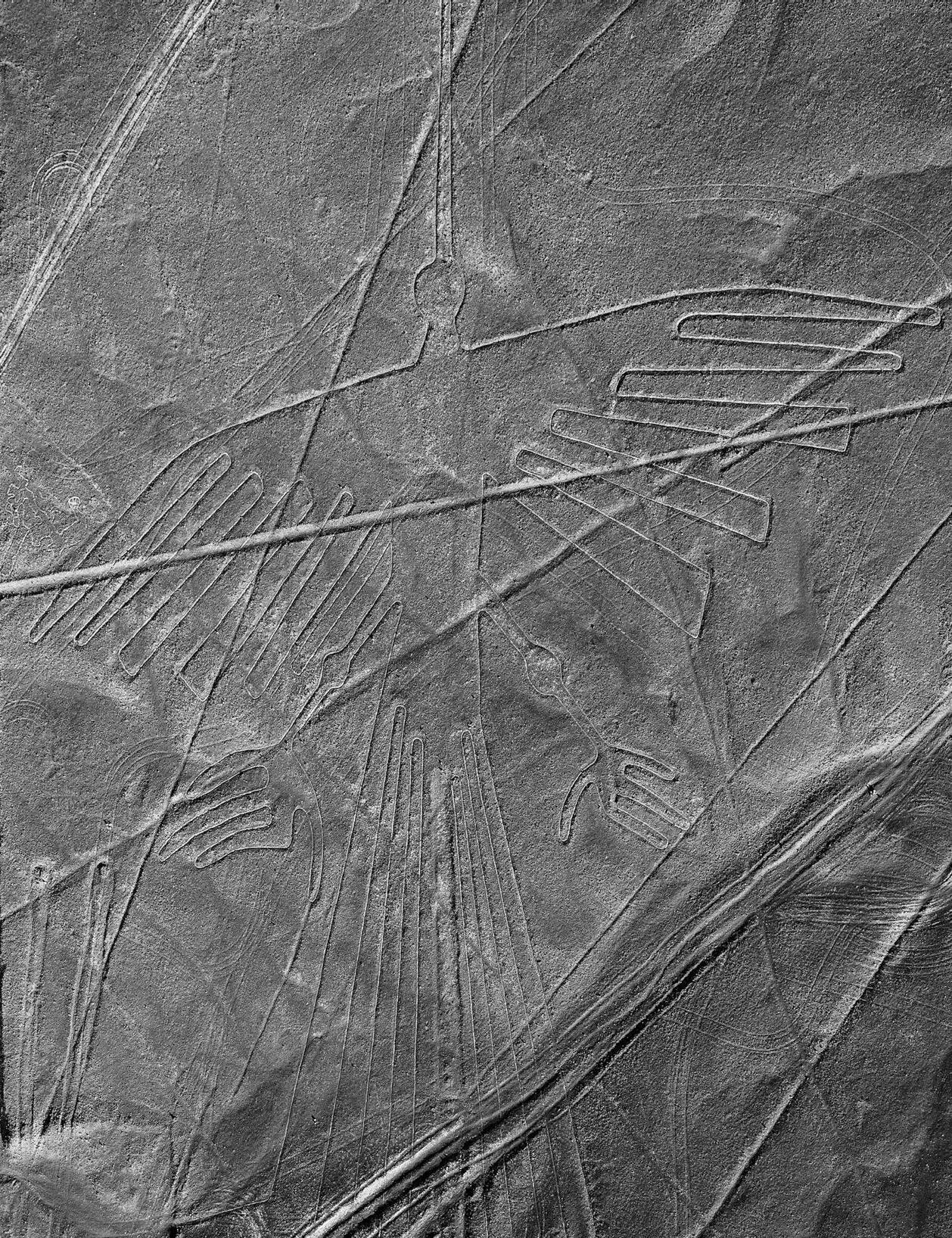
(ABOVE ) Author (and Swiss Hotel Manager) Erich von Däniken. (UPPER INSET ) Chariots of the Gods? (Bantam Books, 1973). Designer unknown. © Erich Von Däniken. (BACKGROUND) An example of the Nazca lines found in Nazca, Peru. Purpose unknown! Coutesy of Diego Delso/ Wikipedia.
The book was a work of speculative nonfiction that wove together elements of archaeology, astronomy, and the general public’s ongoing preoccupation with unidentified flying objects (UFOs), which had been percolating for more than a decade since the dawn of the space age in the late 1950s. The original German-language edition of Chariots of the Gods? was translated into English in 1969, and into numerous other languages in subsequent years.
Von Däniken, who died in January 2026 at the age of 90, based his book—and his subsequent literary career—on the premise that extraterrestrial aliens mated with prehistoric humans, which instilled in the otherwise lowly earth creatures the intellect and the engineering know-how to build ancient structures like the Great Pyramids and Stonehenge, and make other technological leaps in the early centuries of human civilization.
The promotional copy on the cover of the paperback edition heralded Chariots of the Gods? as “the startling book
BY ANDY MANGELS
Welcome back to “Andy Mangels’ Retro Saturday Morning,” and prepare for a visual feast! Saturday morning television was appointment viewing for anyone growing up from the 1960s to the 1990s. From 8 a.m. to noon, while their parents slept in from the work week, kids could sit in front of the television and enjoy a time just for them. Cartoons—and later, liveaction series —were produced by studios like Filmation Associates, DePatie-Freleng Enterprises, Total Television, Jay Ward Productions, Hanna-Barbera Productions, Sid and Marty Krofft, D’Angelo Productions, Marvel Productions, Sunbow Productions, Ruby-Spears, DIC, Film Roman, and others.
But how could the networks best reach kids to let them know when the new shows would be airing? Enter the television ads that ran in the comics, touting new and exciting fall seasons! It made sense, since many shows were adapted from comic books! For most kids, those two-page spreads were their first looks at future TV favorites, but by the mid-1970s, comic ads were dropping and more plain TV Guide ads were sometimes the only promotions. In the fifth of a yearly series, we’re giving you a rare look at every Saturday ad we can find from 1981–1983! See RetroFan #24, 30, 36, and 43 for the previous installments!
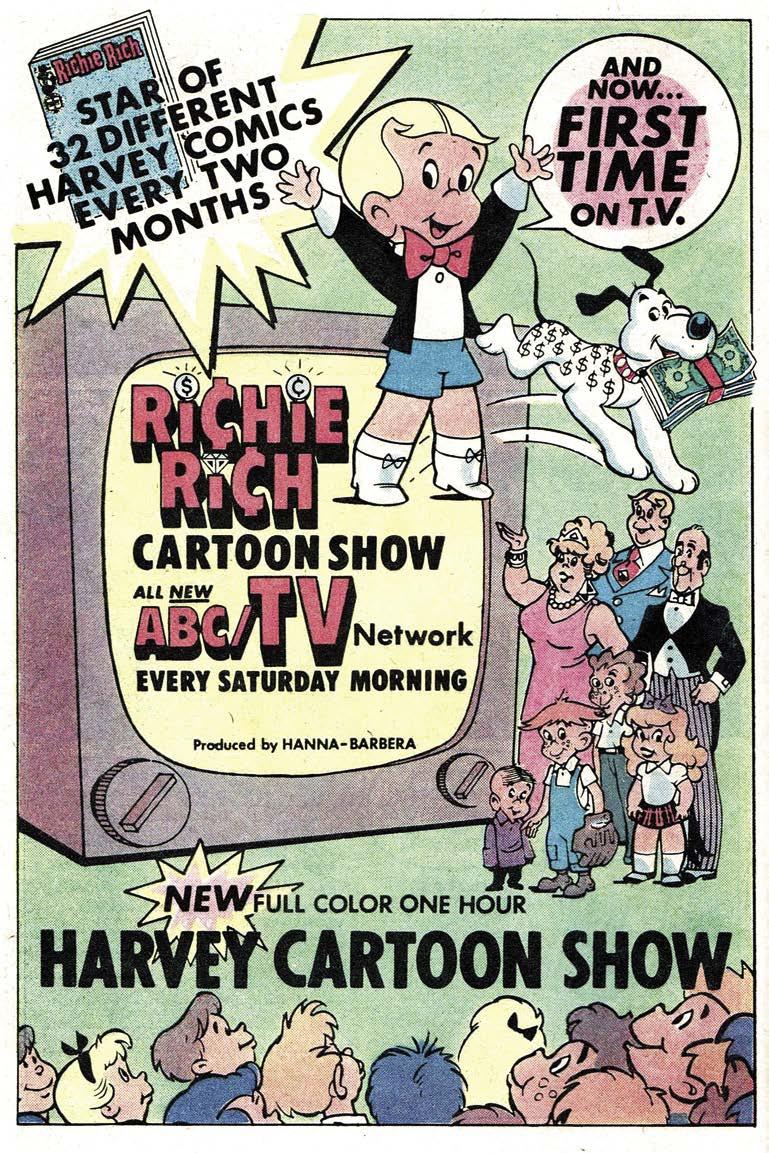
Harvey comics ran this one-pager showcasing the world’s richest boy and his cartoon series and whopping 32 different titles every two months. And you thought Batman was overexposed? All artwork from the collection and courtesy of Andy Mangels. Richie Rich and Harvey characters are now © and TM NBCUniversal.
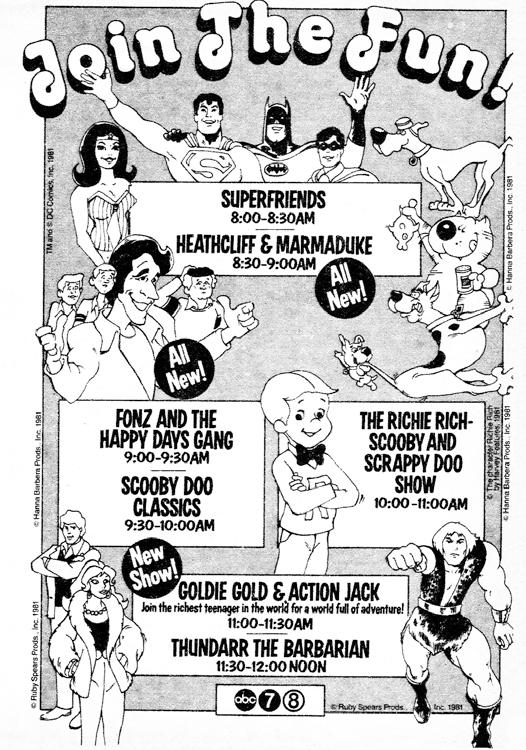
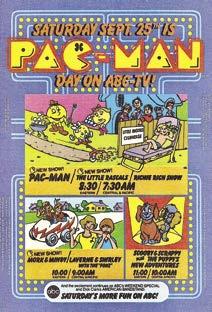
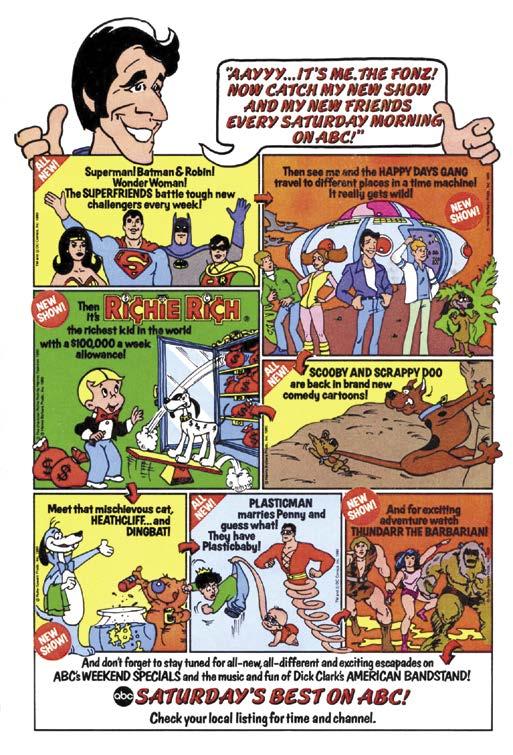
(LEFT ) This ad for ABC’s 1981 Saturday morning lineup season—beginning on September 12th —didn’t appear in any comic books; it only appeared in TV Guide! The return of Super Friends [See RetroFan #28 – RetroEd ] is heralded by a costume Wonder Woman never wore, and the crew of Happy Days made their animated debut. Plus, if the adventures of one rich white boy wasn’t enough on Richie Rich, more rich, white people showed up for Goldie Gold and Action Jack. (RIGHT ) Much more dynamic than the TV Guide ad, this ABC’s 1981 Saturday morning ad ran in fall comics, and actually featured Plastic Man and “Plasticbaby,” soon to be known as “Baby Plas,” who were missing from the TV Guide ad [the full story is in issue #34 – RetroEd ]. Thundarr and friends also made an appearance [Lords of Light! It was all in RetroFan #32 – RetroEd ]. Super Friends and Thundarr are © Warner Bros. Entertainment. Richie Rich and Harvey characters are © and TM NBCUniversal.
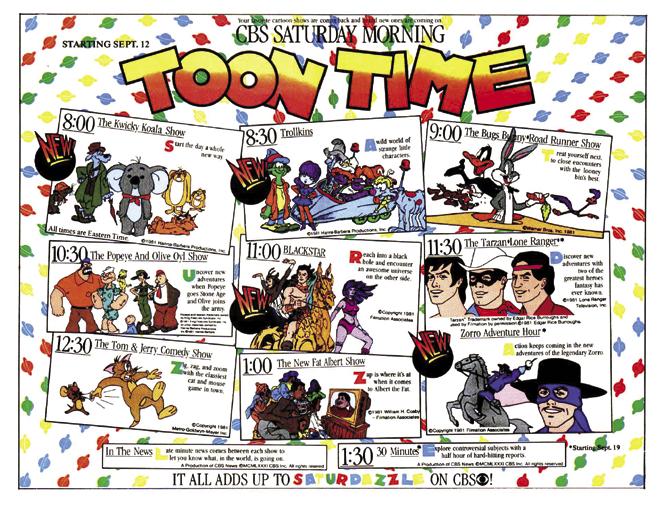
(ABOVE ) CBS ran their traditional two-page centerfold ad for the 1981 season! It showcased newcomers The Kwicky Koala Show, Hanna-Barbera’s Smurfs rip-off Trollkins, Filmation’s high-fantasy hero Blackstar, and the addition of Zorro to The Tarzan/Lone Ranger/Zorro Adventure Hour [see RetroFan #20–22 – RetroEd ].
BY DAVE MADDOX
Blockbuster films changed the landscape of cinema in the late 20th Century. They deeply altered culture and collective experience of generations as well as creating a massive new business of merchandising tie-ins. The era arguably started with Steven Spielberg’s Jaws in 1975 which was heralded by the cultural shift malls were bringing to suburban locations.
Jaws ’ had a wide national release backed by a massive advertising campaign, rather than the traditional progressive release in which a film slowly entered new markets and built support over time. It’s a model that’s mimicked to this day. And it set the groundwork for an interesting licensing tie-in that would come to full fruition almost a decade later. Breakfast cereal.
The connection between the sci-fi/ fantasy genre and cereal merchandise tie-ins actually dates back to Kellogg’s sponsoring the Buck Rogers radio program in 1932. This was the beginning of promotions that found children and adults digging to the bottom of cereal boxes in hopes of acquiring rare collectibles. (Side note, Jaws itself would not see a cereal connection until the third film released in 1983 and Shredded Wheat offered a flimsy pair of 3-D glasses for kids to use in the theater).
By the time of the 1980s, breakfast cereal manufacturers would go all out
and create a cereal literally based around an actual film. Let’s take a look back at the early days of the cereal tie-in and the five biggest blockbuster cereals that still retain their place in nostalgic history and Gen X hearts.
(KELLOGG’S, 1984)
Star Wars has had an enormous impact worldwide since its release in 1977. Many of the film’s references are deeply embedded in popular culture. It re-wrote the idea of what a blockbuster movie could be as well as what merchandising for a property could look like.
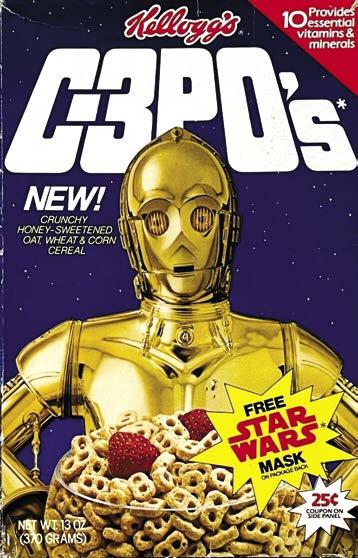
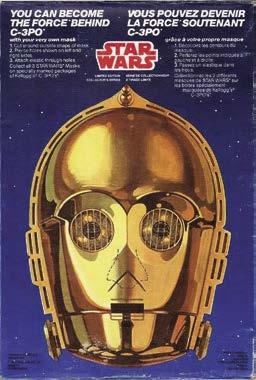
Therefore, probably the most famous of the blockbuster breakfast cereal tie-ins is Kellogg’s C-3PO’s cereal. It was marketed as packing a ‘double crunch’ due to its unique double-O shape. Released around a year after the premiere of Return of the Jedi, the cereal had a flavor that was not too sweet, but not too bland. The golden, oat-y morning treat set the foundation for what would come after. Anthony Daniels, never one to miss an opportunity to
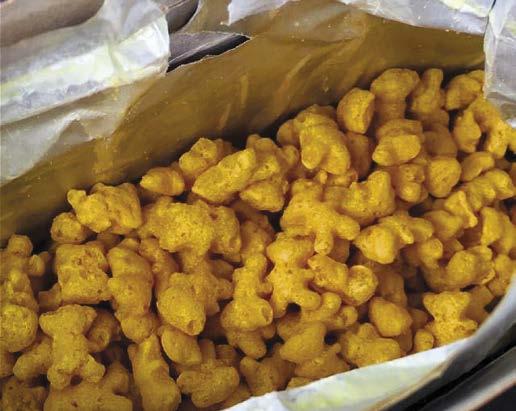
(ABOVE ) An open box of Gremlins cereal. © Warner Bros. Discovery and Amblin Entertainment. All images courtesy of Dave Maddox unless otherwise noted. (LEFT ) C-3P0’s features the popular Star Wars character. © Disney. Courtesy of Worthpoint.
reprise his iconic character, appeared as the Golden Droid himself in television ads.
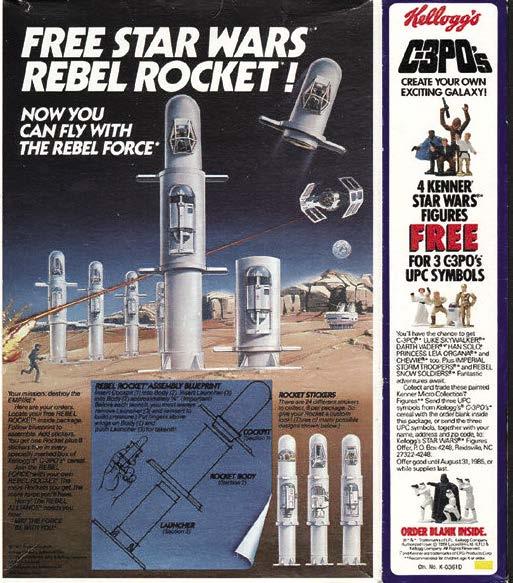
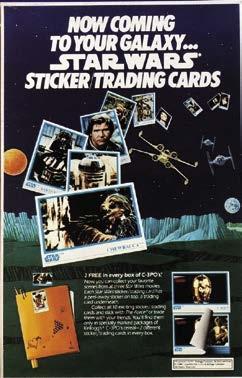
While only for sale for a little over a year, the cereal featured a variety of in-box premiums, starting with cut out masks on the back of the box which featured C-3PO, Luke Skywalker, Darth Vader, Chewbacca, Yoda, and a Stormtrooper. The initial run also featured sticker/trading cards (a peel-off sticker actually over a trading card), and a plastic ‘Rebel Rocket’ that came with Star Wars themed stickers to decorate it. As with any good cereal there was also a mail-away offer to get four of the Kenner Star Wars Micro-Figures. This was actually done to get rid of warehoused back-stock as the line had failed previously.
C-3PO’s is also the only blockbusters cereal to have been released as an individual serving size. Those boxes are considered some of the rarest of Star Wars collectibles.
The cereal was briefly relaunched under the name ‘Prograin’ in 1987, but lacking any connection to a galaxy far, far away, only lasted a year on the shelves.
Joe Dante’s horror/comedy film Gremlins blended dark comedy with a heavy critique of 1980s consumerism and how it affected suburban complacency. The film heavily influenced the creation
of the PG-13 rating and critics recognize it as a satire of American values. It also is unique in that it blends holiday sentimentality with chaotic anarchy.
Gremlins cereal was a crunchy sweet Mogwai-shaped breakfast that had the consistency of Kix with a lot more sugar. The cereal was an early release from Ralston Purina (without the ‘Purina’ on the label as that name had such a strong connection with dog food). Ralston would become known for creating over ten licensed cereals through the 1980s and ’90s.
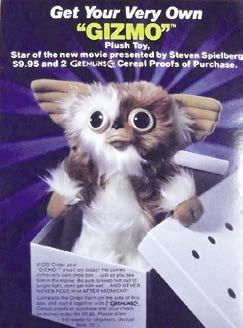
Prize-wise, buyers could collect one of eleven stickers at the bottom of the box. The mail-awayZ offer was exceptionally high-end. Buyers would receive a stuffed Gizmo doll which could be ordered for the low price of $9.95
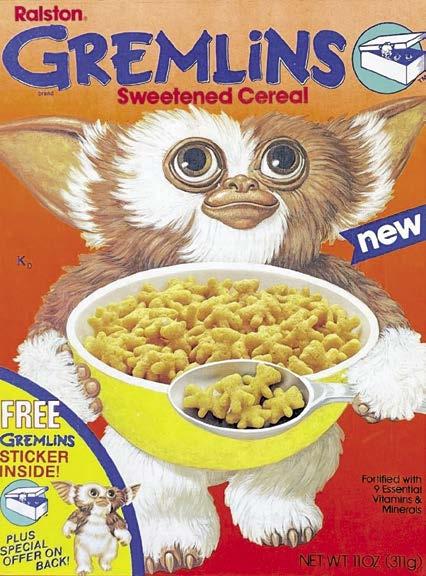
(LEFT ) Gremlins cereal debuted in 1984. Courtesy of Worthpoint. (BELOW ) Get your own Gizmo! © Warner Bros. and Amblin Entertainment

BY SCOTT SAAVEDRA
Coming off of the staid toy landscape of the 1950s, the 1960s enjoyed a lively heyday for weird playthings (why this was the case would certainly make for an interesting article—let me know if you find one). TV commercials were constantly touting the must-have features of strange robots, ugly creatures, and other oddities.
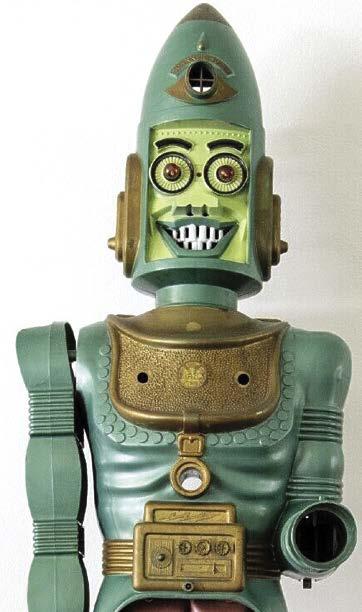
One such toy was Big Loo. He was a robot of which there were plenty then like the Zeroids [see RetroFan #39 –RetroEd ] or the Robot from Lost in Space [see RetroFan #40 –RetroEd ]. Loo was a homely, slender overachiever who was able to shoot darts out of his chest, shoot sparks from his belly, and launch balls from his left arm. He could bend over and maybe pick something up. He could do morse code and had a compass and whistle (just in case the two of you got stranded in the woods). He also had a bell (perhaps for prompt service at a glitzy hotel?). Big Loo was the product of Marx Toys in 1963, a prodigious producer of affordable toys. It would not be a stretch to guess that most of us boys encountered one or more of their colorful playsets full of little plastic figures and accessories.
An especially weird group of toys from Marx were the Nutty Mads, plastic figures with distorted features similar to the contemporary work of Ed “Big Daddy” Roth’s Rat Fink character. The Nutty Mads brand was later beefed up but at first they were just strange looking
Big Loo (Marx, 1963). © The Nacelle Company. Courtesy of Worthpoint.
baseball players and thinkers (seriously, one of them is just thinking). Nutty Mads were fun to look at but they didn’t do anything except look weird. But I’m not here to talk about weird looking toys (though they make an appearance) but toys that are weird [see next paragraph –RetroEd ].
To be honest (and I am) it’s no big deal to make something look weird, odd, or strange. Big Loo is weird but at its root it’s just a collection of other toys (if indeed a bell can be considered a plaything) in robotic form. That’s all well and good but what has gotten my attention over the years are the toys that are weird not so much for aesthetic reasons but for the biggest reason of all… why? Why did somebody think a child would want this thing?
And the answer is: because somebody made a mistake. I asked Artificial Intelligence (also known as AI) why people make mistakes. If AI has taught us anything, it’s that information scraped from the efforts of others can lead to easy references in articles. And that information is: “because the human brain is built for efficiency rather than flawless data processing.” I believe the AI (though my brain isn’t especially built for either most of the time—case in point… hi!). Of course, I’ve heard that AI could be wrong or hallucinating but is the AI hallucinating with this information? I don’t think so. Television of the 1970s and 1980s proved that hallucinations from, say, “mary jane joints” or Dungeons and Dragons always involve screaming and AI doesn’t scream. Yet. With all due respect to great, fondly recalled weird toys like King Zor [see RetroFan #39 –RetroEd ] have a look at this collection of weird, poorly thought out playthings.

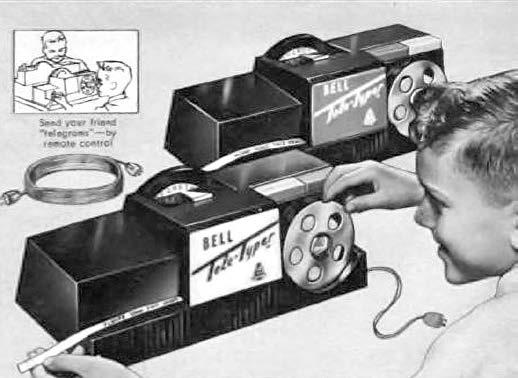
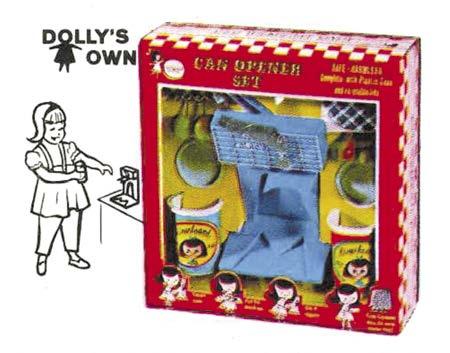
Toys mimicing adult activity is nothing new: (LEFT ) The Bell Tele-Typer (1957) allowed youngsters to send telegrams to, well, basically, one other person. Still, I would have enjoyed this. (RIGHT ) And what little girl wouldn’t love opening cans over and over—just like mom —using Dolly’s Own Can Opener Set (Miner Industries, 1963)? Bell Tele-Typer in the public domain. Dolly’s Own Can Opener © American Plastic Equipment, Inc. Images courtesy of Archive.org
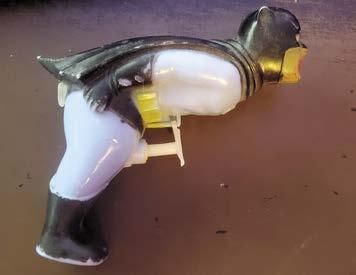
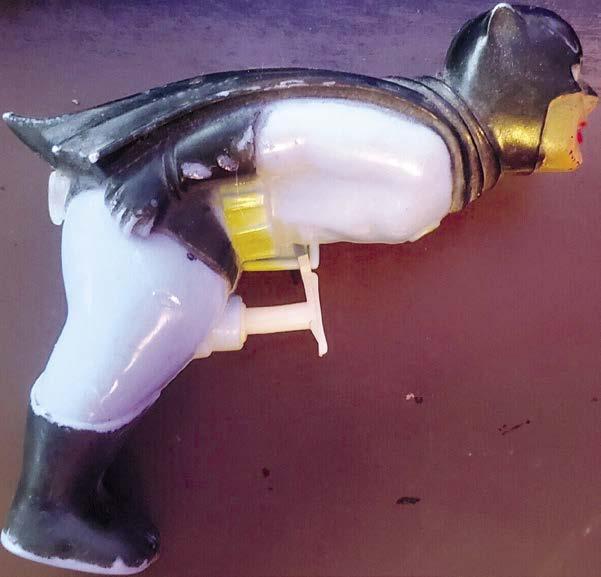
When I first saw the “BatMan” squirt gun I thought it as a one-off example of inattentive toy design. Sadly, the same mistake has been made on other ocassions as well. So, yeah, snicker, snicker. A rack toy (cheap bagged item) c. 1960s. Made in Hong Kong. © DC. Courtesy of Worthpoint.
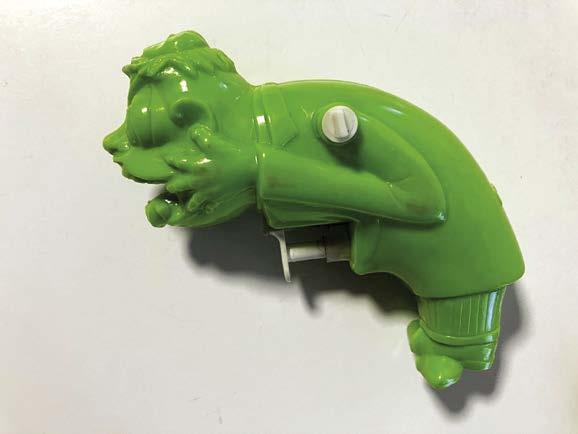
(RIGHT ) Trying to get at that “Rat Fink” fad money, Parker Plastics (c. 1960s ) gave us this Mr. Fink squirt gun. © Respective owners. Courtesy of Worthpoint.
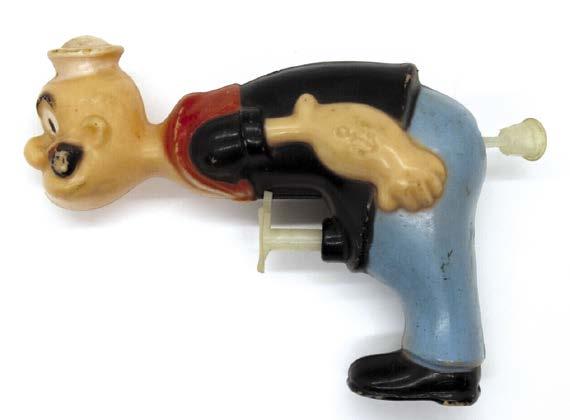
its water guns, including a popular realistic Luger pistol. © King Features syndicate. Courtesy of Worthpoint.
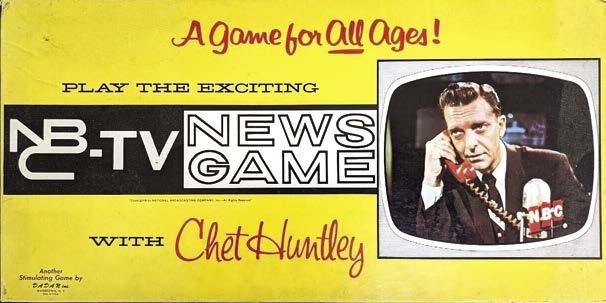
If you love capitals of the world and miss the days before David Brinkley honed in on Chet Huntley’s camera time, then the NBC-TV News Game is the “stimulating” game for you (Dadan, 1962). © Respective owners. Courtesy of Worthpoint.
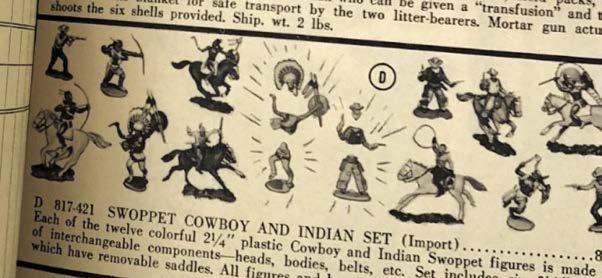
This image from a 1964 F.A.O. Schwarz catalog appears to show an exploding cowboy and “indian.” No such luck. The Swoppet sets featured figures with interchangable parts. No explosions. Boo. © Respective owners.
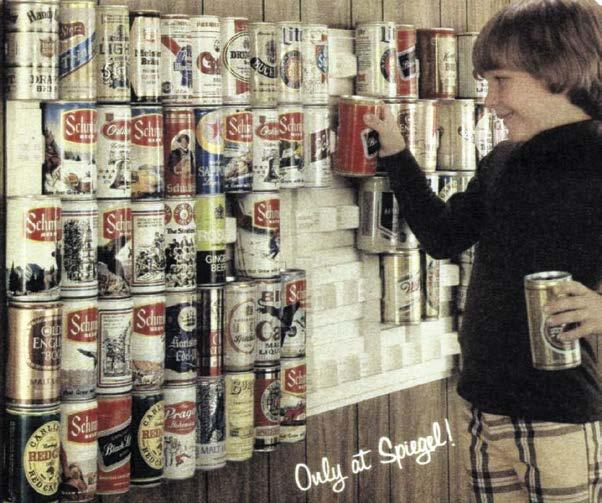
(LEFT ) Hey kids! Display your beer can collection on any wall! Holds up to 100 beer cans. How many beer cans can Bobby collect? Start emptying those beer cans now kiddo. From the 1976 Spiegel Christmas catalog. © Respective owners. Courtesy of Archive.org
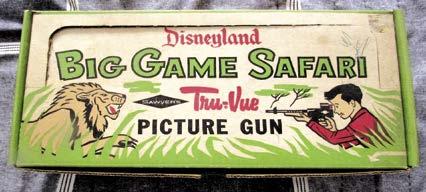
The Big Game Safari Picture Gun from Sawyers, the same company that brought you View-Master! Look through the scope. See the animal alive, fire the gun, and “watch your quarry ‘bite the dust.’” Includes a picture tour of Disneyland’s Adventureland (where you will not be able to make park guests “bite the dust”). © Mattel. Disneyland is a trademark of Disney Enterprises, Inc. Courtesy of Worthpoint.
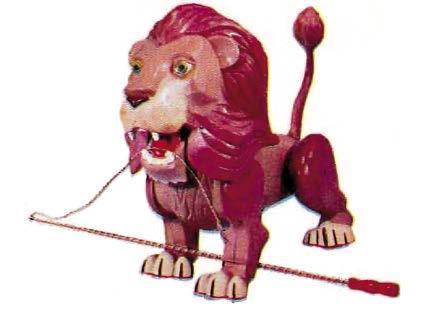
Tame Dandy the Lion with “little master’s whip.” He goes forward, backward, and rears up (if you know where to smack him). Created by toy genius Marvin Glass [see RetroFan #39 for more about Glass –RetroEd ]. © Respective owners. Courtesy of Archive.org
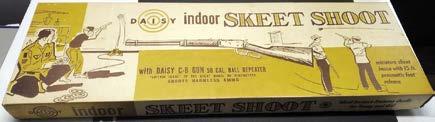
Indoor Skeet Shoot? No and no. From Daisy in 1961. © Bruckmann, Rosser, Sherrill & Co. Courtesy of Worthpoint.
BY ED CATTO
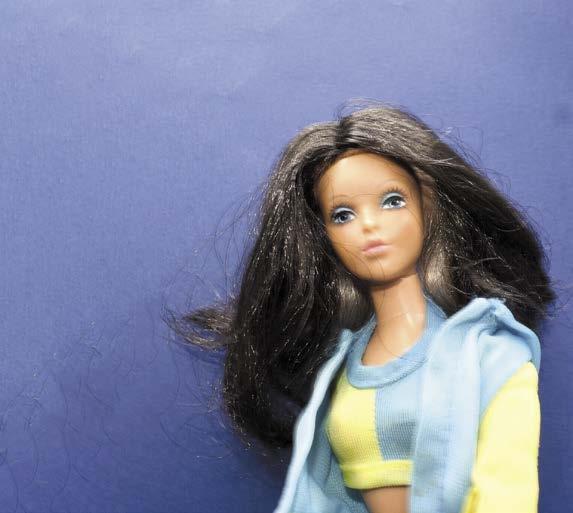
Might Barbie actually be a mean girl? Why wouldn’t she ever let any other fashion doll step into the spotlight, even briefly, to claim the hearts of doll collectors and young fans? Must she always be #1?
It really does seem like that was case. Barbie famously debuted in March of 1959, and has been the dominant fashion doll ever since. Oh sure, the old girl has had some ups and downs. But she’s always on the top of the heap. [For the full story, see Katharine Kerestman’s Barbie article in RetroFan #30 –RetroEd. It didn’t have to be this way. So many manufacturers looked at the toy landscape and thought, “We can win a piece of this.” Or maybe they schemed, “We’ll beat her at her own game!” Perhaps they realized that “kids are fickle and always want the next big thing.” Were they right? Were they wrong? I don’t know. But I do know that so many of these wannabe, second-stringers are fascinating—full of hope, ambition, and ready to
RetroFan ’s Pop Culture Guide to Barbie® Knockoffs of the ’60s & ’70s
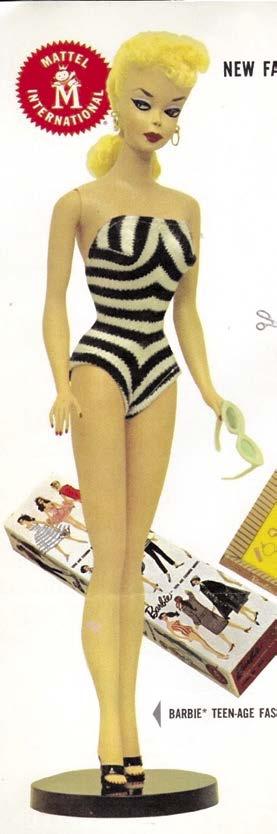
(RIGHT ) Before the decade of the 1950s concluded, Barbie burst onto the scene… and the toyscape was the never the same again. Barbie® and associated trademarks are registered trademarks of Mattel.
make their mark on fandoms. Sadly today so many of these also-ran doll brands are nothing but a distant, nostalgic memory.
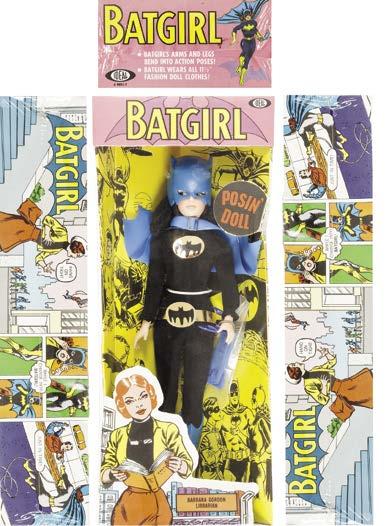
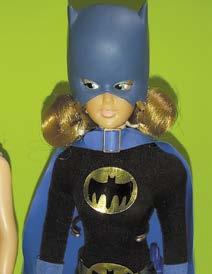
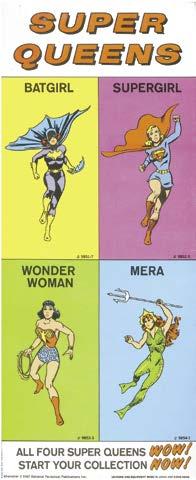
(ABOVE ) Batgirl Super Queens Posin’ Dolls’ box art. Super Queens Posin’ Dolls were, in many ways, the female version of Captain Action. (RIGHT ) Super Queens Posin’ Dolls’ box featuring the entire line. Art by Murphy Anderson. Supergirl, Batgirl, Wonder Woman, and Mera are © DC Comics.
In 1964, toy entrepreneur Stan Weston, and his company, Leisure Concepts, had success creating for G.I. Joe and selling the concept to a Rhode Island-based manufacturer named Hassenfeld Brothers, Inc. The world would soon know this company better as Hasbro.
His next project, Captain Action, burst onto the scene just as the country was embracing Batmania and a new superhero craze. Captain Action was 1/6 scale action figure who was a new hero—but with a gimmick. His mysterious background was not spelled out for children—instead they were left to imagine their own backstory for
the character. And then, by purchasing additional outfit sets, fans (and later, collectors) could transform the figure into other, established heroes, including Batman, Superman, the Lone Ranger, the Phantom, Captain America, and more. It was the right product for the right time.
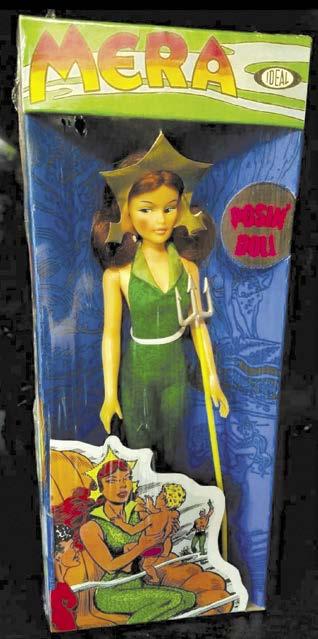
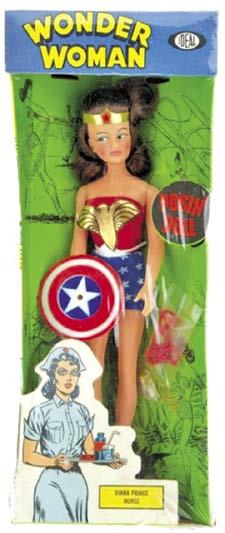
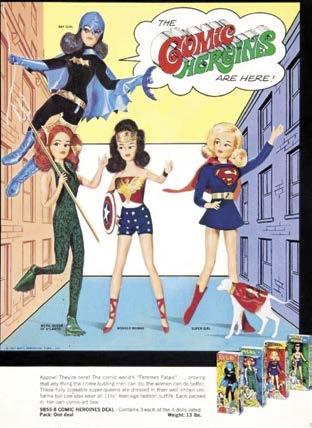
Super Queens packaging for (LEFT TO RIGHT ) Wonder Woman, Mera, and Supergirl. (BELOW ). Identity Crisis —the Super Queens were also called the Comic Heroines in this trade industry ad/announcement. Supergirl, Batgirl, Wonder Woman, Mera, and Krypto are © DC Comics. Courtesy of Ray Flores.
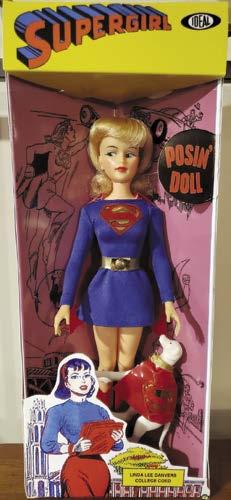
While not “officially” a spin-off, Super Queens Posin’ Dolls were a brand extension, after a fashion. These four figures in this line were female superheroes: Wonder Woman, Supergirl, Batgirl and Mera, Queen of the Seven Seas. Unlike Captain Action figures, there was no element of changing or transformation—the figures were just the figures.
Almost half a century after the Super Posin’ Queens debuted, Captain Action Enterprises (the current rights holder of Captain Action) collaborated with fashion doll manufacturer Robert Tonner, and his company, Tonner, to revisit the Super Queens concept. This time, there would be a main character, Lady Action (the female version of Captain Action, who also had attainted “the rank” of Captain) she was eager to Let Justice Be Done—just like Captain Action.
Fans could buy the 16" Lady Action doll and then also purchase officially licensed costume sets for Wonder Woman and Supergirl, essentially transforming Lady Action into those heroines. The Lady Action line was launched with great fanfare in in 2013 at both Toy Fair and New York Comic Con.
In addition, this author spoke as the keynote speaker at the Tonner Toy Collector’s conference in Chicago to announce it all to fans.
Perhaps, just the same way that the Captain Action line sidestepped the military background of market leader G.I. Joe, with the Super Queens line Ideal could sidestep the fashion/ every-girl aspect of Barbie to provoke and provide new play patterns for kids.
The illustrations on the packaging for Super Queens were lovingly rendered by longtime comics professional Murphy Anderson. He had also worked for Ideal to develop the Captain Action toy line and packaging. His finely detailed style and authentic comic book look absolutely reinforced and added authenticity to the whole effort. One odd element of it all was the fact that one of the characters, Mera, was a young wife and mother. On the front of her package, she’s shown holding her baby as her husband waves in the distance. Maybe there was a stinky underwater diaper and Aquaman was not enlightened enough to do his fair share as a dad? Sadly, once these Posin’ Dolls burst on the scene that was it. Ideal never followed up with additional figures or playsets. And Barbie never bothered to fully embrace the superhero trend until many years later.
Two other companies demurely put their toes into the water for similar efforts:
Gilbert Toy company, founded in Westville, Connecticut but which later moved to New Haven, enjoyed success with their erector set toys. And they had, seemingly, a certain level of success with the James Bond line of 1/16th scale figures. It was 1965 when Gilbert launched their Honey West 1/6 scale doll. In a way, this made sense as she was “sort of” a female version of 007 Created by the wife and husband team of Gloria and Forest (Skip) Fickling, using the pseudonym G.G.
BY JIM BEARD
The old adage is true: Two great tastes can taste great together. In the realm of toys, Mattel proved it in 1971 by shuffling the deck to bring a king into play, and in doing so, creating one of the true curiosity pieces of two different industries.
The 1970s saw two different monarchs ruling over their respective kingdoms, each masters of their domains. For
Jack Kirby, the undisputed King of Comics, the decade brought new opportunities for the artist in the form of a leap of faith when he jumped ship from “little” Marvel Comics to land across town at National Publications, known as DC Comics to its readers. The move was a long time coming, but Kirby saw new vistas at the House of Superman. He saw a new land to conquer with ideas and concepts he’d been holding back
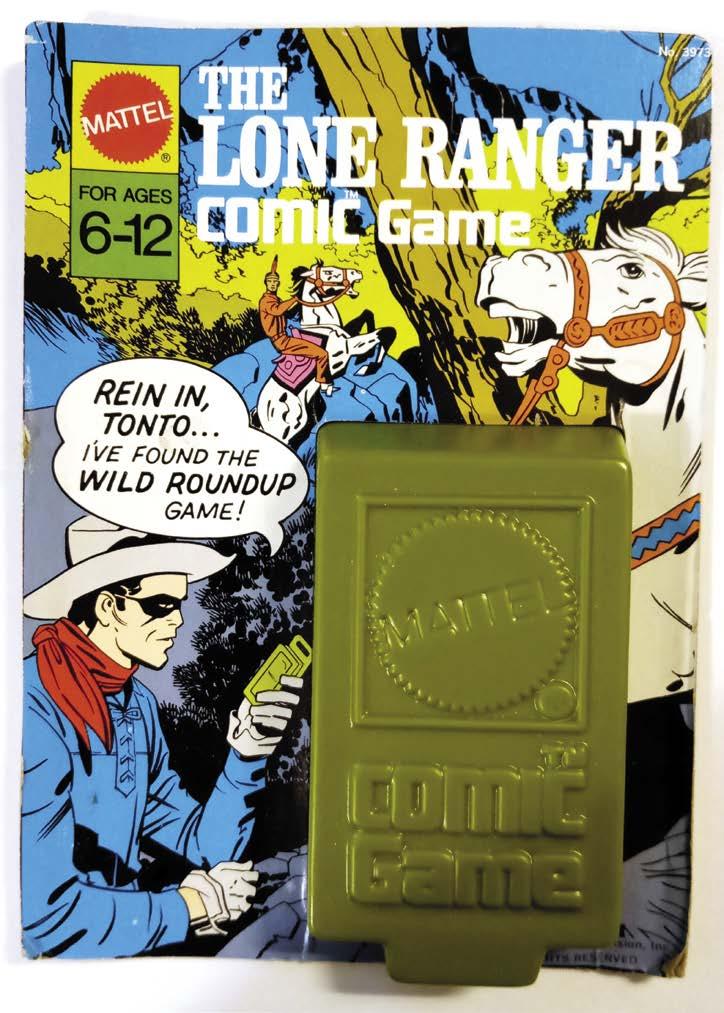
Hi Yo, Silver! Time for a Wild Roundup Game! The Lone Ranger ® is a registered trademark of the Lone Ranger, LLC. Image courtesy of the Jim Beard collection.
BY KEITH MANZELLA
Unless you were living under a rock in the mid-1970s, you’ve undoubtedly heard of one of the biggest fads of the time. No, not lime green jumpsuits or even color-changing mood rings—I’m talking about the Pet Rock. In 1975, advertising copywriter Gary Dahl had the crazy idea to sell ordinary rocks as pets. He packaged them in small, pet carrier-style boxes, complete with air holes, straw bedding, and even an instruction manual filled with humorous tips on caring for and training your rock. These no-maintenance pets became a cultural phenomenon, selling 1.5 million units in just a few months. As with most fads of the ’70s, the novelty eventually wore off, and the Pet Rock craze hit rock bottom by the year’s end. But not before it made an indelible mark on pop culture—and turned Dahl into a rock-solid millionaire.
IF YOU ENJOYED THIS PREVIEW, CLICK THE LINK TO ORDER THIS ISSUE IN PRINT OR DIGITAL FORMAT!

RETROFAN #47
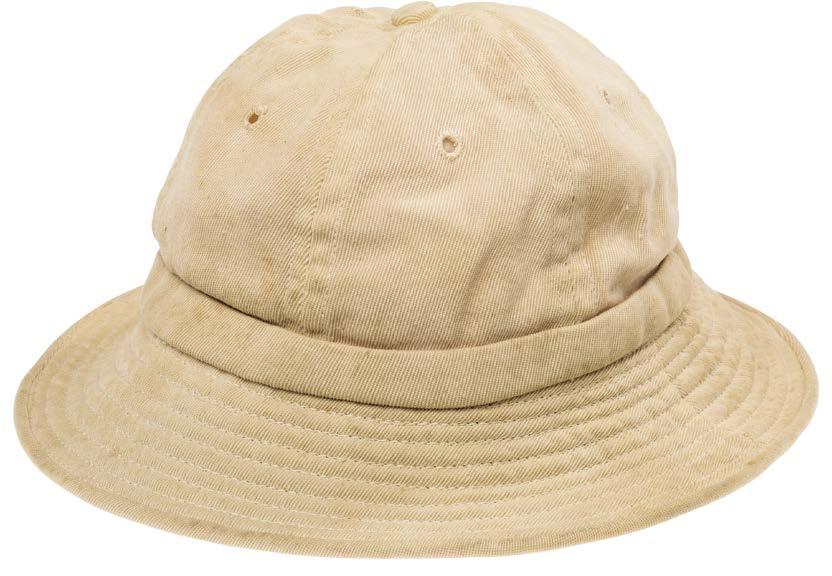
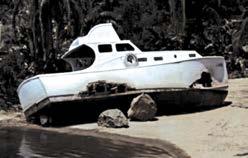
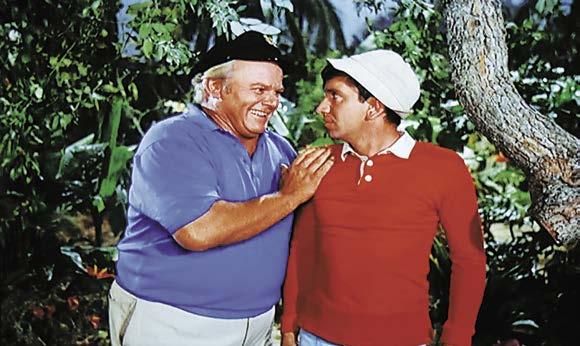
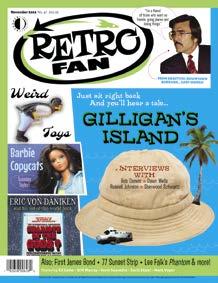
VOGER takes us back to Gilligan’s Island, check out
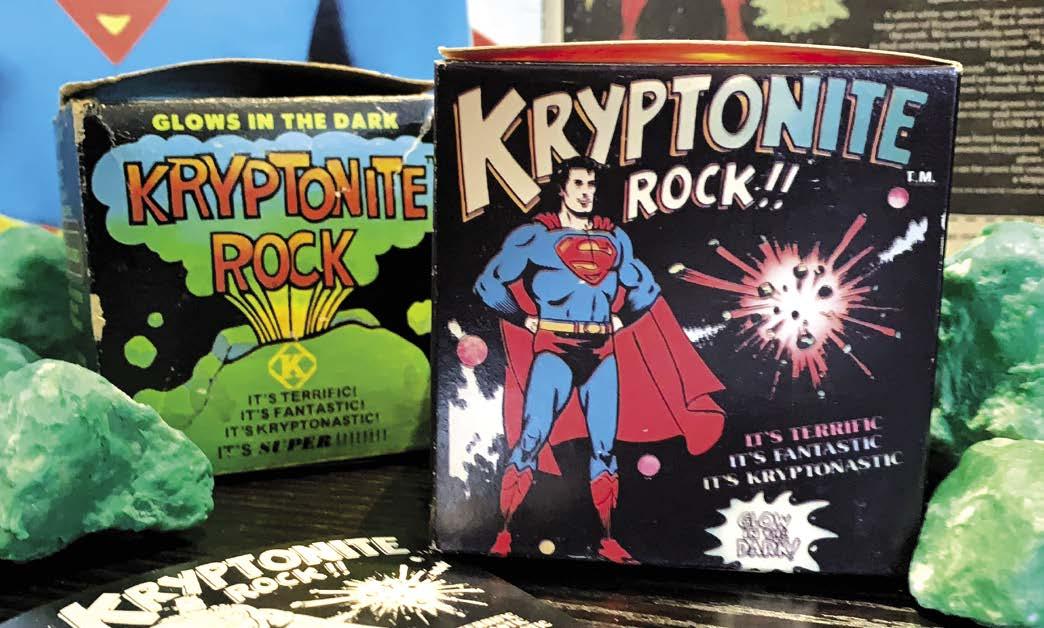
( ) Both Pro Arts and Krypton Enterpris es offered identical Kryptonite Rocks in 1977. Note the packaging differ ences. ( 1975 Pet Rock. Kryptonite, and Kryptonite Rocks are all © and TM DC Comics, a division of Warner Bros. Entertain ment. Pet Rock © Super Impulse. Images courtesy of Keith Manzella.
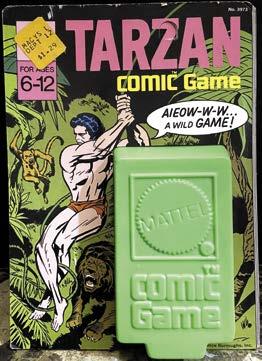
Toys with SCOTT SAAVERDA, take a drive down 77 Sunset Strip with WILL MURRAY, and then from Beautiful Downtown Burbank: it’s Laugh-In’s GARY OWENS! Plus a look back at Chariots of the Gods, and its effect on the pop culture we grew up with! Featuring columns by ANDY MANGELS, SCOTT SHAW!, AARON SULTAN and more. (84-page FULL-COLOR magazine) $10.95 (Digital Edition) $4.99
In the years that followed, imitators popped up everywhere. As a kid, I remember seeing a “Pet Ghost” display in a major department store—basically a bit of white cloth with invisible string, sold in a small cardboard box designed to look like a haunted house. More obvious knockoffs like “Pebble Pals” tried to cash in but failed to duplicate Dahl’s quirky success.